
Judge, 1926-10-16 · page 23 of 36
Judge — October 16, 1926 — page 23: what you’re looking at
What you’re looking at
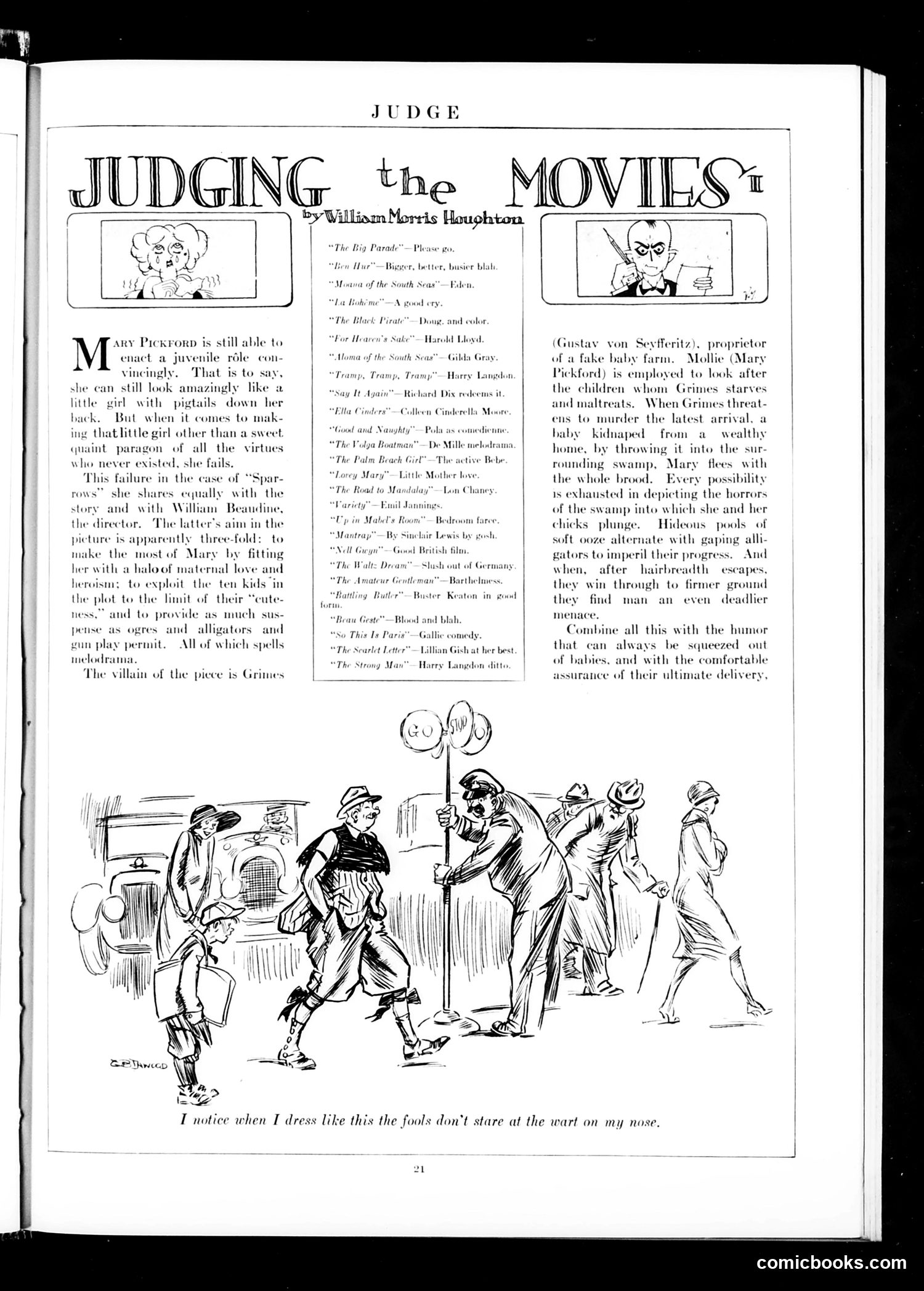
This page reviews contemporary 1920s films, with the main critique focusing on Mary Pickford's film "Sparrows." The reviewer argues that while Pickford convincingly plays a child (she's known for pigtails and youthful roles), director William Beaudine fails to create a believable character—instead presenting an unrealistic "quaint paragon of virtue." The plot involves Pickford protecting babies from Gustav von Seyfferitz, who runs a corrupt baby farm and threatens to drown an infant. She escapes with the children into a swamp filled with alligators and quicksand. The satire mocks the film's heavy-handed melodrama: despite serious threats (infanticide, swamp horrors), the movie relies on sentimental humor about babies to ensure viewer confidence in a happy ending. The page also lists other contemporary films briefly reviewed, including works by Harold Lloyd, Harry Langdon, and Buster Keaton. The cartoon below illustrates the satirical point about absurdly dramatic scenarios presented as entertainment.
📄 Transcribed text from this page (OCR, searchable)
Machine-transcribed from the original scan — historical spelling and the odd misread are preserved.
JUDGE UDGING, the MOVIES” ARY Pickrorp is still able to M enact a juvenile role con- vincingly. is a she can still look ame little girl with pigtails down her back. But when it comes to mak- ing thatlittle girl other th quaint: paragon of all who never existed, she fi sweet virtues. This failure in the case of “Spar- 's equally with the story and with William Beaudine, the director. The latter's picture is d ently three-fold: to make the most of M her with a haloof mat rows” she shi im in the ry by fitting il love and to exploit: the ten kids in the plot to the limit of their “cute- heroism: as much sus- ness,” and to provide and alligators and All of which spells The villain of the piece is Grimes T notice ®y Villiom Morris Houghton, “The Big Parade” —V\ Ben Mur Moana of the “La Bohime™ ery Bigger, better, busier blal. th Seas’ —Eden, “The Black Pi Doug. and color For Heaven's Sake Harold Lloyd. eas ~ Gilda Gray Tramp, Tramp, Tramp Harry Langdon. “Say It * whard Dix redee en Cinderella M Pola 1 — De Milk The Palm Beach Girt” —The active “Lorey Mary"—Little Moth to Mandalay E1il Jannings. Bedroom farce nelair Lewis by gosh, British film out of Germany Barthel jer Keaton in lood and blah, Gallic Lillian G Harry La “The Strony Man” (Gustav von Seyfferitz). proprietor of a fake baby farm. Mollie (Mary Pickford) is employed to look after the children whom Grimes starves and maltreats. When Grimes threat- ens to murder the latest: arrival, a baby kidnaped from a wealthy home, by throwing it into the sur- Mary flees with ery possibility is exhausted in depicting the horrors of the swamp into which she and her chicks phinge. rounding swamp, the whole brood. Hideous pools of soft ooze alternate with gaping alli- gators to imperil their progress. And when, after hairbreadth they win through to firmer ground escapes, they find man an even deadlier menace. all this with the humor always be Combine that can of babie squeezed out nd with the comfortable assurance of their ultimate delivery, comicbooks.com