
A complete issue · 36 pages · 1926
Judge — August 7, 1926
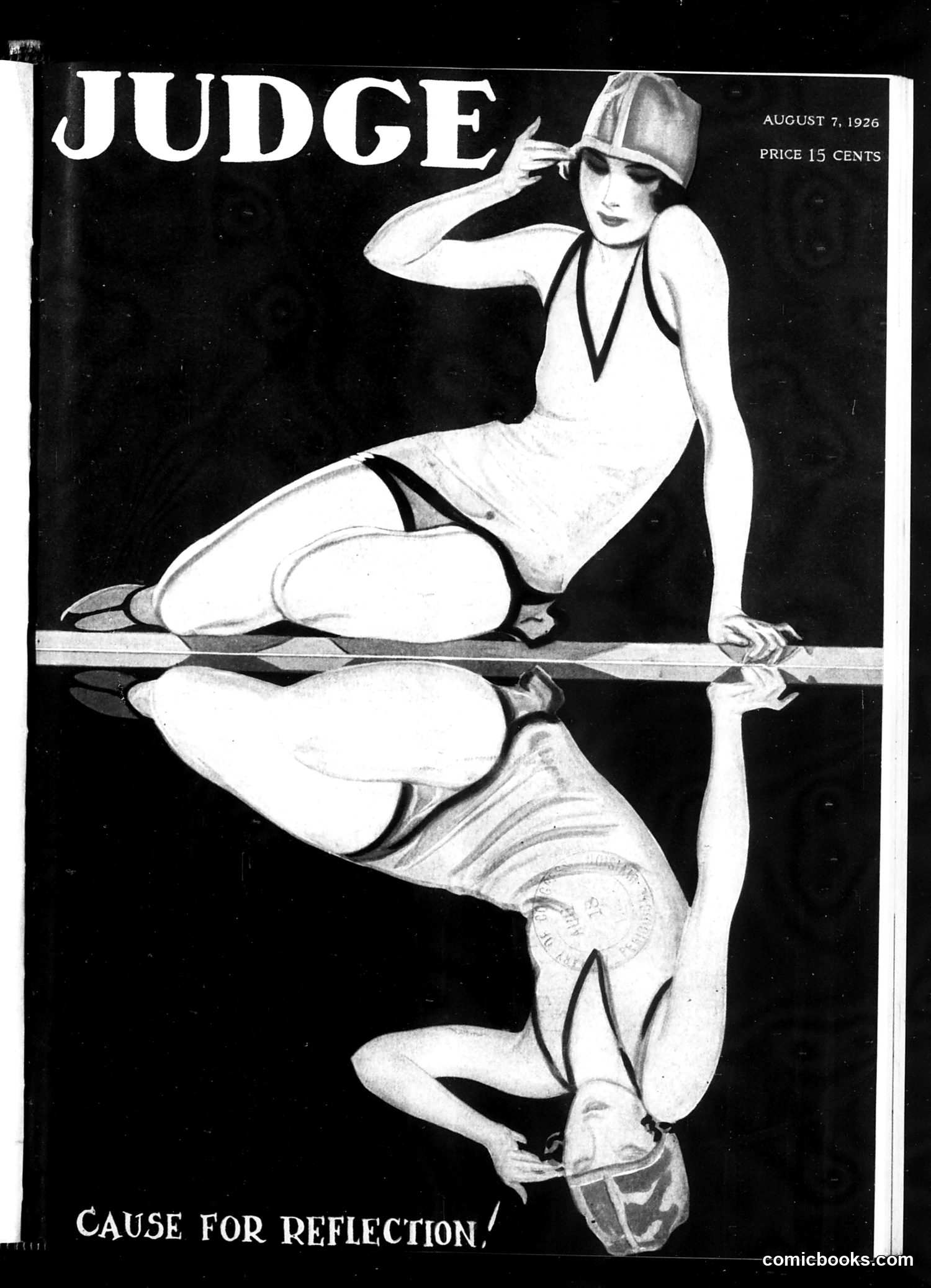
This August 1926 Judge magazine cover presents a visual pun about vanity and self-image. The illustration shows a woman in swimwear and cloche hat looking at her reflection in a mirror or pool of water, but her reflection appears distorted or inverted—appearing upside-down beneath her. The caption "Cause for Reflection" plays on the double meaning: both the literal reflection in the water and the metaphorical idea of self-examination or reconsideration. The joke likely satirizes 1920s women's fashion and attitudes toward appearance during the Jazz Age, when such swimwear and bobbed-hair styles were considered daringly modern and somewhat scandalous. The distorted reflection humorously suggests a disconnect between self-perception and reality.
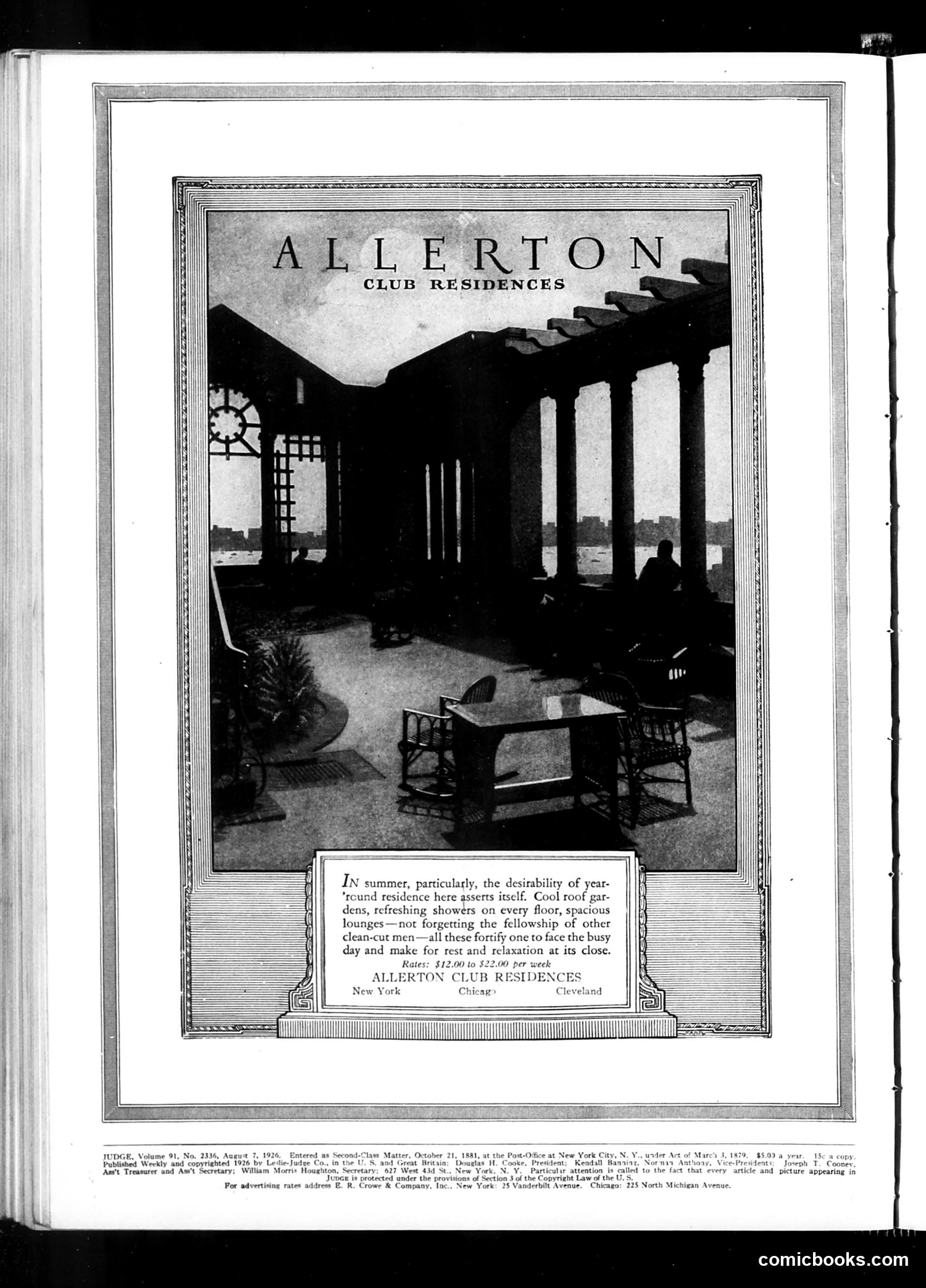
This page is **primarily an advertisement**, not political satire. It promotes "Allerton Club Residences," luxury accommodations in New York, Chicago, and Cleveland. The advertisement features an architectural photograph of an elegant covered loggia or pavilion with columns, potted plants, and period furniture, presented as an attractive amenity. The accompanying text emphasizes year-round residence appeal, highlighting "cool roof gardens, refreshing showers on every floor, spacious lounges" and "fellowship of other clean-cut men." Rates are listed as "$12.00 to $25.00 per week." This reflects early 20th-century upscale urban housing marketed to professional men—essentially a predecessor to modern residential clubs. The page contains no political cartoons or satirical commentary; it is purely commercial in nature.
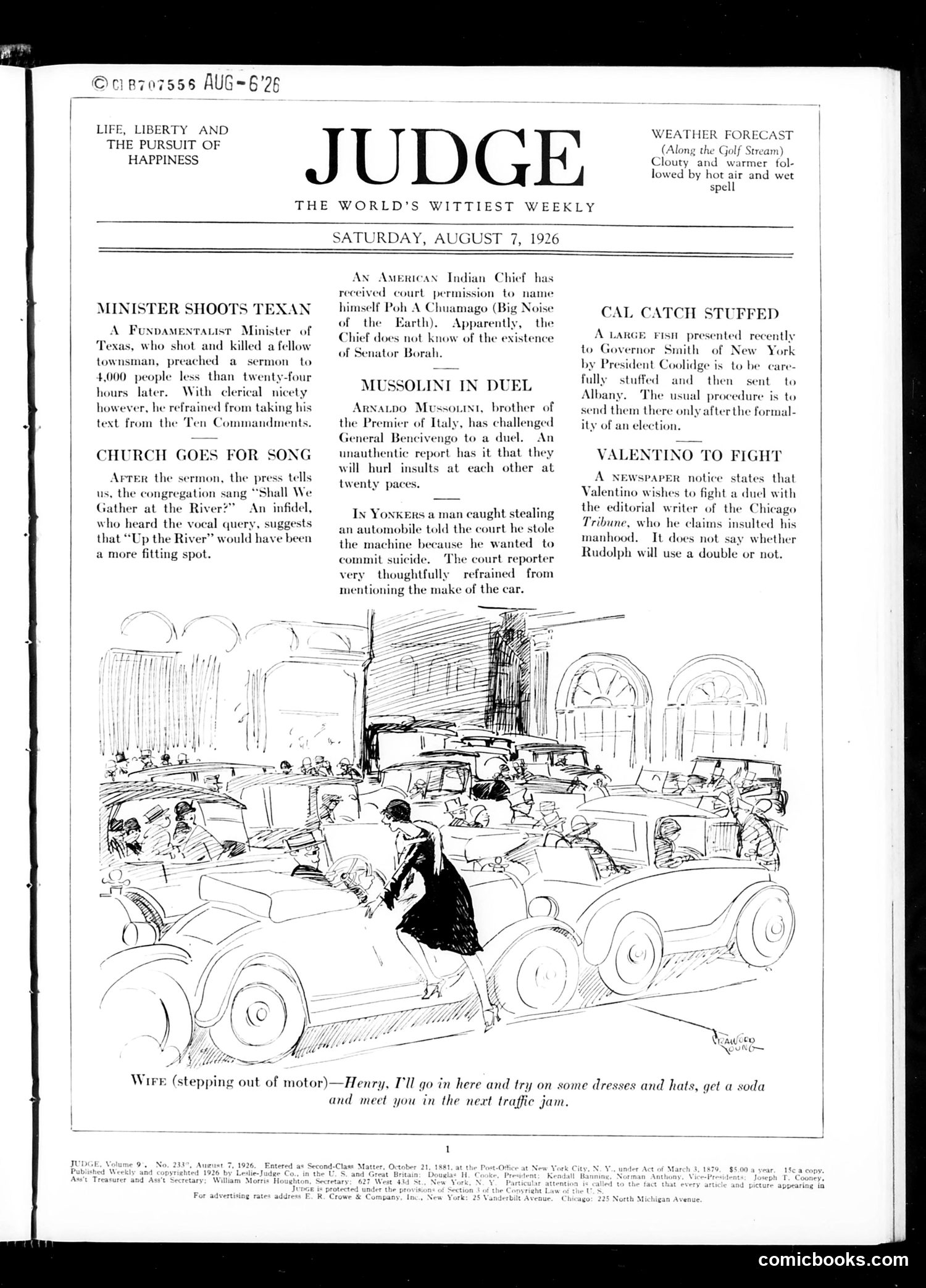
The main cartoon depicts a traffic jam of automobiles with a woman stepping out of a car. The caption reads: "Wife (stepping out of motor)—Henry, I'll go in here and try on some dresses and hats, get a soda and meet you in the next traffic jam." **The satire:** This mocks urban traffic congestion in 1920s America. The joke is that traffic jams have become so severe and commonplace that a wife can casually abandon her husband to shop, confident she'll encounter another equally massive jam to meet him in later. The cartoon satirizes both the explosion of automobile ownership and the resulting gridlock plaguing American cities—treating gridlock as an accepted, predictable urban reality rather than an aberration.
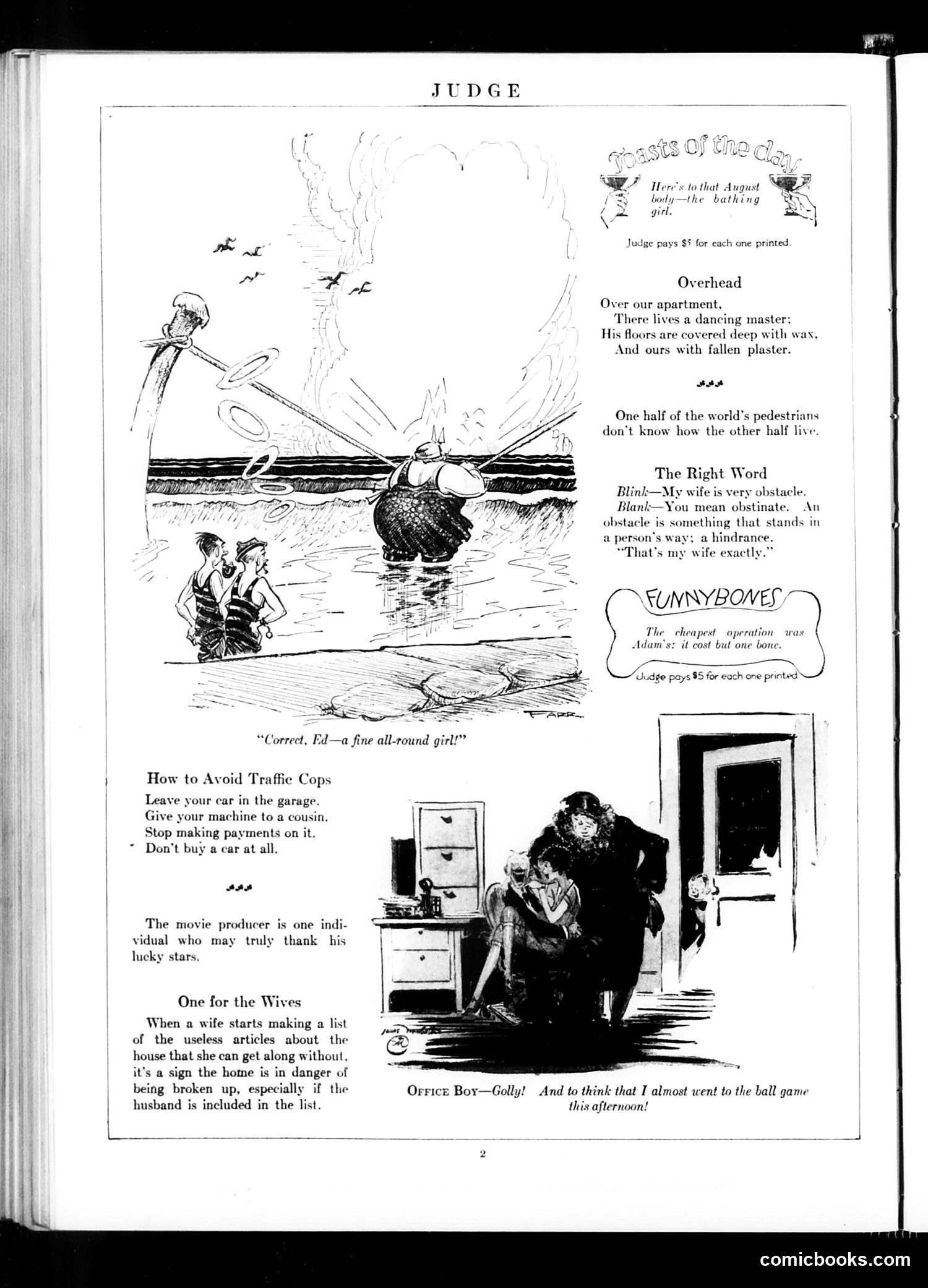
This page contains several unrelated satirical pieces typical of Judge's humor format: **Main Cartoon ("Correct, Ed—a fine all-round girl!")**: Shows a woman diving or bathing, with a man complimenting her athleticism. The satire appears to praise women's physical independence and swimming ability—relatively modern for the era. **"Overhead"**: Brief satirical commentary on a dancing master's pretentious lifestyle, with waxed floors and fallen plaster. **"The Right Word"**: A marital argument joke about semantics—the husband calls his wife an "obstacle" (hindrance), she corrects him that it's more accurately an "obstinate" person. **"How to Avoid Traffic Cops"**: Humorous advice suggesting not owning a car at all. **"Office Boy—Golly!"**: An office scene joke about missing a baseball game. The humor is gentle, domestic, and topical rather than political.
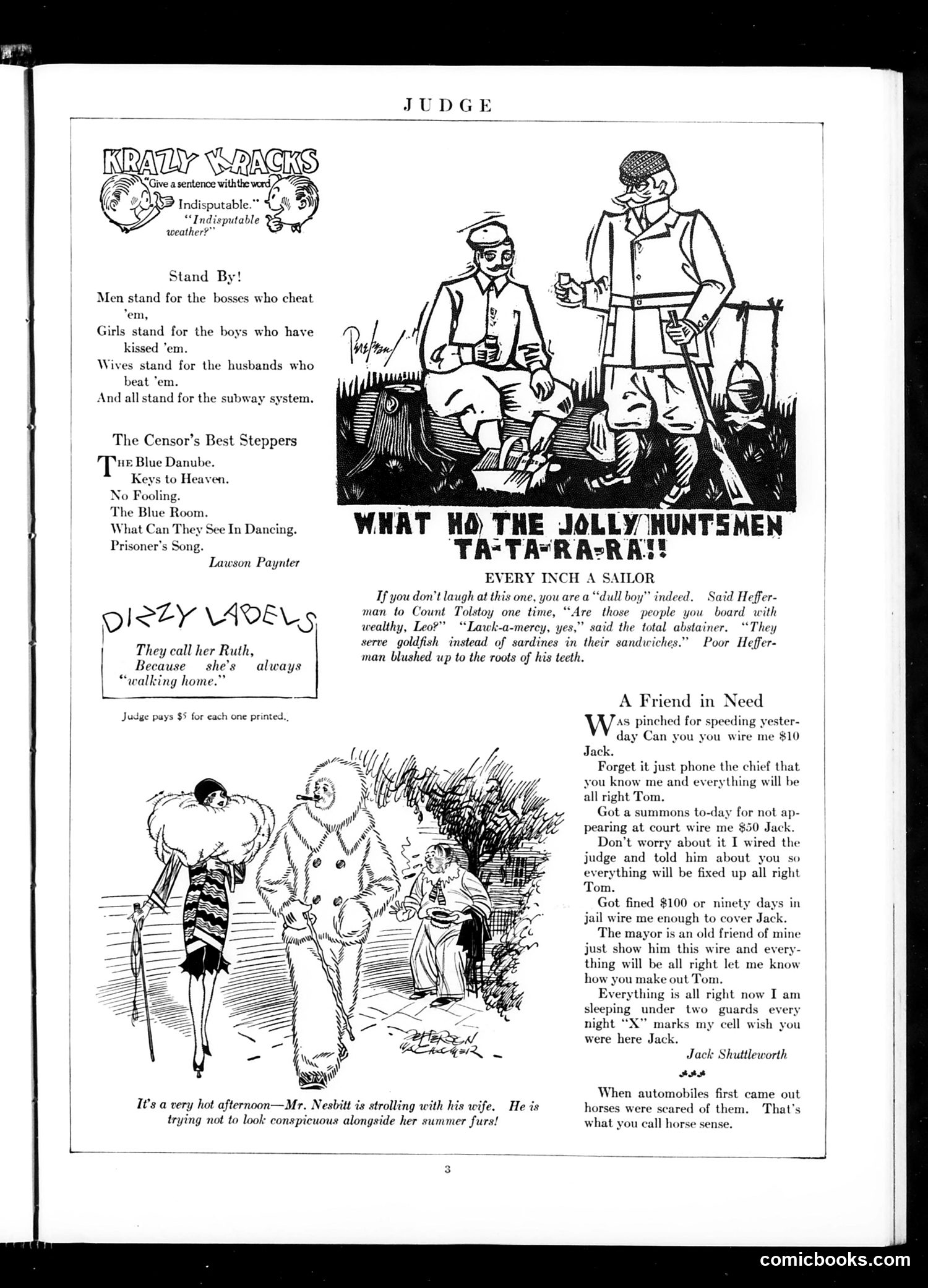
This page contains early 20th-century humor pieces rather than political cartoons: **"Krazy Kracks"** presents absurdist wordplay and sight gags typical of Judge's comic style. **"What Ho the Jolly Huntsmen Ta-Ta-Ra-Ra!!"** is a visual joke about sailors misunderstanding refined language—a common theme mocking working-class figures encountering upper-class speech (references to "goldfish instead of sardines"). **"Dizzy Labels"** appears to be a brief pun about a woman named Ruth. **"A Friend in Need"** is a humorous narrative about someone wiring money to help a jailed friend, playing on common urban anxieties about legal troubles and corruption. **The bottom illustration** depicts Mr. Nesbitt trying to appear inconspicuous while strolling with his wife in her large fur coat—satirizing vanity and conspicuous consumption among the wealthy. The humor emphasizes class distinctions, urban anxieties, and marital dynamics typical of the era.
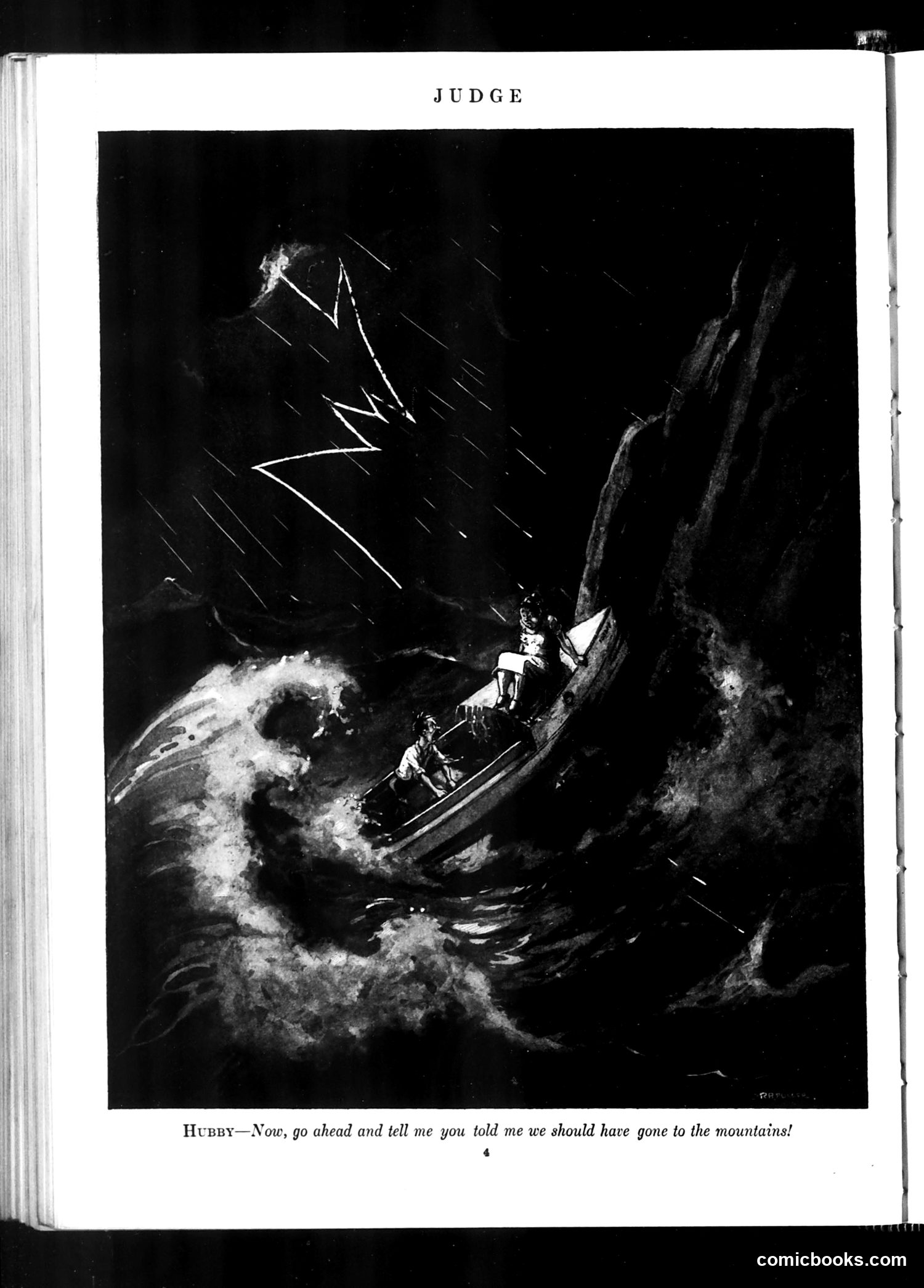
This page is titled "JUDGE" and depicts a dramatic maritime scene with two figures in a small boat amid turbulent waters and stormy conditions. The caption reads: "HUBBY—Now, go ahead and tell me you told me we should have gone to the mountains!" This is a domestic humor cartoon playing on marital conflict. A husband sarcastically blames his wife for insisting on a seaside vacation that has turned disastrous—they're now caught in dangerous waters. The joke relies on the common trope of wives being wrong about vacation planning, while the husband smugly claims vindication ("I told you so"). The dramatic imagery of the storm contrasts absurdly with the petty domestic argument, amplifying the humor through exaggeration. This reflects early 20th-century gender stereotypes about wives' poor decision-making.
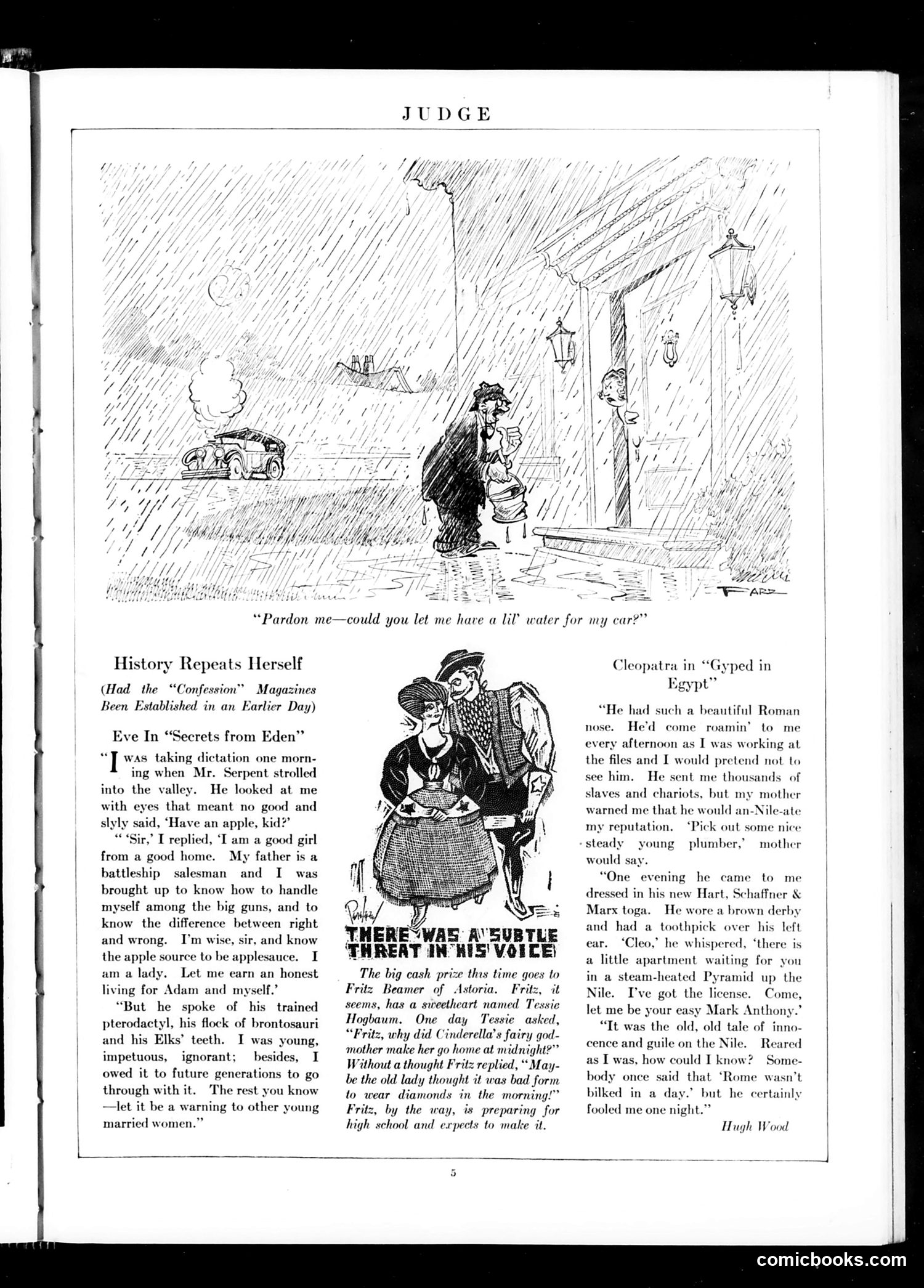
The top cartoon depicts a rainy street scene where a woman asks a judge for water for her car—a visual gag playing on the judge's authority and the absurdity of the request during heavy rain. The humor relies on the incongruity of asking for water when it's abundantly falling. The page contains three separate articles/features: 1. **"History Repeats Herself"** — commentary on confessional magazines revealing women's secrets across time periods 2. **"Eve In 'Secrets from Eden'"** — a woman's anecdote about a battleship salesman and inherited family curses, satirizing gossip columns and scandal narratives 3. **"Cleopatra in 'Gyped in Egypt'"** — Hugh Wood's humorous piece about a Roman suitor, playing with historical romanticization and domestic comedy The page satirizes contemporary magazine culture and sensational storytelling conventions popular in early 20th-century print media.
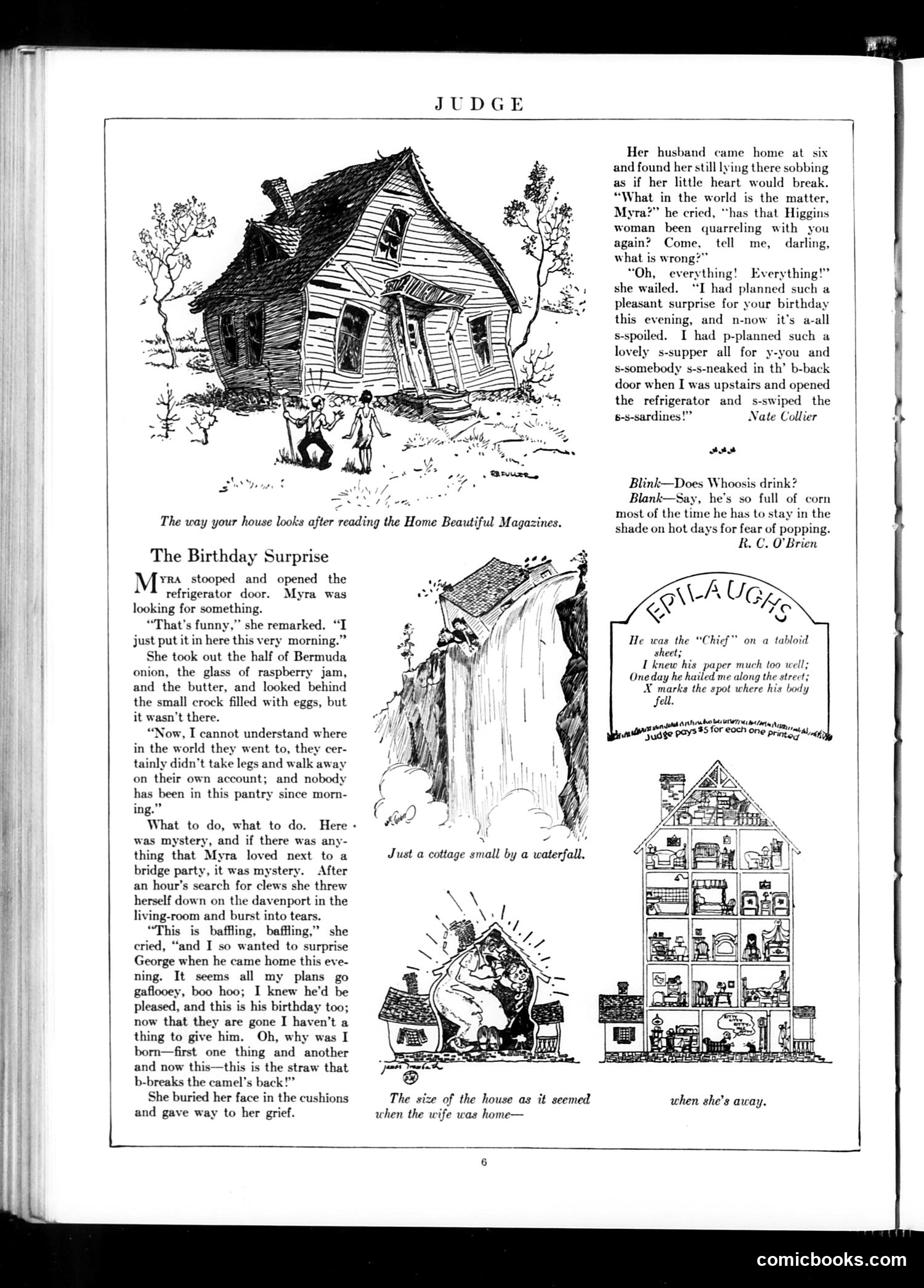
This page mocks the aspirational lifestyle promoted by *Home Beautiful* magazine and similar domestic publications of the era. The top illustration shows a deliberately shabby house—the ironic caption suggests reading such magazines makes your actual home look terrible by comparison. The main story satirizes wives obsessed with impressing their husbands through elaborate meal preparation and surprise parties. Myra plans an elaborate birthday dinner but discovers mysteriously missing sardines from the refrigerator. She dissolves into melodramatic tears, treating this minor domestic mishap as catastrophic—her entire identity and self-worth apparently hinge on the success of this one meal. The satire targets both the unrealistic domestic perfectionism these magazines encouraged and the emotional dependency women were expected to have on pleasing their husbands. The humor lies in Myra's histrionic overreaction to a trivial problem, exposing the absurdity of women's prescribed role as house-manager and entertainer.
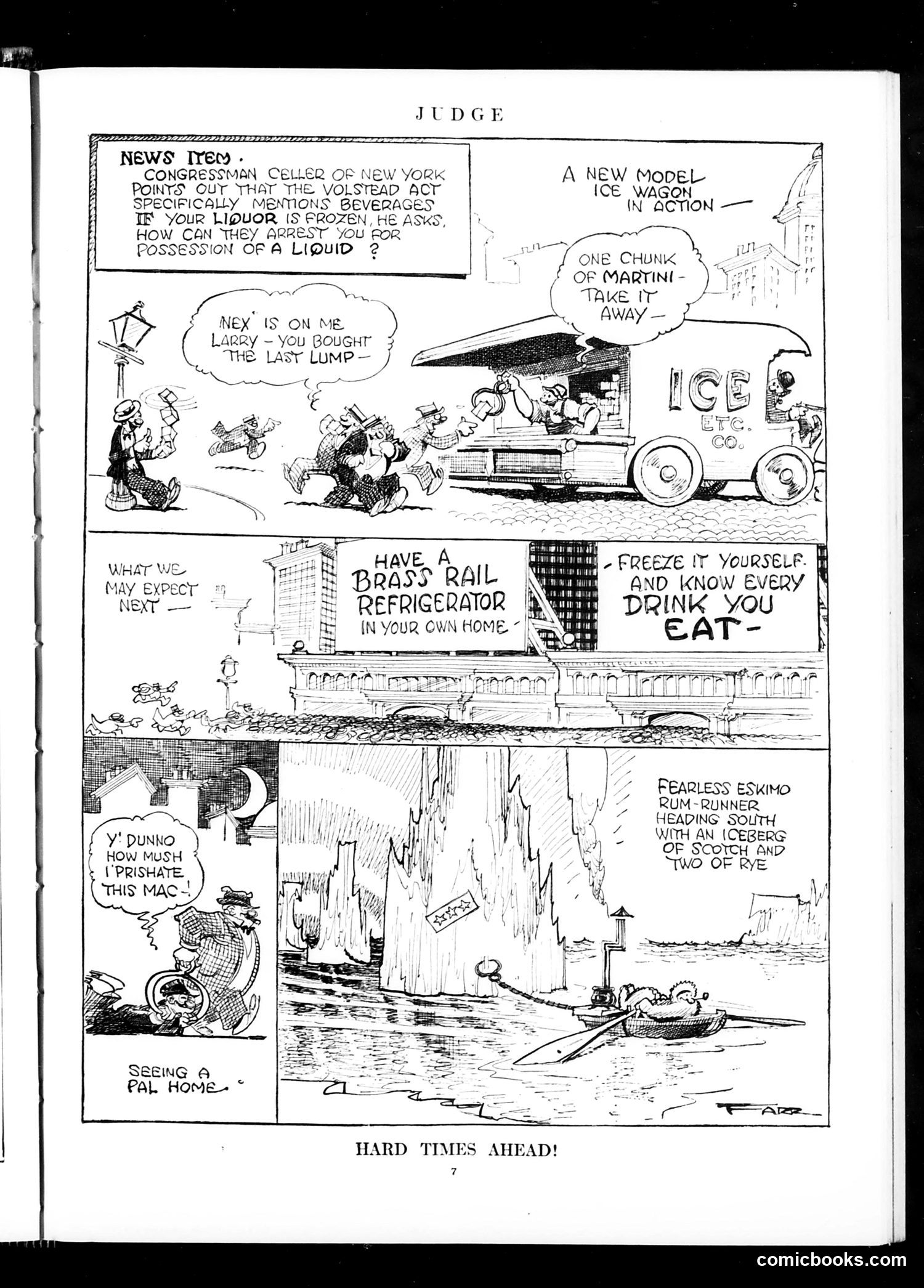
This Judge cartoon satirizes Prohibition enforcement during the 1920s-30s. It references Congressman Emanuel Celler's legal argument that frozen alcohol isn't technically a "liquid," so possession might not violate the Volstead Act (the law enforcing Prohibition). The cartoon mocks this loophole by depicting creative workarounds: an ice wagon selling frozen martinis, home refrigerators enabling illegal drinking, and rum-runners transporting contraband. The "fearless Eskimo rum-runner" heading south with icebergs suggests alcohol smuggling has become absurdly normalized. The joke warns of "hard times ahead"—showing how Prohibition's unintended consequence was spurring ingenious criminal enterprise rather than eliminating drinking. The cartoon implies the law is so poorly conceived that citizens and lawmakers alike recognize its futility, making enforcement nearly impossible.
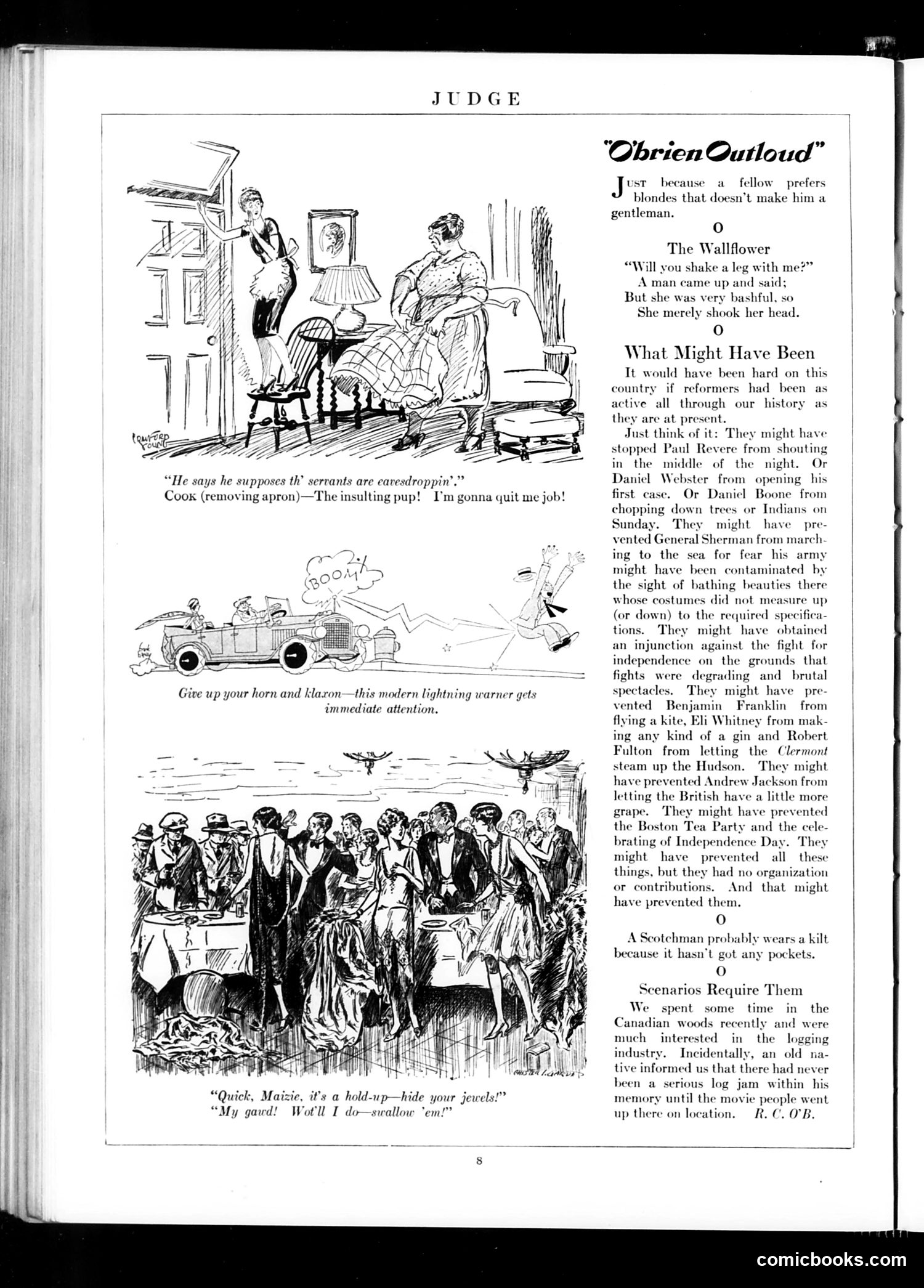
This page from *Judge* contains several short satirical pieces typical of early 20th-century American humor magazines. **"Obrien Outloud"** opens with a quip about blonde preferences and gentlemanliness—light social commentary on dating customs. **"The Wallflower"** is a brief verse joke about a shy woman rejecting a dance invitation. **"What Might Have Been"** is the page's main satirical piece, mocking contemporary **reformers** (likely Progressive Era activists concerned with moral standards and regulation). The satire argues that if reformers had existed throughout American history with their restrictive attitudes, they would have prevented major historical achievements—Paul Revere's midnight ride, Daniel Boone's frontier expansion, Sherman's Civil War campaign, and the American Revolution itself. This defends historical figures and progress against what the author sees as excessive modern moral policing. The cartoon illustrations show domestic servants eavesdropping, a traffic accident, and a formal gathering—supporting themes of social observation and constraint. The final anecdote about logging in Canada references how movie companies' presence altered local conditions, suggesting artificiality in modern entertainment.
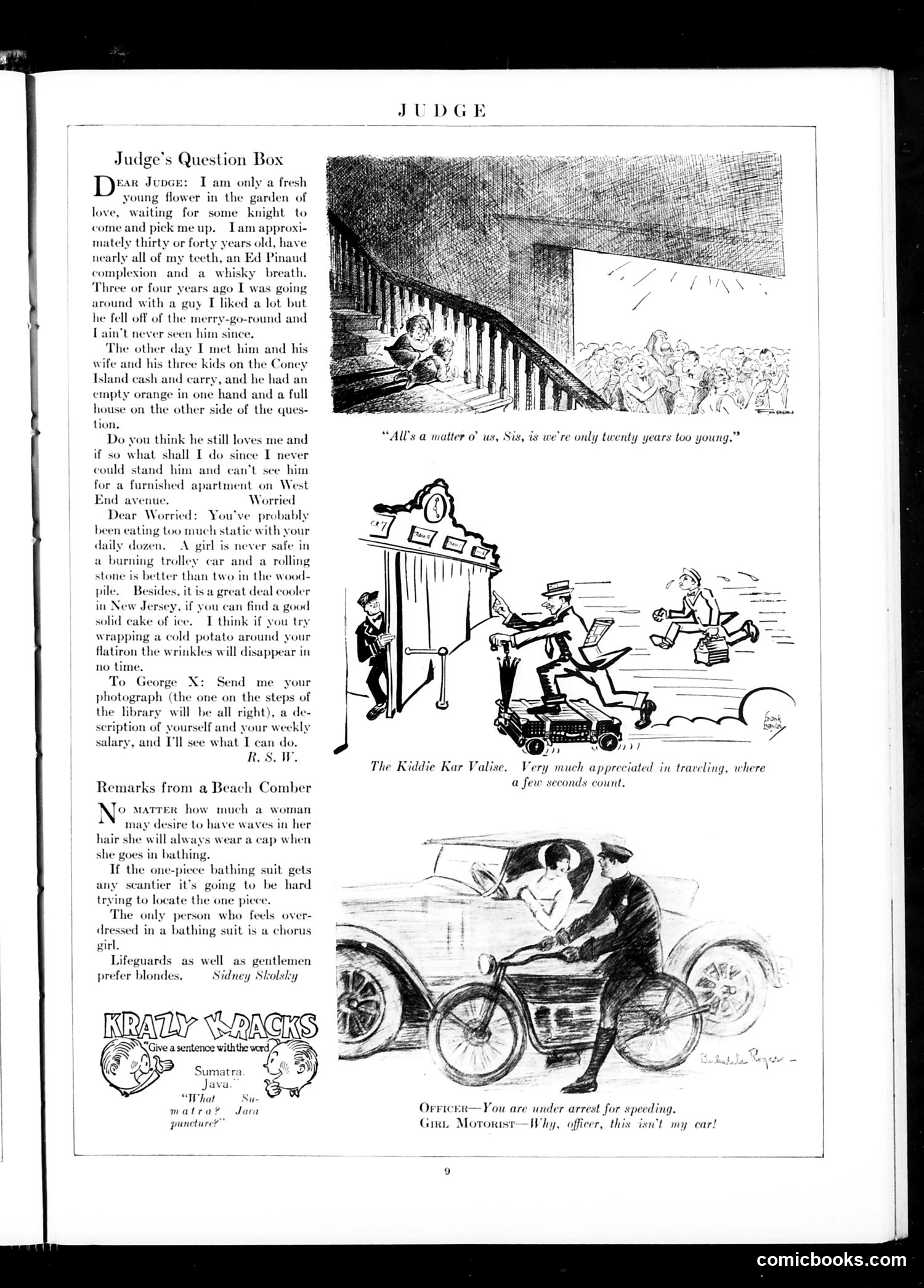
This page from *Judge* contains several humor pieces typical of the 1920s-30s era: **"Judge's Question Box"** parodies advice columns with absurdist non-sequiturs—the "Dear Judge" letter about a woman seeking romance gets deliberately nonsensical responses (wrapping potatoes around flatirons). This mocks the earnest advice-column format. **Beach Comber remarks** satirize gender behavior: women wearing caps to preserve hairstyles while swimming, the impracticality of one-piece bathing suits becoming increasingly scanty, and the dated trope that "gentlemen prefer blondes." **The cartoons** show period-specific humor: the "Kiddie Kar Valise" depicts absurdly speedy child transportation; the final cartoon plays on the common excuse "it's not my car" when caught speeding—likely satirizing wealthy people's casual attitude toward traffic laws and vehicle ownership. The overall tone reflects Jazz Age social commentary: dating mishaps, changing women's fashion, automobile culture, and class attitudes. The humor relies on exaggeration and non-sequitur logic typical of *Judge's* satirical style.
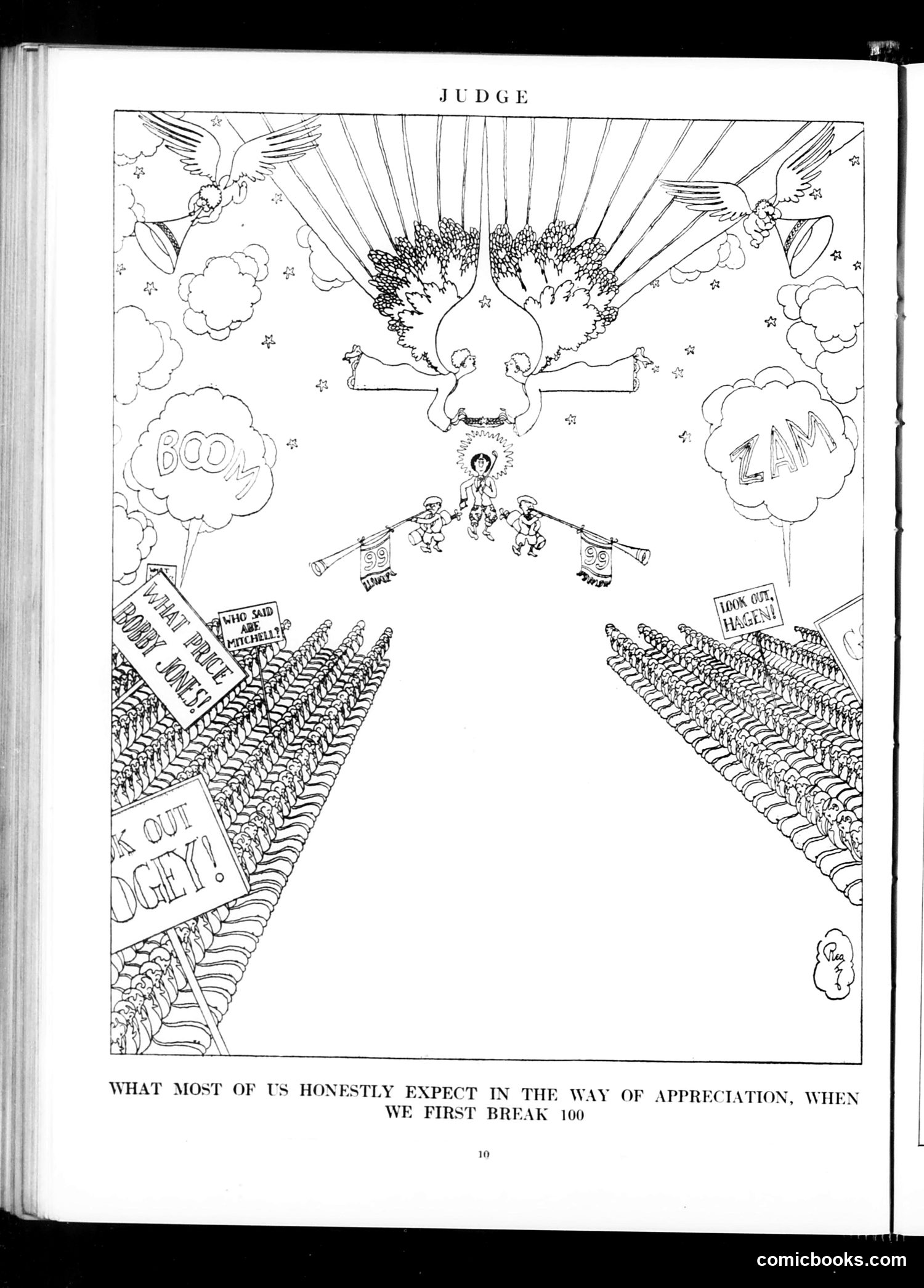
This satirical cartoon depicts a heavenly scene mocking expectations of divine reward. A figure has apparently achieved a score of "100" (likely in golf, given the reference to "break 100"—a significant amateur milestone). The cartoon shows: **The Scene:** Angels with trumpets descend from clouds; divine light radiates downward; crowds of soldiers stand in formation below with signs reading partially visible text. **The Satire:** The exaggerated heavenly celebration—complete with angelic fanfare and masses of what appear to be military personnel—mocks the grandiose recognition amateur golfers expect for merely achieving "breaking 100." It's absurdly inflated praise for a modest accomplishment. **The Joke:** The title suggests this represents what golfers "honestly expect" versus reality—their internal fantasy of cosmic importance versus the actual modest achievement. The cartoon appears to satirize human vanity and the gap between self-importance and actual accomplishment, using golf culture as its vehicle.
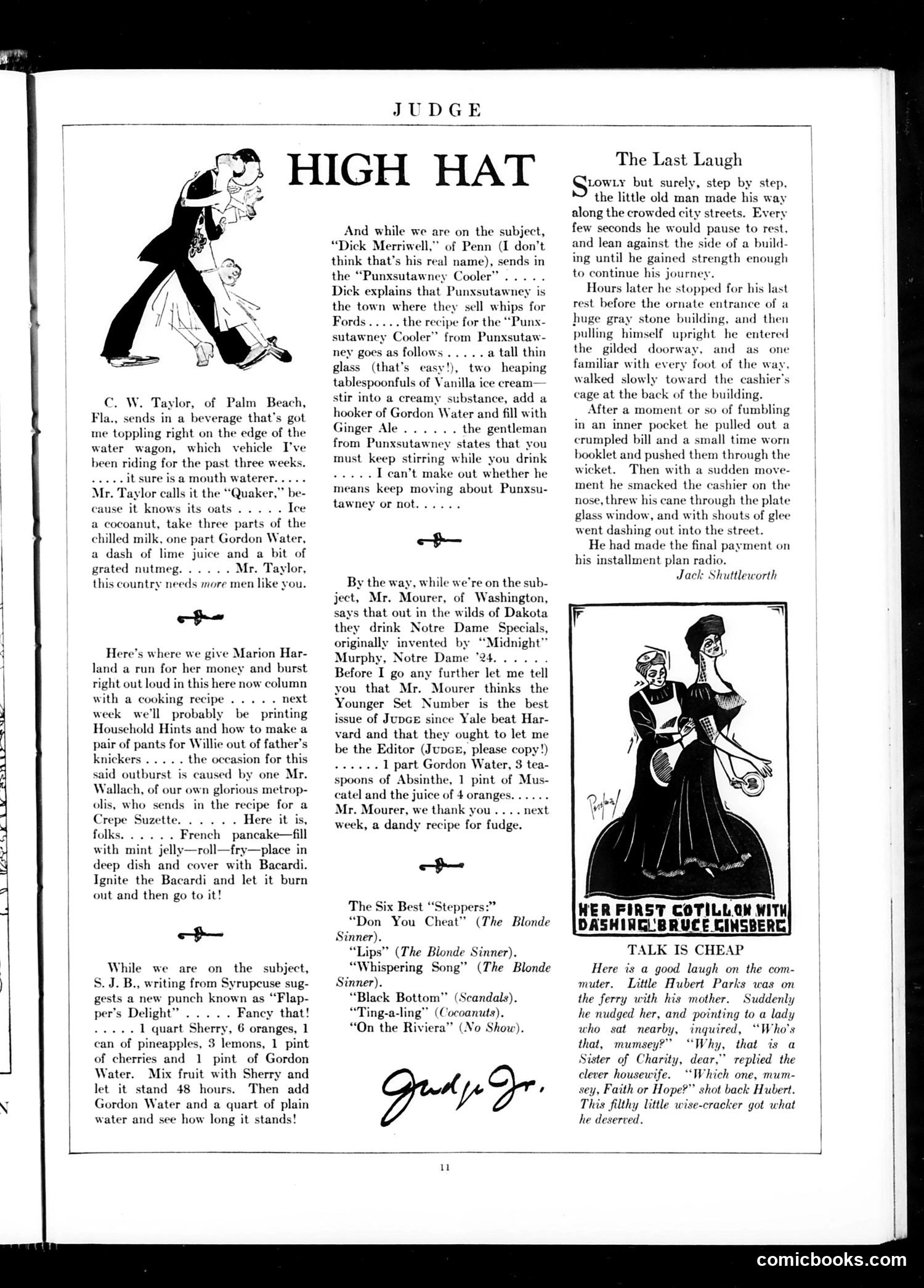
This page from Judge magazine contains mostly **humorous beverage recipes** rather than political satire. The "HIGH HAT" column presents cocktail and punch recipes submitted by readers, many featuring "Gordon Water" (likely a brand name product). The cartoons are brief comedic illustrations with minimal political content. The main visual shows a tall man in formal dress interacting with a shorter figure—typical Judge-style social humor about class or appearance contrasts. **"The Last Laugh"** story describes an elderly man entering a bank, withdrawing money from a savings account, then punching the cashier—the humor being the surprise violent punchline after building sympathy for the struggling senior. The "**Talk is Cheap**" section references a silent film with Bruce Ginsberg, typical of 1920s Judge content commenting on contemporary entertainment. This appears to be a **non-political Judge issue** focused on lifestyle humor, recipes, and entertainment references rather than political satire or commentary on current events.
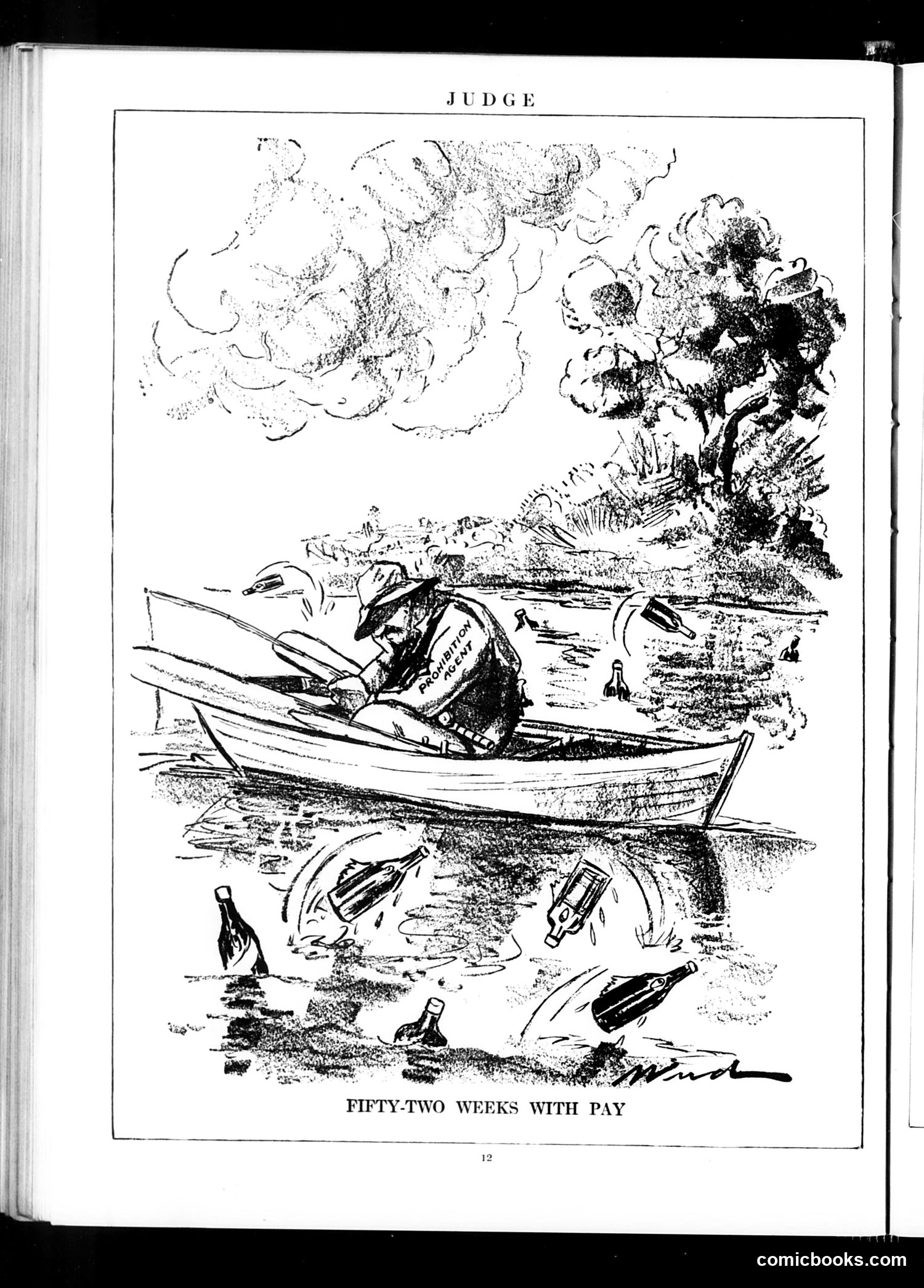
This cartoon depicts a fisherman relaxing in a boat surrounded by empty bottles, with fish jumping in the water and leisure activities visible in the background. The title "Fifty-Two Weeks with Pay" is the key to understanding the satire. This appears to be political commentary on labor disputes or worker demands, likely from the early-to-mid 20th century. The cartoon satirizes the concept of paid vacation or year-round salary by showing an idle worker enjoying perpetual leisure while bottles (suggesting drinking/idleness) accumulate. The artist is mocking the idea that workers could receive full payment for not working—presenting it as an absurd fantasy where someone fishes and relaxes constantly while still collecting wages. The satire criticizes either overly generous labor proposals or worker entitlement, depending on the magazine's editorial stance.
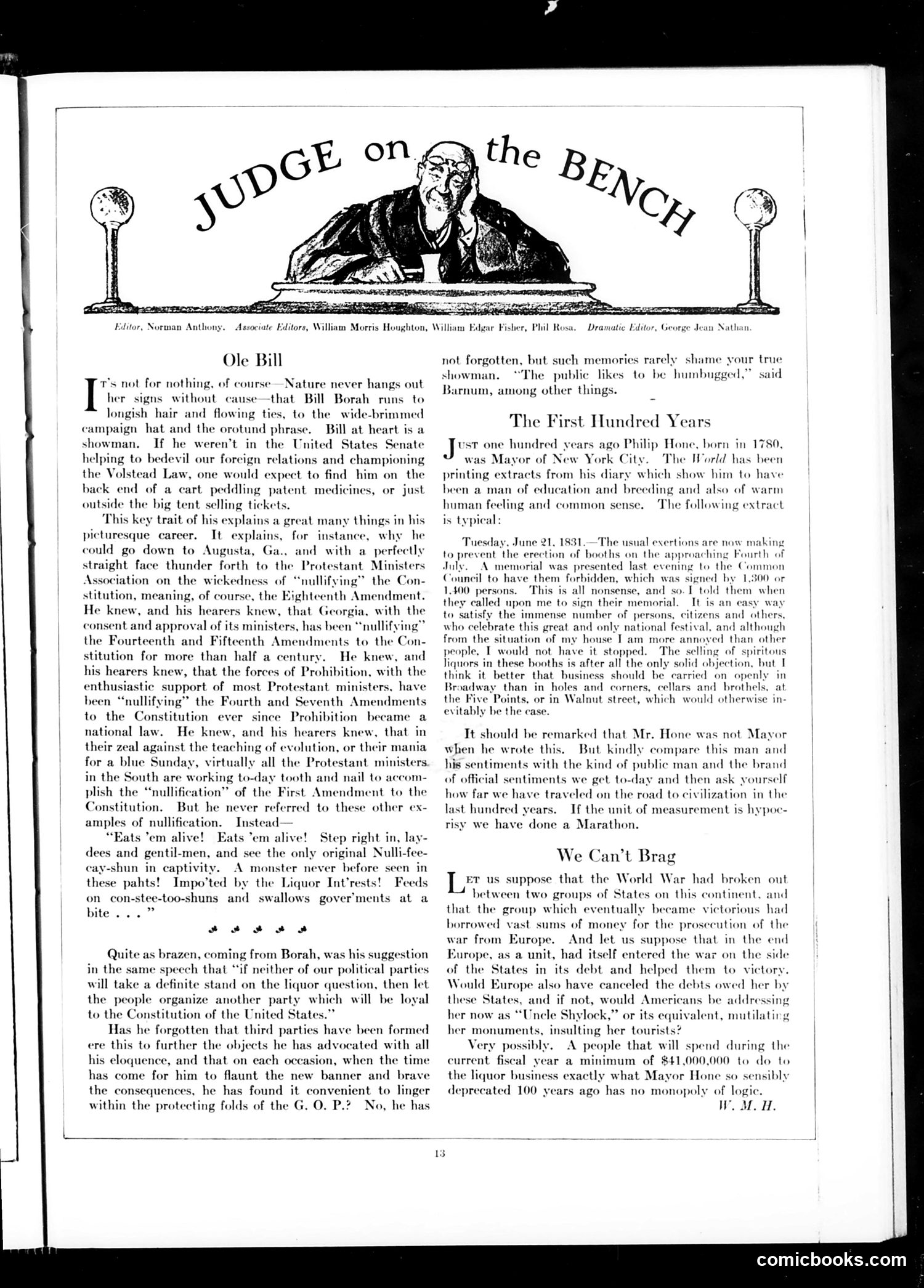
This page contains two satirical pieces from Judge magazine's "Judge on the Bench" column. **"Ole Bill"** attacks Senator William Borah, a prominent politician known for his distinctive appearance (long hair, flowing ties, wide-brimmed hat). The satire accuses Borah of being a showman and hypocrite on Prohibition enforcement. The article claims Borah denounces "nullification" of the Constitution (specifically the Eighteenth Amendment/Prohibition) while ignoring Southern states' long-standing nullification of the Fourteenth and Fifteenth Amendments (Civil Rights protections). It further charges he ignores how Prohibition itself violates the Fourth and Seventh Amendments. The piece mocks his suggestion to form a third party, noting he never actually commits to such ventures, hiding within the Republican Party instead. The caricature portrays him as all rhetoric and no principle—a carnival barker rather than serious statesman. **"The First Hundred Years"** references Mayor Philip Hone's 1831 diary, praising his reasonable approach to Fourth of July celebrations versus contemporary sanctimonious attitudes.
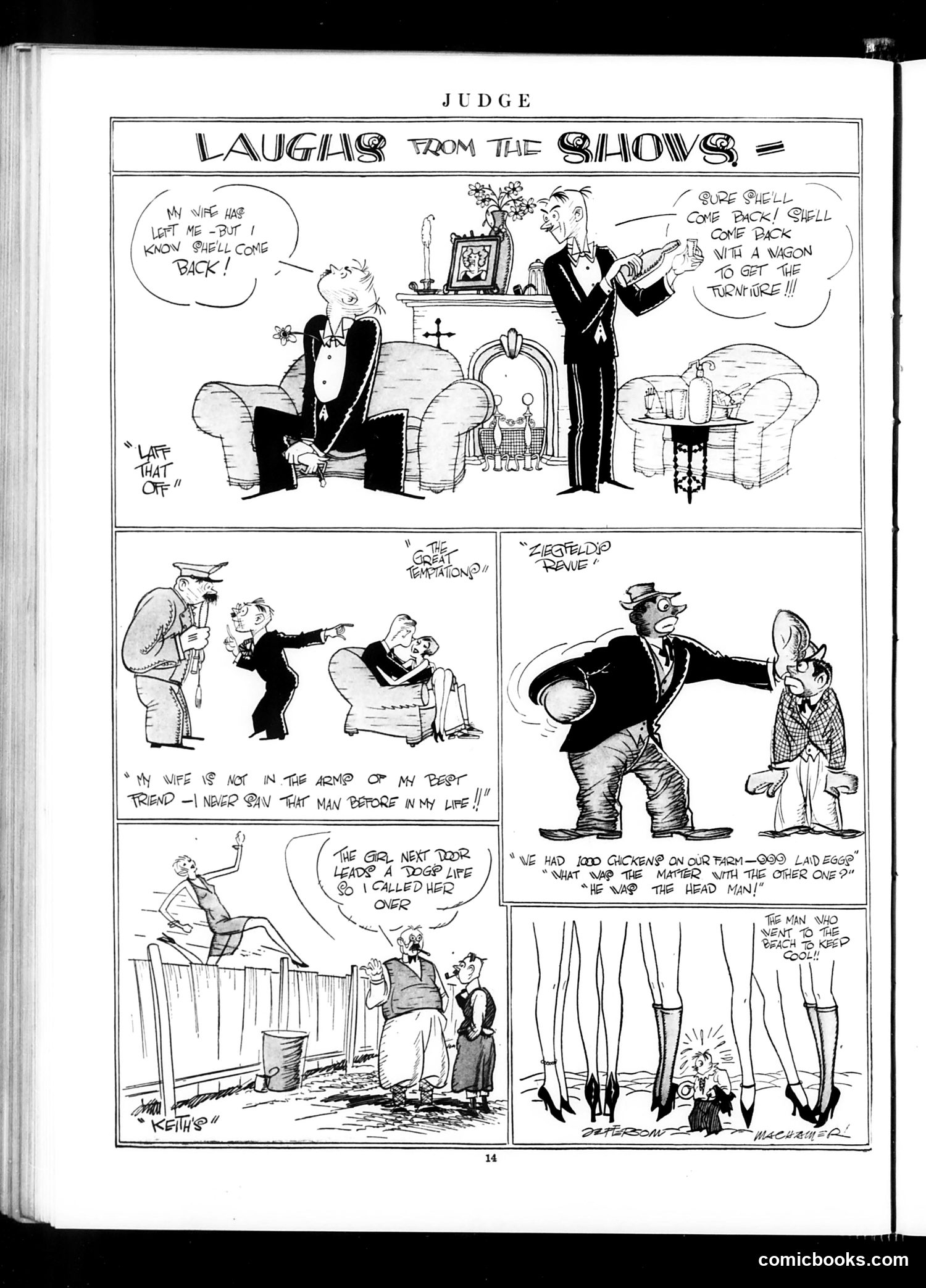
This page collects comic scenarios satirizing domestic life and social situations, likely adapted from contemporary theatrical performances ("the shows"). The cartoons depict: **Top panel**: A husband complaining his wife left him, while another man boasts about retrieving furniture with a wagon—mocking marital discord and material possessions. **Middle panels**: Scenes of domestic conflict—a wife objecting to her husband's friend, a man being comically beaten, and jokes about farm animals and hierarchy. **Bottom panels**: Rural/working-class scenarios involving fences, dogs, and physical comedy. The satire targets middle and working-class marriage troubles, male bravado, and the gap between romantic ideals and domestic reality. The crude, exaggerated drawings emphasize the humor through physical comedy rather than wit. Without knowing the specific theatrical sources, the exact references remain unclear, but the page mocks conventional domestic expectations of the era.
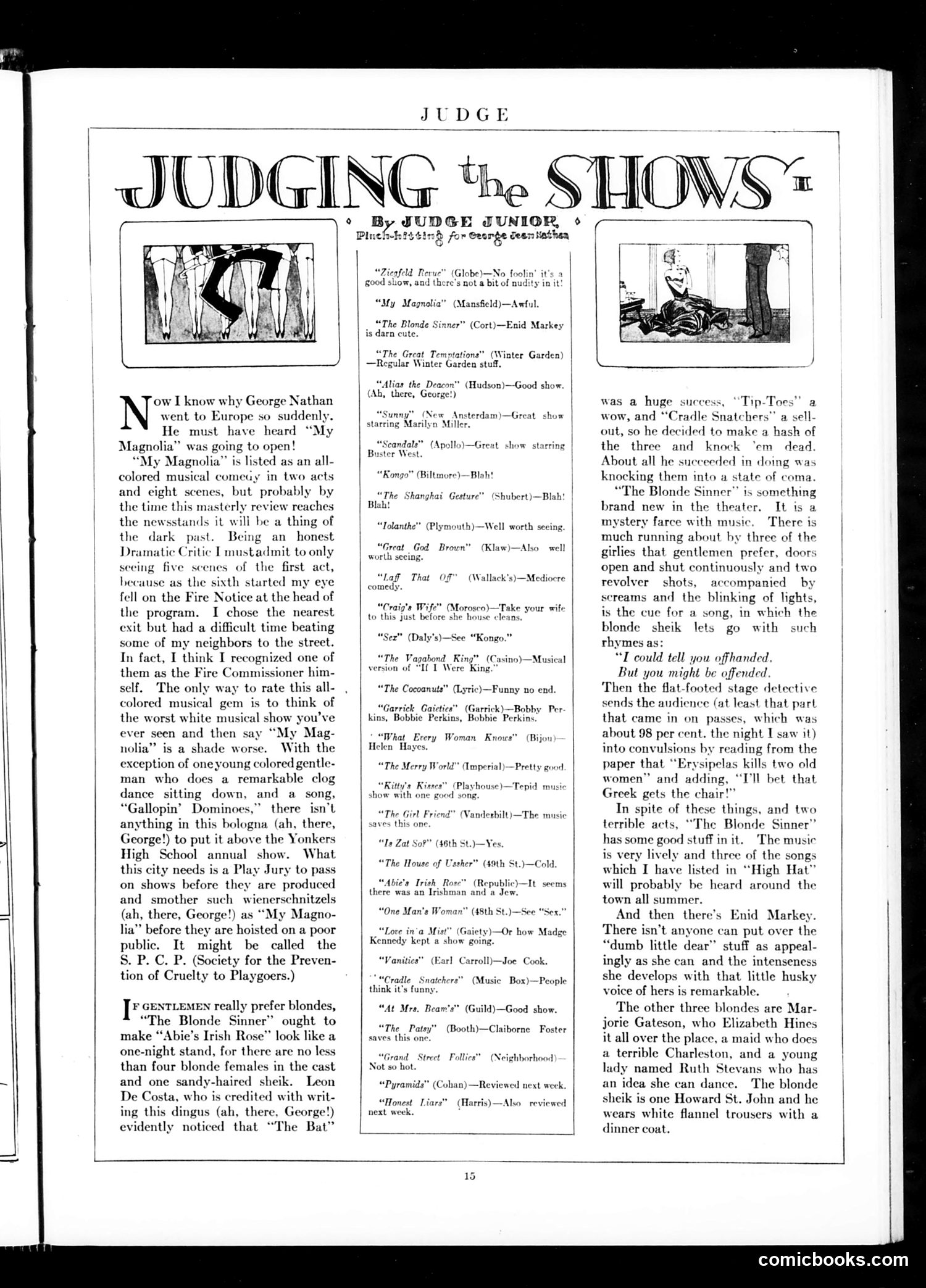
This is a theater review column satirizing Broadway productions. The main article mocks "My Magnolia," an all-Black musical comedy, with the critic claiming it was so terrible he fled during the sixth scene—even recognizing the Fire Commissioner escaping. He sarcastically proposes creating an "S.P.C.P." (Society for Prevention of Cruelty to Playgoers) to stop such shows before production. The second review targets "The Blonde Sinner," joking that its four blonde actresses and one male lead represent a formula borrowed from successful shows like "Abie's Irish Rose" and "The Bat." The page also lists brief, snarky assessments of other current Broadway shows with one-word judgments ("Blah!", "Awful," "Good show"). The satire reflects 1920s theater culture and contemporary racial attitudes—the dismissive treatment of Black performers was typical of period entertainment criticism.
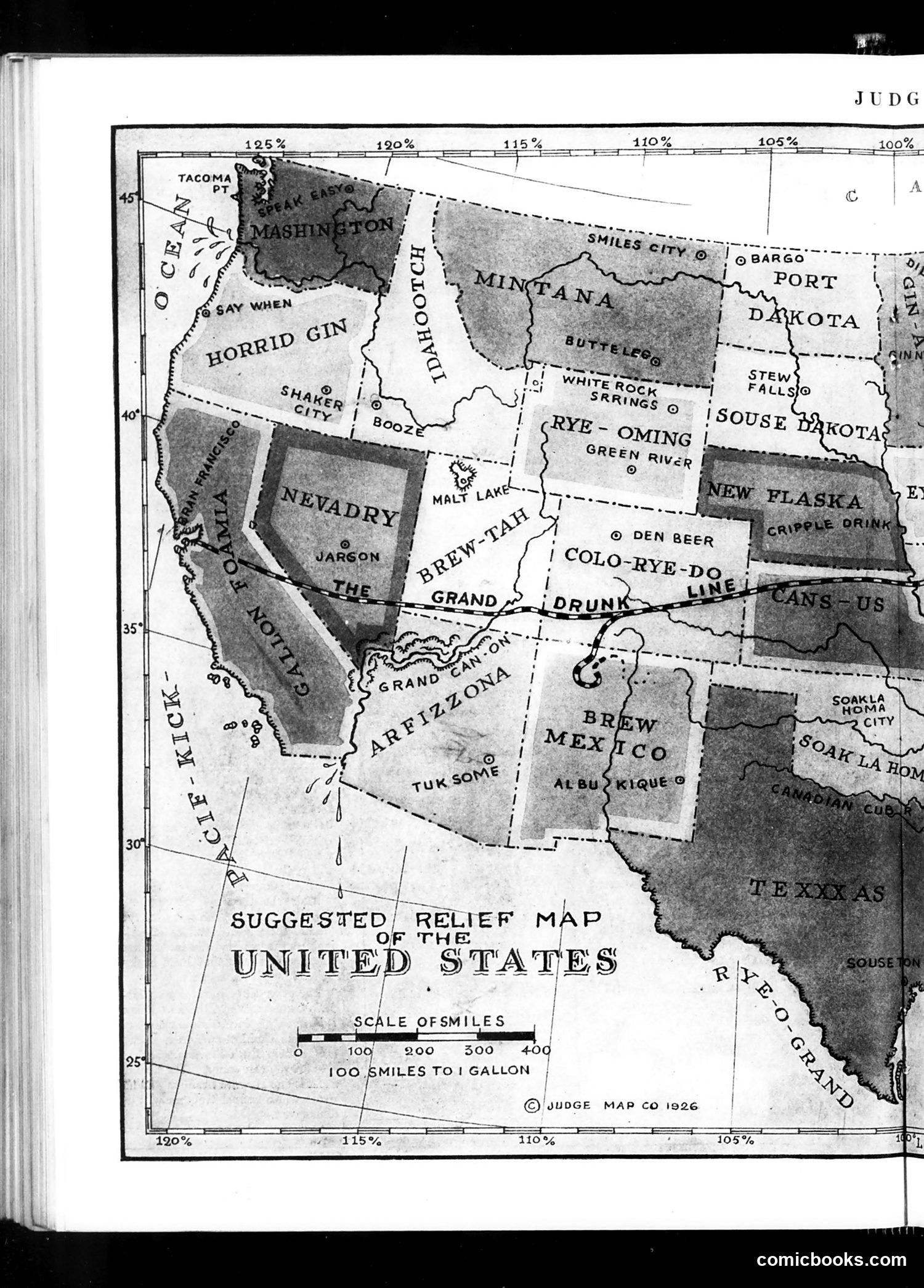
This is a Prohibition-era satirical map using humorous place names to mock the enforcement of the 18th Amendment. The shaded regions represent states or areas associated with illegal alcohol production and consumption. Key satirical elements include fictitious county names like "Horrid Gin," "Booze," "The Nevadry," "Brew-Tah," "Colo-Rye-Do," and "Brew Mexico"—puns combining geography with alcohol types (gin, rye whiskey, beer). Real place names are also incorporated as jokes (e.g., "Say When," referencing the phrase used when pouring drinks). The map's caption, "100 miles to 1 gallon," sarcastically suggests alcohol availability rather than distance measurements. Created in 1926 during Prohibition (1920-1933), this cartoon mocked the widespread failure of alcohol bans, the prevalence of illegal speakeasies and home brewing, and public mockery of government enforcement efforts. Judge magazine frequently satirized Prohibition's ineffectiveness and unpopularity.
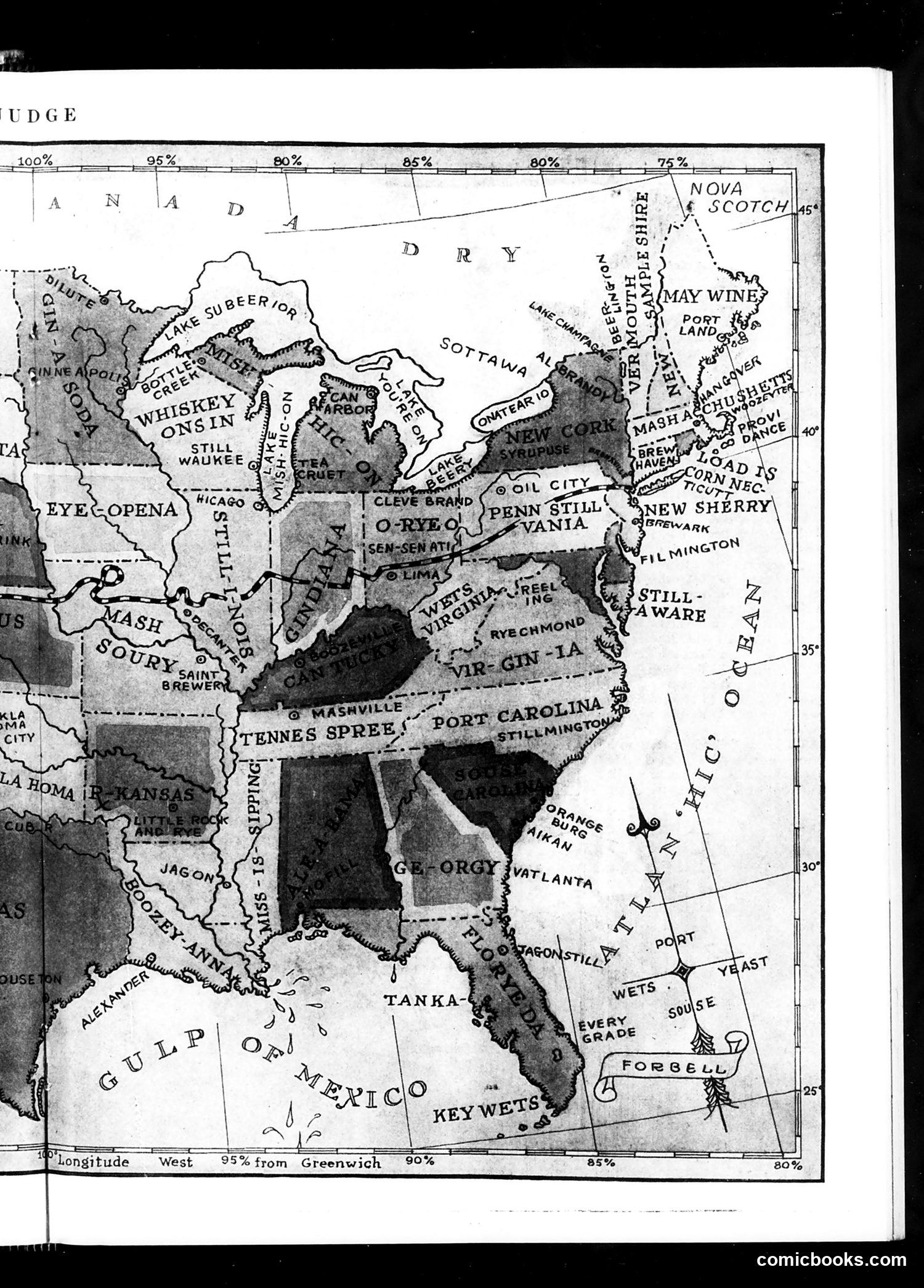
This appears to be a **Prohibition-era map of the United States**, showing distilling and brewing locations during the alcohol ban period (1920-1933). The shaded regions mark illegal liquor production centers—whiskey in Wisconsin, gin operations in Virginia, stills throughout the South, and various other unlawful operations across the country. The map's satirical point is **documenting how thoroughly Prohibition failed**: despite the constitutional amendment banning alcohol, illegal distilleries flourished nationwide, demonstrating that the law created widespread criminal enterprise rather than eliminating drinking. The detailed labeling of specific "brands" and locations mocks both the ineffectiveness of enforcement and the persistence of American drinking culture. This Judge cartoon critiques Prohibition's unintended consequences—organized crime, hypocrisy, and institutional failure.
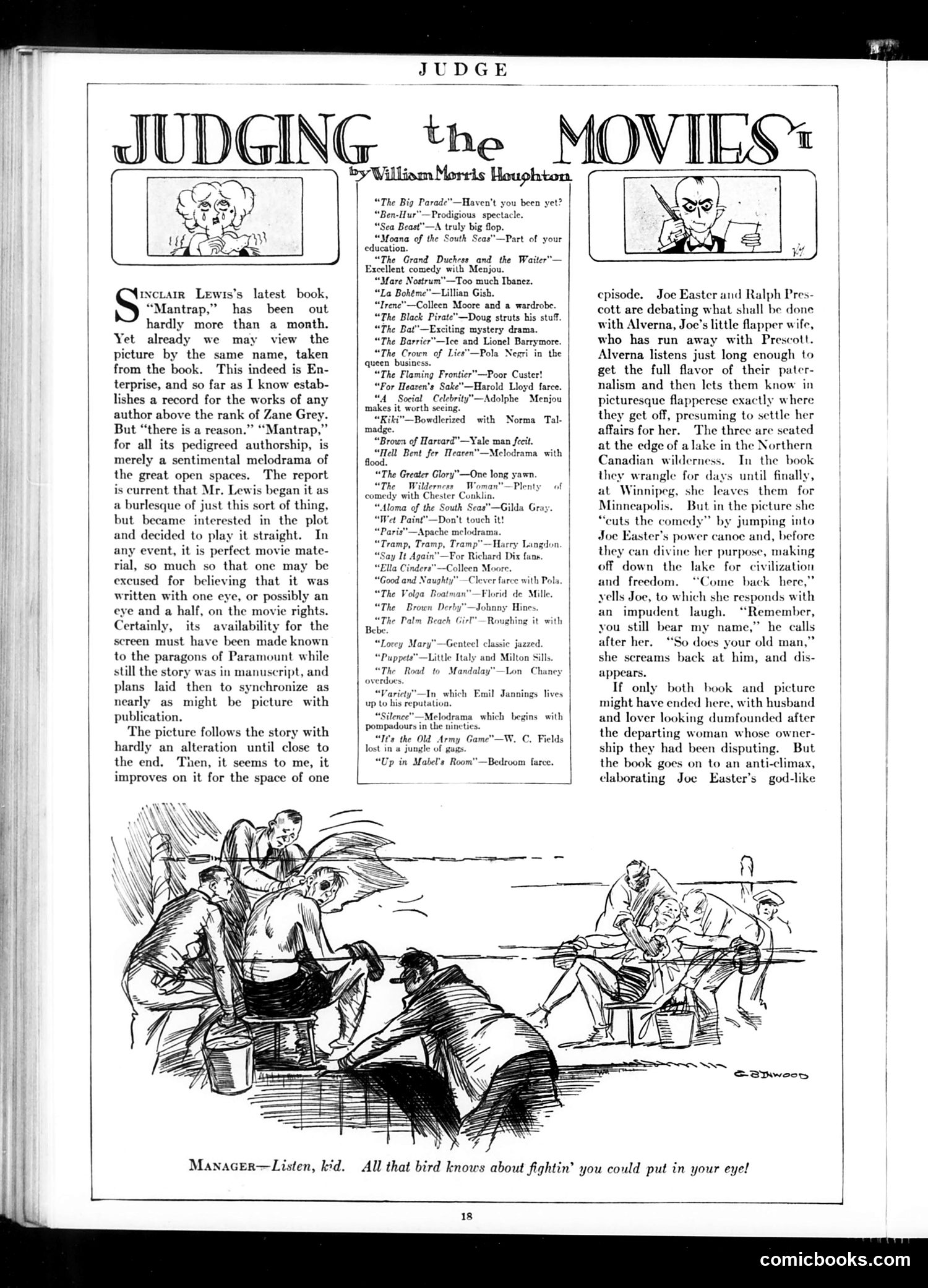
This page reviews Sinclair Lewis's novel *Mantrap* and its film adaptation. The main article praises the book-to-screen adaptation, noting it's unusually fast (book published, film released within months). Lewis apparently began *Mantrap* as satire of sentimental frontier melodrama but got invested in the plot. The cartoon at bottom depicts a scene from the film: a manager telling a boxer that fighting experience could improve his eye—a visual pun on "putting your eye out." The bulk of the page is a contemporary movie capsule guide listing 1925 films with brief reviews: *The Big Parade*, *Ben-Hur*, *Variety*, W.C. Fields comedies, etc. The tone is gossipy and opinionated—typical Judge magazine style. The *Mantrap* review's key point: the film improves on the book's ending by having the female character (a "flapper") assert independence, jumping into a canoe and escaping the men debating her fate—a progressive moment for 1925 cinema.
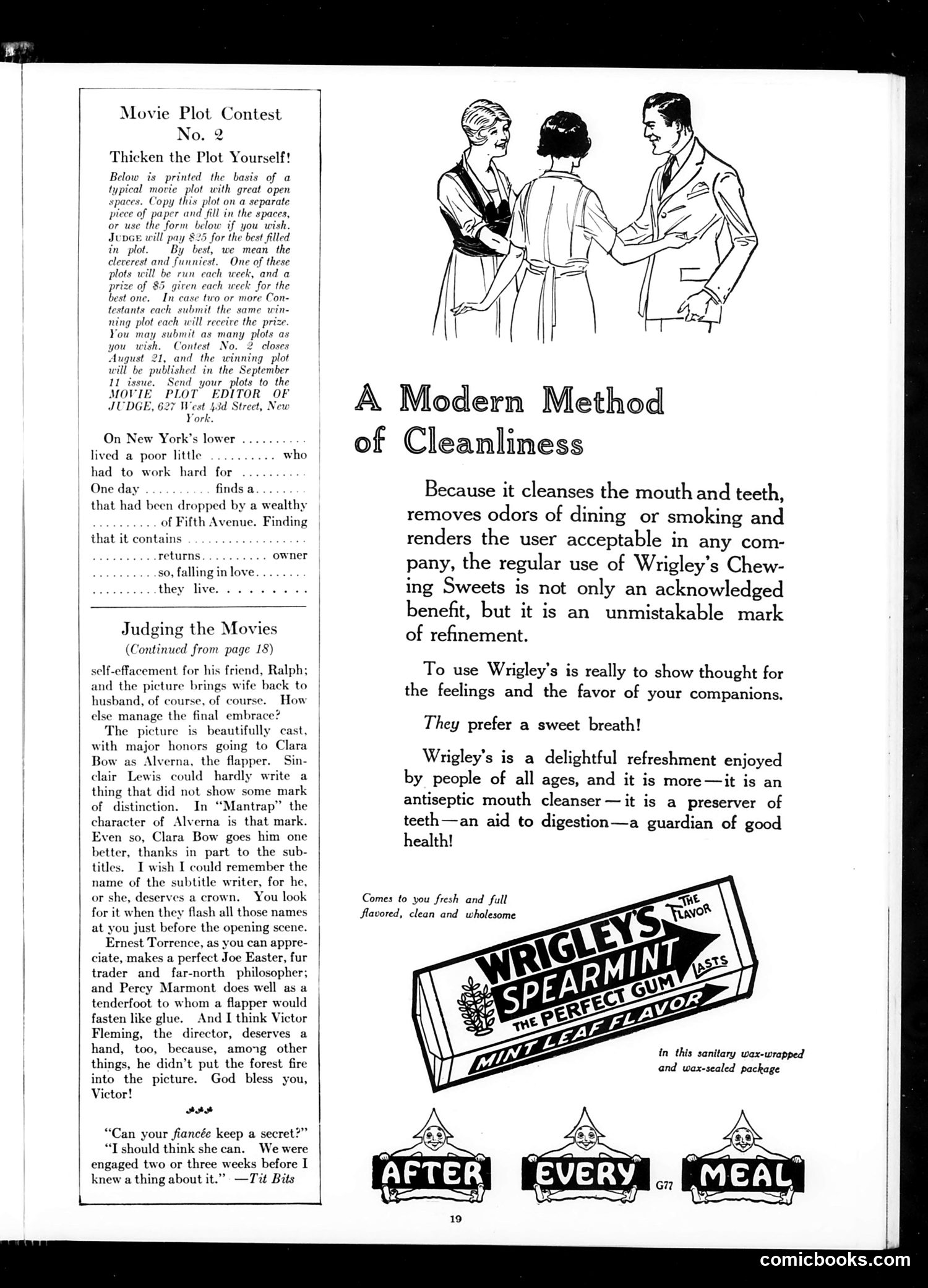
This page contains two main elements: **Movie Plot Contest & Review:** Judge magazine runs a participatory contest where readers complete a skeleton movie plot for prizes. The review section discusses "Mantrap," praising Clara Bow's performance as the flapper character Alverna and director Victor Fleming's work, with particular praise for the subtitle writer. **Wrigley's Chewing Gum Advertisement:** The bulk of the page is a Wrigley's ad positioning gum as a "modern method of cleanliness" and marker of social refinement. The ad emphasizes that chewing gum removes dining/smoking odors, aids digestion, and demonstrates consideration for companions—framing it as a hygiene and etiquette product rather than mere candy. **Historical Context:** This reflects 1920s consumer culture, where commercial products were marketed with health and social respectability claims that would later be questioned. The simultaneous promotion of consumer goods alongside entertainment content was typical of Judge's business model during this era.
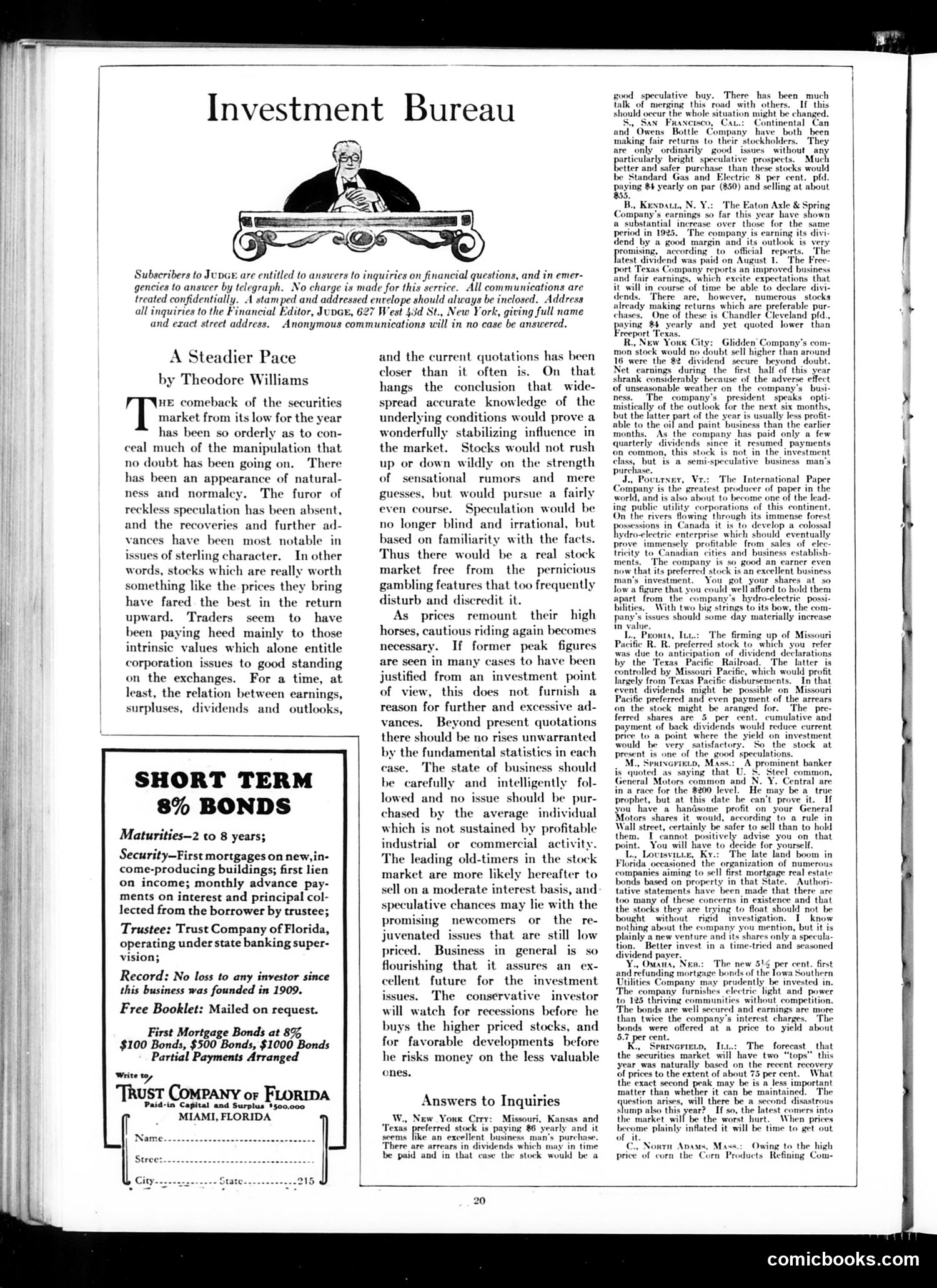
This page features Theodore Williams's financial column "A Steadier Pace," advocating for rational, fundamentals-based stock market investing over reckless speculation. The article argues that the recent market recovery has been orderly and driven by genuine corporate values—earnings, dividends, and outlooks—rather than rumors and manipulation. Williams warns against excessive speculation and recommends that conservative investors carefully analyze business conditions before purchasing stocks, particularly avoiding overpriced securities. The accompanying image shows a bespectacled man at a desk, presumably the financial advisor answering reader inquiries. This reflects Judge magazine's service offering free financial advice to subscribers. The page also includes a substantial advertisement for Trust Company of Florida's 8% short-term bonds, marketed as safe investments secured by first mortgages on income-producing properties, with a claimed perfect track record since 1909.
This page is primarily **financial advice and investment advertising**, not political satire. The left column contains a "Letters to Investors" section where readers ask about stocks (Corn Products, radio companies, oil stocks, automobiles, adding machines). A financial columnist gives conservative investment guidance—recommending bonds over speculative stocks, warning against overpaying for dividends, and advocating for "responsible bond houses." The right side is an **advertisement for Milton Strauss Corporation's first mortgage real estate bonds**, emphasizing safety, security margins, and intelligent investment. There's a coupon to mail for information. The only mild satire appears in the header "**$ $ $ $ $ $ $ $ $ $ $ are mighty good friends**"—a tongue-in-cheek acknowledgment that money talks. This reflects 1920s investor culture: post-WWI economic boom, stock market enthusiasm, but also caution about speculation (the "radio boom" is mentioned as cooling). The page targets affluent readers seeking reliable income through bonds rather than risky stock speculation.
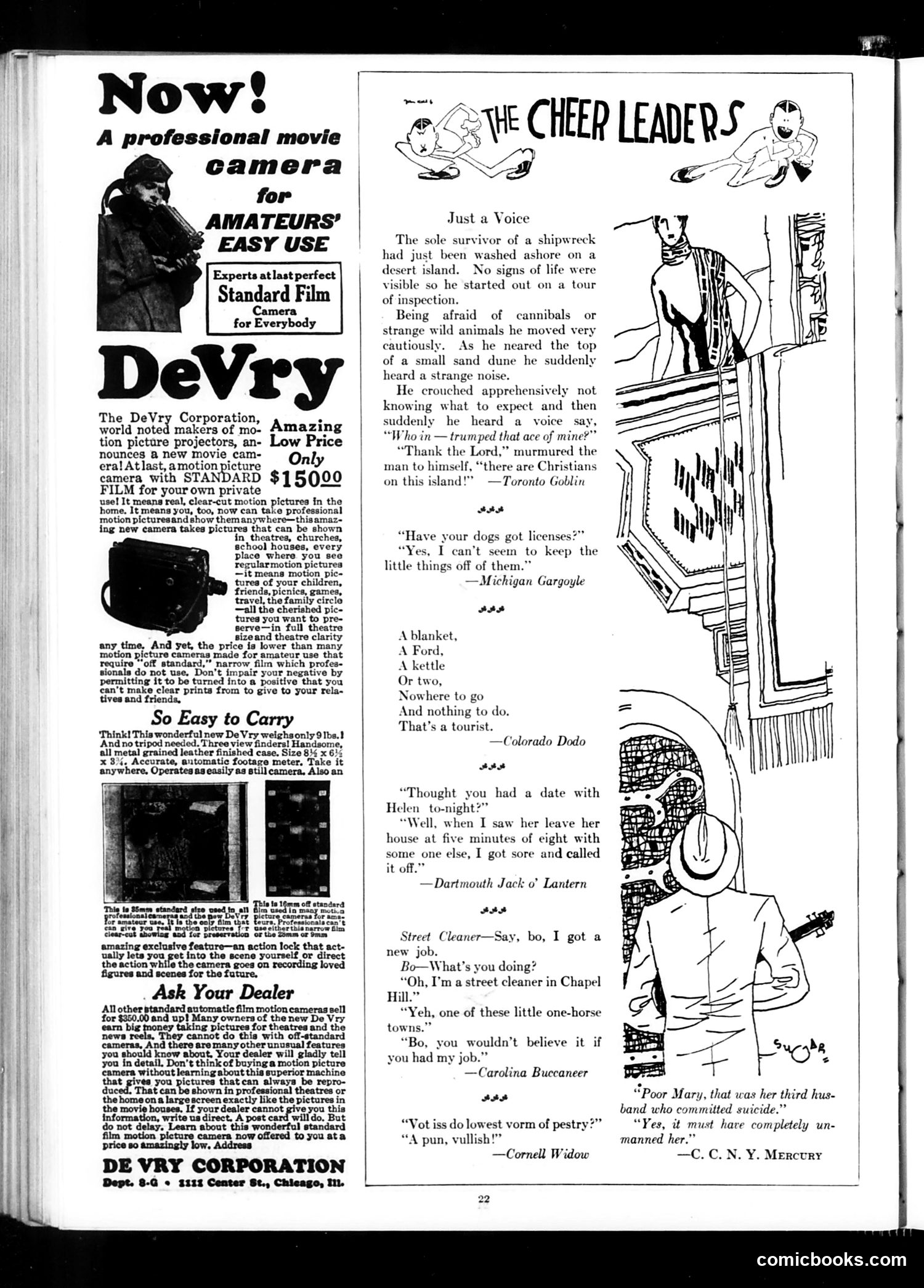
This page is primarily **advertising for the DeVry motion picture camera**, aimed at amateur filmmakers. The large left side promotes an affordable ($150) home movie camera using standard film—a significant innovation allowing ordinary people to film family events with professional quality. The right side contains **"The Cheerleaders,"** a humor section collecting brief jokes from college publications and newspapers. These satirical quips target everyday social situations: a castaway finding Christians via a poker dispute; tourists with nowhere to go; a man canceling a date after seeing his date leave with someone else; and wordplay about a street cleaner's unglamorous job. The humor is gentle, observational comedy reflecting 1920s middle-class concerns—dating, employment, travel, and leisure. No specific political satire is evident; this is social humor suitable for a general audience. The juxtaposition of earnest advertising with lighthearted jokes was typical Judge magazine layout.
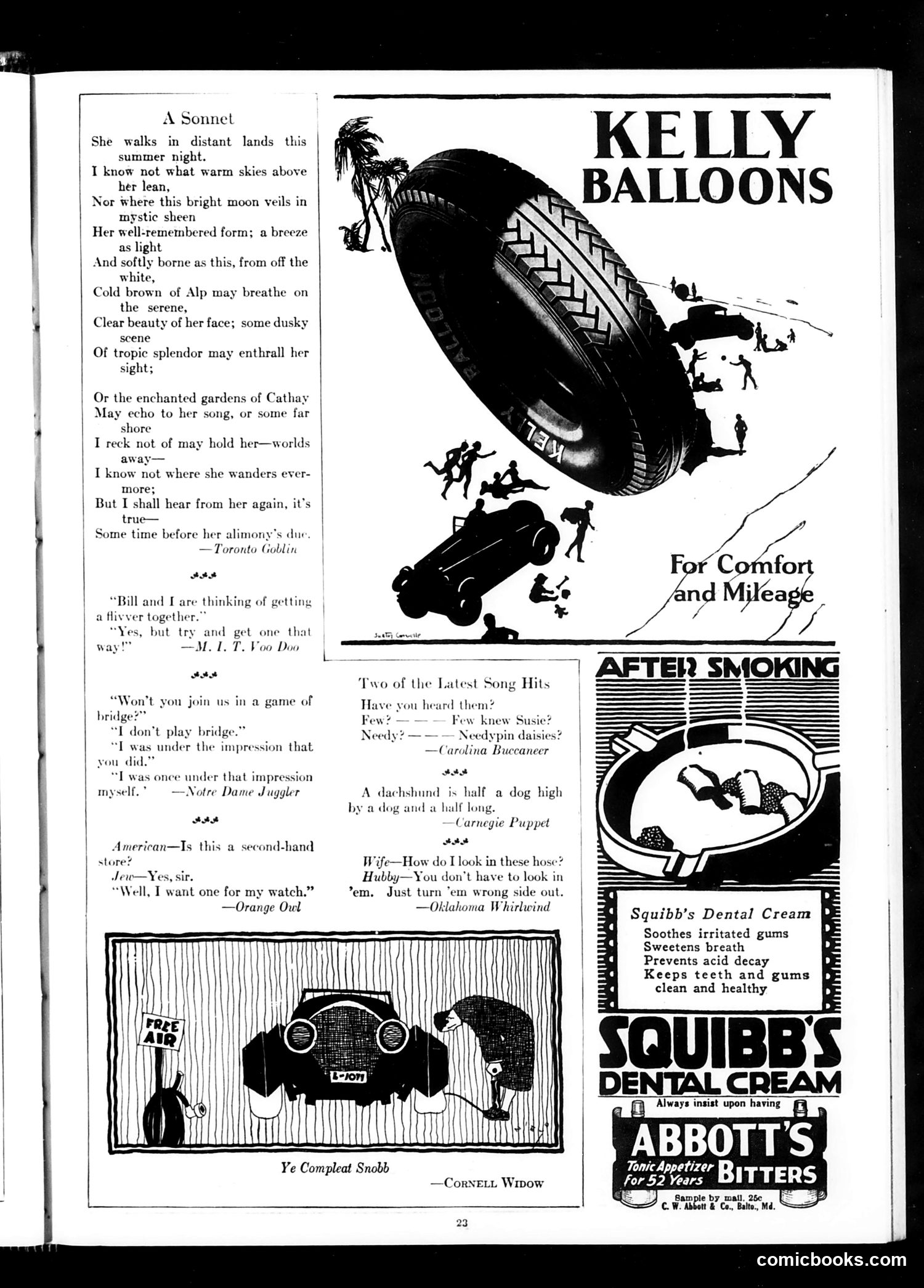
This page from *Judge* contains primarily **short humorous jokes** and **advertisements** rather than political cartoons. The jokes satirize **modern social life**: a sonnet mocking alimony payments ("before her alimony's due"), automobile culture ("flivver" = cheap car), and class encounters (an American tourist and Jewish shopkeeper). One cartoon shows a car owner seeking a "second-hand" timepiece—a pun on "second-hand store." The humor is **topical to the 1920s**: references to bridge (popular card game), dancing/songs, and the casual anti-Semitic stereotyping typical of that era's "humor" magazines. The **advertisements** for Squibb's Dental Cream and Abbott's Bitters represent typical period marketing, with Kelly Balloons prominently advertising leisure/recreation products. No specific political figures or events are referenced. This is entertainment-focused content reflecting upper-middle-class social preoccupations of the era.
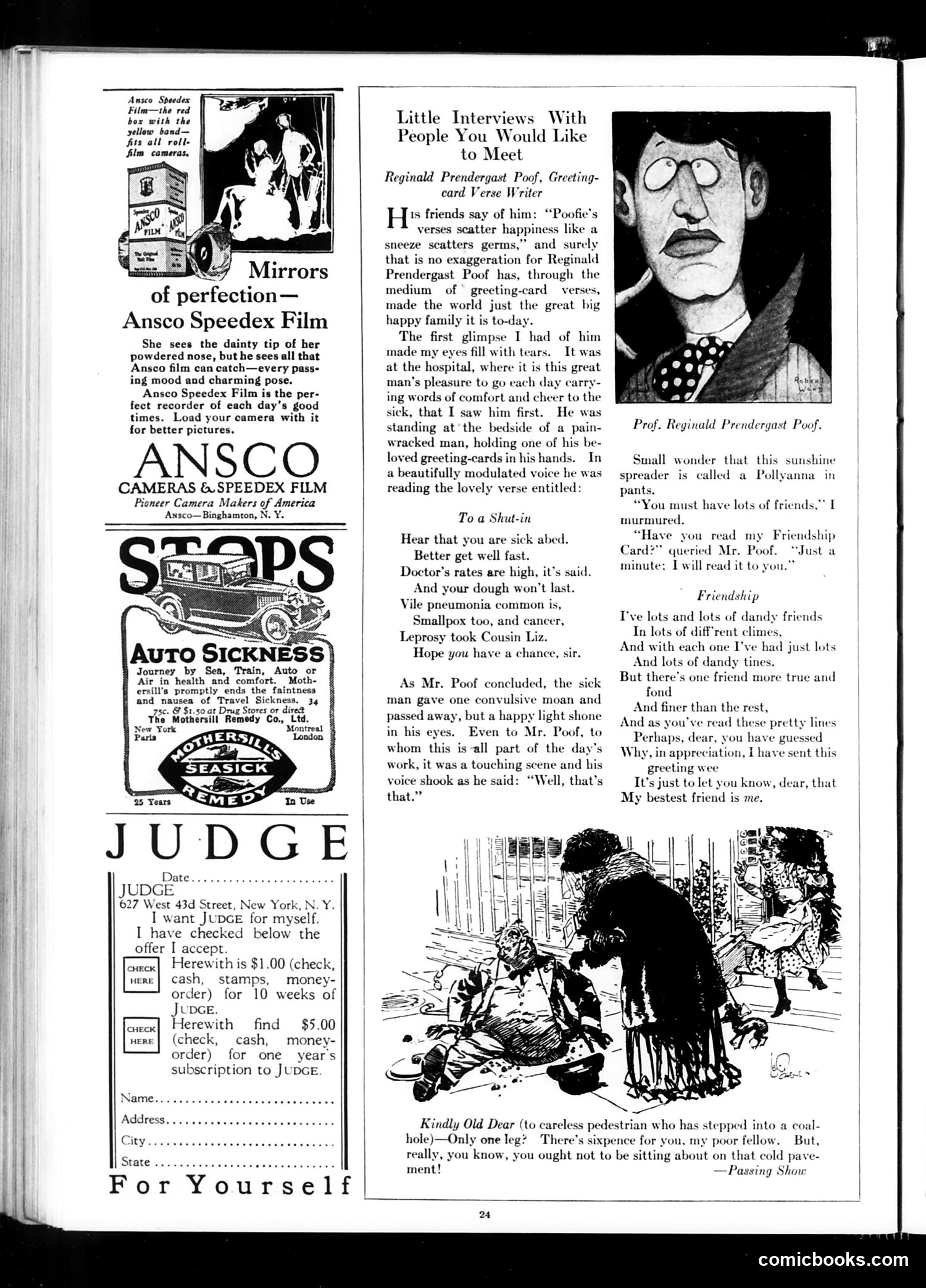
This page contains satirical content mocking sentimental greeting-card culture. The main feature, "Little Interviews With People You Would Like to Meet," profiles **Reginald Prendergast Poof**, a fictional greeting-card verse writer presented as a beloved humanitarian spreading joy through verse. The satire is sharp: Poof's actual "Shut-in" greeting card is hilariously callous, listing diseases and death while offering minimal comfort ("Hope you have a chance, sir"). A patient dies while Poof reads it—a dark joke about greeting-card platitudes' uselessness during genuine suffering. The irony deepens when Poof's "Friendship" poem ends by admitting his best friend is himself, undermining the entire premise of his supposed generosity and social contribution. The bottom cartoon (partially visible) shows another figure—appears to be about poverty or social indifference. Overall, Judge ridicules both the greeting-card industry's saccharine pretense and society's shallow sentimentality masquerading as compassion.
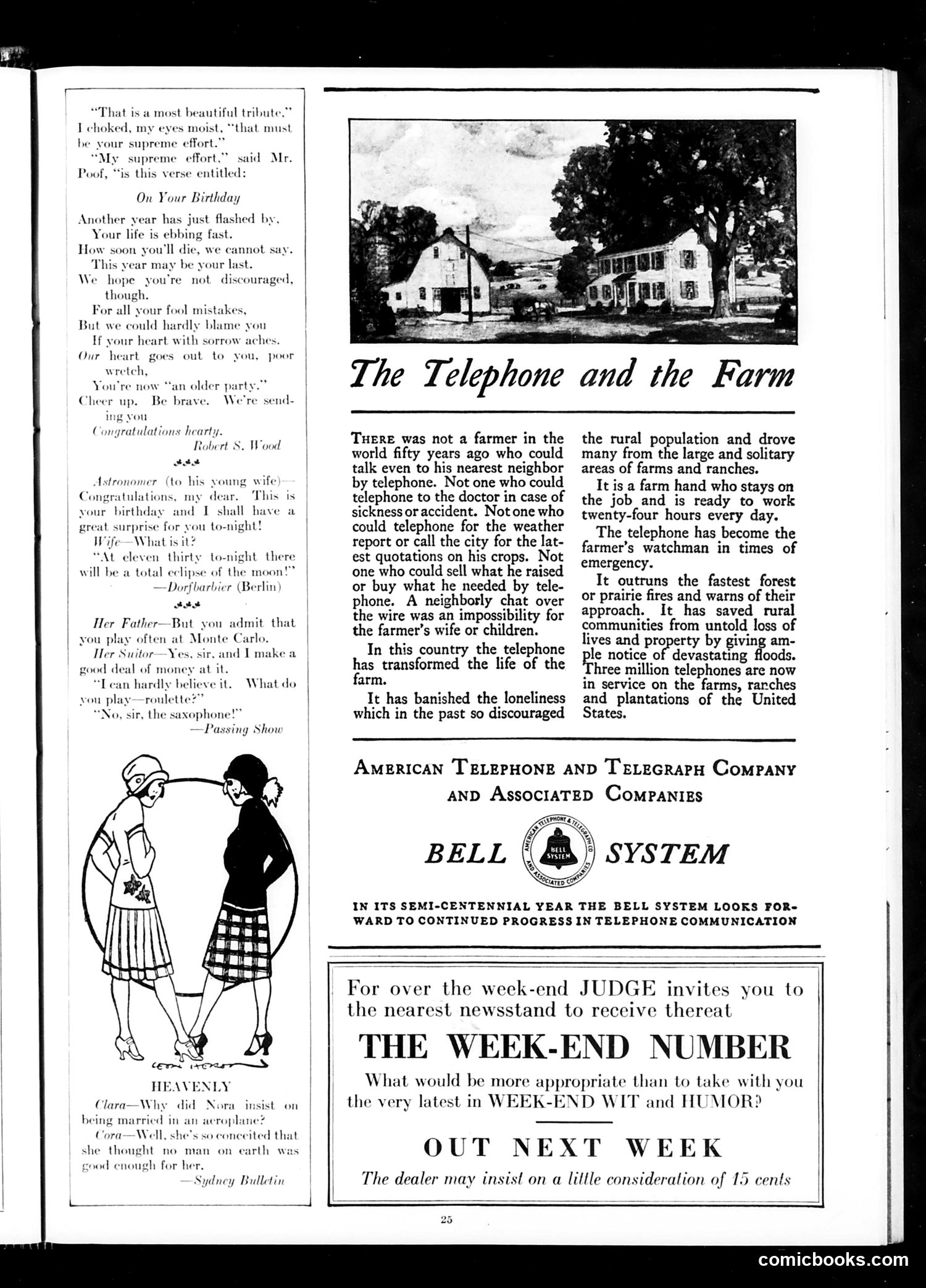
This page mixes humor with corporate advertising. **Left side:** Several short jokes and witty exchanges, including a darkly comic "birthday poem" by Mr. Poof that congratulates someone while reminding them they're aging and will die soon—satirizing insincere, maudlin greeting sentiments. Other jokes involve romantic mishaps (a woman marrying in an airplane) and a man claiming to win money at roulette by playing saxophone (absurdist humor). **Right side:** A lengthy advertorial for the Bell System telephone company. Rather than satirizing the telephone (as Judge typically does), it earnestly promotes how telephones have transformed rural farm life—eliminating isolation, enabling emergency communication, and warning of fires and floods. The ad notes three million farm telephones are now in service. **The contrast is notable:** Judge's left page offers cynical, irreverent humor; the right page is straight corporate messaging. The page closes with a promotion for Judge's weekend edition. This appears to be paid advertising integrated into the magazine's content.
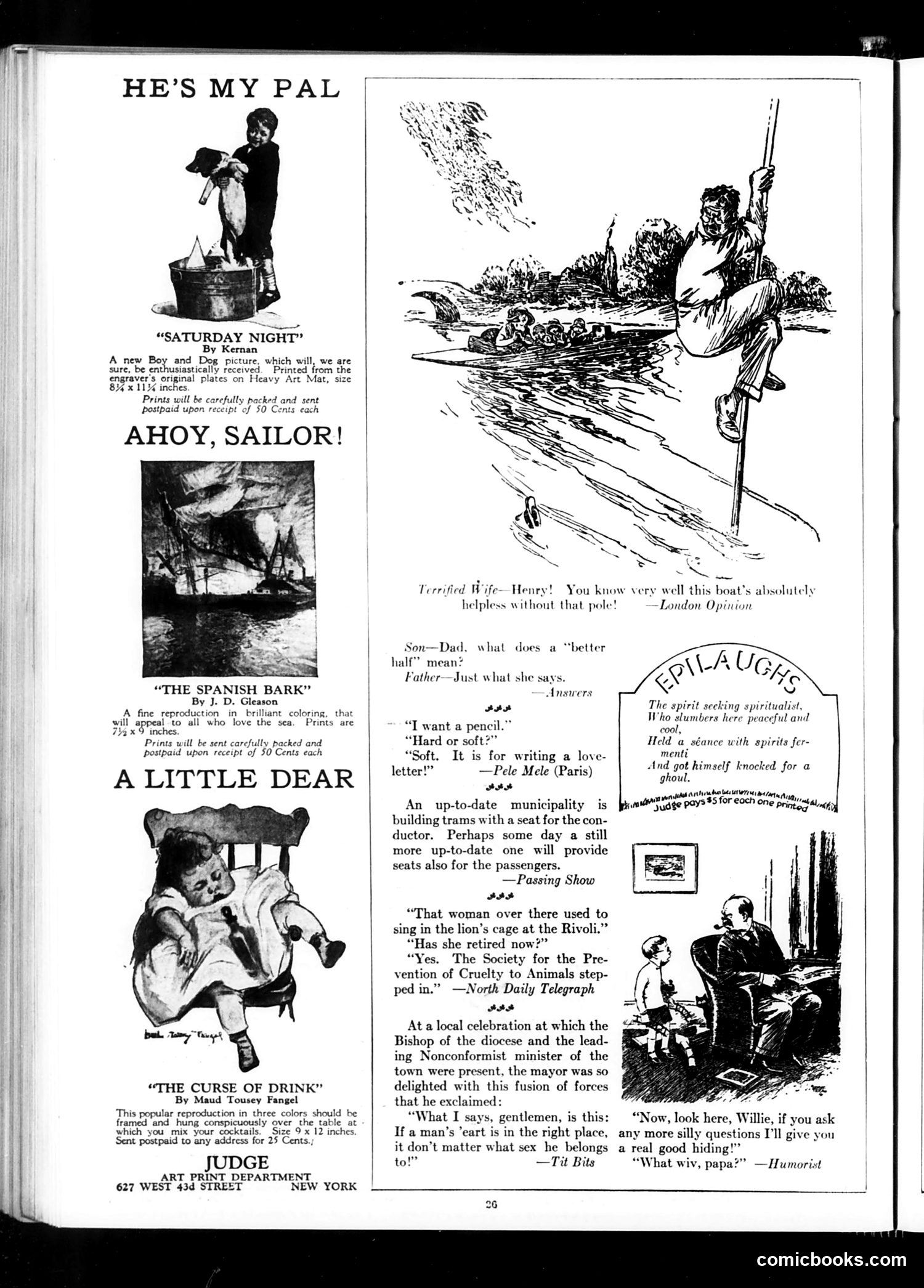
This page primarily consists of **advertisements for art prints** rather than political cartoons. Judge's Art Print Department marketed reproducible illustrations by various artists—"Saturday Night" (a boy-and-dog scene), "The Spanish Bark" (a maritime scene), and "The Curse of Drink" (a temperance-themed image). These sold for 25-50 cents. The right side collects **humorous anecdotes and jokes** typical of satirical magazines: - A wife calls her husband "Henry" during a boat crisis (gender role humor) - A child's innocent misunderstanding of "love-letter" (wordplay) - A municipality building trams without passenger seats (bureaucratic incompetence satire) - A woman banned from performing at the Rivoli for animal cruelty concerns (social reform humor) - A mayor praising religious unity while using poor grammar (class-based satire) - A father threatening corporal punishment (parenting humor) These jokes mock social pretensions, bureaucratic absurdity, and contemporary reform movements—typical Judge content, though now dated in sensibility.
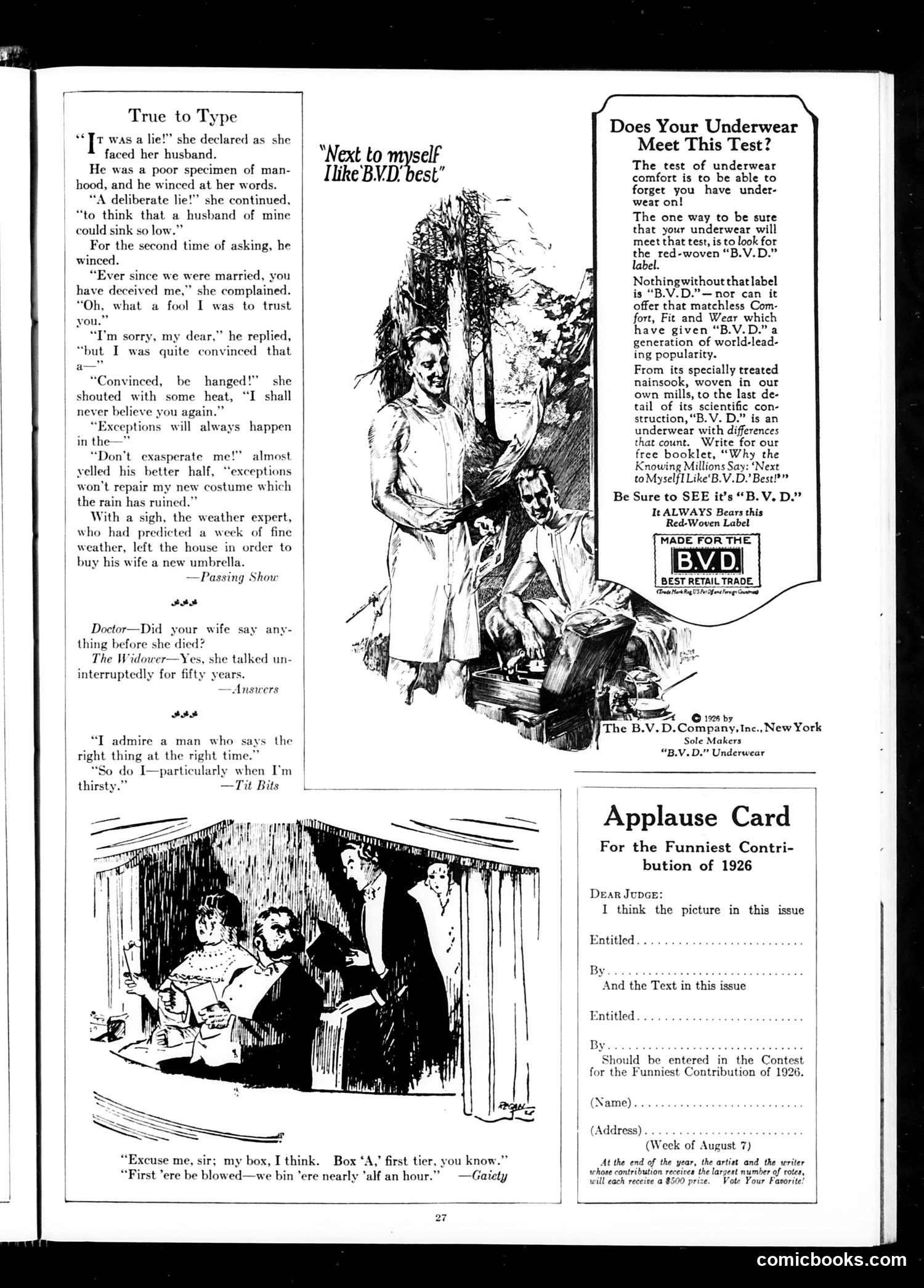
This page contains three humor pieces satirizing marriage and domestic life, plus a B.V.D. underwear advertisement. **"True to Type"** depicts a nagging wife berating her husband—a weather forecaster whose rain prediction failed, ruining her new costume. The joke targets both the wife's shrewish behavior (she won't let him speak) and the husband's emasculation (he "winces" repeatedly). This reflects 1920s stereotypes about domineering wives. **The brief jokes** mock marriage itself: one depicts a widow who won't stop talking even in death; another celebrates a man who knows when to stay silent—especially when thirsty (implying escape to a bar). **The theater cartoon** shows working-class men in a theater dispute, using Cockney dialect ("'ere be blowed"), representing lower-class comedy stock characters. The **B.V.D. advertisement** is a straightforward commercial claiming their underwear brand is most comfortable because you'll "forget you have underwear on." The **Applause Card** invites readers to vote for the funniest contribution of 1926, with $500 prizes for winners.
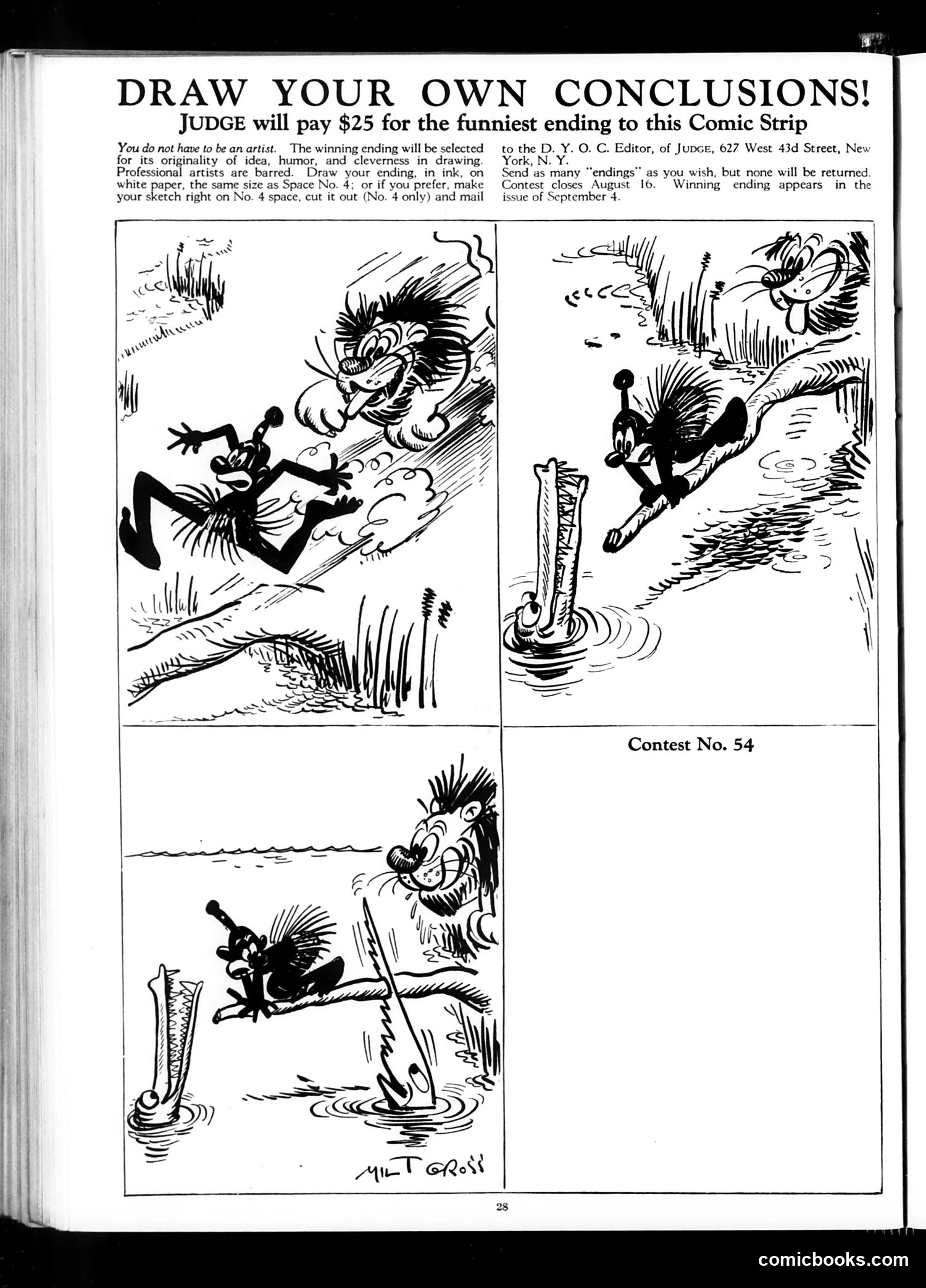
This is a **reader participation contest** from *Judge* magazine, not political satire. The page shows an incomplete comic strip (Contest No. 54) featuring a cartoon character with spiky hair being chased by what appears to be a smaller, humanoid creature near water and a log. Readers were invited to draw their own funny endings to the strip, with the winner receiving $25 and publication in the September 4 issue. Professional artists were excluded to encourage amateur submissions. This type of interactive content was common in early 20th-century magazines—it engaged readers, generated submissions, and filled pages inexpensively. The incomplete narrative creates comedic potential: viewers must imagine how the chase concludes. Without knowing the specific characters or context, the humor likely relies on physical comedy and absurdist situations typical of the era's comic strips.
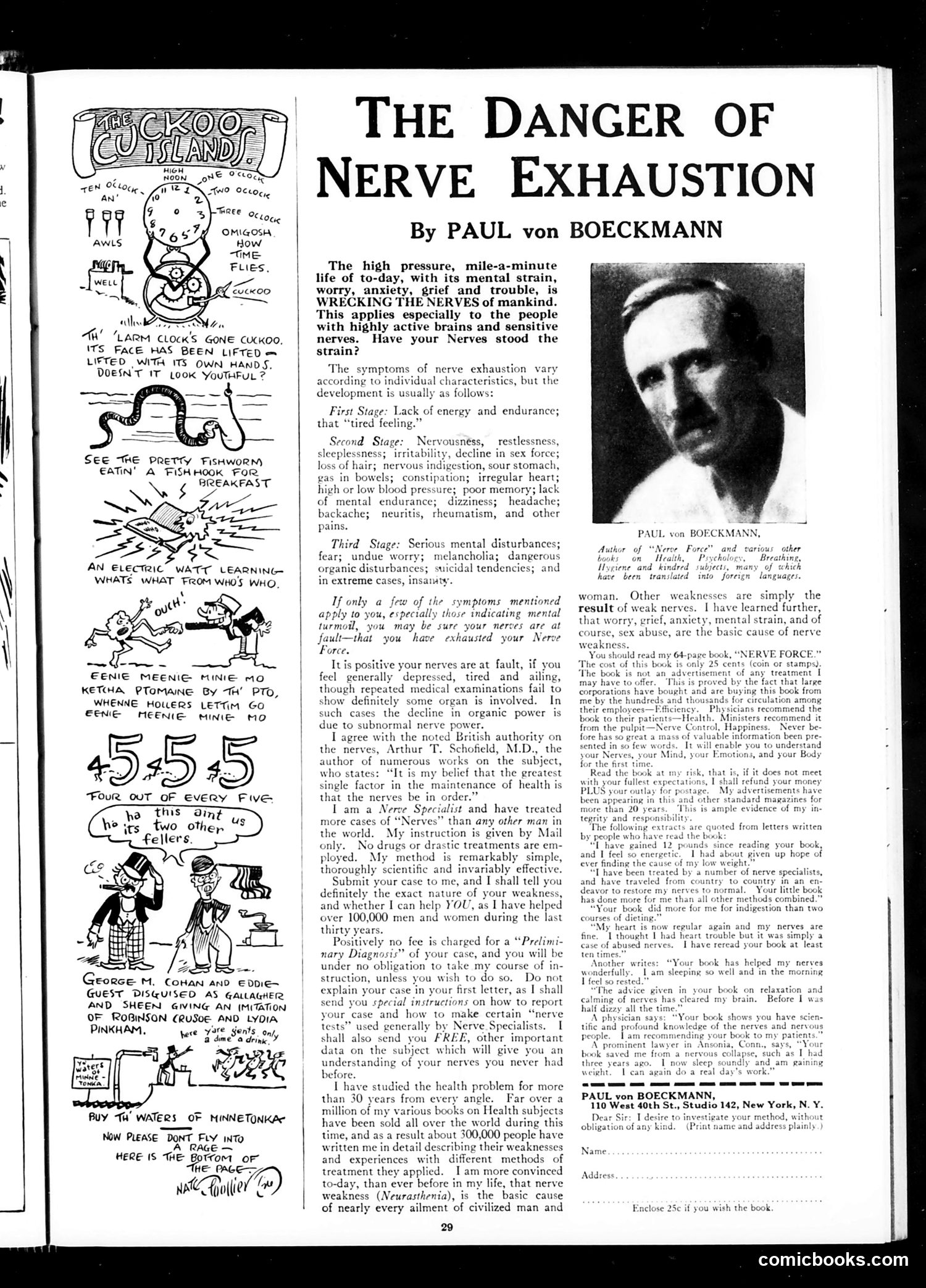
This page contains two distinct elements: **cartoons on the left** (mostly humorous sight gags with minimal coherence—a clock's face lifted, a fishworm eating a fishhook, vaudeville performers doing imitations) and **a substantial advertisement on the right**. The advertisement is for Paul von Boeckmann, a "Nerve Specialist" offering mail-order treatment for "nerve exhaustion"—a condition popular in early 20th-century medicine that attributed various ailments (fatigue, insomnia, hair loss, heart palpitations, depression, suicidal thoughts) to depleted "nerve force" caused by modern life's stress. The pitch promises a free "preliminary diagnosis" by mail, no obligation to purchase treatment, and claims success with 100,000 patients over 30 years. This was typical patent-medicine advertising of the era—exploiting vague psychological/physical complaints with pseudo-scientific language. The cartoons appear unrelated filler, possibly by different artists. Their satire targets are unclear—possibly mocking contemporary entertainment or fashion trends.
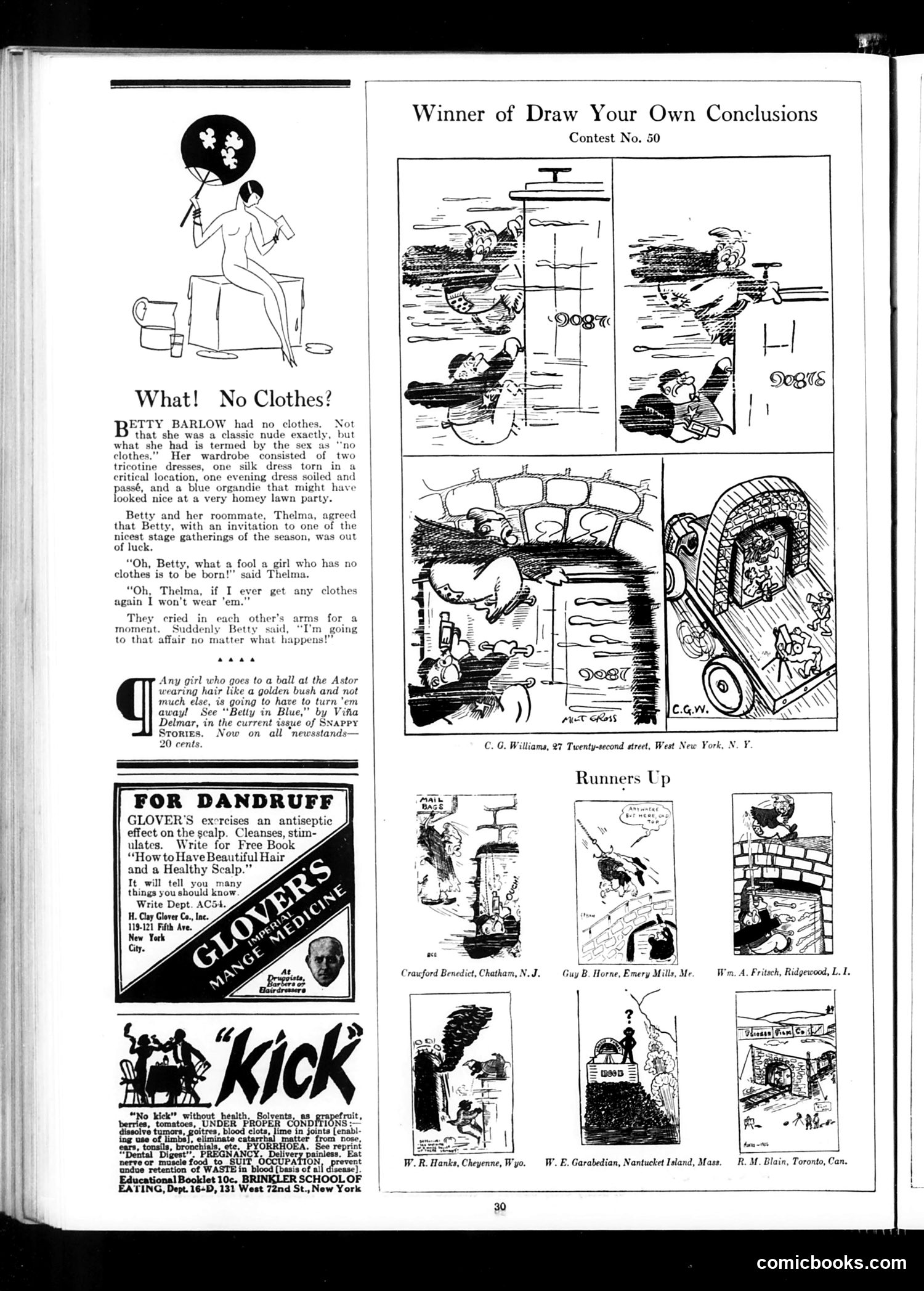
This page contains a short story titled "What! No Clothes?" about Betty Barlow, a young woman with virtually no wardrobe who desperately wants to attend a prestigious ball at the Astor hotel. The humor derives from the era's social anxiety about fashion and status: Betty owns only worn, damaged, or outdated dresses and feels she cannot possibly attend without proper attire. Her dramatic friend Thelma commiserates until Betty decides to go anyway, joking that her bare appearance will force the venue to "turn 'em away"—suggesting that shocking audacity might succeed where poverty prevents respectability. The story satirizes 1920s-30s women's preoccupation with fashion and social standing, while also gently mocking the desperation some women felt about their limited wardrobes during economically uncertain times. The page also features contest winners for "Draw Your Own Conclusions" (a visual puzzle feature) and period advertisements for dandruff treatment and dietary education.
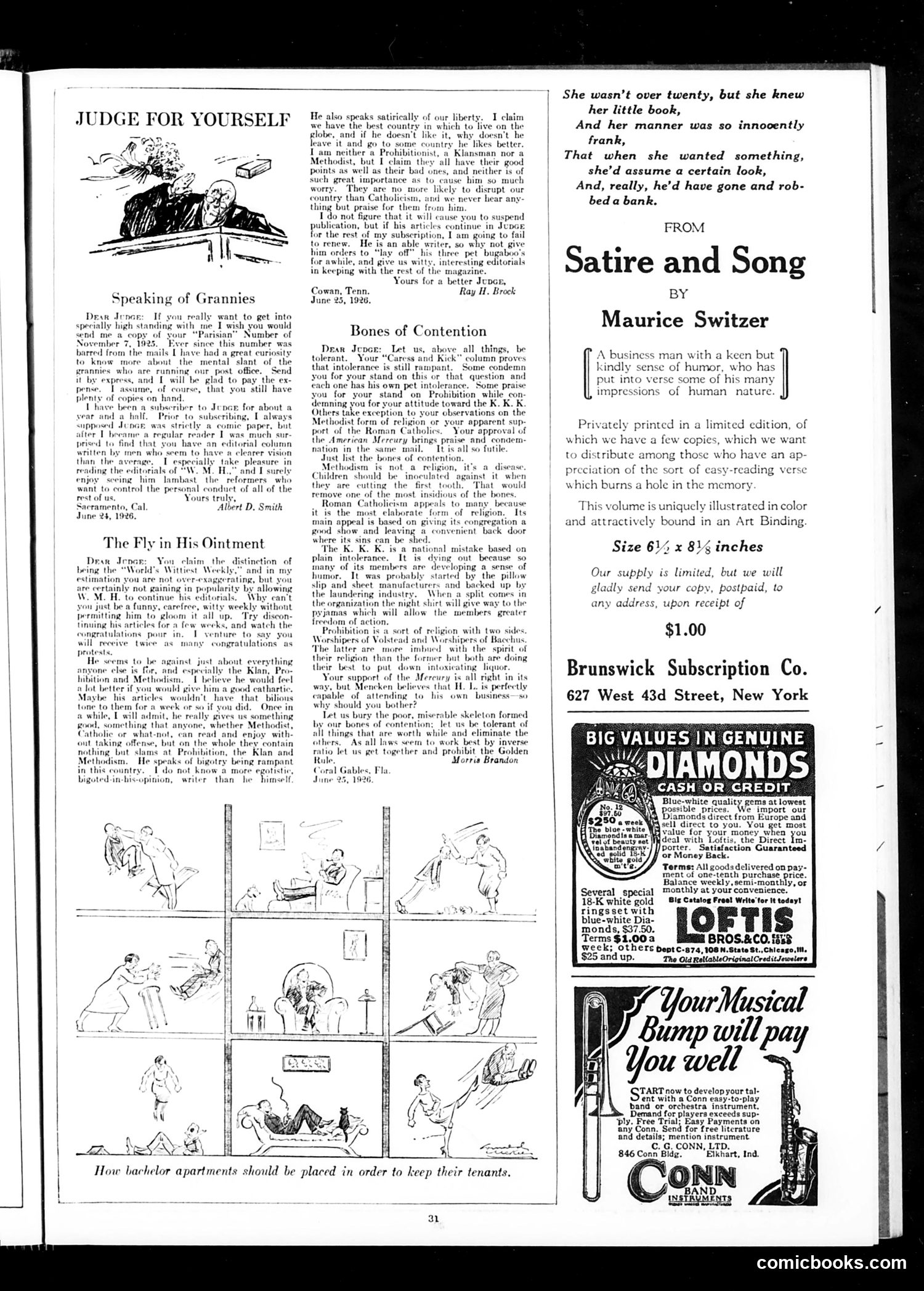
This page features readers' letters to *Judge* magazine's advice column, offering insight into 1920s cultural anxieties. **Key Issues:** The first letter praises *Judge* for intellectual content beyond mere comedy. The second, from Ray H. Brock, criticizes columnist W.M.H. for repeatedly attacking Prohibition, the Ku Klux Klan, and Methodism. Brock defends these institutions as legitimate and resents W.M.H.'s "bigotry" against them. The third letter from Morris Brandon advocates tolerance while listing contentious issues: whether Methodism is "religion," childhood inoculation timing, and Catholicism's practices. **Context:** These letters reveal *Judge* readers were divided over Prohibition (then active, 1920-1933) and the Klan's cultural influence. Conservative readers defended traditional institutions; W.M.H.'s satirical attacks apparently troubled those sympathetic to these movements. The debate reflects deep 1920s social fractures over modernism versus tradition.
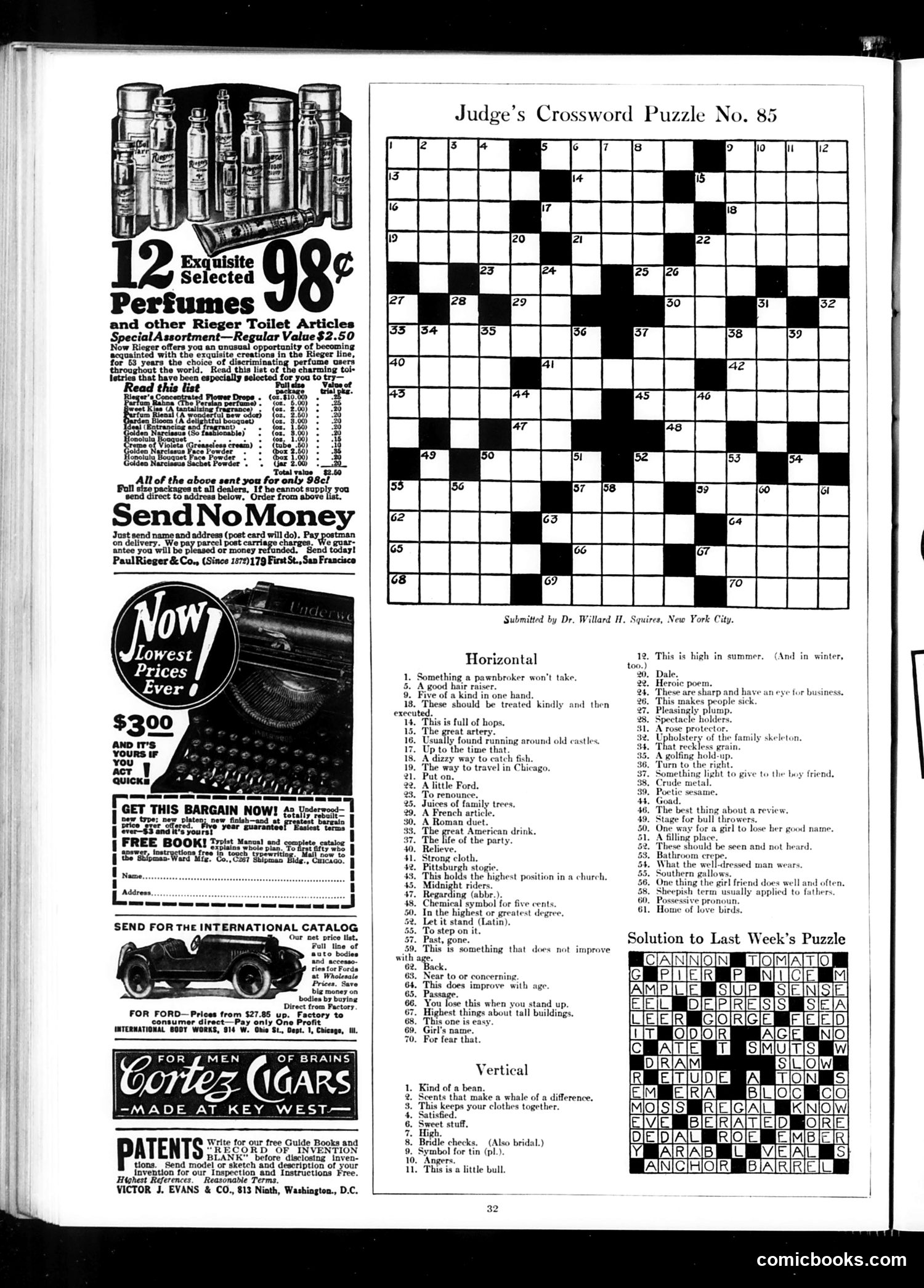
This page is primarily **advertising and puzzles**, not satire or political cartoons. It contains: **Main Content:** - A crossword puzzle ("Judge's Crossword Puzzle No. 85") with clues and a solution grid from the previous week - Multiple product advertisements typical of 1920s magazines **Advertisements Include:** - Rieger perfumes and toilet articles (98¢ special offer) - A typewriter deal ("GET THIS BARGAIN NOW!") - Ford automobile pricing - Cortez cigars - Patent/invention submission service **Historical Context for Modern Readers:** This reflects pre-Depression consumer culture—mail-order products, aggressive pricing claims, and direct-to-consumer sales pitches. The "Send No Money" payment model was novel marketing. The magazine subsidized content through extensive advertising, a standard publishing model of the era. There are **no political cartoons or satirical figures** on this page—it's essentially a period document showing how magazines monetized themselves and what products/services Americans could purchase through print media circulation.
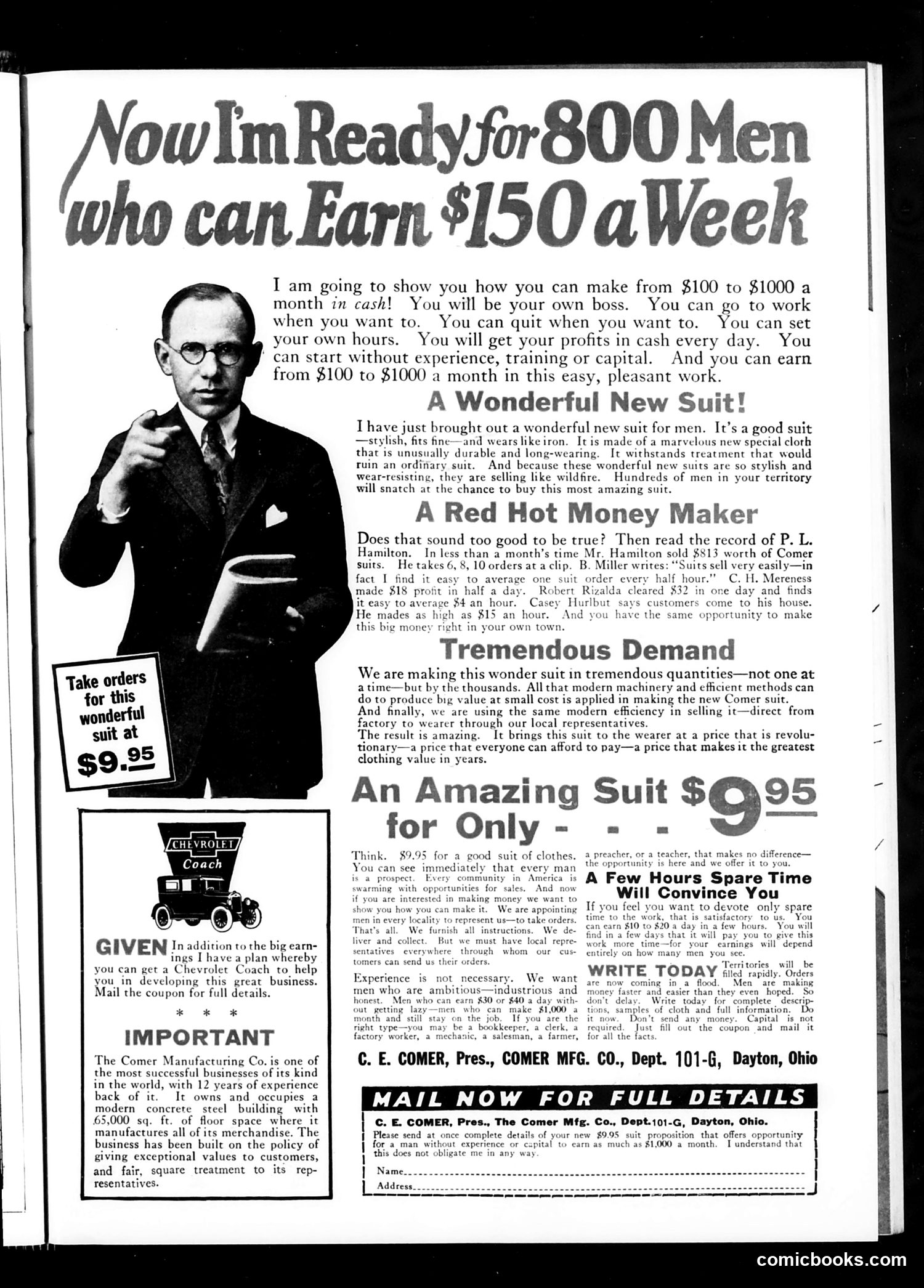
This page is primarily **advertising, not political satire**. It's a sales pitch from the Comer Manufacturing Company of Dayton, Ohio, recruiting commission salesmen to sell men's suits door-to-door. The central appeal uses classic early-20th-century get-rich-quick rhetoric: promises of $100-$1000 monthly income with minimal effort, no experience needed, and being "your own boss." The $9.95 suit (remarkably cheap for the era) is positioned as a "Red Hot Money Maker" through testimonials from salesmen claiming extraordinary profits ($15-$32 daily). The image shows a businessman in glasses and suit gesturing persuasively—likely representing either the company owner or an idealized successful salesman. The pitch also offers a Chevrolet Coach as incentive for recruits, leveraging automobile ownership as status symbol. This represents Depression-era direct-sales culture and reflects both genuine opportunity and exploitative recruitment practices targeting economically desperate workers.
This is a **cigarette advertisement**, not satire or political commentary. It's a Lucky Strike ad from Judge magazine promoting their "It's Toasted" branding—a marketing claim about their tobacco processing method. The image shows a hand holding a cigarette over what appears to be a tobacco package. The ornate decorative frame typical of Judge's design adds prestige to the product placement. For modern readers: This represents an era when cigarette advertising appeared freely in mainstream magazines without health warnings. "It's Toasted" was Lucky Strike's actual slogan from that period, emphasizing their supposedly superior tobacco treatment. The ad uses Judge's sophisticated design aesthetic to target educated, affluent readers—reflecting how tobacco companies marketed aggressively to respectable audiences before widespread awareness of health risks.