
A complete issue · 36 pages · 1926
Judge — July 24, 1926
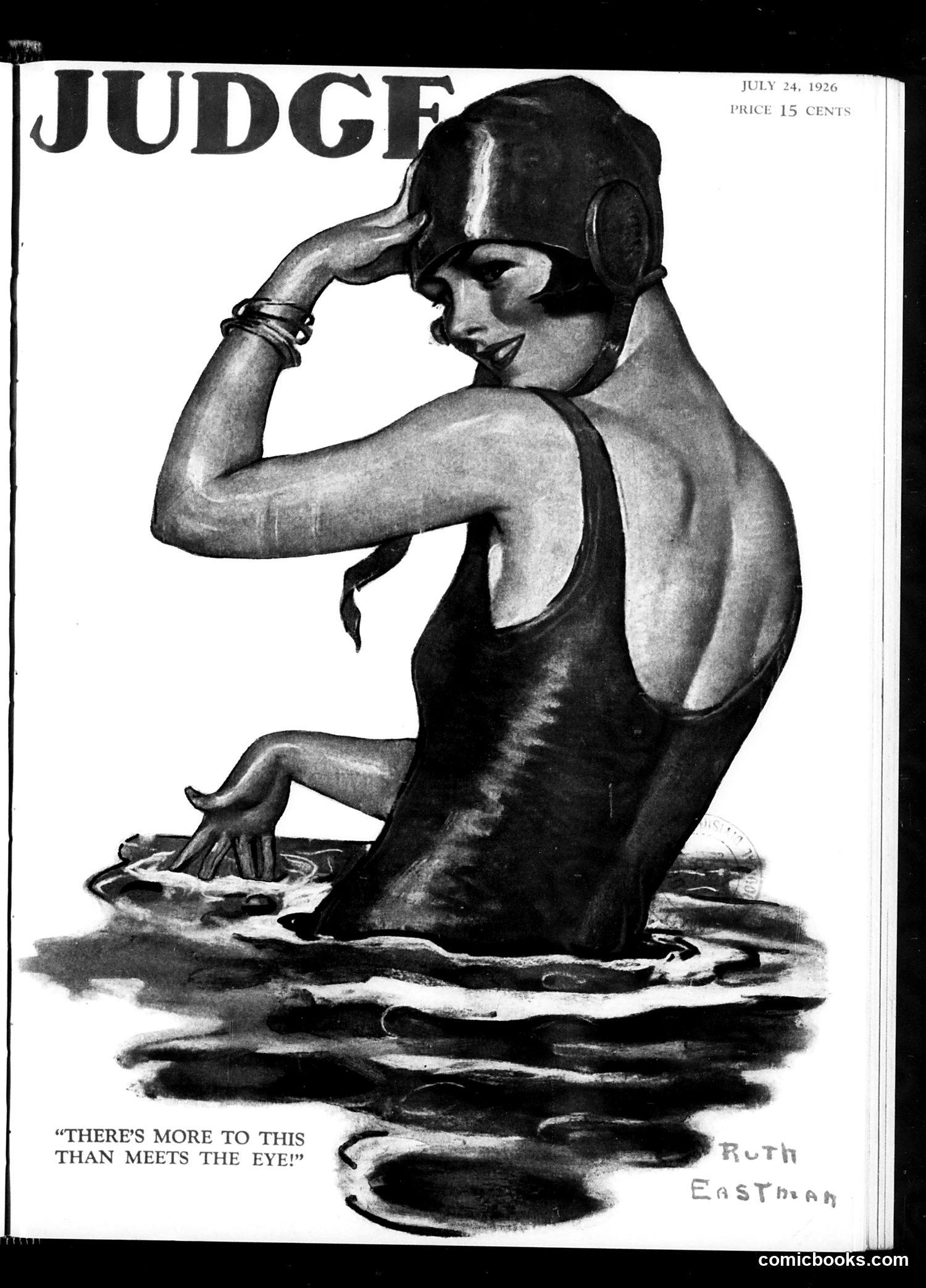
This illustration by Ruth Eastman depicts a woman in a swimming bathing suit and cap, kneeling in water while adjusting her headgear. The caption reads "There's More to This Than Meets the Eye." The satire likely comments on 1920s beach culture and evolving women's fashion. The bathing suit was controversial during this era—more revealing than previous decades—representing changing social mores around women's bodies and public behavior. The phrase suggests hidden depths or complications beneath surface appearances, possibly mocking contemporary anxieties about modernity, women's increasing freedom, or the gap between public propriety and private behavior. The artwork's prominent display on Judge's cover indicates this was a notable social commentary for the magazine's readership during the Jazz Age.
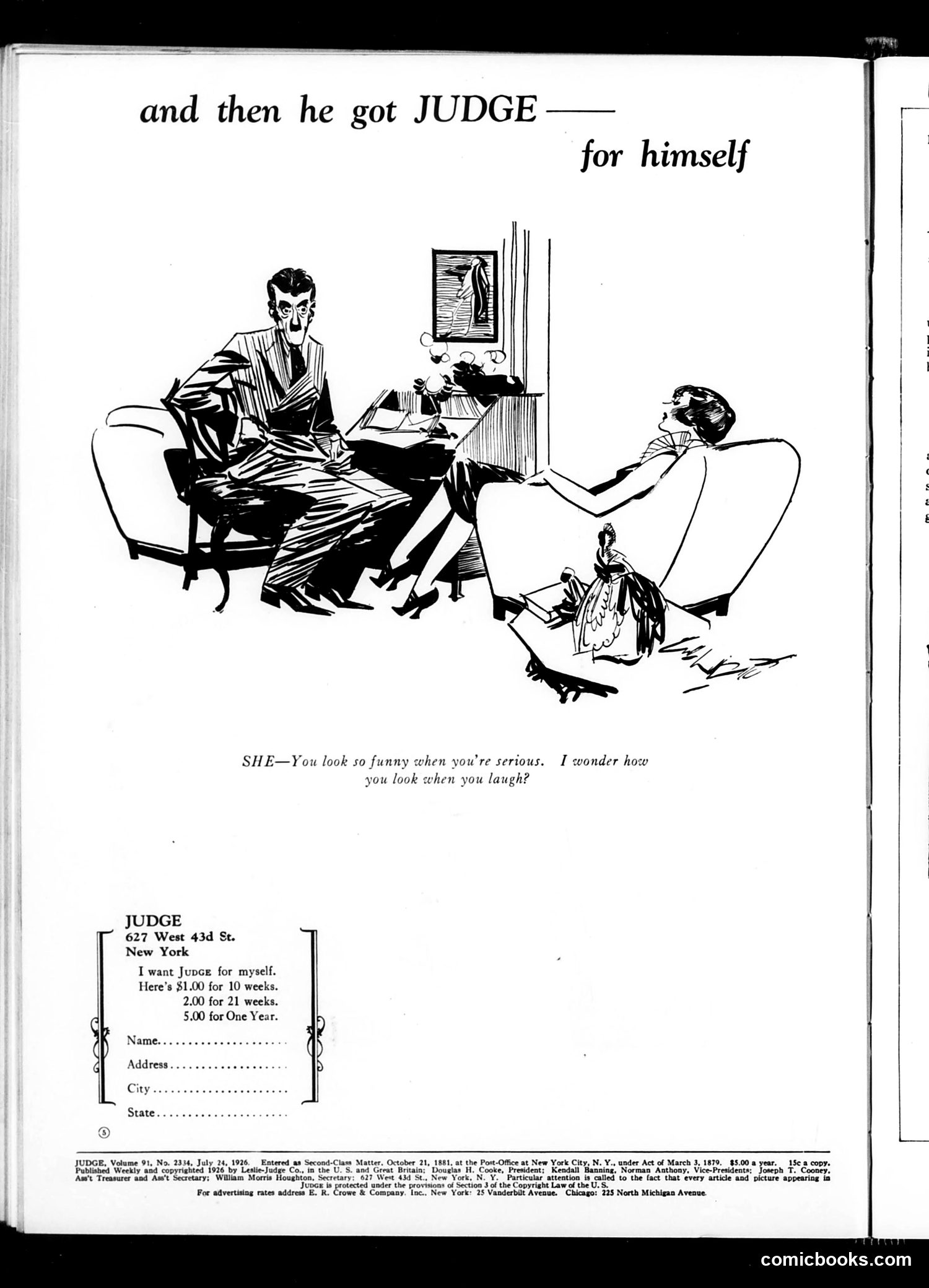
This is primarily an **advertisement for Judge magazine itself**, disguised as satirical content. The headline "and then he got JUDGE — for himself" promotes a subscription offer. The cartoon depicts a serious man (representing the magazine's authority or a judge-like figure) with a woman who comments on his appearance when serious versus when laughing, creating a gentle domestic humor scenario typical of the era. The advertisement below offers subscriptions at various rates ($1.00 for 10 weeks through $5.00 for one year) to the Judge publication at 627 West 43rd St, New York. The satire is minimal—this is fundamentally a **self-promotional advertisement** using light humor to encourage subscriptions to Judge, a publication known for political and social satire during this period.
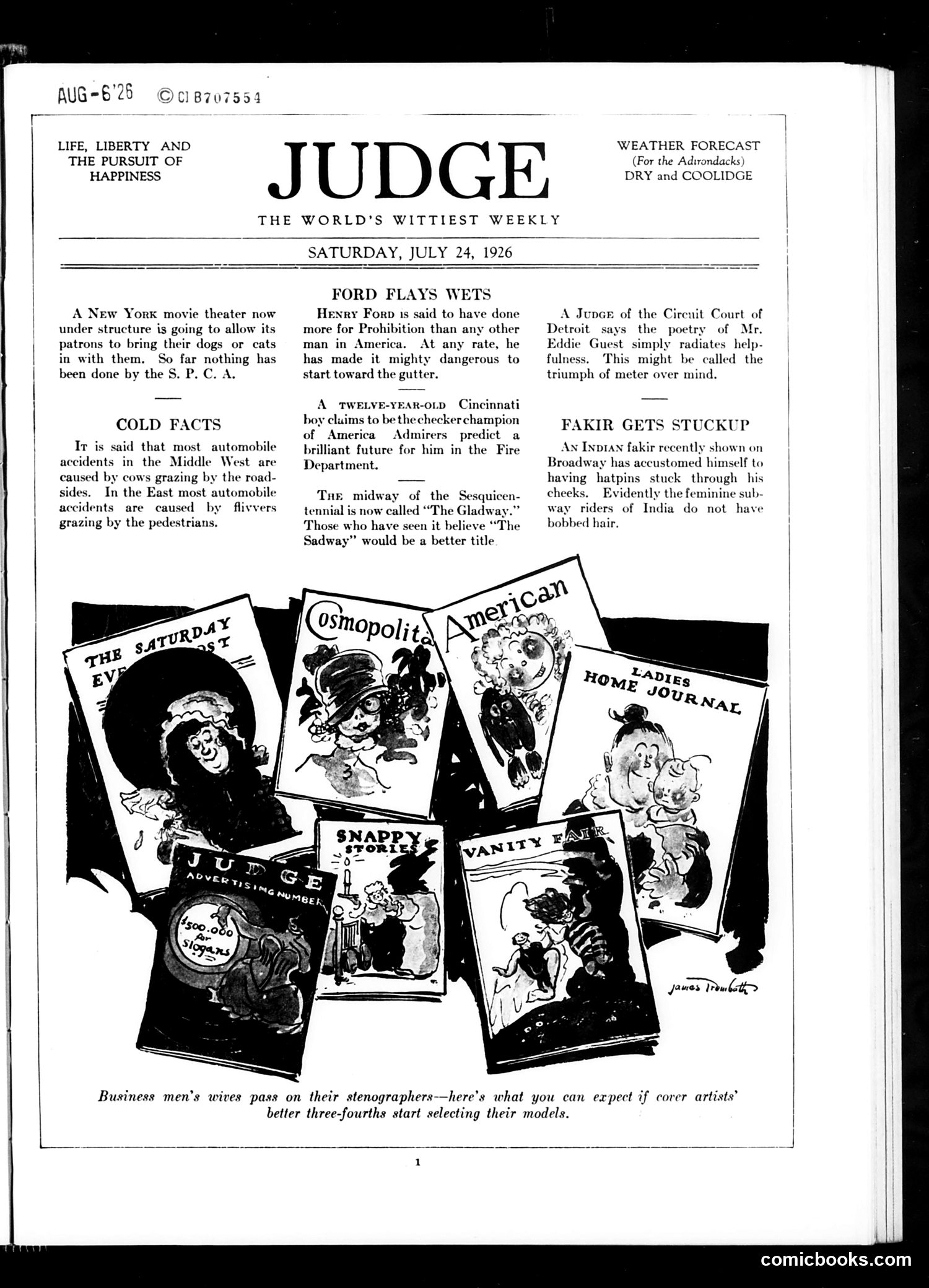
The main cartoon satirizes **magazine cover artists' selection of models**. It displays covers from popular magazines of the era (The Saturday Evening Post, Cosmopolitan, American, Ladies' Home Journal, Snappy Stories, and Vanity Fair), each featuring illustrated female faces. The caption suggests that businessmen's wives are "passing on their stenographers"—implying wives are selecting which attractive female office workers should appear as cover models, presumably as a form of quality control or perhaps mockingly ensuring unattractive alternatives get chosen instead. The surrounding text includes brief humorous items about Henry Ford and Prohibition, a Cincinnati boy's firefighting ambitions, and an Indian fakir's theatrical mishap. The page represents typical Judge content: social commentary and light satire targeting 1920s urban American culture.
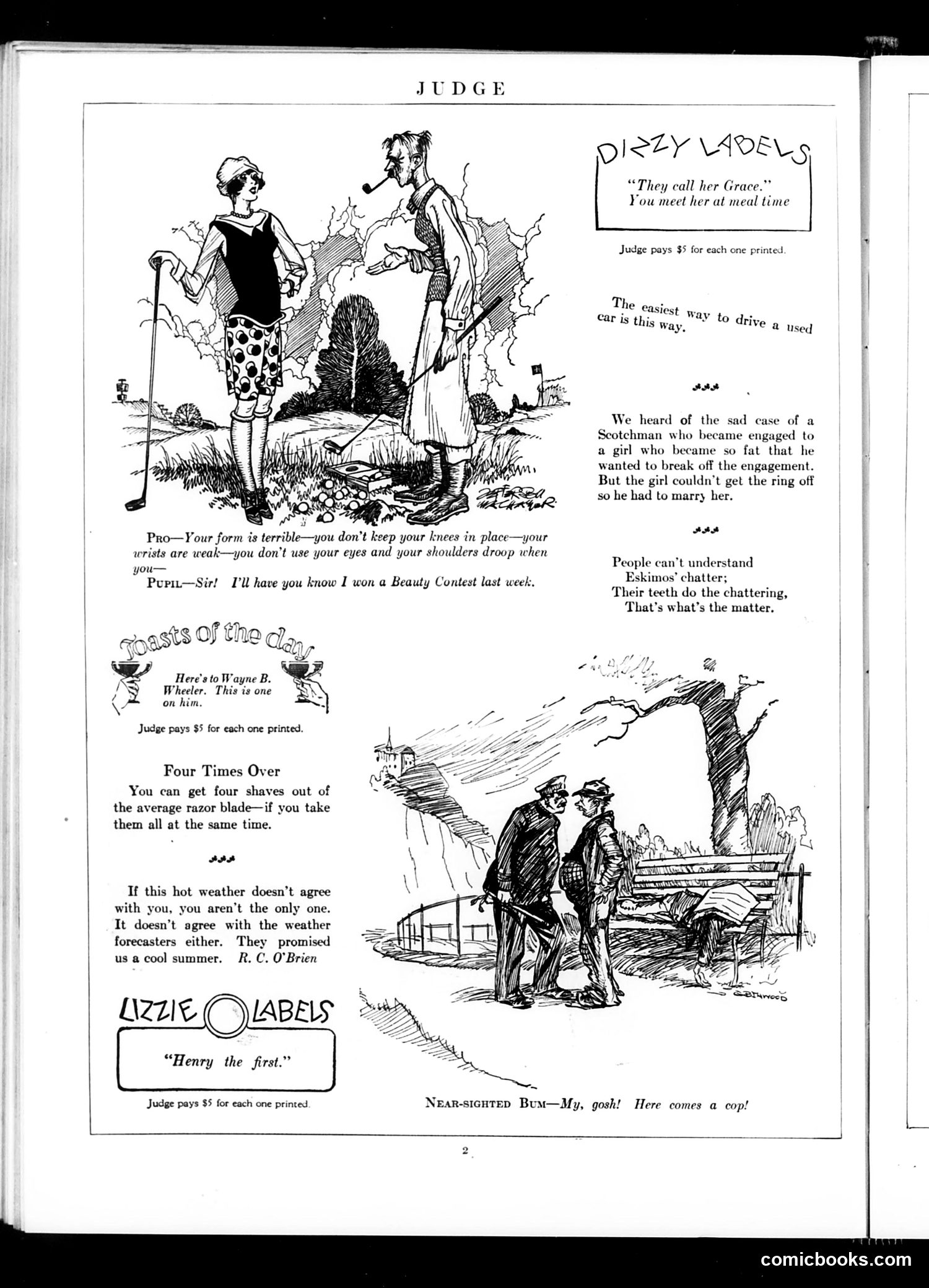
This page contains humor and advertisements rather than political commentary. The top cartoon mocks poor posture in women, with a snobbish instructor criticizing a pupil's form while the pupil boasts of winning a beauty contest—satirizing vanity and superficial standards. "Toasts of the day" advertises a humorous piece about Wayne B. Wheeler, likely a public figure of the era (unclear from context alone). The "Four Times Over" section offers a practical razor blade tip. The bottom cartoon depicts two men encountering a police officer, with the caption suggesting they're trying to appear innocent—a common vaudeville-style joke setup. "Lizzie Labels" advertises another feature. Overall, this is a light humor and lifestyle page typical of early 20th-century Judge magazine.
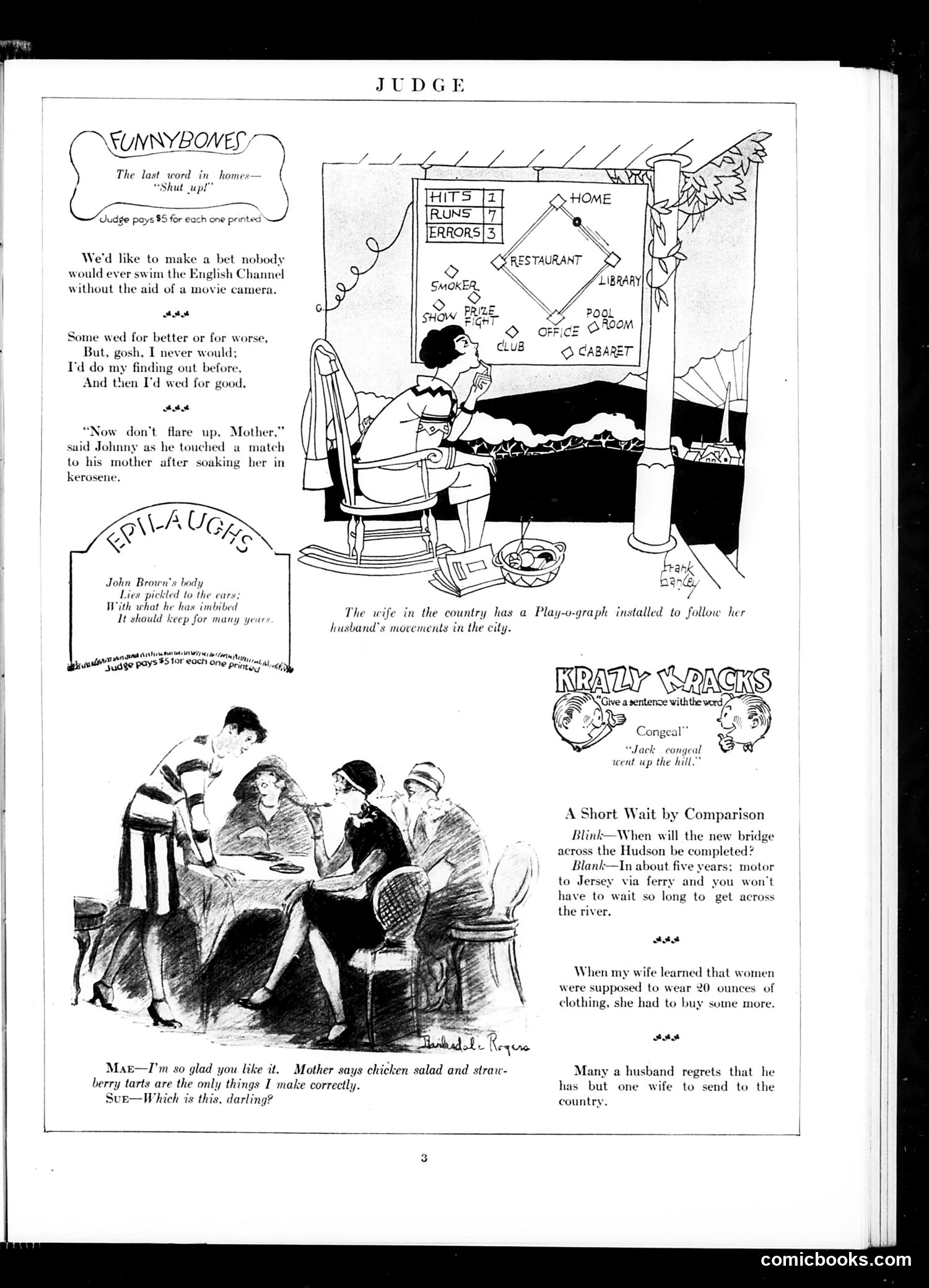
This page contains several humorous pieces typical of 1920s Judge magazine: **"Funnybones"** offers light wordplay about swimming and betting at the English Channel. **"Epilaughs"** presents a dark joke about John Brown's body being picked apart by crows—a morbid pun. **"Krazy Kracks"** shows a play on the word "congeal" (Jack's conga line went uphill). The main cartoon depicts a wife monitoring her husband via a "Play-a-graph" (playback device) installed in their home—satirizing emerging surveillance technology and marital suspicion in the modern era. **"A Short Wait by Comparison"** jokes about the Hudson River bridge project delays, comparing them to ferry commutes. The bottom section contains domestic humor about wives' clothing budgets and husbands' marital regrets. The satire targets 1920s anxieties about modern technology, gender relations, and consumer culture.
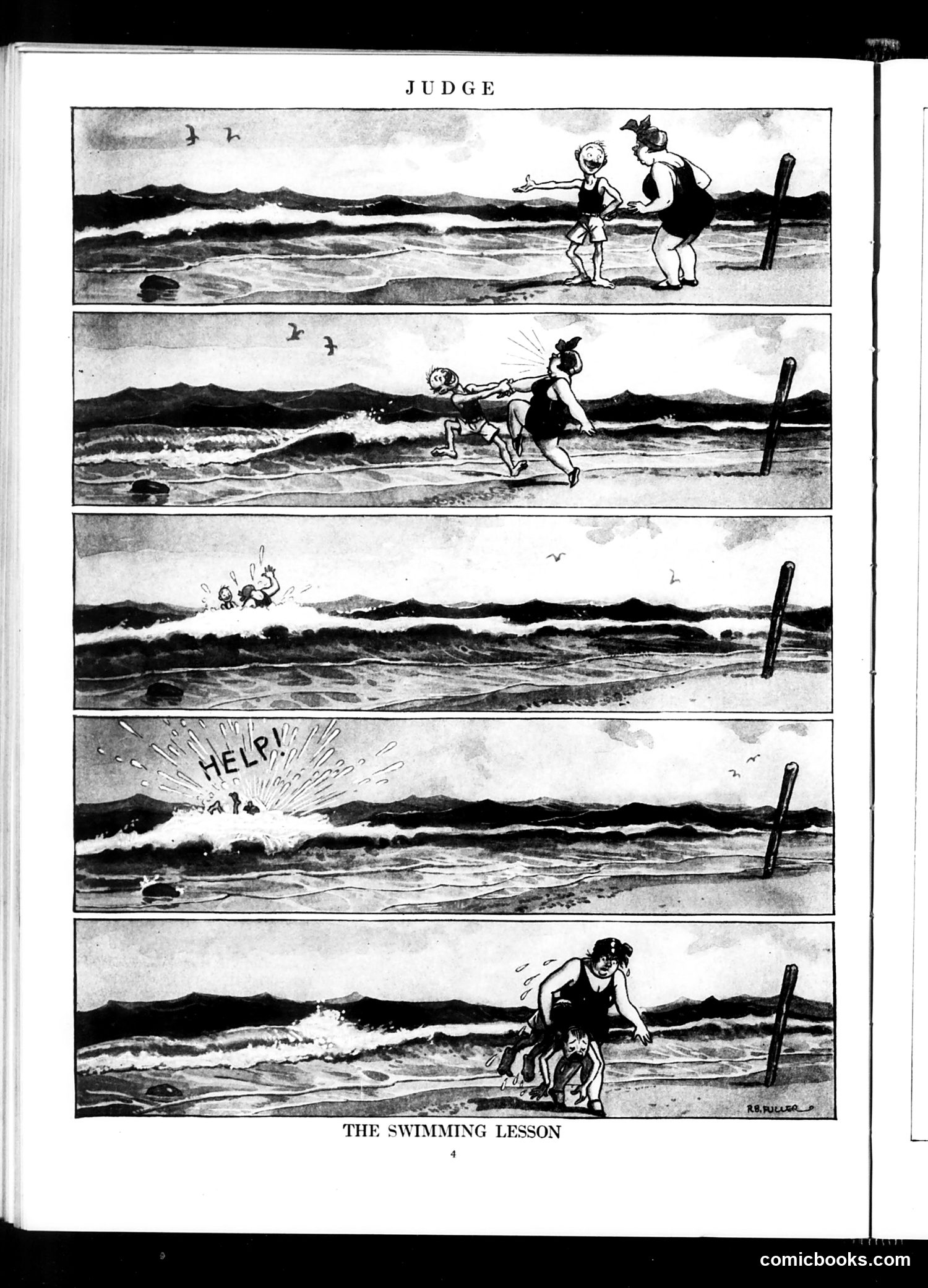
This is a humorous comic strip titled "The Swimming Lesson" showing a swimming instruction scene at the beach. An adult (likely a parent or instructor) attempts to teach a small child to swim in the ocean. The comic's joke progresses through five panels: the adult demonstrates confidence in the shallow water, attempts to guide the child, a large wave appears, the child calls out "HELP!", and the final panel shows the instructor has apparently gotten soaked or knocked over while the child remains relatively unharmed. The satire appears to be a straightforward commentary on the irony and chaos of swimming lessons—the instructor meant to provide safety and guidance ends up experiencing misfortune instead. It's gentle domestic humor rather than political satire, typical of Judge's lighter content alongside its heavier satirical pieces.
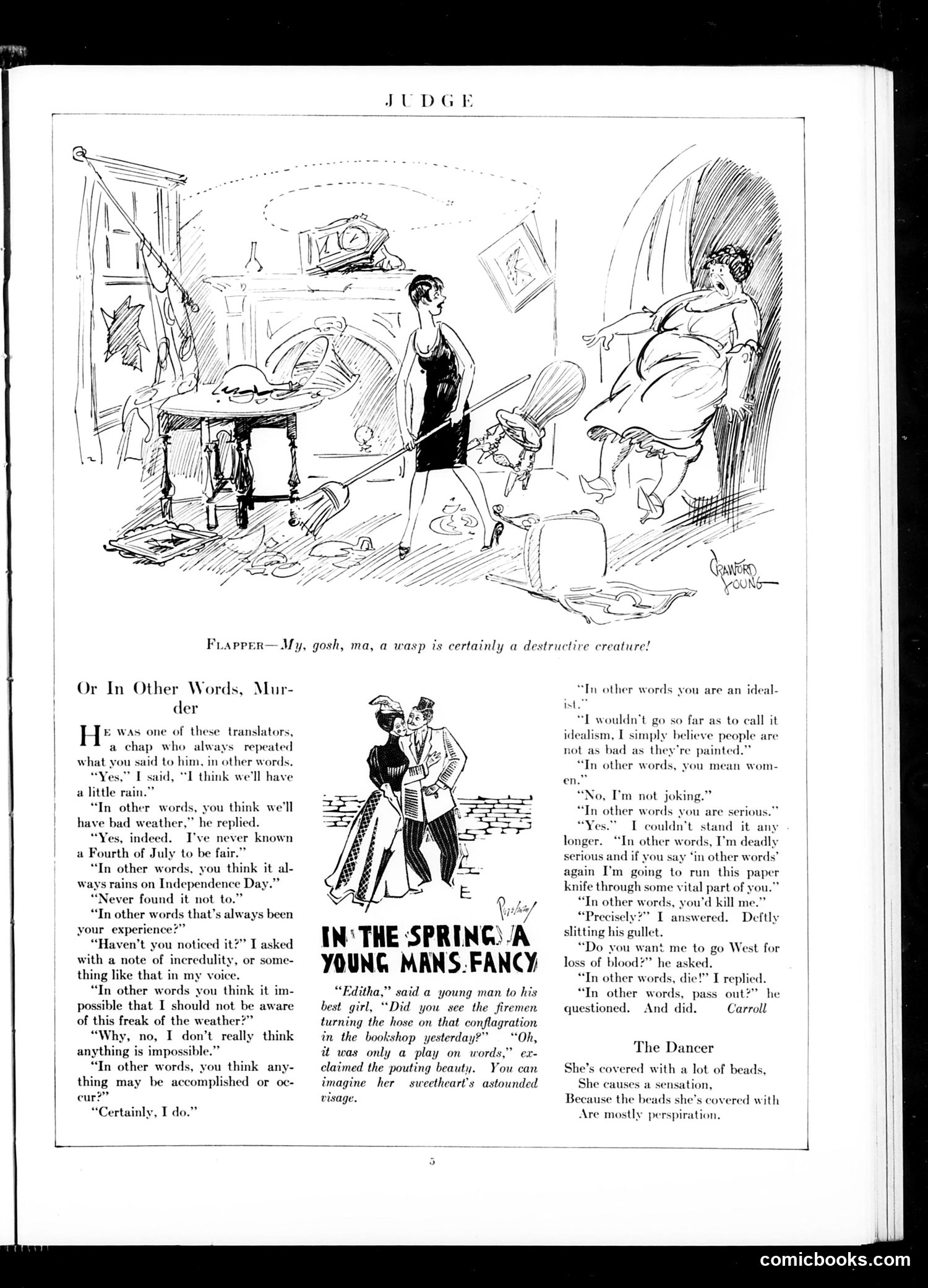
This page contains three separate satirical pieces: 1. **"Judge" (top cartoon)**: Shows a messy domestic scene with a woman confronting a man about a wasp. The joke plays on the phrase "destructive creature"—the man claims the wasp is destructive, but the woman's reaction suggests she means *him*. 2. **"Or In Other Words, Murder"**: A dialogue-based story mocking pretentious speech. A translator character repeatedly uses the phrase "in other words" to reframe ordinary statements into dramatic ones (e.g., "a little rain" becomes existential crisis). This satirizes affected intellectualism and verbose communication. 3. **"In The Spring, A Young Man's Fancy"**: A brief romantic anecdote about a young couple at a bookshop, playing on the classic phrase about spring romance. The page's humor targets verbal affectation and domestic absurdities rather than specific political figures.
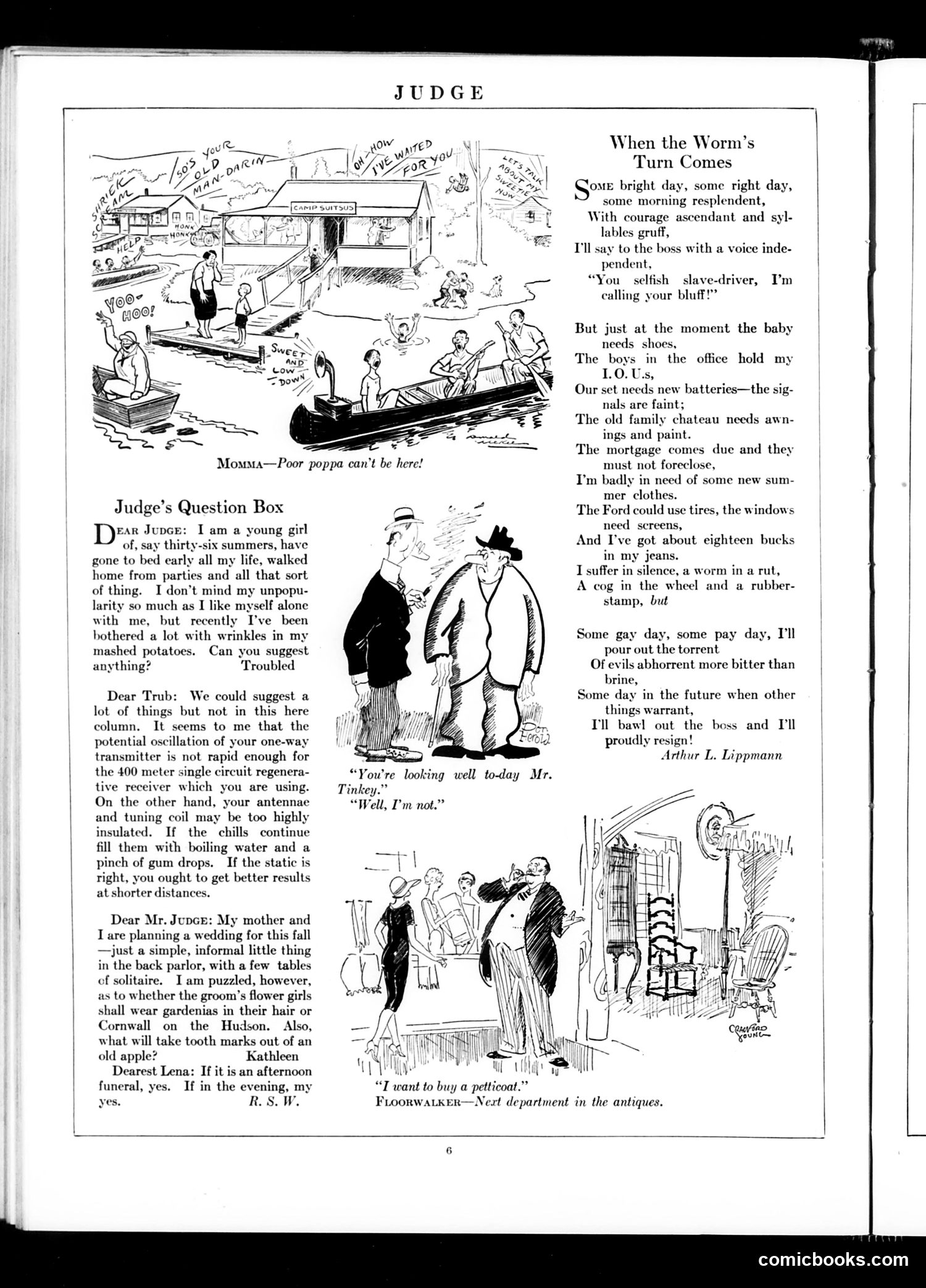
This page contains satirical humor typical of early 20th-century American magazines. The "Judge's Question Box" feature deliberately gives absurd, nonsensical answers to ordinary advice questions—mixing radio terminology into a cooking problem, confusing weddings with funerals. The joke mocks both advice columnists and readers seeking guidance. The poem "When the Worm's Turn Comes" expresses working-class frustration with economic constraints. The speaker fantasizes about confronting their boss defiantly, but cannot act because of pressing financial obligations: children's shoes, mortgage payments, car repairs, household needs. The "worm" metaphor suggests submission and powerlessness. The satire critiques how financial desperation keeps workers trapped in exploitative situations, unable to assert dignity or independence—a commentary on early-20th-century labor conditions and economic precarity. The cartoon captions provide additional gentle humor about everyday life and consumer desires.
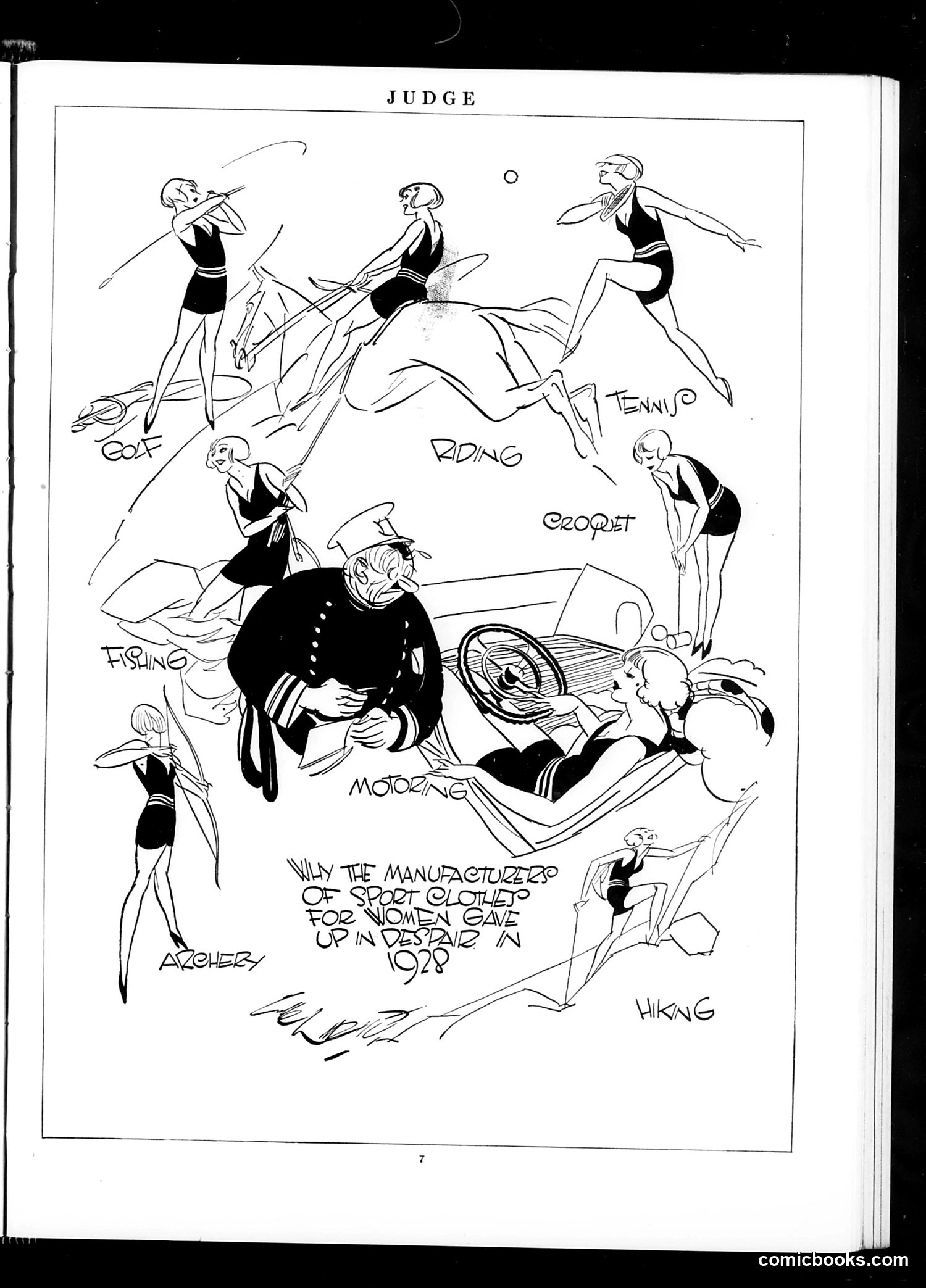
This satirical cartoon titled "JUDGE" depicts a stern, rotund judge surrounded by figures engaged in various sports and recreational activities (golf, riding, tennis, croquet, fishing, archery, hiking, motoring). The central figure appears dismayed. The cartoon satirizes the 1920 legal decision regarding women's sportswear manufacturers. The caption questions why manufacturers of athletic clothing for women "gave up investing in 1920"—likely referencing the judge's apparent disapproval of women's active participation in sports, or restrictive regulations affecting the industry. The irony is clear: the judge, representing authority and tradition, is surrounded by evidence of women's athletic pursuits, yet appears troubled by their participation. This reflects early 20th-century tensions between traditional gender roles and women's increasing public visibility in sports and recreation—activities previously considered unsuitable for women.
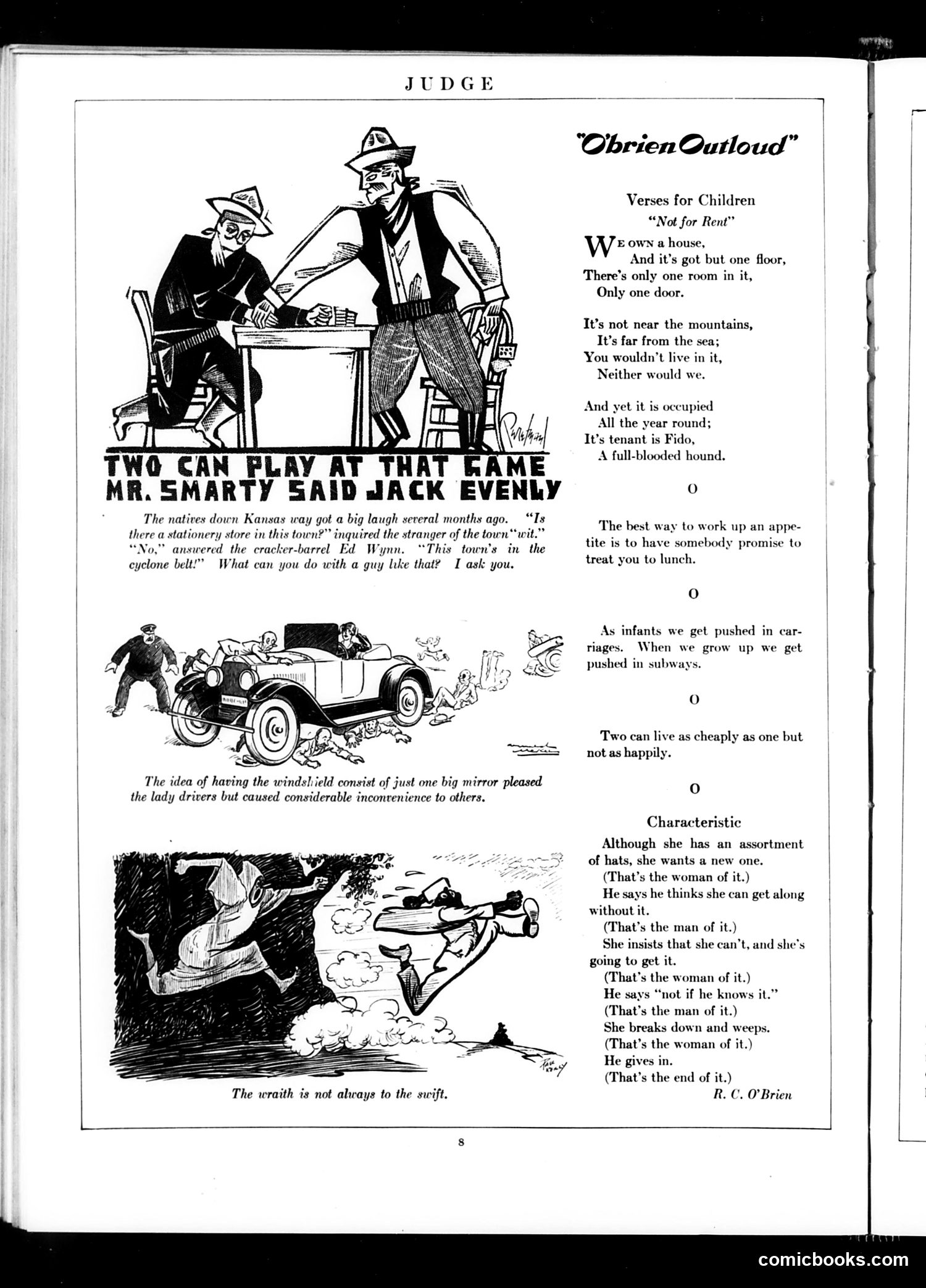
This page collects humorous content typical of early-to-mid 20th century American satire. The top cartoon shows two men playing cards, captioned "Two Can Play at That Game," referencing a Kansas anecdote about a town "wit" (likely Ed Wynn, a famous comedian) who makes jokes about his cyclone-prone region—mocking small-town humor and regional pride. Below are several illustrations and verses satirizing contemporary domestic life and gender dynamics. Content includes jokes about automobiles (windshield mirrors inconveniencing other drivers), urban living (being "pushed in subways"), and marriage economics. The final piece, "Characteristic," uses repetitive dialogue to mock predictable marital conflict: a woman wants a hat, the man objects, she insists, he refuses, she cries, and he capitulates. This pattern—presented as inevitable male-female behavior—reflects period stereotypes about women's materialism and emotional manipulation versus male rational resistance. The satire targets both genders' predictable social roles and relationship dynamics.
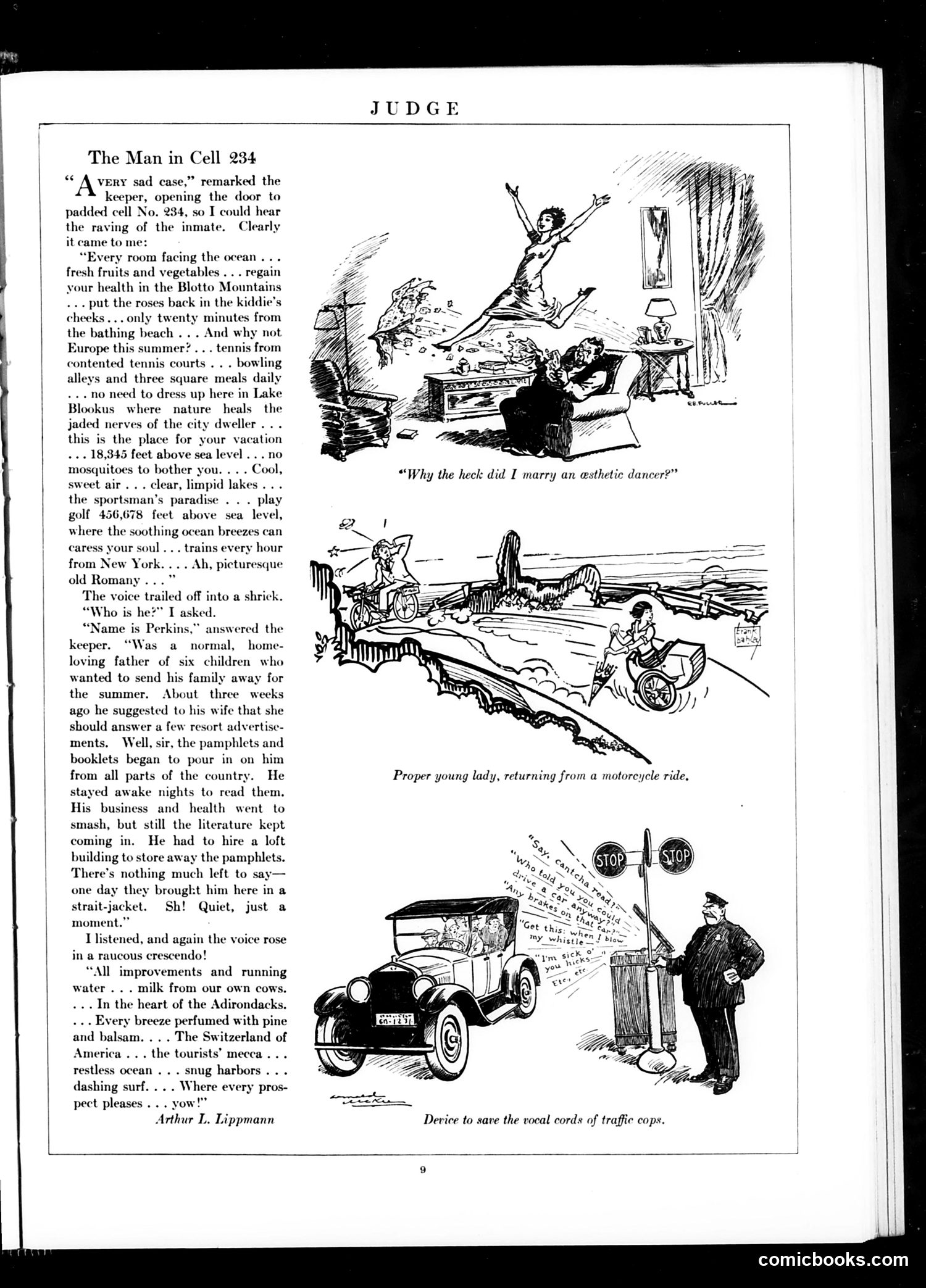
This piece satirizes **resort advertising saturation** in the early 20th century. A man named Perkins, a normal family father, becomes institutionalized after his wife suggests answering resort advertisements for a summer vacation. Overwhelmed by the flood of competing promotional pamphlets and booklets arriving from resorts nationwide, he suffers a mental breakdown from the relentless marketing barrage. The joke critiques both the explosion of American resort tourism marketing and consumer culture's ability to overwhelm ordinary people. Perkins's compulsive reading of increasingly hyperbolic resort claims ("every prospect pleases") drives him mad—a darkly humorous commentary on advertising excess. The lower cartoons show unrelated contemporary social observations: an "aesthetic dancer" spouse causing marital regret, and a traffic cop device to protect police from vocal strain—satirizing modern urban annoyances.
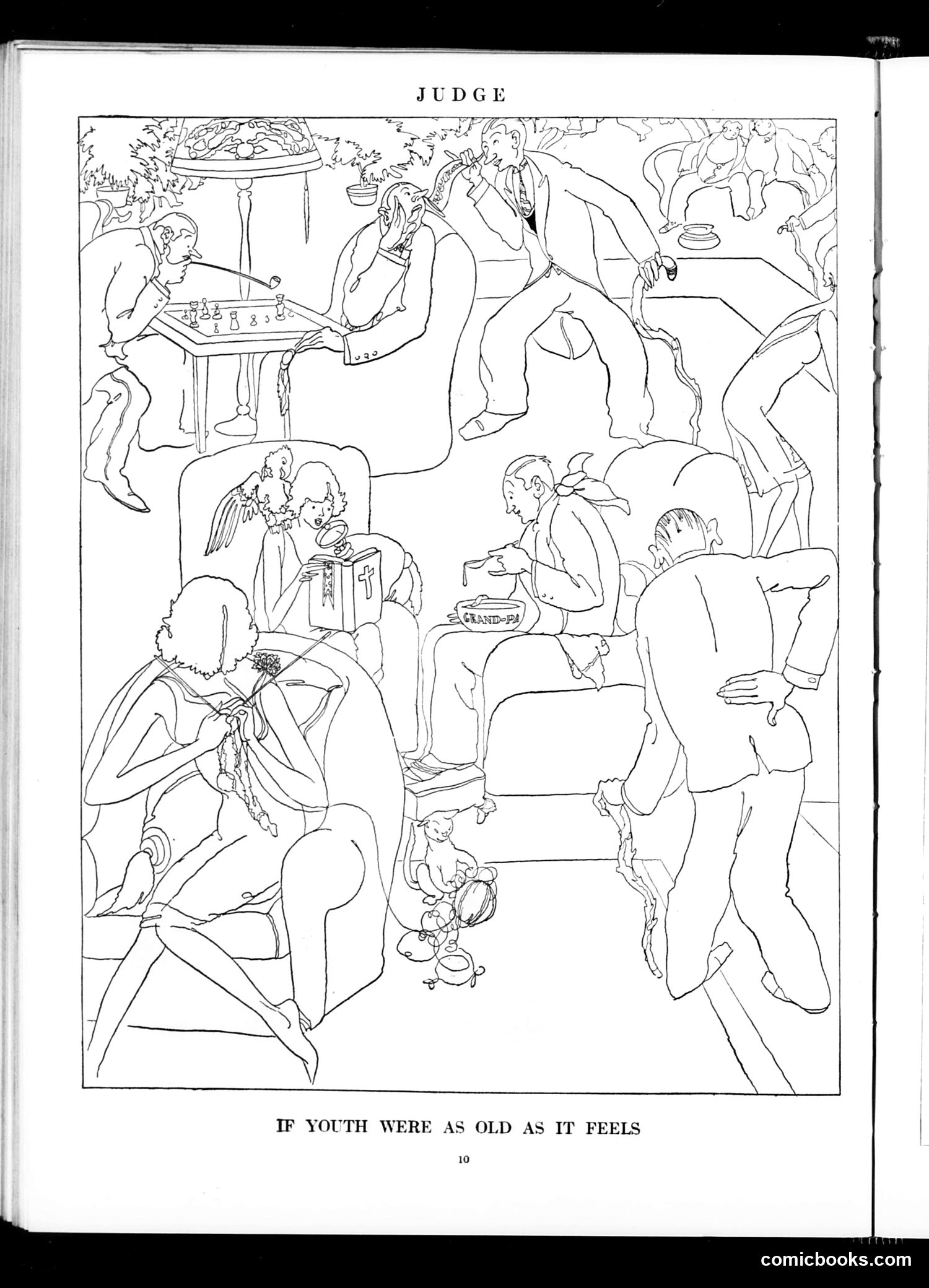
This Judge cartoon satirizes young people's self-perception of maturity and worldliness. The illustration depicts various youthful figures engaged in sophisticated adult activities—chess games, socializing, drinking, smoking, and romantic encounters—all rendered with exaggerated physical proportions that make the young people appear grotesquely aged and decrepit. The satire's point is ironic: adolescents and young adults *feel* mature and experienced beyond their years, imagining themselves as worldly sophisticates. The cartoon visualizes this delusion by literally showing what youth would look like if their *subjective* sense of age matched reality—resulting in prematurely withered, ancient-appearing bodies engaged in grown-up pursuits. It's a timeless joke about youthful overconfidence and the gap between self-perception and actual maturity.
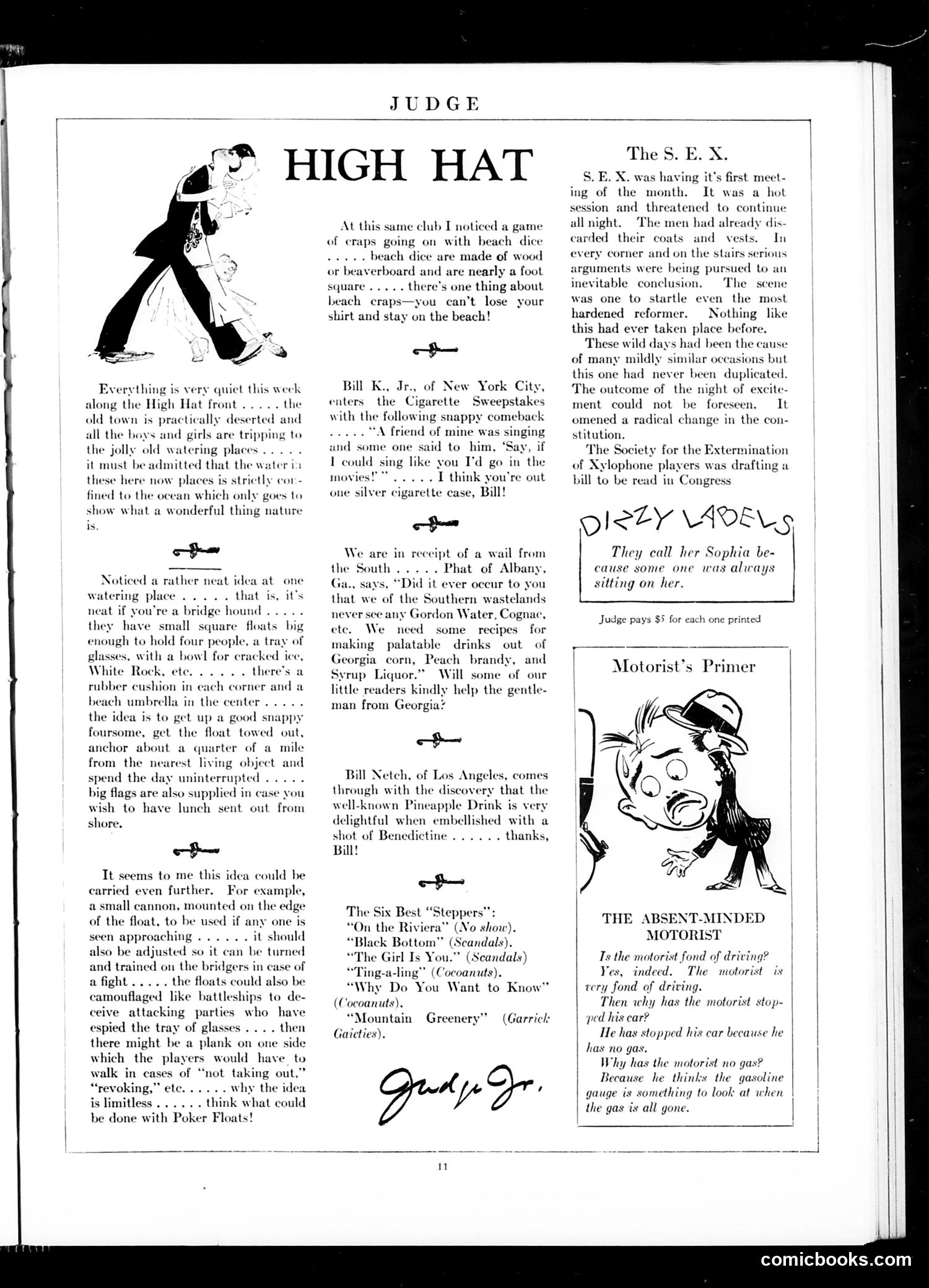
This page satirizes 1920s leisure culture among the wealthy elite. The "High Hat" column mocks affluent vacationers at exclusive clubs during summer season. **Main content:** The lead cartoon shows a man in formal dress dancing with a woman, establishing the "high hat" (snobbish) tone. The column humorously describes resort innovations: floating poker platforms on water with ice, glasses, and umbrellas—allowing wealthy bridge players to gamble uninterrupted from shore. The author facetiously suggests adding cannons for defense and camouflage. **Other items** include humorous reader submissions about beach dice craps, cigarette sweepstakes jokes, and requests for Prohibition-era drink recipes using "Georgia corn" and "Syrup Liquor" (thinly veiled references to illegal alcohol). The sidebar "Motorist's Primer" and "Dizzy Dames" sections mock absent-minded drivers and women respectively—period stereotypes. **Context:** This reflects Jazz Age excess, Prohibition (1920-1933), and class-conscious humor targeting wealthy, frivolous leisure activities.
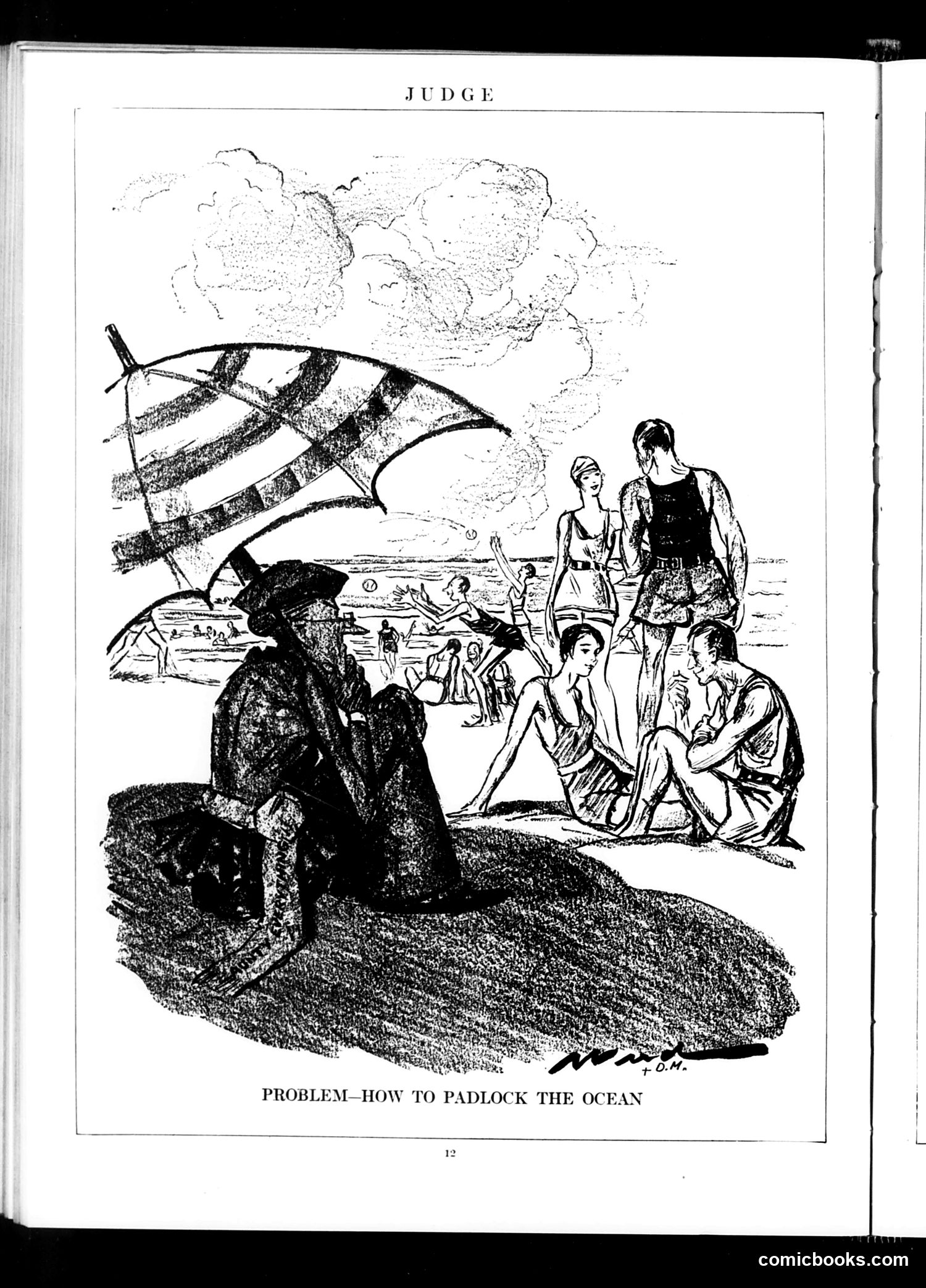
This cartoon satirizes an absurd or impossible task—likely a political reference to attempts at maritime control or regulation. The figure in dark clothing on the left appears to be a government official or authority figure, while the beach scene behind shows civilians enjoying recreation. The title's metaphor of "padlocking the ocean" suggests trying to control something fundamentally uncontrollable or regulating something meant to be free and open. Without knowing the specific publication date, the likely target is either: prohibition-era enforcement (attempting to control smuggling across water), naval/territorial disputes, or restrictions on public beach access. The cartoon mocks the futility and absurdity of such governmental overreach, presenting an impossible problem as the punchline.
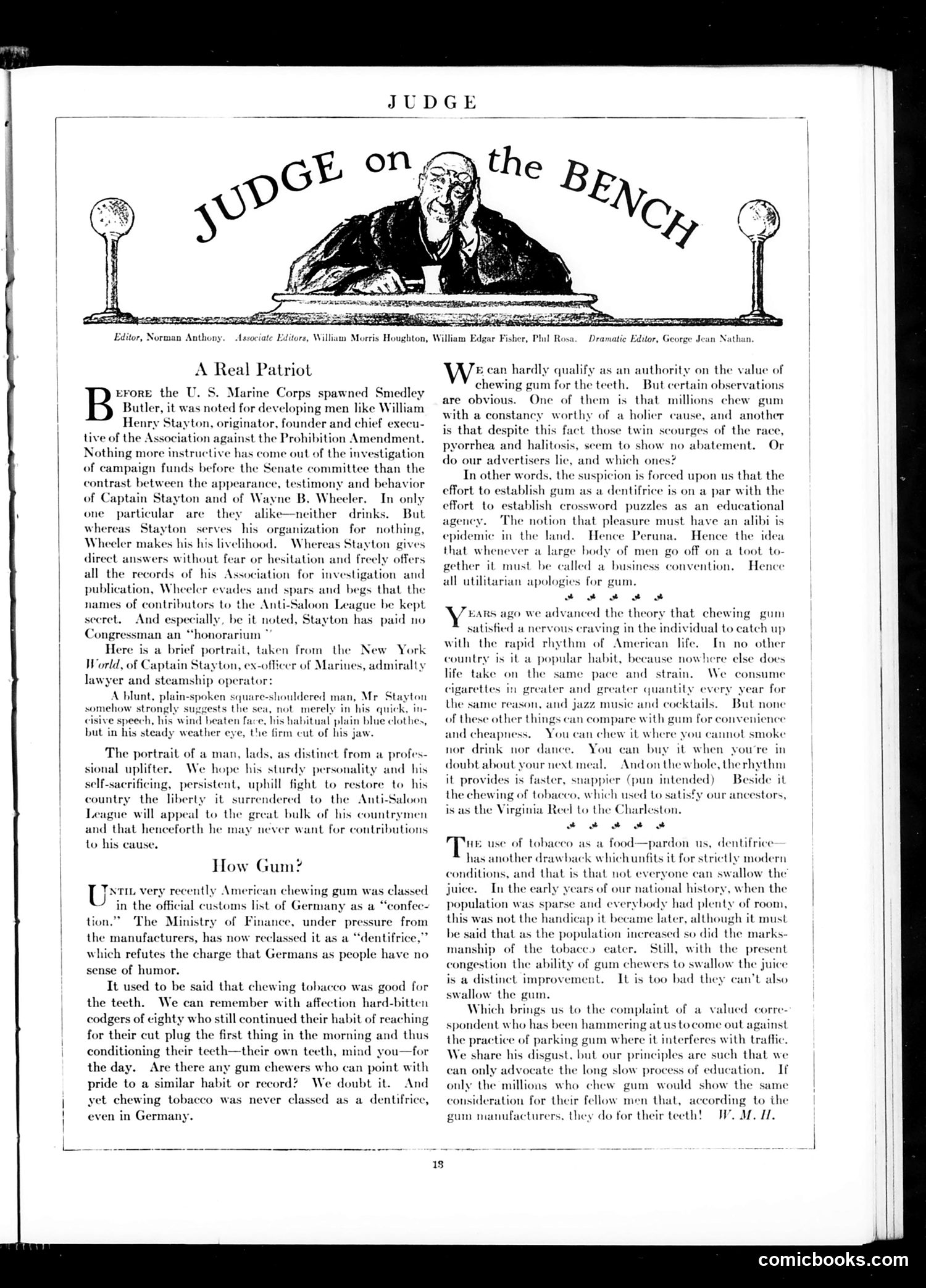
This page contains two editorial pieces: **"A Real Patriot"** contrasts Captain William Henry Stayton (head of the Association Against the Prohibition Amendment) with Wayne B. Wheeler (leader of the Anti-Saloon League). The satire criticizes Wheeler's hypocrisy: while both oppose drinking personally, Stayton volunteers his time and openly shares records, whereas Wheeler profits from his position and hides donor names. The piece attacks the Anti-Saloon League's secretive fundraising and suggests Wheeler has bribed politicians with "honorariums." This reflects 1920s Prohibition-era tensions. **"How Gum?"** mocks American society's desperate need to justify pleasure activities. Germany reclassified chewing gum from "confection" to "dentifrice" (toothpaste), which Judge ridicules as absurd. The editorial satirizes Americans' constant rationalization—claiming gum is healthy when it's merely entertainment, just as people call leisure trips "business conventions" to legitimize enjoyment. The piece reflects broader cultural anxiety about productivity and self-justification in early 20th-century America.
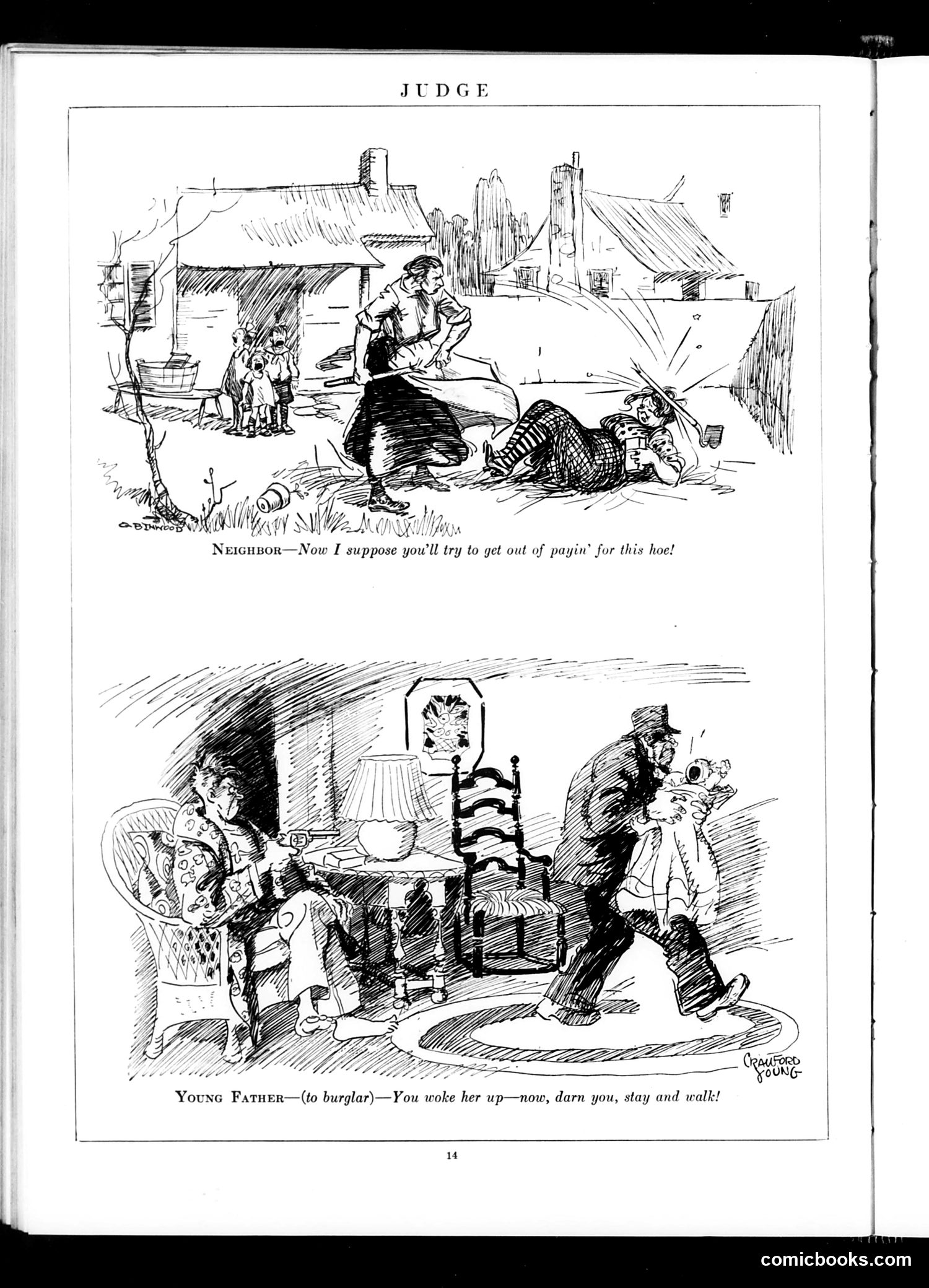
This page contains two unrelated satirical cartoons: **Top cartoon:** A rural scene where a neighbor discovers someone ("this hoe") lying in a field. The joke plays on the double meaning of "hoe" (the garden tool vs. derogatory slang), with the neighbor suggesting the prone figure should "get out of payin'" for whatever transgression occurred. **Bottom cartoon:** A young father, discovering a burglar in his home at night, demands the thief stay and help walk his crying baby. The satire targets the exhausting reality of infant care—the father uses the burglar's presence as an opportunity to force someone else to deal with nighttime baby duty, treating crime as secondary to parental desperation. Both cartoons use exaggeration and unexpected reversals to mock domestic life and social situations of the era.
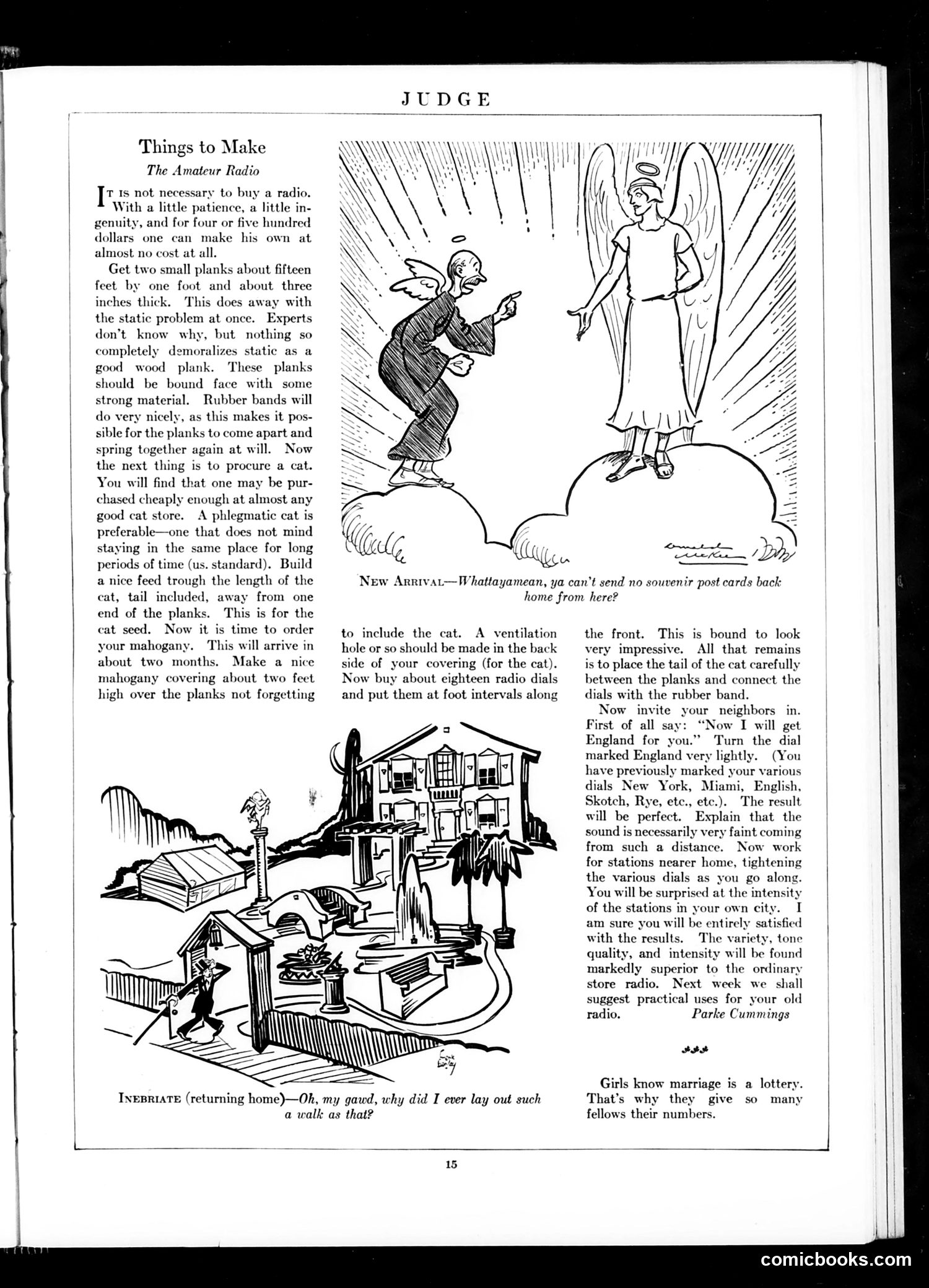
This page satirizes the 1920s amateur radio craze through absurdist humor. "The Amateur Radio" mocks DIY radio-building enthusiasm by presenting deliberately ridiculous instructions: constructing a radio from wooden planks, rubber bands, and a live cat whose tail connects dials via rubber band. The joke plays on radio's mystique—people didn't fully understand how it worked, so the author invents nonsensical "solutions" to technical problems (wood planks eliminate static, a cat serves as components). The cartoons mock related social pretensions: wealthy people boasting about receiving distant broadcasts ("England"), and suburban ennui (the exhausted woman returning home). The final joke about marriage being a "lottery" is unrelated social commentary. This satirizes both working-class aspiration to own new technology and the era's general fascination with radio as a miraculous modern invention that amateur enthusiasts attempted to replicate at home.
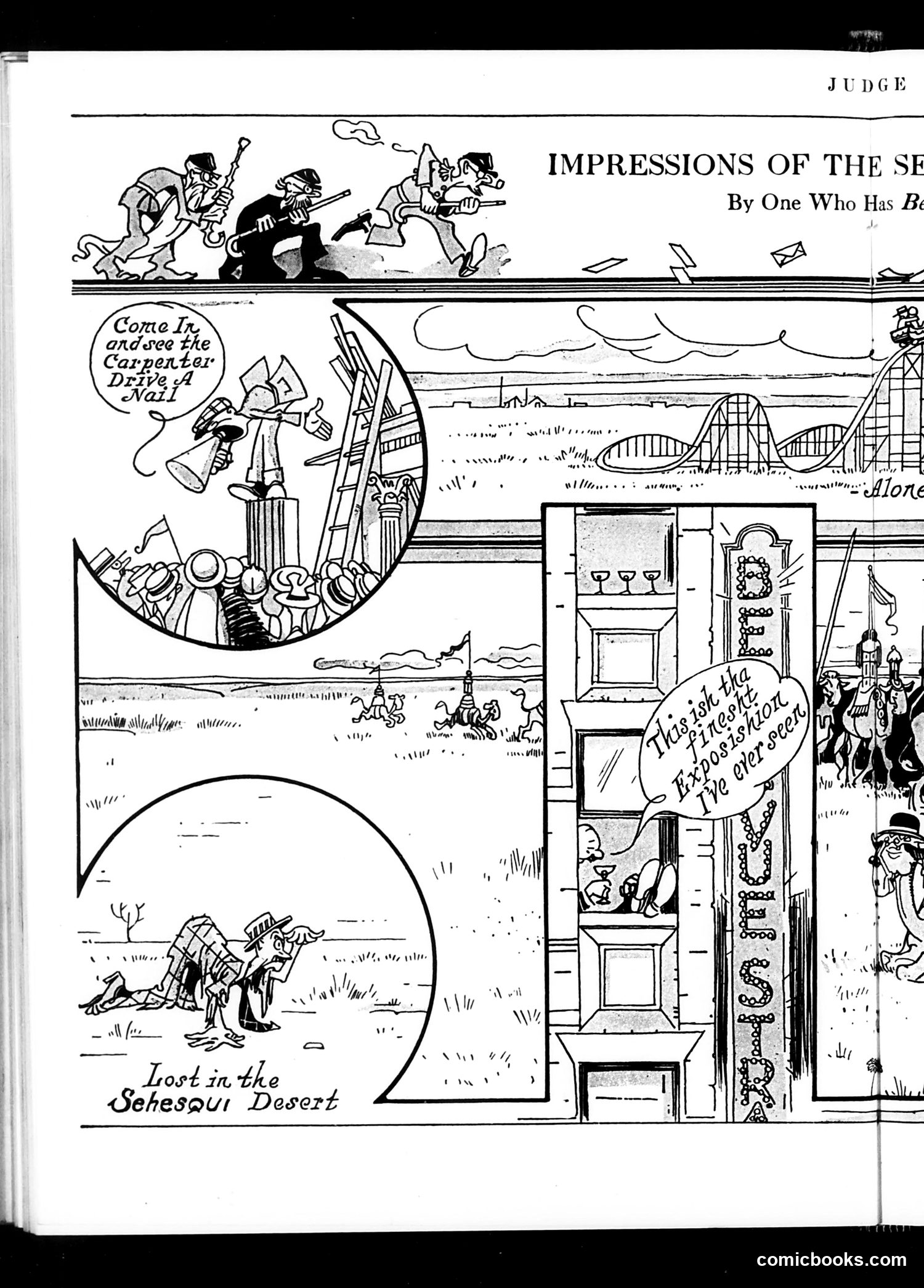
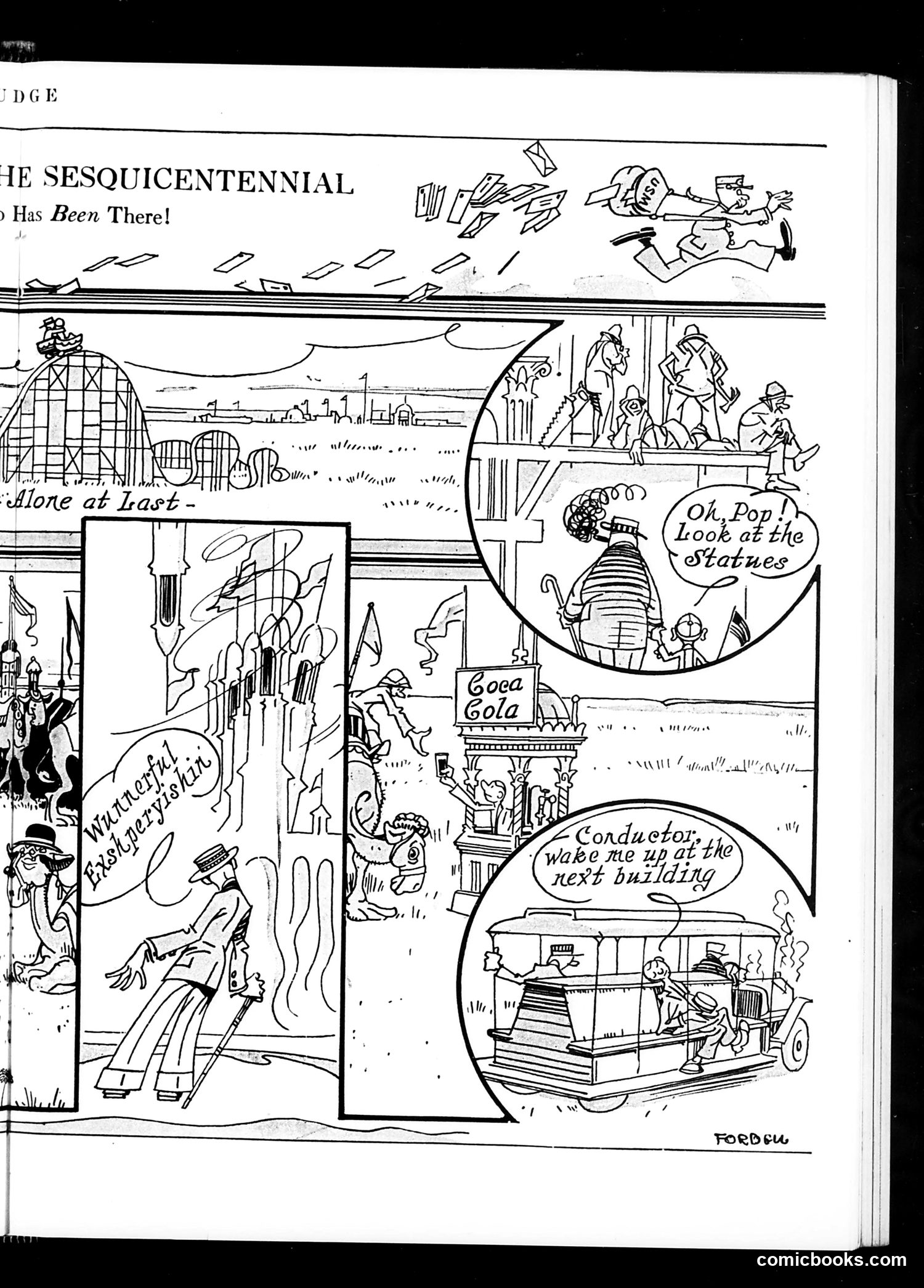
This cartoon satirizes Philadelphia's 150th anniversary celebration (sesquicentennial). The comic depicts the chaos of the event: at top, papers and a person are blown about frantically. The main panel shows crowds overwhelming various attractions—a Ferris wheel, Coca-Cola stand, and exhibition buildings. The satire centers on how the conductor (visible in a speech bubble) can barely manage the overwhelming crowds and attractions. The phrase "Alone at Last" is ironic—suggesting the opposite of peaceful solitude amid the madness. The "Witchcraft & Broomsticks" panel on the left appears unrelated, possibly an advertisement or separate comic strip. Overall, Judge mocks the sesquicentennial as an overly commercialized, chaotic spectacle rather than a dignified historical commemoration.
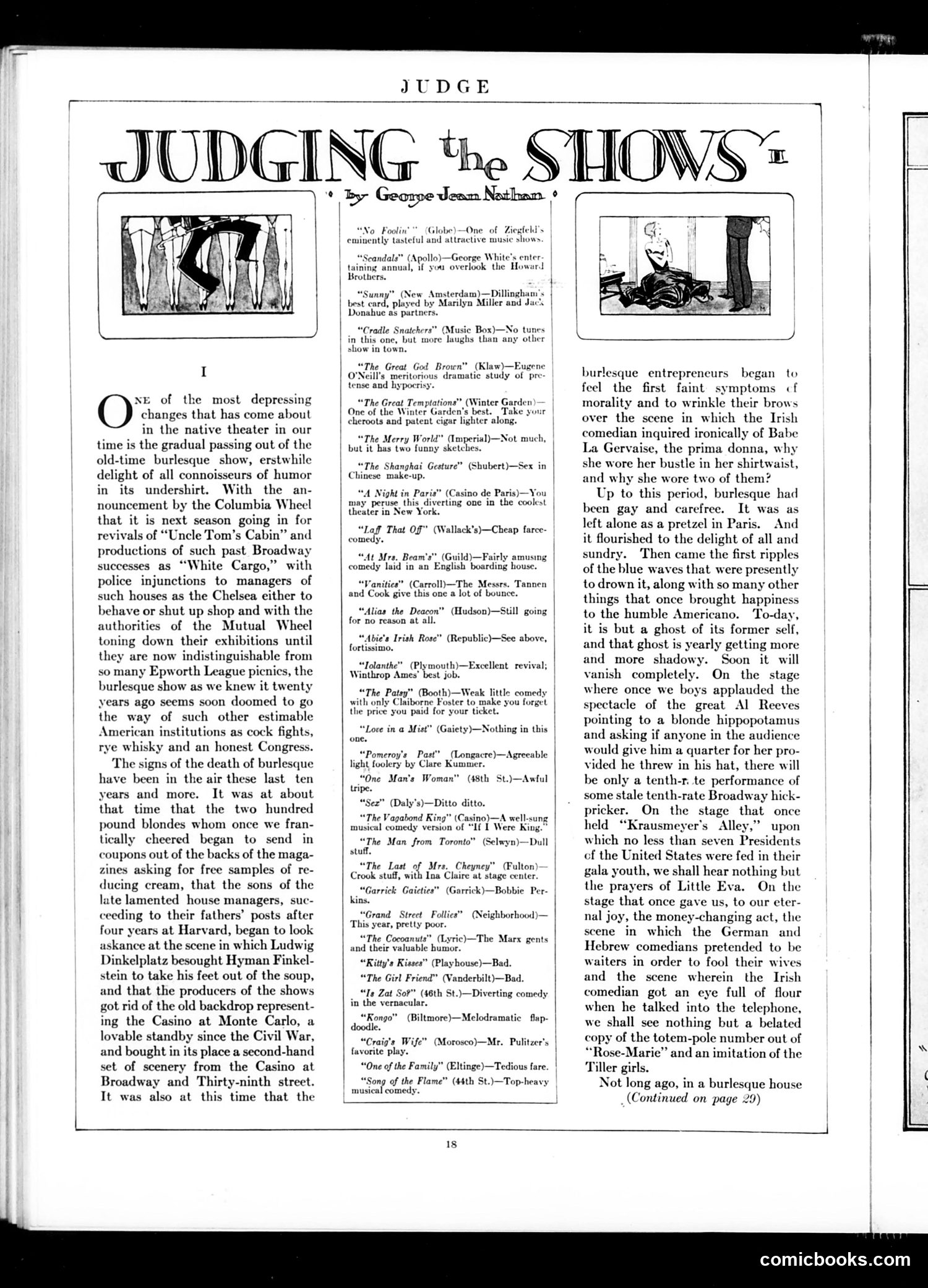
This page contains a theater column by prominent critic George Jean Nathan lamenting the decline of burlesque theater. The accompanying text discusses how traditional burlesque—known for slapstick comedy, scantily-clad performers, and lowbrow humor—is being sanitized and dying out. Nathan argues that Harvard-educated theater managers, police injunctions, and corporate oversight (the Columbia and Mutual Wheels—booking agencies) are killing the form by imposing respectability. He nostalgically contrasts this with an earlier era when crude comedians like "Ludwig Dinkelplatz" and "Hyman Finkelstein" (stereotypical ethnic names suggesting working-class immigrant humor) performed absurdist sketches to enthusiastic audiences. The list of current Broadway shows suggests Nathan's broader complaint: theater is becoming genteel and commercialized. The cartoons (visible but unclear) likely illustrate this cultural shift visually.
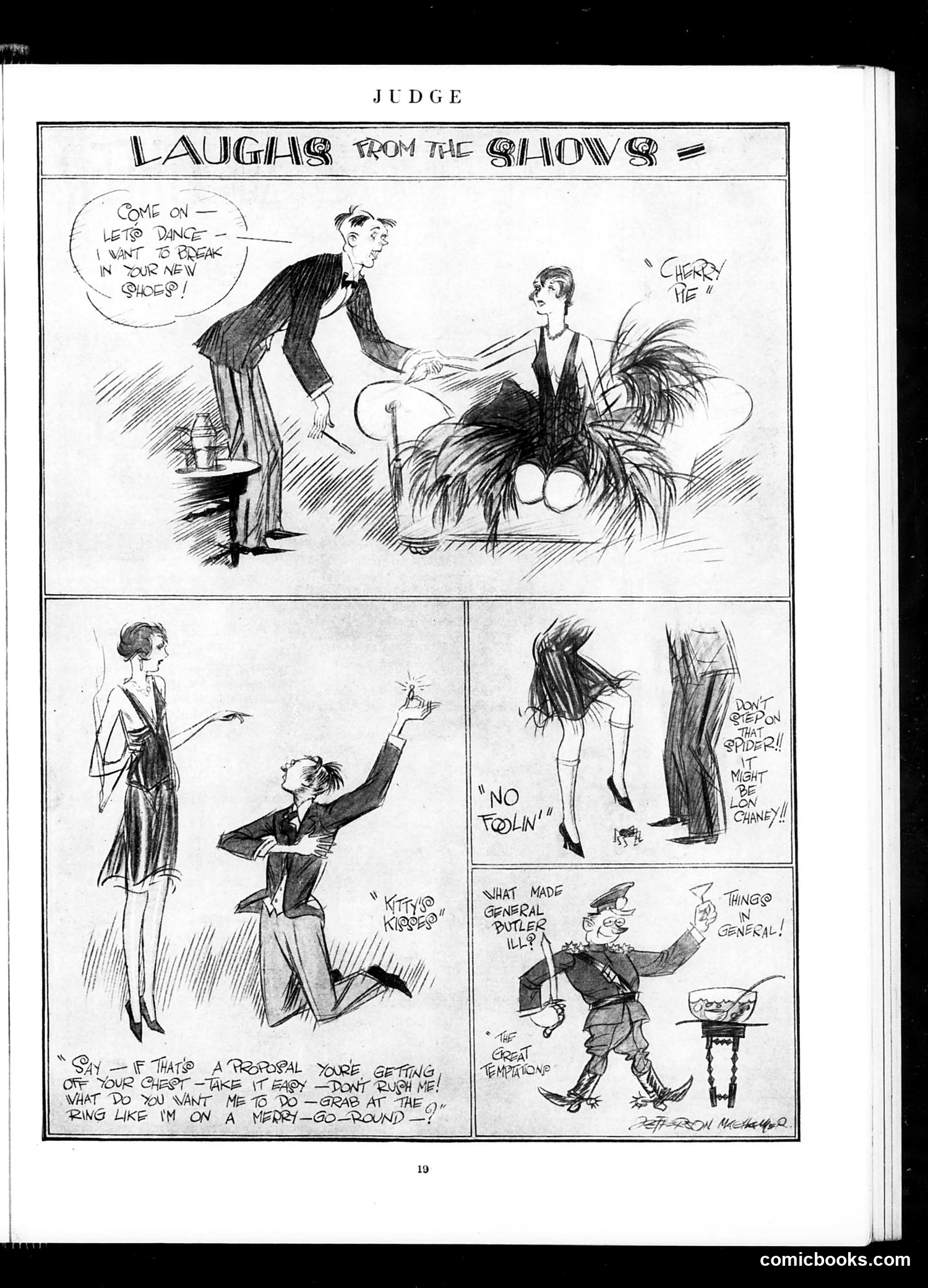
This is a theatrical comedy sketch satirizing courtship and marriage dynamics. The narrative follows a man attempting to propose to a woman while she resists his advances. **The setup:** He wants to "break in" new shoes by dancing; she agrees but on her terms. When he attempts a formal proposal (grabbing "at the ring like I'm on a merry-go-round"), she rejects him sharply ("No Foolin'!"). **The joke:** His exasperation contrasts with her continued refusal. A military figure (appearing to be General Butler, likely referencing a public figure) comments on the situation, suggesting the proposal-rejection dynamic is absurd—comparing it to chaotic behavior. **Social commentary:** The satire mocks both aggressive male courtship tactics and the performative nature of romantic proposals in early 20th-century society. The woman's agency in refusing advances without explanation was considered humorous to contemporary audiences, though it also implicitly critiques male entitlement in courtship.
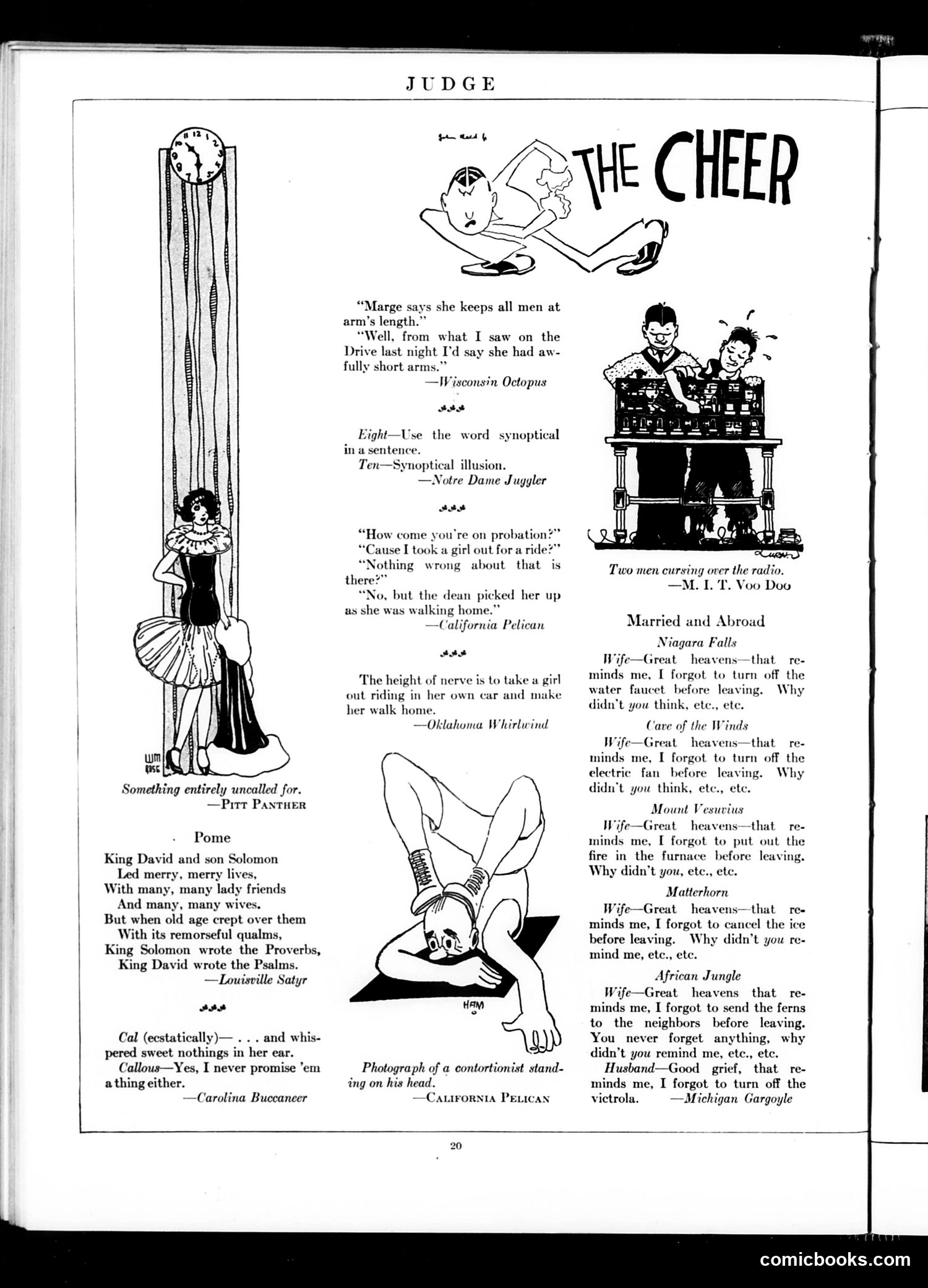
This page from *Judge* (a satirical magazine) contains college humor and jokes about dating and marriage customs from the early 20th century. **The dating jokes** mock the casual practice of young men taking girls on car rides—then a novel and unsupervised activity. Multiple colleges' humor magazines jest about the audacity: one girl's date makes her walk home after the ride; another involves a dean discovering impropriety. These reflect anxiety about changing courtship norms and automobile-enabled privacy. **"The Cheer" section** features a "Married and Abroad" series that satirizes wives' perpetual forgetfulness and nagging, regardless of exotic location (Niagara Falls, volcanoes, jungles). Each punchline has the wife fretting over forgotten household tasks while the exasperated husband finally admits *he* forgot something too—typically the victrola (record player). This mocks both nagging spouses and husbands' pretense of superiority. The humor reflects period attitudes: women as scatterbrained nags, dating as transgressive, and marriage as comedic conflict between genders.
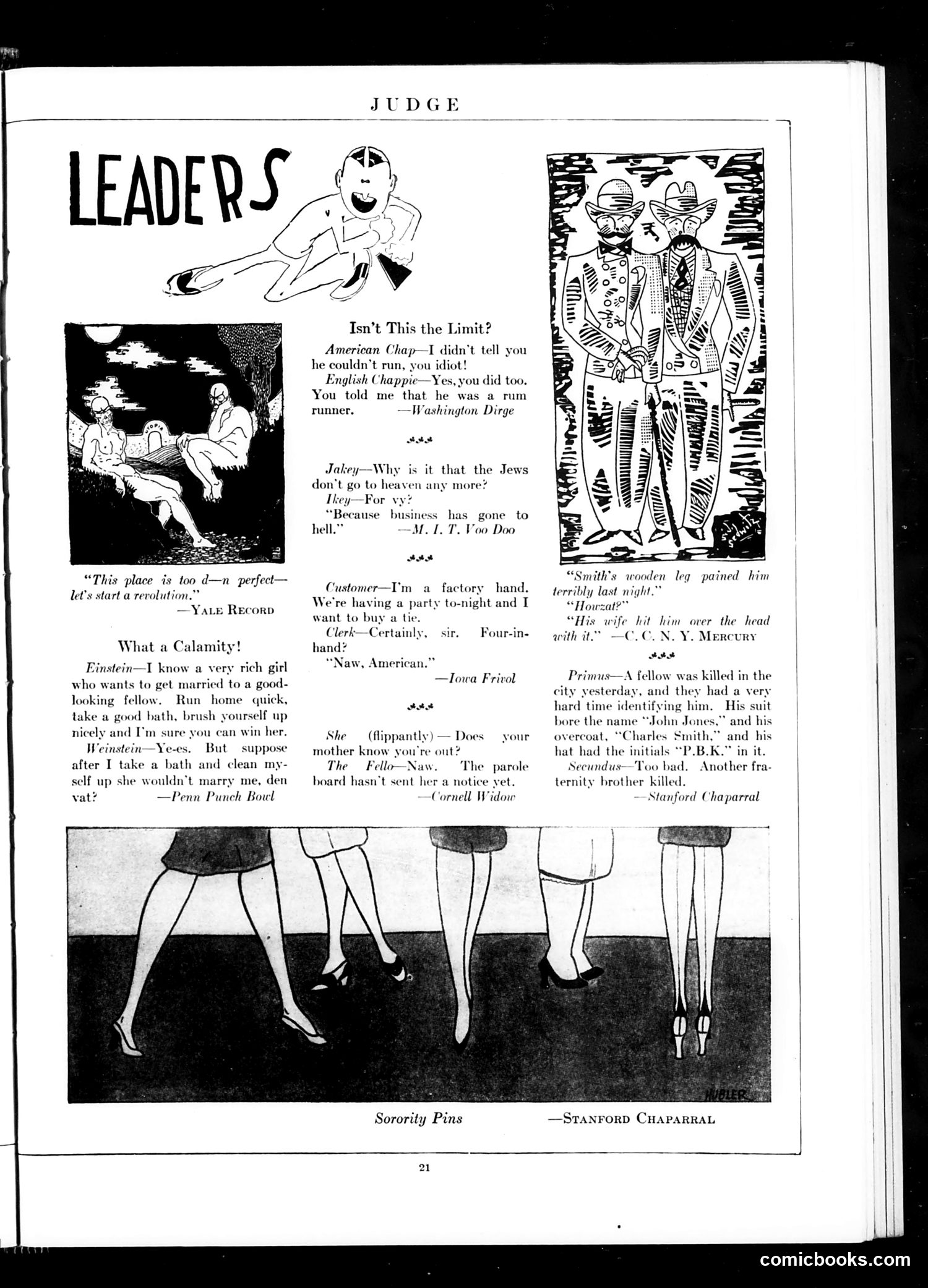
This page from *Judge* (a satirical magazine) compiles brief jokes and cartoons mocking various 1920s social types and situations. **Key content:** - **Einstein/Weinstein joke**: Ethnic humor playing on Jewish surnames and stereotypes about wealth and appearance. - **American vs. English chap**: References "rum runner"—a person smuggling alcohol during Prohibition—suggesting the English speaker falsely accused someone of this illegal activity. - **Jalkey joke**: An offensive antisemitic gag about Jewish people and "business" going to "hell." - **Factory worker tie**: Humor about class difference; the worker's tie brand preference reveals his working-class status. - **Parole board reference**: Dark comedy about a young man whose date is on parole/probation. - **Identification mix-up**: Gallows humor about a corpse with multiple name labels, suggesting identity confusion or multiple identities. - **Bottom illustration**: "Sorority Pins" showing women's legs—presumably satirizing college social hierarchies. The satire targets working-class figures, immigrants, criminal elements, and social pretension typical of 1920s-era *Judge* humor.
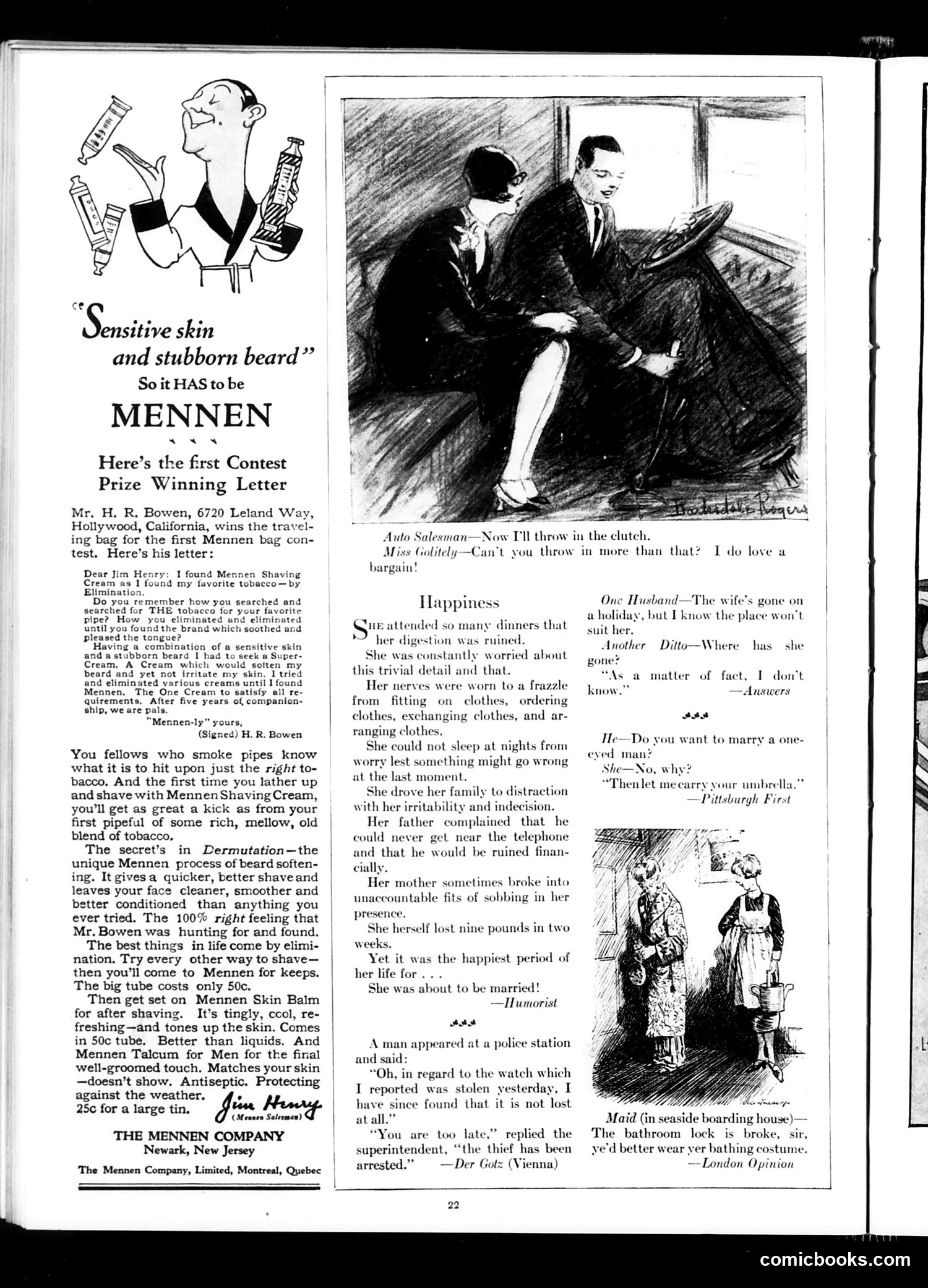
This is primarily a **Mennen shaving cream advertisement** disguised as editorial content in Judge magazine. The left page features a contest-winning letter praising Mennen products, using the metaphor of finding the "right" tobacco pipe to describe discovering quality shaving cream. The ad emphasizes "Dermutation," Mennen's proprietary beard-softening process. The right page contains **unrelated humor content**: short comic sketches and jokes about marriage, domestic life, and a police station anecdote. These include an illustration of a couple in a car and another of a maid and guest at a seaside boarding house. The satirical commentary is minimal—this page is overwhelmingly **commercial content**. The magazine appears to have blended advertising with humor to engage readers, a common early 20th-century magazine practice. The jokes target marital anxiety and domestic absurdity rather than politics or social issues.
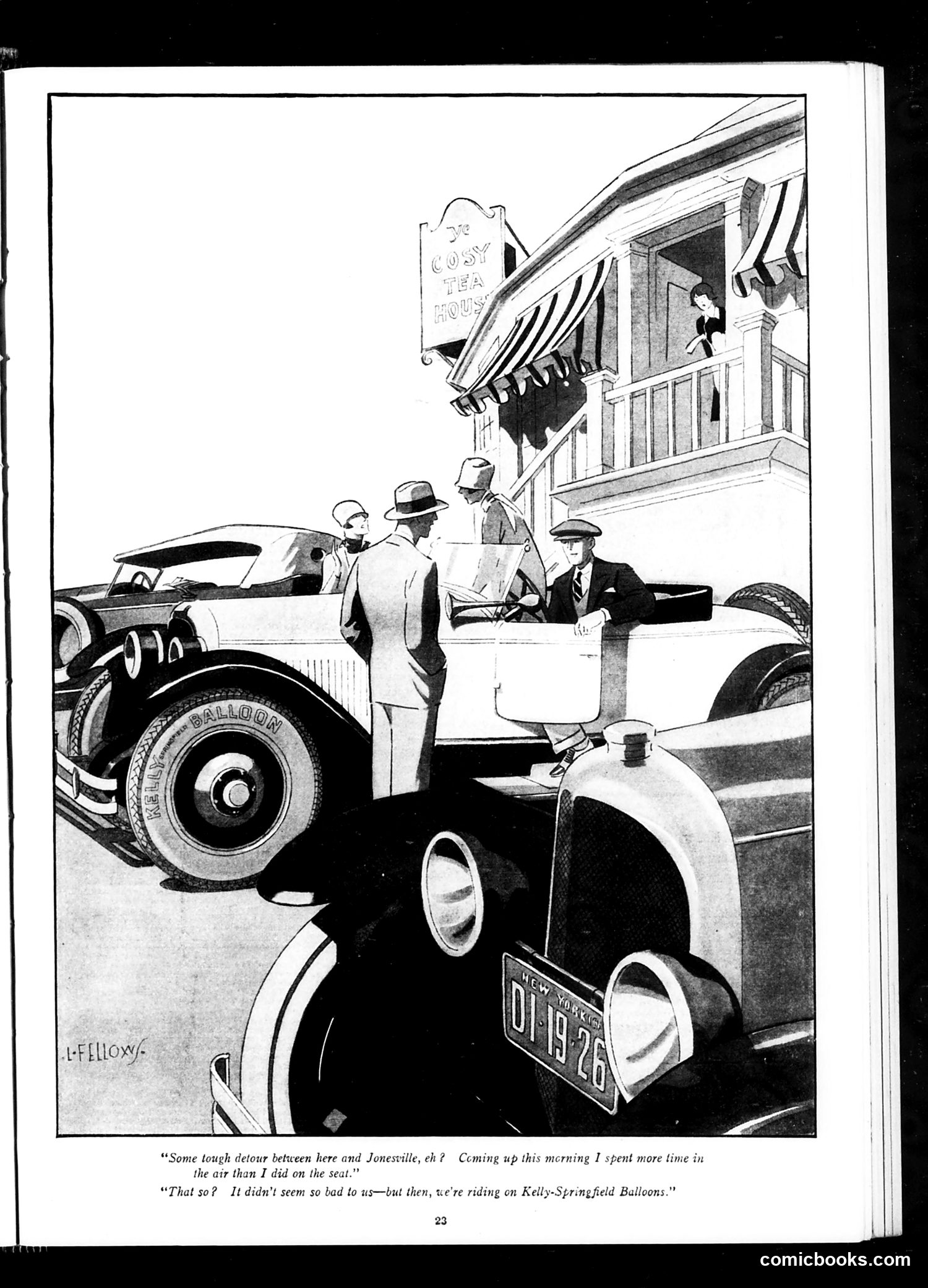
This is a **Kelly-Springfield Balloons tire advertisement** disguised as a cartoon joke. The scene shows men discussing a rough road journey between towns. One man complains about experiencing more airtime than seat time (being jostled), while another attributes his smoother ride to Kelly-Springfield balloon tires—a pneumatic tire technology that provided better shock absorption than solid rubber tires of the era. The "Cosy Tea House" storefront and vintage automobiles date this to the 1920s-1930s. The humor is comparative: the first driver's miserable experience contrasts with the second's comfort, making the advertiser's product the clear solution. This represents typical early 20th-century advertising that wrapped commercial messages in relatable comic scenarios rather than direct pitches.
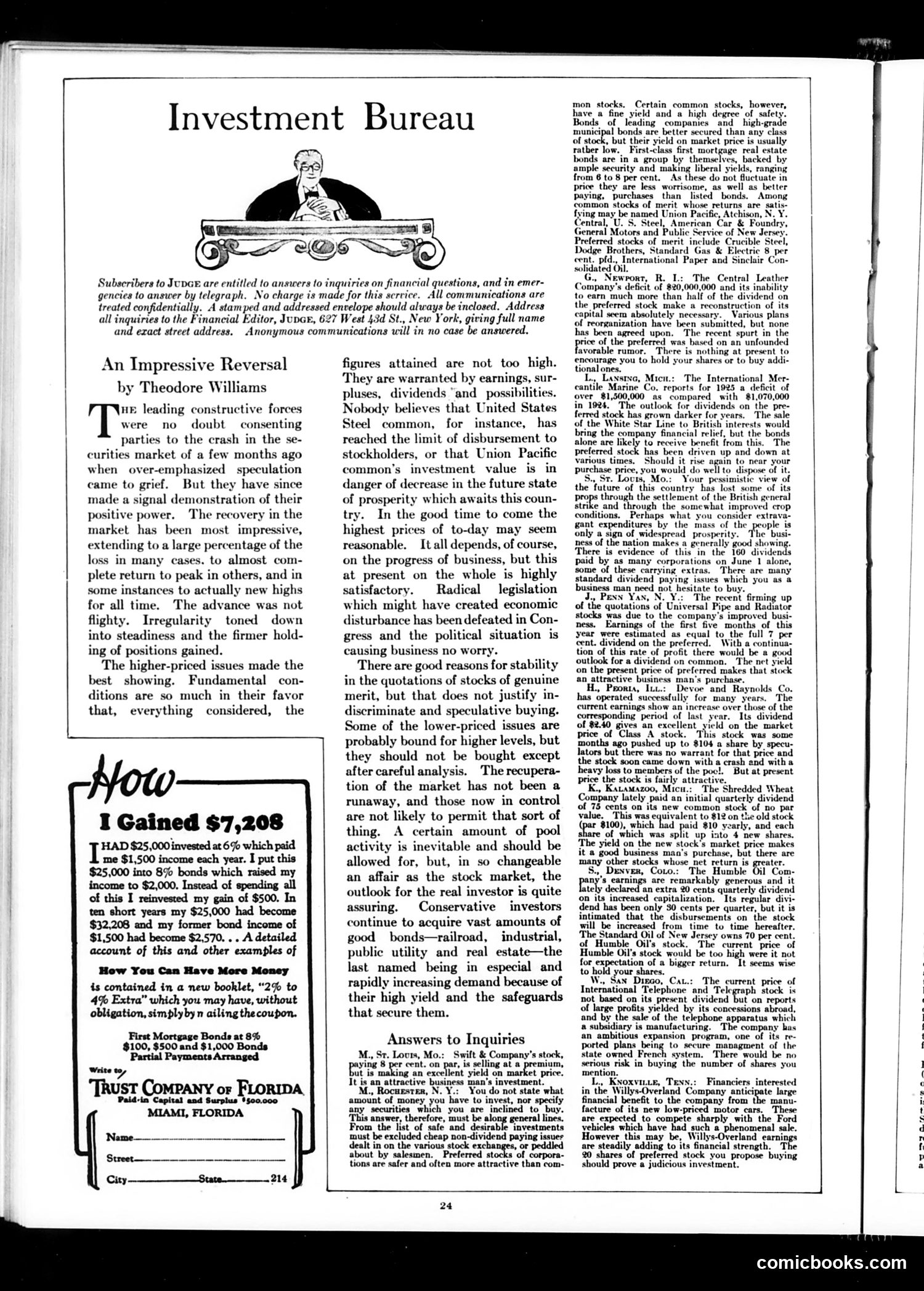
This page combines financial advice with period advertisements. The main article, "An Impressive Reversal" by Theodore Williams, addresses the 1929 stock market crash and subsequent recovery. Williams argues that the market rebound demonstrates the "positive power" of constructive economic forces and reflects genuine business fundamentals—particularly in high-priced stocks like U.S. Steel and Union Pacific. The satire is subtle: Williams advocates cautious optimism while warning against indiscriminate speculation, yet the irony (likely unintentional to contemporary readers) is that he's writing *during* the dangerous bubble preceding the Great Depression. His confidence in business stability and dismissal of political/legislative risk appears naive in retrospect. The page also features a Trust Company of Florida bond advertisement with a testimonial about investment gains—typical period financial marketing that would soon prove disastrous for many investors.
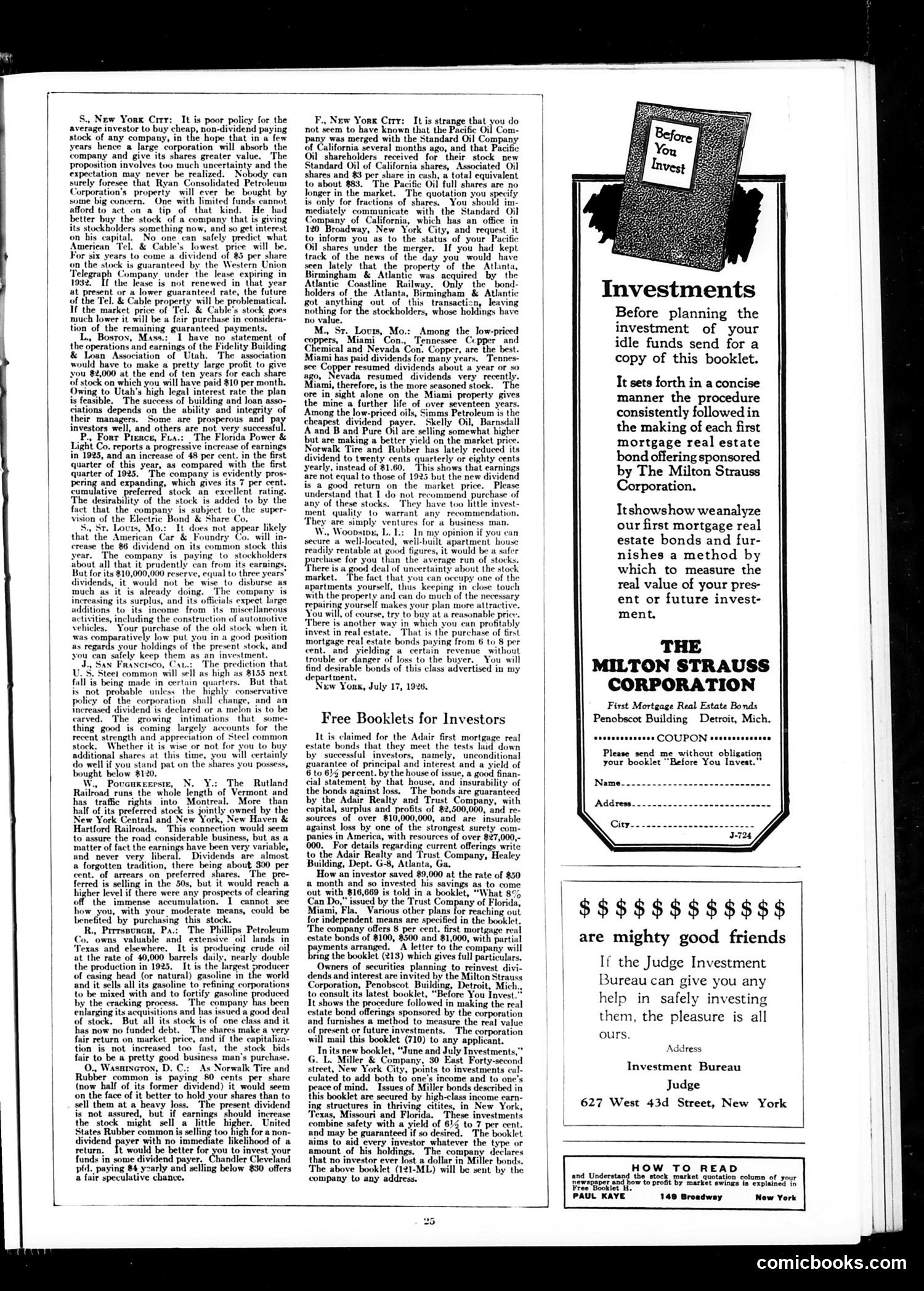
This page is primarily **investment advisory content** rather than political satire or editorial cartooning. It features a series of readers' questions about stock purchases, answered by an investment columnist—a common Judge magazine feature from this era. The page addresses concerns typical of 1920s retail investors: speculative stocks, railroad dividends, building-and-loan associations, and utility company securities. Notable is advice **against** risky speculation (like "Ryan Consolidated Petroleum") and **toward** stable, dividend-paying stocks—conservative guidance for ordinary savers. The right side advertises **Milton Strauss Corporation's real-estate bond offerings** and the **Judge Investment Bureau's free booklets**, reflecting how Judge monetized investment content by promoting financial products to its readership. The satire is implicit: Judge positions itself as a voice of prudent reason amid the speculative frenzy of the 1920s boom market, warning readers away from get-rich-quick schemes.
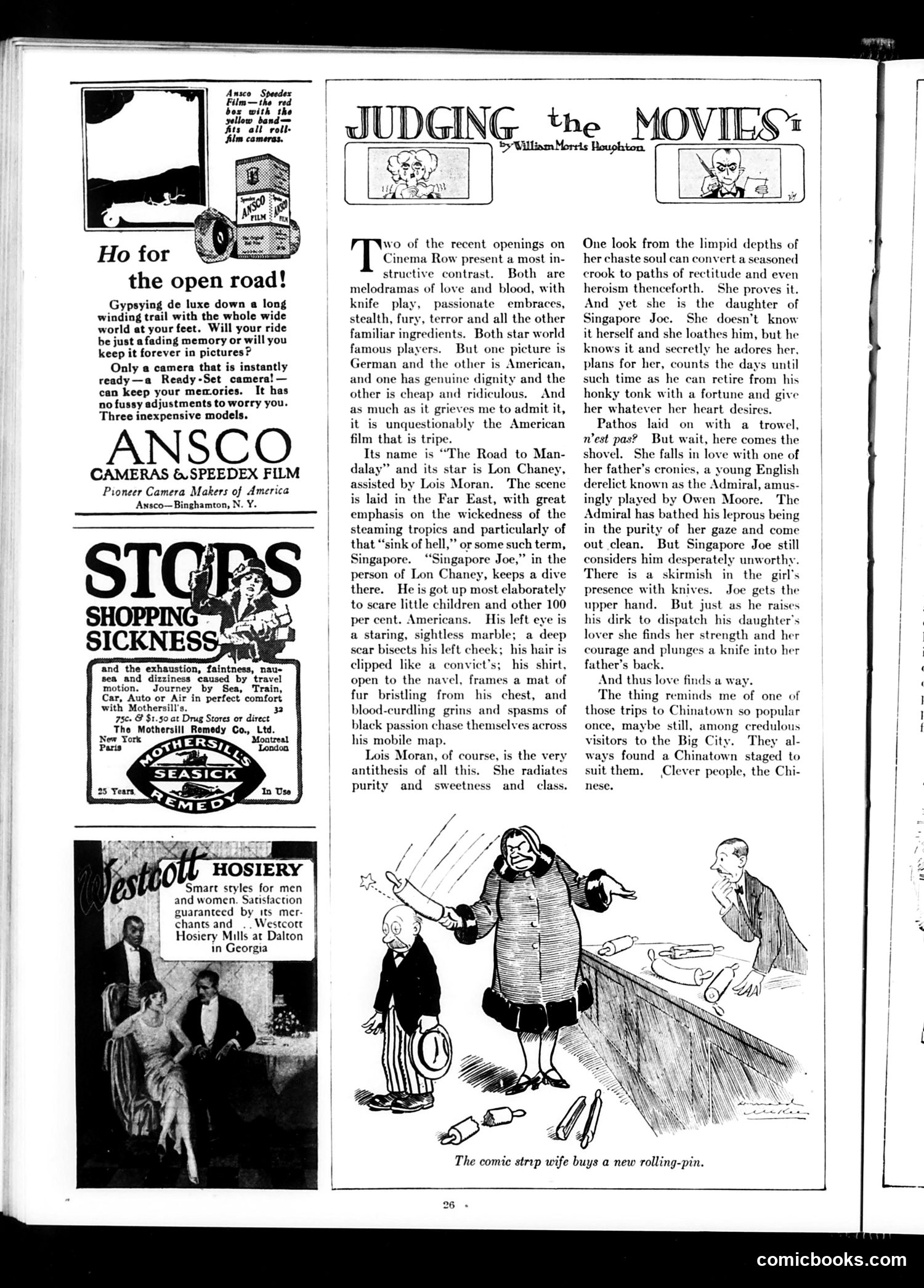
This page contains a film review column by William Morris Houghton critiquing two melodramas: a German film and "The Road to Mandalay," an American picture starring Lon Chaney and Lois Moran. The review's satire targets American cinema's crude sensationalism. Houghton contrasts the German film's "genuine dignity" with the American film's cheap exploitation. He mocks "The Road to Mandalay" for its overwrought exoticism—the grotesquely made-up villain "Singapore Joe" (Chaney) with his sightless eye and chest scars designed to "scare little children," and the impossibly pure heroine (Moran) whose virtue miraculously reforms criminals. The final jab compares the film to tourist Chinatown attractions: staged, artificial, designed for credulous audiences. Houghton suggests American filmmakers pander to viewers with melodramatic clichés rather than genuine artistry. The cartoon below illustrates domestic comedy—a wife buying a rolling pin—offering comic relief from the film criticism.
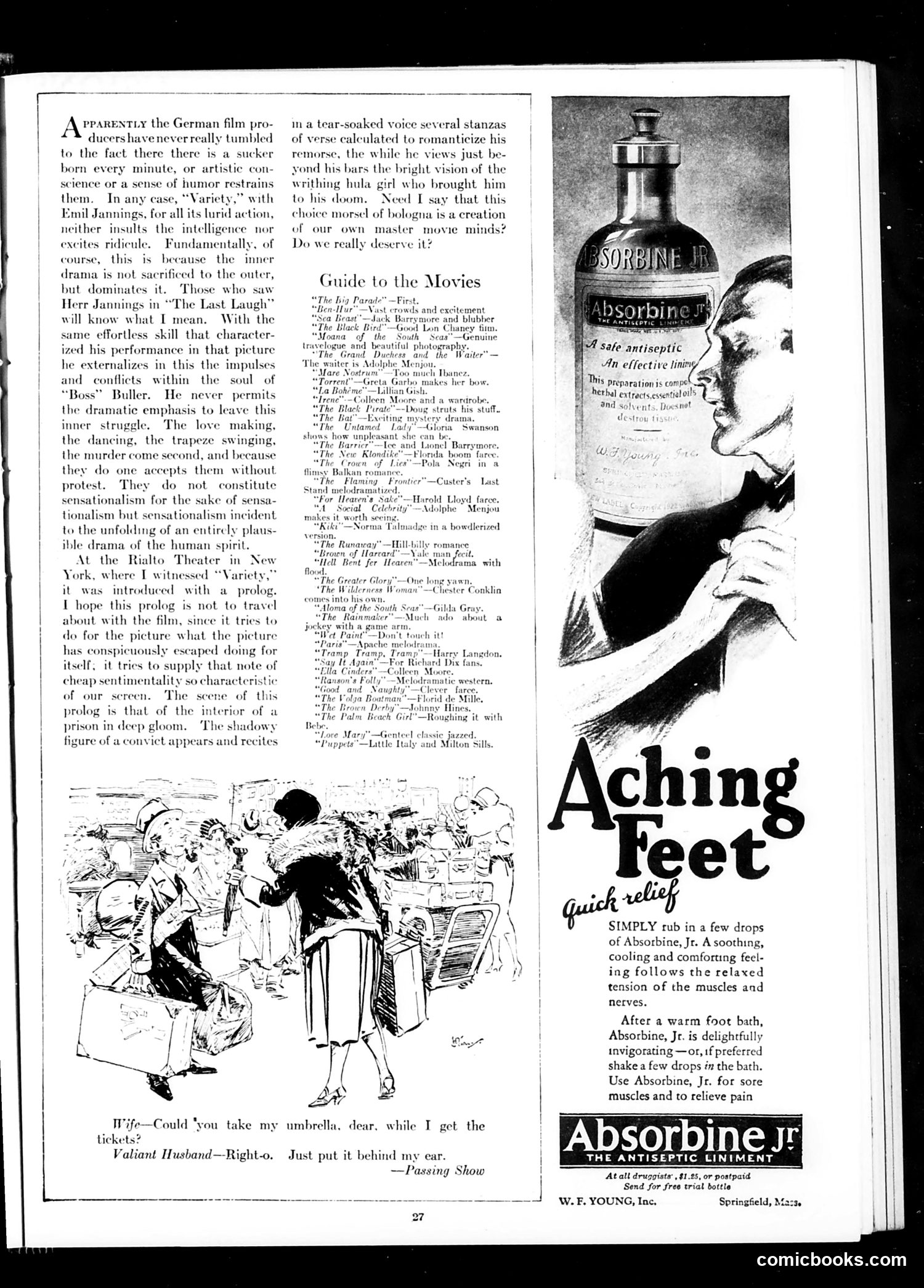
This page contains a film critique essay and movie guide alongside advertisements. The main cartoon shows a domestic scene where a wife asks her husband to hold her umbrella while she attends to business—a humorous commentary on marital dynamics and gender roles in the 1920s. The essay critiques German film producers for exploiting audience sentimentality, using Emil Jannings as an example of an actor who elevates material through inner character work rather than cheap theatrical tricks. The author specifically objects to a melodramatic prologue added to a film screening at the Rialto Theater in New York, where a convict recites tear-jerking verse about a "hula girl" who brought him to ruin—dismissing it as undeserved "bologna." The "Guide to the Movies" lists contemporary films with brief, often sarcastic reviews. The page concludes with a vintage advertisement for Absorbine Jr., a liniment for foot pain relief—typical period advertising content.
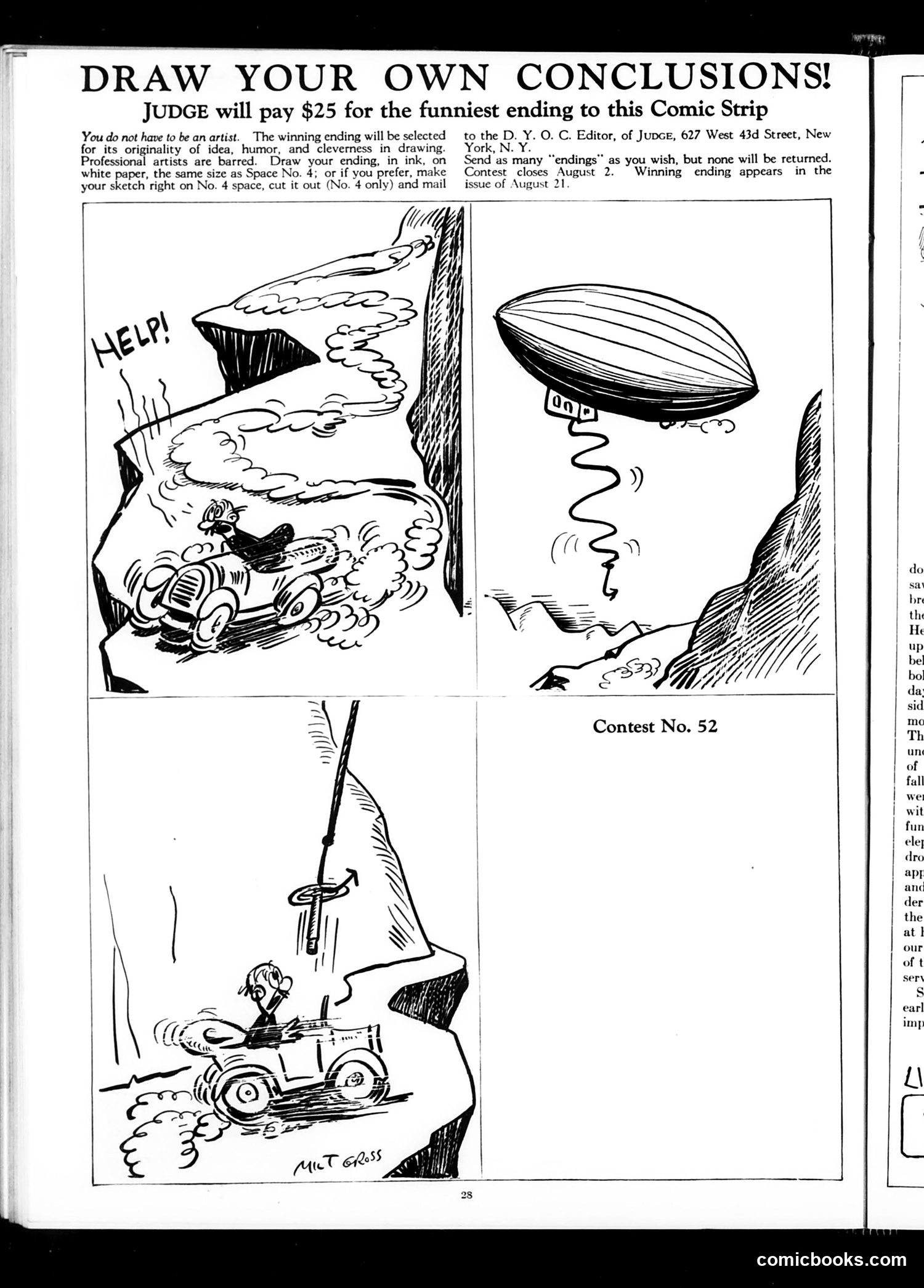
This page presents a reader-participation contest where Judge magazine invites amateur artists to complete an unfinished comic strip. The contest offers $25 for the funniest ending (professional artists excluded). The three panels show a slapstick sequence: Panel 1 depicts a character in a vehicle crying "HELP!" while escaping from an explosion or disaster. Panel 2 shows a blimp or airship descending with a rope. Panel 3 (signed "MILT GROSS") shows the character being lifted by the rope while dangling from a large shovel or scoop. The joke setup is unclear from these panels alone—readers are expected to supply the punchline. The contest represents typical early-20th-century magazine engagement, inviting reader creativity rather than passive consumption. The specific context of the disaster or threat remains undefined, allowing contestants creative freedom in resolving the situation.
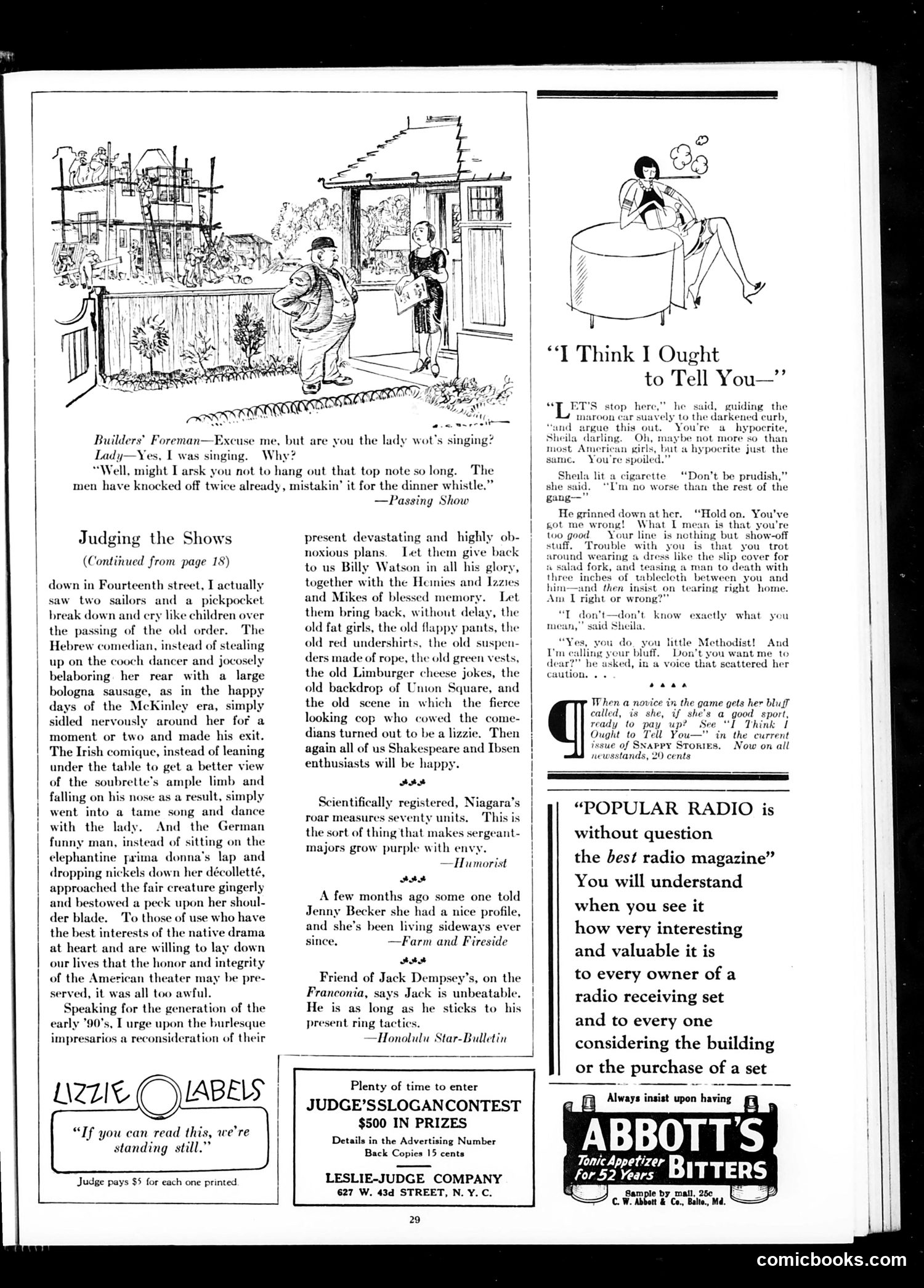
This page contains satirical commentary on early 20th-century American theater and burlesque. **The main cartoon** shows a Builders' Foreman addressing a female singer, complaining that her high note was mistaken twice for the dinner whistle—a joke about both her vocal prowess and the disruption of work rhythms. **"Judging the Shows"** is a nostalgic lament by someone mourning changes in burlesque comedy. The author complains that performers have become timid and proper, replacing the bawdy physical comedy of the "McKinley era" (early 1900s) with tame performances. He mentions specific old acts: Hebrew, Irish, and German comedians engaging in crude, physical humor with female performers. The piece expresses anxiety about modernization and perceived moral decline in American entertainment. **The right-side cartoon** illustrates a domestic quarrel where a man accuses a woman of hypocrisy—claiming she dresses provocatively but demands propriety. The advertisements promote *Popular Radio* magazine and Abbott's Bitters. The overall tone reflects nostalgia for earlier, less-restrained entertainment conventions.
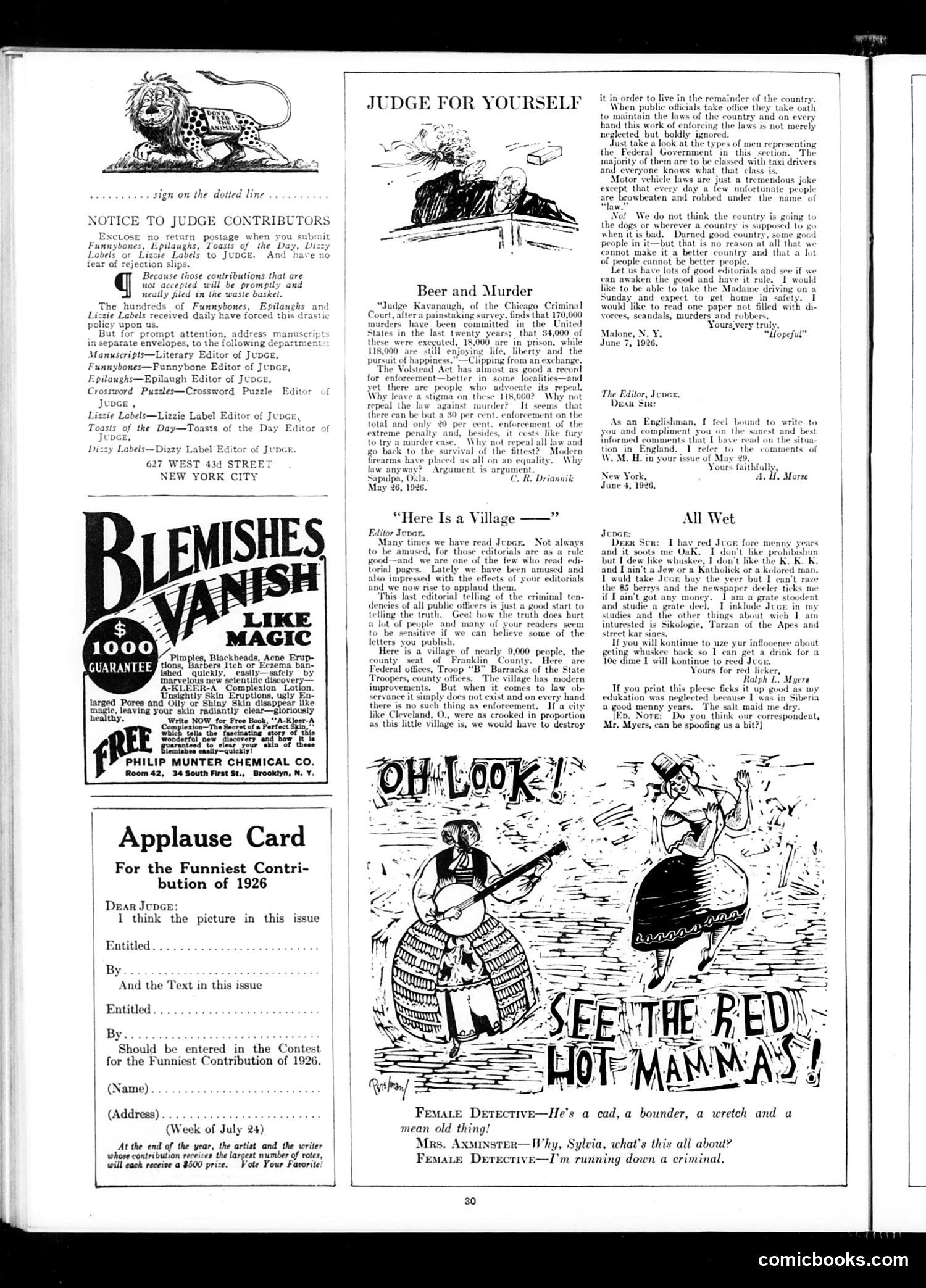
This page contains editorial content and advertising from Judge magazine. The main satirical pieces address two topics: **"Beer and Murder"** critiques inconsistent law enforcement. The author notes that while 170,000 murders occurred in the US over 20 years, only 34,000 were executed and 118,000 murderers remain free—yet people want to repeal Prohibition (the Volstead Act). The satire argues: if we tolerate murder at this rate, why strictly enforce alcohol laws? The piece exposes the hypocrisy of selective law enforcement. **"Here Is a Village"** complains about corruption and lawlessness in a small Franklin County village despite federal presence. The writer criticizes lax enforcement of traffic and other laws, arguing that if cities were equally corrupt they'd need destruction. He calls for stronger editorials to awaken civic responsibility. The page also includes an "Applause Card" contest for readers to vote on the funniest contributions, and period advertisements (skin cream, blemish removal).
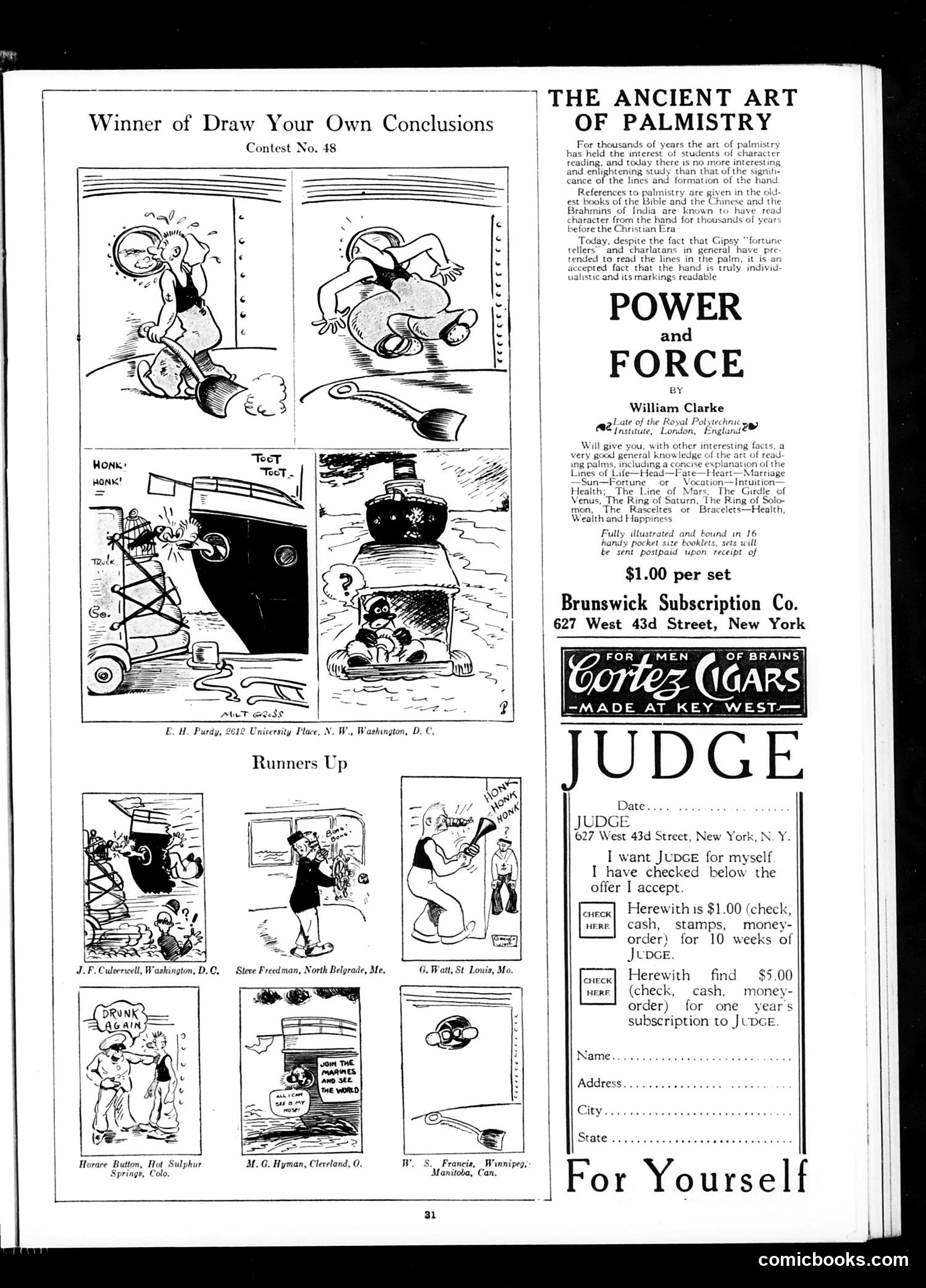
This page showcases the winner of **Judge's "Draw Your Own Conclusions" Contest No. 48**, featuring cartoons by E.H. Pardy. The winning entry (top) and runners-up depict absurdist, surrealist humor typical of 1920s-30s satirical cartooning—chaotic scenes with exaggerated figures, impossible situations, and visual gags rather than direct political commentary. The cartoons mock everyday life through distorted imagery: a figure tangled in geometric confusion, someone swallowing oversized objects, and similar visual nonsense. Without identifying specific individuals or events, the humor relies on visual absurdism and surrealism popular in the era. The page also advertises palmistry books and Judge magazine subscriptions—commercial content typical of period satirical magazines that subsidized operations through ads and premium content.
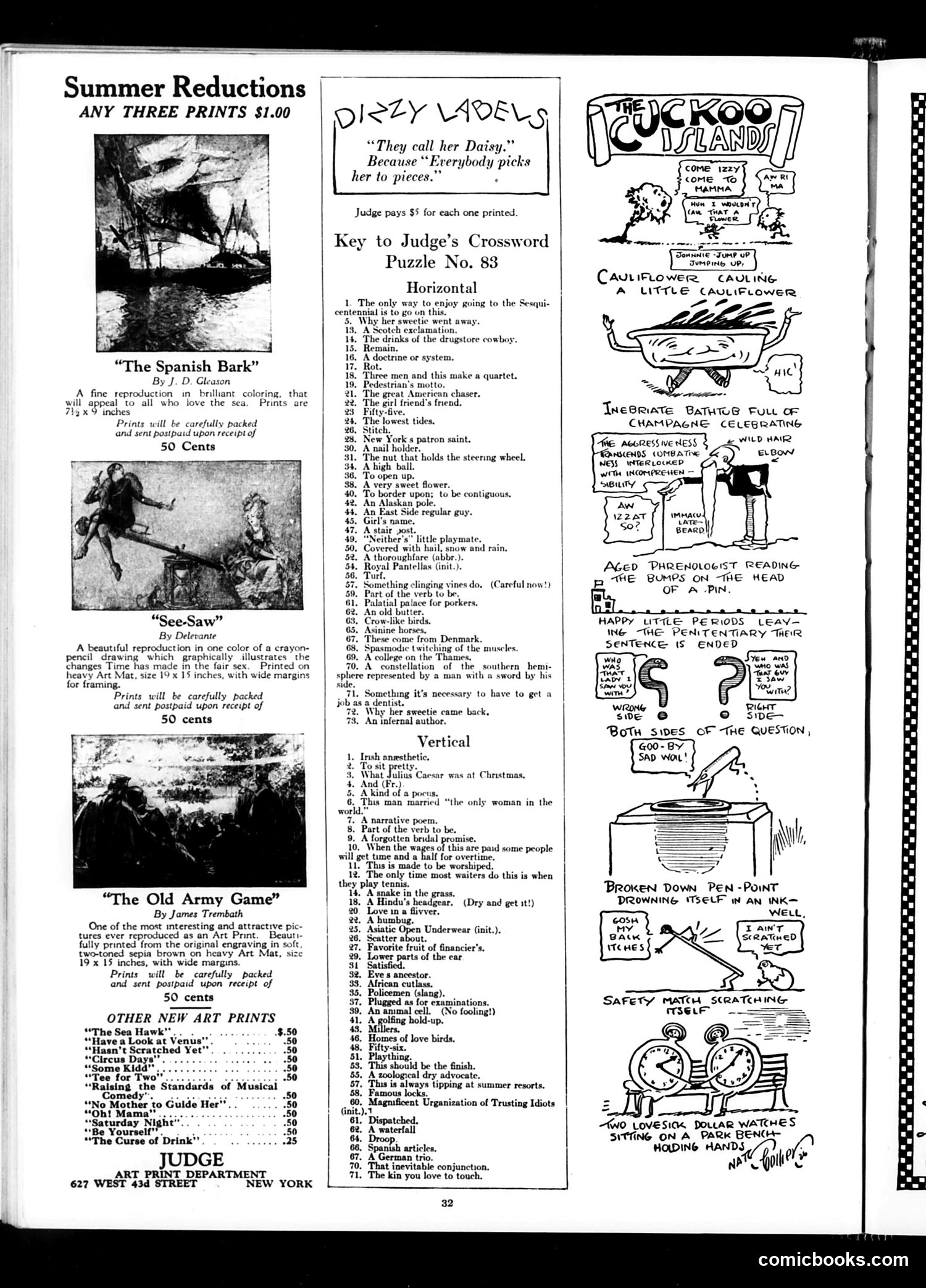
This page is primarily **advertising and reference material**, not editorial content. It features: **Art Print Advertisements**: Judge's print department offers reproductions—"The Spanish Bark," "See-Saw," and "The Old Army Game"—at reduced summer prices (50 cents to $1.00). These appear to be landscape, social commentary, or historical scenes typical of the era's genteel art market. **"Dizzy Daisys" Caption Joke**: A brief gag explaining the nickname "Daisy" because "Everybody picks her to pieces"—a mildly risqué double-entendre suggesting both physical attractiveness and harsh criticism. **Comic Strip "Cuckoo Island"**: Crude pen-and-ink humor featuring absurdist scenarios (bathtub champagne celebrations, broken pens drowning in inkwells, safety match fights). This appears to be nonsense/slapstick comedy without clear political meaning. **Crossword Puzzle**: A standard Judge crossword with clues referencing 1920s slang, geography, and contemporary culture (Sesquicentennial, "flivver," drugstore cowboys). The page reflects Judge's identity as an entertainment and advertising publication rather than focused political satire.
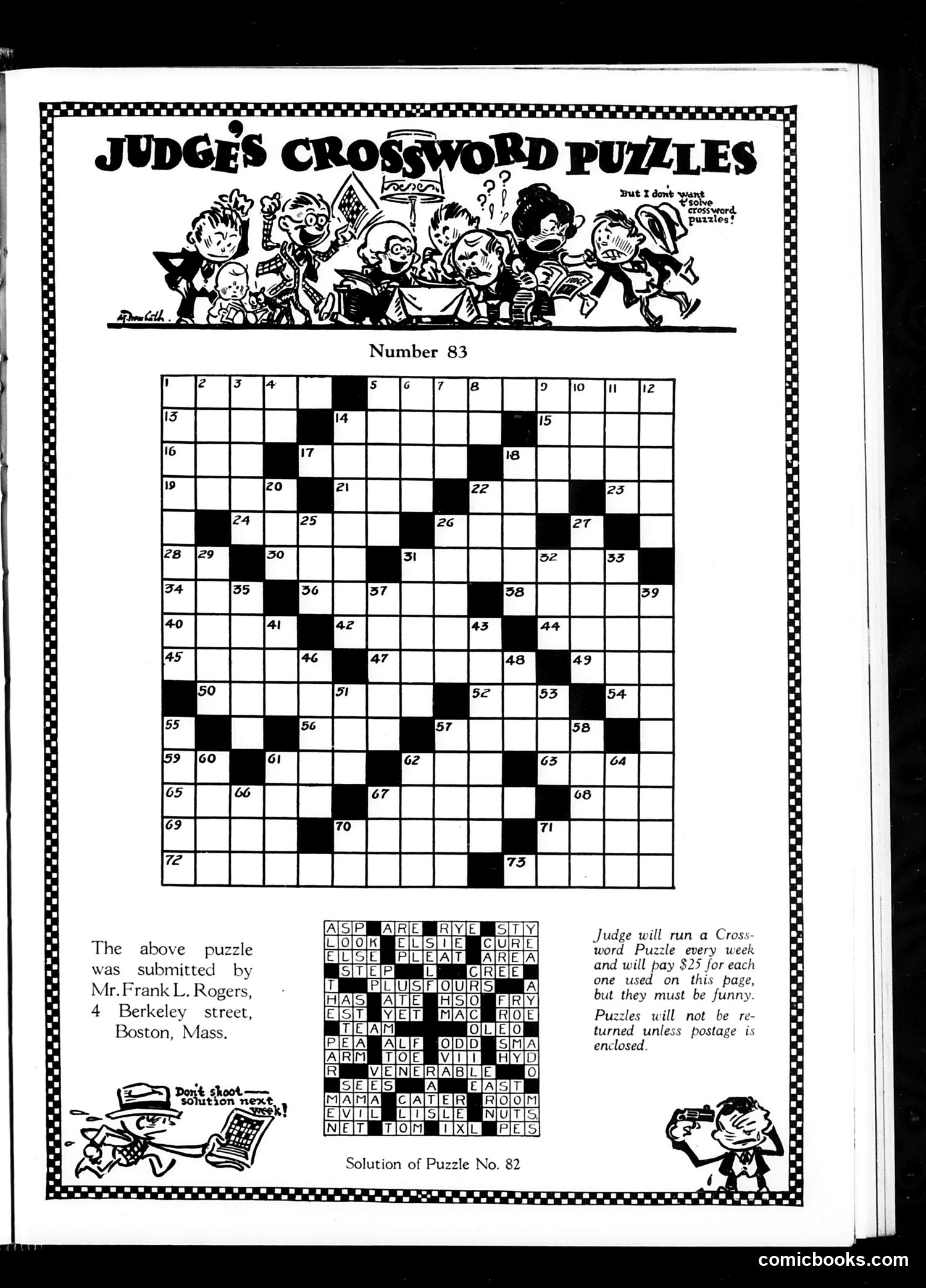
This page is primarily a **crossword puzzle submission feature**, not political satire. Judge magazine ran a weekly crossword puzzle contest, paying $25 for accepted submissions—a significant sum in this era. The page shows **Puzzle No. 83** (blank grid for solvers to complete) and the **solution to Puzzle No. 82** in the center. The small cartoon at bottom left appears to show a frustrated solver, capturing the common experience of struggling with crossword clues—a light, relatable joke about the puzzle-solving process itself. The submission information credits **Frank L. Rogers of Boston, Massachusetts** as the puzzle creator. This reflects the puzzle's popularity as entertainment during this period. The page's tone is straightforward commercial promotion rather than political commentary or social satire typical of Judge's main content.
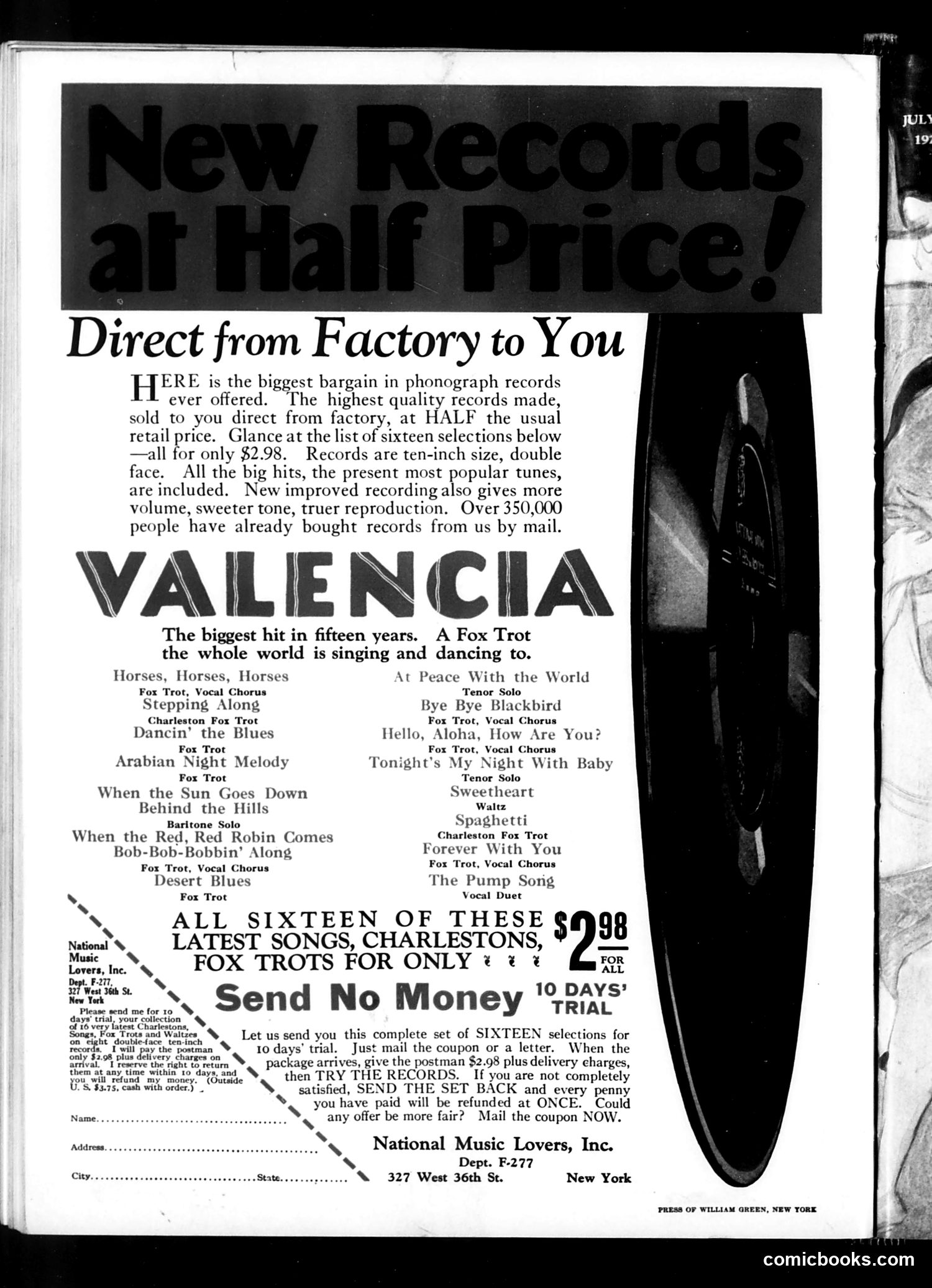
This page contains **no political cartoon or satire**. It's a full-page advertisement from National Music Lovers, Inc. promoting phonograph records sold mail-order at $2.98 for sixteen selections—marketed as "half price" direct from factory. The ad targets 1920s consumers interested in popular dance music: Fox Trots, Charlestons, and waltzes featuring hit songs like "Valencia" (described as "the biggest hit in fifteen years"). The "10 days' trial, send no money" pitch was a common direct-mail sales tactic of the era, designed to overcome consumer hesitation about mail-order purchases. The only visual element is a photograph of a phonograph record on the right side. This is straightforward commercial content, not editorial commentary or humor—typical filler advertising that magazines like *Judge* used to generate revenue.