
Judge, 1926-07-24 · page 15 of 36
Judge — July 24, 1926 — page 15: what you’re looking at
What you’re looking at
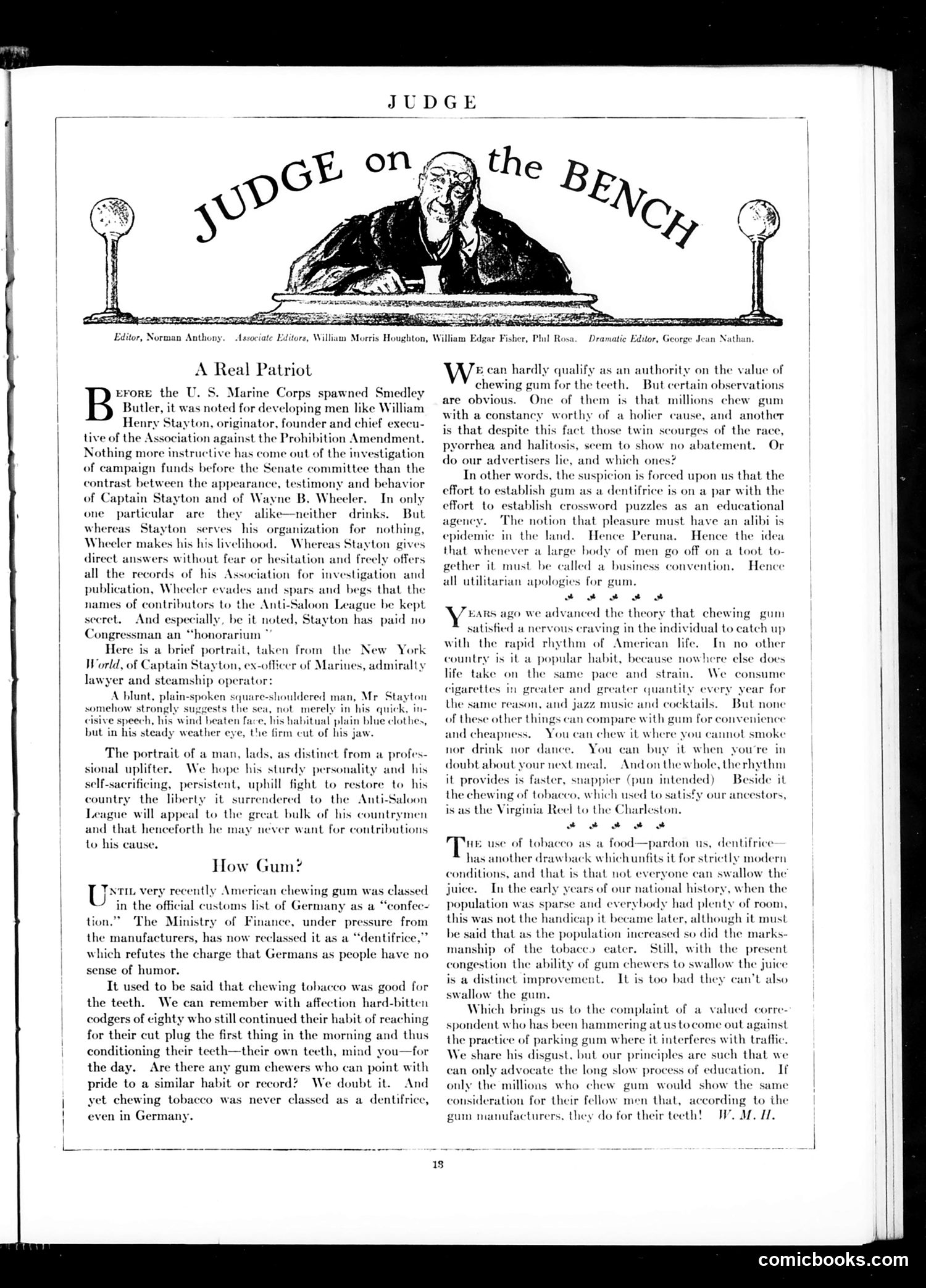
This page contains two editorial pieces: **"A Real Patriot"** contrasts Captain William Henry Stayton (head of the Association Against the Prohibition Amendment) with Wayne B. Wheeler (leader of the Anti-Saloon League). The satire criticizes Wheeler's hypocrisy: while both oppose drinking personally, Stayton volunteers his time and openly shares records, whereas Wheeler profits from his position and hides donor names. The piece attacks the Anti-Saloon League's secretive fundraising and suggests Wheeler has bribed politicians with "honorariums." This reflects 1920s Prohibition-era tensions. **"How Gum?"** mocks American society's desperate need to justify pleasure activities. Germany reclassified chewing gum from "confection" to "dentifrice" (toothpaste), which Judge ridicules as absurd. The editorial satirizes Americans' constant rationalization—claiming gum is healthy when it's merely entertainment, just as people call leisure trips "business conventions" to legitimize enjoyment. The piece reflects broader cultural anxiety about productivity and self-justification in early 20th-century America.
📄 Transcribed text from this page (OCR, searchable)
Machine-transcribed from the original scan — historical spelling and the odd misread are preserved.
Editor, Norman Anthony A Real Associate titors, William Mor -atriot EFoRE the U. S. Marine Corps spawned Smedley B Butler, it was noted for developing men like William Henry yton, originator, founder and chief execu- tive of the Association against the Prohibition Amendment. Nothing more instructive has come out of the investigation of campaign funds before the Se contrast between the appearanc of Captain Sta one ate committee than the testimony and behavior yton and of Wayne B. Wheeler. In only particular are they alike—neither drinks. But whereas Stayton serves his organization for nothing, Wheeler makes his his livelihood. Whereas Stayton gives direct answers without fear or hesitation and freely offers all the records of his Association for investigation and publication, Wheeler evades and spars and begs that the names of contributors to the secret. Anti-Saloon League be kept And especially, be it noted, Stayton has paid no Congressman an “honorarium * Here is a brief portrait, taken from the New York World, of Captain Stayton, ex-oflicer of Marines, admiralty lawyer and steamship operator: A blunt, plain-spoken square-shouldered man, Mr Stayton somehow strongly suggests the sea, not merely in his quick, in- cisive speech, his wind beaten face, his habitual plain blue clothes, but in his steady weather e firm cut of his jaw. The portrait of a man, lads, as distinct from a profes- sional uplifter.. We hope his sturdy personality and his self-sacrificing, persistent, uphill fight to restore to his country the liberty it surrendered to the Anti-Saloon League will appeal to the great bulk of his countrymen and that henceforth he may never want for contributions to his cause. Ifow Gum? Txt very recently American chewing gum was classed in the official customs list of Germany as a The Ministry of the manufacturers, has now reclassed it as a “confec- tion.” Finance, under pressure from “dentifrice,” which refutes the charge that Germans as people have no sense of humor. It used to be said that chewing tobacco was good for the teeth. We can remember with affection hard-bitten codgers of cighty who still continued their habit of reaching for their cut plug the first thing in the morning and thus conditioning their teeth—their own teeth, mind you—for the day. Are there any gum chewers who can point with pride to a similar habit or record? We doubt it. And yet chewing tobacco was never classed as a dentifrice, even in Germany. is Houghton, William Edgar Fisher, Phil Rosa. Dramatic Editor, George Jean Nathan WwW: can hardly qualify as an authority on the va chewing gum for the teeth. But certain obser are obvious. One of is that millions chew with a constancy worthy of a holier cause, Lue of ions gum and another is that despite this fact those twin scourges of the race, pyorrhea and halitosis, seem to show no abatement. Or do our advertisers lie, them and which ones? In other words, the suspicion is forced upon us that the effort to establish gum as a dentifrice is on a par with the effort to establish crossword puzzles as an educational agency. ‘The notion that pleasure must have an alibi is epidemic in the land. Hence Peruna. Hence the idea ge body of men go off on a toot to- Hence that whenever a gether it must be called a business convention. all utilitarian apologies for gum. et tH “ARS ago we advanced the theory that chewing gum satisfied a nervous craving in the individual to catch up with the rapid rhythm of American life. In no other country is ita popular habit, because nowhere else does life take on the and strain. We consume cigarettes in greater and greater quantity every year for the same reason, and jazz mus same pace -and cocktails. But none of these other things can compare with gum for and cheapness. onvenience You can chew it where you cannot sme nor drink nor dance. You can buy it when you're in Andon thewhole, the rhythni it provides is faster, snappier (pun intended) — Beside it the chewing of tobacco, which used to satisfy our ancestors, is as the Virginia Reel to the Charleston, Dh ih ow Te use of tobacco as a food—pardon us, dentifrice has another drawback which unfits it for strictly modern conditions, and that is that not everyone juice. population was sparse doubt about your next meal. can swallow the rs of our national history, when the und everybody had plenty of room, this was not the handicap it became later, although it must be said that as the population increased so did the marks- Still, with the present congestion the ability of gum chewers to swallow the juice is a distinct improvement. swallow the gum. manship of the tobaces eater. It is too bad they can’t also Which brings us to the complaint of a valued corre- spondent who has been hammering at us tocome out against the practice of parking gum where it interferes with traffic. We share his disgust, but our principles are such that we can only advocate the long slow process of education. If only the millions who chew gum would show the same consideration for their fellow men that, according to the gum manufacturers, they do for their teeth! JW. M. I. comicbooks.com