
A complete issue · 36 pages · 1926
Judge — June 12, 1926
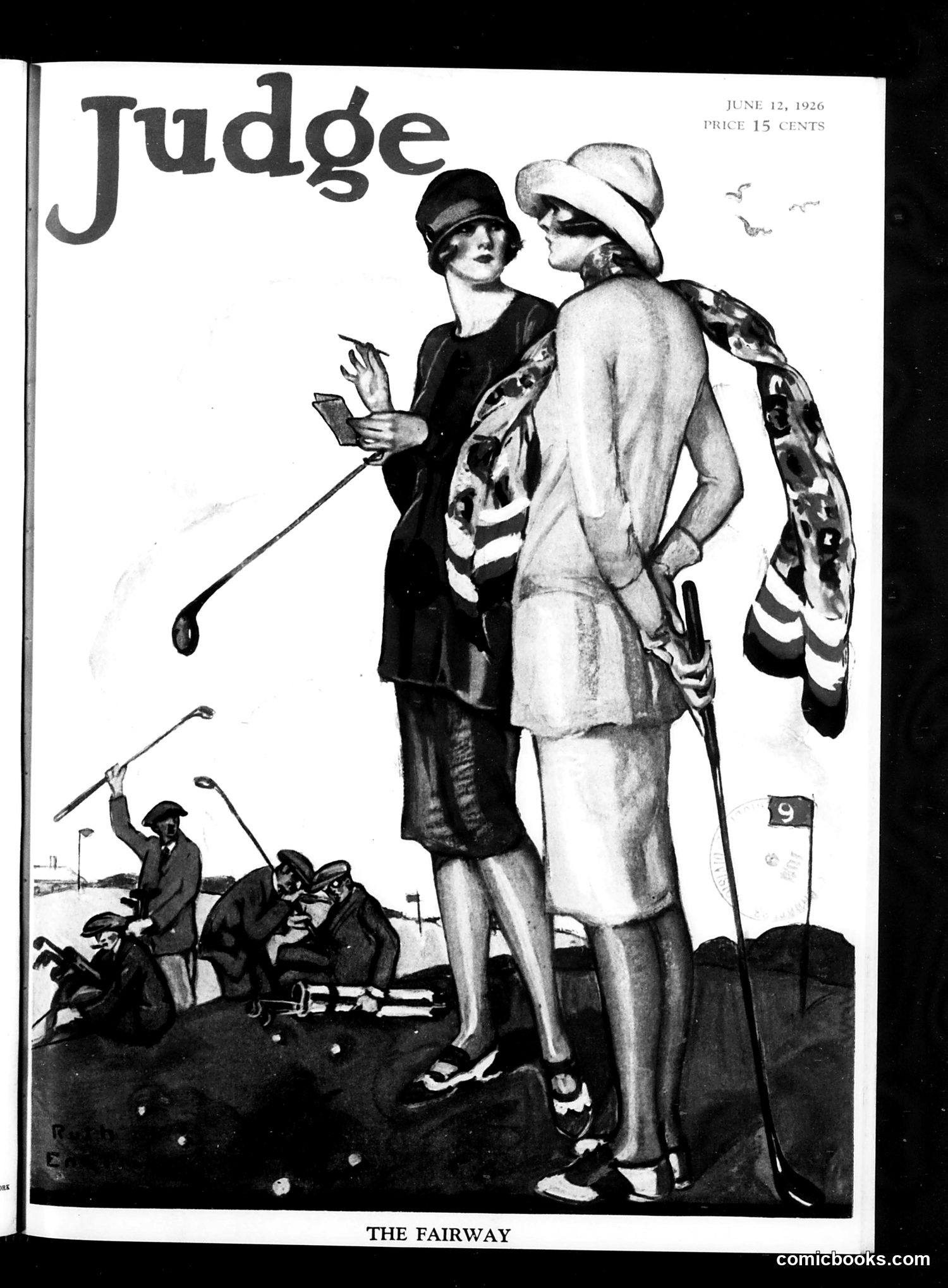
This golf-themed cartoon satirizes women's participation in the sport during the 1920s. Two fashionably dressed women in cloche hats and period swimwear-style golf attire converse on the course while holding golf clubs. In the background, male golfers play, appearing smaller and less prominent. The satire likely comments on the novelty and social disruption of women's growing presence in previously male-dominated recreational spaces during the Jazz Age. The women's prominent positioning, modern dress, and apparent confidence suggest they command attention on "the fairway"—perhaps mocking or celebrating women's increasing social independence and their invasion of traditionally masculine leisure activities in the 1920s.
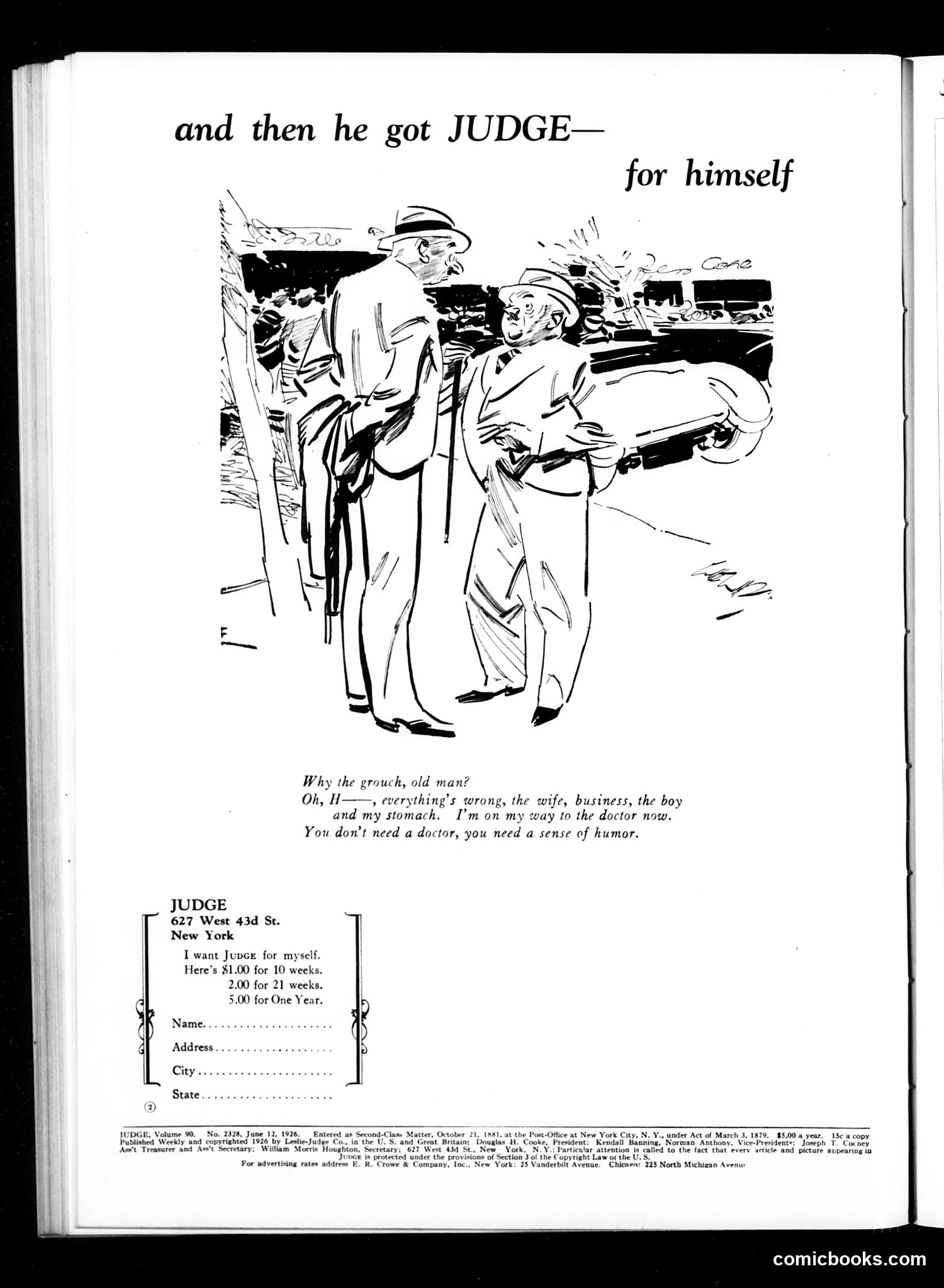
This page features a satirical cartoon about a man complaining to another about life's troubles—his wife, business, and stomach—while heading to a doctor. The second man's response suggests the real problem is lacking humor. The cartoon illustrates a common social anxiety of the era: excessive worry and hypochondria. The satire implies that many ailments stem from taking life too seriously rather than actual medical conditions. Below the cartoon is a subscription advertisement for *Judge* magazine itself, playing on the visual joke: the magazine offers itself as the cure—a "sense of humor" delivered weekly. This clever self-promotion positions *Judge* as therapeutic entertainment for stressed, modern Americans circa 1926. The advertisement lists subscription rates ranging from $1.00 for 10 weeks to $5.00 annually.
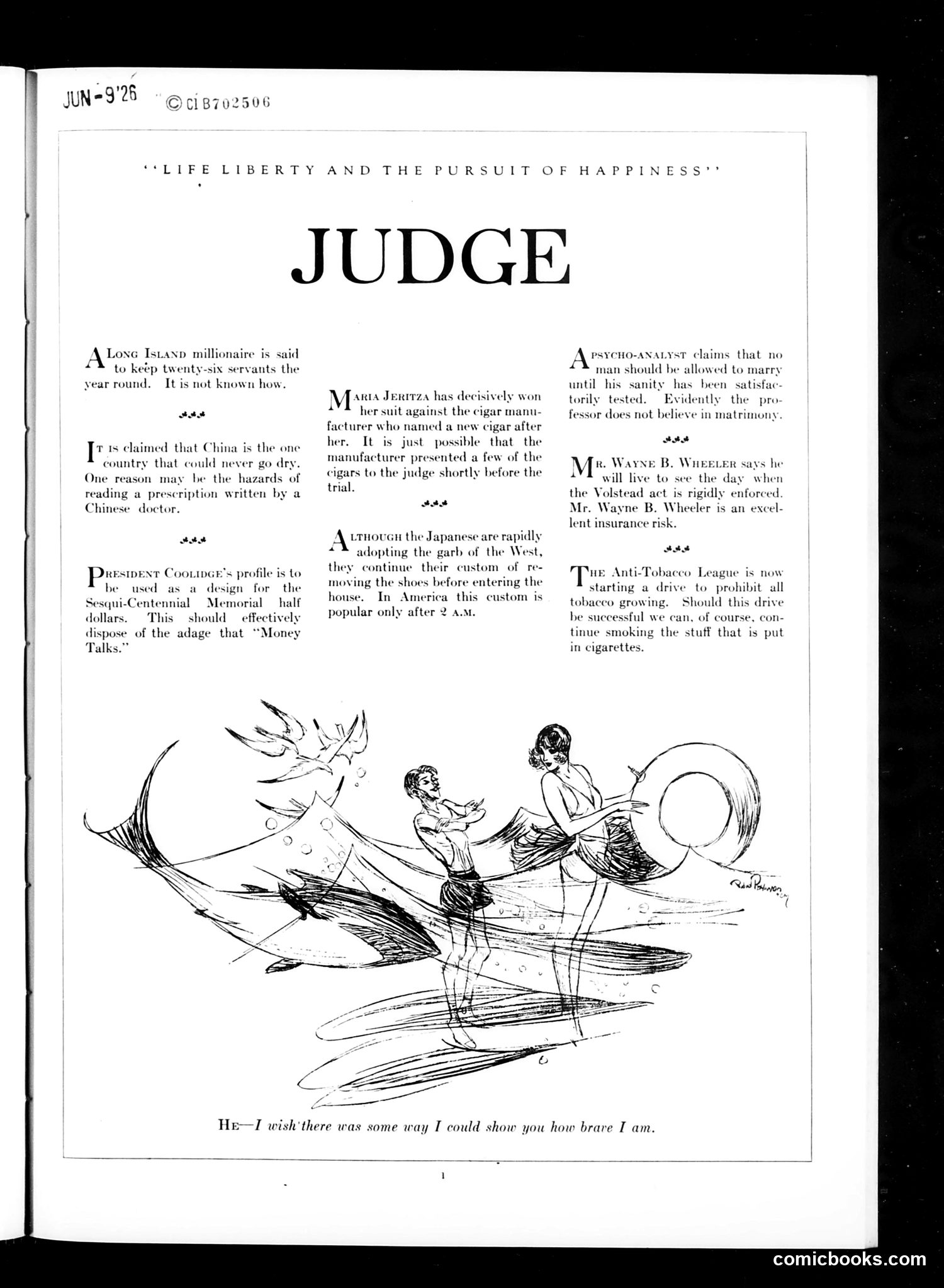
This page contains brief satirical items rather than a coherent cartoon sequence. The main illustration depicts two figures riding a large fish, with one saying "He—I wish there was some way I could show you how brave I am." The text items mock various contemporary subjects: - A Long Island millionaire keeping 26 servants year-round - Maria Jeritza (opera singer) winning a lawsuit against a cigar manufacturer who named a product after her - China being the only country never going dry (Prohibition reference) - Japanese adopting Western customs like removing shoes indoors - President Coolidge's profile as a memorial design - A psychoanalyst's views on marriage - Insurance risks and tobacco prohibition efforts The fish-riding illustration appears to be generic humor about exaggeration or boasting, unrelated to the surrounding text items. The page exemplifies Judge's format of mixed satirical commentary on 1920s American society and current events.
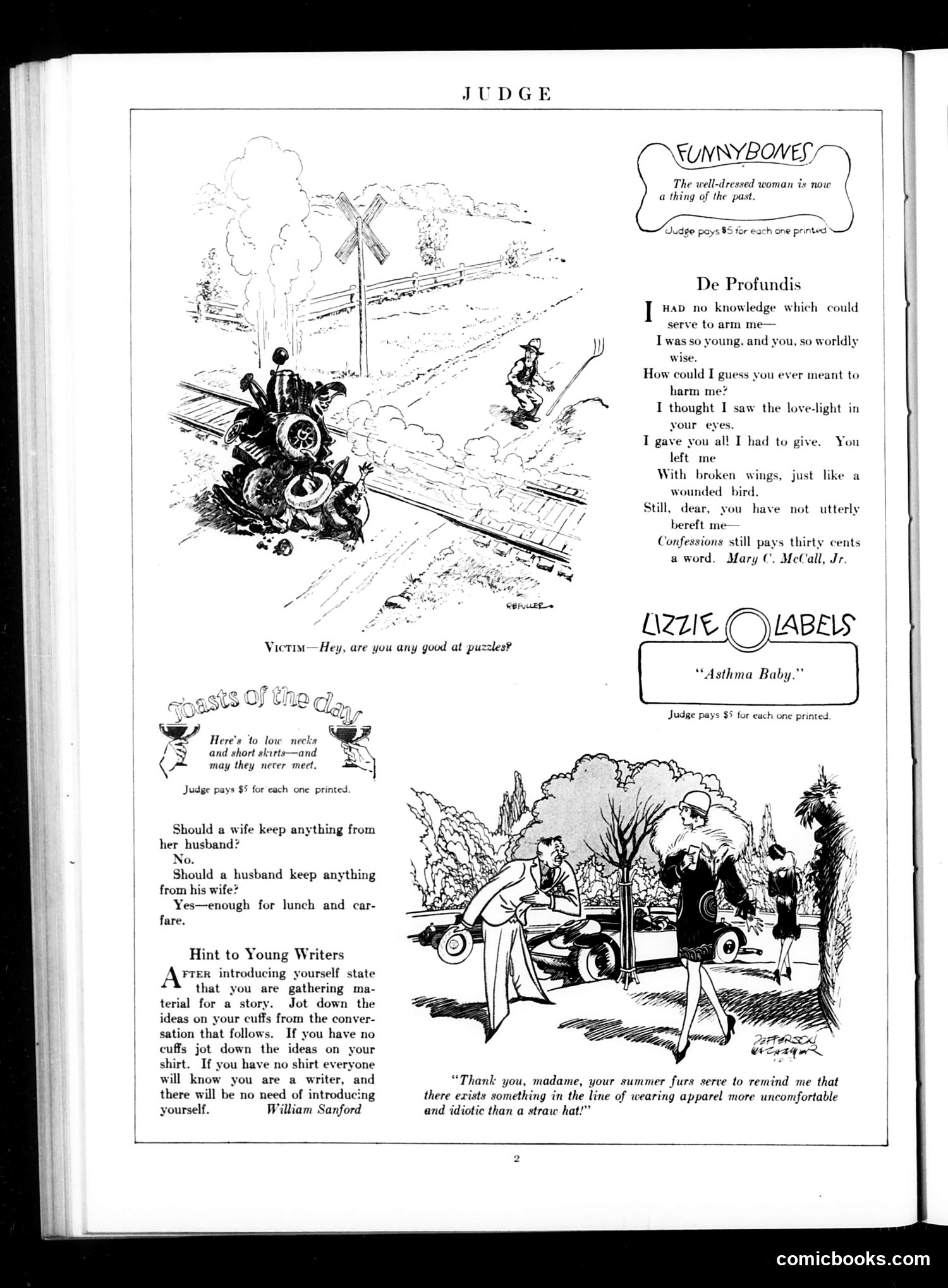
This page contains several unrelated satirical pieces typical of Judge magazine's format. **Top cartoon** ("Victim—Hey, are you any good at puzzles?") depicts a car crash, satirizing early automobile dangers and the chaos of motor vehicles. **"De Profundis"** is a serious poem about romantic betrayal, likely referencing the famous Oscar Wilde work of the same name—a confessional piece about heartbreak and abandonment. **"Lizzie Labels"** section offers social commentary on women's fashion and manners, with a cartoon mocking pretentious women concerned with appearance. **"Tastes of the Day"** and "Hint to Young Writers"** are humorous advice columns—one about marital secrets, another satirizing aspiring writers who lack originality. The page reflects Judge's mix of topical humor, social satire about gender roles and consumer culture, and literary references aimed at educated readers.
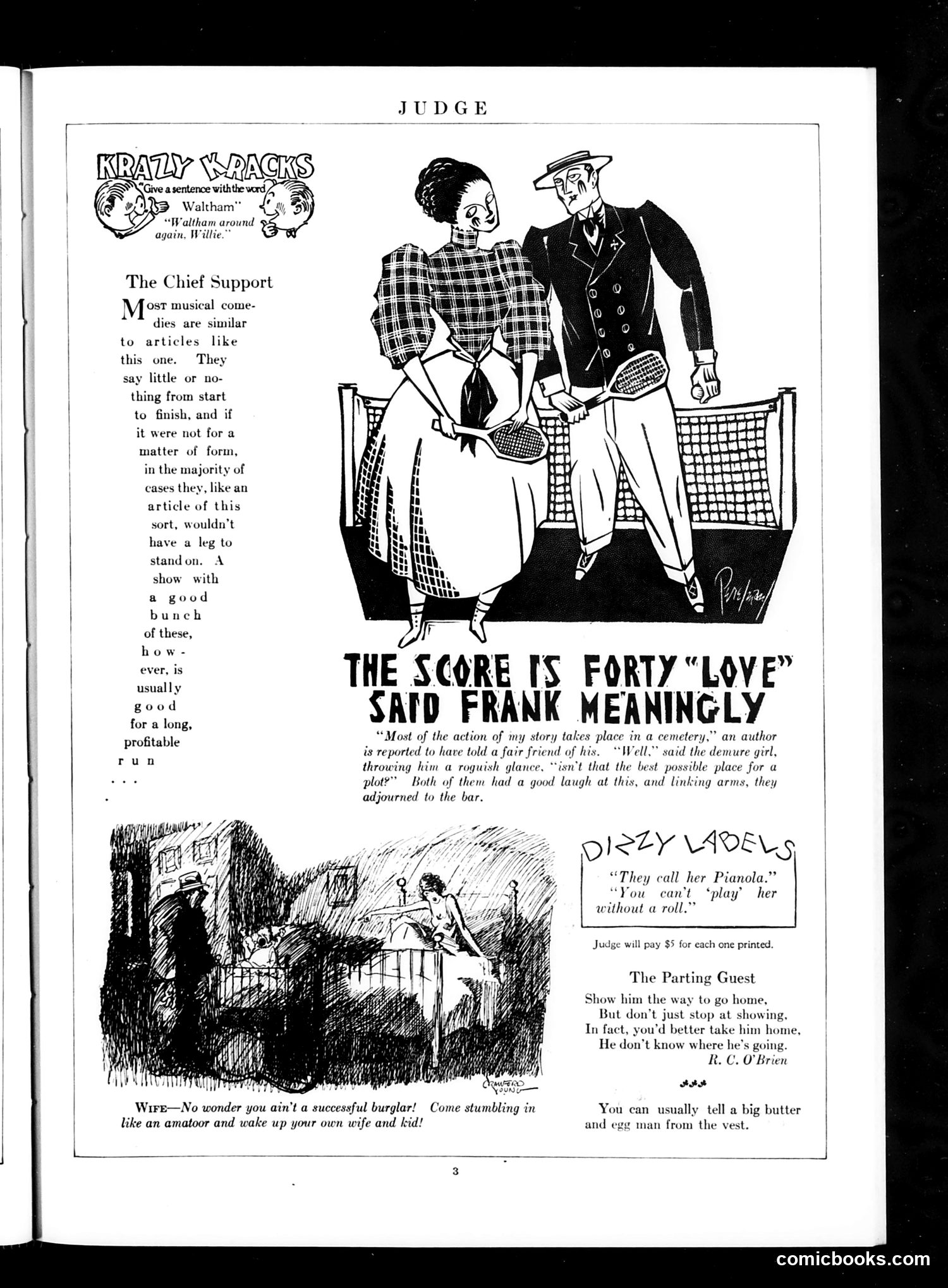
This page contains several unrelated humor pieces rather than unified political commentary. **"The Score Is Forty 'Love' Said Frank Meaningly"** depicts a couple at a tennis net. The joke plays on "love" (the tennis scoring term for zero) as a double entendre about romance, with the author apparently using tennis as a flirtation scenario. **"Dizzy Labels"** is a brief visual joke about piano playing. **"The Parting Guest"** is a poem about an overstaying visitor—social satire about poor manners. **"Wife"** shows a burglar encounter, with domestic humor about a wife waking her husband during a break-in. These appear to be filler humor pieces without significant political content. The magazine's "Krazy Knacks" feature and other elements suggest this is primarily entertainment-focused rather than satirical commentary.
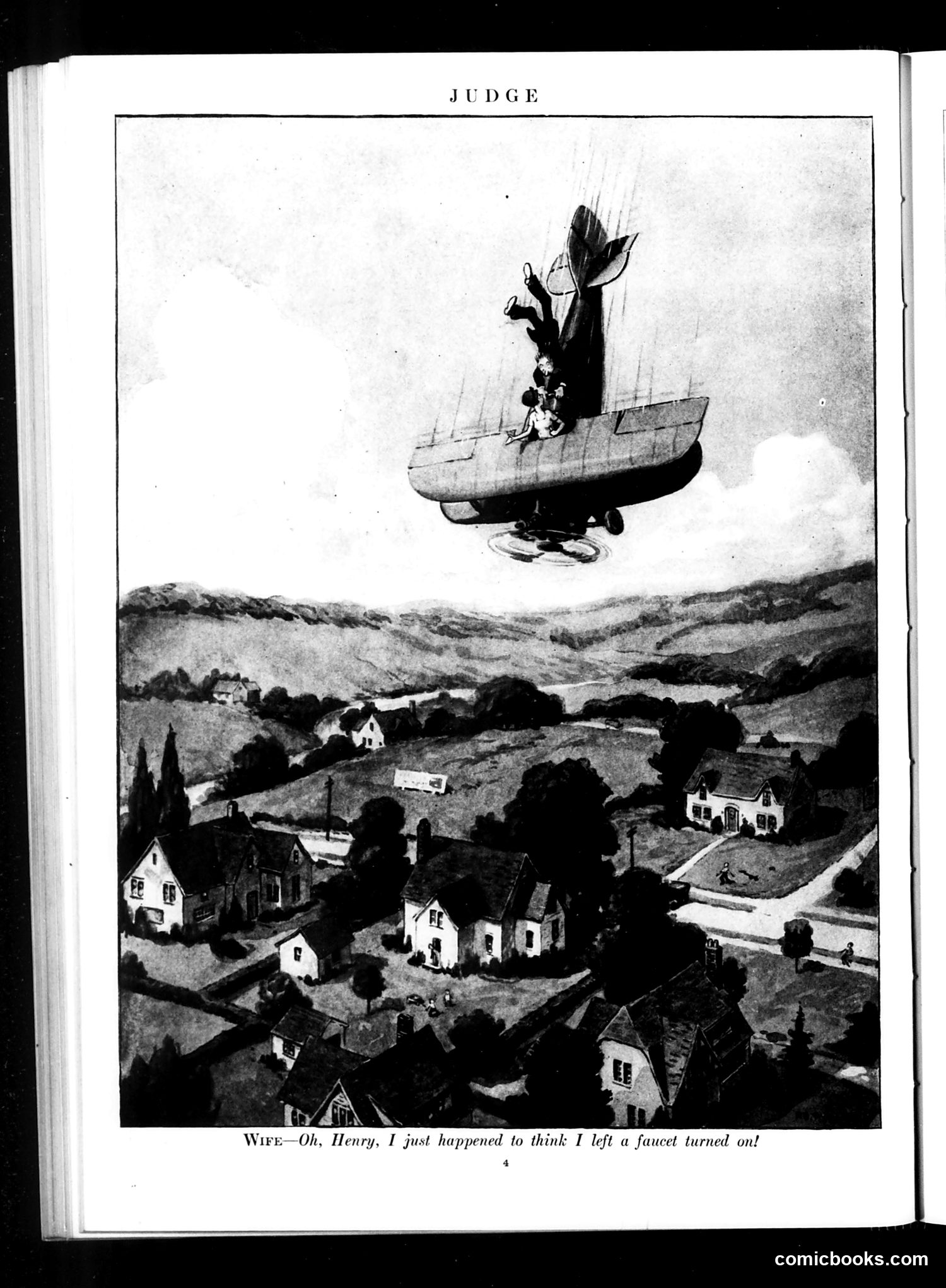
This is a satirical cartoon from *Judge* magazine depicting a surreal domestic scene. A sailboat with a figure appears to be flying or hovering impossibly above a peaceful suburban valley landscape with houses and rolling hills. The caption reads: "Wife—Oh, Henry, I just happened to think: I left a faucet turned on!" The joke is a play on domestic anxiety and absent-mindedness. The wife's casual realization that she left a faucet running is treated with absurd proportions—suggesting the water damage would be so catastrophic it would cause a massive flood (represented by the airborne boat). This exaggerates the humorous panic husbands and wives might experience over forgotten household tasks, turning a minor oversight into an apocalyptic scenario. It's commentary on domestic worry and marital communication.
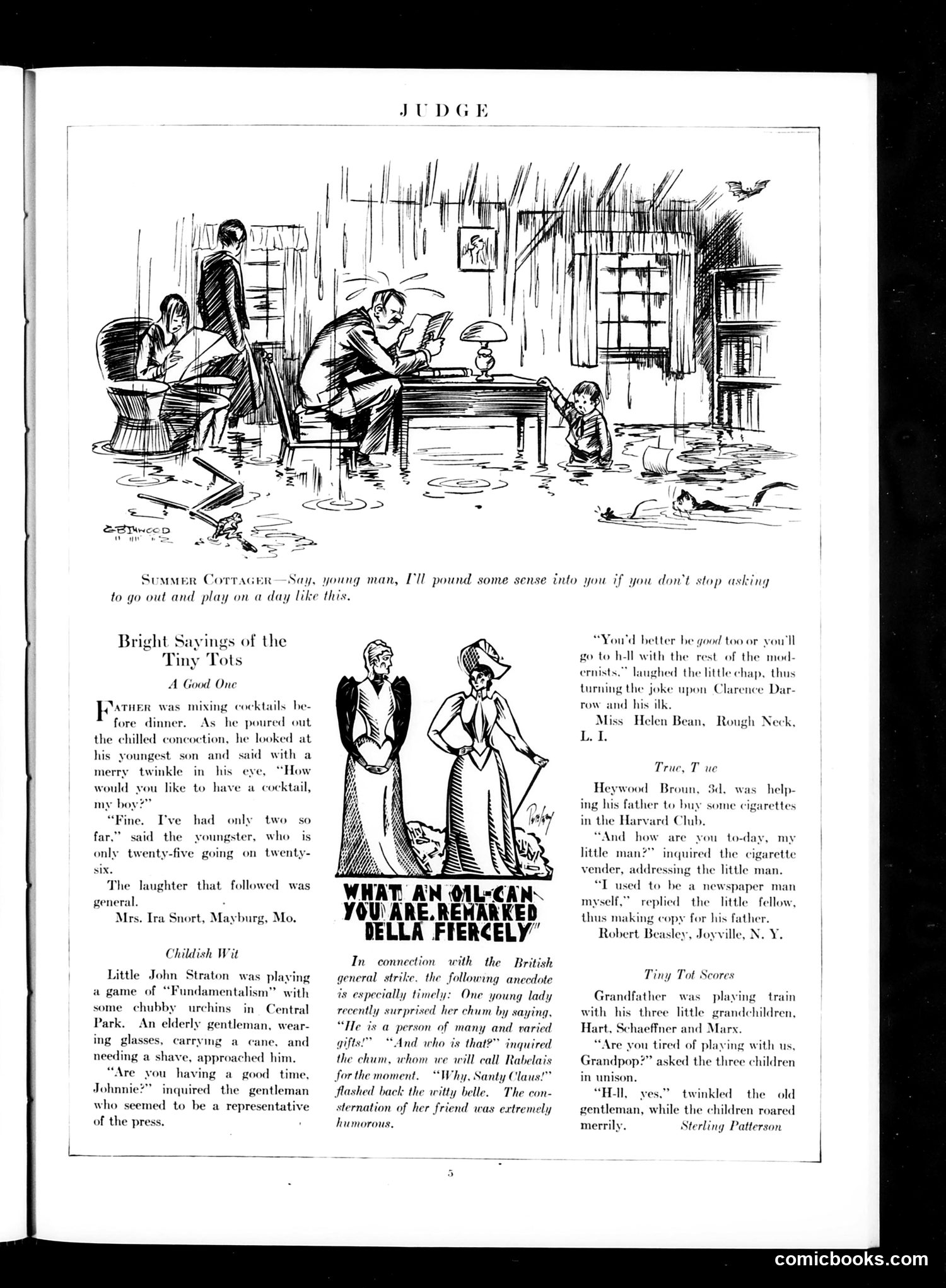
This page contains several unrelated humor pieces rather than political cartoons. The top illustration depicts a flooded summer cottage with a father threatening to "pound some sense" into his son for playing indoors on a nice day—a domestic humor piece about parenting frustrations. Below are brief anecdotes labeled "Bright Sayings of the Tiny Tots" and "Childish Wit," featuring innocent children's comments and misunderstandings. The central image shows a flapper-era woman captioned "What an American You Are, Remarked Della Fiercely"—seemingly satirizing modern courtship or flirtation customs. Additional brief jokes follow, including "True, True" and "Tiny Tot Scores," typical of Judge's format mixing domestic humor with social observation. This represents the magazine's general-interest comedy content rather than sharp political satire.
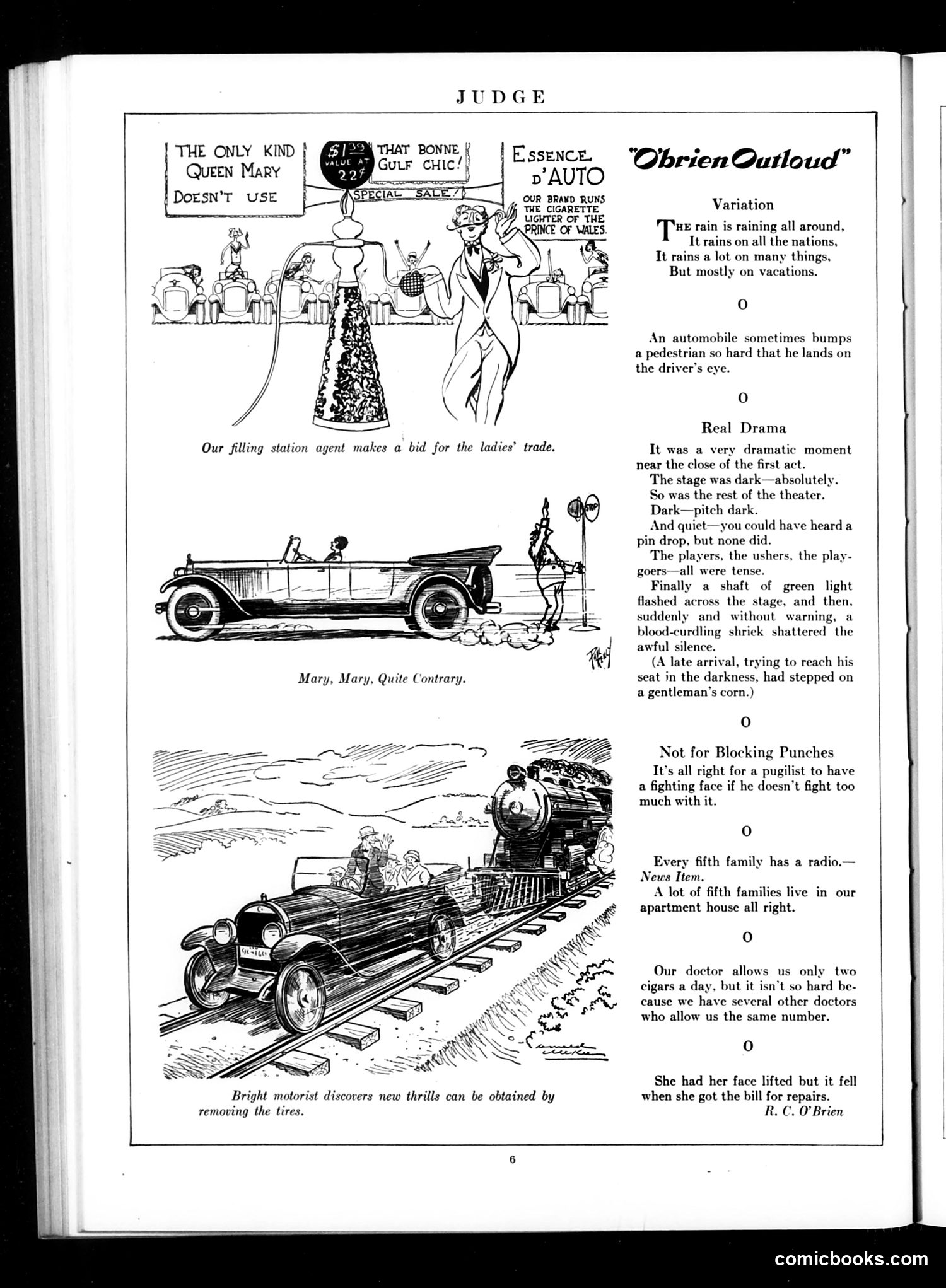
This page from *Judge* magazine combines advertisements with humorous short pieces and cartoons typical of 1920s-30s satirical humor. The **top cartoon** advertises Essence d'Auto cigarettes, showing a filling station attendant pitching to female customers—satirizing aggressive marketing to women, a relatively new consumer demographic. The **middle illustrations** depict automobiles in absurd situations: one labeled "Mary, Mary, Quite Contrary" shows a car hitting a pedestrian; another shows a motorist discovering "new thrills" by removing tires, driving on railroad tracks. The **right column contains brief humorous observations** (credited to R.C. O'Brien) poking fun at contemporary life: rain on vacations, automobile accidents, theater disruptions, radio ownership statistics in apartment buildings, doctor visits, and cosmetic surgery costs. The humor is gentle, observational satire targeting middle-class anxieties: modern technology (automobiles, radios), changing social norms (women consumers), and consumer culture. The jokes rely on wordplay and unexpected punchlines rather than political commentary.
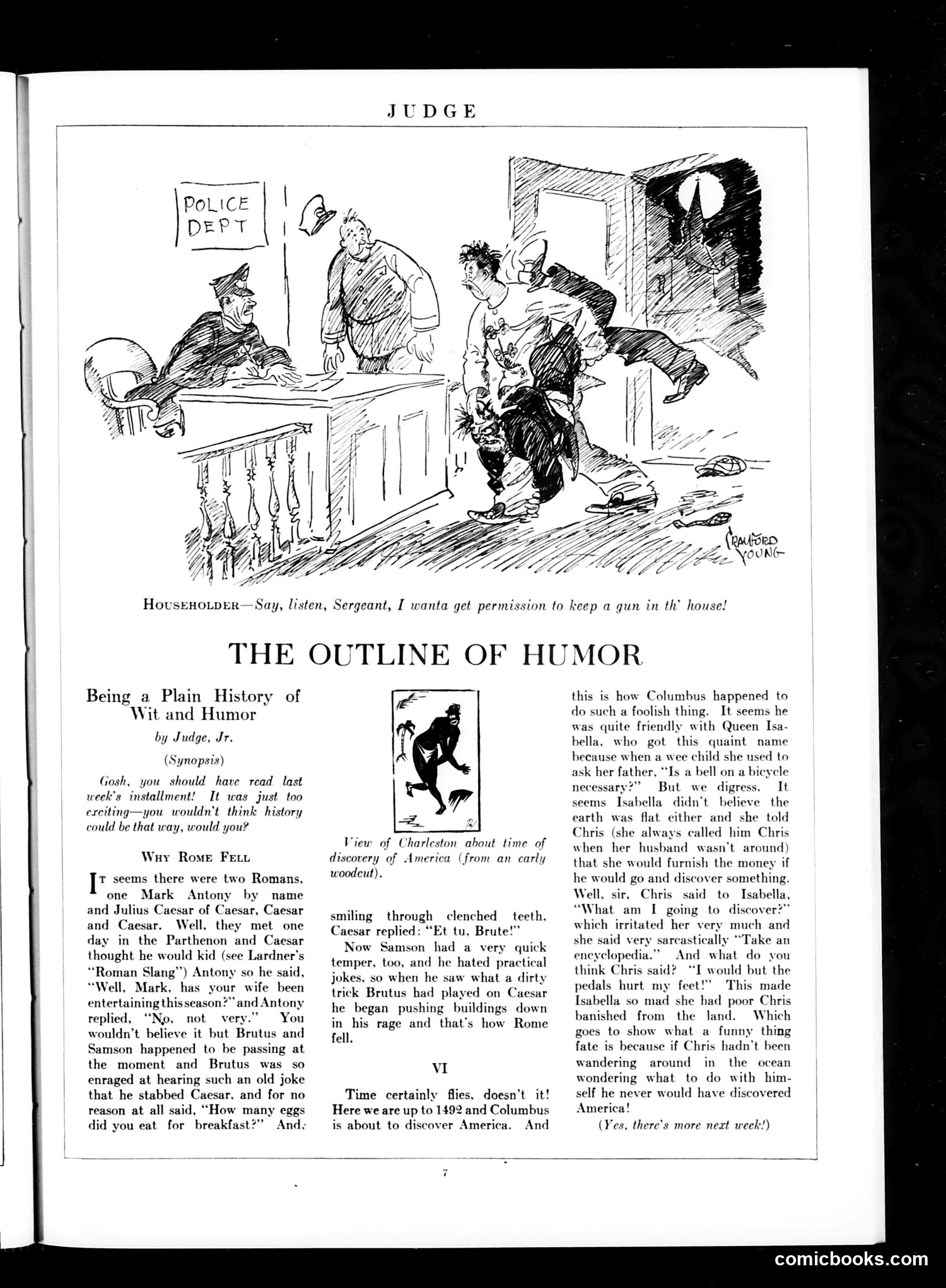
The top cartoon depicts a domestic scene at a police station where a householder requests permission to keep a gun for home protection—a straightforward joke about bureaucratic absurdity. The main content, "The Outline of Humor," is a comedic history series that deliberately mangles historical facts for laughs. It conflates unrelated figures (Julius Caesar with the biblical Samson, for instance) and creates nonsensical cause-and-effect narratives. The Rome section jokes that Brutus stabbed Caesar over a bad joke, causing Samson to demolish buildings in anger, thereby "explaining" Rome's fall through absurd logic. The Columbus section similarly fabricates ridiculous motivations: Queen Isabella finances his voyage on a whim about bicycle bells, and Columbus refuses to take an encyclopedia because "the pedals hurt my feet." The humor relies on readers recognizing how wildly these accounts distort actual history while maintaining a mock-serious explanatory tone. This style of deliberate historical mockery was characteristic of Judge's satirical approach to American wit.
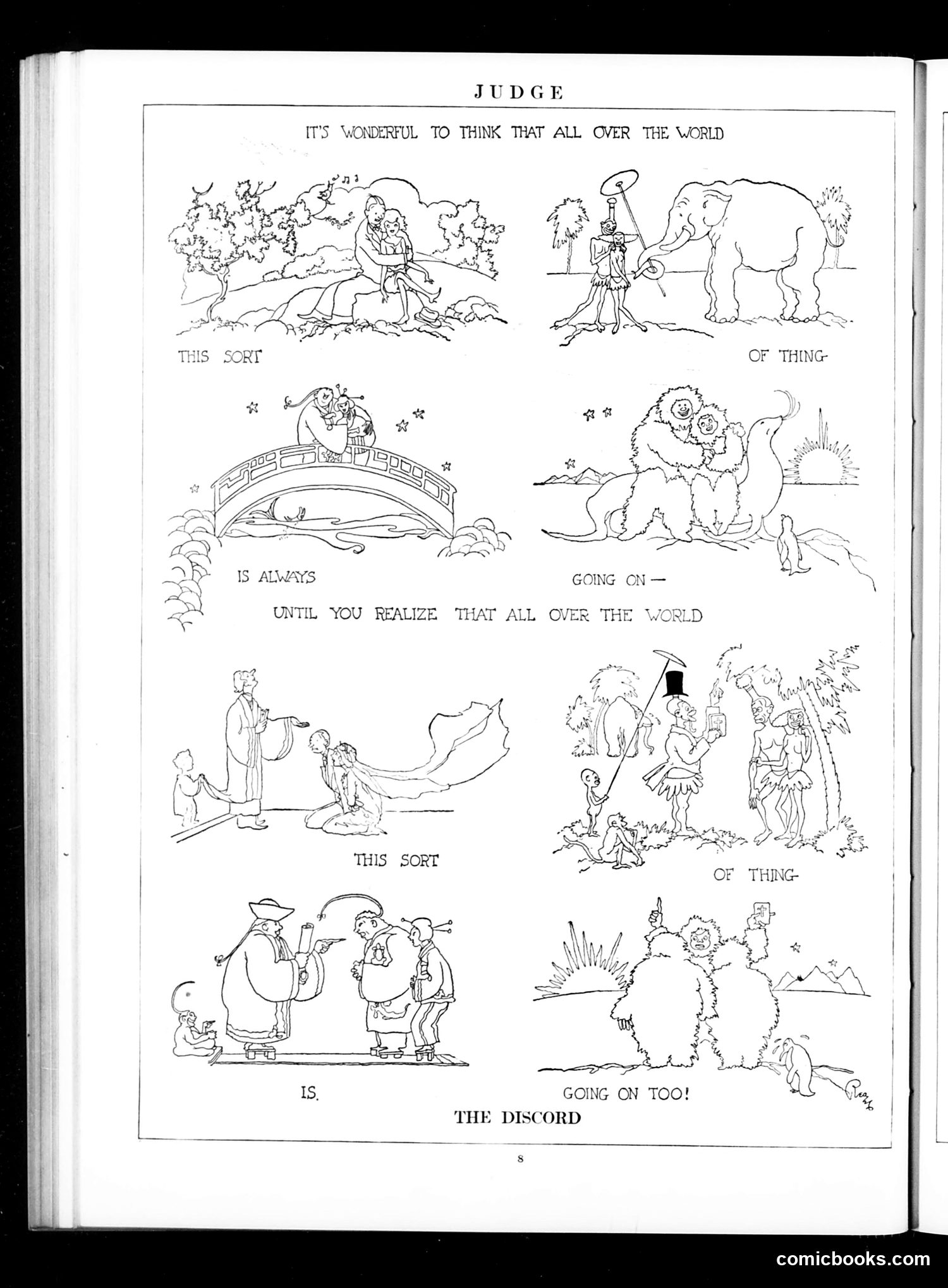
This is a satirical cartoon about human inconsistency and hypocrisy. The top half shows various positive scenarios worldwide—people farming, celebrating, worshipping, and generally conducting orderly lives. The caption reads "It's wonderful to think that all over the world this sort of thing is always going on." The bottom half reveals the dark flip side: the same geographical locations feature chaos, corruption, and discord—people quarreling, stealing, and behaving immorally. The punchline, "until you realize that all over the world this sort of thing is going on too!" exposes the uncomfortable truth that human misconduct occurs everywhere simultaneously. The cartoon satirizes naive idealism about human nature and global civilization, suggesting that while we celebrate humanity's achievements, equal amounts of vice and corruption persist universally. It's a commentary on selective perception and willful ignorance about society's darker aspects.
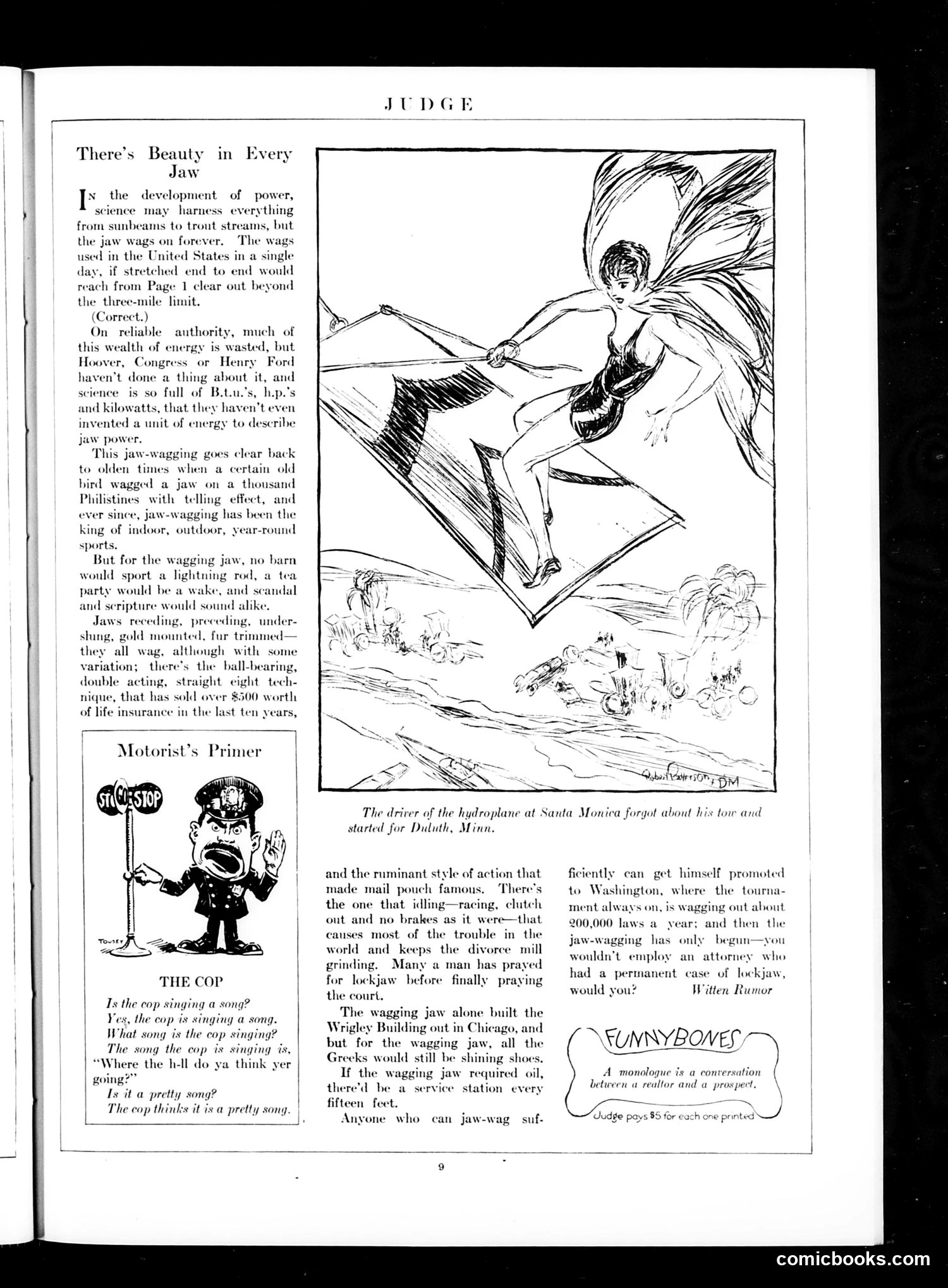
This satirical article mocks excessive talking ("jaw-wagging") as a distinctly American phenomenon. The piece humorously argues that verbal energy expended daily by Americans is immense and largely wasted, yet celebrated as a valued skill. The satire targets multiple institutions: business (the Wrigley Building supposedly built by talk alone), law and government (politicians promoted through talking, Congress passing 200,000 laws yearly), and divorce courts (idle chatter destroying marriages). The accompanying illustrations include a "Motorist's Primer" mocking a traffic cop's standard warning ("Where the h-ll do ya think yer goin?"), and an allegorical figure representing jaw-wagging's power. The implicit critique is that Americans conflate verbal facility with actual accomplishment, and that endless talking substitutes for meaningful action—a complaint that resonates across eras.
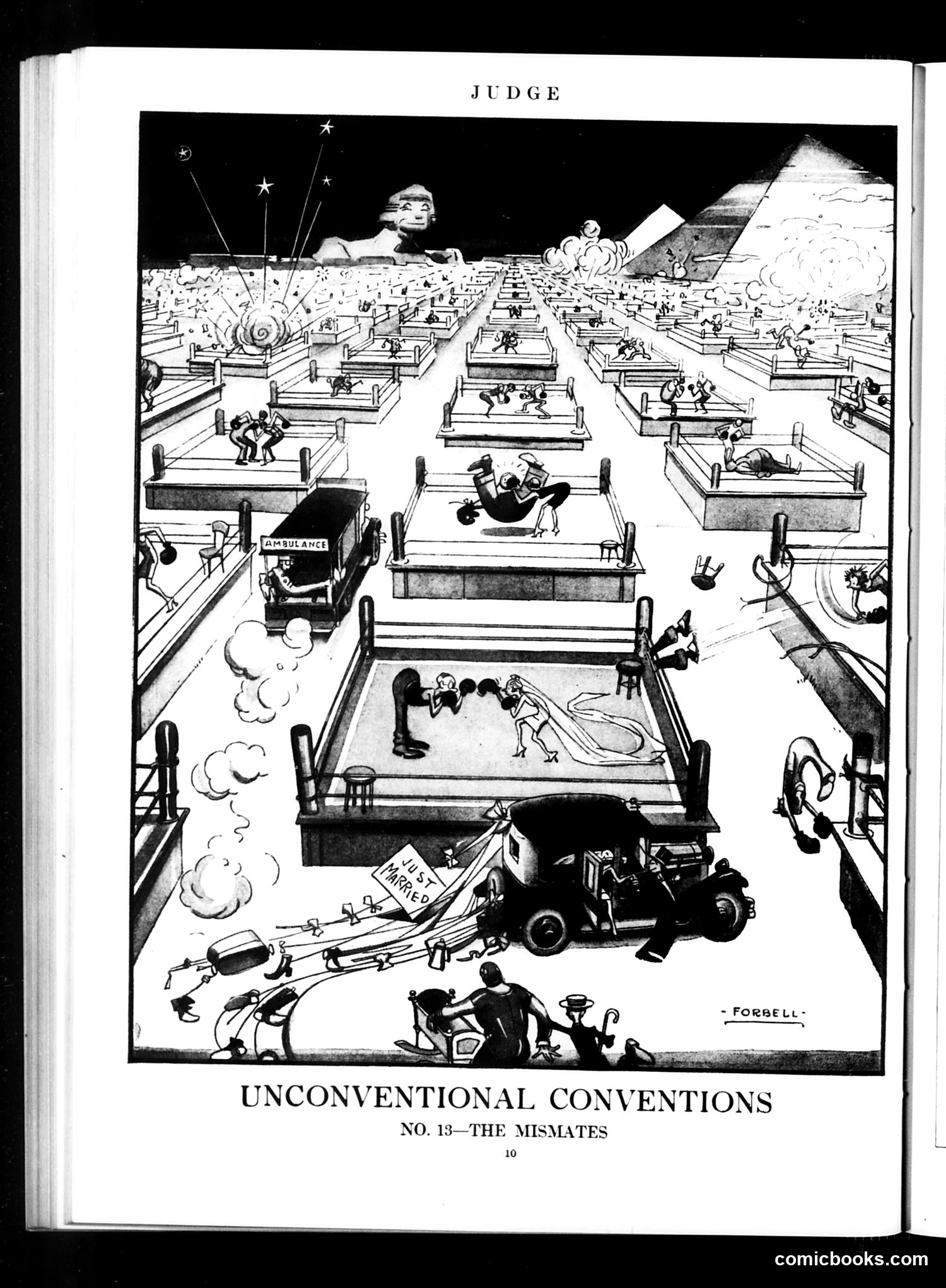
This satirical cartoon by Forbell depicts a surreal, dystopian convention space—likely referencing political or social conventions of the early 20th century. The image shows an enormous sphinx-like head looming over a vast grid of boxing rings where people engage in various chaotic activities: fighting, accidents with vehicles and ambulances, and general mayhem. The title "Unconventional Conventions: The Mismates" suggests social critique through absurdist humor. The boxing-ring grid may represent society's rigid structures producing conflict rather than harmony. The sphinx symbolizes mystery or judgment, watching over the chaos below. The "mismates" reference likely critiques inappropriate social pairings or conventions that produce discord. The overall effect is darkly comic—convention transformed into organized pandemonium, suggesting that strict social rules generate rather than prevent disorder.
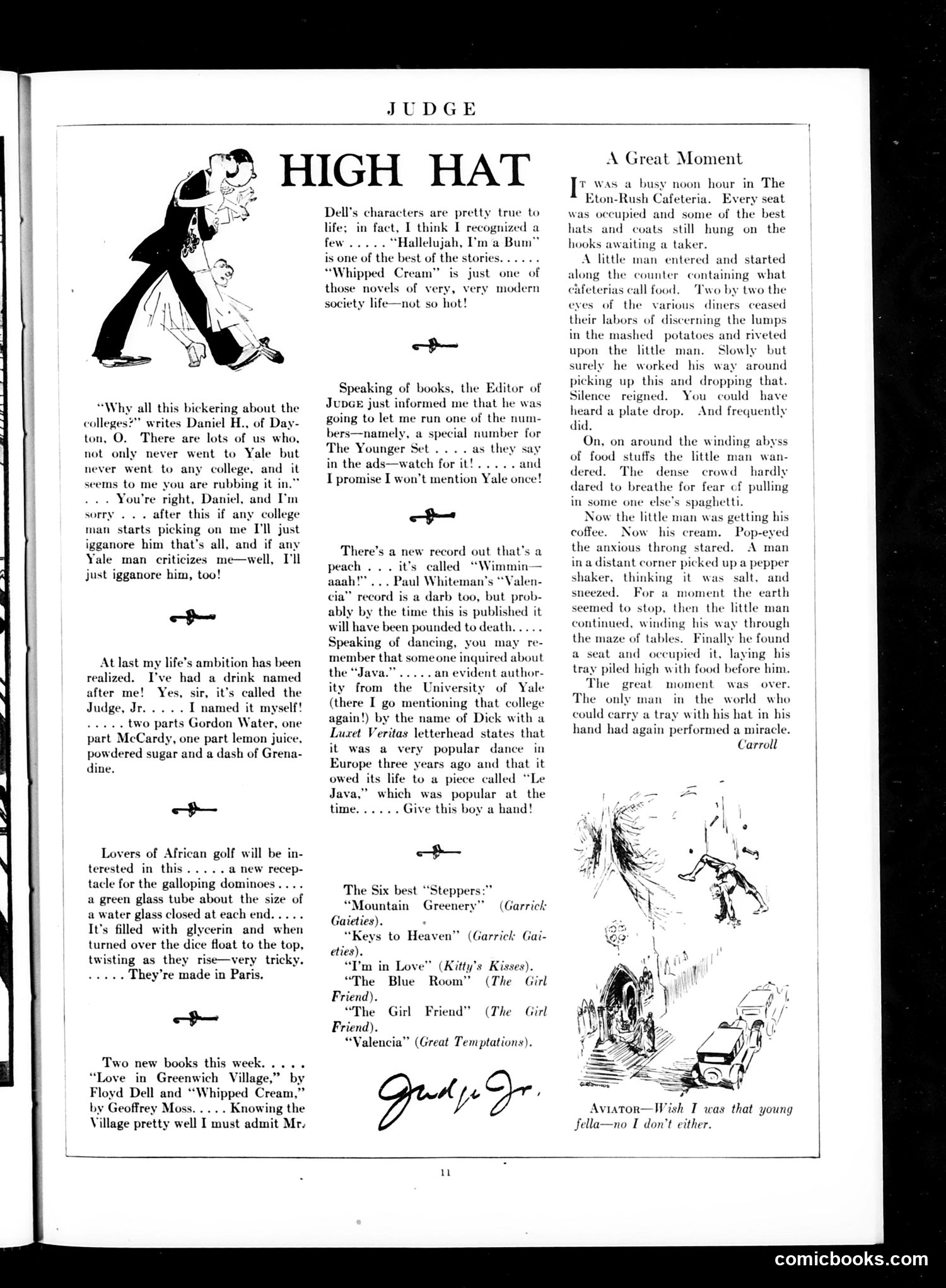
This page from Judge magazine is primarily a humor column by the editor. The main content mocks social pretension and college snobbery. The opening responds to a reader complaining about college-related mockery—the editor jokingly promises to ignore both non-college-goers and Yale men who criticize him, satirizing the era's class consciousness around elite education. The bulk consists of light social commentary: a drink named after the author; African golf equipment; book reviews of contemporary fiction (Floyd Dell's "Love in Greenwich Village" and similar modernist works); and popular dance records and Broadway songs (referencing the "Java" dance, Paul Whiteman's "Valencia"). The cartoon illustrates "A Great Moment"—an observational joke about a cafeteria scene where diners become oddly fixated watching a small man navigate the food line, their attention creating mounting tension over mundane events (he picks up pepper instead of salt, sneezes). It's gentle satire on human nature and crowd behavior rather than political commentary.
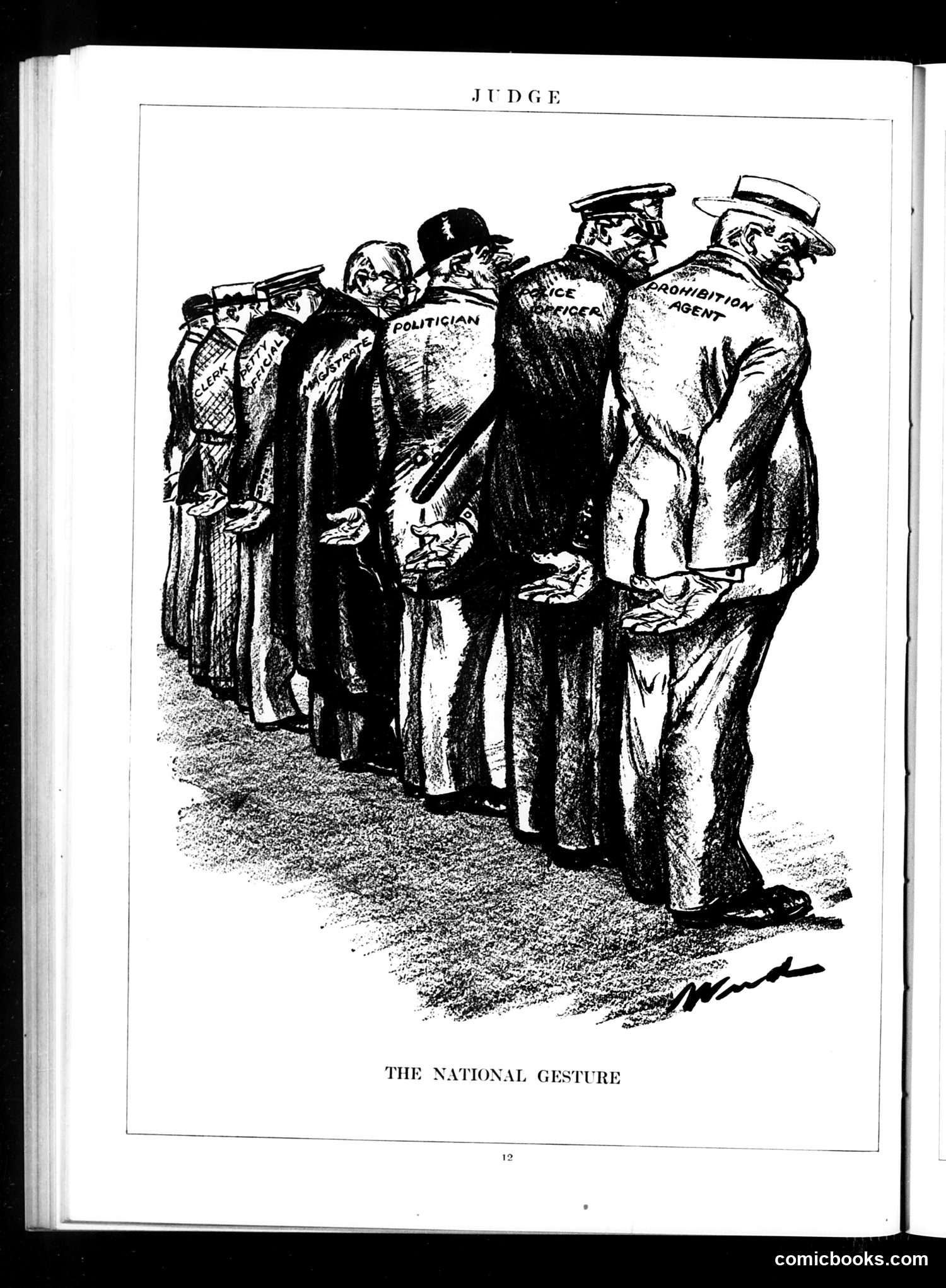
This political cartoon depicts a line of officials—labeled "Politician," "Police Officer," and "Prohibition Agent"—along with other law enforcement and government figures, all turning their backs in unison. The gesture appears to satirize widespread corruption or deliberate blindness among authorities during Prohibition (1920-1933). The cartoon's title, "The National Gesture," suggests this turning away was endemic to American governance. It likely critiques how politicians, police, and prohibition enforcers collaborated with or ignored bootleggers and speakeasies rather than enforcing alcohol bans. The unified pose emphasizes systemic complicity—that ignoring violations wasn't individual corruption but institutionalized policy. This reflects the era's notorious reality: Prohibition bred organized crime partly because officials accepted bribes to overlook illegal alcohol production and sales.
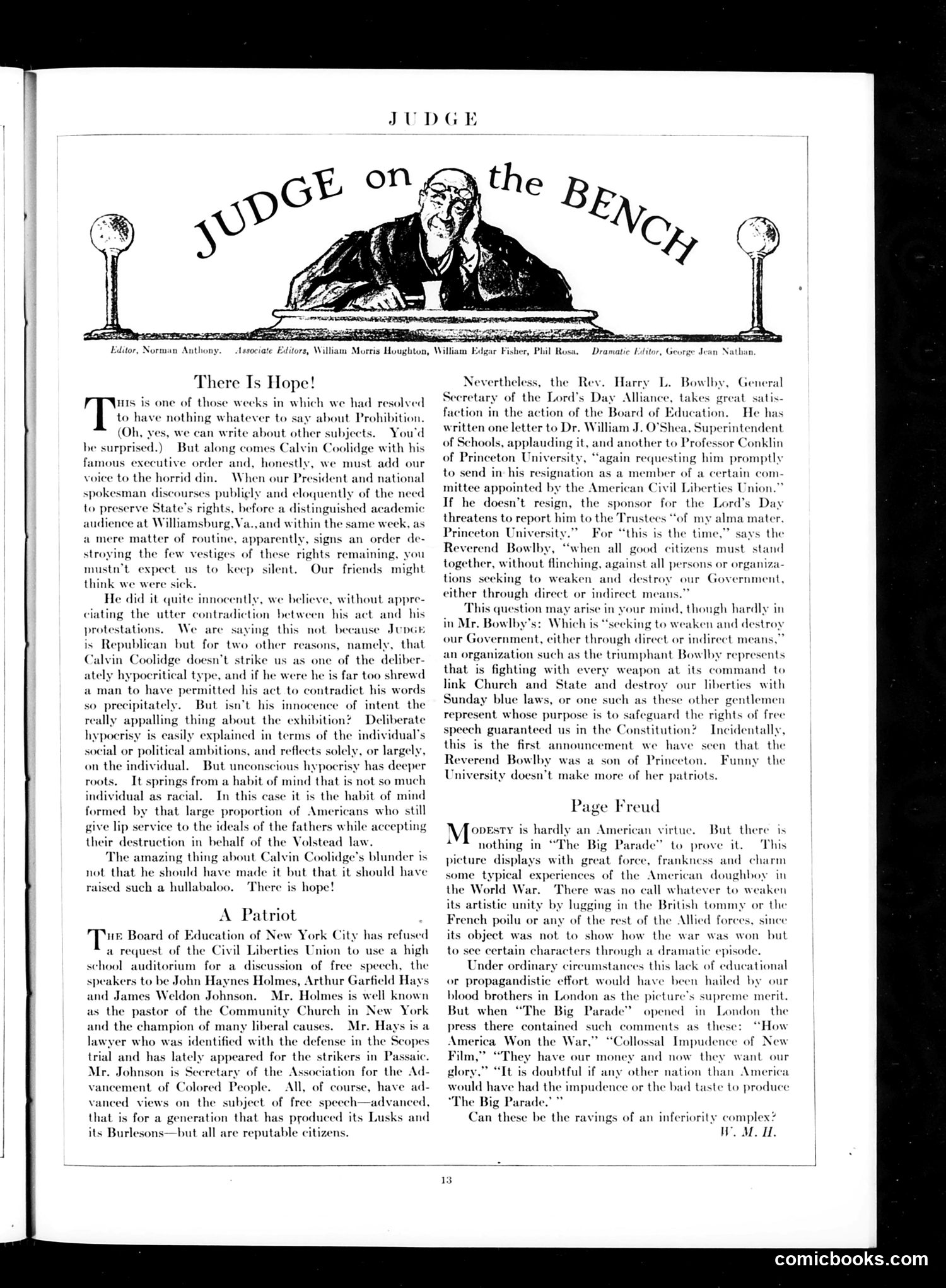
This page critiques President Calvin Coolidge's contradiction between public statements defending civil liberties (made at Williamsburg) and his simultaneous executive order restricting those same rights, likely related to Prohibition enforcement. Judge argues Coolidge's hypocrisy stems not from deliberate deception but from unconscious acceptance of government overreach—a deeper cultural problem. The second section satirizes Rev. Harry L. Bowlby of the Lord's Day Alliance, who pressured Princeton professor Edwin Conklin to resign from the American Civil Liberties Union committee. Judge highlights the irony: Bowlby claims to defend "free speech" and "good citizens" while actively suppressing civil liberties through religious-moral coercion. The piece questions who truly threatens American freedoms—suggesting religious organizations weaponizing institutional pressure represent the real danger to democratic values.
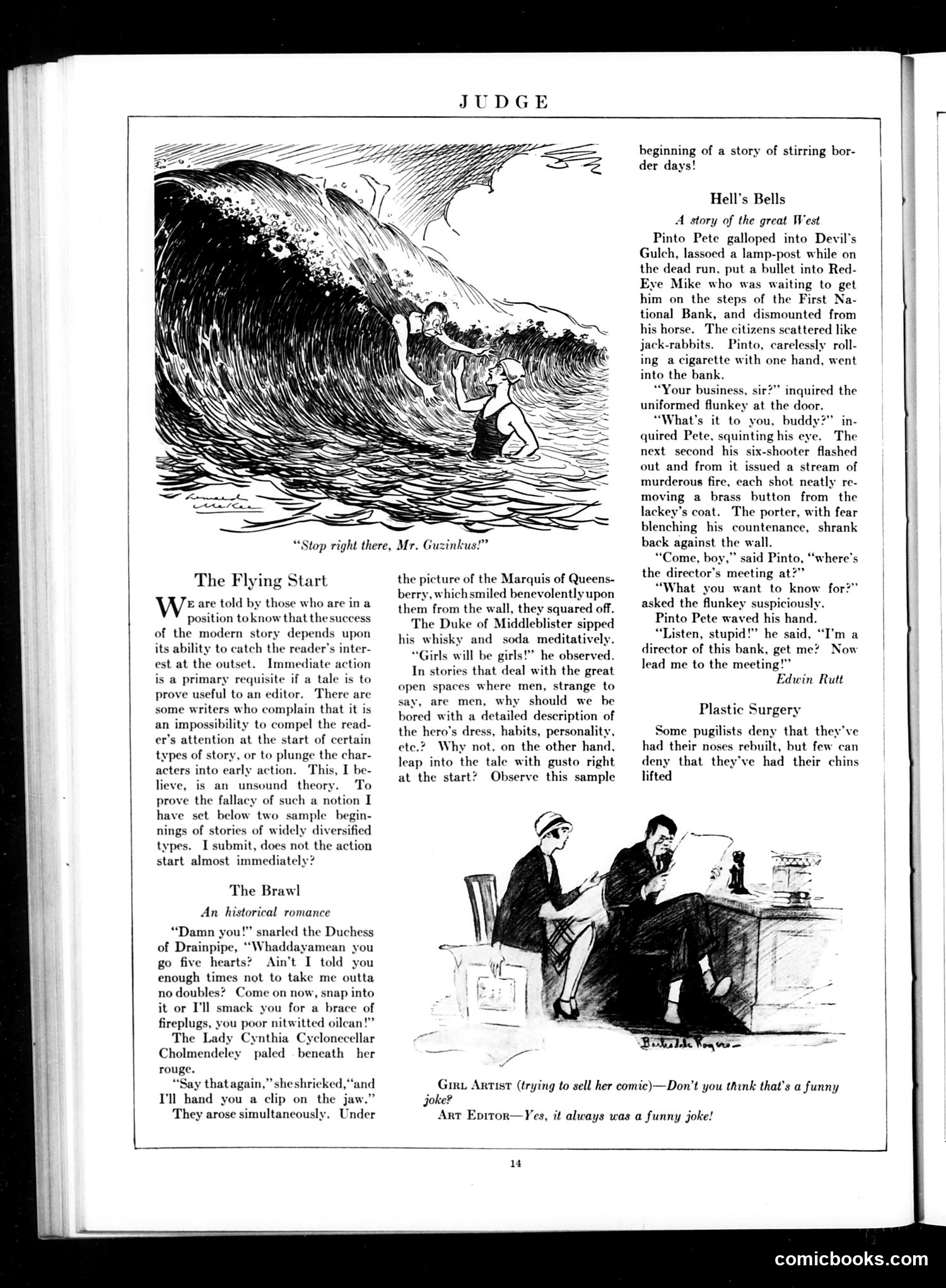
This page satirizes the literary advice that modern stories must begin with immediate, dramatic action. The editor presents two absurdly contrasting story openings to mock this rule. **"The Brawl"** parodies historical romance: upper-class women ("the Duchess of Drainpipe," "Lady Cynthia Cyclonecellar") brawl over card games using vulgar slang ("nitwitted oilcan"), stripped of any dignity the genre promised. **"Hell's Bells"** exaggerates the Western genre: Pinto Pete performs ridiculous feats of violence and casual gunplay at a bank, treating criminal behavior as routine. The absurdity peaks when he casually shoots brass buttons off a porter's coat. The joke: following the "immediate action" rule to its logical extreme produces ridiculous, tonally incoherent stories where characters' behavior contradicts genre expectations. The satire critiques simplistic writing formulas that prioritize action over coherence or characterization. The bottom cartoon about plastic surgery is unrelated filler.
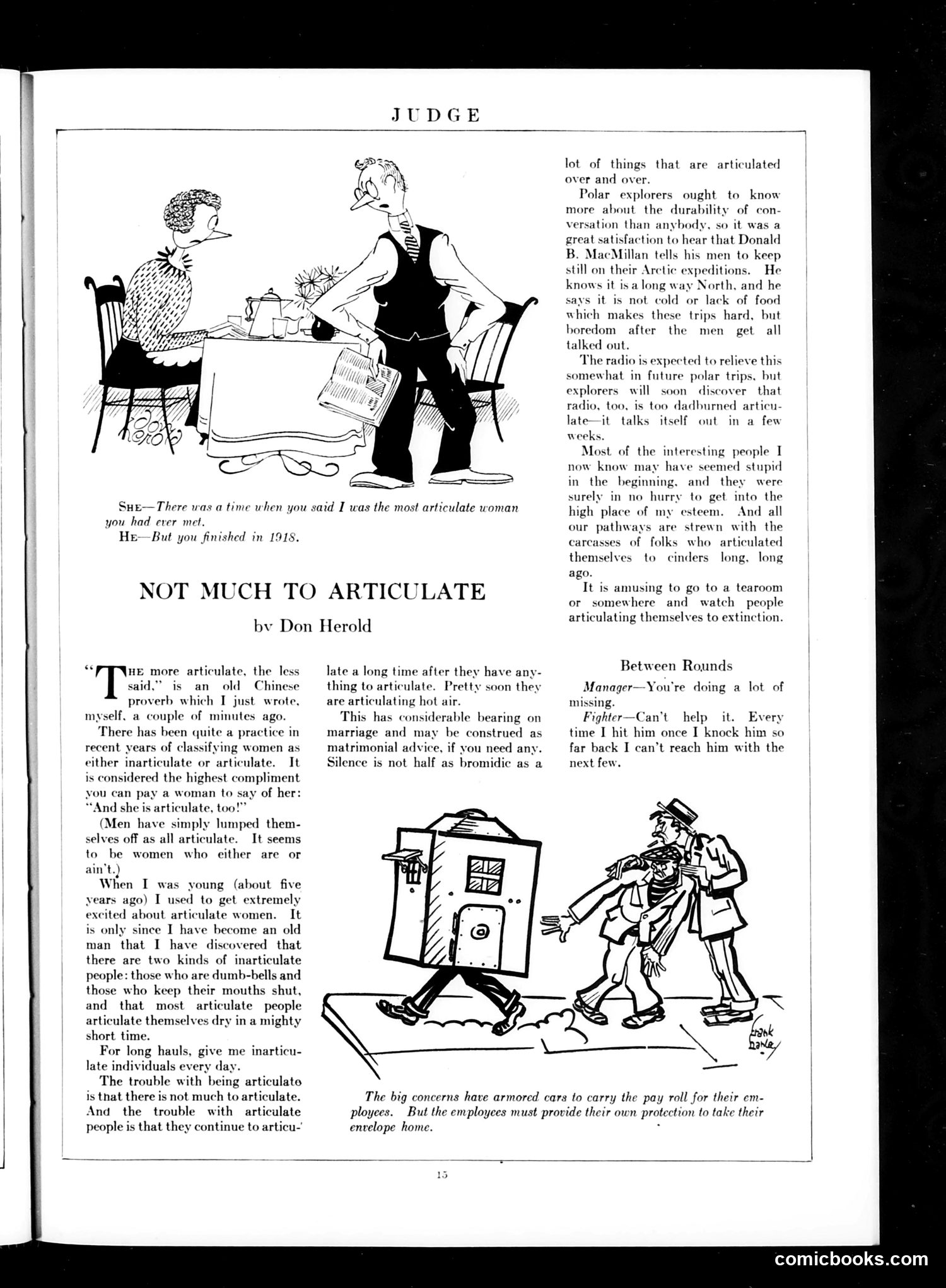
This humorous essay satirizes the 1920s cultural obsession with women being "articulate"—a fashionable compliment of the era. The opening cartoon joke references a marriage that ended in 1918: the husband quips his wife was "articulate" until she literally stopped talking after the war ended, implying she talked constantly during their relationship. Herold's broader point mocks both excessive talkativeness and the era's valorization of verbal skill. He argues articulate people "talk themselves dry" and eventually produce only "hot air." He cites explorer Donald B. MacMillan, who reportedly told Arctic expedition teams silence—not cold or hunger—made long journeys bearable. The secondary cartoon about armed cars carrying payroll (but workers unprotected going home) reflects post-WWI labor anxieties and economic inequality. The satire targets not women specifically but contemporary culture's worship of constant, articulate speech as a virtue—suggesting quiet people may possess actual wisdom.
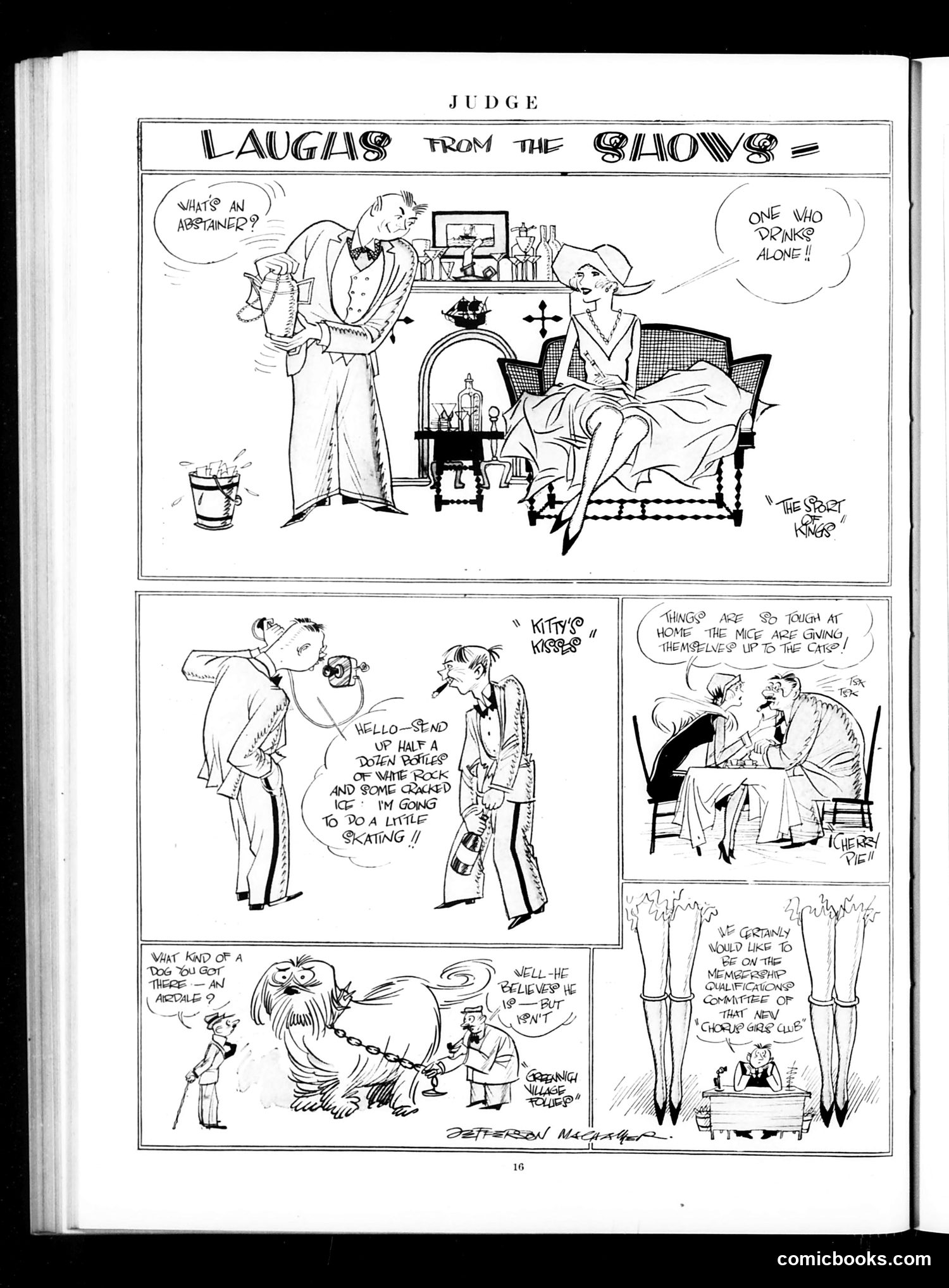
This page presents satirical vignettes about social behavior and dating customs, likely from the 1920s-30s based on the style. The top strip jokes about abstinence—a man asks what an "abstainer" is, and a woman replies "one who drinks alone," mocking teetotalers or those hiding their drinking. Middle panels depict dating scenarios: young couples making social plans (ice skating, drinking), with commentary on courtship rituals. One scene shows women discussing house troubles ("mice are giving themselves up to the cat"), contrasting domestic problems with romantic pursuits. The bottom panel satirizes a small dog as an "abstainer" in humorous fashion, while the right side mocks a new "Cicero Club"—likely a fictional social organization—questioning membership qualifications, suggesting snobbishness or exclusionary practices among social clubs of the era. The overall theme appears to be satirizing upper-middle-class social pretensions, dating conventions, and club culture through everyday embarrassments and contradictions.
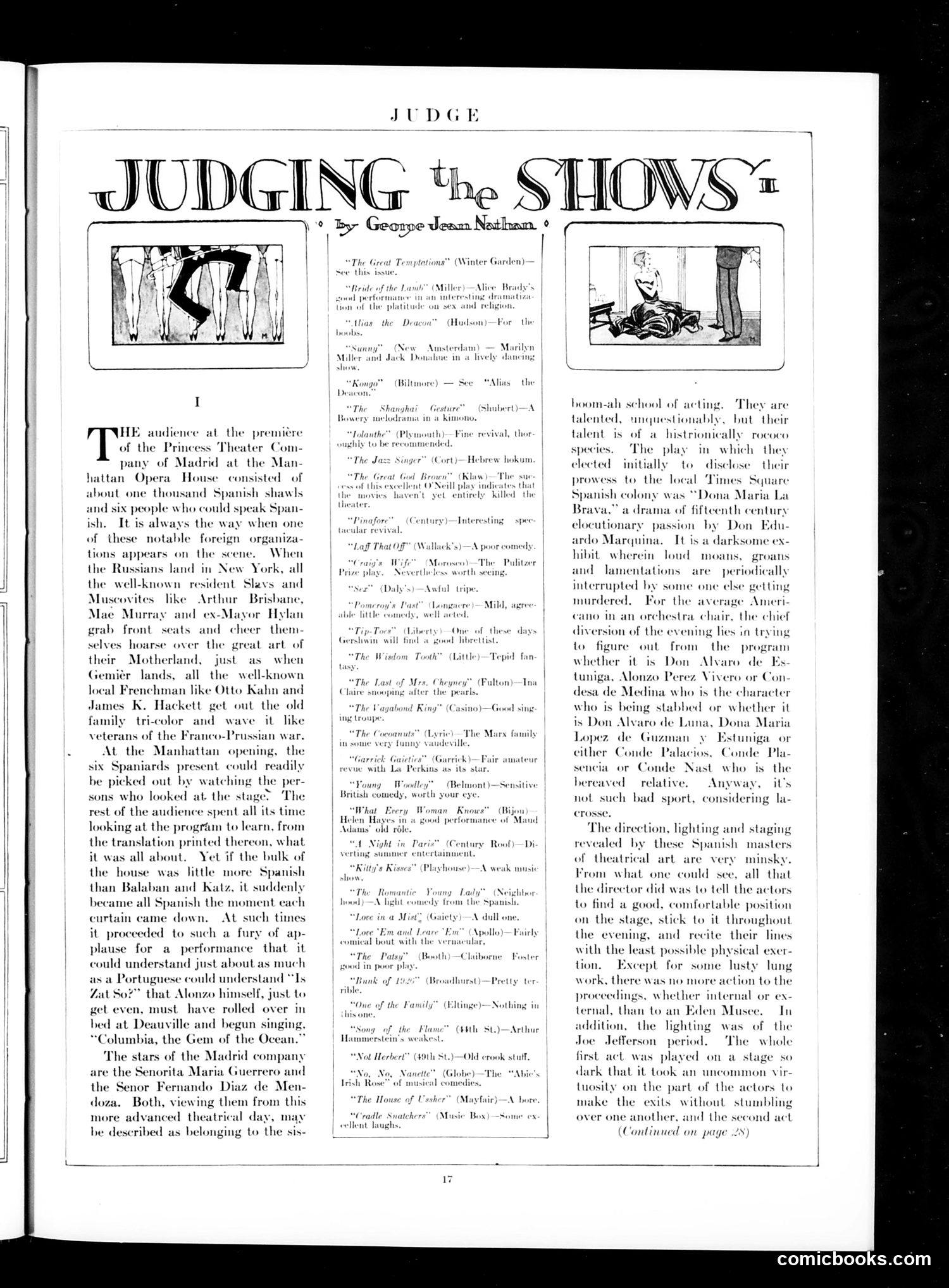
This is a theater review column by George Jean Nathan critiquing the Madrid company's performance at the Manhattan Opera House. The satire targets pretentious New York audiences who claim cultural sophistication but don't actually understand foreign theater. Nathan mocks how Spanish speakers were easy to spot—they were the ones actually watching the stage, while everyone else consulted programs for translations. He ridicules the audience's sudden, enthusiastic applause after each curtain despite comprehending nothing, comparing their judgment to what a Portuguese would understand of "Is Zat So?" (a contemporary play). The review dismisses the visiting stars María Guerrero and Fernando Díaz de Mendoza as relics of an earlier theatrical era, and criticizes their Spanish drama "Doña Brava" as melodramatic and impenetrable—the American viewer cannot distinguish which character is which without constantly referencing the program. The core joke: fashionable New Yorkers perform cultural appreciation they don't genuinely feel, applauding what they cannot comprehend.
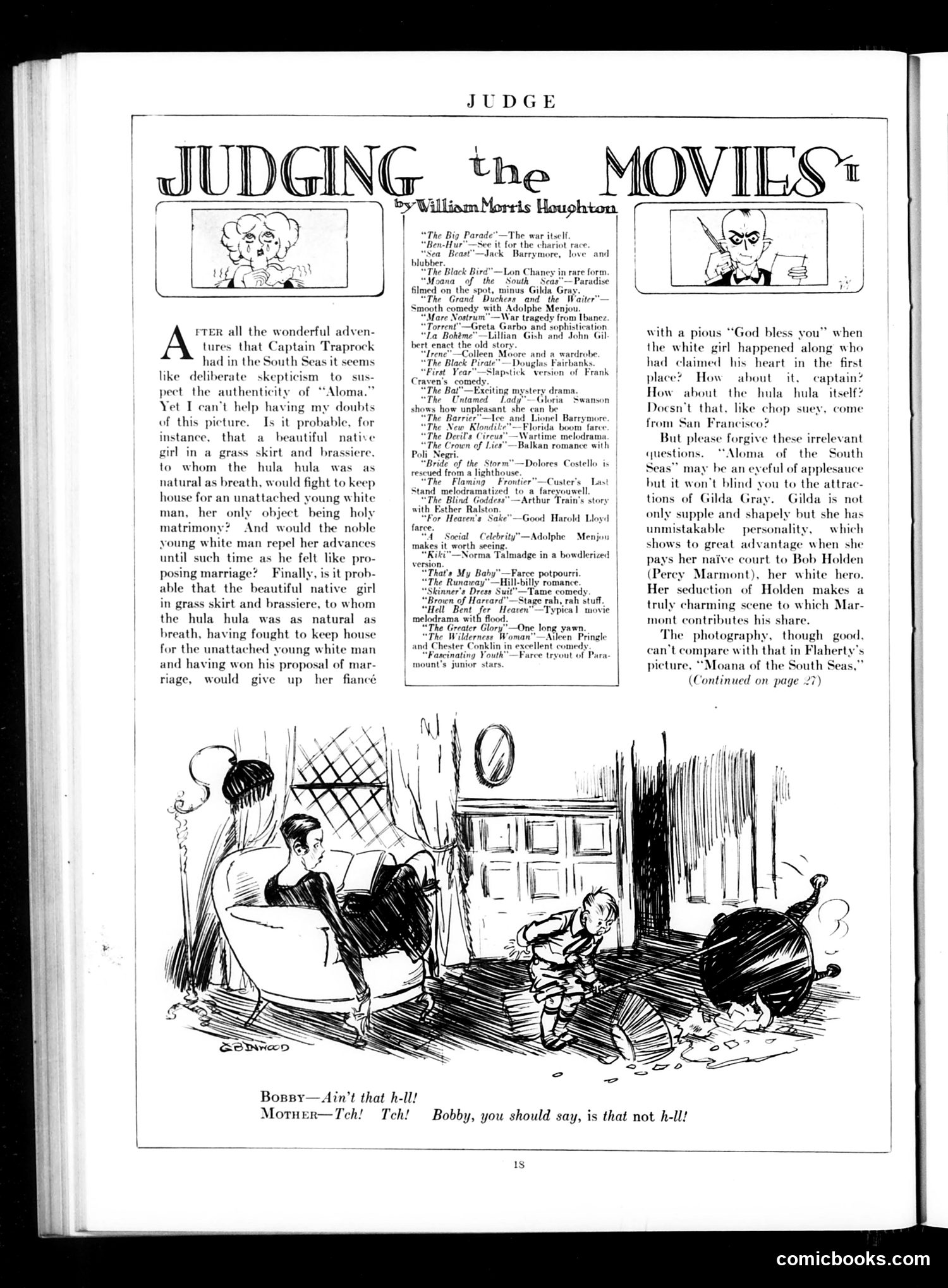
This is a film review column by William Morris Houghton critiquing the movie "Aloma of the South Seas." The main cartoon below depicts a domestic scene where a child says "Ain't that h-ll!" and his mother corrects him: "Bobby, you should say, is that not h-ll!"—a joke about proper grammar and class affectation. The review itself satirizes the film's implausible romantic plot: a native Hawaiian woman in a grass skirt supposedly fights to marry a white man out of pure devotion, he virtuously rejects her advances, and then—improbably—she abandons her fiancé when a white girl arrives. Houghton mocks these fantasy scenarios as unrealistic, while acknowledging the film's appeal through star Gilda Gray's "unmistakable personality." The review reflects 1920s attitudes about race, colonial romance narratives, and Hollywood's exotic fantasy offerings.
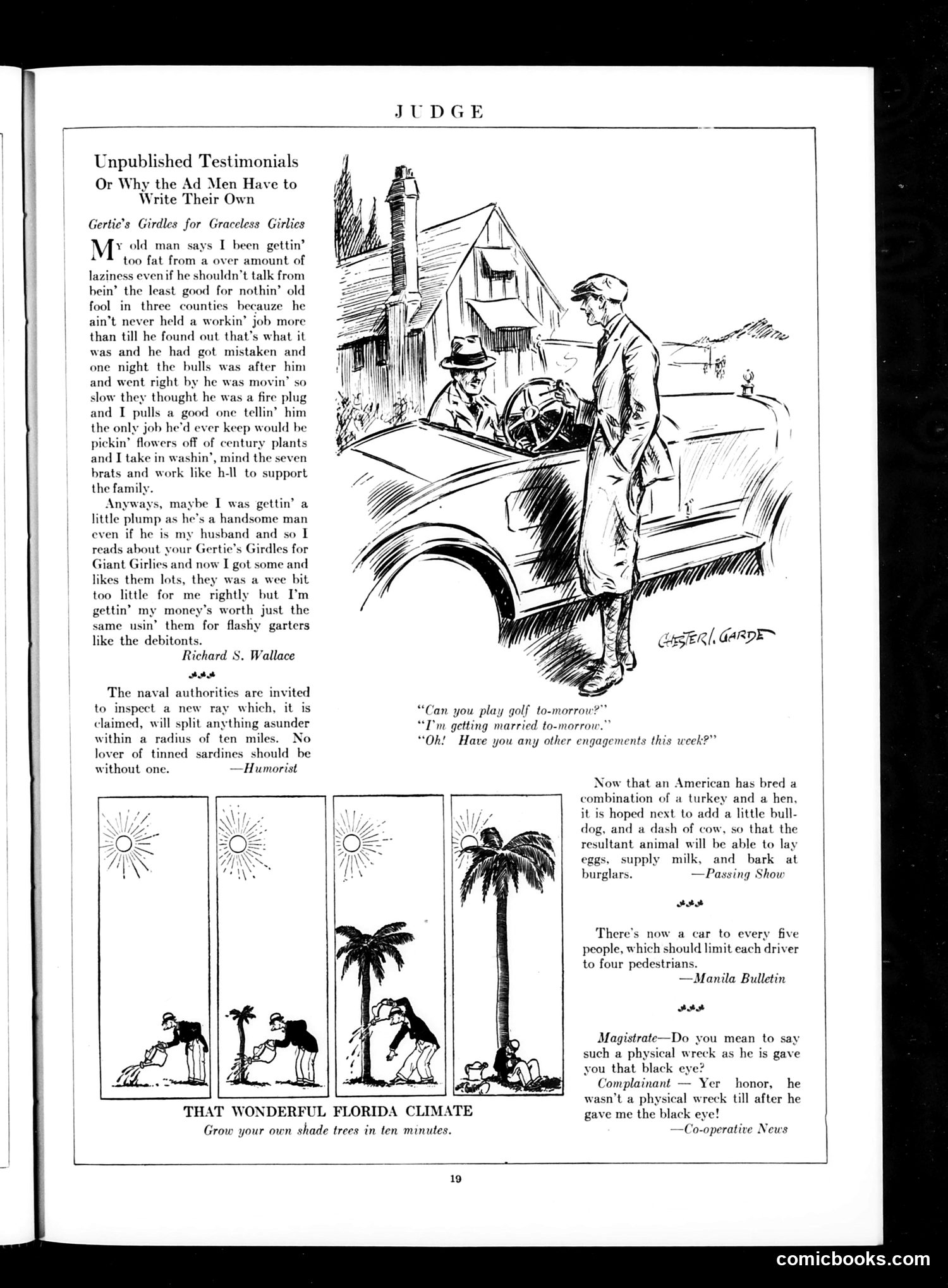
This page collects brief satirical items mocking advertising testimonials and social absurdities of the era. **Main content:** The opening section parodies fake product testimonials. A woman's rambling letter endorses "Gertie's Girdles for Giant Girlies"—a corset product—but reveals she's using them as garters instead, suggesting the product doesn't actually work for its intended purpose. This satirizes how advertisers fabricate customer endorsements. **Other jokes target:** - Naval weapons (a new "ray" that destroys things) - Agricultural absurdity (breeding turkeys with hens with bulldogs and cows) - Urban congestion (one car per five people limiting pedestrians) - A courtroom exchange where a man claims he wasn't a "physical wreck" until after receiving a black eye **The cartoon** shows people discussing marriage and golf engagements—a joke about wedding priorities. **Overall point:** Judge ridicules both fake advertising and contemporary social follies through exaggeration and working-class vernacular voices.
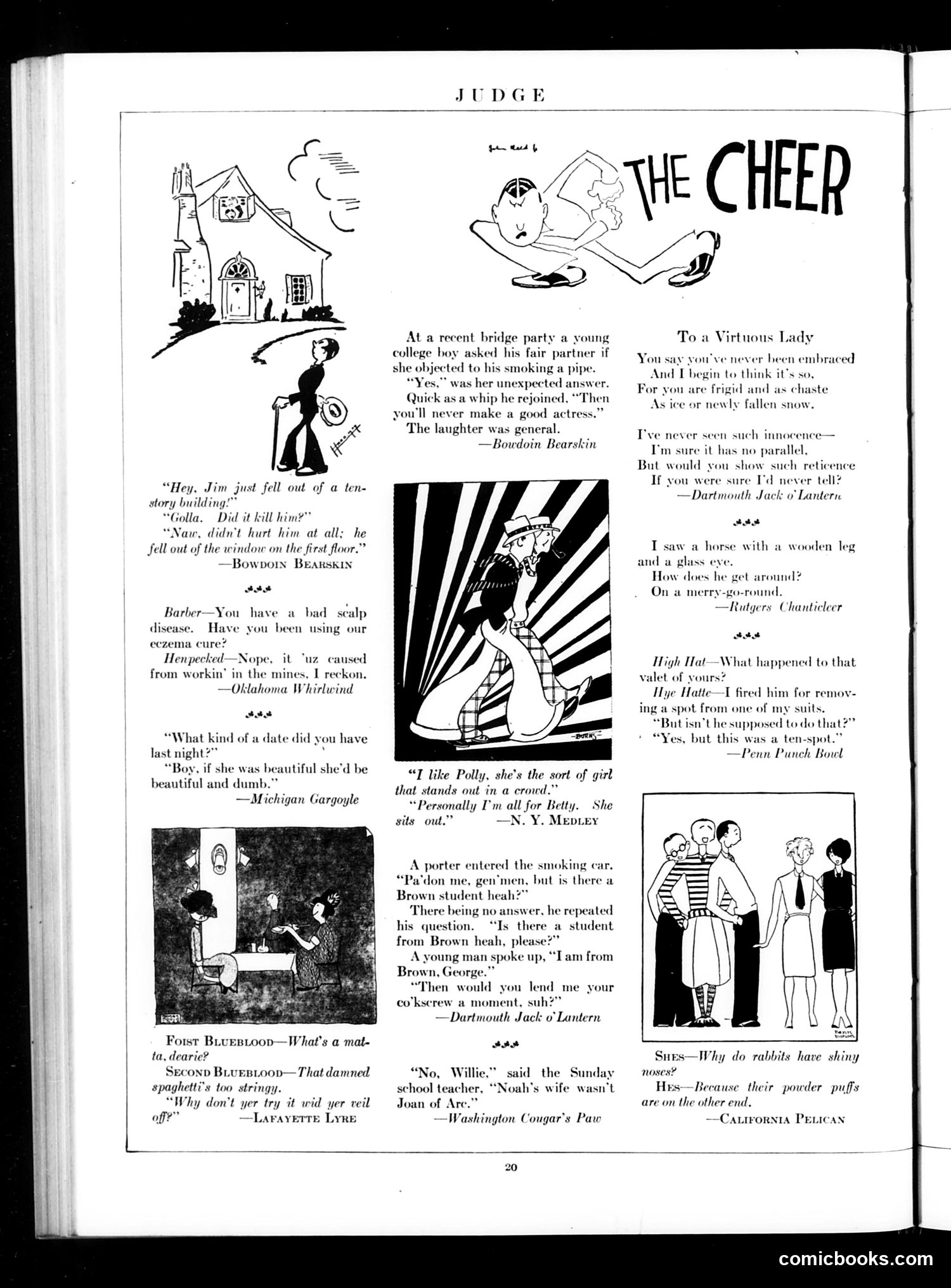
This page collects brief jokes and humorous anecdotes from college newspapers and humor magazines, typical of early 20th-century American comic publications. The content includes: **Visual humor**: A cartoon shows a woman in a striped dress, likely satirizing fashionable attire of the era. **Joke subjects**: The humor targets common social situations—dating ("if she was beautiful she'd be beautiful and dumb"), gender dynamics (a college boy's quip to his bridge partner about pipe-smoking making a "good actress"), class pretension, and innocent innuendo (poems "To a Virtuous Lady"). **Source attribution**: Most jokes credit college humor publications (Bowdoin, Dartmouth, Brown, Penn, etc.), reflecting the collegiate humor circuit popular at the time. **Social commentary**: Mild satirization of gender relations, working-class characters ("henpecked" husbands, porters), and upper-class affectation appears throughout. The page represents typical Judge-era humor—lighthearted, sometimes risqué by contemporary standards, primarily focused on social observation rather than political satire.
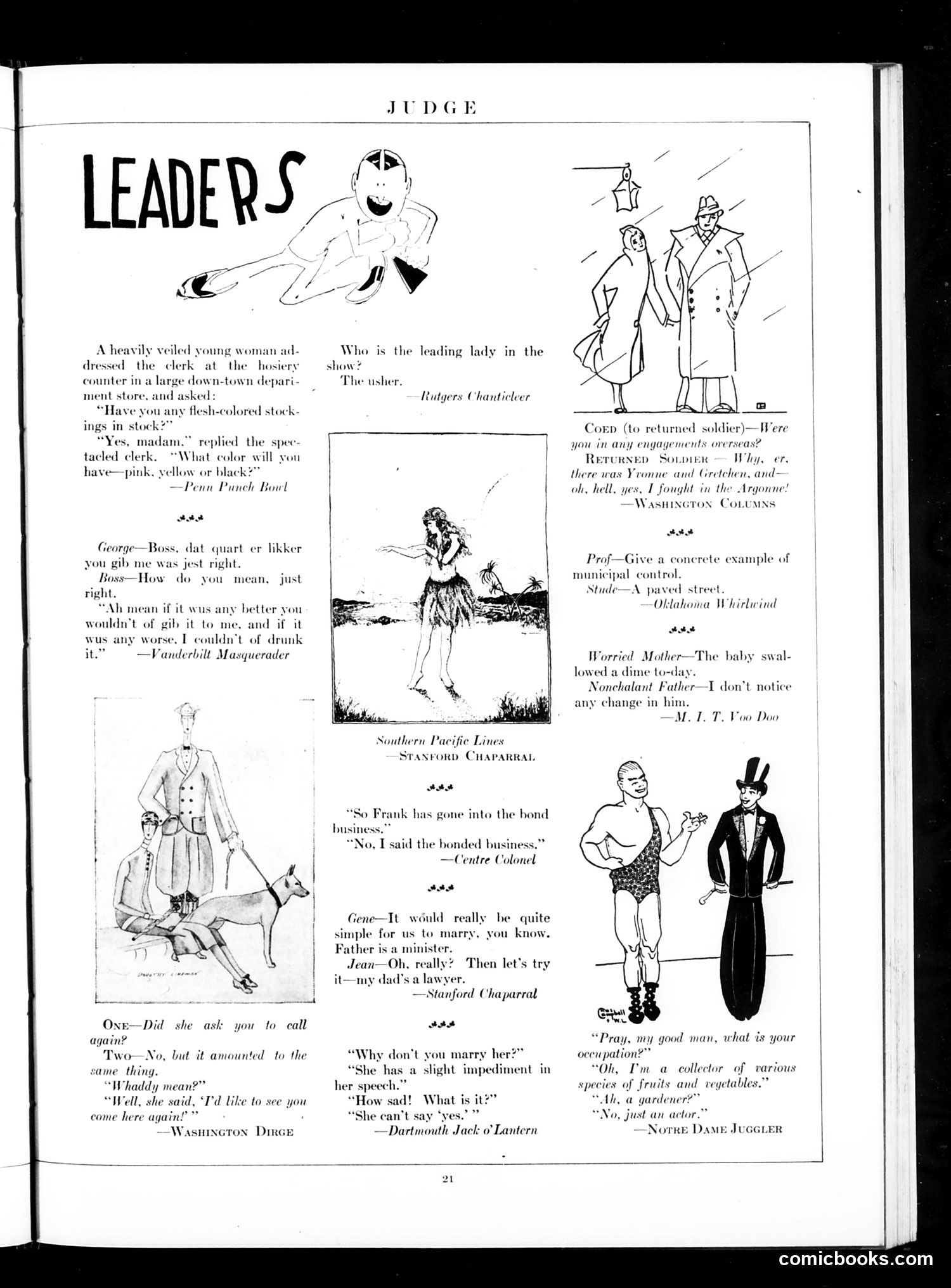
This page collects brief humorous anecdotes and jokes from various college and satirical publications circa the 1920s. The central theme is "Leaders"—authority figures and those who claim importance. The humor operates through **social satire and wordplay**: - A clerk's confusion about "flesh-colored" stockings mocks consumer absurdity - A Black worker's logic about liquor quality satirizes class dynamics - A woman's "impediment" preventing marriage is her inability to say "yes"—mocking women's limited agency - A returned WWI soldier conflates military battles with romantic conquests (Yvonne, Gretchen), satirizing masculine bravado - A "municipal control" example (paved streets) mocks academic pretension - An actor calling himself a "collector of trades" satirizes professional ambition The illustrations show period fashion and social types. The jokes rely on **irony and unexpected reversals** rather than visual gags. This represents typical Judge humor: punching at vanity, pretension, and social conventions through snappy dialogue sourced from university humor magazines and other publications.
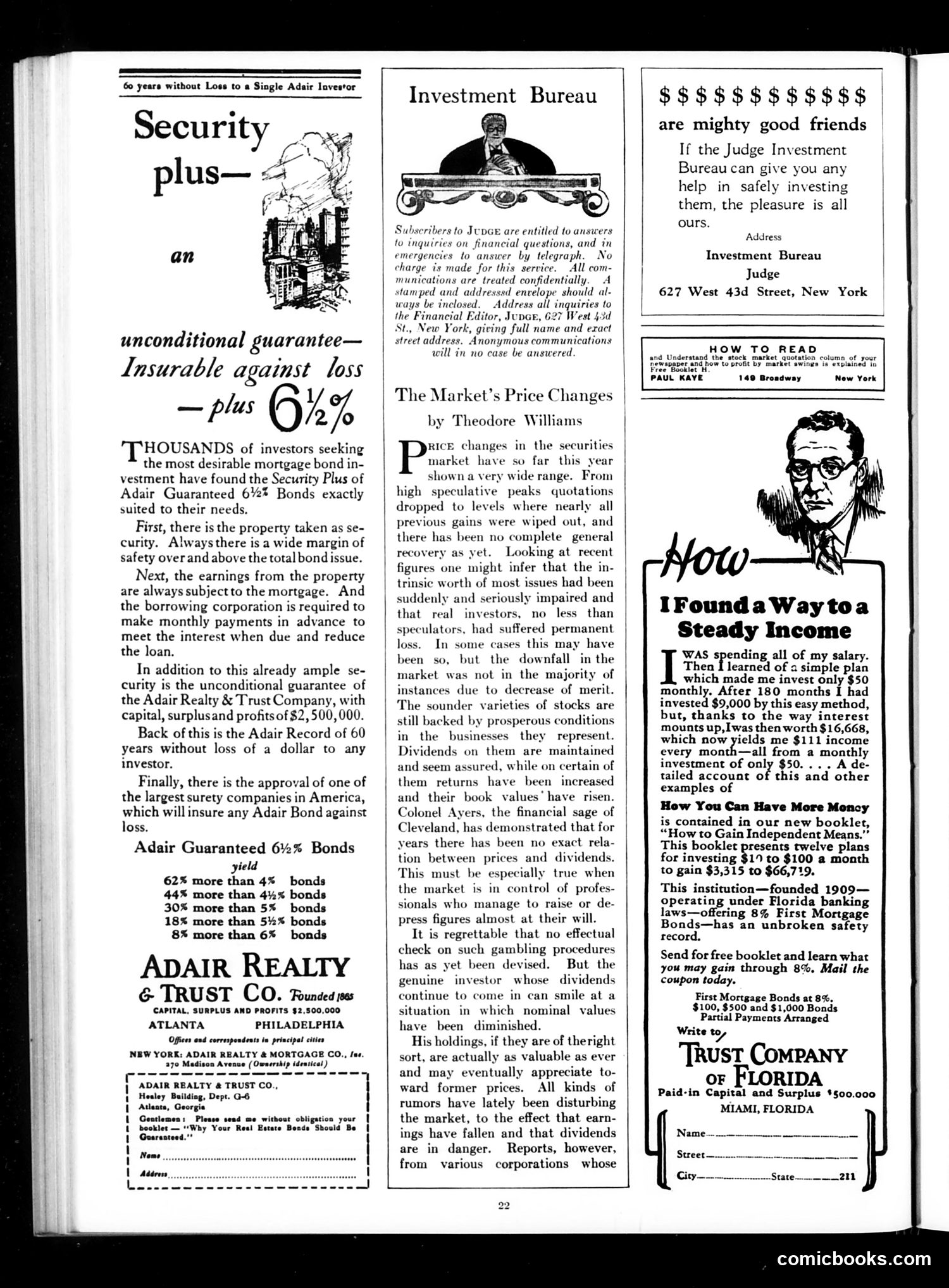
This page is primarily **financial advertising** from Judge magazine, circa early 1900s. The layout contains three major investment pitches rather than political satire. The **Adair Realty & Trust Company** advertisement (left) promotes mortgage bonds with guaranteed 6½% returns, emphasizing a 60-year safety record. The **Investment Bureau** (center) offers financial advice to Judge subscribers. The **Trust Company of Florida** (right) advertises real estate bonds. The one editorial piece—Theodore Williams's article on "The Market's Price Changes"—discusses stock market volatility and manipulation. Williams argues that price drops don't necessarily reflect true company value, and that professional traders artificially manipulate prices ("almost at their will"), though no regulatory mechanism exists to prevent this. The overall message reflects **pre-1929 crash optimism**: even amid market turbulence, sound investments remain valuable. The irony for modern readers is the assumed safety of these "guaranteed" investments—many such schemes collapsed during subsequent economic downturns.
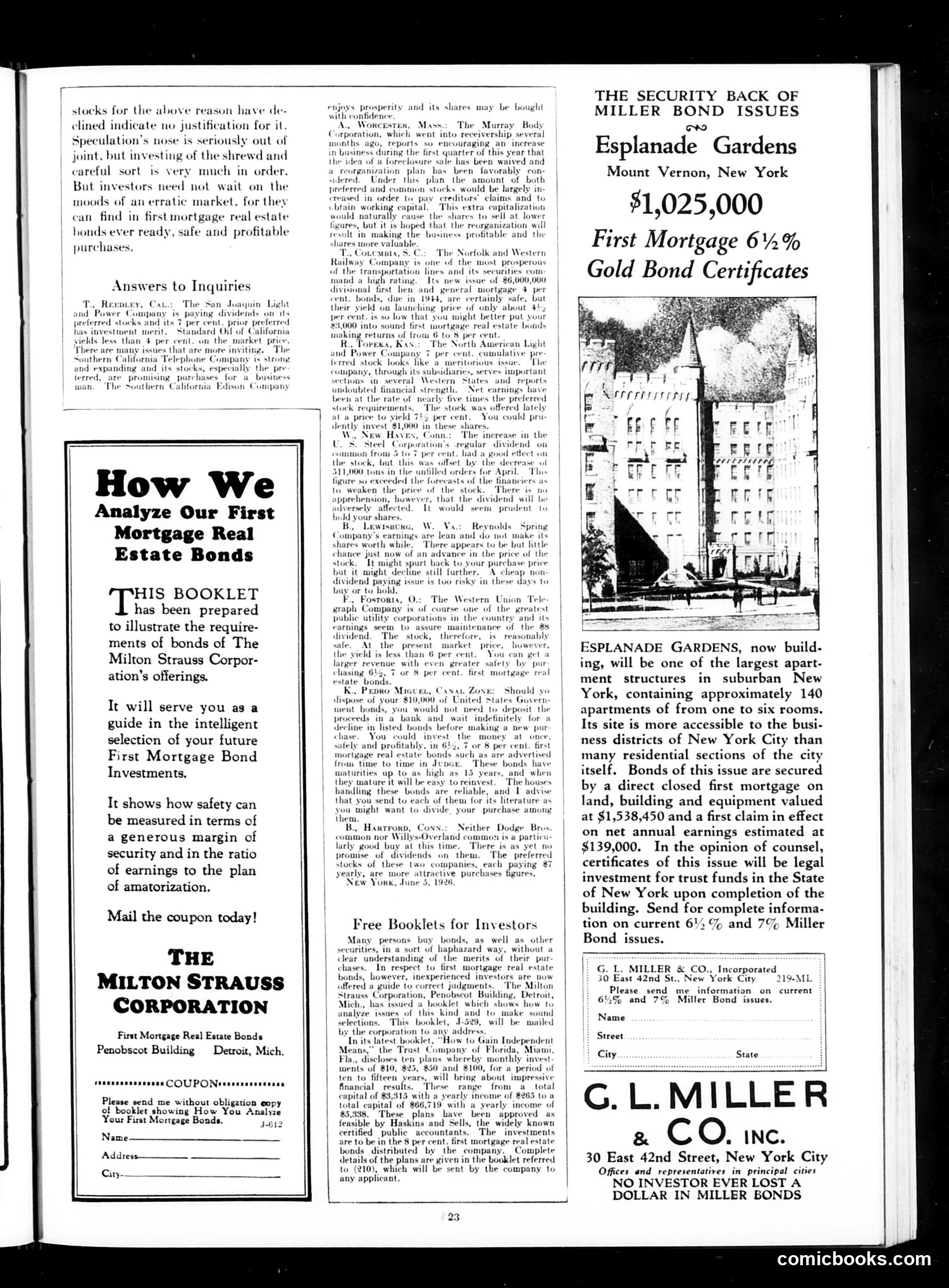
This page is primarily **advertising and financial advice**, not satirical commentary. The left side features a Milton Strauss Corporation advertisement promoting a booklet on analyzing first mortgage real estate bonds—a safe, conservative investment. The accompanying "Answers to Inquiries" column provides investment advice to readers, recommending bonds over stocks as more reliable income sources. The right side advertises Esplanade Gardens, a Mount Vernon apartment development, secured by a $1,025,000 first mortgage bond at 6½%. **Context for modern readers**: This represents 1920s investment culture before the 1929 stock market crash. The repeated advice to choose stable bonds over volatile stocks reflects the era's investment philosophy. The emphasis on "safety" and "earnings ratios" shows how bonds were marketed as prudent alternatives to speculative stock purchases. This is a sales pitch, not satire—Judge's pages often mixed editorial content with advertisements.
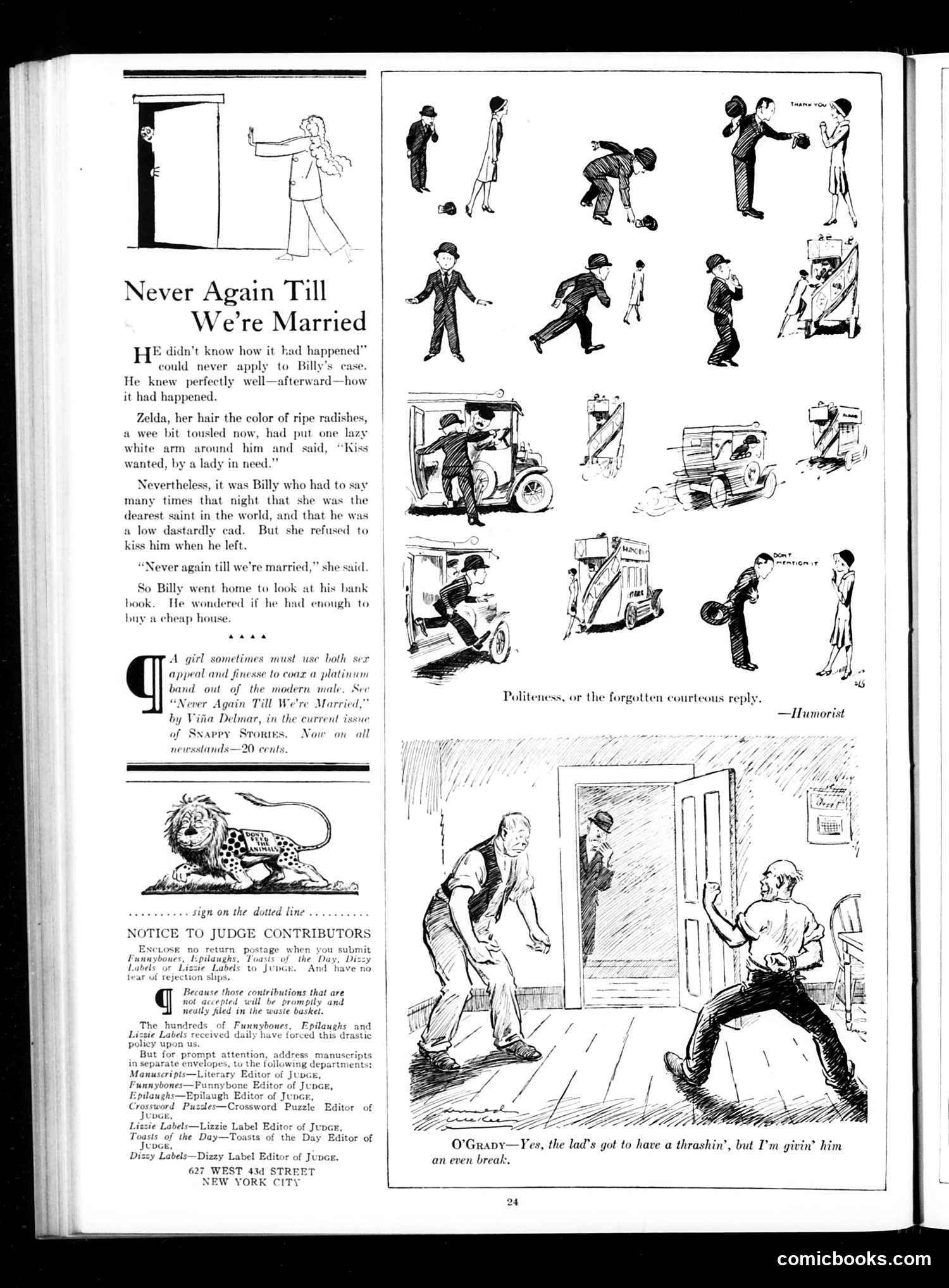
This page contains two separate satirical pieces: **"Never Again Till We're Married"** (left): A romantic comedy about modern courtship. A red-haired woman named Zelda manipulates a man named Billy into marriage by withholding kisses unless he commits. The satire targets female manipulation tactics and male desperation—Billy must examine his bank account to afford a house. The accompanying illustration series mocks slapstick male behavior (falling, stumbling, physical comedy), suggesting men become ridiculous fools around women. **"Politeness, or the Forgotten Courteous Reply"** (right): A cartoon showing various situations where people fail to respond politely—multiple vignettes of characters not acknowledging greetings or courtesies. The final panel depicts a father about to strike his son but claims he's giving him "an even break," a darkly humorous comment on corporal punishment as supposedly fair discipline. Both pieces satirize social behavior and gender relations typical of 1920s American life, with humor deriving from exaggerated character types and situational comedy.
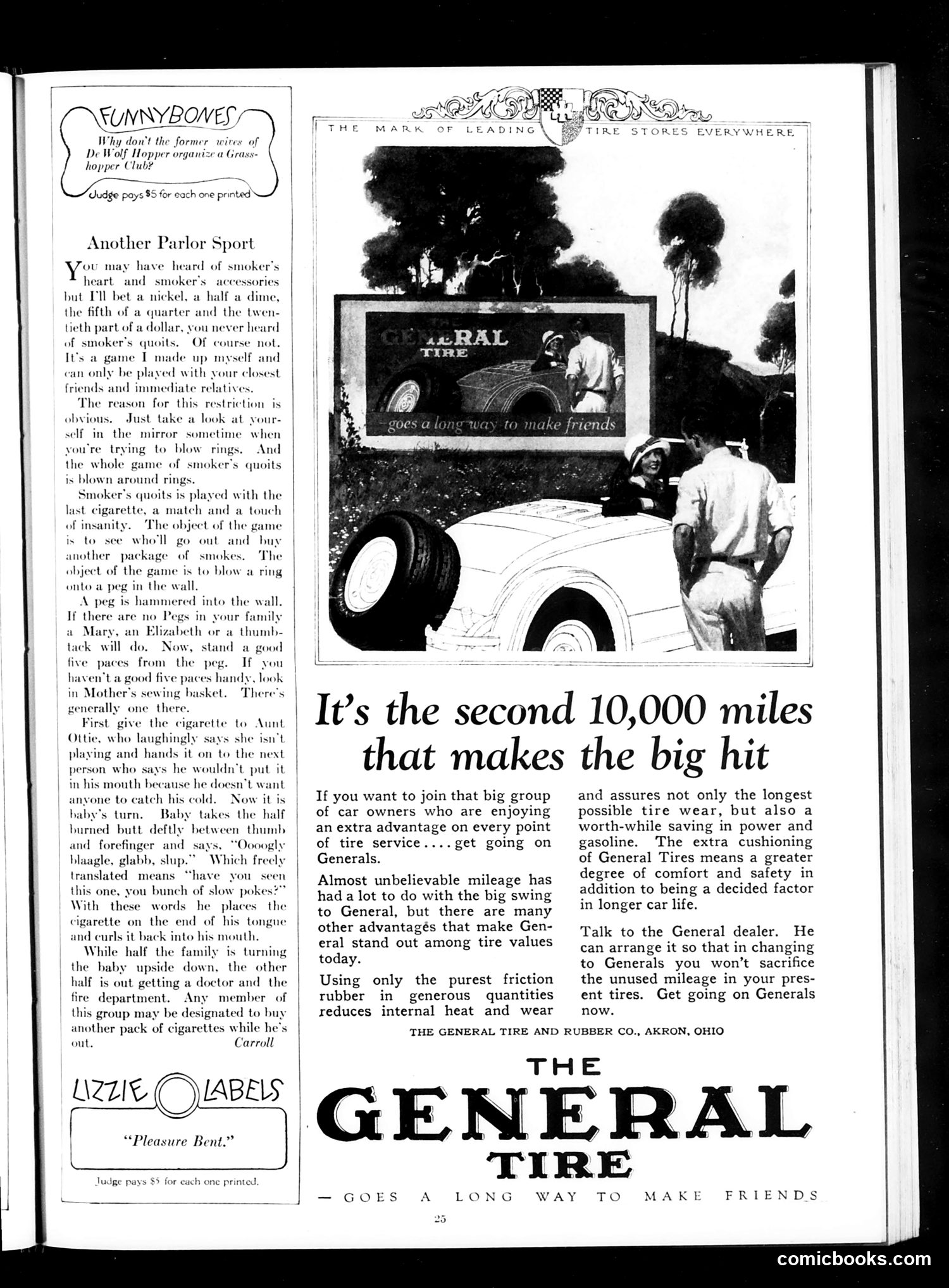
This page mixes humor with advertising, typical of 1920s Judge magazine. **"Funnybones" section**: A joke about De Wolf Hopper (a famous stage actor known for reciting "Casey at the Bat") whose multiple ex-wives should form a "Grasshopper Club"—a pun on his name and presumably his marital history. **"Another Parlor Sport"**: A satirical piece inventing an absurd smoking game called "smoker's quoits," where friends blow cigarette rings at a peg. The humor lies in the ridiculous rules, the implied social awkwardness (looking in mirrors to practice ring-blowing), and the escalating chaos (summoning doctors and fire departments). It mocks parlor games and smoking culture. **Lower sections**: Two small joke boxes ("Lizzie Labels") and a large General Tire advertisement using the slogan "goes a long way to make friends"—standard early auto advertising emphasizing durability and value. The page reflects Jazz Age leisure culture, casual smoking norms, and automobile enthusiasm among affluent readers.
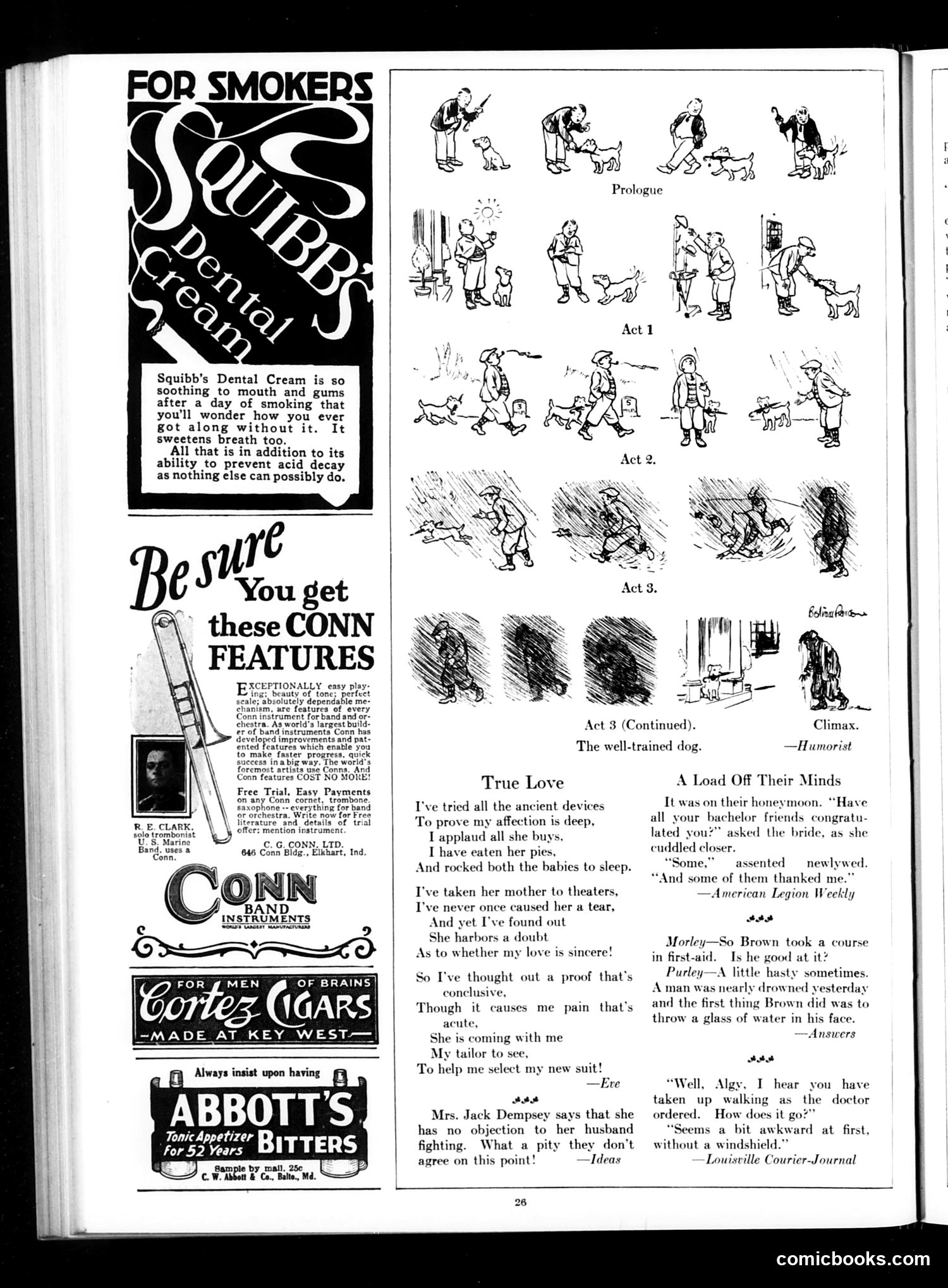
This page from *Judge* magazine combines advertisements with humorous short jokes and verses typical of early 20th-century satirical publications. **The cartoons** on the right depict a silent comedy narrative—a man with a dog progressing through various scenes (Prologue through Act 3), culminating in the "Climax" where the well-trained dog apparently triumphs. This visual gag format was common in the era. **The jokes** are light social commentary: "True Love" satirizes male insecurity in relationships; Mrs. Jack Dempsey's quip plays on the boxer's fighting career (likely referencing Jack Dempsey, heavyweight champion); the first-aid joke mocks overzealous medical knowledge; and the final joke jokes about the recent automobile era, with "windshield" suggesting a man needs protective equipment for walking—a humorous exaggeration of modern life's dangers. **The advertisements** (Squibb's Dental Cream, Conn Band Instruments, Cortez Cigars, Abbott's Bitters) reflect products marketed to the magazine's middle-class male readership. The dental cream humorously targets smokers—a common audience for *Judge*.
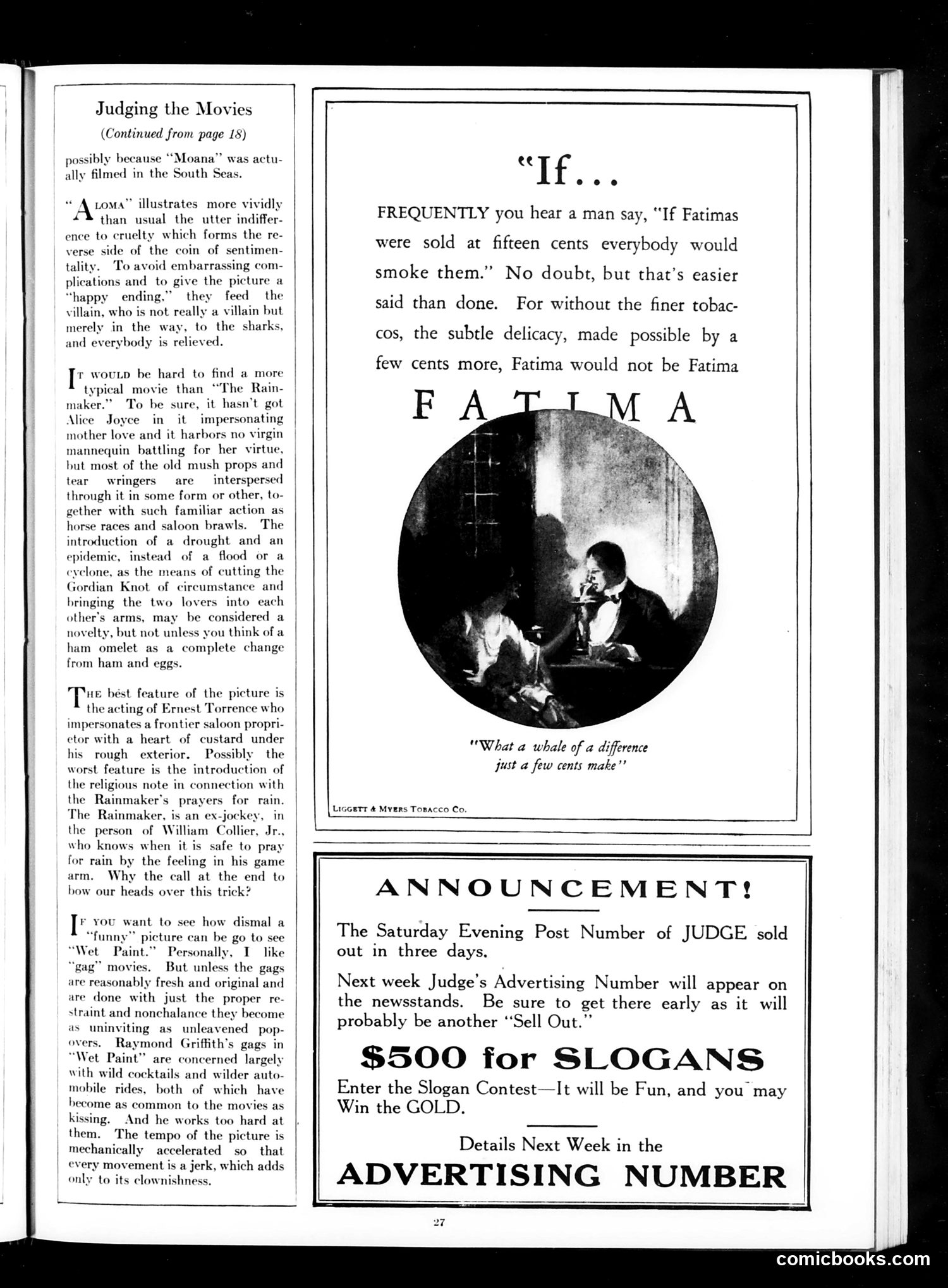
This page contains film criticism and a cigarette advertisement from Judge magazine. **The Movie Reviews** (left column) critique recent films including "Moana," "The Rainmaker," and "Wet Paint." The critic dismisses these as relying on tired, manipulative plot devices—sentimental melodrama, contrived romance resolutions, and forced humor. He praises Ernest Torrence's acting but criticizes the films' mechanical, heavy-handed approach to emotion and comedy. **The Fatima Cigarette Ad** (center) is a classic early 20th-century advertising pitch: it uses a "hypothetical" argument to justify premium pricing. The ad suggests that cheaper cigarettes would lose their quality appeal, so the higher cost is necessary to maintain the product's prestige and subtle flavor profile. This reflects period advertising techniques emphasizing brand distinction and perceived luxury. **The Announcement** (bottom) promotes Judge's upcoming advertising-focused issue and solicits slogan contest entries for $500.
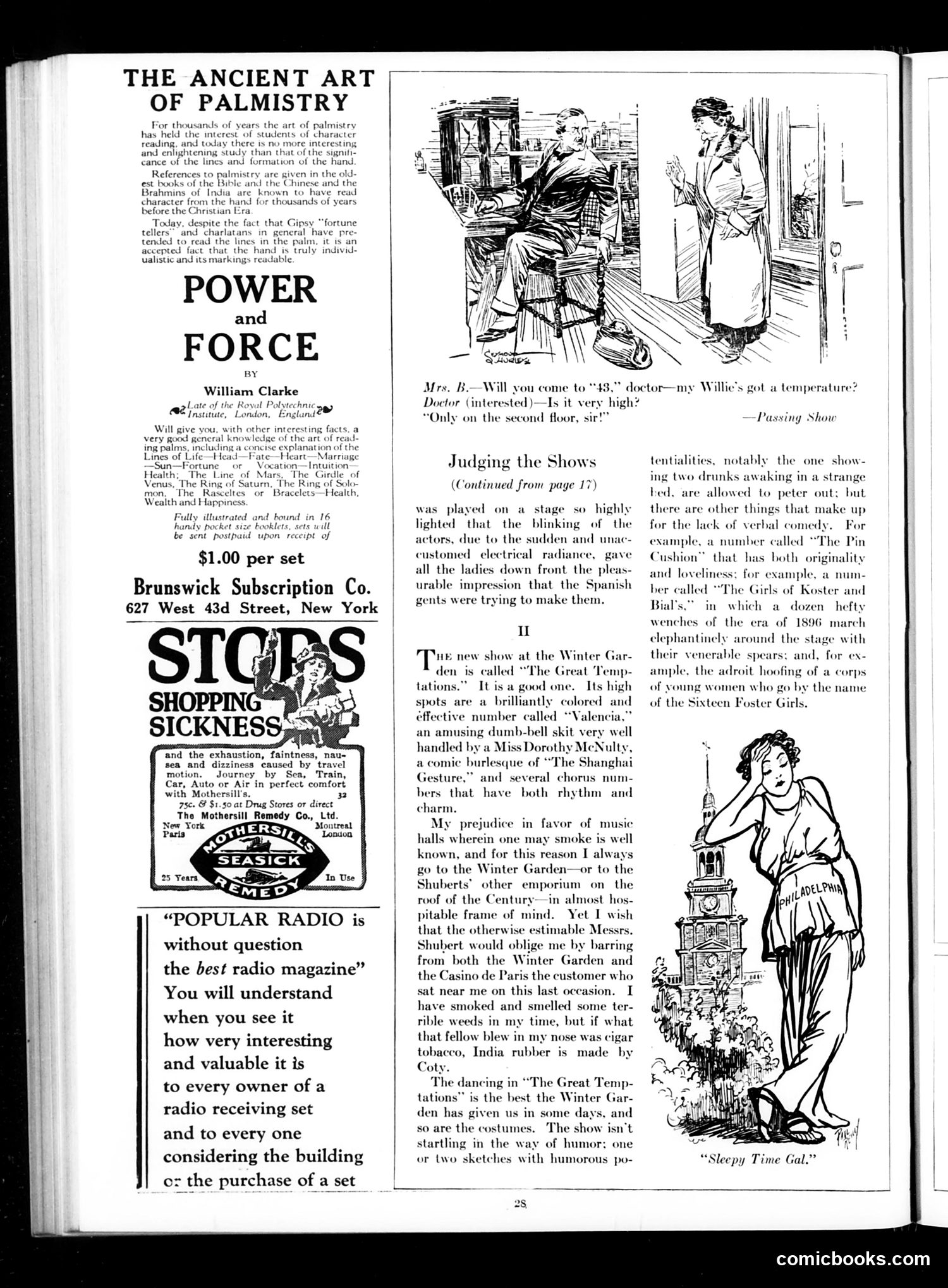
This page is primarily **advertisements and entertainment reviews**, not political satire. The main content includes: **Top section**: Ads for palmistry instruction books and motion-sickness remedies—typical early 20th-century commerce. **Center cartoon**: A domestic humor sketch showing a woman calling a doctor about her sick child ("Willie's got a temperature?"), with the doctor's practical response that he'll come only to the second floor. This is genteel domestic comedy, not satire—poking gentle fun at doctor visits and household concerns. **Bottom section**: A theater review of shows at the Winter Garden, critiquing dance numbers, comedic sketches, and performances. The reviewer praises "The Great Temptations" and complains about a fellow audience member's cigar smoke. **No political content** is evident. This reflects Judge magazine's lighter side—entertainment and consumer advertising rather than the satirical political commentary the magazine is known for.
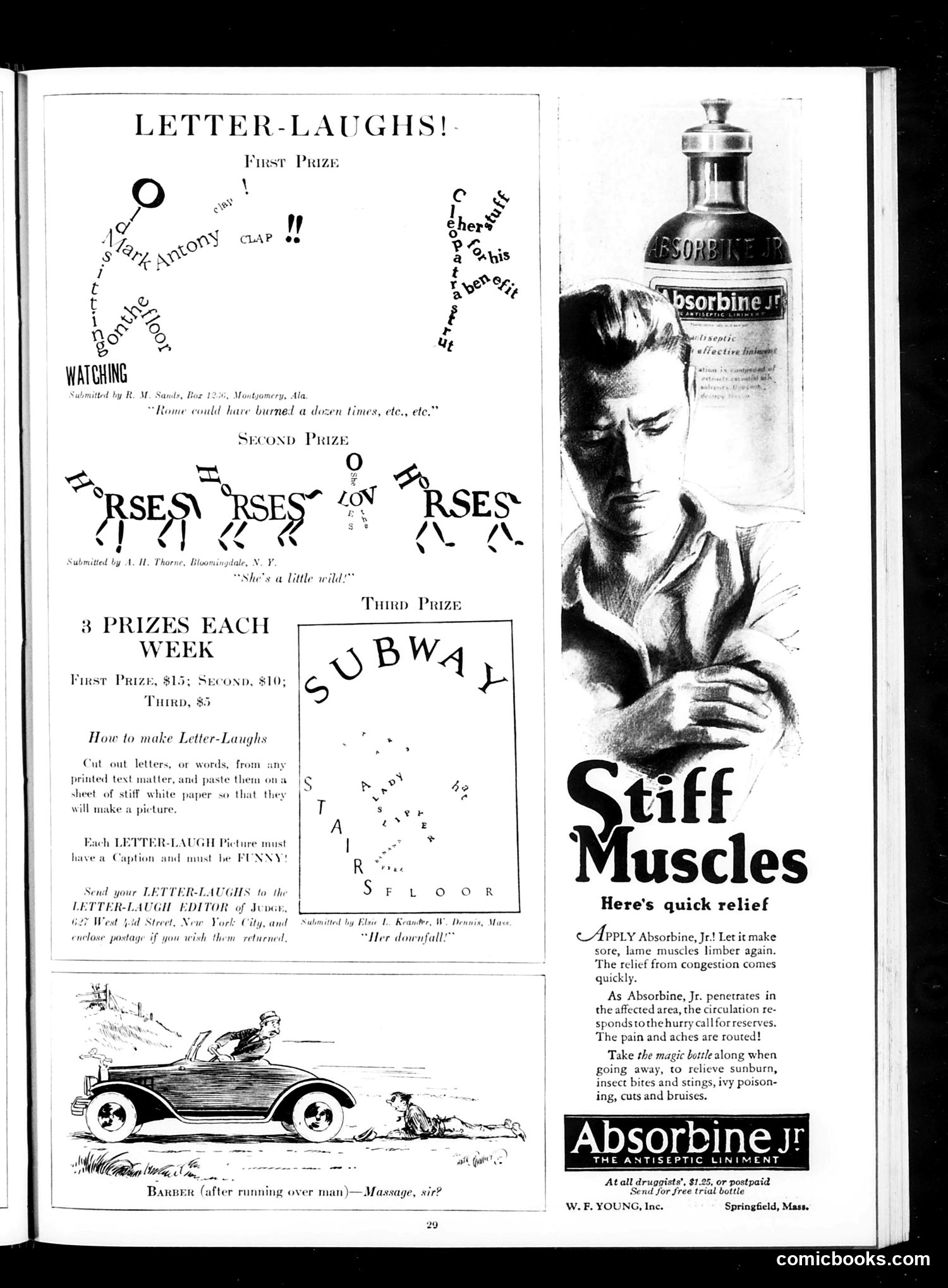
This page showcases **Letter-Laughs**, Judge's reader-submitted visual pun contest. Readers cut letters from printed materials and arranged them to form pictures with captions, creating word-image jokes. The three prize-winning entries include: 1. "Watching" — letters arranged to depict someone observing (likely referencing Rome burning, suggesting distraction during crisis) 2. "Horses" — letters forming galloping horses with caption "She's a little wild!" 3. "Subway" — letters arranged in a subway-themed composition with caption "Her downfall!" The contest offered weekly prizes ($15, $10, $5) and instructions for participation. This was a lighthearted, participatory feature allowing ordinary readers to submit homemade visual humor. The page also includes a cartoon of a driver offering "massage" to a man he's hit—dark humor about traffic accidents—and an advertisement for Absorbine Jr. liniment for muscle pain relief.
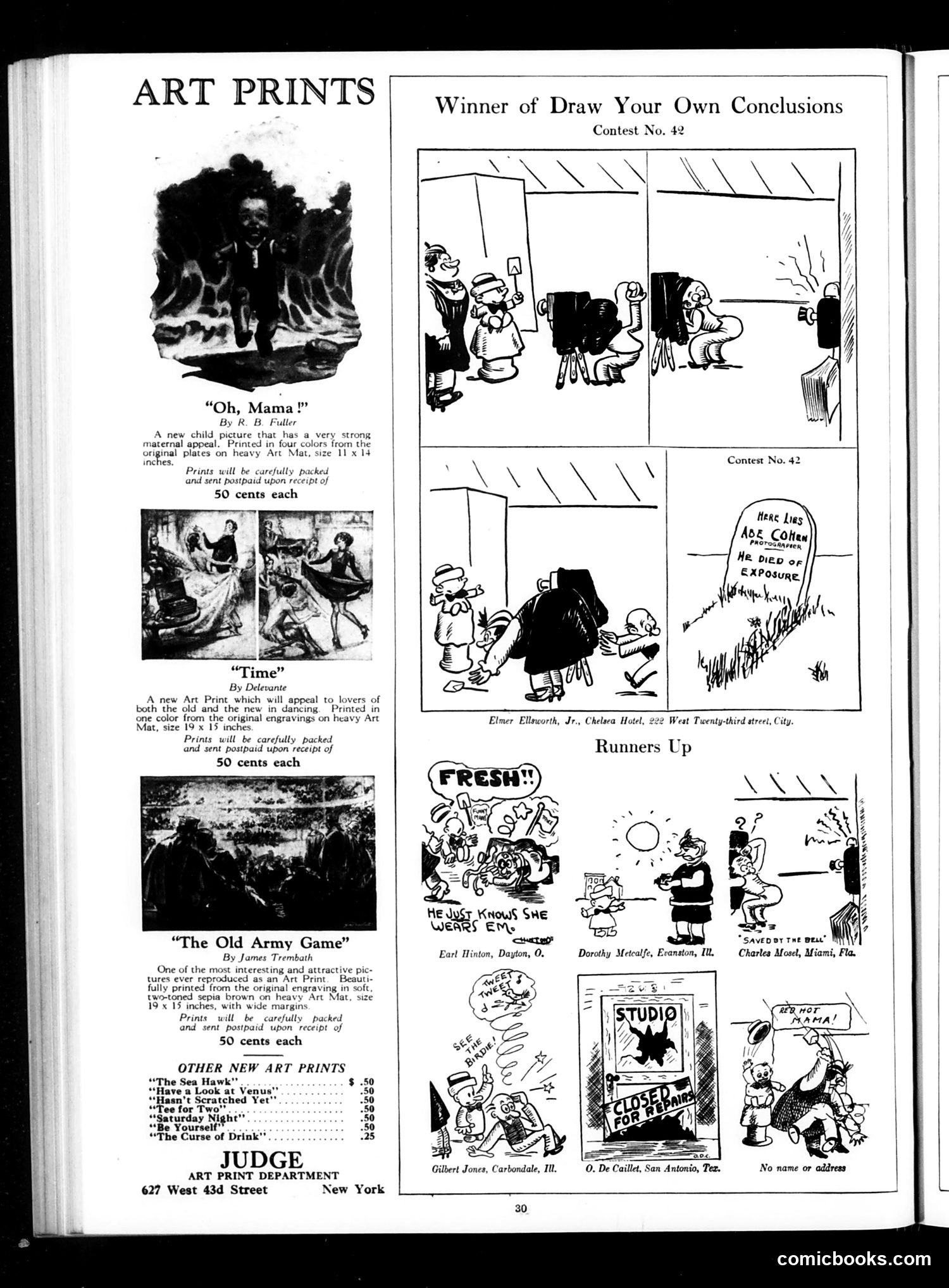
This is primarily an advertisement and contest results page for Judge's art print department. The main feature showcases the winner of "Draw Your Own Conclusions Contest No. 42"—a cartoon by Elmer Ellsworth Jr. depicting children at play with what appears to be a coffin or dark box, with a gravestone visible in the bottom panel. The joke relies on children's morbid misinterpretation of adult activities. Below are "Runners Up" entries, including cartoons about everyday situations: a child misunderstanding dust ("He just knows she wears Em[something]"), a studio marked "Closed for Repairs," and other domestic humor scenarios. The left side advertises three art prints for sale at 50 cents each: "Oh, Mama!" (maternal appeal), "Time" (old vs. new dancing), and "The Old Army Game" (a swindle reference). This is essentially a mail-order catalog page mixed with contest results—typical Judge magazine content from the early 20th century.
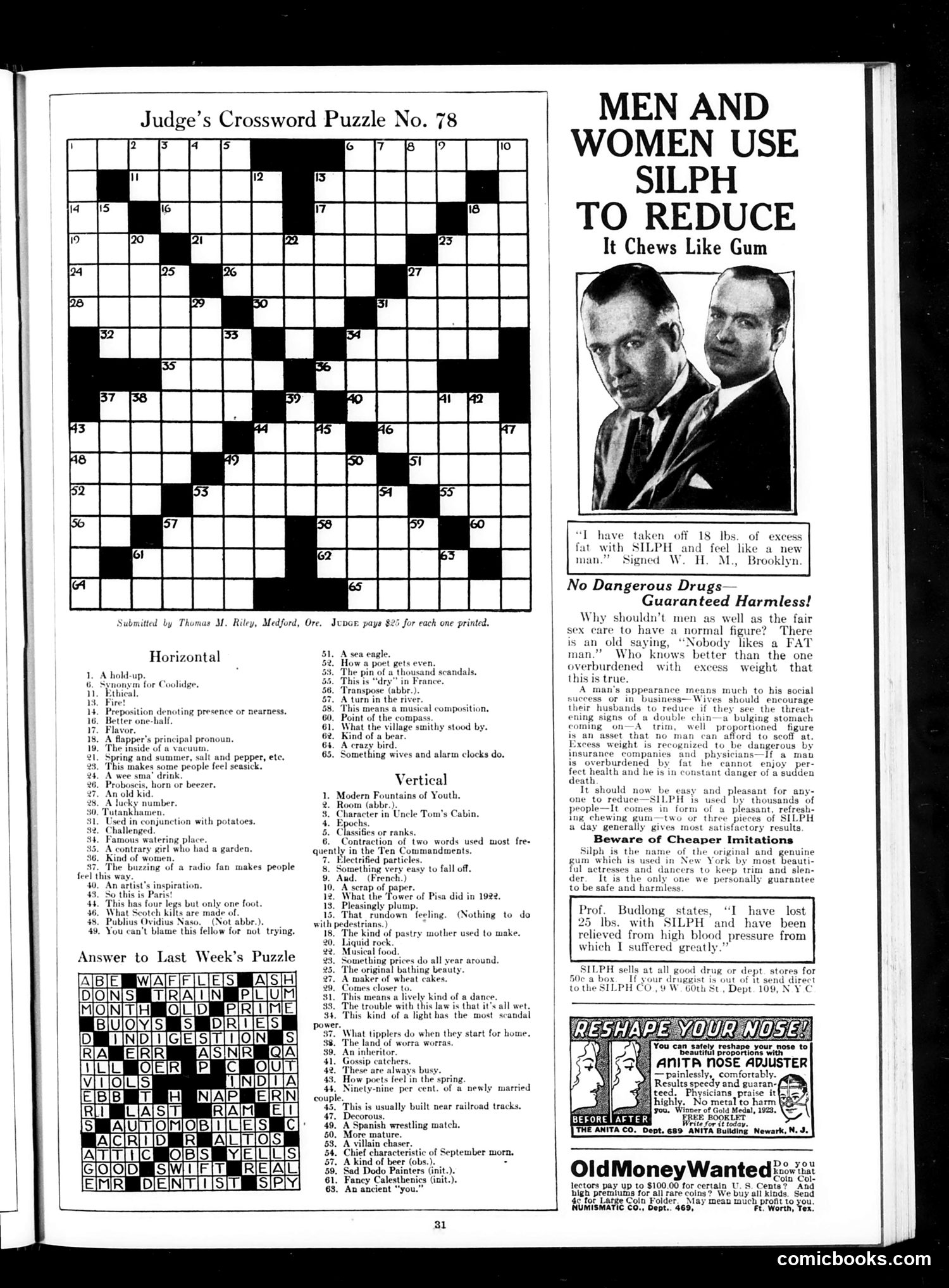
This page is primarily a **commercial advertisement** disguised as editorial content in Judge magazine. The main feature promotes "SILPH," a chewing-gum-based weight-reduction product marketed to both men and women. The advertisement includes testimonials (from "W.H.M., Brooklyn" and "Prof. Budlong") claiming the product safely removes excess fat without "dangerous drugs." It emphasizes that weight loss improves social standing and business success, and appeals to both vanity and health concerns—noting that insurance companies recognize obesity as dangerous. The crossword puzzle on the left appears unrelated to the advertisement. A smaller ad below promotes "Anita Nose Adjuster" for reshaping noses "painlessly." **Modern context**: This reflects early 20th-century marketing practices when product advertisements were often embedded within magazines without clear distinction from editorial matter. The claims about weight loss being essential for social success reflect period attitudes about appearance and gender presentation.
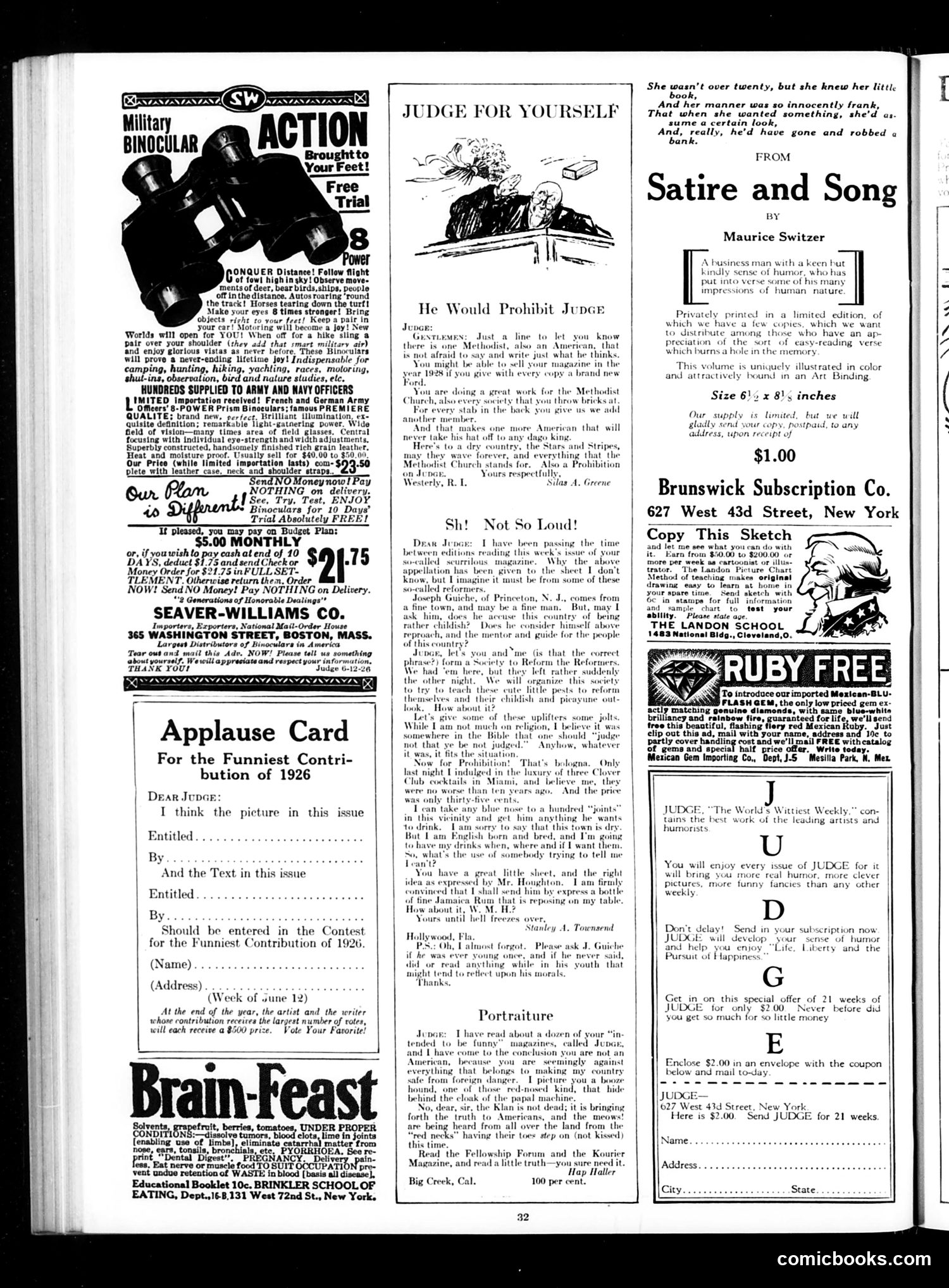
This page features a satirical exchange about Prohibition. A Methodist minister (identified in the text as "Methodist") proposes banning *Judge* magazine itself, apparently viewing its humor and content as morally objectionable—much as prohibitionists sought to ban alcohol. The satire's point: the cartoon highlights the hypocrisy and overreach of reform movements. While the Methodist wants to censor *Judge*, the magazine's editor (represented in the responses) defends freedom of expression and mocks the self-righteous "uplift" culture of reformers trying to dictate public morality. The irony is sharp—prohibitionists claimed moral authority to eliminate "evils," yet reformers like this Methodist would extend that logic to suppressing dissenting voices and humor itself. The responses ridicule this authoritarian impulse, arguing that such people need "jolts" of reality rather than platforms to lecture others. This reflects 1920s tensions between traditional moral reformers and modernist skeptics who saw Prohibition-era moralism as sanctimonious and dangerous to individual liberty.
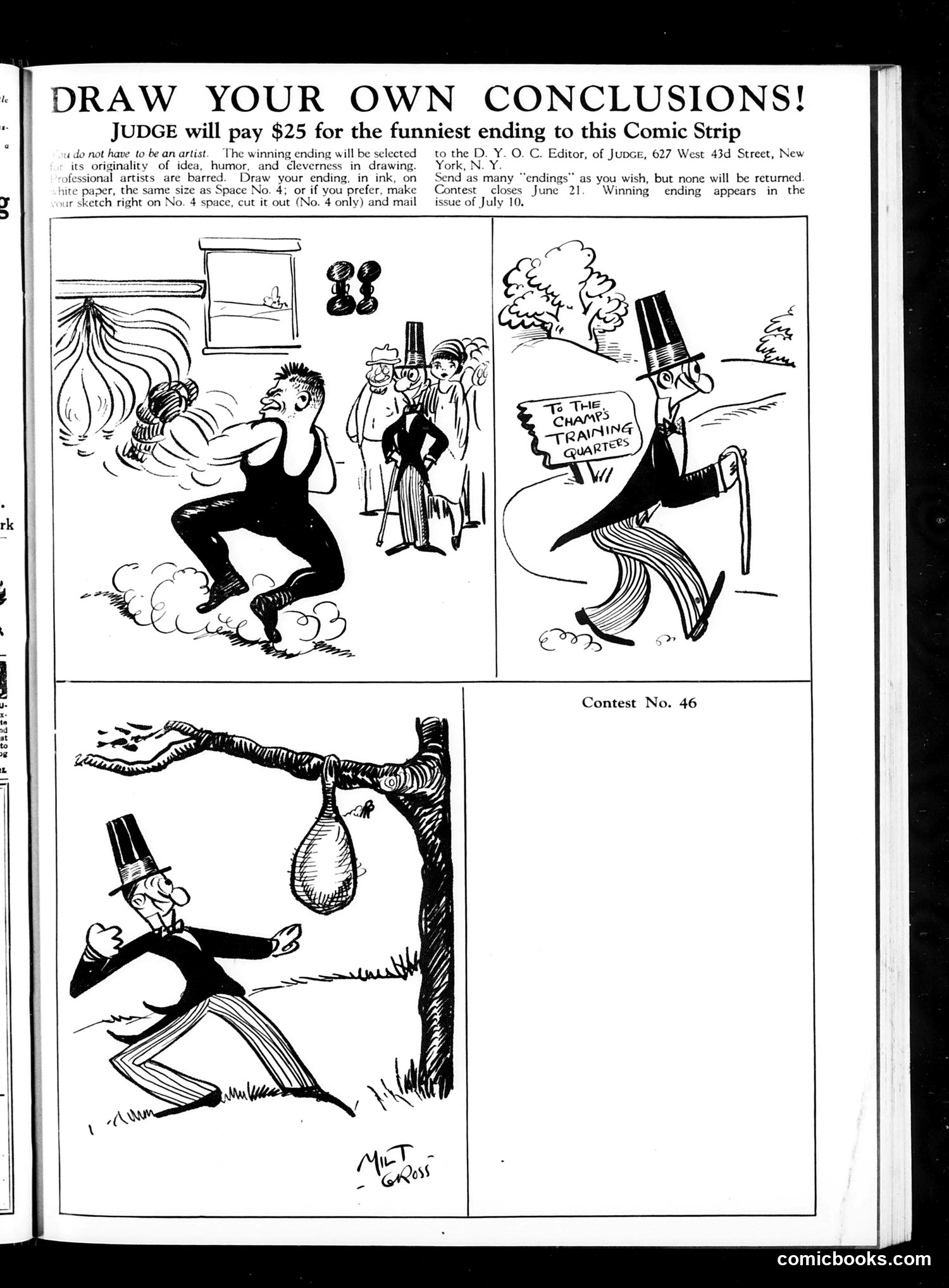
This page showcases a **reader-participation comic contest**. Judge magazine presents an incomplete three-panel comic strip (Contest No. 46) and invites readers to submit funny endings. The visible panels show a well-dressed man in a top hat encountering a punching bag and then a tree with a hanging object. The humor appears to derive from physical comedy and slapstick situations—typical of early-to-mid 20th century comic strips. The contest offered **$25 prize money** for the funniest submitted ending, with entries due by June 21. This was a common engagement strategy for humor magazines, crowdsourcing comedy from readers while generating content and reader loyalty. The phrase "Draw Your Own Conclusions!" is a pun, inviting literal artistic conclusions to the unfinished narrative.
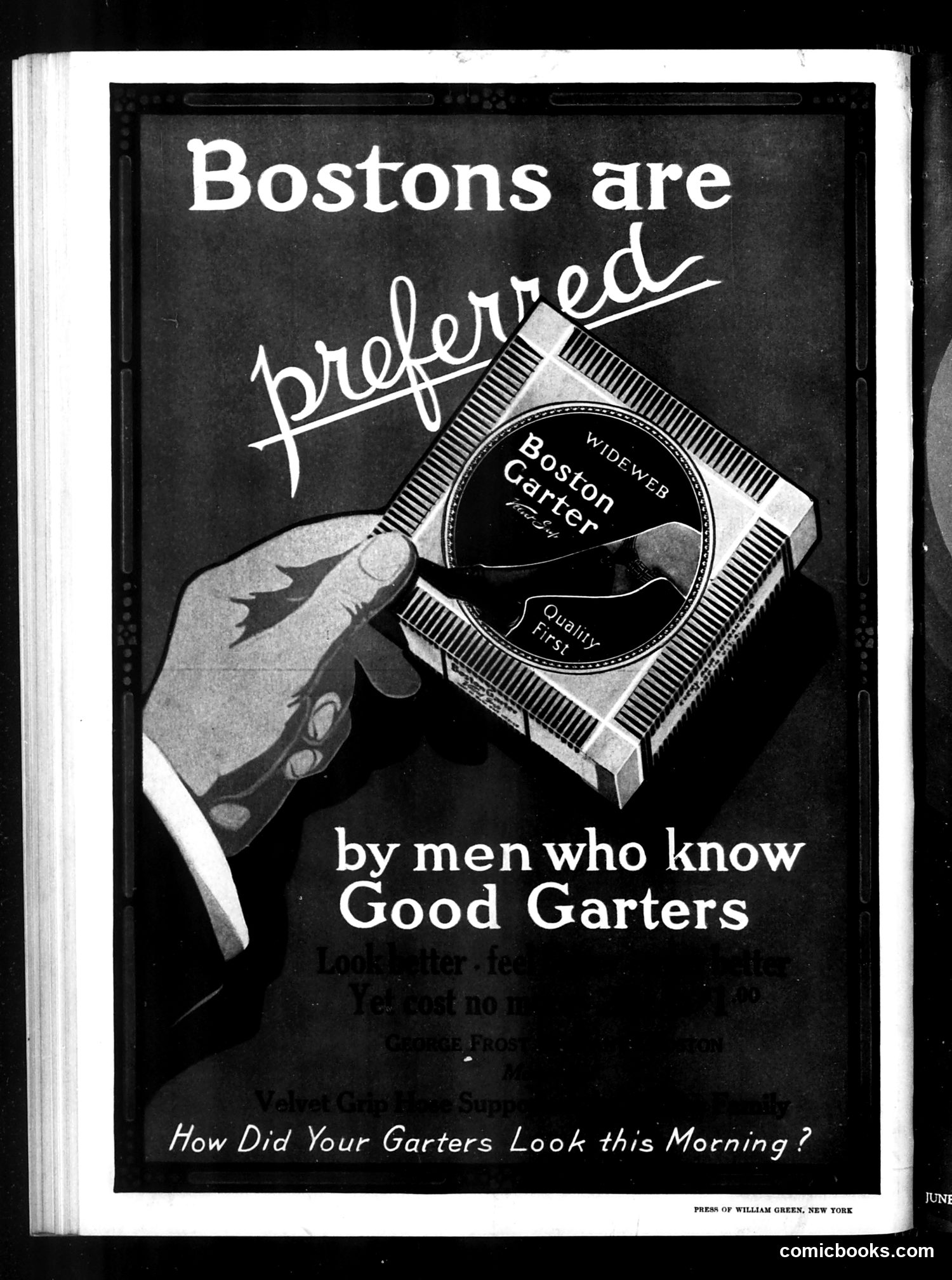
This is a vintage advertisement for Boston Garters, a men's hosiery product. The ad features a hand holding a product box labeled "Boston Garter" with text emphasizing "Widest Web" and "Quality First." The humor relies on a double meaning: "Bostons" refers both to a style of garter (leg-support garment for men's socks) and suggests physical attractiveness or appeal. The tagline "by men who know Good Garters" positions the product as preferred by discerning men, while the closing question "How Did Your Garters Look this Morning?" implies that well-maintained garters reflect on a man's overall presentation and character. This reflects early 20th-century advertising that marketed practical menswear while playing on vanity and social status.