
Judge, 1926-06-12 · page 15 of 36
Judge — June 12, 1926 — page 15: what you’re looking at
What you’re looking at
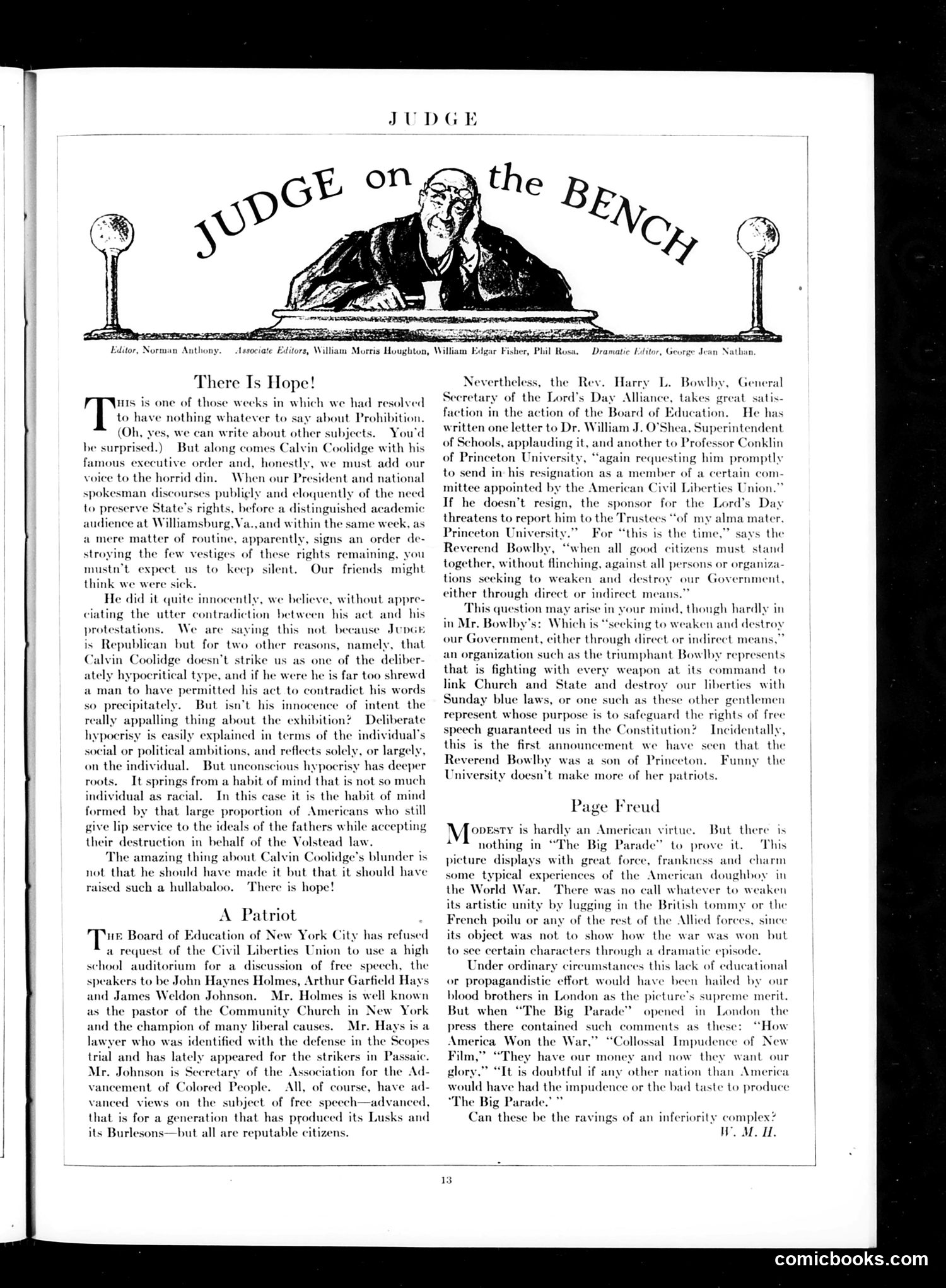
This page critiques President Calvin Coolidge's contradiction between public statements defending civil liberties (made at Williamsburg) and his simultaneous executive order restricting those same rights, likely related to Prohibition enforcement. Judge argues Coolidge's hypocrisy stems not from deliberate deception but from unconscious acceptance of government overreach—a deeper cultural problem. The second section satirizes Rev. Harry L. Bowlby of the Lord's Day Alliance, who pressured Princeton professor Edwin Conklin to resign from the American Civil Liberties Union committee. Judge highlights the irony: Bowlby claims to defend "free speech" and "good citizens" while actively suppressing civil liberties through religious-moral coercion. The piece questions who truly threatens American freedoms—suggesting religious organizations weaponizing institutional pressure represent the real danger to democratic values.
📄 Transcribed text from this page (OCR, searchable)
Machine-transcribed from the original scan — historical spelling and the odd misread are preserved.
TDGE Associate Editors, Willi Editor, Norman Anthony There Is Hope! nis is one of those weeks in which we had resolve I to have nothing whatever to say about Prohibition. (Oh, » we can write about other subjects. You'd he surprised.) But along comes Calvin Coolidge with his famous executive order and, honestly, must add our voice to the horrid din. When our President and national spokesman discourses publigly and eloquently of the need to preserve we ademic und within the same week, as . apparently, signs an order de- stroying the few vestiges of these rights remaining, you mustn't expect us to keep. silent. think we were sick. te’s rights, before a distinguished a audience at Williamsburg,V a mere matter of routine. Our friends might He did it quite innocently, we believe, without appre- ciating the utter contradiction between his act and his protestations. We saying this not becd Jupce is Republican but for two other reasons, namely, that Calvin Coolidge doesn’t strike us as one of the deliber- ately hypocritical type, and if he were he is far too shrewd a man to have permitted his act to contradict his words so precipitately. But isn’t his innocence of intent: the really appalling thing about the exhibition? Deliberate hypocrisy is easily explained in terms of the individual's social or political ambitions, and reflects solely on the individual. are Ise or largely, has deeper It springs from a habit of mind that is not so much individual as racial. In this case it is the habit of mind formed by that large proportion of Americans who still give lip service to the ideals of the fathers while accepting their destruction in behalf of the The amazing thing about Calvin Coolidge’s blunder is not that he should have made it but that it should have raised such a hullabaloo. There is hope! A Patriot ne Board of Educ 1 of Ne’ 1 request of the Civil Libert But unconscious hypocris roots. Volstead law. T school auditorium for a discussion of fre speakers to be John Haynes Holmes, Arthur ( York City has refused Union to u i » the rfield Hays and James Weldon Johnson. Mr. Holmes is well known as the pastor of the Community Church in New York and the champion of many liberal causes : lawyer who was identified with the defense trial and has lately appeared for the strikers in Pa Mr. Johnson is Secretary of the Association for the Ad- vancement of Colored People. All, of course, have vanced views on the subject of free speech—advar that is for a generation that has produced its Lusks and its Burlesons—but all are reputable citizens. Morris Houghton, William Edgar Fisher, Phil Rosa, Dramatic Editor, George Jean Nathan, Nevertheless, the Rey. Harry L. Bowlby, Secretary of the Lord’s Day Alliance, takes faction in the action of the Board of Education. written one letter to Dr. William J. O’She: of Schools, applauding it of Princeton Universit General at satis- He has . Superintendent and another to Professor Conklin ain requesting him promptly to send in his resignation as a member of a certain com- mittee appointed by the American Civil Liberties Union.” If he doesn’t resign, the sponsor for the Lord’s Day threatens to report him to the Trustees “of my alma mater, Princeton Universi For “this is the says the Reverend Bowlby, “when all good citizens must. stand together, without flinching, against all persons or organiza- tions seeking to w either through dire This question m: ise in your mind, thongh hardly in in Mr. Bowlby’s: Which is “secking to weaken and destroy our Government, cither through direct or indirect means,” an organization such as the triumphant Bowlby represents that is fighting with every weapon at its command to link Church and State and destroy Sunday blue laws, or one such as these other gentlemen represent whose purpose is to safeguard the rights of free speech guaranteed us in the Constitution? this is the first. announcement havi Reverend Bowlby was a son of Princeton. University doesn’t make more of her patriots. time,” sen and destroy our Government, t or indirect: means.” our liberties with Incidentally, that the Funny the we seen Page Freud But there it. This frankness and charm American doughboy Most is hardly an American virtue. + nothing in “The Big Pa picture dist with great for some typical ences of the in the World War. here was no call whatever to weaken its artistic unity by lugging in the British tommy or the French poilu or any of the rest of the Allied forces, since its object was not to show how the war was won but to see cer! is ade” to. prove in characters through a dramatic episode, Under ordinary circumstances this lack of educational or propagandistic effort would have been hailed by our blood brothers in London as the picture’s supreme merit. But when “The opened in London the press there contained such comments as these: “How America Won the War,” “Collossal Impudence of New Film,” “They have our money and now they want our glory.” “It is doubtful if any other nation than America would have had the impudence or the bad taste to produce ‘The Big Parade.’ ” Can these be the ravings of an inferiority complex? We M. MW. Big Parade” comicbooks.com