
Judge, 1926-06-12 · page 19 of 36
Judge — June 12, 1926 — page 19: what you’re looking at
What you’re looking at
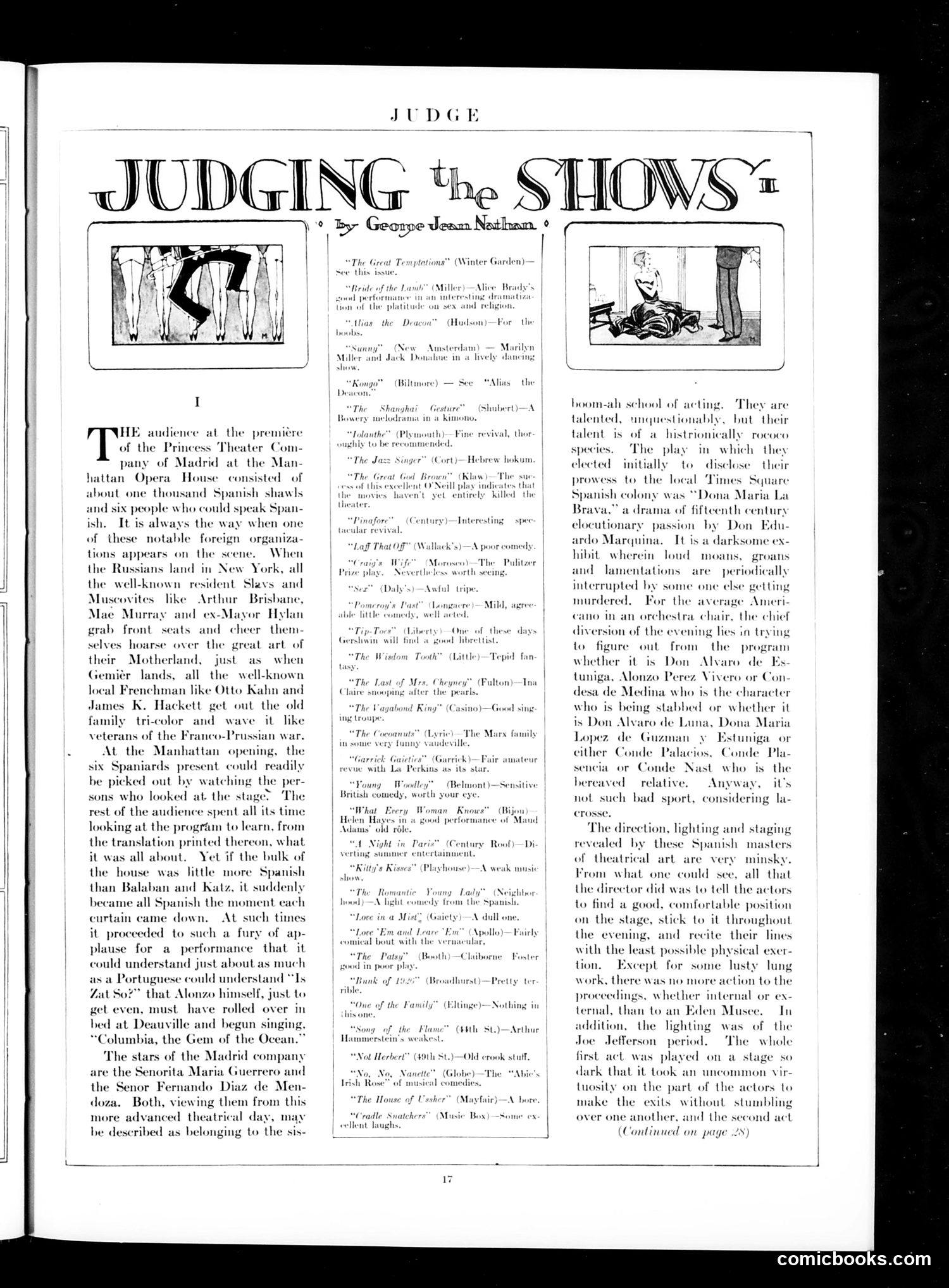
This is a theater review column by George Jean Nathan critiquing the Madrid company's performance at the Manhattan Opera House. The satire targets pretentious New York audiences who claim cultural sophistication but don't actually understand foreign theater. Nathan mocks how Spanish speakers were easy to spot—they were the ones actually watching the stage, while everyone else consulted programs for translations. He ridicules the audience's sudden, enthusiastic applause after each curtain despite comprehending nothing, comparing their judgment to what a Portuguese would understand of "Is Zat So?" (a contemporary play). The review dismisses the visiting stars María Guerrero and Fernando Díaz de Mendoza as relics of an earlier theatrical era, and criticizes their Spanish drama "Doña Brava" as melodramatic and impenetrable—the American viewer cannot distinguish which character is which without constantly referencing the program. The core joke: fashionable New Yorkers perform cultural appreciation they don't genuinely feel, applauding what they cannot comprehend.
📄 Transcribed text from this page (OCR, searchable)
Machine-transcribed from the original scan — historical spelling and the odd misread are preserved.
HE audience at the premiére of the Princess Theater Com- of Madrid at the Man- hattan Opera consisted ol pany House about one thousand Spanish shawls and six people who could speak Span- ish. It is always the way when one of these notable foreign organize tions appears on the scene. When the Russians land in New York, all the well-known resident: Slavs and Muscovites like Arthur Brisbane, Mae Murray and ex-Mayor Hylan grab front seats and cheer them- selves hoarse over the great art of their Motherland, just as Gemiér lands, all the well-known local Frenchman like Otto Kahn and James K. Hackett get out the old family tri-color and wave it like veterans of the Franco-Prussian war. At the Manhattan opening, the yaniards present could. readily be picked out by watching the per- sons who looked at the stage? The when rest of the audience spent all its time looking at the program to learn, from the translation printed thereon, what it was all about. Yet if the bulk of the house was little more Spanish than Balaban and Katz, it suddenly became all Spanish the moment each curtain came down. At such times it proceeded to such a fury of ap- plause for a performance that. it could understand just about as much as a Portuguese could understand “Is Zat So?” that Alonzo himself, just to get even, must have rolled over in hed at Deauville and begun singing. “Columbia, the Gem of the Ocean.” The stars of the Madrid company are the Senorita Maria Guerrero and the Senor Fernando Diaz de Men- doza. Both, viewing them from this more advanced theatrical day, may be described as belonging to the sis- ° JUDGE G the SHOWS by Geanpe Jeasn Nathan ; CF “The Great Temptetions™ (Winter Garden) Miller) Alive resting dramtizat sex and religion. 1 pert of the platitude ¢ the Deacon” Marilyn “Sunny” (New Amsterdam: Miller and Jack Donahue in a lively Kongo” (Biltmore “Alias — the Deacon: Bowery me «in a kimono. *Lolanthe sughly to be rec Fine revival, thor ‘ort)— Hebrew hokum The tod Brown’ (Klaw)—The sue O'Neill play indicates that n't yet entirely killed the Interesting — spec A poor comedy The Pulitzer s worth seeing. ‘ su Price play. Never Sex” (Daly's) Awful tripe Mild, days Little)—Tepid. fan Ina Cheyney” (Bultow F the pearls, Ring” Casino) —Good sing Mary family “Garrick G c arrick)—Pair ai revue with La Perki > ils star Belmont)—Sensitive of Mand Adams’ old role { Night in Paris” (C verling summer entertainmen “Kitty's Risse show The y tury Reof)—Di Playhouse A weak ninsic a Lady" (Neighbor omedy from the Spans ina Mist \ dull one. Leave “E Apollo, the vernacular, Booth Gaiety Fairly Claiborne Foster Browdhurst)—Pretty: ter Eltinge)—Nothing in (#4th St.) —Arthur Hammerstein's weil “Not He $9th St.) —Old crook stuff Irish Re “The House Mayfair} —A bore Masie Box Brady's | Hudson) —For the | boom-ah school of acting. They are talented, unquestionably, but their talent is of a histrionically The play in which they initially to their prowess to the local Times Square Spanish colony was “Dona \ I Brav rococo species. elected disclose . drama of fifteenth century clocutionary. passion by Don ardo Marquina. hibit and Edu- It is a darksome ex- loud groans lamentations periodically interrupted by some one else getting murdered, wherein moans, are For the average Ameri cano in an orchestra chair, the chief diversion of the evening lies in trying to out from the program whether it is Don Alvaro de Es tuniga, Alonzo Perez Vivero or Con desa de Medina who is the character who is being stabbed or whether it is Don Alvaro de Luna, Dona Maria © Guzman y r Conde gure or Pla- is the Anyway, it’s hot such bad sport, considering la- Estunig Conde who Palacios, Nast relative. or Conde hereaved crosse. ‘The direction, lighting and staging led by of theatrical tish masters minsky. ull that the director did was to tell the actors art From what one could se are very to find a good, comfortable position on the stage, stick to it throughout the evening, and recite their lines with the least possible physical exer- tion. Except for some lusty lung work, the i proceedings, wheth ion to the internal or ex- ternal, than to an Eden Musee. In addition, the lighting was of the Joe Jefferson period. ‘The “L was played on a stage so Was no more ac iy whole first dark that it took an uncommon vir- tuosity on the part of the actors to make the exits without stumbling over one another, and the second act L comicbooks.com