
A complete issue · 36 pages · 1926
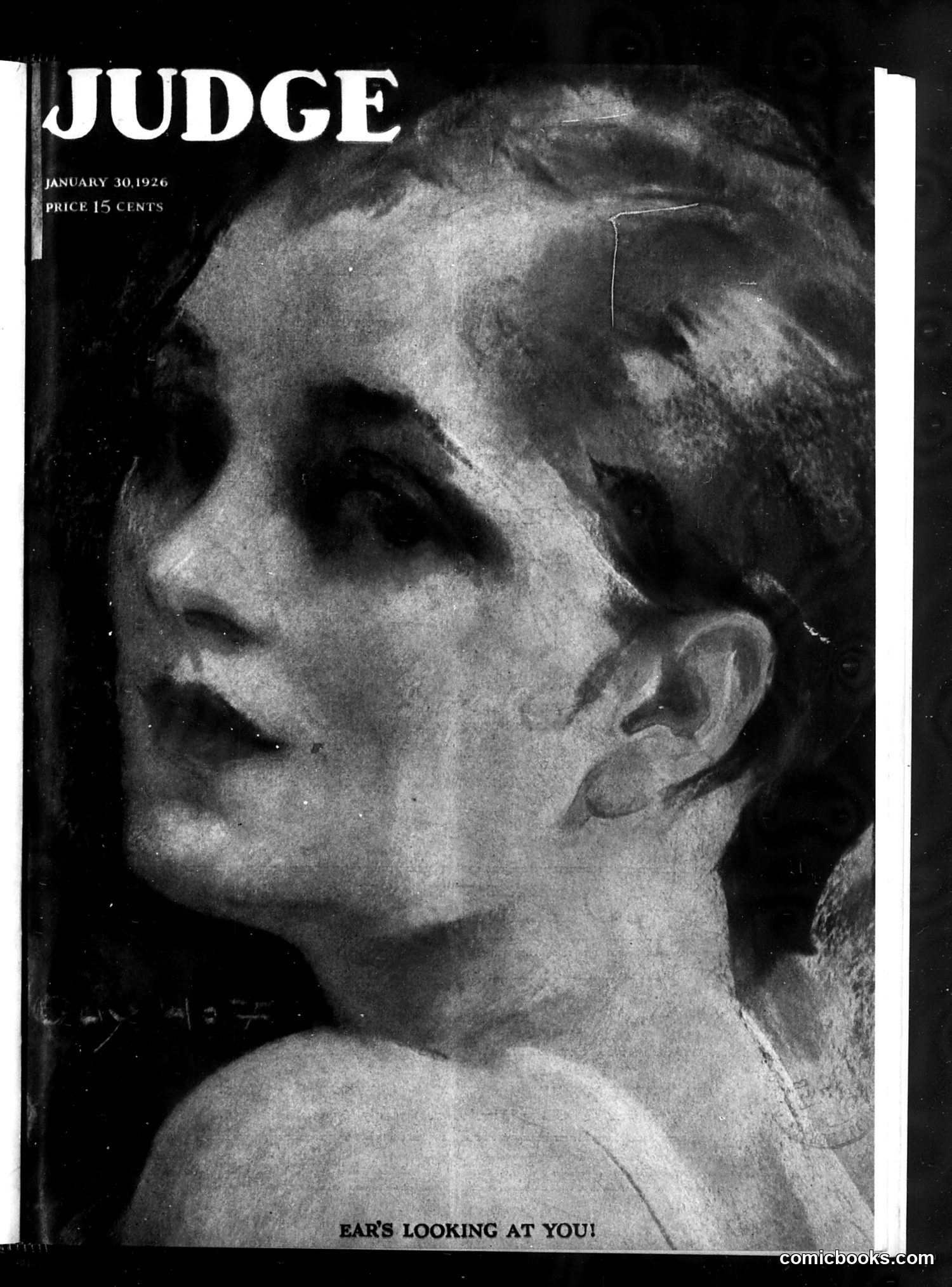
Judge — January 30, 1926
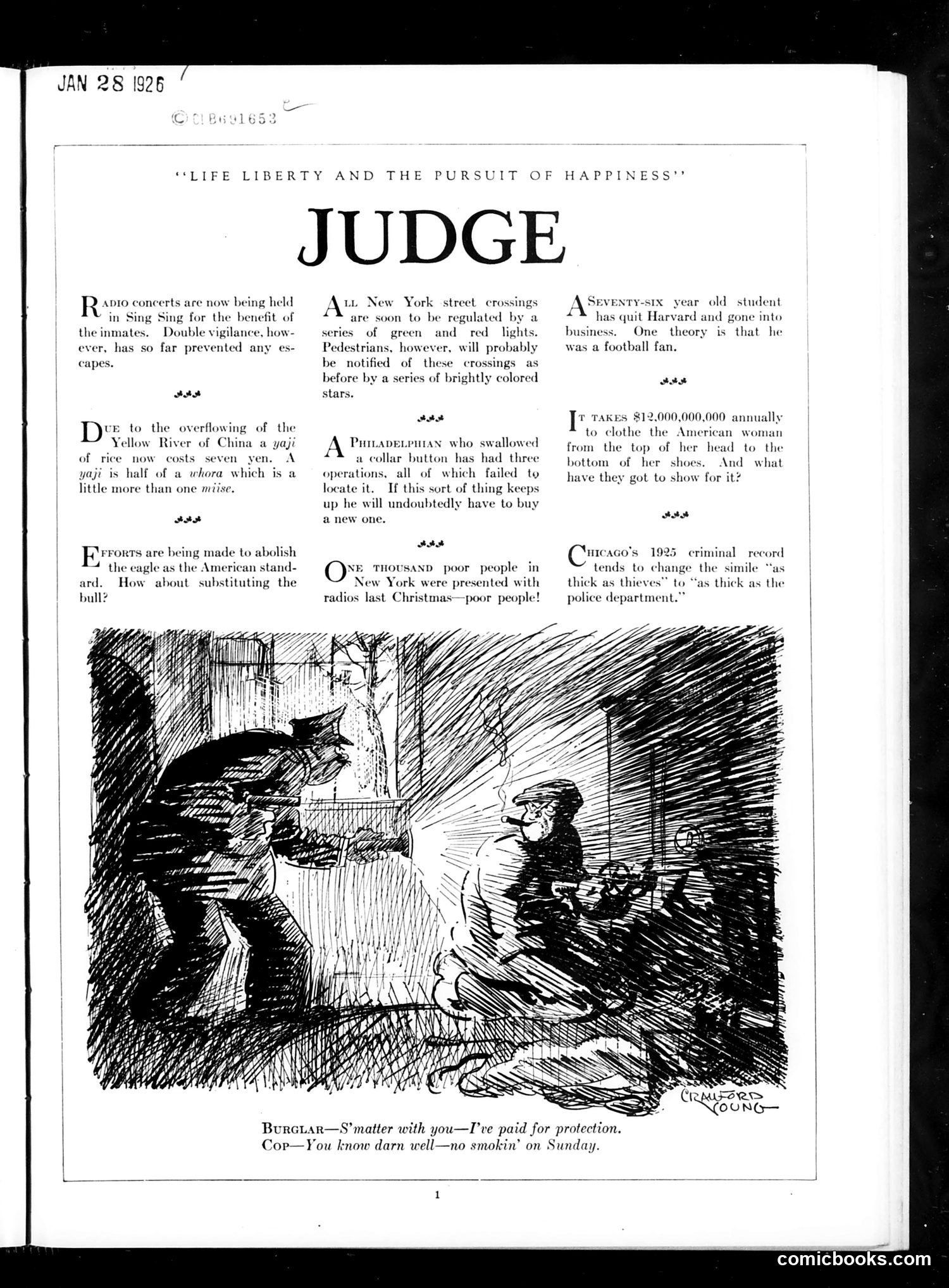
This page contains brief satirical news items rather than a coherent political cartoon. The main illustration depicts a burglar confronting a police officer, with dialogue about "protection"—likely referencing Prohibition-era corruption where criminals paid police for immunity from enforcement. The textual items mock contemporary concerns: radio concerts for museums, NYC traffic regulation, inflation in rice prices, efforts to replace the eagle as national symbol, and wealth inequality (women's clothing costs versus poor people receiving radios as charity). The final item references Chicago's 1925 criminal record and police terminology changes—possibly satirizing official attempts to minimize crime through language manipulation rather than actual reform. The overall tone criticizes hypocrisy, corruption, and the gap between official rhetoric and social reality during the Jazz Age.
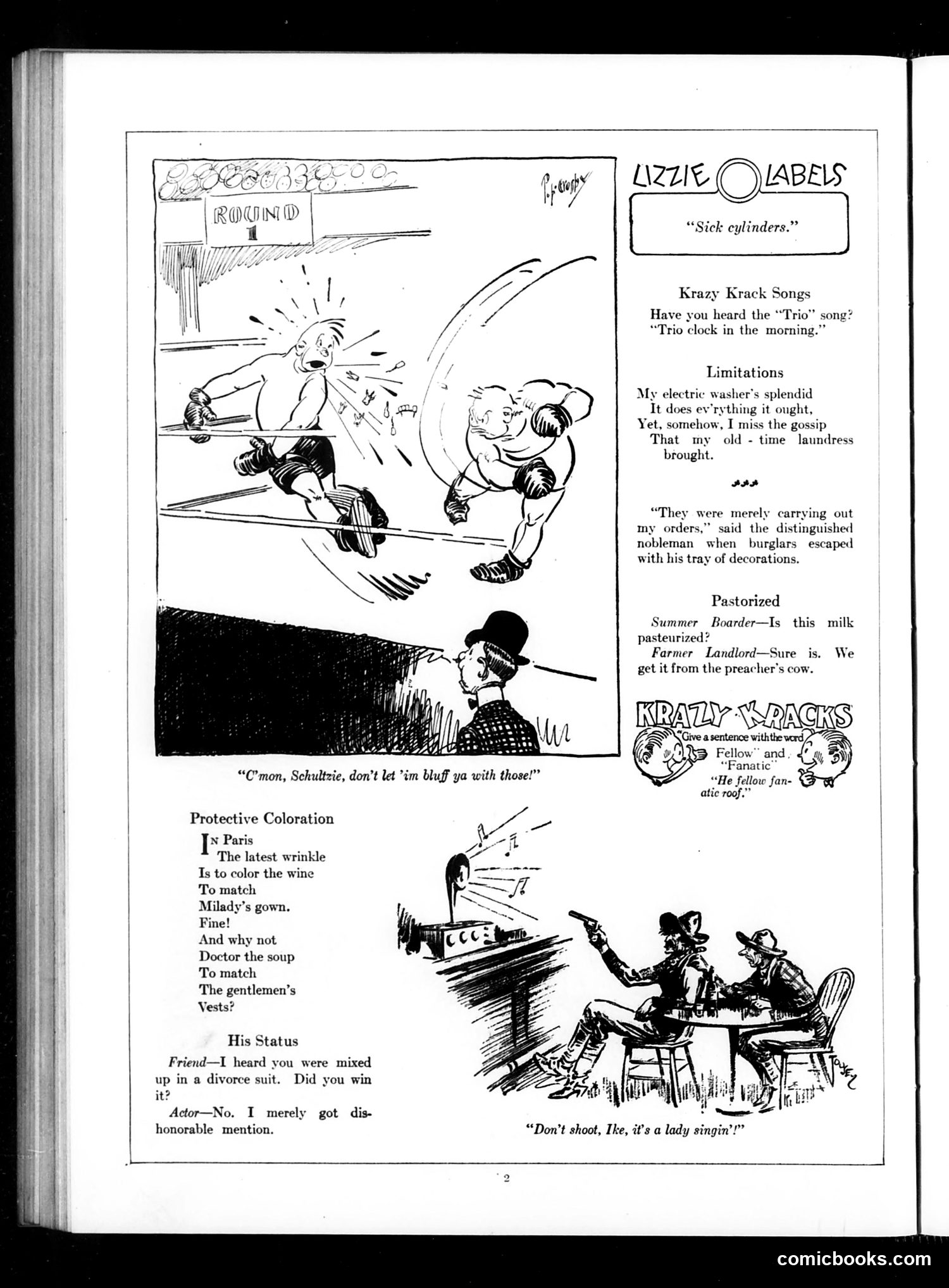
This page contains humor shorts and a cartoon about early 1900s social life. The main cartoon shows what appears to be a boxing or wrestling match at a "Round" venue, with the caption "C'mon, Schultzie, don't let 'im bluff ya with those!" The humor likely references immigrant boxing culture (the German-sounding name "Schultzie" suggests ethnic working-class entertainment). The surrounding text includes several short joke sections: "Krazy Krack Songs," "Limitations" (about modern conveniences), "Pastorized" (a pun on pasteurization), and "His Status" (jokes about social climbing). The bottom cartoon shows men at a table with the caption "Don't shoot, Ike, it's a lady singin'!" - apparently satirizing amateur female performers or modern entertainment pretensions of the era.
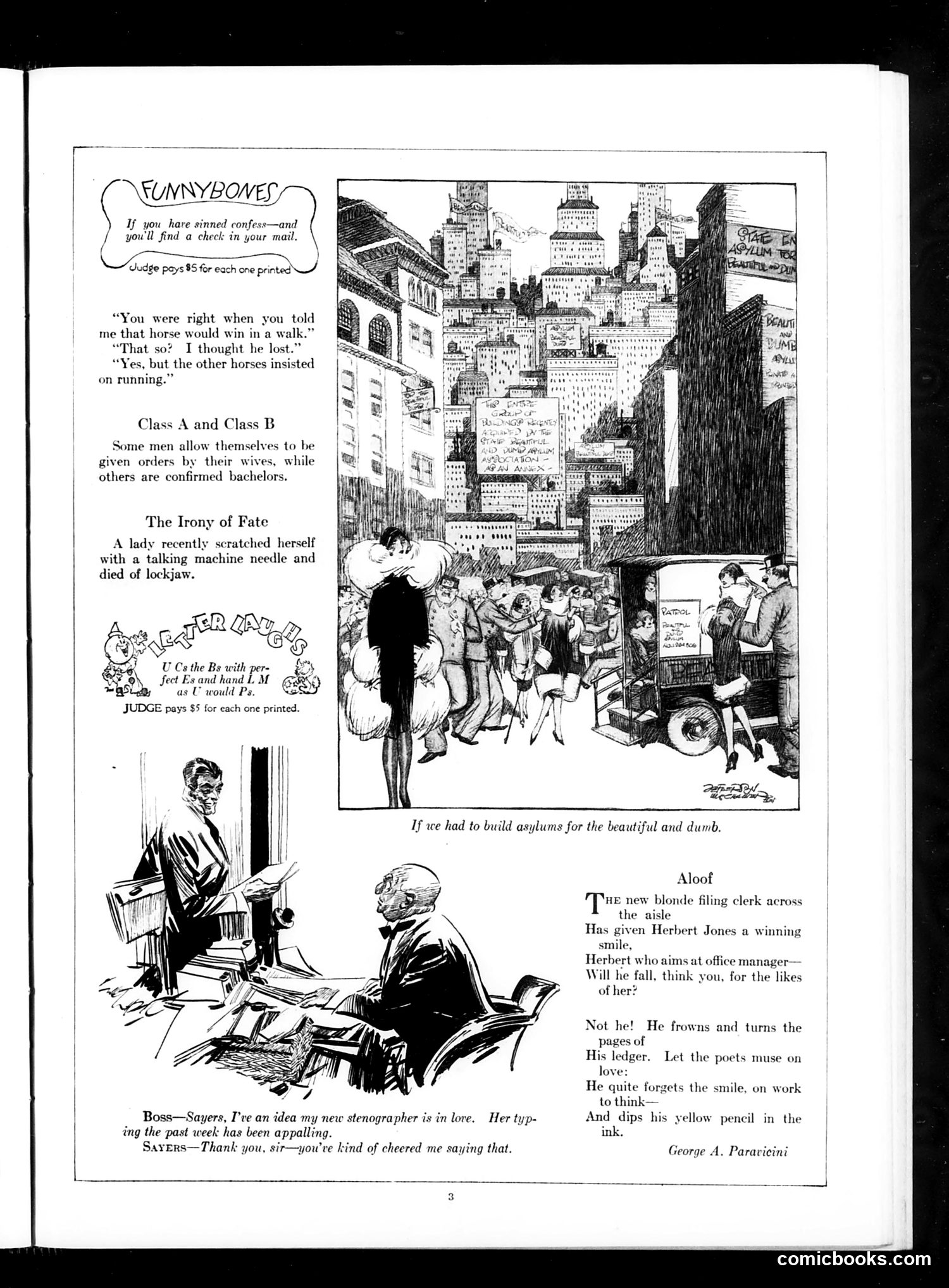
This page contains several brief humorous items typical of Judge's satirical format: **"Funnybones"** section includes jokes about human nature—one about a husband being proven wrong about a horse race, another contrasting how married men versus bachelors take orders. **"The Irony of Fate"** darkly jokes about a woman dying from a sewing machine needle injury. **The main cartoon** depicts a crowded urban street scene with a woman in elaborate dress, captioned "If we had to build asylums for the beautiful and dumb"—satirizing superficiality and vanity in society. **"Aloof"** poem by George A. Paraveini mocks an office manager named Herbert Jones who ignores a new blonde filing clerk, instead obsessing over his ledger. The page reflects early-20th-century American urban satire targeting social pretension and workplace dynamics.
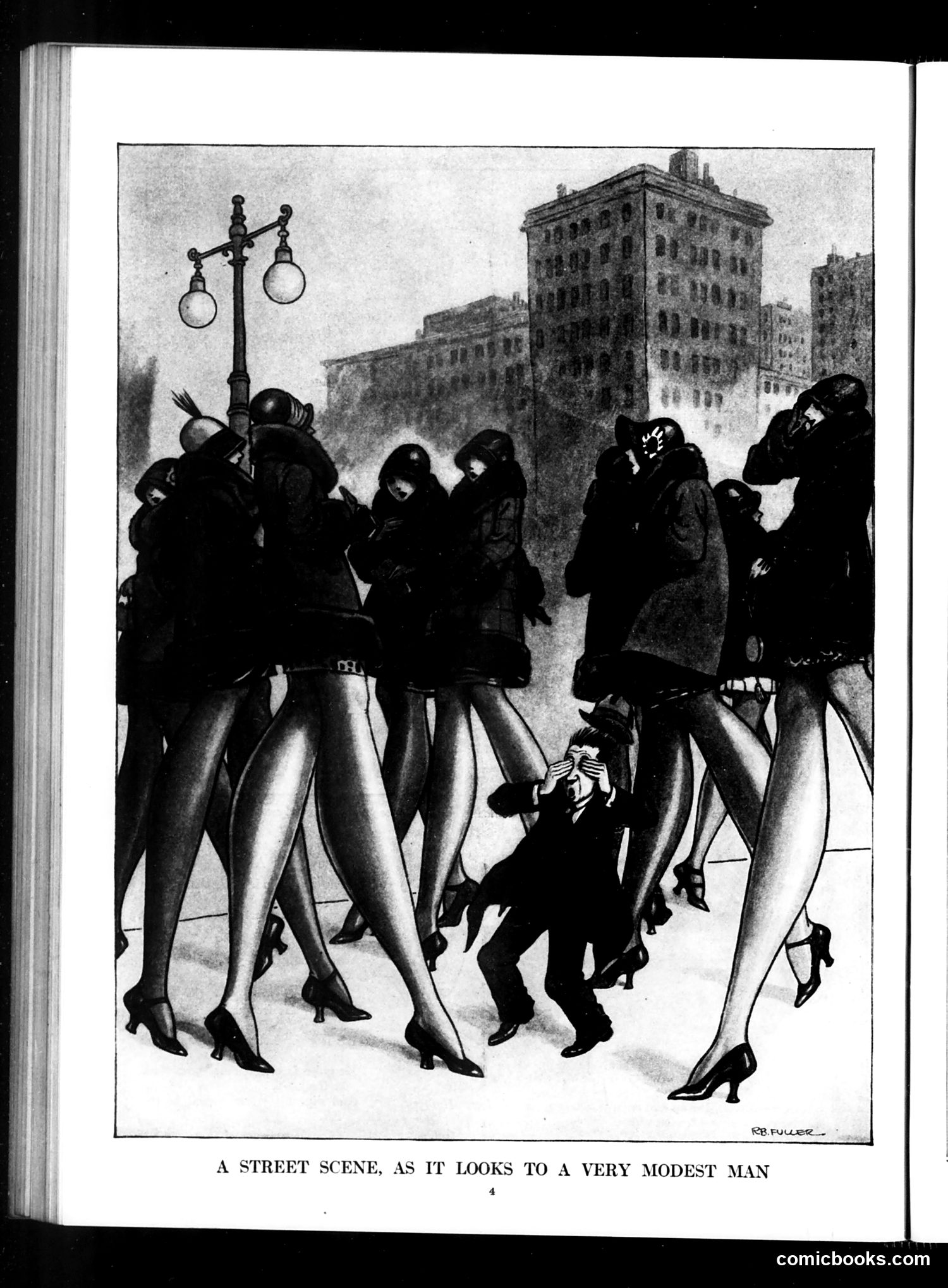
This cartoon satirizes the 1920s fashion trend of women wearing shorter skirts and more revealing clothing. The exaggerated perspective shows a modest or prudish man surrounded by women whose legs dominate his field of vision—their limbs appear enormous compared to his diminished figure cowering in the center. The joke targets conservative attitudes about women's fashion during this era. The "Roaring Twenties" saw dramatic shifts in women's dress codes, which shocked traditional observers. By literally enlarging the women's legs while shrinking the "modest man," the cartoonist humorously illustrates how threatening or overwhelming such fashion changes appeared to puritanical sensibilities. The urban setting with tall buildings establishes a modern city context, emphasizing generational conflict over changing social norms.
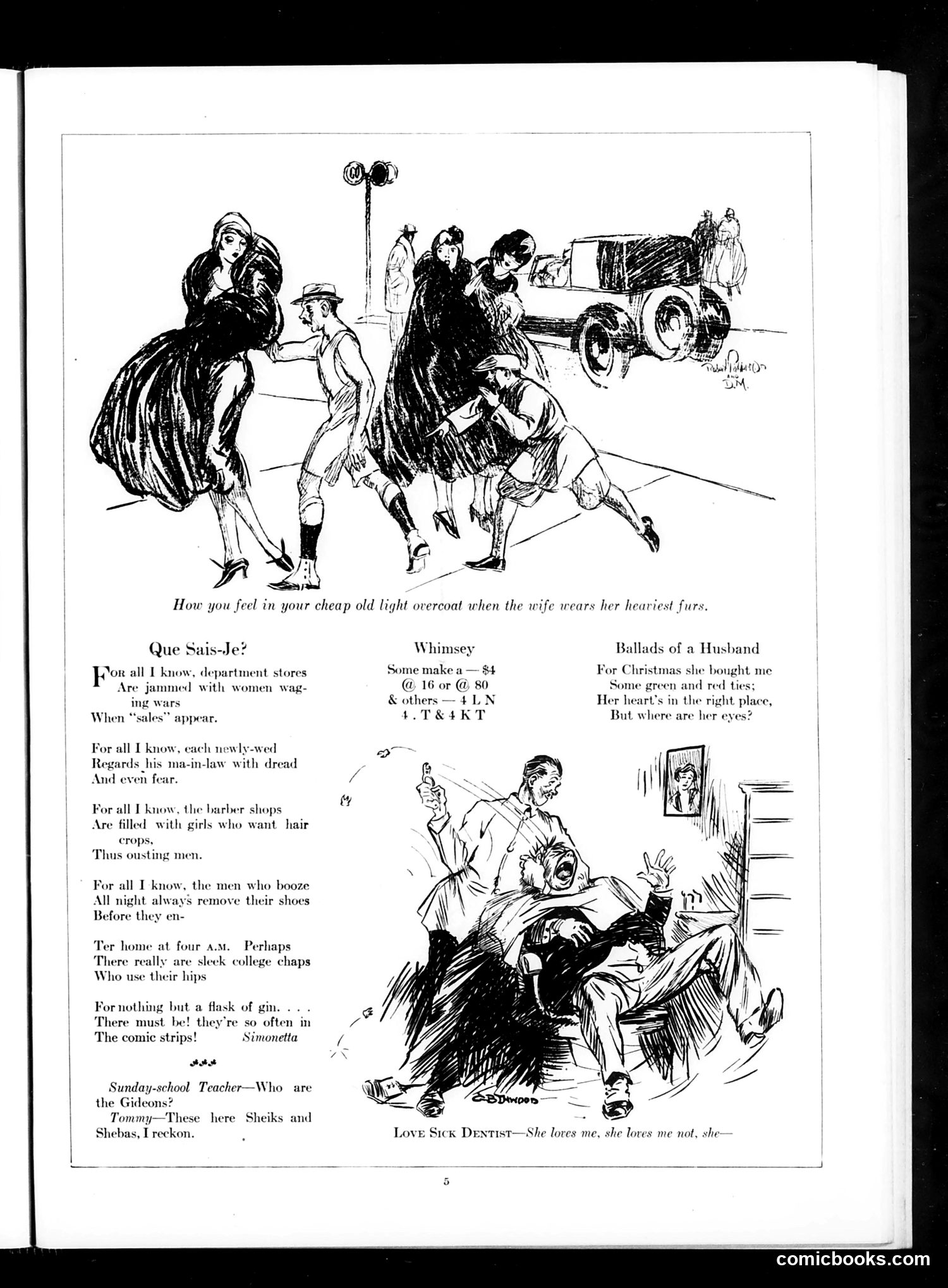
This page contains three separate satirical pieces about post-WWI social changes: **Top cartoon**: "How you feel in your cheap oil light overcoat when the wife wears her heaviest furs" depicts marital tension over luxury purchases—wives buying expensive furs while husbands economize, reflecting 1920s consumer culture anxieties. **"Que Sais-Je?"** mocks wartime profiteering and social disruption: department stores' wartime sales, men's dread of in-laws, barber shops full of women getting bobbed hair (scandalous at the time), drunken men, and college men's loose morals. **"Ballads of a Husband"** and **"Love Sick Dentist"** are domestic humor sketches about marital discord and romantic complications. The page reflects post-WWI anxieties about changing gender roles, consumerism, and moral decay among youth.
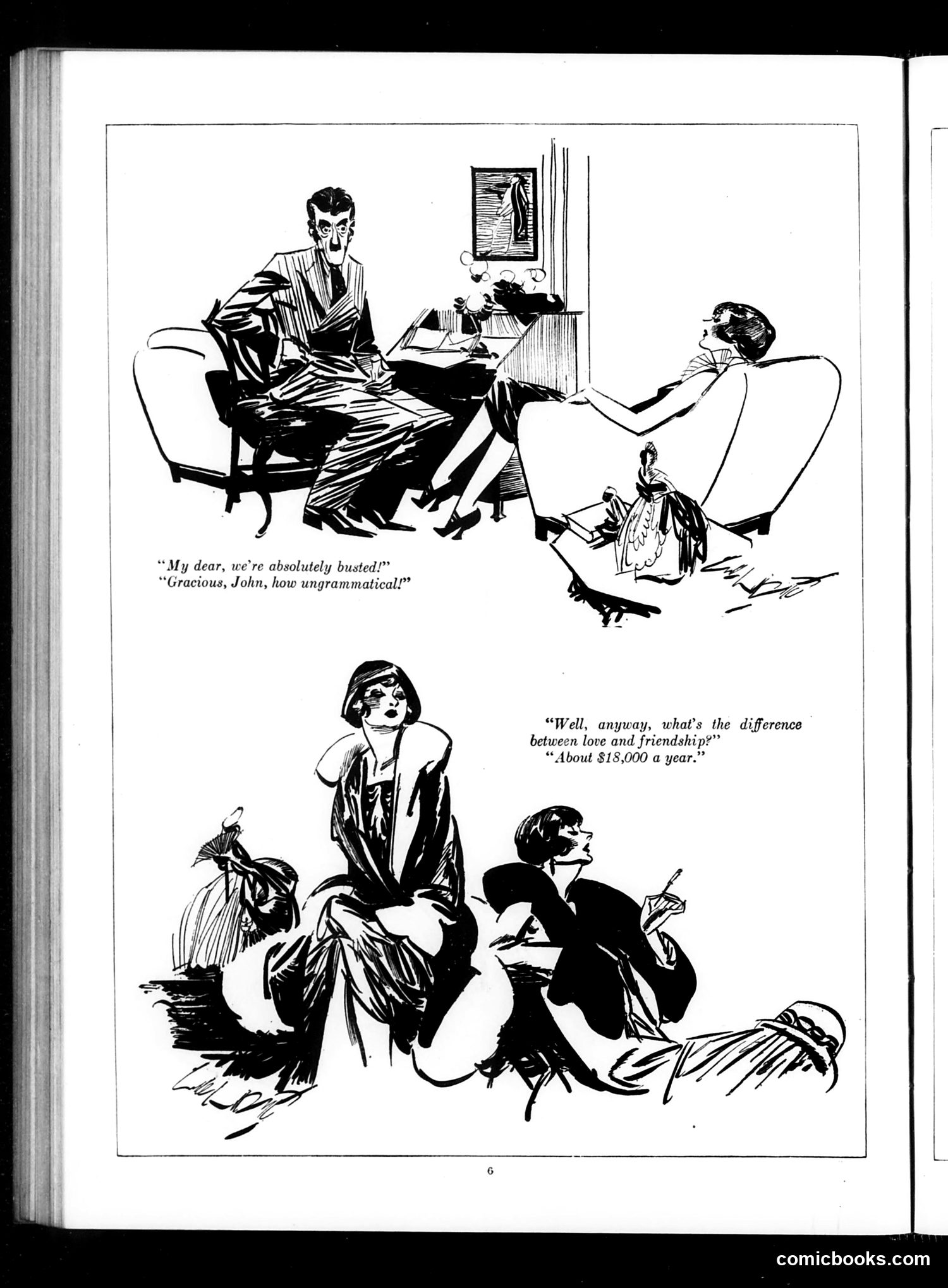
This two-panel cartoon satirizes marriage and financial dependency. The top panel shows a couple in domestic crisis—the husband announces they're "busted" (financially ruined), and the wife pedantically corrects his grammar rather than addressing the crisis, suggesting her superficiality. The bottom panel delivers the punchline: when asked the difference between love and friendship, the wife responds "$18,000 a year"—implying she married for money, not affection. The three figures surrounding her appear to represent different suitors or social options. The satire targets both wives (portrayed as mercenary, grammar-obsessed, and materialistic) and the transactional nature of marriage among the wealthy. The "$18,000" likely references a specific income level marking upper-class status in the magazine's era, though the exact date is unclear from this page alone.
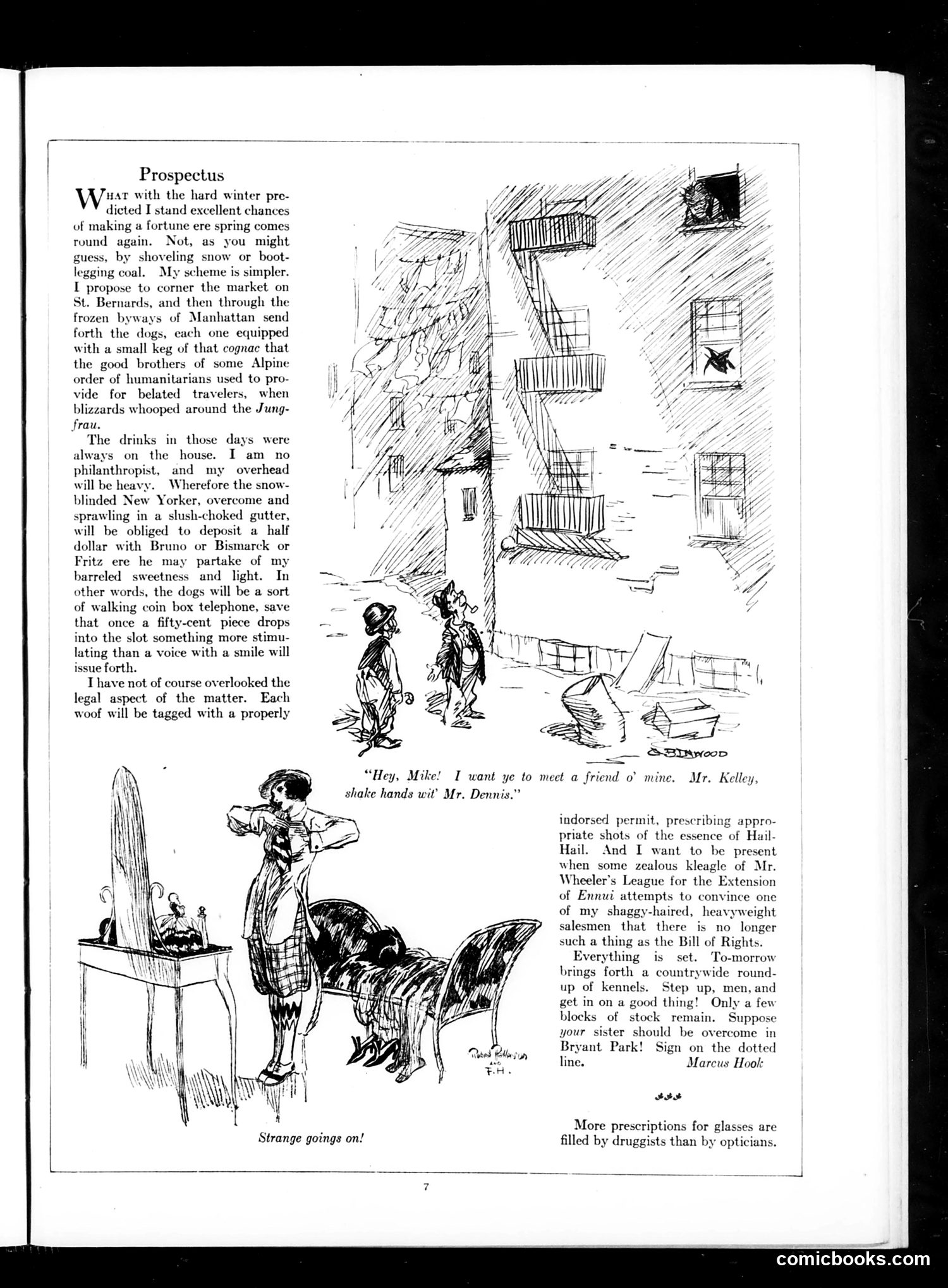
This page satirizes two distinct targets: **Main Article ("Prospectus"):** A humorous scheme to profit from winter by deploying St. Bernard dogs equipped with cognac kegs through Manhattan's streets. The narrator plans to charge stranded, drunk pedestrians fifty cents for access to alcohol—essentially creating "walking coin box telephones." The satire mocks both entrepreneurial greed and the presumed abundance of intoxicated people in winter. References to "Wheeler's League for the Extension of Ennui" (unclear figure) suggest satirizing reform/prohibition movements that might object to the scheme. **Lower Cartoon ("Strange goings on!"):** Depicts what appears to be a working-class encounter between two men ("Mike" and someone meeting "Mr. Dennis" and "Mr. Kelley"). The exact satirical target is unclear without more context, though it likely comments on contemporary social dynamics or labor relations. **Bottom Note:** A throwaway joke about druggists filling more eyeglass prescriptions than opticians—likely mocking either medical incompetence or unregulated practice. The page's overall tone reflects Judge's characteristic satirical approach to urban American life and social absurdities.
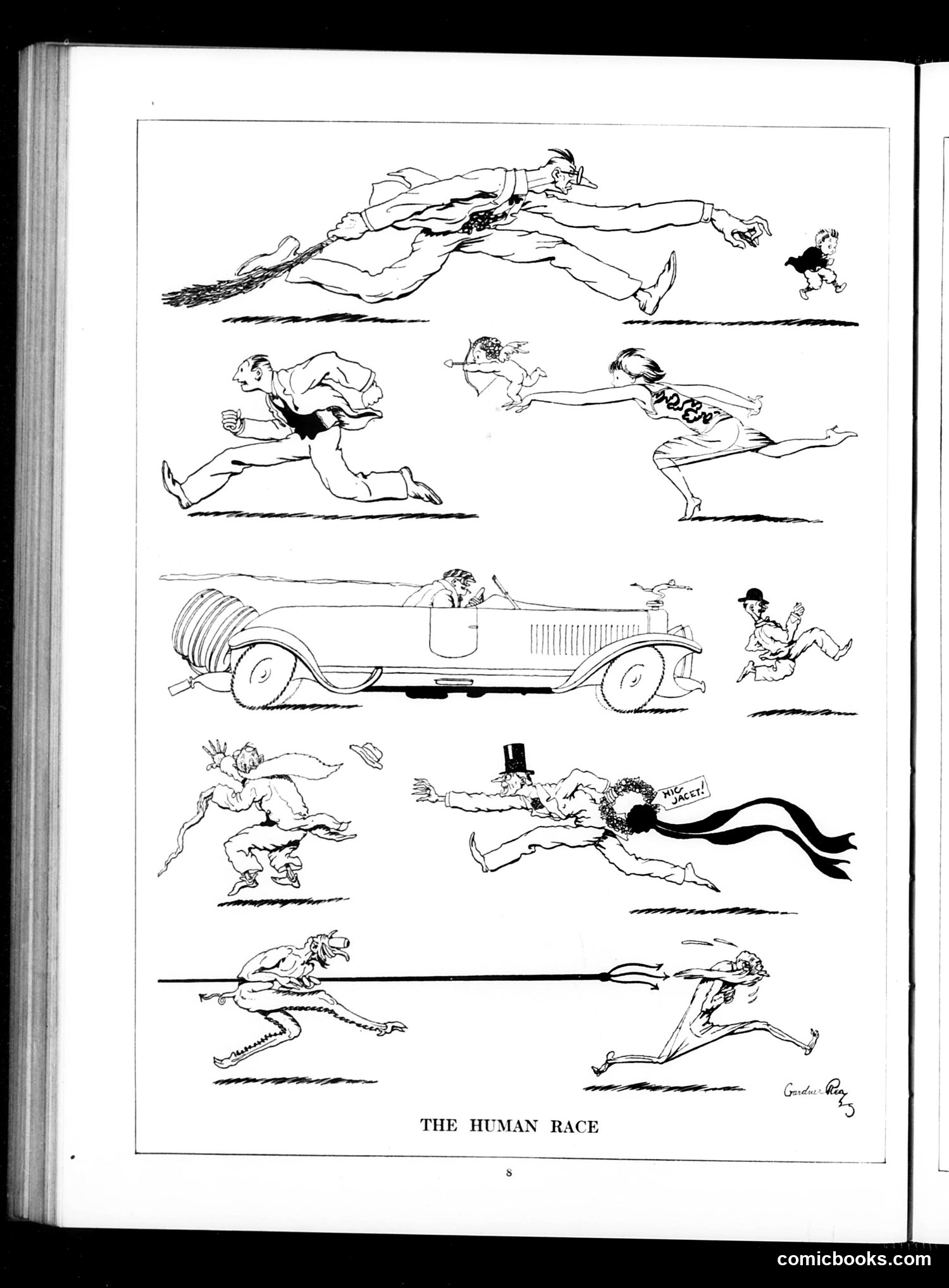
This page presents a satirical visual commentary titled "The Human Race," depicting various figures literally racing or competing in absurd, exaggerated poses. The cartoon appears to mock human ambition and the competitive nature of society through caricatured depictions of different "types" of people—including what seems to be businessmen, athletes, socialites, and other social classes—all engaged in frantic, undignified movement. The humor derives from showing ostensibly dignified humans reduced to primitive, animalistic behavior in pursuit of their goals. This likely critiques the era's social climbing, materialism, and competitive excess. The varied figures suggest the cartoon comments on how people across different social strata are equally driven by base desires and ruthless competition, undermining pretenses of civilization or refined behavior. The title reinforces this reductive view of humanity.
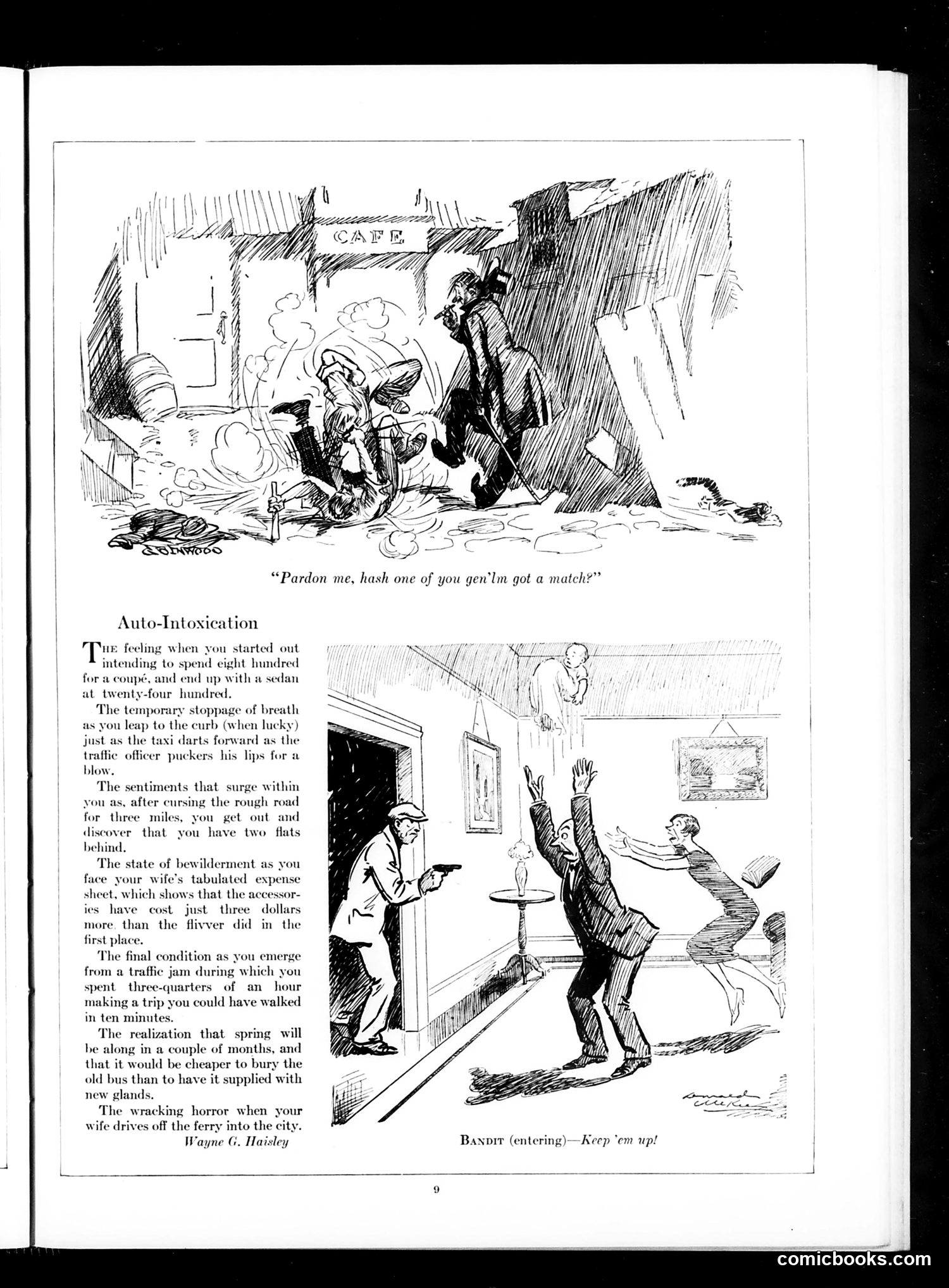
This page satirizes the frustrations of early automobile ownership. The top cartoon shows a beggar asking for a match outside a café, captioning the absurdity of spending lavishly on a car while broke. The main article by Wayne G. Haisley humorously catalogs the emotional roller coaster of car ownership: buyer's remorse (spending $2,400 instead of $800), near-death traffic experiences, blown tires, shock at accessory costs exceeding the vehicle's original price, traffic jams wasting time, and the expense of maintenance. The final indignity is a wife driving the car off a ferry. The bottom illustration shows a "bandit entering" a home, captioning "Keep 'em up!"—likely suggesting the car thief as another threat to owners' peace of mind. The satire targets middle-class anxieties about automobile costs and the gap between car ownership fantasy and expensive, accident-prone reality.
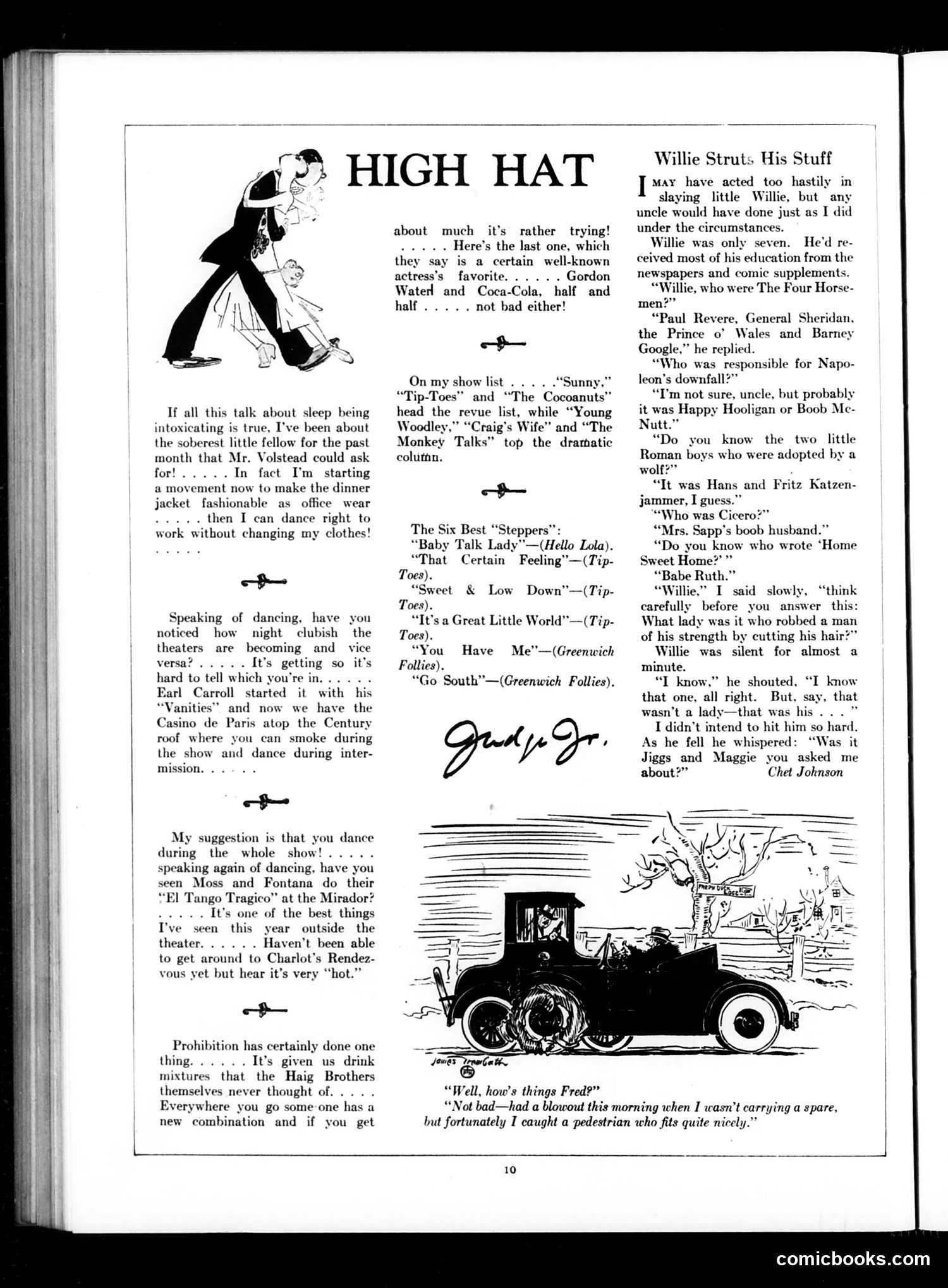
This is a humor column from the Prohibition era (1920s), mixing entertainment commentary with satire about the period's social changes. **Main Content:** The left column discusses theater trends—nightclubs increasingly resembling theaters and vice versa, featuring dancers like Moss and Fontana. It references specific Broadway shows ("Tip-Toes," "The Cocoanuts," "Young Woodley"). **Prohibition Satire:** The column jokes about creative illegal cocktails, mentioning "Water and Coca-Cola, half and half"—clearly implying spiked versions, as Prohibition made alcohol illegal. **"Willie Struts His Stuff":** This satirizes how popular culture (comic strips and newspapers) had replaced traditional education. Willie answers historical questions with references to cartoon characters—"Barney Google," "Happy Hooligan," "The Katzenjammers"—showing children learned from comics rather than schooling. **Bottom Cartoon:** A dark joke about a car accident: the driver caught a pedestrian to use as a spare tire, mocking both reckless driving and the era's callousness. The overall tone: sophisticated adults lamenting modern culture's deterioration.
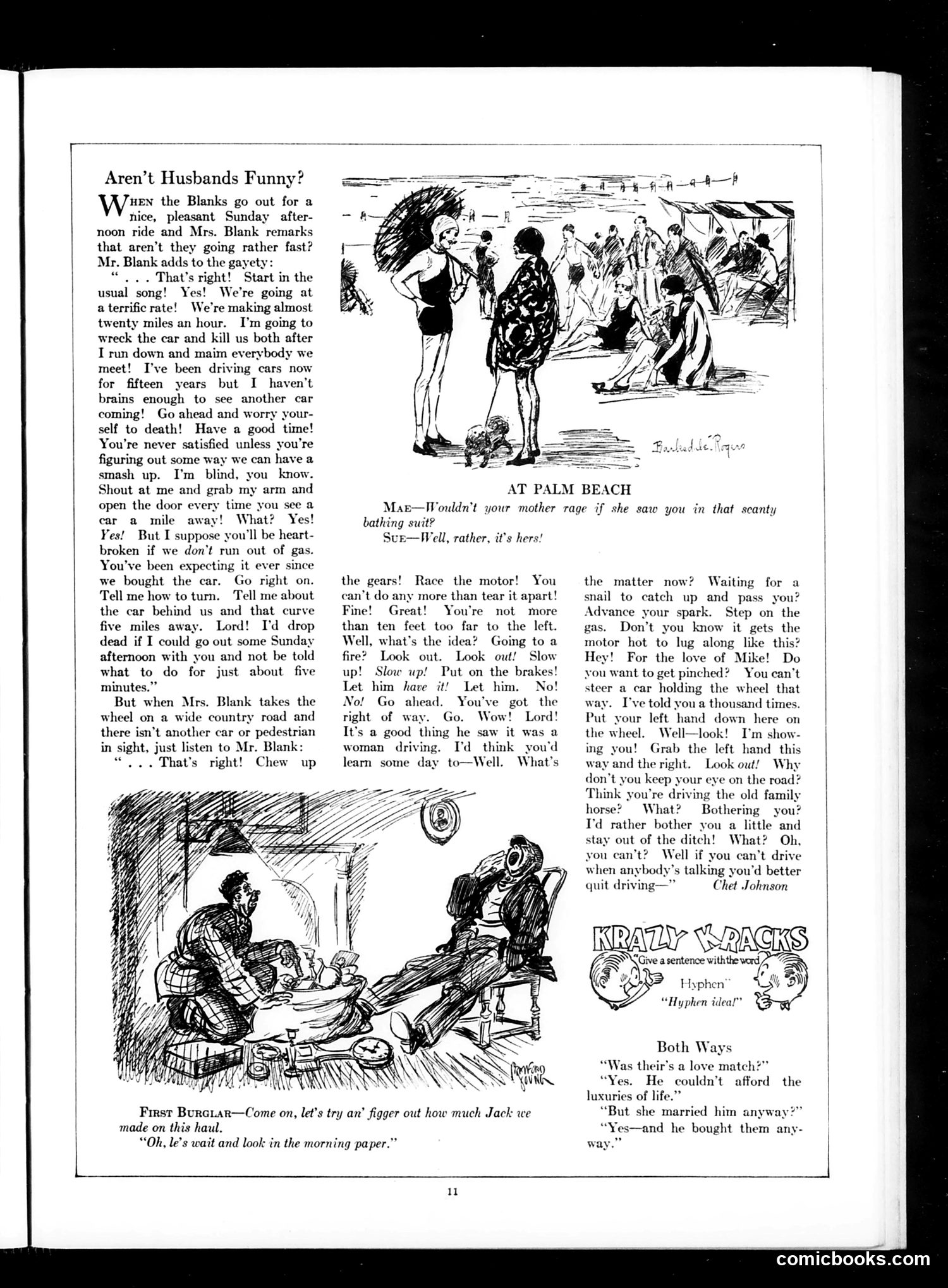
This page contains three separate humorous pieces satirizing early 20th-century gender dynamics and driving culture. **"Aren't Husbands Funny?"** contrasts Mr. and Mrs. Blank's behavior while driving. When Mr. Blank drives, he sarcastically mocks his wife's safety concerns (backseat driving). When Mrs. Blank drives, he constantly criticizes *her* driving with identical complaints—revealing the hypocrisy and double standards of male drivers who resent women's input but give unsolicited advice themselves. The satire targets husbands' defensive arrogance about driving. **"At Palm Beach"** is a brief joke about a woman wearing a scanty bathing suit that belongs to her mother—implying either generational shifts in fashion or the woman's rebelliousness. **"First Burglar"** shows two burglars discussing a heist, with one suggesting they check tomorrow's newspaper to see how much money they stole—a joke about incompetent criminals. The broader context: these pieces mock domestic life, automotive culture (relatively new), and gender relations in the 1910s-20s era when Judge magazine flourished.
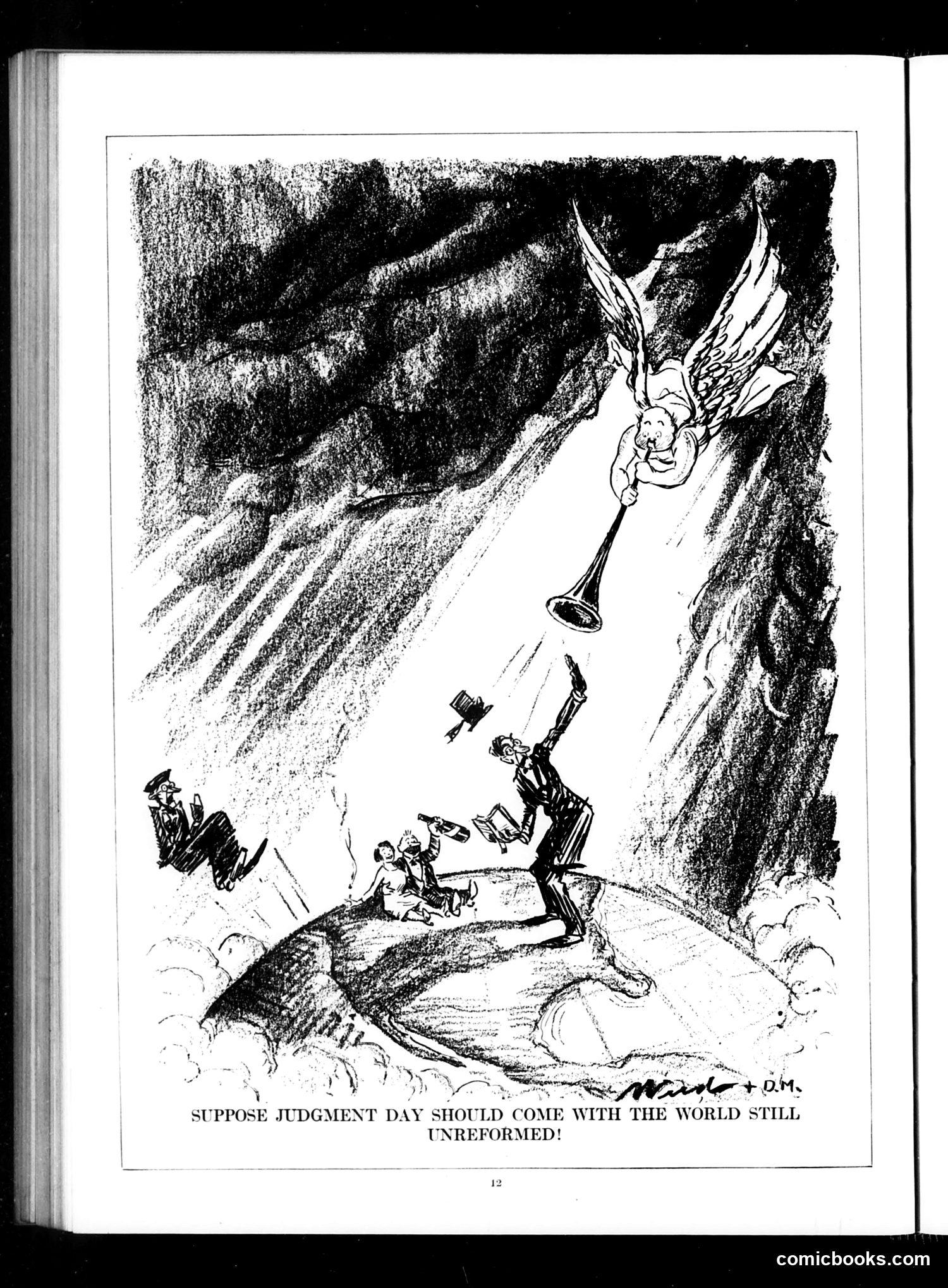
This Judge magazine cartoon depicts a religious/apocalyptic scenario. An angel with trumpet descends from above toward Earth, where figures below appear unprepared or chaotic. The caption "SUPPOSE JUDGMENT DAY SHOULD COME WITH THE WORLD STILL UNREFORMED!" suggests social satire about moral or social decay. The cartoon likely critiques contemporary social conditions—suggesting that if divine judgment arrived in the present moment, society remains morally deficient. Based on Judge's tradition of progressive satire, this probably references specific unreformed aspects: industrialization, political corruption, or moral failures the magazine's editors wanted addressed. The figures' disarray and the angel's descent emphasize the urgency of reform, using religious imagery to argue for immediate social improvement. Without dating information, the specific targets remain unclear, though the style suggests early-to-mid 20th century origins.
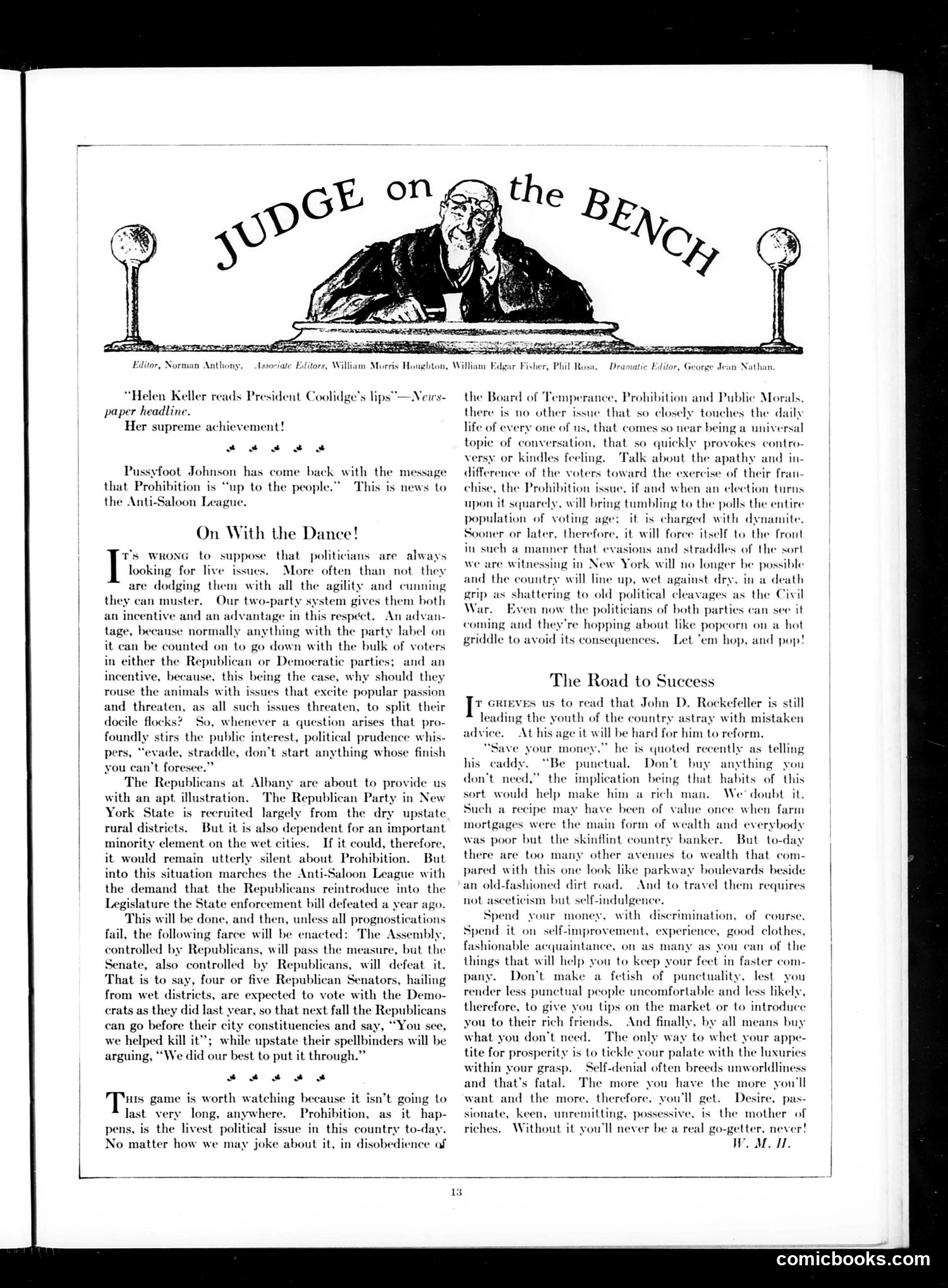
This page contains editorial commentary on Prohibition, the dominant American political issue of the era. The masthead features a caricatured judge overseeing the discussion. **Main Points:** The opening jabs mock Helen Keller reading Coolidge's lips and "Pussyfoot" Johnson (a real Prohibition advocate) claiming the issue belongs "to the people"—suggesting absurdity in their positions. The substantial article attacks politicians for dodging Prohibition rather than confronting it directly. It specifically criticizes New York Republicans, who depend on both dry rural upstate voters AND wet urban constituencies, for attempting to straddle the issue rather than take a clear stance. The author predicts this avoidance cannot last because Prohibition is "the livest political issue in this country to-day" that will eventually force clear party lines. A separate satirical piece mocks John D. Rockefeller's wealth-building advice to his caddy, implying his life lessons are outdated and problematic. The satire's point: politicians' cowardice on Prohibition will inevitably backfire.
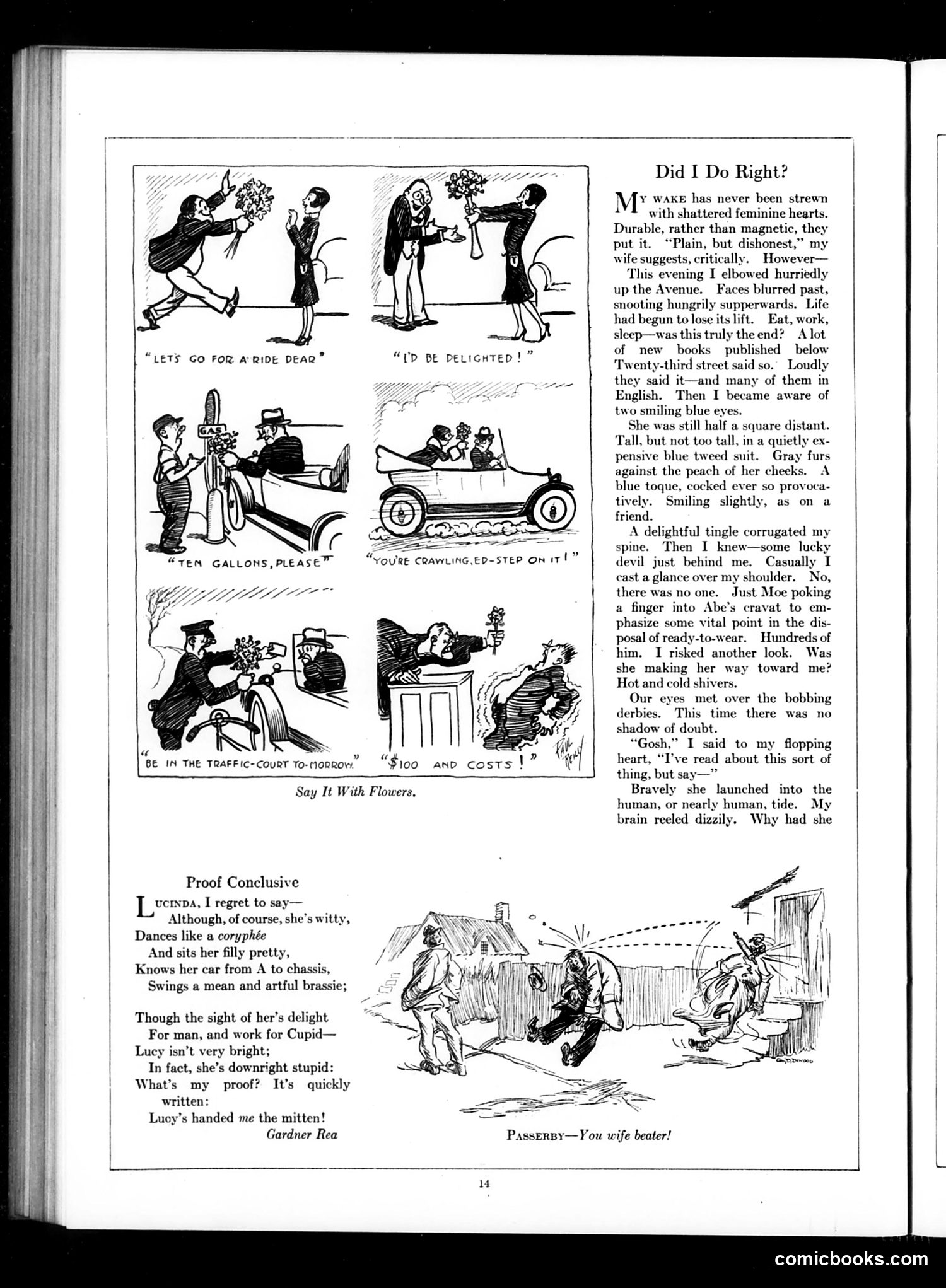
This page contains three separate pieces of romantic satire typical of Judge magazine's humor circa 1920s-1930s. **"Say It With Flowers"** (top): A six-panel comic strip satirizing men's courtship tactics. Each panel shows a man giving flowers to a woman with escalating consequences—from a casual "ride" invitation to traffic court fines ($100 and costs). The joke is that flowers are supposed to smooth over romantic missteps, but they fail to prevent increasingly serious legal troubles. **"Proof Conclusive"** (bottom left): A poem by Gardner Rea mocking male ego. A man concludes his girlfriend is "stupid" because she rejected him ("handed me the mitten"), despite acknowledging her wit, athleticism, and charm. The satire targets male vanity—he can't accept rejection so invents a character flaw. **"Did I Do Right?"** (right): A prose story about a man experiencing love-at-first-sight on a crowded avenue, complete with physical descriptions of the mysterious woman. The narrative treats this fleeting encounter with dramatic intensity, satirizing romantic daydreaming and male fantasizing about strangers. Together, these pieces mock masculine attitudes toward courtship and relationships.
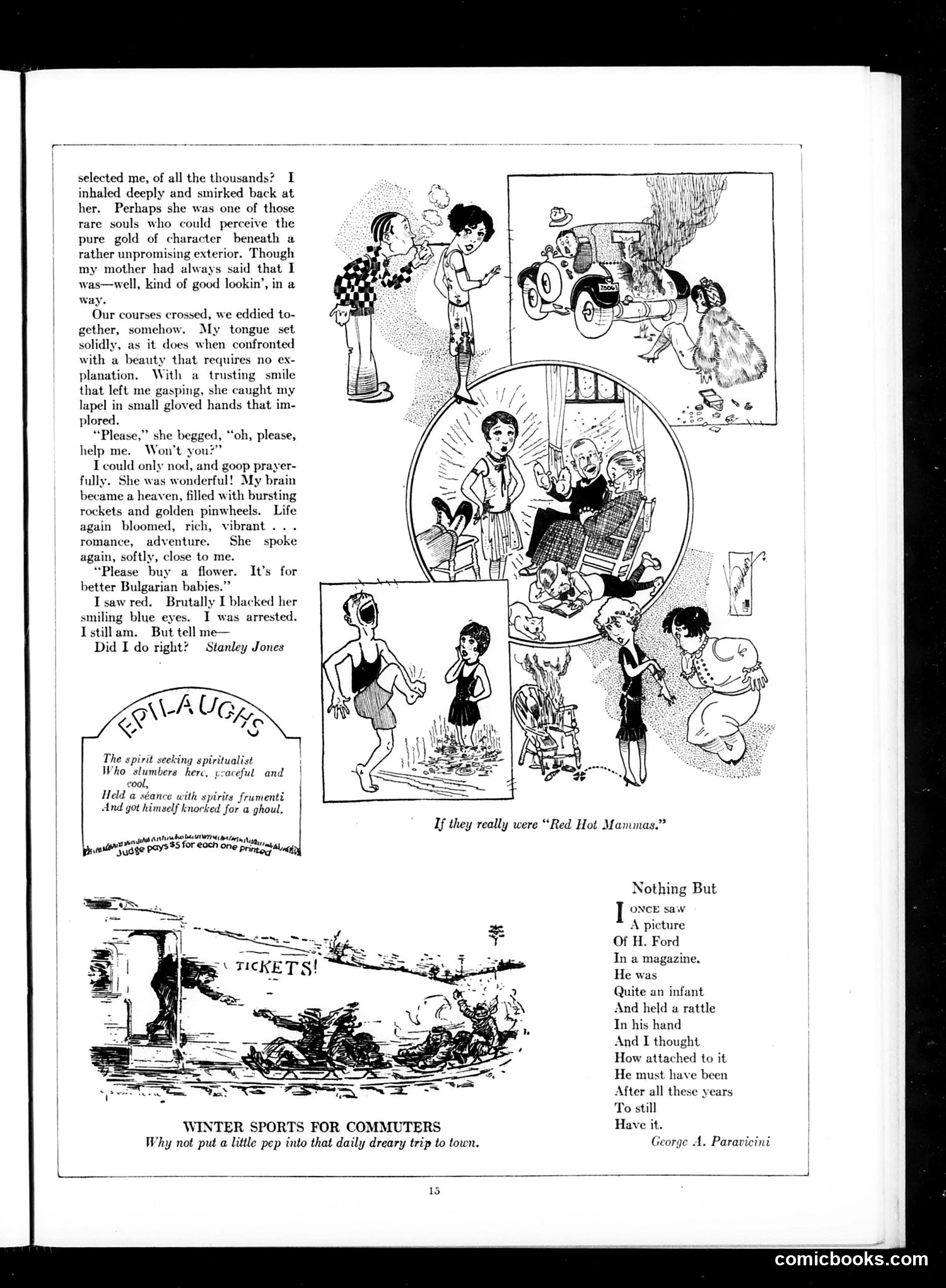
This page contains three distinct satirical pieces: **"Stanley Jones" Story (top):** A humorous narrative where a man is seduced by a woman's charm into buying a flower "for better Bulgarian babies"—likely referencing Depression-era street charity appeals. The twist: he becomes enraged at the deception and strikes her, then wonders if he was justified. The satire mocks both romantic delusion and aggressive male reactions to perceived manipulation. **"Epilaughs" (left):** Brief comic epitaph mocking spiritualism and séances, which were popular in early 20th-century American culture. **"Nothing But" (right):** A poem by George A. Paravicini sardonically observing that H. Ford (Henry Ford, the automobile magnate) still clings to childhood possessions—likely satirizing either wealthy industrialists' acquisitiveness or Ford's personal quirks. **Bottom cartoon:** "Winter Sports for Commuters" jokes about making dreary daily commutes more entertaining with unspecified "pep." The page emphasizes romantic/social mishaps and absurdist humor typical of Judge magazine's satirical approach.
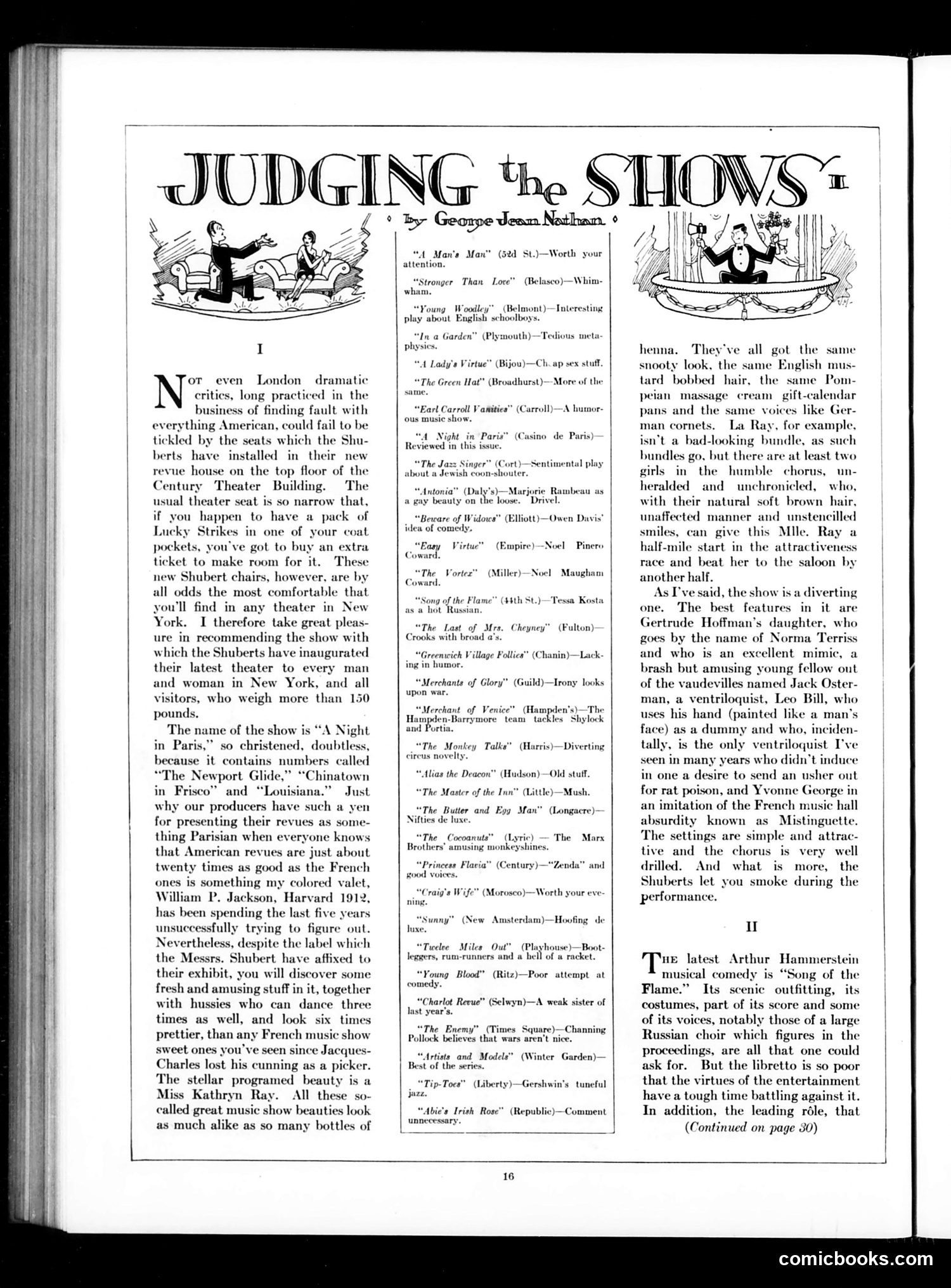
This is a theater review column by George Jean Nathan critiquing Broadway productions. The page contains no political cartoons—rather, it's a satirical commentary on New York theater. The critic praises the Shuberts' new Century Theater Building for its comfortable seats (notably spacious enough to accommodate Lucky Strike cigarette packs), then reviews numerous shows. He's dismissive of Paris-themed revues, noting American producers' inexplicable obsession with presenting shows as "something Parisian" when American revues are "about twenty times as good as the French ones." Notable performances highlighted include Gertrude Hoffman's daughter Norma Terriss and ventriloquist Jack Osterman. The critique is lighthearted and gossipy, typical of Judge's theatrical commentary—poking fun at producers' pretensions and theater fashions rather than engaging political satire.
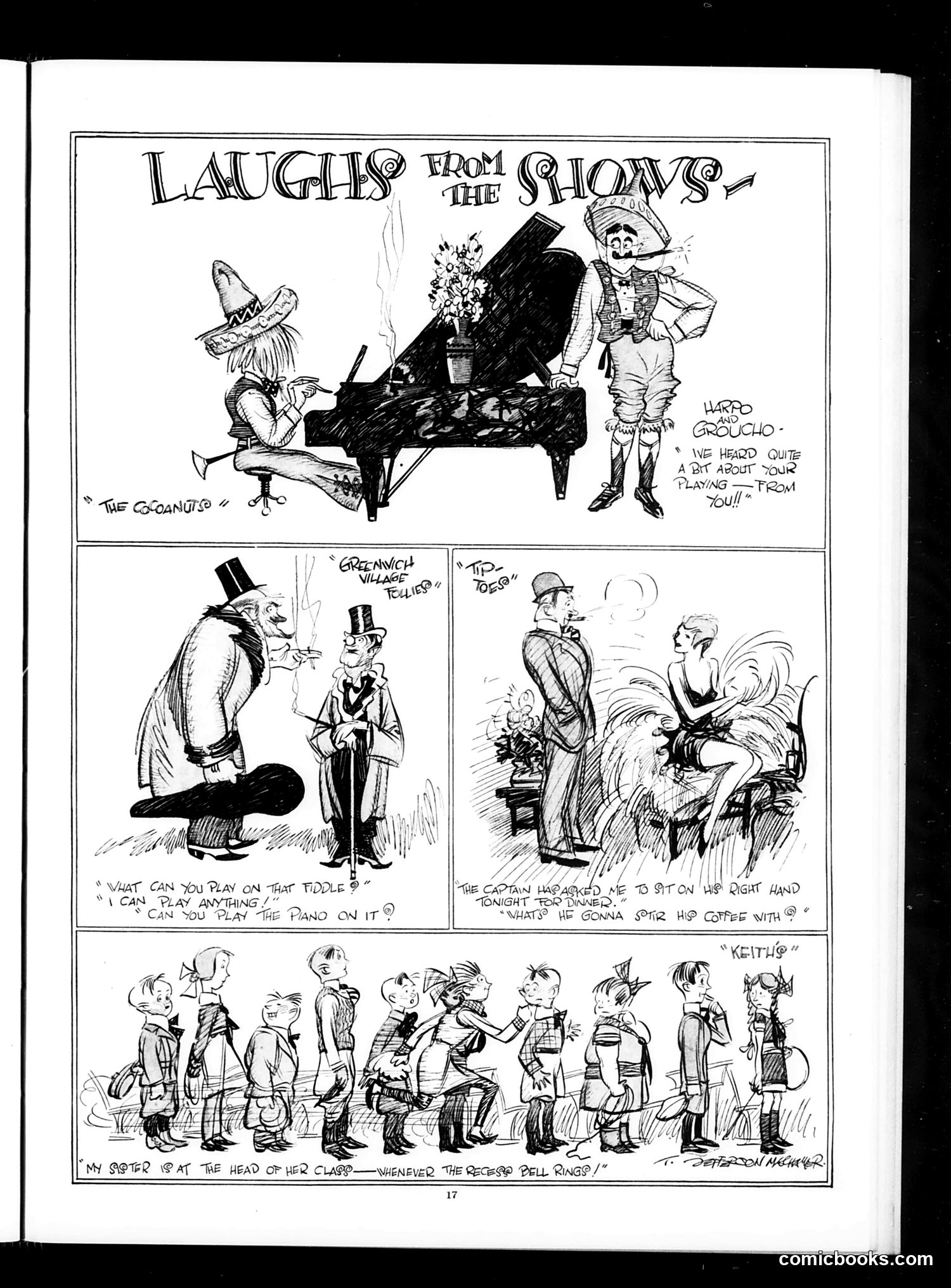
This page collects theatrical humor from Judge magazine. The top panel shows a piano performance interrupted by two characters—one appears to be a Mexican musician (labeled "Groucho") and another in military dress, with a piano player. The jokes play on musical incompetence: a character claims he can "play anything" on a fiddle, leading to absurd exchanges about playing a piano on a fiddle. The middle panels depict Greenwich Village theater folk in dated formal wear, with jokes about awkward dinner invitations and coffee service. The bottom panel shows what appears to be a schoolroom scene with children, captioned about a sister "at the head of her class" whose "Oscar Bell rings." The satire targets theatrical pretension and vaudeville-style comedic absurdity typical of early 20th-century American entertainment humor. The specific references to characters and shows are unclear without additional historical context.
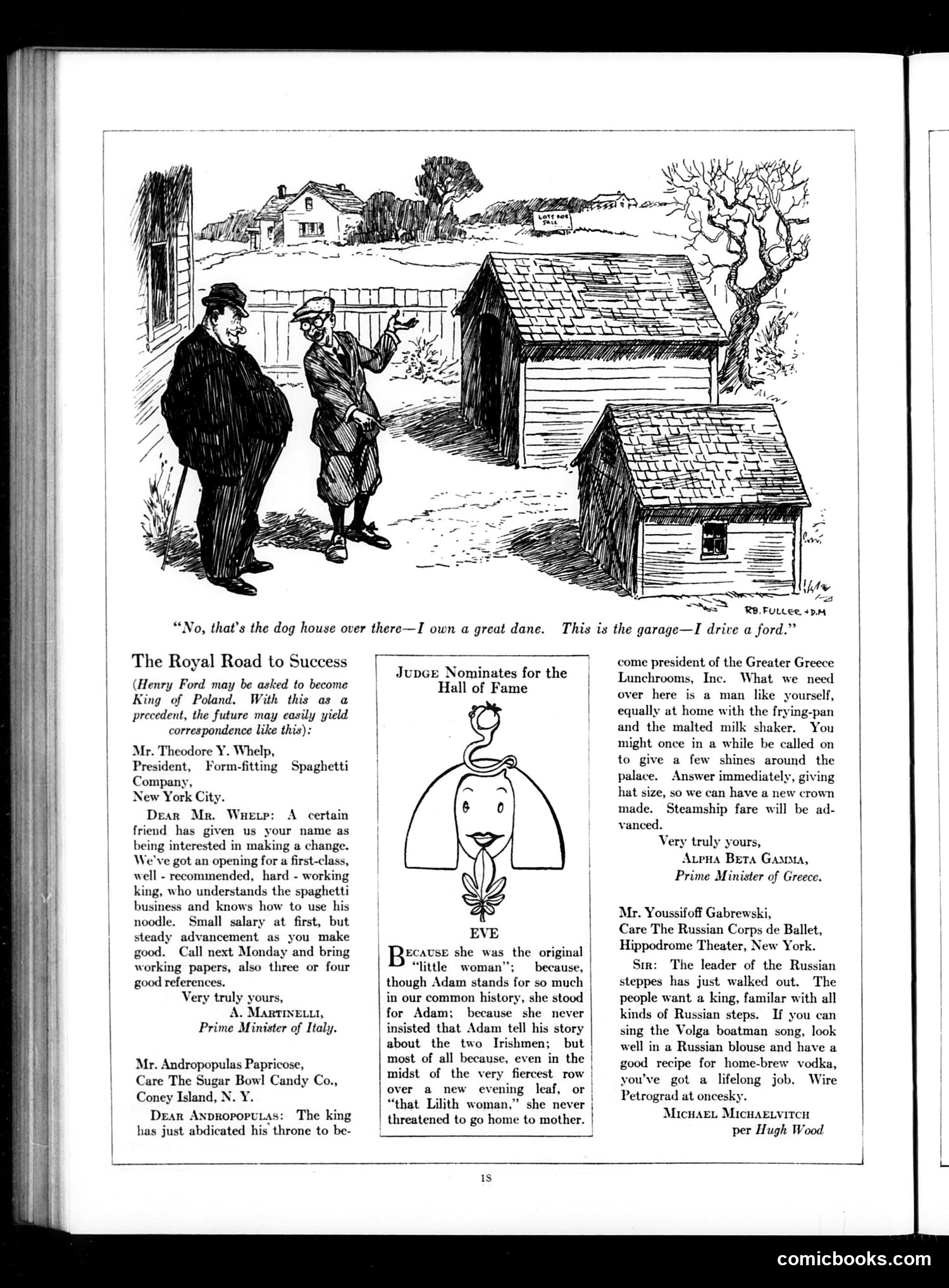
This 1920s satire mocks the instability of European monarchies following World War I. The main cartoon shows a man confused about his own property—mistaking his garage for a dog house—a visual gag about ownership and identity. The text section "The Royal Road to Success" parodies job recruitment letters, imagining European prime ministers advertising for kings as if hiring factory workers. It references Henry Ford's rumored interest in becoming King of Poland, then sarcastically extrapolates: Italy's PM seeks a spaghetti-company executive as king; Greece's PM recruits a candy-company manager; Russia's PM wants a Russian ballet dancer who knows folk songs and vodka recipes. The humor targets the era's political chaos—thrones changing hands rapidly, traditional monarchies collapsing, and the absurdity of treating kingship as an ordinary job opening. The sidebar about Eve for the "Hall of Fame" praises her as the original humble housewife who never nagged or threatened to leave.
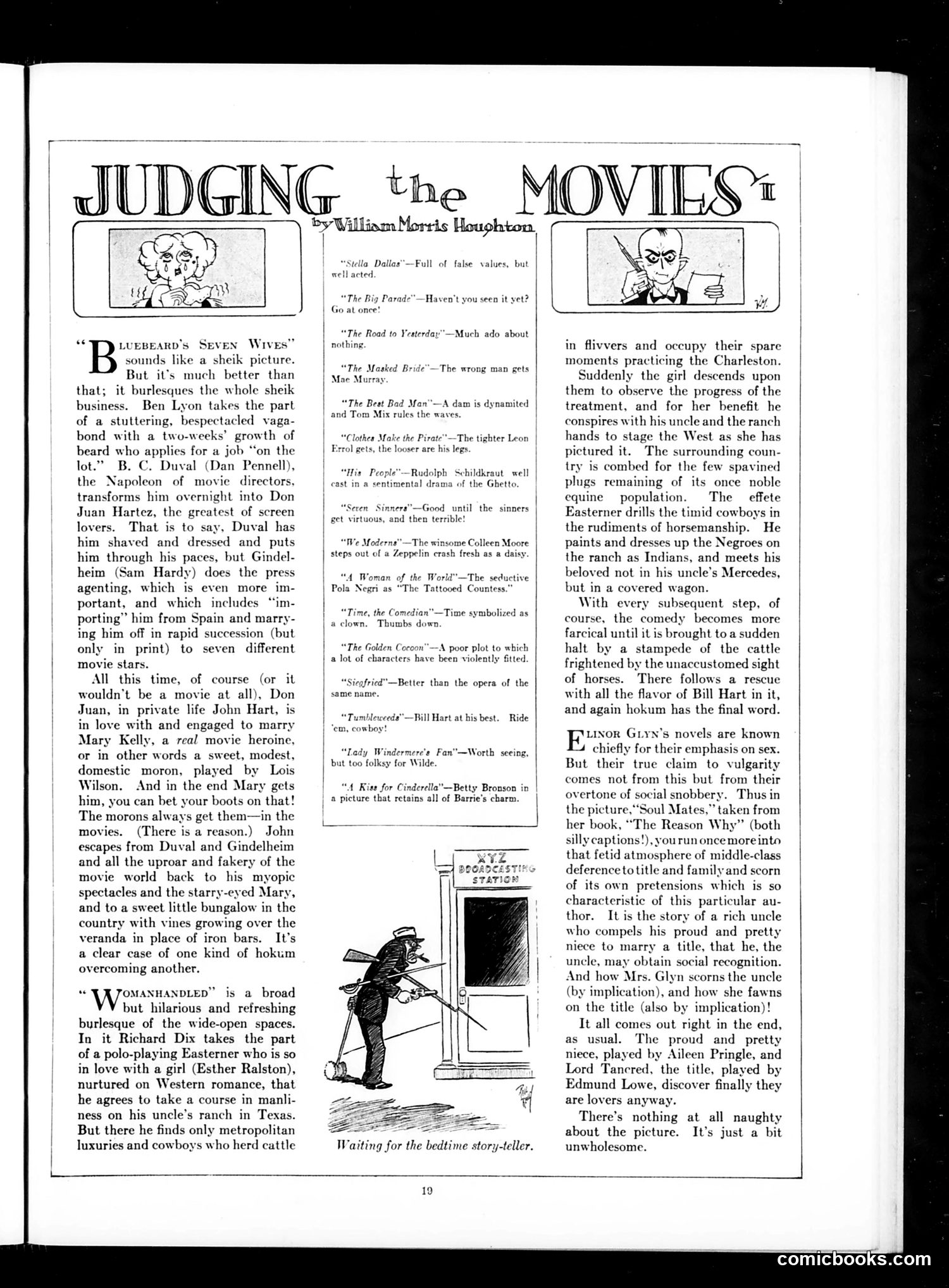
This page satirizes 1920s Hollywood's fakery and artificiality through film reviews. The main target is the "sheik" genre—glamorous male seduction films that were wildly popular. **Key satire:** The review of "Bluebeard's Seven Wives" mocks how easily cinema manufactures star personas: a shabby vagrant becomes a romantic idol through mere grooming and press agenting—pure hokum masquerading as entertainment. The author notes the irony that audiences prefer this manufactured fantasy to genuine romance, with the protagonist escaping back to "real" life. "Womanhandled" burlesques Western romance fantasies: an Easterner's uncle and cowboys stage an elaborate fake Old West to impress his girlfriend, complete with painted Negroes costumed as Indians and broken-down horses presented as noble steeds. **The broader point:** Hollywood operates through layers of deception—manufactured stars, fabricated narratives, and fake sets—yet audiences embrace this "hokum" over authenticity. The cartoonist criticizes both the industry's cynicism and the public's willingness to be deceived.
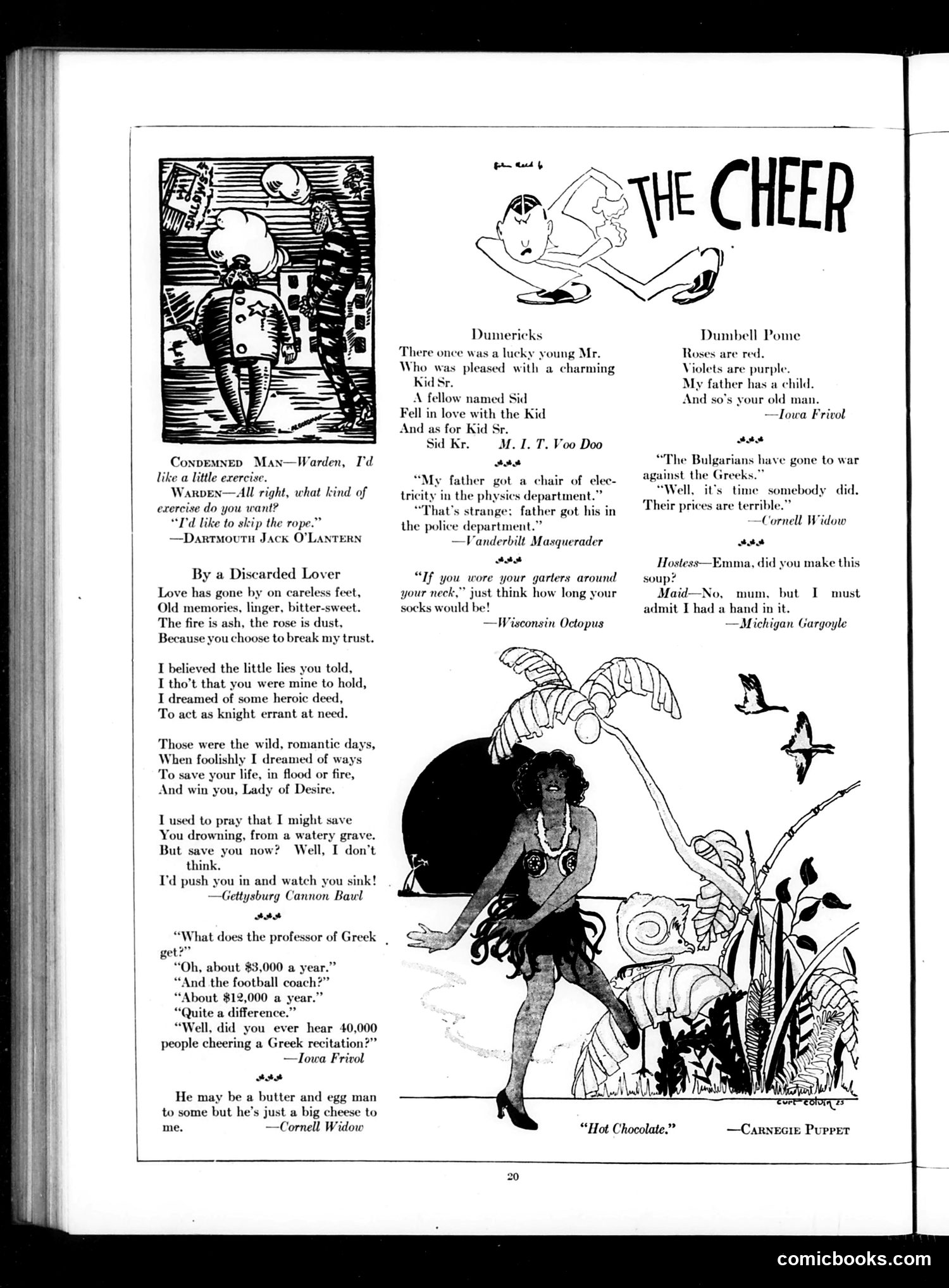
This is a humor compilation page from *Judge* magazine featuring jokes and verses primarily from college publications (MIT, Iowa, Vanderbilt, Cornell, Wisconsin, Michigan). The content reflects early 20th-century campus humor. **Key satirical elements:** - **"Condemned Man"**: Dark humor about execution by hanging—the prisoner requests "exercise" as a pun on "slip the rope" (both exercise and slang for hanging). - **"By a Discarded Lover"**: Romantic verse that unexpectedly pivots to misogyny—the spurned lover shifts from idealistic rescue fantasies to violent revenge ("I'd push you in and watch you sink"). - **Greek Professor joke**: Satire on academic undervaluation—a Greek professor earns $3,000/year while a football coach earns $12,000, mocking that entertainment draws larger crowds than intellectual pursuits. - **Illustrations**: Include period caricatures; one appears to depict a woman in a cave-like setting, likely crude sexual innuendo. The page represents college newspaper humor emphasizing cynicism, misogyny, and class commentary typical of that era.
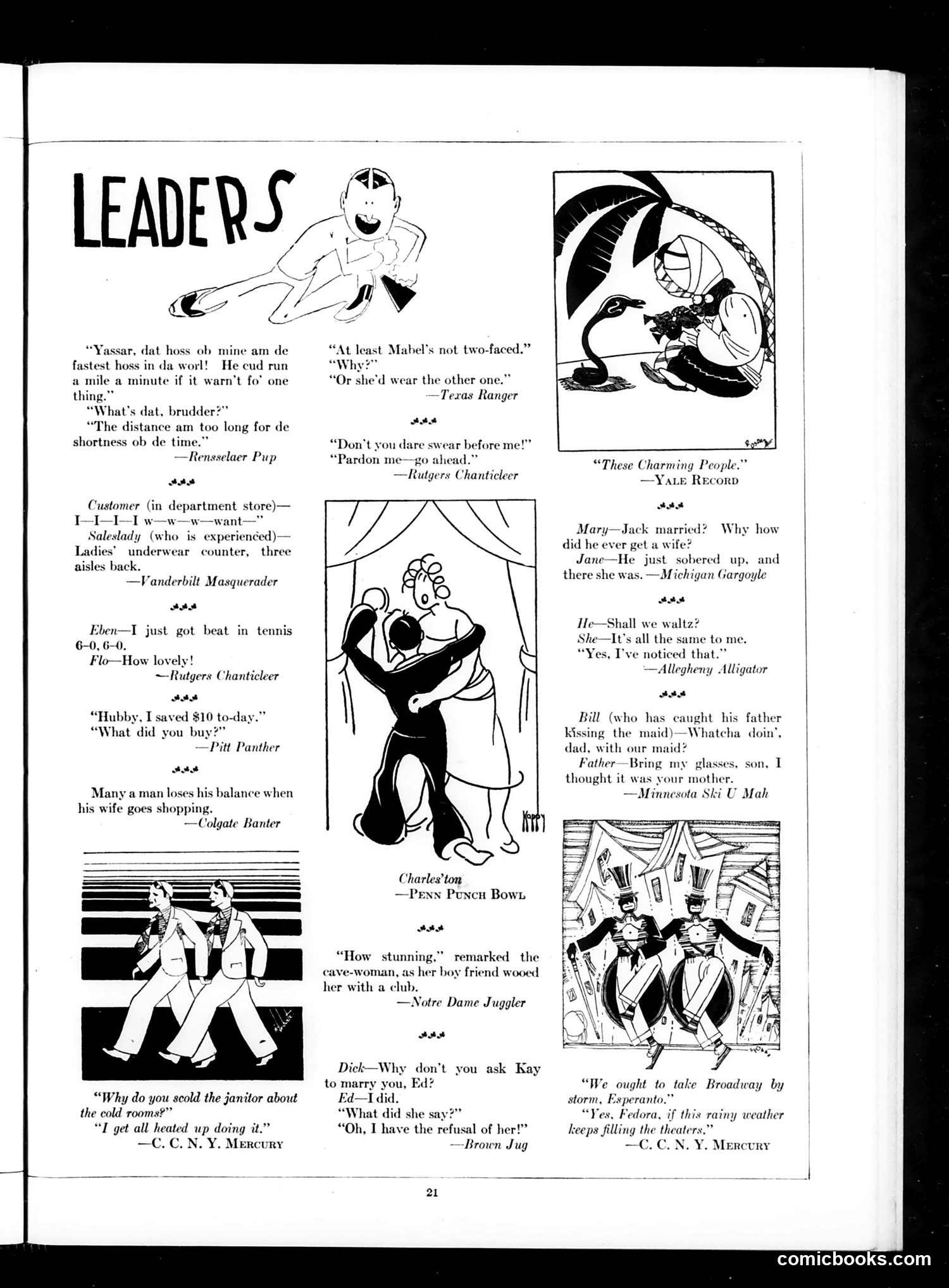
This page collects brief humorous quips and jokes typical of early 20th-century college humor magazines, republished from various university publications. The satire targets domestic life and gender relations rather than politics. **Key themes:** - **Marriage jokes**: Several quips mock wives' shopping habits and husbands' confusion (the wife going shopping causes men to "lose balance"). - **Gender and propriety**: A customer's stammering in a department store is immediately understood by the saleswoman as seeking ladies' underwear—satirizing both male embarrassment and female knowingness about male awkwardness. - **Relationships**: Jokes about courtship, infidelity (a father kissing the maid), and marriage proceeding from drunkenness. - **Caveman reference**: One cartoon depicts "cave-woman" courtship via clubbing, mocking primitive romance. The page reflects period attitudes toward marriage, shopping, and gender roles as comedy fodder for college-age readers, with no specific political figures or events referenced.
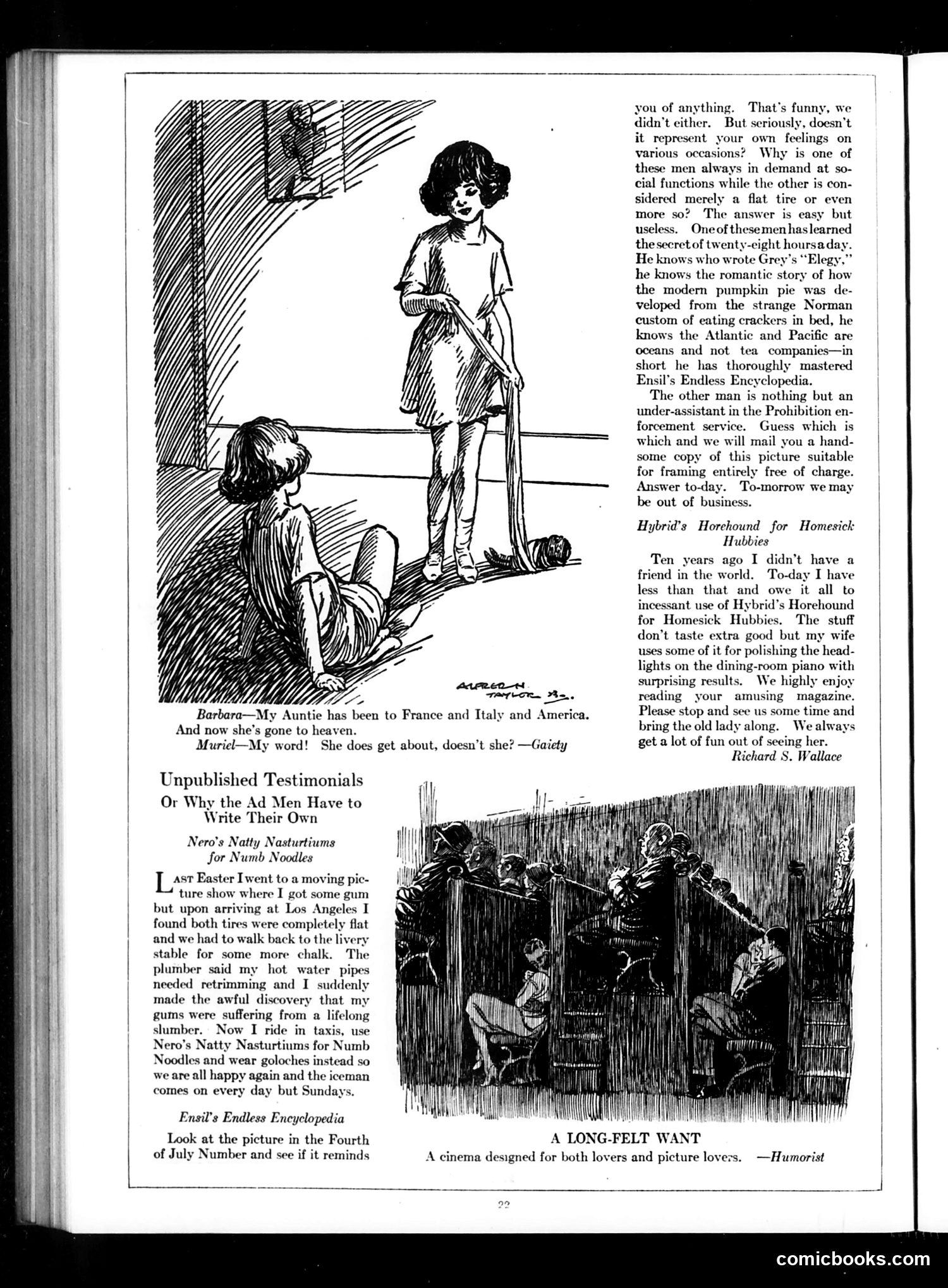
This page contains mock "testimonials" parodying early 20th-century advertising copy. The satire targets absurdist product endorsements where testimonials make nonsensical claims disconnected from the actual product. **"Nero's Natty Nasturtiums for Numb Noodles"** features a rambling account where someone's gum, flat tires, plumbing problems, and dental issues somehow resolve through using the product—the logic is deliberately incoherent, mocking how ads exploit consumer gullibility. **"Ensil's Endless Encyclopedia"** satirizes products marketed as keys to social success. It suggests one man succeeds because he's memorized trivia (knowing who wrote Grey's "Elegy," facts about pumpkin pie origins), while another is merely a "flat tire"—period slang for a boring, undesirable person. The joke: encyclopedias claim to make you interesting, but the difference between popular and unpopular people remains "easy but useless." **"Hybrid's Horehound for Homesick Hubbies"** similarly mocks testimonials where the product's actual purpose becomes absurd (polishing piano headlights), yet the writer claims it solved loneliness. The cartoons lampoon how advertisers exploit insecurity while offering meaningless solutions.
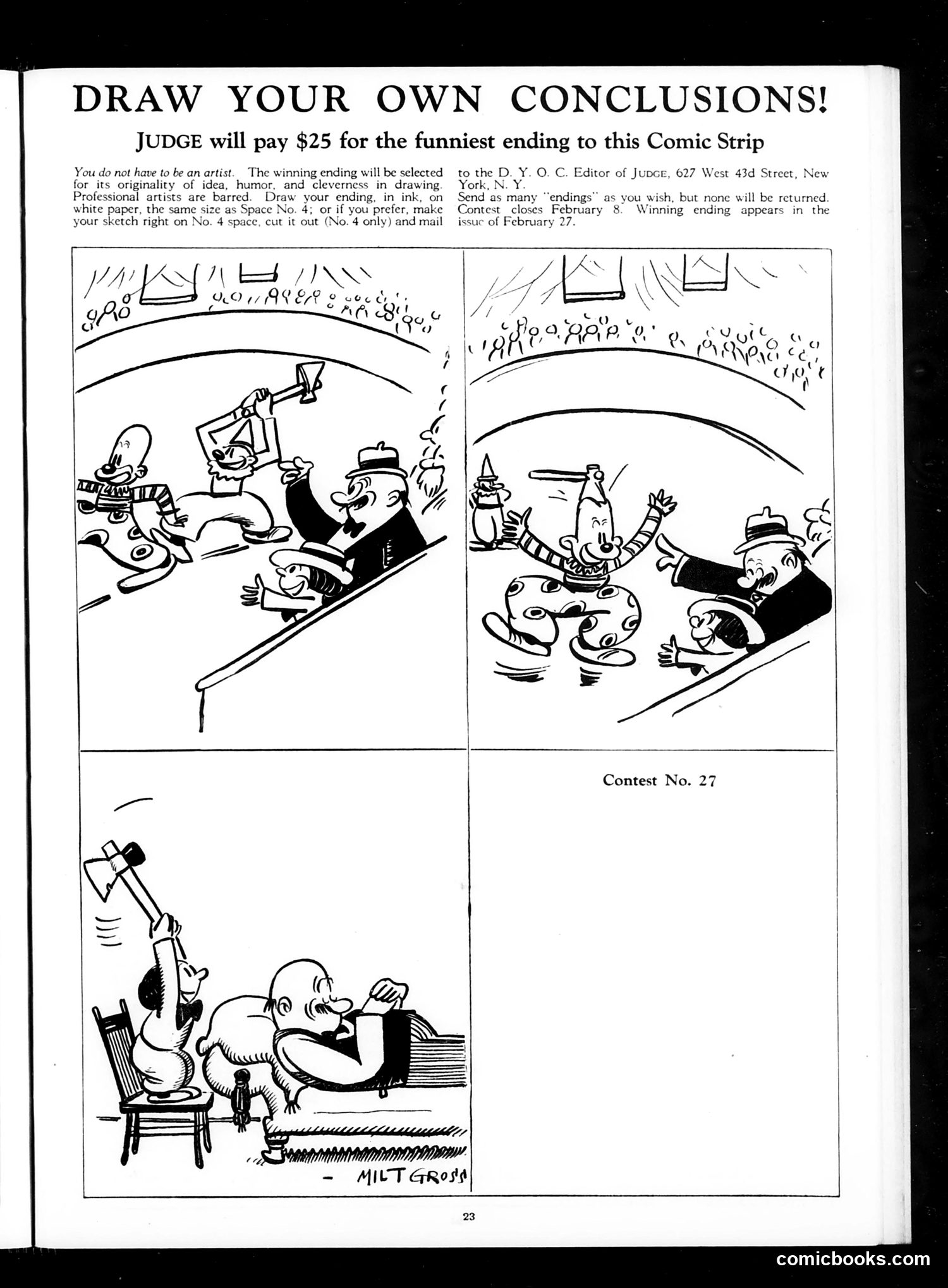
This page presents Contest No. 27 from *Judge* magazine, inviting readers to complete an unfinished comic strip for a $25 prize. The contest excludes professional artists to encourage amateur participation. The three visible comic panels depict what appears to be a theatrical or vaudeville scene: well-dressed men in formal attire (top panels) interact in increasingly chaotic situations with exaggerated gestures and expressions. The bottom panel, signed by Milt Gross, shows a figure with an axe near seated characters—suggesting slapstick violence typical of silent-film comedy. The satire targets early 20th-century entertainment culture, likely poking fun at theatrical melodrama or slapstick humor conventions. Readers were challenged to supply a humorous final panel resolving this absurd scenario. The contest reflects *Judge's* focus on visual humor and audience participation, while the cartooning style and formal dress suggest commentary on vaudeville or stage entertainment of that era.
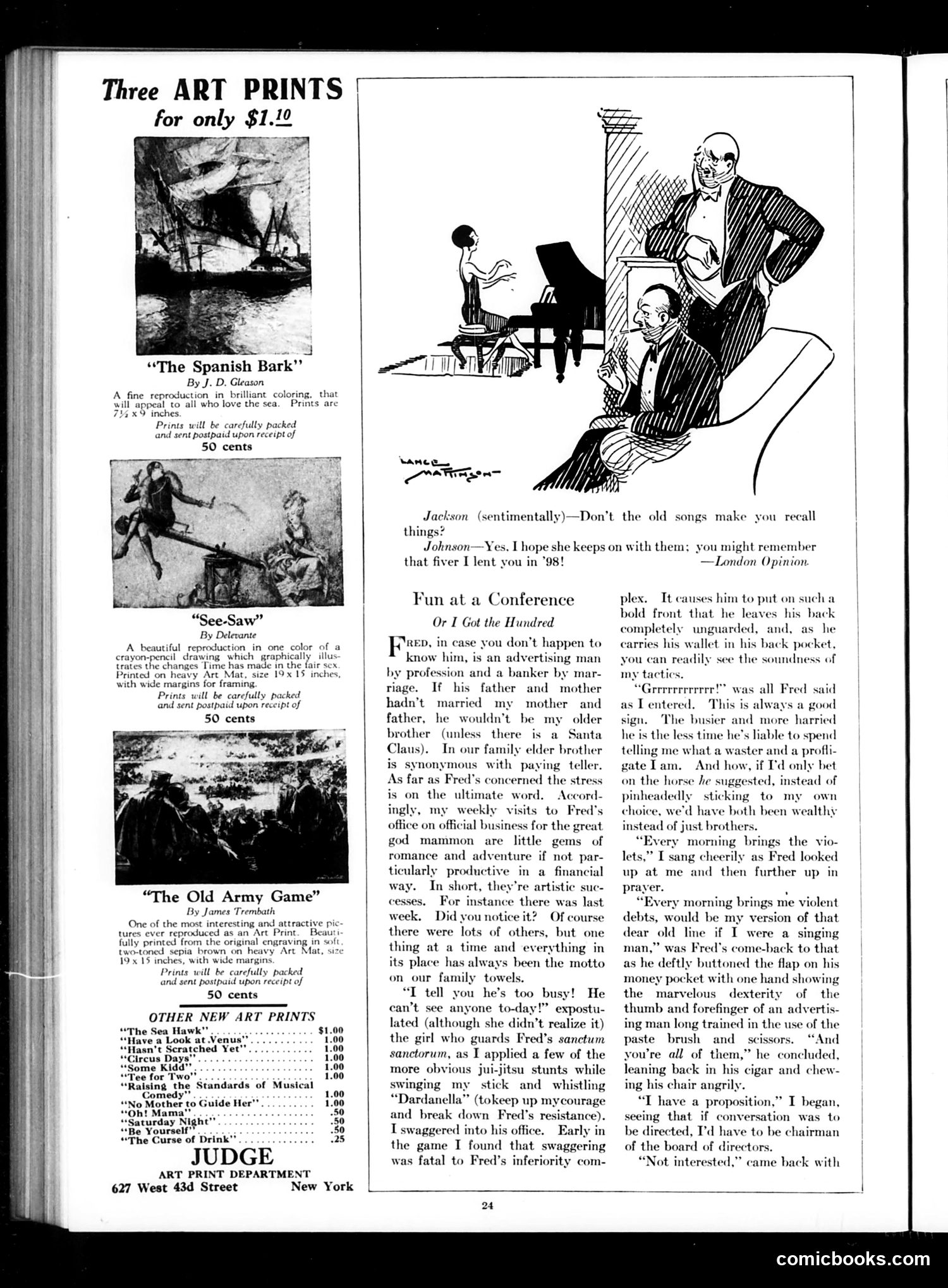
This page is primarily **advertising for art prints**, with one satirical cartoon and a humorous short story. **The cartoon** (top right) depicts two men in business attire discussing old songs. Jackson sentimentally asks if music recalls memories; Johnson replies he hopes "she keeps on with them" because Jackson might remember "that fiver I lent you in '98!"—a joke about using nostalgia as cover to remind someone of an unpaid debt from over a decade prior. **The story** "Fun at a Conference" is a fraternal comedy about the narrator visiting his older brother Fred, an advertising man and banker, at his office. The humor derives from family dynamics: Fred acts busy and important to mask insecurity ("inferiority complex"), while the narrator tries to borrow money by flattering him and creating distractions. The piece satirizes workplace pretense, financial anxiety among family members, and early-20th-century office culture—particularly how busy-ness signals status and authority. The rest of the page advertises reproducible art prints (seascapes, historical scenes) priced at 50 cents each.
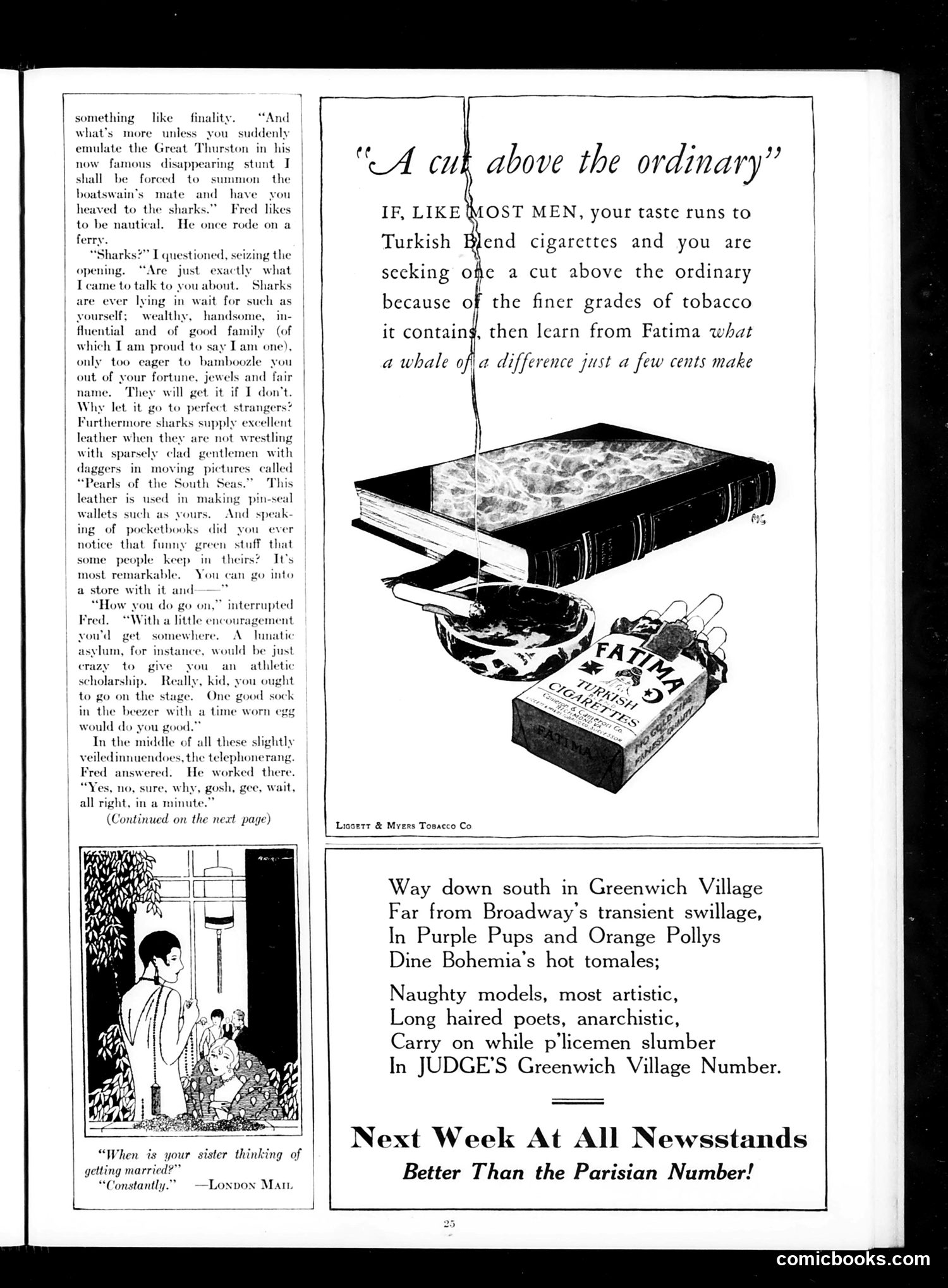
This page contains a narrative story (left column), a cigarette advertisement (center-right), and promotional text for an upcoming issue (bottom). **The Story:** A humorous monologue about a character trying to persuade "Fred" to invest in sharkskin wallets by warning him that "sharks" (con artists) will otherwise steal his wealth and good name. The joke relies on deliberate misinterpretation—treating actual sharks as a threat while pivoting to financial scams. **The Advertisement:** Fatima Turkish Blend cigarettes, marketed as "a cut above the ordinary" due to finer tobacco grades. The ad uses the common early-20th-century sales pitch that small price differences yield significant quality improvements. **The Promotion:** Judge magazine is advertising its upcoming "Greenwich Village Number," mocking bohemian culture—artists, poets, models, and "anarchistic" types living in lower Manhattan. The satirical verse treats bohemia as exotic, slightly scandalous entertainment for mainstream readers, suggesting Judge will cover this subculture for humorous effect. The overall tone is light, commercial comedy targeting a sophisticated urban audience.
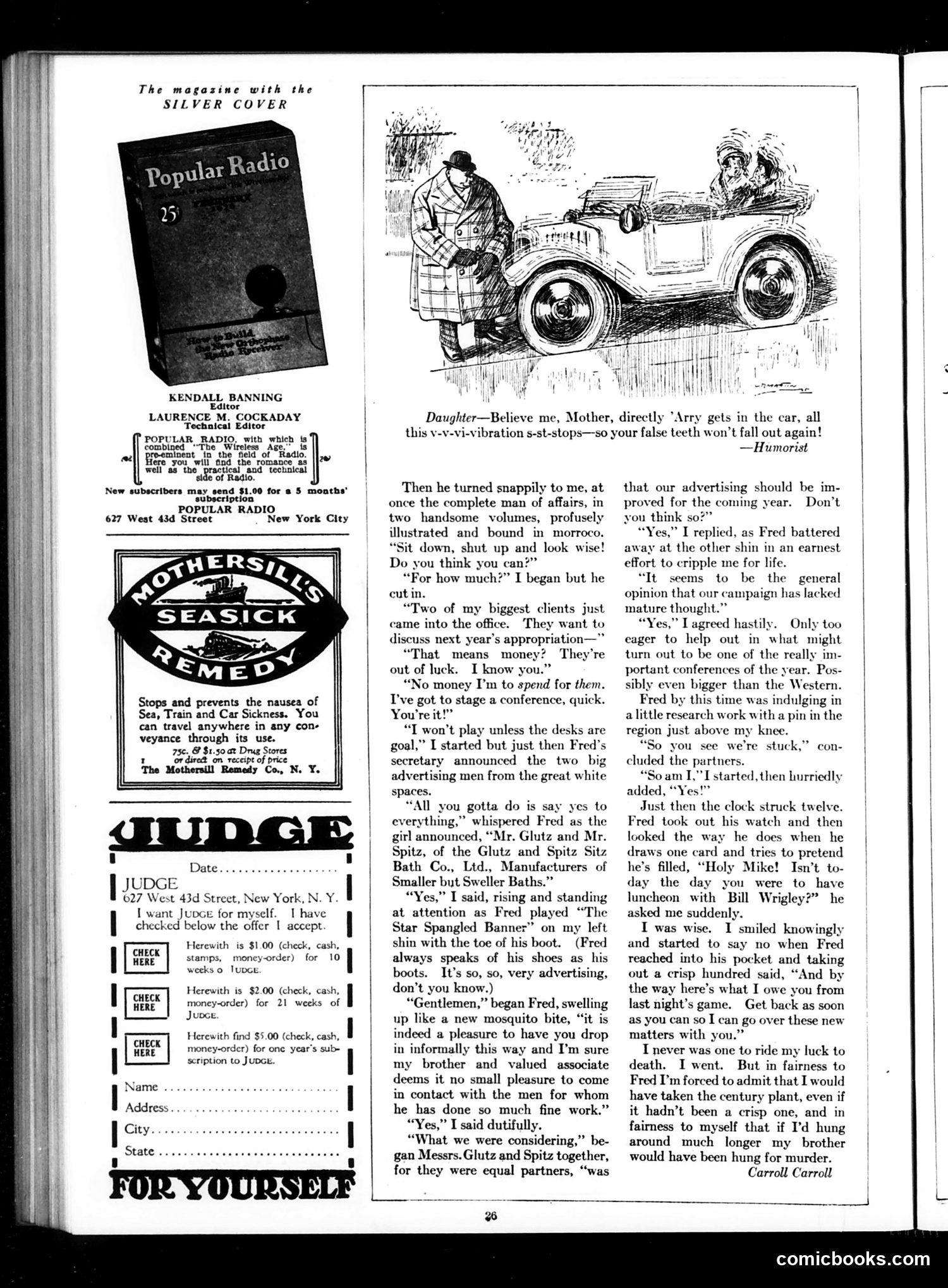
This page combines **advertising and satirical fiction**. The main cartoon depicts a daughter convincing her mother that a car's vibration will prevent her dentures from falling out—a absurdist ad promoting automobile ownership to women. The longer text is a humorous story by Carroll Carroll about an advertising executive who uses his brother as a prop during a client meeting with "Messrs. Glutz and Spitz" (manufacturers of "Smaller but Sweller Baths"). The satire targets **advertising industry pretension**: the executive performs elaborate theatrics—playing patriotic songs with his shoe, physically abusing his brother—to impress clients about improving their campaign. The joke is that none of this has anything to do with actual advertising strategy; it's pure performance. The surrounding ads (Popular Radio magazine, Mothersill's seasickness remedy, Judge subscription offers) reflect 1920s consumer culture and emerging technologies like radio.
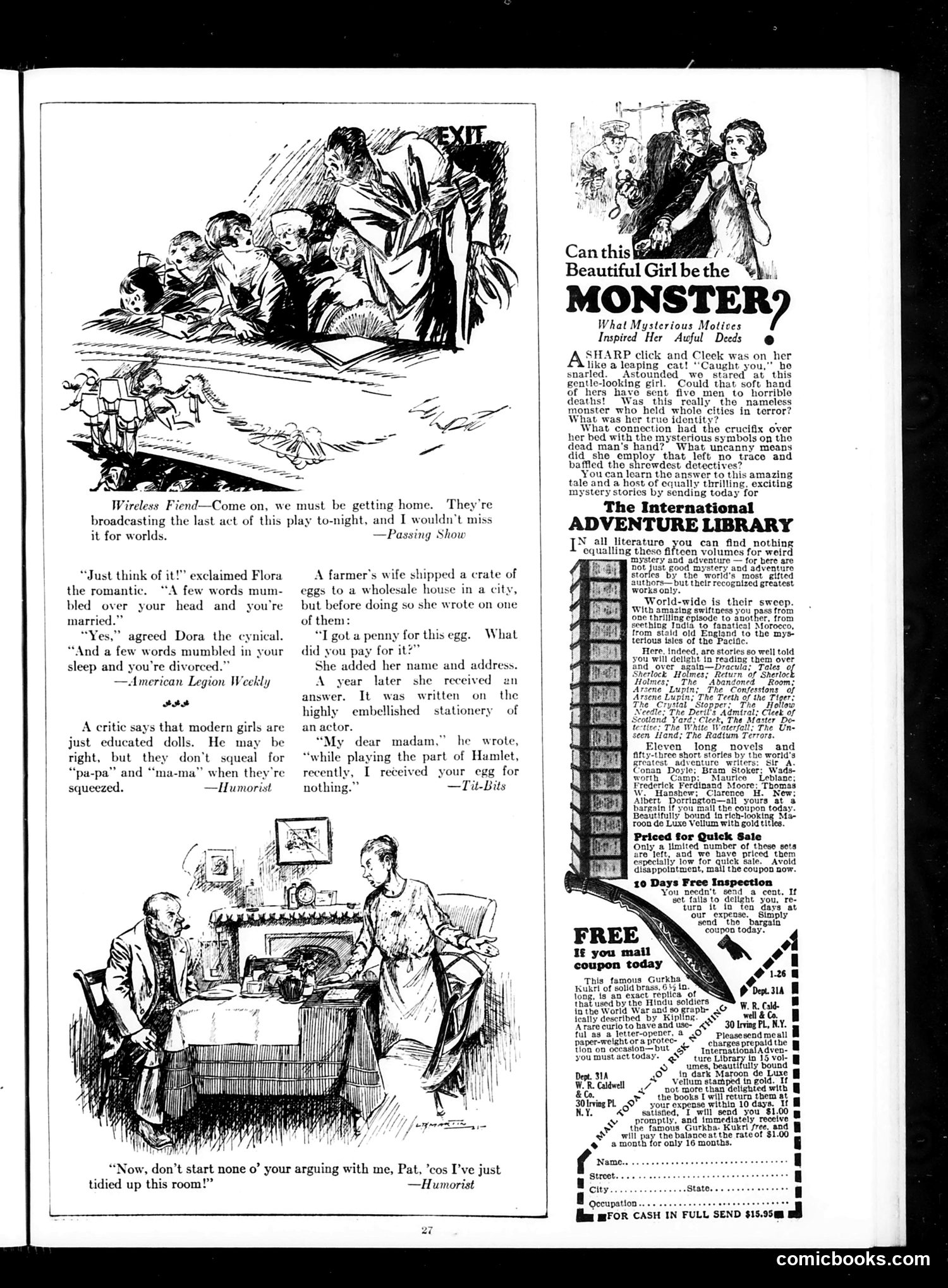
This Judge magazine page contains several humor pieces and a large advertisement. **The cartoons** are brief domestic comedies: one depicts a couple arguing about tidying a room (typical marital banter), another shows a woman at a vanity discussing romantic notions of marriage versus the cynical reality of divorce. A third involves a farmer's wife who included a challenge note with eggs shipped to a city—an actor later responds on fancy stationery, having received her egg "for nothing" while playing Hamlet. These jokes rely on wordplay and everyday domestic situations. **The right-side advertisement** promotes "The International Adventure Library"—a fifteen-volume set of classic mystery and adventure stories by Conan Doyle, Bram Stoker, and others (Dracula, Sherlock Holmes, Arsene Lupin tales). It emphasizes these are "greatest works," beautifully bound, offered at bargain price with a 10-day free inspection period. This reflects early 20th-century mail-order publishing practices. The page is primarily advertising with brief satirical commentary on modern romance and marriage.
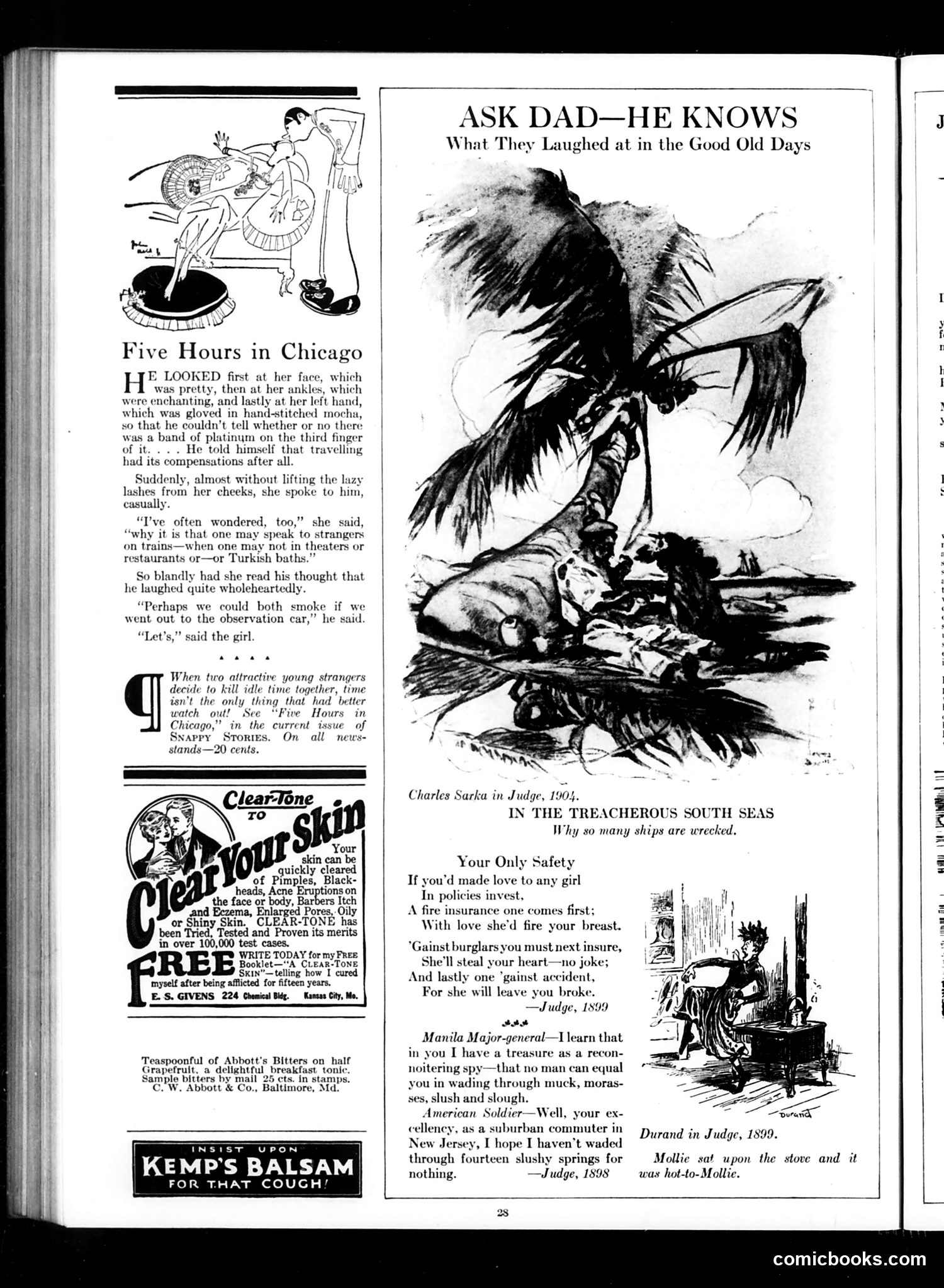
This page mixes fiction, advertising, and humorous content typical of early-1900s Judge magazine. **"Five Hours in Chicago"** is a flirtation story playing on contemporary anxieties about stranger interaction and female independence. The narrative hints at romantic/sexual impropriety between unacquainted travelers—considered scandalous. The girl's boldness in initiating conversation challenges period norms about female passivity. **"Ask Dad—He Knows"** presents historical humor from earlier decades. The Charles Sarka illustration (1904) depicts a shipwreck with dark comedy. The "Your Only Safety" poem uses insurance as metaphor for romantic risk—a woman will "steal your heart" and "leave you broke," treating marriage as financial danger. The military exchange mocks a Manila-based officer's assumption that a New Jersey commuter's experience with "slushy springs" qualifies him as a reconnaissance spy. The remaining items are period advertisements (skin treatments, bitters, cough syrup) interspersed throughout—standard magazine filler of the era.
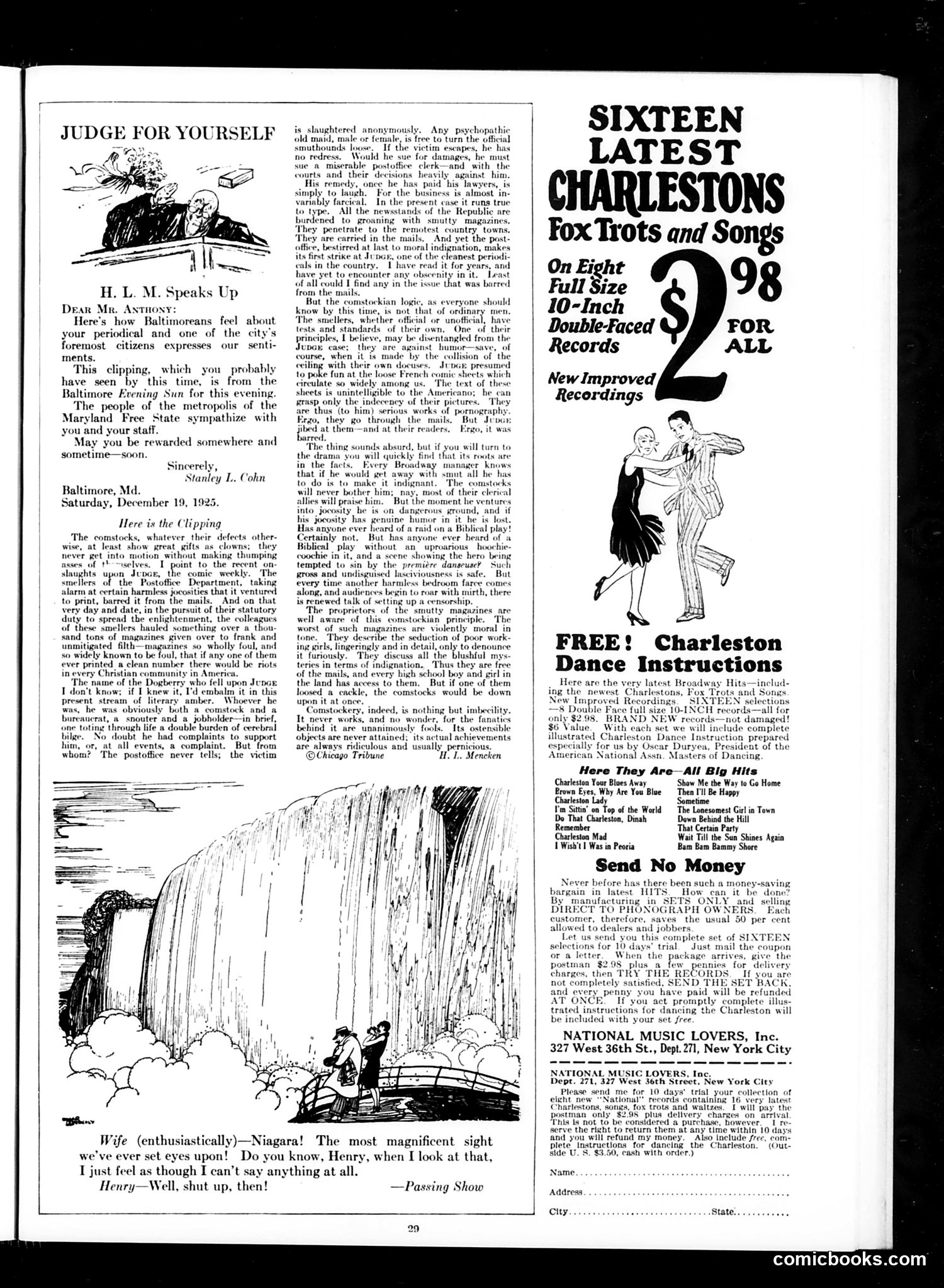
This page contains a letter to the editor defending Judge magazine against censorship attacks, likely from Anthony Comstock's anti-obscenity society (the "Comstocks"). **The satire's target:** The writer argues that censorship is hypocritical and ineffective. While the Comstock society raids "smutty magazines" in the mails, they ignore genuinely obscene Broadway plays because those have respectable veneer. The author sarcastically notes that Biblical plays contain seduction scenes uncensored, while humorous publications face raids. **The point:** Comstock-style censorship is portrayed as intellectually inconsistent—attacking magazines for mild humor while ignoring genuinely salacious theatrical content. The writer suggests censors are motivated by principle rather than actual harm prevention. **Context:** The 1920s saw ongoing battles between morality crusaders and publishers over mail distribution and obscenity standards. Judge, a satirical magazine, frequently mocked such censorship efforts as both futile and absurdly selective. The remainder of the page advertises Charleston dance records—contemporary popular culture Judge's readers would recognize.
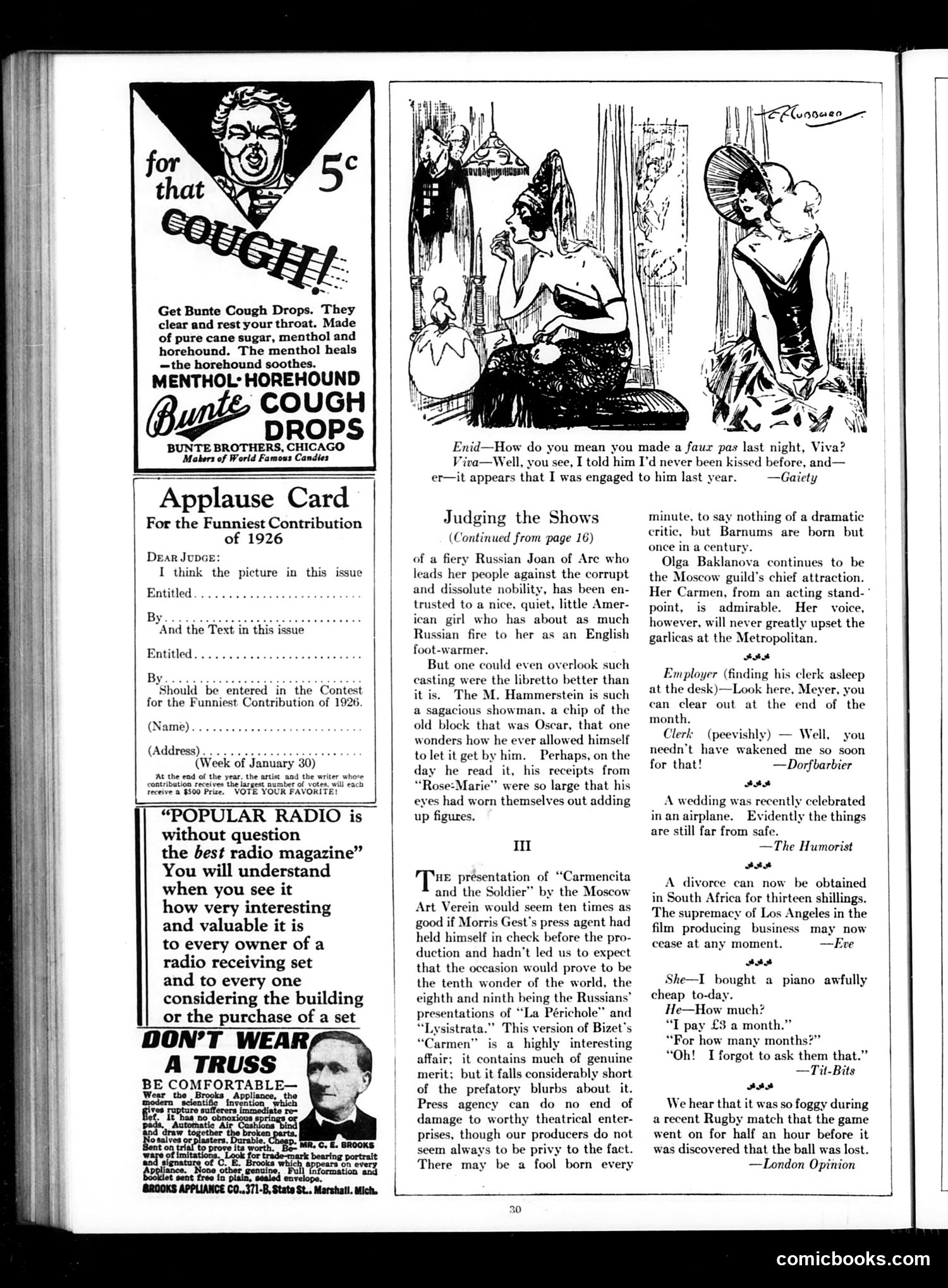
This page from *Judge* magazine contains several separate items: **Top Left:** A Bunte Cough Drops advertisement—standard period product marketing. **Top Right:** A single-panel joke cartoon about a woman named Viva claiming she'd never been kissed before, then revealing she was actually engaged to someone the previous year. The humor relies on the double standard of 1920s courtship—her fabrication about virginal innocence is exposed as false. **Center & Right:** "Judging the Shows" is a theater review column critiquing recent Broadway productions, particularly Russian theatrical companies performing in New York. The reviewer criticizes casting choices (an American actress playing a "fiery Russian Joan of Arc") and overhyped press agents for shows like "Carmencita and the Soldier." **Bottom Section:** Miscellaneous brief jokes about workplace embarrassment, divorce costs in South Africa, and piano purchasing—typical *Judge* filler humor. The page is primarily **advertising and theater criticism**, not political satire. It reflects 1920s entertainment culture and advertising conventions.
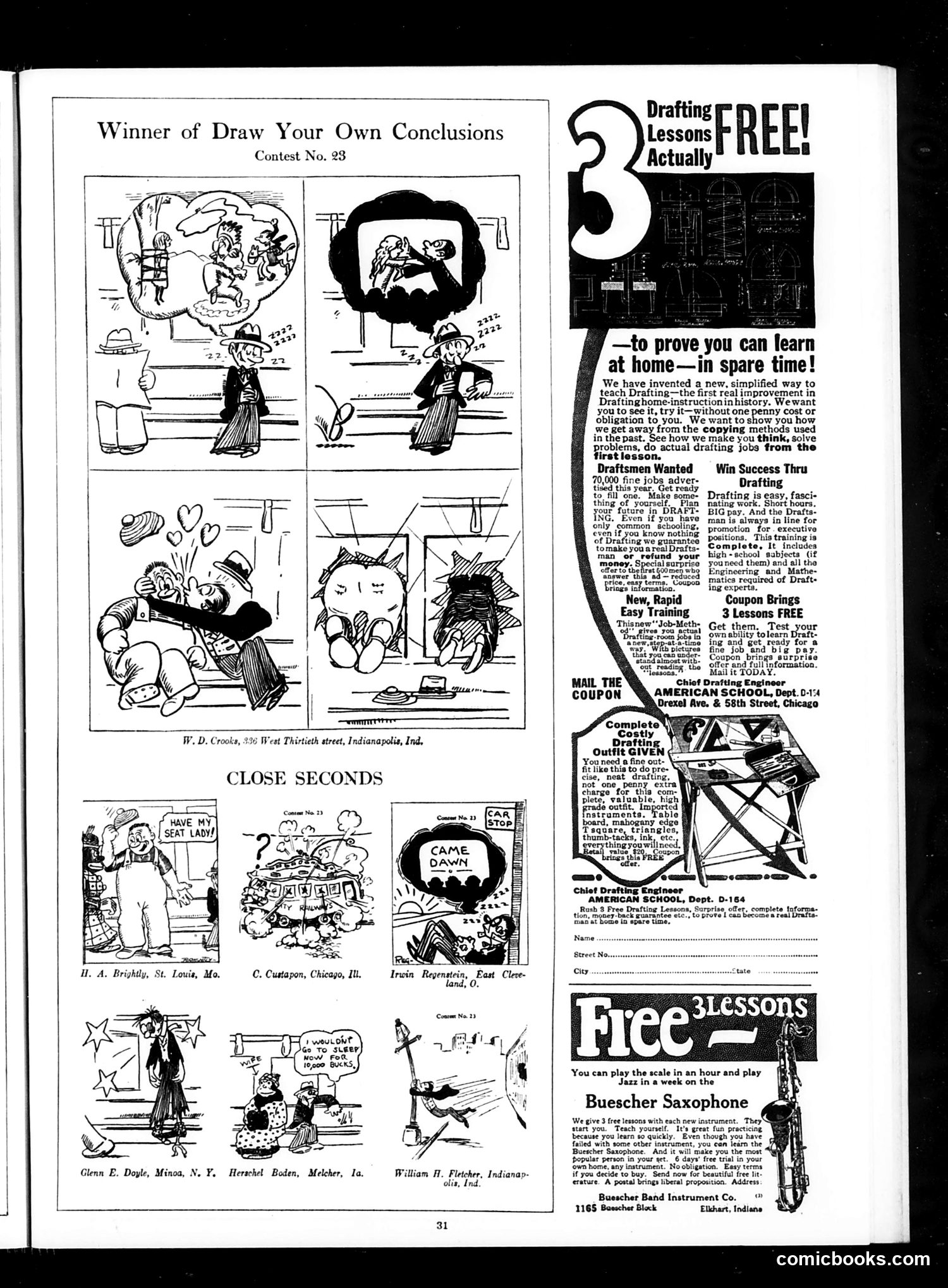
This page combines two unrelated elements: a cartoon contest winner and advertisements. **Top Section - "Draw Your Own Conclusions" Contest:** Four sequential cartoon panels by W.D. Crooks depict a domestic scenario where a woman appears to be daydreaming or fantasizing (shown in thought bubbles). The humor suggests she's imagining romantic or adventurous scenarios while performing mundane household tasks. This represents typical early-20th-century magazine humor playing on the contrast between women's domestic reality and their imagined desires. **Right Side - Advertisements:** The page is dominated by three vocational correspondence-course ads typical of the era: drafting lessons, saxophone instruction, and implied music training. These ads promise quick mastery ("learn in a week") and appeal to working-class readers seeking self-improvement or new skills. **Bottom Section - "Close Seconds":** Additional cartoon panels showing failed contest entries, representing humor submissions that didn't win the competition. The page reflects interwar American culture: women's limited social roles, the popularity of mail-order education, and the accessibility of Judge magazine to middle and working-class audiences seeking both entertainment and practical opportunity.
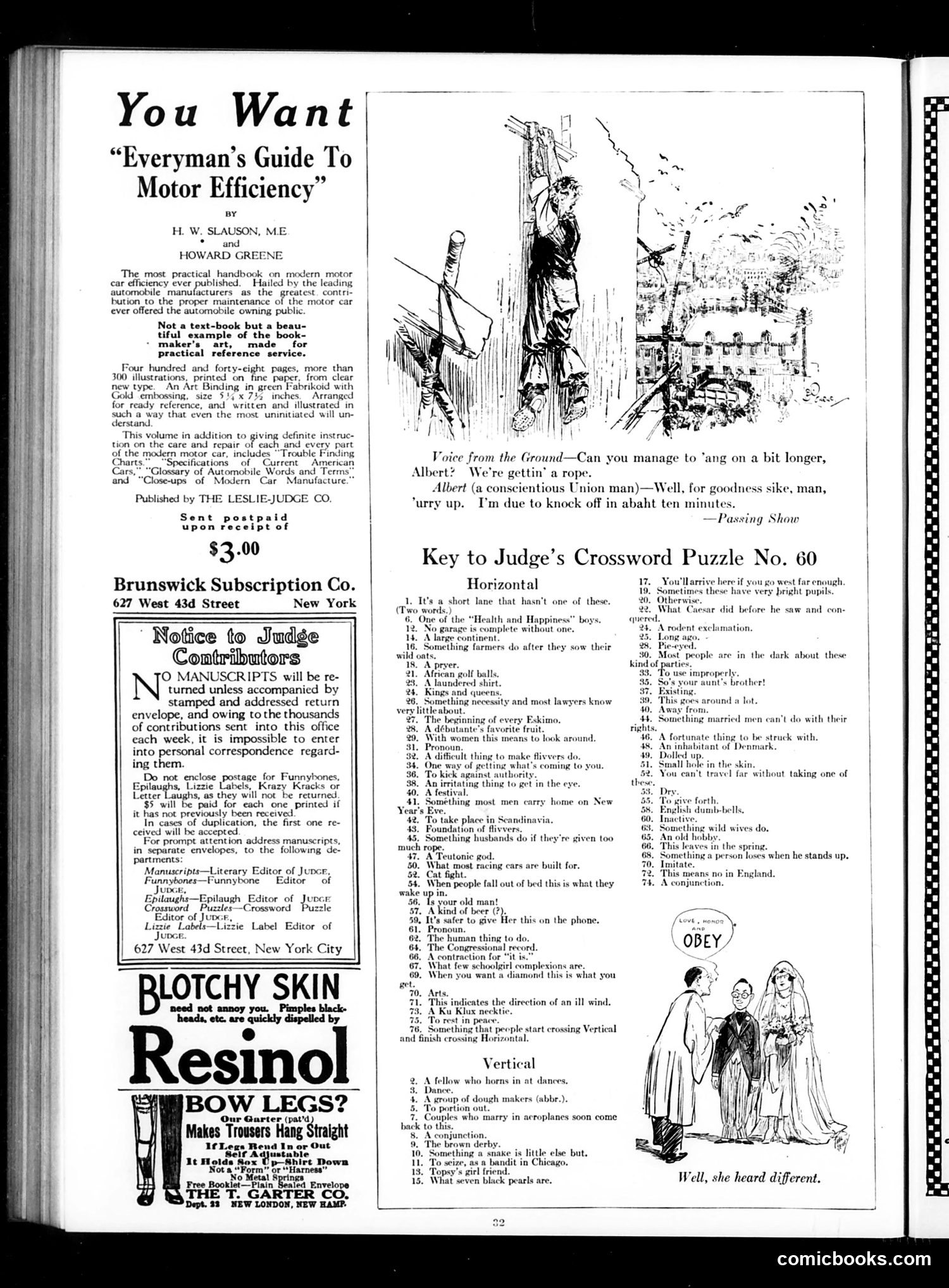
This cartoon depicts a **Union worker (labeled "Albert") hanging from a rope or cable**, while someone above urges him to hold on longer so they can fetch help. Albert, identified as "a conscientious Union man," insists on leaving because his shift is ending—he must "knock off in abaht ten minutes." **The satire criticizes Union labor rigidity**: Despite being in potential danger and needing rescue, Albert refuses to stay past his scheduled work hours due to strict union rules about shift length. The joke suggests that Union workers prioritize adherence to labor contracts over practical necessity or emergencies. This reflects early 20th-century anti-Union sentiment common in Judge magazine, which typically mocked labor organizing as inflexible and economically irrational. The humor relies on the absurdity of a man in peril being more concerned with clocking out than survival.
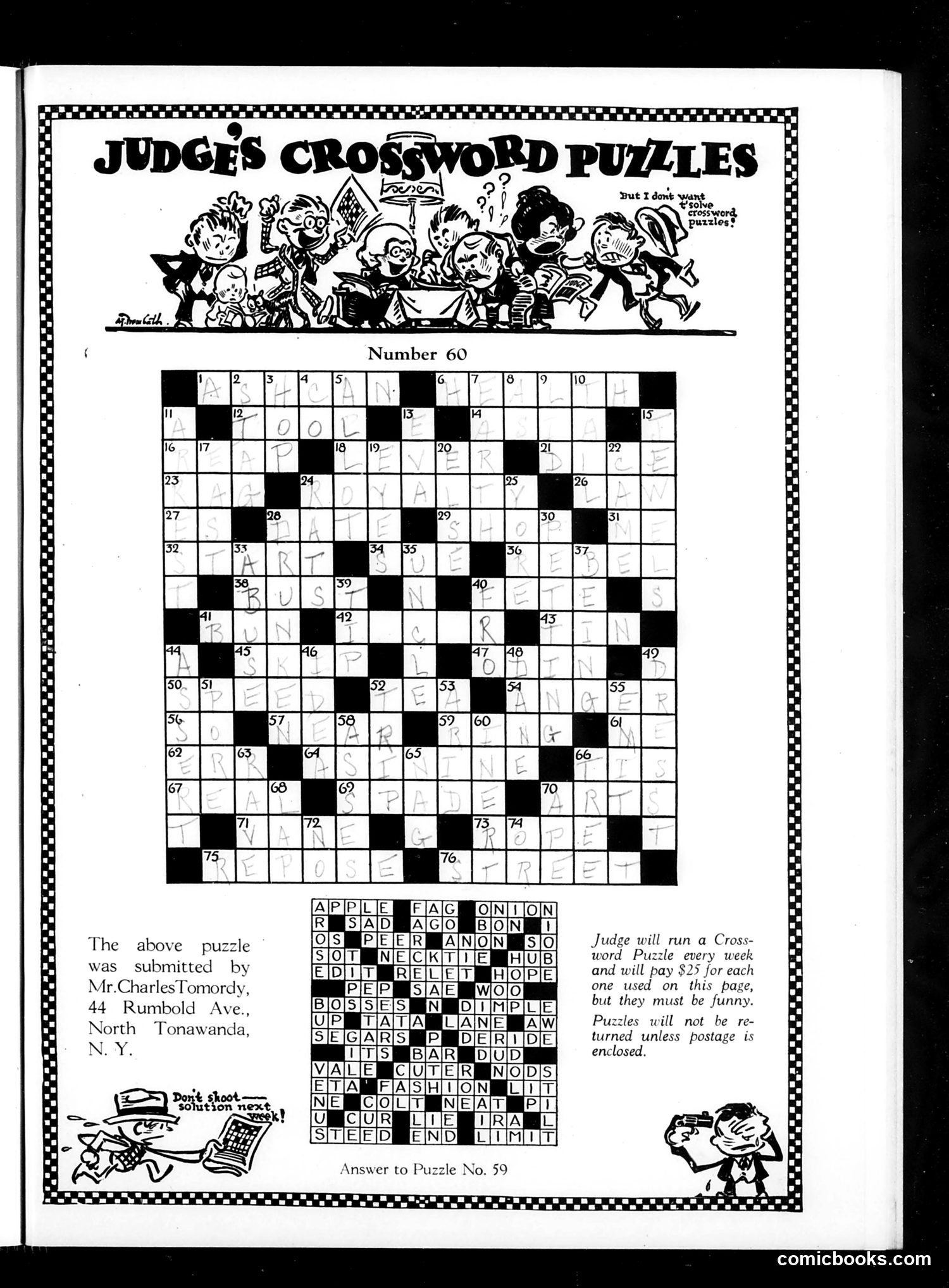
This page is primarily a crossword puzzle (Puzzle No. 60) submitted by a reader from North Tonawanda, New York. The puzzle itself contains no political or social satire—it's a standard word game grid with numbered clues. The page includes the answer key to the previous week's puzzle (No. 59) and announces Judge's weekly crossword puzzle feature, which offered $25 payment for accepted submissions. The decorative header shows cartoon characters in a celebratory pose, typical of Judge magazine's playful visual style, but these are generic illustrations rather than caricatures of specific political figures. This appears to be a reader-participation feature rather than satirical content.
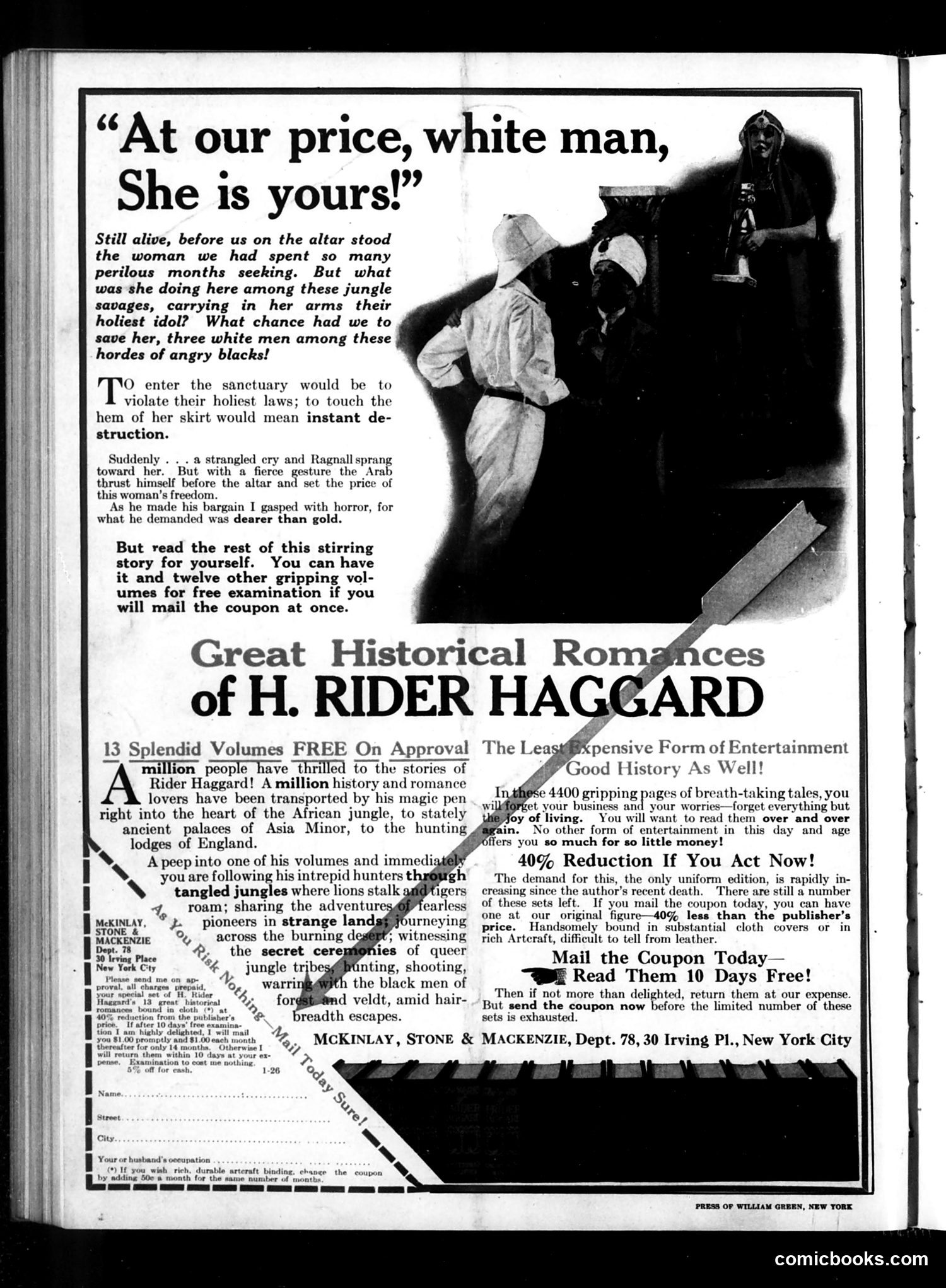
This is primarily **advertising** for H. Rider Haggard novels, not satire. The page promotes a 13-volume book set using a dramatic narrative excerpt depicting colonial-era adventure fiction tropes. The quoted text reflects **late-19th/early-20th-century colonial attitudes**: white male protagonists rescuing a white woman from African natives, with an Arab intermediary negotiating her "price." The language ("jungle savages," "angry blacks") exemplifies period racial stereotypes presented matter-of-factly as entertainment. The ad exploits these adventure fantasies to sell books—promising readers they'll be "transported" into exotic locales with "intrepid hunters" and thrilling danger. The marketing strategy relies on appeals to escapism and the exotic otherness of colonized peoples. By modern standards, this content is starkly racist, but it represents authentic period attitudes toward both literature and non-Western peoples that Judge's audience would have found commercially appealing and culturally unremarkable.