
Judge, 1926-01-30 · page 21 of 36
Judge — January 30, 1926 — page 21: what you’re looking at
What you’re looking at
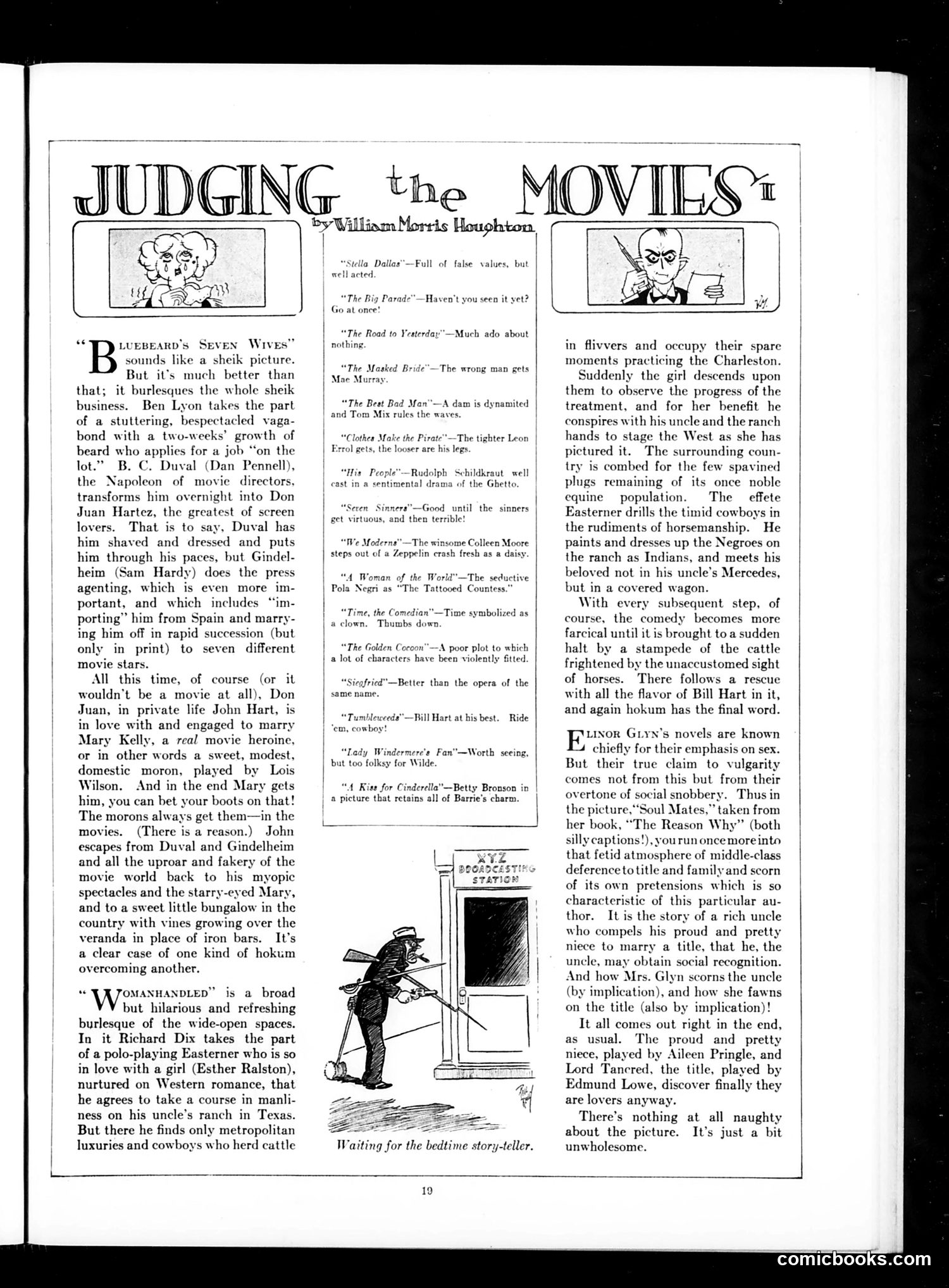
This page satirizes 1920s Hollywood's fakery and artificiality through film reviews. The main target is the "sheik" genre—glamorous male seduction films that were wildly popular. **Key satire:** The review of "Bluebeard's Seven Wives" mocks how easily cinema manufactures star personas: a shabby vagrant becomes a romantic idol through mere grooming and press agenting—pure hokum masquerading as entertainment. The author notes the irony that audiences prefer this manufactured fantasy to genuine romance, with the protagonist escaping back to "real" life. "Womanhandled" burlesques Western romance fantasies: an Easterner's uncle and cowboys stage an elaborate fake Old West to impress his girlfriend, complete with painted Negroes costumed as Indians and broken-down horses presented as noble steeds. **The broader point:** Hollywood operates through layers of deception—manufactured stars, fabricated narratives, and fake sets—yet audiences embrace this "hokum" over authenticity. The cartoonist criticizes both the industry's cynicism and the public's willingness to be deceived.
📄 Transcribed text from this page (OCR, searchable)
Machine-transcribed from the original scan — historical spelling and the odd misread are preserved.
$s LUEBEARD'S Seven Wives” B sounds like a sheik picture. But it’s much better than that; it burlesques the whole sheik business. Ben Lyon takes the part of a stuttering, bespectacled vaga- bond with a two-weeks’ growth of beard who applies for a job “on the lot.” B. C. Duval (Dan Pennell), the Napoleon of movie directors, transforms him overnight into Don Juan Hartez, the greatest of screen lovers. That is to say, Duval has him shaved and dressed and puts him through his paces, but Gindel- heim (Sam Hardy) does the press agenting, which is even more im- portant, and which includes “im- porting” him from Spain and marry- ing him off in rapid succession (but only in print) to seven different movie stars. All this time, of course (or it wouldn't be a movie at all), Don Juan, in private life John Hart, is in love with and engaged to marry Mary Kelly, a real movie heroine, or in other words a sweet, modest, domestic moron, played by Lois Wilson. And in the end Mary gets him, you can bet your boots on that! The morons always get them—in the movies. (There is a reason.) John escapes from Duval and Gindelheim and all the uproar and fakery of the movie world back to his myopic spectacles and the starry-eyed Mary, and to a sweet little bungalow in the country with vines growing over the veranda in place of iron bars. It’s a clear case of one kind of hokum overcoming another. “ Wy ctaaaote” is a broad but hilarious and refreshing burlesque of the wide-open spaces. In it Richard Dix takes the part of a polo-playing Easterner who is so in love with a girl (Esther Ralston), nurtured on Western romance, that he agrees to take a course in manli- ness on his uncle’s ranch in Texas. But there he finds only metropolitan luxuries and cowboys who herd cattle the MOV] ’yWilliom Morris Houphton, —Full of false values, but “The Big Parade” | Go at once! Haven't you seen it yet? “The Road to Yeaterday""—Much ado about nothing. “The Masked Bride’—The wrong man gets Mae Murray “The Beat Bad Man"—A dam is dynamited and Tom Mix rules the waves. 1¢ Make the Pirate"—The tighter Leon | gets, the looser are his legs. | “His People” —Rudolph Schildkraut well | | cast in a sentimental drama of the Ghetto, “Seren Sinners” —Good until the sinners | get virtuous, and then terrible! | “We Moderns” —The winsome Colleen Moore steps out of a Zeppelin crash fresh as a daisy. | “A Woman of the World"—The seductive Pola Negri as “The Tattooed Countess.” “Time, the Comedian"—Time symbolized as a clown, Thumbs down. “The Golden Cocoon"—A poor plot to which lot of characters have been violently fitted. “Sicafried”—Better than the opera of the same name. “Tumbleweeda"—Bill Hart at his best. Ride ‘em, cowboy! “Lady Windermere's Fan"—Worth seeing, but too folksy for Wilde. “4 Kise for Cinderella"—Betty Bronson in a picture that retains all of Barrie's charm. in flivvers and occupy their spare moments practicing the Charleston. Suddenly the girl descends upon them to observe the progress of the treatment, and for her benefit he conspires with his uncle and the ranch hands to stage the West as she has pictured it. The surrounding coun- try is combed for the few spavined plugs remaining of its once noble equine population. The effete Easterner drills the timid cowboys in the rudiments of horsemanship. He paints and dresses up the Negroes on the ranch as Indians, and meets his beloved not in his uncle’s Mercedes, but in a covered wagon. With every subsequent step, of course, the comedy becomes more farcical until it is brought to a sudden halt by a stampede of the cattle frightened by the unaccustomed sight of horses. There follows a rescue with all the flavor of Bill Hart in it, and again hokum has the final word. Bux" Gryn’s novels are known chiefly for their emphasis on sex. But their true claim to vulgarity comes not from this but from their overtone of social snobbery. Thus in the picture,“‘Soul Mates,” taken from her book, “The Reason Why” (both silly captions!), yourun oncemoreinto that fetid atmosphere of middle-class deference to title and family and scorn of its own pretensions which is so characteristic of this particular au- thor. It is the story of a rich uncle who compels his proud and pretty niece to marry a title, that he, the uncle, may obtain social recognition. And how Mrs. Glyn scorns the uncle (by implication), and how she fawns on the title (also by implication)! It all comes out right in the end, as usual. The proud and pretty niece, played by Aileen Pringle, and Lord Tancred, the title, played by Edmund Lowe, discover finally they are lovers anyway. There’s nothing at all naughty about the picture. It’s just a bit unwholesome. comicbooks.com