
A complete issue · 42 pages · 1925
Judge — October 17, 1925
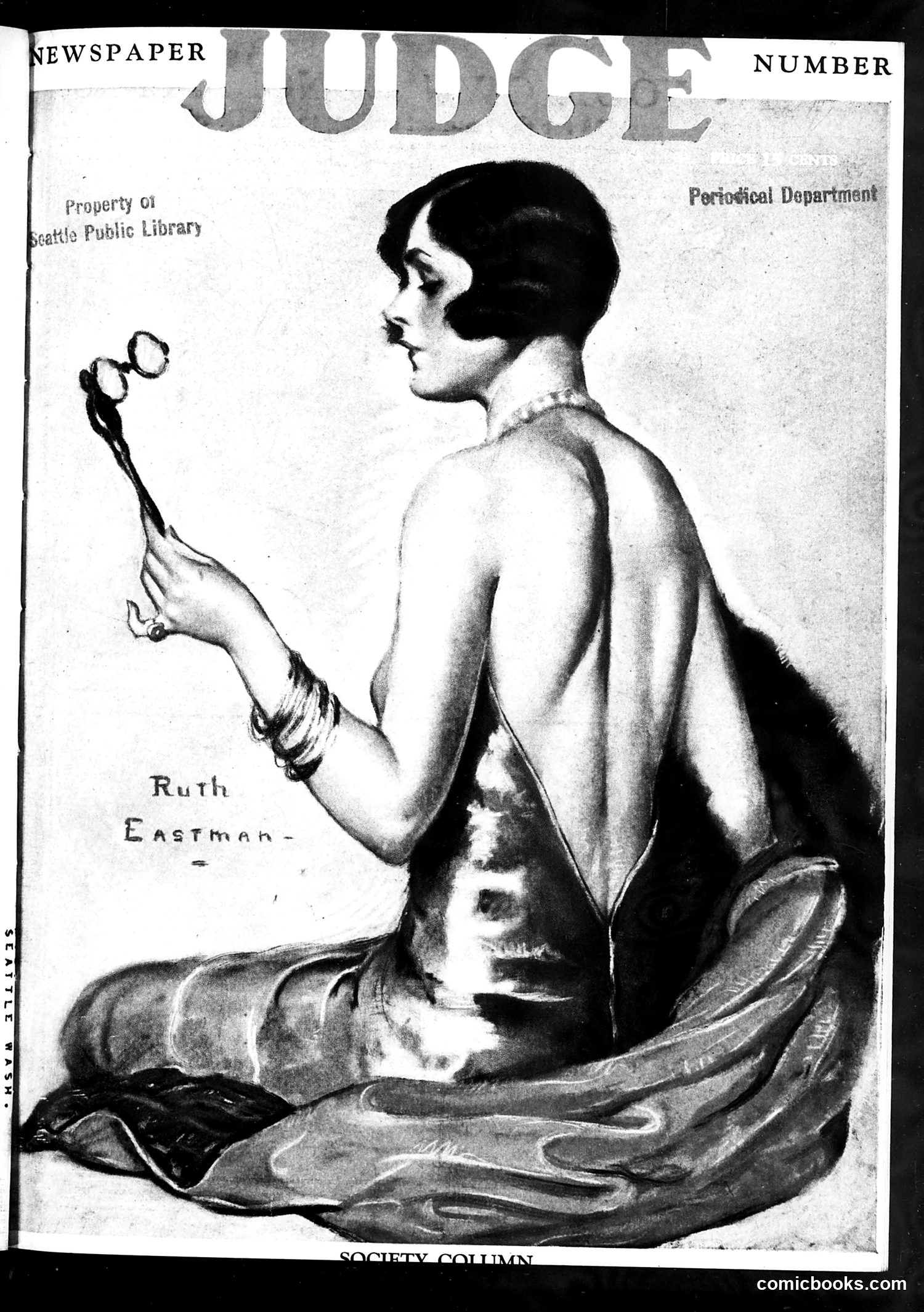
This appears to be a portrait cover from Judge magazine's "Society Column" section, featuring Ruth Eastman. The image shows a woman in profile holding a hand mirror, examining her reflection. She wears period costume—possibly theatrical or classical dress—with draped fabric and what appears to be a snake or serpent element at the bottom. Without additional context about Ruth Eastman or contemporary events, I cannot definitively explain the satirical intent. The mirror and serpent imagery might suggest vanity or mythological reference (possibly Medusa), which was common satirical commentary on public figures of the era. The "Society Column" designation suggests she was a notable social or entertainment personality, but the specific point of satire remains unclear from the image alone.
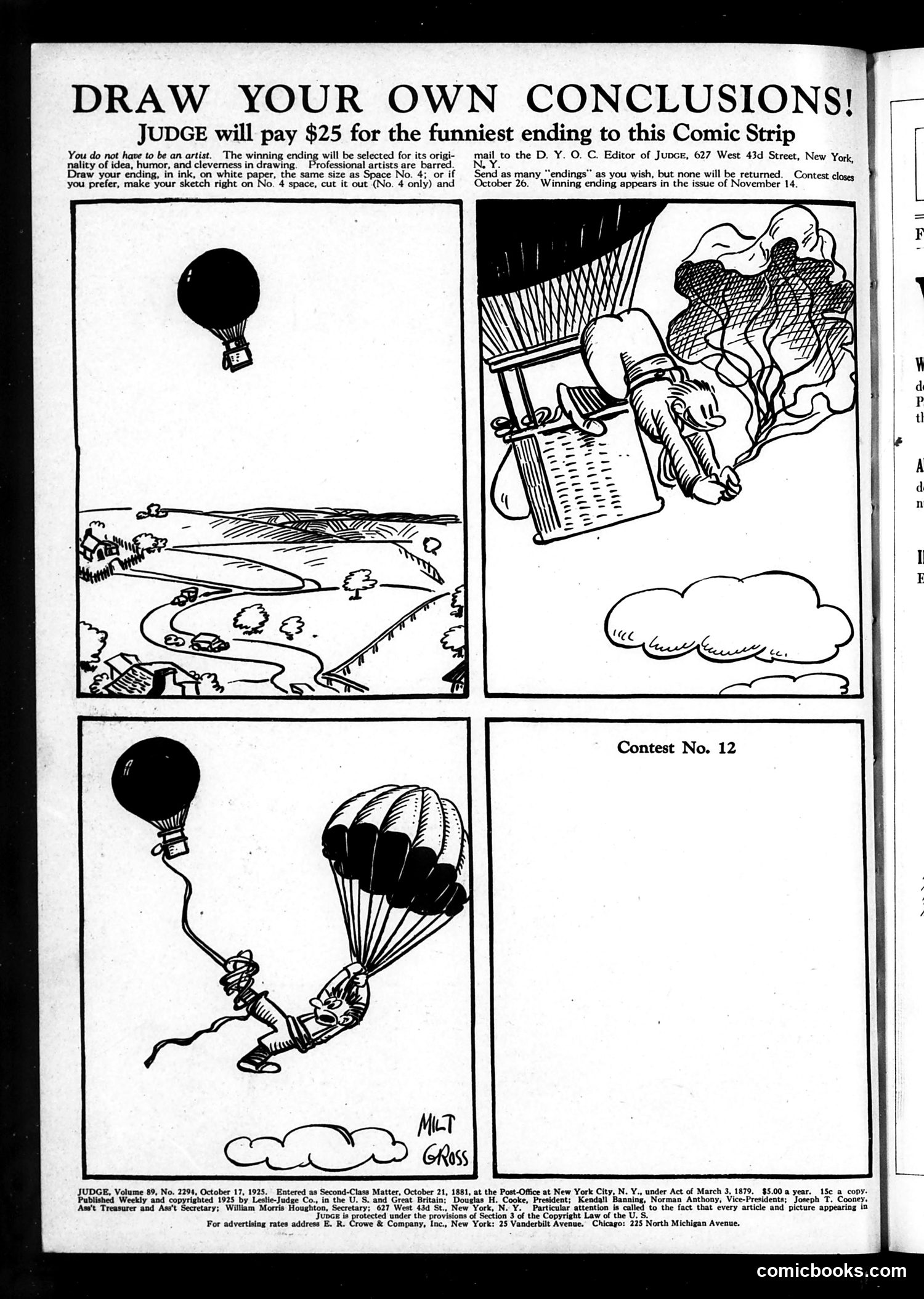
This page is a **drawing contest**, not political satire. Judge invites readers to complete a comic strip by drawing their own endings to three setup scenarios, with a $25 prize for the funniest conclusion. The three incomplete strips show: 1. A hot air balloon above a landscape 2. A figure with a large feather duster or broom among clouds 3. A person being pulled upward by a parachute Each strip's final panel is blank, awaiting reader submissions. The contest instructions specify entries should be submitted by October 26, with winners published November 14. This represents Judge's interactive format, encouraging reader participation through creative contests rather than offering editorial commentary on current events.
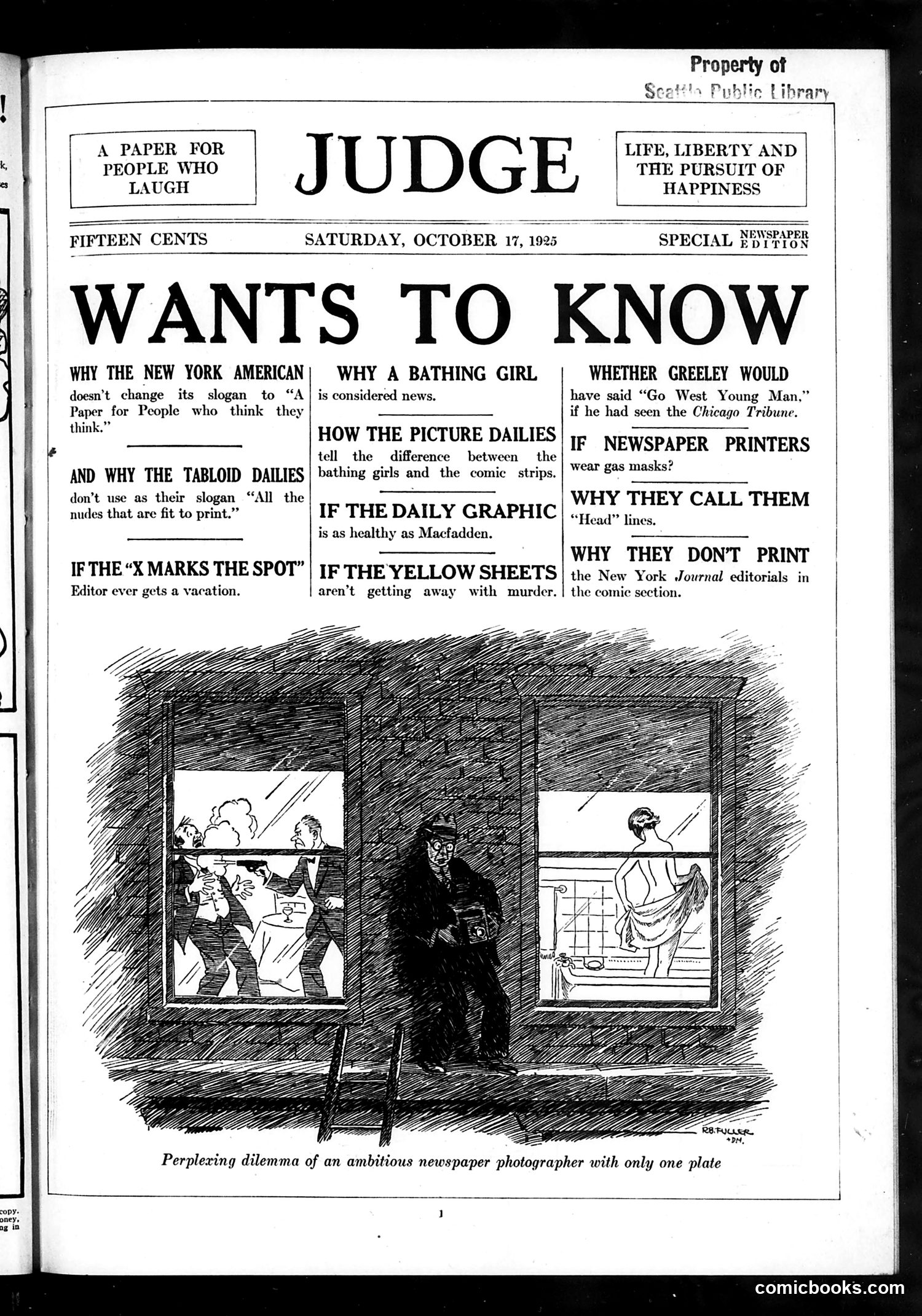
This page satirizes newspaper practices and sensationalism. The main cartoon depicts a photographer positioned between two shop windows, unable to decide which scene to photograph with his single plate (film). On the left, a domestic/romantic scene; on the right, a woman in a bathing suit. The "Wants to Know" section mocks newspapers for their editorial choices: tabloids publishing "unfit" nudes, yellow journalism's obsession with murder stories, and picture dailies' focus on bathing girls as "news." It also jokes about newspapers' contradictions—like refusing to print Journal editorials in comic sections while running sensational photographs elsewhere. The satire critiques 1920s tabloid culture's prioritization of scandal and voyeurism over substantive journalism.
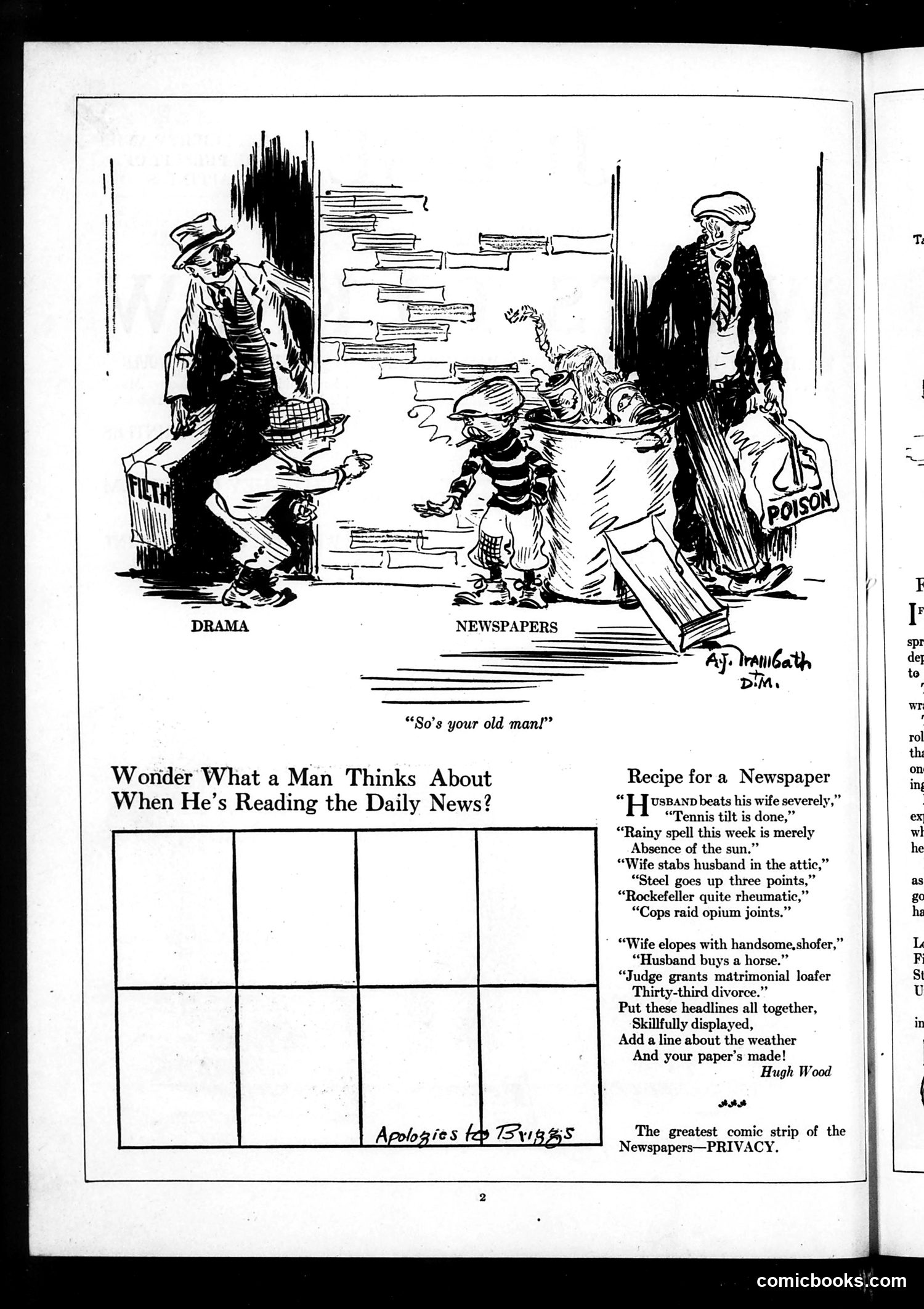
This satirical cartoon critiques sensationalist newspaper journalism. The top illustration shows "Drama" and "Newspapers" as two figures poisoning a well labeled "Poison," with the caption "So's your old man!" — suggesting newspapers and drama are corrupting public discourse through inflammatory reporting. Below, "Wonder What a Man Thinks About When He's Reading the Daily News?" presents an empty grid, implying readers absorb nothing substantive. The "Recipe for a Newspaper" by Hugh Wood mocks how papers combine scandal headlines (infidelity, crime, divorce) with trivial weather reports to create entertainment rather than inform. The piece satirizes early 20th-century yellow journalism — the sensationalist, scandal-focused reporting style that prioritized drama over facts, reducing newspapers to vehicles for gossip and scandal rather than serious news.
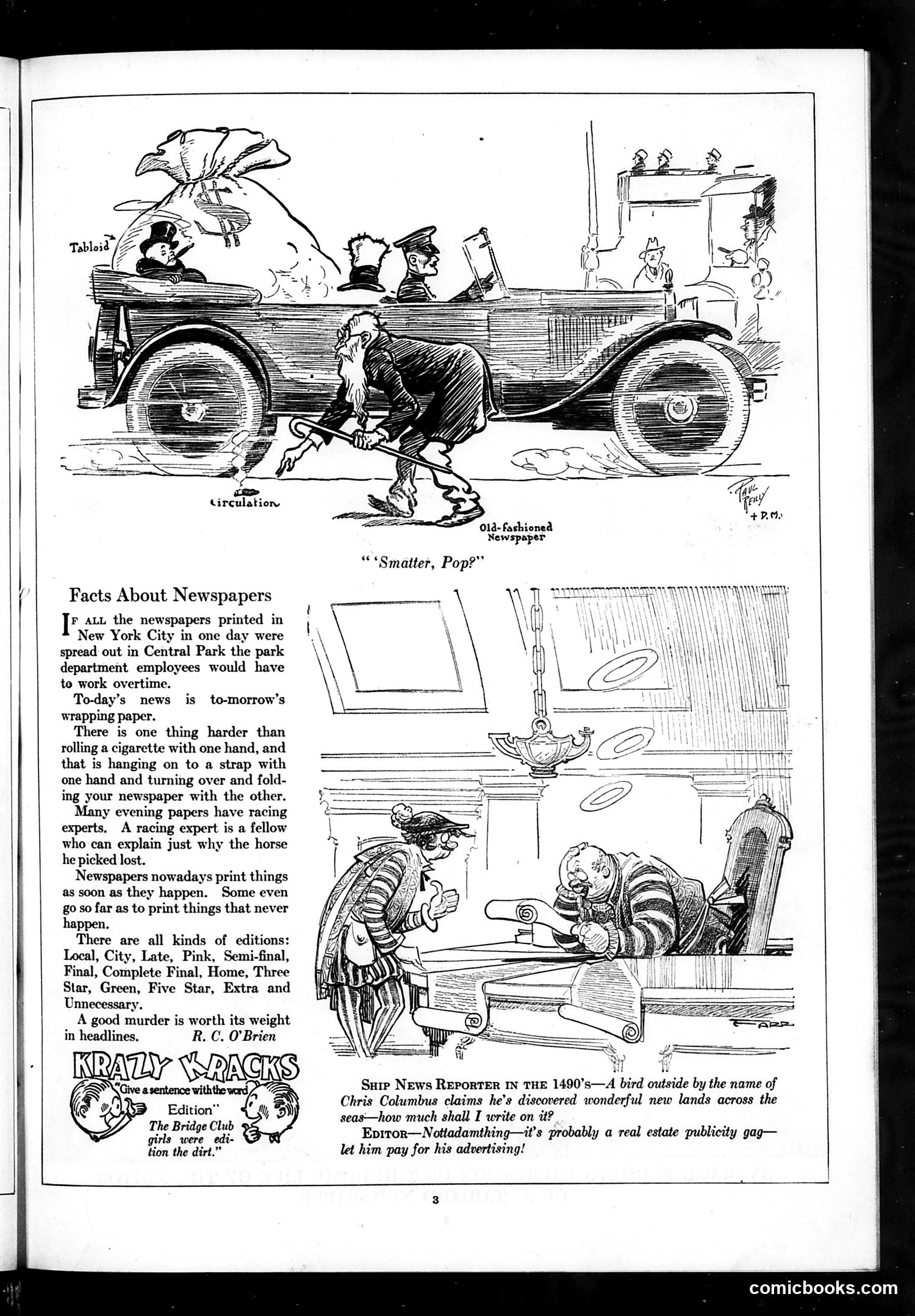
The top cartoon titled "Smatter, Pop?" satirizes newspaper distribution. An elderly man (labeled "Old-Fashioned Newspaper") struggles to pull a heavily-loaded truck filled with papers, while "Circulation" rides inside. The joke: modern newspapers have become so bloated with content and advertising that distribution itself is overwhelming. The accompanying "Facts About Newspapers" section humorously catalogs newspaper industry absurdities—racing editions, multiple versions, the difficulty of handling papers while smoking, and sensationalism. The final item mocks editors accepting dubious stories (like Columbus discovering "new lands") as advertisements. The overall satire critiques early 20th-century newspapers for prioritizing volume, speed, and profit over accuracy and practicality.
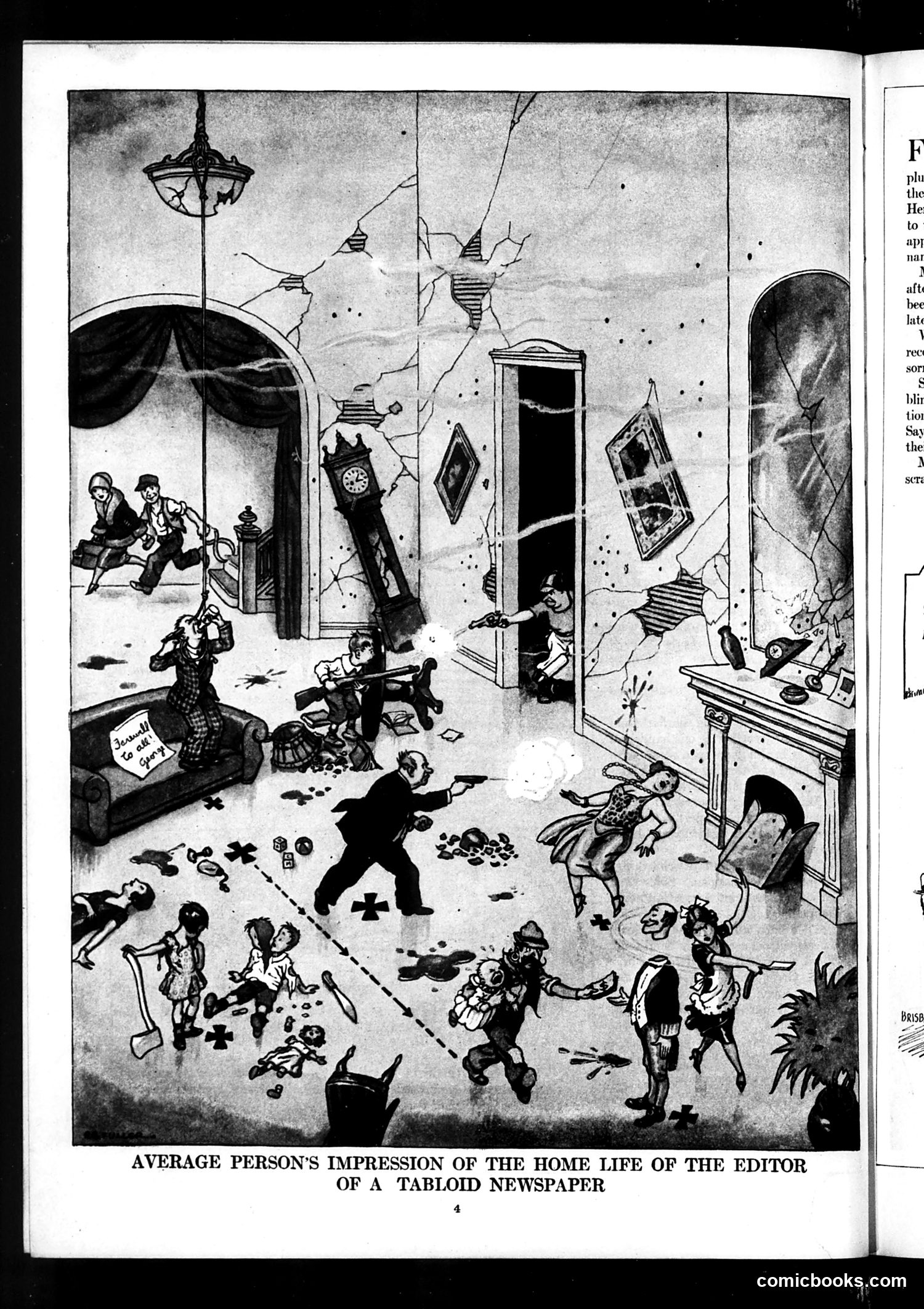
This satirical cartoon depicts the chaotic, frenetic home environment of a tabloid newspaper editor. The image shows a domestic space literally falling apart: objects suspended mid-air, people in disarray, furniture overturned, and general pandemonium throughout. The satire mocks the stereotype that tabloid editors—known for sensationalism and high-pressure journalism—bring that same chaos and disorder into their personal lives. The caption suggests this represents "the average person's impression," implying the public views tabloid editors as living in perpetual bedlam, unable to escape the frenzied nature of their work. This reflects early 20th-century skepticism toward tabloid journalism's credibility and methods.
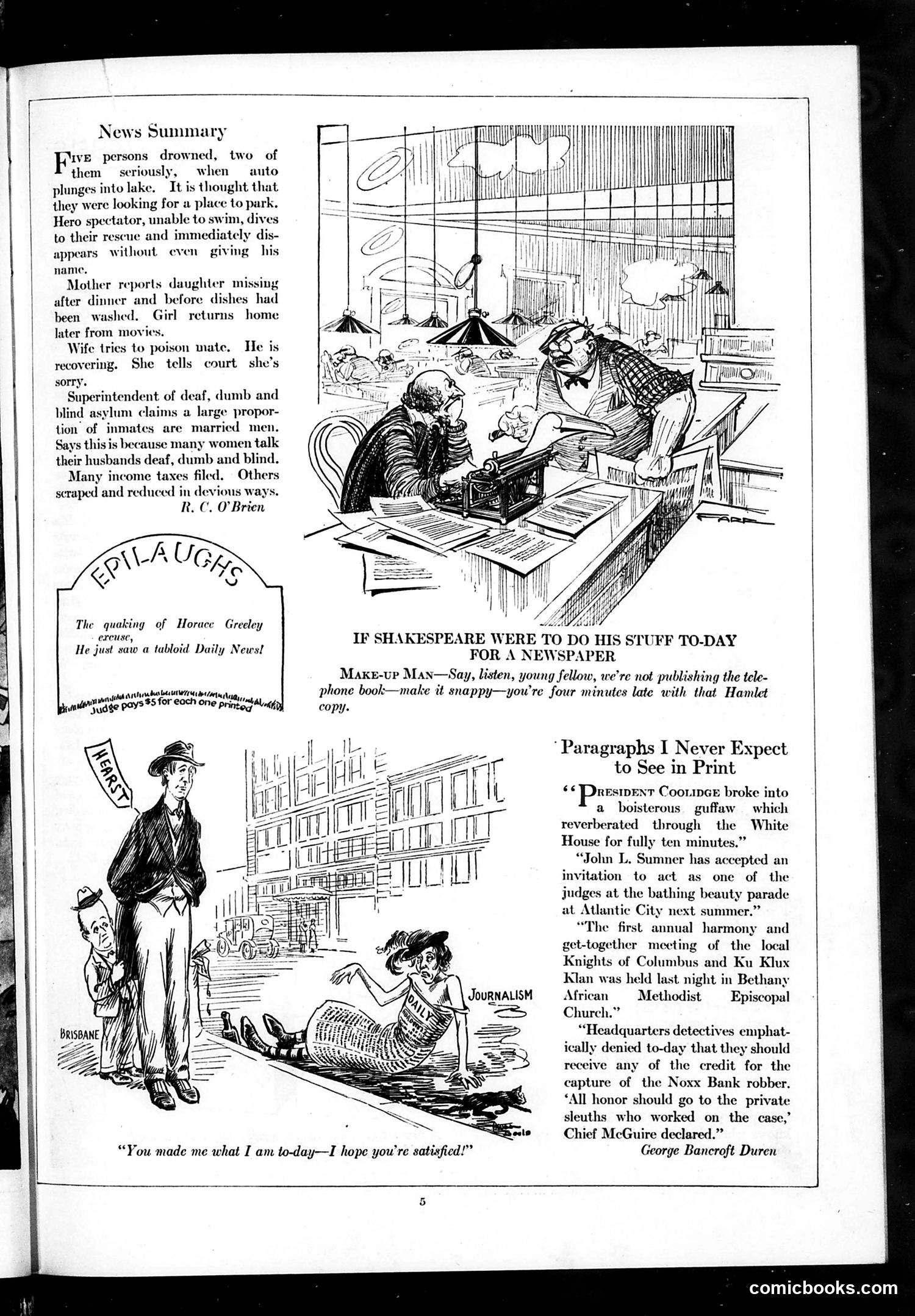
The cartoons and text satirize early 20th-century American journalism and social issues. **Top section ("If Shakespeare Were to Do His Stuff To-Day")**: Mocks sensationalist newspaper culture by imagining Shakespeare reduced to writing tabloid headlines and sensational copy rather than serious literature. The crowded newsroom scene depicts the frenzy of modern journalism. **Bottom cartoon** by Boardane depicts "Journalism" (personified as a disreputable figure) creating "Liberty" as a street urchin, suggesting journalism corrupts rather than protects freedom. The caption "You made me what I am to-day—I hope you're satisfied!" holds journalism responsible for societal degradation. **"Paragraphs I Never Expect to See"**: Satirizes absurd news items, including a Knights of Columbus and KKK "harmony meeting"—likely mocking claims of interfaith cooperation during an era of real tension.
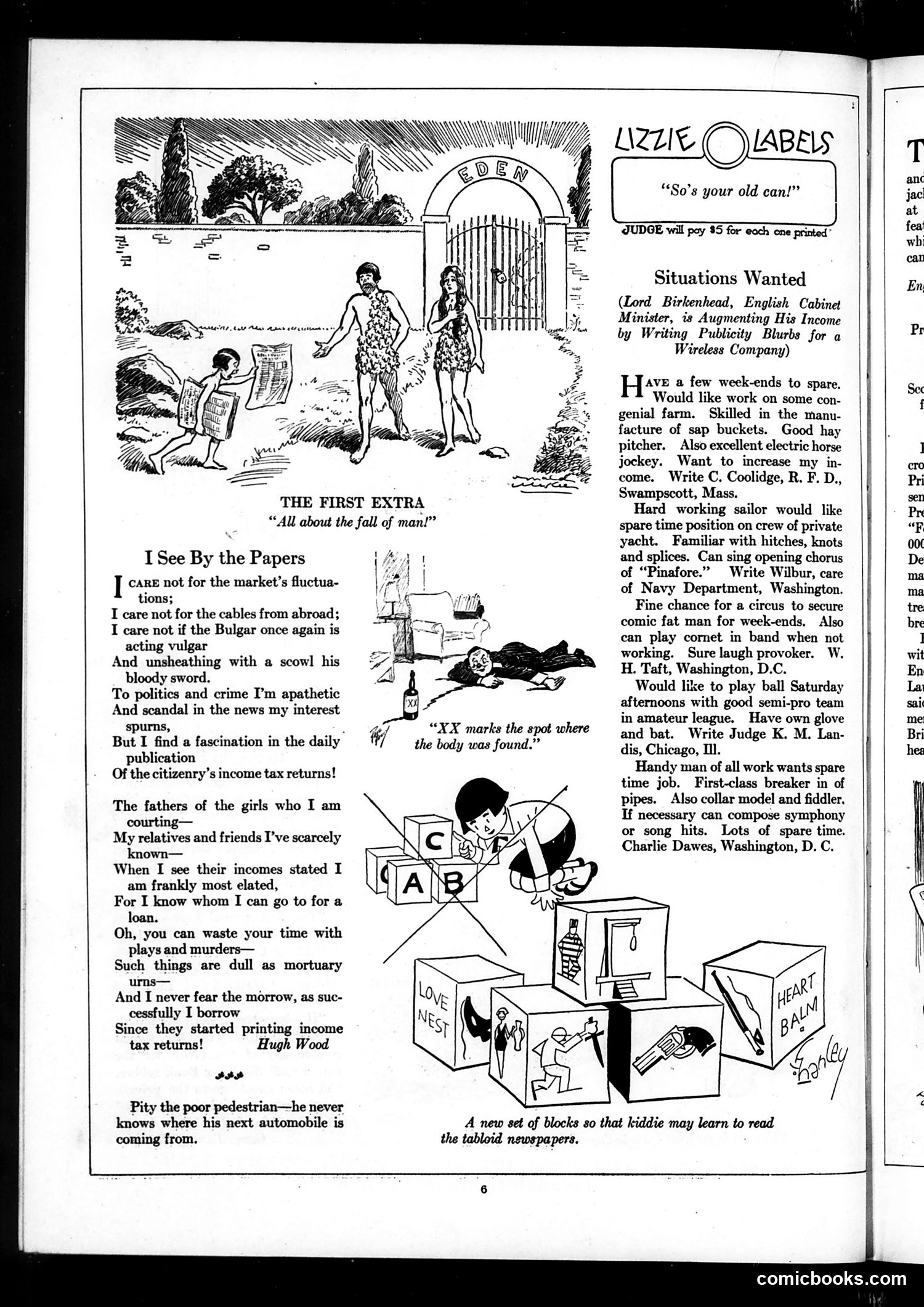
This page satirizes Americans' obsession with income tax returns, a relatively new phenomenon (income tax was reinstated in 1913). The poem mocks how people—supposedly indifferent to politics, crime, and international crises—become genuinely excited only when reading published tax information, using it to identify wealthy acquaintances they can borrow from. The "Situations Wanted" section parodies famous American political figures advertising themselves for side work: Calvin Coolidge (president) doing farm labor, William Howard Taft (former president) performing as a circus performer, and Judge Kenesaw Landis (baseball commissioner) playing semi-pro ball. The joke is that even distinguished public figures need extra income—a jab at either their financial difficulties or America's obsession with money-making. The children's blocks cartoon mocks sensationalist tabloid journalism by suggesting kids should learn to read using block letters spelling out lurid crime scenes—a commentary on tabloids' focus on murders and scandal over substantive news.
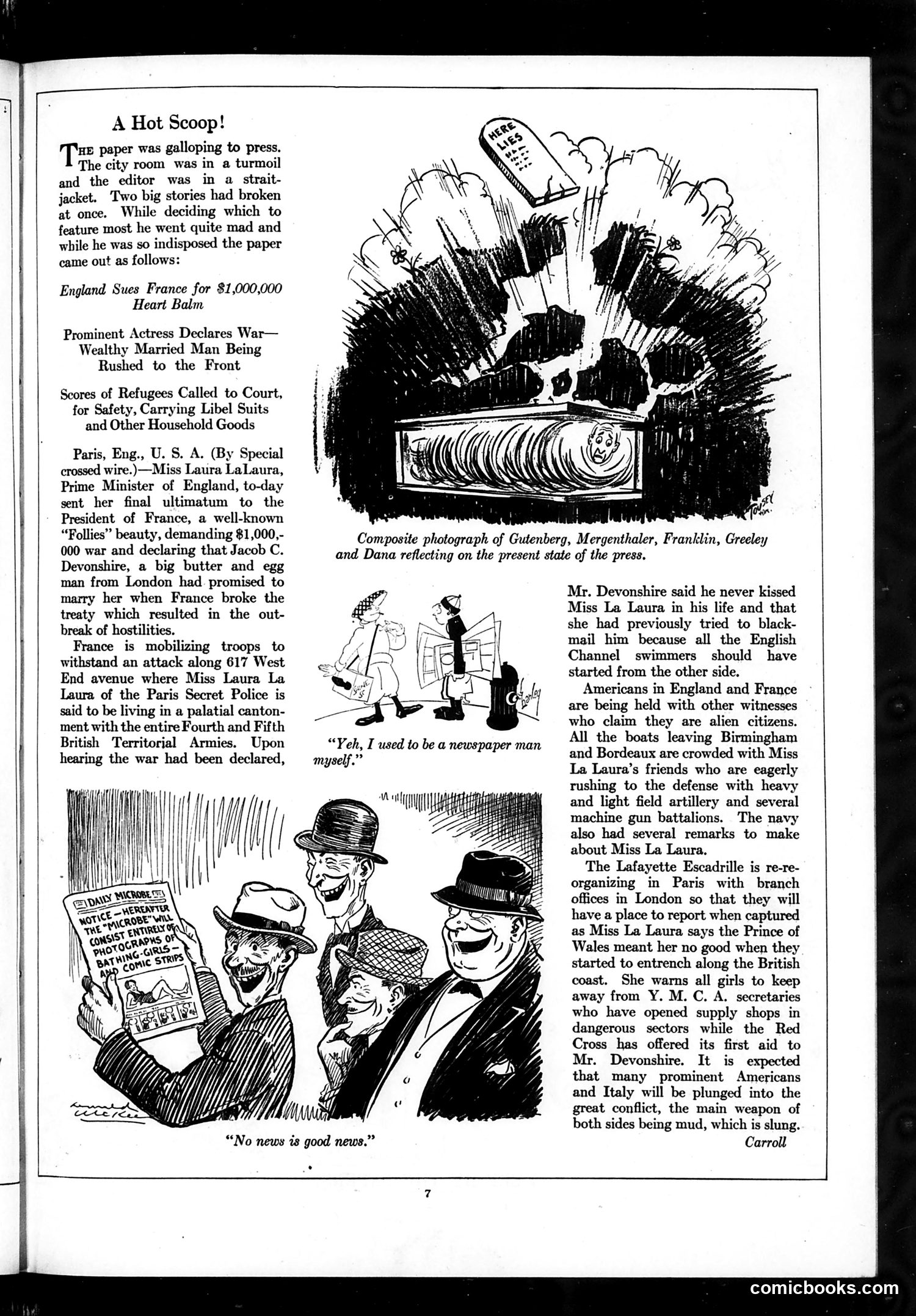
This page satirizes newspaper sensationalism and editorial chaos. The framing story describes a city room in turmoil when two major stories break simultaneously—forcing an unhinged editor to decide which to feature. The result is absurdist fake headlines mixing trivial scandal with WWI coverage. The satire conflates a petty romantic dispute (actress Miss La Laura suing over a wealthy man) with international conflict, imagining England and France mobilizing armies over a love triangle on "617 West End avenue." The joke mocks how papers treat celebrity gossip and war with equal breathlessness. The bottom cartoon shows old newspaper giants (Gutenberg, Franklin, Greeley, Dana) reflecting sadly on modern journalism, with the caption "No news is good news"—suggesting serious journalism has been replaced by sensationalism. The page attacks 1910s-era yellow journalism and tabloid culture overtaking serious news reporting.
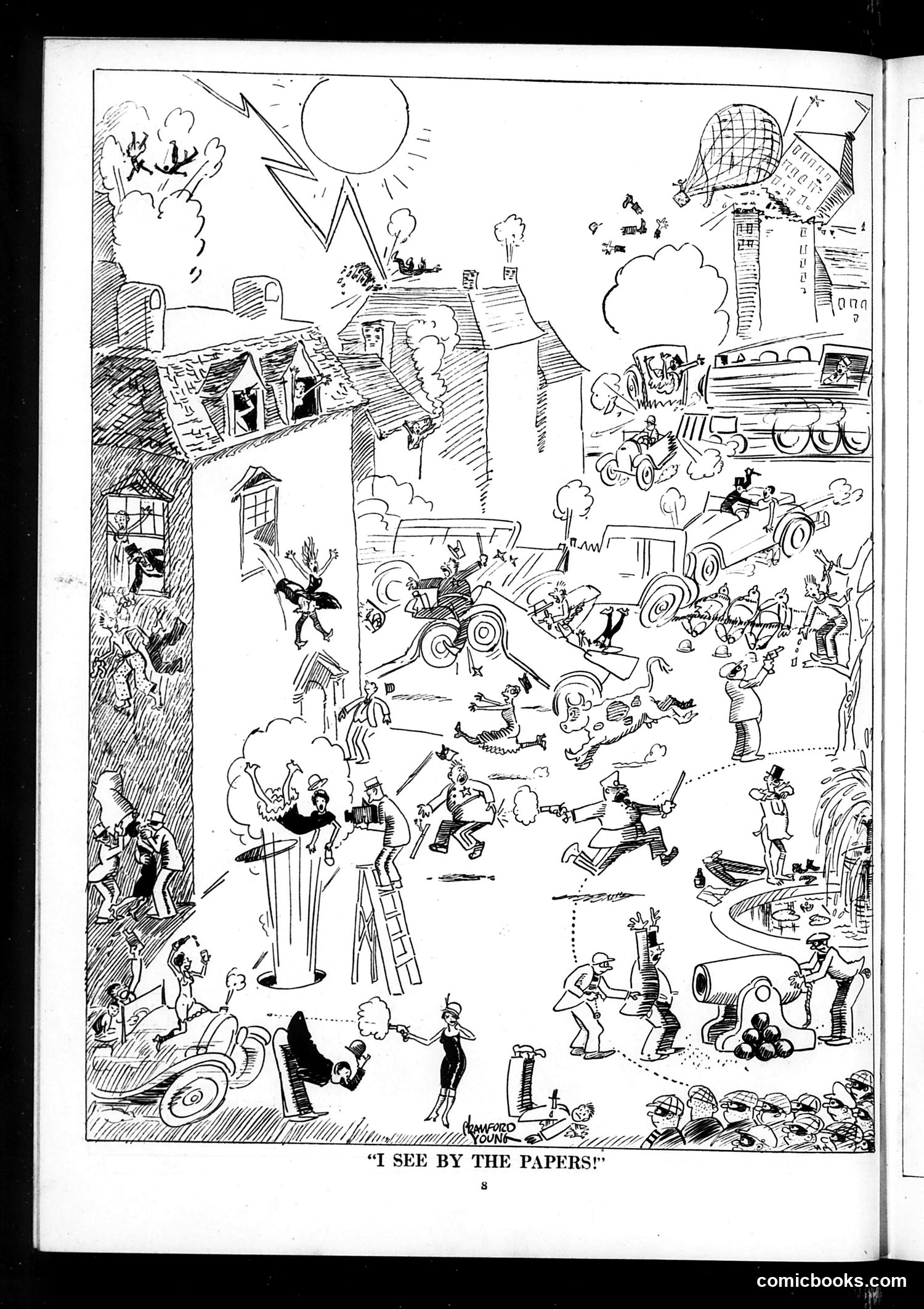
This is a satirical cartoon depicting urban chaos and mayhem. The title "I See By the Papers!" references a common newspaper-reading phrase, suggesting the cartoon comments on sensational crime or scandal reporting. The scene shows a bustling street scene with multiple characters engaged in chaotic activities—vehicles careening, people fighting, figures on ladders, and general pandemonium. The style suggests early-to-mid 20th century American life. The satire likely criticizes either: - Exaggerated newspaper accounts of urban disorder - Actual societal lawlessness and chaos in cities - The public's fascination with sensational crime reporting The dense, frenetic composition emphasizes disorder and confusion. The artist is Rumford Young (signed lower right). The cartoon appears designed to comment ironically on modern urban life through exaggeration.
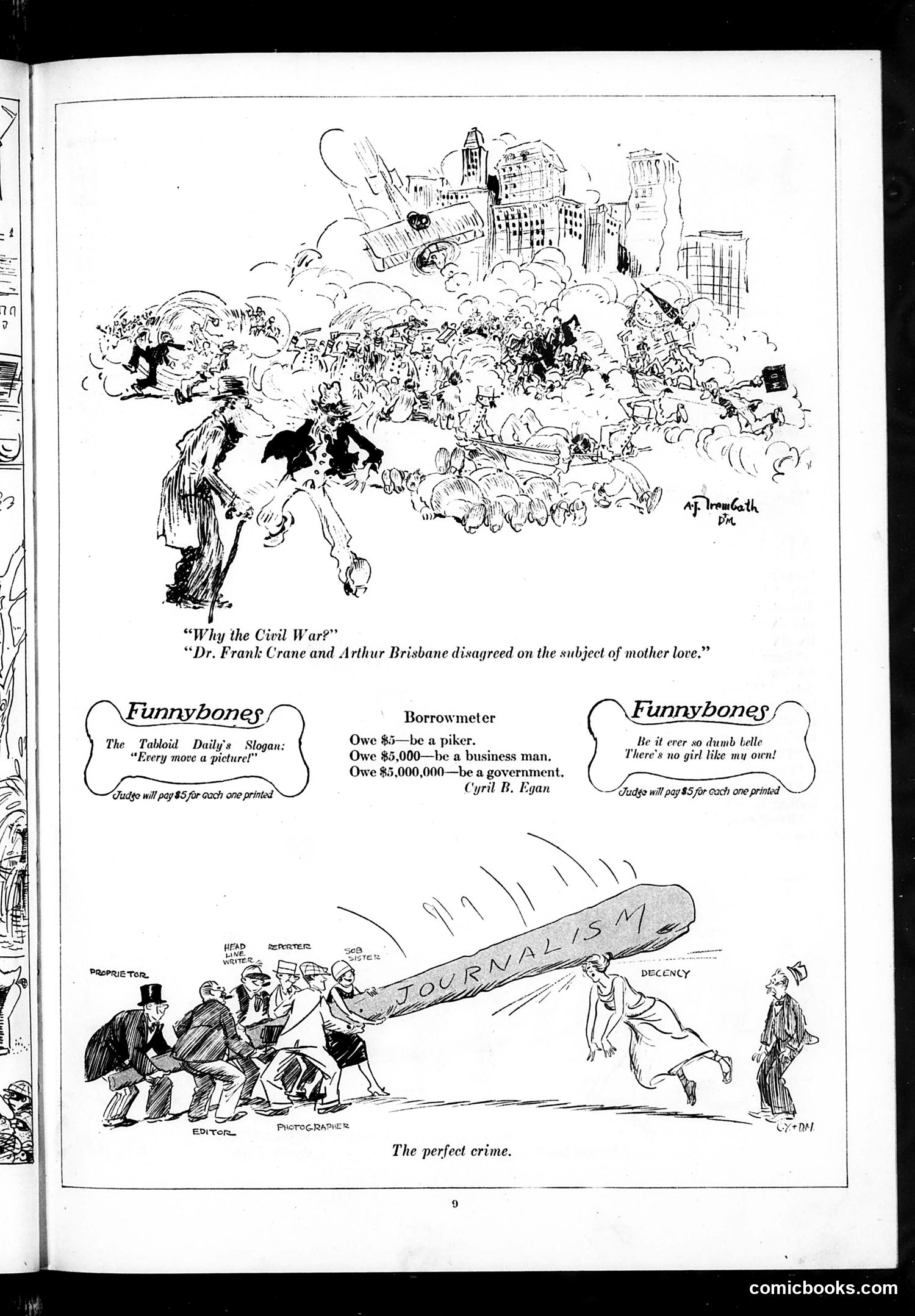
This page contains three separate satirical cartoons mocking early 20th-century American culture. The top cartoon titled "Why the Civil War?" references a contemporary disagreement between **Dr. Frank Crane** and **Arthur Brisbane** (both real public figures) over "mother love"—satirizing how trivial intellectual disputes escalate into major conflicts. The "Funnybon**e**s" section mocks tabloid journalism's sensationalism and class hierarchy: owing $5 makes you a "piker," $5,000 a "business man," and $5,000,000 a "government"—suggesting wealth and power are arbitrarily defined by scale. The bottom cartoon, "The perfect crime," shows newspaper staff (labeled Editor, Photographer, Head Writer, Reporter, Distributor) struggling with a crashed airplane labeled "Journalism." The joke appears to be that destroying the press itself would be the ideal crime—a dark satire on journalism's unpopularity or perceived menace to society at that time.
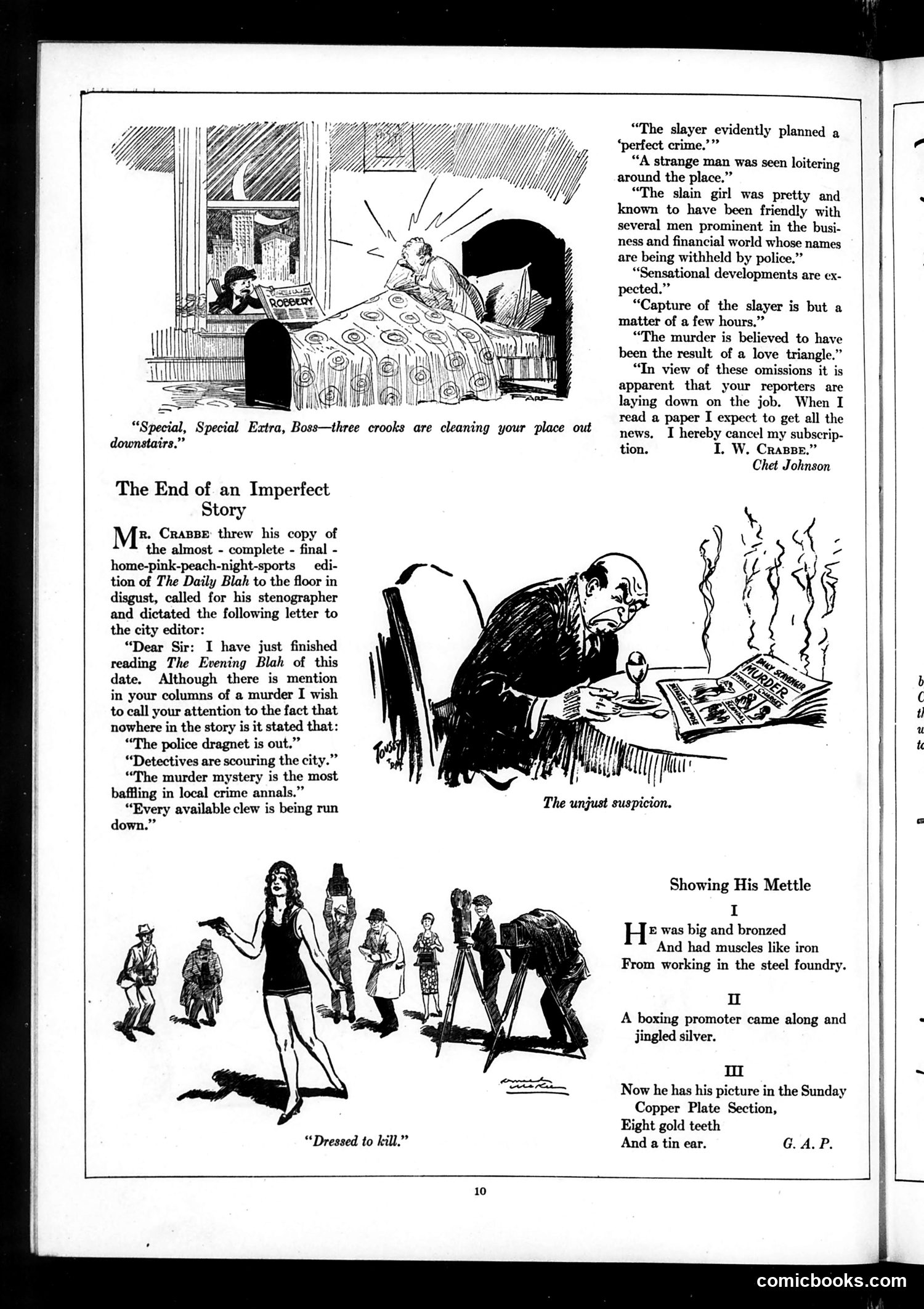
This satire mocks sensationalist newspaper journalism. Editor Mr. Crabbe complains that a murder story in *The Evening Blah* lacks clichéd phrases—"police dragnet," "detectives scouring the city," "baffling mystery"—that readers expect from crime reporting. Rather than criticizing *absent* facts, he demands the *standard melodramatic language* regardless of actual circumstances. The joke targets how newspapers prioritize formulaic excitement over genuine reporting. Crabbe threatens to cancel his subscription because the story failed to deliver predictable sensationalism, exposing how publications pander to readers' appetite for stock phrases and manufactured drama rather than substantive news. The accompanying cartoons satirize social climbers seduced by superficial success: a steel worker gains boxing fame but only "eight gold teeth / And a tin ear," suggesting hollow achievement.
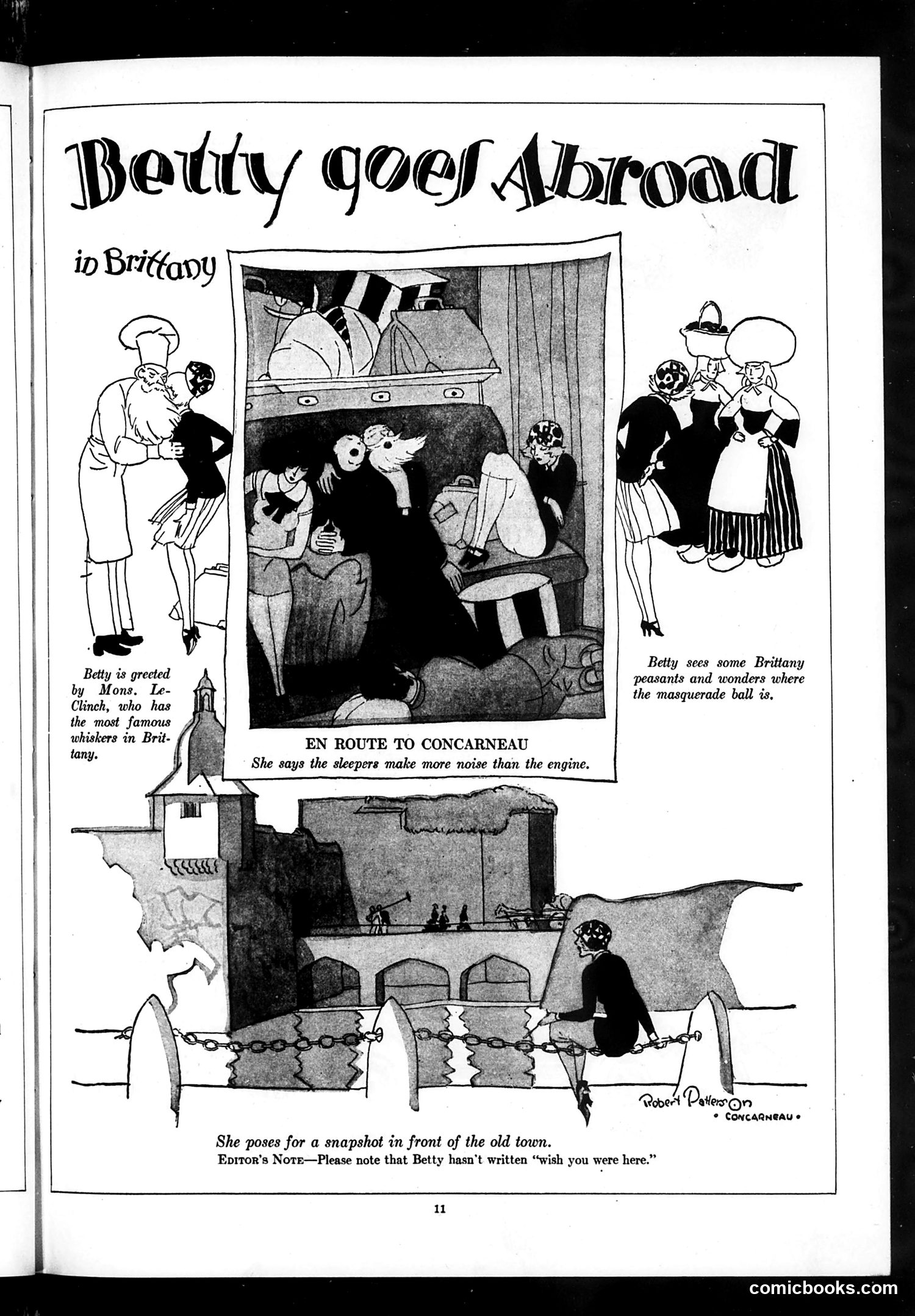
This is a humor comic strip following a character named Betty's travels through Brittany, France. The satire targets several tourist-experience tropes: 1. **Cultural encounters**: Betty meets Monsieur Le-Clinch, identified by his notably large whiskers as a typical Breton character type. 2. **Travel inconveniences**: The joke "sleepers make more noise than the engine" mocks the discomfort of train travel, a common tourist complaint. 3. **Tourist behavior**: Betty poses for photographs at scenic locations—standard vacation clichés. 4. **The editor's note** provides the punchline: Betty hasn't sent postcards saying "wish you were here," satirizing the obligatory postcard-sending tradition of tourists. The comic gently mocks both tourists' predictable behaviors and their tendency to complain about foreign travel experiences while still performing expected vacation rituals.
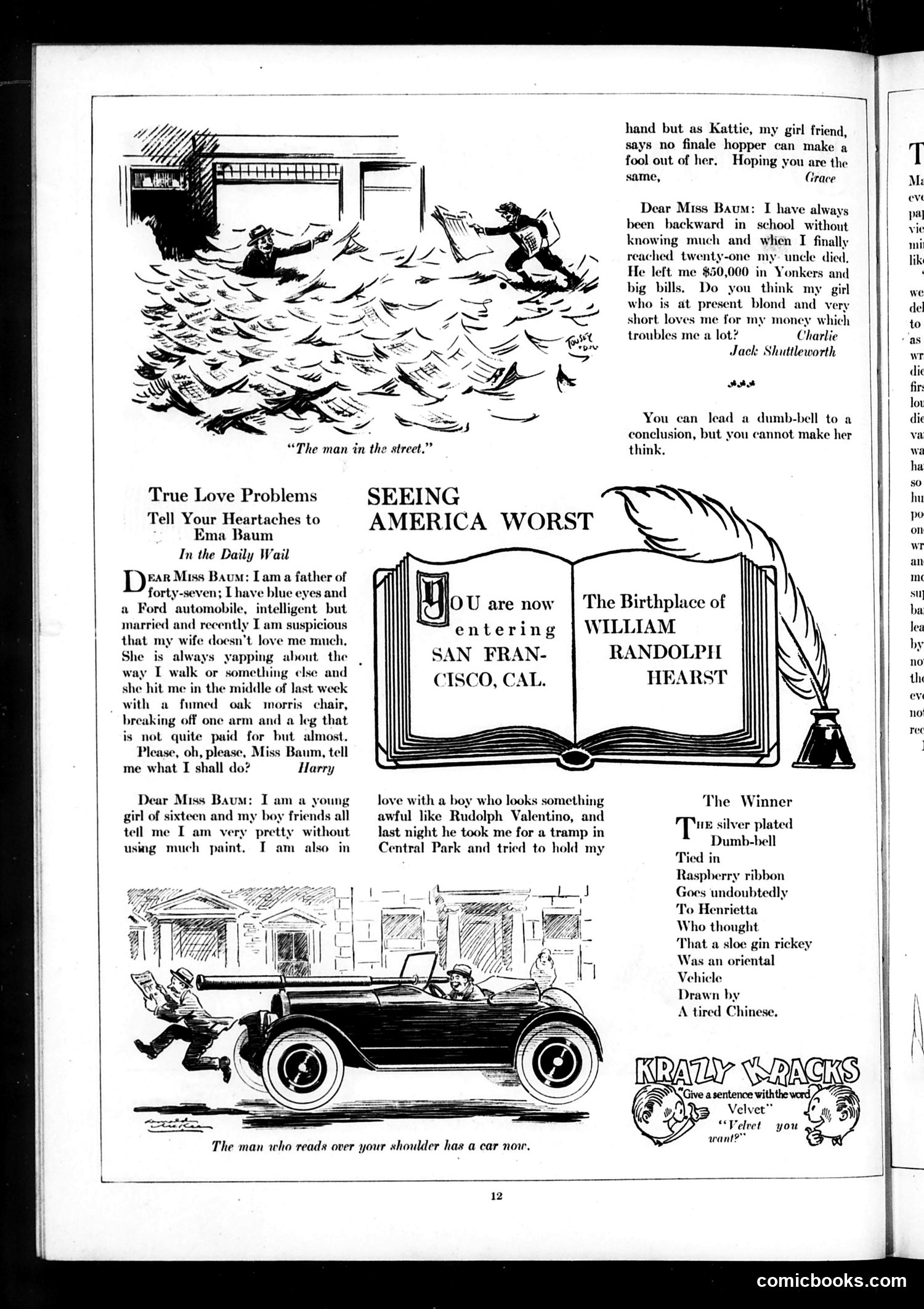
This page satirizes American popular culture and advice columnists circa the 1920s-30s. The "True Love Problems" section mocks the era's advice-column genre through absurd letters: a middle-aged man complaining his wife hits him with furniture, a naive girl worried about a boy resembling Rudolph Valentino (the famous silent-film heartthrob), and a young man anxious his girlfriend only loves his inherited wealth. The cartoons mock consumerism and celebrity culture. "Seeing America Worst" humorously advertises William Randolph Hearst's San Francisco as a tourist destination—likely satirizing Hearst's media empire and self-promotion. The automobile cartoon jokes that reading over someone's shoulder has become so common it's assumed everyone now owns a car. The "Krazy Kracks" word puzzle and "dumb-bell" award are typical period humor features, mocking both the intellectually lightweight nature of such entertainment and the vapid materialism of modern youth.
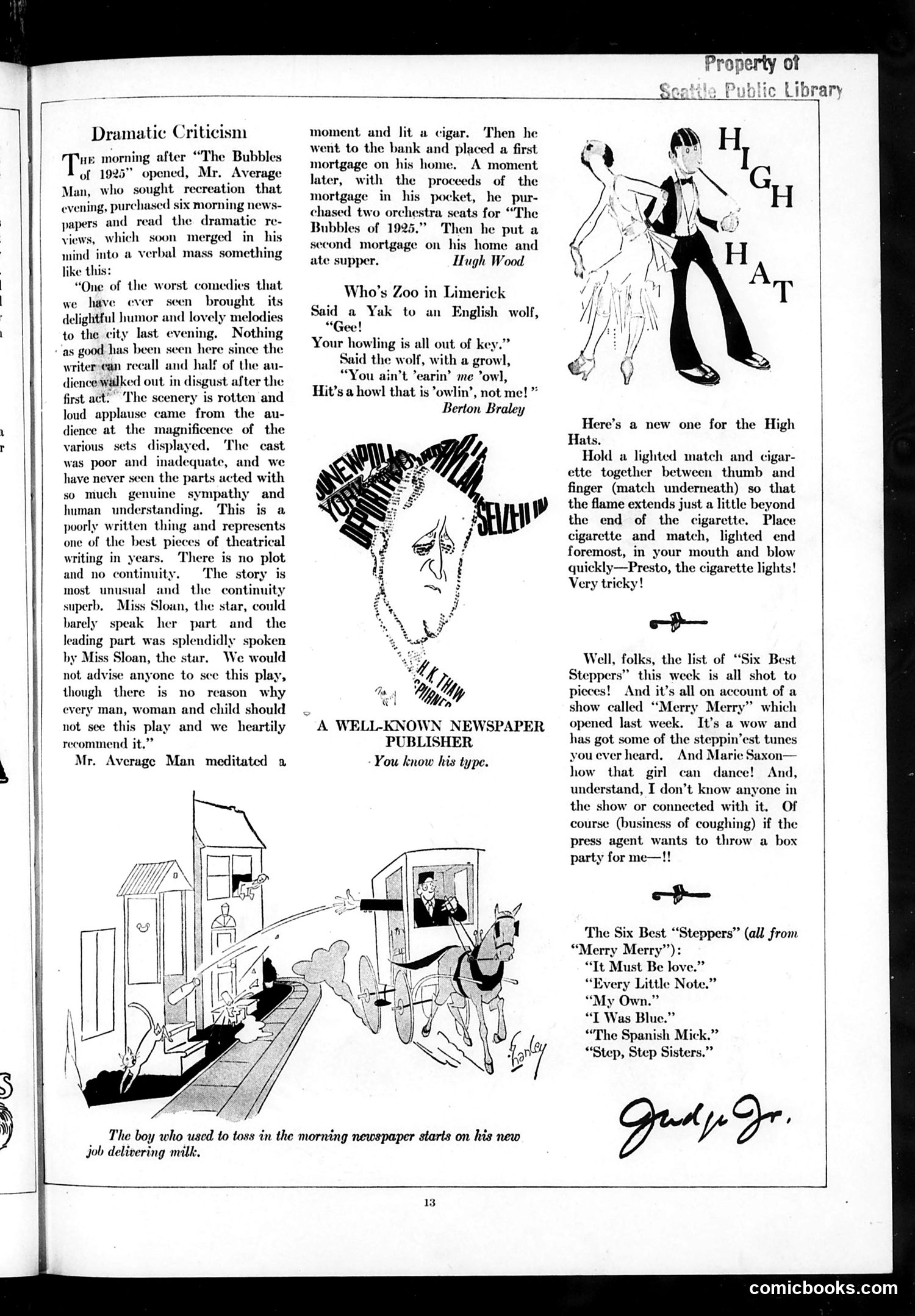
This page satirizes **theatrical review contradictions**. The main piece mocks how newspapers publish mutually contradictory reviews of the same play—one calls it "worst," another "best"; scenery is simultaneously "rotten" and "magnificent." An average man reads six papers and finds this verbal mess so confusing that he impulsively mortgages his house twice to see the show anyway. The satire targets both critics' inconsistency and the public's susceptibility to hype. Secondary content includes light humor: a limerick about animals, a parlor trick for "high hats" (society people), and a music column. A cartoon shows a former newspaper boy now delivering milk—possibly commenting on career transitions or social mobility. The "well-known newspaper publisher" caricature appears designed to mock press types generically, though the specific individual is unclear without additional context.
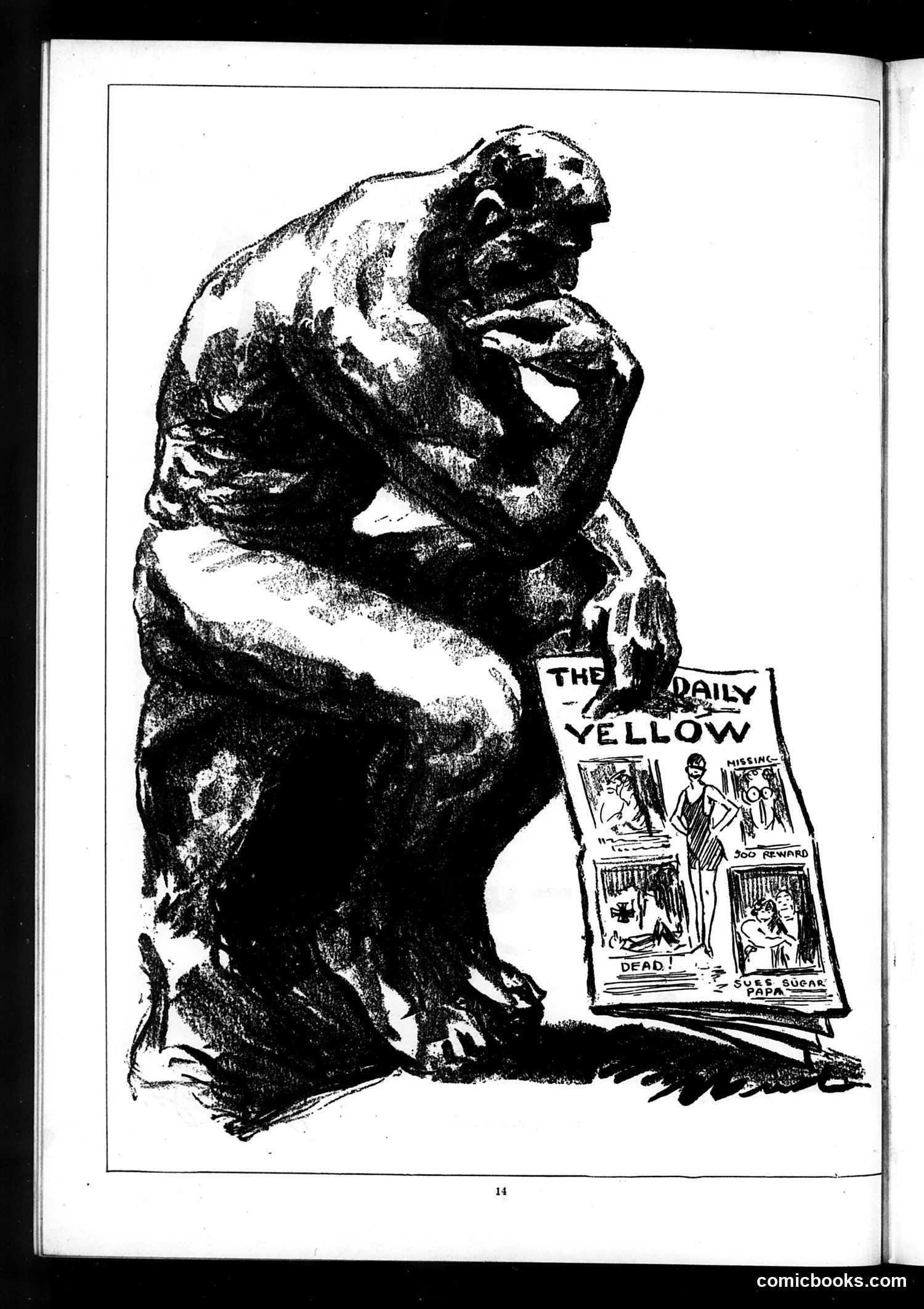
This is a political cartoon from *Judge* magazine featuring a caricatured ape-like figure reading "The Daily Yellow" newspaper. The figure appears designed as racist commentary, though the specific political target is unclear from the image alone. The cartoon likely satirizes "yellow journalism"—sensationalist newspaper reporting—by depicting a grotesque figure engaged with such a publication. The exaggerated, simian features suggest the cartoonist was making a dehumanizing visual argument about readers or producers of sensationalist media. The newspaper shown contains panels about missing persons and rewards, typical tabloid fare. Without additional context about the publication date and specific events referenced, the precise political target remains uncertain, though the work reflects the era's problematic racial caricature conventions common in American satire of that period.
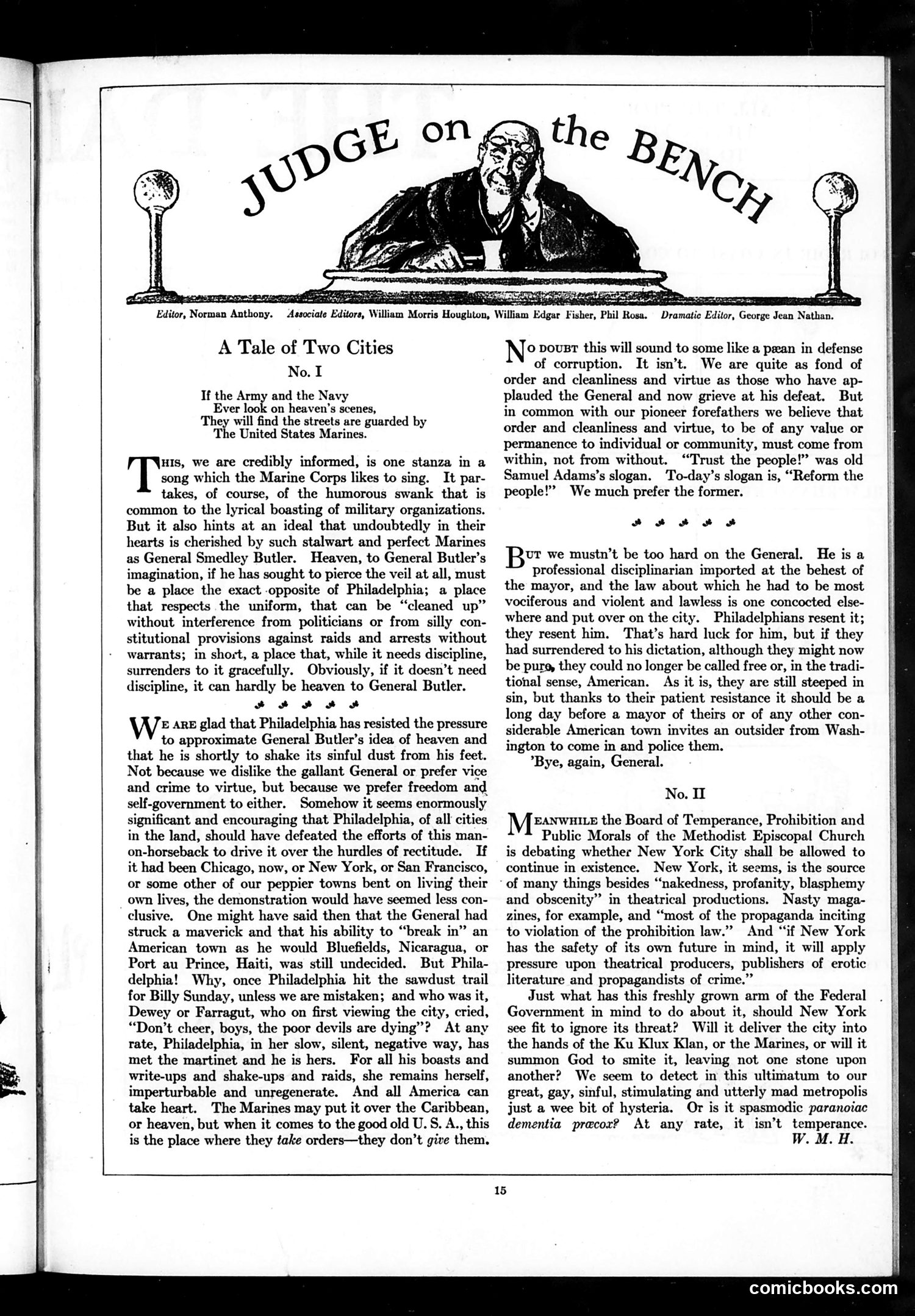
This editorial cartoon satirizes **General Smedley Butler**, a decorated Marine officer who served as Philadelphia's police chief and attempted to impose strict military discipline on the city. The piece celebrates Philadelphia's resistance to his authoritarian reform efforts. The satire's point: Butler represents militaristic "man-on-horseback" governance—imposing order through force rather than allowing communities self-government. Judge praises Philadelphia for rejecting his agenda, arguing that lasting virtue must come "from within, not from without," echoing Founding Father Samuel Adams's principle of trusting the people. The editorial acknowledges Butler's professionalism but sides with democratic freedom over imposed discipline. It's notably sympathetic to Butler personally while opposing his methods—a nuanced critique of authoritarianism dressed as reform. The Marine Corps marching song opening establishes Butler as emblematic of military culture's hierarchical values. This reflects Progressive-era anxieties about strongmen consolidating power under reform rhetoric.
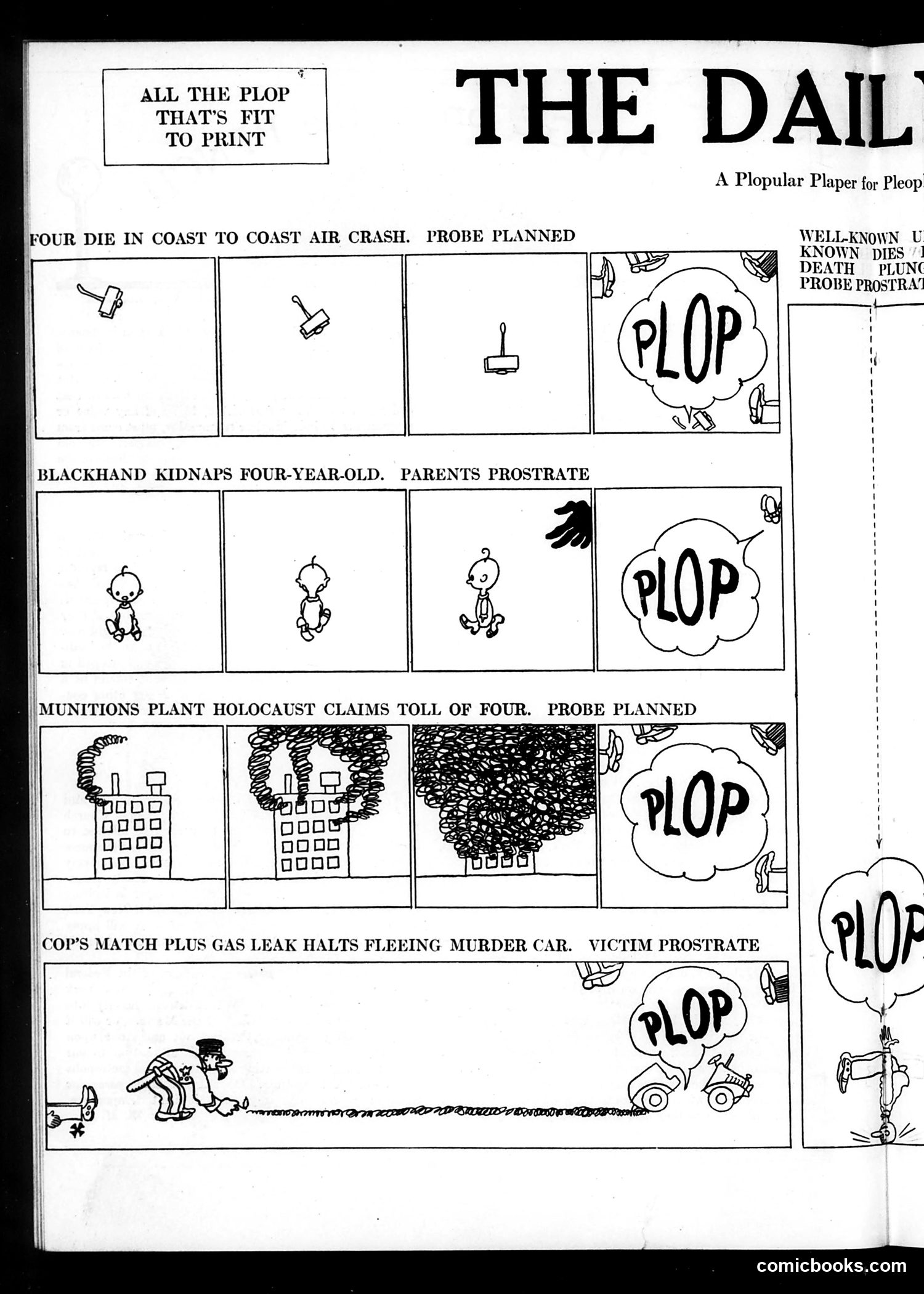
This is a parody newspaper page mocking sensationalist tabloid journalism. The publication's name—"The Daily Plop"—is itself the joke, playing on serious newspapers while suggesting trivial or worthless content ("plop"). Each comic strip adapts genuine tragic headlines into absurdist humor: air crashes, kidnappings, and murders all climax with the word "PLOP"—a sound effect representing the story's literal and figurative collapse into insignificance. The masthead's tagline ("A Plopular Plaper for Pleop") further ridicules tabloids' pretense of public service. By reducing serious crimes and disasters to punchlines, Judge satirizes how mass media sensationalizes tragedy for profit, treating human suffering as disposable entertainment. The recurring "PLOP" becomes a critique of journalism that reduces complex catastrophes to empty spectacle.
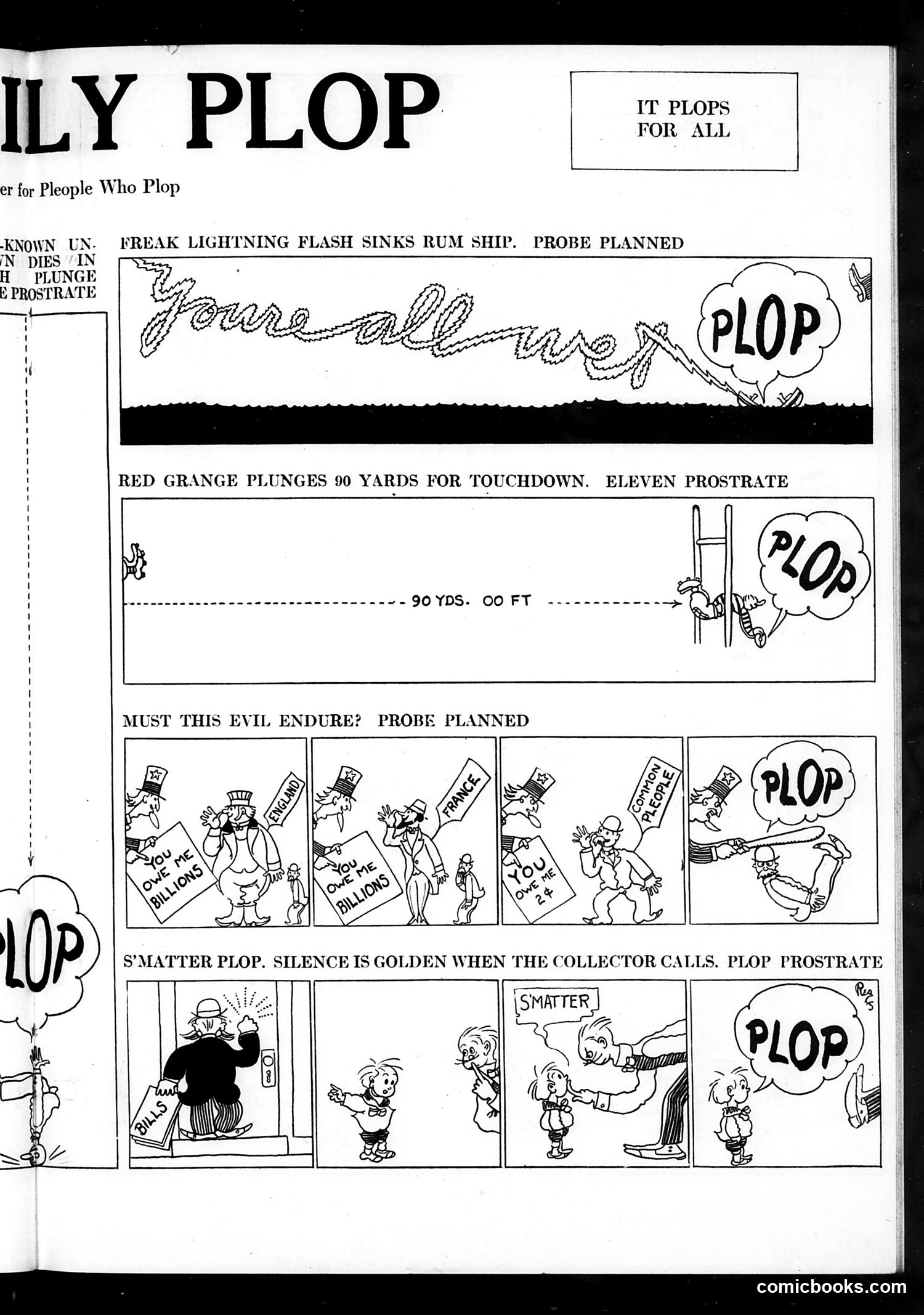
This page satirizes financial scandals and corruption through multiple comic strips titled "IT PLOPS FOR ALL." The recurring "PLOP" sound effects mock the repeated collapse of schemes or revelations. The cartoons appear to reference: 1. **"Freak Lightning Flash Sinks Rum Ship"** – likely mocking a shipping disaster or insurance fraud, with "rum" possibly suggesting smuggling/Prohibition-era bootlegging. 2. **"Red Grange Plunges 90 Yards"** – references football star Red Grange, satirizing celebrity endorsements or financial ventures. 3. **"Must This Evil Endure?"** – depicts figures with signs reading "owe you billions," suggesting debt crises or financial malfeasance affecting the public. 4. **"Smatter Plop"** – shows a collector calling while someone remains silent, satirizing debt collection and financial evasion. The overall theme mocks repeated financial collapses, fraudulent schemes, and public scandals where wealthy or prominent figures repeatedly "plop" (fail spectacularly), with consequences for ordinary people.
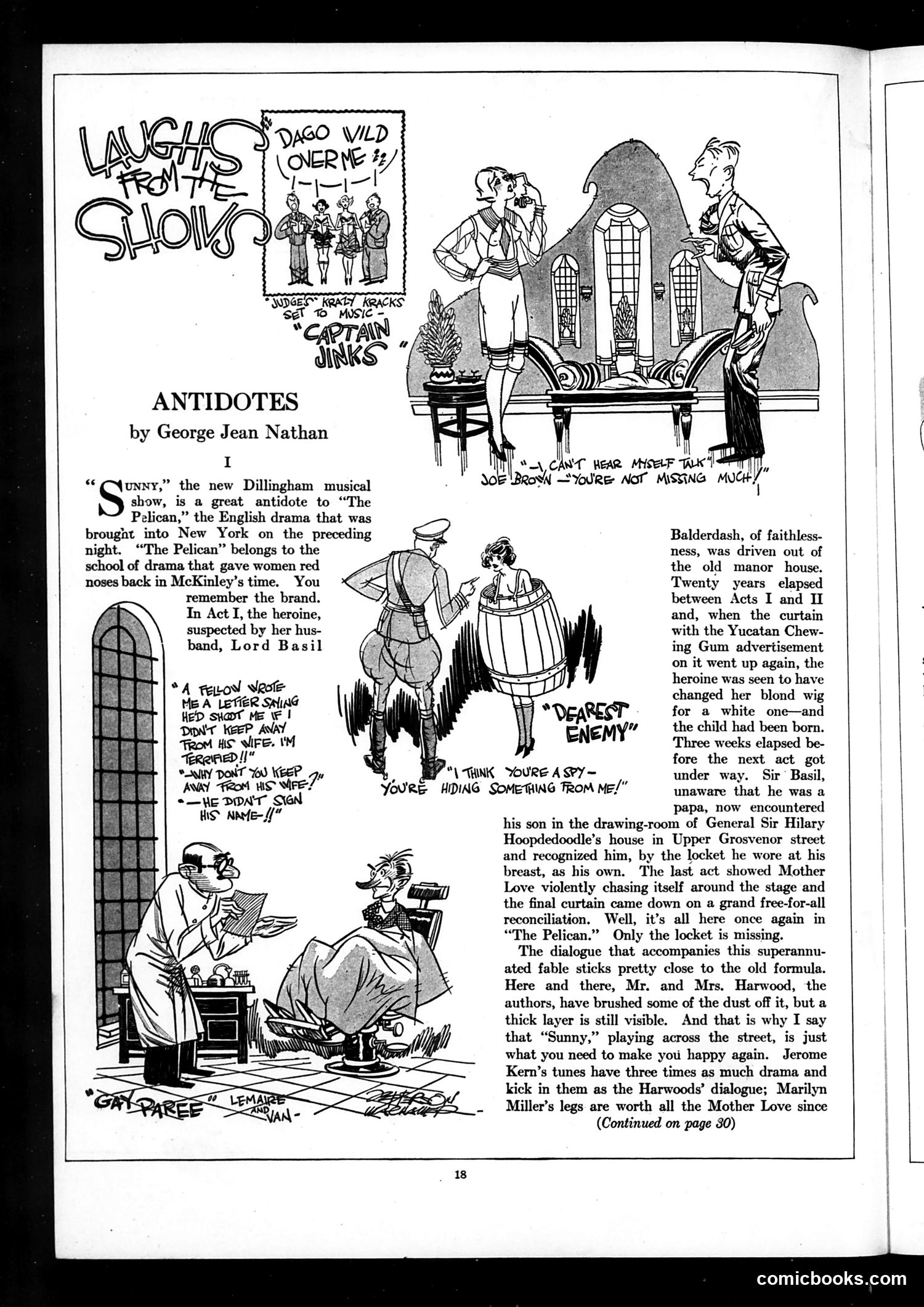
This theater criticism column contrasts two Broadway shows. Nathan reviews "The Pelican," an old-fashioned English melodrama featuring hackneyed plot devices: a wrongly-suspected heroine, separation, a hidden child revealed by a locket, and overwrought "Mother Love" reconciliation. He satirizes its absurdity—including a twenty-year gap between acts and a Chewing Gum advertisement on the curtain. Nathan positions "Sunny," a new musical comedy by Dillingham, as the antidote—lighter relief from such tired dramatics. He credits composer Jerome Kern's catchy tunes and performer Marilyn Miller's dancing as superior entertainment to the Harwoods' stale dialogue. The cartoons illustrate these contrasting theatrical styles: melodramatic confrontations versus comedic lightness. Nathan's point: audiences need contemporary musical comedy to escape recycled Victorian dramatic formulas.
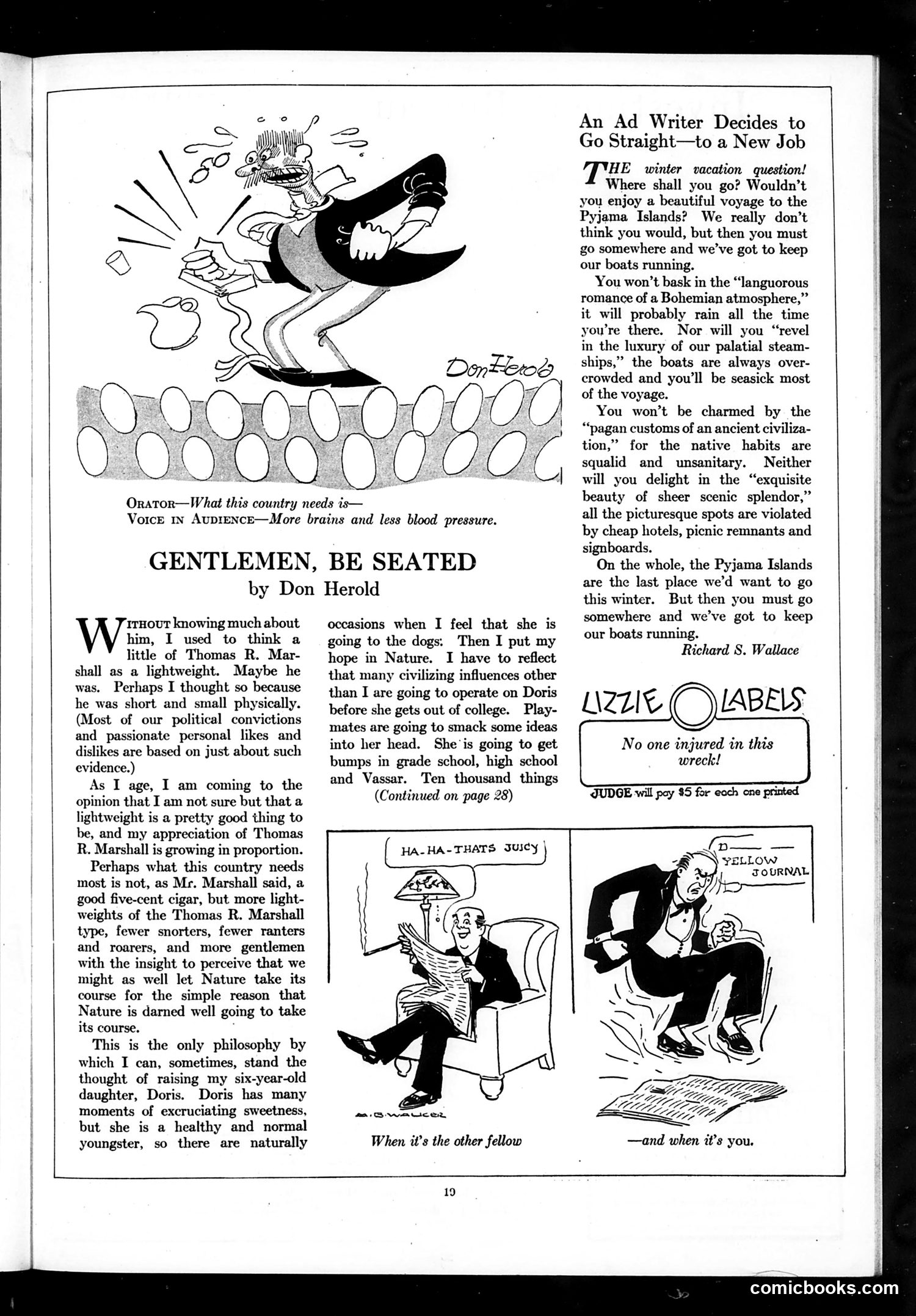
**Main Article ("Gentlemen, Be Seated"):** Don Herold's essay praises Vice President Thomas R. Marshall as a "lightweight"—literally and philosophically. Marshall famously said the country needed "a good five-cent cigar." Herold argues for more calm, measured men like Marshall rather than bombastic politicians ("ranters and roarers"). He uses his own daughter Doris as an example of trusting nature's course rather than constant intervention. This is a defense of understated leadership during what appears to be a more contentious political era. **"Ad Writer" Section:** A satirical advertisement for the "Pyjama Islands" vacation destination that deliberately contradicts typical travel advertising. Instead of promising romance and beauty, it honestly admits: rain, overcrowding, sickness, squalid natives, and cheap hotels. The joke is the advertiser's brutal honesty—they need customers to keep boats running, so admits the destination is unappealing. **Cartoon at bottom:** Shows a man's reaction when it's "the other fellow" versus "when it's you"—mocking how people find misfortune funny when it happens to others.
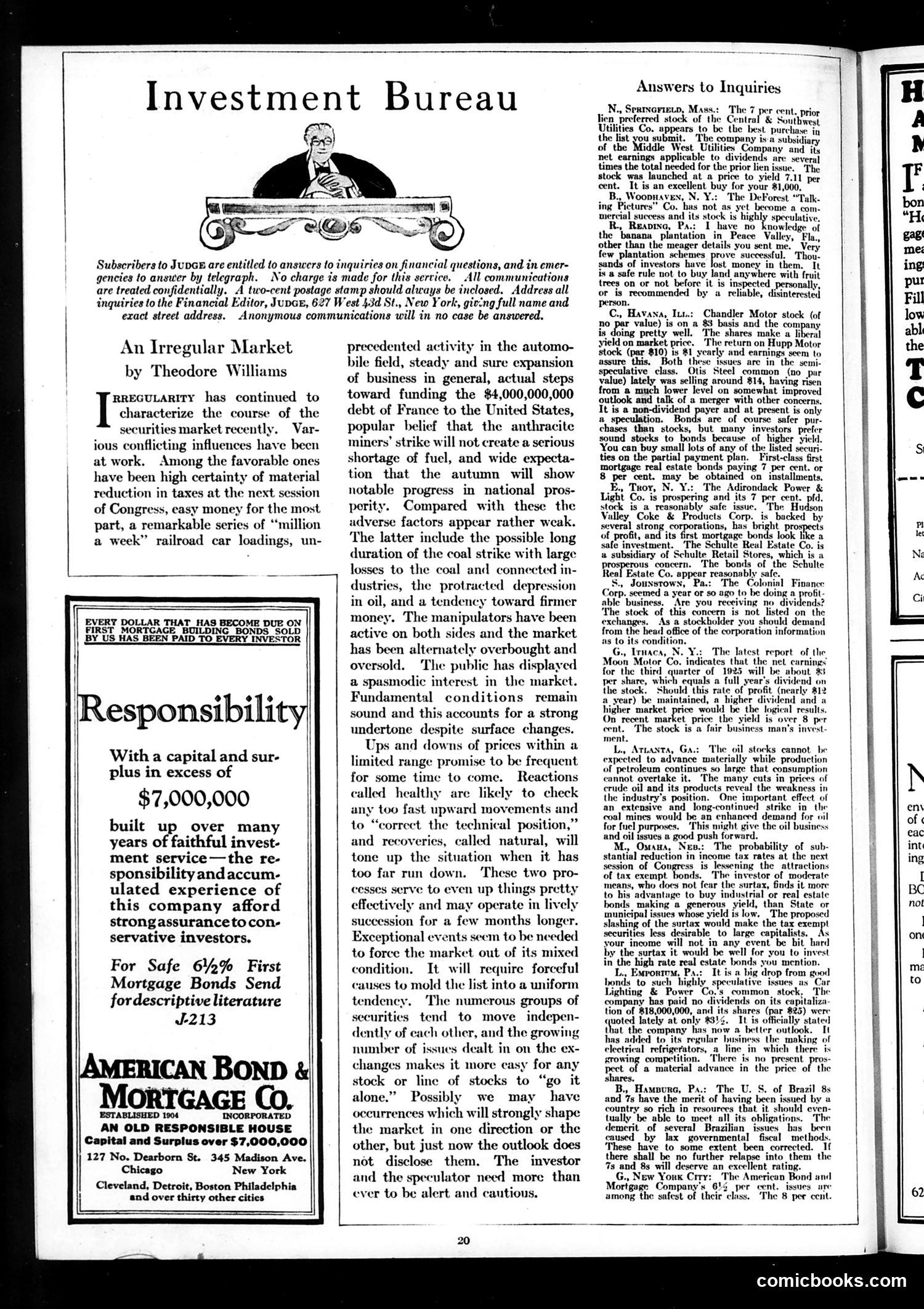
This page is primarily **financial content and advertising**, not political satire. The main illustration shows a man at a desk labeled "Investment Bureau"—this represents Judge magazine's financial advice service, where subscribers could submit questions about stocks and bonds confidentially. The article "An Irregular Market" by Theodore Williams analyzes stock market conditions in what appears to be the early 1920s, discussing competing economic factors: favorable influences (railroad growth, automobile expansion, French debt funding, labor peace hopes) versus negative ones (coal strikes, oil depression, tight money). The large advertisement for **American Bond & Mortgage Co.** emphasizes financial responsibility and safety—key selling points during economically uncertain times. The "Answers to Inquiries" section contains reader questions about specific stocks and bonds. Overall, this reflects Judge's role as a publication for educated, affluent readers interested in investment advice alongside its satirical content.
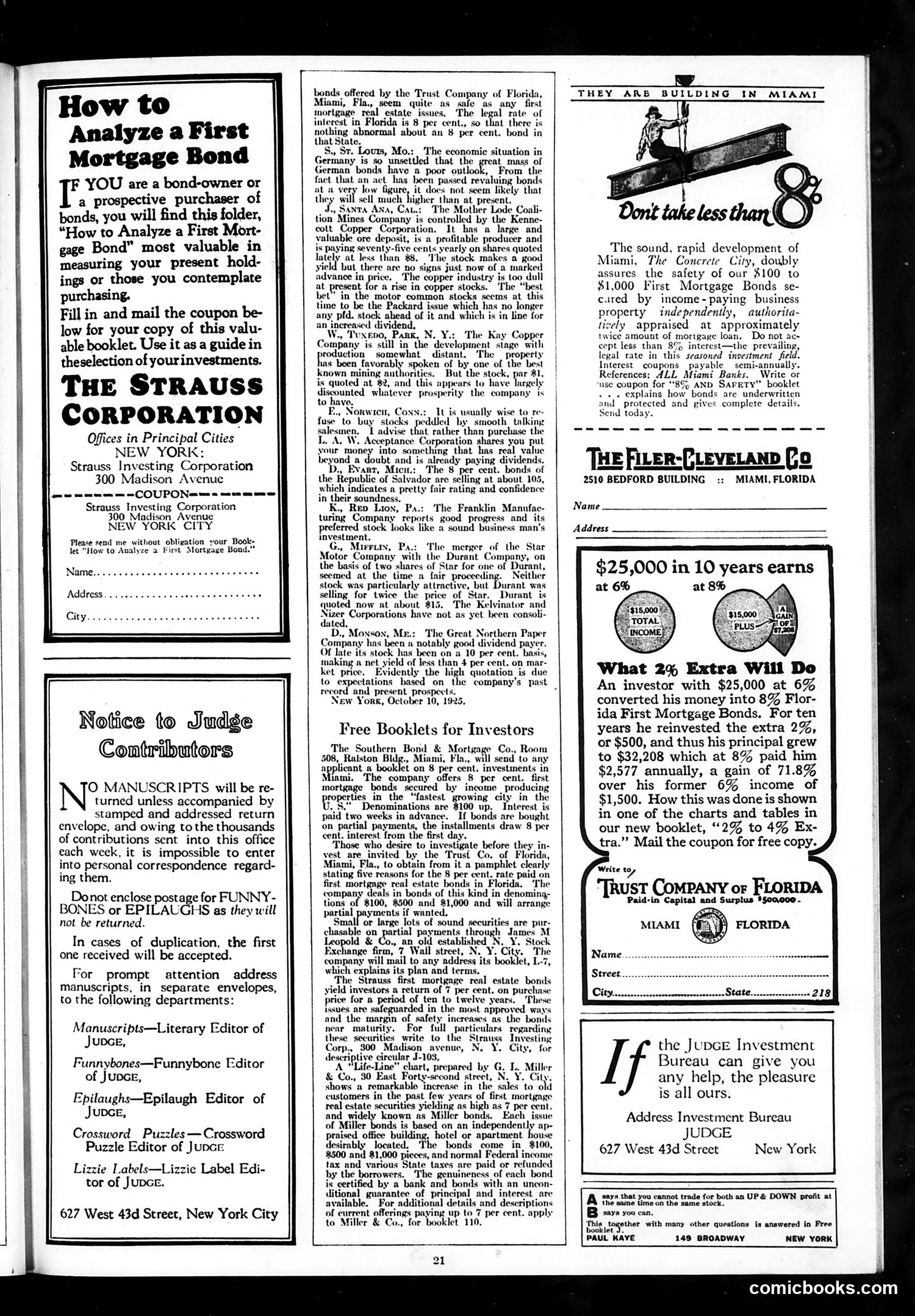
This page is primarily **financial advertising and advice content**, not political satire. The main elements include: **Advertisement Section**: The Strauss Corporation promotes a booklet on analyzing mortgage bonds, targeting investment-minded readers during what appears to be the early 1920s economic period. **"Notice to Judge Contributors"**: Editorial guidelines for manuscript submissions to the magazine. **Investment Advice Column**: The bulk of the page contains financial counsel addressing reader queries about various stocks and bonds—German bonds, copper stocks, motor company shares, and South American securities. The advice is conservative, cautioning against risky speculation and salesmen's pitches. **Context**: This reflects 1920s investment culture when bonds and stocks were marketed to middle-class Americans. The emphasis on "safe" investments and warnings against "smooth talking salesmen" suggest post-war economic uncertainty and perhaps memories of earlier market volatility. No political cartoons or satire are visible on this page.
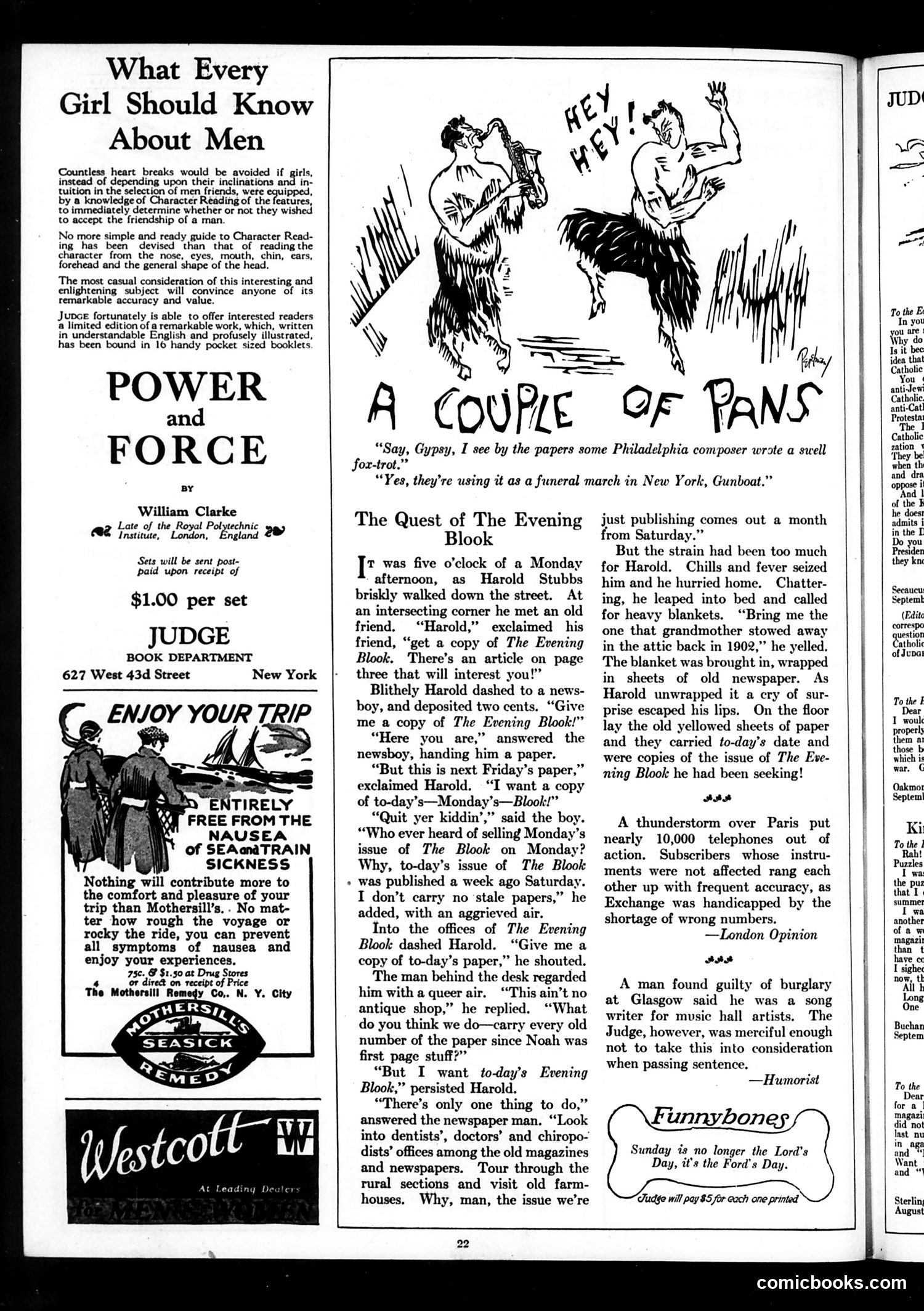
**The Cartoon** shows two men (depicted as caricatured figures, possibly representing stereotypical characters) enthusiastically playing what appears to be kitchen cookware as musical instruments, with "HEY! HEY!" exclamations. The joke mocks a Philadelphia composer's recent work, suggesting it's so bad that New Yorkers are using it as a funeral march—implying the music is dirge-like and unmemorable. **The Story** satirizes newspaper publishing delays. Harold Stubbs tries buying "today's" newspaper but discovers publications are so delayed that Monday's paper won't be published until a month later—it's already stale by distribution. The absurdist humor critiques slow newspaper production cycles of the era. Harold's frustration escalates comically, eventually leading him to illness. The story pokes fun at print journalism's inherent lag versus readers' expectations of timely news.
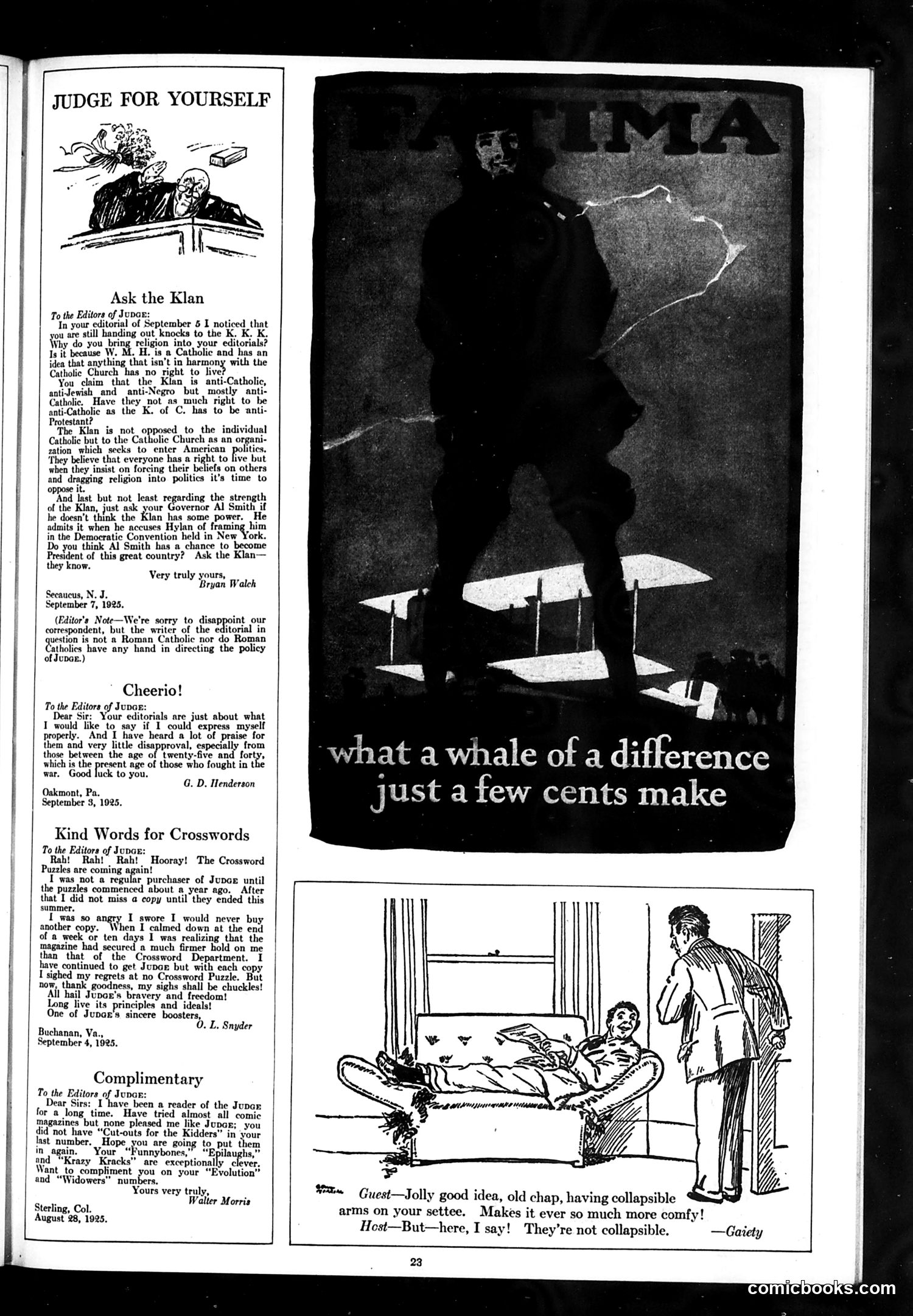
This page contains readers' letters and two separate cartoons from *Judge* magazine (1925). **"Ask the Klan" Letter:** A reader defends the KKK, arguing it's not anti-Catholic but anti-Catholic *institution* (conflating the organization with the Church). The editor responds that *Judge* is independently critical—its writer isn't Catholic. This reflects the genuine 1920s controversy: the KKK was explicitly anti-Catholic, anti-Jewish, and anti-Black, while also claiming to defend "American" values. The letter reveals how some contemporaries rationalized Klan membership. **Governor Al Smith Reference:** Alludes to 1920s Democratic politics where Al Smith (a Catholic) faced KKK opposition and convention complications—historically significant context for anti-Catholic prejudice in American politics. **Bottom Cartoon:** A simple domestic joke about a settee (couch) where a guest misinterprets the host's posture as intentional collapsible armrests, when they're actually just relaxing. No political content—pure light humor, typical of *Judge's* entertainment value. The page illustrates how mainstream magazines engaged with serious social division (the Klan) while also providing escapist humor.
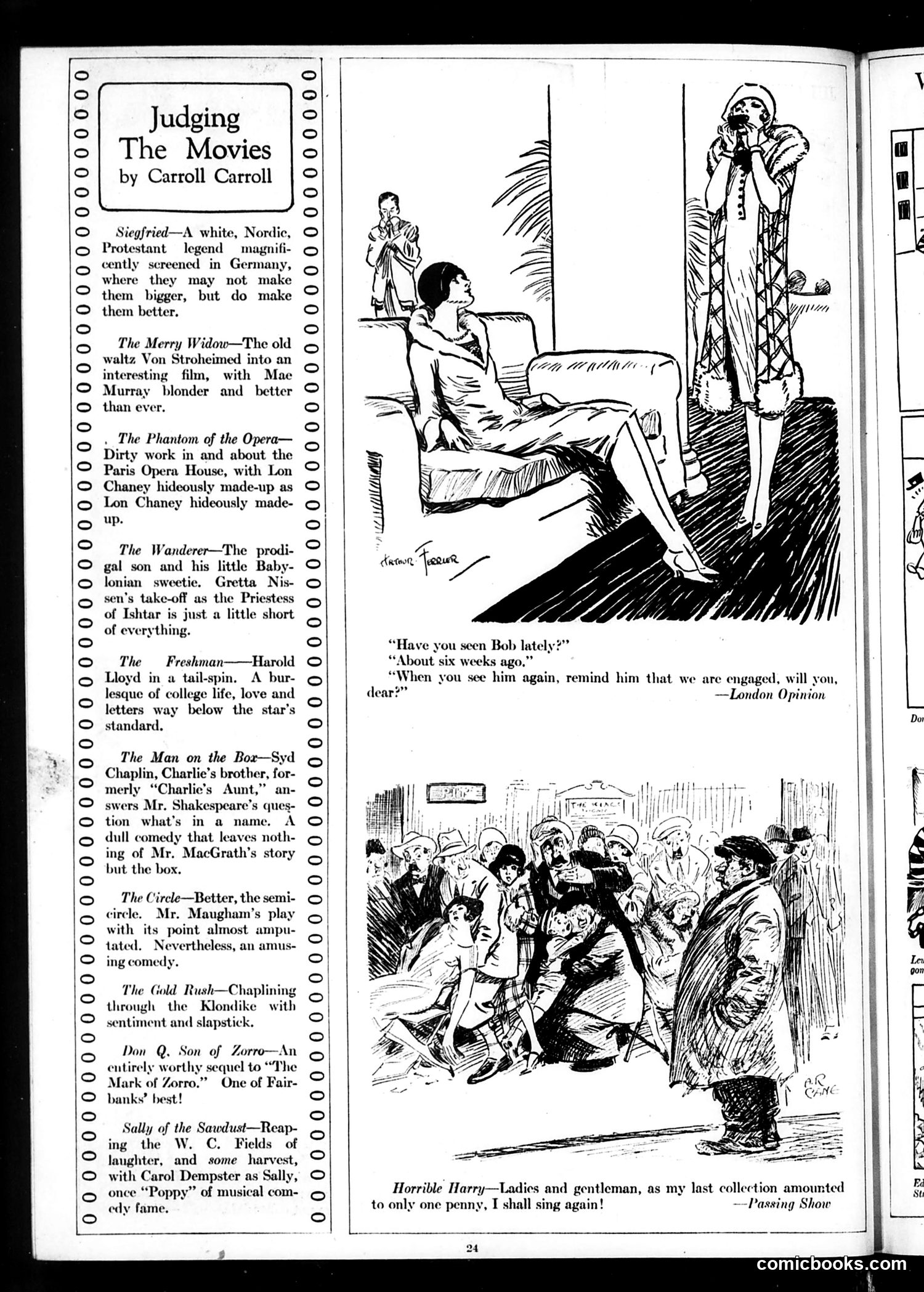
This page from *Judge* magazine features film reviews by Carroll Carroll alongside two cartoon jokes about romance and performance. The top cartoon depicts a woman casually dismissing her fiancé's six-week absence, asking a friend to remind him of their engagement—satirizing the casual attitudes toward commitment in 1920s courtship, particularly among the leisure class. The bottom cartoon shows "Horrible Harry," a street performer collecting pennies, announcing he'll sing again because his last collection yielded only one penny. This jokes about struggling entertainers and the economic realities of street performance during this era. The movie reviews mock 1920s cinema trends: German film superiority, Mae Murray's appearance, Lon Chaney's grotesque makeup, Harold Lloyd's declining comedies, and sentimental Chaplin films. The phrase "Chaplaining through the Klondike" parodies Chaplin's sentimental-slapstick formula as predictable entertainment.
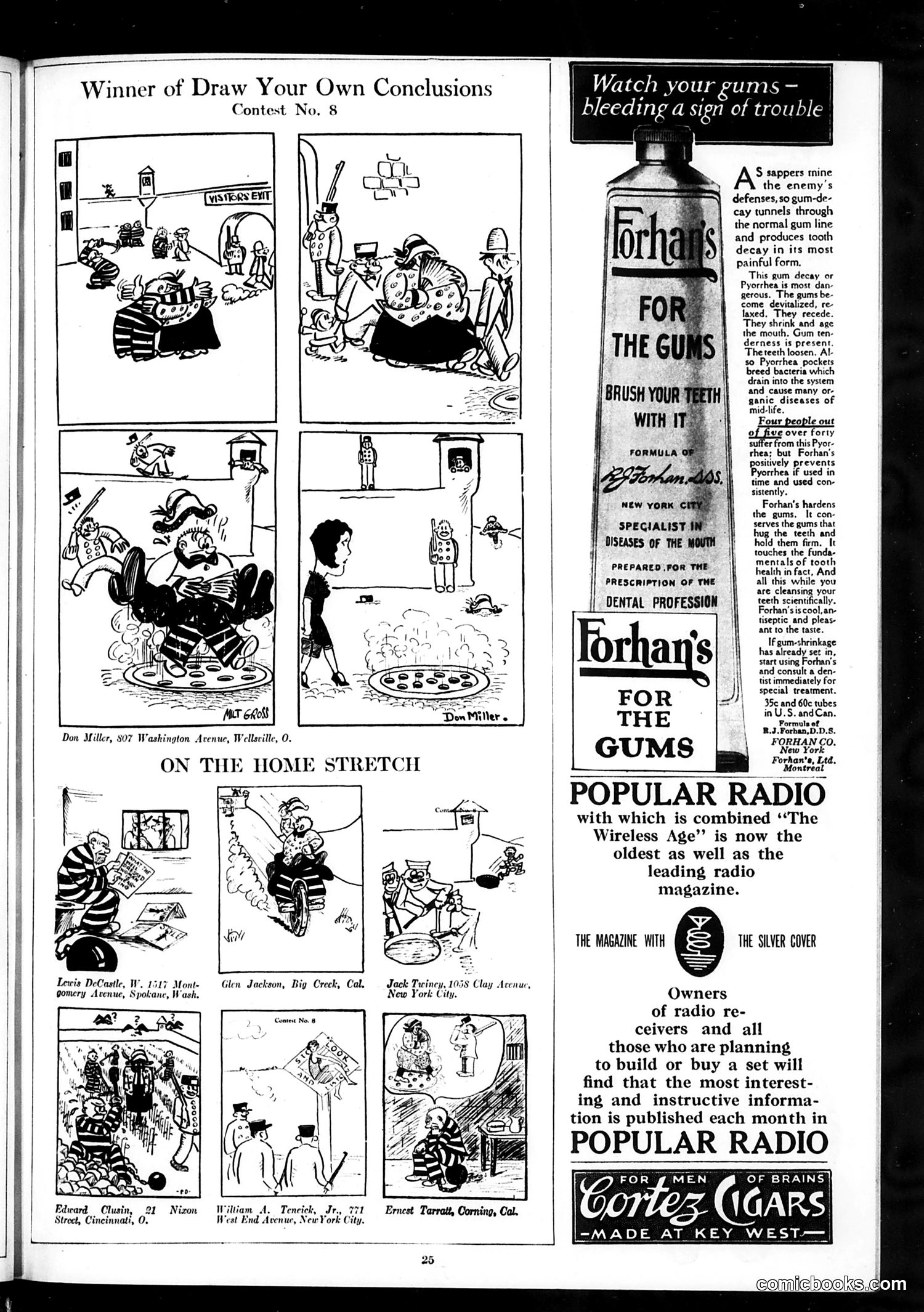
This page presents the winners of "Draw Your Own Conclusions Contest No. 8"—a humor competition where readers submitted cartoon captions or conclusions to unfinished comic scenarios. The top section shows six cartoon panels depicting domestic chaos and absurdity: a surreal "visitors exit" scene, figures engaged in violent slapstick, someone in a bathtub surrounded by mayhem, and other home-based comedic disasters. The credited artists (Dan Miller and others from various U.S. cities) won this contest. Below, "On the Home Stretch" shows six more winning entries, again featuring exaggerated domestic disorder and physical comedy typical of 1920s-30s humor—domestic arguments, falls, and general household pandemonium. The right side contains period advertisements, notably Forhan's gum treatment (warning of pyorrhea/gum disease affecting "four people out of five over forty") and promotions for Popular Radio magazine and Cortez Cigars. The satire targets everyday domestic life through physical humor and absurdist scenarios reflecting era-appropriate anxieties about health and leisure products.
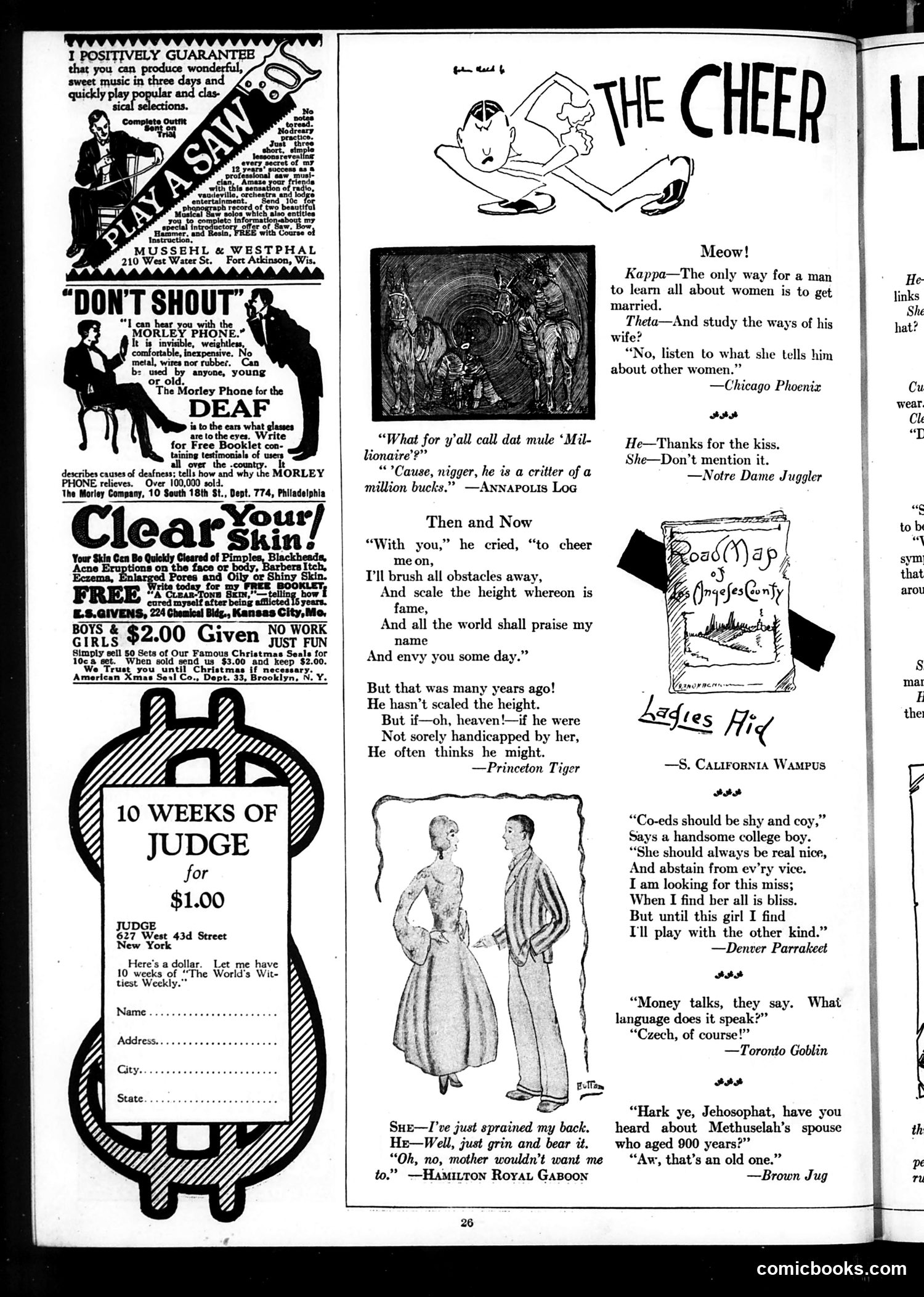
This page from *Judge* magazine contains mostly humorous short jokes and quips from college humor publications, alongside period advertisements (for hearing aids, skin treatments, and subscription offers). **The main content** is a collection of brief, attributed jokes about courtship, marriage, and college life. These include: - A "Then and Now" poem about a man who promised to achieve greatness for a woman but hasn't, blaming her for holding him back - College humor quips about co-eds, dating, and gender dynamics - A joke using a racial slur (in the "Millionaire" reference), reflecting the casual racism of the era **The satire targets** include: - Unfulfilled male ambition and marital blame-shifting - Hypocritical male college students (pursuing "nice" girls while flirting with others) - Marriage as women limiting men's potential The advertisements reflect early 20th-century concerns: hearing loss remedies, acne treatments, and schemes for young people to earn money selling Christmas seals. The page is primarily entertainment ephemera rather than political satire, showcasing period attitudes toward gender and relationships that modern readers would find dated or offensive.
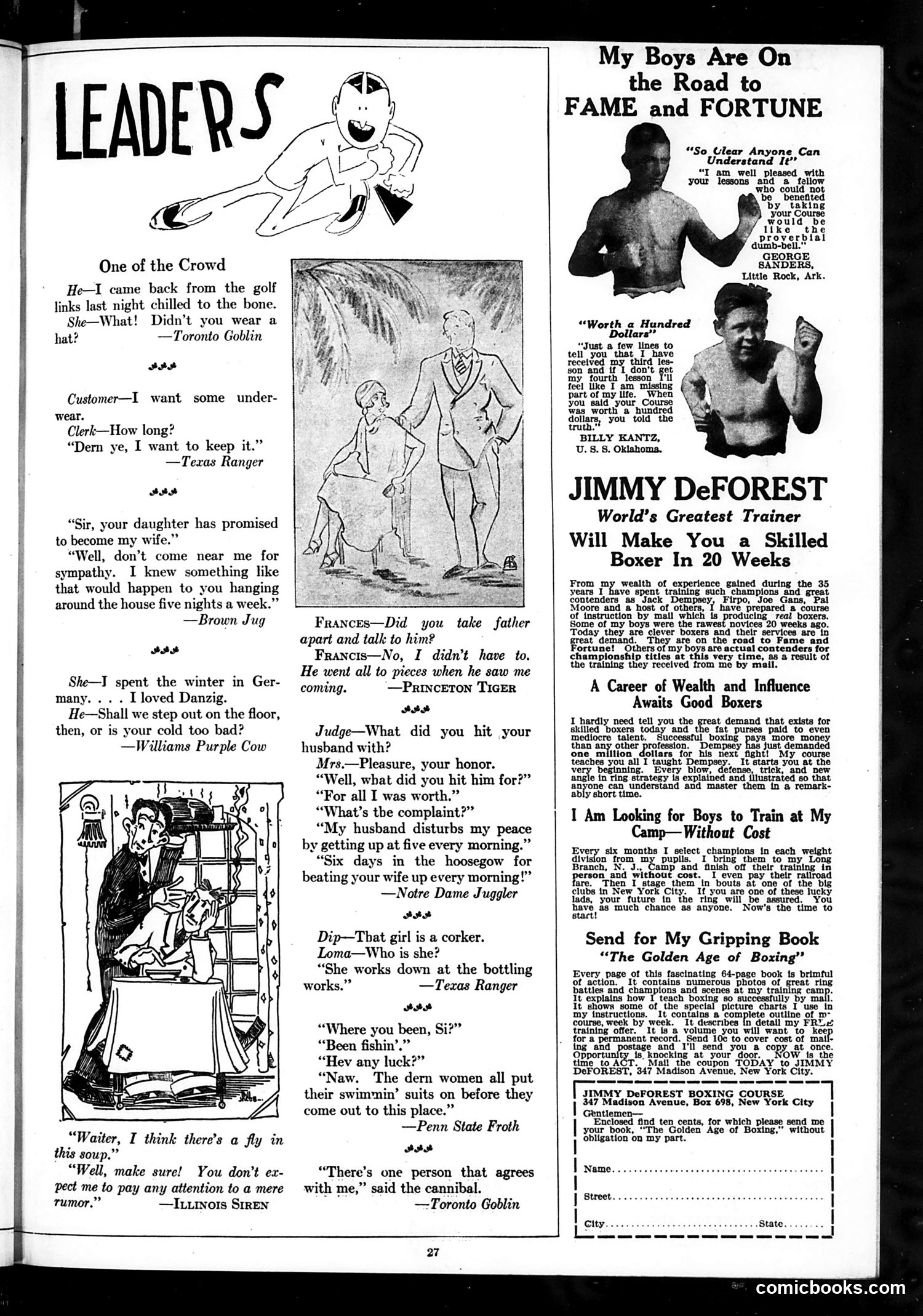
This Judge magazine page contains **humorous short jokes** in the "Leaders" section (left side) and **advertising** for boxing trainer Jimmy DeForest (right side). The jokes rely on dated comedic tropes: a husband returning from golf complaining of cold, a clerk misunderstanding customer requests, marriage jokes portraying wives as shrewish, and class-based humor (a woman "works down at the bottling works"). The cartoon illustrations show domestic scenarios typical of early 20th-century American humor—often depicting women negatively or poking fun at working-class characters. The DeForest boxing advertisements feature testimonials from men claiming his training system delivers results in 20 weeks. The accompanying photographs show shirtless boxers as evidence of his methods' success. This reflects the era's fascination with **physical culture and boxing as a path to prosperity**—marketing self-improvement through athletic training to working-class men seeking "wealth and influence." The page overall represents early 1900s American popular humor: domestic satire, class-based comedy, and promotional material targeting male readers' aspirations.
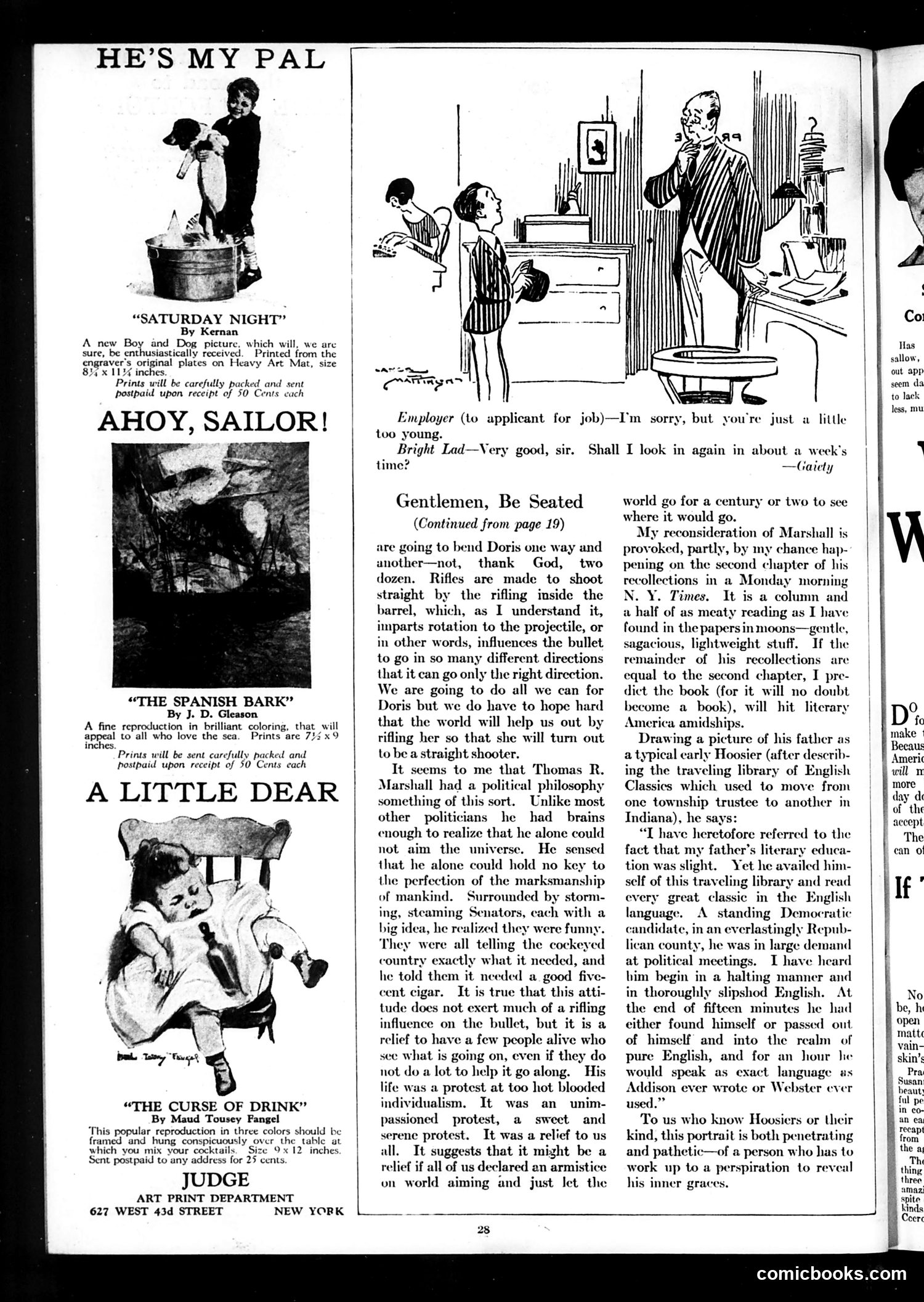
This page is primarily **advertising for art prints** rather than political satire. The main content features four reproducible illustrations for sale: 1. **"Saturday Night"** and **"Ahoy, Sailor!"** — sentimental domestic and nautical scenes 2. **"A Little Dear"** — presumably a cute animal image 3. **"The Curse of Drink"** — a temperance-themed print (notable given Prohibition-era concerns) The small cartoon shows an **employer rejecting a young job applicant as "too young,"** with the applicant cheekily asking to return in a week—a light joke about youthful optimism. The lengthy article discusses **Vice President Thomas R. Marshall's** political philosophy, comparing him favorably to a rifle with "rifling"—praising his modest, unambitious approach to governance. The writer quotes Marshall's recollections about his father, an Indiana Democrat in a Republican county who used traveling libraries. The page reflects early 20th-century concerns: temperance messaging, sentimental popular art, and nostalgic Americana. It's primarily commercial rather than satirical.
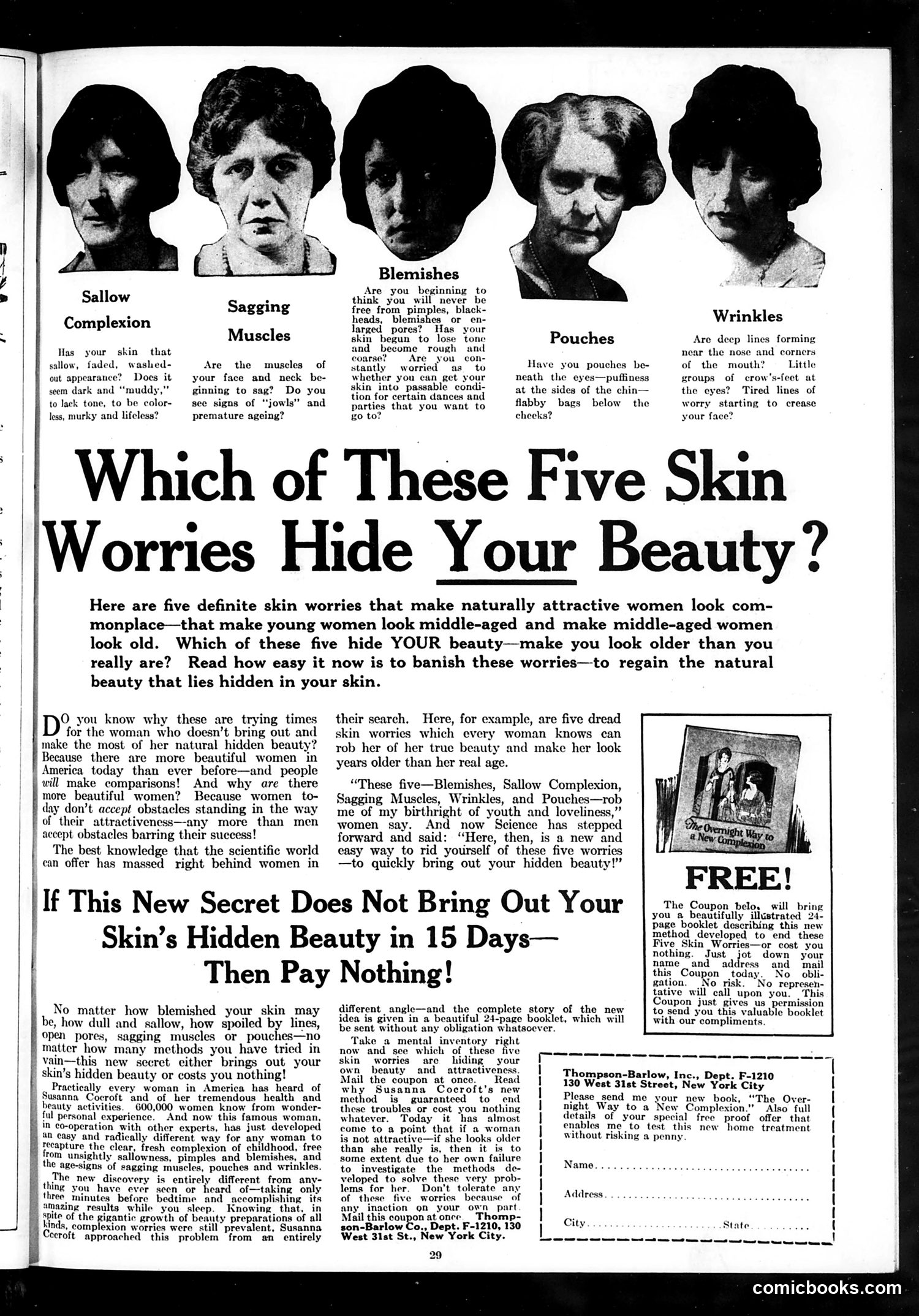
This is a **beauty product advertisement** disguised as editorial content, a common early 20th-century magazine practice. The page presents five photographs of women's faces labeled with aging concerns—sallow complexion, sagging muscles, blemishes, pouches, and wrinkles—then asks readers which "hides your beauty." This is advertising psychology: making women anxious about normal aging to sell a solution. The ad promotes a product by "Susanna Cocroft" (likely a fictional authority figure), claiming a new "secret" treatment takes only three minutes before bed and will reveal hidden beauty in 15 days or cost nothing. **The satire/context:** This reflects early 1900s attitudes toward women's appearance—the anxiety that looking aged meant losing value, and that beauty was a moral/social obligation. The exaggerated claims and pseudoscientific language ("science has stepped forward") typify period advertising targeting women's insecurities. For modern readers, it's striking how the ad equates feminine attractiveness with professional/social success, treating aging as a fixable "problem" rather than inevitable.
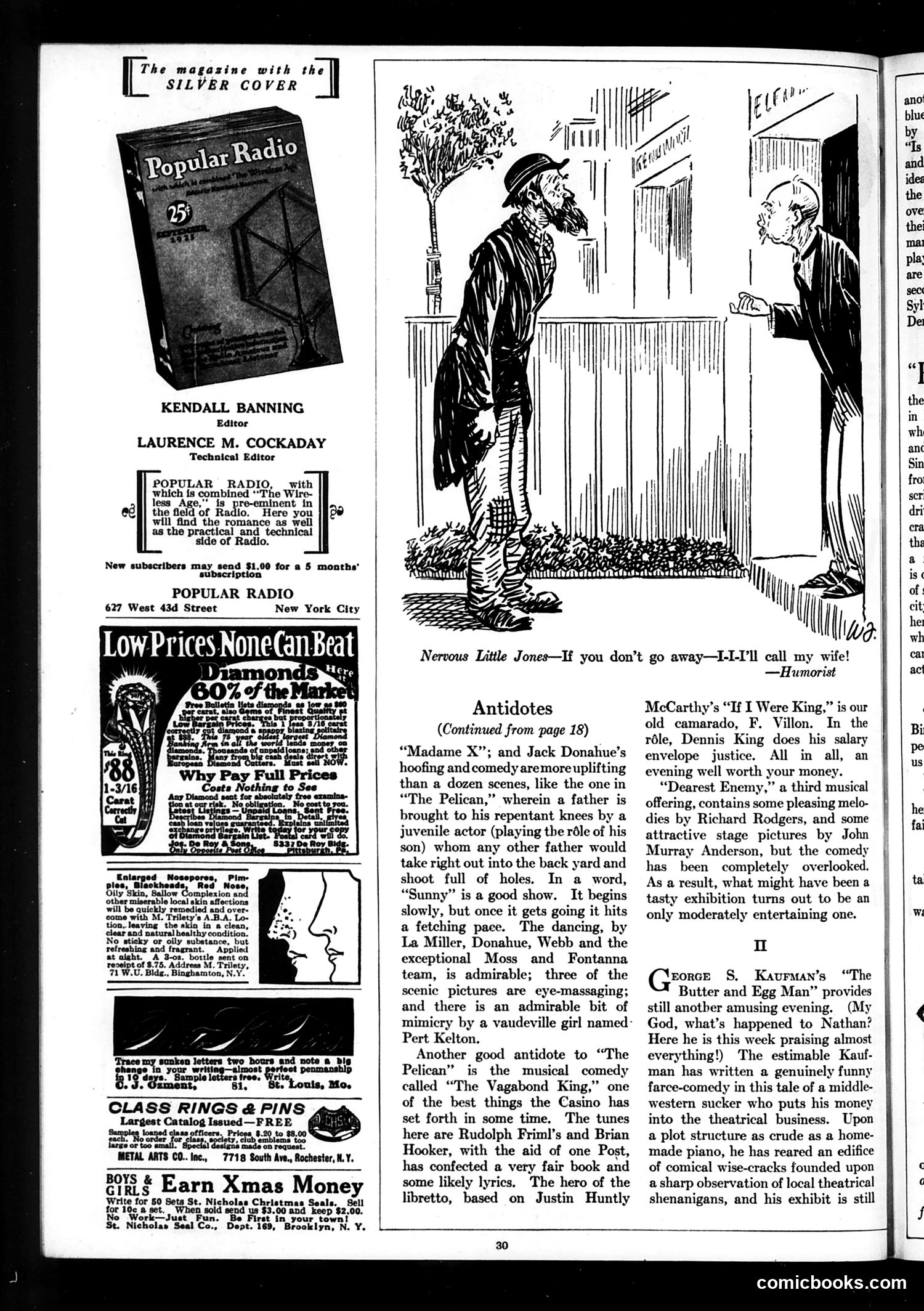
The main cartoon depicts a nervous man threatening to call his wife if an unwanted visitor doesn't leave—implying his wife's temperament or potential anger is more frightening than directly confronting the guest himself. This is domestic humor playing on the stereotype of the domineering or formidable wife as a threat/deterrent. The page is primarily **advertising and entertainment reviews**, not political satire. It includes ads for *Popular Radio* magazine, diamonds, class rings, and Christmas seals. The bulk of editorial content reviews Broadway musicals ("Sunny," "The Vagabond King," "Dearest Enemy," "The Butter and Egg Man"), with theater critic evaluations of their merits and comedic elements. This reflects Judge's function as a general-interest satirical magazine covering entertainment, not exclusively focused on political commentary.
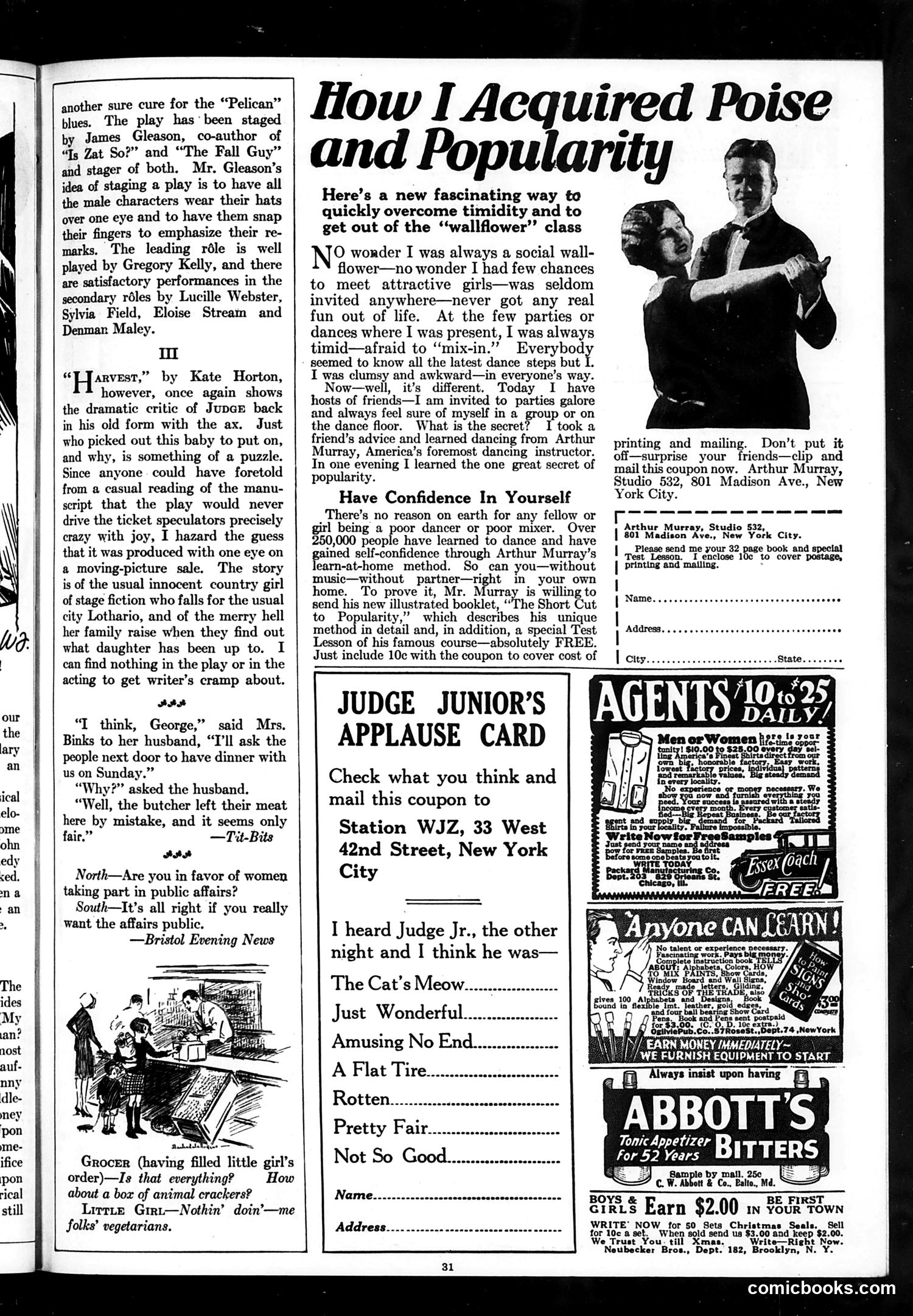
This page primarily contains **advertisements and filler content** rather than political satire. The main content includes: - **Theater reviews** critiquing plays like "Harvest" and "The Pelican" - **Brief humorous anecdotes** (a wife asking neighbors to dinner after receiving their meat by mistake; a grocer and vegetarian child) - **An Arthur Murray dance instruction advertisement** promising to cure social awkwardness and timidity through learning to dance—a classic 1920s self-improvement pitch The **Judge Junior's Applause Card** is a reader engagement feature allowing listeners to rate a radio program. The **advertisements** (Agents Daily, Abbott's Bitters, boys earning money schemes) are typical period commercial pitches. There is **no significant political satire or caricature** on this page. The content reflects 1920s social concerns about social confidence and entertainment, but contains no identifiable political figures or pointed social commentary. The page functions primarily as filler between more substantial editorial content.
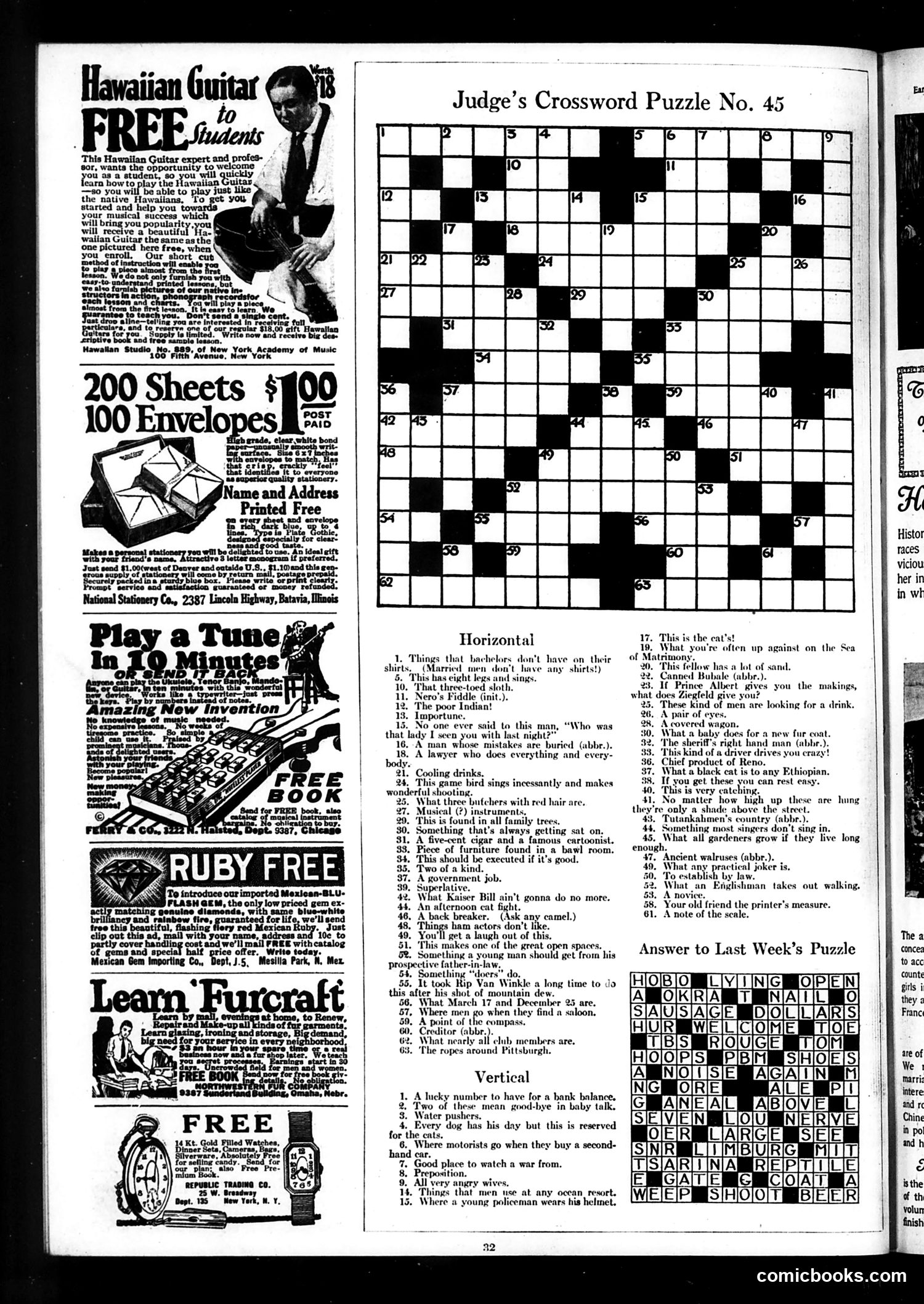
This page contains **primarily advertising and a crossword puzzle**, not political satire requiring historical context. The main content is "Judge's Crossword Puzzle No. 45"—a standard word puzzle with clues. The clues are mostly lighthearted, contemporary wordplay (e.g., "Things that bachelors don't have on their shirts," "The poor Indian!," references to Reno divorces, ham actors). The left side features vintage advertisements: Hawaiian guitar lessons, stationery offers, a piano instruction course, and a "Ruby Free" gem promotion. These ads reflect 1920s-30s consumer culture and mail-order marketing typical of the era. **No identifiable political figures or satirical commentary appears on this page.** It's a leisure/entertainment page mixing puzzles and period advertising, without the cartoon editorial content Judge magazine was known for.
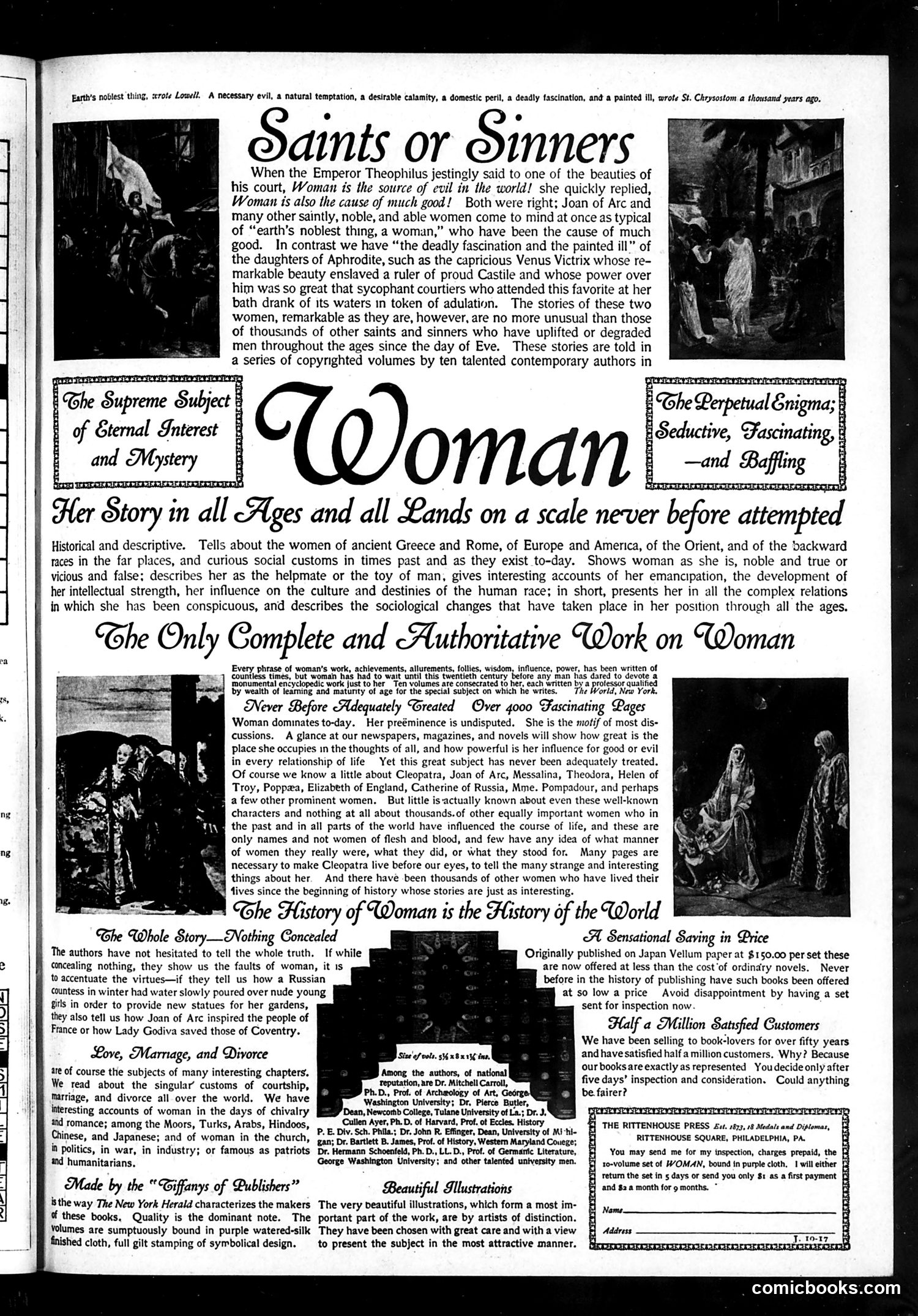
This page is primarily a book advertisement for a ten-volume encyclopedic work titled *Woman*, published by The World (New York). It's not a political cartoon but rather promotional content discussing women's historical roles. The text references an ancient debate between Emperor Theophilus and a court woman about whether women are sources of evil or good—using this to frame the work's scope. It contrasts "saintly" women (Joan of Arc) with morally questionable figures (Venus Victrix, Cleopatra, Messalina), establishing the books' promise to comprehensively cover women across history "never before adequately treated." The advertisement emphasizes the work's unprecedented scale and scholarly authority, claiming ten volumes by university professors treating women's accomplishments, influence, and social position throughout history. The implied satire is subtle: the breathless marketing language suggests women are finally worthy of serious study—a progressive stance for the era, yet the advertising hyperbole itself invites gentle mockery of the publishing industry's tendencies.
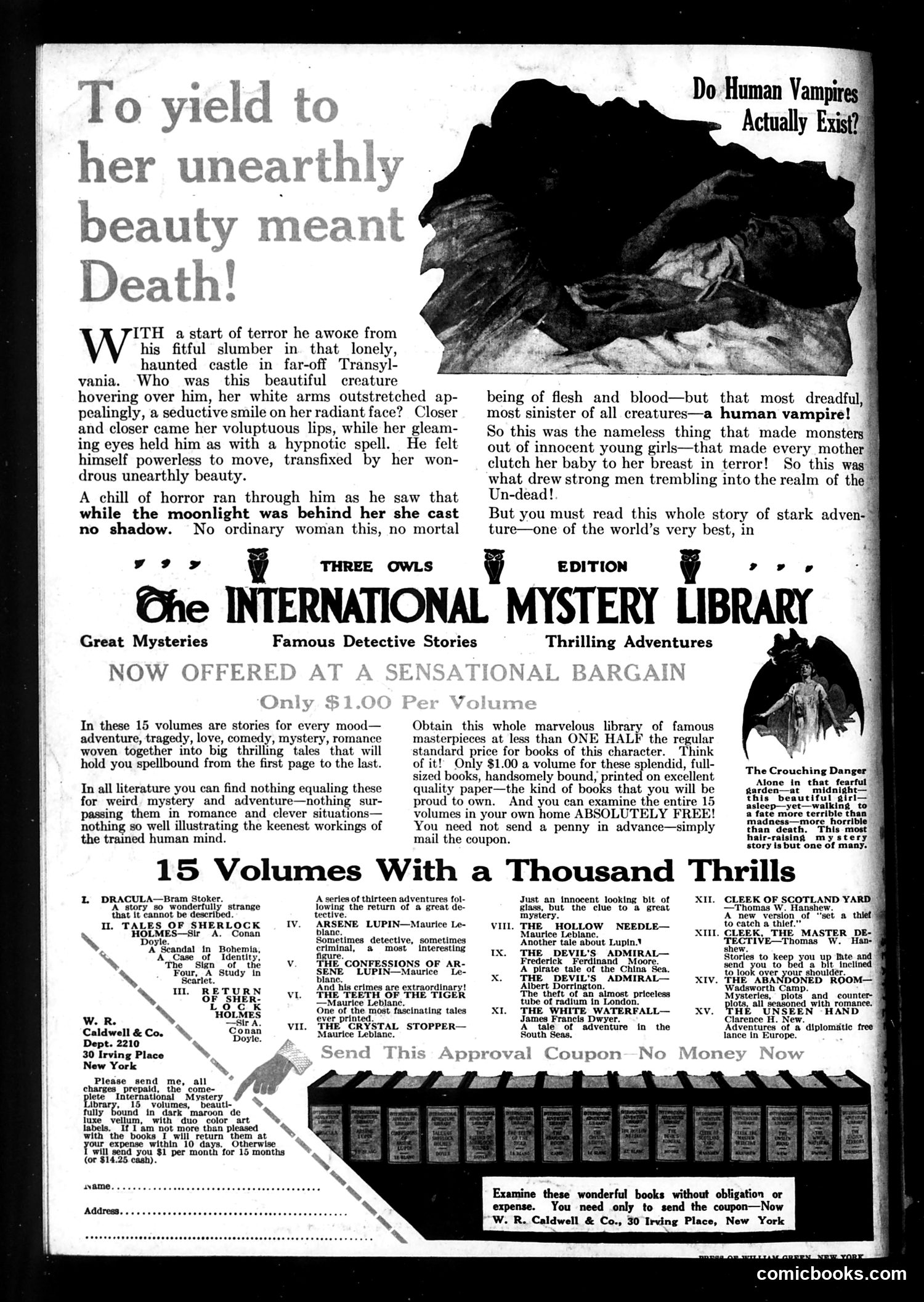
This page is primarily **advertising, not satire**. It's a promotional spread for "The International Mystery Library"—a 15-volume book collection being sold through mail order. The top portion uses sensational vampire fiction prose (featuring Dracula-style horror) as marketing bait. The gothic imagery of a beautiful female vampire casting no shadow in moonlight is meant to entice readers with promises of thrilling, mysterious stories. The text emphasizes these are "world's very best" adventure tales. The bulk of the page lists the 15 volumes available, featuring famous mystery and detective fiction: Dracula, Sherlock Holmes tales, Arsène Lupin adventures, and others. The offer claims to sell these "full-sized, handsomely bound" books at "$1.00 a volume"—presented as a dramatic bargain compared to regular prices. The coupon at bottom allows risk-free examination: readers can request the entire collection free, then decide whether to purchase by monthly installment ($1/month for 15 months) or lump sum ($14.25). This is vintage direct-mail advertising targeting leisure readers' appetite for mystery and horror fiction.

I cannot provide a reliable analysis of this page's content. The image is almost entirely black or heavily degraded, making it impossible to discern any cartoon illustrations, caricatures, or visual details that would be necessary to identify figures or understand satirical commentary. The OCR'd text fragments are too minimal and disconnected ("thief," "DE-Han," etc.) to provide meaningful context about the page's subject matter, political references, or intended satire. A clearer or higher-contrast scan would be needed to properly analyze this Judge magazine page.
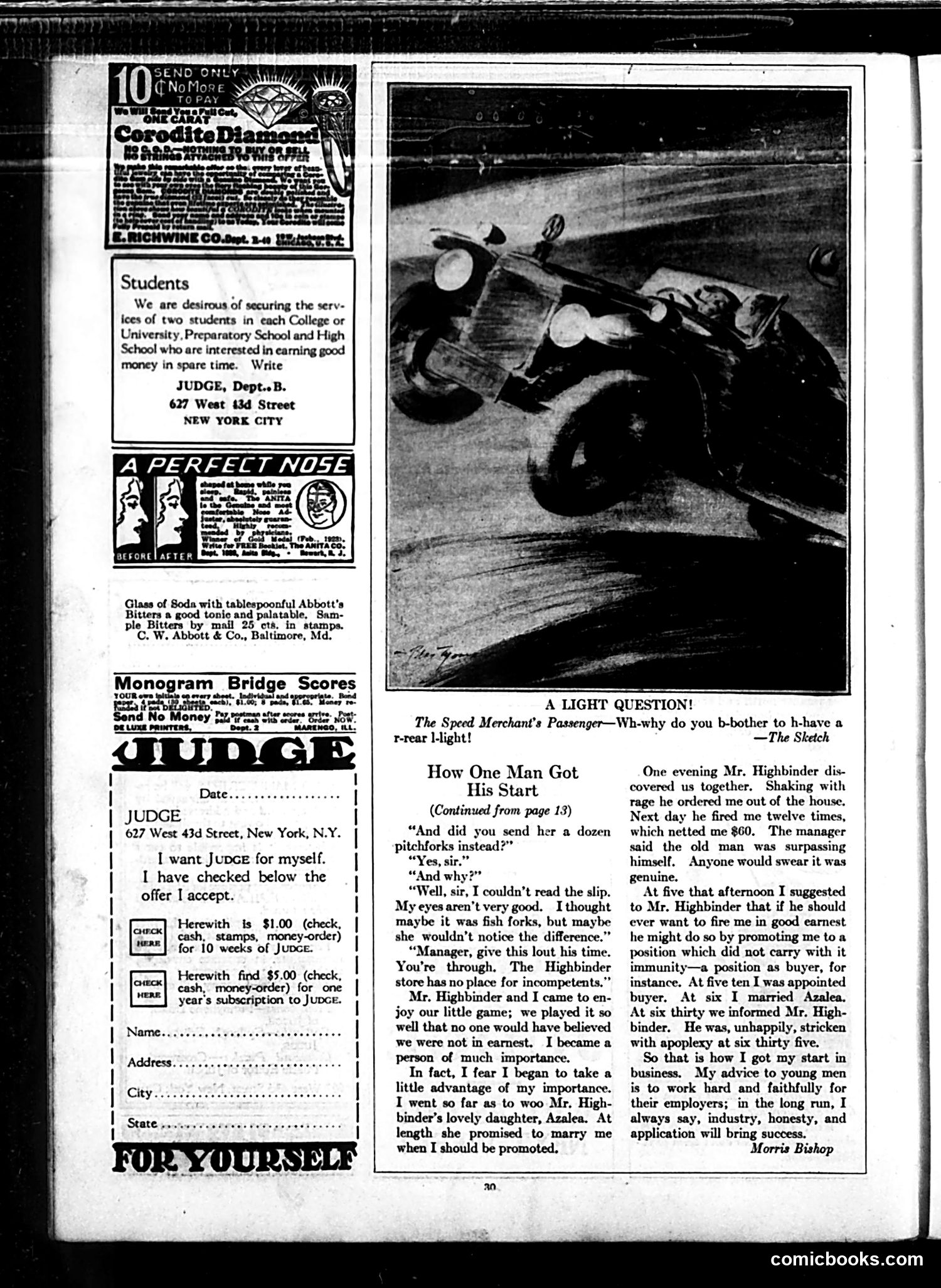
This serialized story (continued from page 13) satirizes both workplace ambition and employer-employee dynamics of the early 20th century. The narrator describes deliberately misinterpreting orders—sending pitchforks instead of fish forks—yet avoiding genuine consequences through elaborate performance. When fired repeatedly by the wealthy Mr. Highbinder, each dismissal nets him payment, turning incompetence into profit. The satire peaks when he courts Highbinder's daughter and suggests promotion as his exit strategy, knowing it will enrage his boss. The employer's apoplexy conveniently removes the obstacle. Authored by Morris Bishop, this mocks the era's "self-made man" mythology and corporate hypocrisy. The narrator's final moral—advising hard work and honesty—directly contradicts his actual success through deception, making the advice itself the joke. It's cynical commentary on Gilded Age business culture.
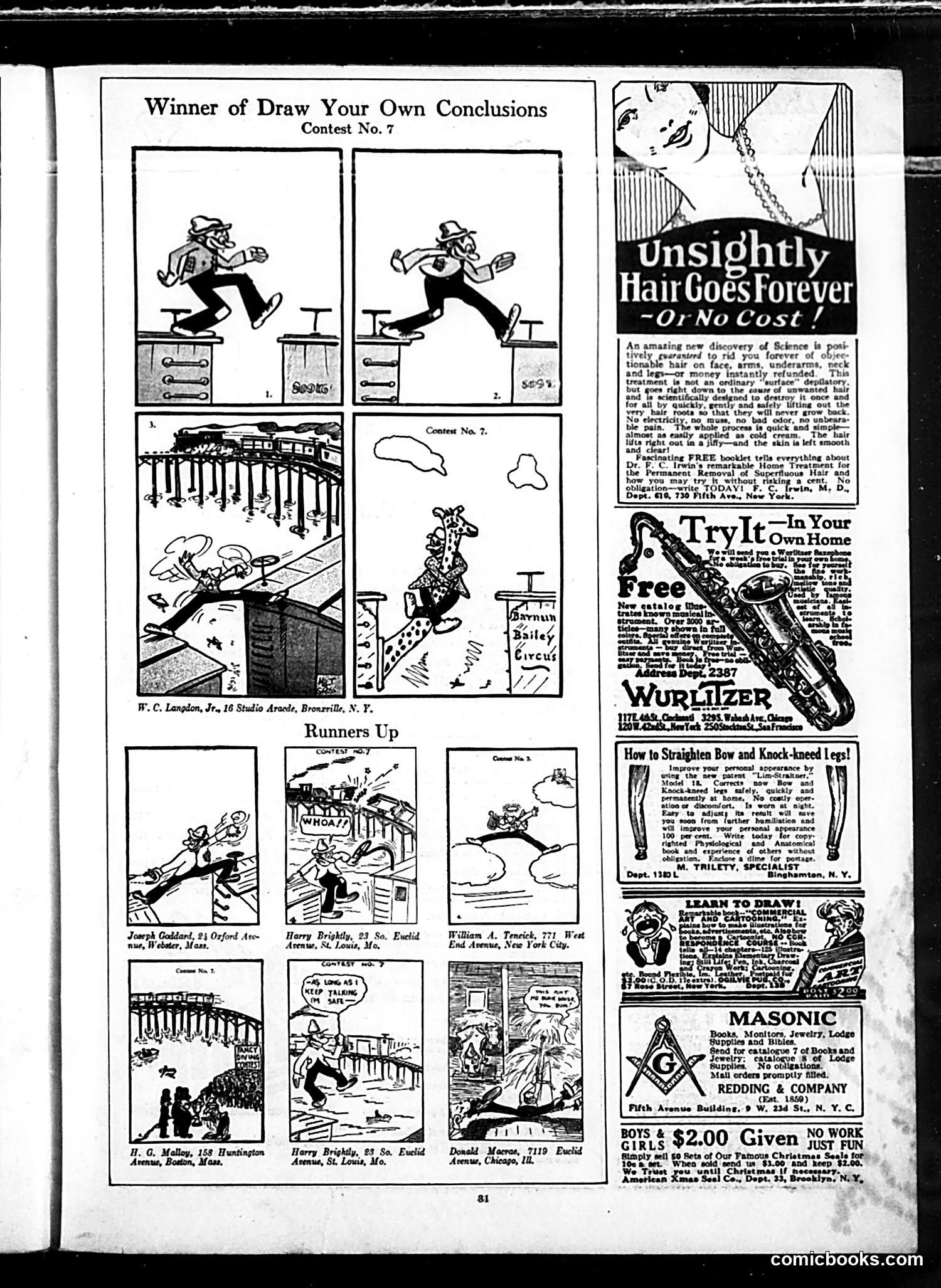
This page combines a cartooning contest winner with period advertisements. The main content is "Draw Your Own Conclusions Contest No. 7," featuring four comic panels by W.C. Langdon Jr. showing a man performing increasingly dangerous stunts—jumping between platforms, leaping over a railing, and performing circus-like acrobatics. The "Runners Up" section displays similar submission cartoons. The satire appears to be visual wordplay: readers were asked to "draw their own conclusions" from ambiguous premise panels, then submit humorous endings. The winner's panels suggest escalating absurdity and physical danger as comedic conclusion. The right column contains period advertisements typical of early-to-mid 20th century magazines: hair removal treatments ("Unsightly Hair Goes Forever"), musical instruments (Wurlitzer saxophone), leg-straightening devices, drawing instruction courses, Masonic supplies, and Christmas seal fundraising. This reflects Judge's dual nature: satirical cartooning for educated readers alongside commercial advertising targeting consumers with dubious health/beauty products.
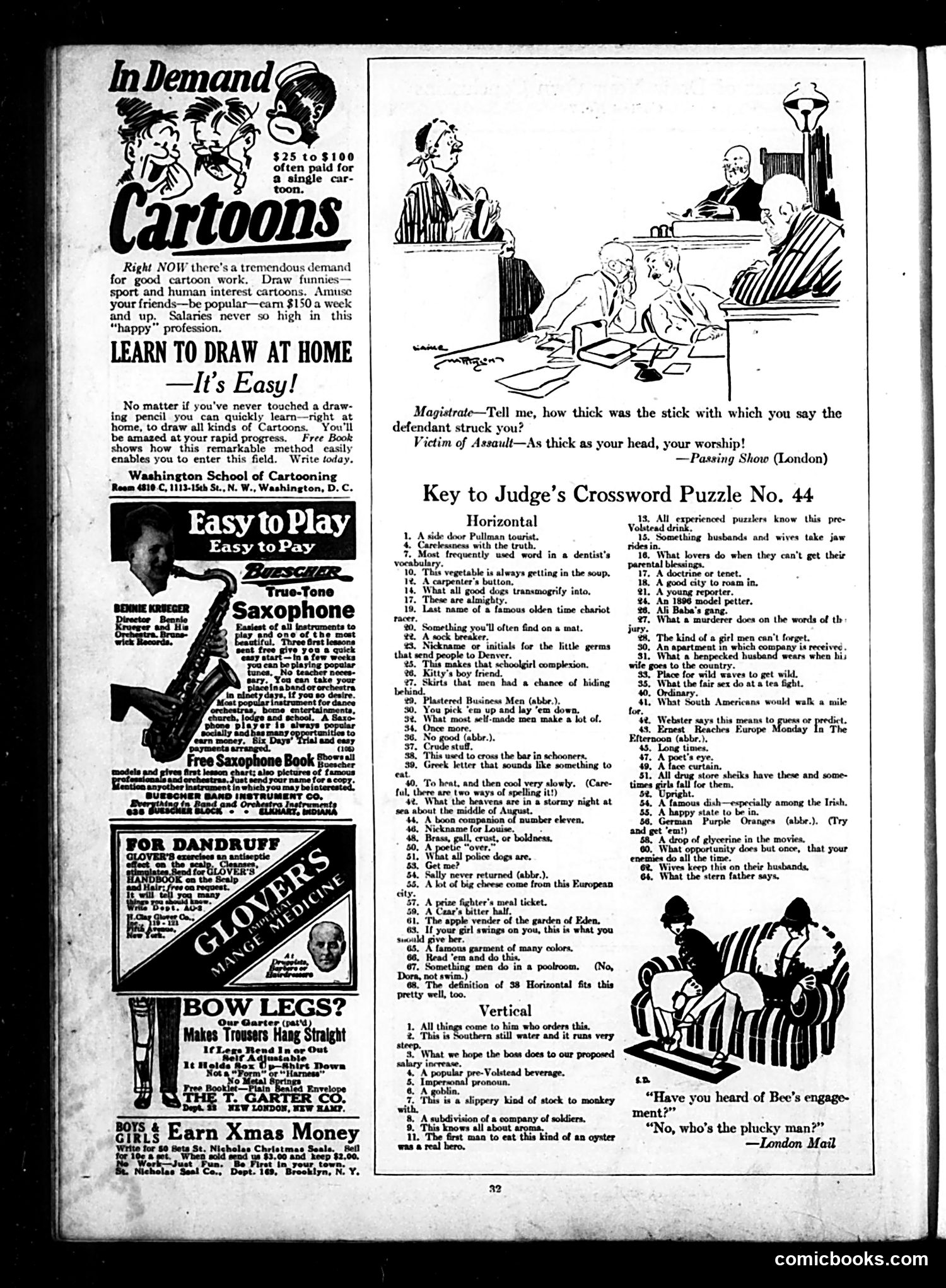
This page is primarily **advertising and puzzle content** rather than political satire. The main elements are: **Left side:** Multiple advertisements recruiting cartoonists and promoting correspondence courses (Washington School of Cartooning), musical instruments (saxophone), and medical products (bow legs treatment, dandruff cure). **Center/Right:** A single cartoon with a courtroom joke. A magistrate asks an assault victim how thick the stick was that hit him; the victim replies "as thick as your head, your worship"—a standard insult joke about the judge's intelligence. This is credited to *Passing Show* (London), not original to Judge. **Bulk of page:** A crossword puzzle with its answer key. The page reflects **early 20th-century commercial interests**—cartooning was genuinely lucrative during this era, hence the recruiting ads. The humor is mild and universal rather than politically pointed. There's no clear political commentary or social satire present here.
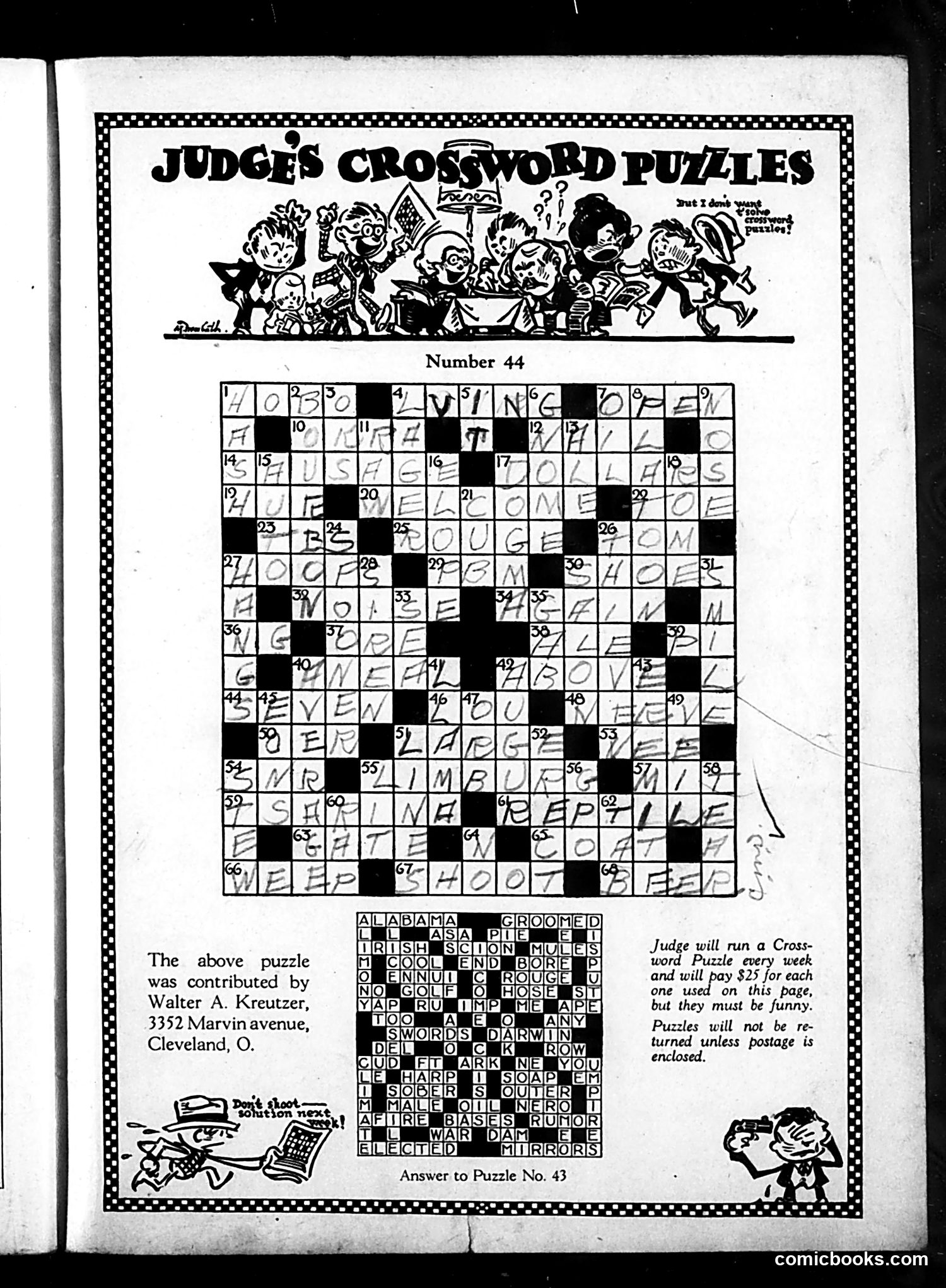
This page from Judge magazine features Puzzle No. 44, a standard crossword puzzle contributed by a Cleveland reader. The top illustration shows cartoon characters celebrating around a puzzle, with one asking "But I don't want to solve crosswords!"—a humorous acknowledgment that puzzle-solving was a popular but sometimes tedious pastime. The page's main content is the crossword grid itself, printed filled-in as an answer key, along with the answer to the previous week's puzzle (No. 43). The text indicates Judge offered cash prizes (25 dollars) for funny, original puzzles submitted by readers, requiring postage for returns. This reflects the 1920s-30s crossword craze in American popular culture—puzzles were a major entertainment phenomenon. The magazine's playful tone and reader-submission format show how Judge engaged its audience through interactive content beyond satire and commentary.
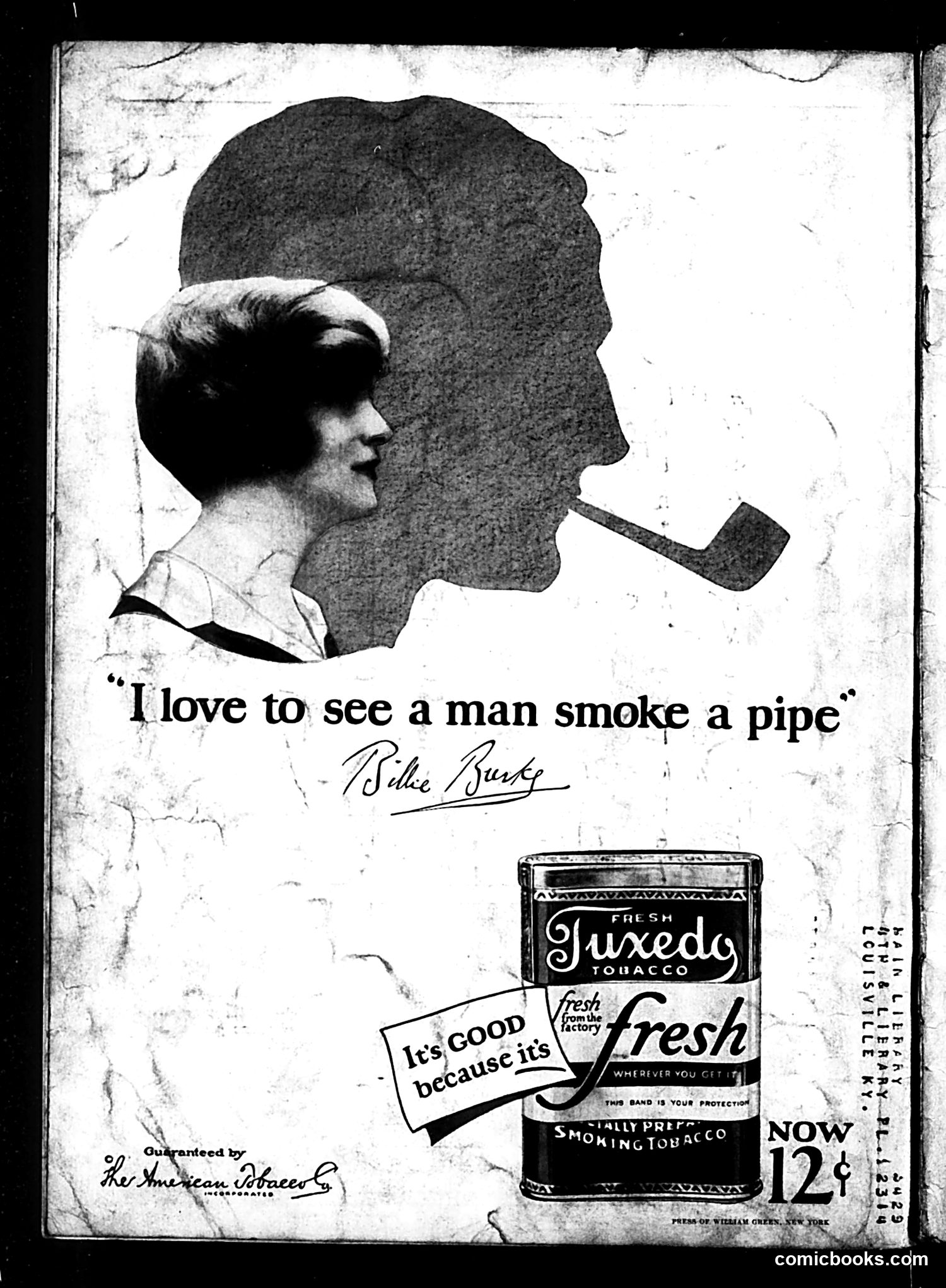
This is a tobacco advertisement, not political satire. It features a quote attributed to "Billie Burke" (a prominent early 20th-century actress) stating "I love to see a man smoke a pipe." The ad promotes "Tuxedo" brand smoking tobacco, emphasizing it's "fresh" and costs 12 cents. The silhouette shows a man in profile smoking a pipe, while the product tin is displayed prominently with marketing copy: "It's GOOD because it's Fresh." The appeal uses celebrity endorsement and gendered messaging—suggesting that smoking pipes enhances masculine appeal to women. This reflects pre-health-warning advertising practices common to the era, when tobacco promotion rarely faced restriction or criticism.