
Judge, 1925-10-17 · page 17 of 42
Judge — October 17, 1925 — page 17: what you’re looking at
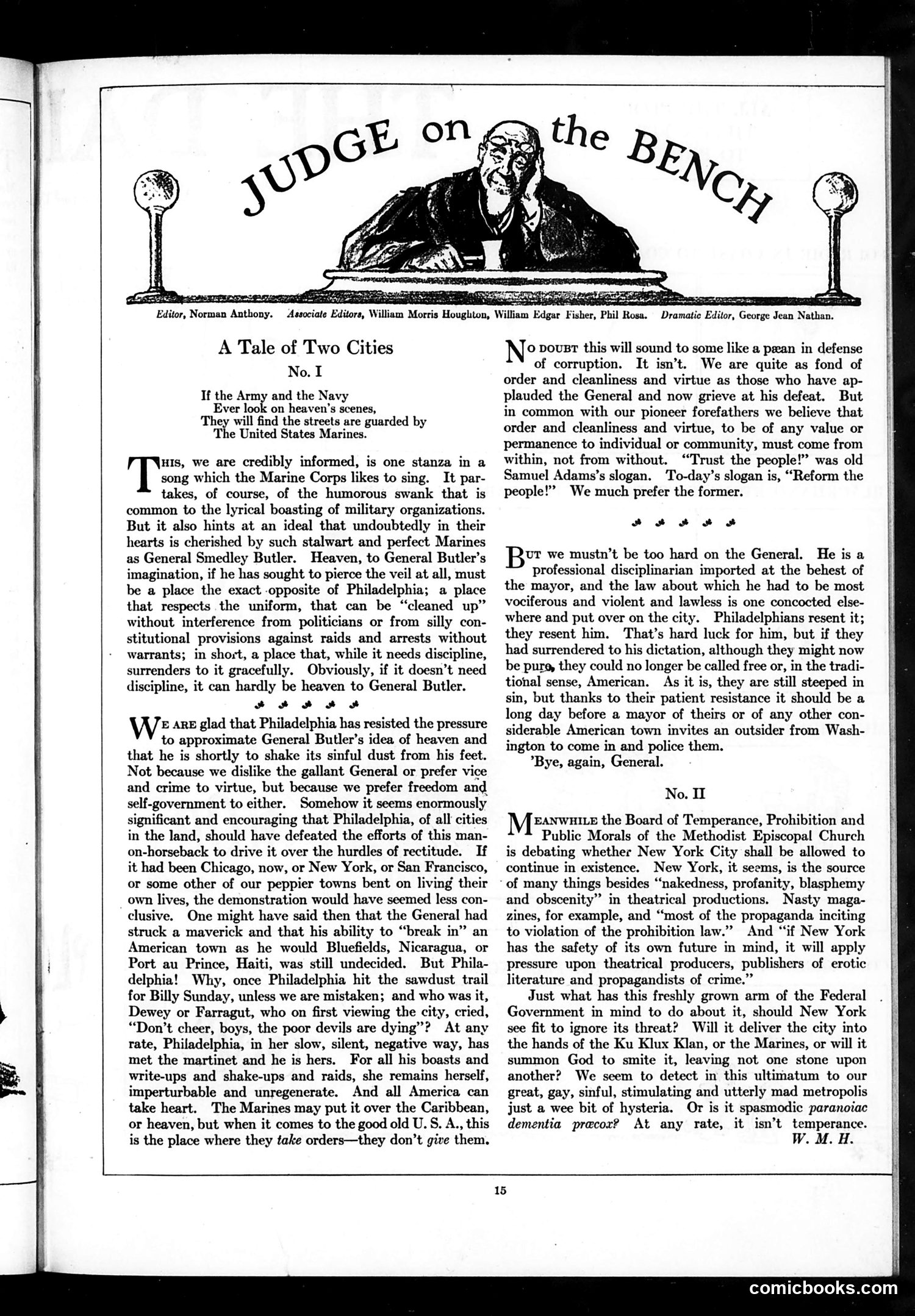
What you’re looking at
This editorial cartoon satirizes **General Smedley Butler**, a decorated Marine officer who served as Philadelphia's police chief and attempted to impose strict military discipline on the city. The piece celebrates Philadelphia's resistance to his authoritarian reform efforts. The satire's point: Butler represents militaristic "man-on-horseback" governance—imposing order through force rather than allowing communities self-government. Judge praises Philadelphia for rejecting his agenda, arguing that lasting virtue must come "from within, not from without," echoing Founding Father Samuel Adams's principle of trusting the people. The editorial acknowledges Butler's professionalism but sides with democratic freedom over imposed discipline. It's notably sympathetic to Butler personally while opposing his methods—a nuanced critique of authoritarianism dressed as reform. The Marine Corps marching song opening establishes Butler as emblematic of military culture's hierarchical values. This reflects Progressive-era anxieties about strongmen consolidating power under reform rhetoric.
📄 Transcribed text from this page (OCR, searchable)
Machine-transcribed from the original scan — historical spelling and the odd misread are preserved.
Editor, Norman Anthony. Associate A Tale of Two Cities No. I If the Army and the Navy Ever look on heaven’s scenes, They will find the streets are guarded by The United States Marines. HIS, we are credibly informed, is one stanza in a song which the Marine Corps likes to sing. It par- takes, of course, of the humorous swank that is common to the lyrical boasting of military organizations. But it also hints at an ideal that undoubtedly in their hearts is cherished by such stalwart and perfect Marines as General Smedley Butler. Heaven, to General Butler’s imagination, if he has sought to pierce the veil at all, must be a place the exact opposite of Philadelphia; a place that respects the uniform, that can be “cleaned up” without interference from politicians or from silly con- stitutional provisions against raids and arrests without warrants; in short, a place that, while it needs discipline, surrenders to it gracefully. Obviously, if it doesn’t need discipline, it can hardly be heaven to General Butler. eee aS WE ARE glad that Philadelphia has resisted the pressure to approximate General Butler’s idea of heaven and that he is shortly to shake its sinful dust from his feet. Not because we dislike the gallant General or prefer vice and crime to virtue, but because we prefer freedom and self-government to either. Somehow it seems enormously significant and encouraging that Philadelphia, of all cities in the land, should have defeated the efforts of this man- on-horseback to drive it over the hurdles of rectitude. If it had been Chicago, now, or New York, or San Francisco, or some other of our peppier towns bent on living their own lives, the demonstration would have seemed less con- clusive. One might have said then that the General had struck a maverick and that his ability to “break in” an American town as he would Bluefields, Nicaragua, or Port au Prince, Haiti, was still undecided. But Phila- delphia! Why, once Philadelphia hit the sawdust trail for Billy Sunday, unless we are mistaken; and who was it, Dewey or Farragut, who on first viewing the city, cried, “Don’t cheer, boys, the poor devils are dying”? At any rate, Philadelphia, in her slow, silent, negative way, has met the martinet and he is hers. For all his boasts and write-ups and shake-ups and raids, she remains herself, imperturbable and unregenerate. And all America can take heart. The Marines may put it over the Caribbean, or heaven, but when it comes to the good old U.S. A., this is the place where they take orders—they don’t give them. Ne povusr this will sound to some like a pean in defense of corruption. It isn’t. We are quite as fond of order and cleanliness and virtue as those who have ap- plauded the General and now grieve at his defeat. But in common with our pioneer forefathers we believe that order and cleanliness and virtue, to be of any value or permanence to individual or community, must come from within, not from without. “Trust the people!” was old Samuel Adams’s slogan. To-day’s slogan is, “Reform the We much prefer the former. people!” as HHH SH UT we mustn’t be too hard on the General. He is a professional disciplinarian imported at the behest of the mayor, and the law about which he had to be most vociferous and violent and lawless is one concocted else- where and put over on the city. Philadelphians resent it; they resent him. That’s hard luck for him, but if they had surrendered to his dictation, although they might now be pura, they could no longer be called free or, in the tradi- tional sense, American. As it is, they are still steeped in sin, but thanks to their patient resistance it should be a long day before a mayor of theirs or of any other con- siderable American town invites an outsider from Wash- ington to come in and police them. *Bye, again, General. No. II EANWHILE the Board of Temperance, Prohibition and Public Morals of the Methodist Episcopal Church is debating whether New York City shall be allowed to continue in existence. New York, it seems, is the source of many things besides “nakedness, profanity, blasphemy and obscenity” in theatrical productions. Nasty maga- zines, for example, and ‘“‘most of the propaganda inciting to violation of the prohibition law.” And “if New York has the safety of its own future in mind, it will apply pressure upon theatrical producers, publishers of erotic literature and propagandists of crime.” Just what has this freshly grown arm of the Federal Government in mind to do about it, should New York see fit to ignore its threat? Will it deliver the city into the hands of the Ku Klux Klan, or the Marines, or will it summon God to smite it, leaving not one stone upon another? We seem to detect in this ultimatum to our great, gay, sinful, stimulating and utterly mad metropolis just a wee bit of hysteria. Or is it spasmodic paranoiac dementia pracox? At any rate, it isn’t temperance. W. M. H. comicbooks.com