
A complete issue · 37 pages · 1925
Judge — October 10, 1925
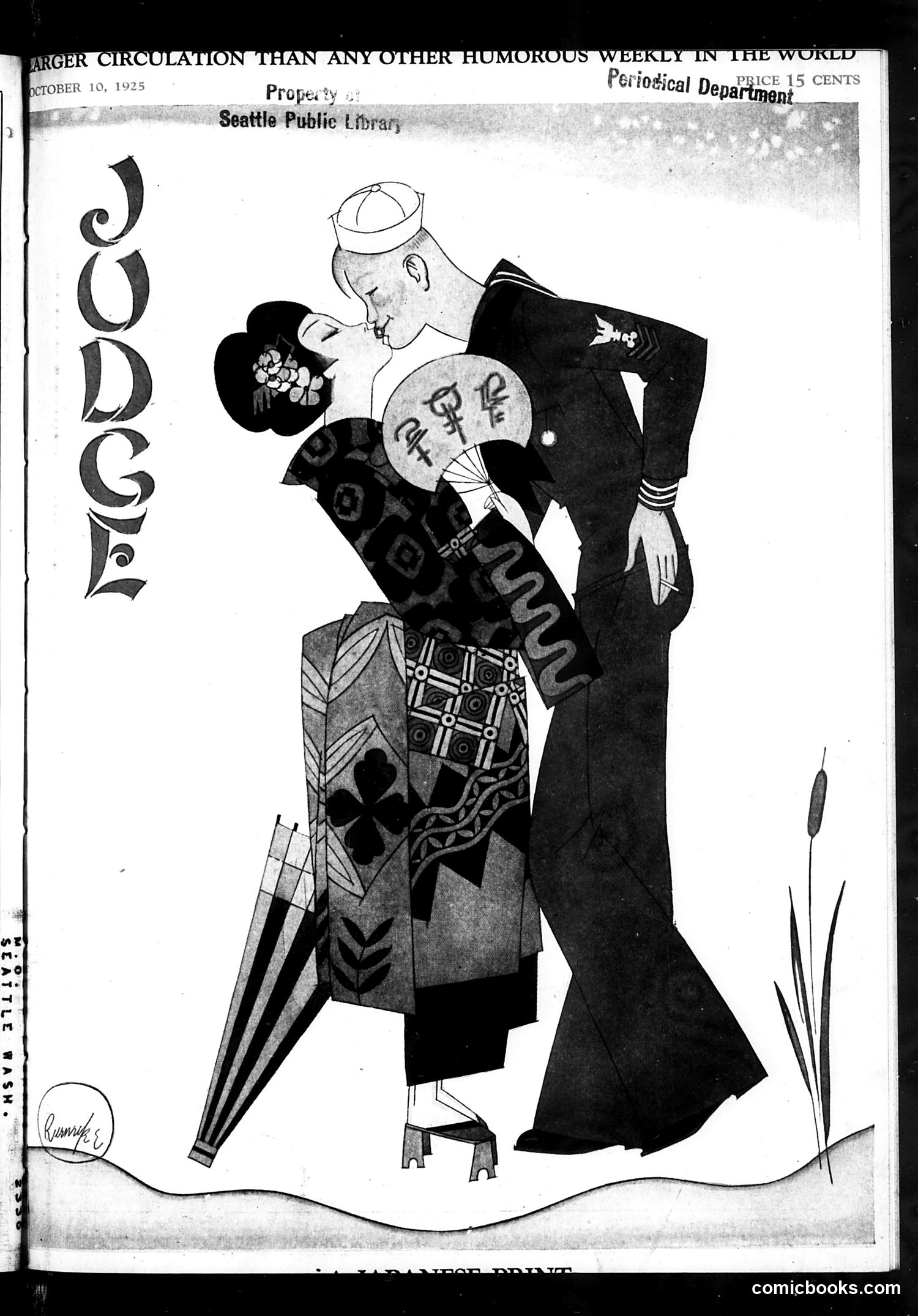
This cover satirizes American naval spending and military romance. A tall sailor in dress uniform embraces a woman labeled with dollar signs, presenting military expenditure as seduction. The woman wears elaborate, patterned clothing suggesting wealth or luxury goods—possibly representing the nation's resources being "courted" away. The visual joke equates naval budgeting with romantic pursuit: the sailor is "wooing" the woman (money/national budget), suggesting that military interests are aggressively pursuing increased defense spending. The decorative fan she holds and ornate dress emphasize extravagance, implying such spending is wasteful rather than necessary. This reflects 1920s debates over post-World War I military budgets and disarmament advocates' concerns about naval competition and arms races.
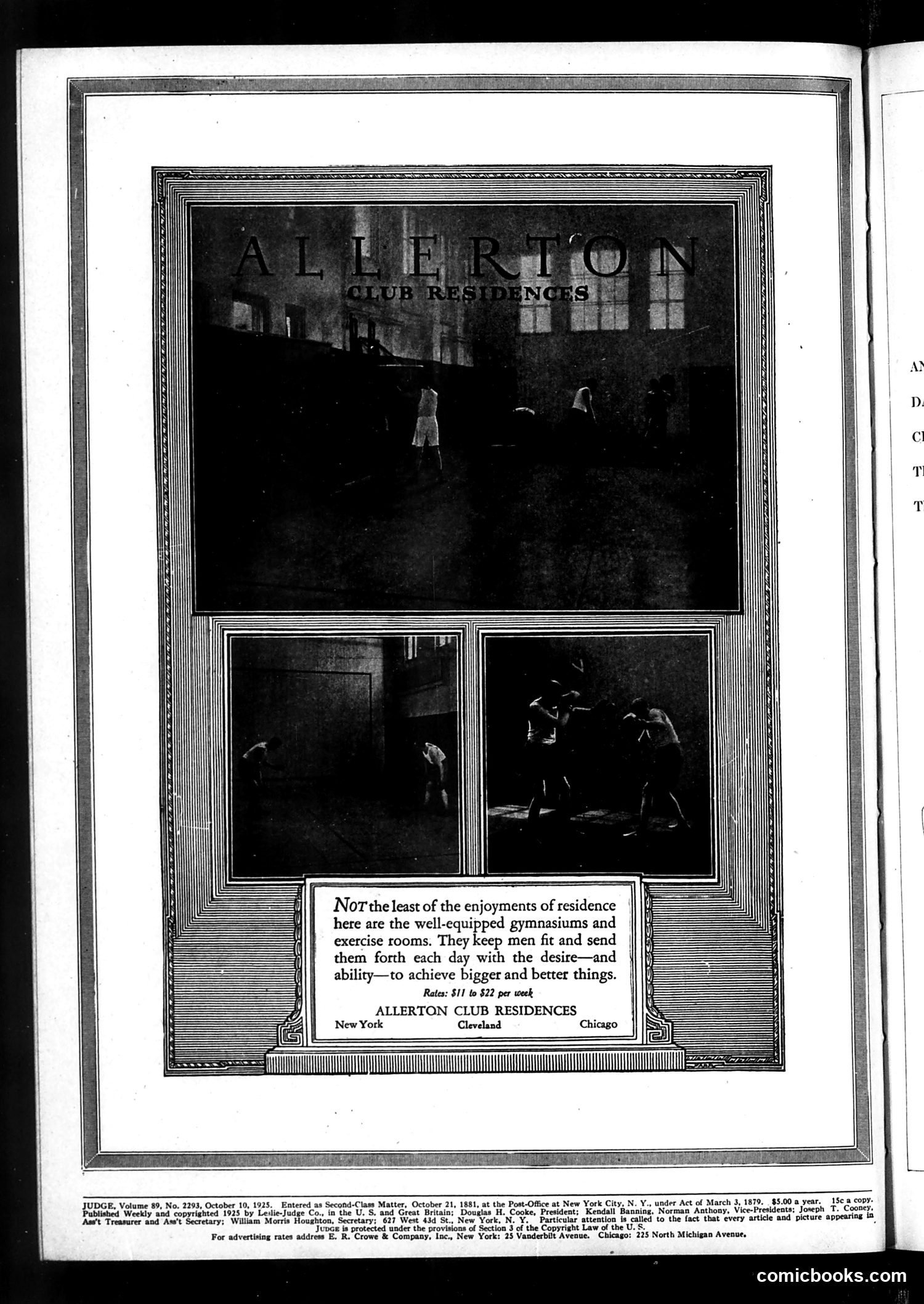
This page is primarily **advertising, not political satire**. It's a full-page advertisement for Allerton Club Residences, a men's residential club with locations in New York, Cleveland, and Chicago. The advertisement features photographs of gymnasium and exercise facilities, promoting these as key amenities. The text emphasizes that well-equipped gymnasiums and exercise rooms "keep men fit and send them forth each day with the desire—and ability—to achieve bigger and better things." The rates listed are $11 to $22 per week. This appears to be a straightforward commercial advertisement aimed at middle-class professional men seeking affordable urban housing with modern amenities, rather than political commentary or satire.
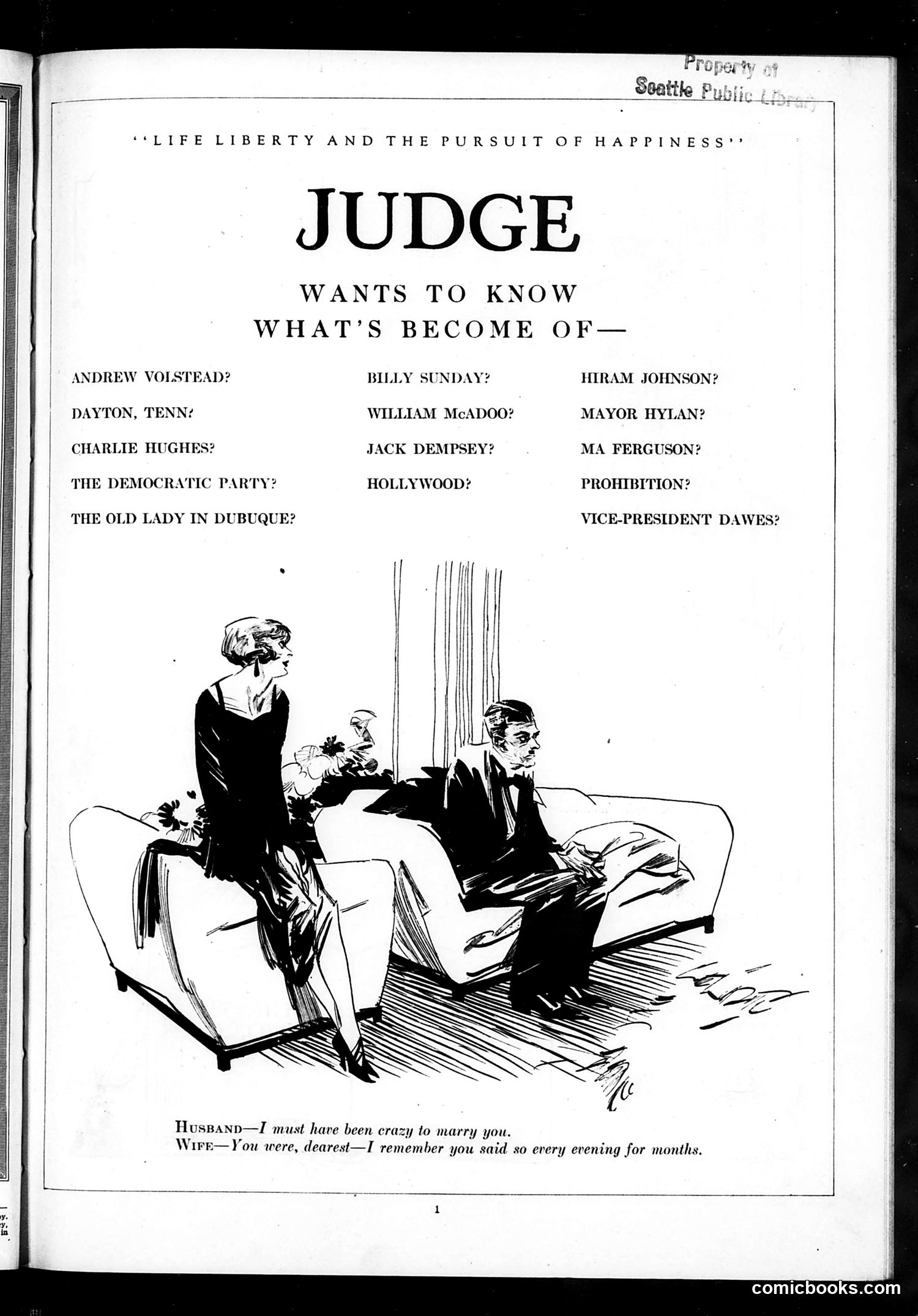
This Judge magazine page satirizes a judge's curiosity about the fates of various public figures and institutions. The headline lists prominent subjects of speculation—individuals like Andrew Volstead, Billy Sunday, and Charlie Hughes; entities like "The Democratic Party" and "Hollywood"; and issues like Prohibition and the fate of Vice-President Dawes. The cartoon below depicts a married couple on a sofa. The husband says he "must have been crazy to marry you," while the wife retorts that *he* was the one who "said so every evening for months" before proposing. This domestic scene serves as the actual "joke"—a commentary on marital regret and how courtship rhetoric contradicts post-marriage behavior. It's a commentary on changing attitudes within marriage rather than political satire, using marital discord as comedic fodder typical of early-20th-century humor magazines.
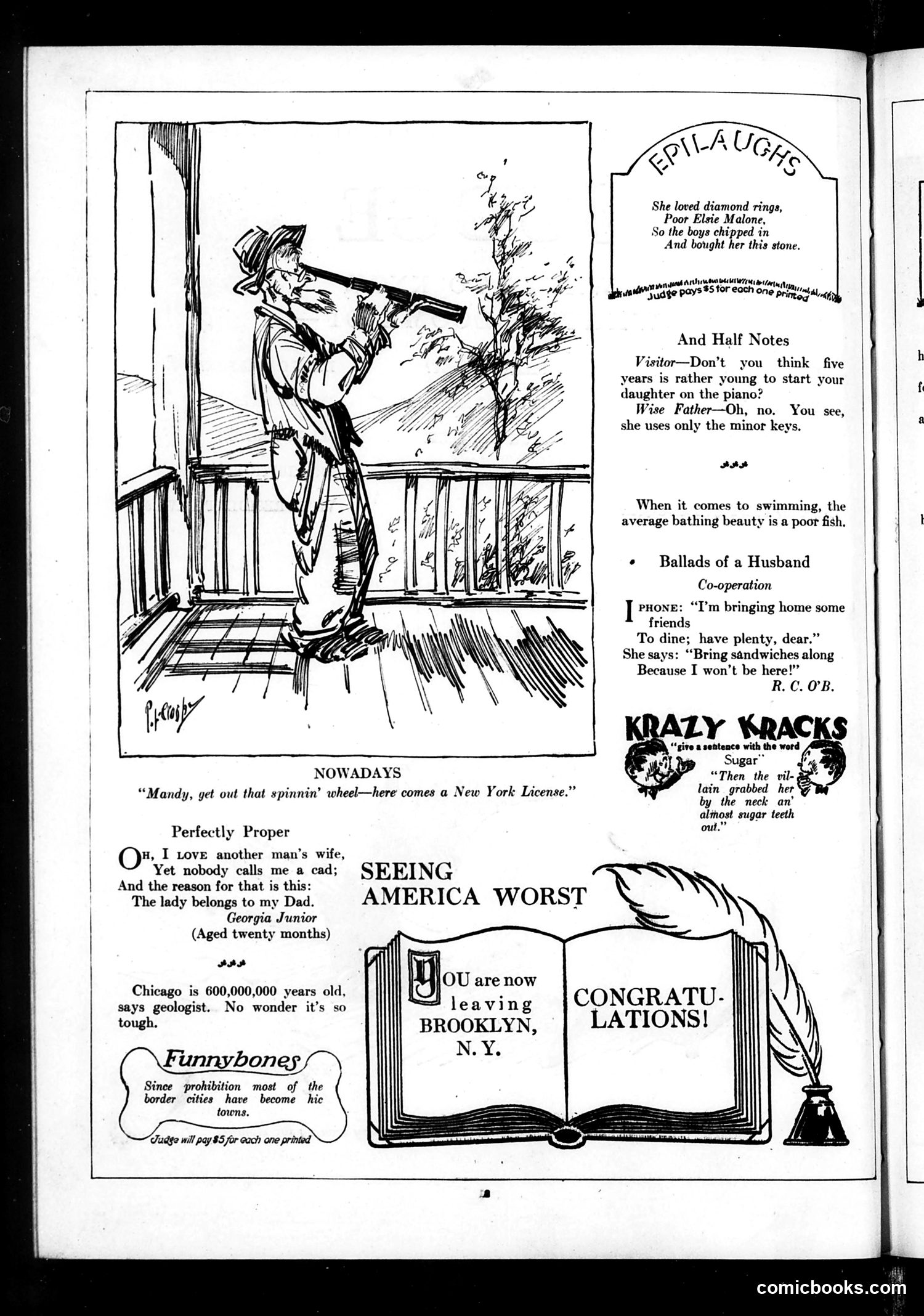
The main cartoon "Nowadays" depicts a man with a telescope on a balcony, captioned "Mandy, get out that spinnin' wheel—here comes a New York License." This appears to satirize the introduction of automobile licensing in New York, suggesting even rural residents must now prepare for modern motorized traffic invading their countryside. Below are several brief humor items and advertisements. "Perfectly Proper" is a joke about a man loving another's wife without social censure because "the lady belongs to my Dad." The page includes typical period advertising like "Krazy Kracks" candy and a mock congratulations to those leaving Brooklyn, New York. The content reflects early 20th-century anxieties about modernization and automobiles transforming American life.
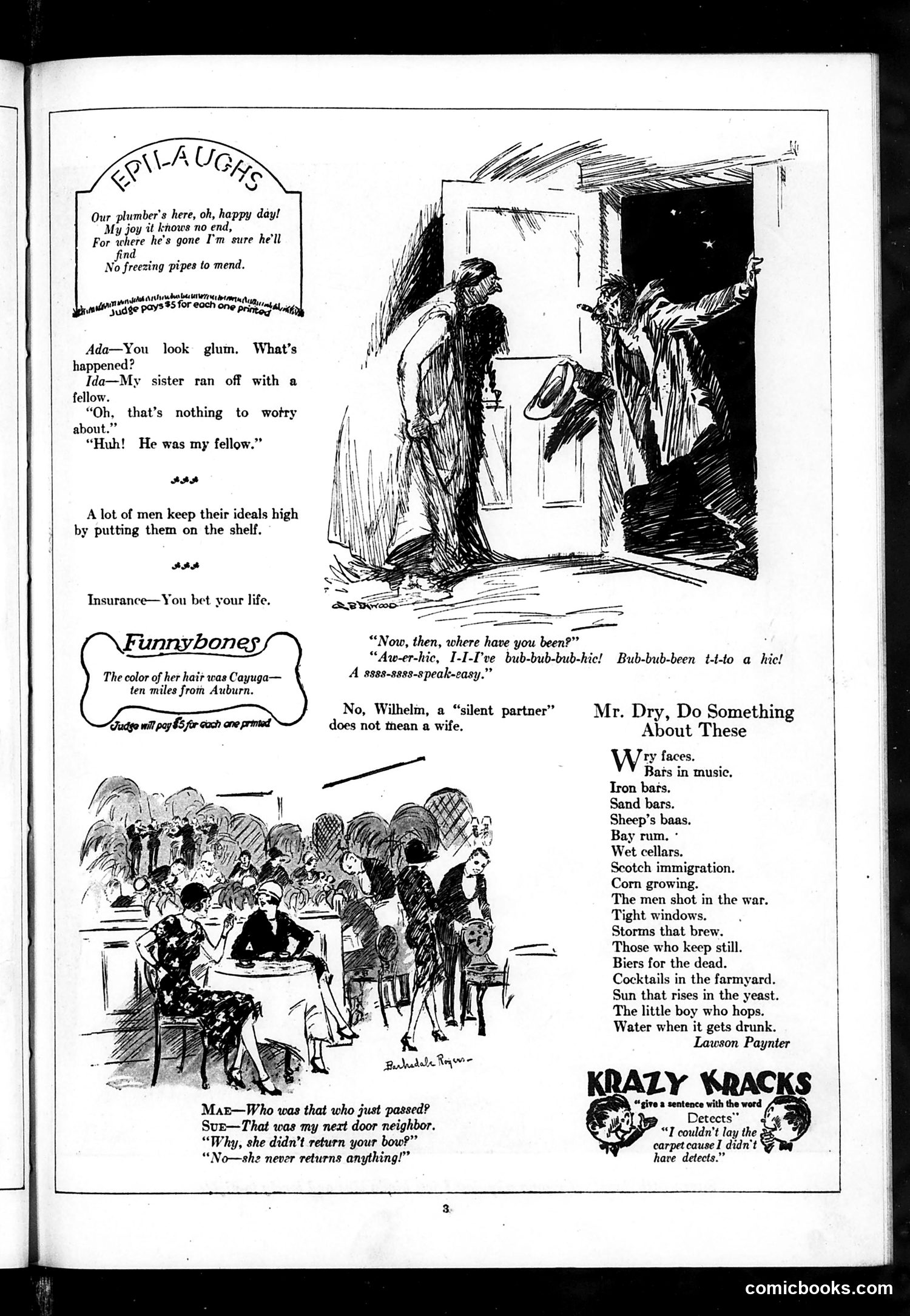
This page contains several humor pieces typical of early 20th-century satirical magazines: **"Epilaughs"** presents a light joke about a plumber's predictable usefulness—joking that wherever he goes, broken pipes await repair. **"Funnybones"** is a trivial factoid about hair color, typical filler content. **The main cartoon** depicts a domestic scene where a woman confronts a man arriving home, asking "where have you been?" with his nonsensical response. The caption clarifies this is about "silent partners"—likely a jab at husbands who remain emotionally unavailable in marriages. **"Mr. Dry, Do Something About These"** lists various social ills (bars, wet cellars, corn growing, war casualties, tight windows, storms) in verse form, appearing to be satirical commentary on contemporary problems. The page is primarily humor and light satire rather than pointed political commentary.
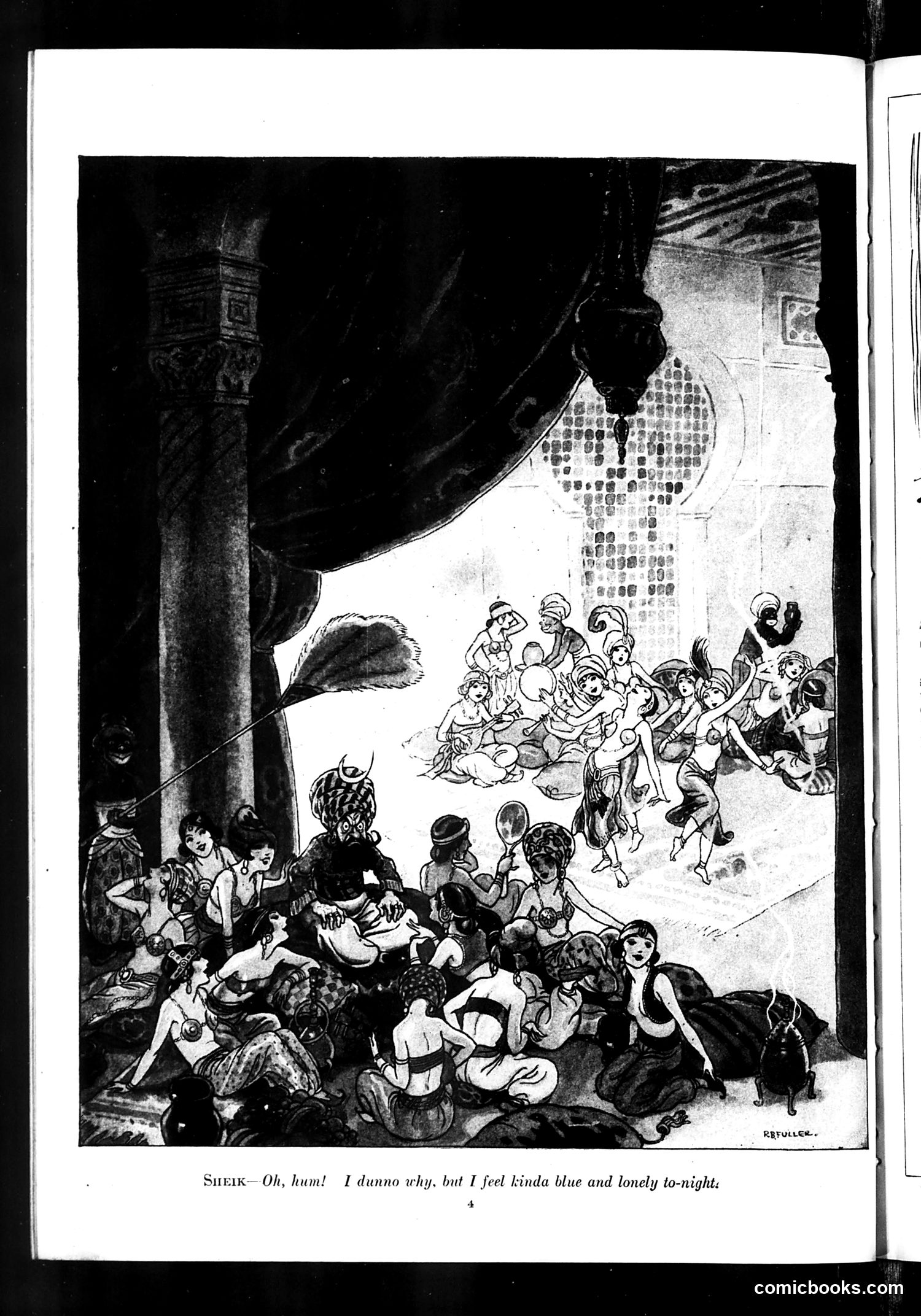
This appears to be an illustration from Judge magazine depicting a scene set in what looks like an Arabian or Middle Eastern setting, based on the architectural elements (ornate column, latticed window). The caption reads: "SHEIK—Oh, hum! I dunno why, but I feel kinda blue and lonely to-night!" The satire seems to target the "Sheik" figure—likely referencing the contemporary fascination with exotic "sheik" characters that were popular in 1920s American culture and entertainment. The joke appears to mock the romanticized portrayal of wealthy Middle Eastern figures in Western popular culture by showing this character feeling "blue and lonely" despite being surrounded by what appears to be a harem or attendants. The satire comments on the gap between fantasy and reality regarding these exoticized figures.
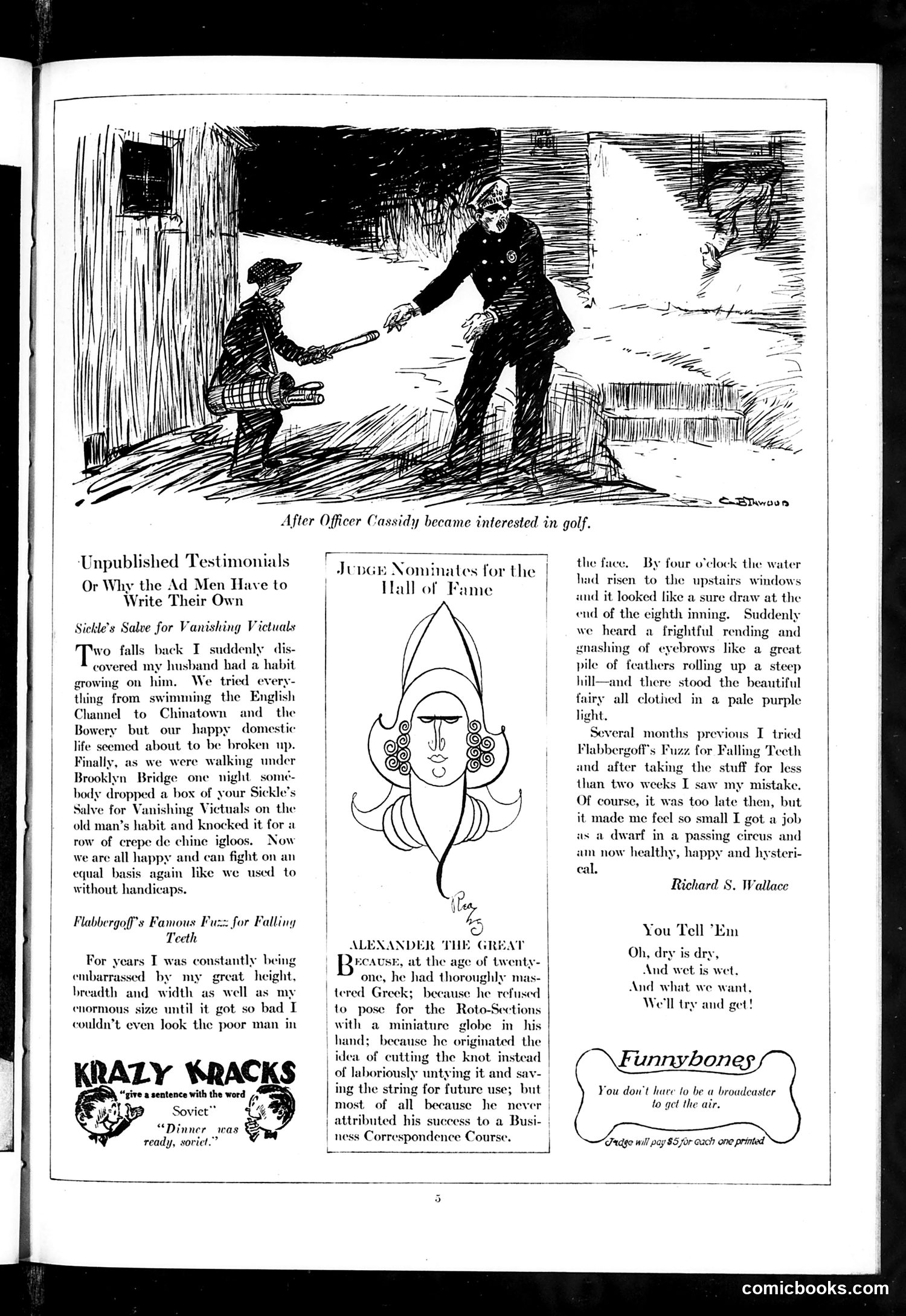
This page contains advertisements and humorous testimonials rather than political commentary. The main cartoon depicts "Officer Cassidy" becoming interested in golf—a joke about an Irish policeman adopting an upper-class sport. The "Unpublished Testimonials" section parodies product advertisements, with fake customer endorsements for items like "Sickle's Salve for Vanishing Viruals" and "Flabbergoff's Famous Fizz for Falling Teeth." These mock real advertisements' exaggerated claims about miraculous products. The Alexander the Great section appears to be a humorous historical piece, while "You Tell 'Em" and "Krazy Kracks" are standard joke features. "Funnybones" is an advertising placeholder. The overall tone is light, domestic humor typical of Judge's satirical-but-not-overtly-political content from this era.
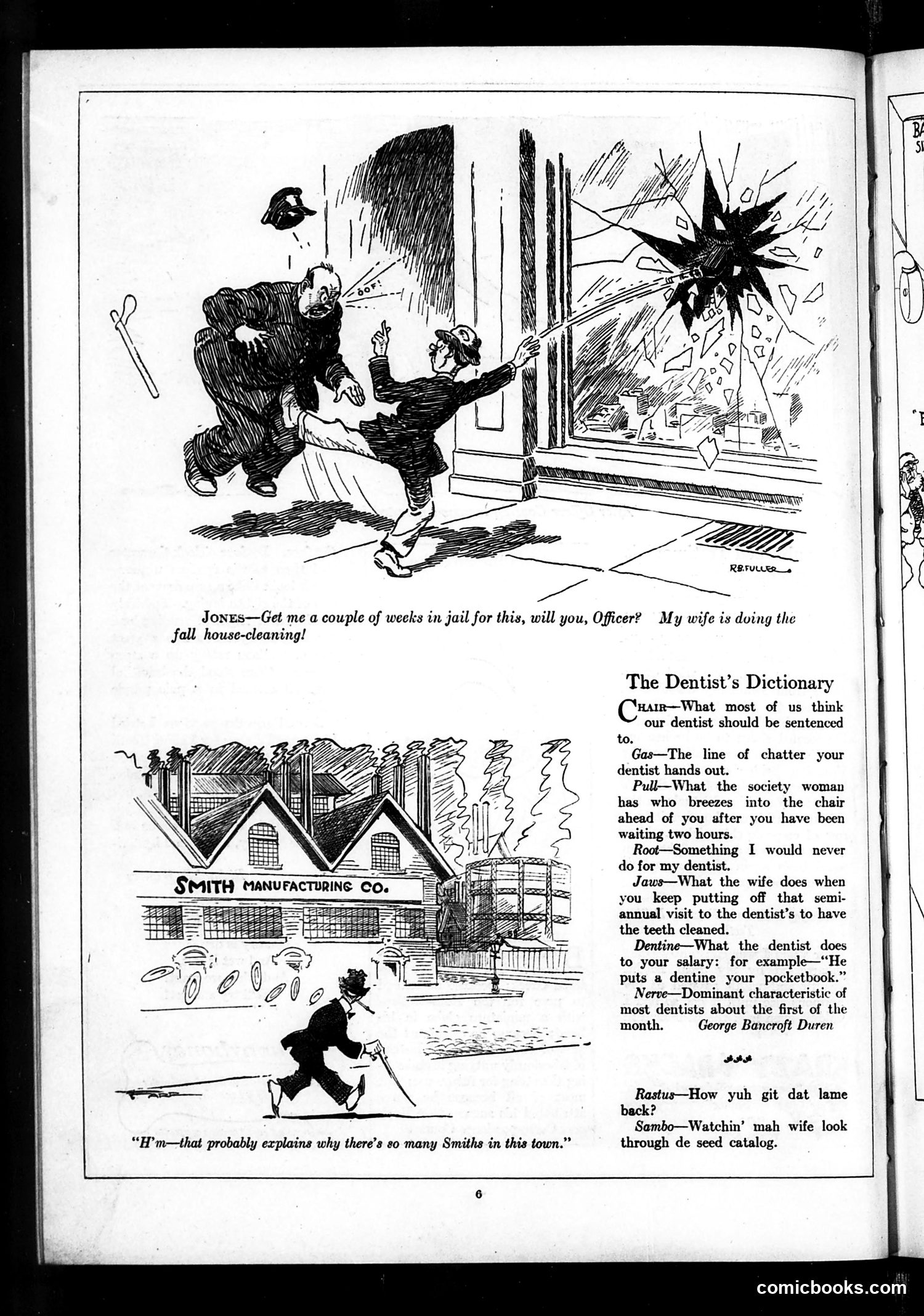
This Judge magazine page contains two separate satirical pieces: **Top Cartoon**: A man kicks through a window, telling a police officer to jail him for two weeks because his wife is doing fall house-cleaning. The satire mocks the disruptive chaos of spring cleaning (here, fall cleaning), suggesting jail is preferable to enduring it at home. **Bottom Cartoon**: A man runs from the Smith Manufacturing Co. building with a cane. The caption jokes that this explains "why there's so many Smiths in this town"—implying men are fleeing the factory in droves, suggesting poor working conditions or low pay that drives away employees. **The Dentist's Dictionary**: A humorous glossary mocking dentists' behavior and costs. Entries like "Dentine" (a pun suggesting dentists "dine" on patients' wallets) and "Nerve" (calling out their aggressive billing) criticize dentists' greed, inflated talk ("Gas"), and the financial burden of dental work on ordinary people. The page uses working-class and ethnic humor typical of the era.
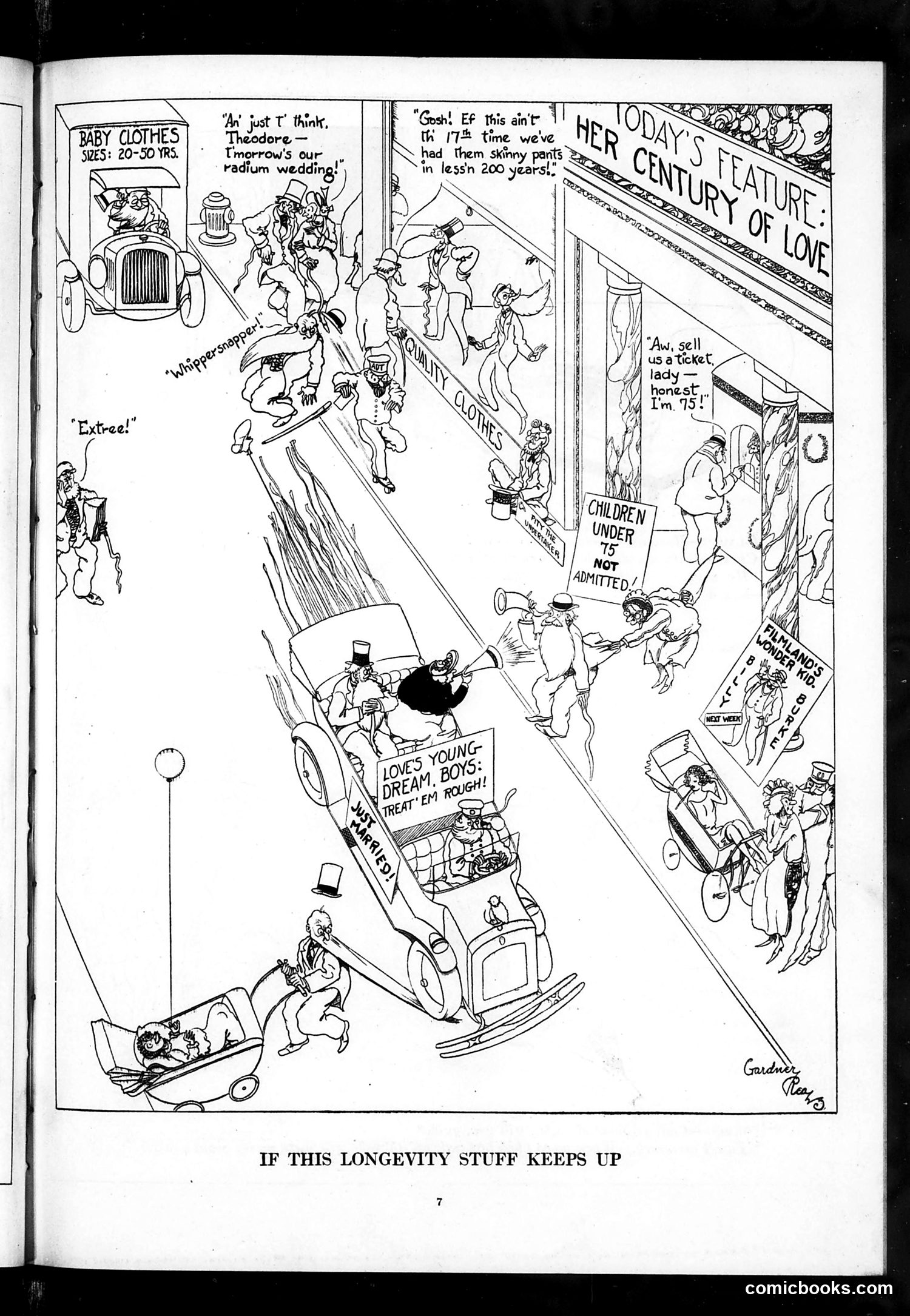
This Judge magazine cartoon satirizes the early 20th-century craze for radium products, which were marketed as health panaceas despite their dangerous radioactivity. The joke centers on radium's supposed life-extending properties ("longevity stuff"). The cartoon depicts a futuristic scene where radium's benefits have worked *too well*—people are living so long that baby clothes from "200 years" ago are still fashionable, and an elderly couple married in a "radium wedding" remain youthfully active. A theater advertises "Today's Feature: Her Century of Love," suggesting extreme longevity has become absurd. The satire mocks both the era's unfounded faith in radium as a miracle cure and the anxiety about overpopulation and resource scarcity that extended lifespans might create. The crowded street scenes and repeated warnings ("Children Under 15 Not Admitted") amplify this dystopian vision of a world burdened by too many long-lived people.
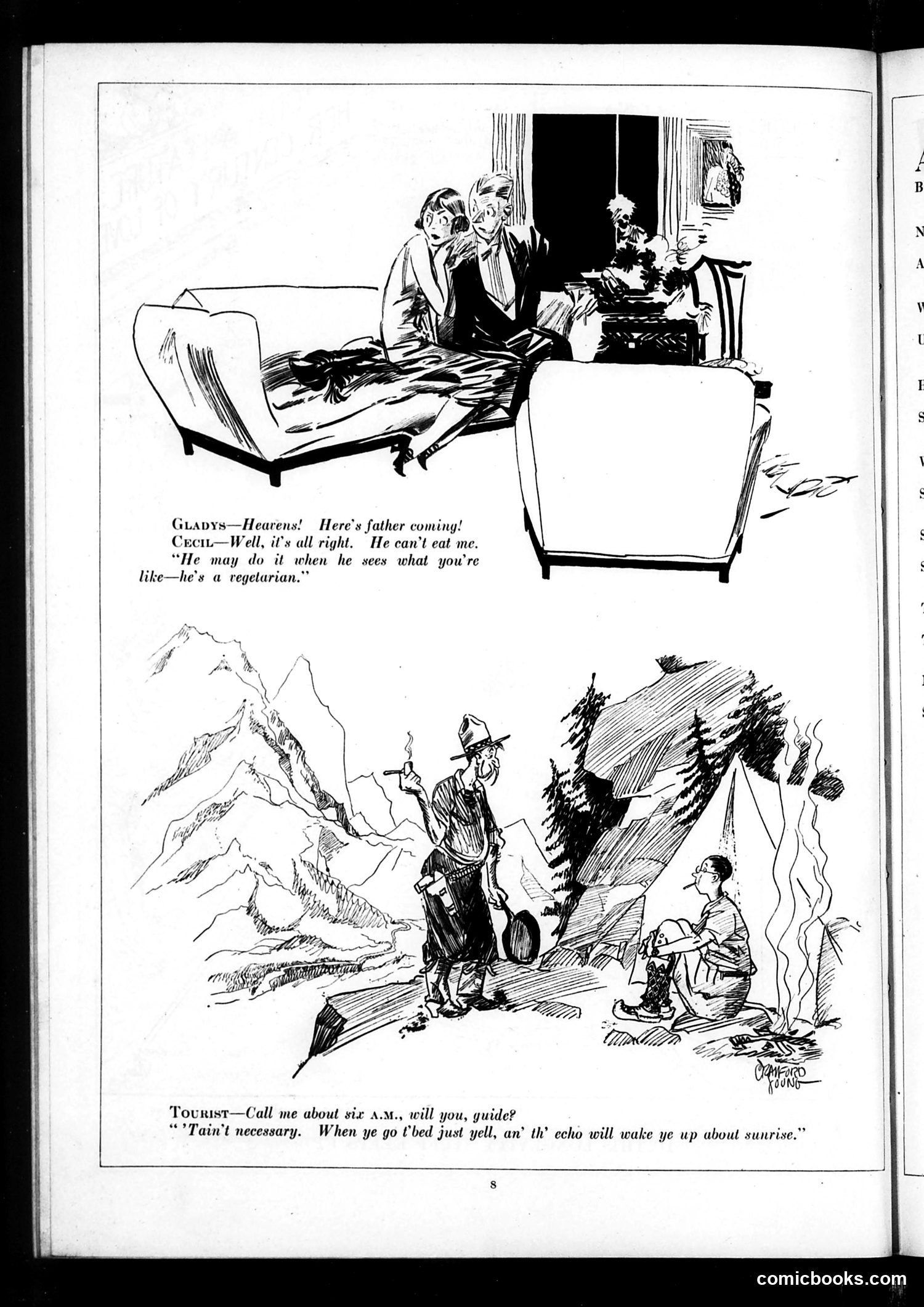
**Top cartoon:** A domestic comedy about a vegetarian father. Cecil reassures Gladys that her father can't eat him, joking that the father might want to after seeing what Gladys is "like"—implying she's unattractive or undesirable. The humor relies on the casual cruelty typical of early 20th-century satire about courtship and women's appearance. **Bottom cartoon:** A tourist humor piece mocking mountain scenery. The guide claims the echo from yelling in bed will naturally wake the tourist at sunrise—a tall tale playing on rural/frontier stereotypes about dramatic landscapes and the gullibility of city tourists. The exaggeration is the joke's entire point. Both cartoons feature straightforward, era-typical humor without apparent political content.
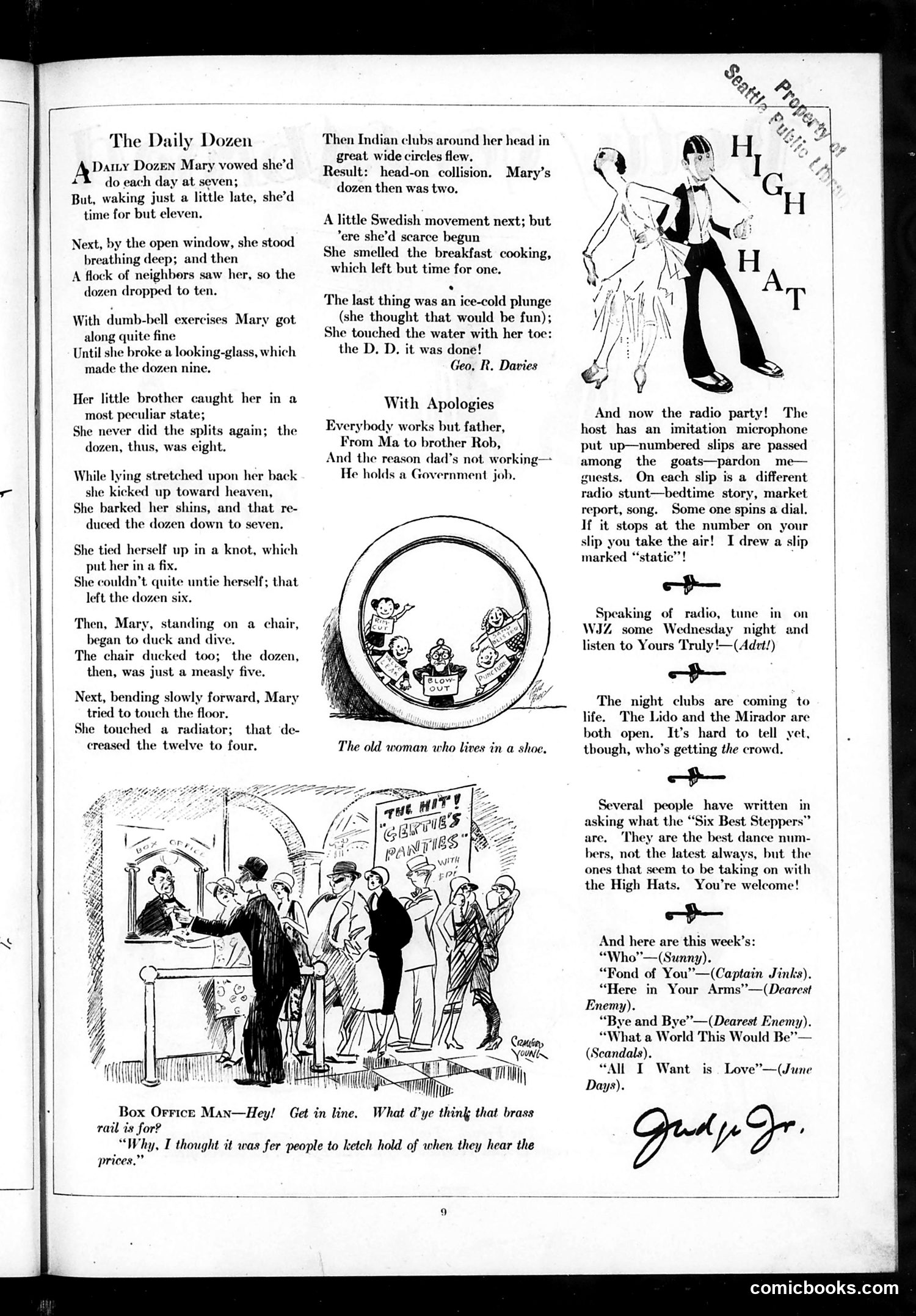
This page contains humor pieces satirizing 1920s American life. **"The Daily Dozen"** mocks the popular exercise fad of the era—a standardized fitness routine that Americans were encouraged to perform daily. The joke follows a woman trying to complete all twelve exercises but failing repeatedly through comic mishaps (breaking mirrors, getting stuck in knots, colliding with radiators). It's lighthearted satire of wellness culture and the gap between fitness aspirations and reality. **"With Apologies"** is a darker political jab at government employment during what appears to be a recession or economic hardship. The parody of the popular song "Everybody Works but Father" suggests that fathers employed by the government aren't actually working—a critique of perceived government inefficiency or patronage jobs. The remaining content discusses radio entertainment, night clubs, and popular dance music of the period, reflecting Jazz Age leisure culture. The "Box Office Man" cartoon (bottom) appears to be an unrelated gag about theater seating.
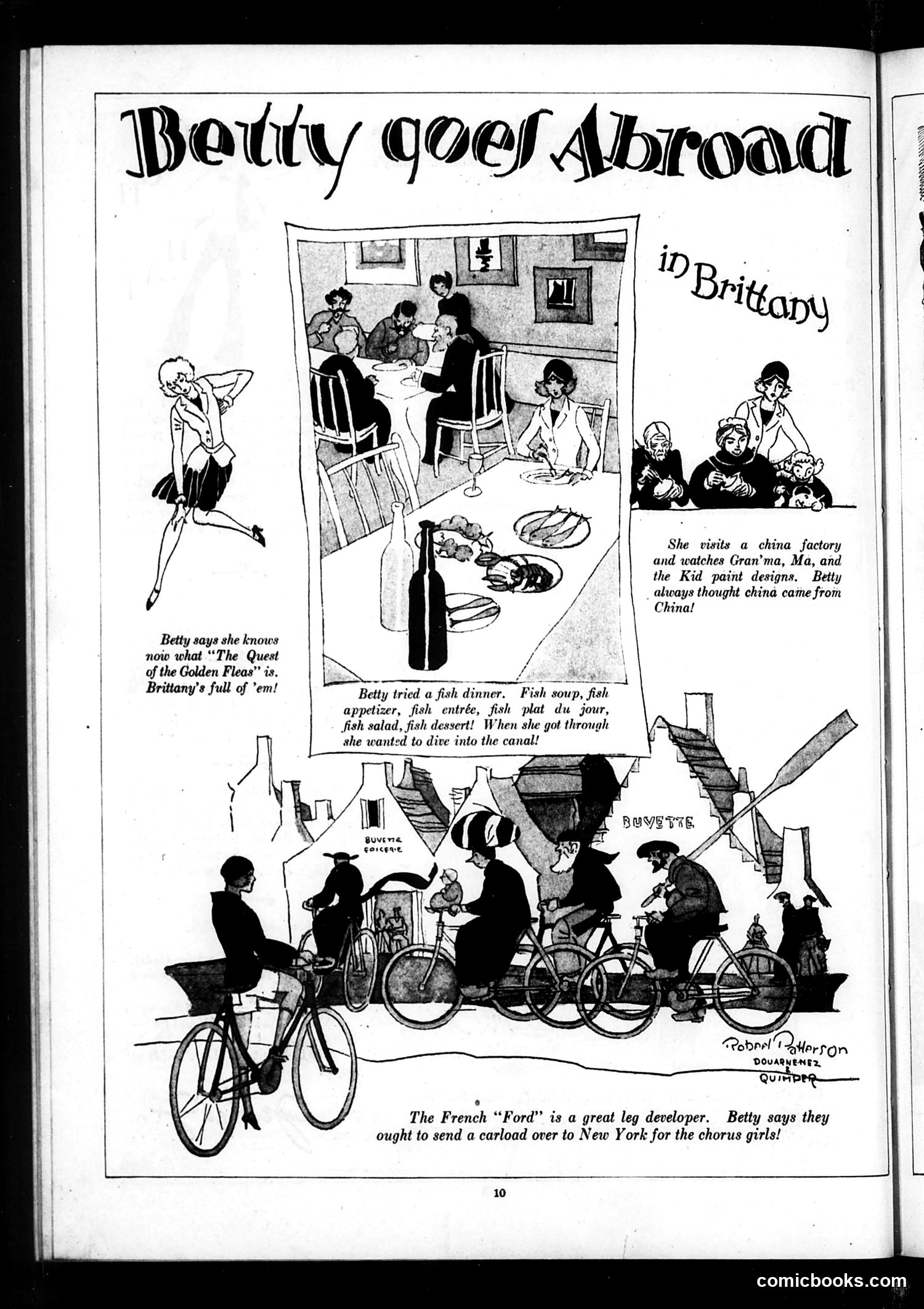
This is a humorous travel narrative about an American girl named Betty visiting Brittany, France. The satire targets American ignorance and cultural assumptions: **The jokes:** - Betty assumes fine china must come from China (suggesting American naïveté about origins) - Brittany is infested with fleas—a jab at French hygiene standards - A fish dinner consists entirely of fish courses, humorously overwhelming her - The French "Ford" bicycle is so sturdy it develops leg muscles—implying American chorus girls need physical conditioning The cartoons mock both American tourists' provincial expectations and French stereotypes current in 1920s American media. The style and subject matter suggest this is from *Judge's* regular humor section rather than political commentary. The artist is credited as Reginald Marsh (or similar—OCR unclear).
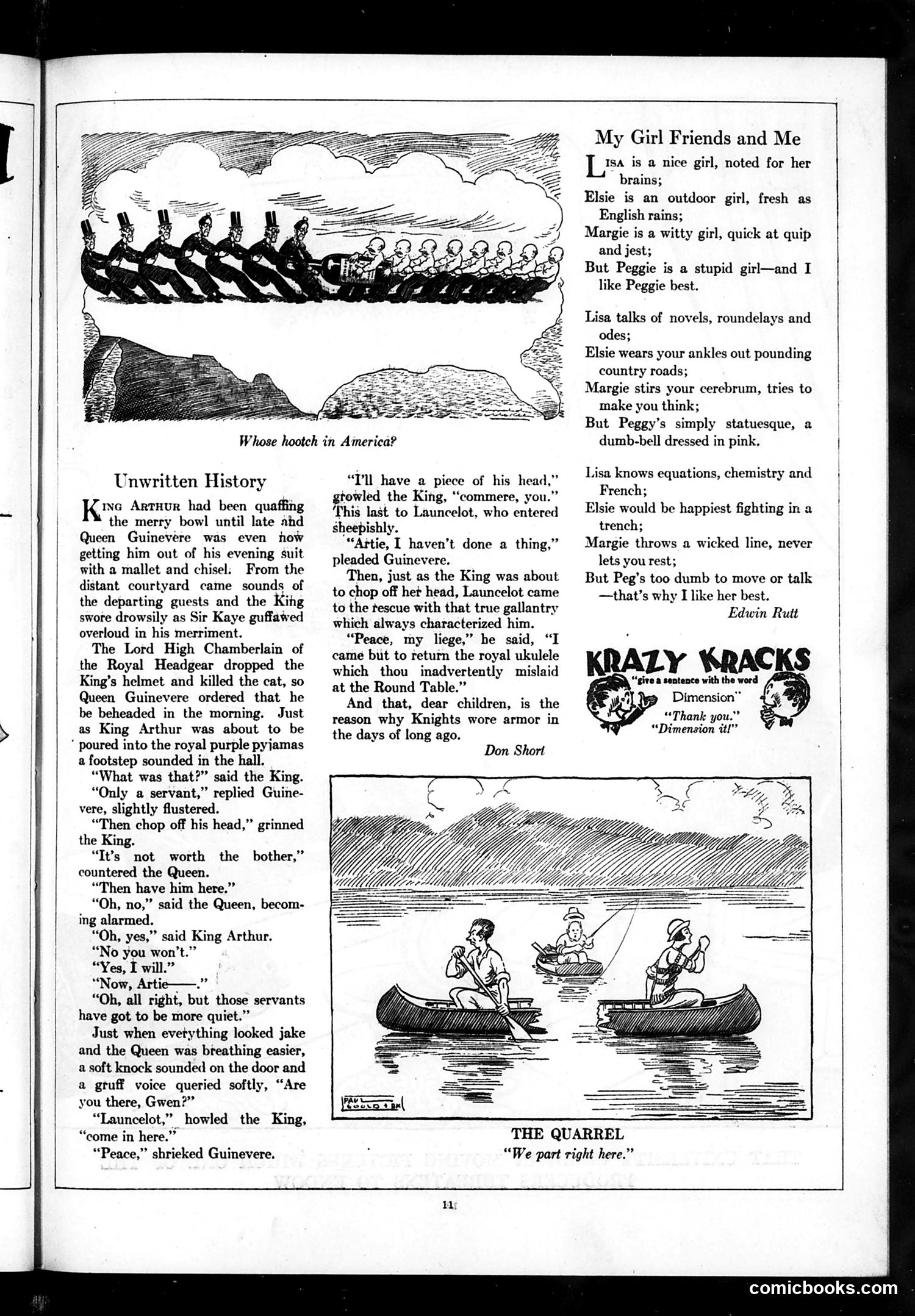
This Judge magazine page contains two distinct pieces of humor targeting early 20th-century American society: **"Unwritten History"** is a comedic parody of Arthurian legend that satirizes Prohibition-era drinking and domestic chaos. King Arthur, depicted as a drunk nobleman ("quaffing the merry bowl"), becomes violent and irrational—threatening to behead servants and his wife over minor disturbances. The joke hinges on the absurdity of medieval chivalry reframed as drunken aristocratic excess. The punchline—that knights wore armor to protect themselves from the King's murderous drunkenness—mocks both the romantic legend and contemporary wealthy men's alcohol-fueled behavior. **"My Girl Friends and Me"** satirizes the "modern girl" of the 1920s through contrasting female stereotypes. The narrator prefers "Peggie," described as beautiful but stupid ("a dumb-bell dressed in pink"), over intelligent or active women. This reflects period anxiety about educated, independent women—Lisa (intellectual), Elsie (athletic/independent), and Margie (quick-witted) are presented as threatening, while the passive, unintelligent woman is the "ideal" romantic choice.
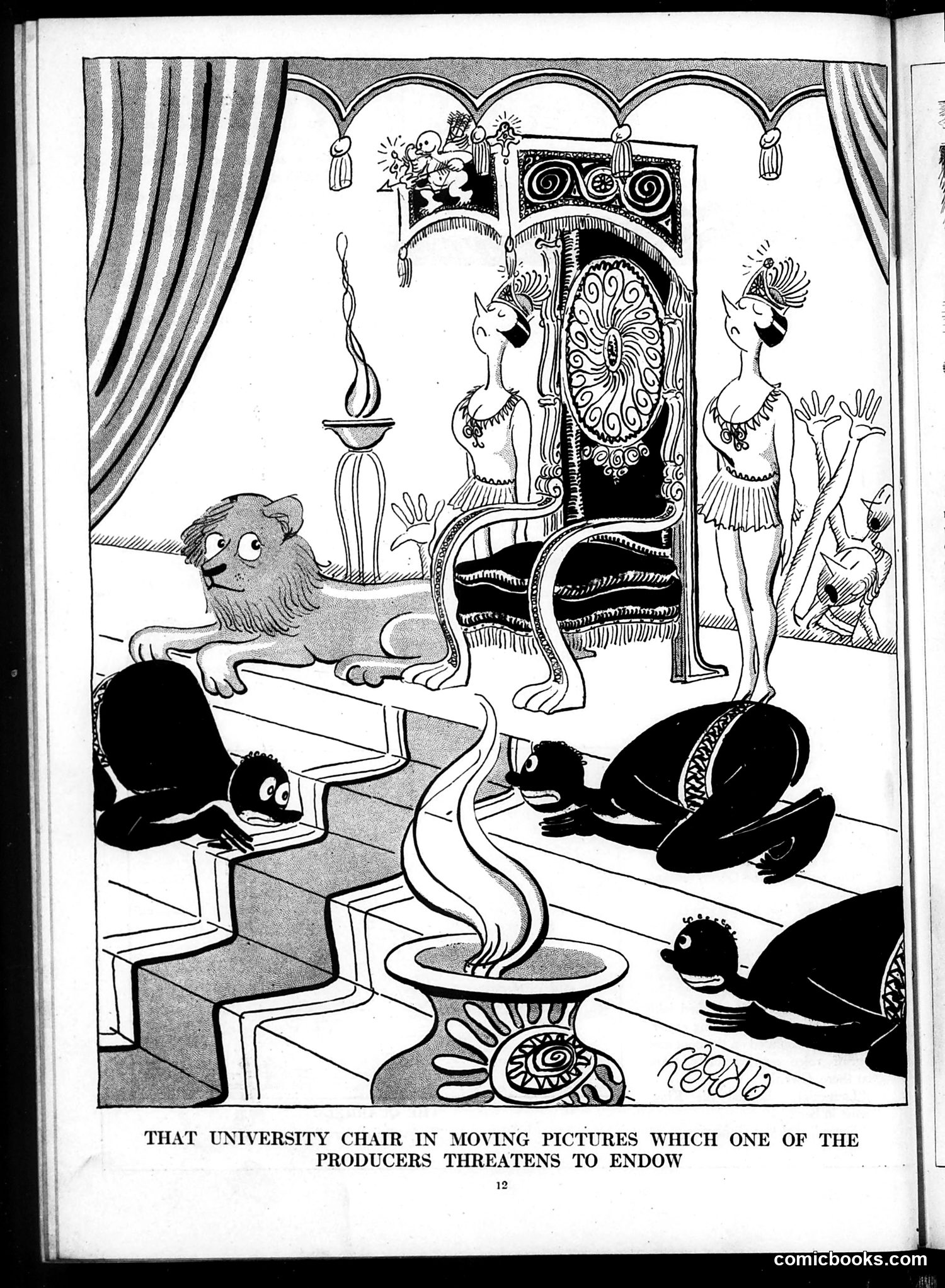
This satirical cartoon depicts a luxurious interior scene mocking a film producer's proposed donation of a university chair in cinema studies. The image shows wealthy figures lounging in an opulent room with classical architecture, while servants or attendants bow before them. A lion rests casually in the space, suggesting decadence and power. The satire targets the pretension of early Hollywood producers attempting to gain intellectual legitimacy and respectability by funding academic positions. The exaggerated grandeur and the servile positioning of figures suggest the cartoon criticizes this as self-aggrandizing—the producer seeking to elevate his status through philanthropy rather than genuine scholarly commitment. The date appears to be from cinema's early era, when the film industry was still establishing its cultural credibility among traditional institutions.
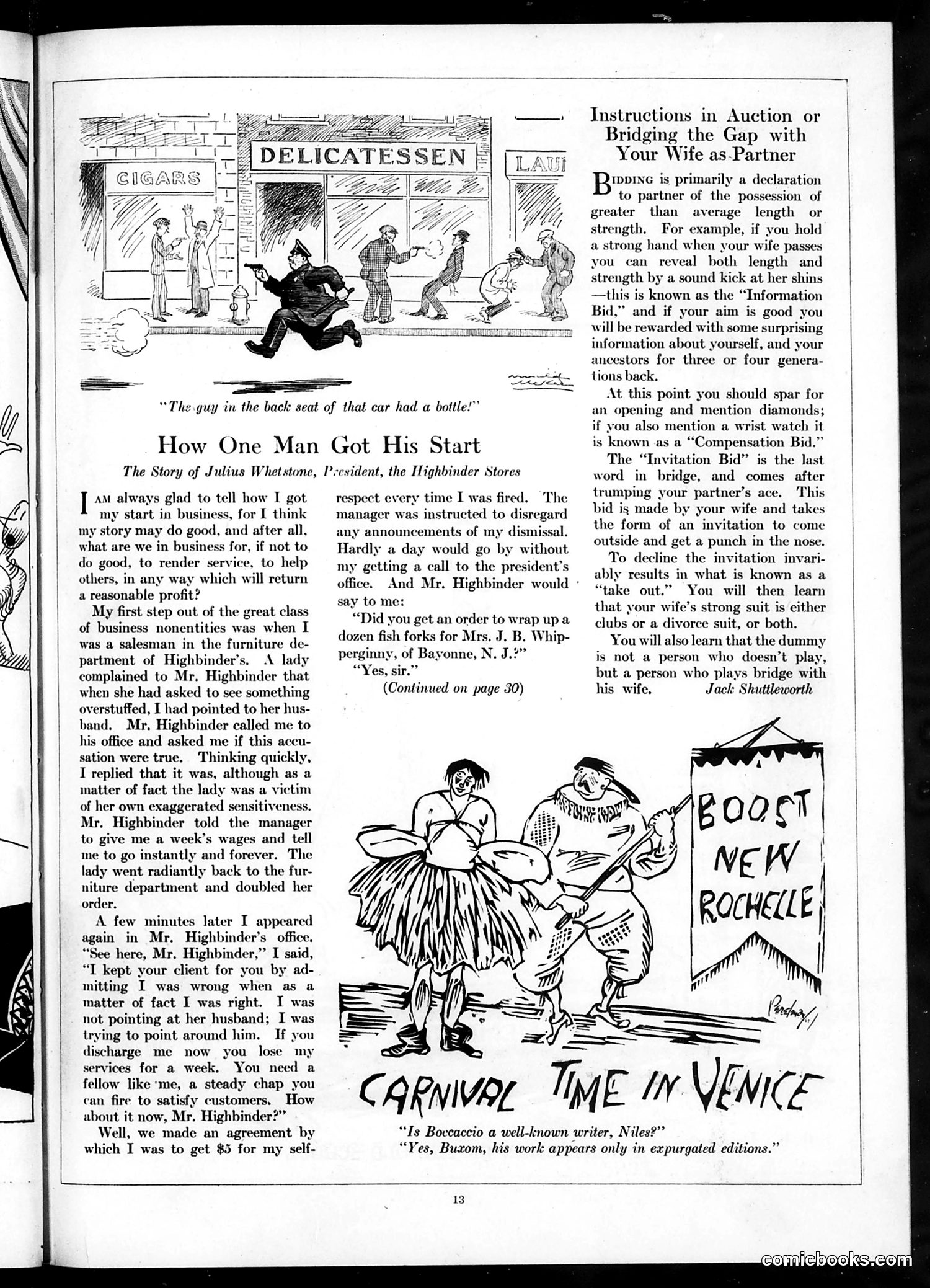
This page contains two satirical pieces typical of 1920s-era Judge magazine: **"How One Man Got His Start"** mocks corporate duplicity and customer appeasement. Julius Whetstone insults a customer's husband, gets fired, then immediately rehires himself by arguing he's useful *because* customers will pay to see him dismissed. Mr. Highbinder agrees to pay him "$5 for my self-respect every time I was fired"—a cynical joke about how businesses manipulate both employees and customers, rewarding deception as good business practice. **"Instructions in Auction or Bridging the Gap"** uses bridge (the card game) as cover for domestic satire. The piece humorously describes marital conflict through bridge terminology—an "Information Bid" is kicking your wife's shins, an "Invitation Bid" is her inviting you outside for a punch. The final cartoon about Boccaccio appearing "only in expurgated editions" jokes that obscene classical literature must be censored. Both pieces reflect 1920s cynicism about business ethics and marital discord presented as humor for Judge's educated, urban readership.
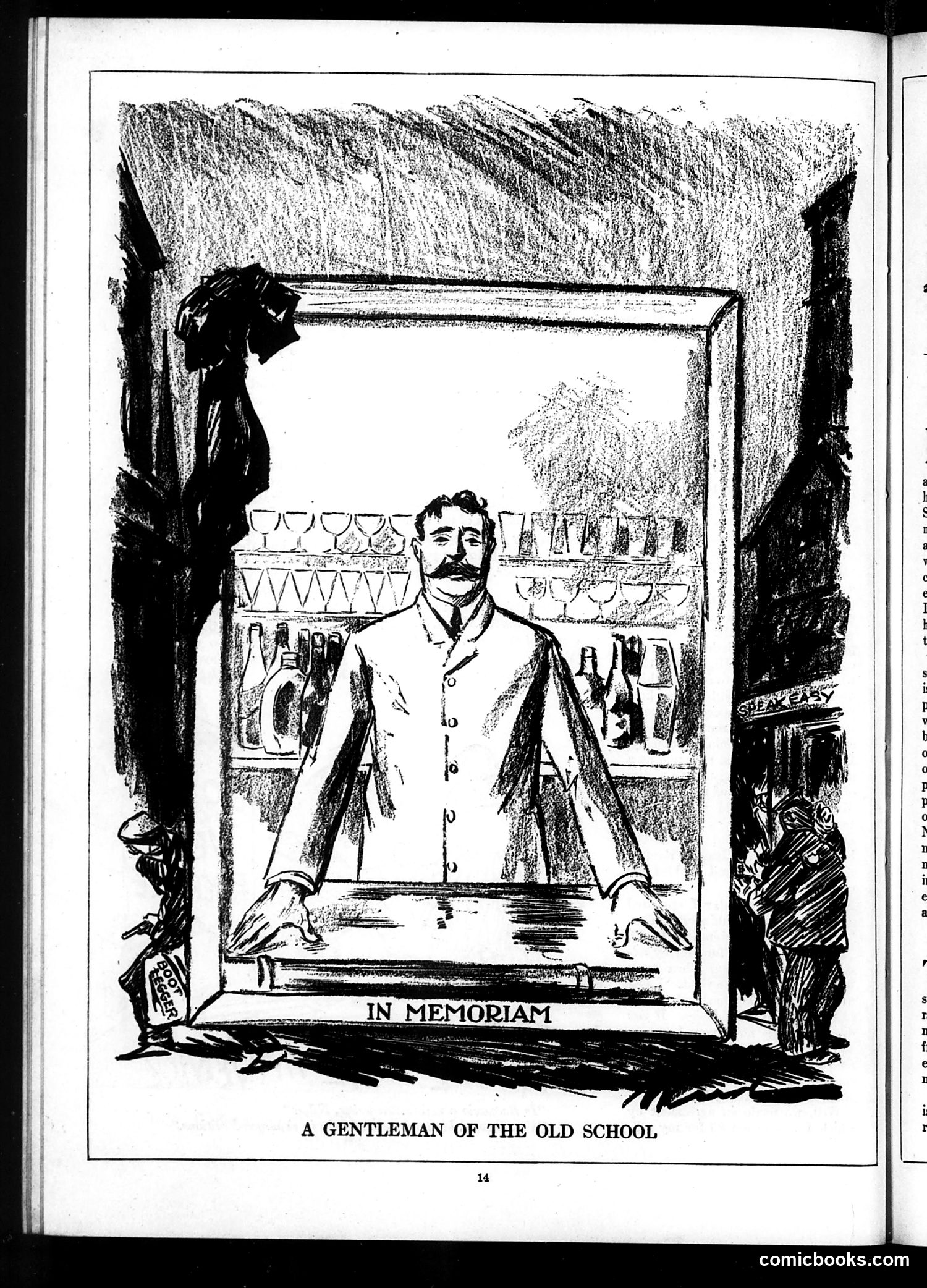
This appears to be a memorial illustration rather than satirical commentary. The framed portrait shows a distinguished man with a prominent mustache wearing formal attire, positioned in what resembles a shop or establishment (glasses and bottles visible in the background). The Latin phrase "IN MEMORIAM" indicates this is a tribute to a deceased person. The title "A Gentleman of the Old School" suggests nostalgia for traditional values and refined manners from an earlier era. The elaborate decorative frame with draped fabric on either side emphasizes the commemorative, respectful nature of the image. Without additional context about who this specific figure is or the publication date, the exact subject and satirical intent remain unclear, though the overall tone appears elegiac rather than mocking.
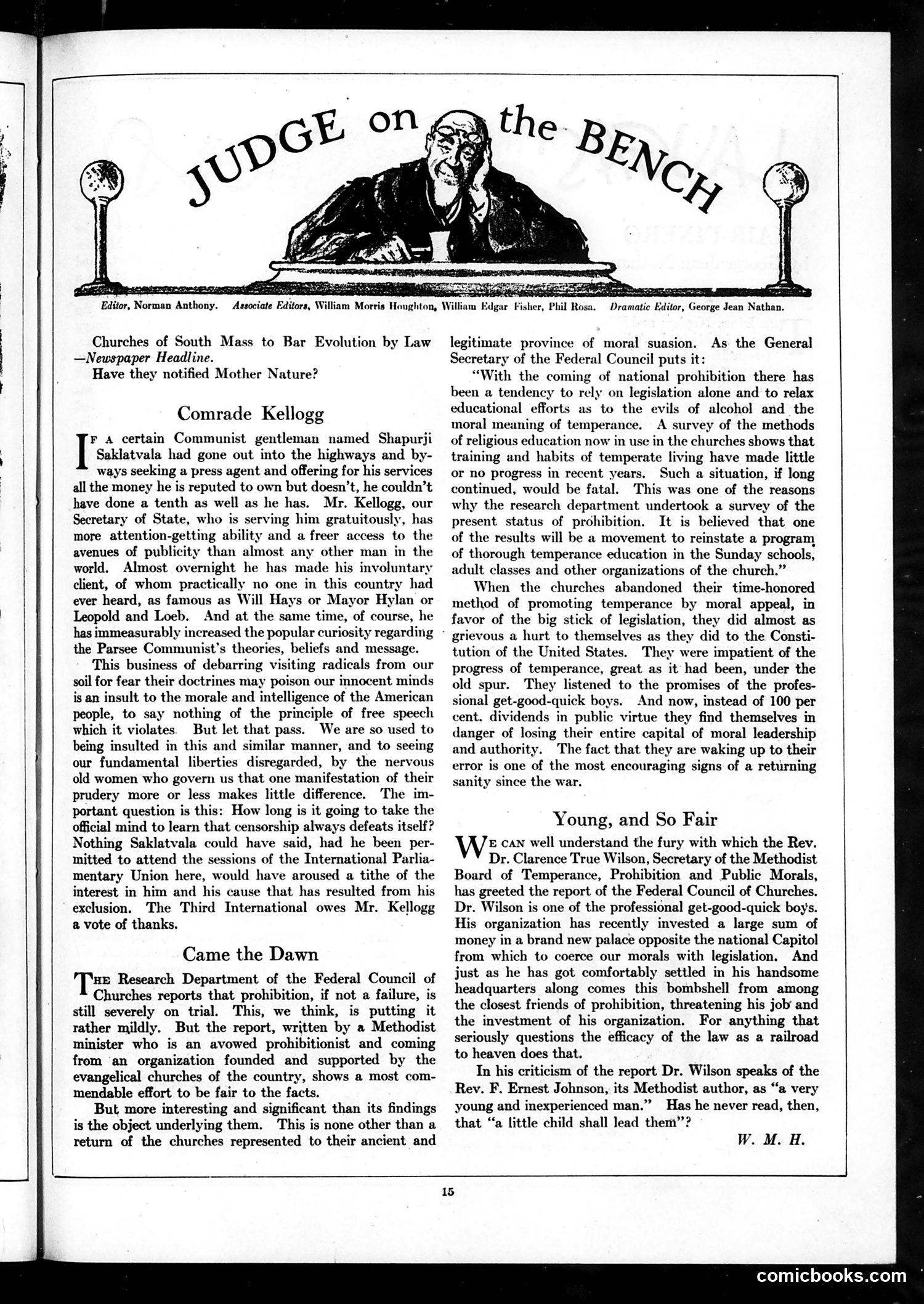
This page contains three satirical editorial pieces criticizing government overreach and institutional hypocrisy in 1920s America. **"Comrade Kellogg"** mocks Secretary of State Frank Kellogg for inadvertently making Communist Shapurji Saklatvala famous by banning him from entering the country. The satire argues censorship backfires—the exclusion generated more publicity than Saklatvala could have achieved through speeches. Judge defends free speech principles while criticizing government's "nervous" suppression of radical ideas. **"Churches of South Mass to Bar Evolution by Law"** (headline) sarcastically asks if churches notified "Mother Nature" of their legal ban on teaching evolution—absurdly implying nature won't obey legislation. **"Came the Dawn"** critiques churches' shift from moral persuasion to legislative enforcement regarding Prohibition. The Federal Council of Churches' report acknowledges that relying solely on law rather than education and moral suasion failed. Judge applauds churches returning to their "ancient" role of moral guidance rather than political coercion. The unifying theme: institutions overestimating government power while underestimating human nature and reason.
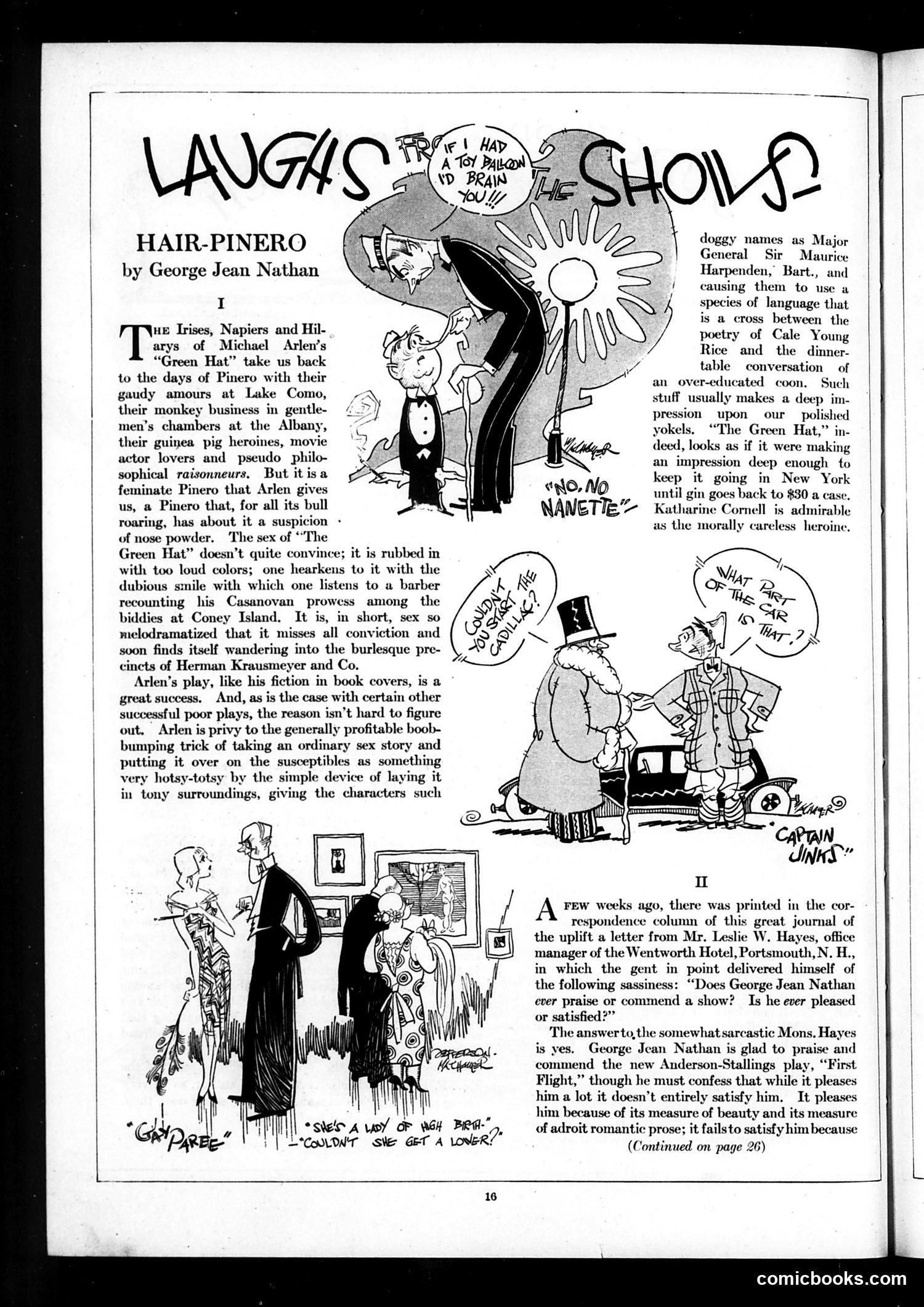
This is a theatrical drama criticism in Judge magazine's satirical style. Nathan reviews Michael Arlen's play "The Green Hat," comparing it unfavorably to the 19th-century playwright Arthur Wing Pinero. Nathan's critique argues that while Arlen's work enjoys commercial success among "polished yokels," it achieves this through superficial tricks: placing a conventional sex story in wealthy settings (Lake Como, the Albany club) and giving characters aristocratic names (Major General Sir Maurice Harpenden) and affected dialogue that mimics both high poetry and pretentious conversation. The cartoons illustrate Nathan's point mockingly—characters discuss the play while embodying its shallow glamour and affected speech. The second section references a hotel manager's letter questioning whether Nathan ever praises anything, allowing Nathan to defend his critical standards while grudgingly commending the Anderson-Stallings play "First Flight" for possessing some artistic merit despite its limitations. The satire targets both Arlen's melodramatic play and the audiences susceptible to its packaging of mediocrity as sophistication.
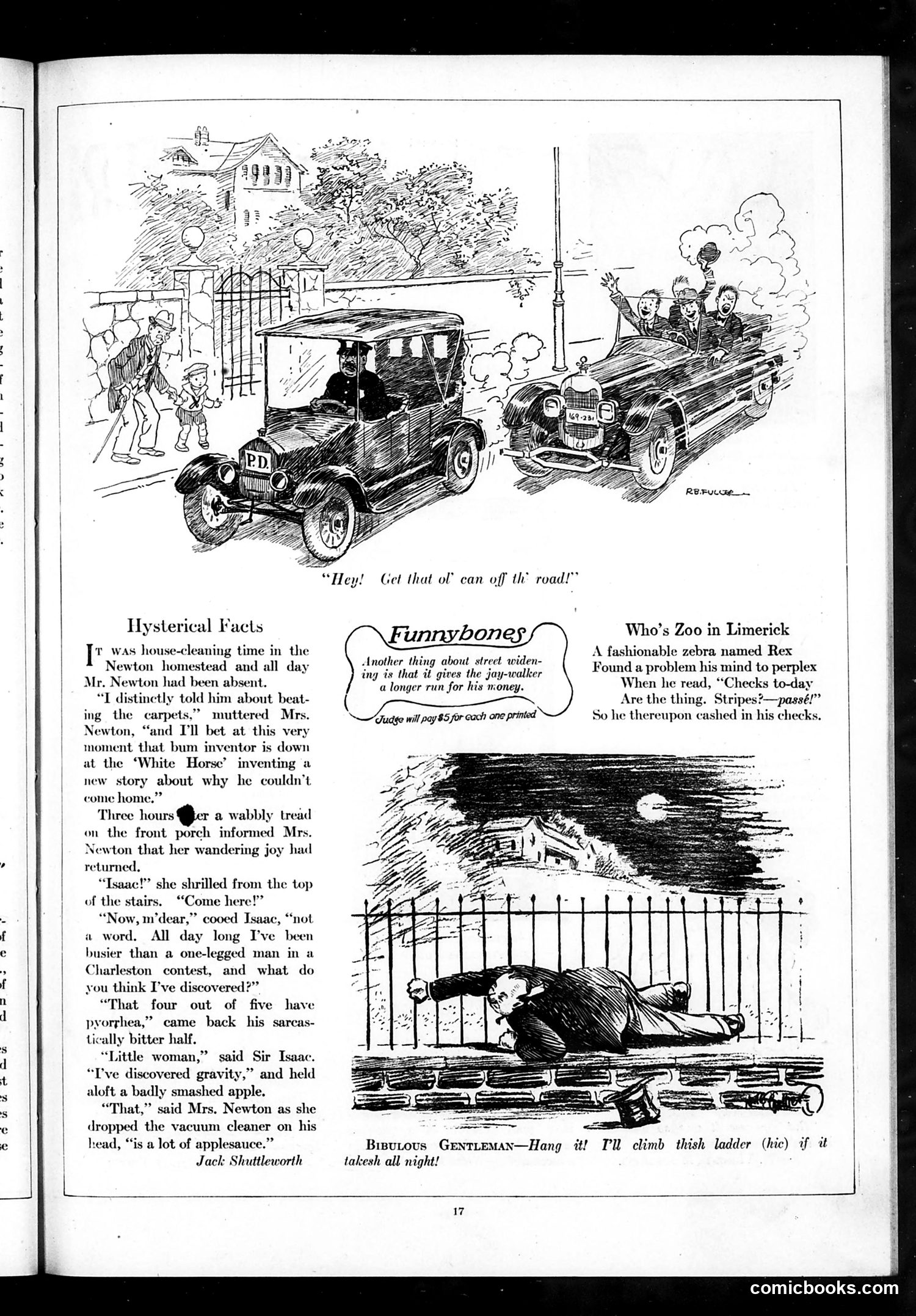
**Top Cartoon:** Shows two vintage automobiles on a road with the caption "Hey! Get that ol' can off th' road!" This satirizes early automobile culture—the tension between new motor vehicles and existing traffic/pedestrians. The "can" is slang for an old or poorly-functioning car, mocking the unreliability of early automobiles. **"Hysterical Facts" Story:** A domestic comedy where Mrs. Newton accuses her husband of avoiding housework by inventing excuses at a bar ("White Horse"). When he claims to have "discovered gravity" and produces a smashed apple, she literally drops a vacuum cleaner on his head. This mocks both pseudointellectual husband excuses and references Newton's famous apple anecdote about gravity—treating a domestic dispute through the lens of scientific pretension. **Minor Items:** "Funnybones" contains a one-liner about street widening; "Who's Zoo in Limerick" is a humorous poem about a zebra rejecting stripes for fashionable checks—gentle wordplay humor typical of the era.
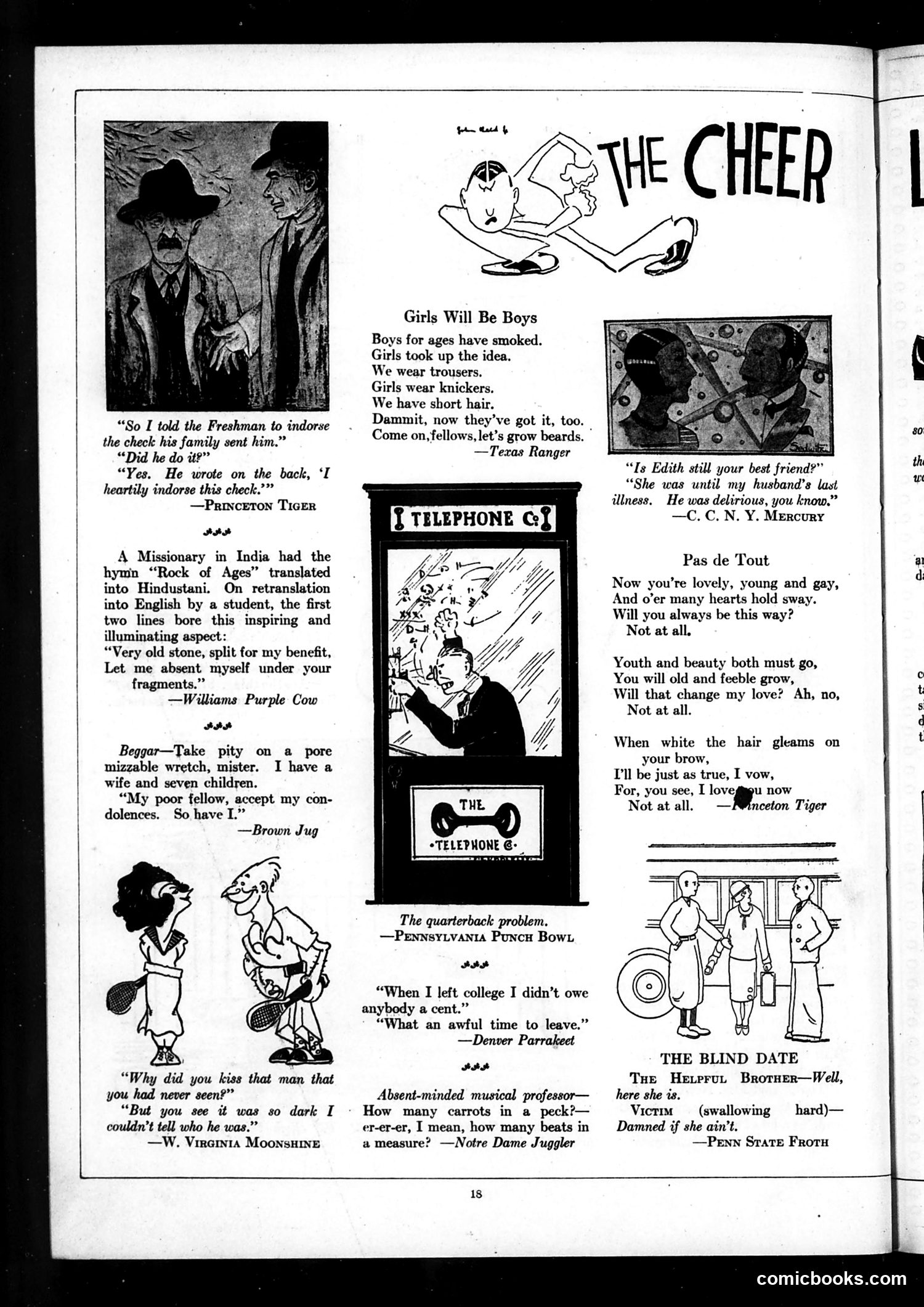
This page from Judge magazine contains multiple short humorous pieces targeting college life and social conventions of the era (likely 1920s, based on references to bobbed hair and women smoking). **Key content includes:** - **"Girls Will Be Boys"**: Satirizes women adopting traditionally masculine habits—smoking, wearing trousers and short hair. The joke is men's defensive response: "let's grow beards" to reclaim male distinction. This reflects anxiety about gender role changes during the flapper era. - **"Telephone Girl" cartoon**: Appears to depict a telephone operator, a common female occupation of the period. - **Various college jokes**: Target Princeton, Penn State, Notre Dame students—mocking freshman naiveté, absent-minded professors, and romantic disappointment ("The Blind Date"). - **"Pas de Tout"**: A sentimental poem about enduring love despite aging, juxtaposed against the magazine's generally cynical humor. The satire reflects 1920s concerns about changing gender norms, college culture, and courtship customs among upper-class youth.
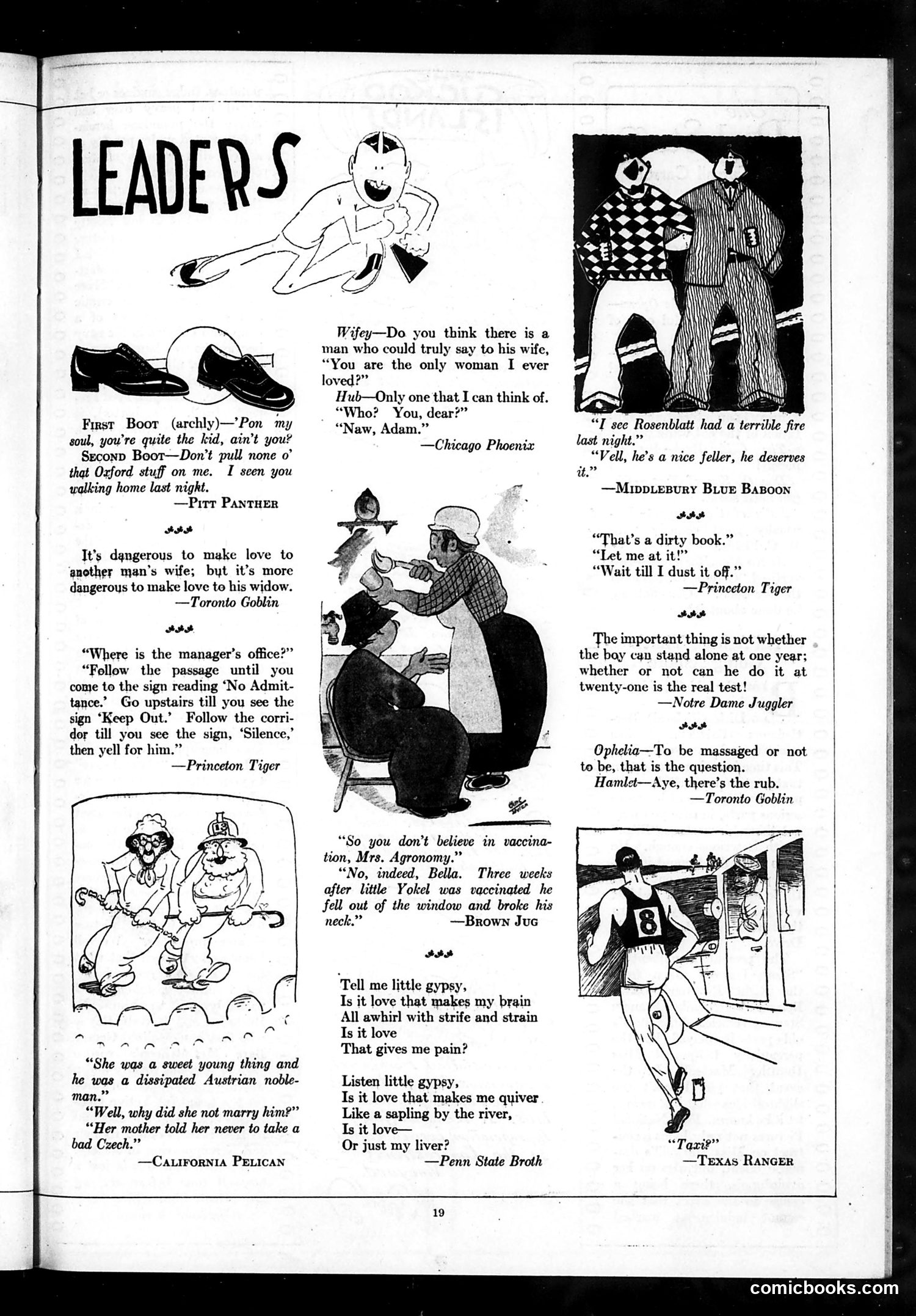
This is a collection of humorous one-liners and cartoons from various college humor publications (Princeton Tiger, Penn State Broth, etc.), typical of Judge magazine's "Leaders" section showcasing collegiate wit. The humor relies on wordplay and social commentary: A dialogue about Adam being the only man who could claim monogamy; a vaccination joke implying correlation-isn't-causation absurdity; a pun on "Czech" (the ethnicity) and "check" regarding an Austrian nobleman; and a play on "Hamlet" where "there's the rub" (massage) becomes literal rather than philosophical. The cartoons depict recognizable scenarios: military/fraternity hazing, office bureaucracy's circular logic, and physical comedy. The "Tani" runner reference appears incomplete without full context. Overall, the page satirizes early 20th-century American college culture, gender relations (frequent references to wives/widows), and contemporary anxieties about vaccination and immigration through irreverent collegiate humor.
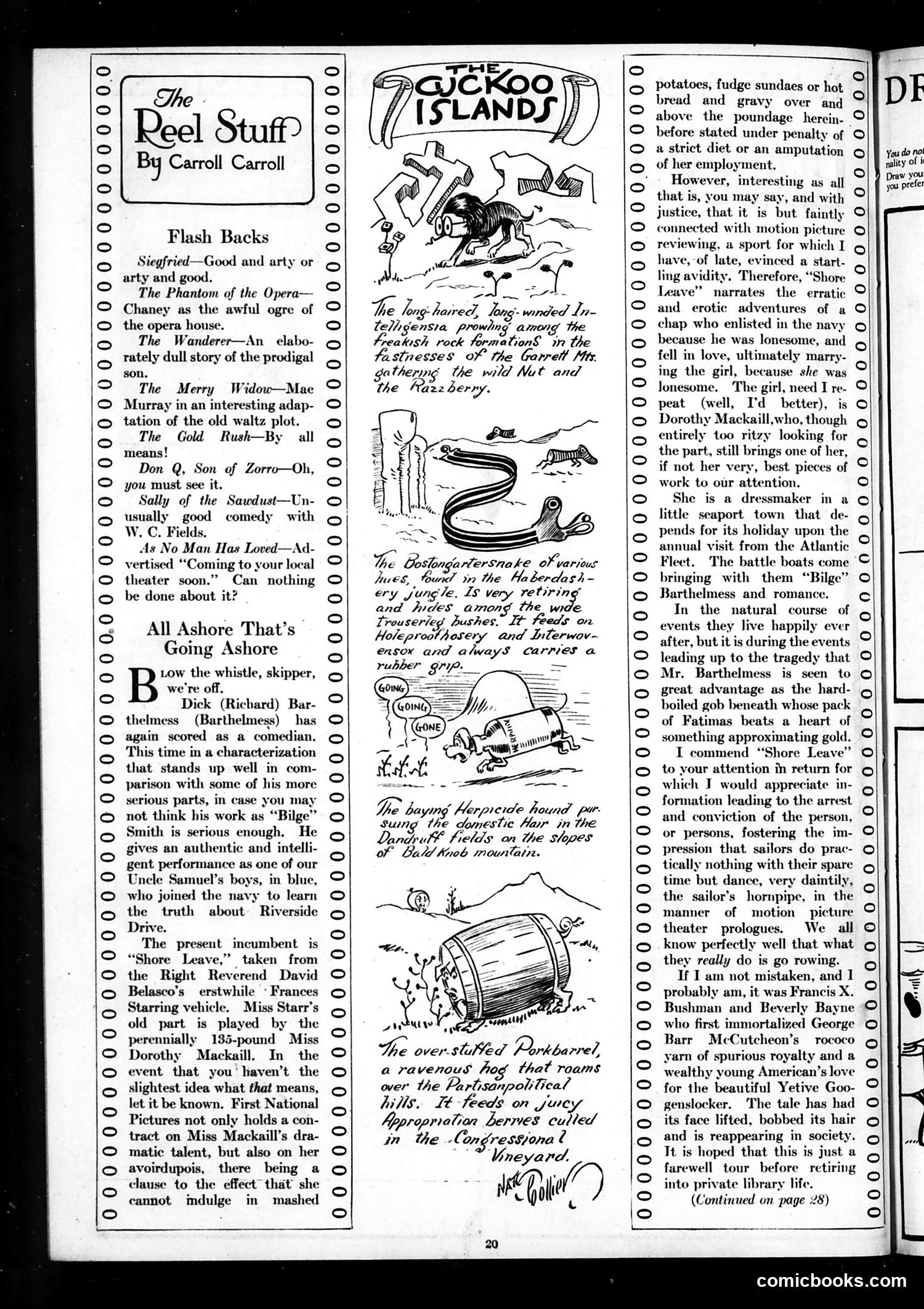
This page contains two film review columns by Carroll Carroll critiquing silent films from approximately the mid-1920s. **Left column** ("All Ashore That's Going Ashore") reviews "Shore Leave," starring Richard Barthelmess and Dorothy Mackaill. The reviewer praises Barthelmess's comedic performance as a naive Navy sailor and notes Mackaill plays a dressmaker in a seaport town. The humor includes a dig at Mackaill's weight—her studio contract apparently includes a clause preventing her from indulging in "mashed potatoes, fudge sundaes" without penalty. **Right column** features whimsical illustrated descriptions of fictional creatures in "The Cuckoo Islands"—creatures like the "Doshfgartersnake" and "over-stuffed Parkbarrel" (a political creature feeding on "juicy Appropriation berries"). This appears to be satirical fantasy rather than film criticism. The column titles and casual tone reflect Judge's trademark irreverent approach to entertainment and politics.
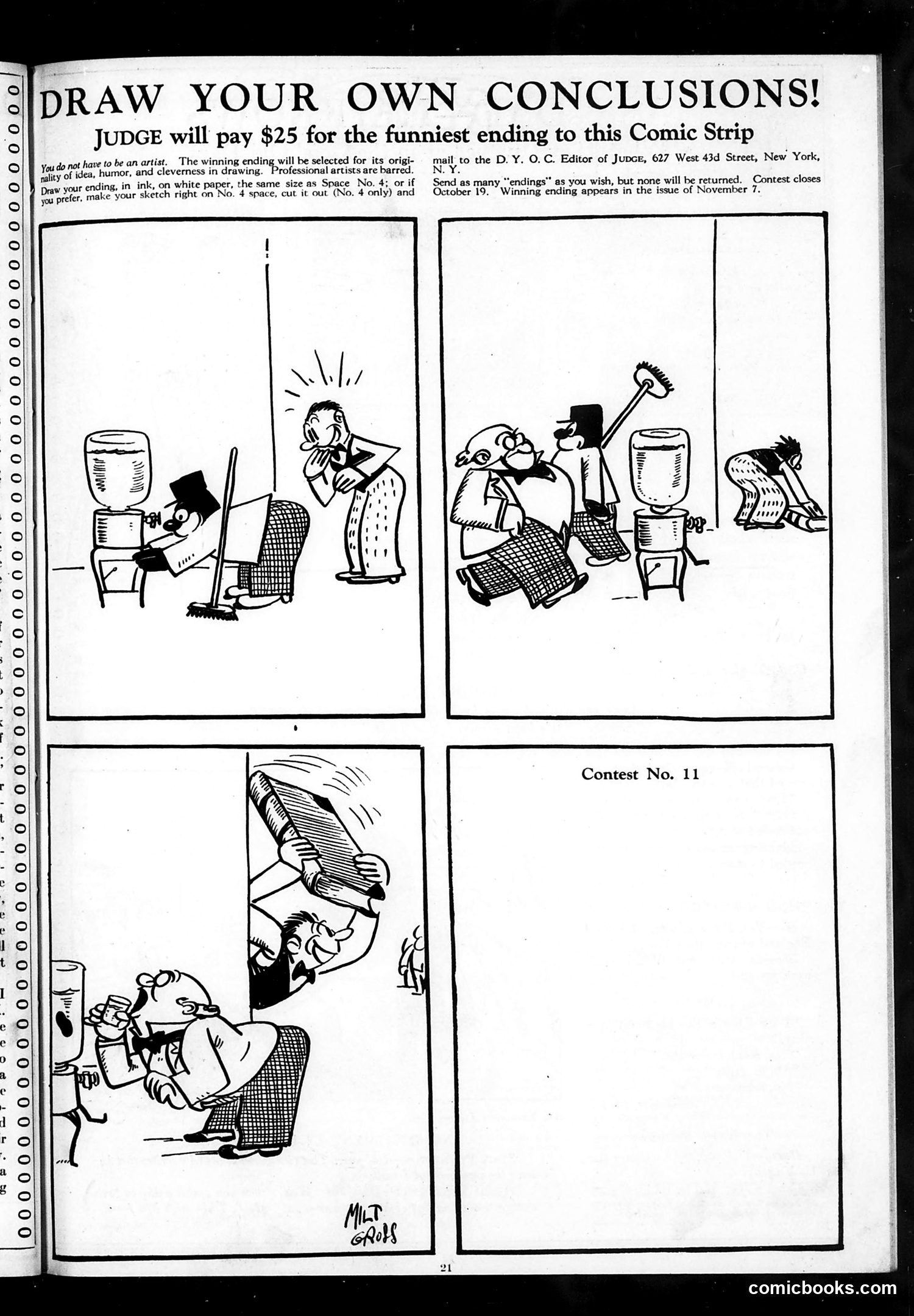
This page presents a reader participation contest from Judge magazine, offering $25 for the funniest ending to an incomplete comic strip (Contest No. 11). The three completed panels depict domestic chaos involving what appears to be working-class or immigrant characters in early-20th-century America. The humor relies on slapstick and domestic disorder: Panel 1 shows a man sweeping while a child cries and a woman appears distressed with a broom. Panel 2 escalates the mayhem with multiple figures in chaotic positions. Panel 3 depicts a man being struck by a large fish or similar object. The satire targets domestic incompetence—likely playing on contemporary anxieties about housekeeping, gender roles, and social propriety. The blank fourth panel (marked "Contest No. 11") invites readers to provide the punchline. This reflects Judge's dual role as both satirical commentary and entertainment vehicle, engaging its audience directly while maintaining its class-conscious humor about domestic life.
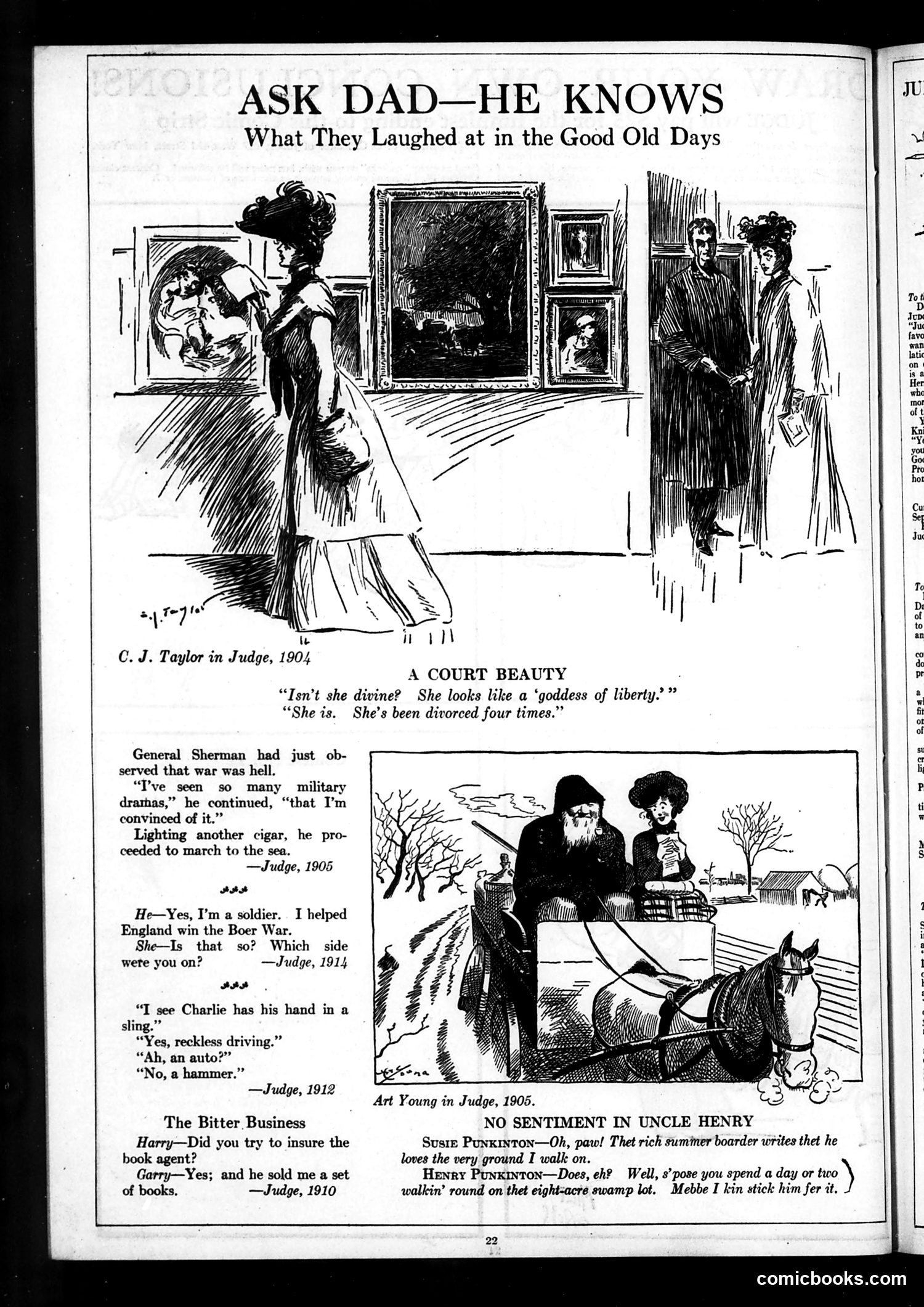
This page collects vintage jokes and cartoons meant to amuse readers with humor from "the good old days." Key targets: **Court Beauty**: Mocks a woman's multiple divorces (four times), treating serial divorce as scandalous rather than divine. **Military/War Jokes**: Reference General Sherman's famous "war is hell" quote; humor about the Boer War (1899-1902) and soldiers; mocks casual violence ("reckless driving" with a hammer). **Social Humor**: A joke about an insurance agent as unreliable/dishonest; the final cartoon satirizes rural farmers' mercenary attitudes—a wealthy summer boarder's romantic declarations are cynically dismissed when Uncle Henry sees profit opportunity in renting his swampy land. The overall message: these are "quaint" old jokes showing how differently previous generations found humor in divorce shame, war casualness, and rural shrewd business practices. The compilation itself is nostalgic commentary on changing social values.
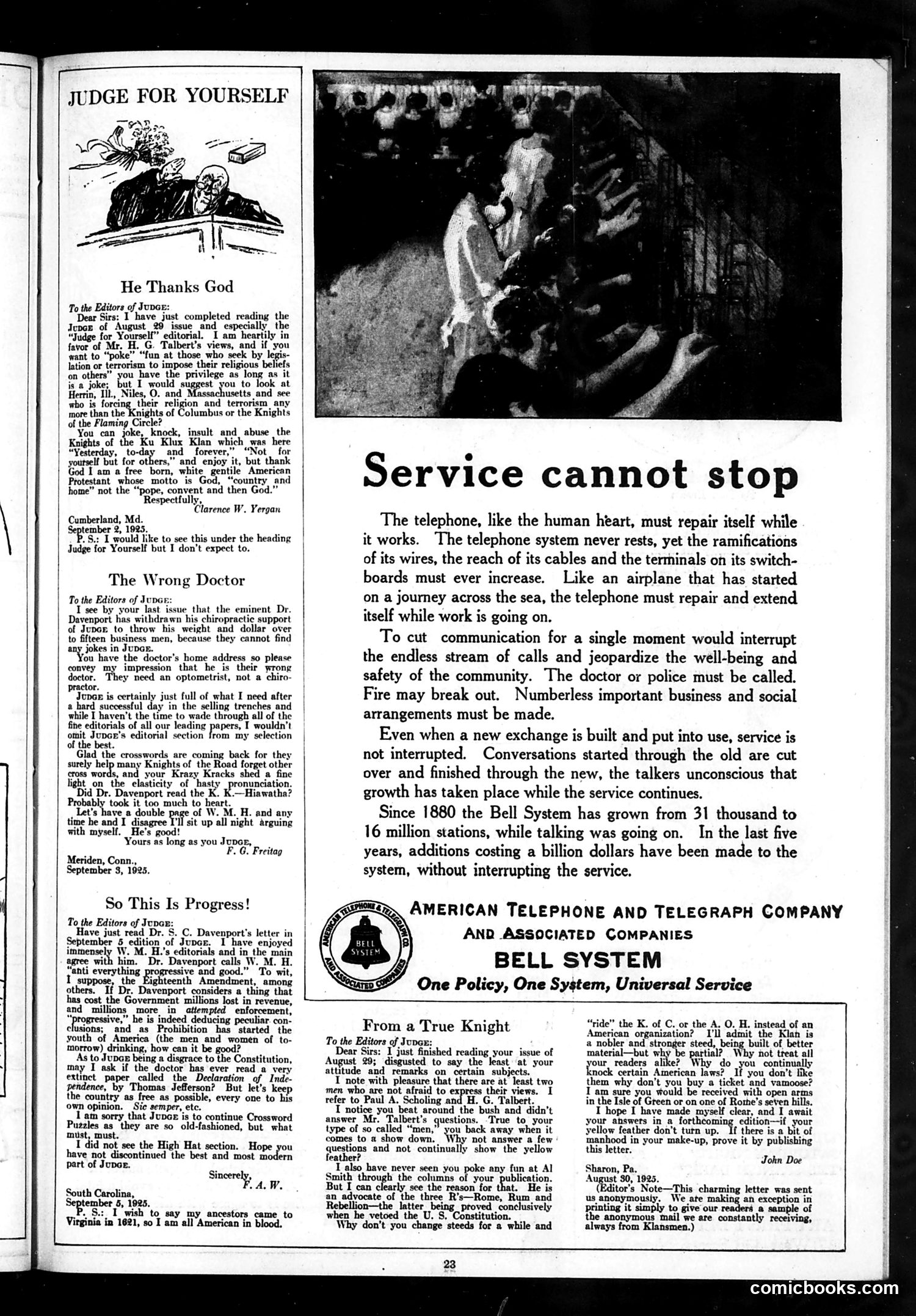
This page contains readers' letters to the editor alongside a Bell Telephone System advertisement. **The Letters Section ("Judge for Yourself"):** The visible letters debate religious freedom and Prohibition. A reader named Yergan defends the Ku Klux Klan and attacks the Knights of Columbus, claiming the KKK represents American Protestant values ("God, country and home") against Catholic influence—reflecting 1920s nativist anxieties. Another letter criticizes Dr. Davenport for withdrawing support from *Judge*, sarcastically suggesting he needs an optometrist rather than chiropractor. A third attacks Davenport's defense of Prohibition as "progressive," arguing it has failed and corrupted American youth. **The Advertisement:** The Bell System ad emphasizes continuous telephone service during expansion—"Service cannot stop"—comparing the telephone network to a human heart that repairs itself while working. This addresses practical concerns about infrastructure interruptions during the 1920s growth of telecommunications. The page reflects 1920s tensions: religious/ethnic conflict, Prohibition debates, and modernization anxiety alongside corporate confidence in technological progress.
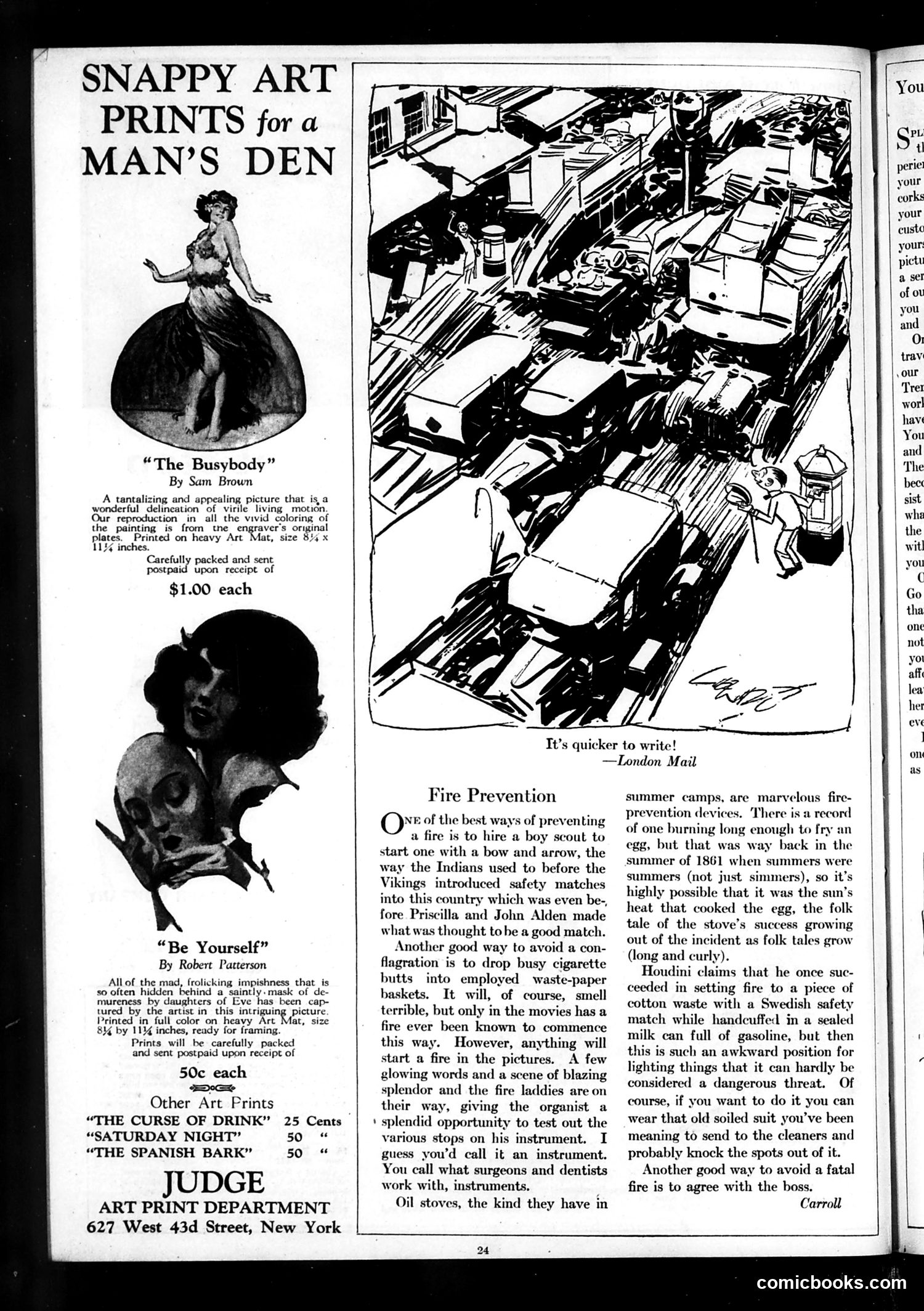
This page combines art print advertisements with a humorous essay on fire prevention. The **art prints section** markets decorative images for men's dens—"The Busybody" (a woman in motion) and "Be Yourself" (a mischievous woman)—reflecting early 20th-century tastes in masculine domestic decoration. The **"Fire Prevention" essay** by Carroll is satirical commentary disguised as practical advice. It mocks both actual fire hazards and contemporary attitudes toward them. The author employs absurdist humor: suggesting hiring boy scouts to start fires "the Indian way," dropping cigarettes in wastebaskets, and referencing a dubious 1861 egg-cooking anecdote. The Houdini reference adds surreal comedy. The closing line—"Another good way to avoid a fatal fire is to agree with the boss"—shifts to social satire: workers accepting poor workplace safety conditions (like unsafe oil stoves in camps) rather than demanding improvements. This reflects early 20th-century labor tensions and corporate indifference to employee welfare. The piece uses absurdist exaggeration to critique both dangerous practices and worker powerlessness.
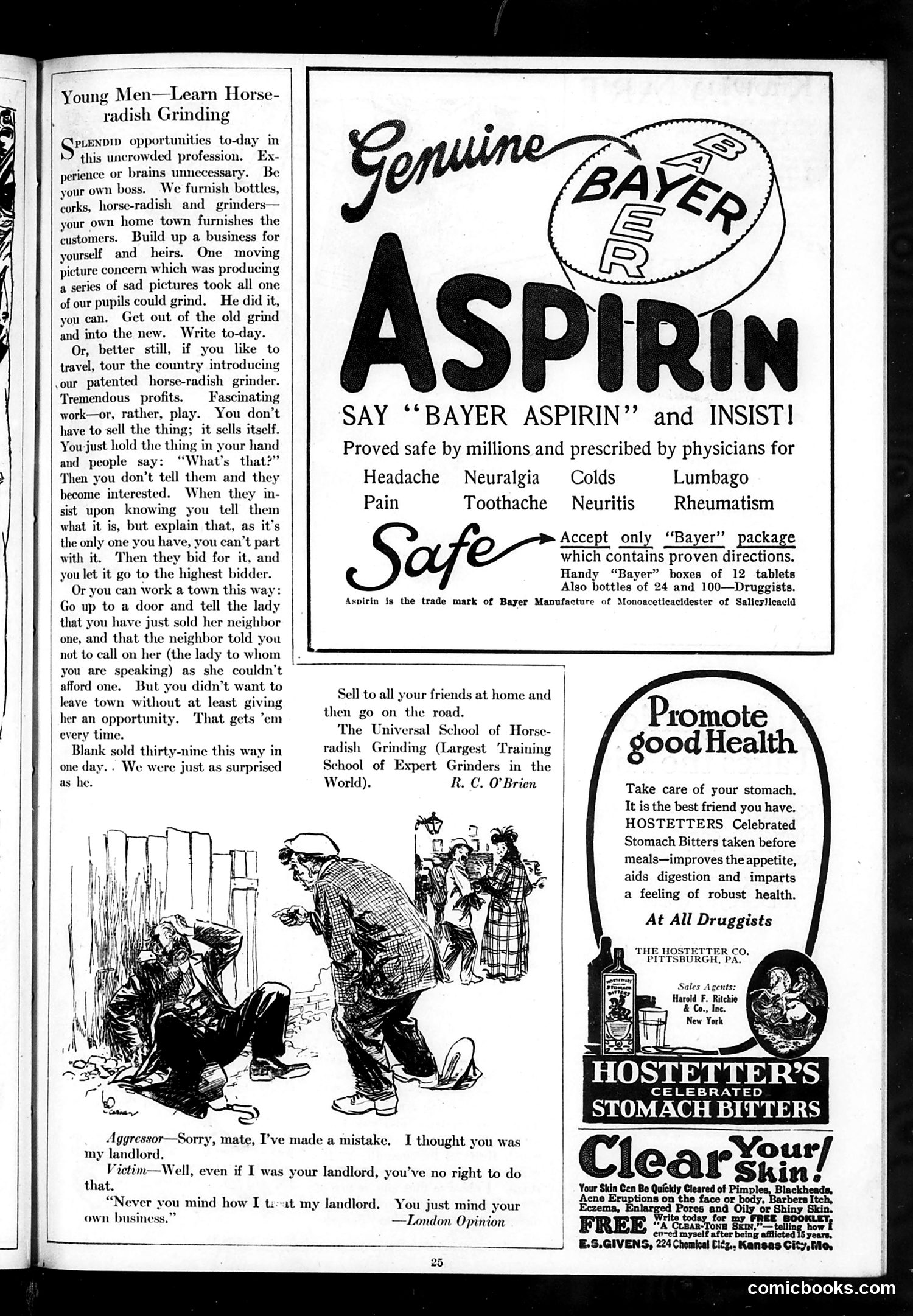
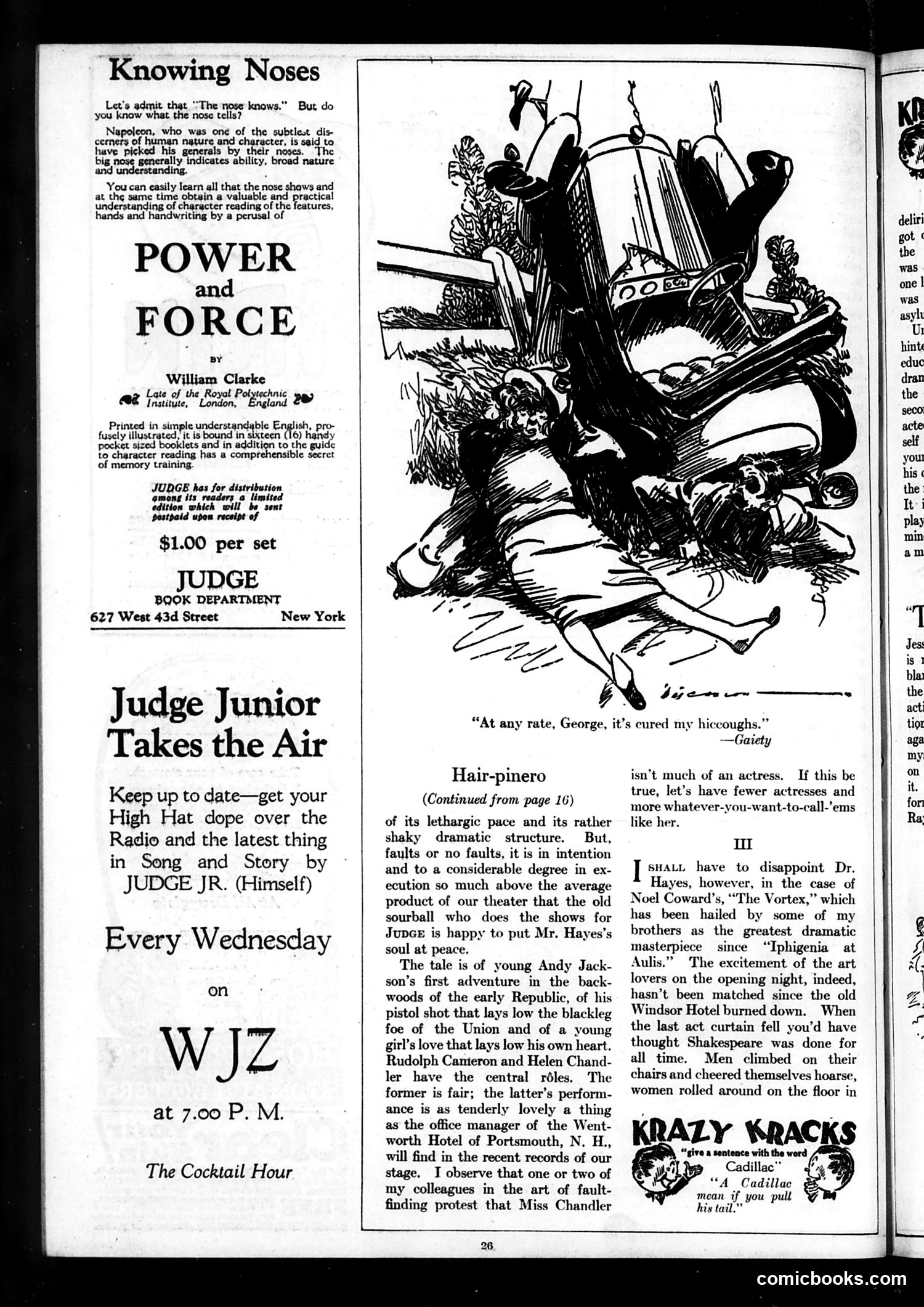
This page is primarily **advertising and magazine promotion** rather than political satire. The main elements are: **"Knowing Noses"** advertisement promotes a character-reading book by William Clarke, invoking Napoleon's supposed use of physiognomy (facial features) to judge military officers. This reflects early 20th-century pseudo-scientific belief in phrenology and character assessment through physical appearance—ideas now understood as discredited. **The cartoon** (top right) shows a couple in a car with the caption about hiccoughs being "cured." This appears to be a light domestic humor piece about remedies, not political commentary. **"Judge Junior Takes the Air"** promotes the magazine's radio program on WJZ, reflecting 1920s enthusiasm for broadcasting as the "latest thing." **"Hair-pinero"** is a theater review discussing a play about Andrew Jackson's youth, praising actress Helen Chandler's performance while dismissing criticisms of her acting ability. The page reflects 1920s entertainment, advertising trends, and pseudo-scientific beliefs rather than containing meaningful political satire.
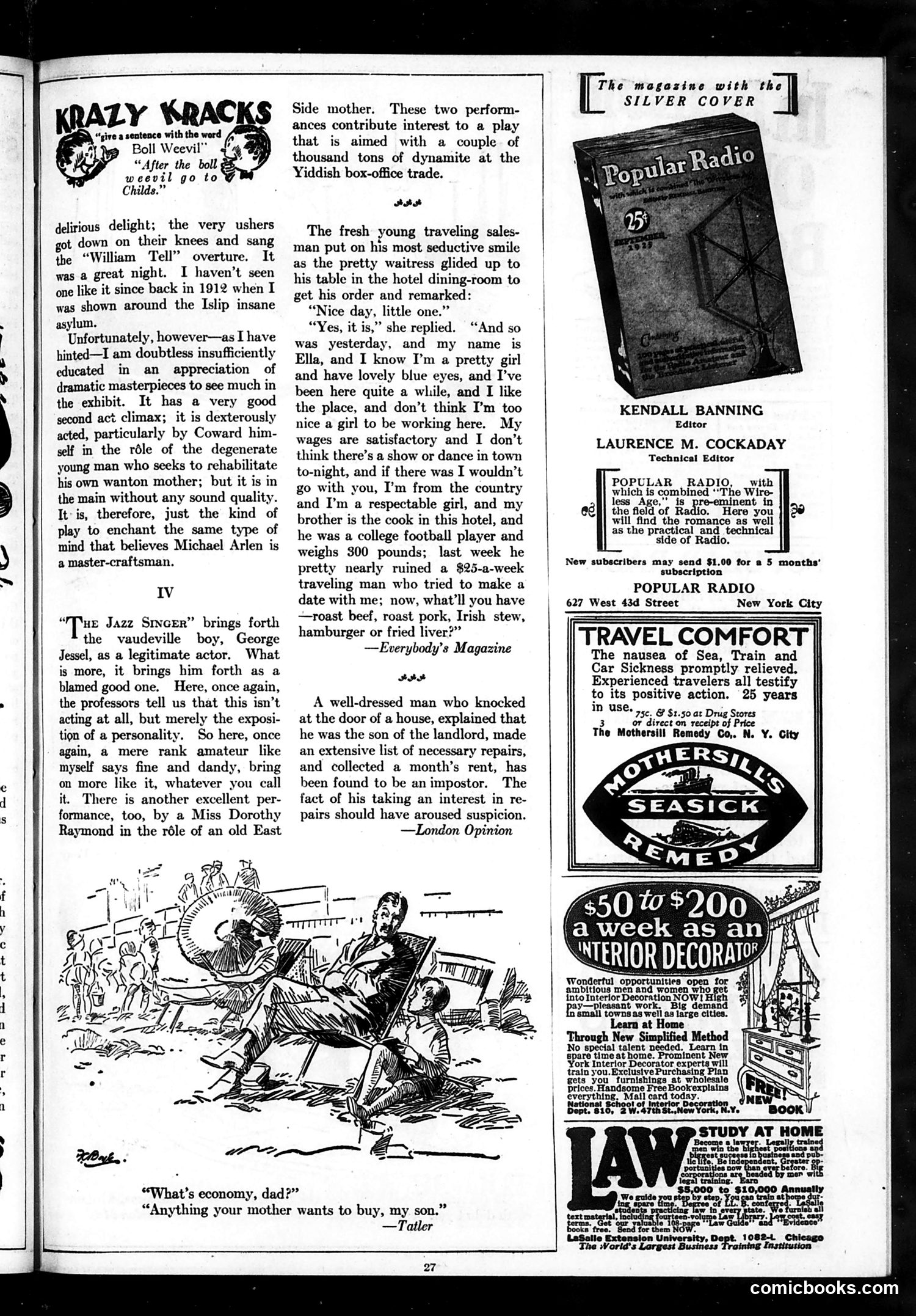
This page from Judge magazine contains theater reviews and social commentary typical of the 1920s. **Main Content:** The left column reviews "The Jazz Singer," praised for featuring George Jessel as a "legitimate actor," and another play ("Ball Weevil") aimed at "the Yiddish box-office trade"—referencing Jewish audiences and theaters. **The Cartoon:** The sketch below shows a man being offered money with the caption "What's economy, dad?" and the response "Anything your mother wants to buy, my son." This satirizes post-WWI consumer culture and changing family dynamics, where mothers—newly empowered economically—drove household spending, undermining traditional paternal financial authority. **Historical Context:** The 1920s saw women gaining economic power and independence. The joke mocks fathers' loss of control over household spending as wives and mothers became more assertive consumers during the Jazz Age. **Right Side:** Advertisements for Popular Radio magazine, seasickness remedy, and interior decoration jobs reflect period consumer interests.
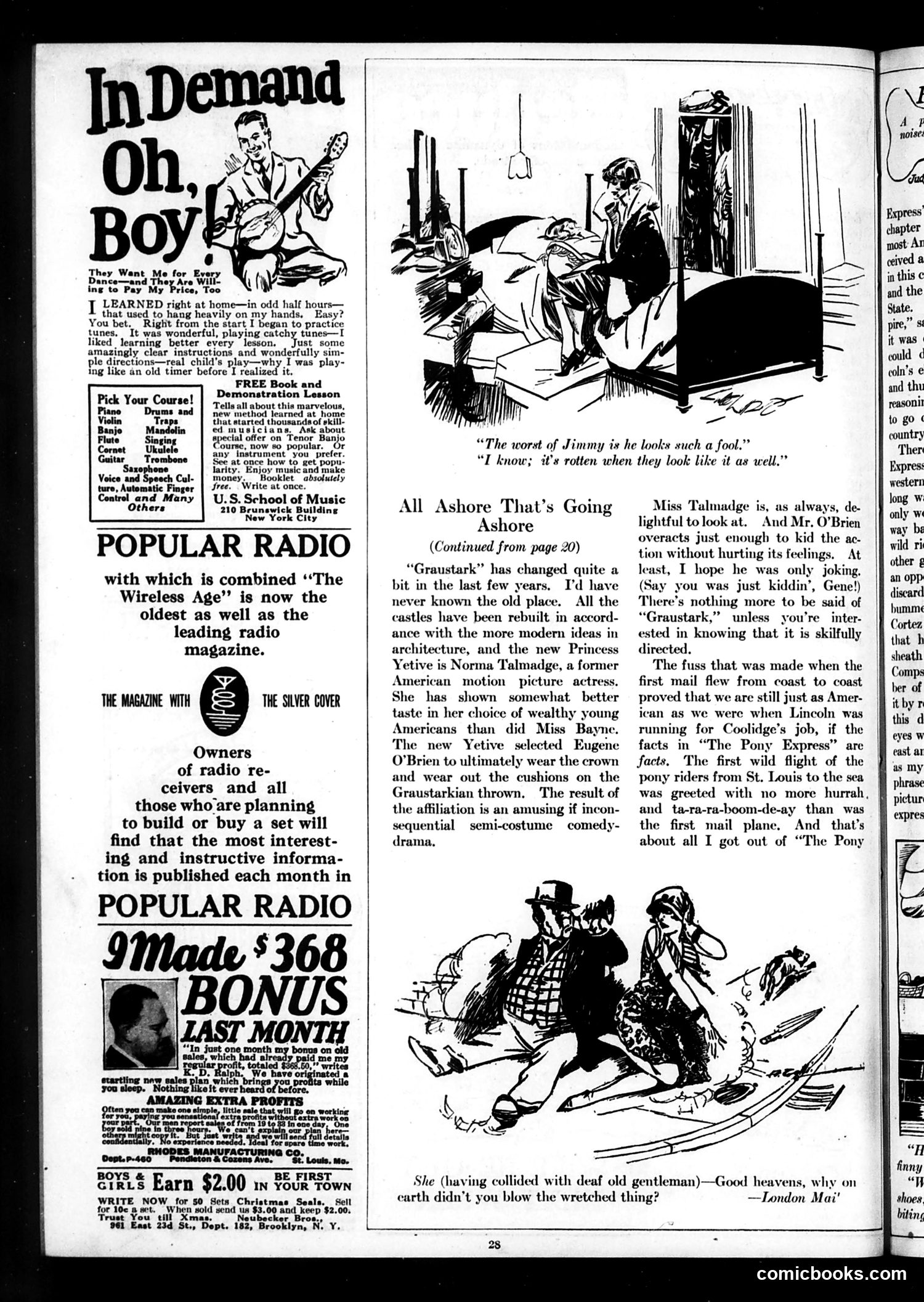
This page combines advertisement and entertainment content typical of 1920s magazines. **Main Cartoon**: The bottom illustration shows a woman who has collided with a deaf elderly man on skis. She's frustrated he didn't hear her warning shout. The caption jokes about his deafness being worse than his foolish appearance—a dark humor joke about disability. **"In Demand Oh Boy!" Advertisement**: Features testimonial copy promoting the U.S. School of Music's correspondence course for learning instruments at home. The appeal targets aspiring musicians wanting popularity and income—reflects 1920s enthusiasm for self-improvement and entertainment careers. **"All Ashore That's Going Ashore" Column**: Reviews two films: "Graustark" (starring Norma Talmadge and Eugene O'Brien) and "The Pony Express." The critic praises Talmadge's appeal while gently mocking O'Brien's over-acting. **Radio Magazine Advertisement**: Promotes "Popular Radio" magazine as the authoritative publication for radio set owners and builders—reflecting the era's radio boom. The page reflects 1920s consumer culture: entertainment, self-education, new technology, and leisure.
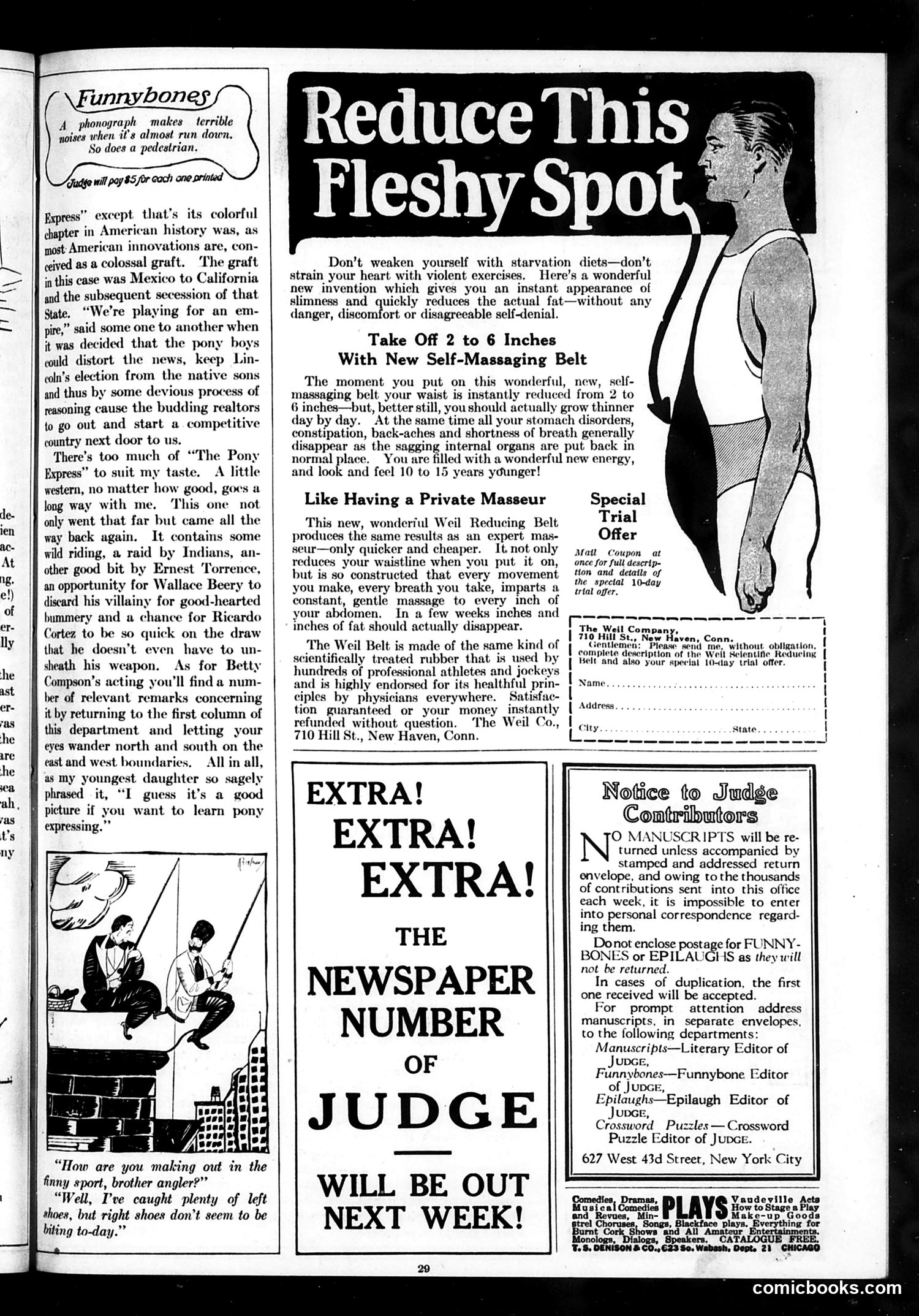
This page mixes entertainment criticism with period advertising. The main content is a review of "The Pony Express," a Western film featuring Ernest Torrence, Wallace Beery, and Ricardo Cortez. The critic argues the film is formulaic—containing "too much" of the standard Western genre elements (Indian raids, wild riding) that, while competent, becomes tedious by recycling familiar plot devices. The dominant feature is a full-page advertisement for the "Weil Self-Massaging Belt," a dubious weight-loss device claiming to reduce waistline measurements by 2-6 inches instantly and promote fat loss through mechanical vibration. This reflects early 20th-century pseudoscientific marketing targeting body-conscious consumers, promising results "without danger, discomfort or disagreeable self-denial"—appealing to readers skeptical of diet and exercise. The page also advertises Judge's upcoming newspaper-themed issue. The cartoons are unrelated vignettes about pedestrians and fishing.
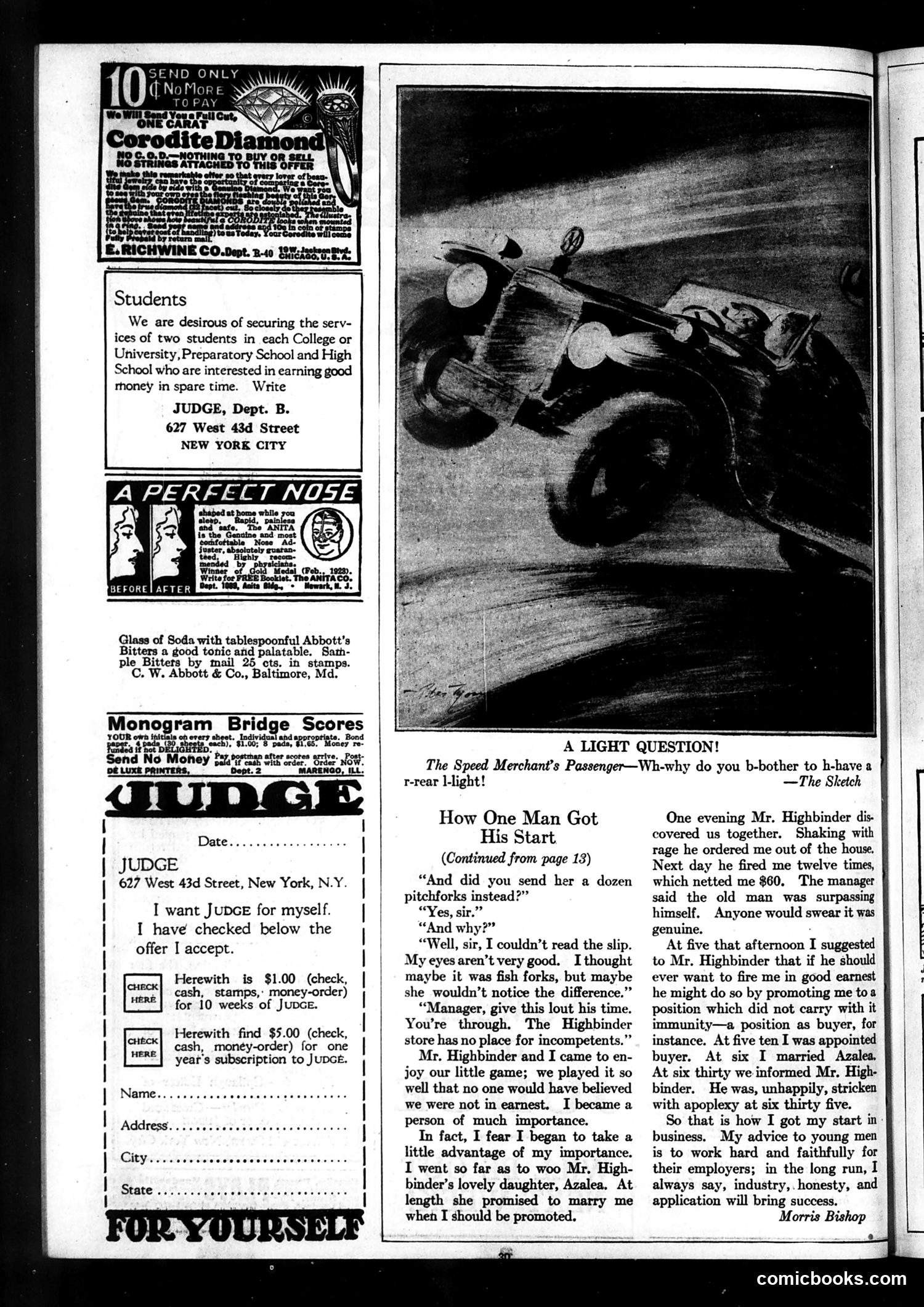
This page contains two distinct pieces. The main cartoon, "A Light Question," shows a car accident with the caption joking about a reckless driver's missing rear light—satirizing early automobile safety hazards and careless motorists. The longer piece, "How One Man Got His Start," is a humorous serialized story about workplace scheming. A young man deliberately misreads shipping orders (claiming poor eyesight), gets fired repeatedly for the same "mistake," uses these firings as leverage, and ultimately woos his boss's daughter Azalea by accepting a "promotion" to buyer—a position without immunity from further firing. When he marries her immediately after, the boss has an apoplectic stroke. The satire mocks the speaker's self-serving cunning while pretending to offer earnest business advice about "industry, honesty, and application." The page is primarily **advertising and serialized fiction**, with satirical content embedded in the fiction rather than in standalone editorial cartoons.
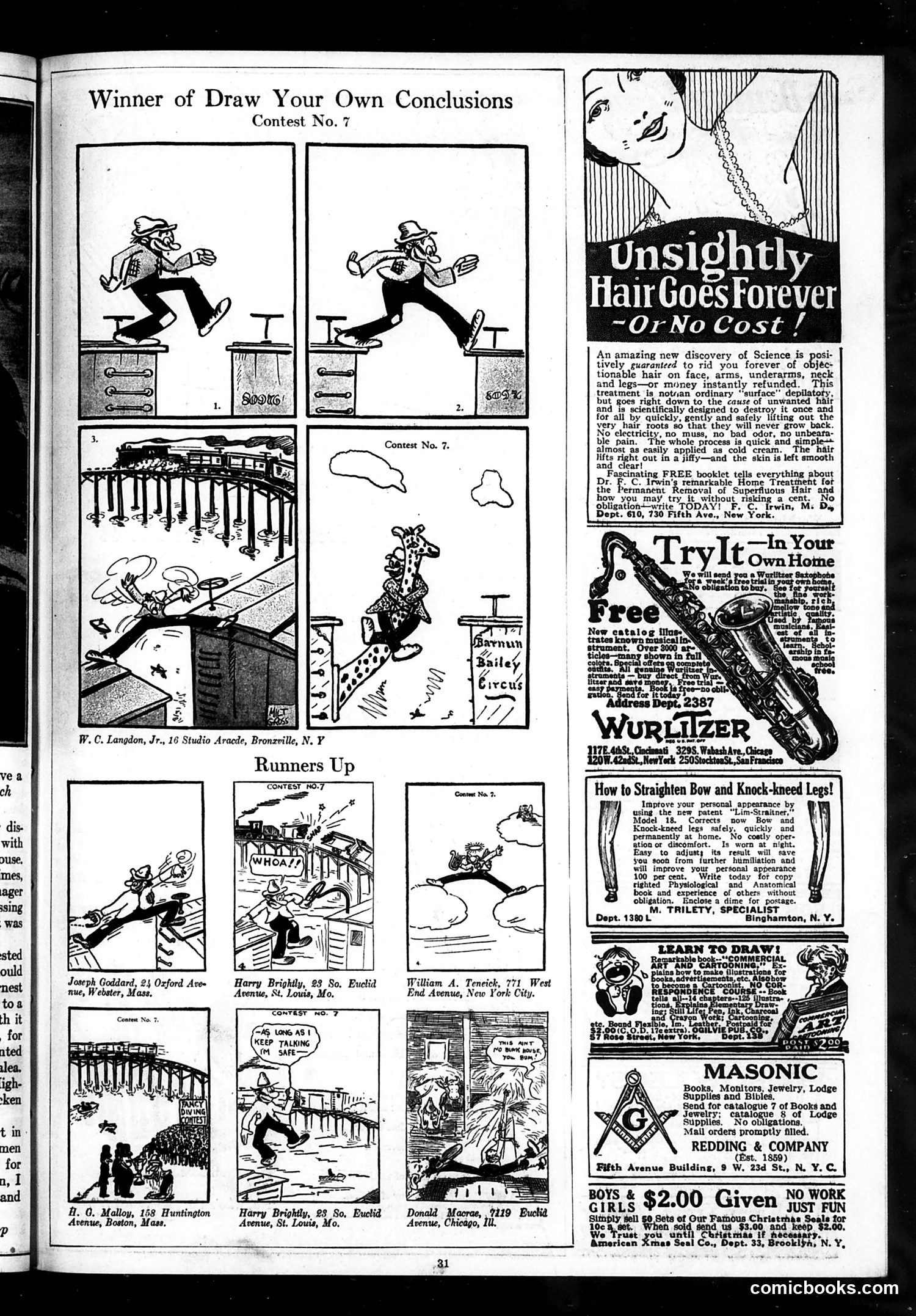
This page showcases the winner and runners-up of a comic-drawing contest where readers completed a visual narrative. The winning entry by W.C. Langdon Jr. depicts a man leaping between desk drawers in panels 1-2, then falling into what appears to be a pit or hole (panel 3), with an ambiguous final panel—likely inviting readers to imagine the conclusion. The contest exemplifies Judge's interactive approach to humor: readers supplied the punchline through their interpretations. The "draw your own conclusions" format was popular in early 20th-century magazines, encouraging audience participation and creativity. The page is primarily **advertising**, featuring period products (hair removal treatments, leg-straightening devices, Masonic supplies, saxophone lessons) typical of vintage magazine revenue. These ads reveal contemporary beauty anxieties and mail-order commerce customs of the era.
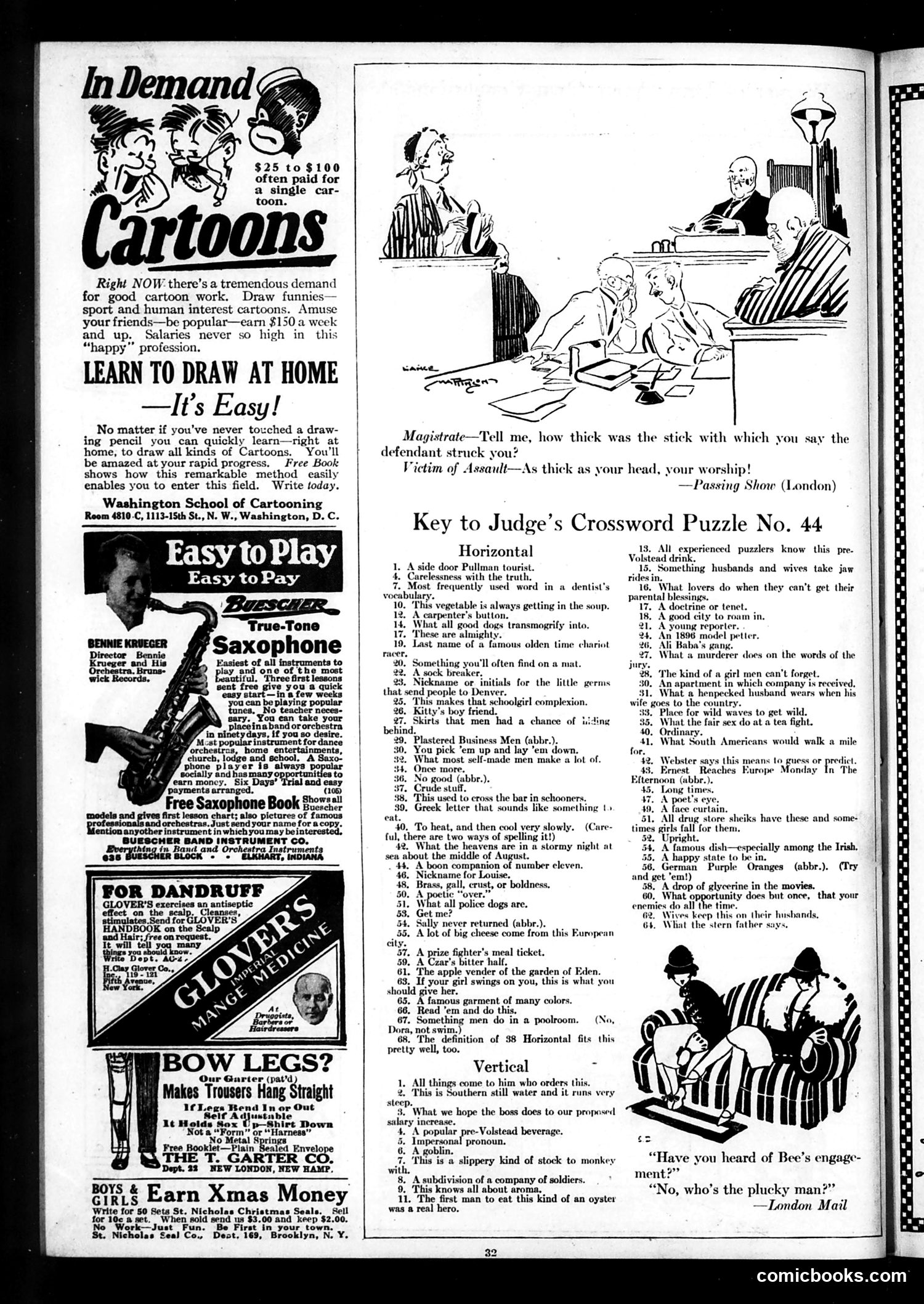
This page is primarily **advertising and filler content** typical of early 20th-century magazines, not political satire. The main cartoon is a courtroom joke: a magistrate asks a victim how the defendant struck them, and the victim replies the blow was "as thick as your head, your worship!"—a casual insult to the judge himself. The page is dominated by **want ads and instructional promotions**: a cartooning correspondence school, a saxophone retailer, dandruff treatment, garter company, and Christmas seal fundraising. These reflect the era's direct-mail marketing culture. Notable is the implicit **class commentary**: the ads target working/middle-class readers seeking home-based income, musical skill, or self-improvement—reflecting pre-Depression economic anxieties and the appeal of easy money schemes. The crossword puzzle clues contain mild contemporary references (Volstead Act prohibition, popular songs) but are mostly generic wordplay meant to occupy leisure time.
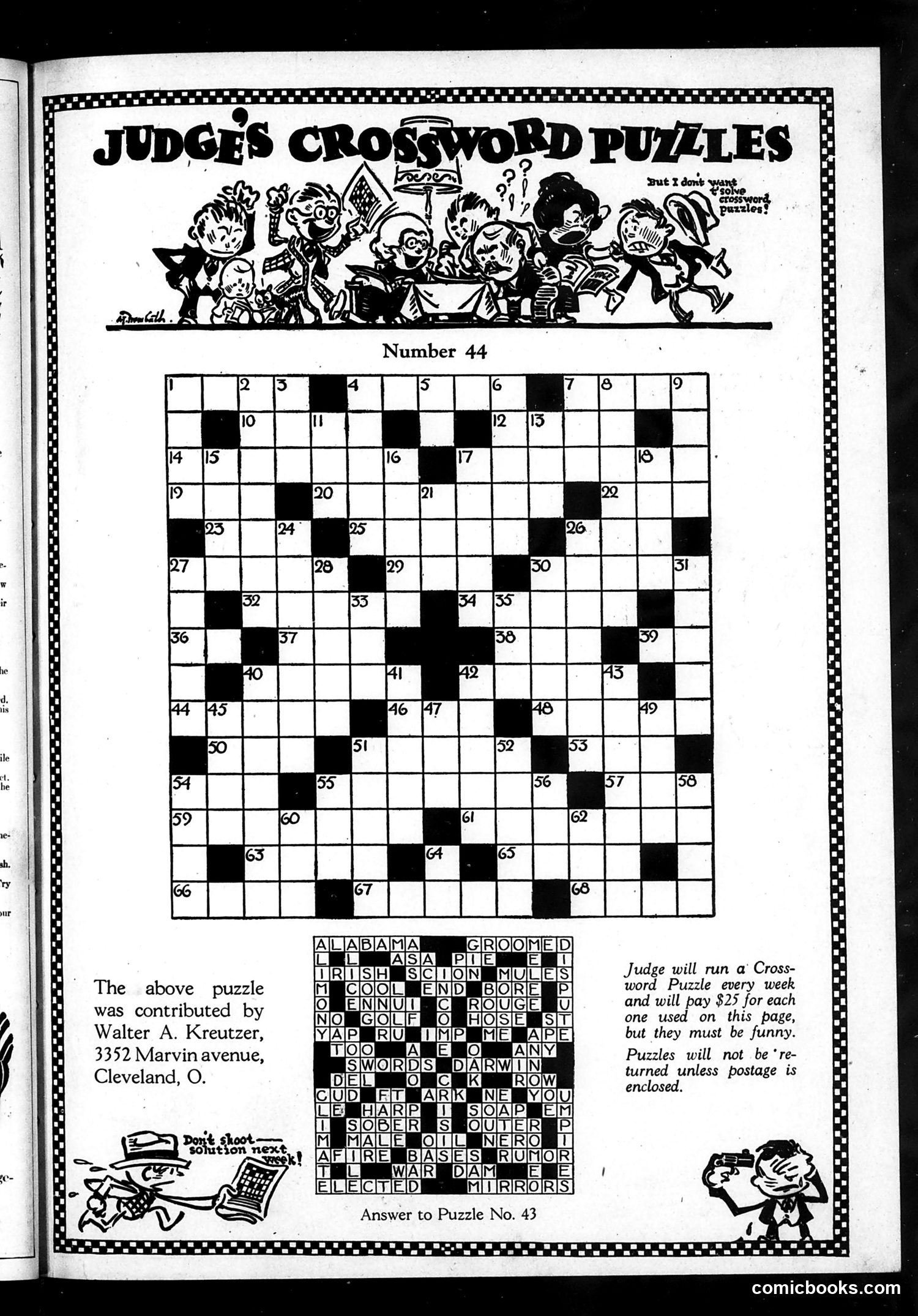
This page is primarily a **crossword puzzle feature**, not a political cartoon. It shows "Judge's Crossword Puzzles" Number 44, contributed by Walter A. Kreutzer of Cleveland, Ohio. The page includes: 1. **A decorative header** featuring cartoon characters celebrating around a large crossword puzzle grid—typical of 1920s-30s comic illustration style 2. **The actual crossword puzzle** with numbered squares (standard format) 3. **The answer key** to the previous week's puzzle (No. 43), displayed in a filled grid 4. **A payment incentive**: Judge offered $25 per puzzle published, with the stipulation that submissions "must be funny"—suggesting the magazine sought humorous clues or theme-based puzzles The cartoons flanking the text ("Don't shoot—solution next week!") are light-hearted jokes about puzzle difficulty, not political satire. This appears to be **entertainment content** rather than editorial commentary, representing Judge's diversification into puzzle games during the interwar period.
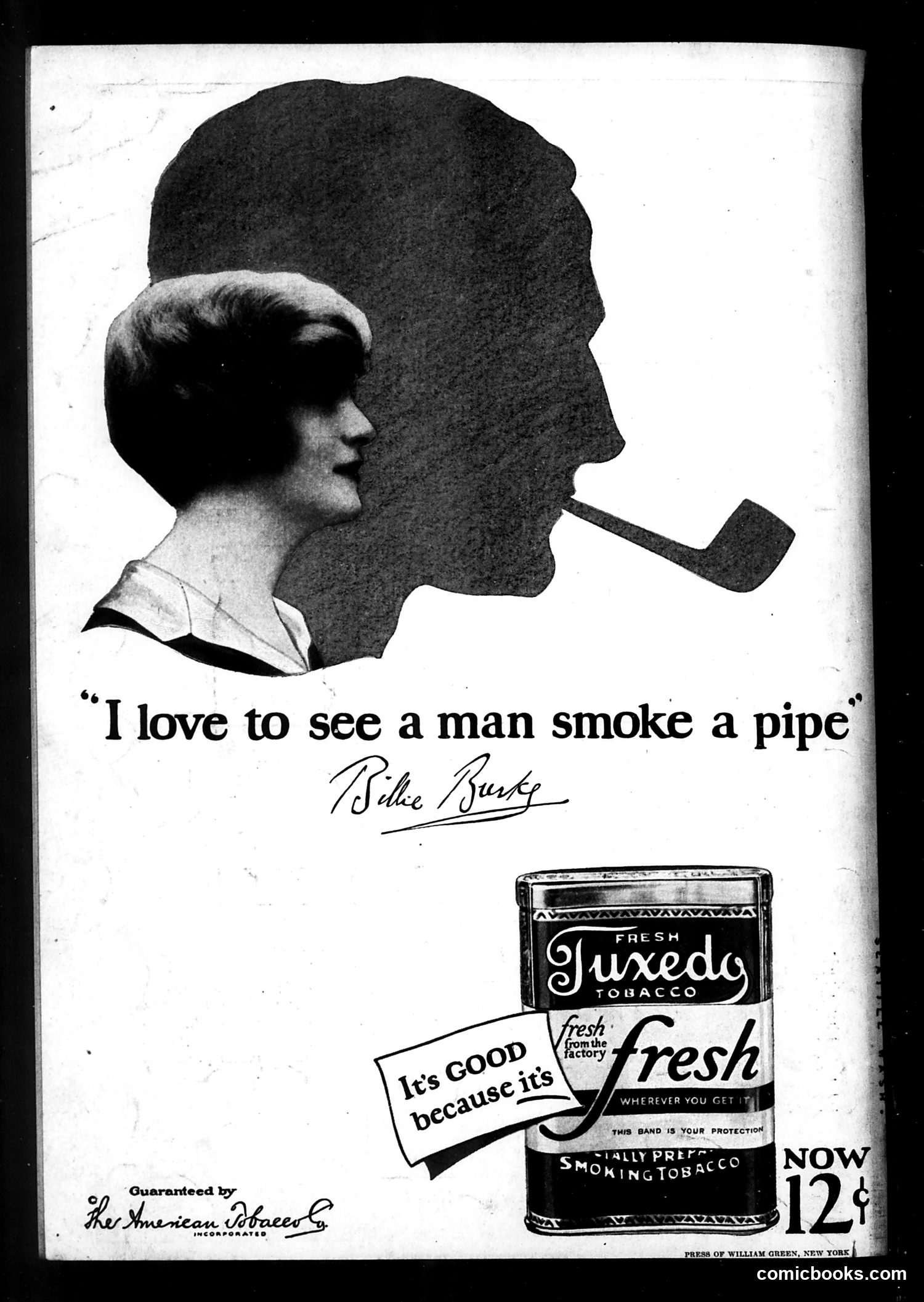
This is a **tobacco advertisement**, not political satire. It features a silhouette profile of a man smoking a pipe, accompanied by a quote: "I love to see a man smoke a pipe" attributed to "Babe Ruth" (the famous baseball player). The ad promotes Tuxedo brand smoking tobacco, emphasizing it's "fresh from the factory" and costs 12 cents. The tagline "It's GOOD because it's fresh" suggests the product's main selling point. By the 1920s-30s (Judge's era), celebrity endorsements were common advertising strategy. Ruth's name and fame lent credibility to the product. The pipe-smoking imagery conveyed sophistication and masculinity—values the advertiser associated with both the athlete and their tobacco brand. This would be considered a straightforward commercial pitch to modern readers, with no satirical content.

I can see this is a page from Judge magazine, but the image quality is too poor for me to reliably discern specific cartoon content, figures, or text details. The page appears predominantly dark/black with some faint ornamental or decorative patterns visible, and a white margin strip on the left side. While there are some marks and design elements present, I cannot make out distinct figures, captions, or satirical content with sufficient clarity to accurately explain the cartoon's meaning, identify the caricatured figures, or explain the political or social references to a modern reader. To provide accurate historical analysis, I would need a clearer reproduction of this page.