
Judge, 1925-10-10 · page 11 of 37
Judge — October 10, 1925 — page 11: what you’re looking at
What you’re looking at
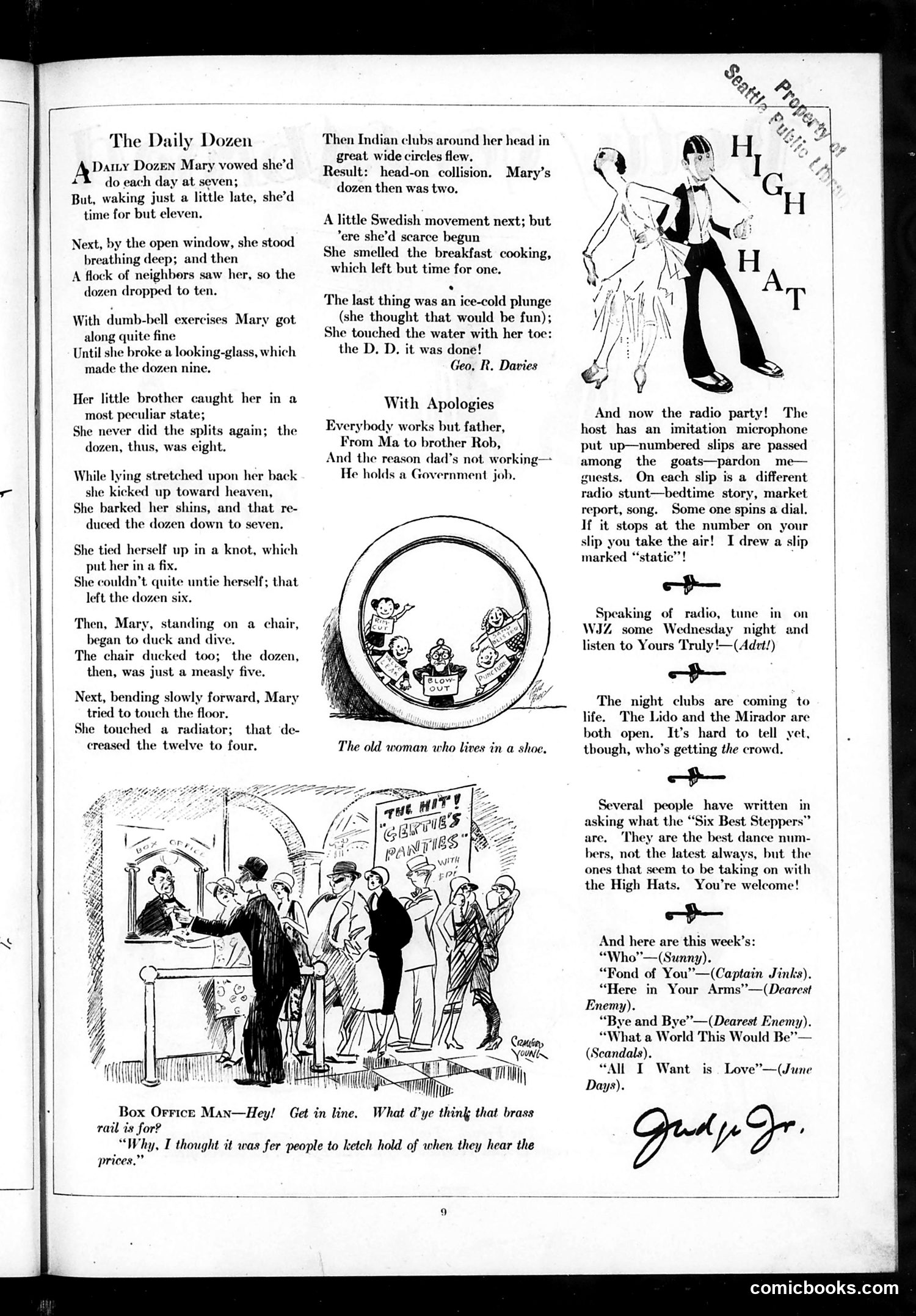
This page contains humor pieces satirizing 1920s American life. **"The Daily Dozen"** mocks the popular exercise fad of the era—a standardized fitness routine that Americans were encouraged to perform daily. The joke follows a woman trying to complete all twelve exercises but failing repeatedly through comic mishaps (breaking mirrors, getting stuck in knots, colliding with radiators). It's lighthearted satire of wellness culture and the gap between fitness aspirations and reality. **"With Apologies"** is a darker political jab at government employment during what appears to be a recession or economic hardship. The parody of the popular song "Everybody Works but Father" suggests that fathers employed by the government aren't actually working—a critique of perceived government inefficiency or patronage jobs. The remaining content discusses radio entertainment, night clubs, and popular dance music of the period, reflecting Jazz Age leisure culture. The "Box Office Man" cartoon (bottom) appears to be an unrelated gag about theater seating.
📄 Transcribed text from this page (OCR, searchable)
Machine-transcribed from the original scan — historical spelling and the odd misread are preserved.
The Daily Dozen Datty Dozen Mary vowed she’d +% do each day at seven; But, waking just a little late, she’d time for but eleven. Next, by the open window, she stood breathing deep; and then A flock of neighbers saw her, so the dozen dropped to ten. With dumb-bell exercises Mary got along quite fine Until she broke a looking-glass, made the dozen nine. Her little brother caught her i most peculiar state; She never did the splits again; the dozen, thus, was eight. While lying stretched upon her back she kicked up toward heaven, She barked her shins, and that re- duced the dozen down to seven. She tied herself up in a knot, which put her in a fix. She couldn’t quite untie herself; that left the dozen six. Then, Mary, standing on a chair, began to duck and dive. The chair ducked too; the dozen, then, was just a measly five. Next, bending slowly forward, Mary tried to touch the floor, She touched a radiator; that de- creased the twelve to four. Box Orrice Man—Hey! rail is for? Get in line. Then Indian clubs around her head in great wide circles flew. Result: head-on collision. Mary’s dozen then was two, A little Swedish movement next; but “ere she’d scarce begun She smelled the breakfast cooking, which left but time for one. The last thing was an ice-cold plunge (she thought that would be fun); She touched the water with her toe: the D. D. it was done! feo, R. Davies With Apologies Everybody works but father, From Ma to brother Rob, And the reason dad’s not working— He holds a Government job. SNe Tt What d’ye thing that brass “Why, I thought it was fer people to ketch hold of when they hear the host has an imitation microphone put up—numbered slips are passed among the goats—pardon me— guests. On each slip is a different radio stunt—bedtime story, market report, song. Some one spins a dial, If it stops at the number on your slip you take the air! I drew a slip marked “‘static’’! > Speaking of radio, tune in on WJZ some Wednesday night and listen to Yours ‘Truly !—(Adzt/) f= The night clubs are coming to life. The Lido and the Mirador are both open. It’s hard to tell yet, though, who's getting the crowd. f= Several people have written in asking what the “Six Best Steppers” are. ‘They are the best dance num- hers, not the latest always, but the ones that seem to be taking on with the High Hats. You're welcome! op And here are this week’s: “Who"—(Sunny). “Fond of You”—(Captain Jinks). “Here in Your Arms’”’—(Dearest Enemy). “Bye and Bye”—(Dearest Enemy). “What a World This Would Be”— (Scandals). “All I Want is Love”’—(June Days). Gry Se comicbooks.com