
Judge, 1925-10-10 · page 17 of 37
Judge — October 10, 1925 — page 17: what you’re looking at
What you’re looking at
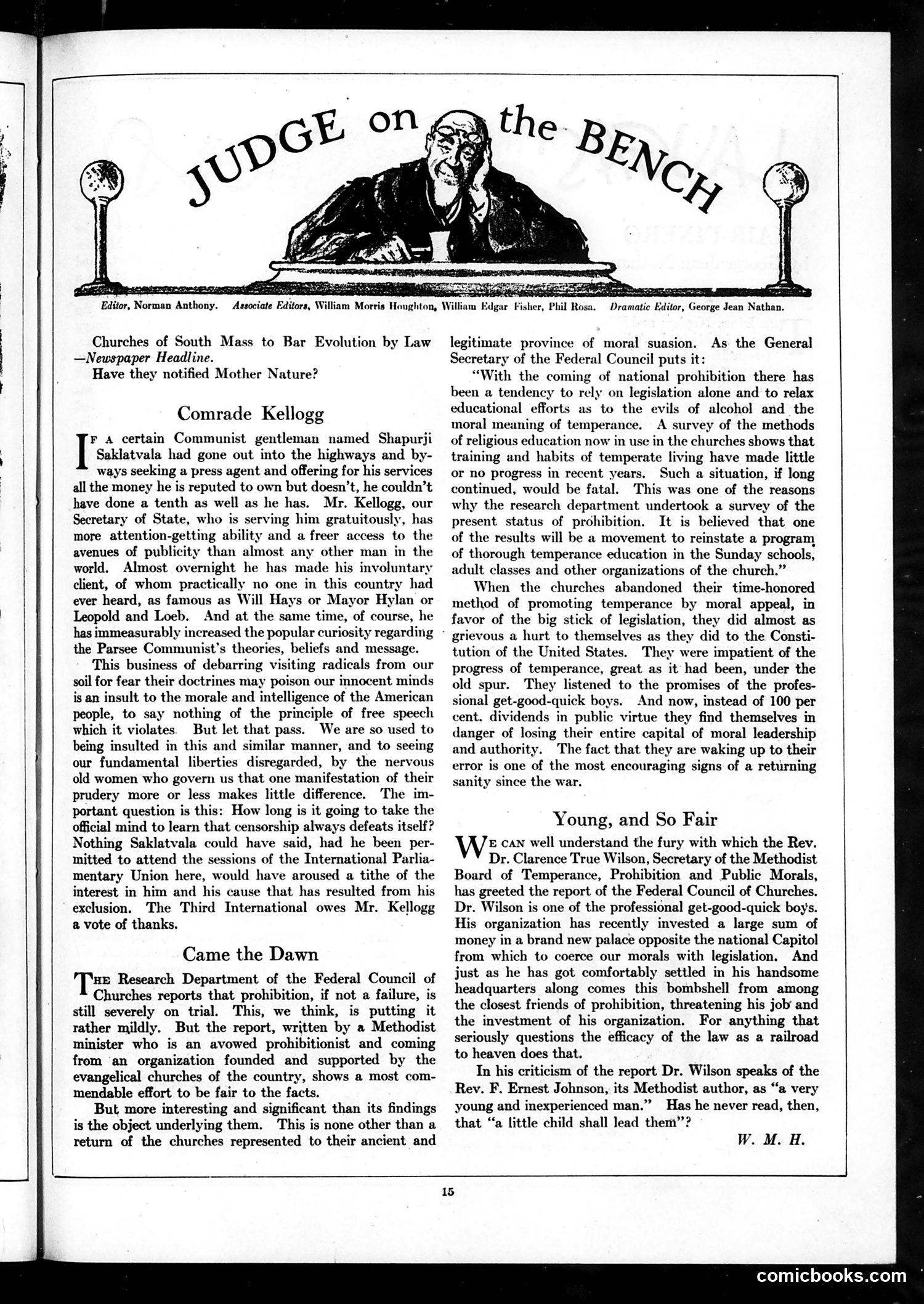
This page contains three satirical editorial pieces criticizing government overreach and institutional hypocrisy in 1920s America. **"Comrade Kellogg"** mocks Secretary of State Frank Kellogg for inadvertently making Communist Shapurji Saklatvala famous by banning him from entering the country. The satire argues censorship backfires—the exclusion generated more publicity than Saklatvala could have achieved through speeches. Judge defends free speech principles while criticizing government's "nervous" suppression of radical ideas. **"Churches of South Mass to Bar Evolution by Law"** (headline) sarcastically asks if churches notified "Mother Nature" of their legal ban on teaching evolution—absurdly implying nature won't obey legislation. **"Came the Dawn"** critiques churches' shift from moral persuasion to legislative enforcement regarding Prohibition. The Federal Council of Churches' report acknowledges that relying solely on law rather than education and moral suasion failed. Judge applauds churches returning to their "ancient" role of moral guidance rather than political coercion. The unifying theme: institutions overestimating government power while underestimating human nature and reason.
📄 Transcribed text from this page (OCR, searchable)
Machine-transcribed from the original scan — historical spelling and the odd misread are preserved.
Editor, Norman Anthony. Churches of South Mass to Bar Evolution by Law —Newspaper Headline. Have they notified Mother Nature? Comrade Kellogg F a certain Communist gentleman named Shapurji Saklatvala had gone out into the highways and by- ways seeking a press agent and offering for his services all the money he is reputed to own but doesn’t, he couldn’t have done a tenth as well as he has. Mr. Kellogg, our Secretary of State, who is serving him gratuitously, has more attention-getting ability and a freer access to the avenues of publicity than almost any other man in the world. Almost overnight he has made his involuntary client, of whom practically no one in this country had ever heard, as famous as Will Hays or Mayor Hylan or Leopold and Loeb. And at the same time, of course, he has immeasurably increased the popular curiosity regarding the Parsee Communist’s theories, beliefs and message. This business of debarring visiting radicals from our soil for fear their doctrines may poison our innocent minds is an insult to the morale and intelligence of the American people, to say nothing of the principle of free speech which it violates. But let that pass. We are so used to being insulted in this and similar manner, and to seeing our fundamental liberties disregarded, by the nervous old women who govern us that one manifestation of their prudery more or less makes little difference. The im- portant question is this: How long is it going to take the official mind to learn that censorship always defeats itself? Nothing Saklatvala could have said, had he been per- mitted to attend the sessions of the International Parlia- mentary Union here, would have aroused a tithe of the interest in him and his cause that has resulted from his exclusion. The Third International owes Mr. Kellogg a vote of thanks. Came the Dawn wg Research Department of the Federal Council of Churches reports that prohibition, if not a failure, is still severely on trial. This, we think, is putting it rather mildly. But the report, written by a Methodist minister who is an avowed prohibitionist and coming from ‘an organization founded and supported by the evangelical churches of the country, shows a most com- mendable effort to be fair to the facts. But more interesting and significant than its findings is the object underlying them. This is none other than a return of the churches represented to their ancient and Dramatic Editor, George Jean Nathan. legitimate province of moral suasion. As the General Secretary of the Federal Council puts it: “With the coming of national prohibition there has been a tendency to rely on legislation alone and to relax educational efforts as to the evils of alcohol and the moral meaning of temperance. A survey of the methods of religious education now in use in the churches shows that training and habits of temperate living have made little or no progress in recent years. Such a situation, if long continued, would be fatal. This was one of the reasons why the research department undertook a survey of the present status of prohibition. It is believed that one of the results will be a movement to reinstate a program of thorough temperance education in the Sunday schools, adult classes and other organizations of the church.” When the churches abandoned their time-honored method of promoting temperance by moral appeal, in favor of the big stick of legislation, they did almost as grievous a hurt to themselves as they did to the Consti- tution of the United States. They were impatient of the progress of temperance, great as it had been, under the old spur. They listened to the promises of the profes- sional get-good-quick boys. And now, instead of 100 per cent. dividends in public virtue they find themselves in danger of losing their entire capital of moral leadership and authority. The fact that they are waking up to their error is one of the most encouraging signs of a returning sanity since the war. Young, and So Fair E CAN well understand the fury with which the Rev. Dr. Clarence True Wilson, Secretary of the Methodist Board of Temperance, Prohibition and Public Morals, has greeted the report of the Federal Council of Churches. Dr. Wilson is one of the professional get-good-quick boys. His organization has recently invested a large sum of money in a brand new palace opposite the national Capitol from which to coerce our morals with legislation. And just as he has got comfortably settled in his handsome headquarters along comes this bombshell from among the closest friends of prohibition, threatening his job and the investment of his organization. For anything that seriously questions the efficacy of the law as a railroad to heaven does that. In his criticism of the report Dr. Wilson speaks of the Rev. F. Ernest Johnson, its Methodist author, as “a very young and inexperienced man.” Has he never read, then, that “a little child shall lead them’? W. M. H. comicbooks.com