
A complete issue · 36 pages · 1925
Judge — July 4, 1925
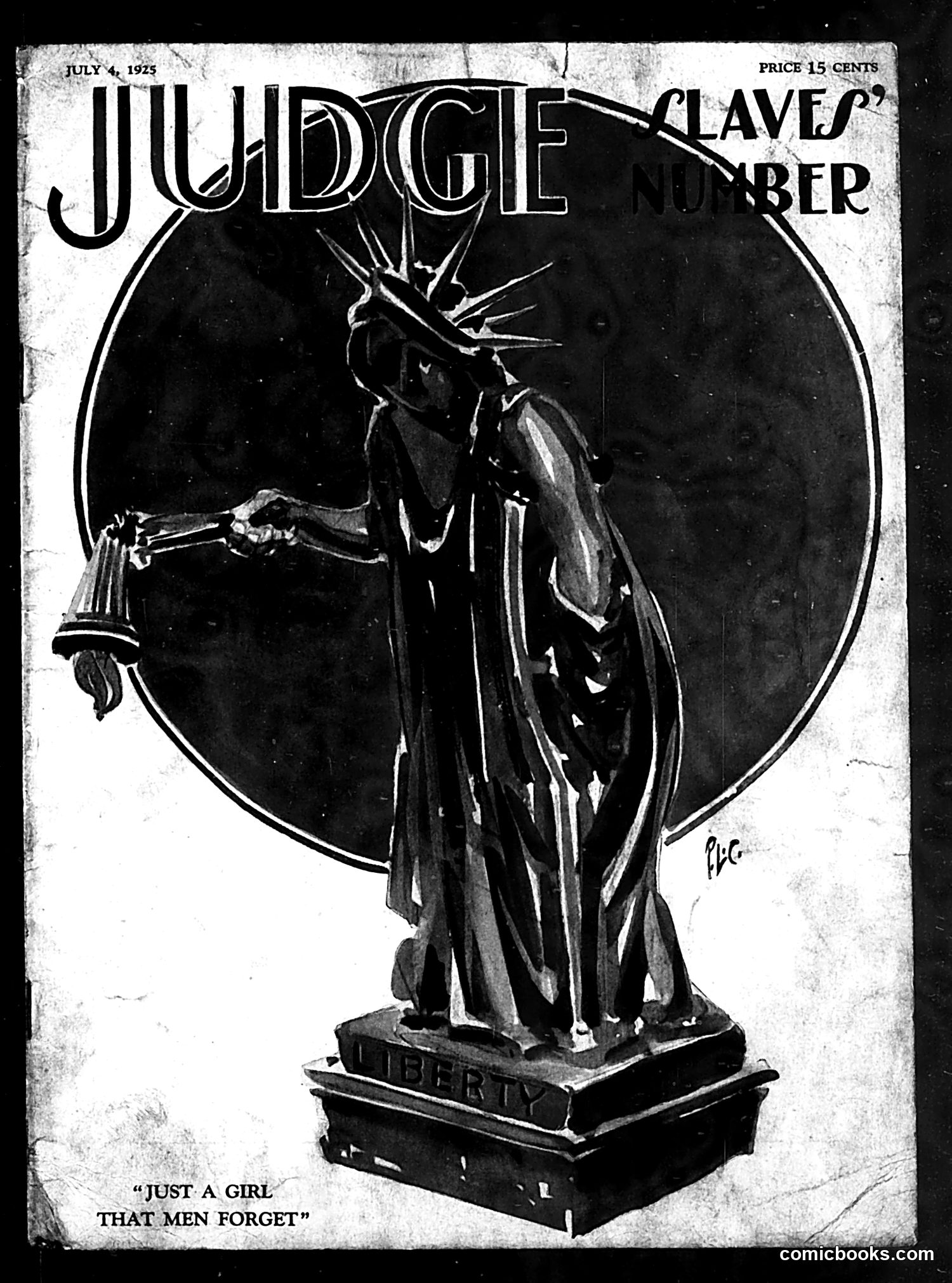
This is a cover illustration for Judge magazine's Independence Day issue. The central image depicts the Statue of Liberty holding her torch, framed against a large circular background. The caption reads "Just a Girl That Men Forget." This appears to be social satire commentary on women's status in 1925 America—just two years after women gained voting rights (19th Amendment, 1920). The joke suggests that despite being the symbolic representation of American freedom and liberty, women themselves remain overlooked or undervalued by men in society. The Liberty statue becomes a metaphor for the disconnect between America's ideals of freedom and women's actual social and political standing, making it pointed commentary on gender relations in the Jazz Age.
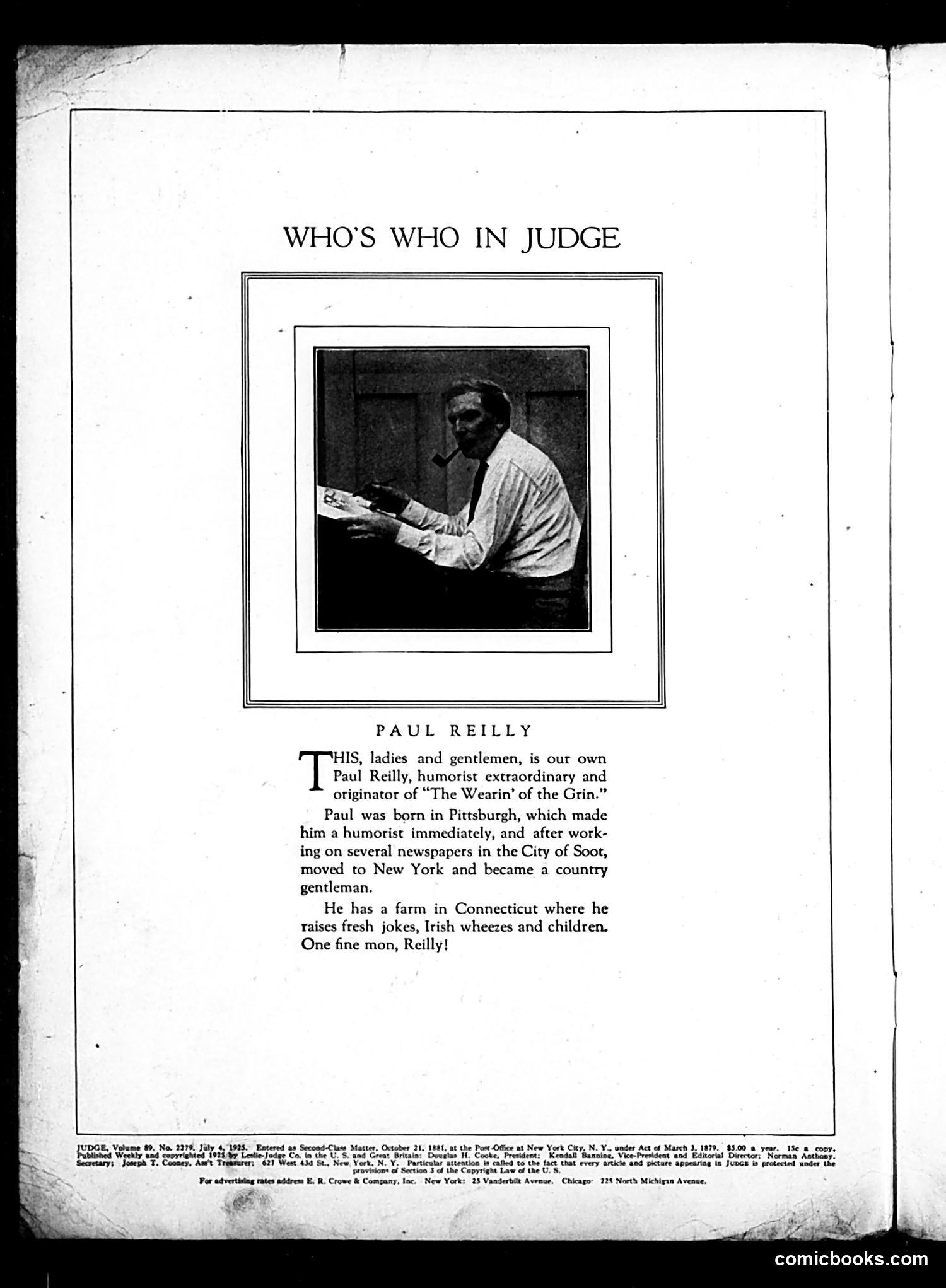
This is a "Who's Who in Judge" biographical profile page featuring **Paul Reilly**, a humorist and cartoonist. The text describes him as the originator of "The Wearin' of the Grin," suggesting he created a popular comic feature for the magazine. The biographical entry emphasizes his Pittsburgh origins (which "made him a humorist immediately"), his newspaper work in Pittsburgh, relocation to New York, and his Connecticut farm where he allegedly "raises fresh jokes, Irish wheeces and children." The humor is gentle self-promotion typical of Judge magazine's style—playing on Reilly's Irish heritage ("Irish wheeces," likely "Irish wheezers" or jokes) and presenting him as both a working humorist and country gentleman. The photograph shows him at work, reinforcing his professional identity. This appears to be house-organ promotional content for a staff contributor.
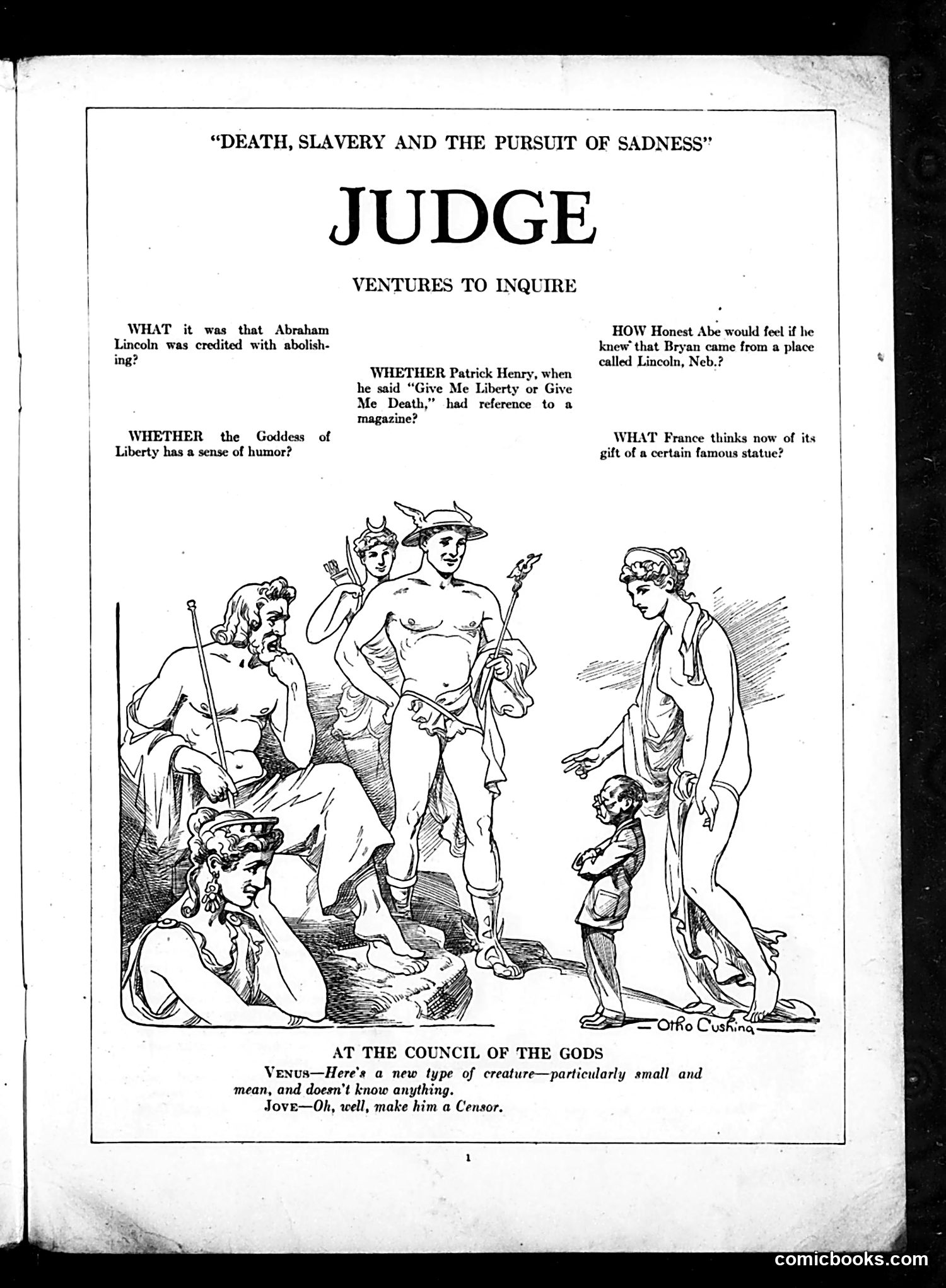
This satirical page from *Judge* magazine presents "Ventures to Inquire"—rhetorical questions mocking public figures and institutions—alongside a classical-style cartoon labeled "At the Council of the Gods." The central illustration depicts classical deities (Venus, Jupiter, and others) discussing a small human figure—apparently representing a "Censor." Venus remarks he's "a new type of creature—particularly small and mean, and doesn't know anything," while Jupiter responds "make him a Censor," suggesting censorship is an absurd, contemptible institution. The surrounding questions reference contemporary figures: Abraham Lincoln and abolitionism, Patrick Henry's rhetoric, the Statue of Liberty, and Bryan (likely William Jennings Bryan). The satire criticizes censorship and pokes fun at various American political and cultural concerns, using classical mythology to mock modern governance.
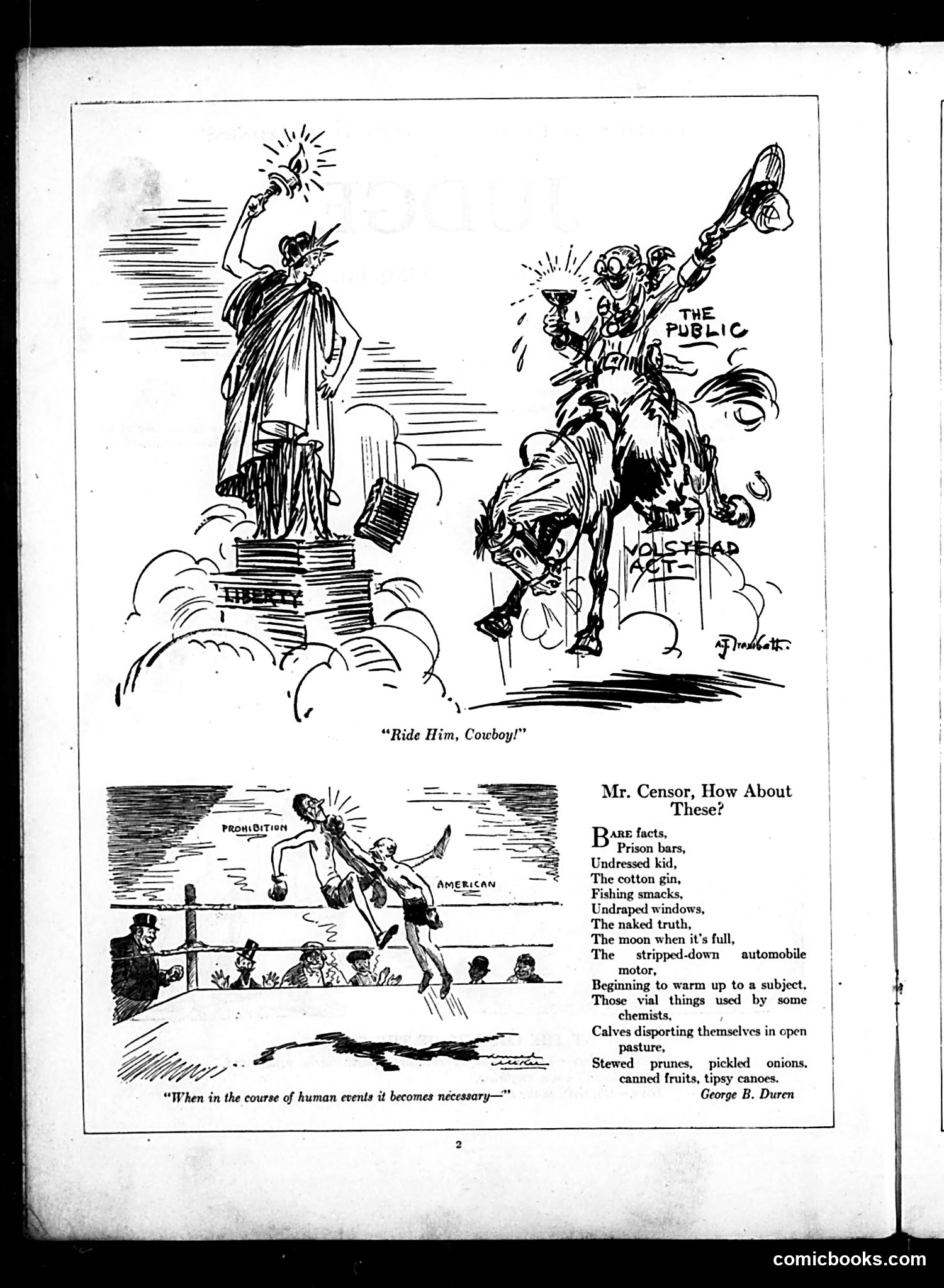
This page from *Judge* magazine contains two political cartoons satirizing censorship and moral policing. The top cartoon, "Ride Him, Cowboy!" depicts "The Public" as a bucking horse labeled "Bullhead Act," with various figures (likely censors or moral reformers) struggling to control it. Lady Liberty holds her torch above, suggesting the tension between censorship and freedom. The bottom cartoon shows Prohibition personified as a figure juggling American products—the cotton gin, fishing tackle, automobiles, and various foods. The caption quotes George B. Duren, listing items censors target: "Prison bars, Undressed kid, The naked truth," etc. Together, these cartoons critique overzealous censorship efforts, arguing that attempts to suppress information or moral content are chaotic, contradictory, and ultimately futile. The satire targets censors attempting to control public discourse and American innovation.
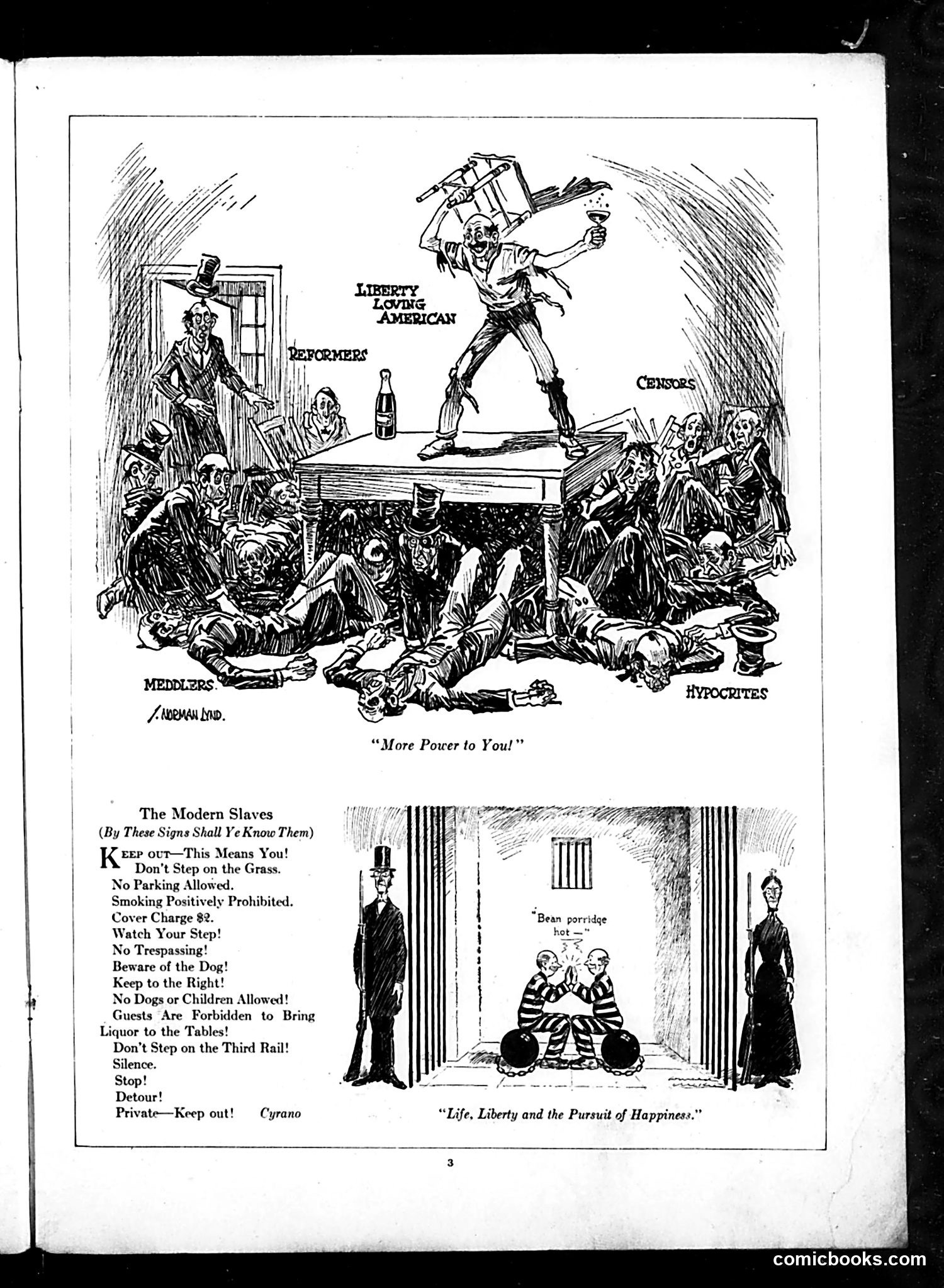
The top cartoon critiques American censorship and moral control. A performer labeled "Liberty Loving American" performs wildly on stage while various authority figures surround the audience: "Performers" (left), "Censors" (right), "Meddlers" and "Hypocrites" (bottom). The caption "More Power to You!" is ironic—the cartoon suggests censors and self-appointed moral guardians actually control what Americans can say and do, despite claims of freedom. The bottom section, "The Modern Slaves," lists absurd prohibitions ("Keep Out," "No Parking," "Smoking Positively Prohibited") juxtaposed with a prison scene captioned "Life, Liberty and the Pursuit of Happiness"—mocking how regulations restrict rather than protect American freedoms. The satire argues that modern restrictions contradict founding ideals.
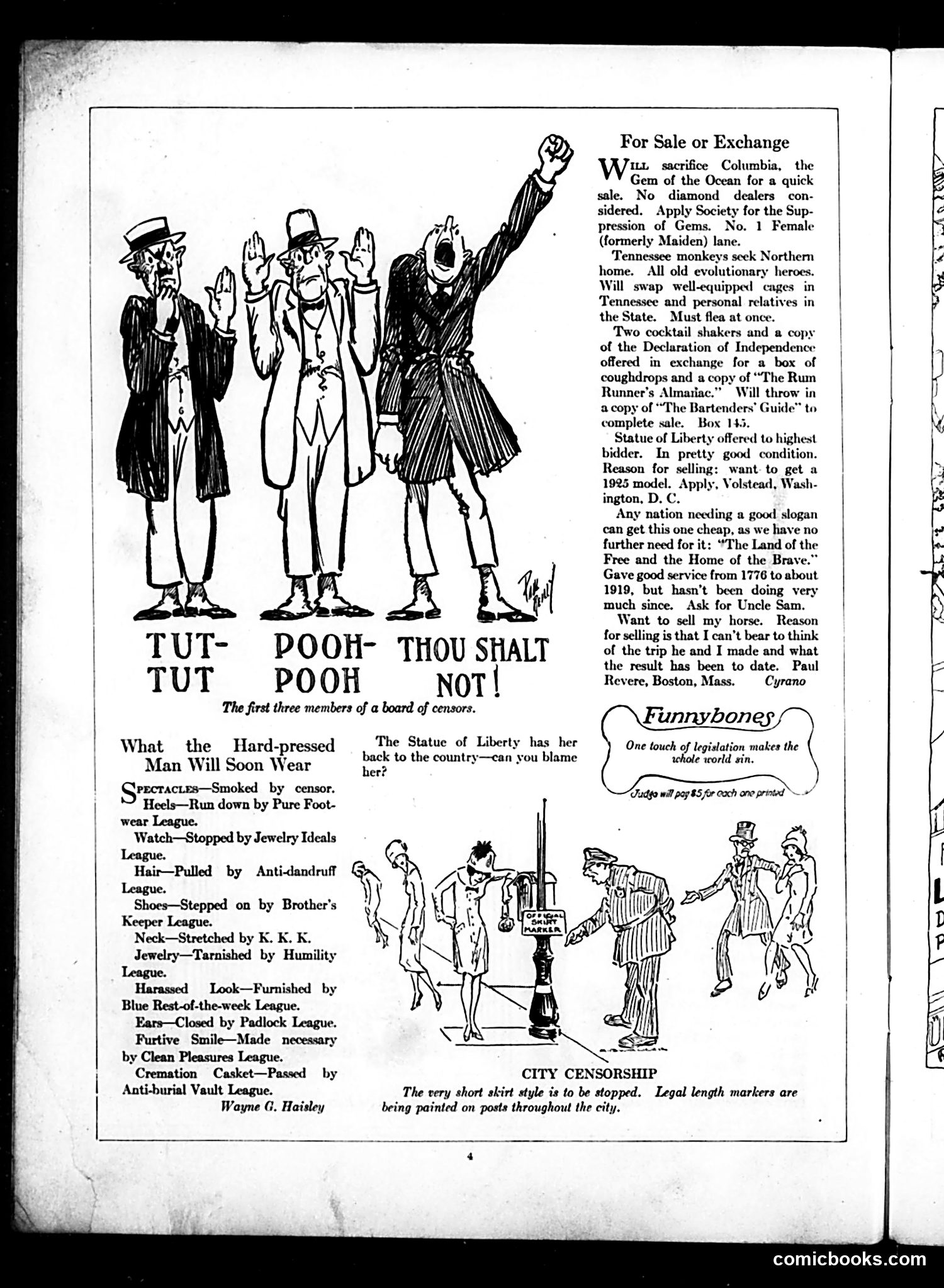
**Main Cartoon:** "The first three members of a board of censors" depicts three figures labeled "Tut-Tut," "Pooh-Pooh," and "Thou Shalt Not!"—personifying disapproving censorship voices. This satirizes the 1920s censorship movement, mocking moral guardians who rejected modern culture. **"What the Hard-pressed Man Will Soon Wear"** lists absurd restrictions censors supposedly impose: stopped watches, pulled hair, tarnished jewelry, etc.—exaggerating censorship's pervasive control over daily life and appearance. **"City Censorship"** cartoon shows authorities measuring women's skirt lengths, referencing actual 1920s debates over hemlines—a real flashpoint between modernists and moral conservatives. The page collectively mocks the era's aggressive censorship boards and social reformers as excessive killjoys stifling American life and fashion.
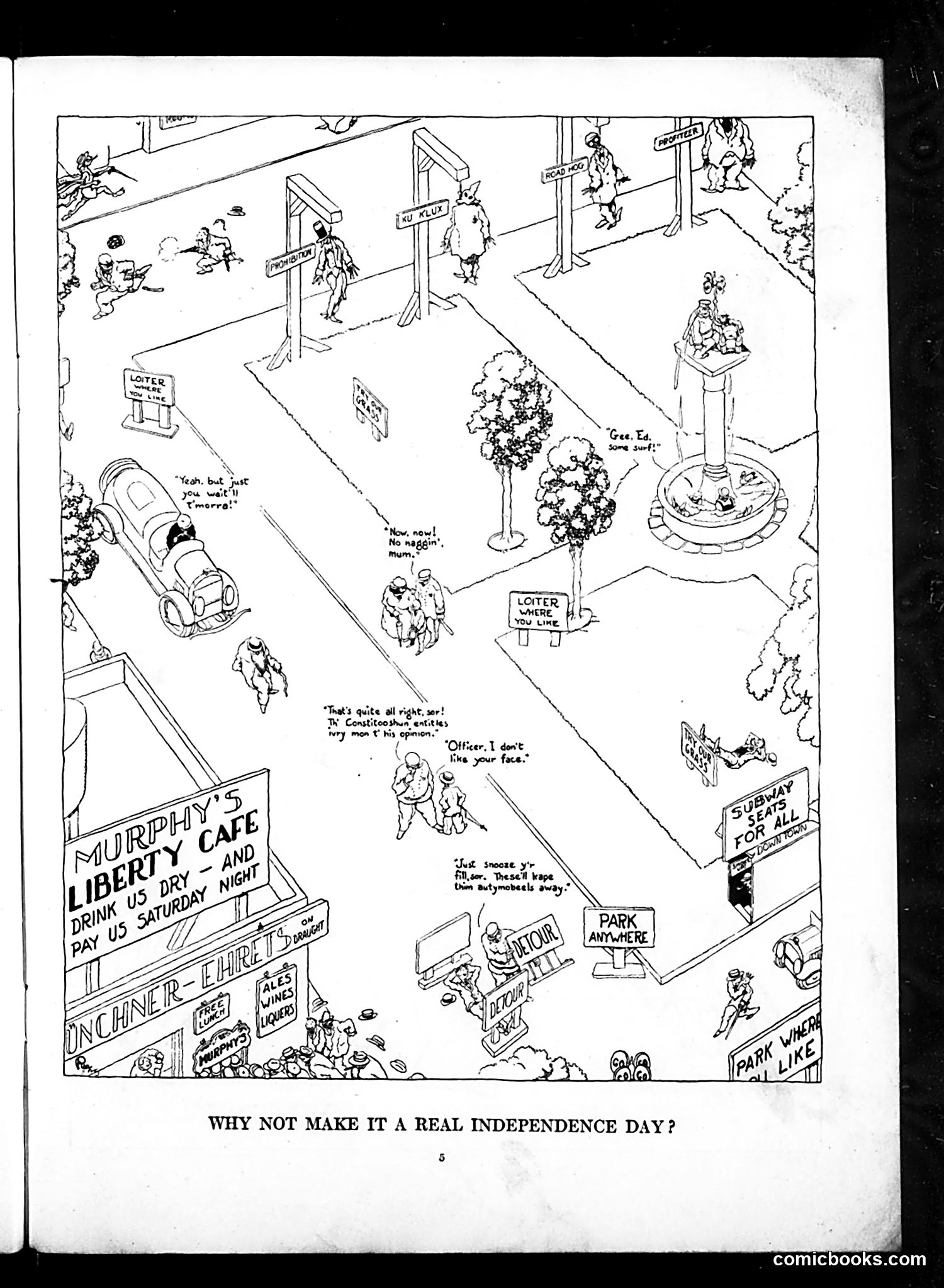
This satirical cartoon depicts a chaotic urban park scene critiquing how Americans actually celebrate Independence Day. The image shows: **The satire's point:** Despite Independence Day's patriotic significance, the cartoon illustrates citizens engaged in rowdy, undignified behavior—public drunkenness, fighting, and general disorder. Visible signs advertise bars ("Murphy's Liberty Cafe"), suggesting alcohol-fueled celebrations. **The irony:** The title questions whether the holiday represents genuine independence or merely an excuse for societal breakdown. Characters exchange crude remarks; one says "Officer, I don't like your face," highlighting disrespect for authority. **Social critique:** Judge magazine is mocking what it views as the degradation of a serious national holiday into an occasion for drunkenness and street violence—suggesting Americans have lost sight of the holiday's true meaning.
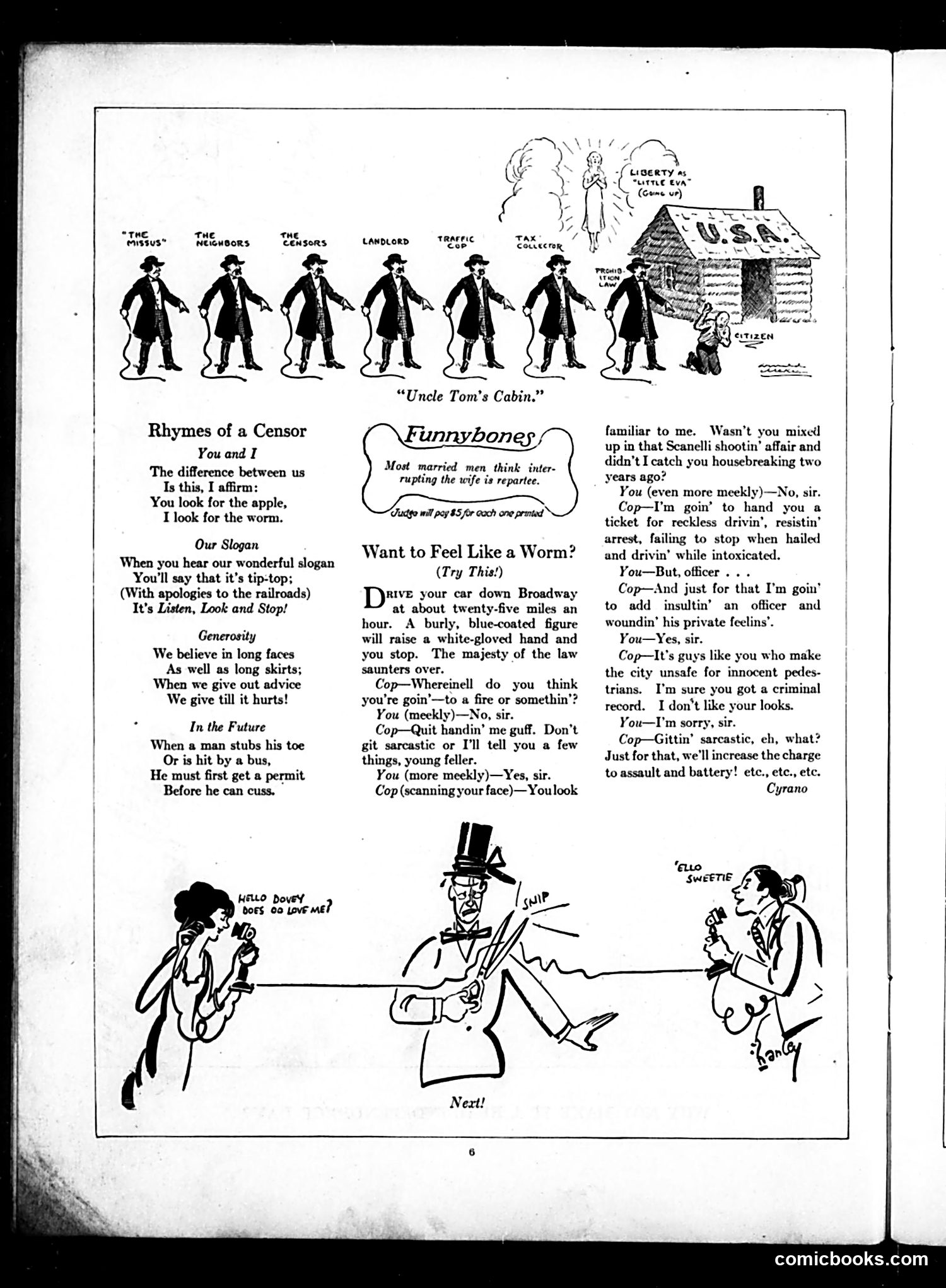
**"Uncle Tom's Cabin" cartoon (top):** A satirical lineup showing different authority figures (the census taker, neighbors, censors, landlord, traffic cop, tax collector) all identified as exploitative or intrusive—culminating in "Liberty" reduced to a small figure in a ramshackle cabin marked "U.S.A." The implication is that American citizens are hemmed in and oppressed by government and social authorities. **"Rhymes of a Censor":** Attacks censorship itself. The censor looks for moral "worms" (faults) rather than good ("apples"), represents intrusive moral policing, and the slogan mocks government control ("Listen, Look and Stop"). **"Want to Feel Like a Worm?":** Depicts police abuse—a traffic officer verbally bullies a motorist into submission, fabricates charges, and intimidates him into helpless compliance. It satirizes arbitrary police power and the citizen's powerlessness. **Overall theme:** Progressive-era critique of government overreach, censorship, and police tyranny undermining American liberty.
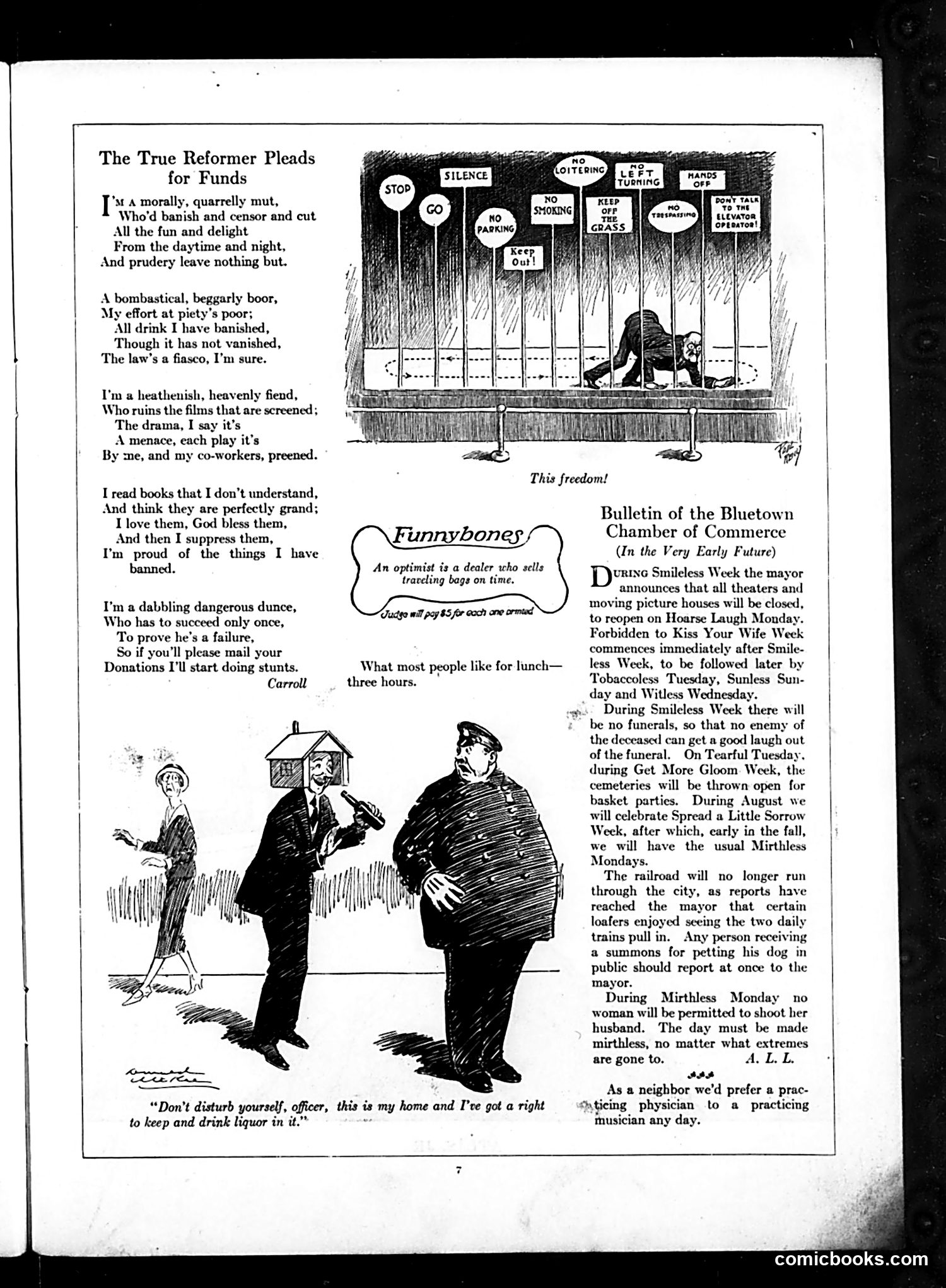
This page satirizes American moral reformers and censors of the early 20th century. "The True Reformer Pleads for Funds" mocks self-righteous activists who ban alcohol, censor films and literature, and restrict public behavior—while admitting (through the poem's ironic voice) their efforts fail and are hypocritical. The reformer admits drinking persists despite prohibition and describes himself as a "dangerous dunce." The accompanying cartoon shows a reformer trapped behind numerous restrictive signs ("No Parking," "No Smoking," "Keep Off Grass"), suggesting reformers are imprisoned by their own rigid rules. The "Bulletin of the Bluetown Chamber of Commerce" parodies this further, imagining a dystopian future where the reformist impulse has created absurd weeks: "Smileless Week," "Mirthless Monday," "Witless Wednesday"—suggesting that excessive moral policing destroys basic human joy and normalcy. The bottom cartoon mocks a man claiming his home is exempt from law enforcement, likely referencing Prohibition-era hypocrisy about private drinking. The satire targets puritanical reform movements as counterproductive, absurd, and ultimately self-defeating.
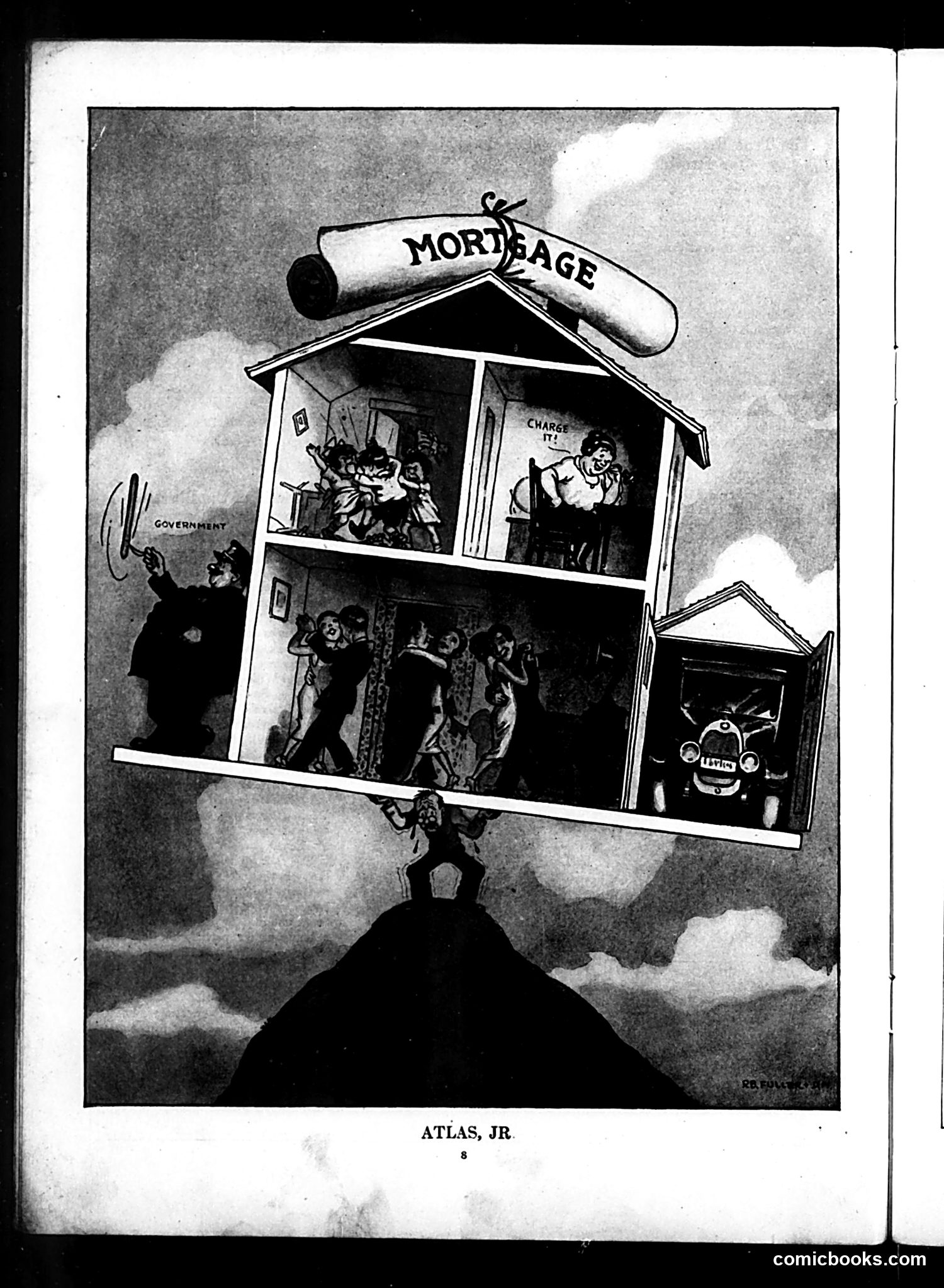
This cartoon depicts a figure labeled "Atlas, Jr." struggling to support a house-shaped structure containing multiple scenes of domestic chaos and financial burden. The roof bears the label "MORTGAGE," emphasized as a heavy weight crushing downward. Inside the building, various vignettes show struggling families and what appears to be a car, suggesting economic hardship. On the left, a figure labeled "GOVERNMENT" appears to be adding additional burden. The satire critiques how ordinary citizens—positioned as modern-day Atlas figures—bear the weight of mortgages, government taxation, and economic obligations that keep them perpetually strained. The cartoon likely comments on post-WWI economic pressures or Depression-era financial hardship, portraying homeownership and government burden as crushing weights on the working class.
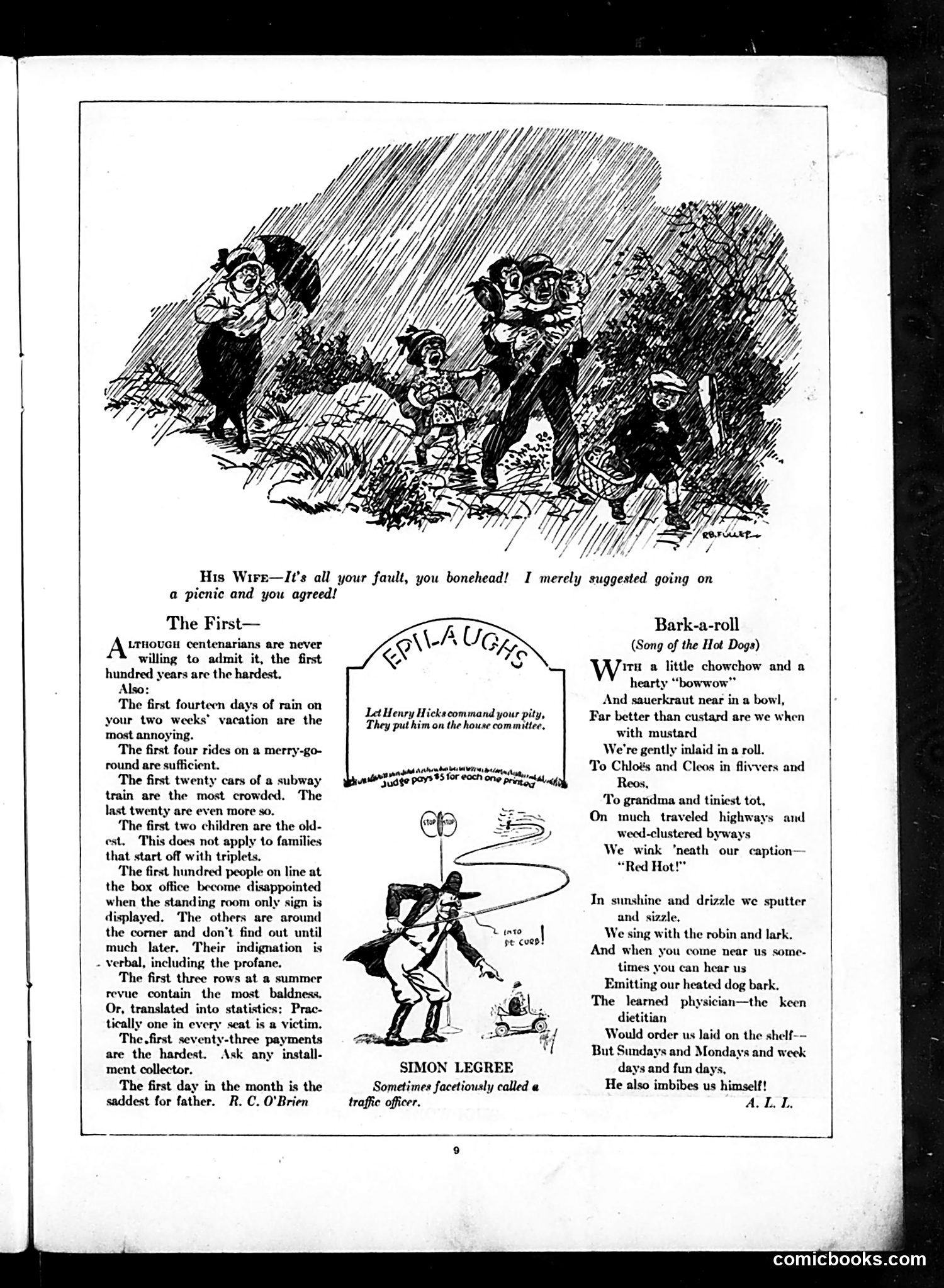
This page contains humorous observations about "firsts" rather than political satire. The top cartoon depicts a family caught in rain during a picnic, with the wife blaming her husband for agreeing to the outing—illustrating the text's point that "the first fourteen days of rain on your two weeks' vacation are the most annoying." The middle section lists various "first" experiences that are notably unpleasant: the first hundred years being hardest, crowded subway cars, disappointing theater lines, and bald men at summer shows. These are relatable, everyday frustrations presented as general life observations. The bottom includes a brief joke about "Simon Legree" (the villainous slave-owner from *Uncle Tom's Cabin*) being "facetiously called a traffic officer"—comparing traffic cops to tyrants. The "Bark-a-roll" section is a lighthearted song about hot dogs, their popularity despite health concerns, presented as entertainment rather than satire. Overall, this page prioritizes humor over political commentary.
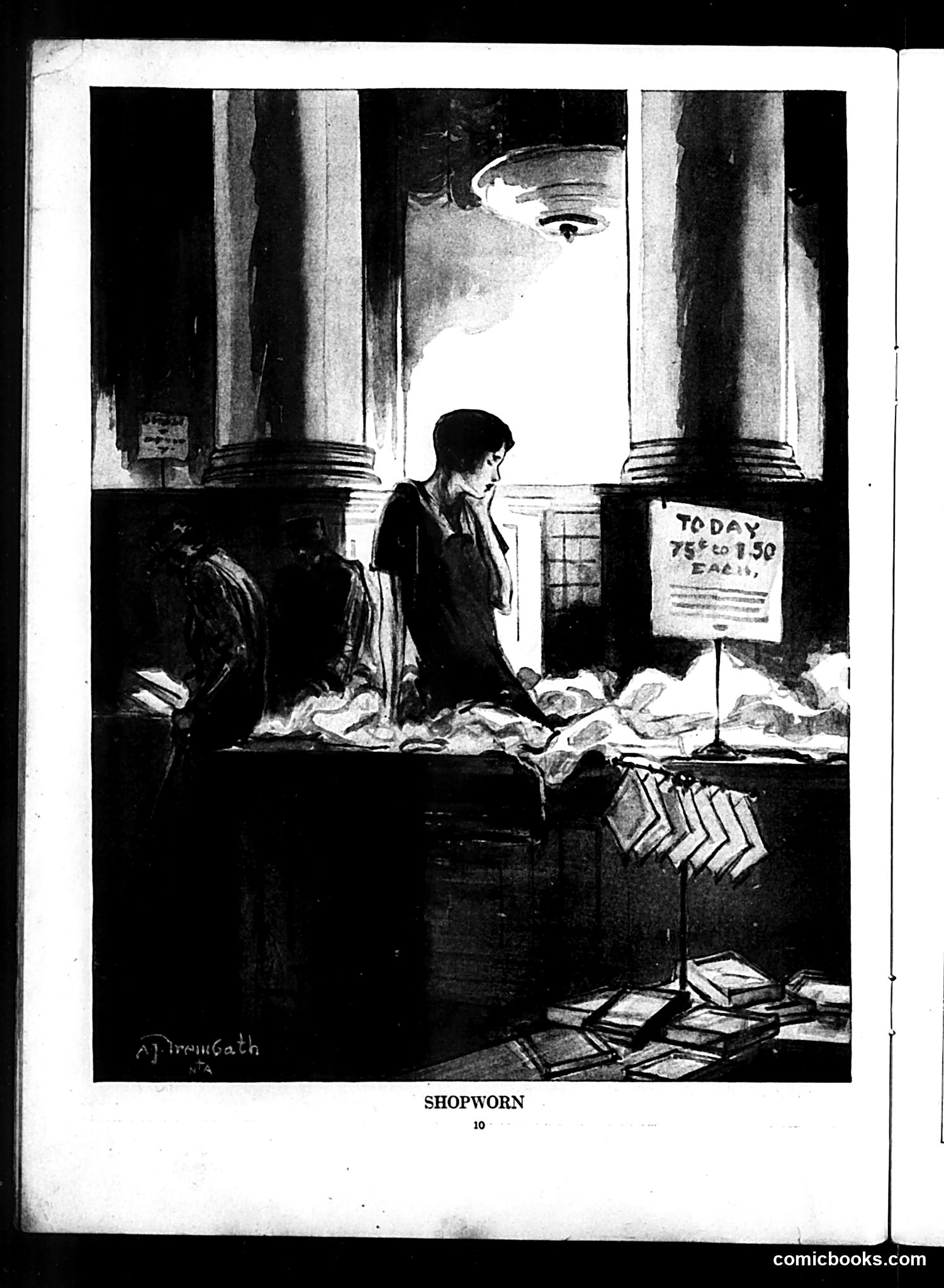
This illustration depicts a street vendor operating a small shop window display, likely selling clothing or textiles. A price sign reading "TODAY 75¢ to $1.50 EACH" is prominently displayed. The cartoon satirizes the practice of selling damaged or worn merchandise—hence "shopworn"—at supposedly discounted prices. The vendor appears to be arranging or displaying goods that look shabby or of questionable quality, suggesting the merchandise may not be the bargain it claims. The satire likely critiques deceptive retail practices: merchants passing off inferior or worn items as deals to unsuspecting customers. The detailed rendering of the window display and the merchant's posture emphasizes the con inherent in the transaction.
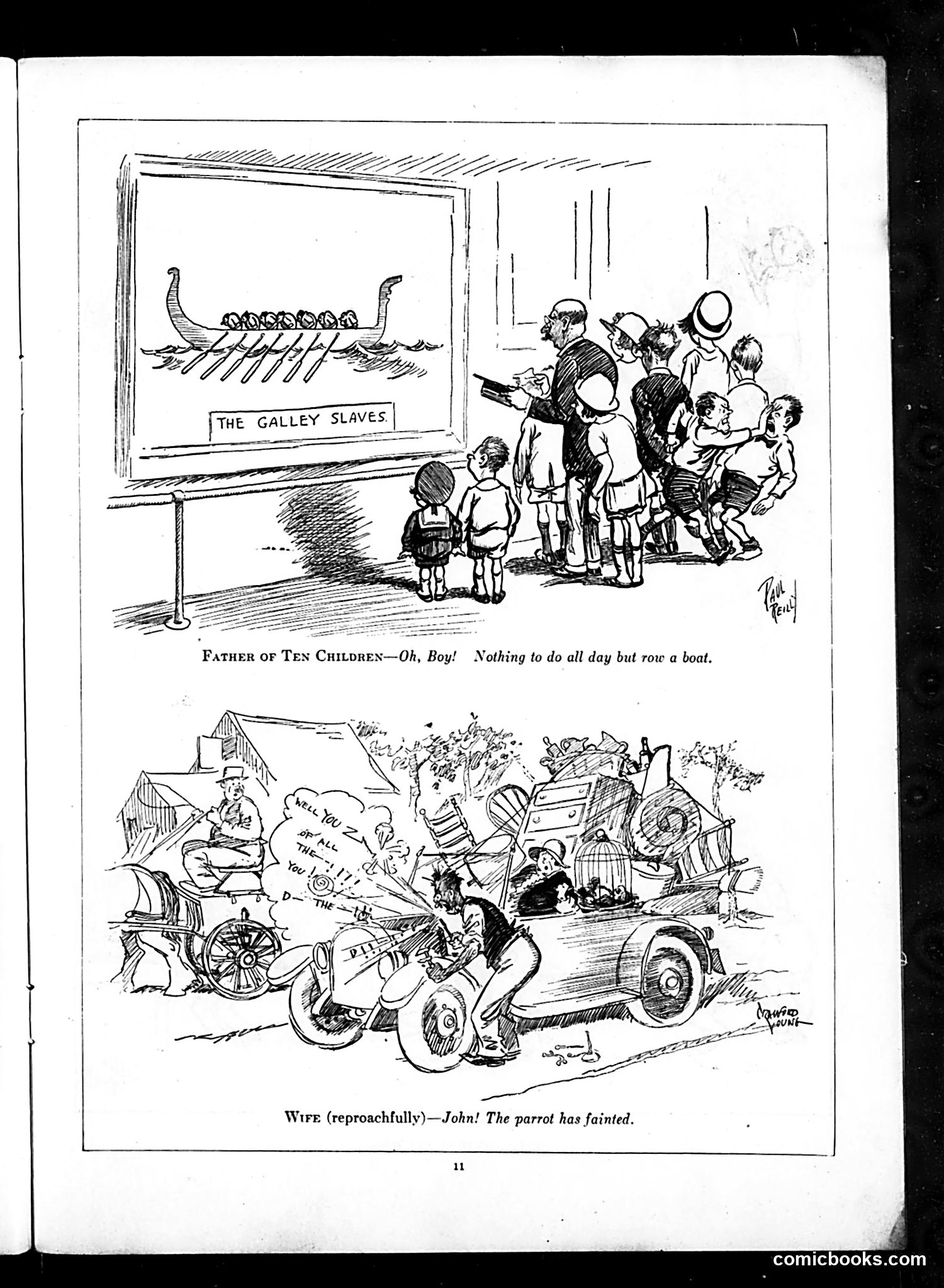
**Top cartoon**: A museum or educational exhibit labeled "The Galley Slaves" shows a painting of ancient Roman galley slaves rowing. A father and children view it, with the caption joking that the father has "nothing to do all day but row a boat"—satirizing wealthy leisure or possibly idle husbands. **Bottom cartoon**: A chaotic domestic scene where a wife addresses her husband "John" after their parrot has fainted. The scene shows overturned vehicles, scattered cargo, and general mayhem, suggesting John has caused destruction through reckless driving or behavior, prompting the wife's reproachful comment. The humor lies in the wife's deadpan understatement given the surrounding disaster. Both cartoons use situational humor rather than political satire.
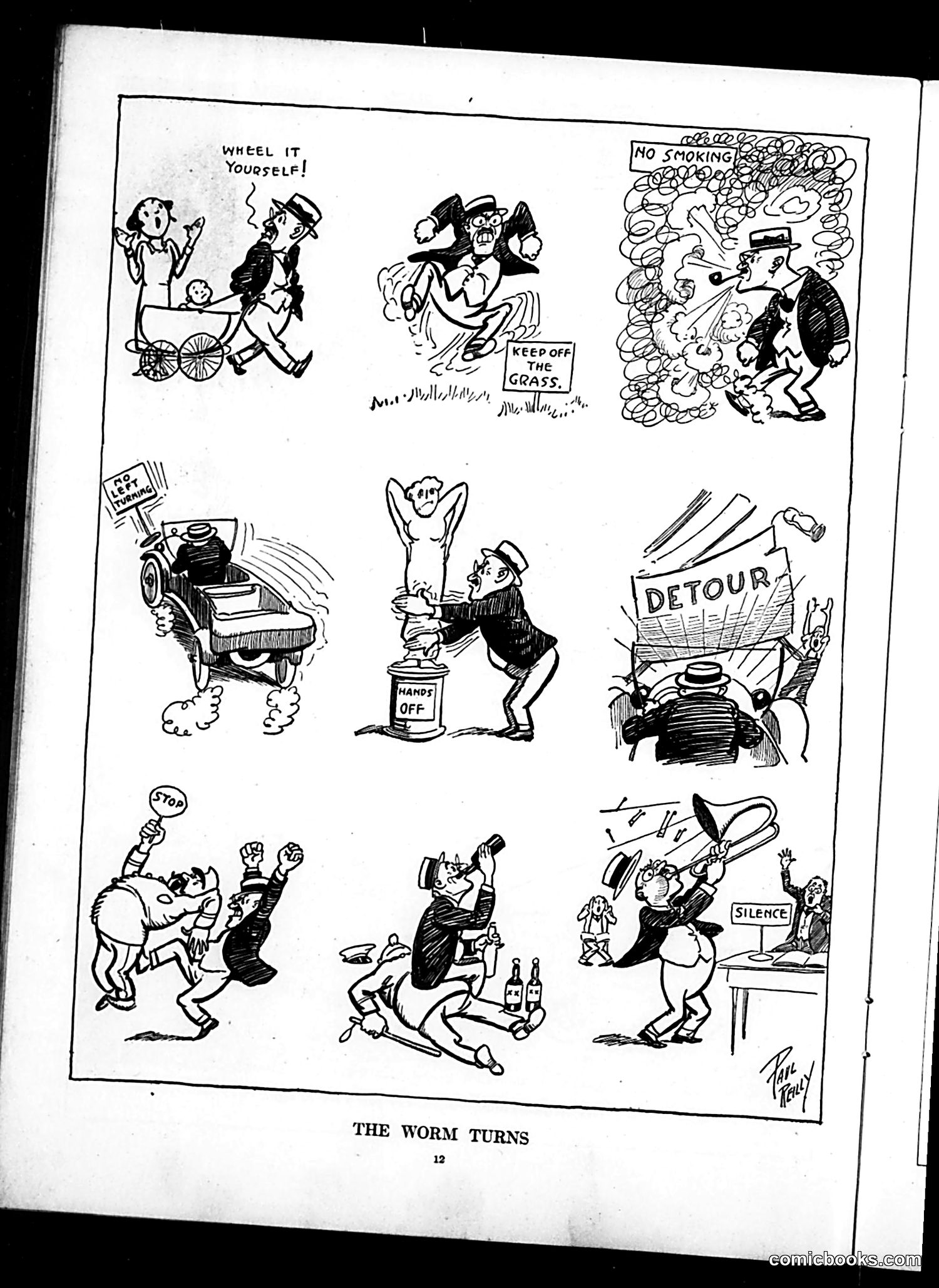
This page presents nine cartoon vignettes satirizing social disruption and rule-breaking. The title "The Worm Turns" suggests previously submissive people rebelling against authority and social norms. The scenes depict: - A woman dismissing a man ("Wheel it yourself!") - Adults ignoring "Keep Off the Grass" signs - Defying "No Smoking" rules - A "Hands Off" sign being ignored - A car marked "Detour" causing chaos - Ignoring traffic "Stop" signs - Drinking in public (bottles visible) - A "Silence" sign being disregarded The cartoon appears to mock post-WWI social disorder or Prohibition-era lawlessness, where citizens openly flouted regulations and authorities lost control. The satire critiques widespread public disrespect for rules, presented as comedic scenes of societal breakdown rather than orderly civic behavior.
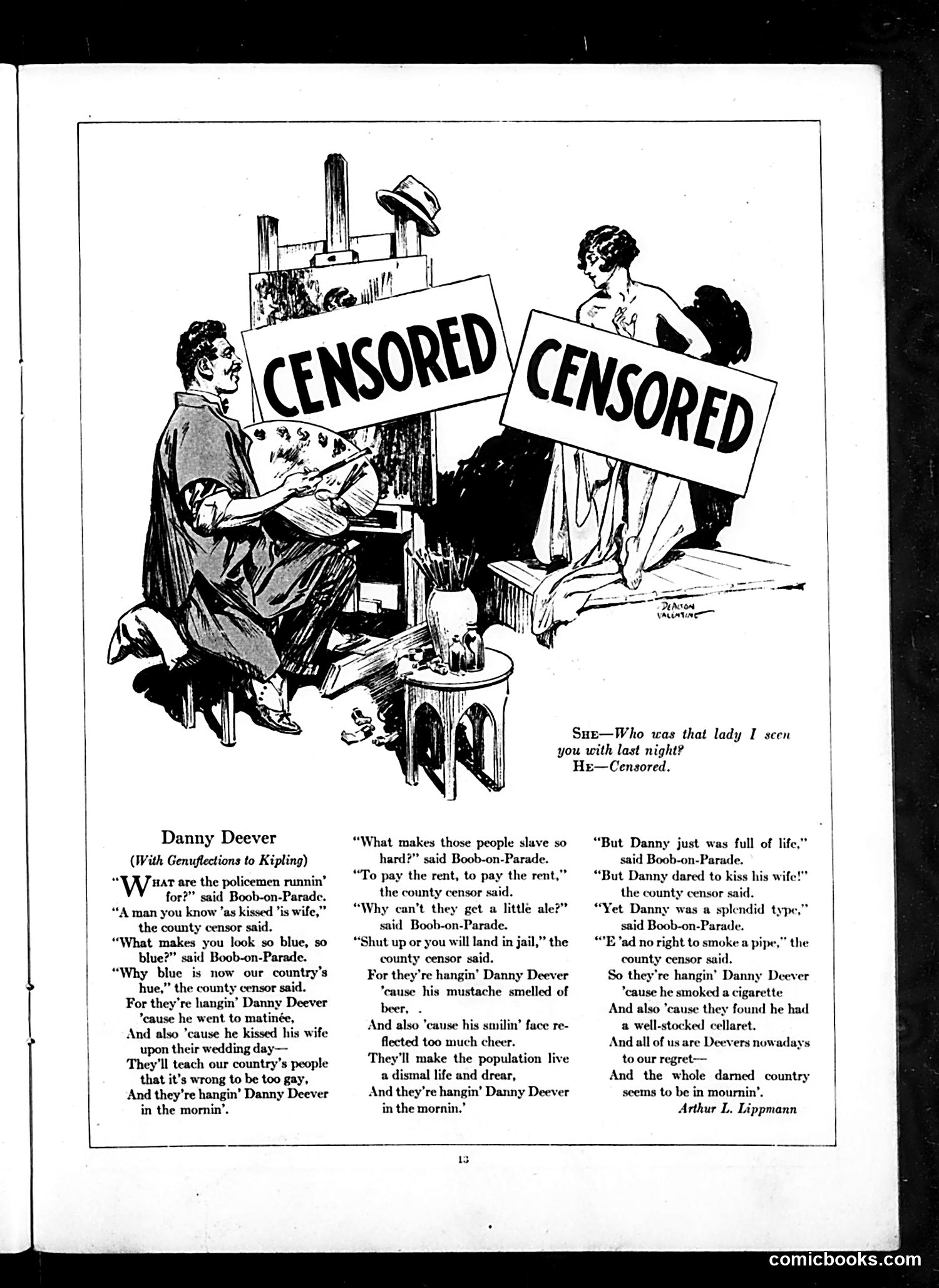
This cartoon satirizes overzealous censorship and social control, likely during the Prohibition era (1920s). The illustration shows a "county censor" figure wielding arbitrary power over citizens' behavior. The poem, parodying Kipling's "Danny Deever," depicts a man hanged not for crime but for minor infractions: kissing his wife, visiting a matinee, smiling, smoking, and keeping alcohol. The censor represents government overreach—punishing ordinary pleasures and joyful living as moral offenses. "Boob-on-Parade" (the everyman questioning the censor) represents the bewildered public. The cartoon criticizes how authorities criminalize innocent behavior, create fear through arbitrary enforcement, and suppress human happiness in the name of morality or order. The final exchange where any romantic encounter gets labeled "Censored" emphasizes the absurdity of total behavioral control. The satire warns against letting censors dictate private conduct.
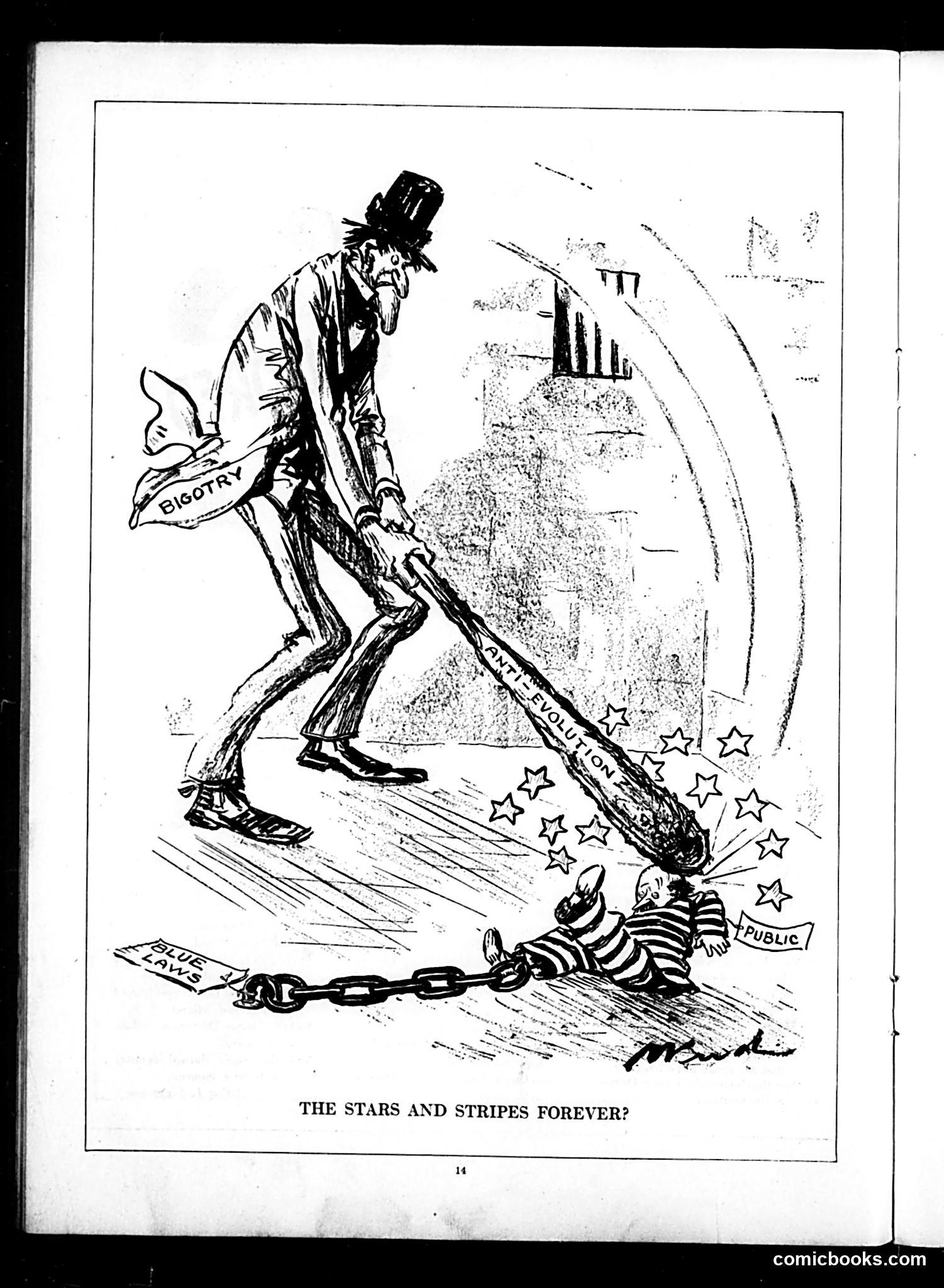
This political cartoon depicts a confrontation between two figures: a tall, well-dressed man labeled "BIGOTRY" wielding a large club labeled "ART REVOLUTION," and a small figure labeled "PUBLIC" chained to a block labeled "TRUE FACTS," being struck down. The cartoon satirizes how bigotry—weaponized as artistic or revolutionary rhetoric—threatens the public's connection to truth and facts. The question "THE STARS AND STRIPES FOREVER?" suggests anxiety about whether American democratic values (represented by the flag's stars and stripes) can survive when ideological extremism ("ART REVOLUTION") is used to suppress factual reality and public welfare. The satire criticizes how revolutionary or artistic movements might be corrupted by prejudice and used to undermine truth itself.
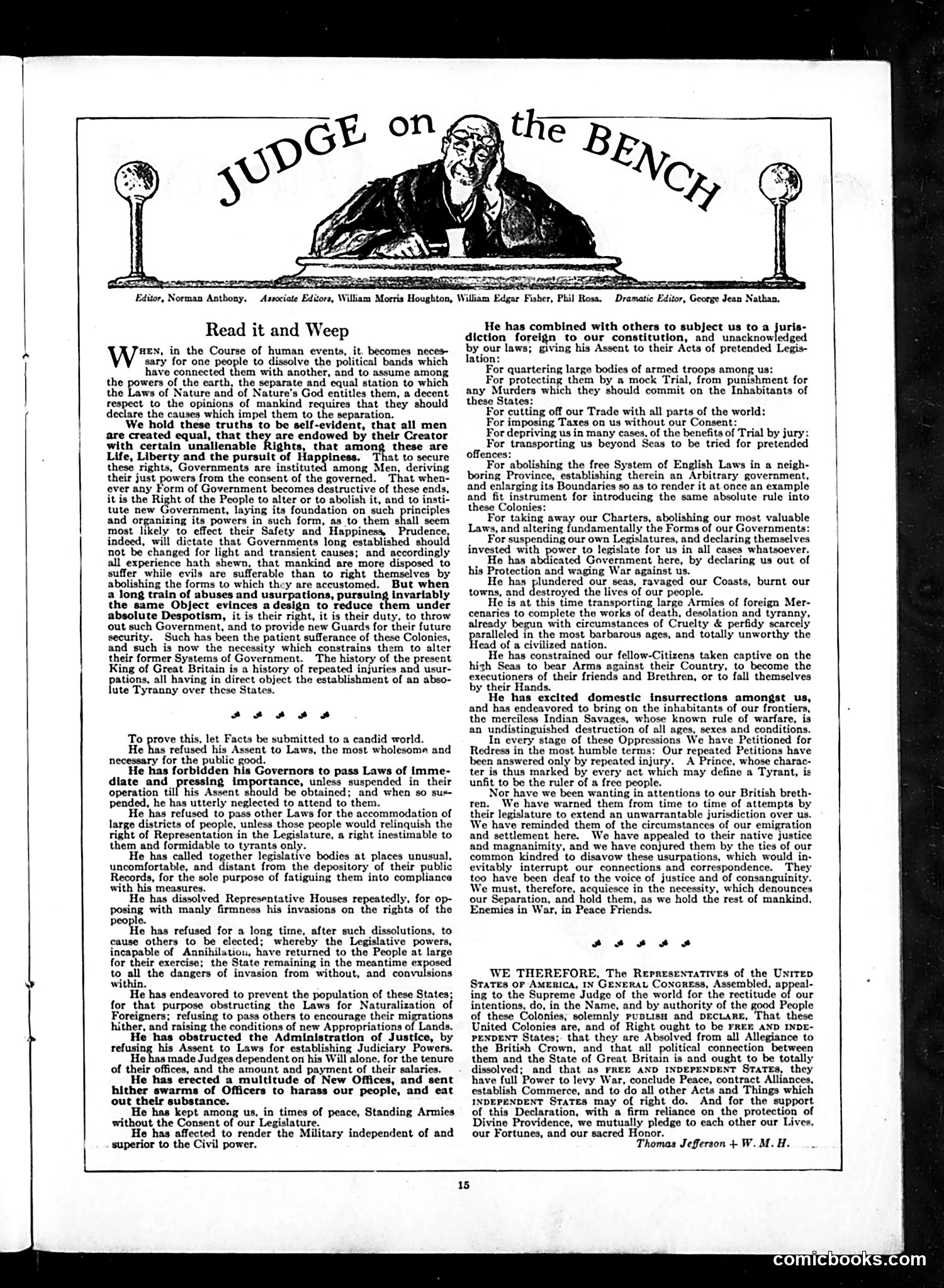
This page satirizes **King George III of Britain** through the visual device of a stern judge presiding over colonial grievances. The cartoon's title "Read it and Weep" signals mockery of British authority. The text reproduces the **Declaration of Independence**—the actual historical document listing colonial complaints against the Crown. By framing it as testimony before a "Judge," the satire inverts reality: instead of the King judging colonists, Americans position themselves as judging the King's tyranny. The illustration shows an imposing judicial figure (representing legitimate authority/justice), ironically used to condemn the actual King as a tyrant. The satire's point: America's independence wasn't rebellion but justified legal action against governmental abuse—the colonists are the righteous party seeking redress through reason and enumerated facts. This appears to be a **patriotic reprint** of the Declaration, using Judge magazine's satirical format to reinforce American revolutionary legitimacy to modern (1920s-era) readers.
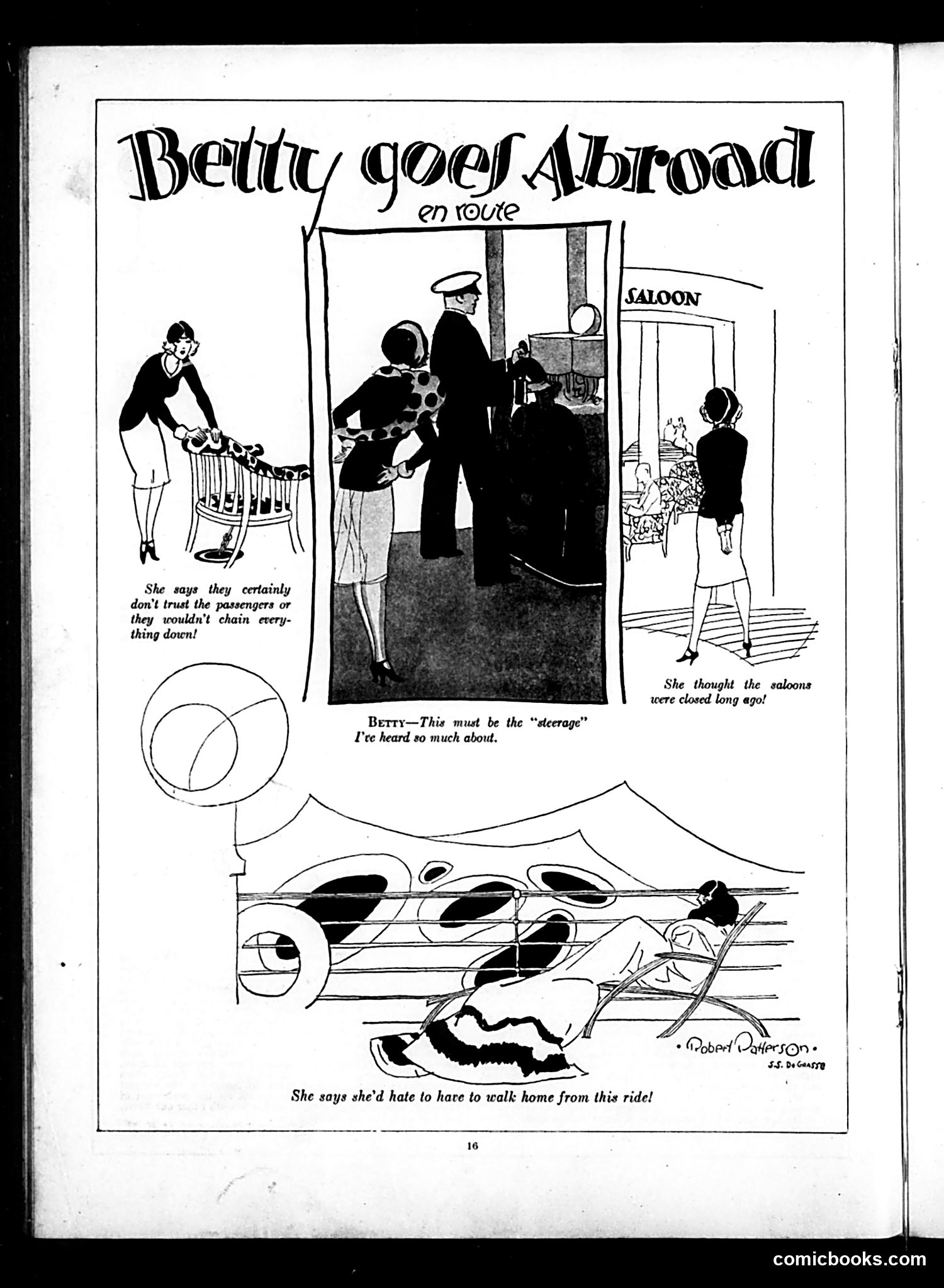
This comic satirizes American women's expectations versus reality of ocean travel, likely from the 1920s Prohibition era. "Betty" appears to be a naive American tourist boarding a ship ("en route" abroad). The humor targets several things: 1. **Steerage conditions**: The wealthy passenger mocks cramped third-class accommodations as the famous "steerage" she'd heard about. 2. **Prohibition hypocrisy**: Betty notices "saloons" still operating openly despite American alcohol bans, suggesting ships exploited legal gray areas at sea. 3. **Safety concerns**: Chained furniture and the rickety vehicle imply poor conditions and passenger distrust—realistic complaints about 1920s ship travel. The satire mocks both American tourists' privileged ignorance of working-class travel and the era's contradictions around drinking laws. The cartoon's target audience would recognize these as genuine grievances about transatlantic voyages of that period.
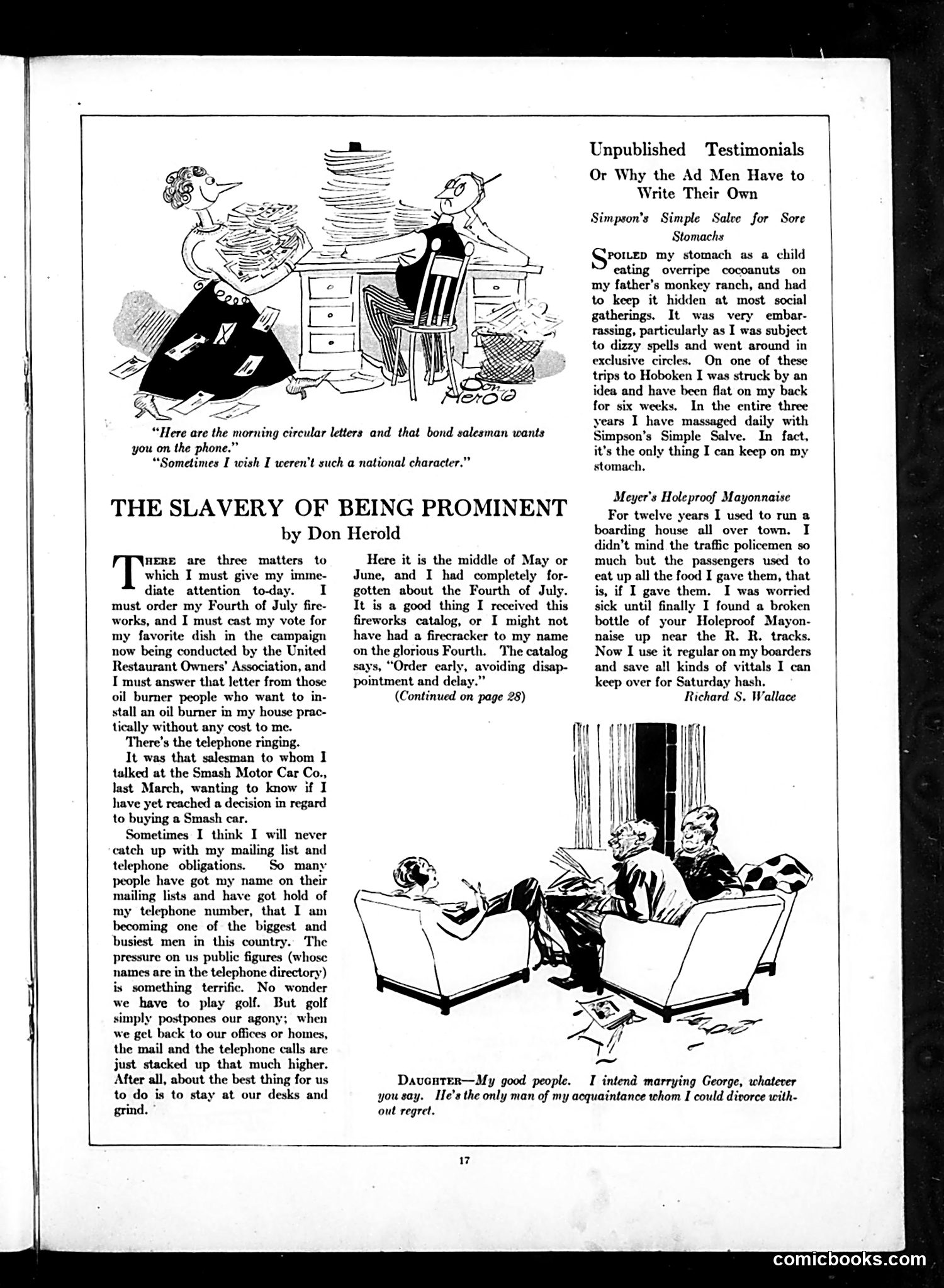
**Main Article: "The Slavery of Being Prominent"** Don Herold satirizes the burden of minor fame in the modern age. The author—apparently someone whose name appears in the telephone directory—complains that being even slightly well-known creates endless obligations: unwanted solicitations, mailing lists, phone calls from salesmen (like one pestering him about a "Smash" car), and product endorsements. The cartoon shows a harried man buried in mail and interruptions. Herold's joke is that being a "public figure" (merely someone listed in the phone book) is exhausting, forcing him to stay chained to his desk rather than enjoy leisure time like golf. **"Unpublished Testimonials" Section** This satirizes fake testimonials used in advertising. The fictional endorsements are deliberately absurd and nonsensical—a man praising stomach salve despite having been "flat on my back for six weeks," or praising mayonnaise for saving money by preventing boarders from eating. The satire suggests advertisers must write their own testimonials because real customers wouldn't produce such ridiculous claims.
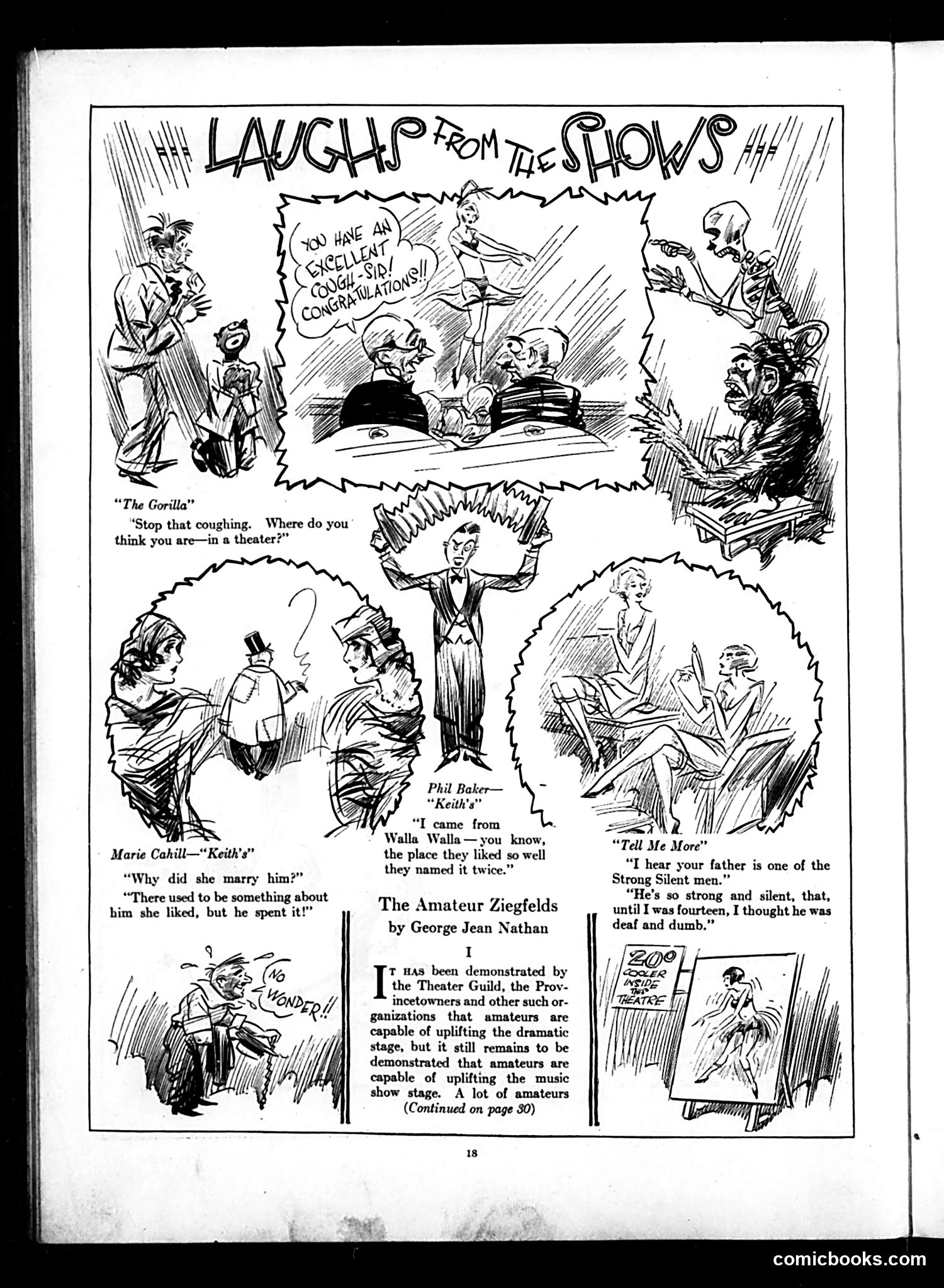
This page collects jokes from Broadway theaters, featuring performers from popular shows of the era ("Keith's," "Tell Me More"). The humor relies on vaudeville-style one-liners: Marie Cahill's quip about marriage to a spendthrift; Phil Baker's joke about Walla Walla being named twice (a genuine place name); and a silent-father joke playing on the "strong silent man" archetype. The central article by George Jean Nathan discusses amateur theatrical productions, particularly musicals. Nathan notes that while amateur dramatic groups (the Theater Guild, Provincetown Players) have proven capable of serious work, amateurs struggle with musical theater—a more technically demanding form. The cartoons depict theater scenes: audience disruption ("The Gorilla"), performers receiving compliments, and presumably scenes from the mentioned shows. The page serves as entertainment gossip and theater criticism for a sophisticated audience familiar with Broadway productions of the period.
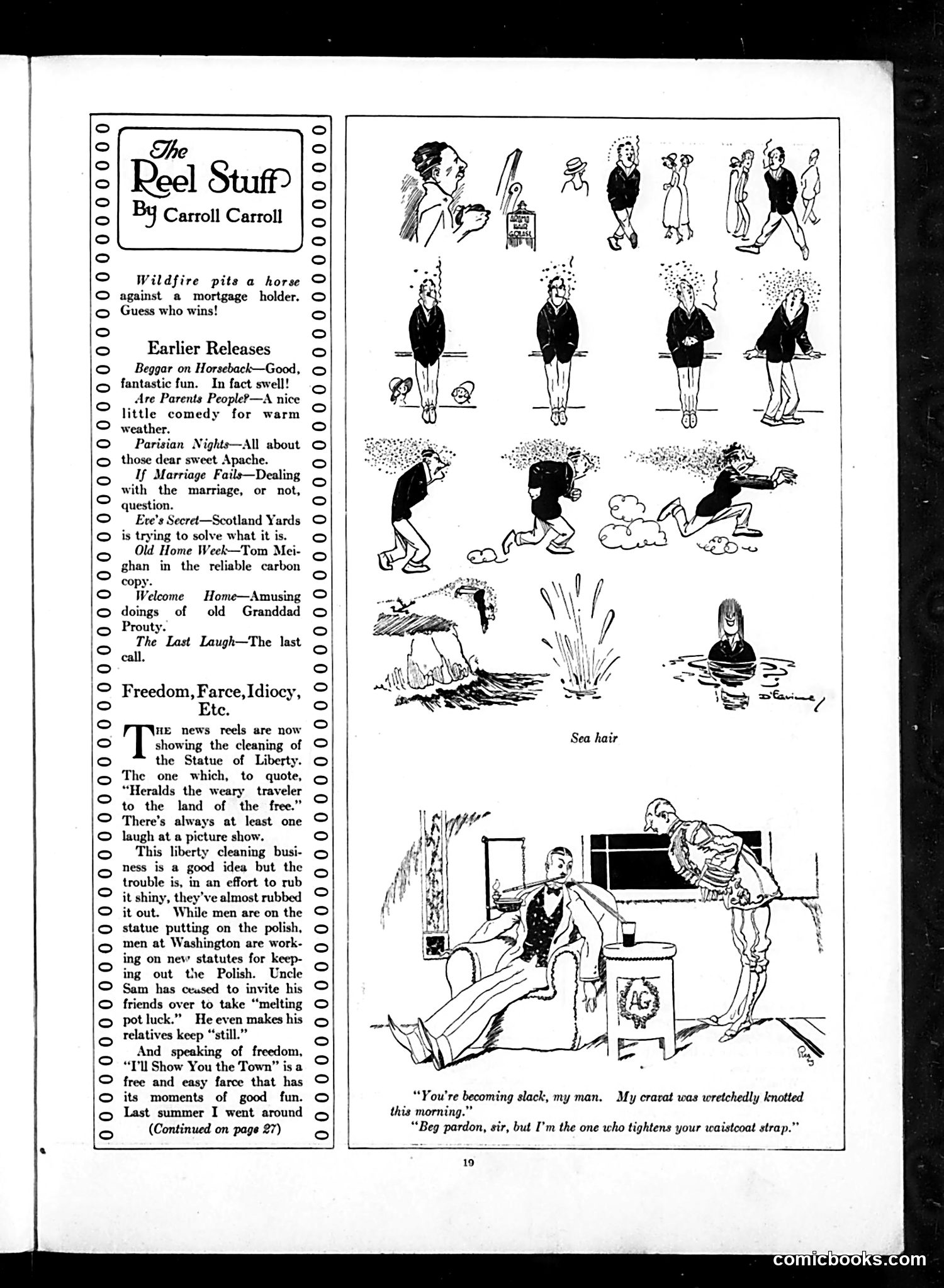
This page combines a film column by Carroll Carroll reviewing recent movies with editorial commentary and cartoon illustrations. **The Main Satire:** Carroll critiques current events through film references. He sarcastically comments on U.S. immigration policy: while newsreels celebrate cleaning the Statue of Liberty (symbol of welcome to immigrants), the government simultaneously works on new restrictive laws specifically targeting Polish immigrants—"working on new statutes for keeping out the Polish." The irony is sharp: Uncle Sam polishes Lady Liberty while actively excluding the very people she's supposed to welcome. **The Cartoons:** Illustrations show various comedic scenarios, including physical humor (people falling, swimming mishaps labeled "Sea hair") and a domestic scene where a valet corrects his employer about who actually maintains his appearance—gentle class commentary. **Context:** This reflects 1920s xenophobia and restrictive immigration legislation that would culminate in the 1924 National Origins Act, targeting Southern and Eastern Europeans.
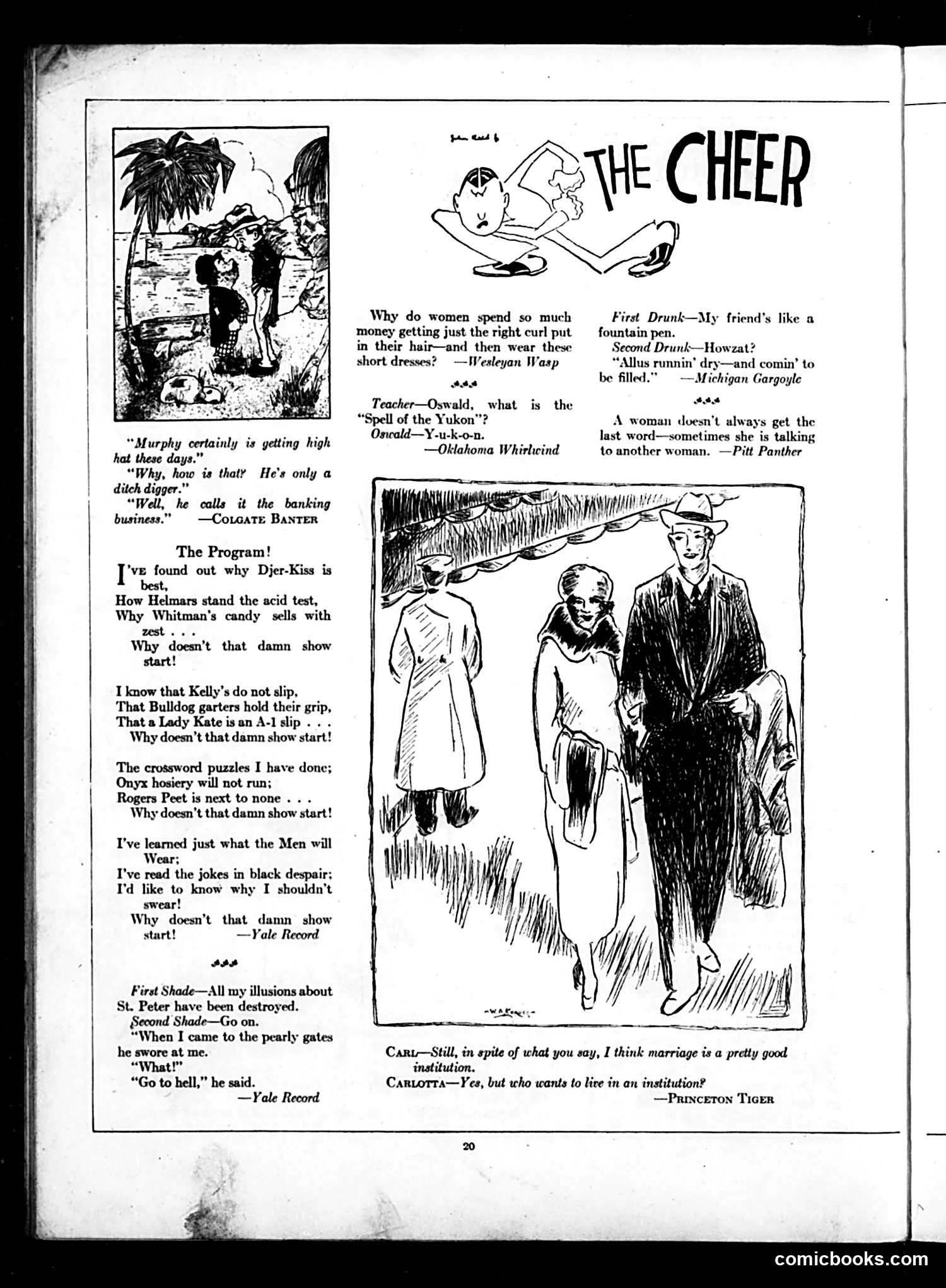
This is a humor compilation page featuring jokes and comic strips from college humor magazines (Yale Record, Princeton Tiger, etc.). The content reflects 1920s social satire: **Top cartoon**: A couple walking; the joke mocks social climbing—a ditch digger calling his work "banking business" to sound respectable. **"The Program" poem**: Satirizes theater audiences' impatience during intermissions. The joke is that readers have absorbed all the *advertisements* (Djer-Kiss cosmetics, Whitman's candy, Kelly's hosiery, etc.) but the show hasn't started—mocking both commercial saturation and audience frustration. **Bottom cartoon**: Shows a couple discussing marriage as an "institution"—the wife's punchline plays on "institution" meaning both "established practice" and "mental institution," suggesting married life is confinement. Other jokes target women's fashion choices, social pretension, and gender dynamics—typical collegiate humor of the era, somewhat dated in sensibility but recognizable as period satire on consumerism, courtship, and class.
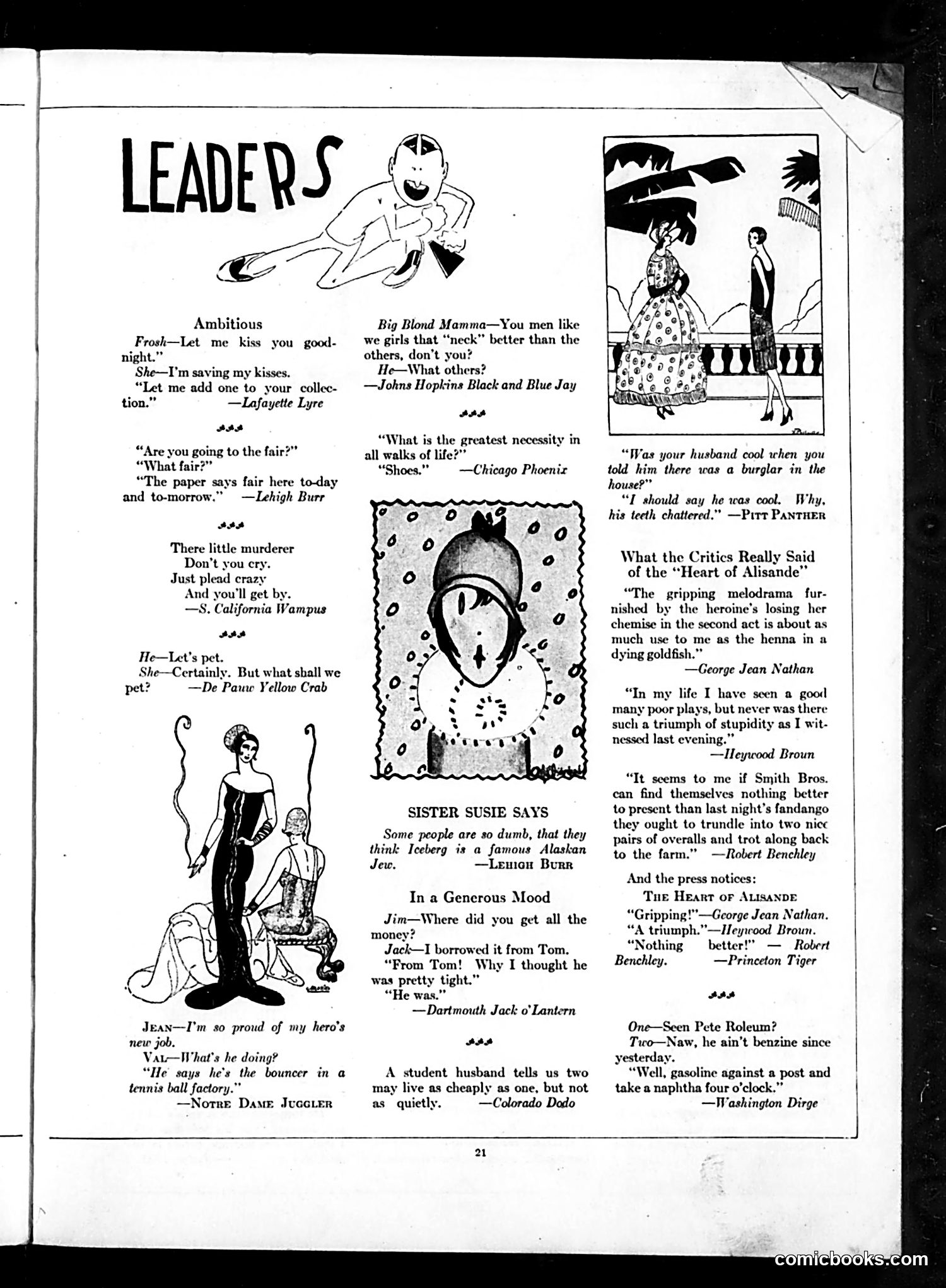
This page from *Judge* magazine collects humorous quotations and jokes from college newspapers, organized thematically under "Leaders." **Content:** The page features witty exchanges between college students on topics like dating ("necking"), borrowing money, and married life. Most jokes target 1920s social conventions—young men seeking physical affection ("Let me kiss you"), financial anxiety, and newlywed dynamics. **Key Sections:** - **"Sister Susie Says"**: A mockery of anti-Semitic stereotyping (calling someone ignorant for mistaking "Iceberg" as a famous "Alaskan Jew") - **Theater Criticism**: Brutal parodies of professional critics reviewing a play called "Heart of Alisande," mocking overwrought melodrama and sexual content - **College Humor**: The recurring joke structure—a setup followed by a punchline attributed to different universities—reflects 1920s campus culture where student publications competed with witty wordplay The cartoons (dancing flapper, masked figure) visualize the flirtatious college social scene. Overall, this is lightweight satirical content targeting youth culture, dating norms, and theatrical pretension typical of mid-century *Judge* magazine.
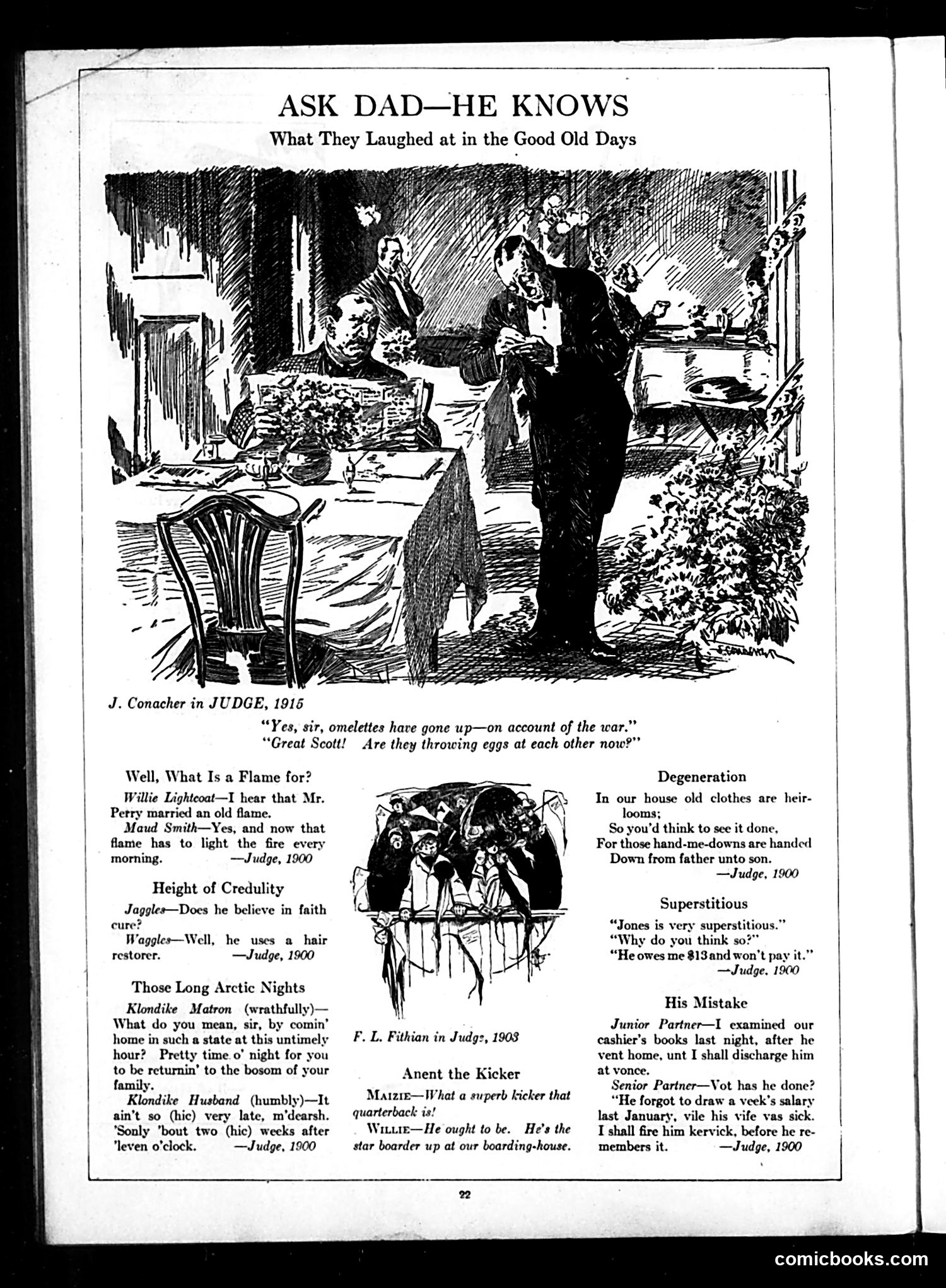
This page collects short jokes representing early 1900s American humor. The main cartoon by J. Conacher (1915) depicts a domestic scene where a man complains about wartime egg price increases; his companion misunderstands, joking that people are literally throwing eggs at each other—a pun on "eggs" as both food and projectiles. The surrounding jokes reflect period preoccupations: "Well, What Is a Flame for?" puns on "old flame" (romantic interest) becoming a literal fire-lighter; "Height of Credulity" jokes about gullible faith-cure believers; Arctic gold-rush humor references the Klondike; and pieces mock superstition and business inefficiency. The dialect jokes—particularly the senior partner's German accent—reveal casual ethnic stereotyping common to the era. Overall, this represents Judge's formula: genteel domestic humor, wordplay, and social observation aimed at middle-class readers nostalgic for "the good old days."
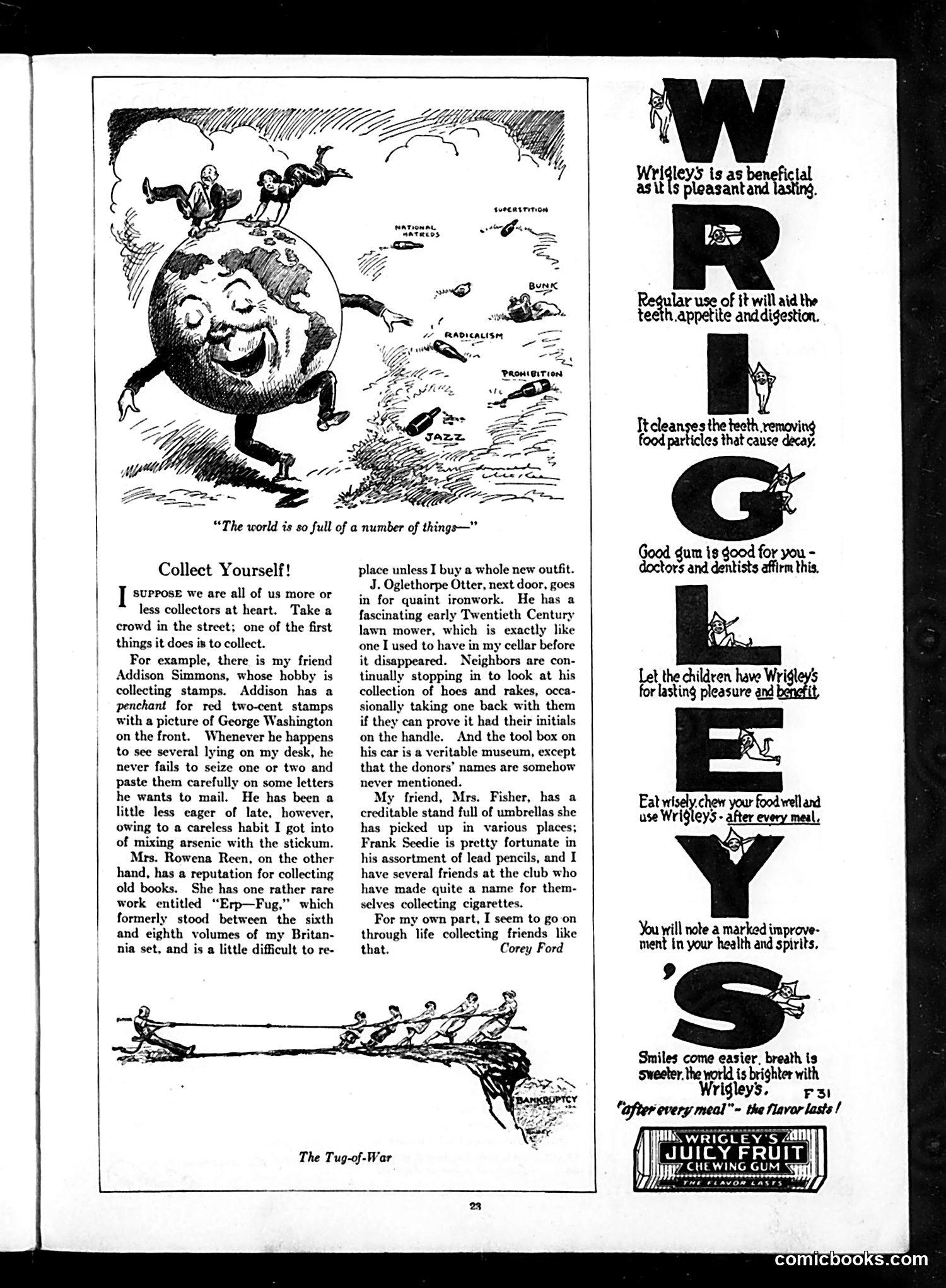
This page combines humor with advertising. The main article, "Collect Yourself!" by Corey Ford, is a light satirical essay about human collecting habits. Corey Ford humorously describes friends who obsessively collect stamps, books, tools, and umbrellas—but reveals the real joke: they're actually *stealing* from him. He casually mentions poisoning stamp glue with arsenic and a neighbor "borrowing" his lawn mower, treating theft as inevitable social behavior among collectors. The cartoon "The Tug-of-War" depicts an oversized, jovial face being pulled by small figures representing social ills labeled "Radicalism," "Prohibition," "Bunks," and "Jazz"—suggesting these 1920s anxieties are literally tearing at American society. The right side is a Wrigley's chewing gum advertisement using pseudo-health claims common to early 20th-century advertising (gum aids digestion, cleans teeth, improves mood). The "W-R-I-G-L-E-Y" vertical layout was typical period marketing.
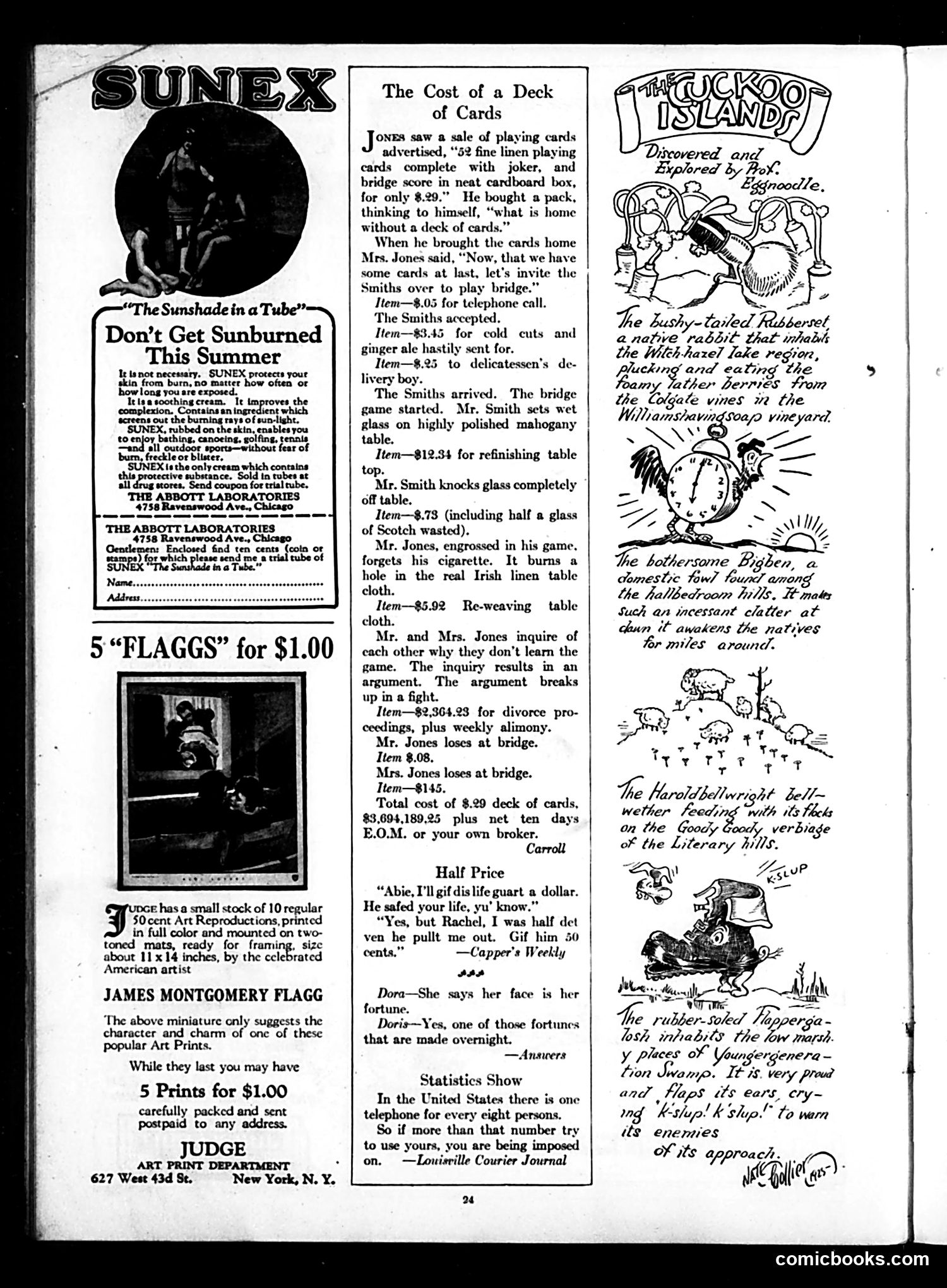
This page is primarily **advertising and humor content**, not political satire. The main feature, "The Cost of a Deck of Cards" by Carroll, is a **satirical joke about domestic life**. It humorously itemizes the actual expenses that result from buying a $0.29 deck of playing cards: the phone call to invite friends ($0.05), refreshments ($3.45), damage to furniture from wet glasses and cigarettes ($12.34 and $5.92), and ultimately a marital argument that escalates into divorce proceedings ($2,364.23 plus alimony). The punch line reveals the "$0.29 deck" ultimately costs $3,694,189.25—a commentary on how small indulgences can spiral into catastrophic expenses, particularly through marital conflict. The right side features "Cuckoo Island," a whimsical illustrated feature about fictional animals and their habits, resembling nature writing parody. The remaining content consists of advertisements for **Sunex sunscreen** and **James Montgomery Flagg art prints**, plus brief joke items ("Half Price," "Statistics Show") typical of Judge's format.
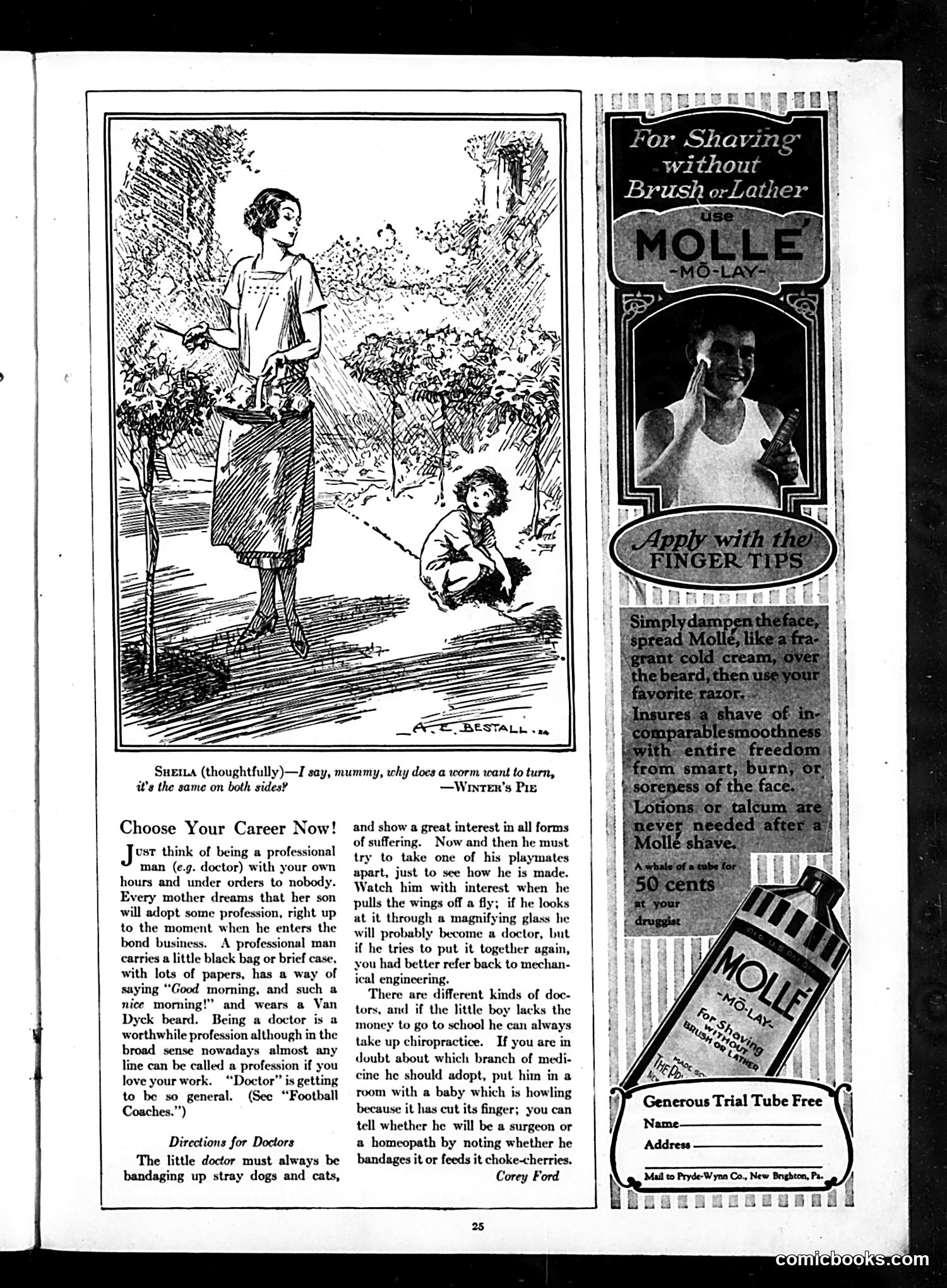
This page contains two unrelated items: **Left side:** A cartoon and humorous essay titled "Choose Your Career Now!" The cartoon shows a child asking his mother why a worm wants to turn when "it's the same on both sides"—a play on the phrase "the worm turns" (meaning the oppressed finally rebel). The essay satirizes the romanticization of professional careers, particularly medicine. It mocks how mothers dream their sons become doctors, and uses absurdist humor about determining if a child should be a doctor by observing whether he dismembers insects, pulls wings off flies, or can properly set a baby's injured finger. The satire targets both pretentious professionalism and questionable child-rearing practices of the era. **Right side:** An advertisement for "Mollé" shaving cream, offering a free trial tube. This is straightforward product marketing with no satirical content. The page demonstrates Judge's typical mix of social commentary and commercial advertising.
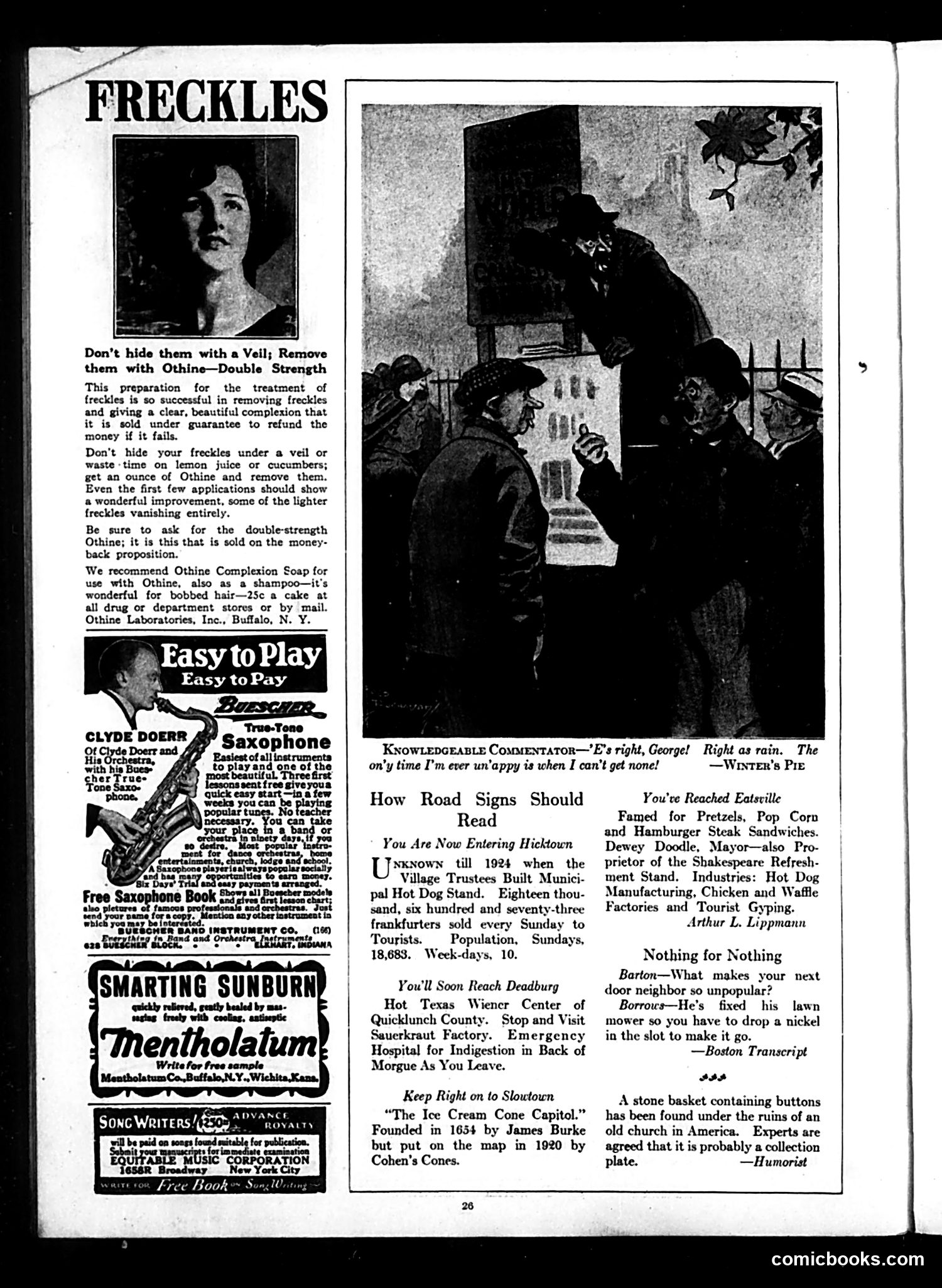
This page is primarily **advertising** with sidebar humor pieces. The main satirical content includes: **"How Road Signs Should Read"** mocks small-town America's commercialism, imagining highway signs that advertise local businesses rather than providing actual directions. Towns are renamed after their dominant products ("Hicktown" = hot dog stand, "Eatsville" = various food vendors, "Sloutown" = ice cream cones). The satire targets both small-town economic desperation and the rise of roadside tourist attractions in the 1920s automobile era. **Minor humor pieces** at bottom mock everyday situations: a neighbor charging coins to use his lawn mower, and a fake archaeological discovery suggesting church collection plates were stone buttons. The **dominant content** is product advertising: Othine freckle cream (with racist/colorist undertones about "clear, beautiful complexion"), Mentholatum sunburn treatment, and a saxophone correspondence course. These ads reflect 1920s beauty standards and consumer culture targeting insecurity.
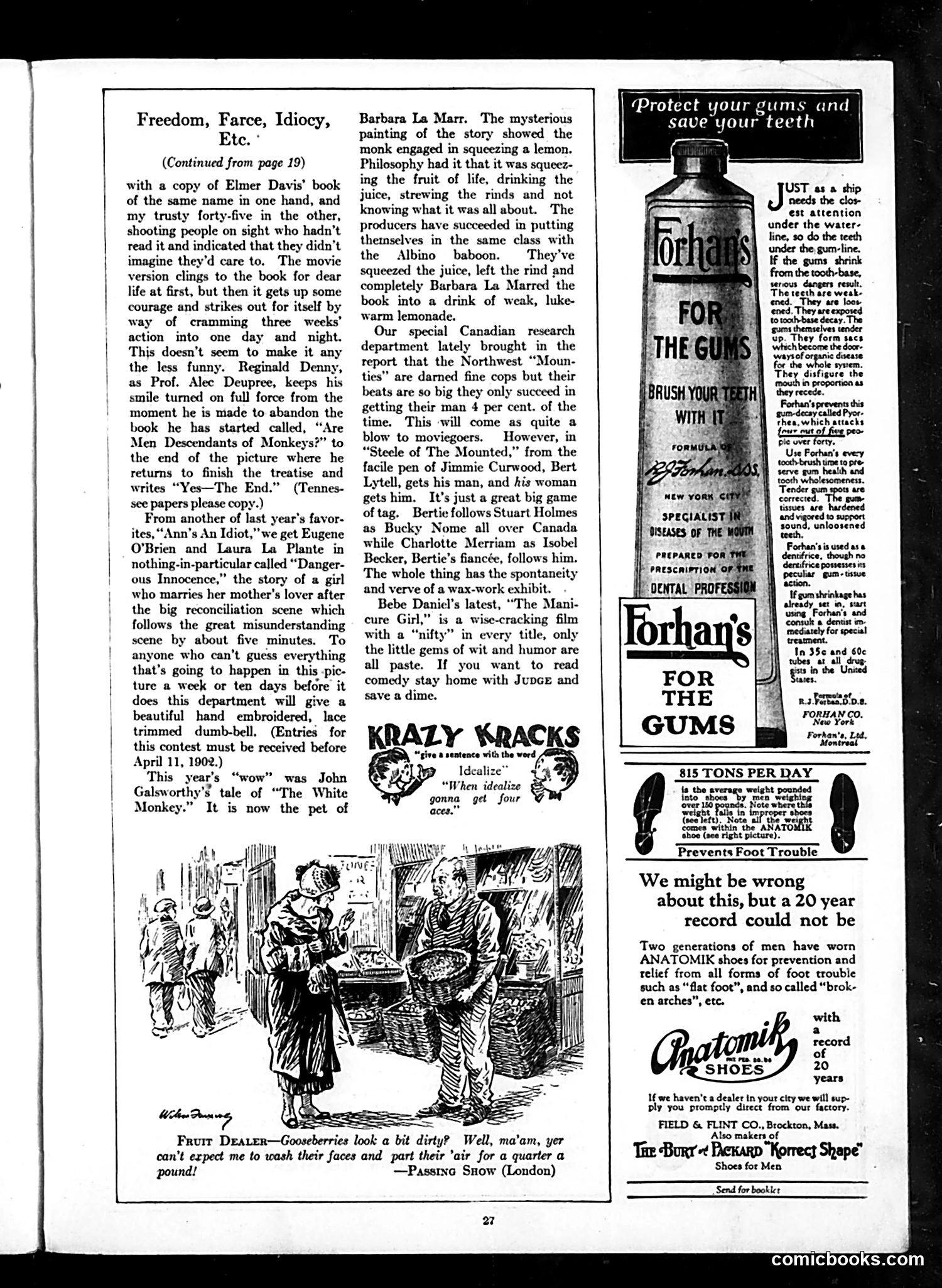
This page primarily contains a humorous film criticism column reviewing recent movies, with scattered advertisements. The reviewer criticizes several films for straying from or mishandling their source material. **Key critiques:** *"Dangerous Innocence"* and *"Ann's An Idiot"* are mocked as predictable melodramas; *"The White Monkey"* (adapted from John Galsworthy) is sarcastically compared to a squeezed lemon—producers have extracted entertainment value but ruined the philosophical content, leaving only "weak, lukewarm lemonade." The reviewer jokes that anyone who can't predict the plot deserves a "dumb-bell." *"Steele of The Mounted"* is criticized for its repetitive tag-game structure and lifelessness ("verve of a wax-work"). *"The Manicure Girl"* is dismissed as all paste without genuine wit. The cartoons include a short joke about idealization and a social humor piece about fruit cleanliness. The advertisements promote dental and foot care products typical of the era.
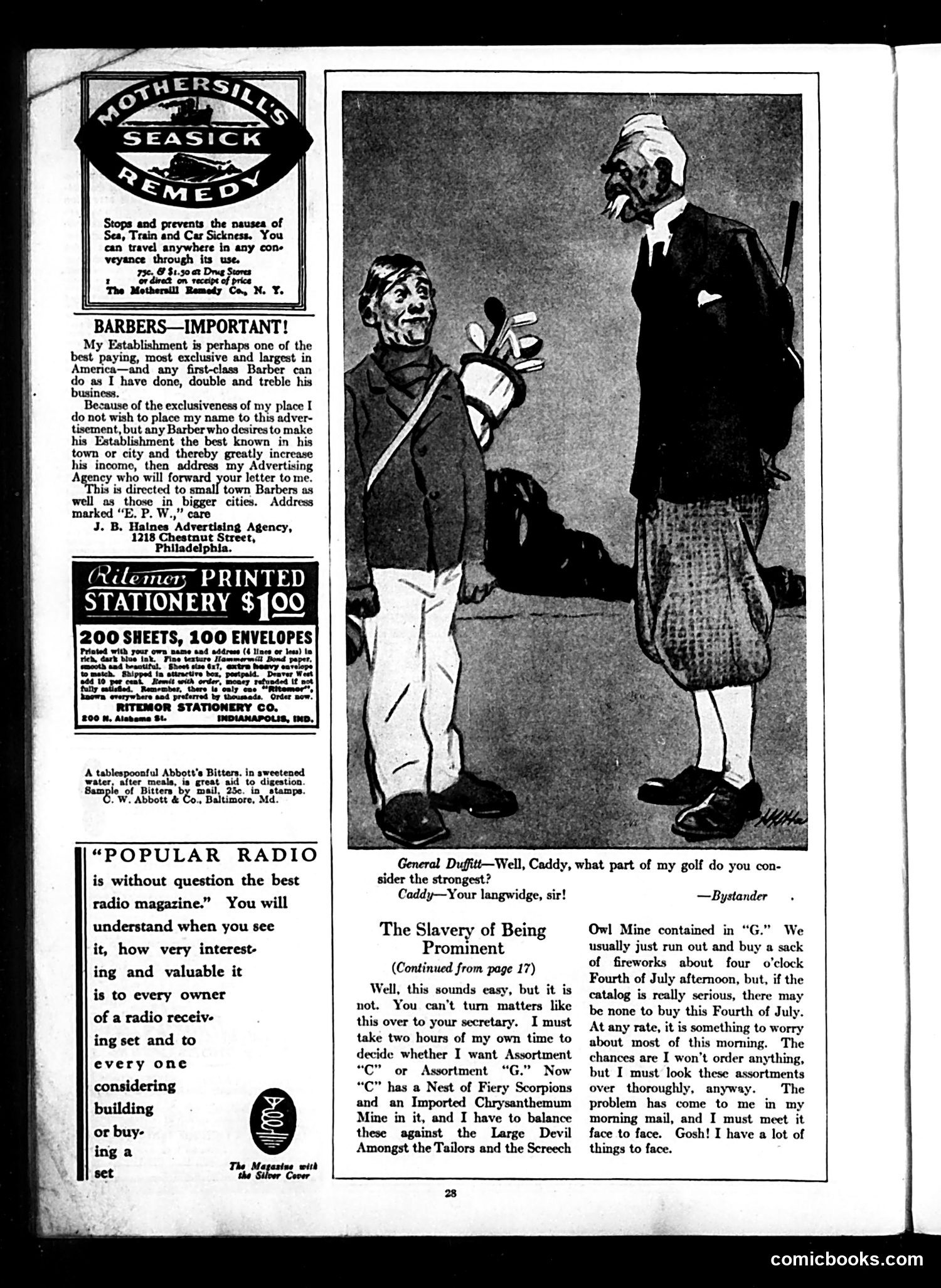
This page contains primarily **advertisements and humor pieces** rather than political satire. The main cartoon depicts a golf scene: a well-dressed gentleman asks his caddy what part of his golf game is strongest. The caddy's reply—"Your langwidge, sir!"—is a class-based joke about the gentleman's profane language during play. The humor relies on the caddy's deferential but pointed observation of his employer's poor conduct. The page also includes: - An anonymous barber recruitment ad promising business success - Product advertisements (stationery, bitters, radio magazine) - A humorous essay titled "The Slavery of Being Prominent" about the tedious burden of choosing fireworks assortments for the Fourth of July The overall tone is lighthearted social commentary on American business and leisure culture, typical of Judge's satirical approach to contemporary life rather than political critique.
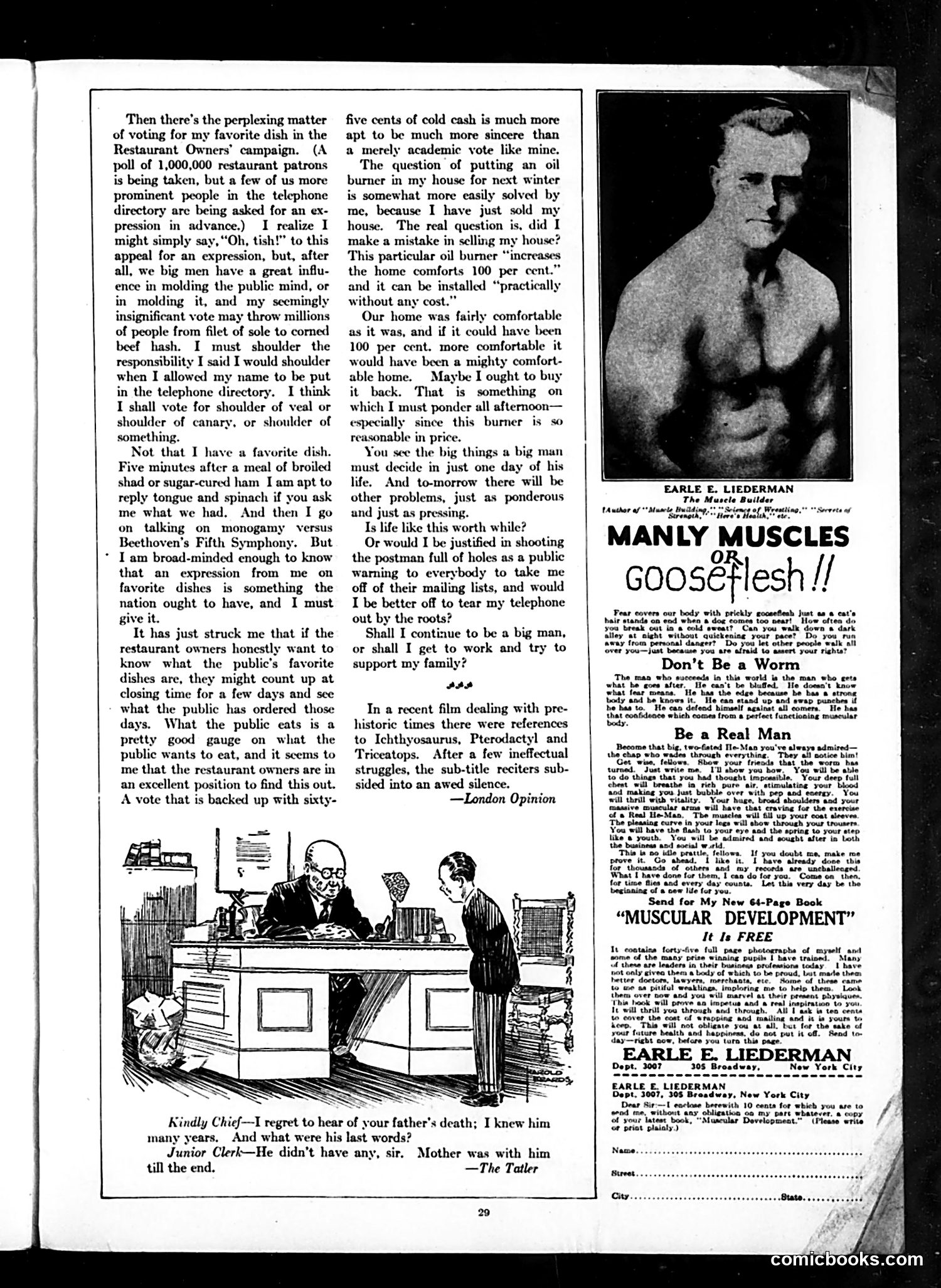
This page satirizes the vanity and self-importance of ordinary people elevated by minor public recognition. The main article mocks a man asked to vote on his "favorite dish" in a Restaurant Owners' campaign poll. The author pretends this inconsequential choice carries enormous weight—he's been added to a telephone directory, so he imagines his vote will sway millions away from filet of sole toward corned beef hash. The satire is sharp: he admits he has no actual favorite dish and forgets meals minutes after eating, yet treats his opinion as a civic responsibility. He then juxtaposes this triviality with an equally pointless dilemma about buying an oil burner for a house he's just sold, asking absurdly whether life is worth living. The cartoon at bottom shows a businessman at a desk, likely representing this inflated sense of importance. The right side contains unrelated advertisement copy for Charles Atlas-style "muscular development" mail courses—typical Judge advertisements mixing satire with commercial content.
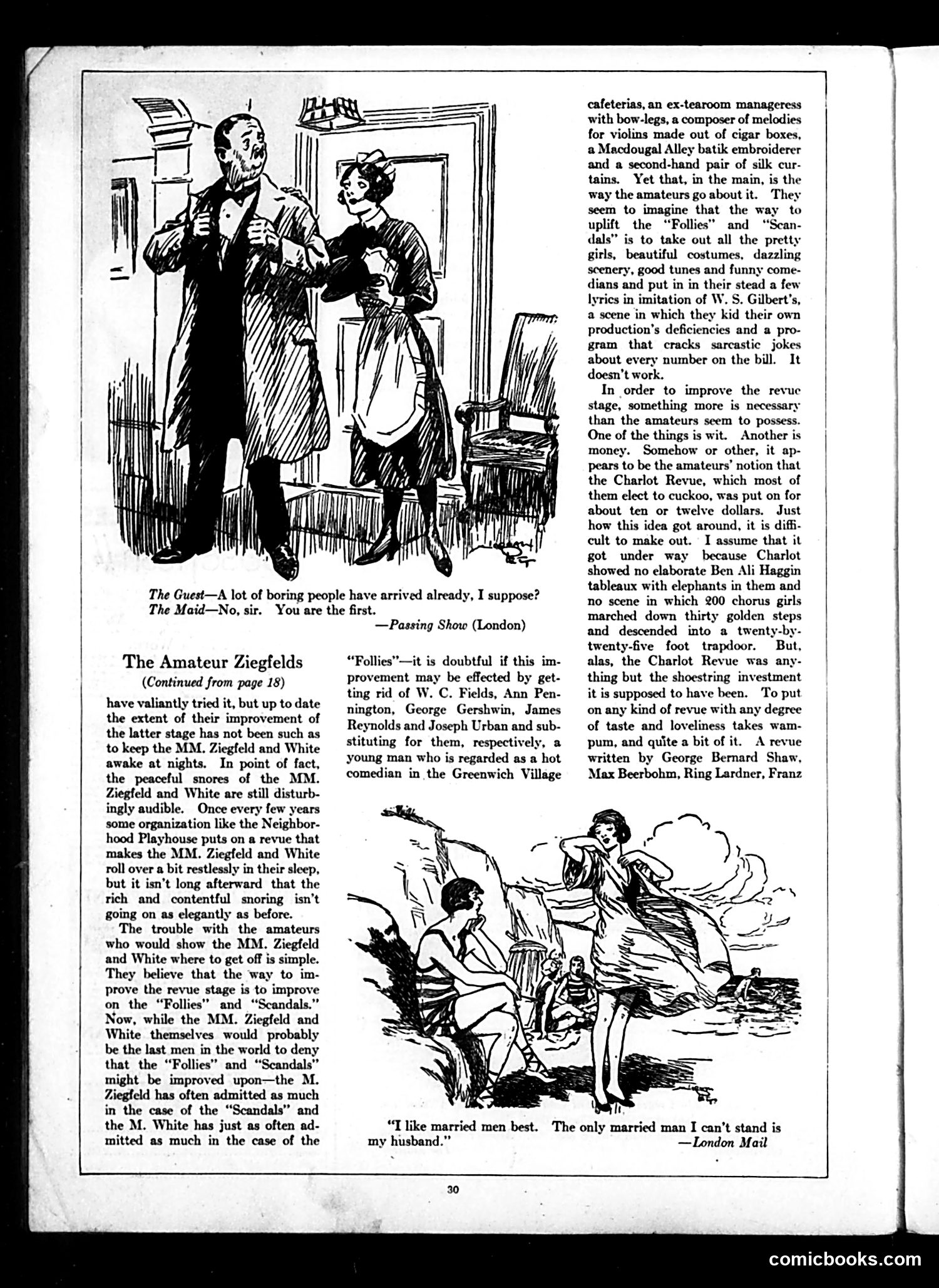
This article satirizes amateur theatrical groups attempting to create Broadway-quality revues by competing with the established producers Florenz Ziegfeld and Bert Williams (the "MM. Ziegfeld and White"). The satire targets amateur theater's fundamental misunderstanding: they believe replacing professional performers—W.C. Fields, Ann Pennington, George Gershwin, and designer Joseph Urban—with cheaper Greenwich Village talent (amateur comedians, ex-tearoom workers, cigar-box violin composers) will improve revues. The author argues this fails because professional revues require substantial funding and genuine artistic talent, not budget shortcuts. The article references the "Charlot Revue" as an example of quality theater mistakenly thought to be cheaply produced. It concludes that successful revues need established writers (George Bernard Shaw, Max Beerbohm, Ring Lardner) and genuine resources—"wampum" (money). The cartoons illustrate the pretentiousness and incompetence of amateur productions, mocking their delusions of theatrical success.
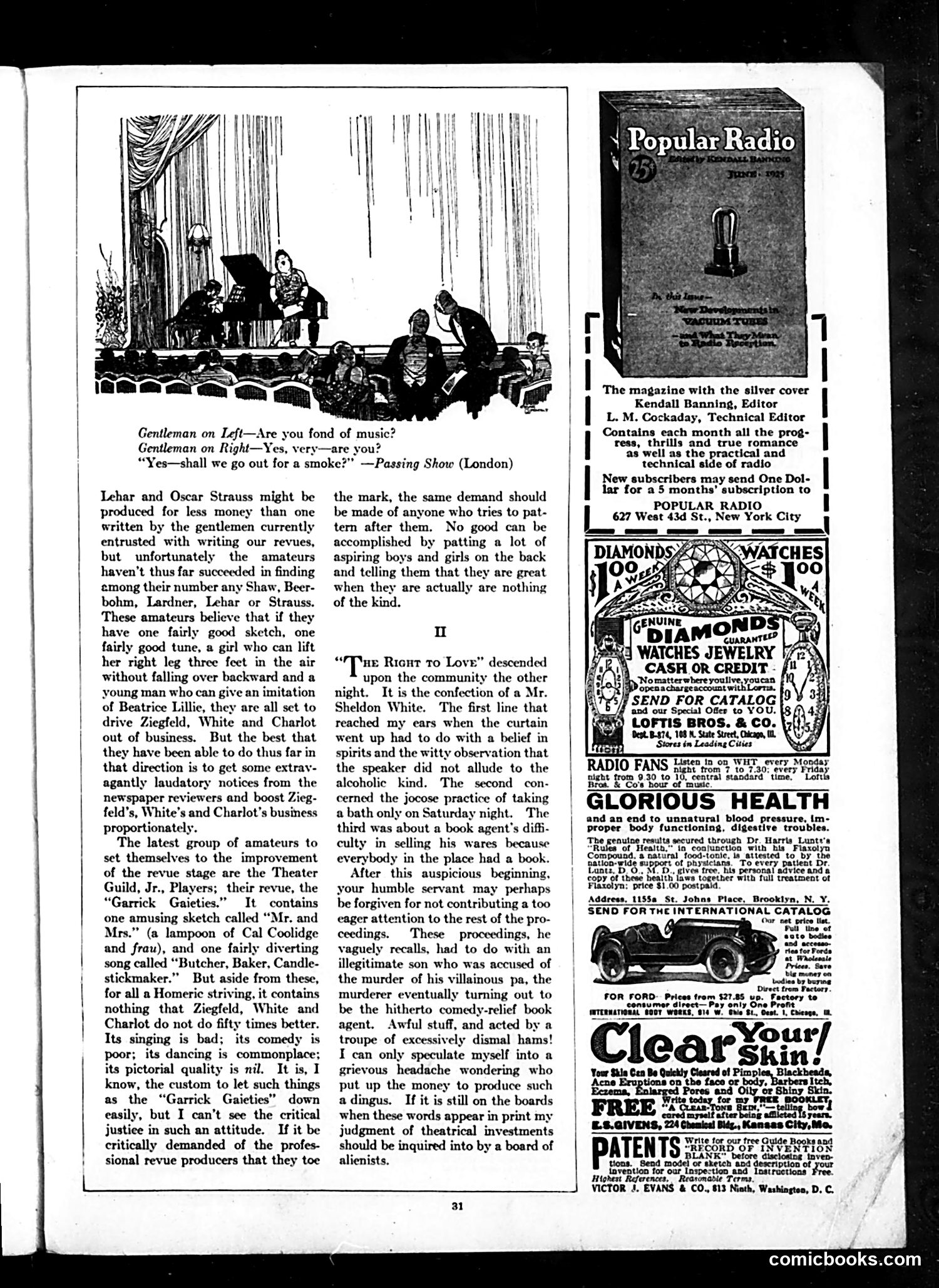
The main cartoon shows two gentlemen leaving a concert, with one asking if they're fond of music and suggesting they go out for a smoke instead. The joke is simple: they claim to like music but immediately want to leave—suggesting the actual performance was tedious. The text discusses amateur theatrical productions, particularly criticizing the "Garrick Gaieties" by Theater Guild, Jr. The author argues that small productions shouldn't receive favorable reviews just for effort, comparing them unfavorably to professional revues by Ziegfeld, White, and Charlot. He also pans "The Right to Love" for being poorly written and performed, questioning why anyone funded such a "dingus." The page is mostly advertisements (Popular Radio magazine, diamond watches, health tonic, Ford automobiles, patent services) with critical theater commentary. The satire reflects 1920s theater culture rivalries and standards.
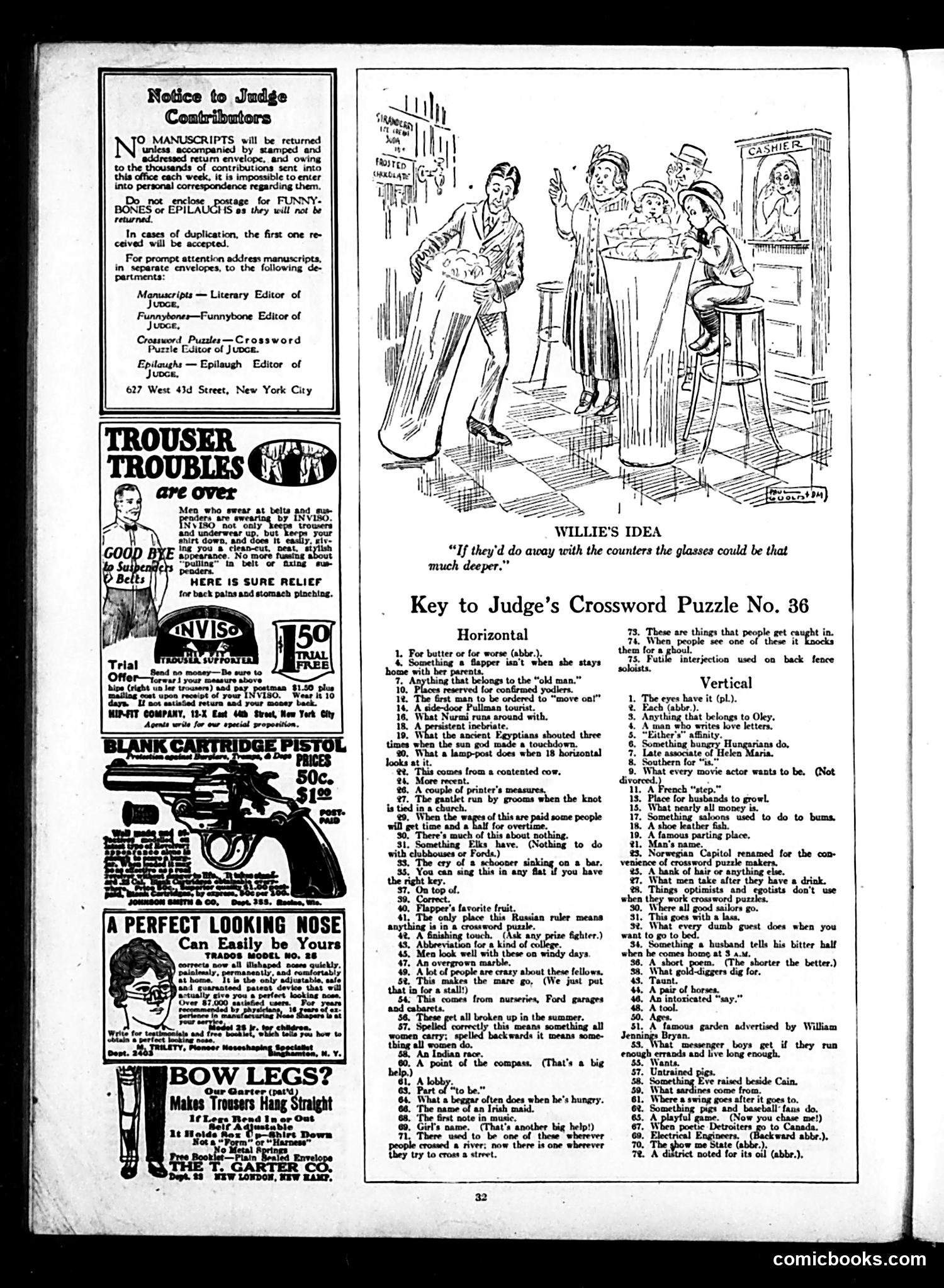
This page is primarily **advertisements and puzzle content**, not political satire. The main cartoon, titled "Willie's Idea," depicts a child suggesting that removing counters from a drinking glass would make it "much deeper"—a simple joke about childish logic. The page's substance consists of: 1. **Submission guidelines** for Judge magazine's various sections (manuscripts, puzzles, humor submissions) 2. **Period advertisements** for common early 20th-century products: trouser supports, nose-correcting devices, and leg straighteners—reflecting contemporary anxieties about appearance and body modification 3. **A crossword puzzle and its answer key** (Puzzle No. 36) There is **no evident political satire or historical reference requiring context**. The content reflects typical magazine filler and commercial advertising of the era rather than commentary on events or figures.
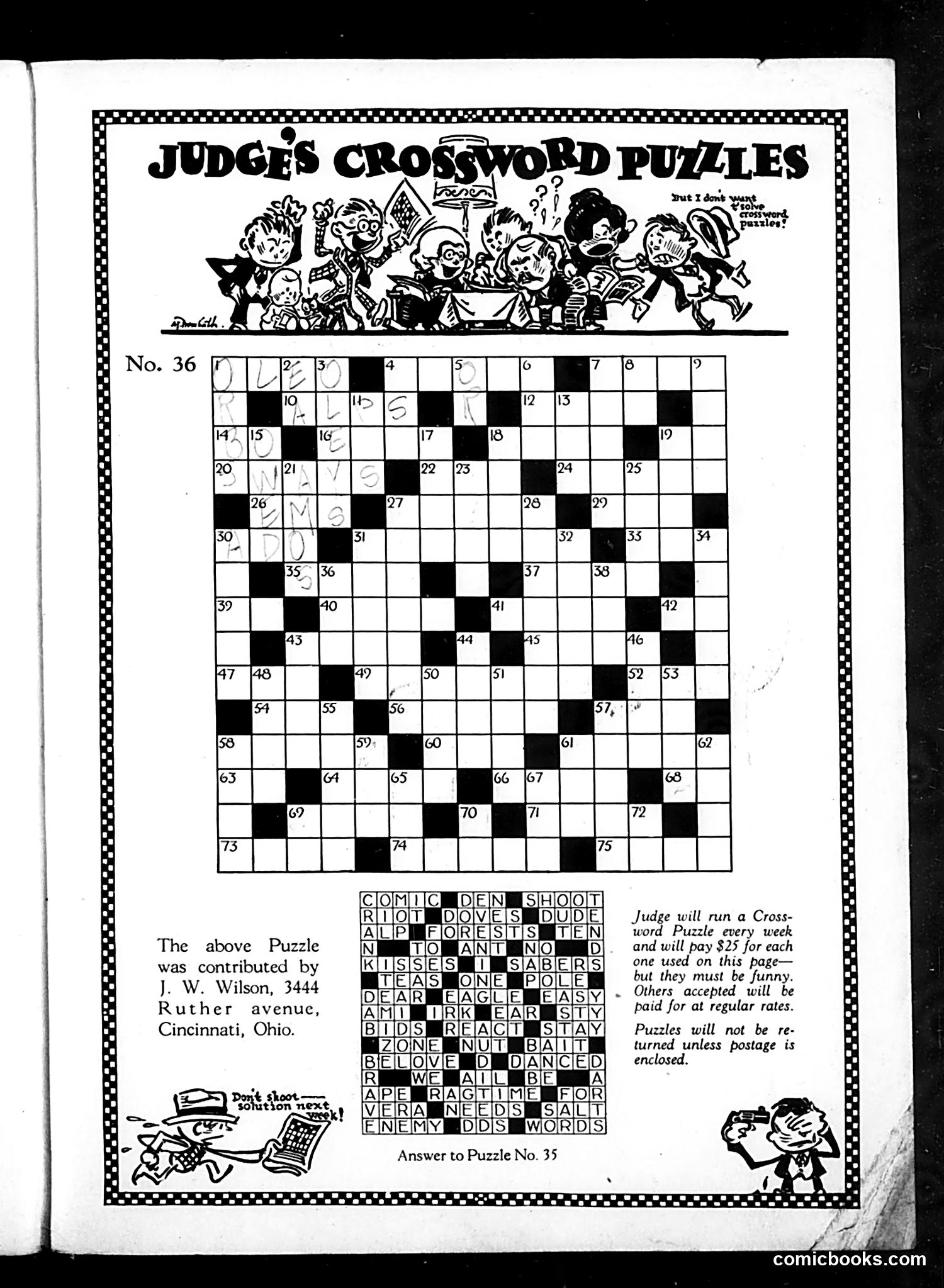
This page contains **Judge's crossword puzzle No. 36**, contributed by a reader from Cincinnati. The puzzle itself is standard grid format, but the answers shown below—including "COMIC," "DEN," "SHOOT," "DOVES," "DUDE," "KISSES," "SABERS"—suggest humor-themed clues typical of Judge magazine's satirical approach. The header illustration shows cartoonish figures in playful poses, establishing the puzzle's lighthearted tone. The page announces Judge will publish weekly crossword puzzles, paying $25 for funny submissions (a substantial sum in this era). This represents Judge's adaptation to the 1930s crossword puzzle craze, monetizing reader participation while maintaining the magazine's humorous brand. The cartoon mascot at bottom reinforces this entertainment focus.
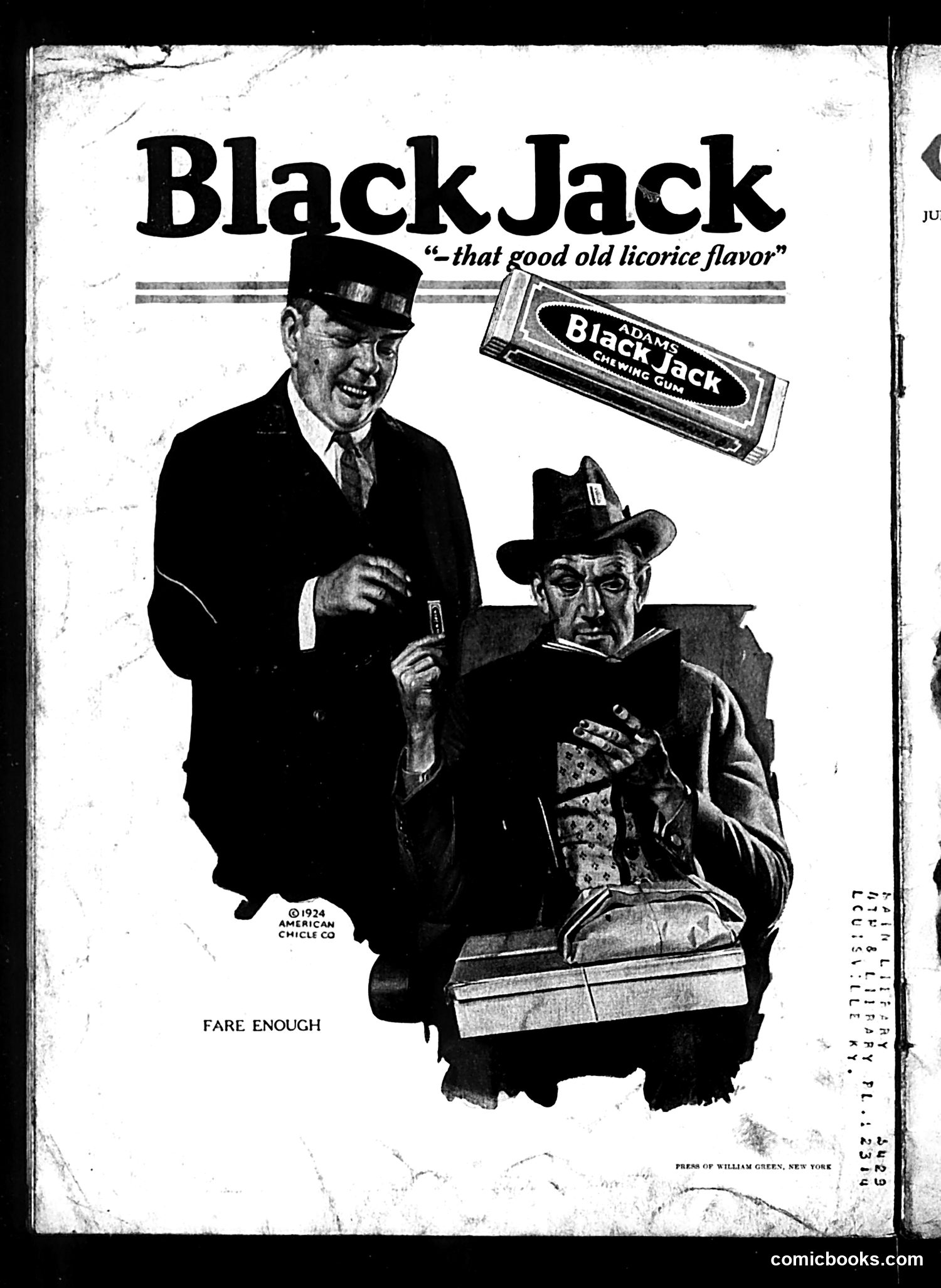
This is a 1924 advertisement for Black Jack chewing gum by American Chicle Co., rather than political satire. The ad depicts two men in a comedic scenario: a tall man in a porter's or conductor's uniform appears to be collecting or inspecting something from a shorter man dressed as a cowboy or rural figure. The tagline reads "Fare Enough," a pun on "fair enough." The humor relies on the visual contrast between the two figures and the wordplay in the headline. The product itself—Black Jack chewing gum with "that good old licorice flavor"—is prominently displayed. This represents typical early 20th-century advertising that used character types and visual gags to sell consumer products to the general public.