
Judge, 1925-07-04 · page 32 of 36
Judge — July 4, 1925 — page 32: what you’re looking at
What you’re looking at
This article satirizes amateur theatrical groups attempting to create Broadway-quality revues by competing with the established producers Florenz Ziegfeld and Bert Williams (the "MM. Ziegfeld and White"). The satire targets amateur theater's fundamental misunderstanding: they believe replacing professional performers—W.C. Fields, Ann Pennington, George Gershwin, and designer Joseph Urban—with cheaper Greenwich Village talent (amateur comedians, ex-tearoom workers, cigar-box violin composers) will improve revues. The author argues this fails because professional revues require substantial funding and genuine artistic talent, not budget shortcuts. The article references the "Charlot Revue" as an example of quality theater mistakenly thought to be cheaply produced. It concludes that successful revues need established writers (George Bernard Shaw, Max Beerbohm, Ring Lardner) and genuine resources—"wampum" (money). The cartoons illustrate the pretentiousness and incompetence of amateur productions, mocking their delusions of theatrical success.
📄 Transcribed text from this page (OCR, searchable)
Machine-transcribed from the original scan — historical spelling and the odd misread are preserved.
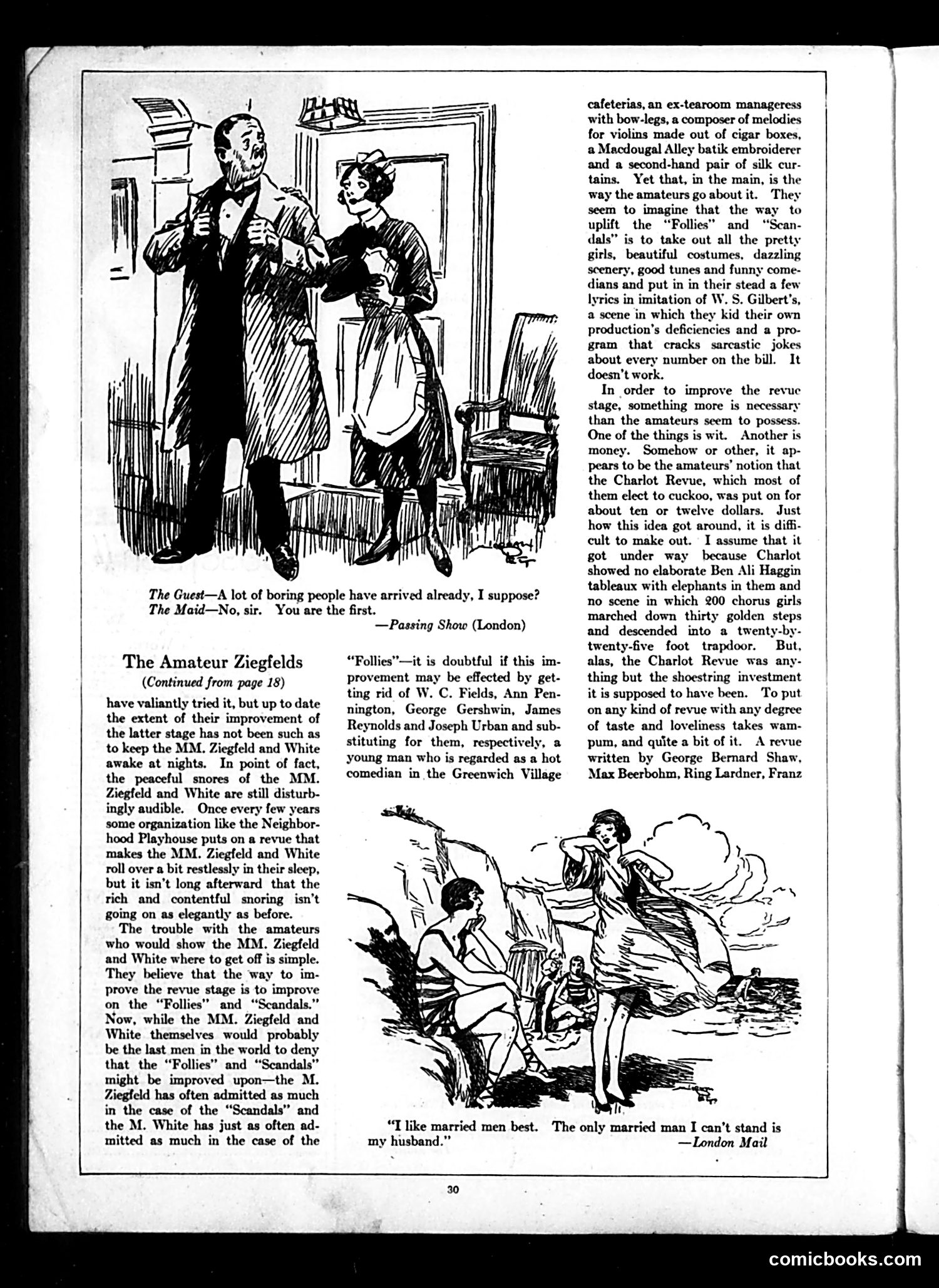
The Maid—No, sir. The Amateur Ziegfelds (Continued from page 18) have valiantly tried it, but up to date the extent of their improvement of the latter stage has not been such as to keep the MM. Ziegfeld and White awake at nights. In point of fact, the peaceful snores of the MM. Ziegfeld and White are still disturb- ingly audible. Once every few years some organization like the Neighbor- hood Playhouse puts on a revue that makes the MM. Ziegfeld and White roll over a bit restlessly in their sleep, but it isn’t long afterward that the rich and contentful snoring isn’t going on as elegantly as before. The trouble with the amateurs who would show the MM. Ziegfeld and White where to get off is simple. They believe that the way to im- prove the revue stage is to improve on the “Follies” and “Scandals.” Now, while the MM. Ziegfeld and White themselves would probably be the last men in the world to deny that the “Follies” and “Scandals” might be improved upon—the M. Ziegfeld has often admitted as much in the case of the “Scandals” and the M. White has just as often ad- mitted as much in the case of the my husband.” The Guest—A lot of boring people have arrived already, I suppose? You are the first. —Passing Show (London) “Follies”—it is doubtful if this im- provement may be effected by get- ting rid of W. C. Fields, Ann Pen- nington, George Gershwin, James Reynolds and Joseph Urban and sub- stituting for them, respectively, a young man who is regarded as a hot comedian in the Greenwich Village = cafeterias, an ex-tearoom manageress | with bow-legs, a composer of melodies for violins made out of cigar boxes, a Macdougal Alley batik embroiderer and a second-hand pair of silk cur- tains. Yet that, in the main, is the way the amateurs go about it. They seem to imagine that the way to uplift the “Follies” and ‘“Scan- dals” is to take out all the pretty girls, beautiful costumes, dazzling scenery, good tunes and funny come- | dians and put in in their stead a few | lyrics in imitation of W. S. Gilbert's, a scene in which they kid their own production's deficiencies and a pro- gram that cracks sarcastic jokes about every number on the bill. It doesn’t work. In order to improve the revue stage, something more is necessary than the amateurs seem to possess. One of the things is wit. Another is money. Somehow or other, it ap- pears to be the amateurs’ notion that the Charlot Revue, which most of them elect to cuckoo, was put on for about ten or twelve dollars. Just how this idea got around, it is diffi- cult to make out. I assume that it got under way because Charlot showed no elaborate Ben Ali Haggin tableaux with elephants in them and no scene in which 200 chorus girls marched down thirty golden steps and descended into a twenty-by- | twenty-five foot trapdoor. But, | alas, the Charlot Revue was any- thing but the shoestring investment it is supposed to have been. To put on any kind of revue with any degree of taste and loveliness takes wam- | pum, and quite a bit of it. Arevue | written by George Bernard Shaw, Max Beerbohm, Ring Lardner, Franz “T like married men best. The only married man I can't stand is —London Mail 30 comicbooks.com