
A complete issue · 36 pages · 1925
Judge — May 23, 1925
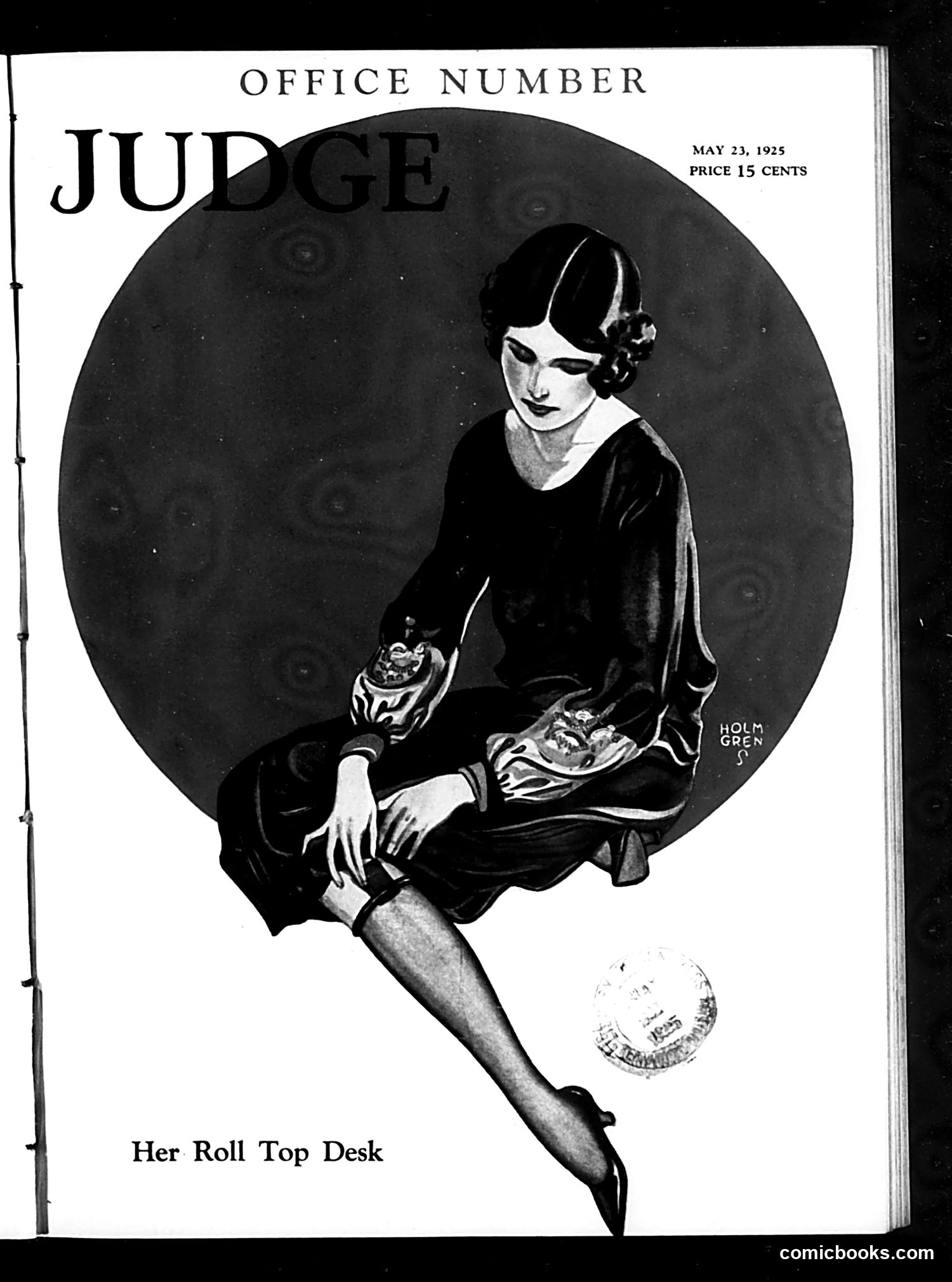
This cover illustrates "Her Roll Top Desk," showing a stylishly dressed woman of the 1920s seated at work. The image satirizes the modern working woman—a relatively recent social phenomenon in the 1920s. Her fashionable cloche hat, bobbed hair, and sophisticated pose suggest the "New Woman" of the Jazz Age who increasingly entered the workforce. The satire likely mocks either the pretensions of female office workers or critiques workplace dynamics. The roll-top desk (a standard office fixture) paired with her elegant presentation suggests tension between professional ambition and feminine style—a common comedic theme when women's workplace participation was still novel and socially contentious. The cartoon reflects 1920s anxieties about changing gender roles.
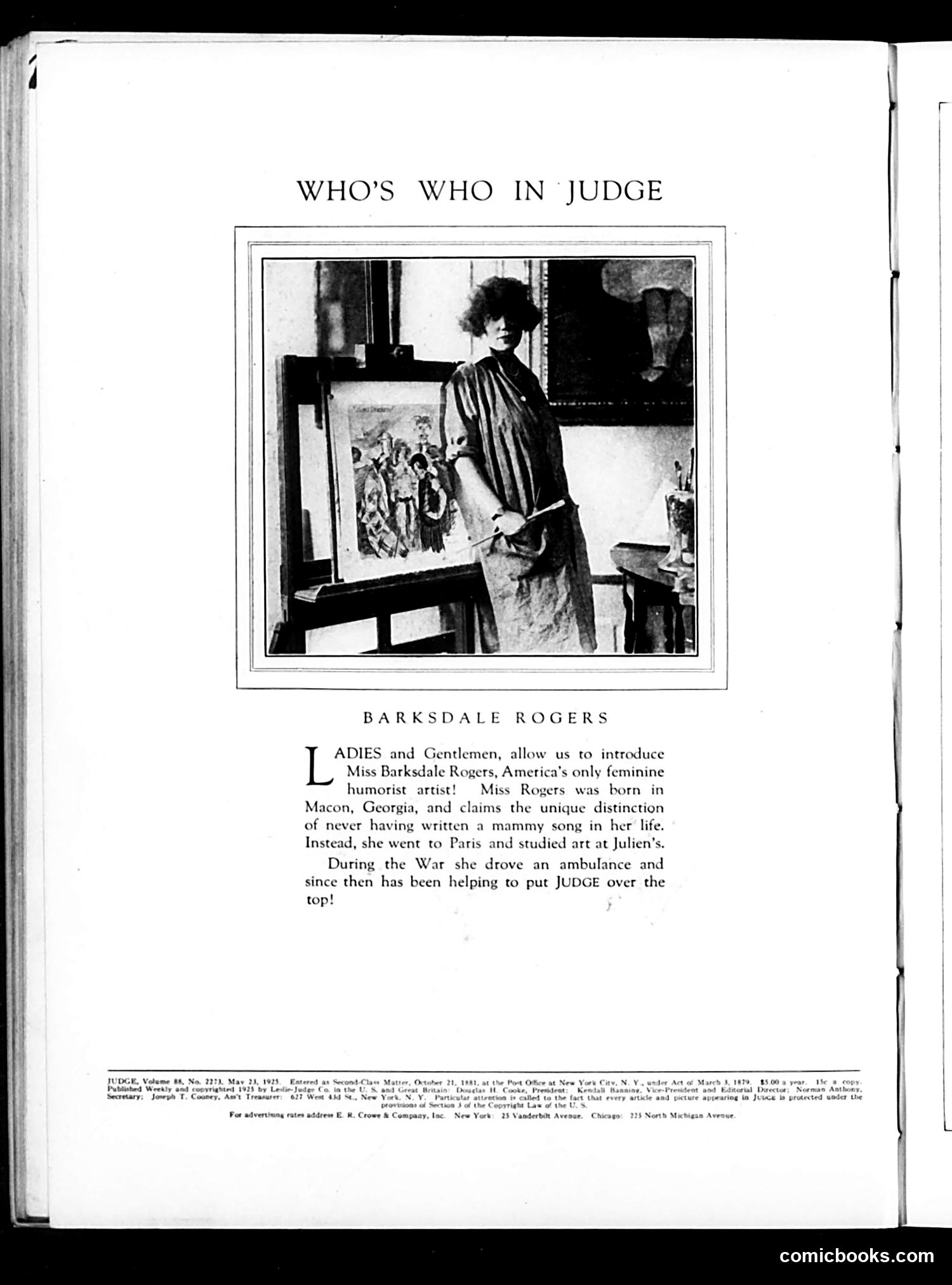
This page introduces Barksdale Rogers, described as "America's only feminine humorist artist." The text emphasizes her unusual status as a woman working in a male-dominated field—she's notably never written a "mammy song," studied art in Paris at Julien's academy, and drove an ambulance during World War I. The cartoon shows Rogers at an easel, paintbrush in hand, displaying her work. The "Judge" reference suggests she's been contributing to the magazine's artistic output. The piece celebrates her professional accomplishments while the somewhat patronizing tone ("Ladies and Gentlemen, allow us to introduce") reflects early-20th-century attitudes toward women in creative professions, treating her gender as her primary distinguishing characteristic rather than her artistic merit alone.
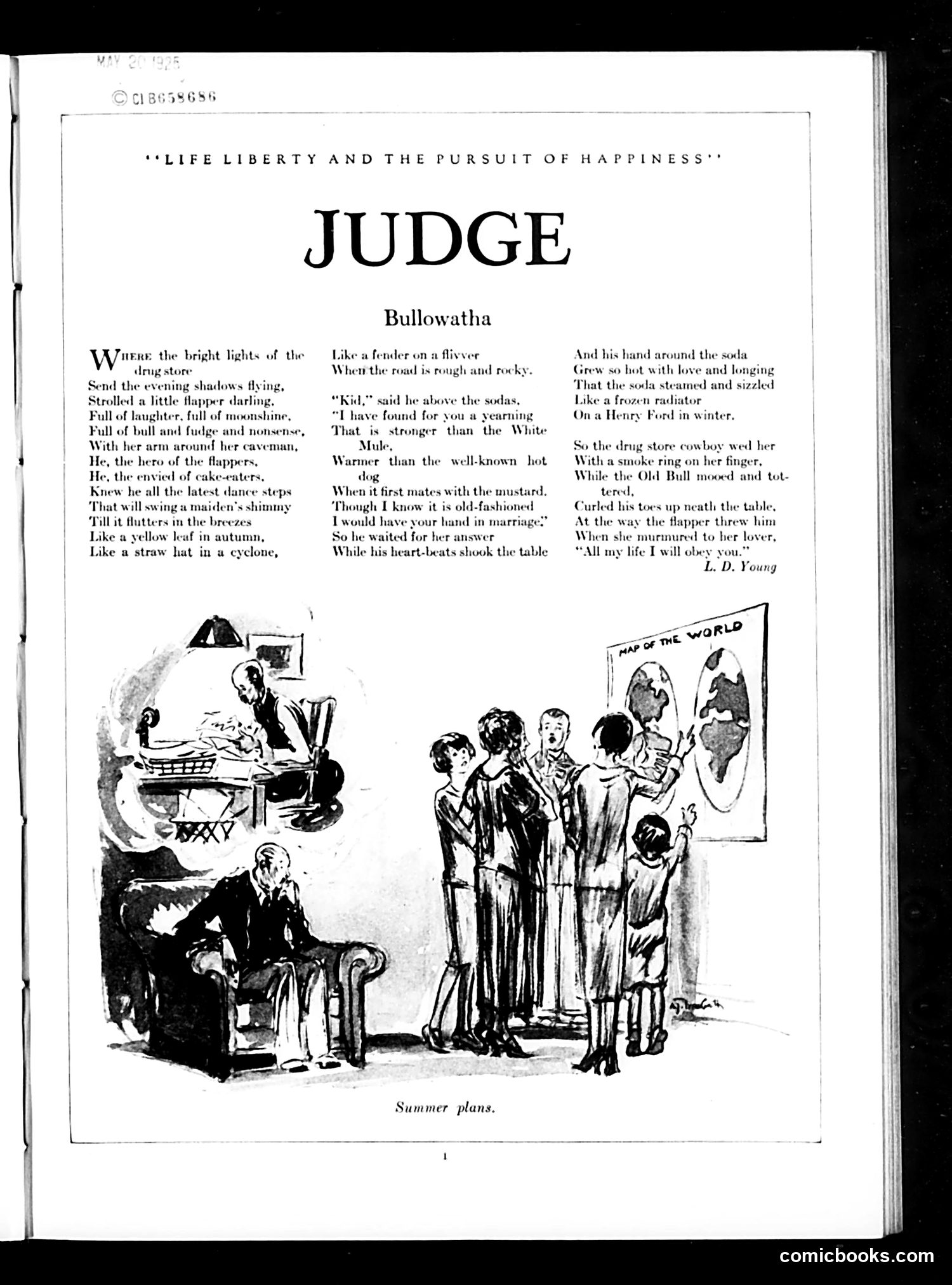
This page features a poem titled "Judge" by L.D. Young, paired with two cartoon vignettes illustrating contrasting summer scenarios. The left cartoon shows a drug store scene with a flapper and her boyfriend in an intimate moment—likely satirizing modern youth culture and casual dating practices of the 1920s era. The right cartoon depicts a family group studying a world map, representing traditional, educational summer planning. The juxtaposition appears to mock generational differences: the satiric contrast between "modern" youth indulgence (the drug store romance) versus conventional family values (geographic education). The poem's references to flappers, "Old Bull" cars, and romance reflect Judge magazine's typical critique of Jazz Age social changes through humorous comparison of old and new behaviors.
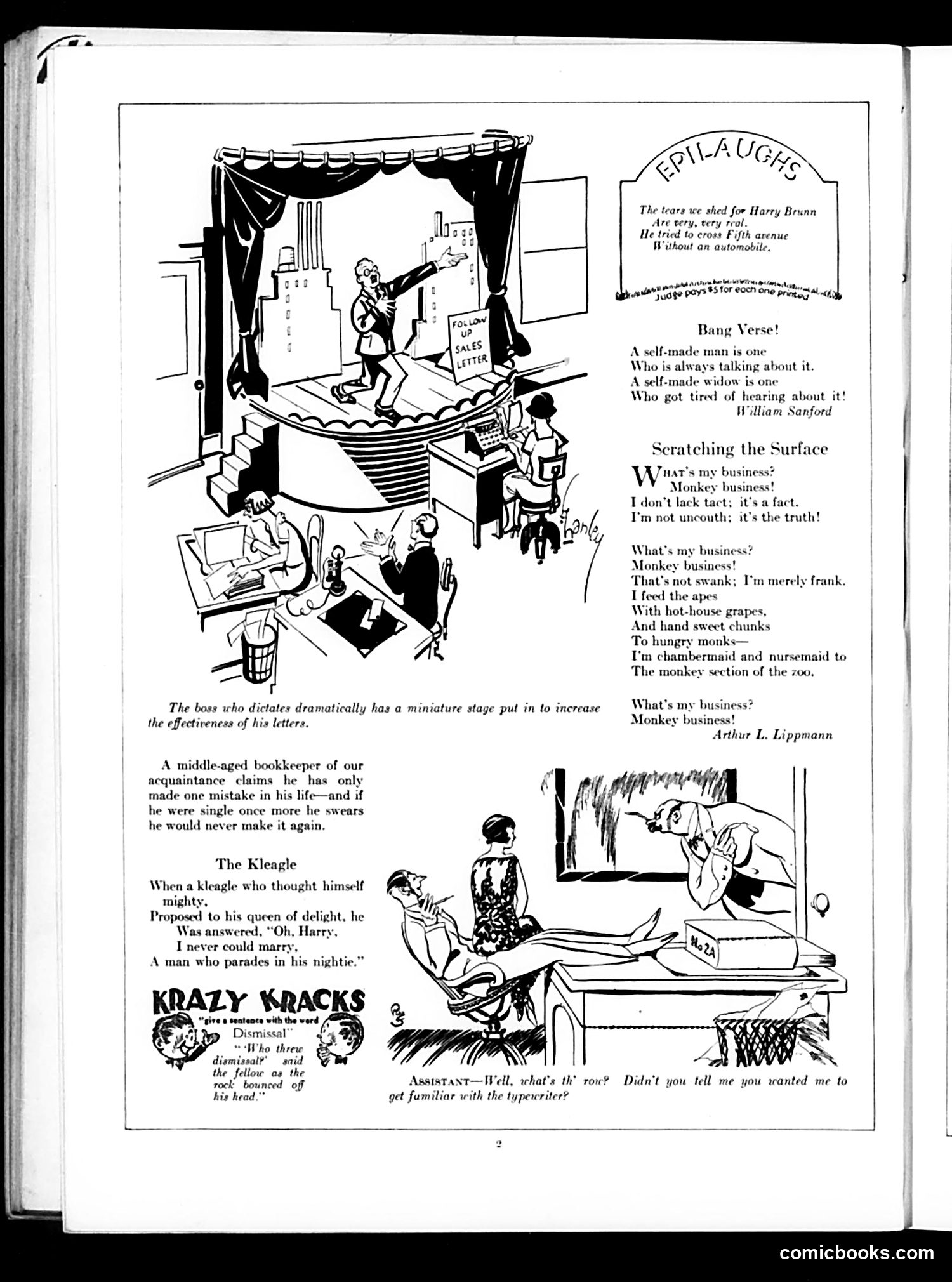
This page from *Judge* magazine contains several humor pieces rather than political cartoons: **Top illustration**: Satirizes theatrical pretension—a boss with a miniature stage setup dramatizes his business letters, mocking inflated self-importance in corporate culture. **"Bang Verse!" and "Scratching the Surface"**: Humorous poems about self-made men and "monkey business" (a phrase meaning dishonest dealings), poking fun at business bluster and pretense. **"The Kleagle"**: A brief verse about a man named Harry who wouldn't marry, suggesting he "parades in his nightie"—likely mocking someone's eccentric behavior. **Bottom cartoon**: Office humor about workplace familiarity—an assistant questions a coworker's casual relationship with a typewriter. **"Krazy Kracks"**: A joke section with wordplay ("Dismissal...all in three words..."). The page emphasizes early-20th-century American workplace and social satire, targeting pretension and office absurdities.
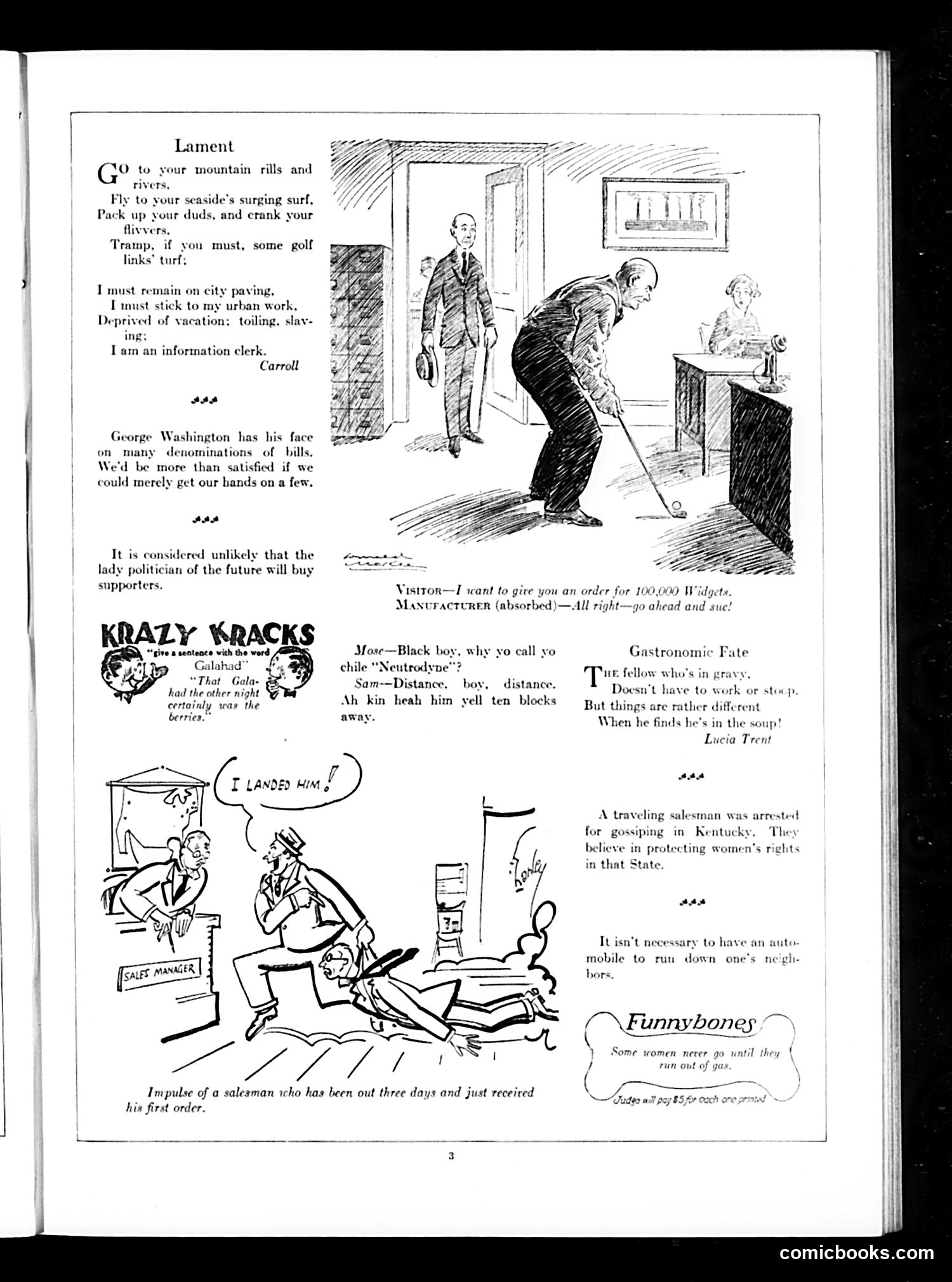
This page contains several satirical pieces lampooning urban life and contemporary politics: **"Lament"** (Carroll poem): Mocks a city clerk trapped in monotonous office work, envying those escaping to nature—reflecting early 20th-century anxieties about industrialization and desk jobs. **Main cartoon**: Shows a man golfing indoors while a businessman and secretary watch. The caption jokes about a manufacturer ordering 100,000 widgets, satirizing absurd salesmanship and business culture's disconnect from reality. **"Krazy Kracks"**: Ethnic humor featuring dialect, typical of period publications. **Other brief items**: Mock political observations (George Washington on currency, women politicians) and a joke about salesmen's luck. The page reflects era-specific concerns about modern work, commercialism, and social change, presented through period-appropriate (if now-offensive) stereotypes and humor.
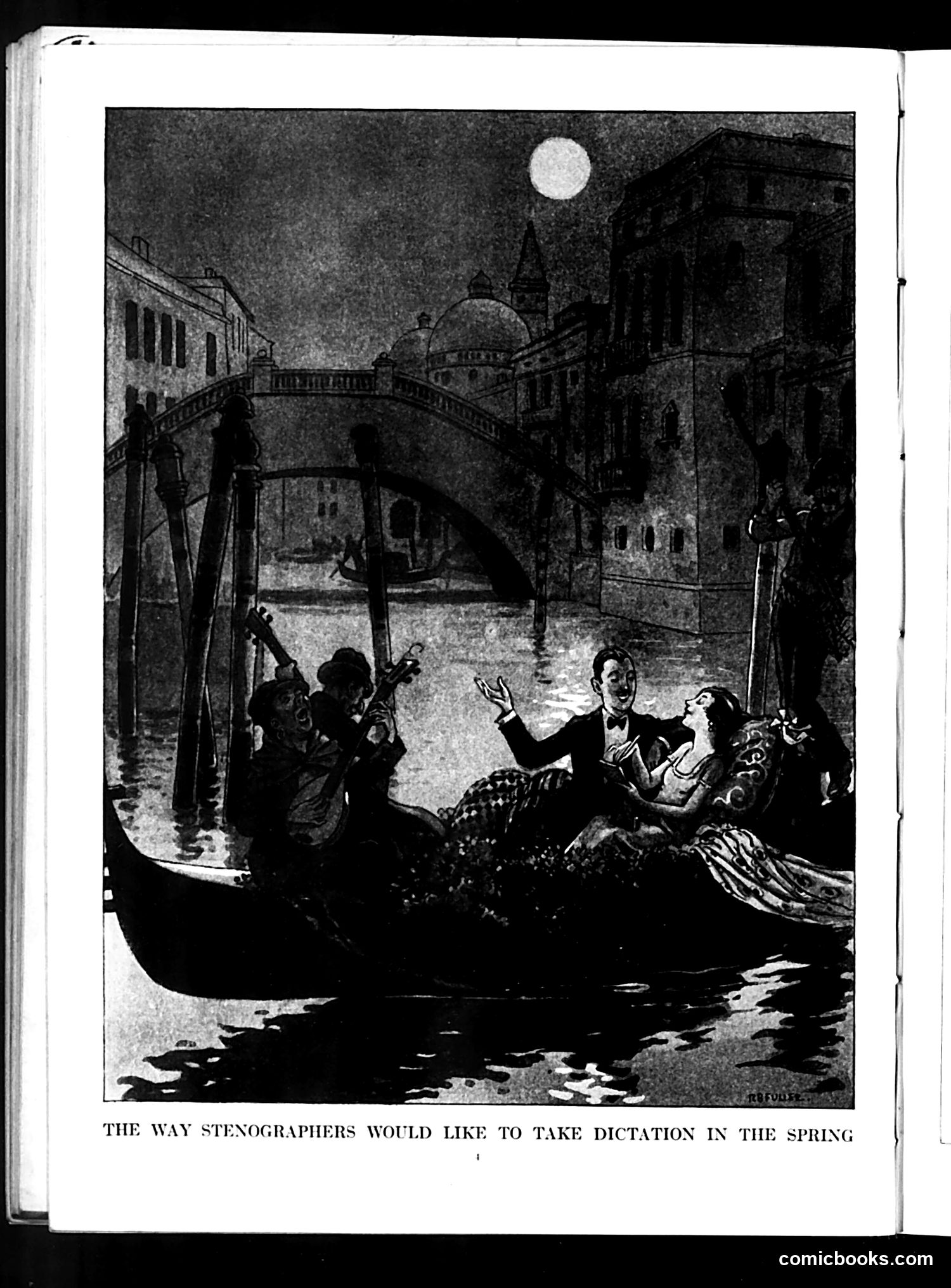
This is a humorous illustration satirizing stenographers' workplace conditions. The image depicts a romanticized fantasy: a stenographer taking dictation while relaxing in a gondola on a Venetian canal under moonlight, rather than confined to an office desk. The joke addresses the monotonous, indoor nature of stenography work—a common job for women in the early 20th century. The caption suggests stenographers dream of conducting their work in idyllic, leisurely settings, particularly during spring when outdoor weather improves. It's gentle satire about the tension between actual working conditions and employees' desires for more pleasant, romantic surroundings.
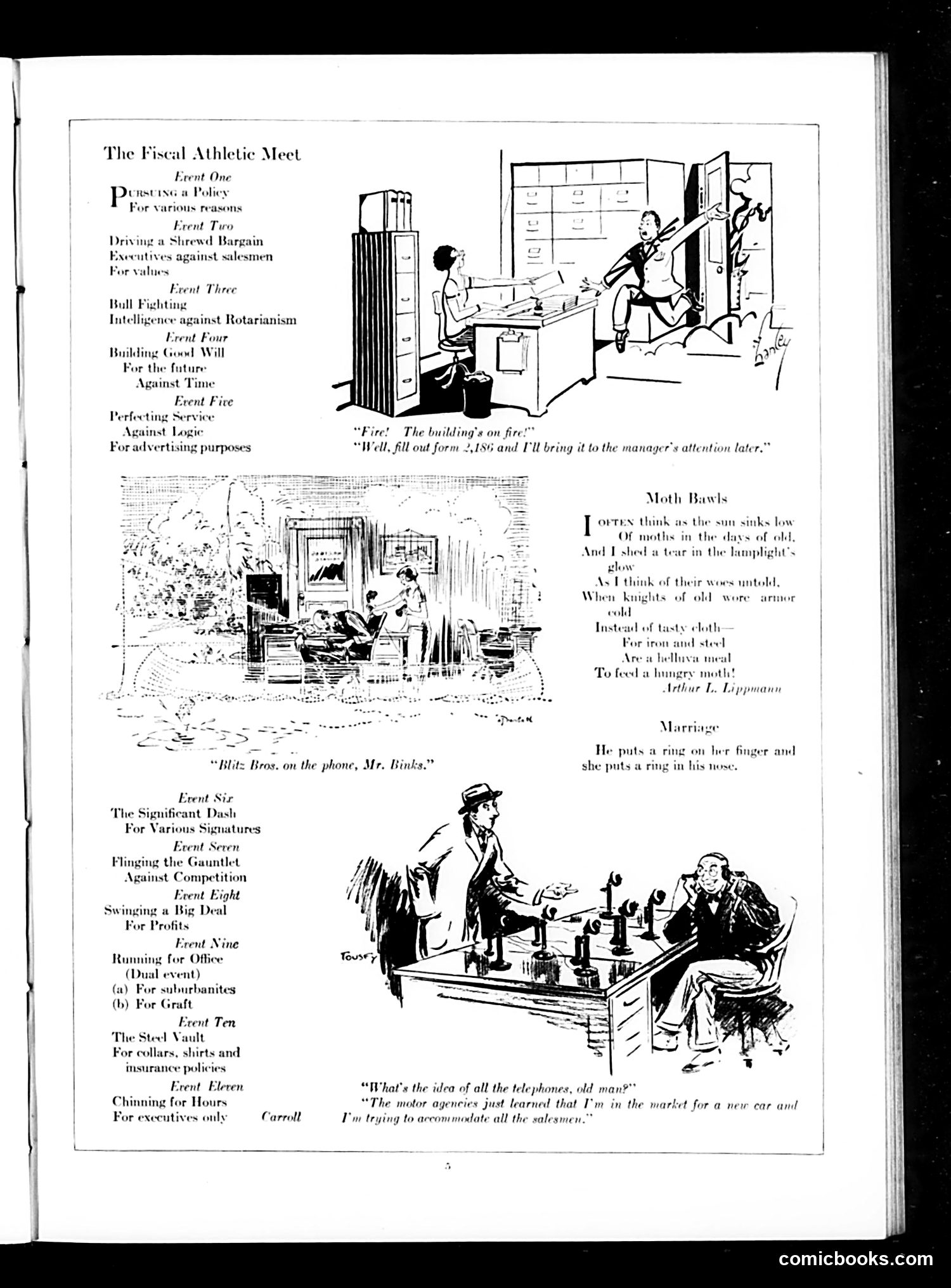
This satirical piece uses a sporting competition metaphor to critique various business and political practices of the era. The listed "Events" mock corporate malfeasance: "Palming a Palace," "Driving a Shrewd Bargain," "Building Good Will," and "Perfecting Service Against Logic" suggest fraudulent executives, unfair labor practices, and hollow corporate messaging. The top cartoon shows an office fire—"Well, fill out form 2,186 and I'll bring it to the manager's attention later"—satirizing bureaucratic indifference to crises. The lower cartoon depicts businessmen playing chess while discussing "telephones, old men," and motor agencies seeking car salesmen, suggesting corporate scheming and manipulation. The "Moth Bawls" poem and "Marriage" joke appear unrelated filler content typical of Judge magazine's mixed satirical and humorous approach.
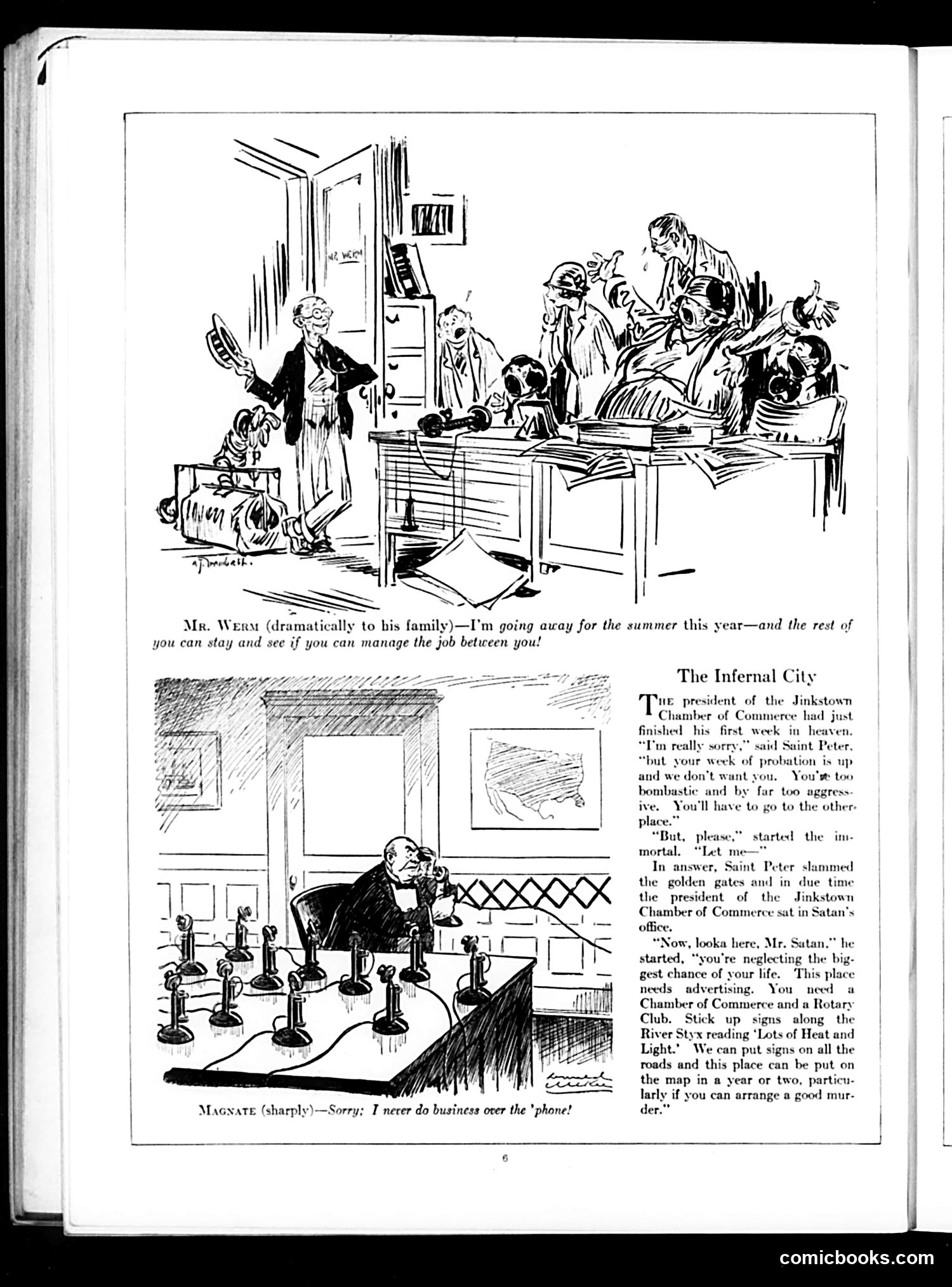
This page contains two satirical cartoons about American business culture and ambition. **Top cartoon**: Mr. Wem announces he's abandoning his family for summer, leaving them to "manage the job between" themselves. The joke mocks the casual abdonment of domestic responsibility by fathers prioritizing leisure. **Bottom cartoon ("The Infernal City")**: A Jinkstown Chamber of Commerce president is rejected from heaven for being "too bombastic and aggressive," then sent to Hell. Satan's office receives him, and the president immediately begins pitching Hell on *advertising and commercialization*—suggesting it needs a Chamber of Commerce, Rotary Club, and promotional signs along the River Styx ("Lots of Heat and Light"). The satire targets aggressive American boosterism and Chamber of Commerce zealotry: the implication is that such relentless commercialism and self-promotion are so fundamentally corrupting that they belong in Hell itself. It's a critique of early 20th-century American business culture's values and methods.
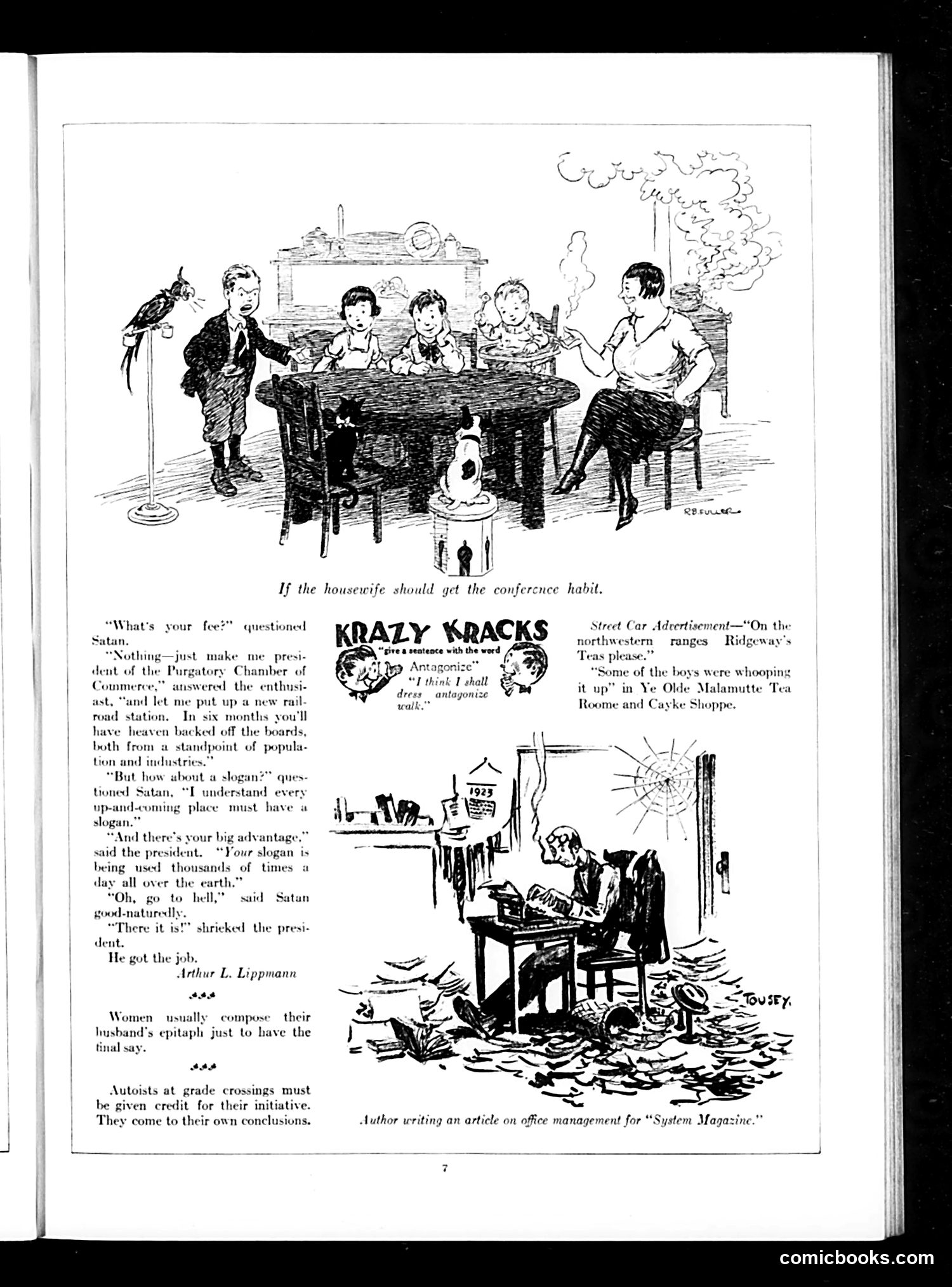
**Top cartoon ("If the housewife should get the conference habit"):** Satirizes business-conference culture by imagining wives adopting the same pretentious jargon and meeting habits as their husbands. The humor mocks both corporate speak and women's supposed mimicry of masculine professional behavior—a gendered joke typical of 1920s-era satire. **Middle section (Arthur L. Lippmann story):** A dialogue where "Satan" pitches a business slogan to a Chamber of Commerce president. The joke: Satan's slogan "Antagonize" gets adopted everywhere because conflict drives commerce. It's satirizing cutthroat business ethics and capitalism's amoral nature. **"Krazy Kracks":** A jokes section with puns about "antagonize" (containing "ant"). **Bottom cartoon ("Author writing an article on office management"):** Shows a cluttered desk overwhelmed with papers—visual comedy mocking the absurdity of writing about organizational efficiency while working in chaos. The page satirizes 1920s business culture, corporate buzzwords, and the gap between professional ideals and messy reality.
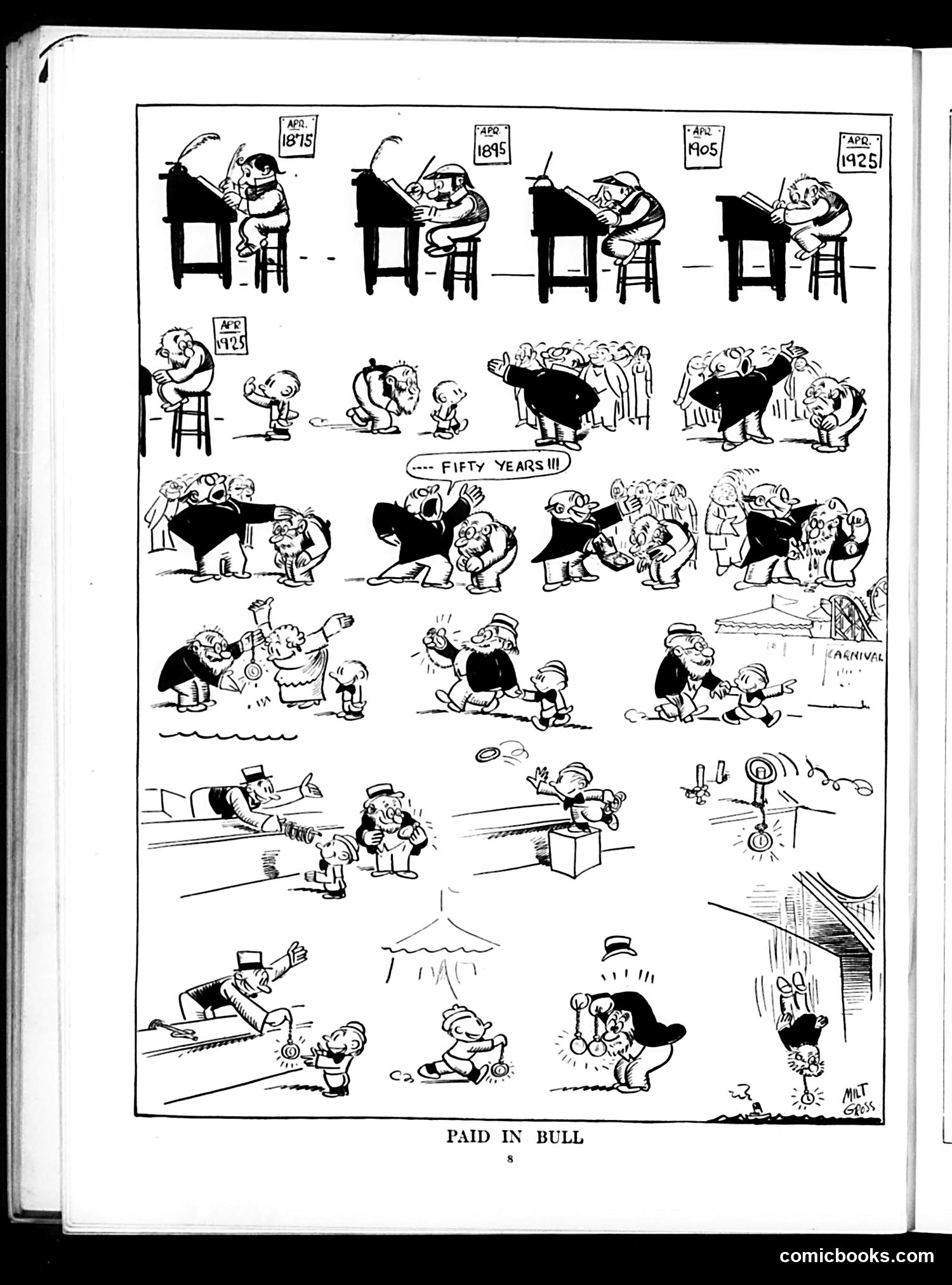
This comic strip titled "PAID IN BULL" humorously tracks a man's relationship with a bull over fifty years (1875-1925). The sequence shows: **Top row**: The man confidently approaches a piano-playing bull in 1875, 1895, 1905, and 1925, suggesting repeated, foolish encounters with the same dangerous animal. **Middle and lower sections**: The narrative escalates through increasingly chaotic scenes—the bull chasing the man, children watching, carnival settings, airplanes, and modern transportation—documenting how the man keeps getting "paid" (attacked/gored) by the bull across changing technological eras. The satire mocks someone stubbornly repeating the same mistake despite decades of consequences, using the bull as a metaphor for a persistent problem or bad decision that follows him through life's modernization.
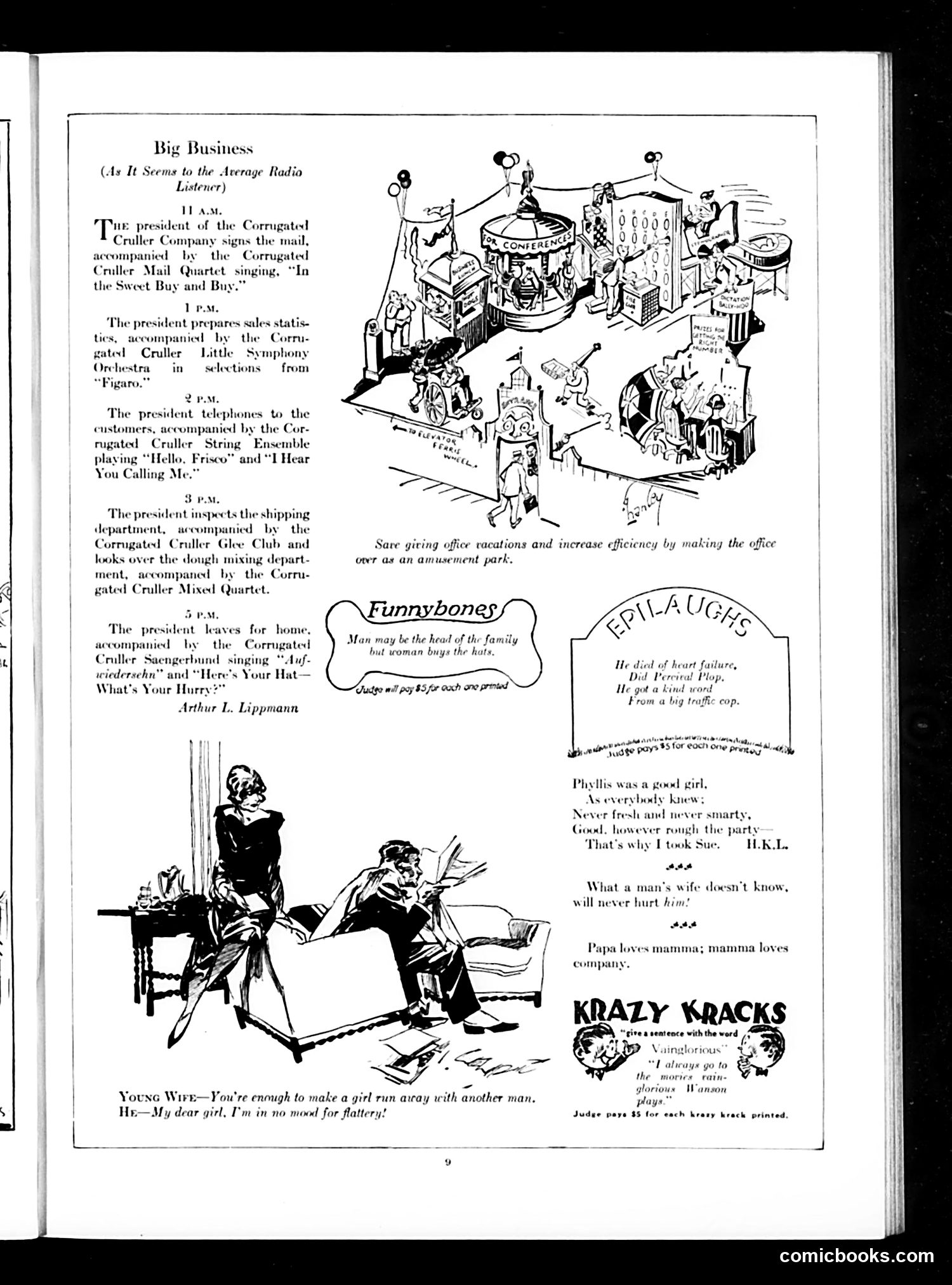
This page satirizes **corporate radio advertising in the 1920s-30s**. The main cartoon mocks how companies used radio to promote products through constant musical performances. The "Corrugated Cruller Company" (a fictional donut manufacturer) accompanies every mundane business activity—signing contracts, preparing statistics, making sales calls, inspecting departments—with sponsored musical ensembles and quartets. The satire targets the absurdity of **commercial radio saturation**: businesses turning ordinary work into entertainment vehicles to advertise their wares to "average radio listeners." Each hour of the executive's day includes a different musical group, suggesting radio's intrusive omnipresence in American life. The surrounding "Funnybones" and "Krazy Kracks" are unrelated gag fillers typical of Judge magazine's format—brief jokes about domestic life, gender relations, and miscellaneous humor. The page essentially critiques early radio's commercialization and how brands weaponized entertainment to reach consumers.
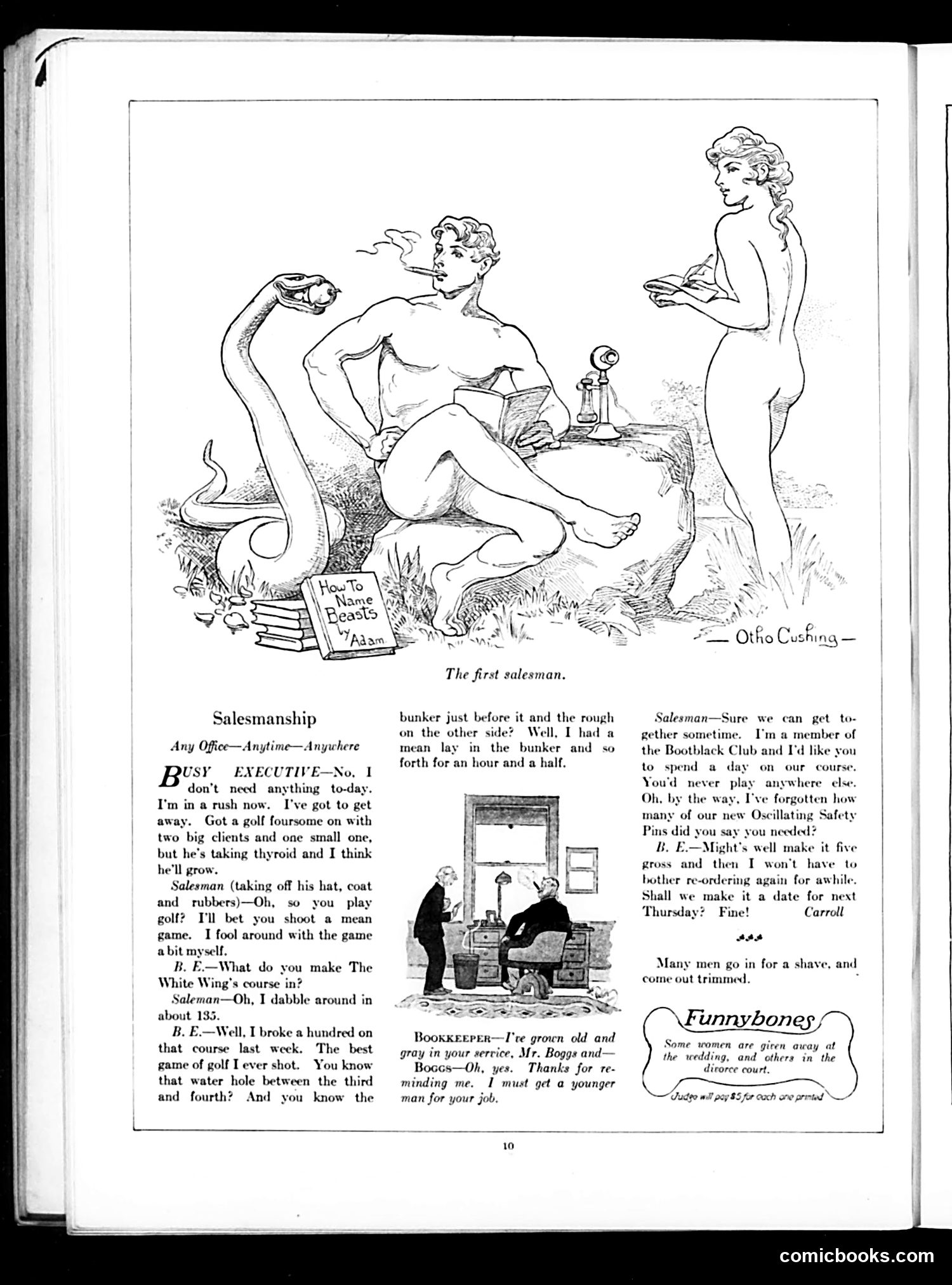
This page satirizes aggressive early-20th-century sales tactics. The top cartoon shows a salesman who has literally stripped down to seduce a busy executive into a sale, using flattery about golf to bypass his resistance—the ultimate "foot-in-the-door" technique. The three brief dialogues below illustrate salesmanship absurdities: a "Busy Executive" who claims to have no time yet gets drawn into lengthy golf conversation; a bookkeeper being fired after decades of loyal service; and the irony of the salesman pivoting from personal rapport-building to suddenly pitching "Oscillating Safety Pins"—revealing the transaction was manipulative all along. The bottom jokes ("Funnybones") mock related social hypocrisies: barber shops that exploit customers, and women treated as commodities in marriage or divorce. The satire targets how salesmen use charm and false friendship to exploit targets' vanity and inattention.
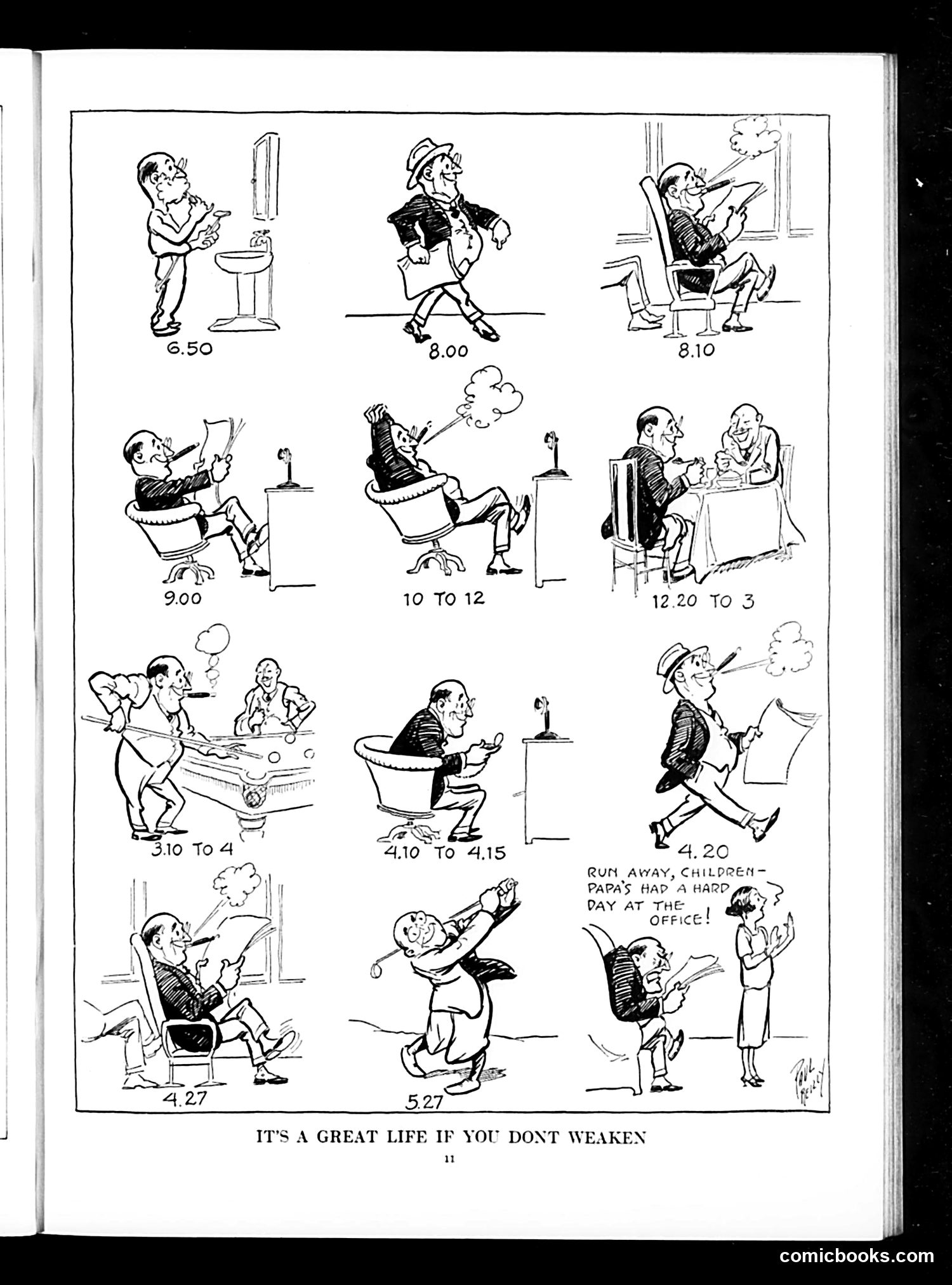
This is a humorous daily schedule cartoon satirizing the exhausting life of a businessman or office worker. The titled man proceeds through his day from 6:50 AM (bathroom routine) through 5:27 PM (exercise), depicting mundane and increasingly chaotic activities: commuting, office work, reading, dining, billiards with colleagues, and domestic scenes with family. The satire targets the grinding monotony and physical/mental toll of white-collar work. Each timestamp marks another obligation or stress. The final panel shows children being told to "run away" because "Papa's had a hard day at the office"—the punchline suggesting that despite calling it "a great life," the exhausted father has become irritable and difficult at home. This reflects early 20th-century American anxieties about modern business culture and its dehumanizing effects on men.
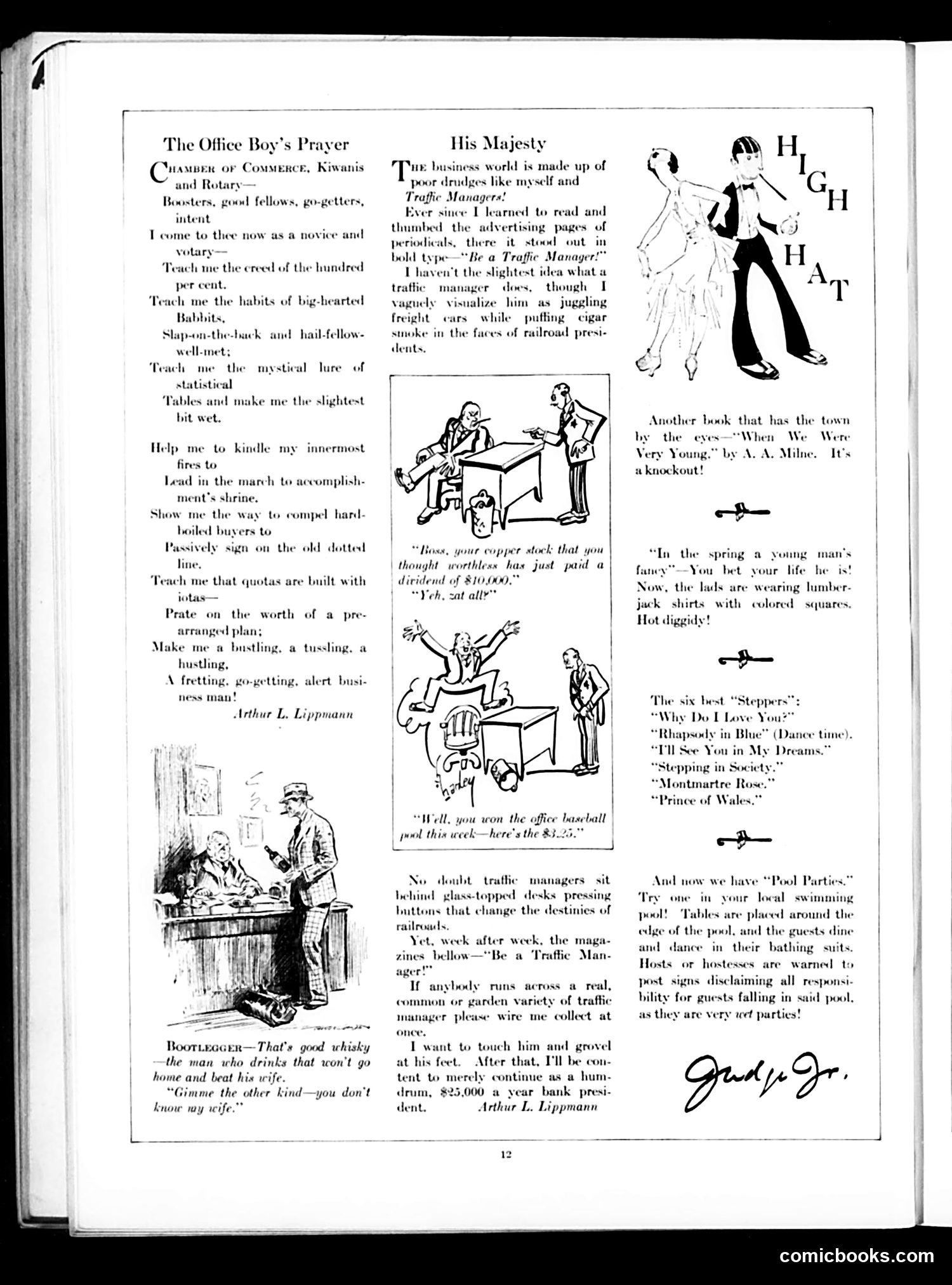
This page satirizes 1920s American business culture, particularly the "booster" mentality of service clubs like Kiwanis and Rotary. **"The Office Boy's Prayer"** mocks the aspirational language fed to young workers—promises of success through "hustling," "quotas," and "pre-arranged plans." The prayer asks to be made into an obedient, ambitious businessman, revealing how corporate ideology was marketed to office workers. **"His Majesty"** ridicules the mystique surrounding "Traffic Managers"—railroad executives portrayed in advertisements as powerful decision-makers. The author admits never actually seeing one, only imagining them "juggling freight cars," exposing how advertising created fantasy versions of white-collar jobs. The cartoon shows absurdly exaggerated office antics (desks launching people into the air) to emphasize the gap between promotional mythology and mundane reality. Both pieces use gentle mockery to critique how business culture promised young men status and meaning through corporate service, when the reality was often tedious clerical work. This reflects 1920s anxiety about industrialization and conformity.
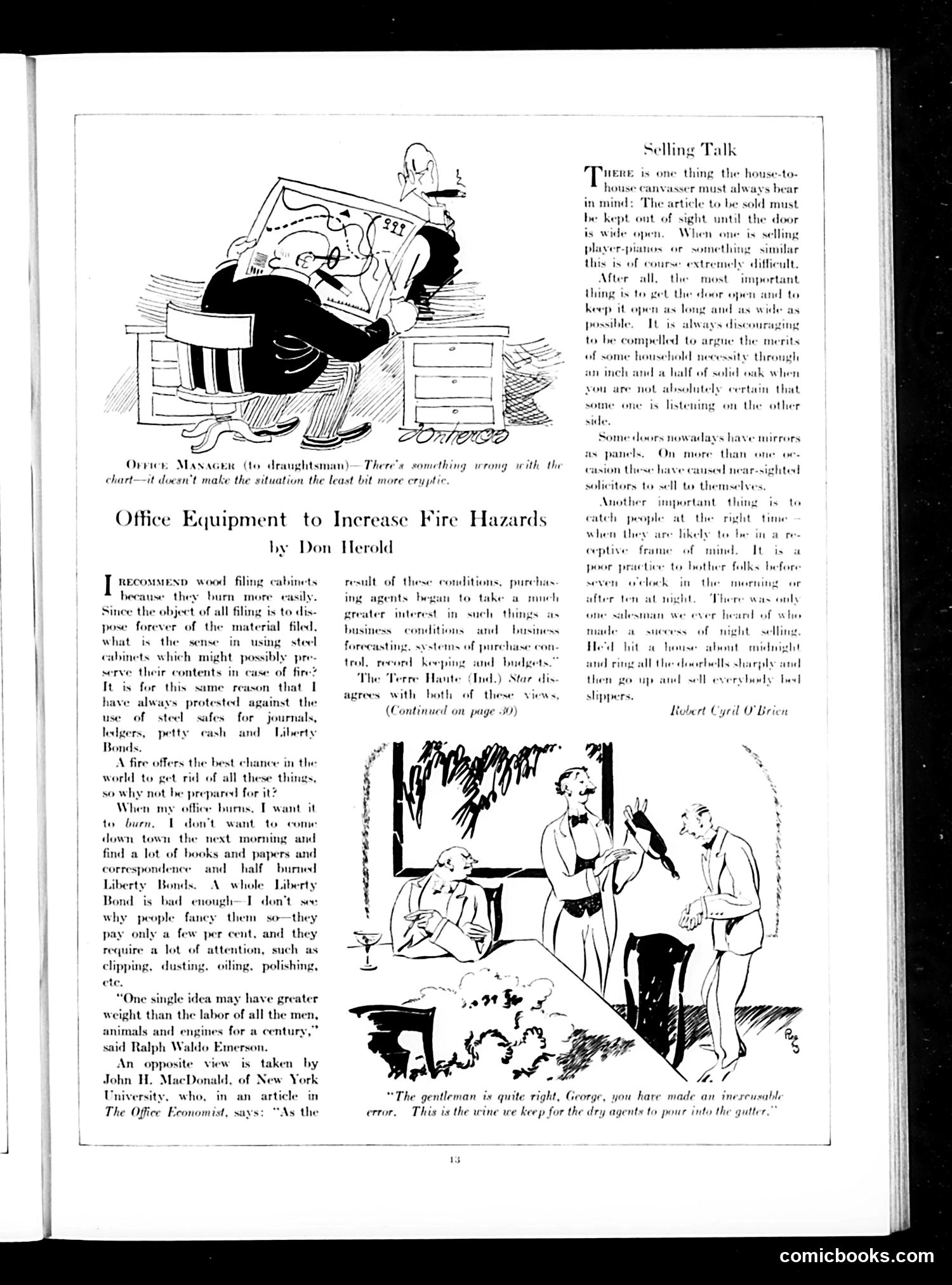
This page contains two satirical pieces about office practices and sales techniques from *Judge* magazine. **Top cartoon**: An office manager confronts a draughtsman about a confusing chart, suggesting the data presentation obscures rather than clarifies the situation—satire on poor business communication. **Main article "Office Equipment to Increase Fire Hazards"**: Author Don Herold argues sarcastically that wood filing cabinets are preferable to steel ones because fire offers a convenient way to destroy troublesome paperwork and Liberty Bonds (government savings bonds). This is dark humor mocking bureaucratic inefficiency and the tedium of record-keeping during the early 20th century. **Bottom cartoon**: Shows a man explaining to colleagues that wine being poured down a drain was deliberately kept for "dry agents"—referencing Prohibition-era authorities who confiscated alcohol. The joke satirizes how people circumvented alcohol laws. Both pieces use humor to critique business culture, government regulation, and office tedium of the era.
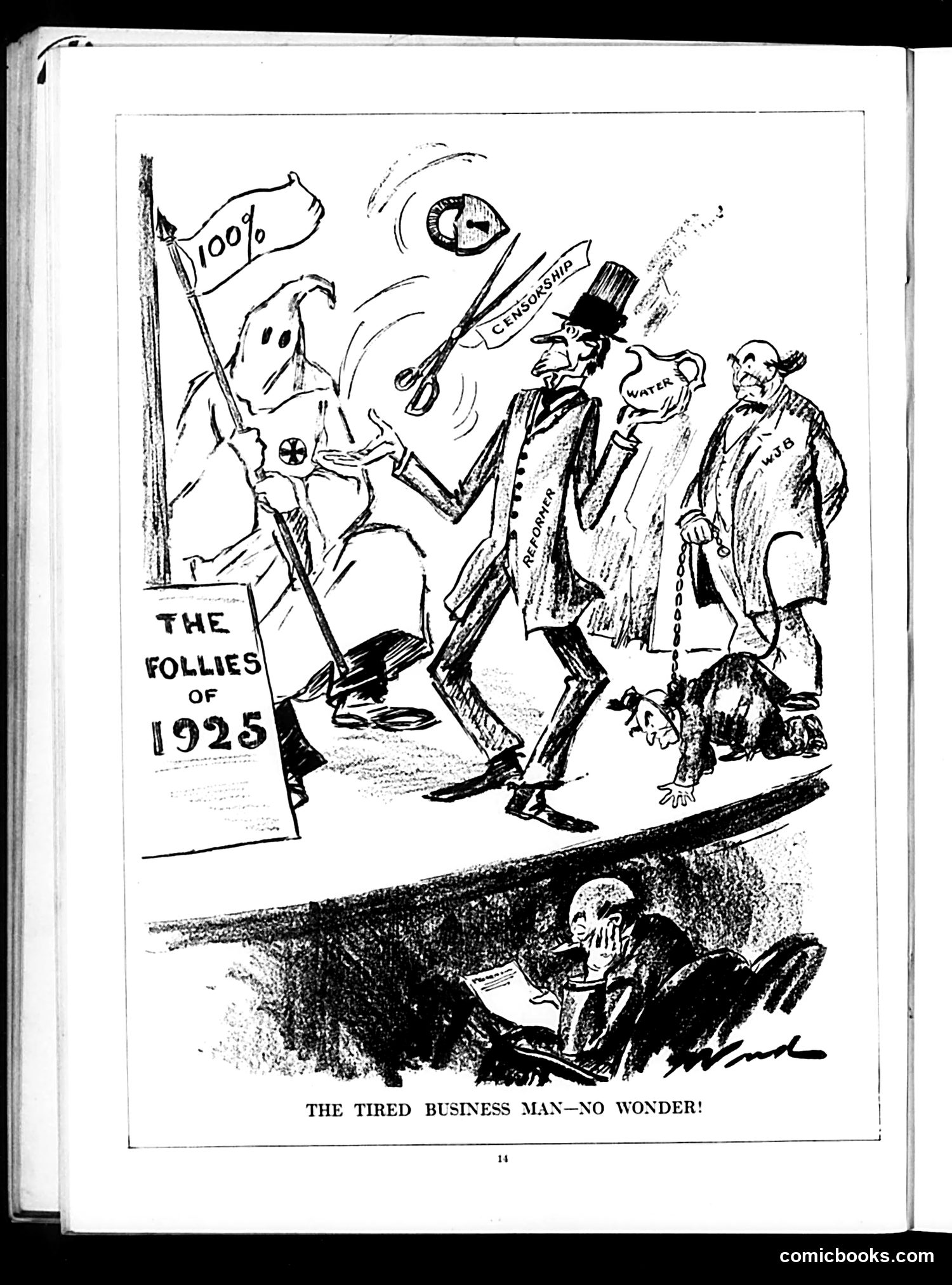
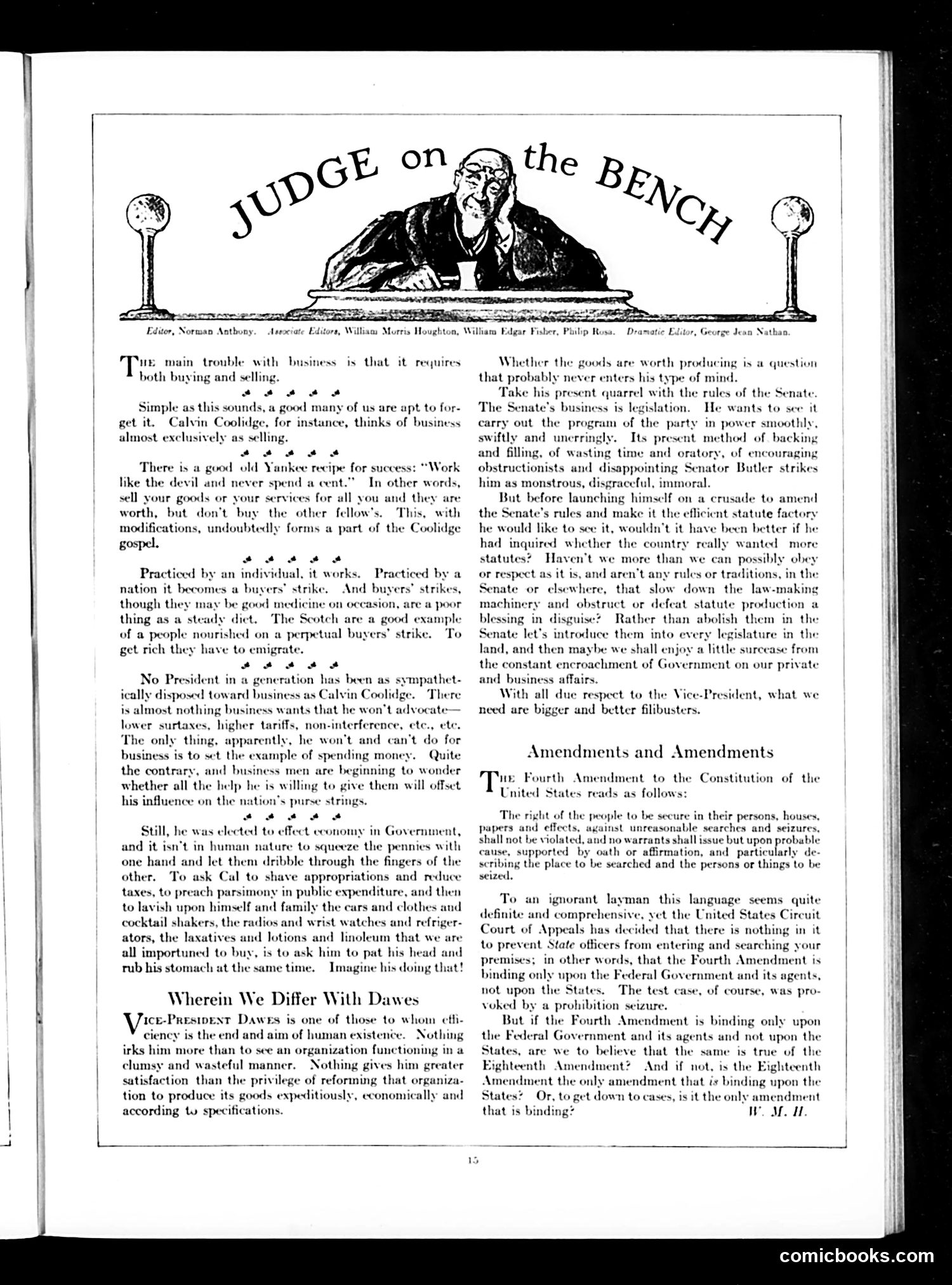
This page satirizes President Calvin Coolidge and Vice-President Charles Dawes through two separate editorial pieces. **"The Main Trouble with Business"** criticizes Coolidge's economic philosophy. The cartoon's judge figure appears to represent editorial commentary. The text argues that while Coolidge promotes business-friendly policies (lower taxes, tariffs, non-interference), he undermines them by personally exemplifying extreme frugality—refusing to spend money himself. This creates a contradiction: he asks citizens to consume and stimulate the economy while modeling stingy behavior. The satire suggests his "purse-string" influence on the nation negates his pro-business rhetoric. **"Wherein We Differ With Dawes"** attacks Vice-President Dawes for pursuing efficiency as an end in itself, particularly regarding Senate procedures. The critique argues Dawes wants to streamline legislation production without questioning whether new laws are actually needed or beneficial. The author suggests existing regulations already burden citizens excessively, and that procedural slowdowns—"blessings in disguise"—protect against government overreach. Both pieces mock Republican leadership for misunderstanding economic and governmental realities.
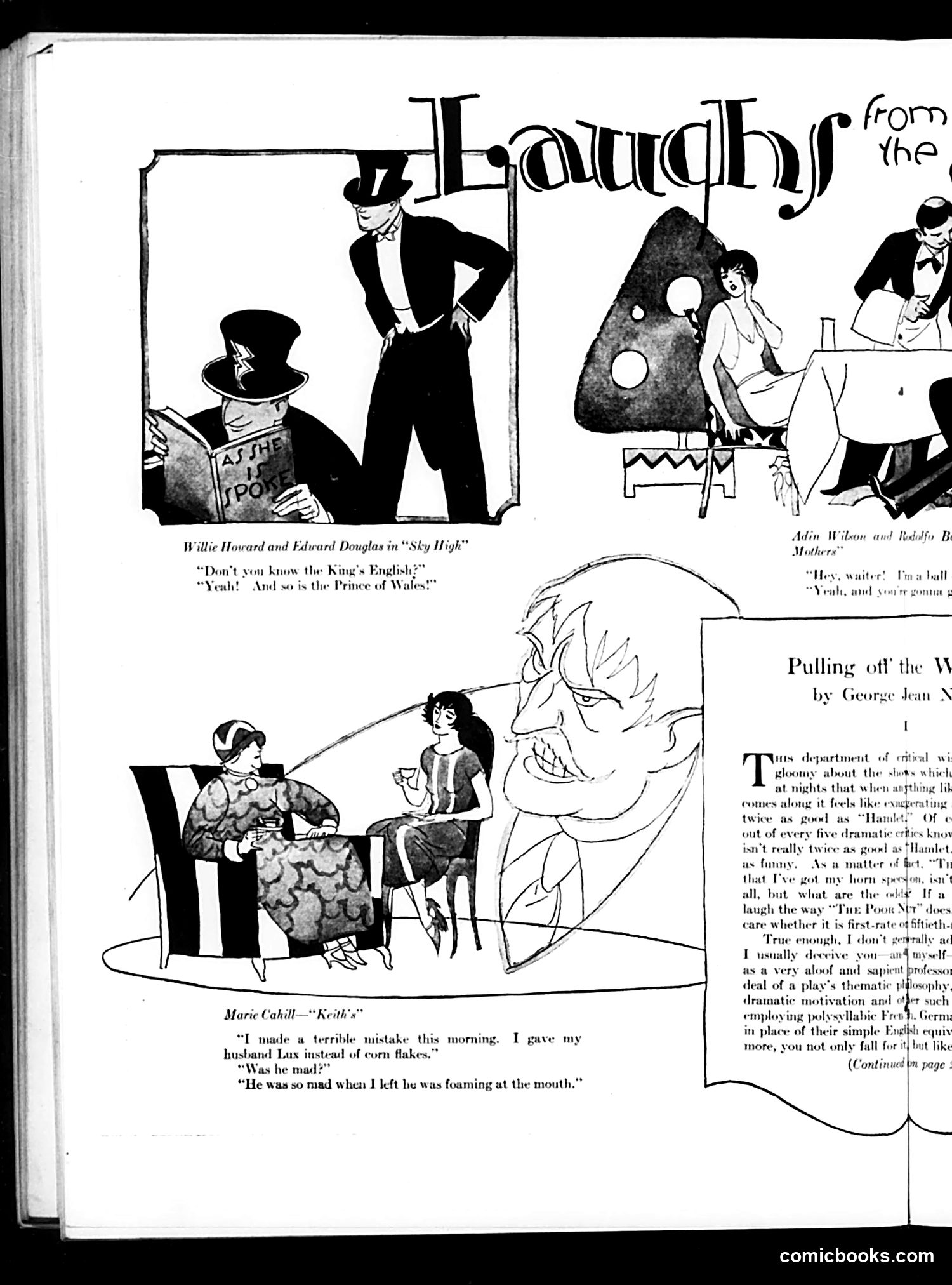
This page contains three separate comedy sketches typical of 1920s-era humor: **Top left:** Willie Howard and Edward Douglas in "Sky High" discuss the King's English—a pun joke where one character claims the Prince of Wales also speaks it poorly, playing on British aristocratic pretension. **Bottom left:** Marie Cahill in "Keith's" tells a joke about giving her husband Lux (a cleaning product) instead of corn flakes, resulting in him "foaming at the mouth." The humor relies on the visual/physical comedy of mistaking cleaning products for breakfast food. **Top right:** A domestic scene with Adin Wilson and Rodolfo, likely about restaurant service etiquette or marital dynamics (text partially unclear). **Right side:** An article titled "Pulling off the W" by George Jean [surname unclear] critiques theatrical criticism, discussing how audiences misjudge plays' quality and dramatic merit. The page represents typical Judge content: vaudeville-era comedy sketches, domestic humor, and cultural commentary on arts/entertainment.
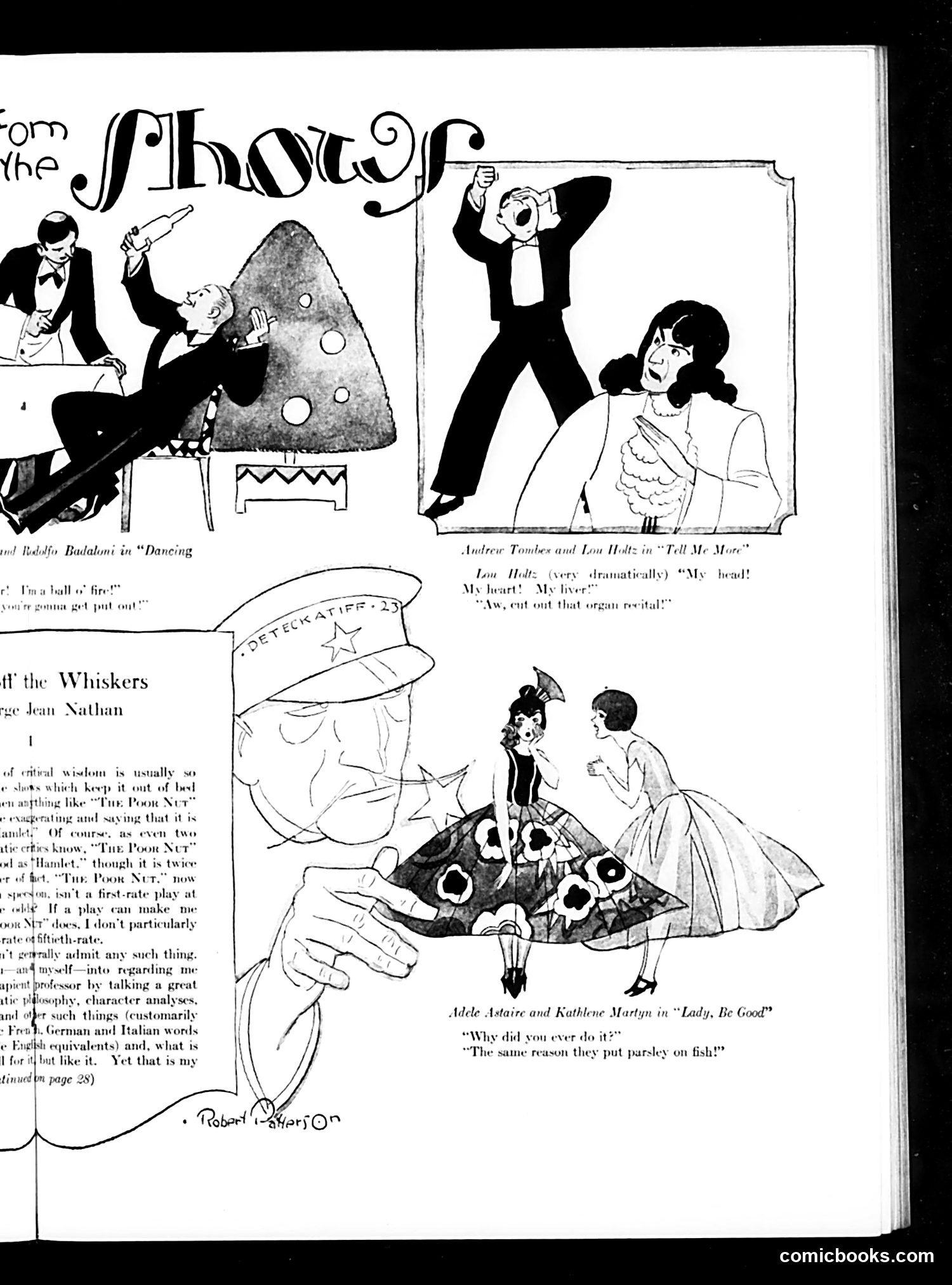
This page features theatrical reviews and comedy sketches from Judge magazine's "From the Shows" section. The content includes: **Theater scenes illustrated** from productions like "Tell Me More," "Dancing," and "Lady, Be Good"—Broadway shows of the era. The accompanying jokes mock theatrical conventions: Lou Holtz's character dramatically listing his ailments ("My head! My liver!") prompts the response "Aw, cut out that organ recital!"—satirizing overwrought melodramatic acting. **A critical essay** by George Jean Nathan (visible byline) discusses "The Poor Nut," dismissing critical wisdom that praises plays mechanically while admitting personal enjoyment—ironic commentary on theatrical criticism's pretensions. **The Astaire-Martyn joke** about parsley on fish is a nonsensical punch line, typical of vaudeville-style humor. The page satirizes both theatrical excess and the gap between critical judgment and genuine entertainment value—recurring themes in Judge's mockery of highbrow culture.
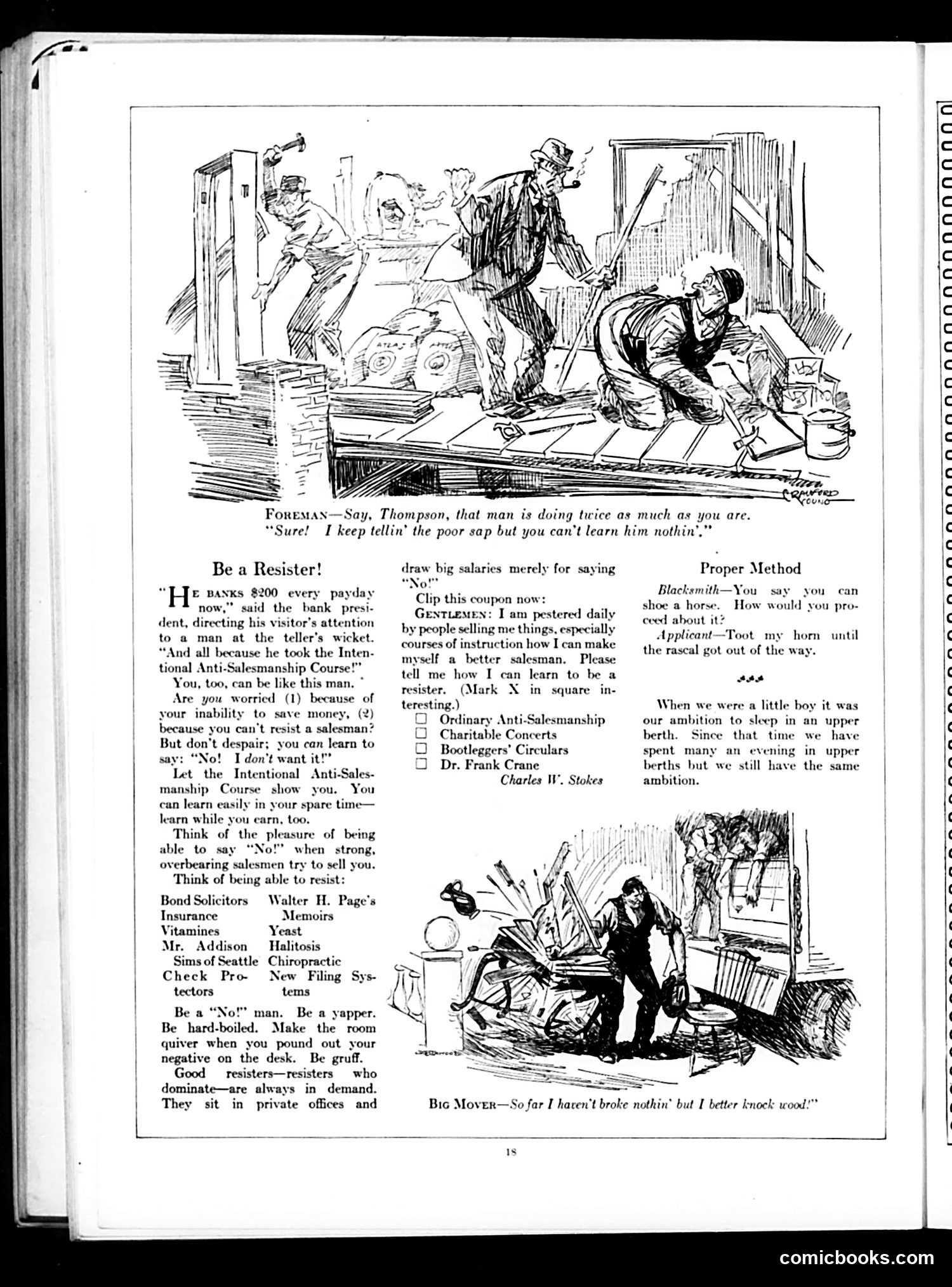
This page satirizes the early 20th-century American obsession with self-improvement courses and salesmanship training. The central cartoon mocks a bank president's boast that an employee earns $200 monthly because he took an "Intentional Anti-Salesmanship Course"—meaning he's so good at saying "no" to pitches that he's valuable to the bank. The satire cuts both ways: it ridicules both the proliferation of dubious mail-order courses promising instant success, and the gullible public buying them. The "coupon" lists absurd courses one might resist (bond soliciting, "Bootleggers' Circulars," etc.), mocking marketing desperation. The bottom cartoons extend the joke—showing that being stubbornly resistant to instruction (the blacksmith applicant, the upper-berth dreamer) isn't actually wisdom but just obstinacy. The overall target: American culture's naive faith that personality training and correspondence courses could solve economic problems—a critique of both corporate hustle-culture and consumer vulnerability.
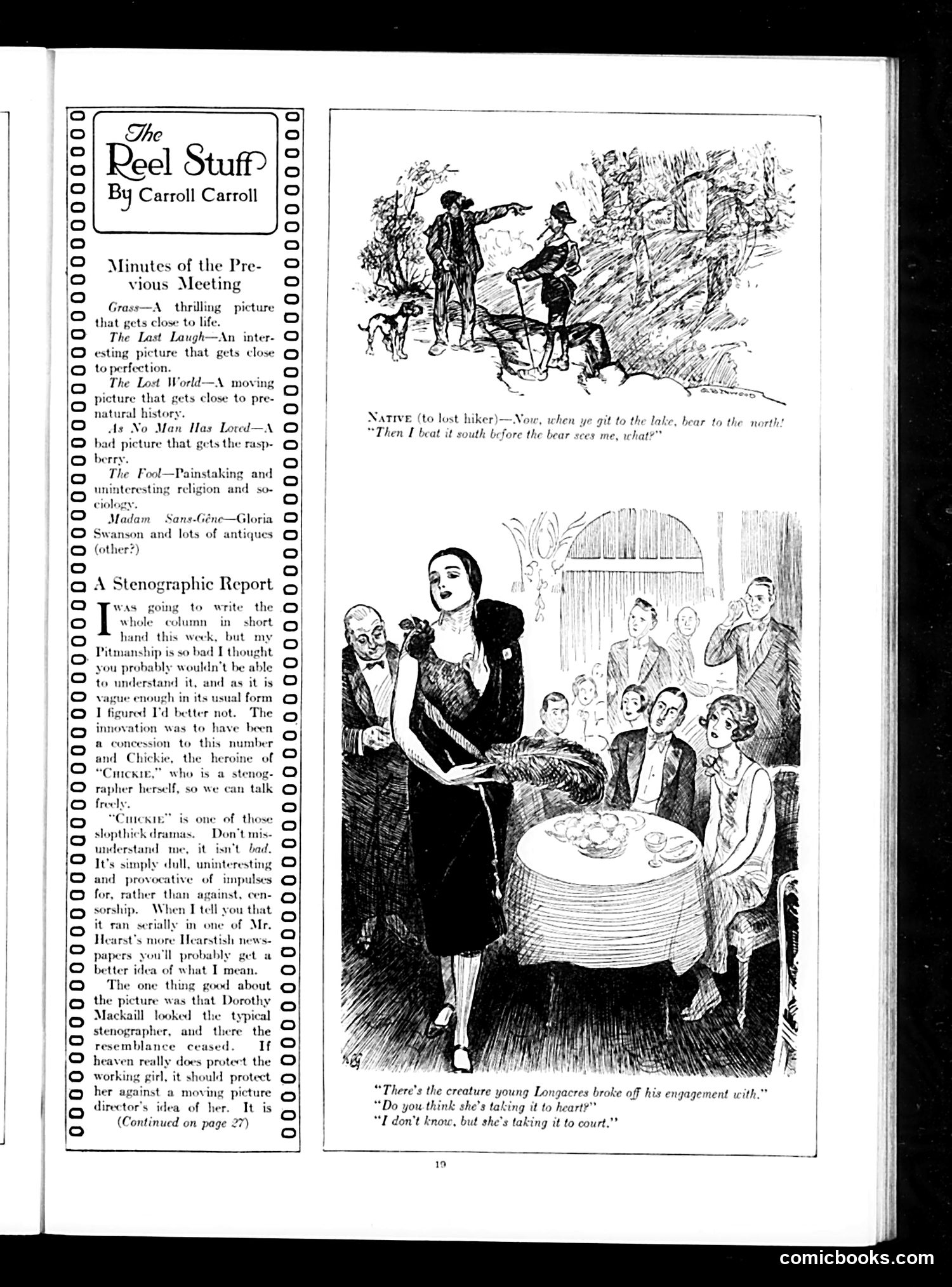
This page contains **film criticism** and **two separate cartoons** lampooning early 1920s cinema and social attitudes. **Left column:** Carroll Carroll reviews recent movies, criticizing "Chickie" (a stenographer drama serialized in Hearst newspapers) as dull and moralistic, though actress Dorothy Mackaill looks appropriately typecast. The tone mocks both the film and censorship impulses it provokes. **Top cartoon:** A hiker asks a Native American for directions, then admits he ignored the advice—a joke playing on the "lost tourist" trope and stereotypical portrayals of Indigenous peoples as guides. **Bottom cartoon:** A woman takes a broken engagement "to court" (suing for damages)—a satirical dig at women's increasing legal assertiveness and marriage litigation, a contemporary social concern. The joke assumes readers find female litigiousness absurd or mercenary. All content reflects 1920s attitudes toward cinema quality, Native representation, and women's rights with period-typical skepticism and condescension.
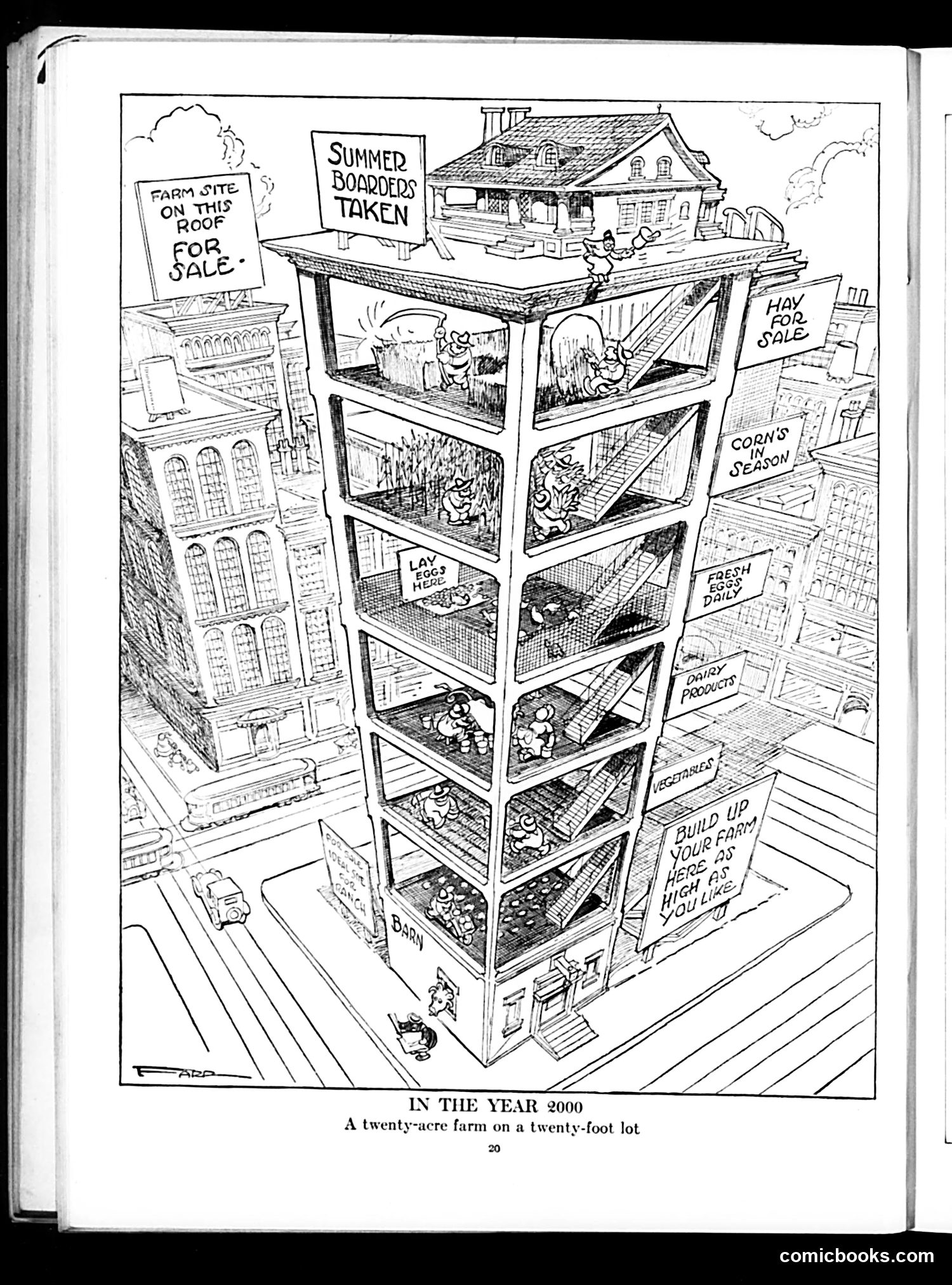
This is a futuristic satire imagining urban agriculture in the year 2000. The cartoon depicts an impossibly tall tower building crammed onto a tiny city lot, with each level housing different farm operations: crops, livestock, dairy products, and vegetables stacked vertically. The humor satirizes the tension between growing urbanization and the need for food production. Signs advertise "Farm site on this roof for sale" and "Hoy for sale," suggesting developers are trying to monetize every inch of space. The absurdist solution—stacking a "twenty-acre farm on a twenty-foot lot"—mocks both urban overcrowding and optimistic technological predictions about solving space constraints. The cartoon likely dates from the early-to-mid 20th century, when such futuristic predictions were common in satirical publications.
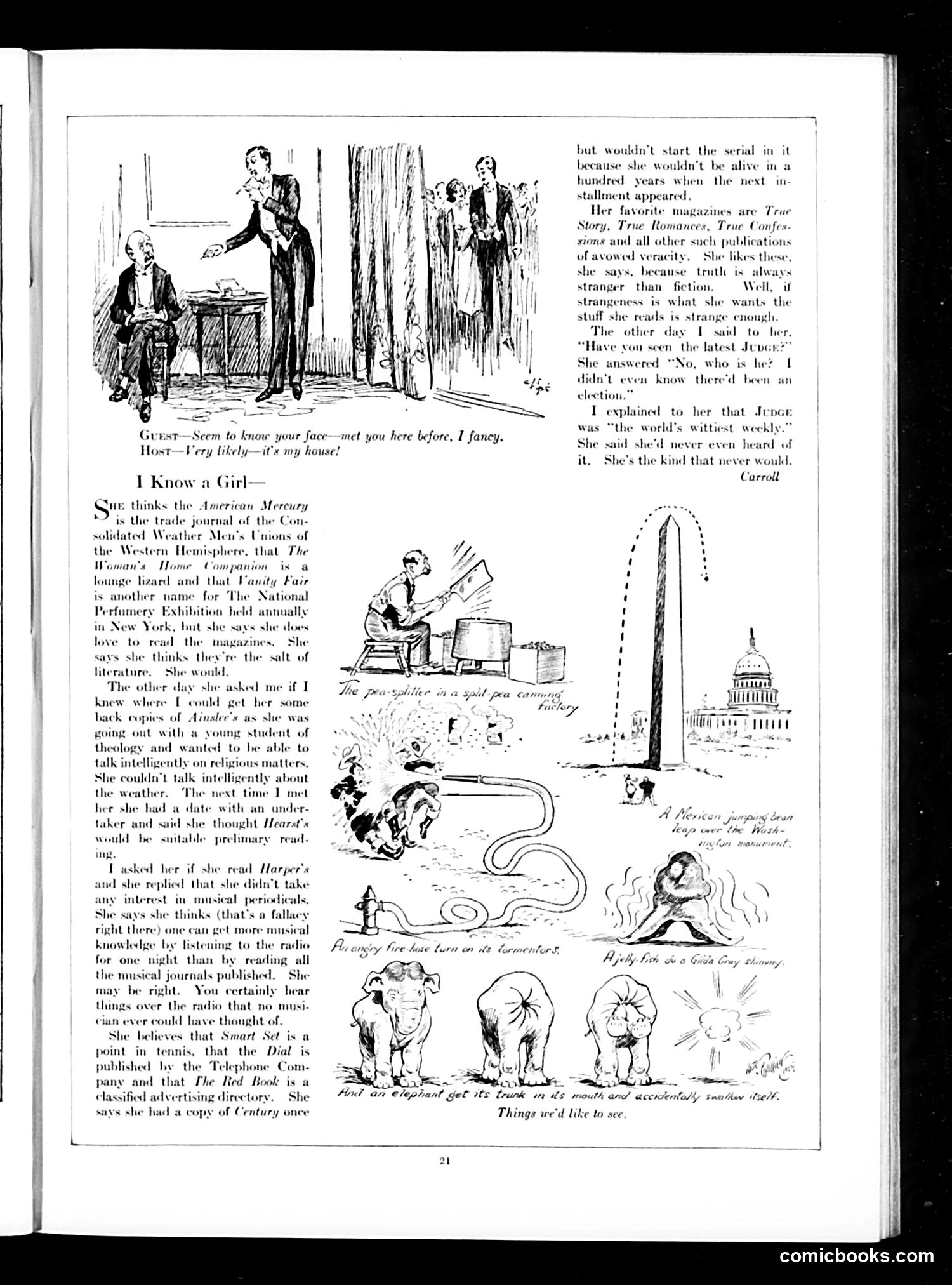
This satirical essay mocks a young woman's profound ignorance about American culture and media despite claiming to enjoy magazines. **The Setup:** The narrator describes a girl who reads *True Story, True Romances*, and *True Confessions*—mass-market magazines marketed to working-class women—but holds comically wrong beliefs about respected publications: she thinks *American Mercury* is a weather union trade journal, *Woman's Home Companion* is a "lounge lizard," and *Vanity Fair* relates only to perfumery exhibitions. **The Satire:** The piece ridicules both her vapid consumerism and anti-intellectualism. She reads magazines constantly yet cannot discuss religion, music, or culture intelligently. She prefers lowbrow sensationalism to serious literature, and her attempt to read *Hearst's* (likely a Hearst publication) before a date with an undertaker is absurd. **Social Context:** This targets the "flapper" or modern young woman stereotype of the 1920s-30s—she's fashionable, date-obsessed, but intellectually empty. The humorous illustrations reinforce the mockery of her shallow worldview.
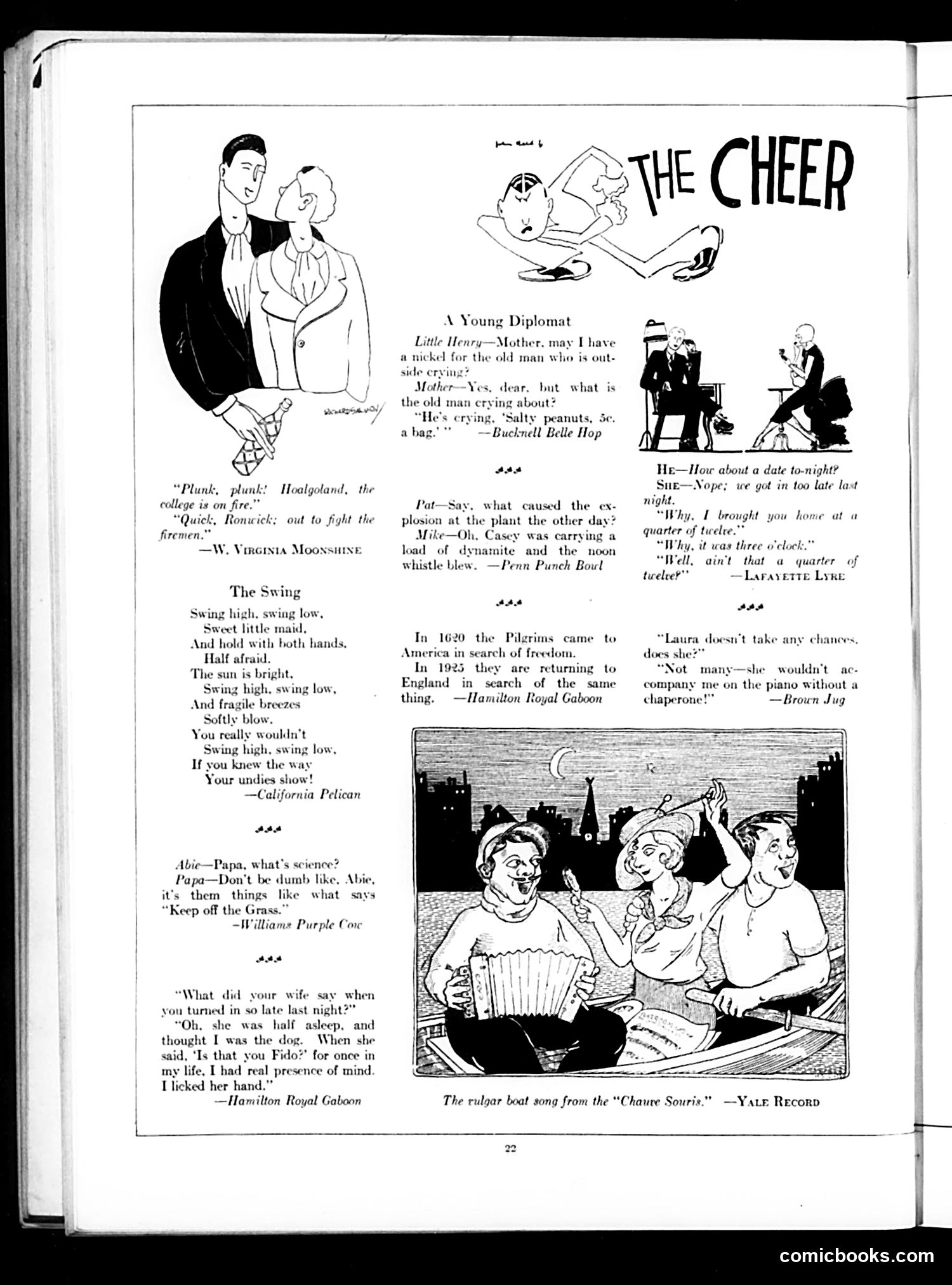
This page collects brief humorous anecdotes and poems typical of Judge's satirical humor circa early 20th century. **Key content:** - **"A Young Diplomat"** jokes exploit innocent misunderstandings (a child's literal interpretation of "crying" about peanuts; a woman's confusion about clock times). - **"The Swing"** is a sentimental poem about courtship, undermined by the final stanza's crude joke about visible undergarments—satirizing Victorian prudishness. - **Historical joke** compares Pilgrims (1620, seeking religious freedom) to modern Americans (returning to England for freedom from Prohibition), mocking contemporary alcohol restrictions. - **"Science" joke** uses an immigrant character ("Abie") to mock working-class understanding, stereotyping Jewish immigrants as uneducated. - **Bottom illustration** depicts a "vulgar boat song" from the Parisian cabaret Chauve-Souris, suggesting risqué European entertainment. The page reflects Judge's typical blend of wordplay, class-based humor, ethnic stereotyping, and mild sexual innuendo—representative of 1920s American satirical magazine conventions.
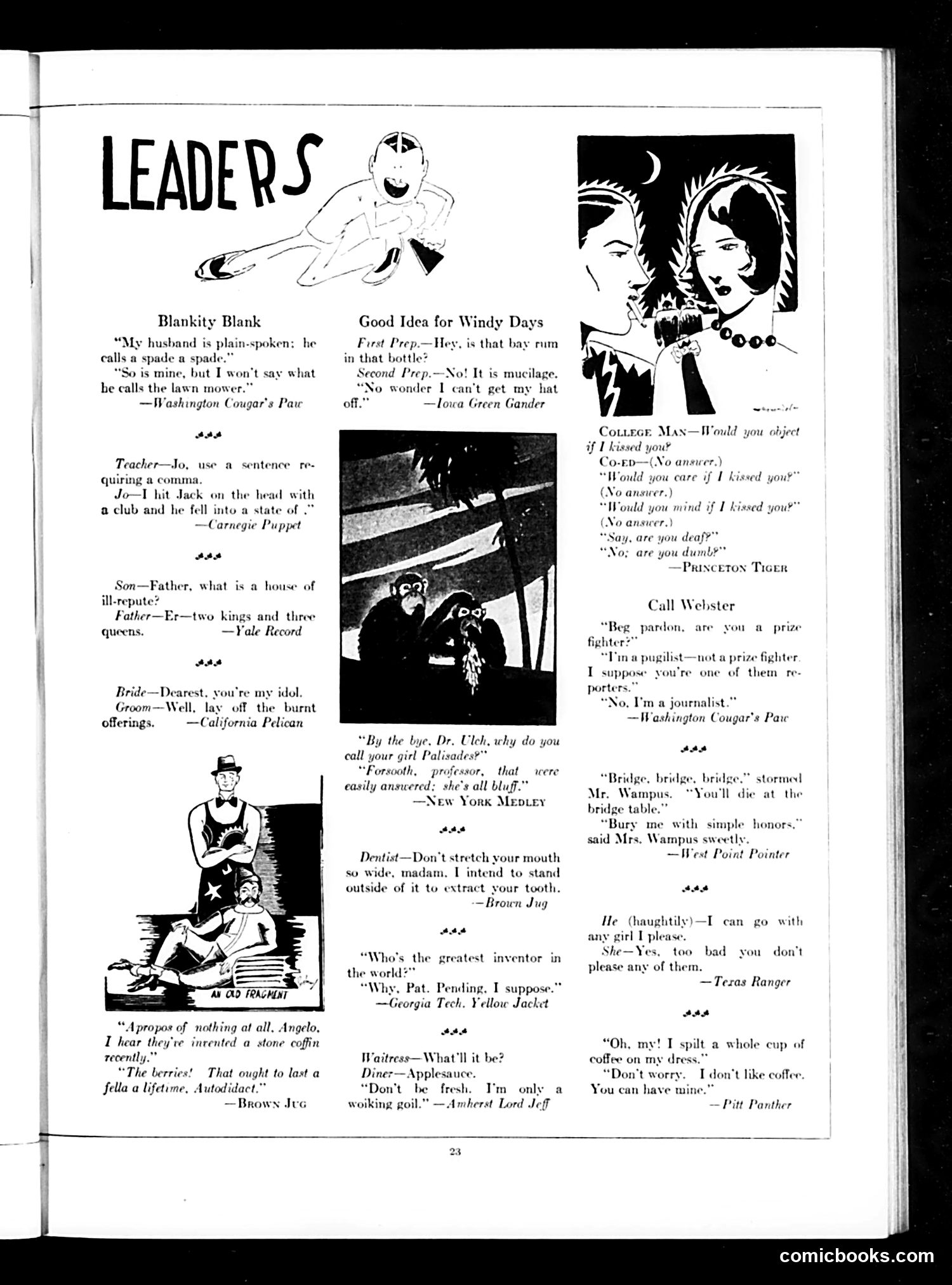
This page contains brief humorous quips and jokes typical of Judge magazine's satirical format—not political cartoons, but social comedy from college humor publications of the early 20th century. The jokes target domestic life, education, and social interactions. "Blankity Blank" mocks husbands' blunt speech. The "Good Idea for Windy Days" jokes play on college prep misunderstandings (bay rum vs. mucilage). Others ridicule pretension: a woman described as "all bluff" like the Palisades cliffs; a dentist's absurd extraction method; confusion between "pugilist" and "journalist." The illustrations—a football player, a man and child, and a formal couple—appear decorative rather than tied to specific jokes. The humor relies on wordplay, puns, and mild social satire about manners, speech, and education, reflecting early 20th-century college culture where these competing campus newspapers published such material.
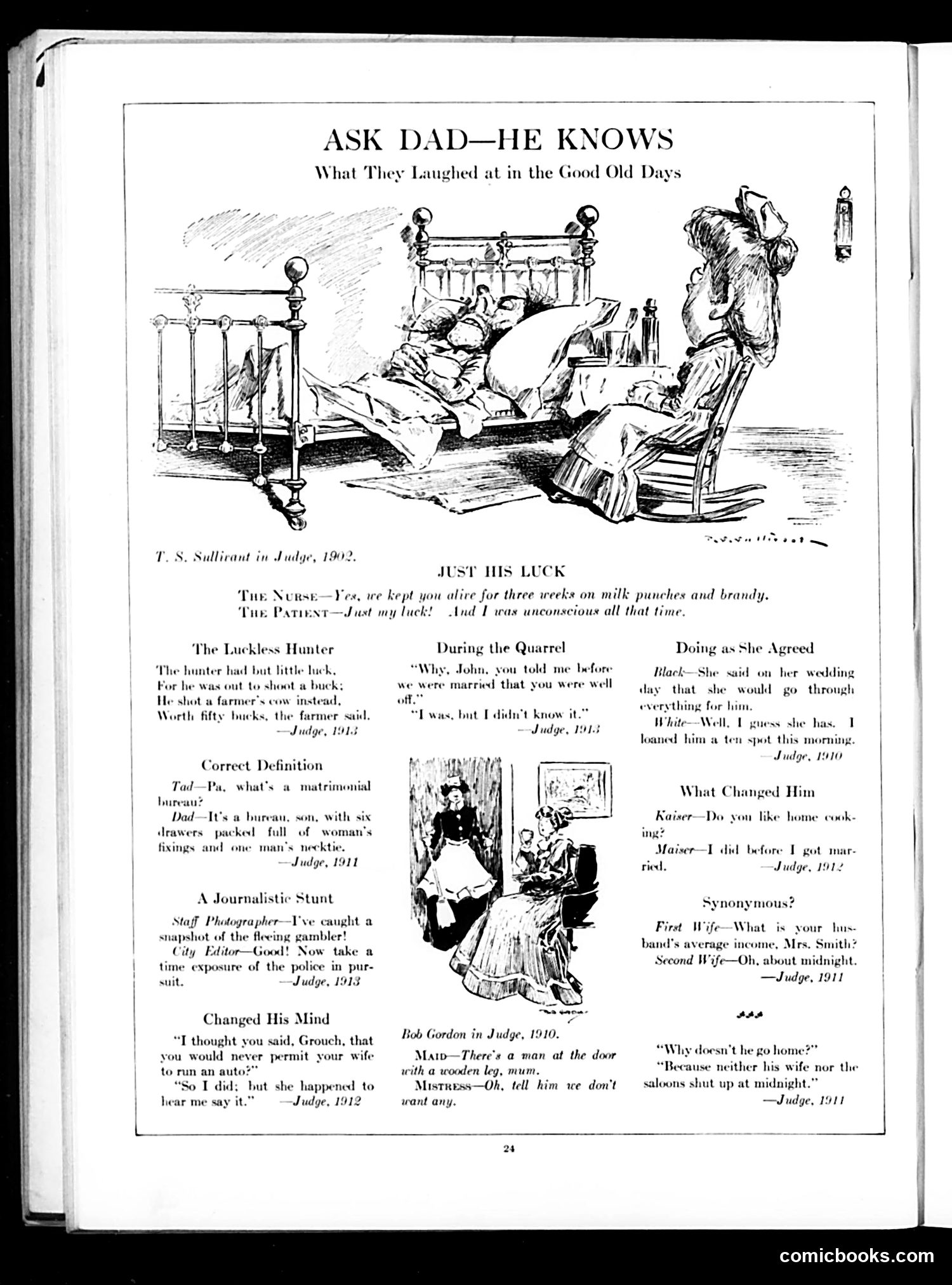
This page collects brief humorous anecdotes labeled "Ask Dad—He Knows," representing popular jokes from an earlier era. The humor targets familiar domestic and social anxieties of the early 1900s: **Key themes:** - **Marriage complaints**: wives portrayed as spendthrifts or nagging ("Correct Definition" mocks matrimonial bureaus as drawers of women's belongings); husbands lose freedom post-marriage ("What Changed Him") - **Gender roles**: the "Maid" and "Mistress" joke reflects servant-class hierarchies; women's unpredictability is mocked - **Male vices**: gambling, drinking, and avoiding home are normalized male behavior ("Why doesn't he go home?") - **Class humor**: references to "fleeing gamblers" and working-class servants The cartoons assume male readership amused by marital discord and female stereotypes. Modern readers should recognize this reflects dated attitudes toward women, marriage, and class, presented as universal truth rather than satirical critique.
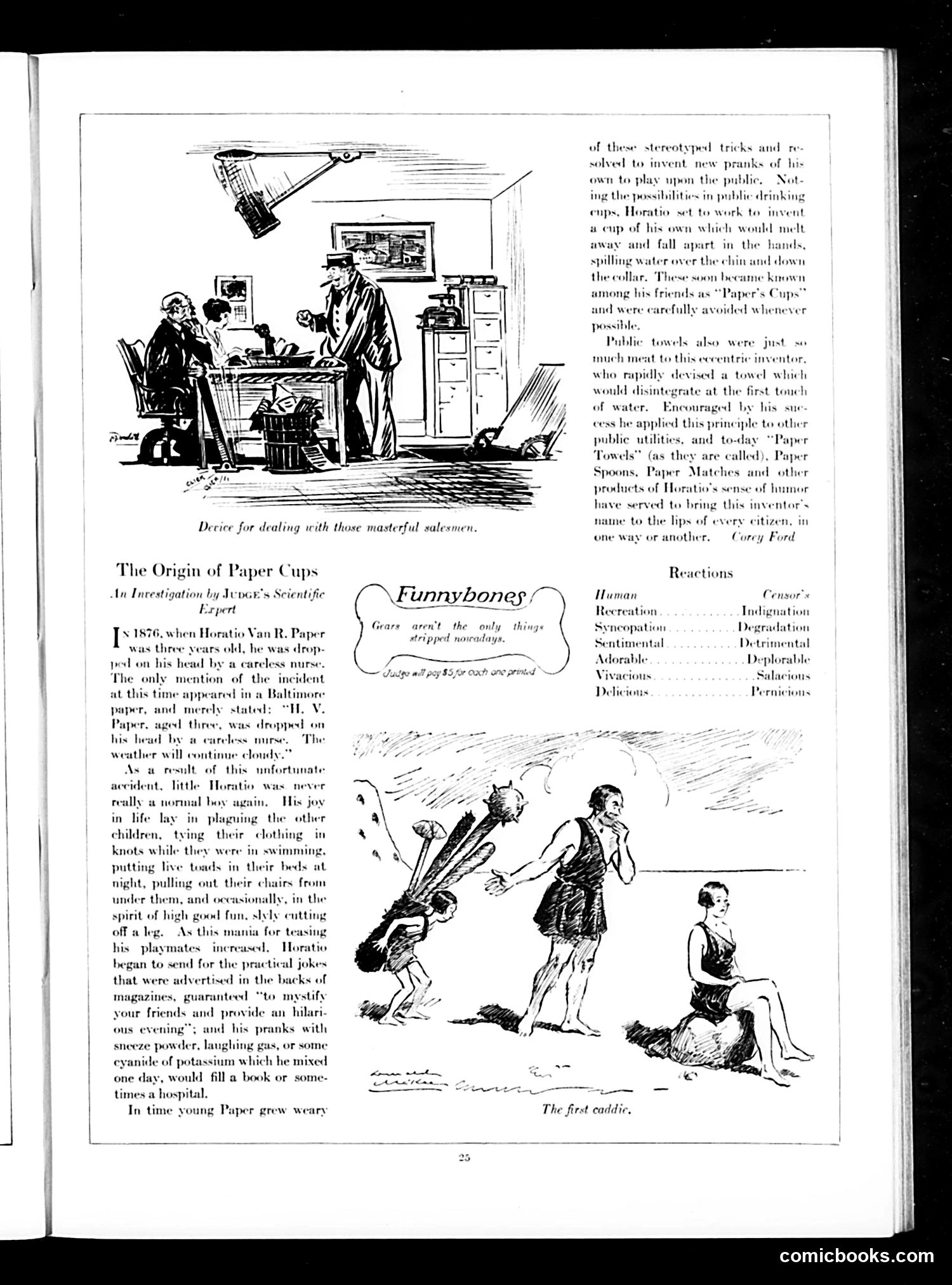
This page satirizes Horatio Van H. Paper, a fictional eccentric inventor credited with inventing disposable paper cups, paper towels, and paper matches. The satire traces his origin story: as a mischievous child in 1876, Paper was dropped on his head by a nurse, supposedly explaining his lifelong obsession with practical jokes and inventions designed to frustrate people. The humor lies in the absurd premise that someone would deliberately invent products meant to *fail* — cups that dissolve, towels that disintegrate, etc. — played as elaborate pranks on the public. The accompanying "Reactions" chart humorously lists human responses to such pranks (indignation, degradation, etc.). The lower cartoon illustrates the "first cuddle" — presumably showing the chaotic results of these faulty products in action. It's a parody of the "Great Man" origin story, mocking both Victorian biography conventions and newfangled disposable products.
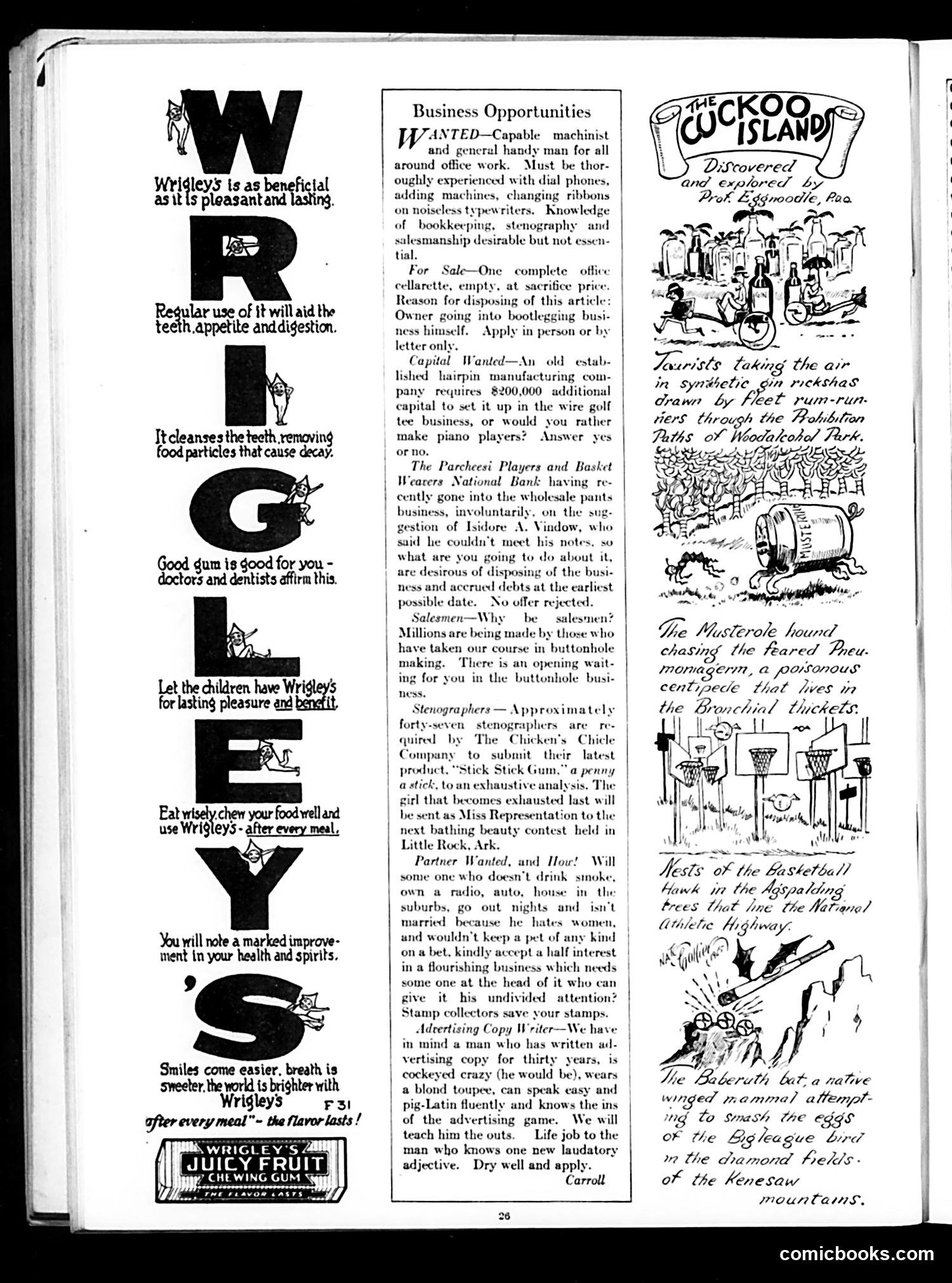
This page combines **Wrigley's chewing gum advertising** (left side) with **satirical "Business Opportunities" classifieds** (center) and **whimsical "Cuckoo Island" cartoon vignettes** (right side). The classifieds mock Prohibition-era desperation and absurdity. One advertiser is "going into bootlegging business"—a direct reference to illegal alcohol manufacturing during Prohibition (1920-1933). Other entries satirize economic instability: a bank that "involuntarily" entered the pants business, hairpin manufacturers pivoting to golf tees, and buttonhole-making courses offering dubious job prospects. The "Cuckoo Island" cartoons parody nature documentaries with surreal invented creatures and situations—tourists in "synthetic gin rickshas," a "Musterole hound" (referencing a real liniment brand), and baseball hawks nesting in trees. These mock pseudo-scientific exploration narratives popular in magazines of the era. Together, the page satirizes post-WWI economic chaos, Prohibition's absurd consequences, and the era's credulous consumption of advertising and pseudoscientific content.
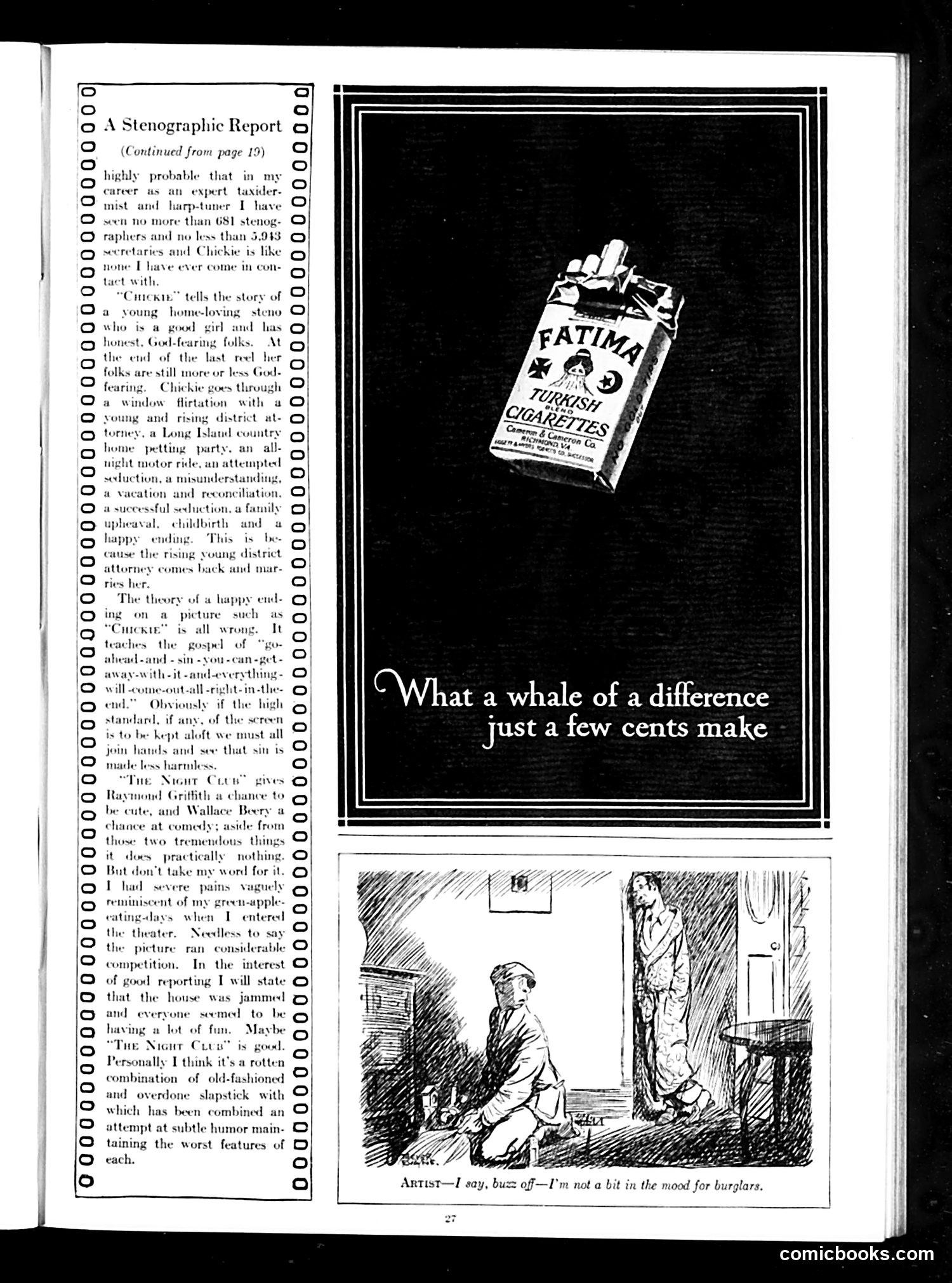
This page contains a **film review** of two movies alongside a **cigarette advertisement** and a **cartoon joke**. The main text critiques "Chickie," a silent film about a virtuous stenographer whose happy ending—marrying a district attorney after various romantic entanglements—the reviewer finds morally problematic. The critic argues such endings undermine religious values by suggesting sin goes unpunished. The **Fatima Turkish Cigarettes advertisement** uses the slogan "What a whale of a difference just a few cents make," playing on product cost differentiation as a selling point. The **cartoon at bottom** shows a burglar confronting a man, with the caption "I say, buzz off—I'm not a bit in the mood for burglars." This is wordplay humor: the man claims he's not receptive to burglary, treating the crime as an unwanted social intrusion rather than a serious threat—a absurdist joke typical of Judge's satirical style. The page reflects 1920s concerns about cinema's moral influence alongside period advertising practices.
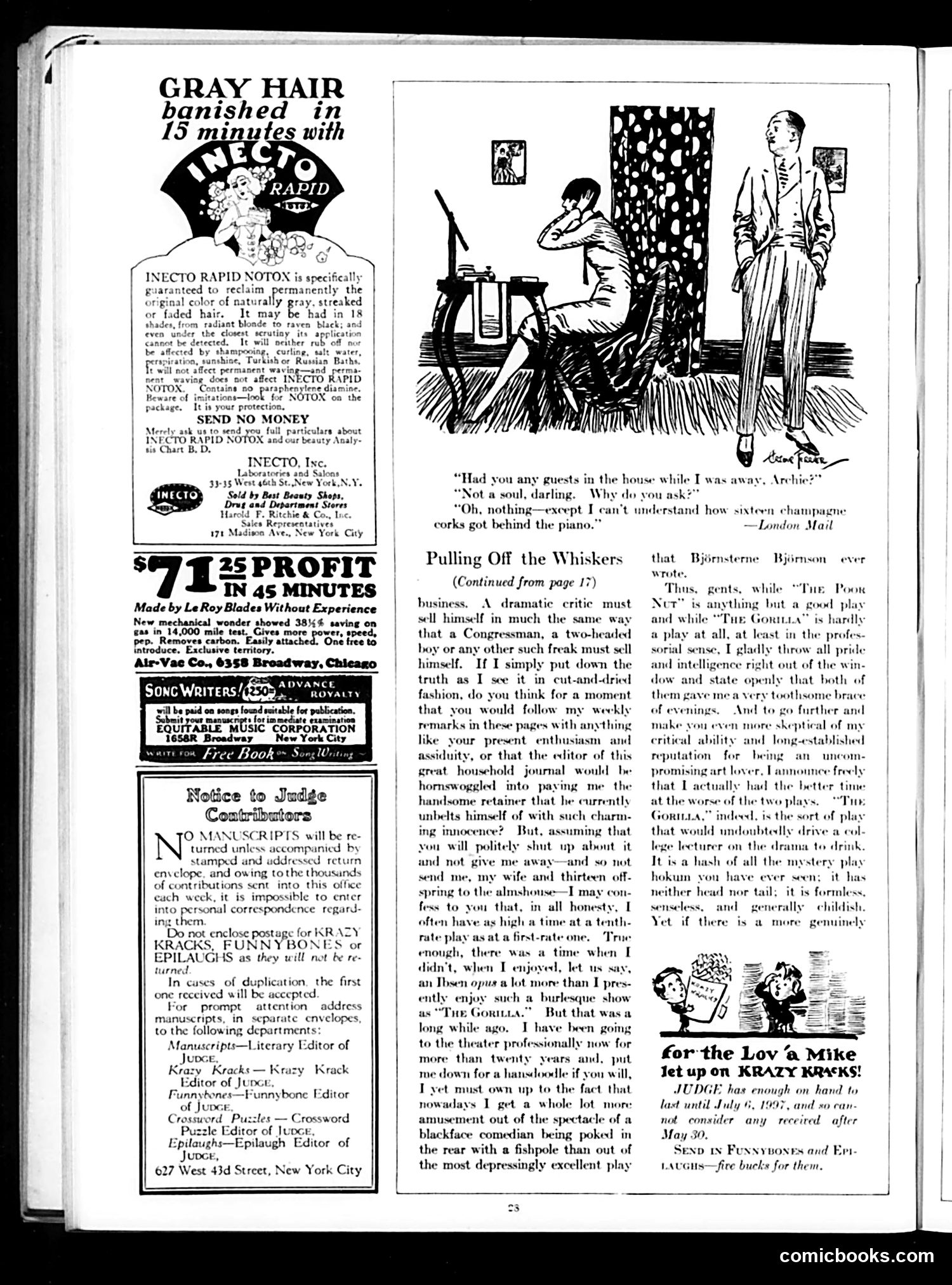
This page contains primarily **advertisements and editorial notices** rather than political satire. The main cartoon shows a domestic scene where a husband returns home to find his wife at the piano; he notices champagne corks behind it, suggesting she entertained guests despite claiming "not a soul" visited. This is a **humor cartoon about marital deception**—a common Jazz Age theme. The bulk of the page features ads for hair dye (Inecto Rapid) and mechanical car parts, plus contributor guidelines. The only substantive editorial content is "Pulling Off the Whiskers" (continued from page 17), a **theater critic's essay** arguing that dramatic critics must sensationalize to maintain readership, even when they privately enjoy lowbrow entertainment like blackface comedy more than serious plays. The critic confesses this gap between professional standards and personal taste somewhat cynically. No specific political figures or events are referenced on this page.
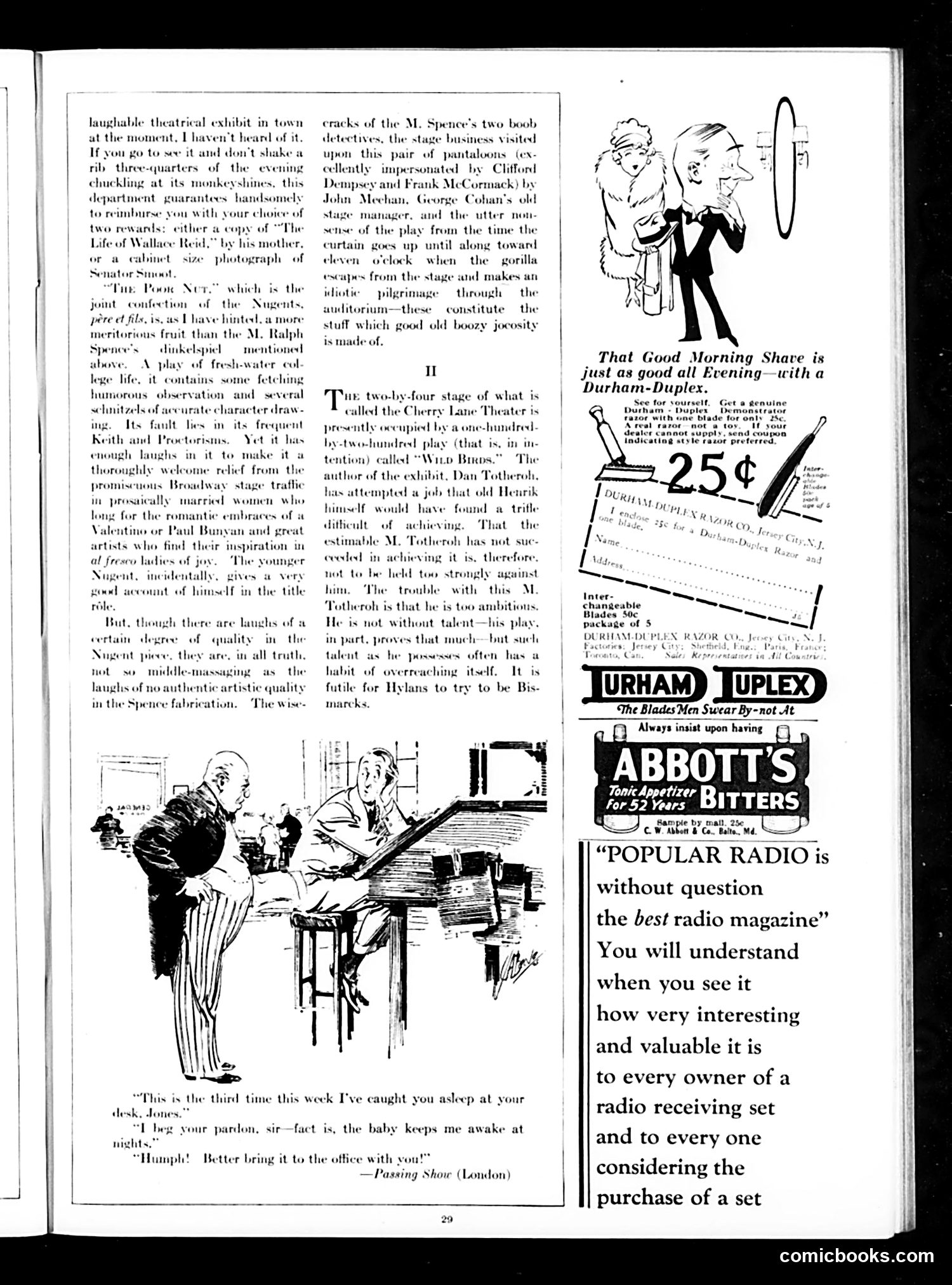
This page contains theater criticism rather than political satire. The main text reviews two Broadway productions: a play featuring the Nugent theatrical family, and "Wino Dregs" by Dan Totheroh at the Cherry Lane Theater. The **cartoon below** depicts a humorous domestic scene where a boss catches an employee sleeping at his desk. The joke plays on the employee's desperate excuse—blaming his baby for keeping him awake—only to be told to bring the disruption to the office. The page is primarily filled with **period advertisements** for consumer products (Durham-Duplex razor blades, Abbott's Bitters tonic, and Popular Radio magazine), which was typical magazine filler of this era. The theater criticism judges the plays' comedic merit and artistic ambition, noting one author (Totheroh) is "too ambitious" for his talent—a common early 20th-century criticism of overreaching dramatists.
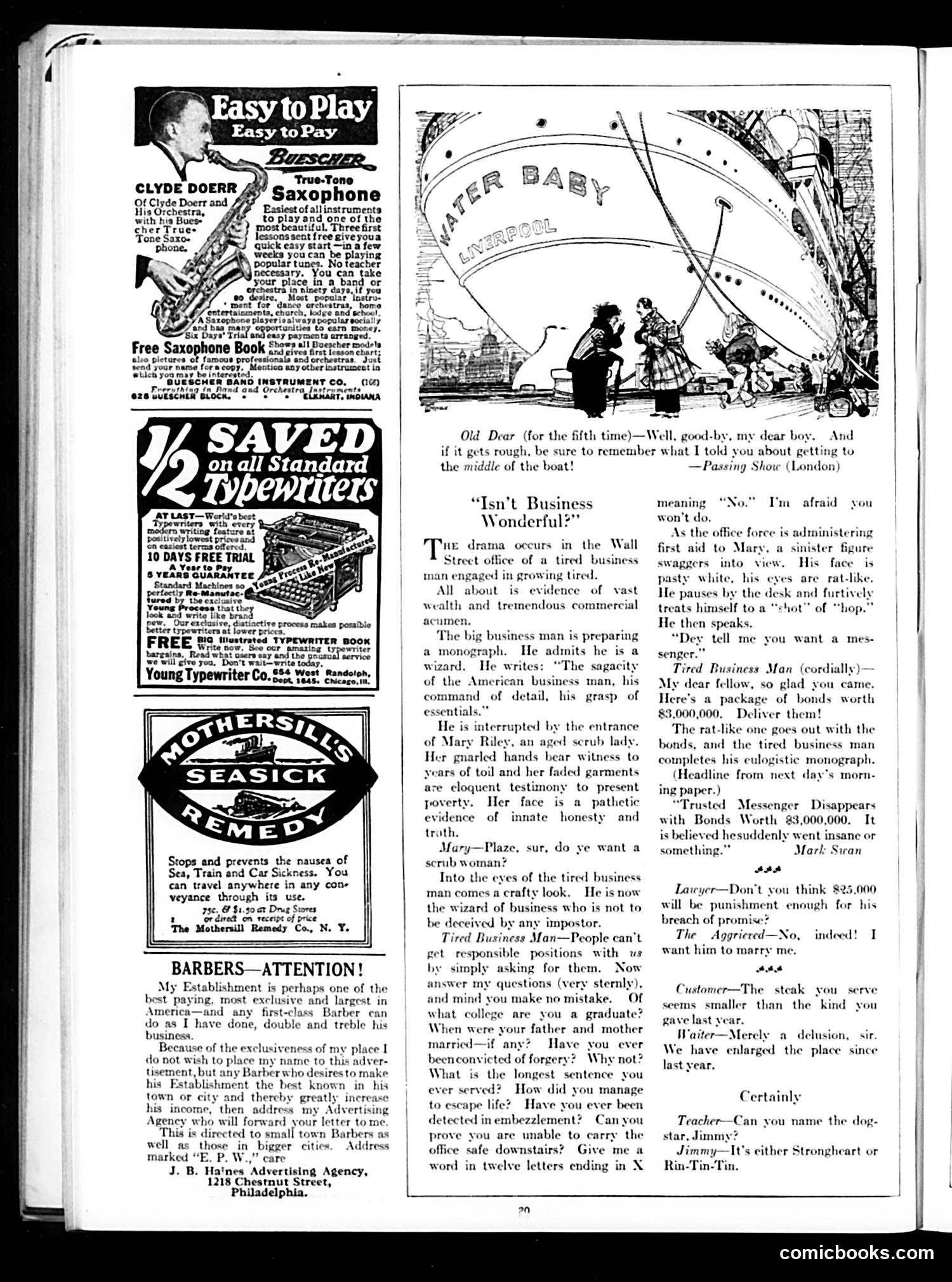
This page contains primarily **advertisements** interspersed with a single **satirical cartoon/story** titled "Isn't Business Wonderful?" ## The Main Satire The cartoon mocks **wealthy Wall Street businessmen** during the era of American industrial expansion. A successful businessman, absorbed in writing a self-congratulatory monograph about "the sagacity of the American business man," is interrupted by **Mary Riley, an elderly cleaning woman**—visibly impoverished after years of labor. The satire's point: when Mary applies for a responsible position, the businessman responds with absurdly hostile and irrelevant questions (about her parents' marriage, criminal history, etc.), revealing his hypocrisy. He celebrates his own business acumen while cruelly rejecting a desperate elderly worker. The illustration of Mary approaching an enormous ship labeled "Water Baby" reinforces the image of ordinary people dwarfed by industrial wealth. **Social context**: This reflects Progressive Era concerns about labor exploitation and wealth inequality—the contrast between the businessman's self-importance and his callousness toward working poor. The surrounding ads (saxophone lessons, typewriters, seasickness remedy, barber recruitment) are typical period commercial content.
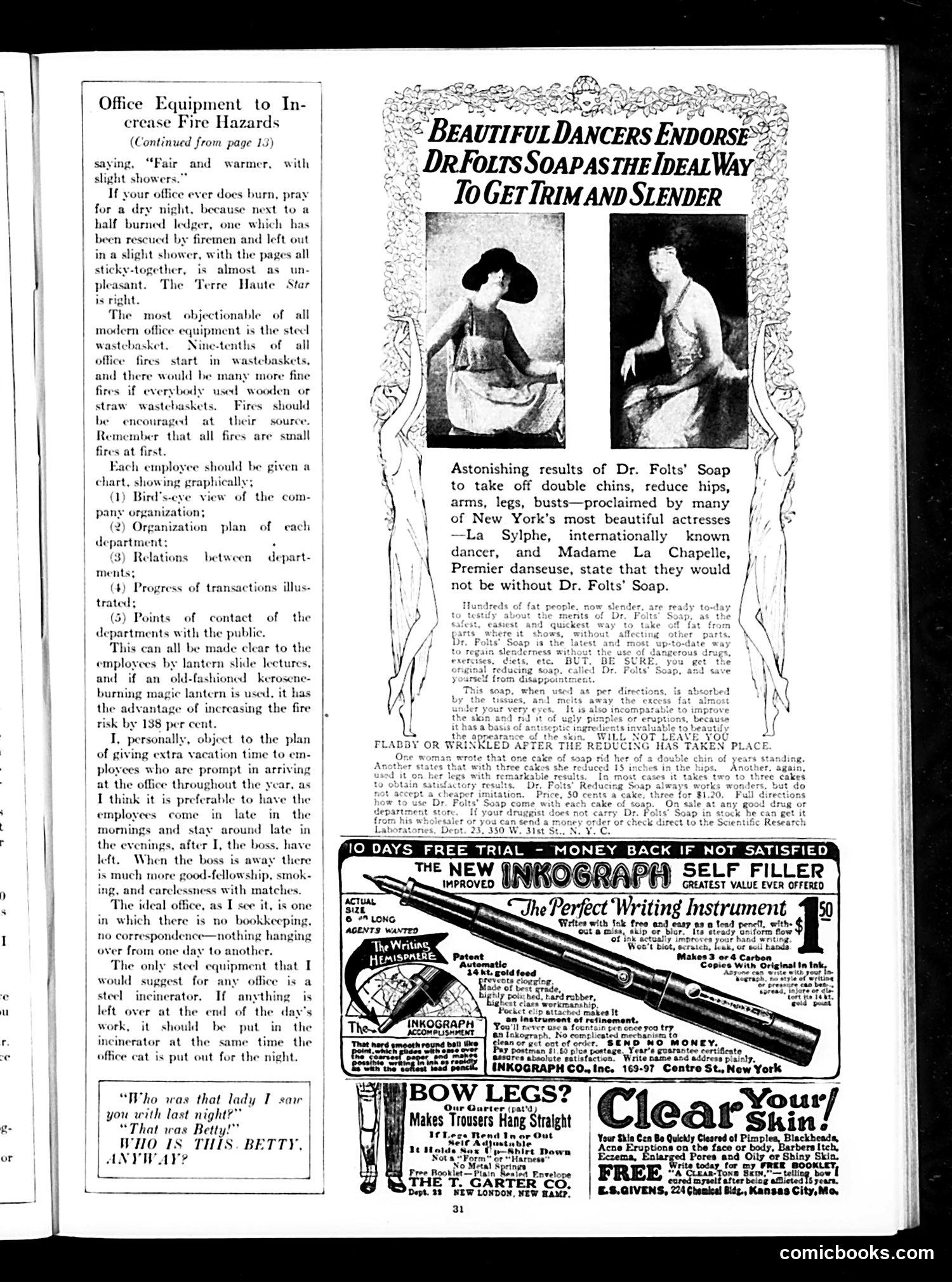
This page is primarily **advertising**, not political satire. The dominant content consists of four commercial advertisements: 1. **Dr. Folts' Soap** (top): Features two women endorsing a weight-loss soap, claiming it reduces double chins, hips, and other body parts. The endorsers are identified as "La Sylphe" and "Madame La Chapelle," described as New York dancers and performers. 2. **Inrograph Self-Filler** (middle): Promotes an improved fountain pen as "the Perfect Writing Instrument." 3. **Bow Legs Corrector** (bottom left): Advertises a device to straighten trouser legs and correct bow legs. 4. **Clear Your Skin** (bottom right): Promotes skin-clearing treatment for pimples, blackheads, and enlarged pores. The left column contains a satirical article about office fire hazards (continued from page 13), recommending wastebasketed and steel incinerators. This is the only editorial content on the page—the rest is commercial material typical of early 20th-century magazines.
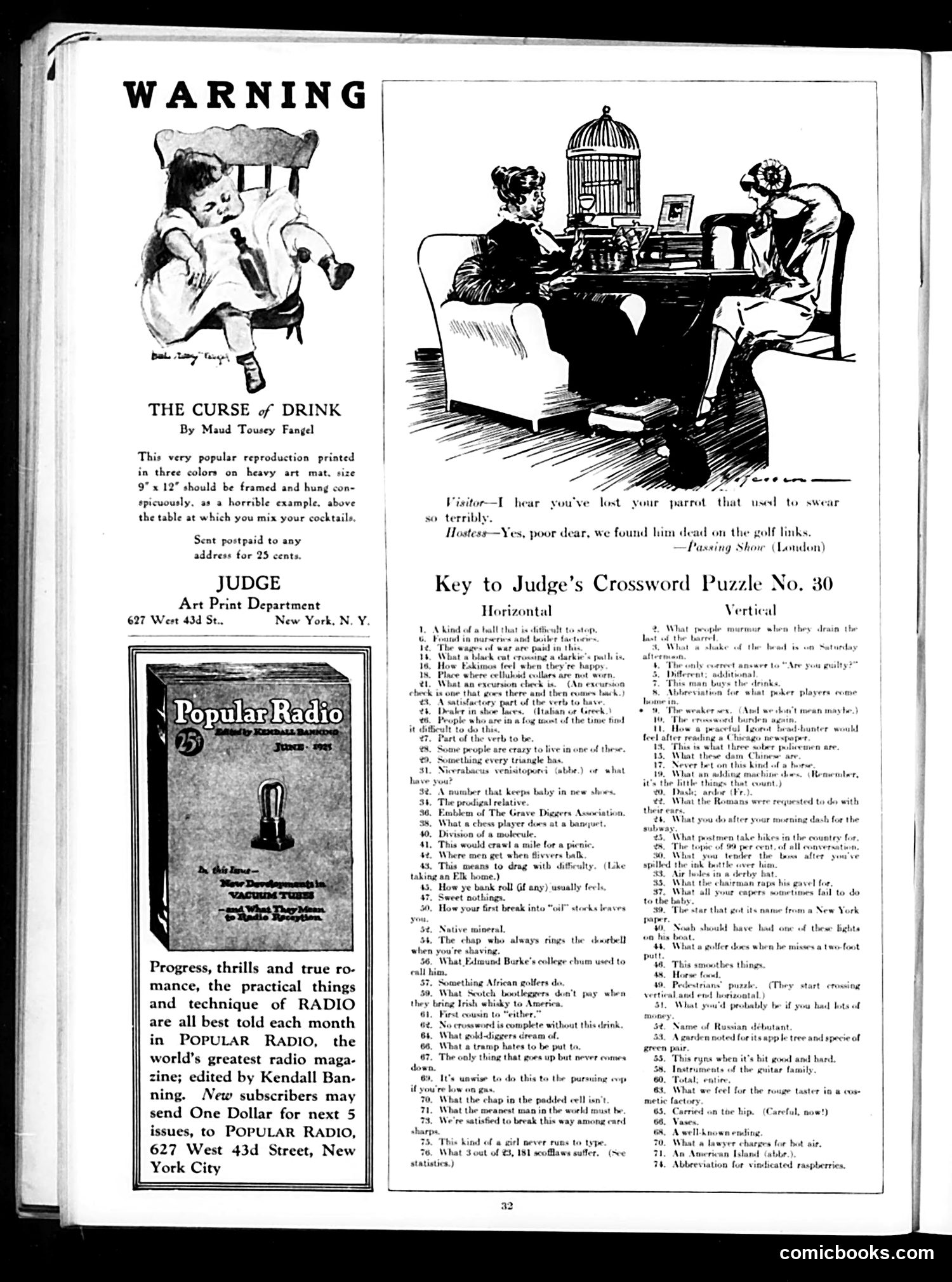
This page contains **advertisements and puzzles** rather than political cartoons. The main content includes: **"The Curse of Drink"** — A framed art print (9"x12") by Maud Tousey Fangel depicting a disheveled drunk, intended to hang "conspicuously...above the table at which you mix your cocktails." This is Prohibition-era moral messaging, presenting alcohol consumption as a cautionary social evil worthy of display in homes. **A social cartoon** shows two women discussing a dead parrot found "on the golf links." The parrot reportedly "used to swear so terribly"—humor based on the bird's crude language and its demise in an upper-class leisure setting. The page also advertises **Popular Radio magazine** and includes a crossword puzzle with clues referencing 1920s-era concerns: Prohibition ("complete without this drink"), bootleggers, and contemporary slang. The overall tone reflects Jazz Age anxieties about modernity, alcohol, and social propriety.
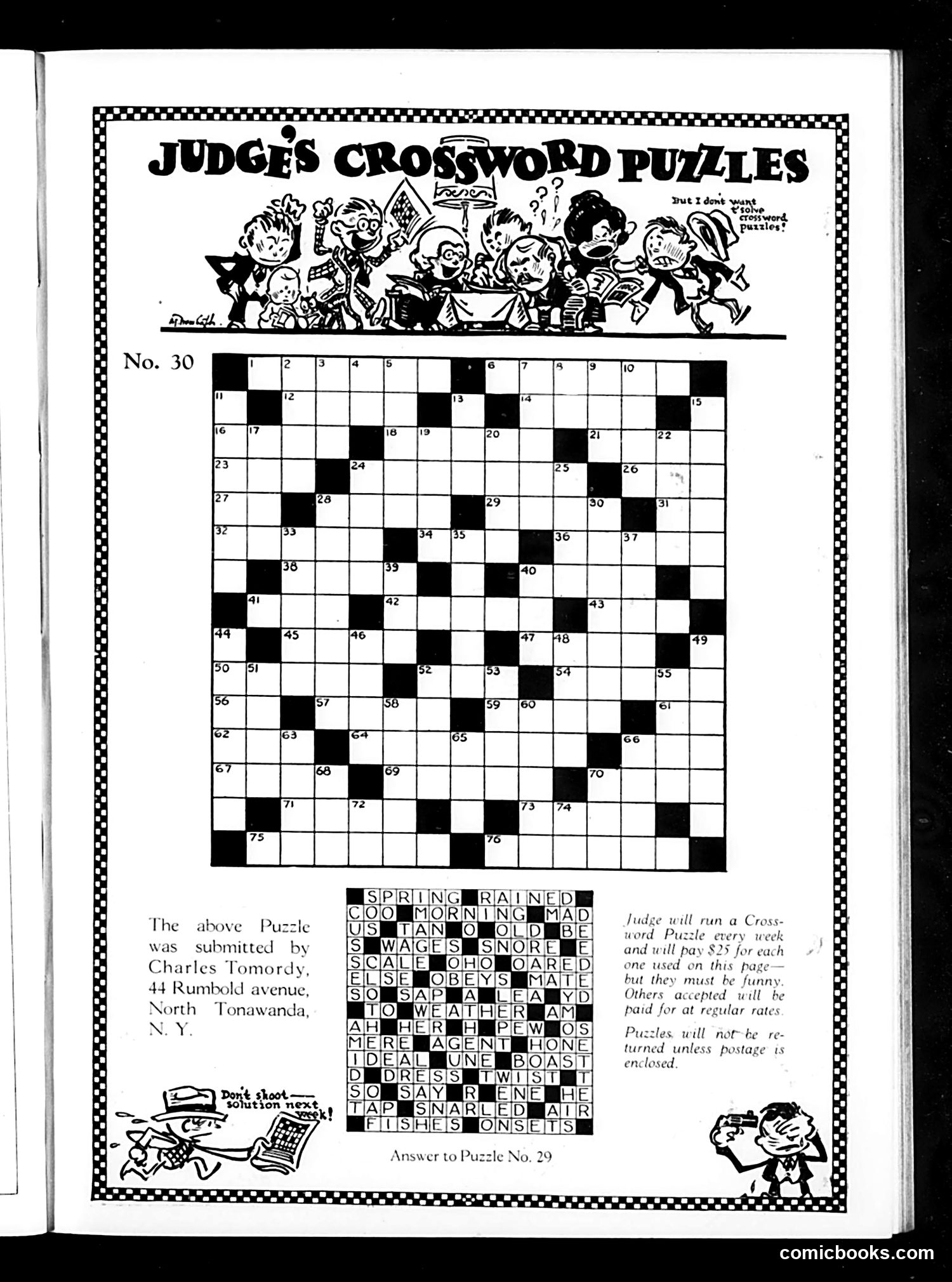
This page showcases **Judge's crossword puzzle contest** — a reader participation feature typical of 1920s-30s magazines. The publication invited readers to submit original crossword puzzles, paying $25 for those deemed "funny" enough to publish, with lower rates for others accepted. The header cartoon shows cartoon characters celebrating crosswords, reflecting their explosive popularity during this era—crosswords were a cultural phenomenon that swept America in the 1920s. The actual content is primarily **procedural**: submission details (Charles Tomordy's puzzle from North Tonawanda, N.Y.), rules (puzzles won't be returned without postage), and the answer grid to the previous week's puzzle (No. 29). The satire is gentle—the requirement that puzzles "must be funny" suggests Judge's effort to elevate the form beyond mere word games into humorous commentary. This represents how magazines positioned themselves as arbiters of taste while capitalizing on public enthusiasm.
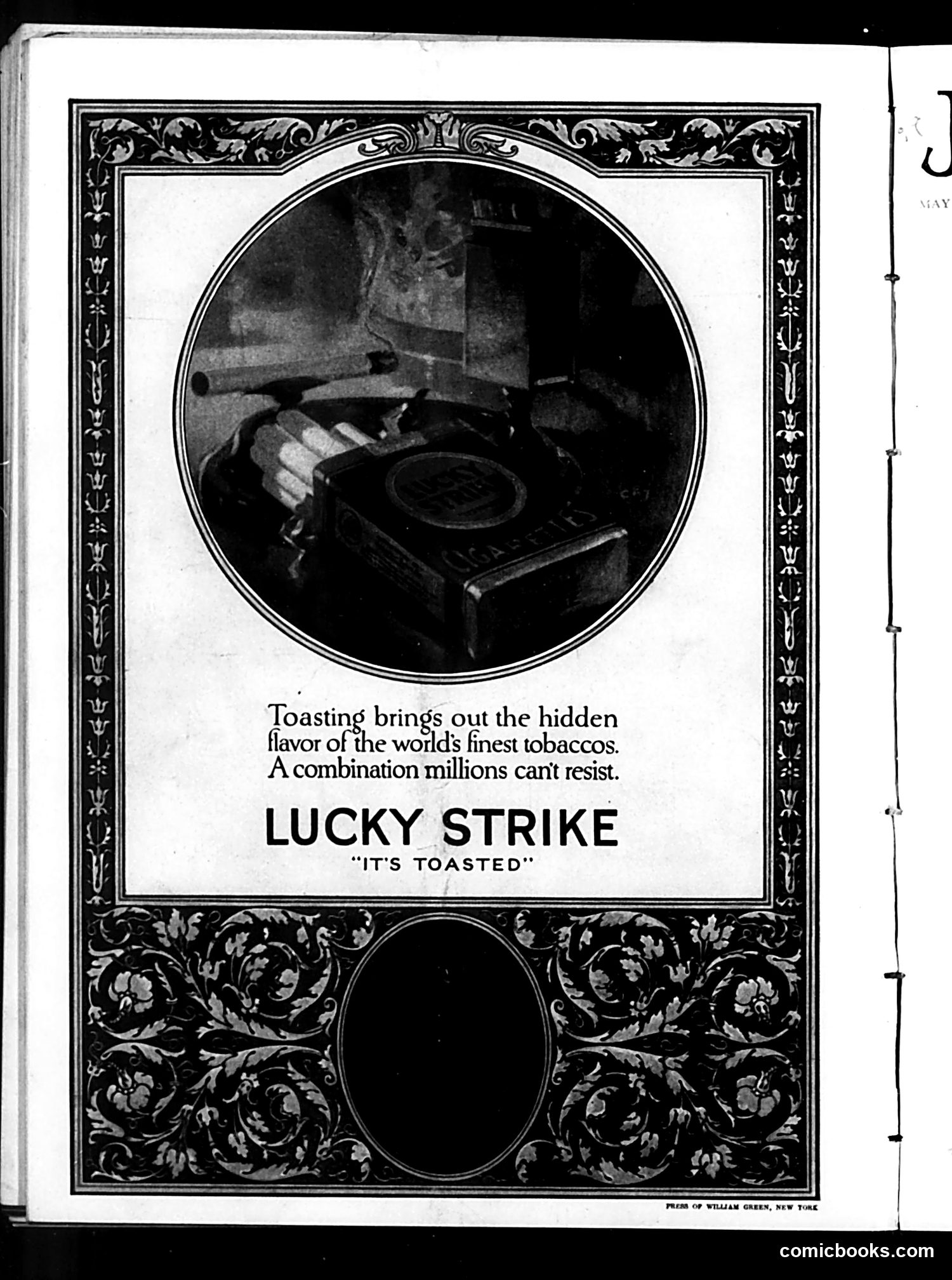
This is a **cigarette advertisement**, not a cartoon or satirical content. It's a Lucky Strike ad from Judge magazine promoting their "toasted" tobacco process. The image shows tobacco being toasted in what appears to be an industrial roasting mechanism. The ad claims toasting brings out hidden flavors and creates "a combination millions can't resist." This reflects early 20th-century advertising before tobacco health warnings. Lucky Strike's "It's Toasted" was their actual marketing slogan emphasizing a purported manufacturing advantage. The ornate decorative border was typical of period magazine design. There is no political satire or social commentary on this page—it's straightforward product promotion.