
Judge, 1925-05-23 · page 17 of 36
Judge — May 23, 1925 — page 17: what you’re looking at
What you’re looking at
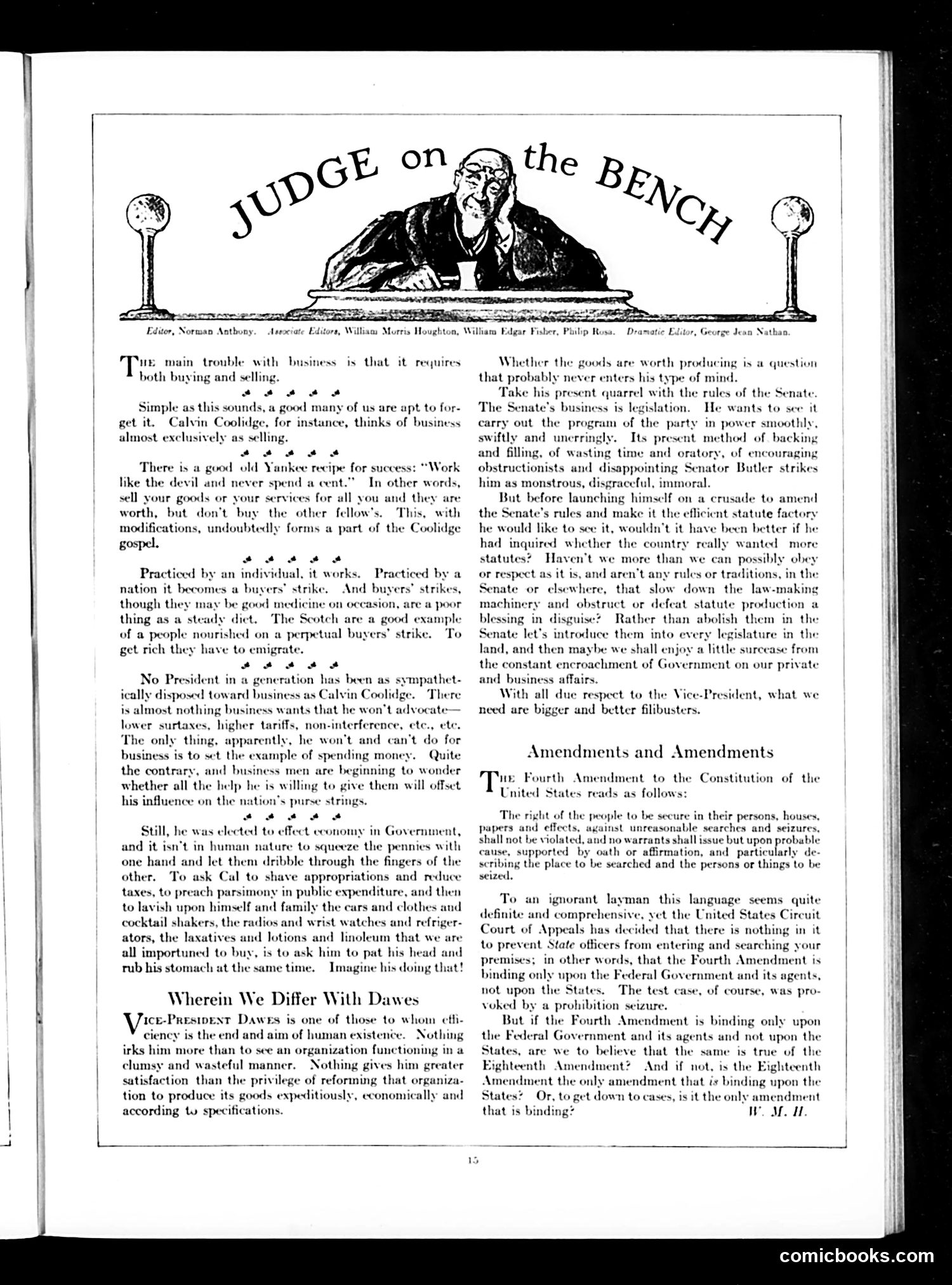
This page satirizes President Calvin Coolidge and Vice-President Charles Dawes through two separate editorial pieces. **"The Main Trouble with Business"** criticizes Coolidge's economic philosophy. The cartoon's judge figure appears to represent editorial commentary. The text argues that while Coolidge promotes business-friendly policies (lower taxes, tariffs, non-interference), he undermines them by personally exemplifying extreme frugality—refusing to spend money himself. This creates a contradiction: he asks citizens to consume and stimulate the economy while modeling stingy behavior. The satire suggests his "purse-string" influence on the nation negates his pro-business rhetoric. **"Wherein We Differ With Dawes"** attacks Vice-President Dawes for pursuing efficiency as an end in itself, particularly regarding Senate procedures. The critique argues Dawes wants to streamline legislation production without questioning whether new laws are actually needed or beneficial. The author suggests existing regulations already burden citizens excessively, and that procedural slowdowns—"blessings in disguise"—protect against government overreach. Both pieces mock Republican leadership for misunderstanding economic and governmental realities.
📄 Transcribed text from this page (OCR, searchable)
Machine-transcribed from the original scan — historical spelling and the odd misread are preserved.
— Tt" main trouble with business is that it requires both buying and selling. “464 ow Simple as this sounds, a good many of us are apt to for- get it. Calvin Coolic or instance, thinks of business almost exclusively as selling. “4a os There is a good old Yankee recipe for success: “Work like the devil and never spend a cent.” In other words, sell your goods or your services for all you and they are worth, but don’t the other fellow’s. This, with modifications, undoubtedly forms a part of the Coolidge gospel. sa a ee Practiced by an individual, it works. Practiced by a nation it becom: buyers’ strike, And buyers’ strikes, though they may be good medicine on occasion, are a poor thing as a steady diet. The Scotch are a good example of a people nourished on a perpetual buyers’ strike. To get rich they have to emigrate. se a ae No President in a generation has been as sympathet- ically disposed toward business as Calvin Coolidge. There is almost nothing business wants that he won't advocate— lower surtaxes, higher tariffs, non-interference, ete., ete. ‘The only thing, apparently, he won't and can't do for business is to set the nple of spending money. Quite the contrary, and business men are beginning to wonder whether all the help he is willing to give them will offset his influence on the nation’s purse strings. Pad Still, he was elected to and it isn’t in human one hand and let them dribble through the fingers of the other. To ask Cal to shave appropriations and reduce taxes, to preach parsimony in public expenditure, and then to lavish upon himself and family the cars and clothes and cocktail shakers, the radios and wrist watches and refriger- ators, the laxatives and Jotions and linoleum that we are all importuned to buy, is to ask him to pat his head and rub his stomach ut the same time. Imagine his doing that! Wherein We Differ With Dawes ice-Presipent Dawes is one of those to whom etli- ciency is the end and aim of human existence. Nothing irks him more than to see an organization functioning in a clumsy and wasteful manner. Nothing gives him greater satisfaction than the privilege of reforming that organiza- tion to produce its goods expeditiously, economically and according tu specifications. saw ect economy in Government, to squeeze the pennies with ature Whether the goods are worth producing is a question that probably never enters his type of mind. Take his present quarrel with the rules of the Senate. The Senate's business is legislation. He wants to see it carry out the program of the party in power smoothly, swiftly and unerri Its present method of backing and filling, of wasting time and oratory, of encouraging obstructionists and disappointing Senator Butler strikes him as monstrous, disgraceful, immoral. But before launching himself on a crusade to amend the Senate's rules and make it the eflicient statute factory he would like to see it, wouldn’t it have been better if he had inquired whether the country really wanted more statutes? Haven't we more than we can possibly obey or respect as it is, and aren't any rules or traditions, in the Senate or elsewhere, that slow down the law-making machinery and obstruct or defeat statute production a blessing in disguise? Rather than abolish them in the Senate let's introduce them into every legislature in the land, and then maybe we shall enjoy a little surcease from the constant encroachment of Government on our private and business affairs. With all due respect to the Vic need are bigger and better filibusters. resident, what we Amendments and Amendments Fourth Ani ‘nited States Iment to the Constitution of the 1s as follows: The right of the people to be secure in their persons, houses, papers and effects, against unreasonable searches and seizures, shall not be violated, and no warrants shall issue but upon probabl cause, supported by oath or affirmation, and particularly scribing the place to be searched and the persons or things to be seized, To an ignorant layman this language seems quite definite and comprehensive, yet the United States Circuit Court of Appeals has decided that there is nothing in it to prevent State officers from entering and searching your premises; in other words, that the Fourth Amendment is binding only upon the Federal Government and its agents, hot upon the States. The test cas voked by a prohibition seizure. But if the Fourth Amendment is binding only upon the Federal Government and its agents and not upon the States, are we to believe that the same is true of the Eighteenth Amendment? And if not, is the Eighteenth Amendment the only amendment that is binding upon the ) et down to cases, is it the only amendment WM if course, was pro- comicbooks.com