
A complete issue · 36 pages · 1925
Judge — May 16, 1925
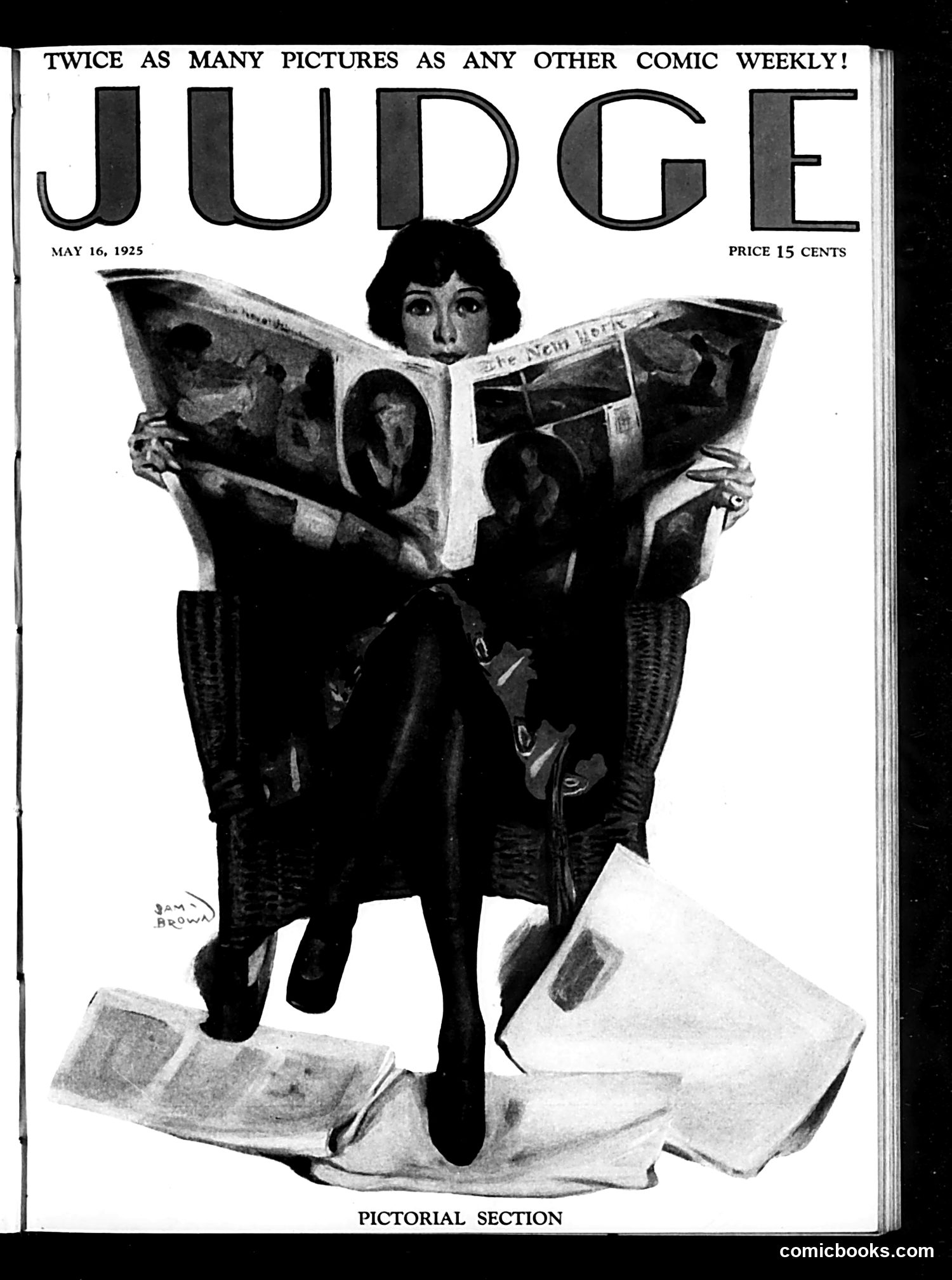
This cover depicts a woman reading a newspaper while surrounded by scattered papers at her feet—a visual metaphor for information overload. The headline "Twice as Many Pictures as Any Other Comic Weekly" is promotional, boasting Judge's pictorial content. The satire appears to target modern newspaper consumption habits, specifically how readers (particularly women, given the figure's presentation) were overwhelmed by the expanding volume of daily news and illustrations in the 1920s. The woman's somewhat bewildered expression and the papers scattered around her suggest the exhausting, almost chaotic nature of staying informed in an increasingly media-saturated era. The "Pictorial Section" label confirms this is promoting Judge's competitive advantage in visual storytelling during a period when illustrated weeklies competed heavily for readers.
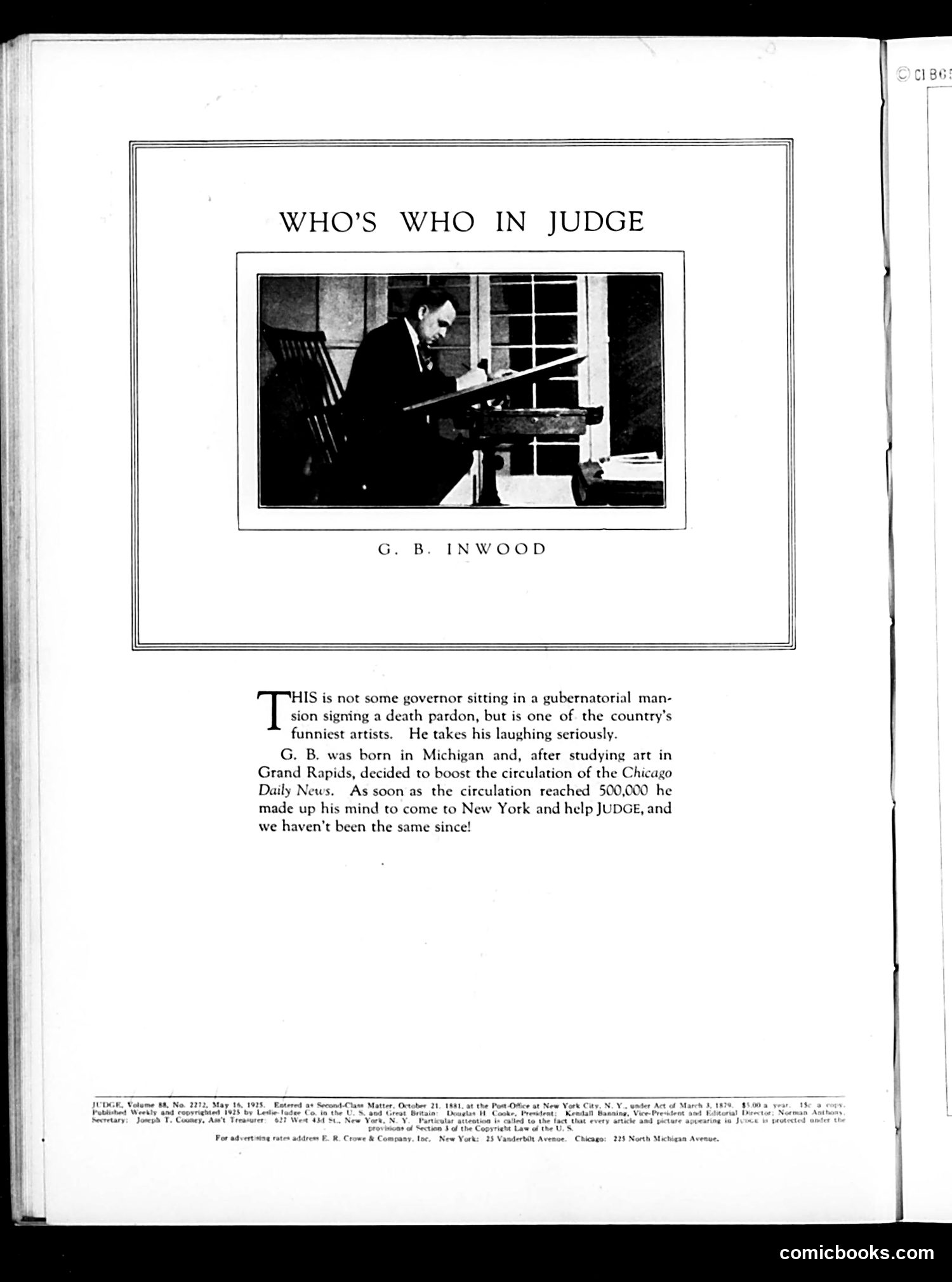
This page profiles **G.B. Inwood**, described as "one of the country's funnest artists" who "takes his laughing seriously." The accompanying text explains that Inwood was born in Michigan, studied art in Grand Rapids, then worked for the *Chicago Daily News*. Once that paper's circulation reached 500,000, he relocated to New York to contribute to *Judge* magazine itself. The photograph shows him at work at a drafting table, appearing to sketch or draw. The feature is essentially a biographical introduction to a staff artist/cartoonist, celebrating his career trajectory and contribution to the publication. It's a common magazine practice of the era—showcasing creative talent to readers.
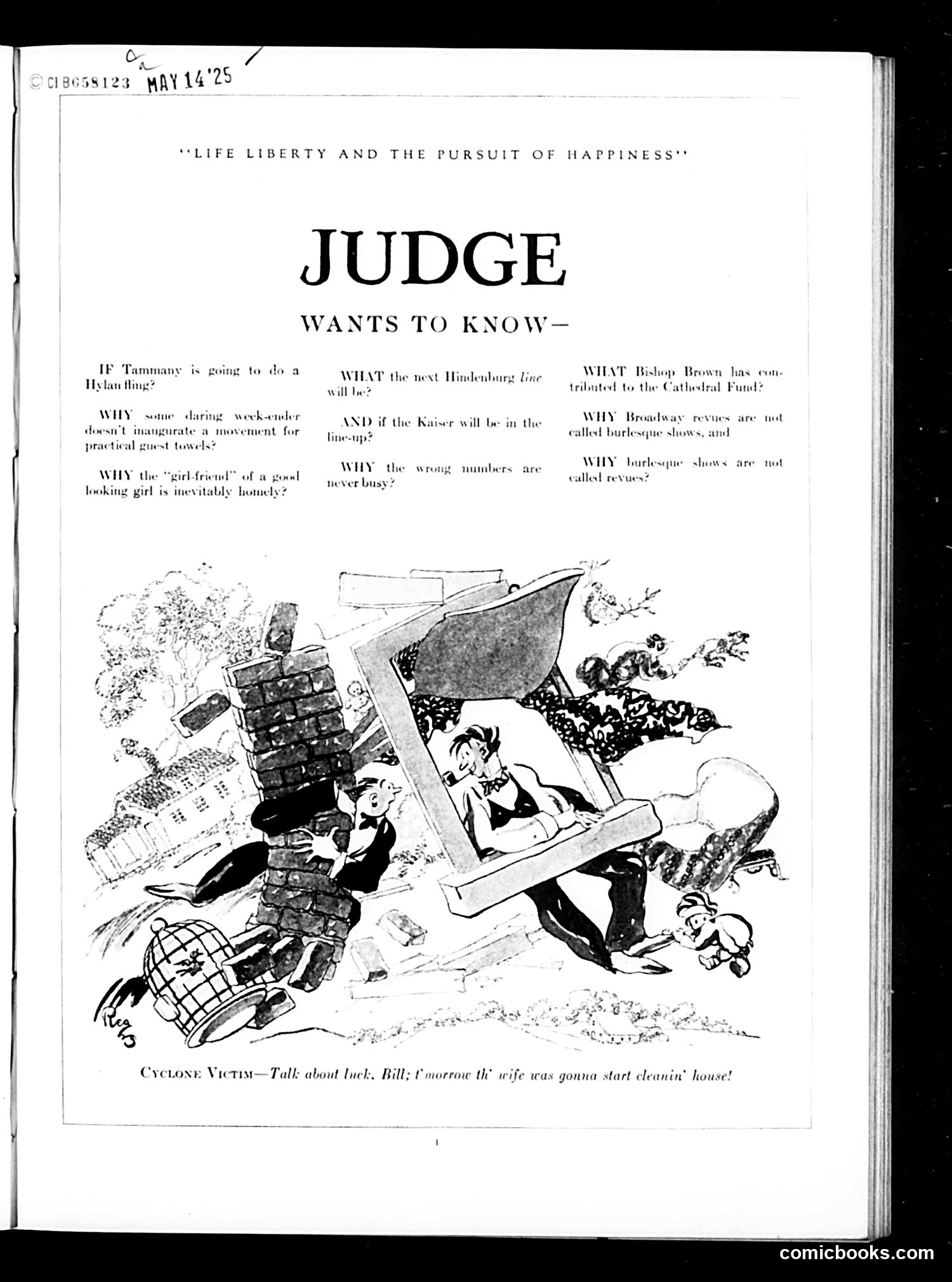
This Judge magazine page satirizes various contemporary social and political topics through a series of rhetorical questions posed to an unnamed "Judge" (the magazine's editorial voice). The questions appear to address early 20th-century concerns: Tammany Hall's political activities, the Hindenburg airship disaster, the Kaiser's involvement in a conflict, numbered lottery schemes, Broadway theater terminology, and religious donations. The accompanying cartoon depicts a man caught in a cyclone amid scattered household items and luggage, illustrating the chaos of natural disaster. The caption reveals dark humor—the disaster victim's immediate concern is explaining to his wife why he must discuss finances rather than acknowledge the destruction. The page reflects Judge's tradition of mixing political commentary with domestic humor and social observation.
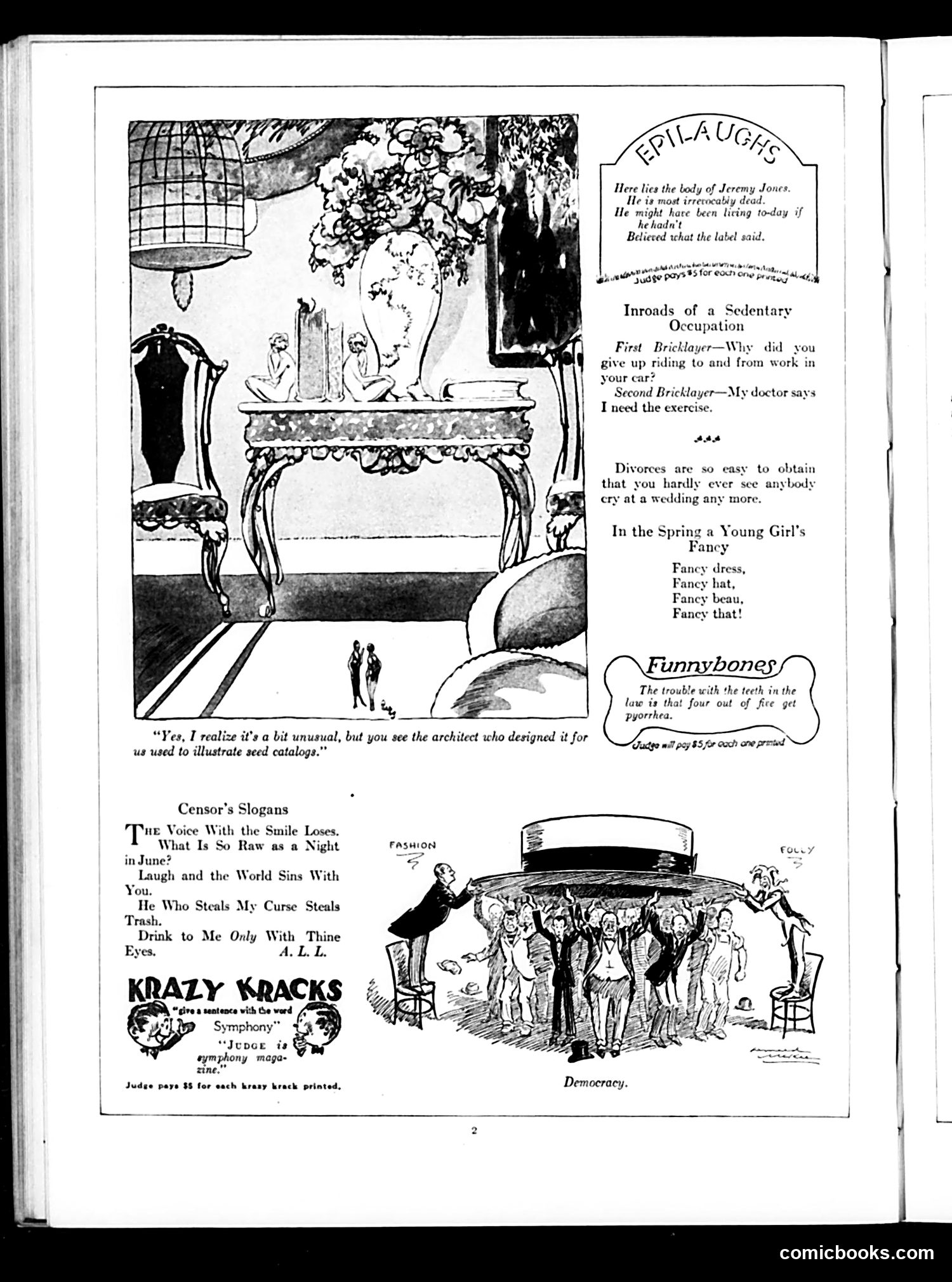
This page contains satirical humor and social commentary typical of early 20th-century Judge magazine. The main cartoon titled "Democracy" depicts a large, bulbous figure (representing Democracy itself or popular opinion) being held up by struggling citizens beneath an enormous hat, suggesting the burden of democratic governance on ordinary people. The surrounding content includes brief humorous observations on contemporary life: "Inroads of a Sedentary Occupation" jokes about workers avoiding commutes, divorce commentary notes how casual divorces have become, and "In the Spring a Young Girl's Fancy" offers lighthearted romantic humor. The page also advertises "Krazy Kracks" jokes and includes "Censor's Slogans"—likely satirizing wartime or political censorship through ironic patriotic phrases. The overall tone mixes political observation with everyday social satire.
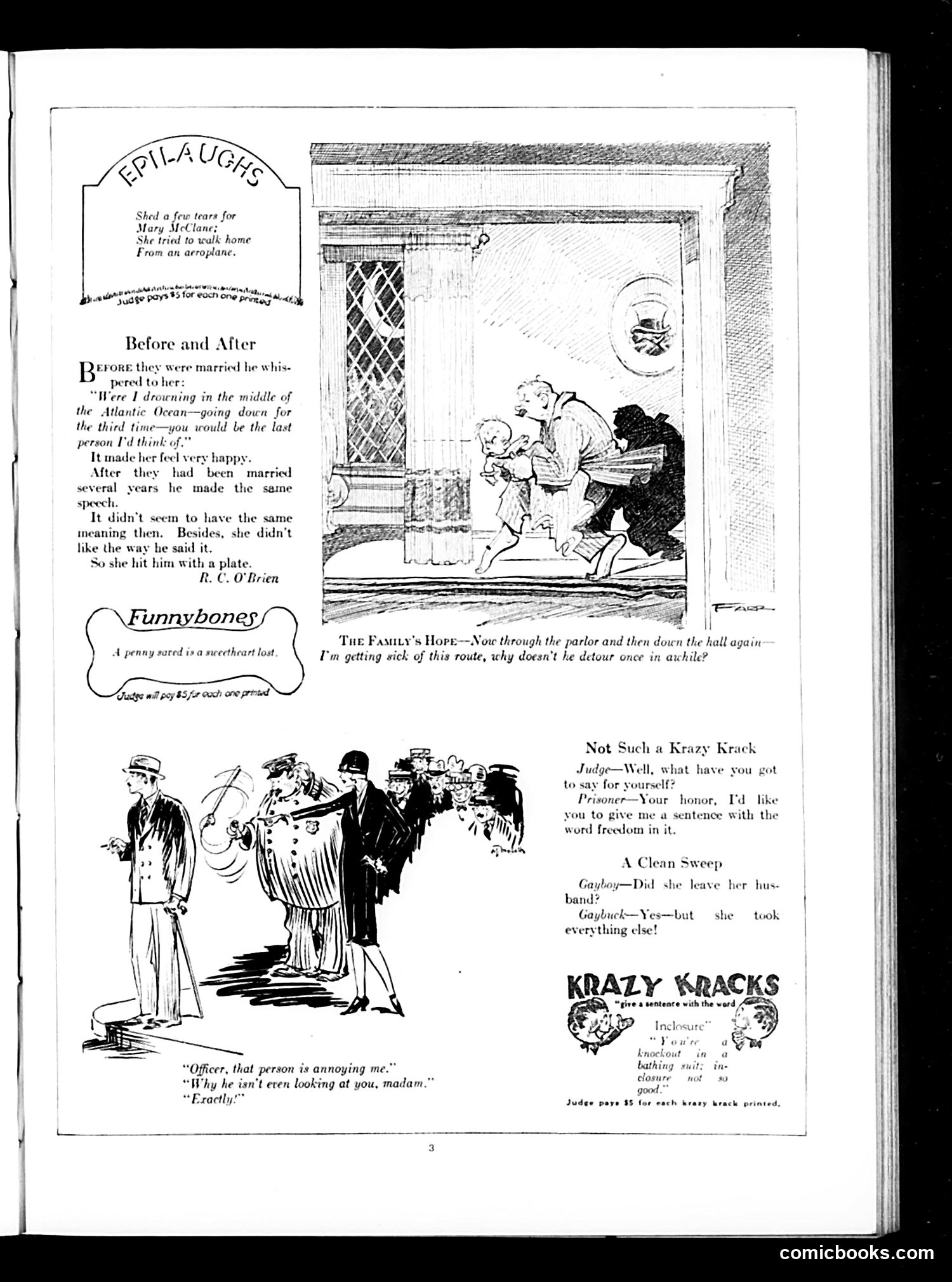
This page contains three separate humor pieces: 1. **"Before and After"** (top): A couple's marriage joke. The husband recalls pre-marriage talk of drowning in the ocean; afterward, she hits him with a plate instead—satirizing how marriage changes romantic ideals into domestic conflict. 2. **"Funnybones"** (middle-left): A brief one-liner joke about penny-saved sweethearts, with minimal visual. 3. **"Not Such a Krazy Krack"** (bottom): An officer tells an annoying woman he isn't looking at her, calling her "madam." The accompanying "Krazy Kracks" advertisement features text about someone in a "bathing suit" being "indecent," with a judge passing sentence—likely mocking sensational court cases or moral outrage over swimming attire. The page primarily contains domestic/social humor typical of early 20th-century American satire.
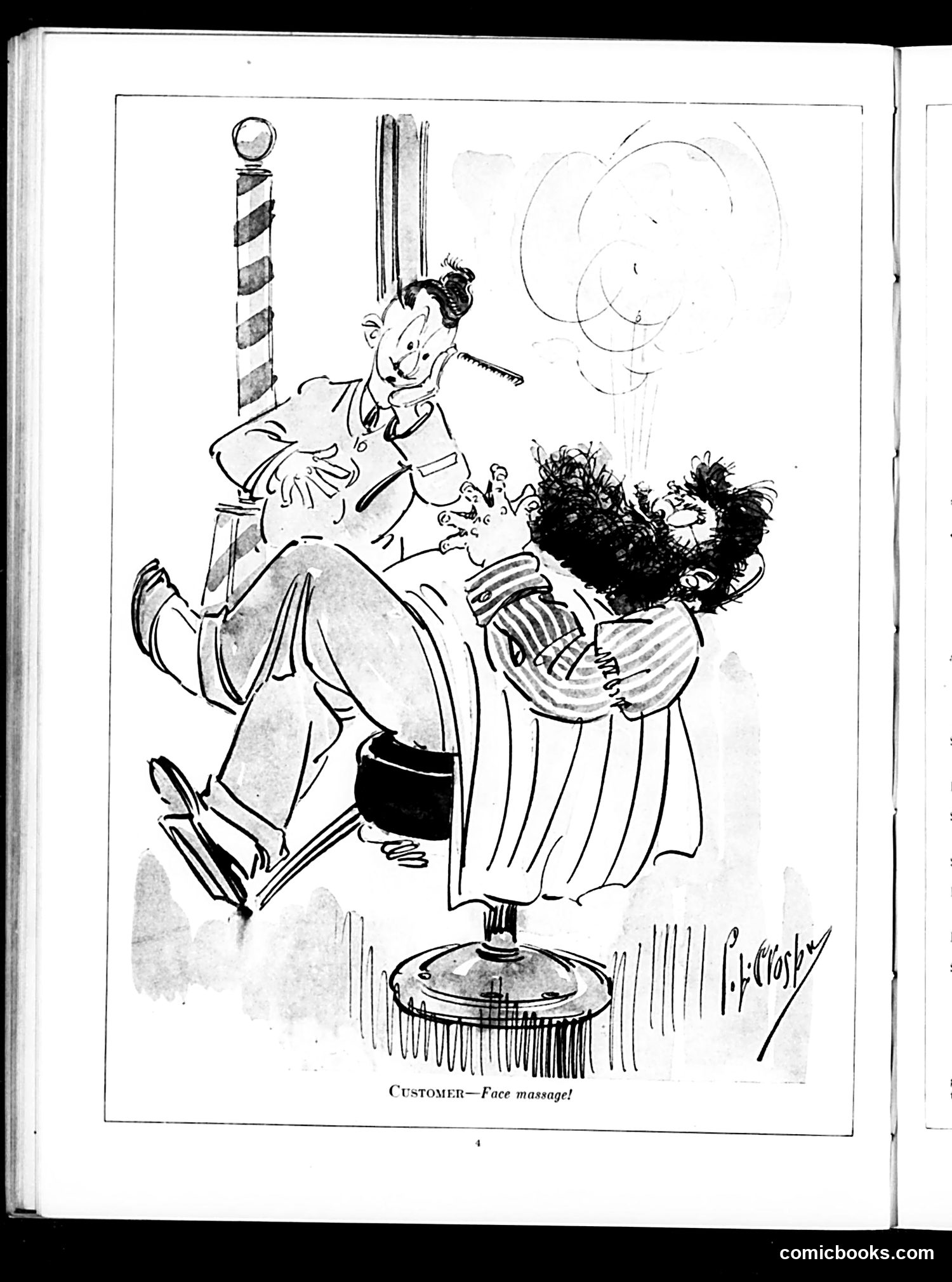
This cartoon depicts a barber or hair-salon worker vigorously manipulating a customer's face during what's labeled a "face massage." The exaggerated cartoon style—with the customer's face distorted and the worker's energetic, somewhat violent gestures—suggests satire about aggressive salon treatments. The humor likely targets the early 20th-century trend of facial massages as pseudo-scientific beauty or health treatments. The cartoonist mocks both the practitioner's overzealous technique and the customer's apparent discomfort, implying these fashionable spa procedures were more painful than beneficial. The barber pole visible in the background confirms a salon setting. The satire critiques contemporary cosmetic trends and the dubious efficacy of such treatments.
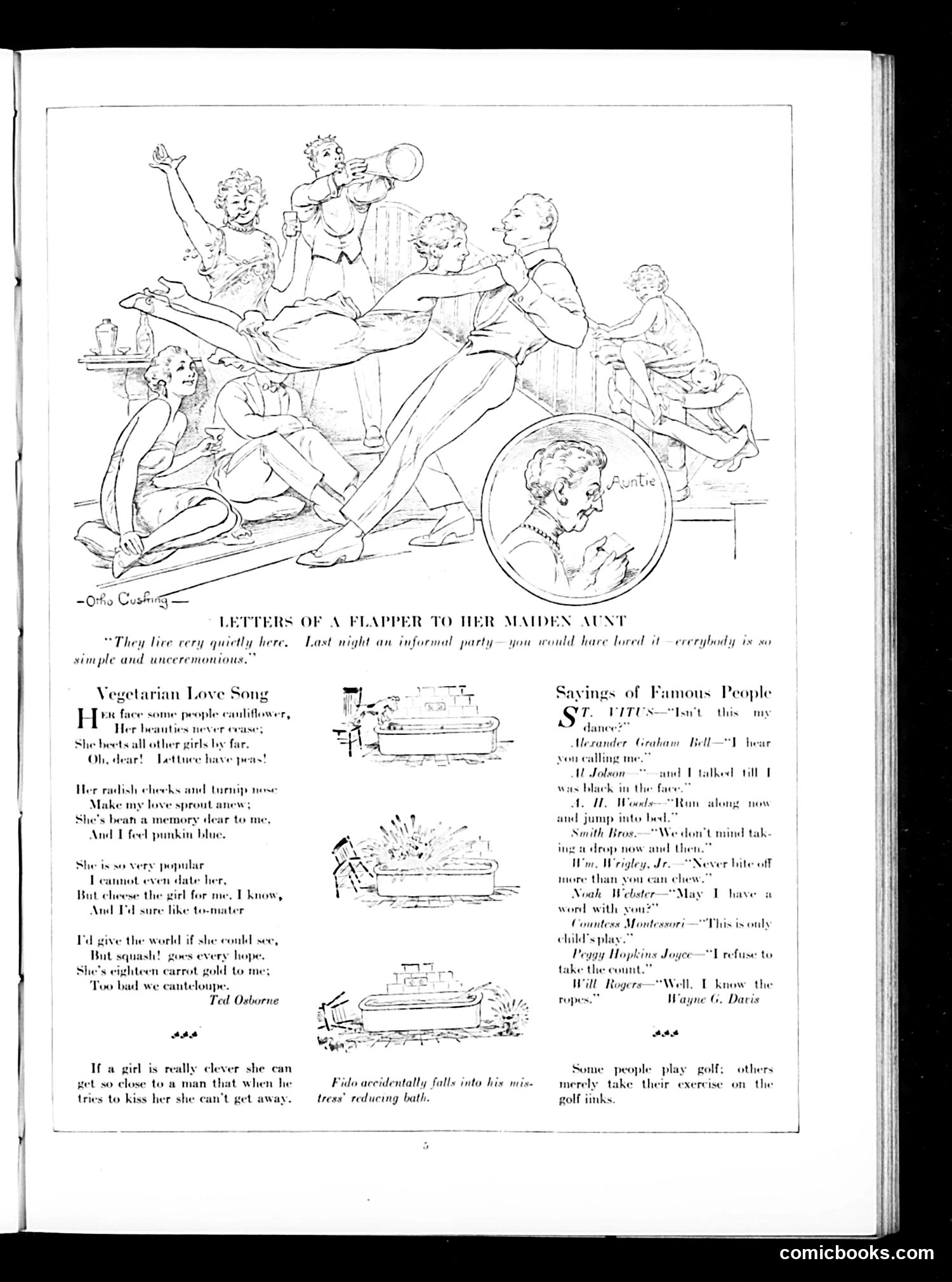
The top illustration depicts a flapper—a young woman of the 1920s—surrounded by admirers in a playful domestic scene. The caption "Letters of a Flapper to Her Maiden Aunt" frames this as satirizing the generation gap between modern youth and older relatives. The "Vegetarian Love Song" parodies romantic poetry using vegetable metaphors (cauliflower, radish, turnip), mocking both vegetarianism and sentimental verse. The "Sayings of Famous People" column collects brief quips attributed to celebrities like Alexander Graham Bell and Wayne G. Davis, offering witty one-liners typical of period humor. Bottom captions offer light social observations about courtship and recreation. Overall, the page satirizes 1920s youth culture, particularly flappers' independence and modernity, alongside gentle mockery of contemporary trends and celebrities.
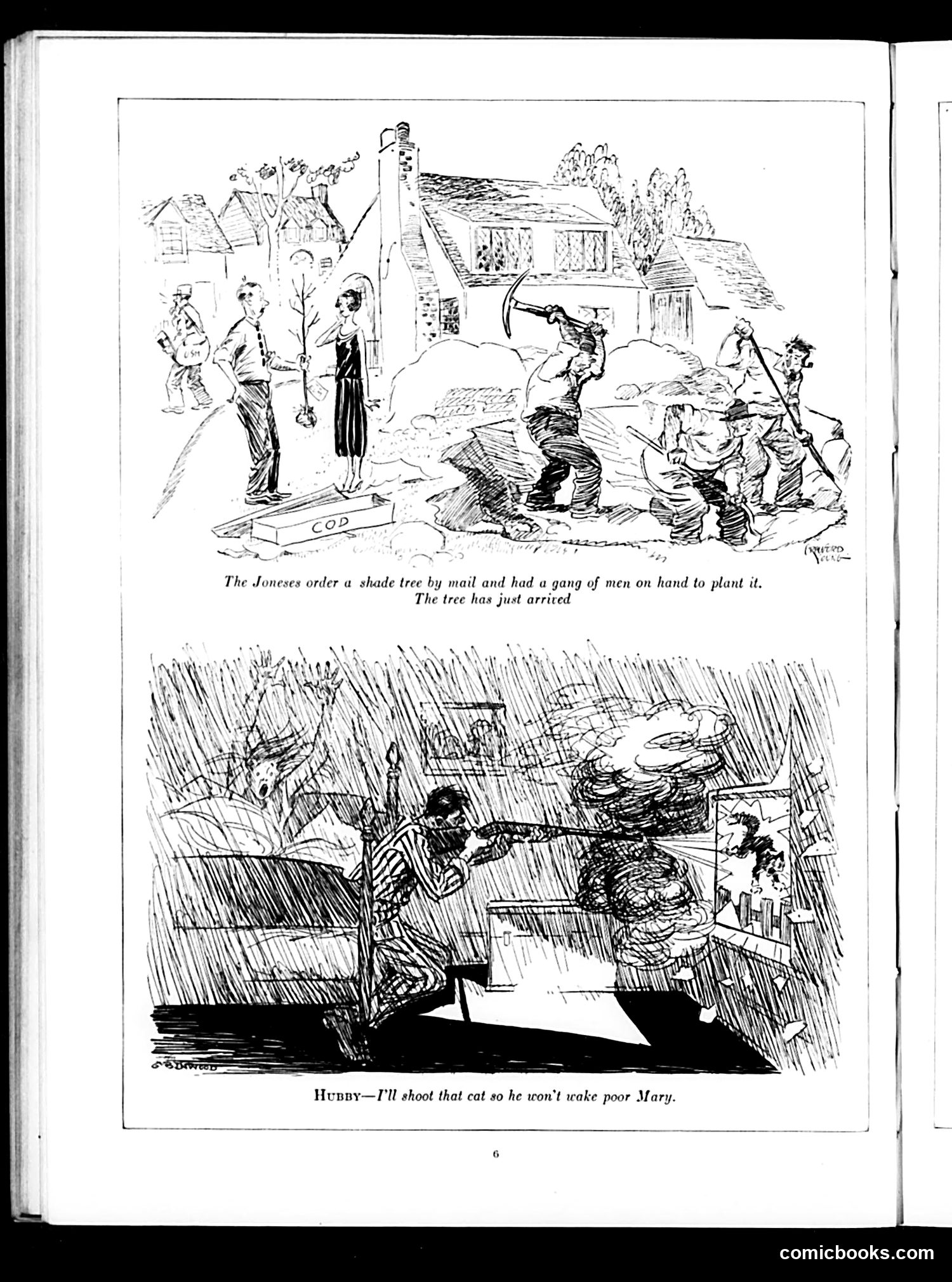
**Top cartoon:** The Joneses order a shade tree by mail with workers ready to plant it. The humor satirizes the wealthy family's attempt at instant, ostentatious landscaping—suggesting they want the appearance of an established, genteel home without patience or genuine cultivation. The "Joneses" reference alludes to keeping up appearances and social competition. **Bottom cartoon:** A man in rain aims a gun at a cat, saying "Henry—I'll shoot that cat so he won't wake poor Mary." This appears to mock exaggerated consideration for one's spouse or absurd solutions to minor problems—killing a cat rather than tolerating it waking someone. The humor lies in the extreme, ridiculous response. Both cartoons mock middle/upper-class pretension and domestic absurdities of the era.
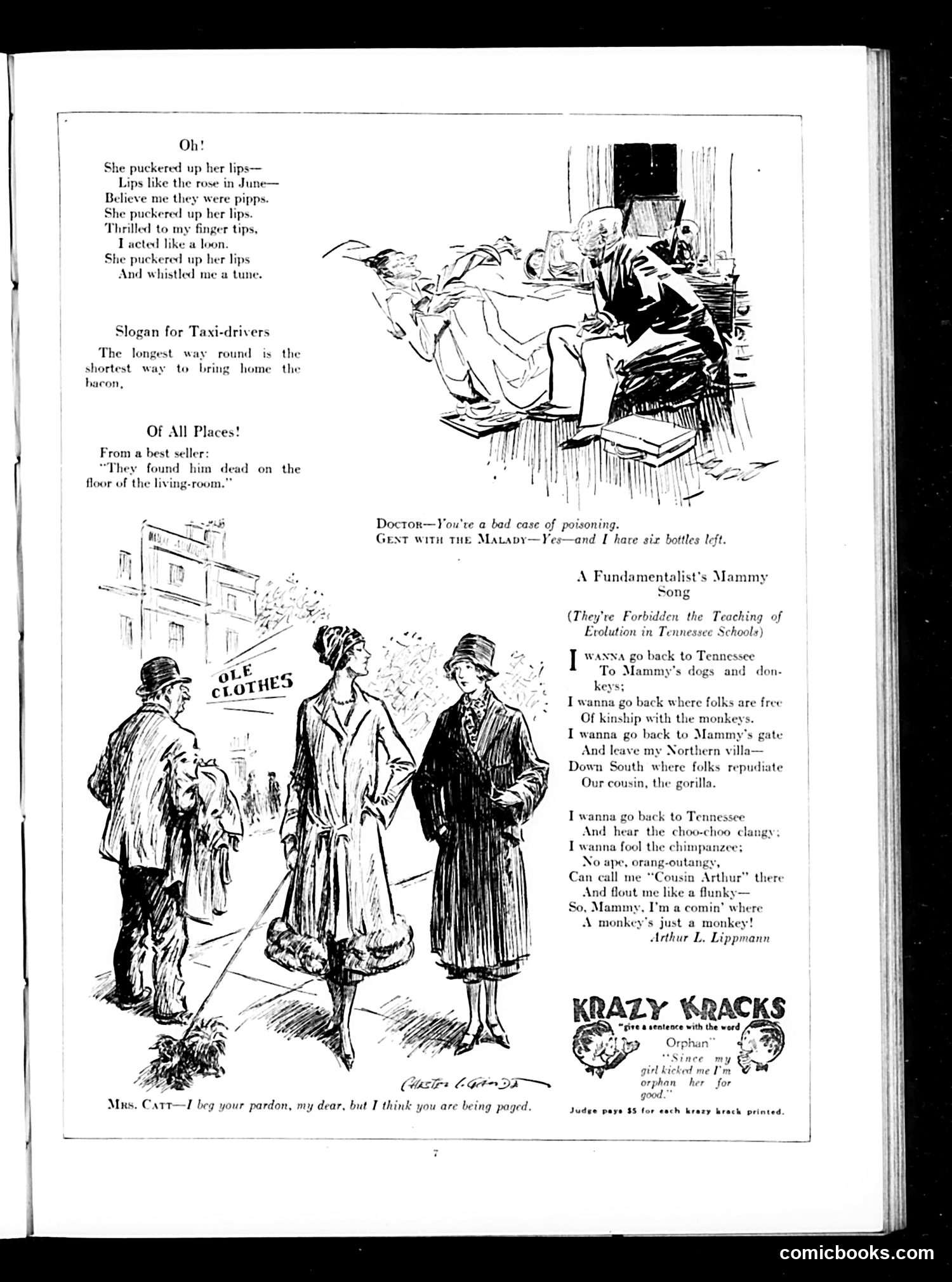
This satirical page contains several distinct pieces targeting early 1920s American culture: **"A Fundamentalist's Mammy Song"** is the primary content—a mocking song about Tennessee's ban on teaching evolution in schools. The satire ridicules fundamentalists who reject Darwinian theory by having a speaker claim he wants to return South where people aren't considered related to primates ("Our cousin, the gorilla"). The joke inverts the anti-evolution argument: the speaker pretends the South is evolutionarily advanced by *denying* human-ape kinship, when the fundamentalists' actual position was the opposite. The surrounding lighter items—quick jokes about taxi drivers overcharging ("longest way round is shortest way to bring home bacon"), a poison case, and "Krazy Kracks" (reader-submitted puns)—fill space typical of Judge's format. The illustrations show period dress and social scenes. The overall page reflects Judge's role as sophisticated urban satire mocking rural religious conservatism and American social pretensions.
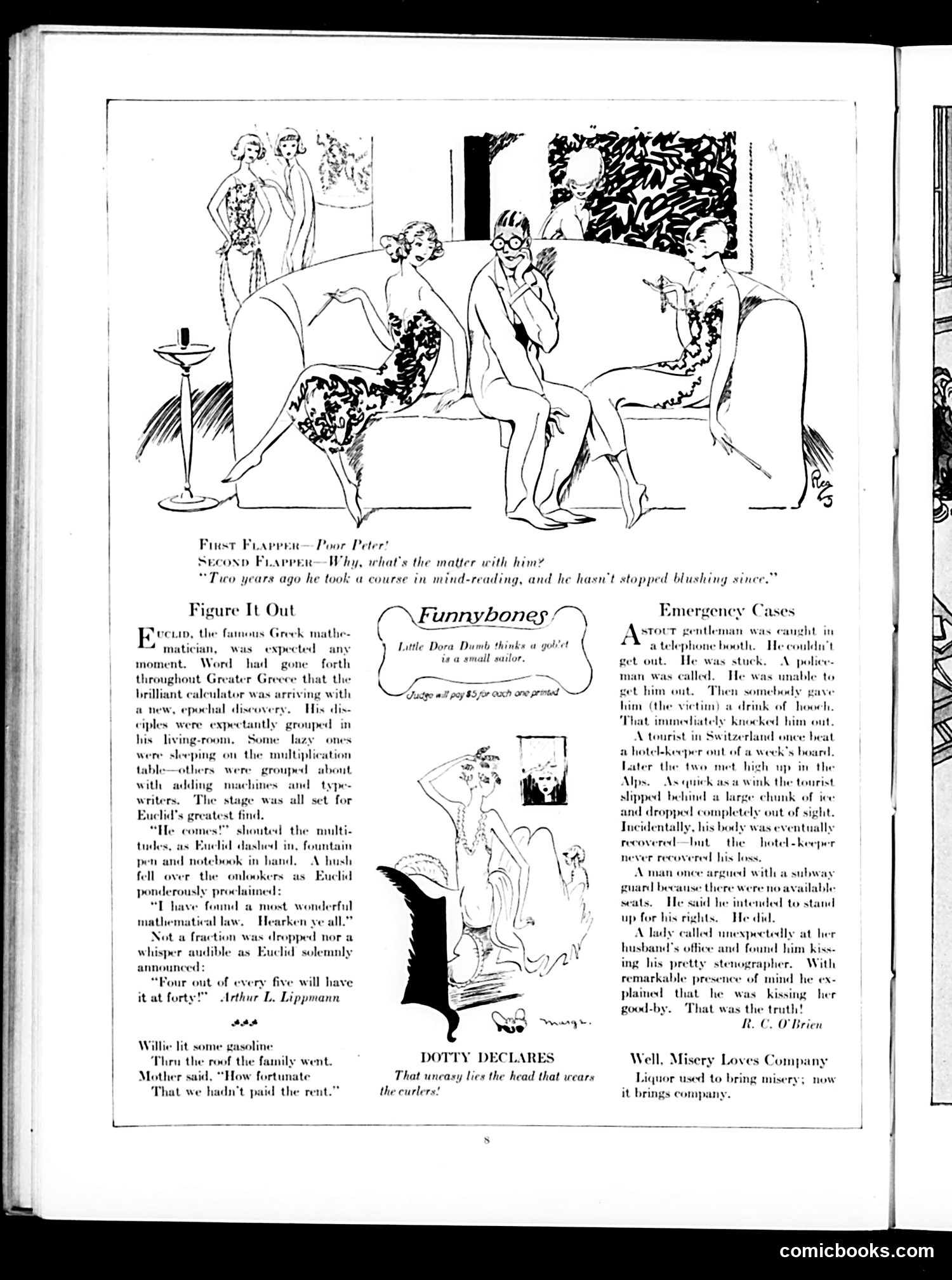
This page from *Judge* magazine contains several humor pieces typical of the 1920s flapper era: **"Figure It Out"** satirizes Euclid (ancient Greek mathematician) as a pompous intellectual announcing a "epochal discovery"—that four out of five people will have arthritis by age 40. The joke mocks pretentious scholars inflating trivial observations as groundbreaking wisdom. **The top cartoon** depicts flappers and references mind-reading as a trendy 1920s fad. The humor is that learning to read minds has made someone perpetually embarrassed by others' thoughts. **"Emergency Cases"** collects brief anecdotes about absurd situations—a man stuck in a telephone booth, tourists misbehaving—presented as humorous miscellaneous observations. **Other items** include wordplay ("Dotty Declares"), puns about curlers and misery, and a joke about a man caught kissing his stenographer. These reflect period attitudes about flapper culture, courtship scandals, and everyday mishaps treated as comedy fodder. The overall tone is light, gossipy satire targeting 1920s social trends and human folly.
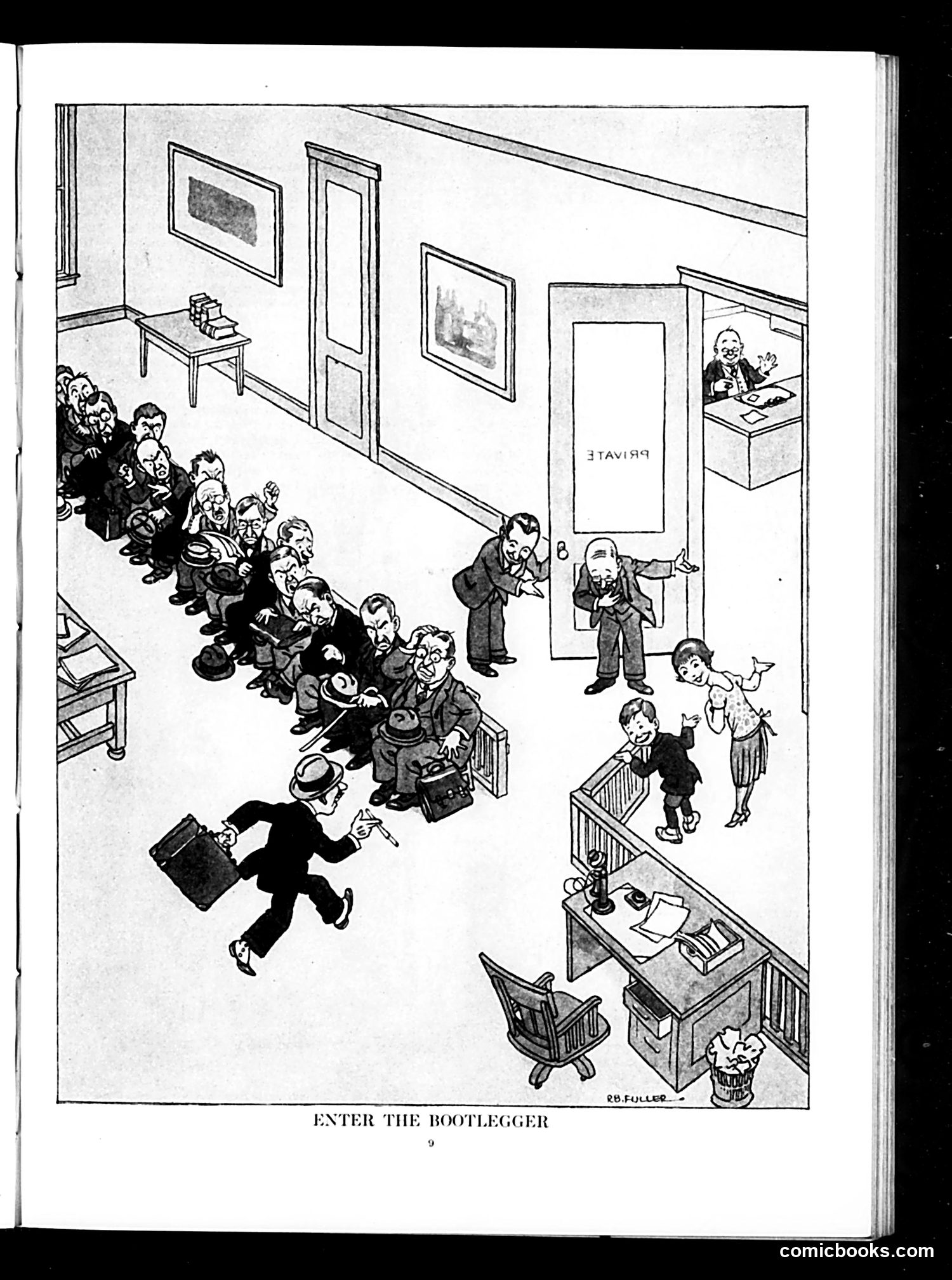
This cartoon satirizes Prohibition-era corruption, likely from the 1920s-early 1930s. The image depicts a long queue of well-dressed men (appearing to be officials, businessmen, or politicians) entering what looks like a government or official building to visit a "bootlegger" — an illegal alcohol supplier. The satire targets the hypocrisy and widespread lawbreaking during Prohibition: despite the constitutional ban on alcohol, ostensibly respectable figures openly patronize illegal suppliers. The crowded line suggests bootlegging was rampant and normalized among the establishment. A man with a briefcase rushes in at the front, while inside, children play near what appears to be an office or counter, implying the operation's brazen openness and the normalization of illegal activity even around families. The cartoon mocks both the failure of Prohibition enforcement and the complicity of supposedly upright citizens.
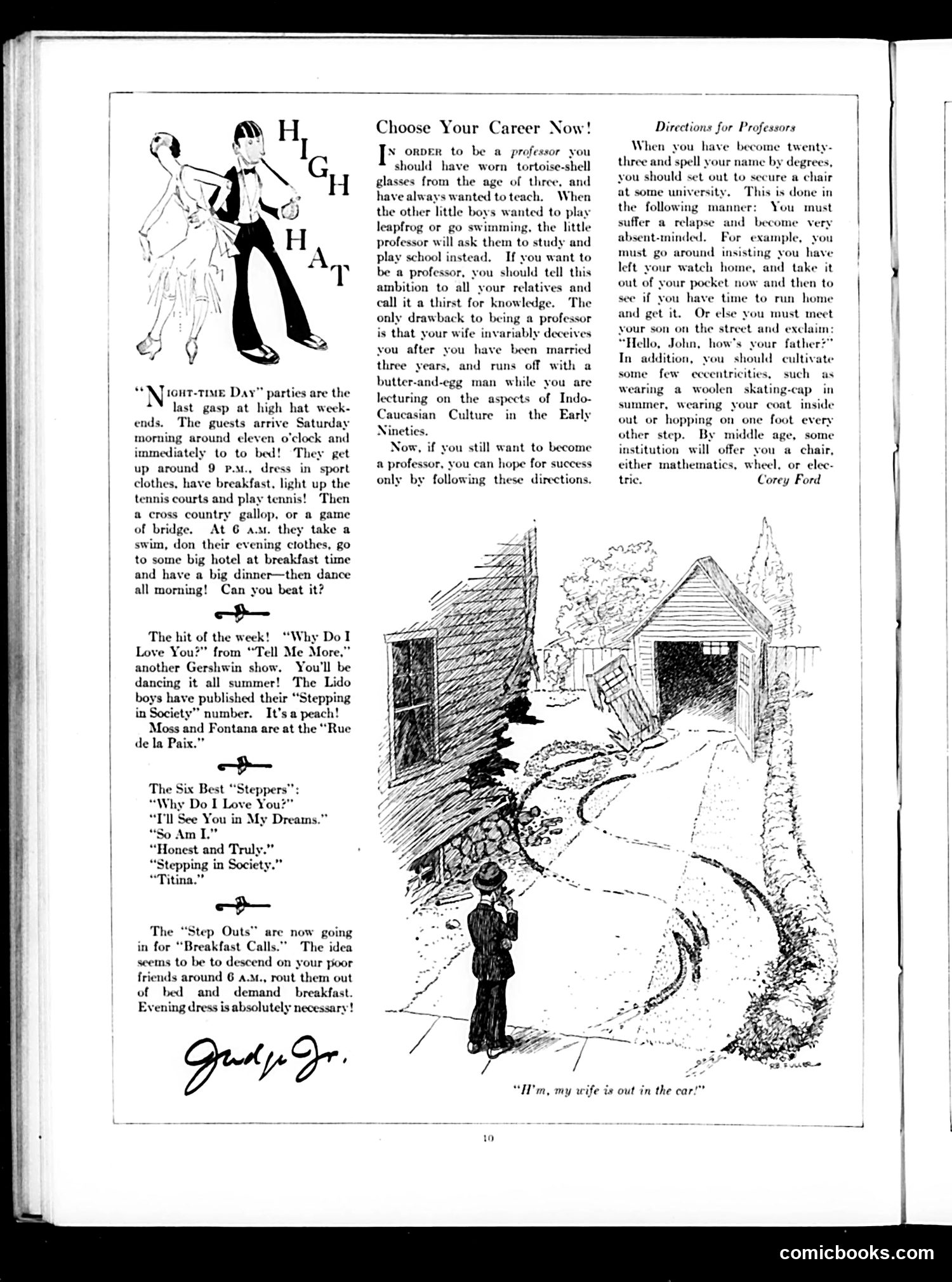
This page contains two humorous pieces satirizing 1920s social trends and professorial stereotypes. The upper section mocks "Night-time Day" parties—exhausting weekend gatherings where wealthy socialites arrive Saturday morning, immediately sleep, then stay awake dancing and dining from evening through morning. The satire targets the absurdity of inverted schedules among the leisure class. The main article, "Choose Your Career Now," is a tongue-in-cheek guide to becoming a professor. It humorously claims professors must wear tortoise-shell glasses from childhood and possess peculiar habits like absent-mindedness, eccentricity (wool caps in summer, coats worn inside-out), and forgetfulness about their own children. The darkest joke: a professor's wife invariably leaves him for a "butter-and-egg man" (a nouveau riche businessman) after three years of marriage. The satire mocks academics as socially awkward, poorly paid, and destined for domestic betrayal—portraying professorship as a career only the eccentric or delusional would pursue. Authored by Corey Ford, this reflects 1920s cultural attitudes toward intellectuals as impractical outsiders.
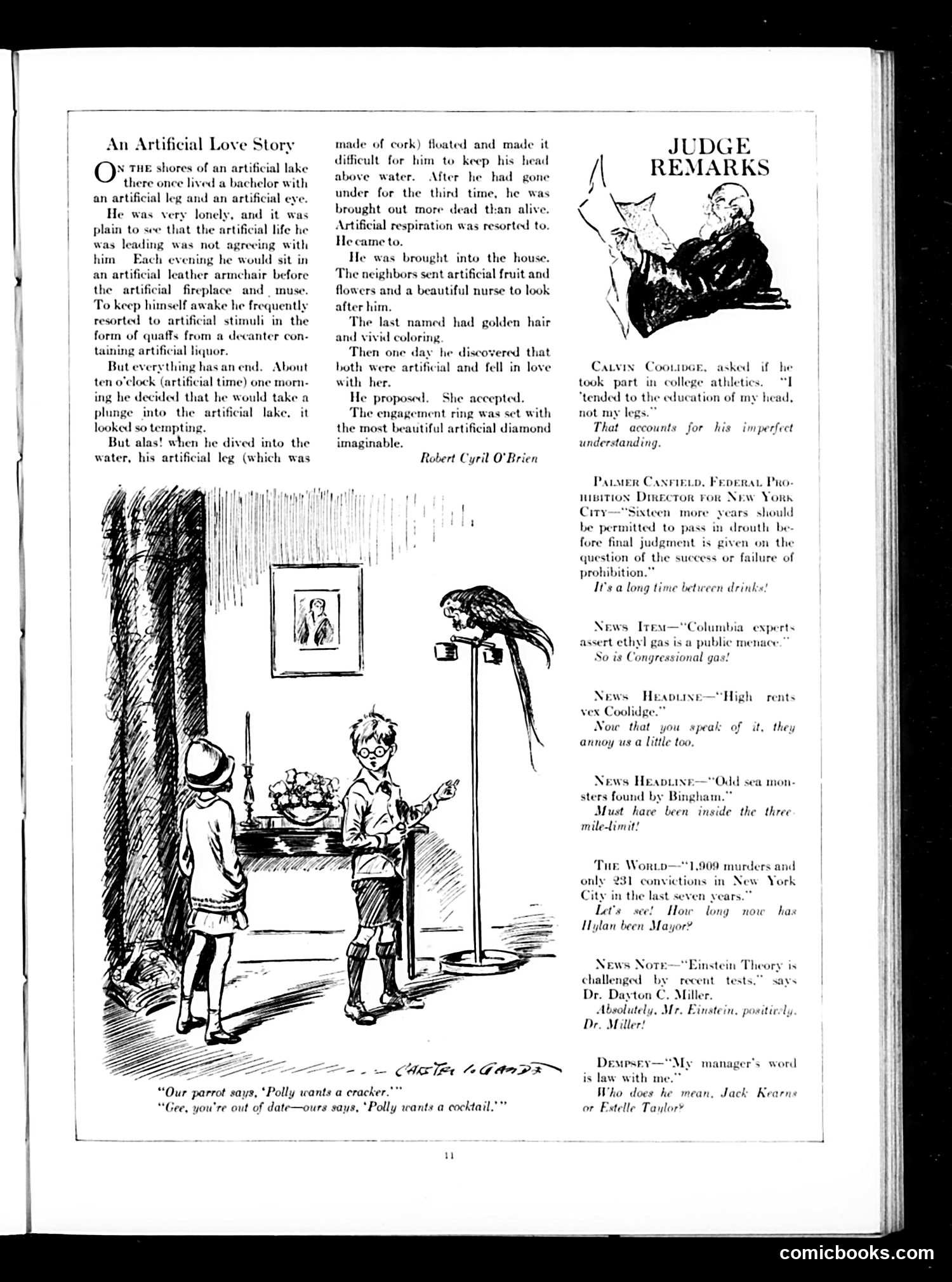
**Main Story: "An Artificial Love Story"** A darkly humorous tale mocking the artificiality of modern life. A lonely bachelor with a prosthetic leg and glass eye lives entirely surrounded by artificial things—fake fireplace, artificial liquor, artificial lake. When he attempts suicide by diving in, his cork leg floats, saving him. A beautiful nurse (also artificial) arrives, and he falls in love with her artificial nature itself. The satire targets the emptiness of contemporary existence and shallow materialism. **Cartoon Caption:** A joke about changing social standards—an older parrot says "Polly wants a cracker" while a modern one demands "Polly wants a cocktail," likely referencing Prohibition-era hypocrisy and the prevalence of illegal drinking. **Judge Remarks:** Brief satirical notes on current events: Calvin Coolidge's education gaps, Prohibition's effectiveness (questioned after "sixteen more years"), Columbia experts warning of ethyl gas dangers, high rents, sea monsters found by Bingham, NYC's high murder rate under Mayor Hylan, Einstein's theories, and boxing manager Jack Kearns's authority over boxer Jack Dempsey.
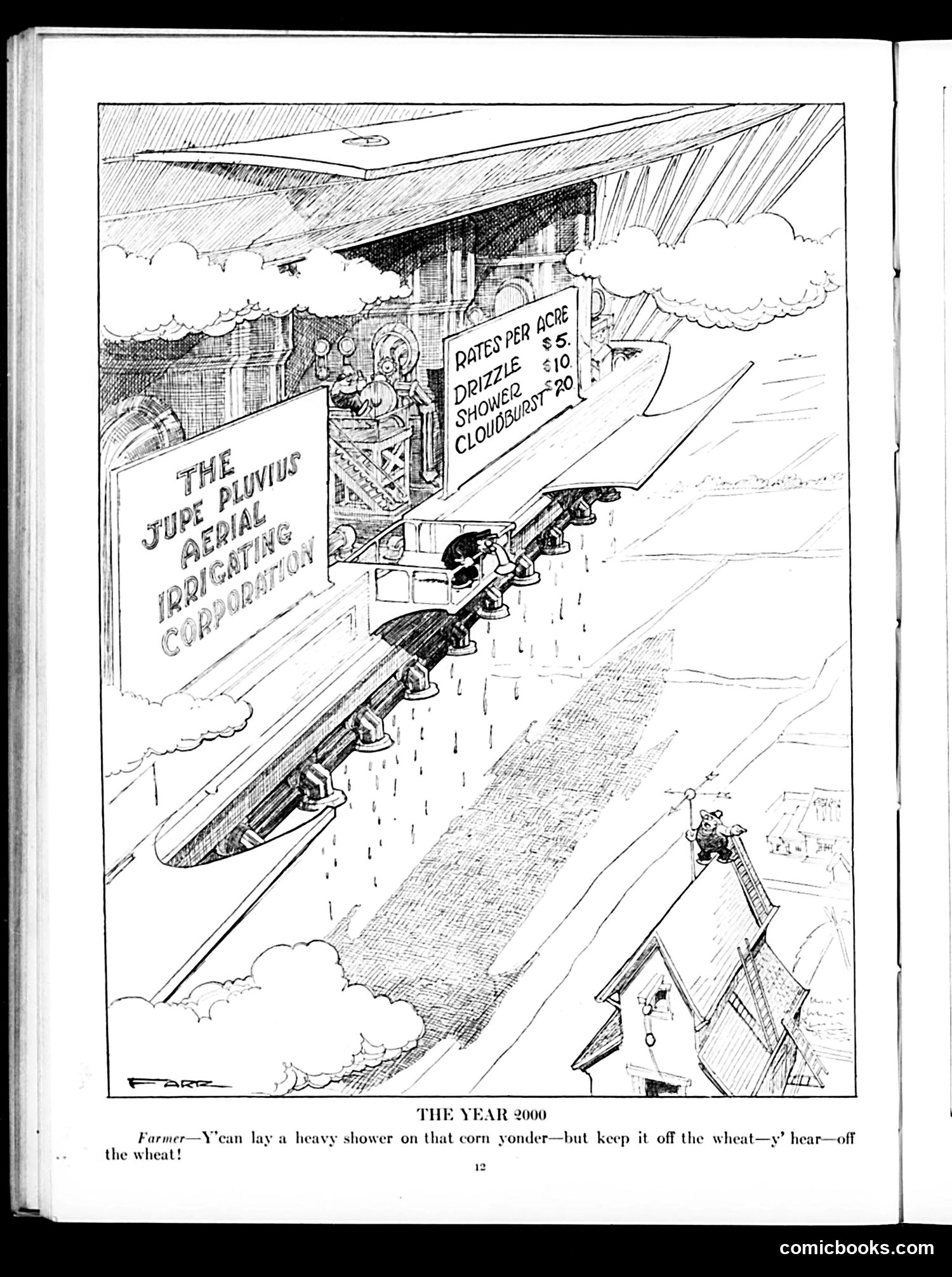
This is a futuristic satire imagining year 2000 agricultural technology. The cartoon depicts an aerial irrigation system where a farmer operates controls from above, directing rainfall onto specific crops. The sign advertises "The Jupe Pluvius Aerial Irrigation Corporation" with rates per acre for various weather services ("Dates," "Drizzle," "Shower," "Cloudburst"). The joke satirizes the idea of controlling nature through technology and commercialization. The farmer's instruction to keep rain off wheat while watering corn reflects concerns about selective agricultural control becoming a purchasable commodity. This appears to mock both optimistic technological utopianism and the anxiety that wealthy farmers could literally buy better weather, creating unfair advantages. The cartoon critiques industrial agriculture's ambitions to dominate natural processes for profit.
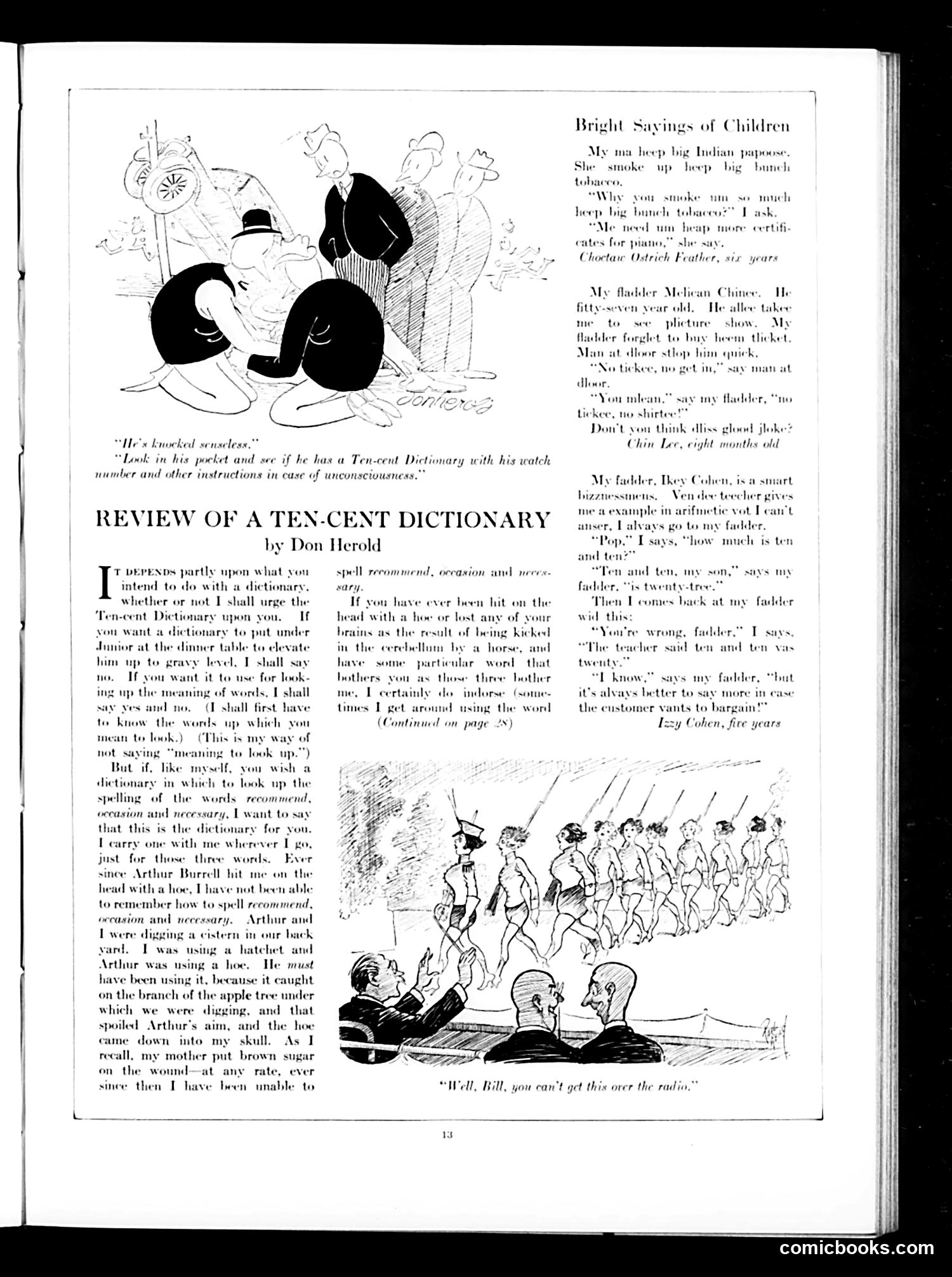
This page contains two distinct pieces of satire: **The Main Cartoon** (top): Shows a man knocked unconscious. The joke is that he carries a ten-cent dictionary in his pocket "in case of unconsciousness"—treating the cheap dictionary as emergency medical equipment, like smelling salts. This mocks both the dictionary's perceived worthlessness and the era's faith in self-improvement gadgets. **"Review of a Ten-Cent Dictionary" by Don Herold**: A humorous essay defending the cheap dictionary. Herold claims he needs it specifically to spell three words (recommend, occasion, necessary) because Arthur Burrell hit him on the head with a hoe years ago, causing brain damage. The satire targets both his own poor memory and the absurdity of blaming a cheap reference book for personal failings. **"Bright Sayings of Children"** (right side): Stereotypical "cute kid" quotes featuring offensive dialect humor—mocking Chinese, Native American, and Yiddish-accented English speech. This reflects period editorial assumptions about what readers found amusing. The bottom cartoon shows a radio broadcast, with the caption suggesting some content "can't get this over the radio," likely referencing broadcast censorship standards.
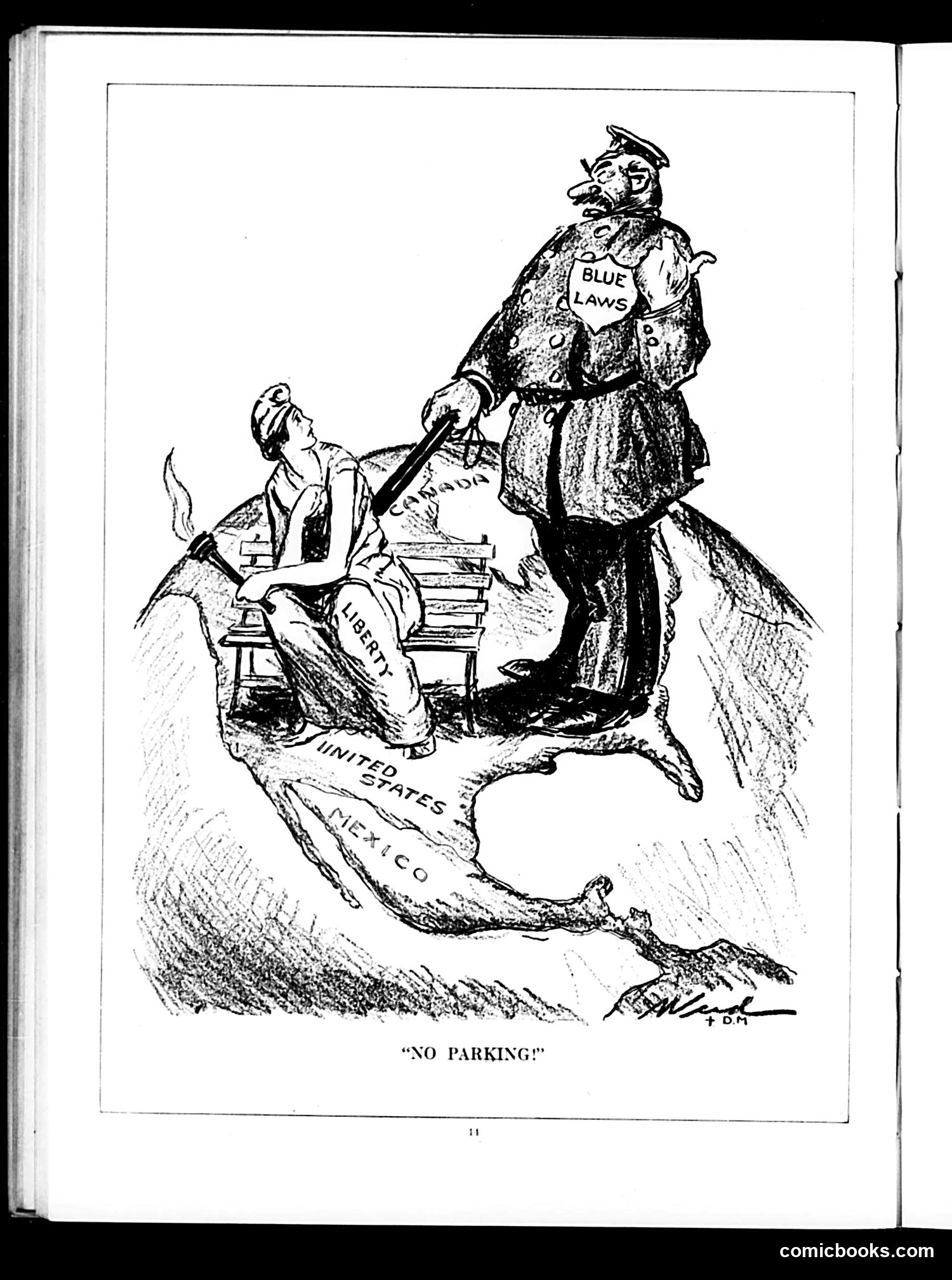
This cartoon satirizes enforcement of "Blue Laws" (restrictive moral legislation) against American liberty. Lady Liberty sits writing, labeled with books and documents, while a stern police officer—representing government authority enforcing Blue Laws—commands "No Parking!" The map beneath shows the United States and Mexico, suggesting this is about American domestic policy. The satire equates Blue Law enforcement with parking violations—trivializing heavy-handed moral policing as petty bureaucratic overreach. The cartoon criticizes how government restricts citizens' freedoms through arbitrary rules, treating fundamental liberties like parking spaces that can simply be prohibited. This reflects Judge magazine's libertarian-leaning critique of excessive government regulation of personal behavior and speech.
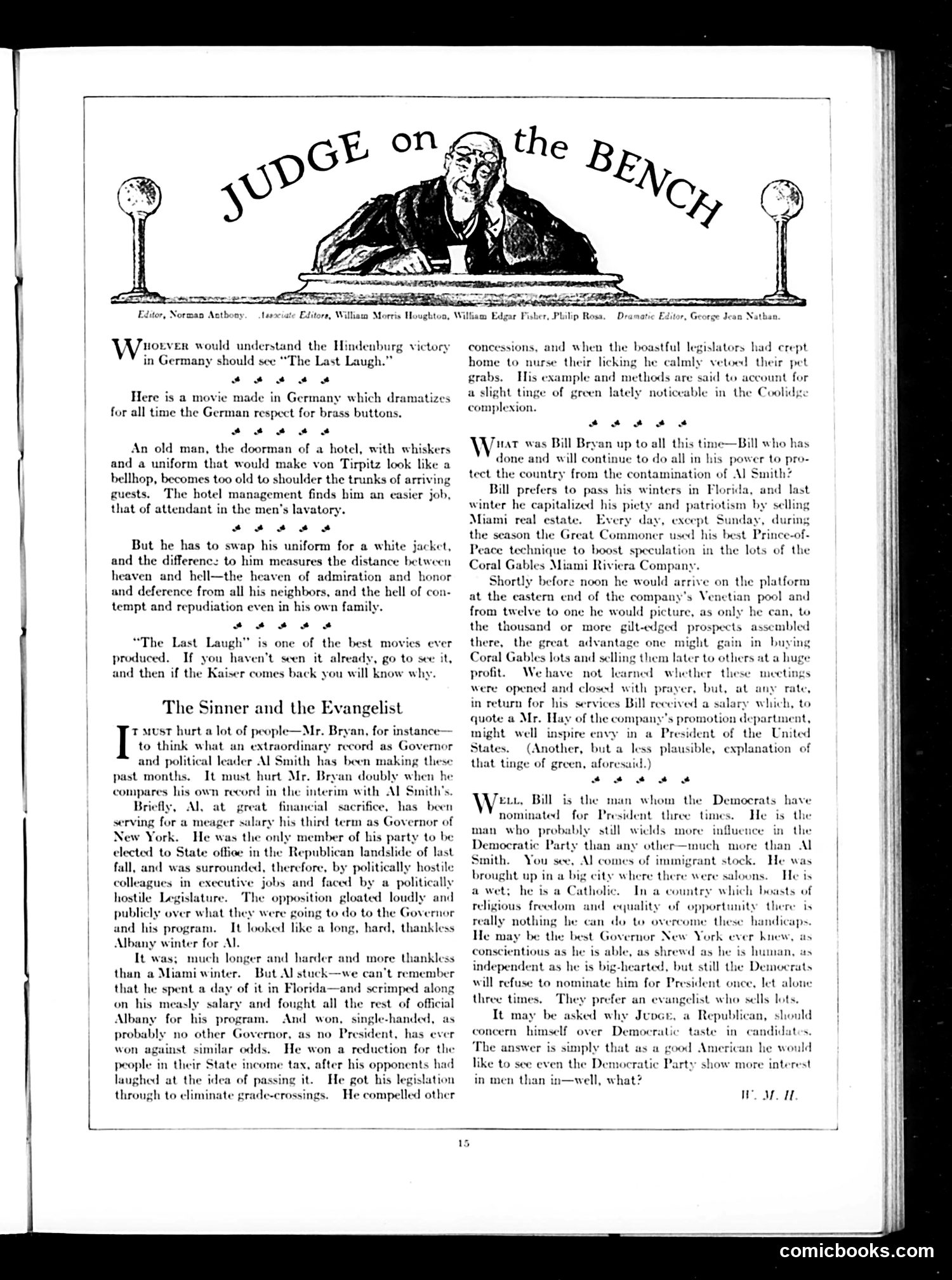
This page contains two separate commentary pieces from *Judge* magazine: **"The Last Laugh"** reviews a German film dramatizing class deference. The satire observes that a hotel doorman's entire sense of dignity depends on his uniform—when demoted to lavatory attendant in plain clothes, he loses social standing despite unchanged work. The piece uses this to mock German respect for hierarchy and "brass buttons" (military/official authority). The reference to "the Kaiser" suggests post-WWI context when German militarism was fresh in American minds. **"The Sinner and the Evangelist"** compares Al Smith (Democratic New York Governor) favorably against William Jennings Bryan. Smith served three terms on meager salary, fought a hostile Republican legislature, and won tax reductions and infrastructure improvements. Bryan, meanwhile, spent Florida winters promoting Miami real estate speculation while publicly positioning himself as protecting America from "contamination" by Smith—a hypocritical contrast between pious rhetoric and profit-seeking. The satire attacks Bryan's moral posturing as mere self-interested salesmanship.
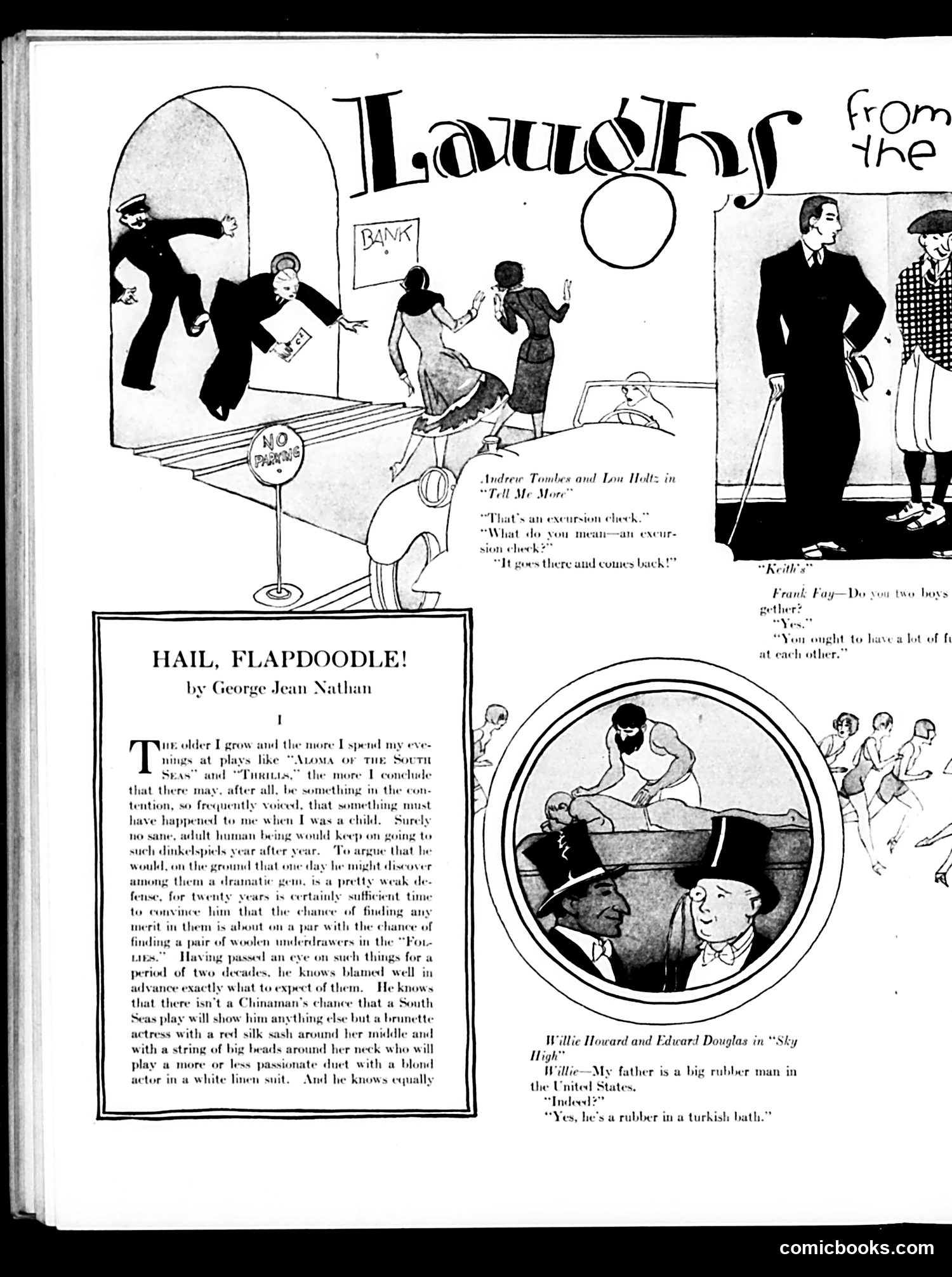
This page contains a satirical essay by George Jean Nathan critiquing theatrical productions, particularly those set in the South Seas. Nathan argues that after two decades of attending such plays, he can predict their formulaic content with certainty: they invariably feature a brunette actress in a red silk sash with a blonde male lead in a white linen suit, performing passionate duets. The page includes promotional snippets from current Broadway shows ("Tell Me More," "Sky High"), featuring actors Andrew Tombes, Lou Holtz, Willie Howard, and Edward Douglas. These brief comedic exchanges serve as examples of contemporary theater. The top illustration shows a bank robbery scene labeled "Hail, Flapdoodle!"—likely mocking another predictable theatrical trope. Nathan's critique targets the repetitive, unimaginative nature of popular entertainment, suggesting audiences tolerate mediocrity out of habit rather than genuine artistic merit. The piece is a cynical commentary on commercial theater's reliance on tired conventions and tired formulas.
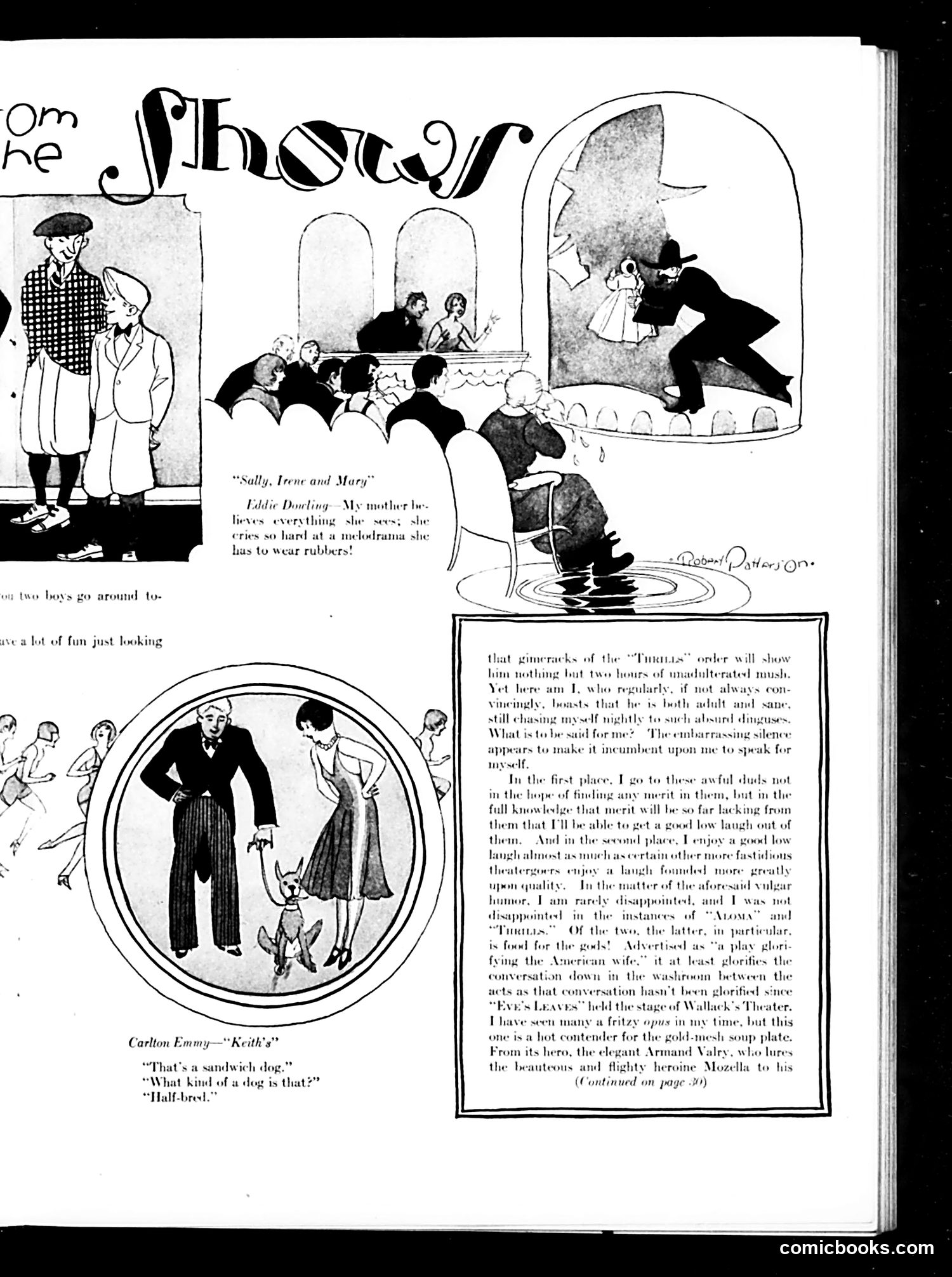
This page contains theater reviews and satirical commentary on Broadway productions from the early 20th century. **The cartoons** mock theatrical audiences and productions. The "Carlton Emmy" panel jokes about dog breeds—a "half-bred" sandwich dog—likely commenting on mixed-quality entertainment. The top illustration shows a melodrama scene, referencing Eddie Dowling's production where a character's mother cries so hard at emotional scenes she needs rubbers (galoshes). **The main critique** (right column) attacks the "Tinaus" order shows—apparently a theatrical production company—for presenting "unadulterated mush" rather than quality art. The reviewer sarcastically claims to attend bad plays specifically to enjoy "low" humor, contrasting this with serious theater-goers' pretensions. **The satire targets**: lowbrow theatrical productions pandering to audiences, particularly plays glorifying "the American wife," and the gap between pretentious theater culture and actual entertainment value. The referenced play "Mozella" appears to be typical of this commercialized melodrama the reviewer dismisses.
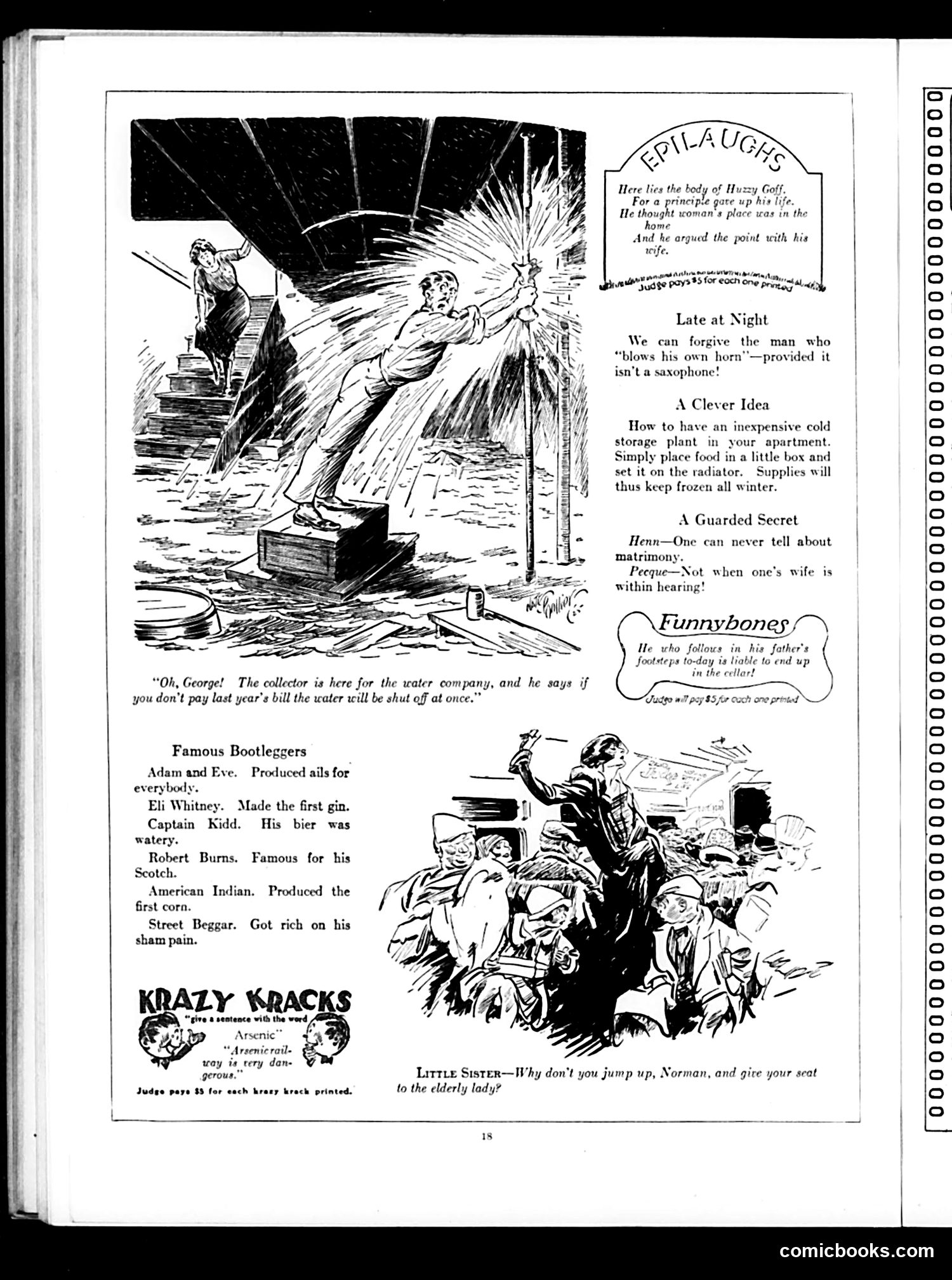
This page from Judge contains multiple short humor pieces reflecting early 20th-century American social concerns: **Main cartoon**: A man confronts a water company collector about unpaid bills—satirizing utilities shutoff threats and working-class financial struggles. **"Epitaph" section**: Mocks a man who died arguing with his wife about "woman's place" in the home, ridiculing rigid gender attitudes. **"Famous Bootleggers"**: A Prohibition-era joke list parodying illegal alcohol production. References include Adam and Eve (producing "oils"), Eli Whitney (the gin inventor, punning on his cotton gin), Captain Kidd (pirate with "watery" beer), Robert Burns (Scottish poet/whisky), Native Americans (corn/whiskey), and beggars (champagne). The "Krazy Kracks" section mentions arsenic danger. **Minor quips**: Saxophone jokes, apartment cold storage tips, marital secrets, and saxophone humor reflect period concerns. **Bottom cartoon**: A child refusing to yield a seat, satirizing manners and generational behavior. The page's recurring theme is social hypocrisy and the gap between stated values and actual behavior.
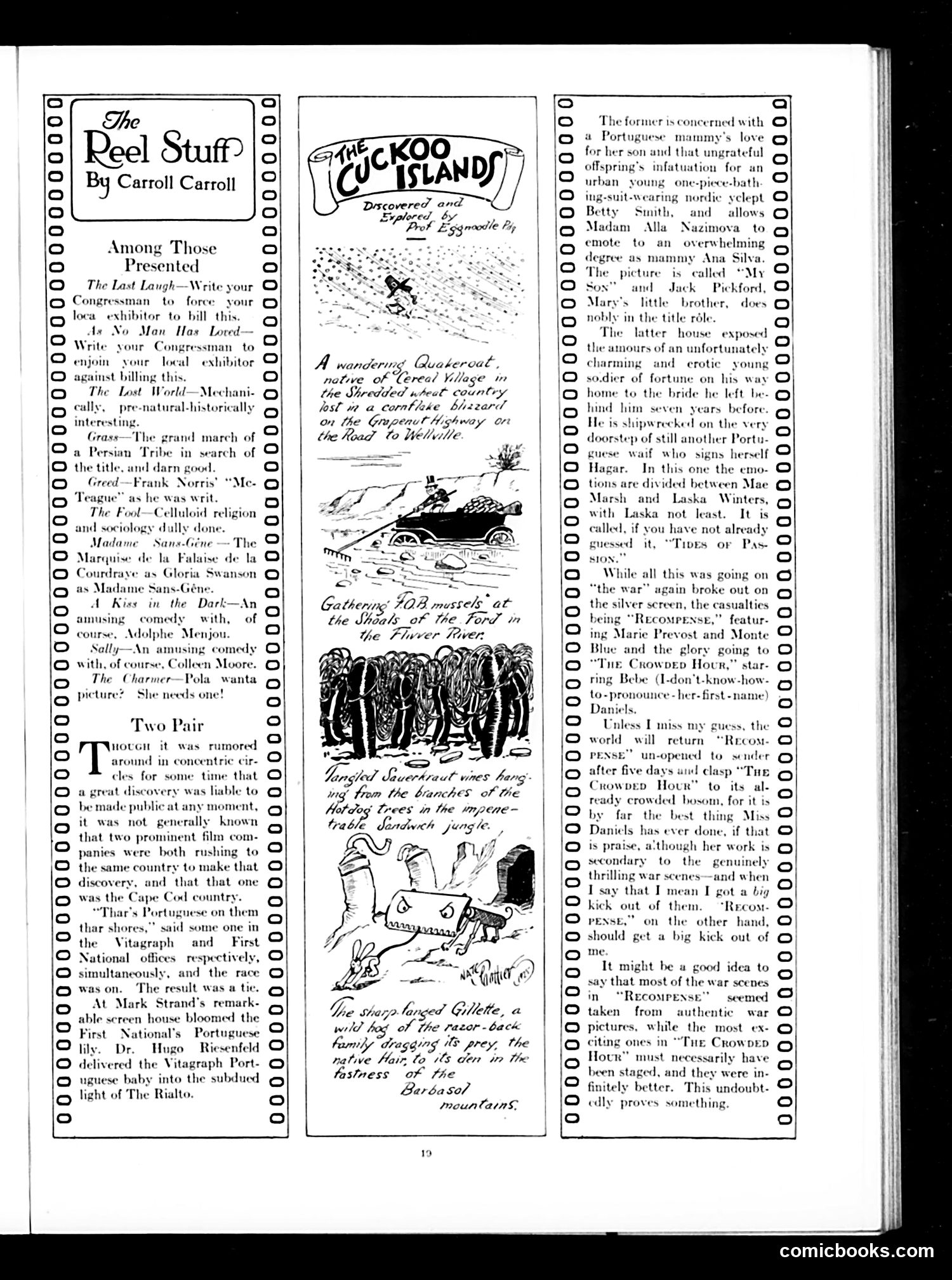
This page contains "The Reel Stuff," a film criticism column by Carroll Carroll reviewing current movies. The content mixes genuine film critiques with absurdist humor typical of Judge's satirical style. **The main satire:** The reviews mock both the films themselves and the obsessive competition between film studios. Two studios (Vitagraph and First National) simultaneously "discovered" Cape Cod as a filming location—resulting in identical Portuguese-themed melodramas. Carroll ridicules the formulaic nature of these films: both feature ethnic mothers, romantic entanglements, and shipwrecks on convenient islands populated by conveniently available women. **The humor:** Carroll exaggerates the melodramatic plots absurdly (using silly made-up place names like "Cereal Village" and "Grapenut Highway") while delivering backhanded compliments about performances and production values. The central joke is how interchangeable these expensive studio productions had become by the early 1920s—studios weren't innovating but merely copying each other's formulas with different casts.
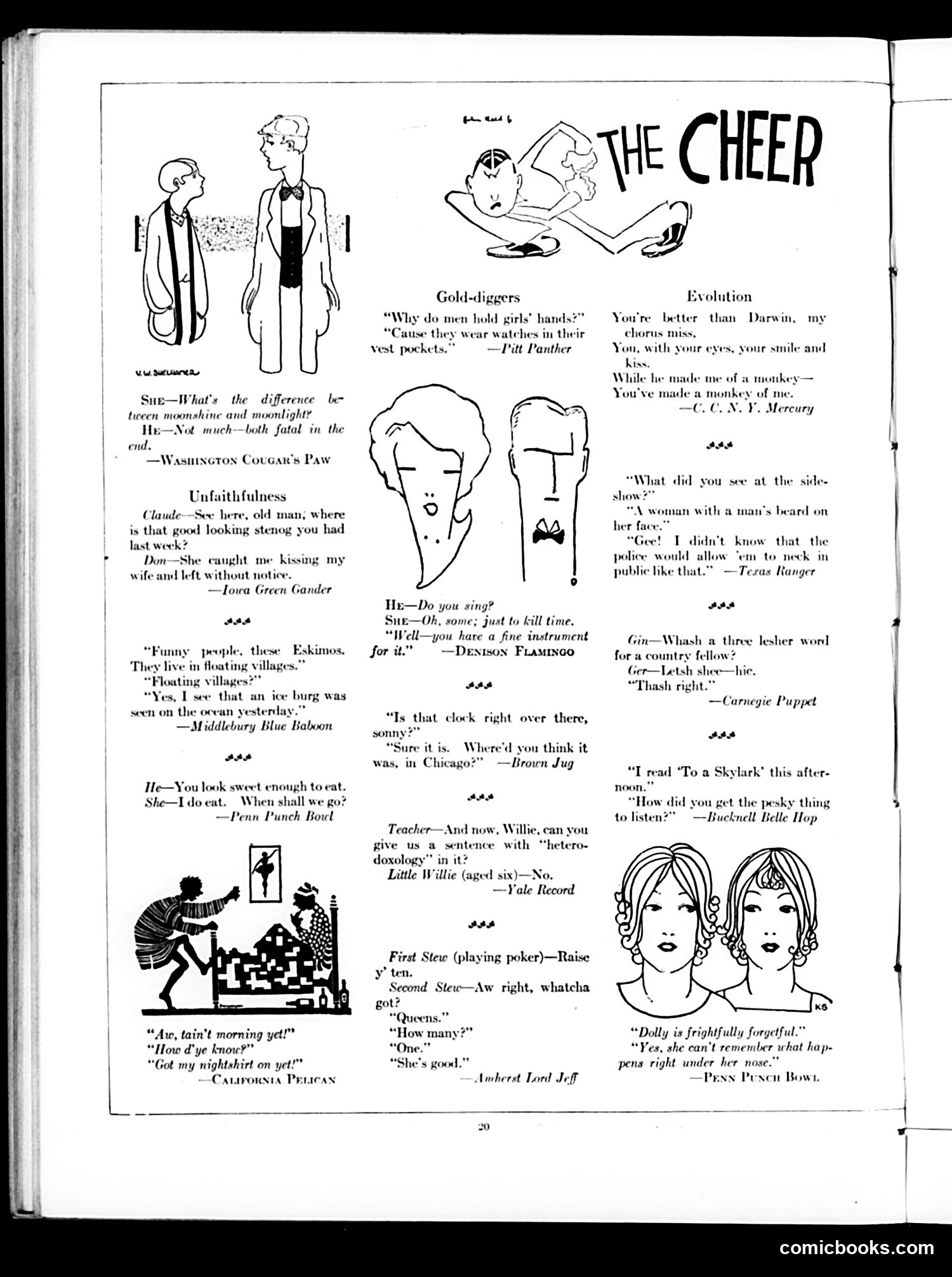
This is a collection of short jokes and quips organized around themes of romantic misadventure and wordplay, typical of Judge magazine's satirical humor. **Key themes:** **Gold-diggers & Courtship**: Multiple jokes mock materialistic women and awkward male-female dynamics—men holding hands to access watches, women eating expensive meals, physical attraction as transactional. **Infidelity & Marriage**: A stenographer leaves her job after catching her boss kissing his wife; husbands caught with other women face consequences. **Darwin/Evolution reference**: A woman compares a man's courtship to evolution, suggesting he's reduced her to a "monkey"—playing on contemporary debates about Darwinism and human refinement. **Wordplay & Education**: A child cannot construct a sentence with "heterodoxology"; a girl misunderstands "To a Skylark" as something requiring compliance. **Social observation**: Jokes about Eskimos, bearded women at sideshows, and urban behavior reflect early-20th-century attitudes toward "exotic" peoples and curiosities. The humor relies on dated gender stereotypes, class anxiety, and linguistic tricks rather than sustained narrative.
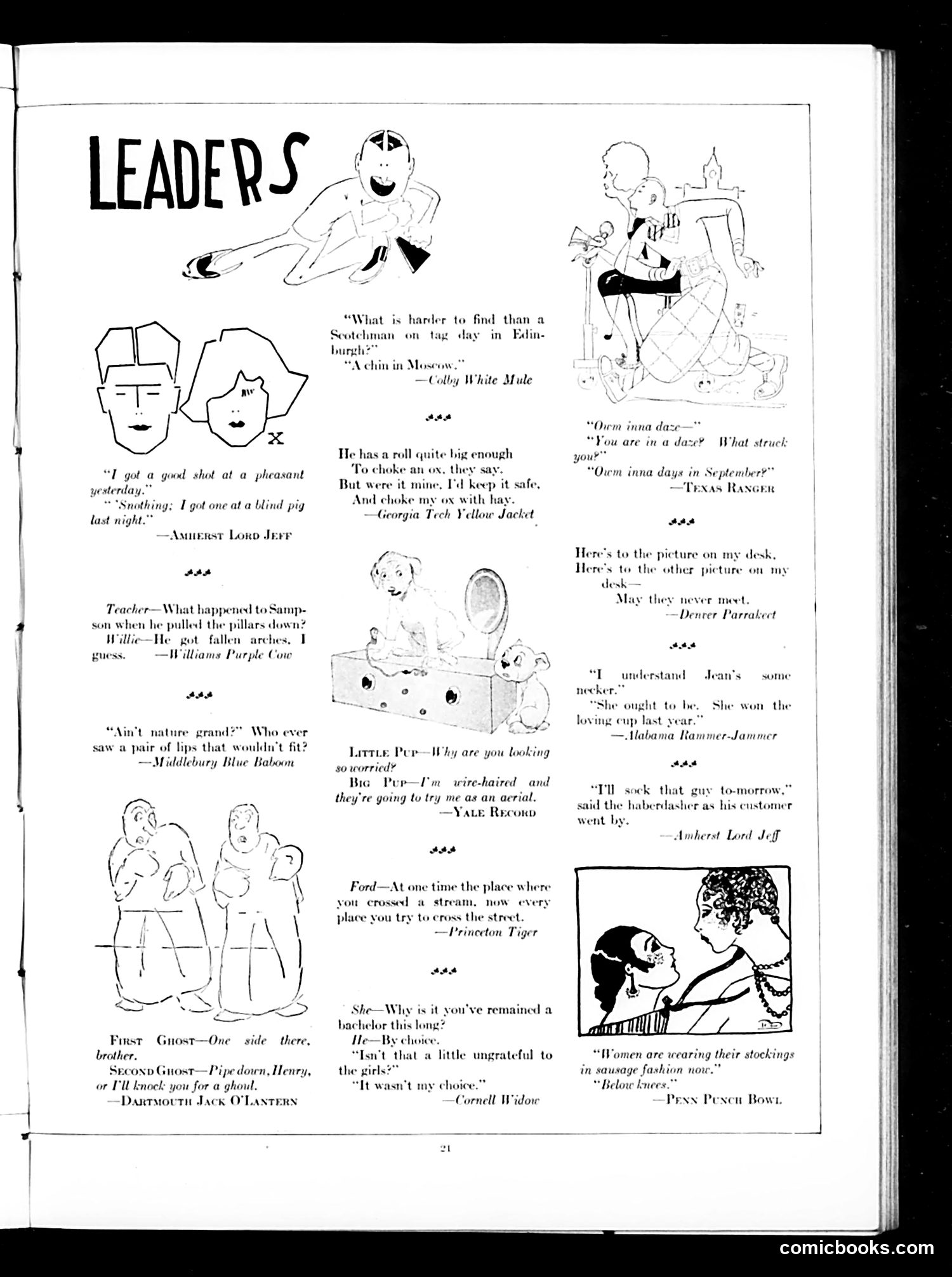
This page from *Judge* magazine collects brief humorous quotes attributed to various college mascots and fictional characters. The satire works through absurdist non-sequiturs and puns rather than political commentary. Key examples: "Amherst Lord Jeff" jokes about shooting a "blind pig" (illegal speakeasy); "Georgia Tech Yellow Jacket" makes a pun about choking an ox; "Williams Purple Cow" includes a play on "fallen arches"; "Texas Ranger" references being in a daze in September (football season context). The cartoon illustrations are largely decorative supporting these college-humor jokes. References like "tag day" (charity fundraising), "necker" (a necking/kissing enthusiast), and "sausage fashion" stockings reflect 1920s social concerns. This represents *Judge's* typical collegiate humor section—lighthearted, pun-driven material aimed at educated readers familiar with university traditions and slang. The page contains no apparent political satire or social commentary beyond gentle mockery of college life and dating customs.
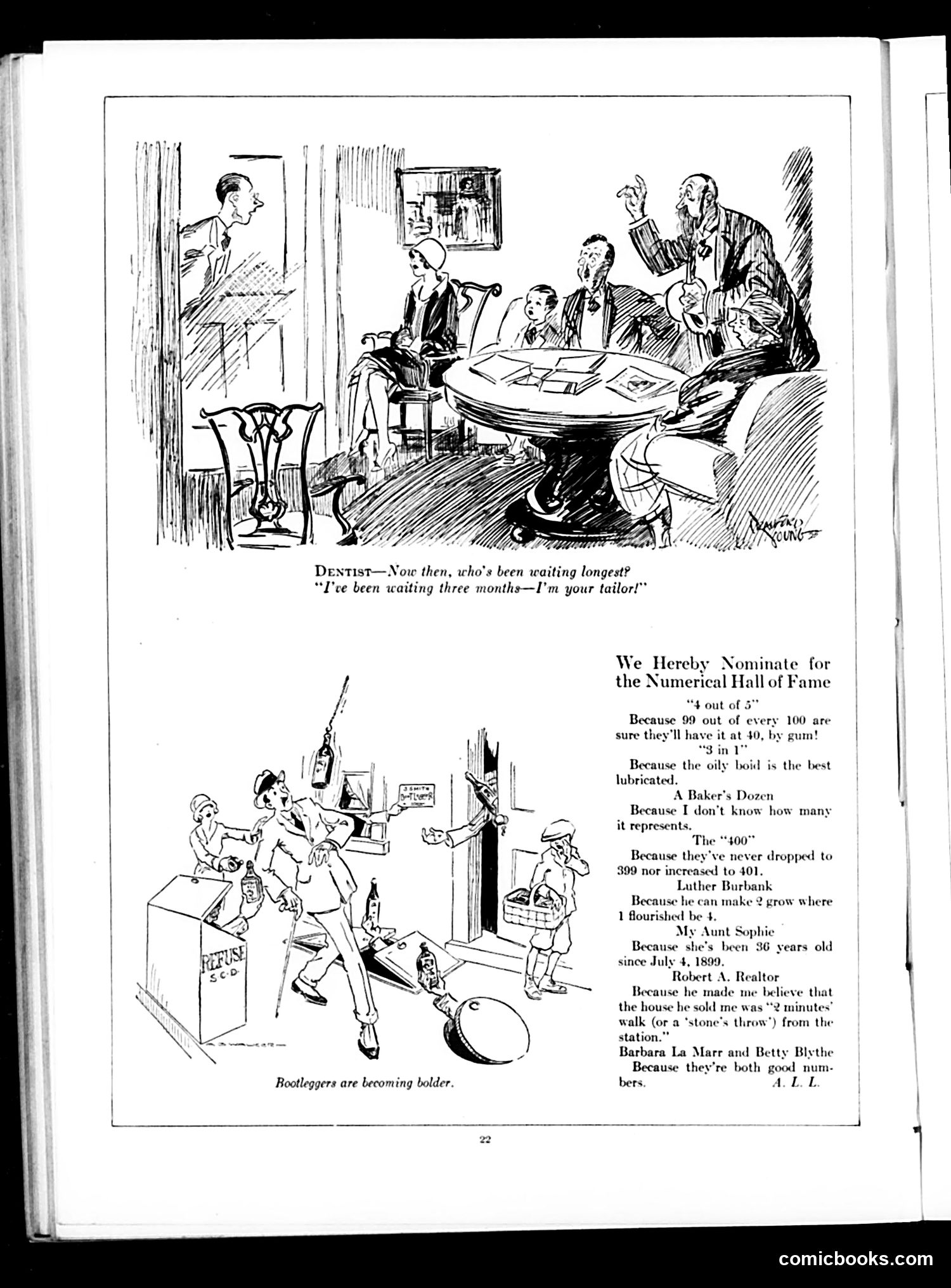
**Top Cartoon:** A dentist's waiting room joke. A tailor has been waiting three months for dental work, complaining he's been neglected longest—a reversal suggesting tailors themselves are notoriously slow, making the dentist's wait times seem reasonable by comparison. **Bottom Section:** "Numerical Hall of Fame" nominations—a humorous list celebrating numbers and numerical concepts through satirical observations: - "4 out of 5" mocks advertising claims (likely toothpaste ads claiming endorsements) - "Sin 1" references lubricant marketing - "Baker's Dozen" jokes about the imprecise count (13) - "The 400" references New York's exclusive social elite, who maintain static membership - Luther Burbank was a famous botanist; the joke plays on his plant-breeding success - "My Aunt Sophie" mocks women lying about age - "Robert A. Realtor" satirizes real estate agents' deceptive distance claims - Barbara La Marr and Betty Blythe were silent film actresses; calling them "good numbers" is a pun on attractiveness and their names The humor relies on contemporary advertising tropes and social stereotypes recognizable to Judge's early-20th-century readers.
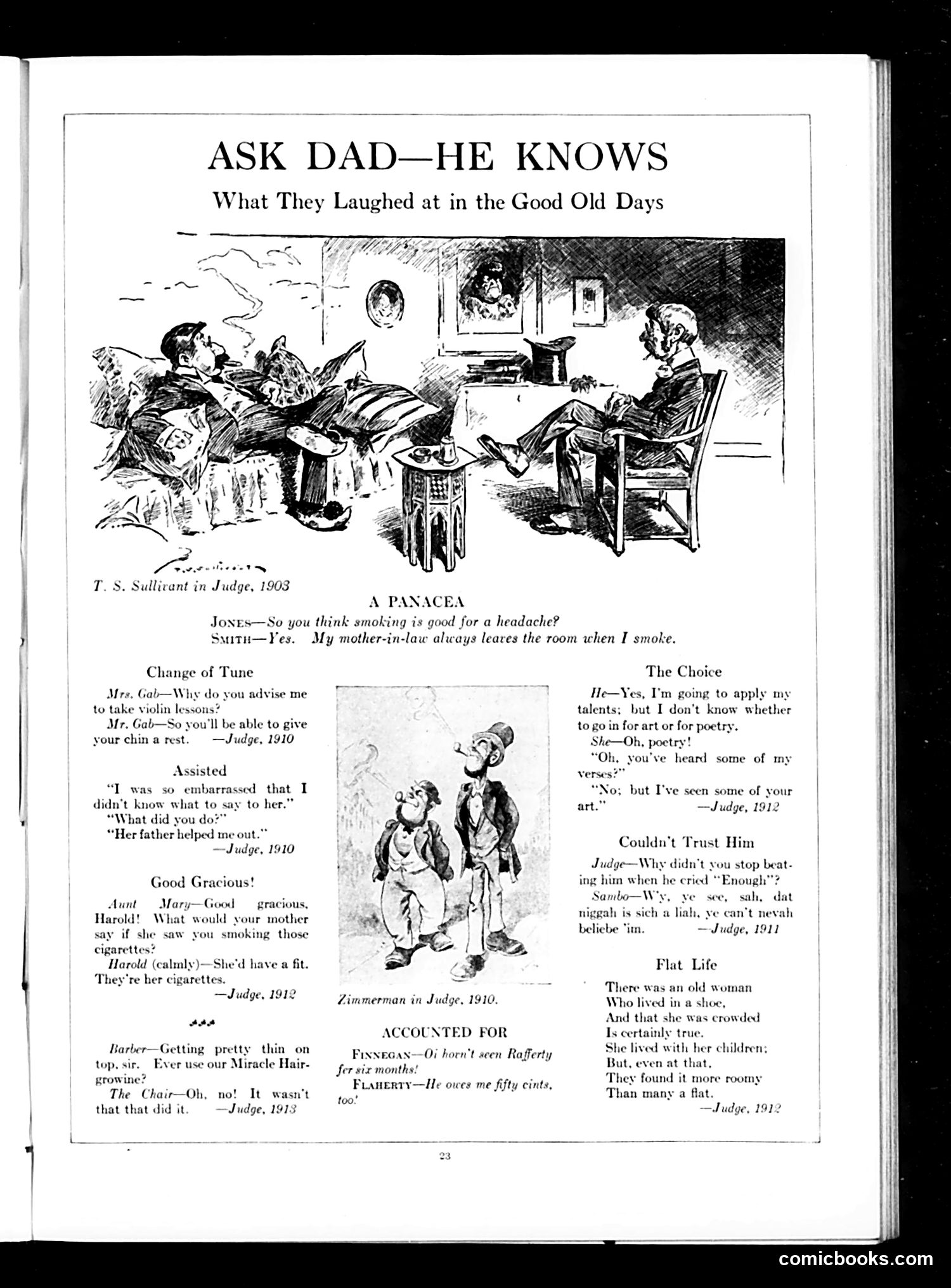
This page collects brief humorous anecdotes titled "Ask Dad—He Knows," presenting jokes about early 20th-century domestic life. The humor relies on period-specific social norms: **Key themes:** - **Smoking**: Multiple jokes treat tobacco as both medicinal and socially contentious—wives/mothers-in-law objecting to male smoking was apparently common enough for repeated satire. - **Marriage dynamics**: Husbands and wives are portrayed as adversarial (the violin joke implies nagging wives; the hair-growth joke suggests wives cause male stress-baldness). - **Class/ethnic humor**: The "Finnegan/Rafferty" joke uses stereotypical Irish dialect for working-class characters avoiding debt—typical of the era's casual ethnic humor. - **Gender roles**: Women are depicted as controlling (mothers-in-law, nagging wives), while men seek escape or maintain secrets. The illustrations by T.S. Sullivant show period interior furnishings. These jokes would have resonated with Judge's middle-class male readership as relatable domestic complaints, reflecting anxieties about marital authority and changing social behavior around tobacco and entertainment.
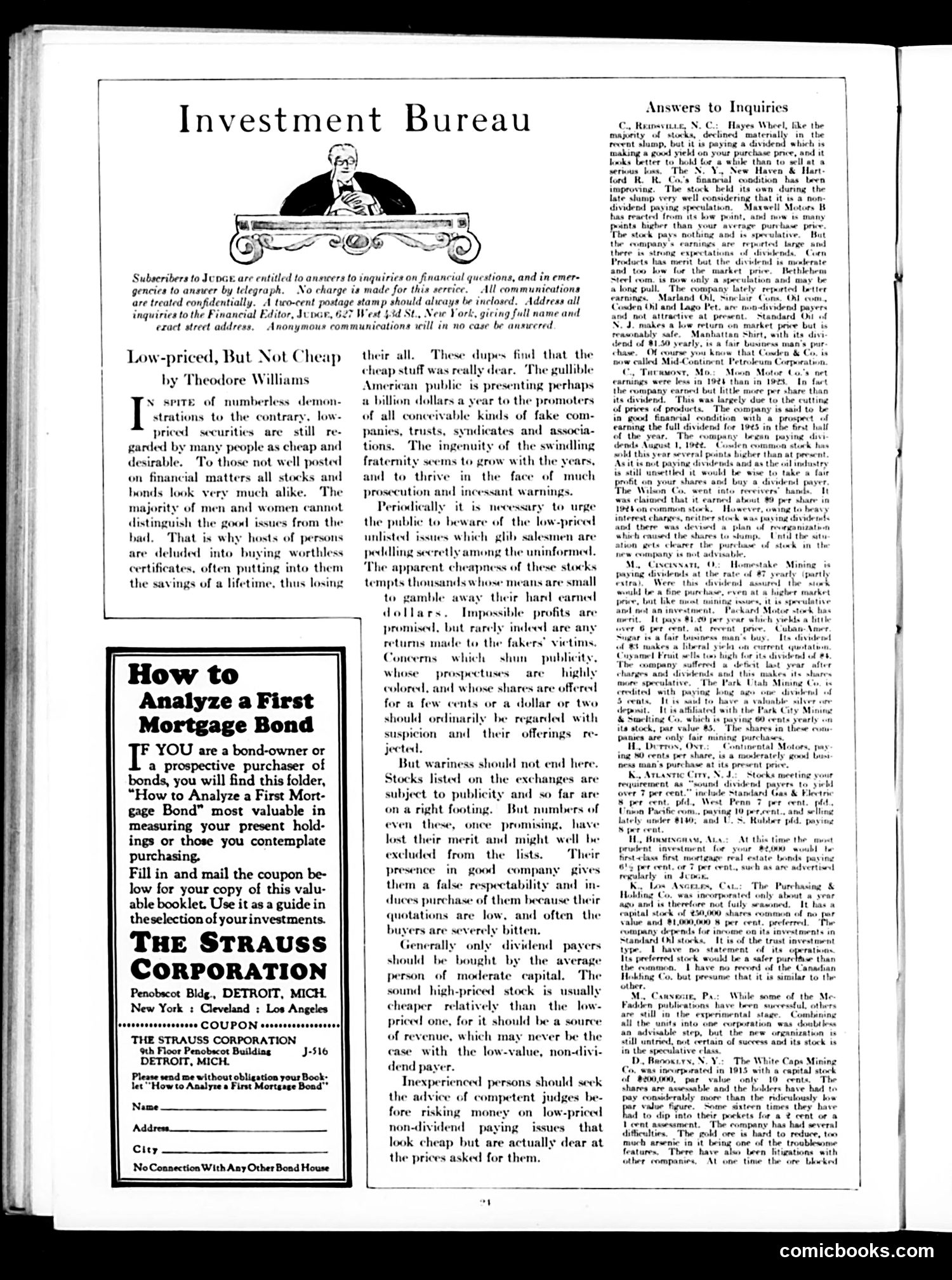
This page from *Judge* presents financial advice rather than political satire. The main article "Low-priced, But Not Cheap" by Theodore Williams warns readers against purchasing worthless stock certificates and bonds from fraudulent companies and syndicates—a billion-dollar-a-year problem, the author claims. Williams argues that unsophisticated investors, unable to distinguish good securities from bad, are duped by cheap-looking stocks that promise impossible profits but rarely deliver returns. He warns against unlisted companies that avoid publicity and those listed on exchanges that have lost merit. The accompanying Strauss Corporation advertisement offers a free booklet teaching readers "How to Analyze a First Mortgage Bond," positioning itself as a solution to investor vulnerability. The *Investment Bureau* header indicates this was *Judge*'s service answering readers' financial questions—practical consumer advice rather than satirical commentary on current events or political figures.
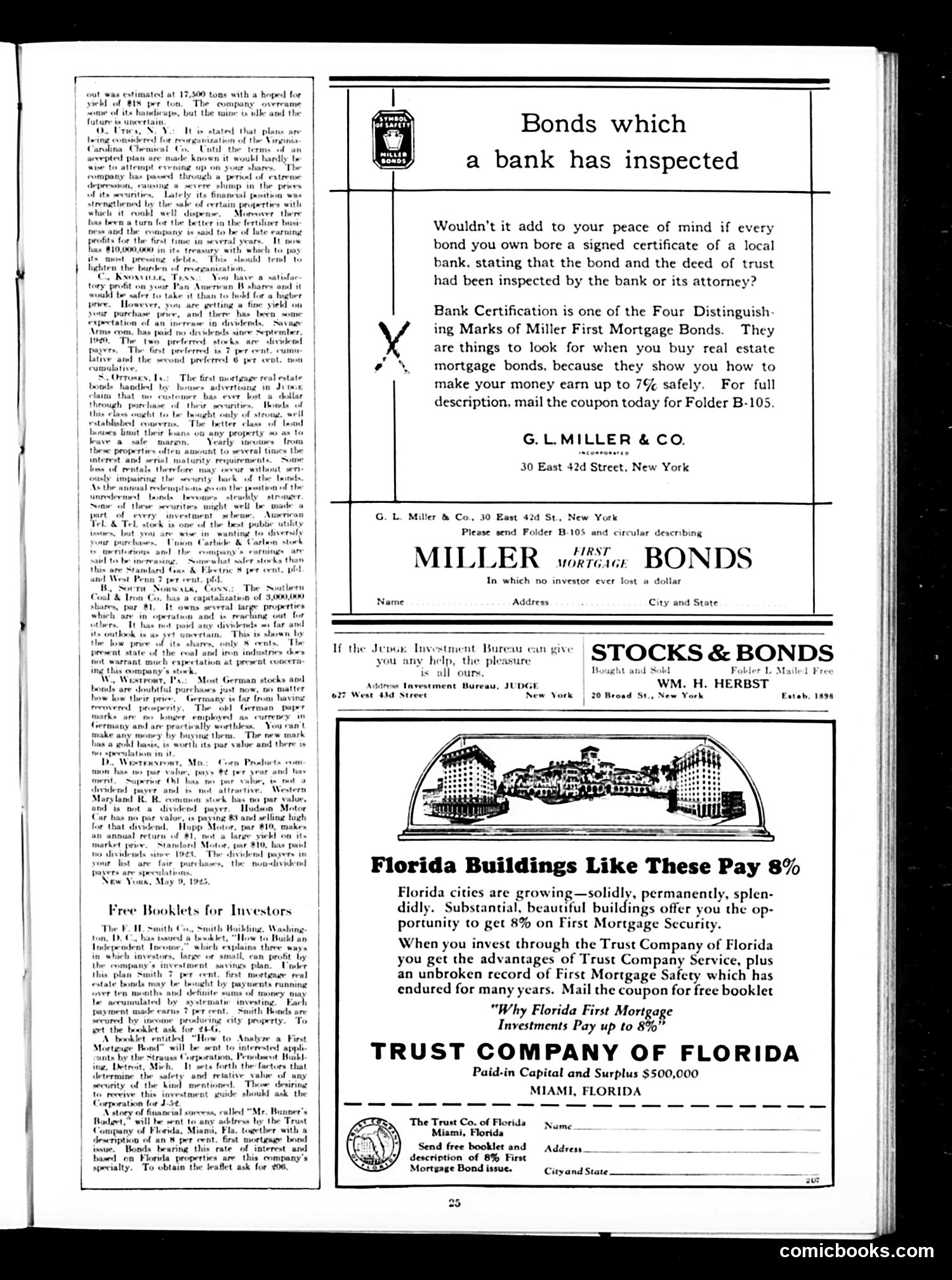
This page is **primarily advertising**, not satire or political cartooning. It consists entirely of financial investment advertisements from the 1920s era. The advertisements promote bonds and mortgage investments, particularly: 1. **G.L. Miller & Co.** - Marketing "First Mortgage Bonds" with bank certification as a safety feature 2. **Trust Company of Florida** - Offering 8% returns on Florida real estate first mortgages 3. **Wm. H. Herbst** - A stocks and bonds broker The implicit message targets middle-class investors seeking safe, income-producing investments. The repeated emphasis on "bank inspection," "certification," and "unbroken records of safety" reflects post-1920s concerns about investment security. The Florida development angle reflects the 1920s Florida real estate boom. There is **no discernible satire or political cartoon** on this page—it represents straightforward period advertising, likely appearing in *Judge* magazine as paid content alongside editorial material.
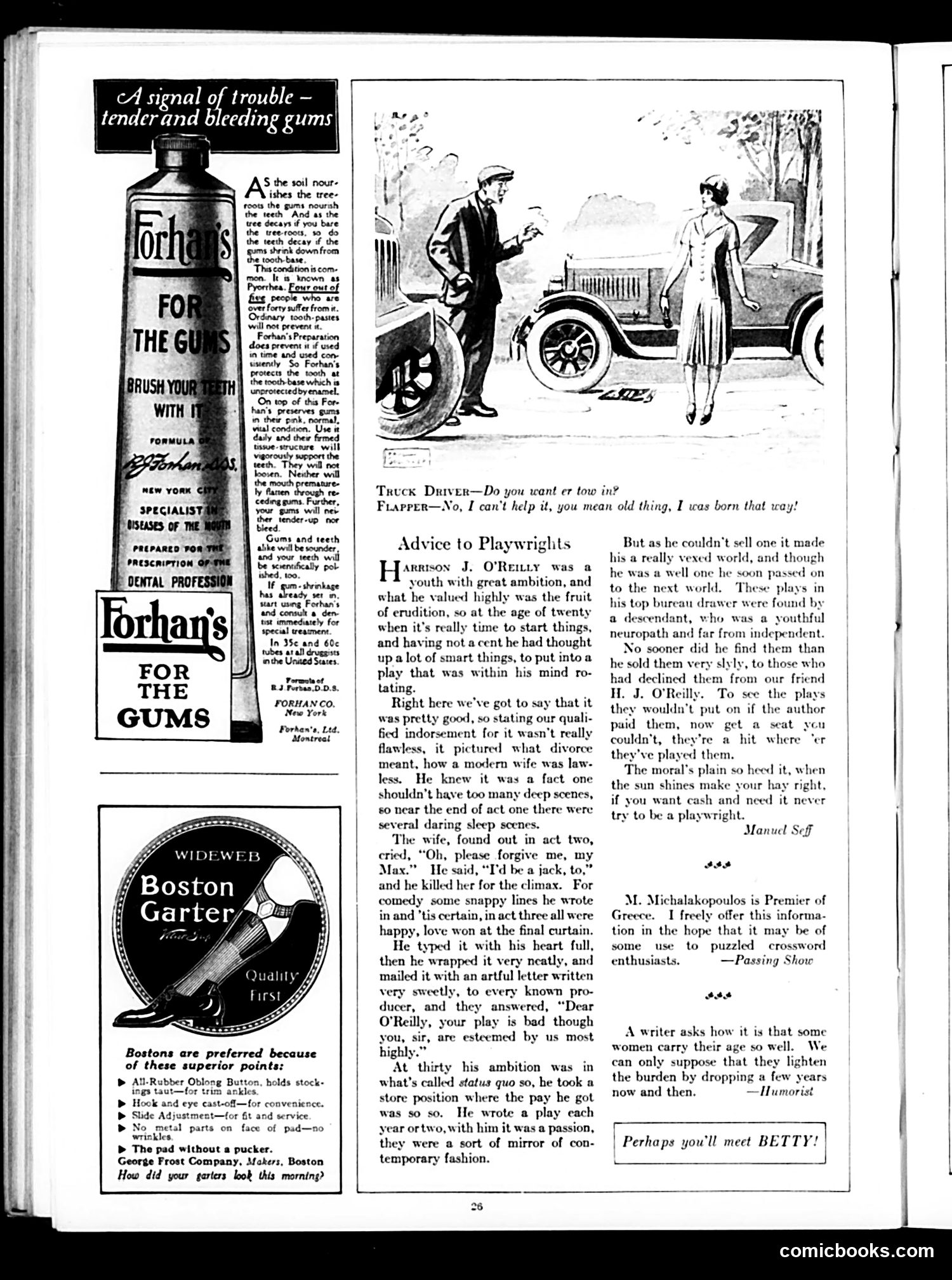
This Judge magazine page contains three distinct elements: **The Main Cartoon**: A brief joke about a truck driver offering to tow a car. The "flapper" (a 1920s young woman) refuses, claiming she was "born that way"—a dig at women's fashion of the era. Flappers were known for their loose, boyish clothing and carefree attitudes, which conservative society viewed as scandalous. **"Advice to Playwrights"**: A satirical poem mocking aspiring writers. Harrison J. O'Reilly writes plays full of divorce, infidelity, and melodramatic death scenes—reflecting popular theatrical trends of the time. The cruel irony: after his death, producers finally stage his rejected works as hits. The moral warns against pursuing art for its own sake rather than commercial success. **Advertisements**: Forhan's toothpaste (targeting gum disease) and Boston Garters dominate the page, typical of Judge's revenue model. The overall tone is cynical about both theatrical fashion and women's liberation movements of the 1920s.
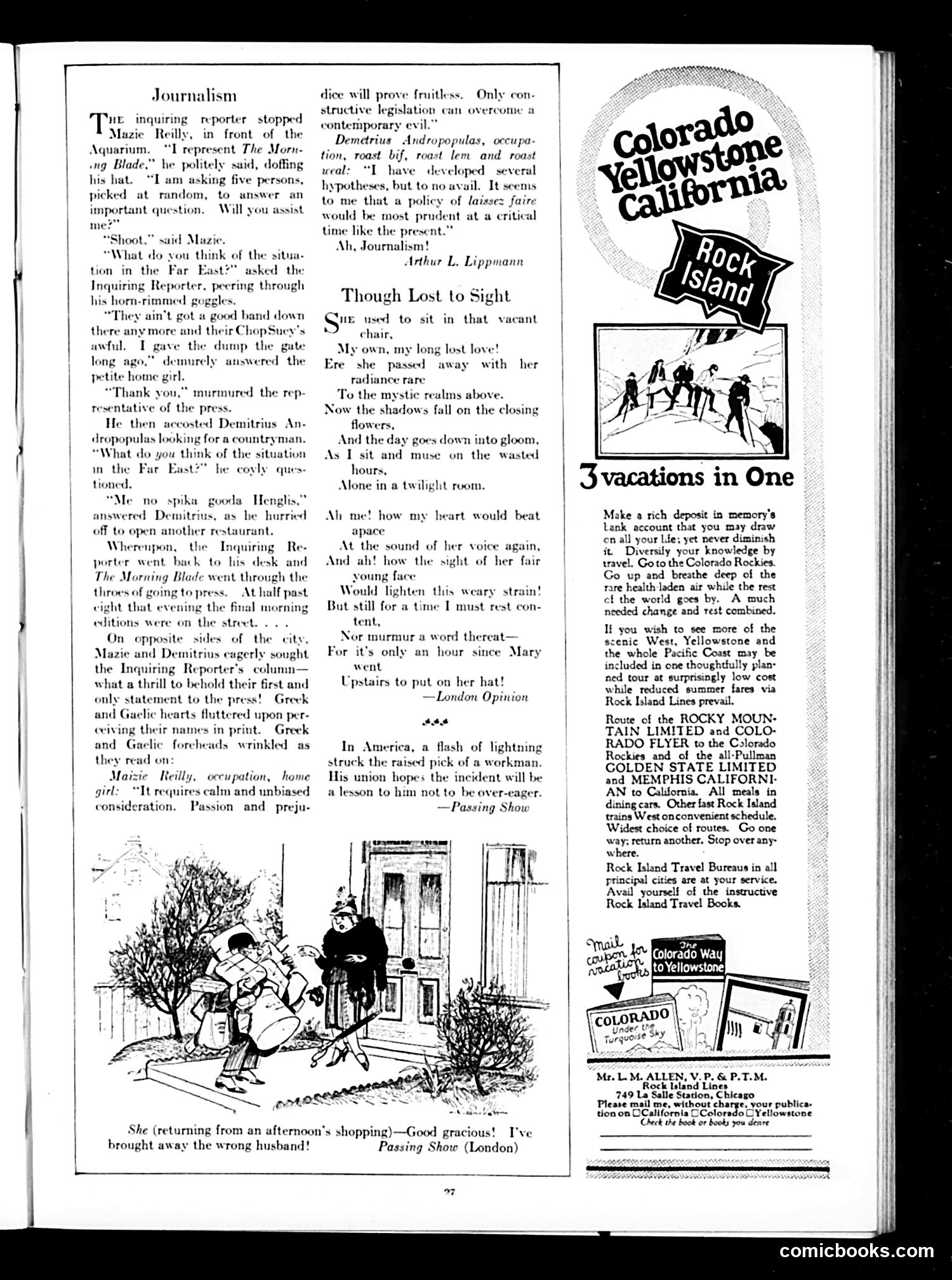
This page contains satirical journalism commentary and light humor typical of early 20th-century Judge magazine. The main cartoon mocks sensationalist newspaper reporting. An "Inquiring Reporter" interviews two random people—Mazie Reilly (a working-class Irish woman) and Demetrius Andropopulas (a Greek immigrant)—asking their opinions on complex Far East politics. Both give dismissive, non-answers reflecting their actual concerns (a restaurant, a band). However, the newspaper fabricates their responses into sophisticated political commentary about "laissez faire" and "constructive legislation," inventing intellectual quotes they never said. The satire targets how press outlets manufactured public opinion by misrepresenting or inventing quotes from ordinary citizens to support predetermined narratives—a journalistic practice evidently common enough to warrant ridicule. The page also includes sentimental poetry and period advertisements for Rock Island railroad travel, typical magazine filler content.
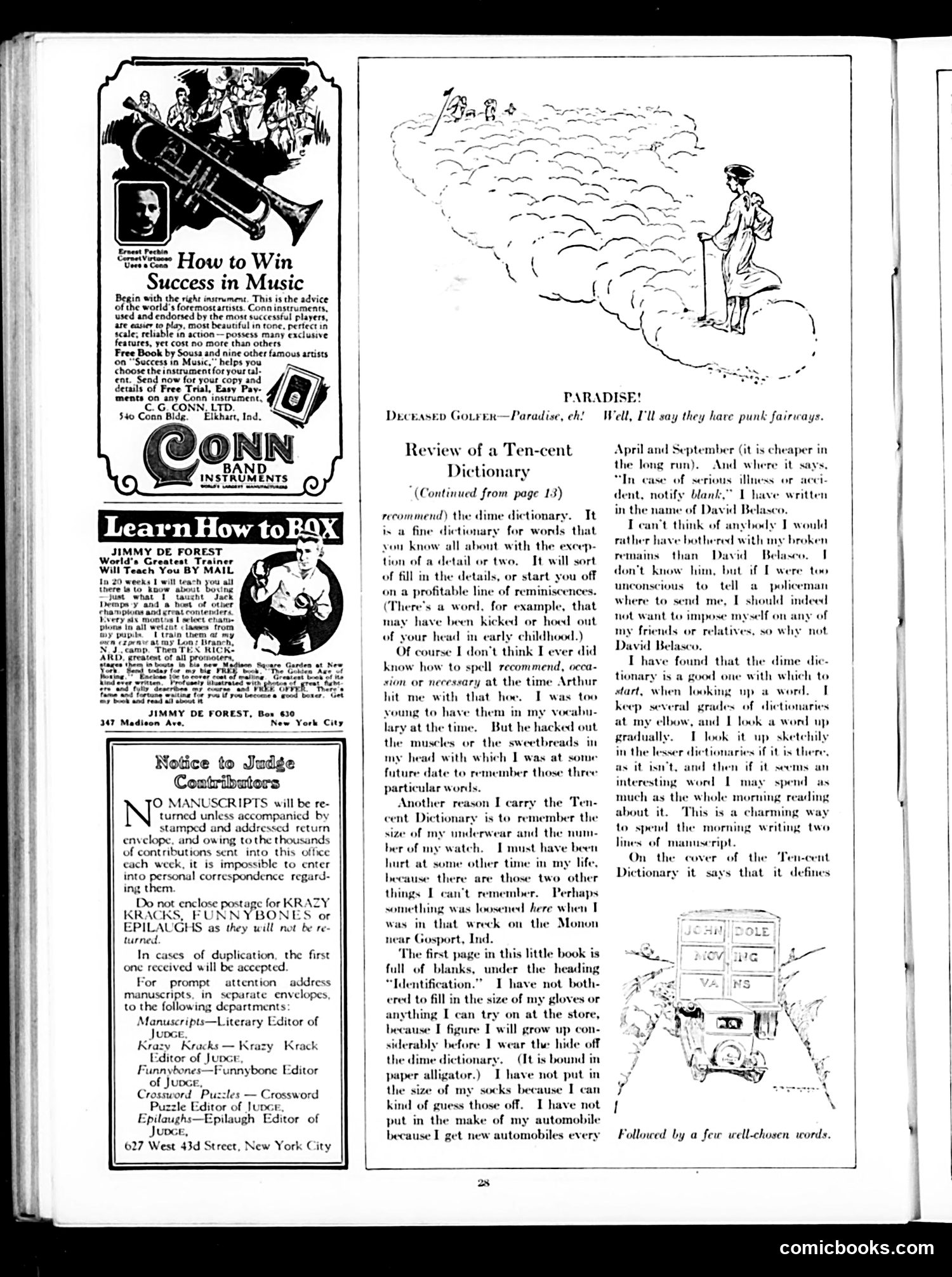
This page contains mostly **advertisements and magazine administrative notices**—not political cartoons requiring historical context. The visible content includes: - **Music and boxing instruction ads** (Conn instruments, Jimmy DeForest boxing lessons) - **Submission guidelines** for Judge magazine contributors - A **humorous essay** titled "Review of a Ten-cent Dictionary" by what appears to be a regular columnist The essay's joke is straightforward: the writer humorously describes carrying a dime dictionary primarily to remember personal details (underwear size, watch number) rather than for its actual purpose—spelling and definitions. He jokes that childhood head injuries left him unable to spell basic words, and he hasn't bothered filling in the "Identification" page because he'll "grow up considerably" before wearing out the paper cover. The small cartoon showing a golfer in "Paradise" appears to be a separate, unrelated gag about poor golf course conditions. **No significant political or social satire requiring historical knowledge is present on this page.**
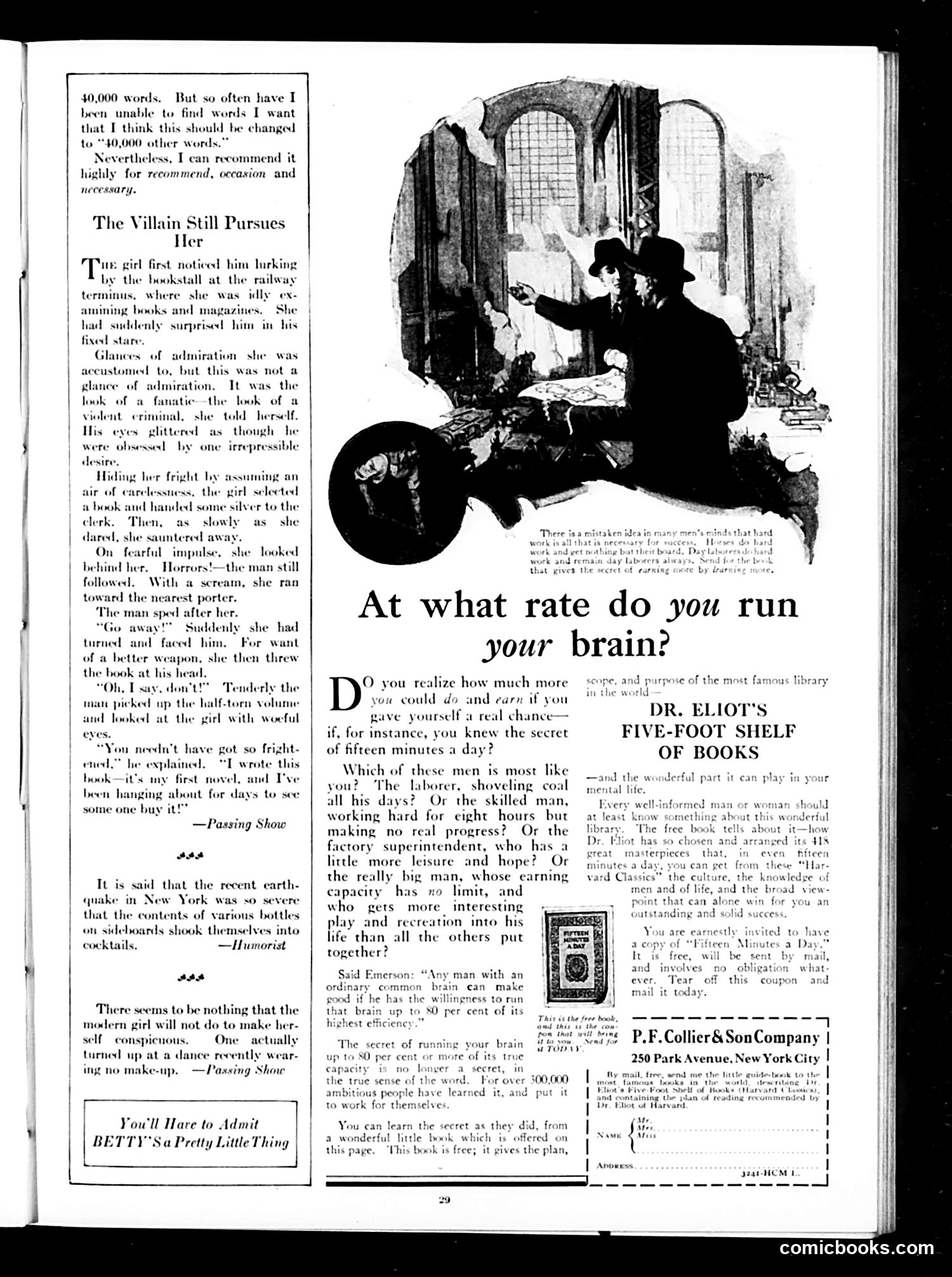
This page contains a short humorous story mocking pulp fiction melodrama. A girl encounters a man staring intensely at her in a railway bookstall. Convinced he's a criminal fanatic obsessed with her, she flees in terror, throws a book at him, and appeals to porters for rescue. His explanation? He's merely a struggling novelist desperate to see someone—*anyone*—actually purchase his self-published novel. The satire targets two things: the overwrought clichés of cheap serial fiction (the "villain pursues innocent maiden" plot), and the struggling author's pathetic eagerness to prove his work has value. The girl's melodramatic terror over what turns out to be harmless authorial desperation forms the joke. The page also advertises Dr. Eliot's Five-Foot Shelf of Books, a popular self-improvement library of the era.
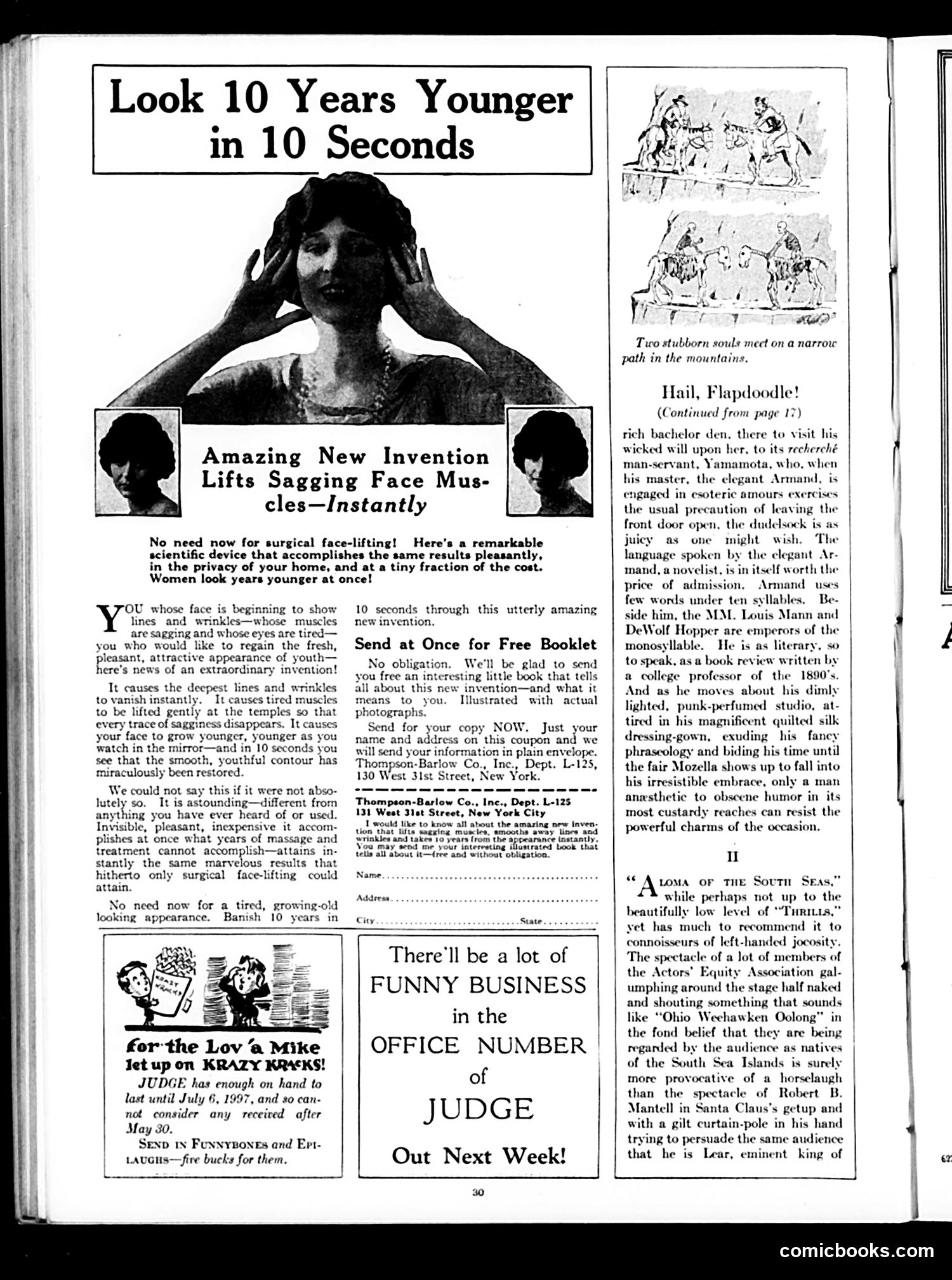
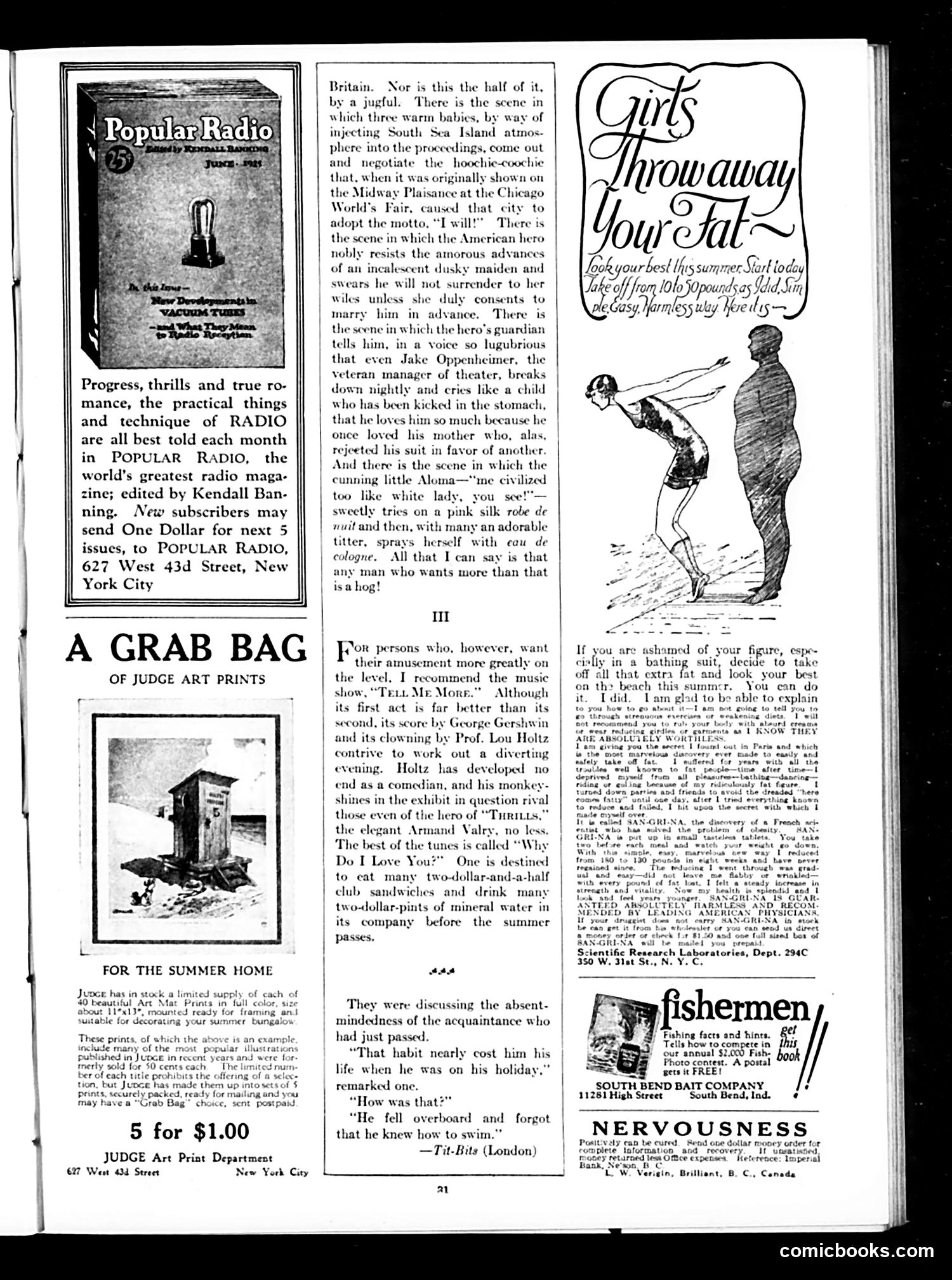
This page is primarily **advertising and filler content** rather than political satire. The main elements are: **"Girls Throw Away Your Fat"** advertisement (right side): A weight-loss pitch targeting women, illustrated with a before/after figure. It promises women can "look your best this summer" by losing 15-30 pounds using some unspecified product or method—typical of 1920s dubious diet marketing. **Theater review** (center): Discusses two shows—one featuring "Aloma," described with racial stereotypes typical of 1920s entertainment ("me civilized too like white lady"), and "Tell Me More" with comedian Lou Holtz and George Gershwin's score. **Miscellaneous ads**: Including fishing equipment, nervousness "cure," and Judge art prints. The page lacks sharp political commentary. It reflects 1920s consumer culture and period attitudes toward women's bodies and racial depictions in entertainment—historically significant mainly as artifact of era prejudices rather than intentional satire.
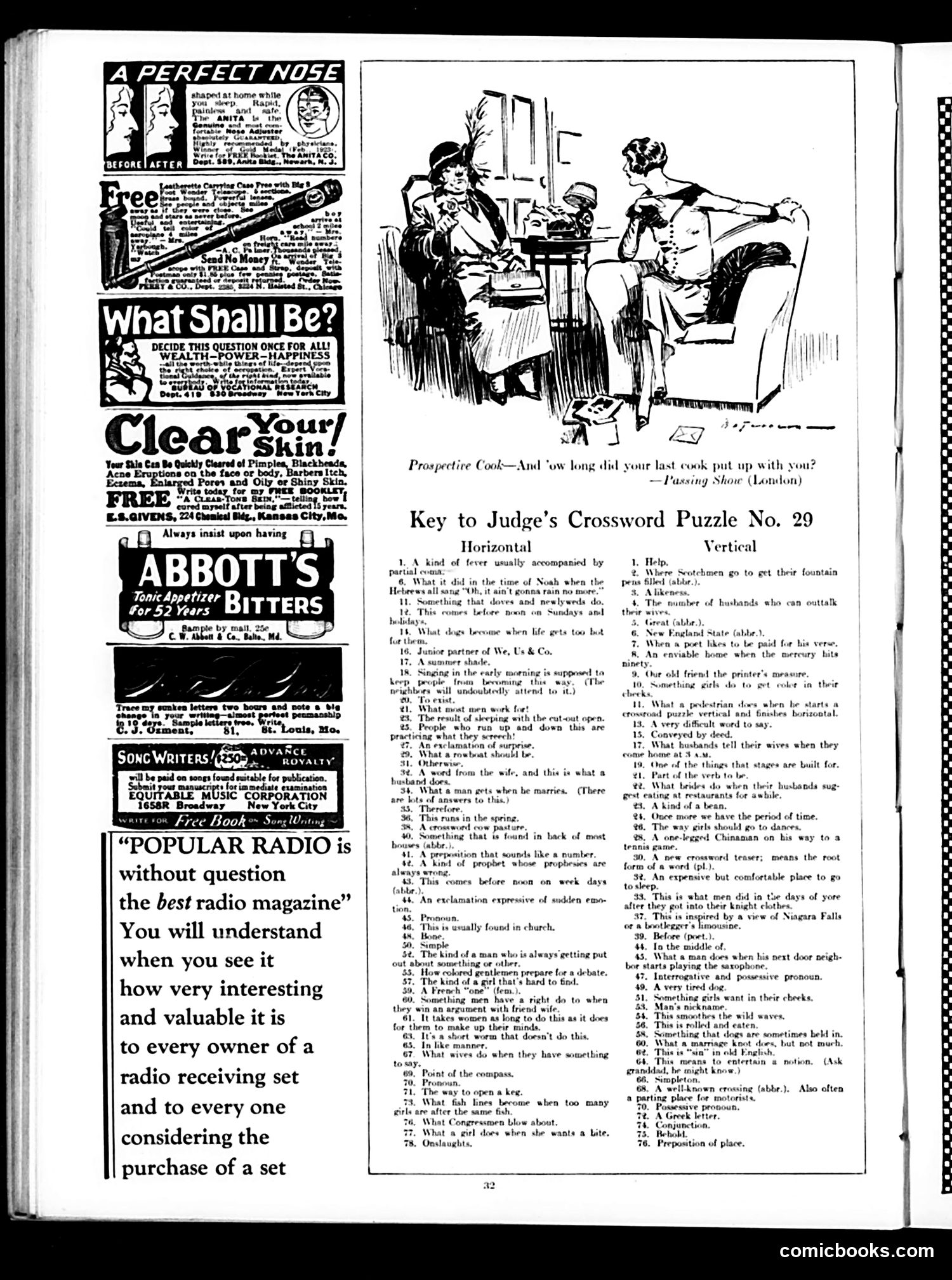
This page is primarily **advertising and puzzle content** rather than political satire. The main cartoon shows a domestic scene: a prospective cook being interviewed by a woman, with the caption asking how long the previous cook tolerated the employer. This is a gentle social joke about difficult employers and high cook turnover—reflecting early 20th-century servant-keeping culture. The surrounding content is commercial: ads for cosmetic treatments ("A Perfect Nose," skin-clearing products), Abbott's Bitters tonic, and songwriting/radio promotions. These ads reflect period concerns (complexion problems, health tonics) and emerging technology (radio). The crossword puzzle answers provided are entirely non-political—wordplay involving marriage, weather, and daily life ("what wives do when they want a Lite"). **No significant political figures or satire appear on this page.** It's a typical era advertisement and entertainment page from Judge magazine.
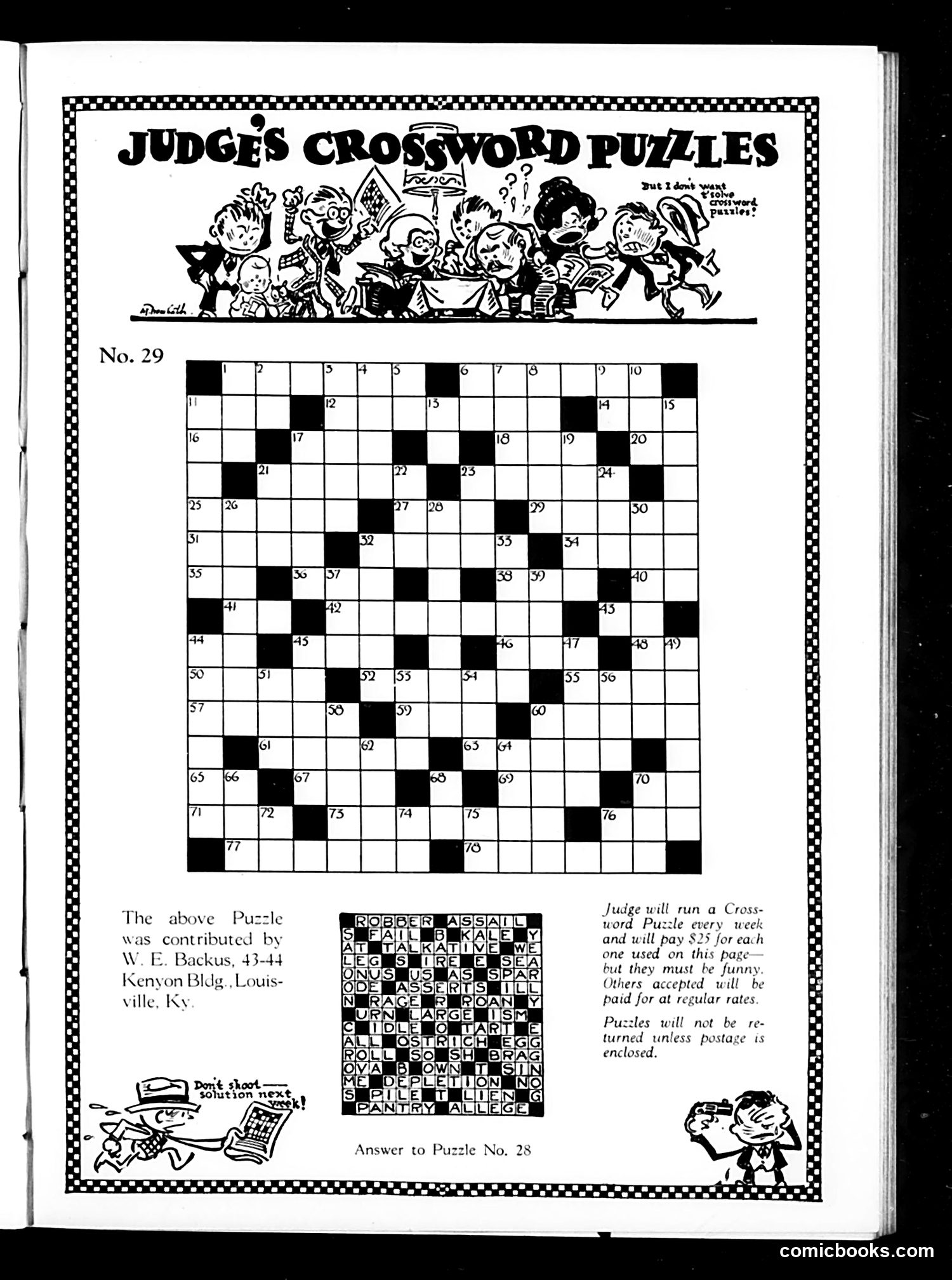
This is primarily a **crossword puzzle feature**, not a political cartoon. The page shows "Judge's Crossword Puzzles" No. 29, contributed by W.E. Backus from Louisville, Kentucky. The decorative header features cartoon children enthusiastically engaged with puzzles and learning materials—typical vintage illustration style celebrating intellectual pursuits. Key content includes: - An empty crossword grid (numbered 1-76) for solvers to complete - The **answer key to Puzzle No. 28** (shown filled in) - **Submission information**: Judge offered $25 weekly for acceptable puzzle contributions, with payment for others at "regular rates" - A note that puzzles won't be returned without postage The cartoon mascots (bottom left and right) are generic Judge magazine characters, not specific political figures. This represents Judge's popular early-20th-century puzzle section—entertainment content rather than satire or social commentary.
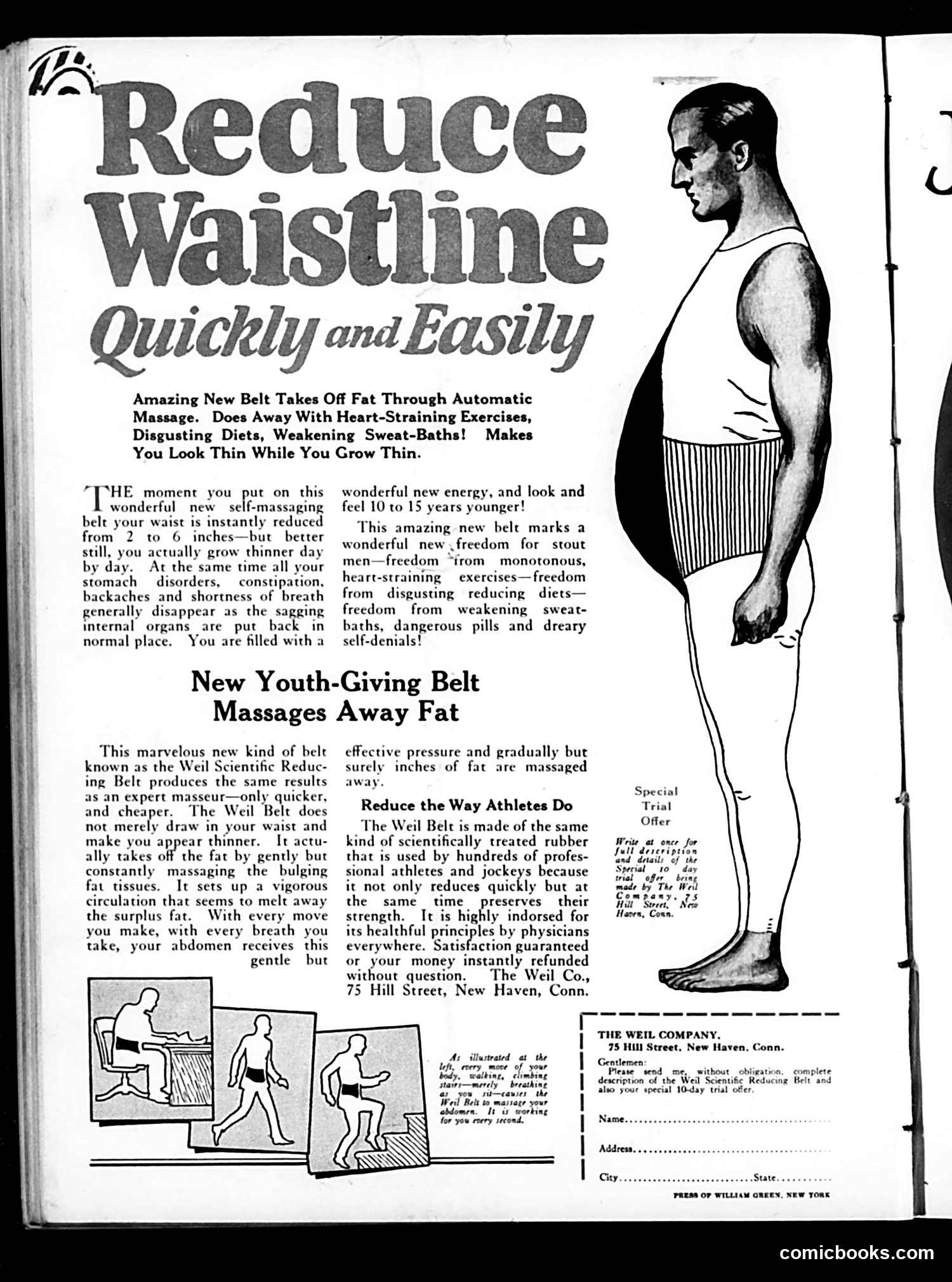
This is primarily a **product advertisement**, not political satire. It promotes the "Weil Scientific Reducing Belt," a mechanical waist-reduction device sold from New Haven, Connecticut. The ad targets men seeking weight loss without exercise or dieting—promising instant waist reduction of 2-6 inches plus actual fat loss through "automatic massage." The accompanying illustration shows a shirtless man in profile wearing the belt. The claims are remarkably exaggerated by modern standards: the belt allegedly cures constipation, backaches, shortness of breath, and makes users "feel 10 to 15 years younger." It promises results identical to a professional masseur but "quicker and cheaper." The ad emphasizes that athletes and jockeys use similar rubber products, lending false credibility. A "special 10-day trial offer" appears at bottom. **For modern readers**: This exemplifies early-20th-century quack medical devices—products making impossible health claims without scientific evidence, targeting consumer desires for effortless weight loss. Such deceptive advertising would violate modern FDA regulations.