
A complete issue · 36 pages · 1925
Judge — May 9, 1925
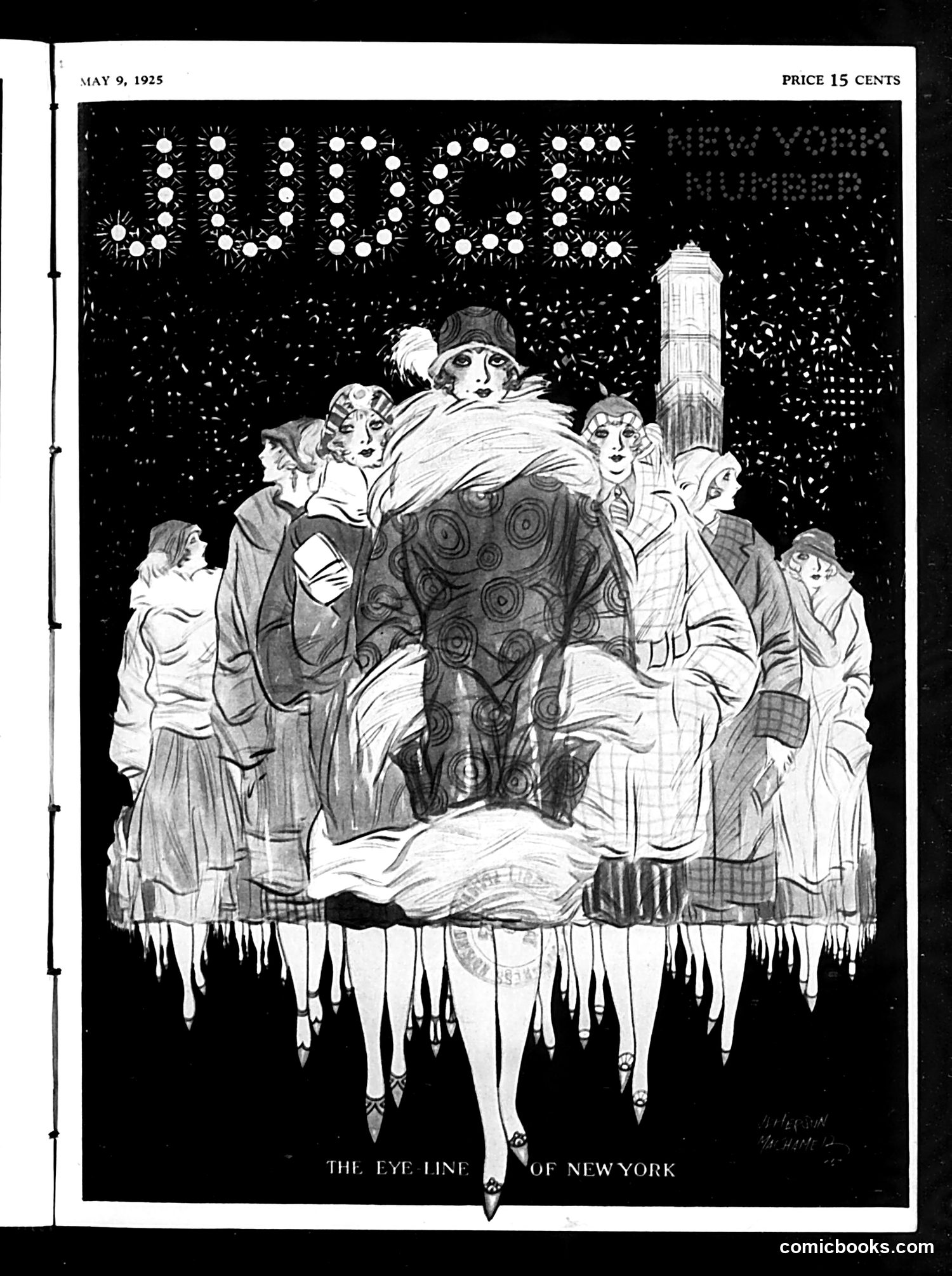
This illustration satirizes New York City's nightlife and entertainment scene during the Jazz Age. The central figure appears to be a showgirl or performer wearing an ornate, patterned dress, surrounded by admirers in evening wear gazing upward. The "eye line" reference suggests this depicts the sightlines of theater patrons—likely men—focused on female performers on stage or in nightclubs. The starry "JUDGE" text at top mimics marquee lights, reinforcing the Broadway/entertainment venue setting. The sensual, somewhat risqué imagery reflects 1920s anxieties about urban morality, commercialized sexuality, and the "dangers" of modern entertainment culture to traditional values. The work satirizes both the performers and the male gaze culture of New York's booming nightlife industry during Prohibition.
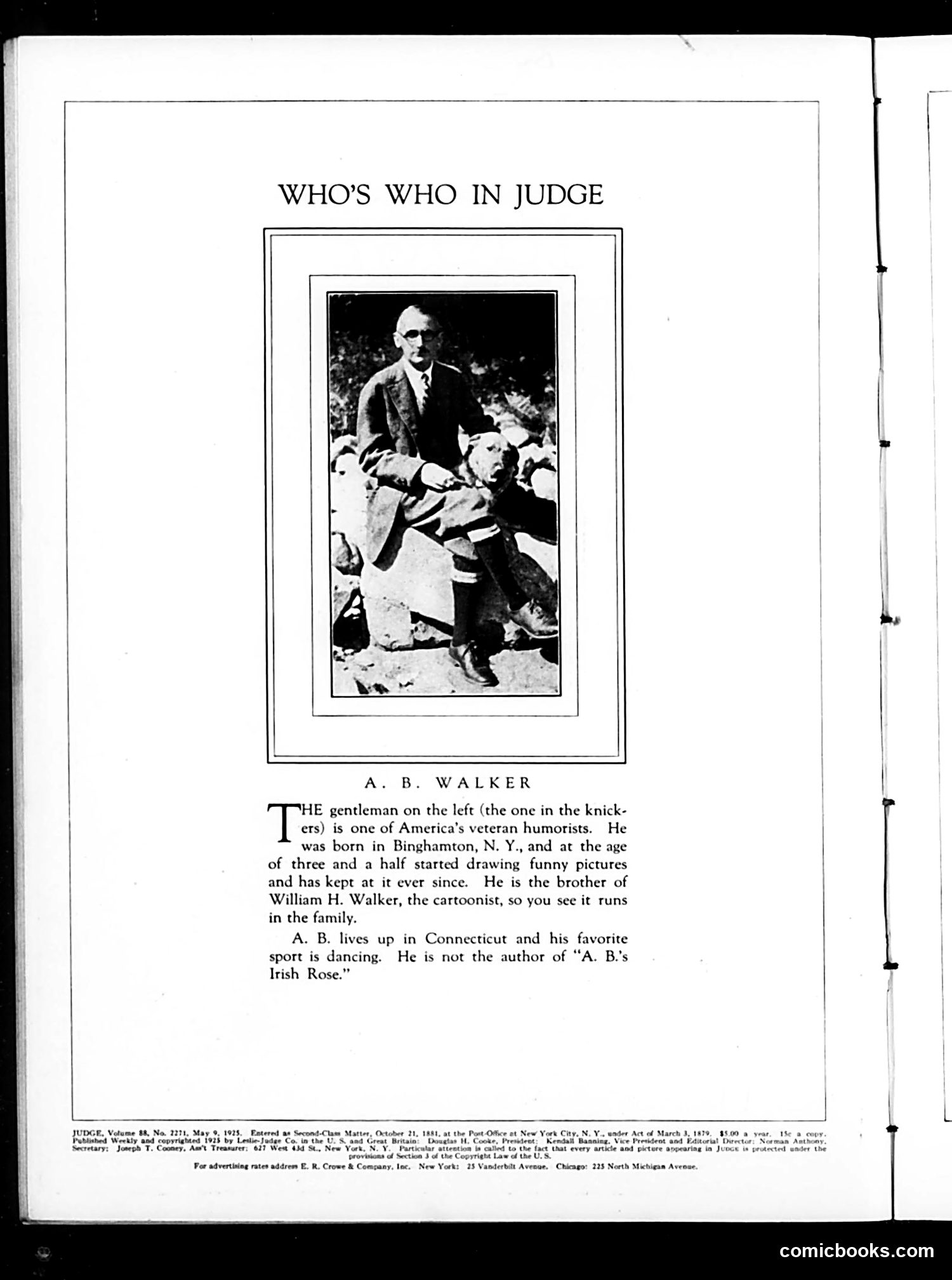
This page profiles **A.B. Walker**, a humor cartoonist and brother of William H. Walker (also a cartoonist). The photograph shows Walker with what appears to be a large teddy bear or similar prop, captioned as "the gentleman on the left (the one in the knickers)." The accompanying text establishes Walker's credentials: born in Binghamton, New York, he began drawing humorous pictures at age three and continued professionally. He lives in Connecticut and enjoys dancing as his favorite sport. The entry explicitly clarifies that Walker is **not** the author of "A.B.'s Irish Rose" — likely addressing reader confusion given the similar name and the work's popularity in that era. This is essentially a biographical reference entry rather than satirical commentary.
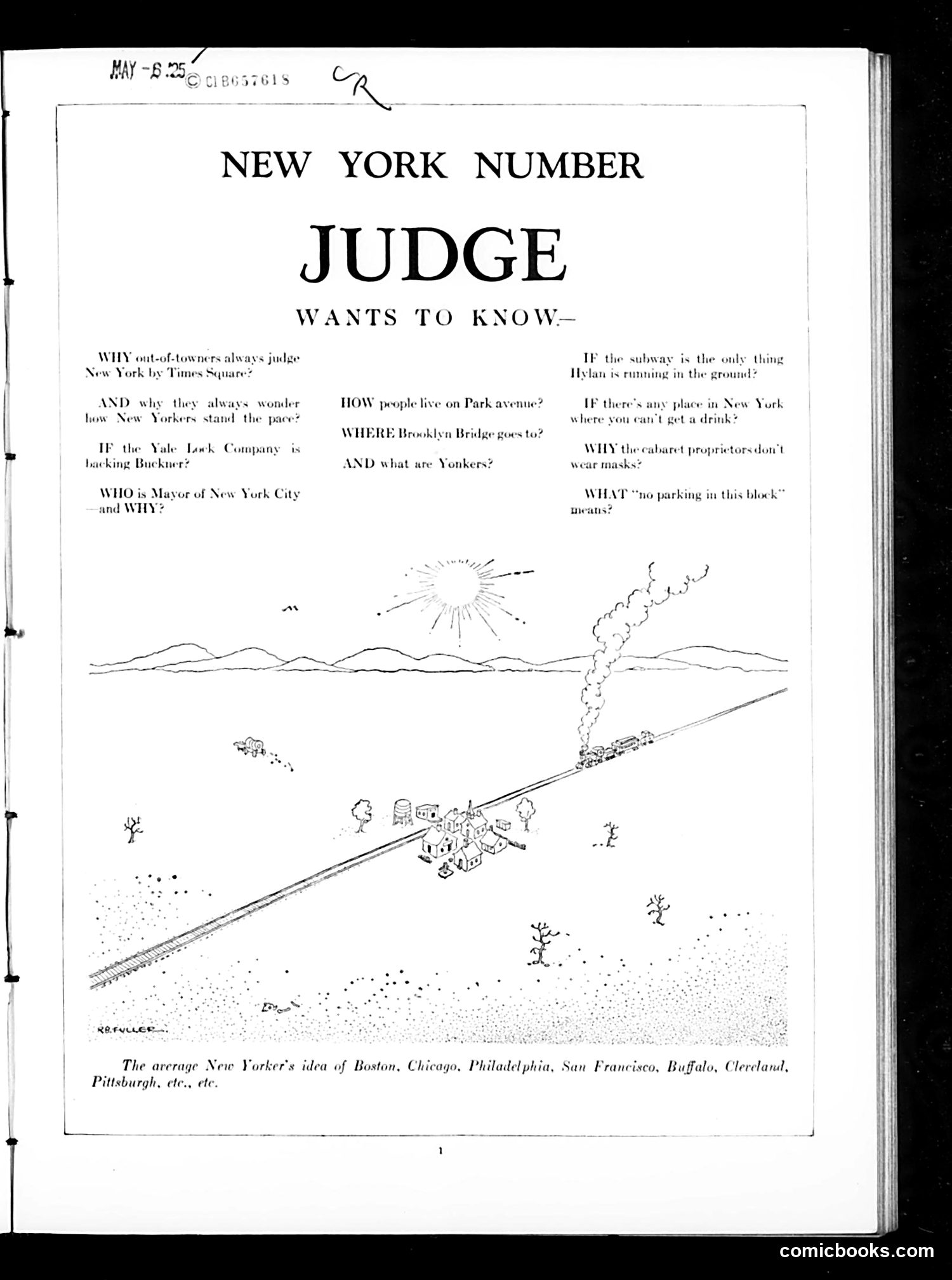
This is a satirical column posing rhetorical questions mocking New York City stereotypes and local peculiarities. The questions target: - **Out-of-towners' perceptions**: Why visitors judge NYC by Times Square alone - **Local behavior**: Why New Yorkers walk fast and wonder why others don't - **Specific landmarks**: Yale Lock Company's "Locking Bracket" (unclear reference) - **City officials**: The Mayor's identity and role - **Urban geography and culture**: Brooklyn Bridge's destination, Yankees fans, Park Avenue living conditions, subway dependency, drinking availability, cabaret culture The accompanying cartoon depicts a train traveling through mostly barren landscape—illustrating how average Americans elsewhere view New York as isolated and peculiar. The satire suggests New Yorkers are self-absorbed, often unaware how their city appears to outsiders.
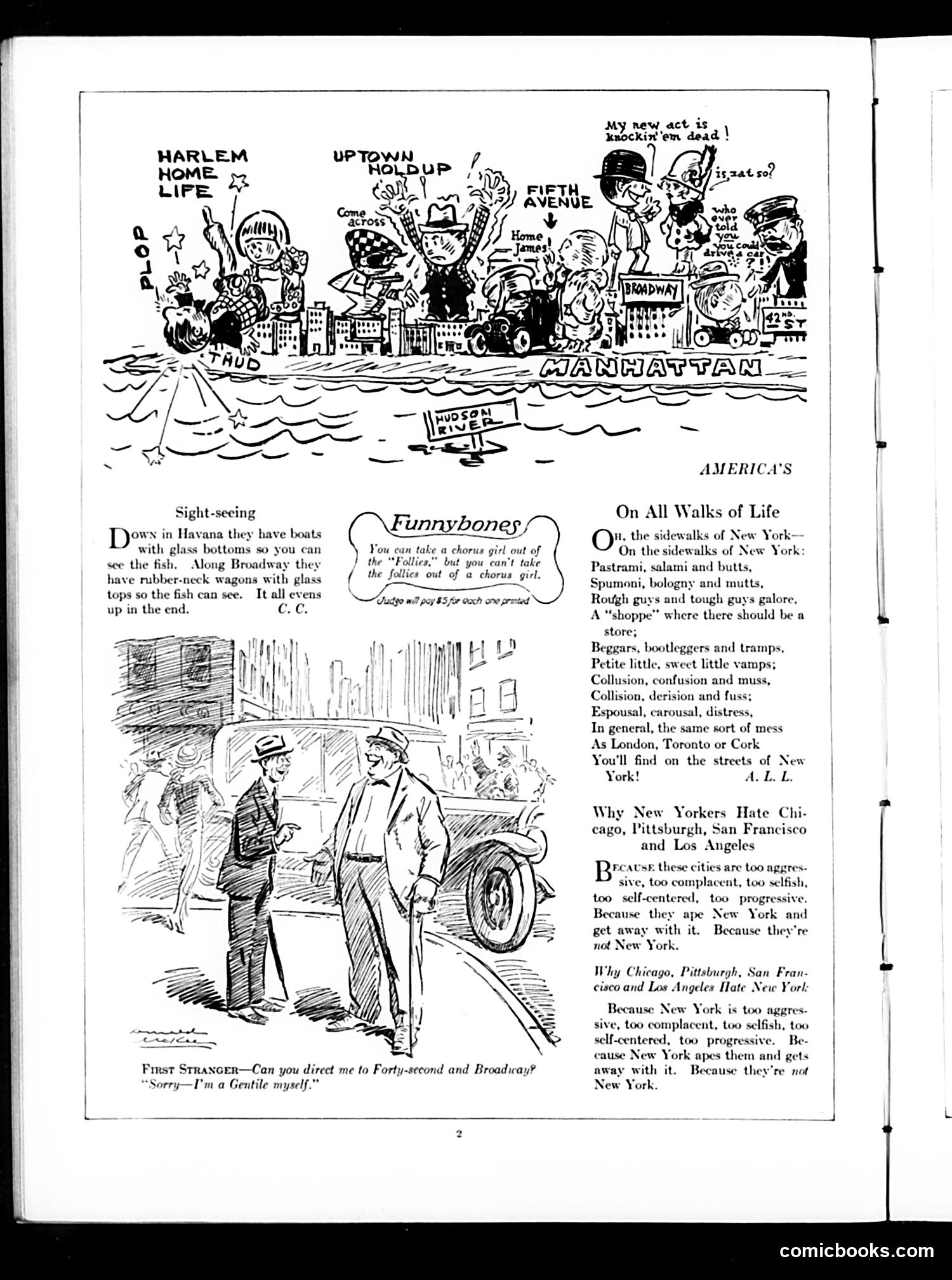
This page satirizes New York City life and attitudes toward other American cities. The top cartoon mocks "Harlem Home Life" and "Uptown Holdup," depicting chaotic street scenes with exaggerated characters along Manhattan's skyline. The main cartoon below shows a stranger asking directions to "Forty-second and Broadway," apologizing for being a "Gentile." This likely references New York's Jewish population and ethnic neighborhoods of the era. The accompanying text sections titled "Funnyboner" and "On All Walks of Life" mock New York's crowded, chaotic streets, beggars, and social disorder. The final sections explain why residents of Chicago, Pittsburgh, San Francisco, and Los Angeles resent New York—characterizing it as "too aggressive," "too selfish," and "too progressive," while "they're *not* New York," implying superiority tinged with defensive mockery.
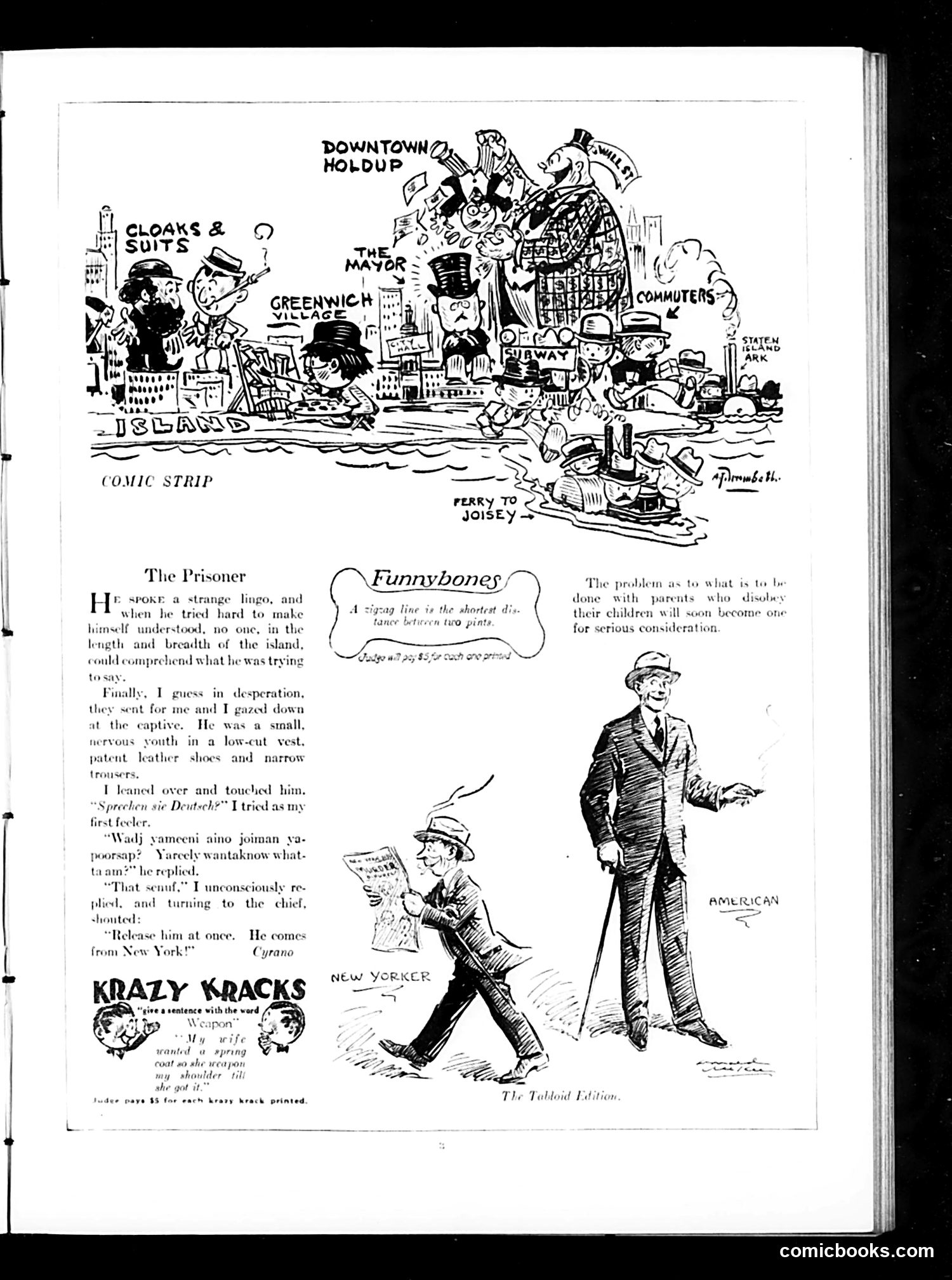
**Top Comic Strip:** A satirical map of Manhattan neighborhoods labeled with stereotypes—"Cloaks & Suits" (Jewish garment workers), "Greenwich Village," "The Mayor," "Downtown Holdup," "Commuters," and "Ferry to Joisey" (Jersey). This reflects early 20th-century ethnic and class divisions in New York City through caricature. **"The Prisoner" Story:** A narrative about a confused foreigner unable to communicate, eventually revealed to be from New York—the punchline being that New Yorkers themselves are incomprehensible. **"Funnybones" Section:** A satirical observation about parent-child relationships and societal concerns. **Illustrations:** Contrast a "New Yorker" (frantic, reading newspapers) with an "American" (calm, well-dressed)—mocking New York's frenetic pace versus perceived American composure. The page satirizes New York's ethnic diversity, urban chaos, and distinctive character.
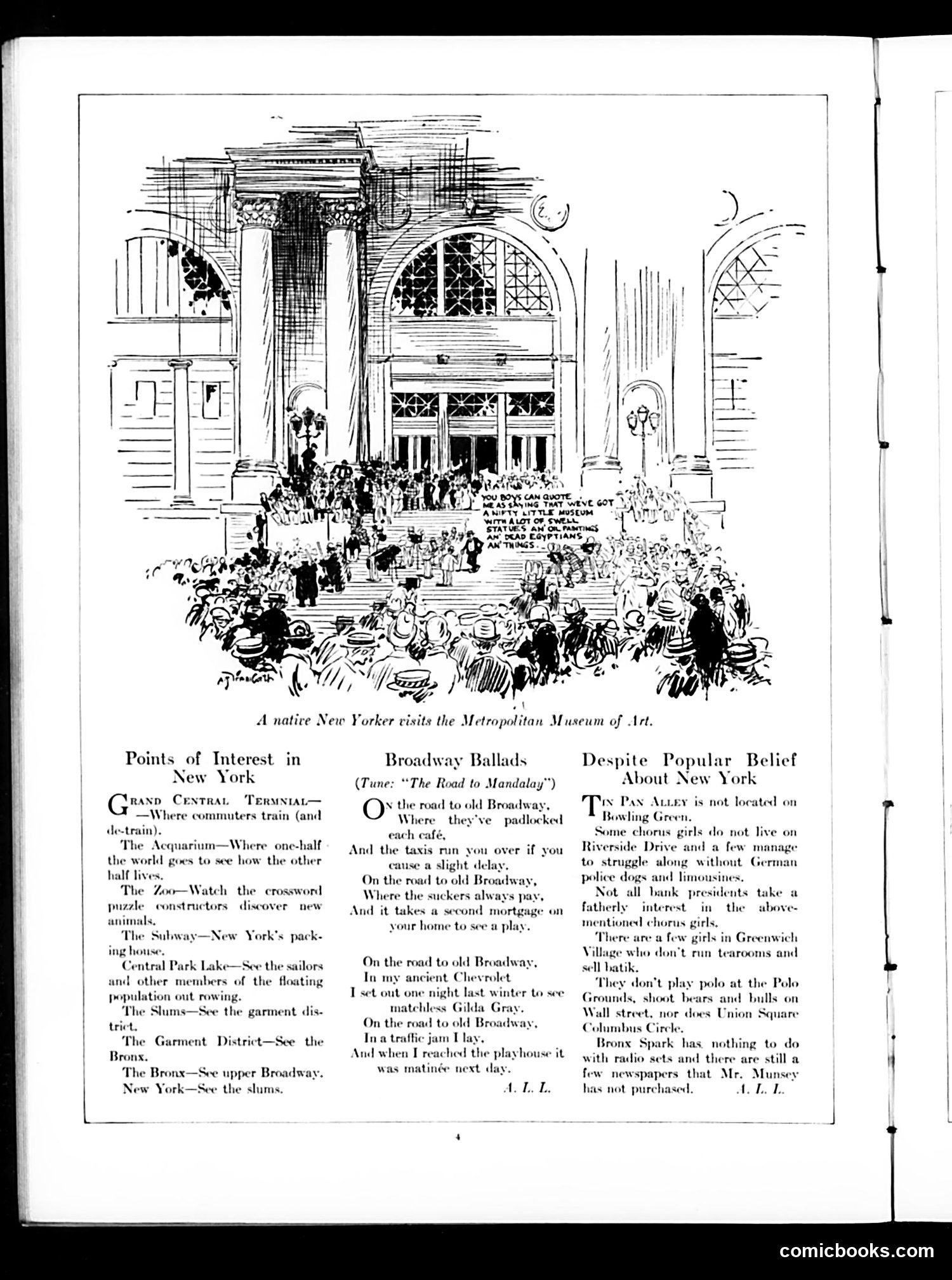
The main illustration depicts crowds visiting the Metropolitan Museum of Art, satirizing New York tourism and culture. The caption reads "A native New Yorker visits the Metropolitan Museum of Art," suggesting irony—that actual New Yorkers rarely visit their own cultural institutions. The three columns below offer satirical commentary on New York life: 1. **"Points of Interest in New York"** lists tourist attractions (Grand Central, The Zoo, Central Park) with humorous descriptions. 2. **"Broadway Ballads"** parodies a popular song about struggling to afford Broadway theater tickets and dealing with traffic jams. 3. **"Despite Popular Belief"** debunks myths about New York neighborhoods (Tin Pan Alley's location, chorus girls' lifestyles, etc.). The satire targets both tourists' narrow views of New York and locals' misconceptions about the city itself.
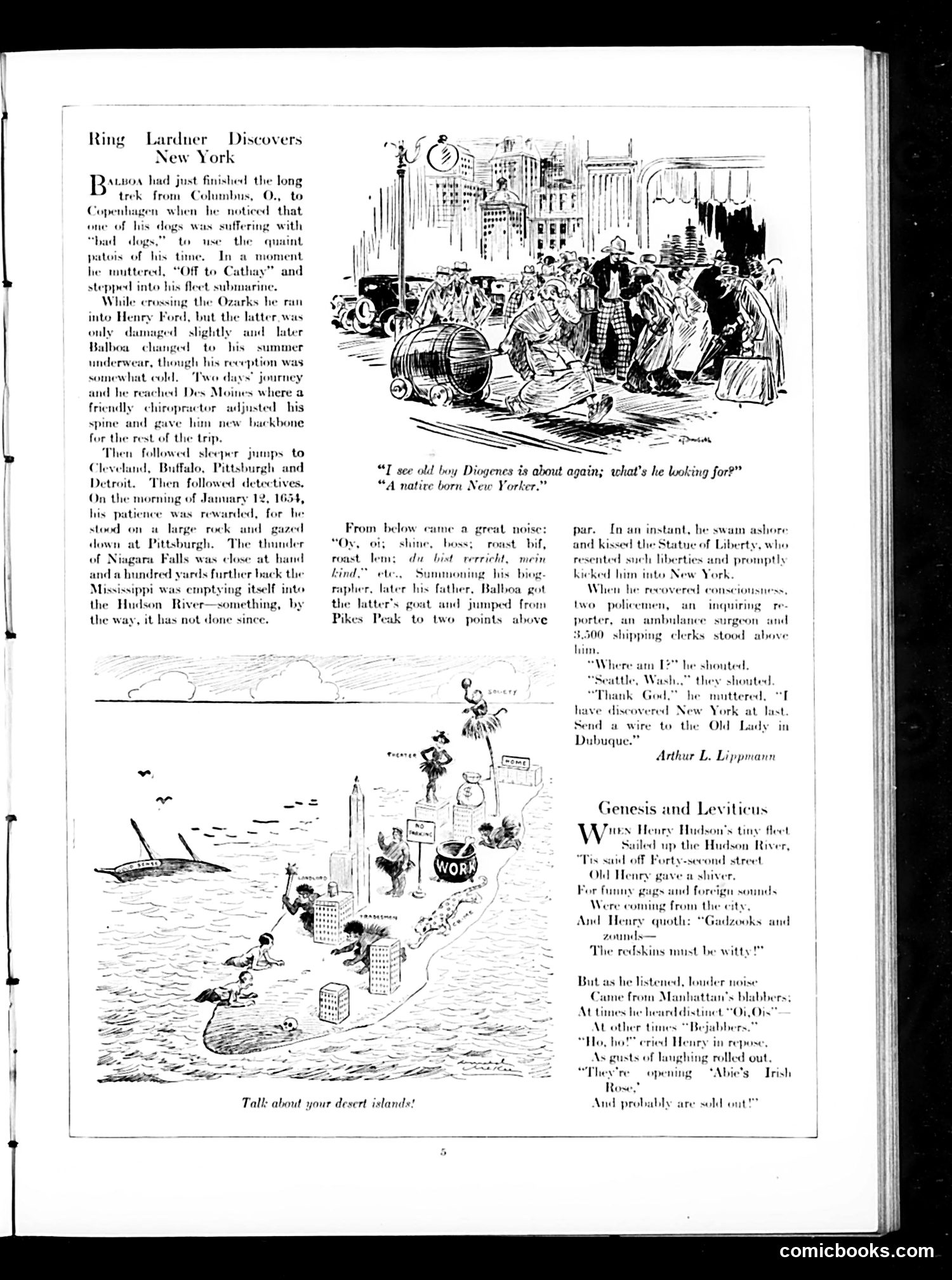
This page contains two separate pieces of humor: **"Ring Lardner Discovers New York"** (top): A satirical story about Balboa, a character who completes a journey from Columbus, Ohio to New York City. The joke appears to play on the contrast between small-town America and the urban chaos of 1920s New York—with its crowded streets, automobiles, and general bedlam depicted in the illustration. The humor targets both provincial innocence and metropolitan sensory overload. **"Genesis and Leviticus"** (bottom): A comedic poem about Old Henry Hudson's boat on the Hudson River at 42nd Street. The humor involves ethnic stereotypes (references to "Gudzooks and red-skins") and the chaos of Manhattan street life, with crowds and noise. This satirizes urban density and the cacophony of city commerce. Both pieces use exaggerated illustration to mock the overwhelming nature of 1920s New York City.
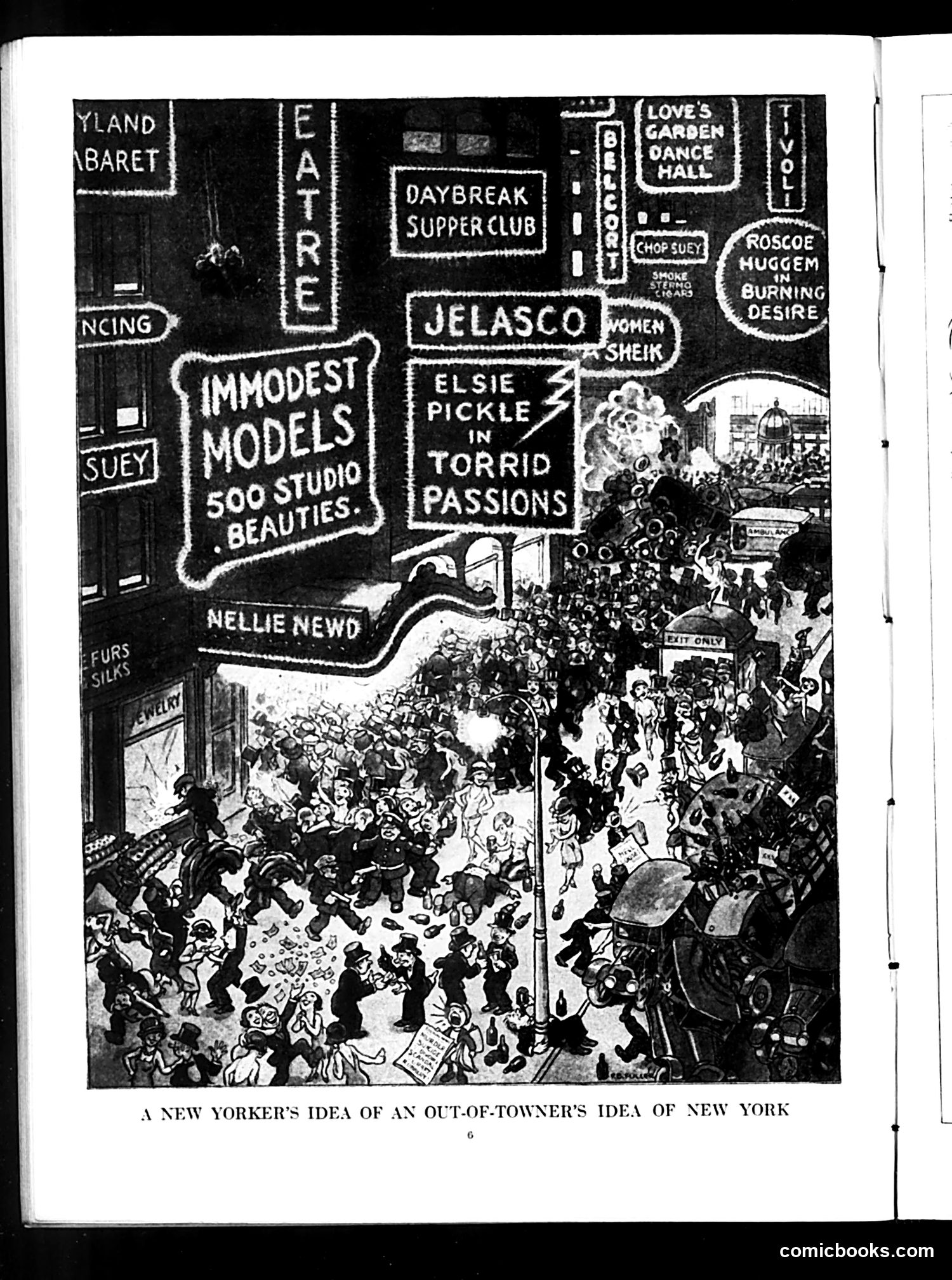
This cartoon satirizes urban stereotypes and outsiders' exaggerated perceptions of New York City. The crowded street scene depicts sensationalized entertainment venues and attractions—including theaters advertising films like "Immodest Models," "Elsie Pickle in Torrid Passions," and "Roscoe Huggem in Burning Desire," alongside dance halls and supper clubs. The satire works on two levels: it mocks both the actual seedier elements of 1920s New York and the *exaggerated* expectations out-of-town visitors might hold about the city. The title suggests a New Yorker is satirizing how rural or provincial Americans imagine Manhattan—as a den of vice, burlesque, and moral danger. The packed, chaotic street teeming with pedestrians emphasizes the sensory overload and seediness outsiders associated with the metropolis.
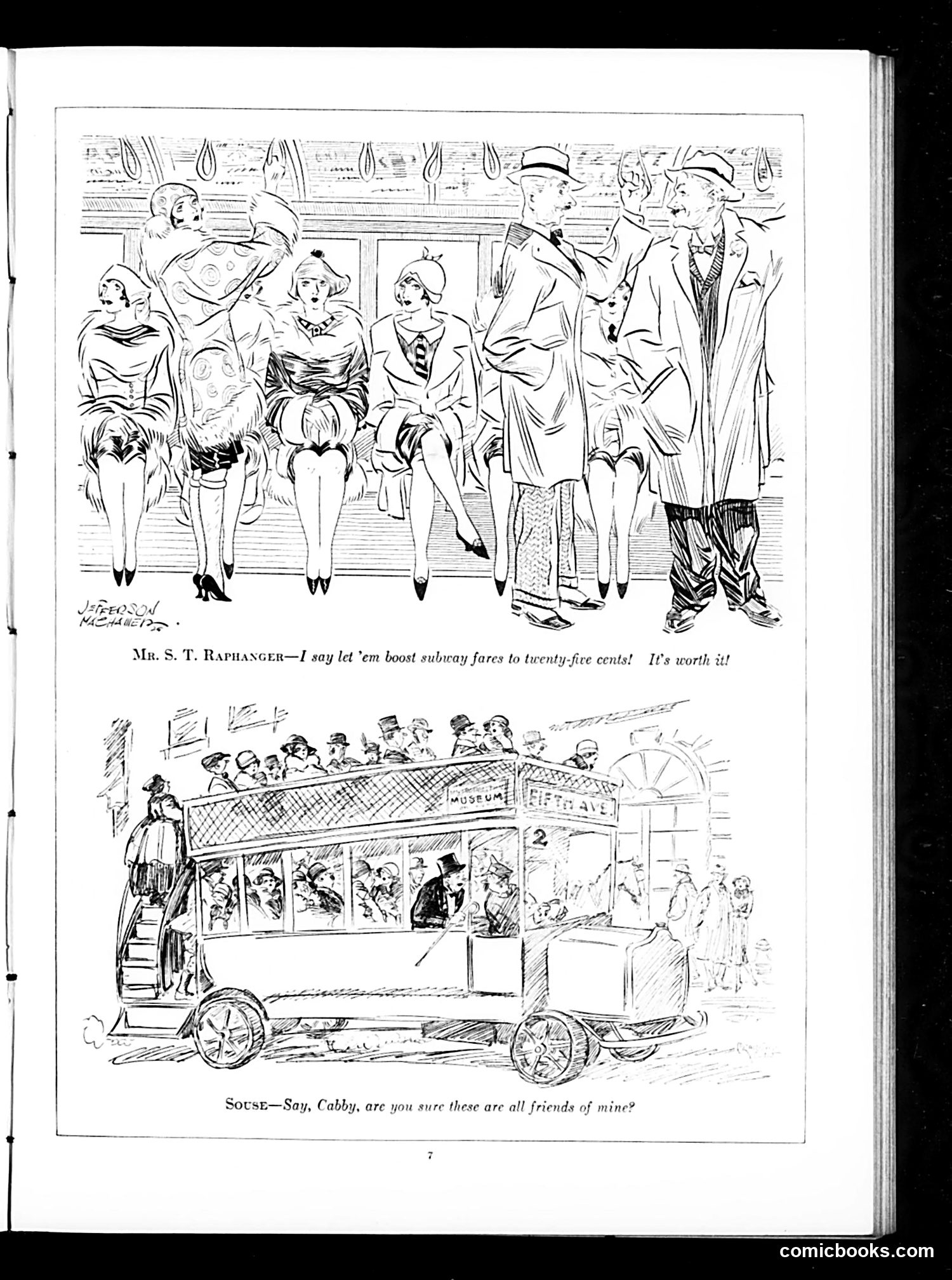
This page contains two cartoons satirizing early-20th-century urban life. The **top cartoon** shows Mr. S.T. Raphanger advocating for cheaper subway fares (boosted to 25 cents), addressing well-dressed women in what appears to be a waiting area or station. The **bottom cartoon** depicts a crowded sightseeing bus labeled "Museum" and "Fifth Ave," packed with tourists. The driver (identified as "Souse") responds to a passenger's question about whether everyone aboard are friends, implying the bus is uncomfortably overcrowded with strangers rather than an actual social group. Both cartoons mock aspects of NYC transit: the top jokes about fare increases affecting riders, while the bottom satirizes tourist experiences and overcrowding on popular routes. The humor relies on familiar frustrations with public transportation.
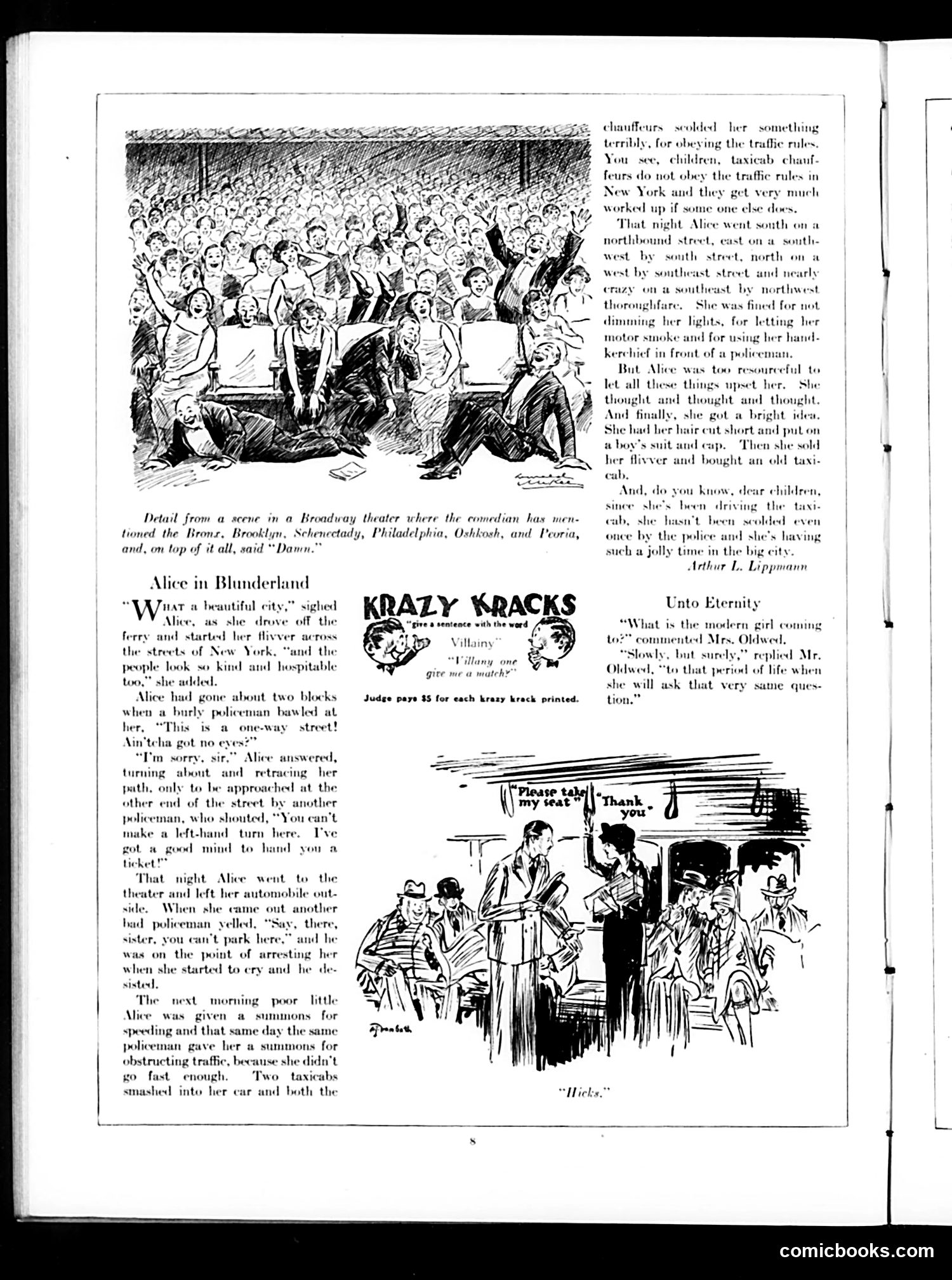
This satirical story mocks the arbitrary and contradictory nature of early automobile traffic enforcement in New York City. Alice, newly arrived from the countryside, encounters police who enforce traffic rules inconsistently and harshly—she's ticketed for going too slow AND too fast, for parking AND for obstructing traffic, for minor infractions like not dimming lights. The satire's point: the system is absurd and designed to punish drivers no matter what they do. The punchline—that Alice escapes harassment only by disguising herself as a male taxi driver—suggests that enforcement targets female drivers specifically, likely reflecting 1920s-era gender bias against women drivers. The accompanying "Krazy Kracks" panel and "Unto Eternity" joke appear to be filler content typical of Judge magazine's format.
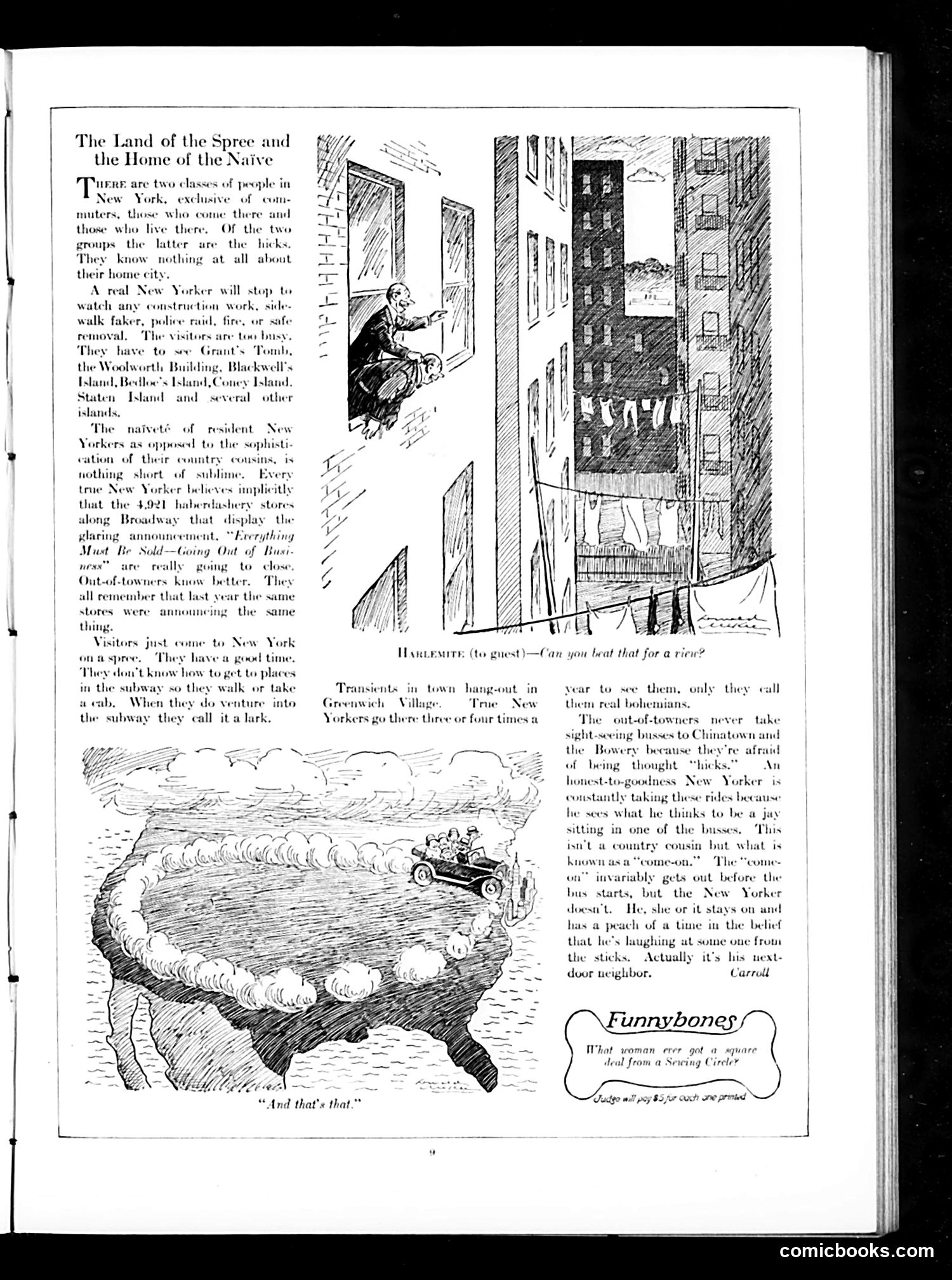
This satirical piece mocks New Yorkers' condescending attitudes toward out-of-town visitors, while revealing New Yorkers themselves are actually the naive ones. **The satire's point:** Resident New Yorkers consider visiting tourists ("hicks") unsophisticated for visiting tourist attractions like Grand Central, the Woolworth Building, and Coney Island. Yet New Yorkers themselves repeatedly ride sightseeing buses, believing they're mocking "country cousins"—unaware their fellow riders are actually their own neighbors doing the same thing. **The cartoon:** Shows a cramped tenement building with narrow window views—illustrating limited urban perspectives. The "Harlequin" caption jokes about viewing nothing noteworthy. **The humor:** The irony that New Yorkers' claimed superiority is baseless; they're equally gullible tourists in their own city, deceiving themselves about who they're laughing at. The bottom joke about sewing circles appears unrelated filler humor.
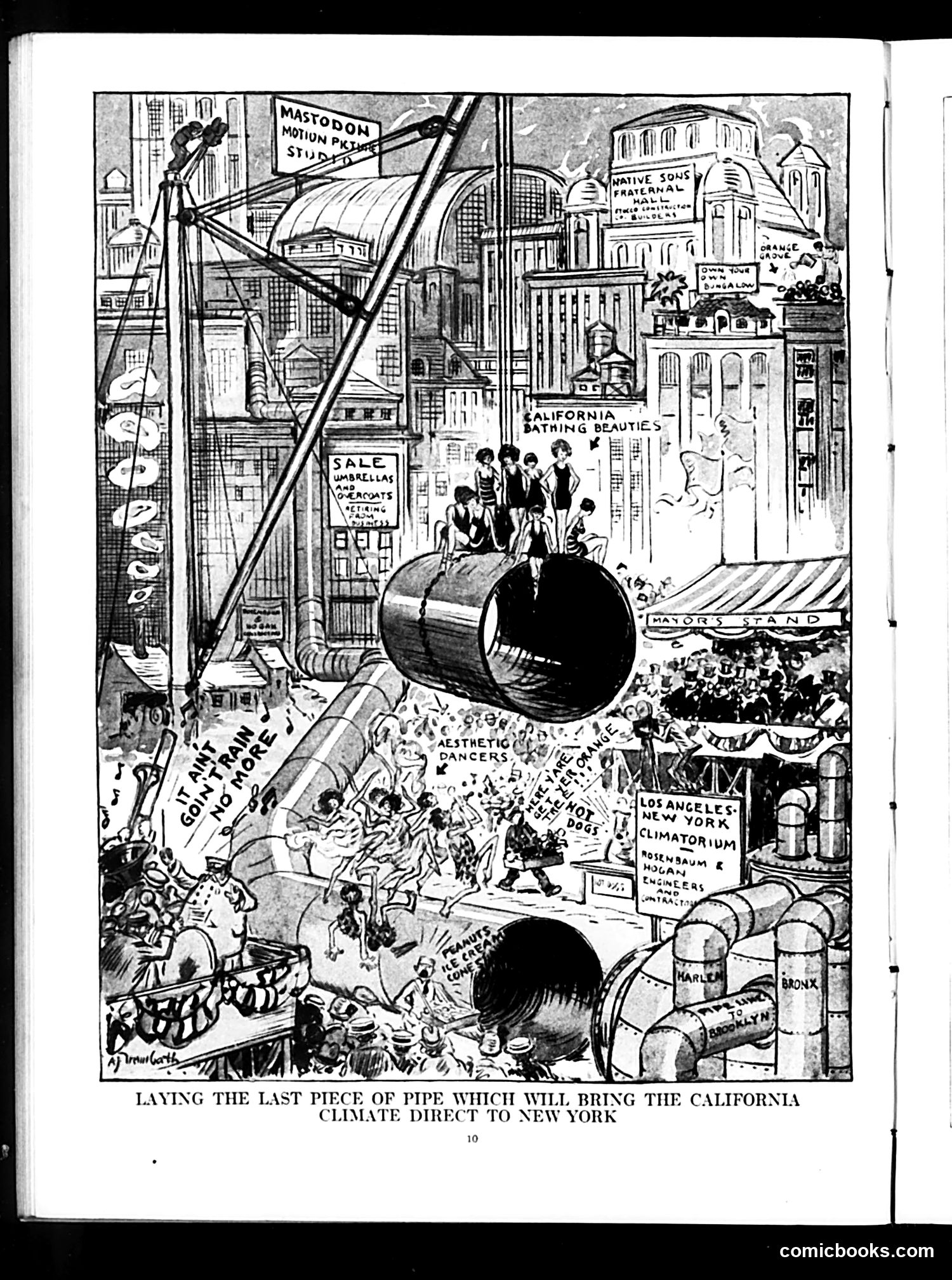
This is a satirical cartoon mocking the idea of piping California's climate to New York. The caption reads "Laying the Last Piece of Pipe Which Will Bring the California Climate Direct to New York." The joke is absurdist: it depicts massive industrial pipes being installed across the country to literally transport California's famous warm weather eastward. The cartoon shows construction chaos, crowds, and various labeled attractions (Mastodon Motion Picture Studios, Native Sons Hall, etc.) mixed throughout the scene. The satire targets two things: (1) the era's fascination with grand engineering projects and (2) California's reputation for perfect weather and glamour—particularly its "bathing beauties," referenced prominently in the image. By treating climate as a commodity that could be physically shipped like oil or water, Judge ridicules both technological utopianism and California's boastful marketing of its climate advantages.
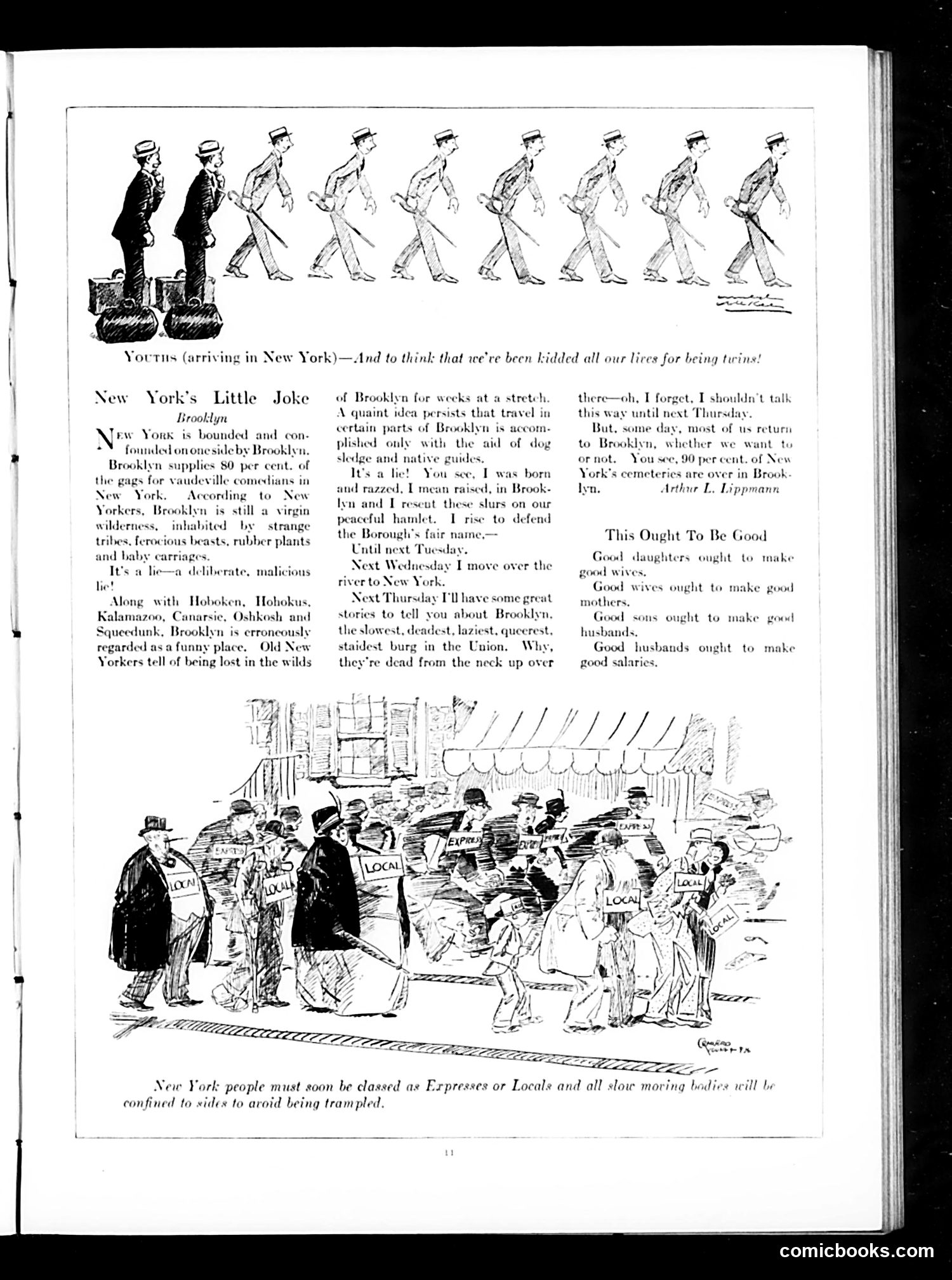
This page satirizes the relationship between New York City and Brooklyn. The top cartoon shows two well-dressed New Yorkers watching a parade of increasingly disheveled Brooklyn arrivals—visual mockery of Brooklyn's perceived lower status. The main article, "New York's Little Joke," is *itself* satire. A Brooklyn resident defends their borough against decades of vaudeville jokes portraying it as a backwards, dangerous place requiring "dog sledges and native guides." The author ironically undermines this defense by admitting he's moving to Manhattan the next day, then promising to share negative stories about Brooklyn afterward. The bottom cartoon depicts crowded morning commuters with signs reading "LOCAL" and "EXPRESS"—referencing Brooklyn's role as a working-class commuter borough feeding workers into Manhattan. The "This Ought To Be Good" section is unrelated moralizing about wives, mothers, and husbands needing to be productive/earn money. The satire captures early 20th-century class tensions: Brooklyn as the working-class outer borough mocked by Manhattan's supposedly sophisticated residents.
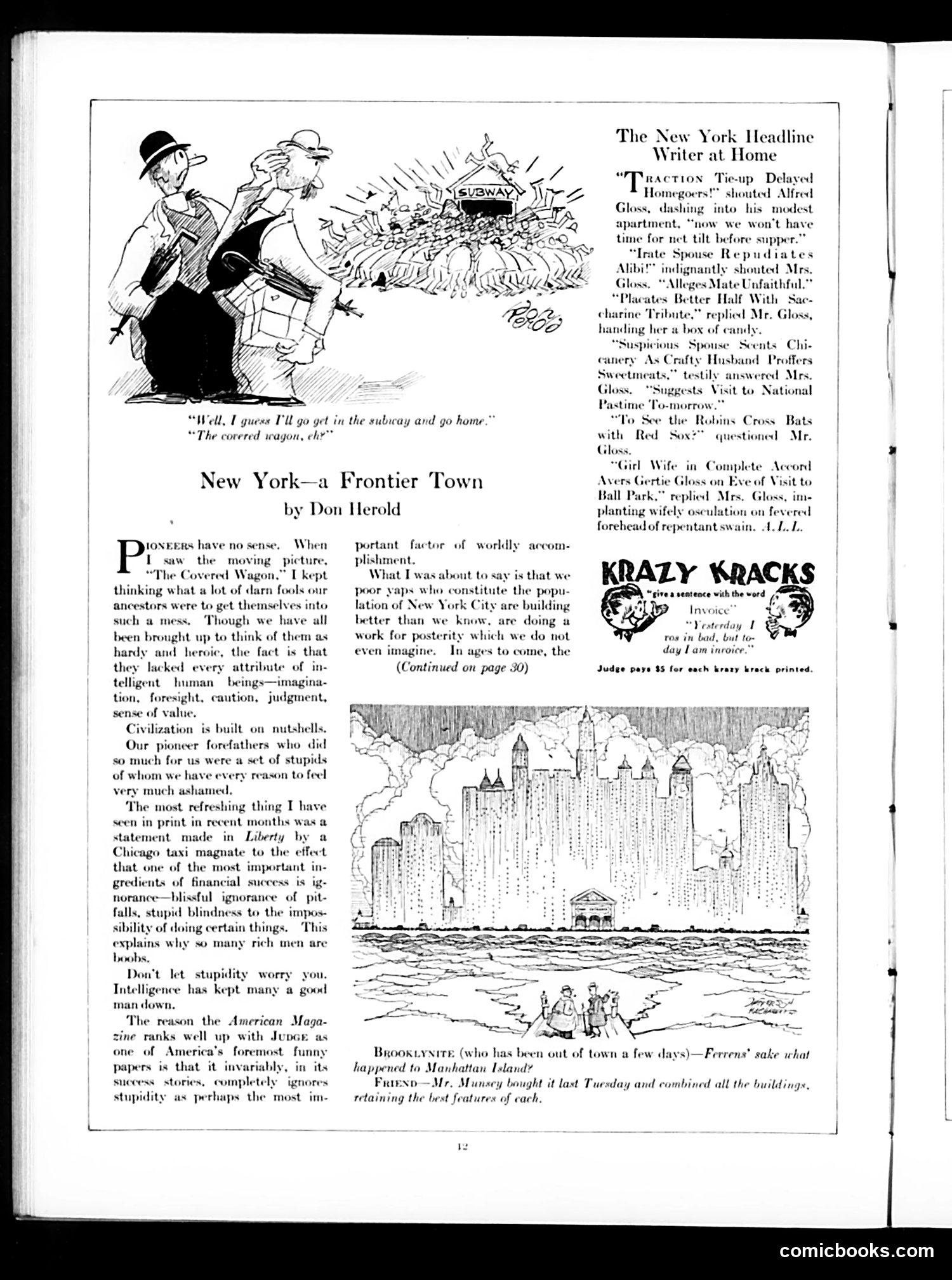
This page contains two main pieces: **"New York—a Frontier Town"** by Don Herold is a humorous essay arguing that pioneers get undeserved credit for heroism when they were actually stupid for settling dangerously. Herold's real point: stupidity often succeeds in business better than intelligence does. He cites a Chicago taxi magnate claiming financial success requires "blissful ignorance" of what's impossible. **The cartoon at top** depicts a New York newspaper headline writer (Alfred Gloss) returning home, dramatically announcing transit delays using sensational newspaper language ("Traction Tie-up!"). His wife responds by sarcastically matching his melodramatic style with fabricated marital-conflict headlines. The joke: headline writers speak in exaggerated crisis language even in casual home life, treating mundane situations as front-page drama. **The lower illustration** shows Brooklyn residents' amazement at Manhattan's skyline, with a caption joking that publisher Frank Munsey bought and consolidated all Manhattan's buildings last Tuesday. This is satirical hyperbole about Munsey's real publishing consolidations.
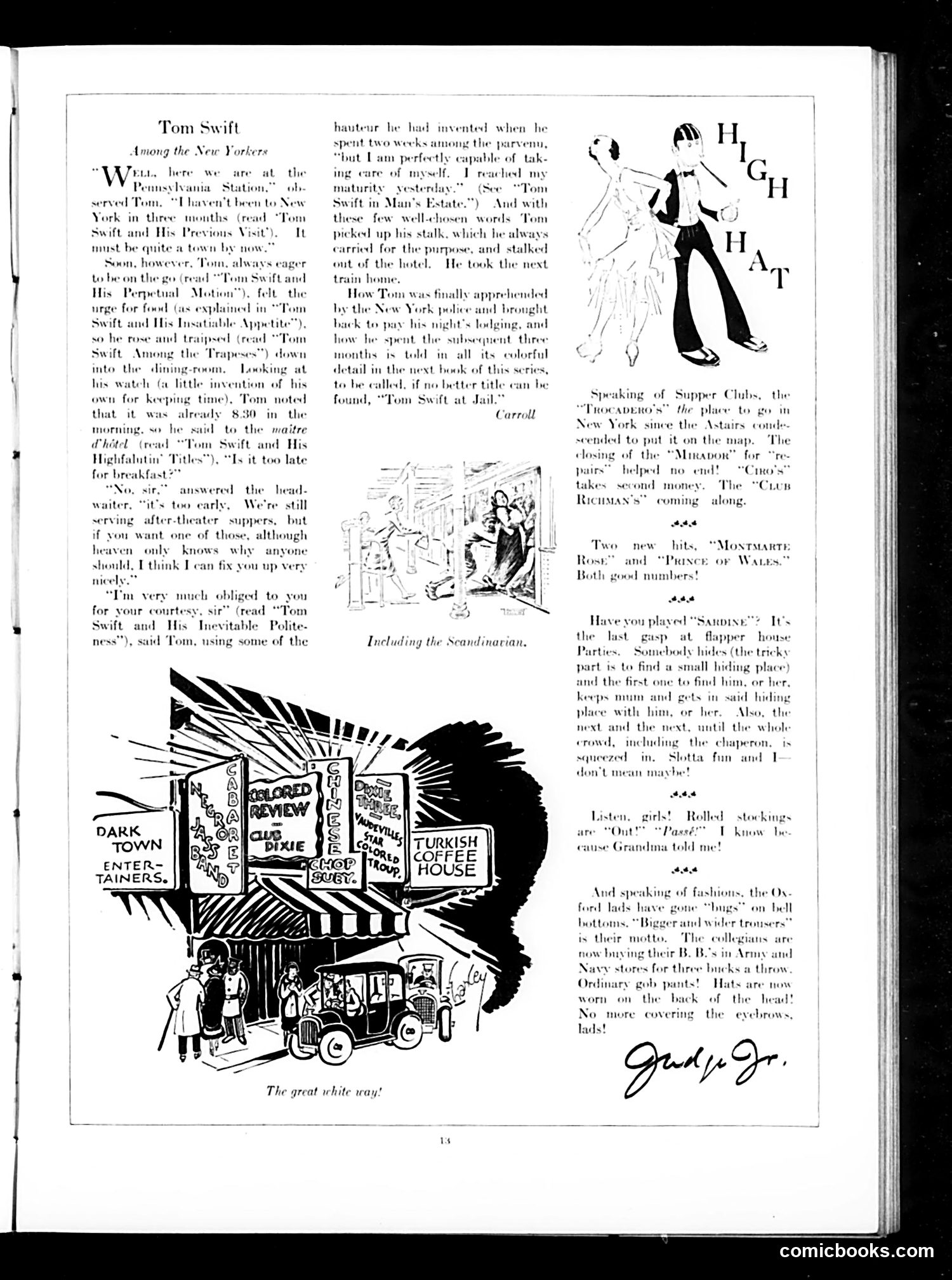
This page combines a serialized story about "Tom Swift" (a fictional character, not the actual Tom Swift book series) with entertainment gossip and fashion commentary. **The Main Cartoon**: The "Dark Town Entertainers" illustration depicts a caricatured African American entertainment district with exaggerated minstrel-style imagery—reflecting the deeply racist visual conventions of 1920s American humor magazines. The caption "The great white way" is a bitter reference to Broadway's nickname, ironically applied to a "colored" entertainment area. **The Text**: The Tom Swift story describes a wealthy young man's visit to New York, his affected behavior at a hotel, and his arrest by police. It's mild satirical fiction about nouveau riche pretension. **The Gossip Section** discusses supper clubs, new theatrical hits, and fashion trends (rolled stockings, Oxford trousers, military-influenced styles)—typical of the magazine's coverage of contemporary urban leisure culture. The page represents Judge's standard formula: mixing satirical fiction with racist visual humor and entertainment-world commentary for affluent readers.
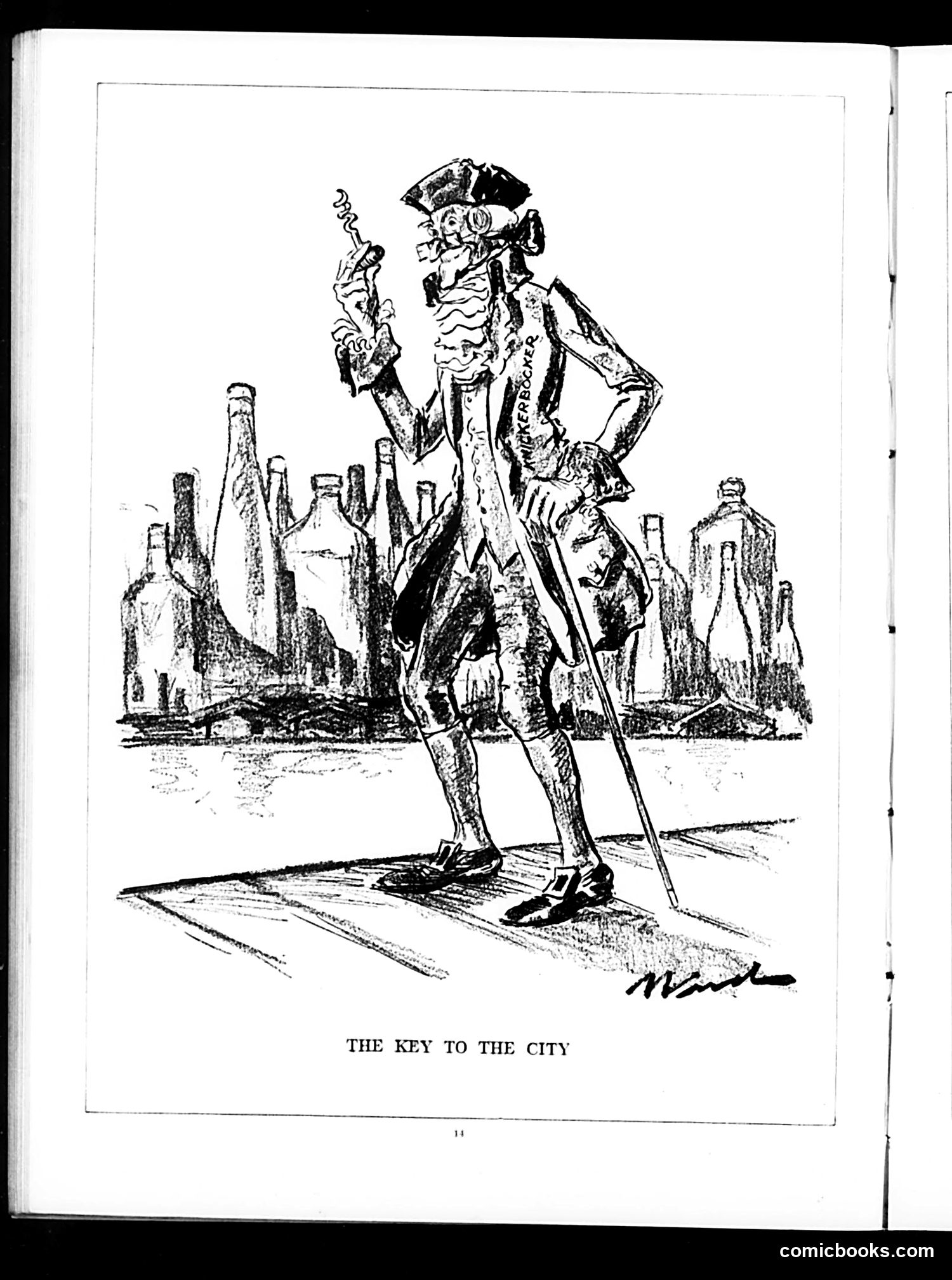
This cartoon depicts a skeletal, grotesque figure in 18th-century dress (tricorn hat, ornate coat) holding a skeleton key and a wine glass, standing before a cityscape of bottles. The title "The Key to the City" is a play on the formal honor of receiving a city's symbolic key. The satire appears to critique alcohol consumption and urban vice. The figure—likely representing either a drunkard, a corrupt politician, or personified Alcohol itself—has literally been given access ("the key") to the city. The skeletal imagery suggests death, decay, and moral corruption. The background of bottles emphasizes alcohol's pervasive presence. This likely comments on Prohibition-era debates or urban corruption tied to the liquor trade, presenting alcohol as the true authority controlling city affairs.
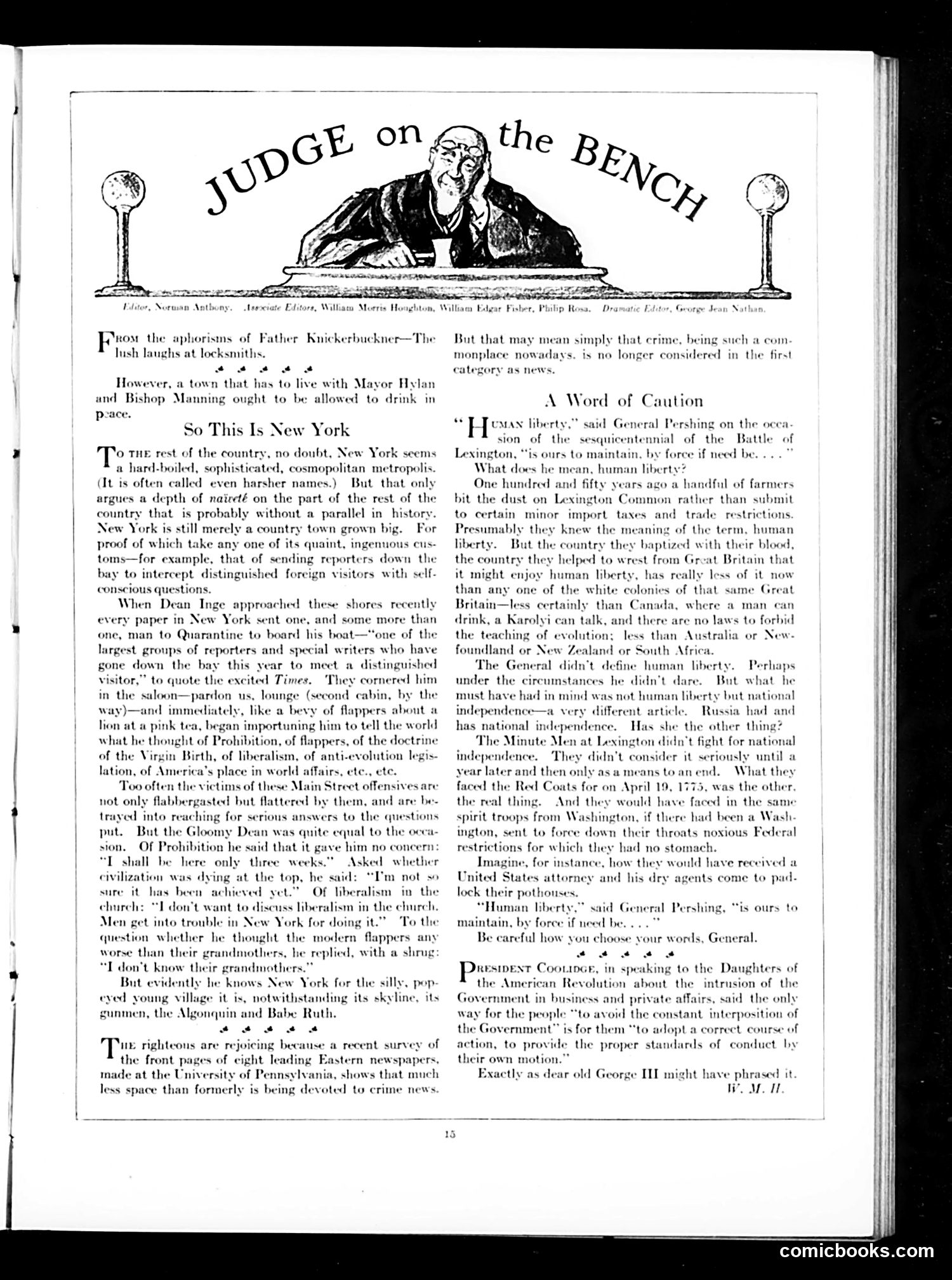
This page contains three satirical pieces critiquing American society and politics circa the 1920s. **"So This Is New York"** mocks New York's provincial behavior despite its cosmopolitan pretensions. It ridicules reporters who aggressively ambushed visiting British Dean Inge at quarantine, pestering him with naive questions about Prohibition, flappers, and evolution—exposing New York's small-town mentality masquerading as sophistication. **"A Word of Caution"** critiques General Pershing's invocation of "human liberty" at the Lexington sesquicentennial. The author argues America, despite its revolutionary origins fighting for freedom from minor taxes, now possesses *less* actual liberty than British colonies, undermining Pershing's rhetoric about maintaining freedom "by force." The page satirizes American hypocrisy: aggressive provincialism hiding behind urban sophistication, and patriotic rhetoric masking reduced civil liberties.
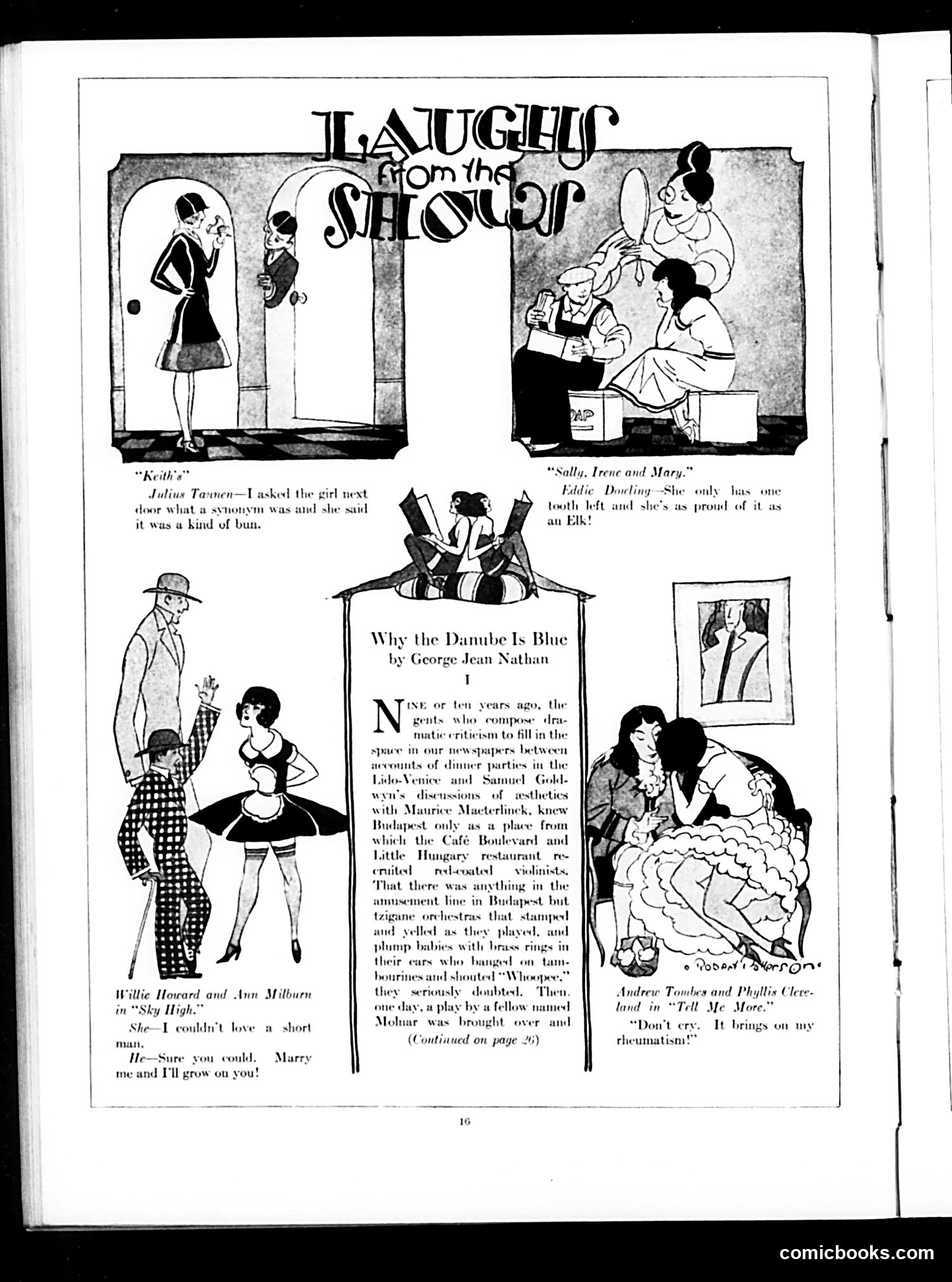
This page contains several brief humor items and advertisements typical of 1920s Judge magazine: **Top sketches** present short comedic anecdotes about schoolchildren and dating—innocent, pun-based humor about synonyms and romantic preferences that plays on misunderstandings. **"Why the Danube Is Blue"** by George Jean Nathan (a real theater critic of the era) is the page's substantial piece. Nathan satirizes American drama critics' ignorance of European culture. He recalls that critics once believed Budapest offered only tzigane orchestras and "plump babies with brass rings," until a Molnár play (likely "Liliom," though the text is cut off) arrived and proved them wrong. The satire targets provincial American intellectual pretension and limited cultural awareness. **Bottom illustrations** show scenes from theatrical productions ("Sky High," "Tell Me More"), including actors Willie Howard, Ann Milburn, Andrew Tombes, and Phyllis Cleveland—promotional content for Broadway shows typical of Judge's entertainment focus. The overall tone is lighthearted social satire aimed at educated readers.
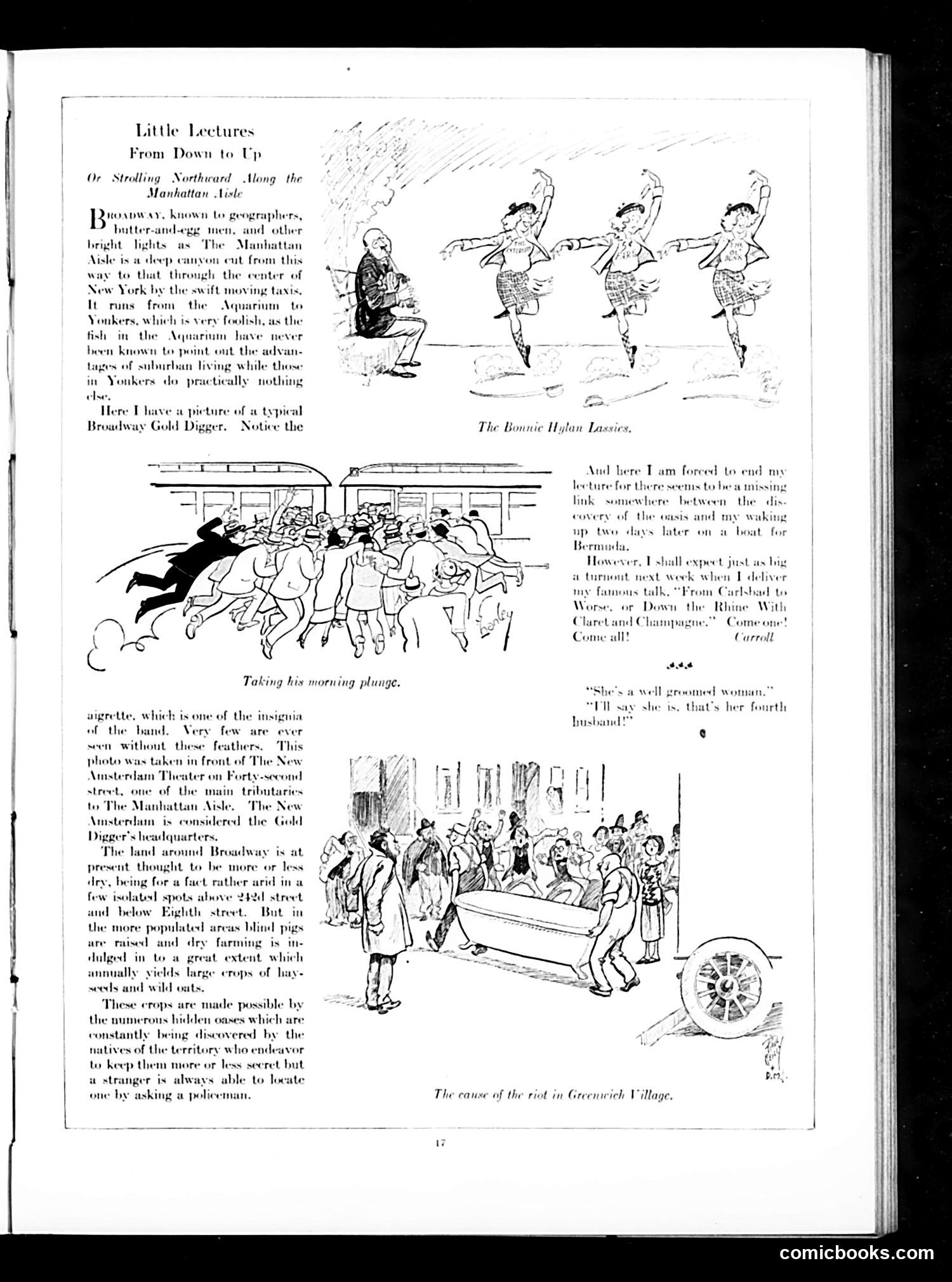
This page from *Judge* presents satirical commentary on 1920s Manhattan social life. **"The Bonnie Hylan Lassies"** (top right) depicts chorus girls or dancers, likely referencing Mayor John Hylan's New York—a visual joke about the city's entertainment culture. **"The Broadway Gold Digger"** section mocks women who pursued wealthy men for financial support—a common 1920s anxiety about female opportunism and social climbing. The text notes their characteristic cigarettes as status markers. **"Taking his morning plunge"** shows a man diving into a crowded subway car—satirizing the chaotic rush-hour crush of commuters on Broadway/the Manhattan "Aisle." **"The cause of the riot in Greenwich Village"** (bottom) depicts an unclear disturbance, though Greenwich Village was known in the 1920s for bohemian culture, labor unrest, and social tensions—suggesting urban disorder. The overall tone mocks modern urban Manhattan life: materialism, moral looseness, overcrowding, and social chaos characteristic of the era.
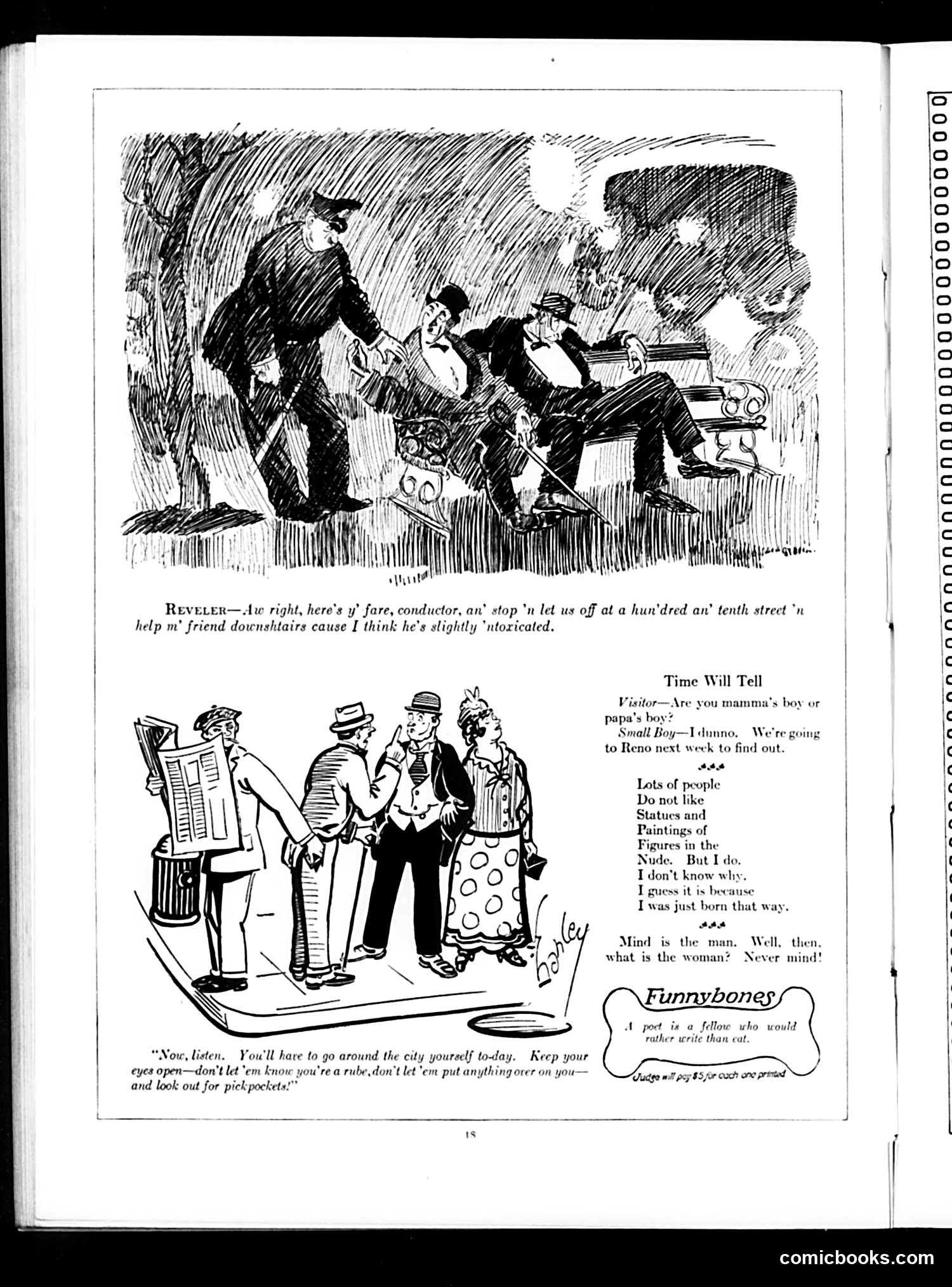
This page contains three satirical pieces typical of early 20th-century American humor: **"Reveler"** mocks intoxicated urban men—a conductor helps a drunk passenger, satirizing public drunkenness and working-class behavior. **"Time Will Tell"** jokes about divorce and custody. A child says parents are taking him to Reno (Nevada's divorce capital) "to find out" whose child he is—dark satire on marital instability and parental abandonment. **Lower cartoon** shows a street con: an adult warns a youth about urban pickpockets and swindlers, depicting the naive "rube" (country person) vulnerable to city crime—a common anxiety about rural migrants in urban centers. **"Funnybones"** is a caption gag equating poets with impractical people who starve for art. Together, these reflect contemporary anxieties: urban vice, marital breakdown, and urban danger to the innocent—typical *Judge* satirical targets.
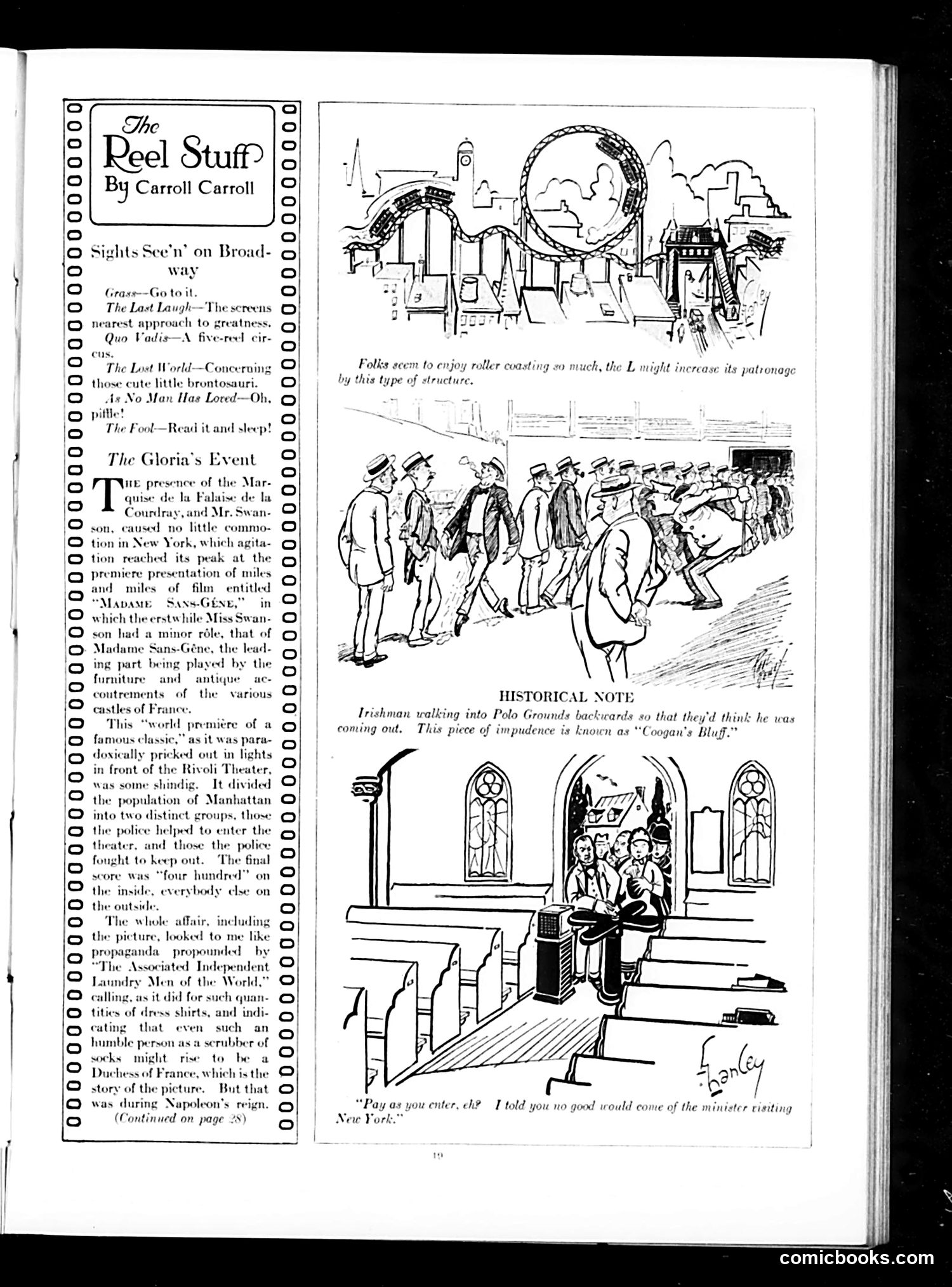
This page contains **film criticism** and **social satire** from Judge magazine's "Reel Stuff" column by Carroll Carroll. The main cartoon mocks the extravagant premiere of "Madame Sans-Gêne" at the Rivoli Theater in New York. The film, a classic French story about Napoleon's era, was promoted as a prestige event but is satirized here as propagandistic—promoting an idealized "rags-to-riches" narrative (a laundress becoming a duchess) that conveniently glorifies social climbing during wartime. The humor targets two aspects: first, the film's implied message that even humble workers could rise to nobility; second, the premiere itself, which divided Manhattan's population into those permitted entry versus those kept out—a class-based divide the satirist finds ridiculous. The bottom cartoon makes a simpler joke about religious hypocrisy: a church collection plate now charges admission ("Pay as you enter"), prompting the joke that the minister's visit to New York corrupted spiritual values into commercialism. The "Coogan's Bluff" historical note appears unrelated, likely filler about a Polo Grounds prank.
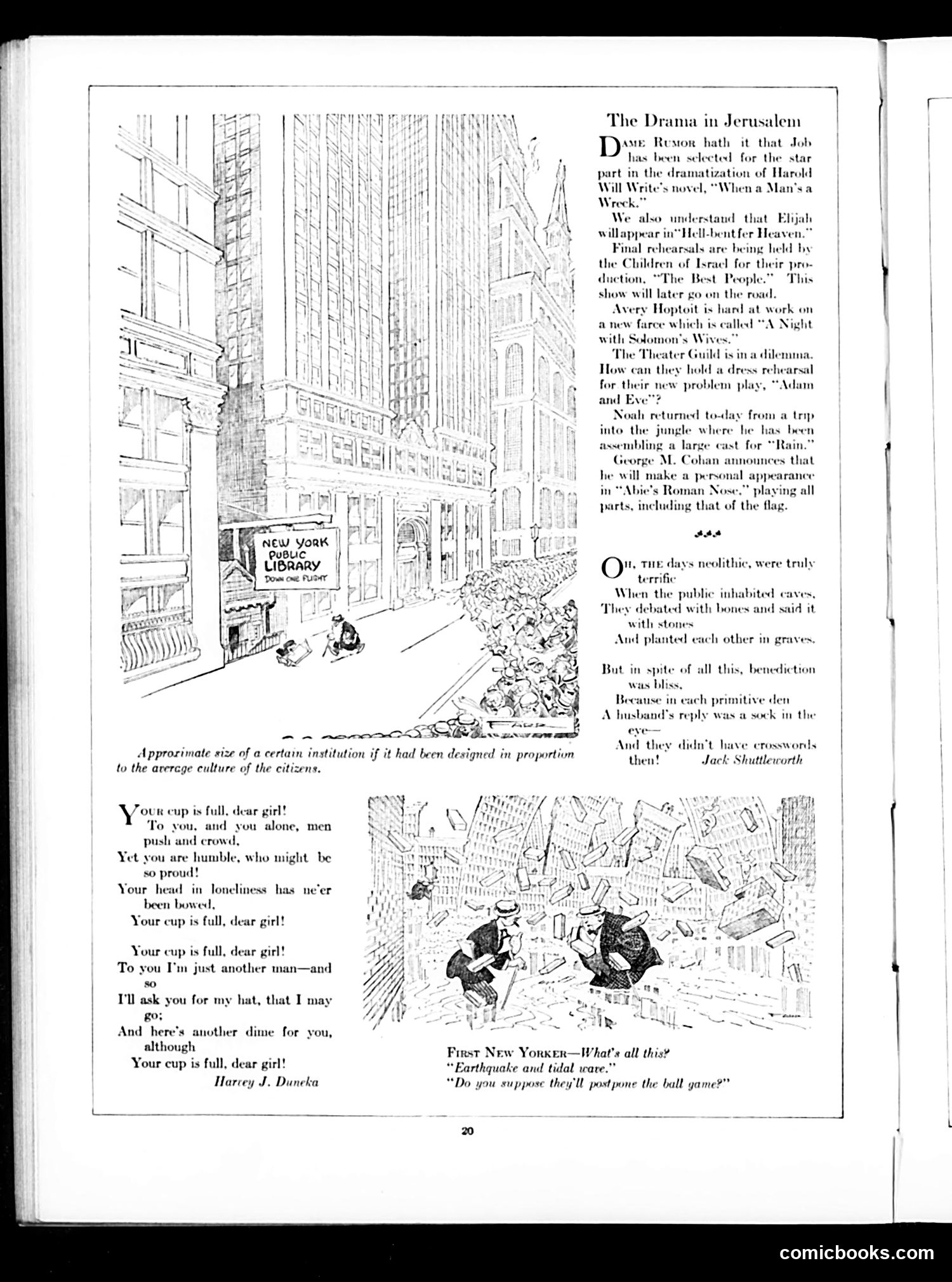
This page contains theatrical gossip and two unrelated cartoons satirizing early 20th-century New York culture. **"The Drama in Jerusalem"** section mocks Broadway's obsession with adaptations by imagining Biblical figures cast in contemporary plays—Job in "When a Man's a Wreck," Elijah in "Hell-bent for Heaven," Noah assembling a cast for "Rain." The humor lies in treating scripture irreverently and suggesting theatrical producers will dramatize anything. **The main cartoon** shows a New York Public Library building scaled to match average citizen culture—depicted as tiny, crude, and surrounded by debris. It's satire on anti-intellectualism and the gap between public institutions and actual public literacy/sophistication. **The bottom cartoon** presents a "First New Yorker" asking dismissively whether an earthquake and tidal wave will "postpone the ball game?"—mocking New Yorkers' indifference to catastrophe when sports are involved, a common theme in Judge's urban satire. The poem about primitive humans establishing domestic hierarchy through violence appears filler content.
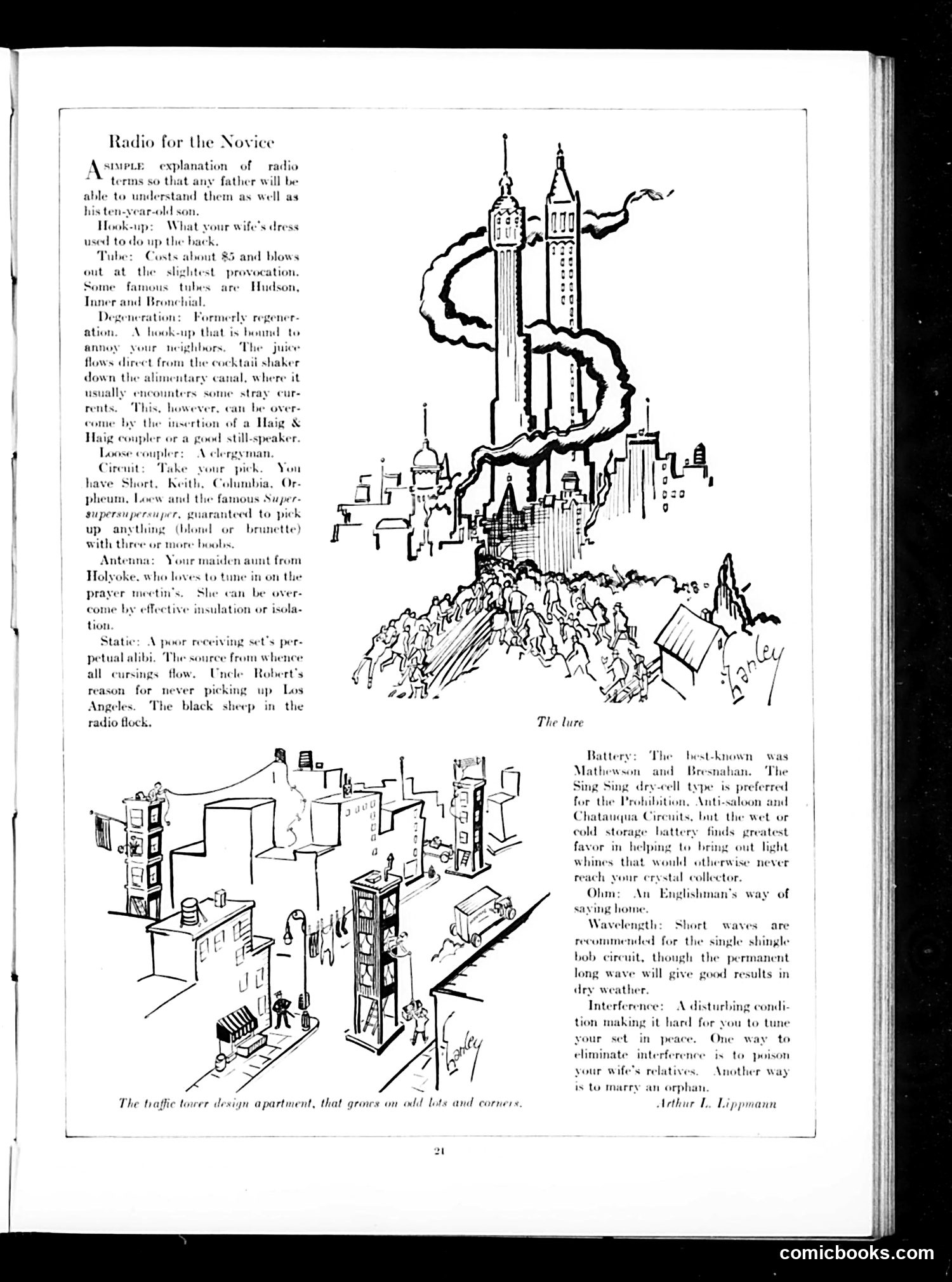
This is a humorous glossary defining radio terminology for fathers trying to understand their sons' hobby. The satire works by replacing technical definitions with absurd, domestic analogies and contemporary references. Key jokes include: "Hook-up" (a dress fastener), "Tube" (expensive, unreliable), and "Circuit" (various entertainment venues—Short, Keith, Columbia, Orpheum, Loew—suggesting the radio picks up anything). "Loose coupler" is a clergyman; "Static" is blamed for radio troubles like Uncle Robert never receiving Los Angeles. Period references include Prohibition ("Sing Sing dry-cell," "Anti-saloon"), and baseball players Mathewson and Bresnahan mentioned for "Battery." The final jokes mock marriage itself: poisoning one's wife's relatives or marrying an orphan to eliminate "interference." The cartoons show radio tower design and a broadcast setup, illustrating the emerging technology's bewildering complexity for ordinary people.
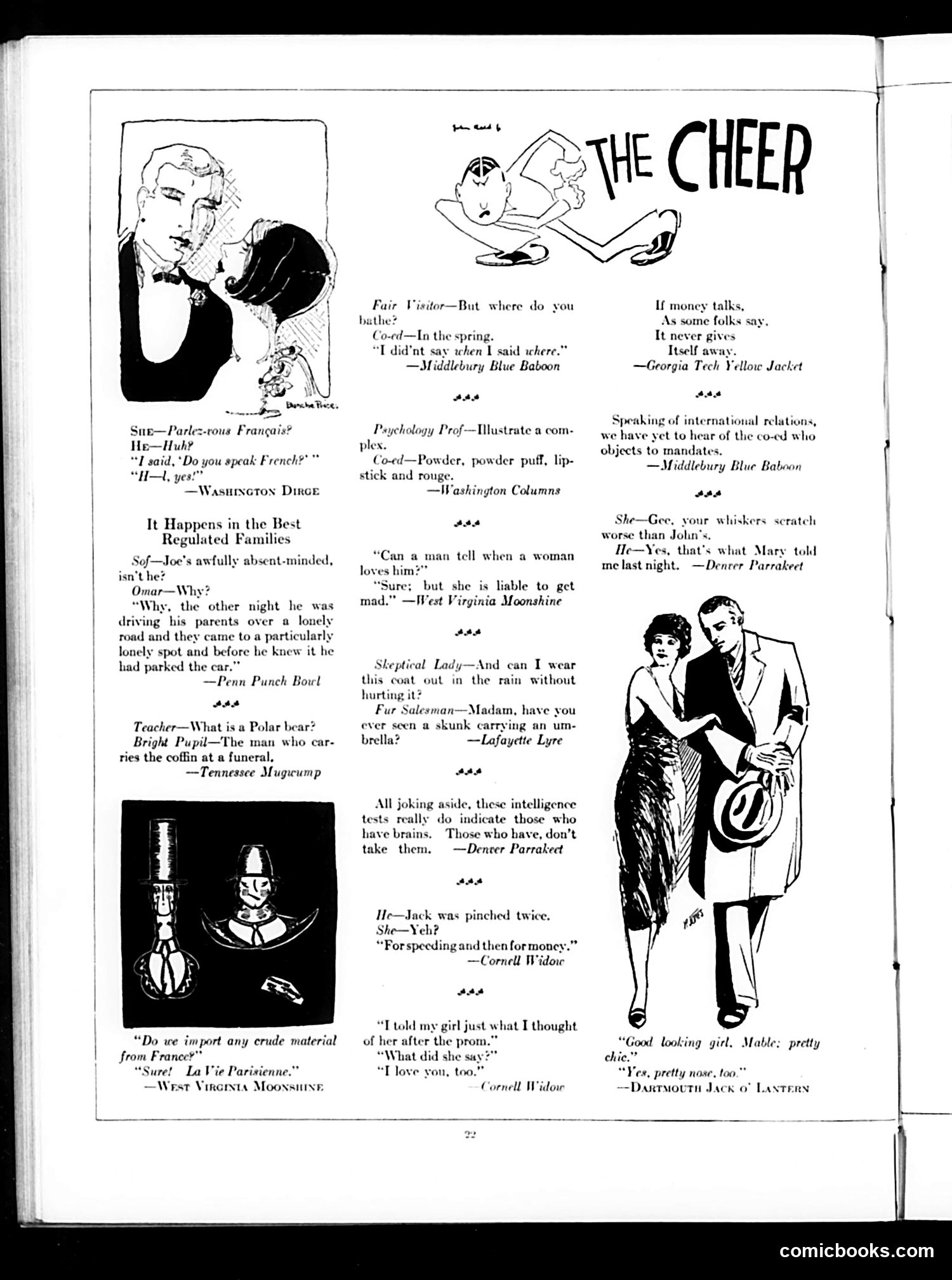
This is a collection of short jokes and one-liners typical of 1920s college humor magazines. The content includes: **Main Jokes:** - A French language misunderstanding (playing on "Parlez-vous" pronunciation) - A young man absent-mindedly parking with his parents during a drive - Wordplay on "polar bear" (pallbearer/polar bear confusion) - A co-ed defining "complex" as cosmetics - A fur coat durability question with a skunk punchline - A man caught twice for traffic violations and bribery **The Satire Points:** These jokes mock typical 1920s social situations: awkward courtship, absentminded youth, women's fashion obsessions, and minor criminality (bribing police). The humor relies on puns, misunderstandings, and innuendo rather than sharp political commentary. **Context for Modern Readers:** The credited publications ("Middlebury Blue Baboon," "Cornell Widow," etc.) are actual college humor magazines. The jokes reflect period anxieties about young people, dating, international sophistication, and women's independence—presented through lighthearted ribaldry typical of the era.
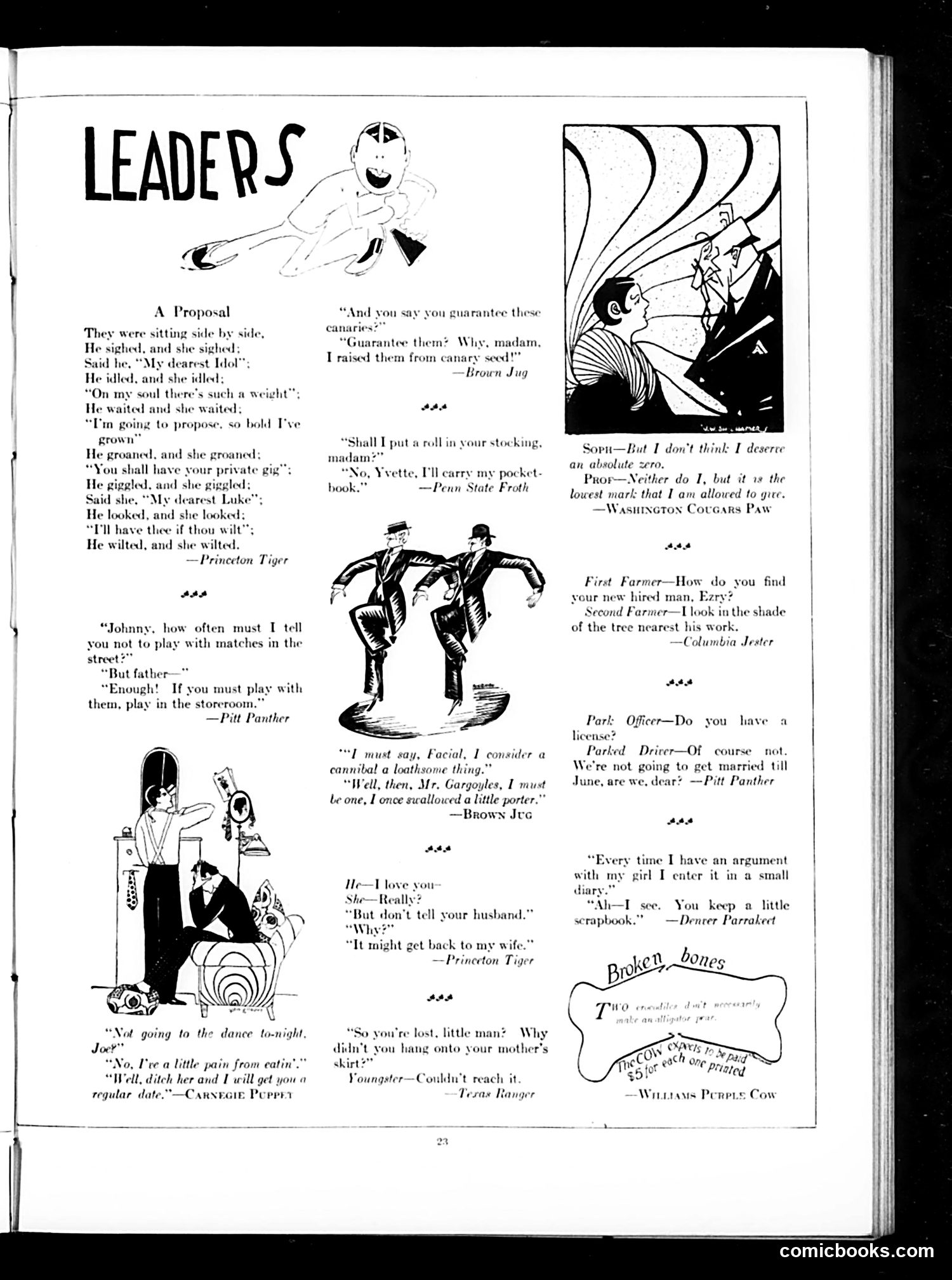
This page collects humorous quips and cartoon vignettes from various college publications (Princeton Tiger, Columbia Jester, Pitt Panther, etc.), reflecting early 20th-century collegiate and domestic humor. The jokes target familiar targets: **courtship and marriage** ("A Proposal" depicts a romantic scene ending in mutual capitulation), **parental discipline** (father permits match-playing only indoors—dark humor suggesting recklessness), and **gender relations** (wives as obstacles, husbands as reluctant). Other jokes mock **working-class life** (a hired farmhand who hides under trees), **romance and deception** (lovers keeping secret diaries), and **institutional authority** (a park officer enforcing licensing). The "Broken Bones" cartoon appears to be rural humor about poor farming practices. Overall, this represents period humor from college audiences: lighthearted, conservative in gender relations, and focused on courtship, authority, and class observation—typical of 1920s-era satirical magazine filler.
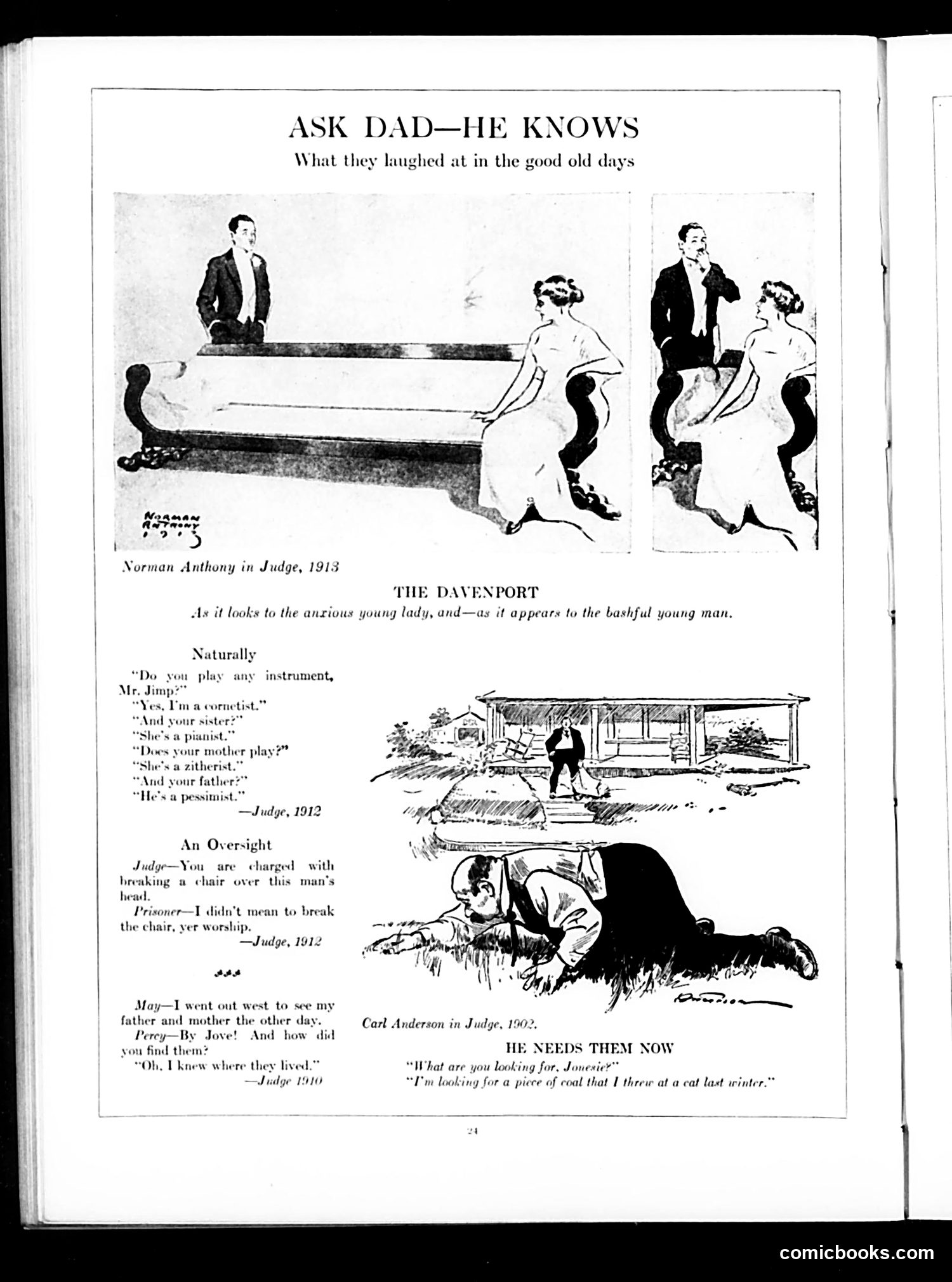
This page collects humorous jokes and cartoons from Judge's archives, illustrating period comedy styles. **"The Davenport"** (1913) uses visual double-meaning: a davenport (sofa) transforms perspective—appearing spacious to a young woman but confining to a bashful young man, suggesting anxieties about courtship and physical proximity. **"Naturally"** (1912) is a pun-based joke: when asked what family members do, each response escalates absurdly, ending with the father being a "pessimist"—a wordplay subversion of the pattern. **"An Oversight"** (1912) features courtroom humor: a prisoner accused of breaking a chair over someone's head protests he only meant to break the chair, not harm the man—inverting expected priorities for comedic effect. **"He Needs Them Now"** (1902) references economic hardship: a man searches for coal he carelessly threw at a cat during winter, implying desperation for fuel during cold months—a dark joke about poverty and regret. The page emphasizes wordplay and domestic/social anxiety typical of early-20th-century American humor magazines.
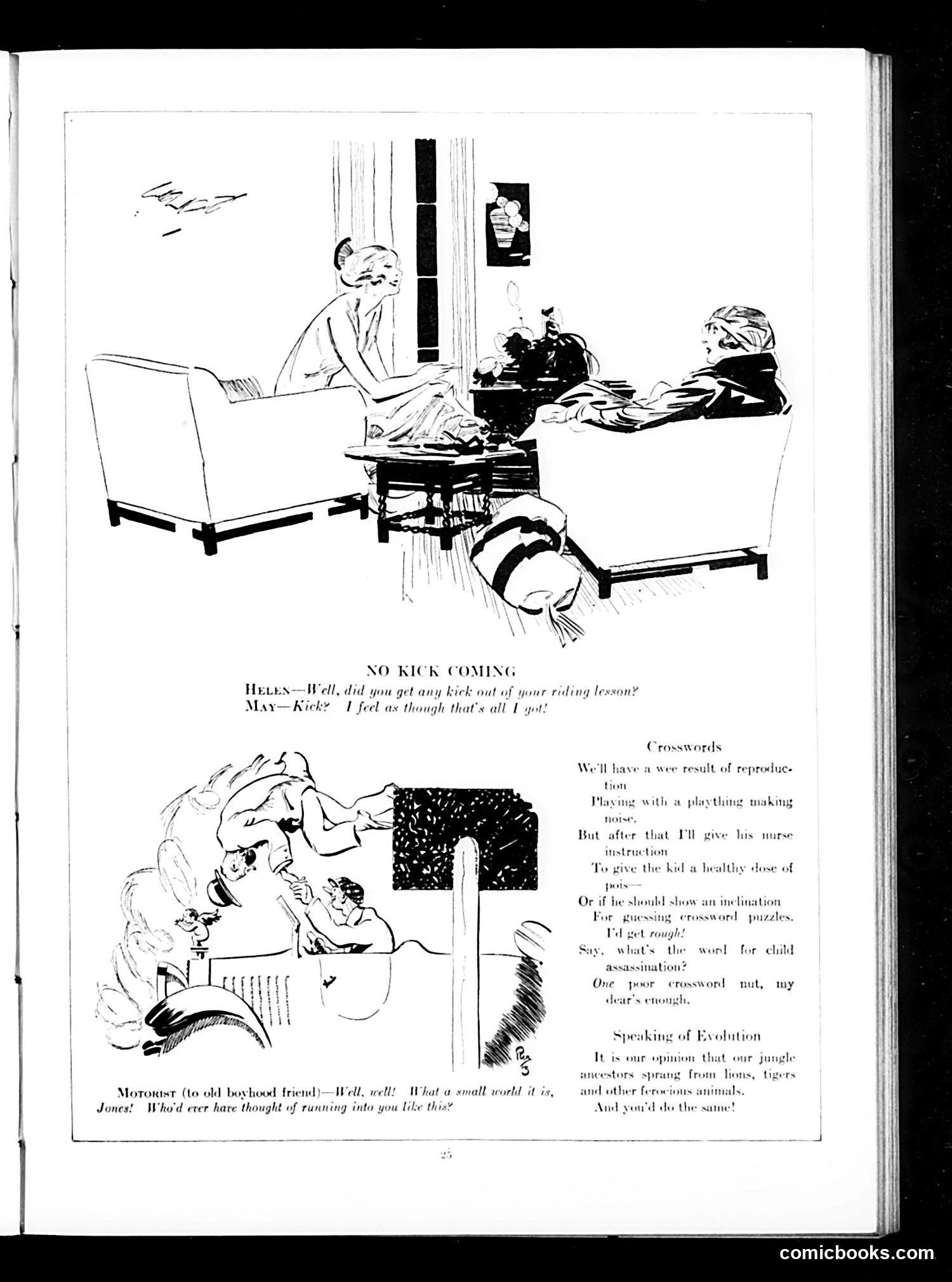
This page contains three separate satirical pieces: 1. **"No Kick Coming"**: A joke about a woman (May) returning from a riding lesson, complaining that she got "kicked" by her horse—the only excitement from the lesson. The humor lies in the double meaning of "kick" (literal impact vs. entertainment value). 2. **"Crosswords"**: Satirizes the crossword puzzle craze (popular in the 1920s-30s) by suggesting parents use them as child-rearing tools, including potentially violent punishments. The humor mocks both the puzzle obsession and parenting philosophies of the era. 3. **"Speaking of Evolution"**: Mocks the theory of evolution by sarcastically suggesting humans descended from lions and other animals, implying readers would behave like beasts. This reflects early-20th-century skepticism toward Darwinism. These are lighthearted social satires typical of Judge magazine's humor, targeting contemporary fads and intellectual debates rather than specific political figures.
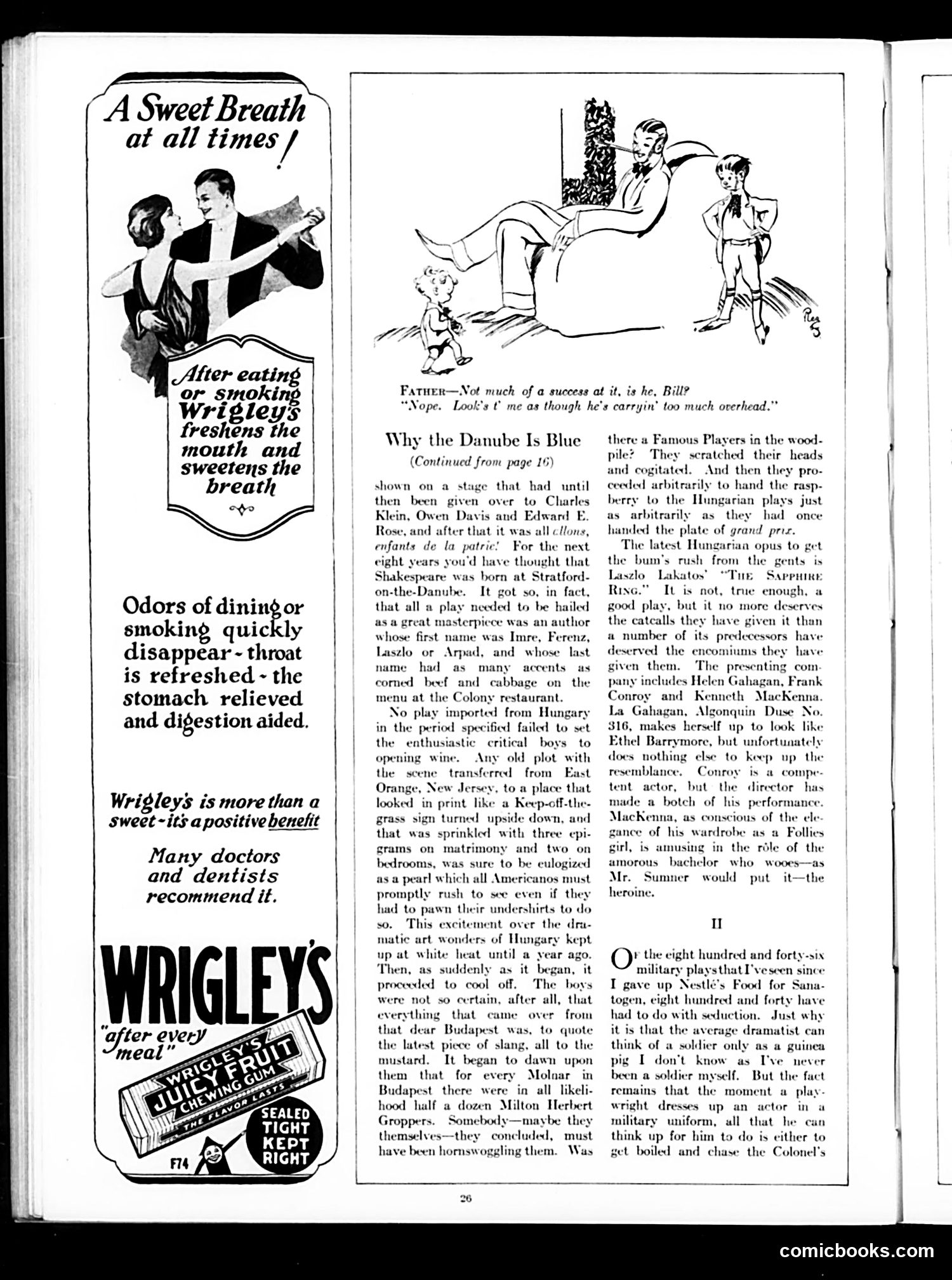
This page contains **primarily advertising** for Wrigley's chewing gum (left column) alongside theater criticism and a cartoon joke. **The cartoon** shows a father watching his son attempt acrobatics or physical feats with poor results. The punchline—"Look's t' me as though he's carryin' too much overhead"—is a business/financial pun: the son's awkward posture resembles a struggling enterprise with excessive costs. **The text** is theater criticism discussing the recent craze for Hungarian plays on Broadway (circa early 1920s). The author satirizes how critics previously lauded any imported Hungarian drama as masterpieces, then abruptly dismissed them as worthless. He argues this arbitrary reversal is unfair, using the recent Hungarian play "The Sapphire Ring" as an example of a mediocre work that doesn't deserve worse treatment than previously overpraised Hungarian imports received. The final section (section II) appears to be separate theater criticism about military-themed plays, complaining that dramatists lazily reduce soldiers to seduction plots.
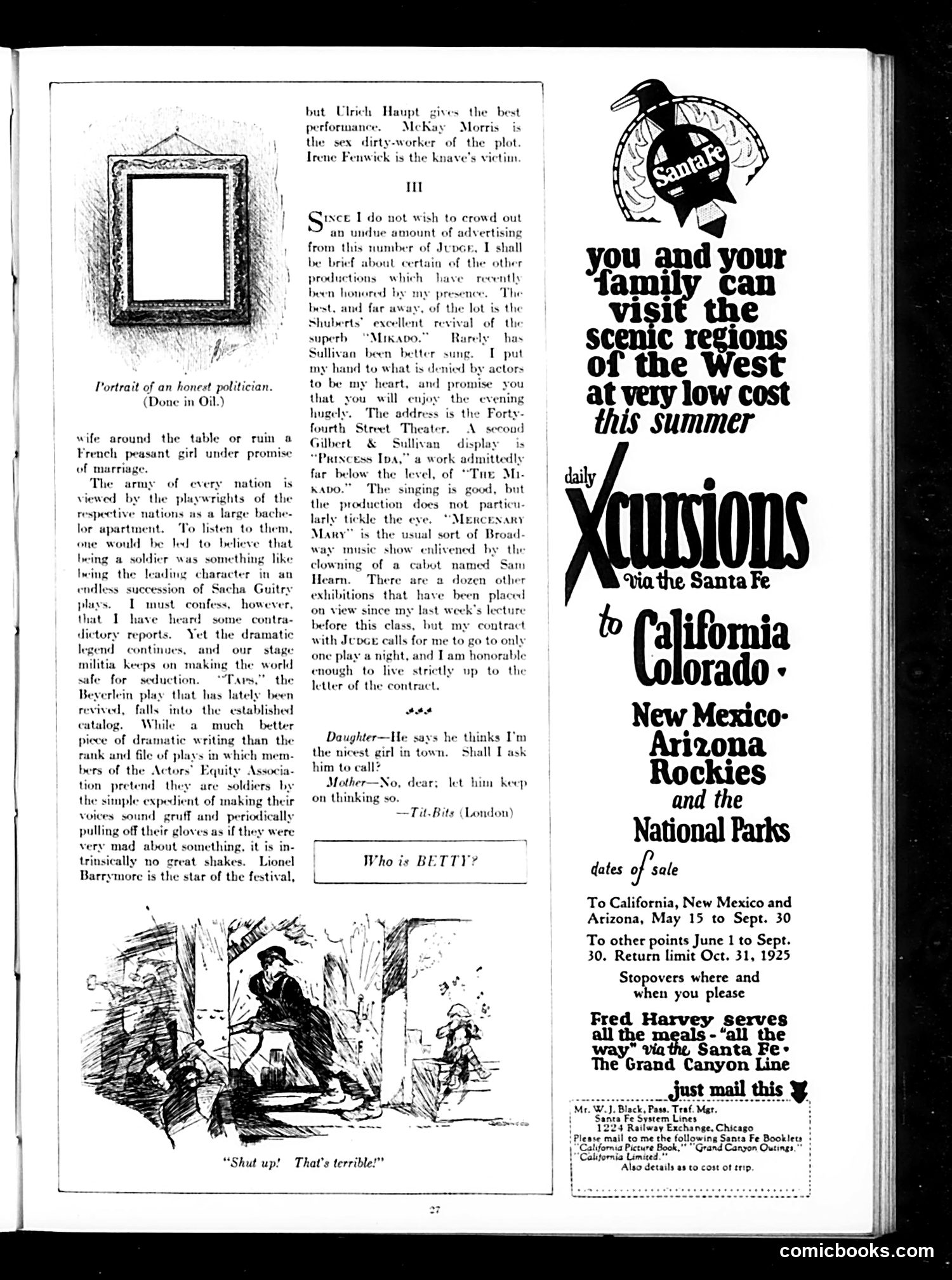
This page contains theater criticism and advertising rather than political cartoons. The main satirical content is the portrait labeled "Portrait of an honest politician (Done in Oil)" — an empty picture frame. This is a sardonic visual joke suggesting that honest politicians are so rare they're practically invisible or nonexistent. The text discusses recent Broadway productions, including Gilbert & Sullivan revivals ("Mikado" and "Princess Ida") and contemporary musicals, with the critic praising Lionel Barrymore's performance. A brief humor item jokes about a daughter asking her mother whether to encourage a young man's courtship. The right page is dominated by a Santa Fe Railway advertisement promoting excursions to Western scenic regions (California, Colorado, New Mexico, Arizona, and the National Parks) during summer 1925, with Fred Harvey services mentioned. The page reflects 1920s entertainment and leisure culture rather than political satire.
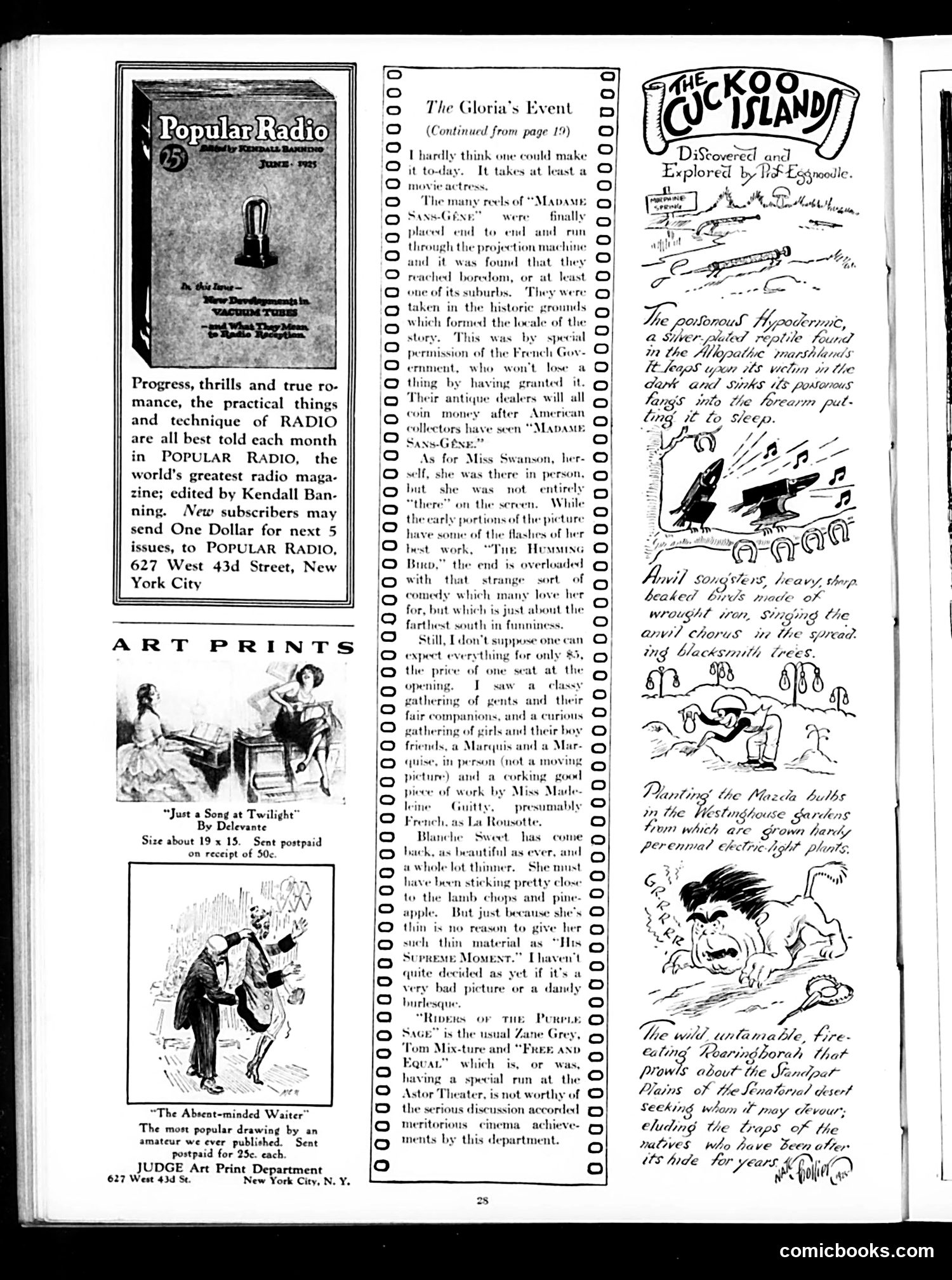
This page is primarily **advertising and filler content**, not satirical cartoons. It contains: **Left side**: Ads for Popular Radio magazine and art prints ("Just a Song at Twilight" and "The Absent-minded Waiter"), offering reproductions for 50 cents. **Center**: A film review (continued from page 19) discussing "The Gloria's Event," a movie featuring Gloria Swanson. The critic discusses the film's use of historic French locations and criticizes the comedy as forced, though acknowledging Swanson's earlier work was stronger. **Right side**: "The Cuckoo Island" - a whimsical illustrated piece about fictional creatures with invented names and absurdist descriptions (the "Poisonous Hypodermis," metal songbirds, etc.). This appears to be lighthearted fantasy rather than satire. The page lacks coherent political or social commentary. It's largely entertainment and consumer advertising typical of Judge's commercial content alongside its satirical features.
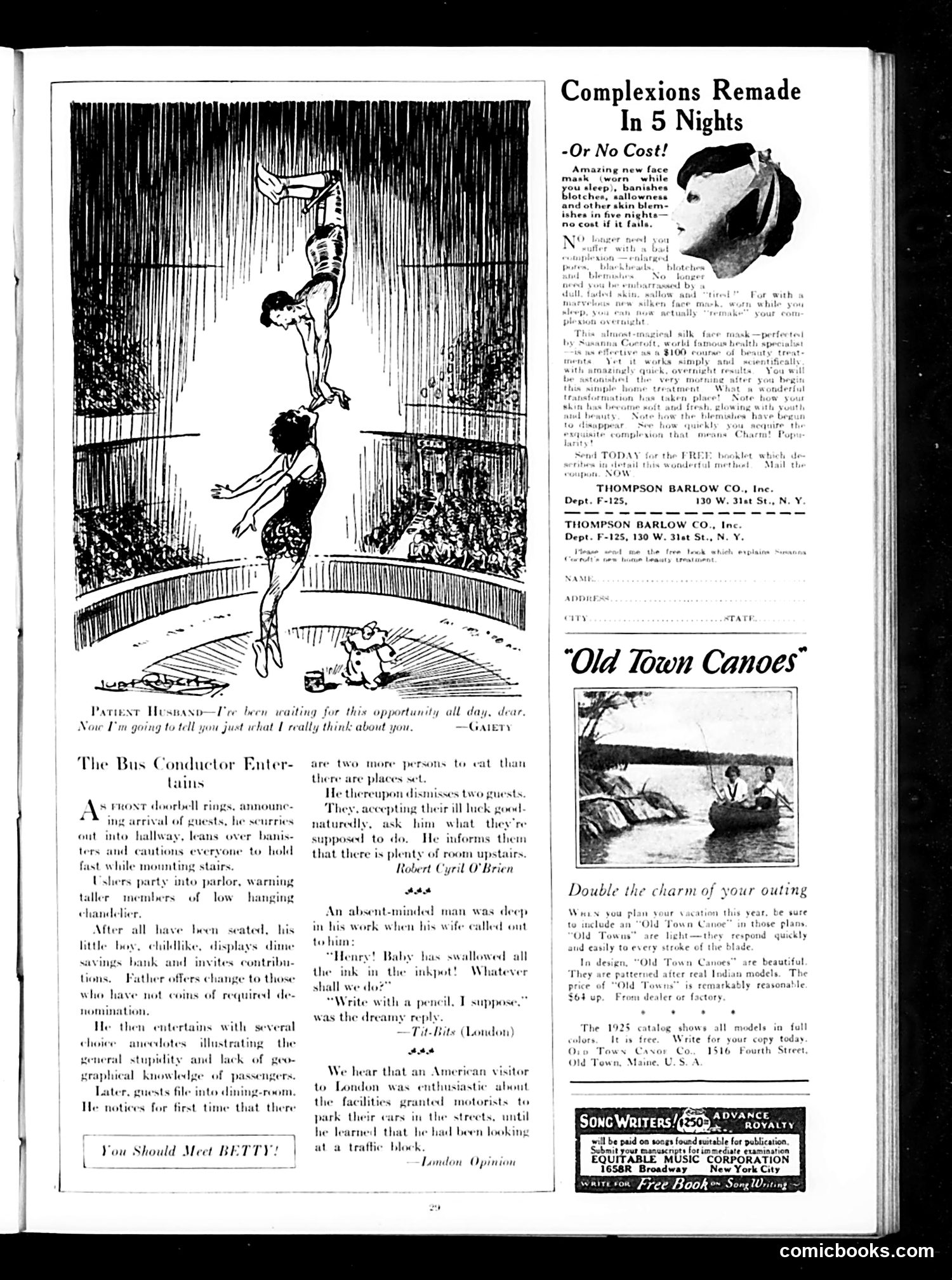
This page contains three distinct humor pieces rather than political cartoons: **"The Bus Conductor Entertains"** is a comic narrative about a working-class bus conductor who becomes an unexpected entertainer at a dinner party. The joke satirizes social pretension: the conductor's "general stupidity and lack of geographical knowledge" (demonstrated by anecdotes) is presented as somehow charming entertainment for upper-class guests. The humor mocks both the conductor's ignorance and the guests' patronizing amusement at his expense—typical class-based humor of the era. **"You Should Meet Betty"** is a brief marital joke: a husband's absent-minded response to his wife's panic about their baby swallowing ink ("Write with a pencil") demonstrates the comedic "illogical husband" trope common to period humor. The page is primarily **advertising** for beauty treatments, canoes, and songwriting services, interspersed with these short humor pieces. There is no significant political content or caricature requiring historical context.
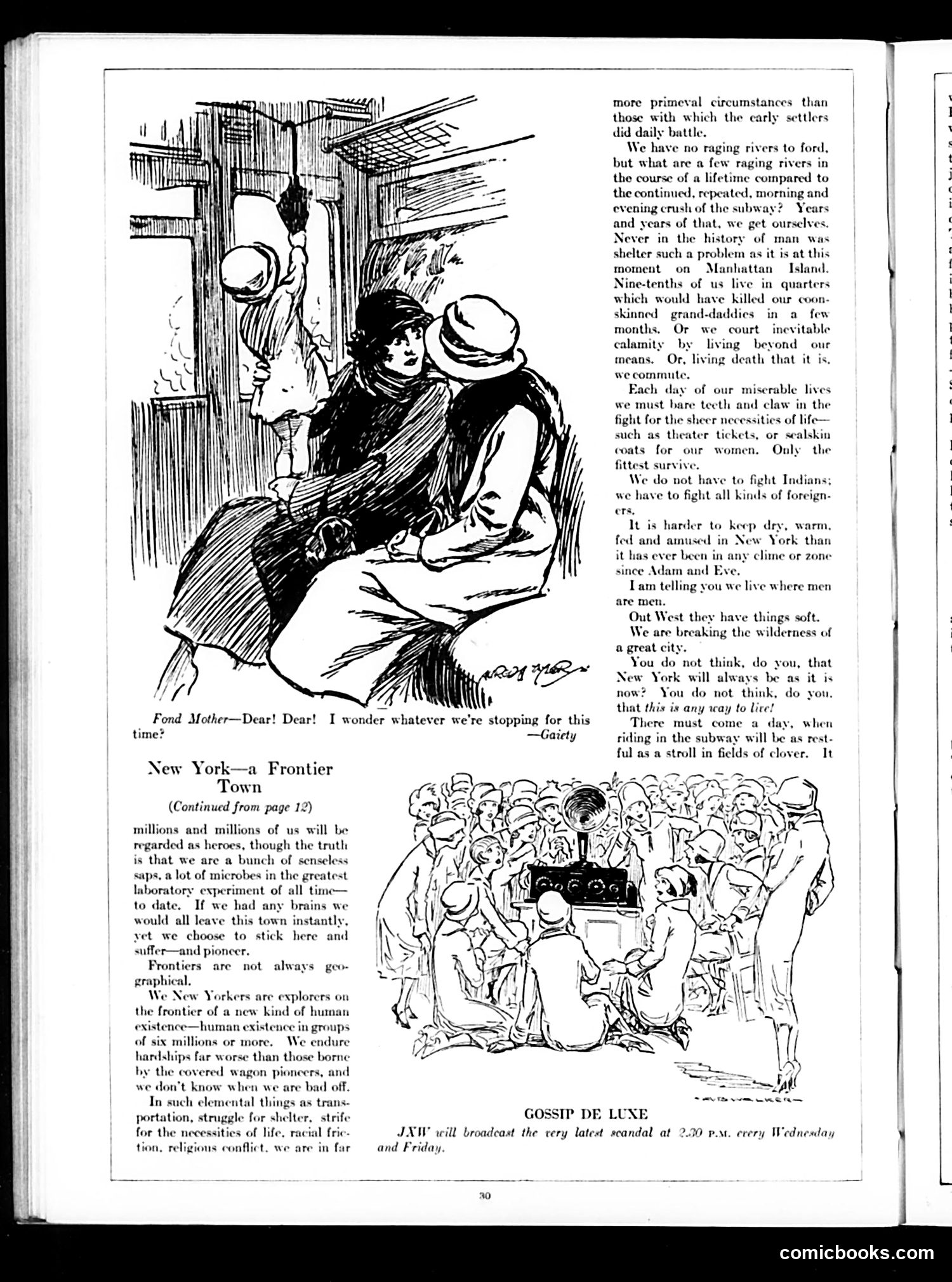
This satirical article uses frontier mythology to mock modern urban life in New York City. The cartoonist compares 1920s New Yorkers struggling with subway congestion, housing shortages, and immigrant populations to pioneer settlers facing "raging rivers" and Indians. The top cartoon shows a weary mother and child on a stalled subway car—the "frontier" the text references. The accompanying essay argues that New Yorkers endure worse hardships than covered-wagon pioneers: daily subway crushes, impossible housing costs on Manhattan Island, and competition with "all kinds of foreigners." The satire is cutting: New Yorkers are "senseless saps" and "microbes" choosing to suffer in this urban experiment. The final cartoon depicts a crowded subway car as a scene of human density matching the text's apocalyptic tone. The piece reflects early-20th-century anxieties about immigration, urban overcrowding, and modernization—presenting these as civilizational crises equivalent to frontier conquest.
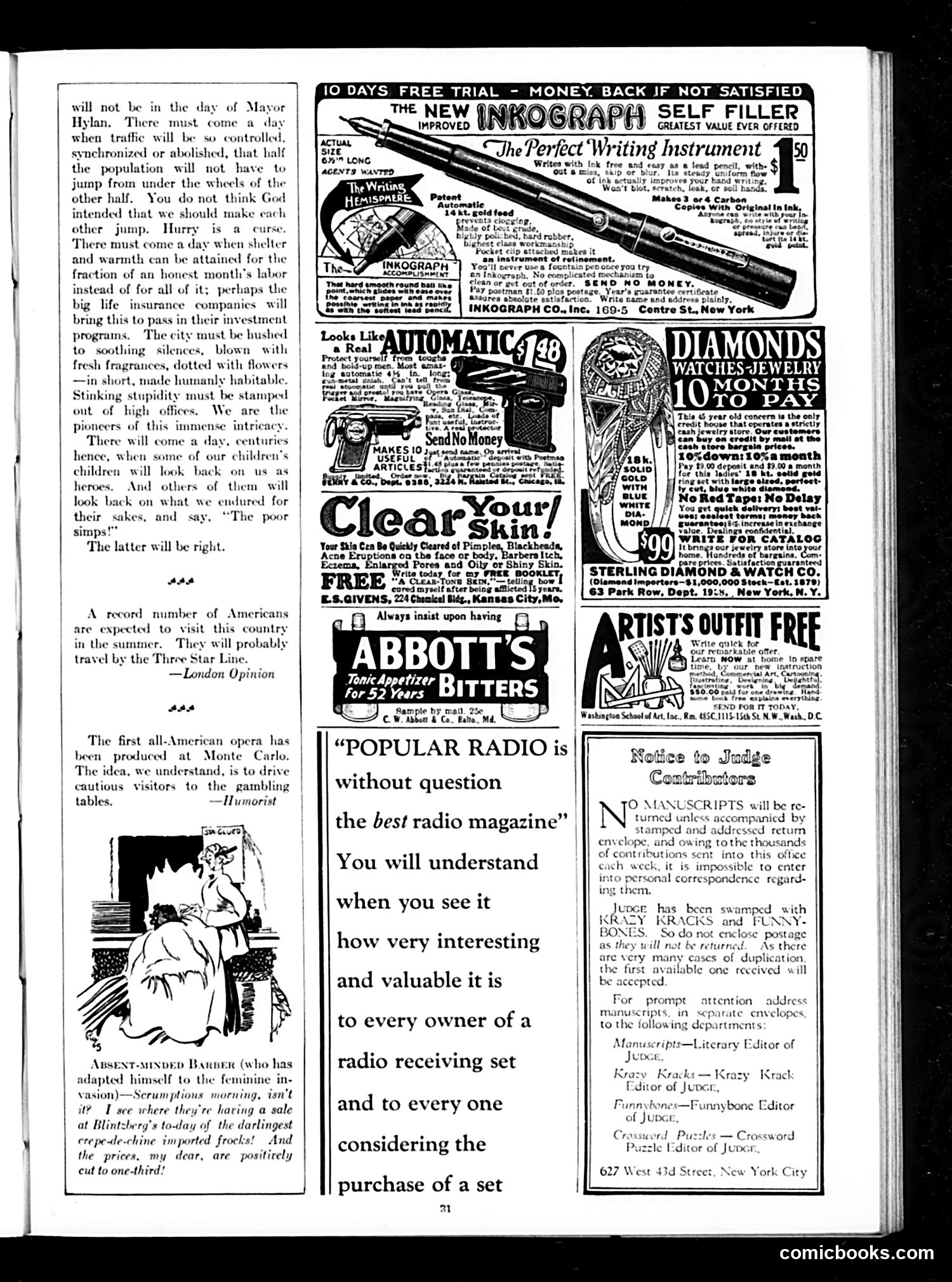
This page is primarily **advertising and editorial notices**, with minimal satirical content. The main cartoon shows an **absent-minded barber** enthusiastically telling a female customer about a dress sale at "Blintzberg's," having adapted to serving women clients during what appears to be the early 20th century. The joke satirizes how men—even traditional tradesmen—have had to accommodate women entering commercial spaces and consumer culture, adopting feminized speech patterns ("the darlingest") to appeal to female customers. The page's substantive text discusses urban reform under Mayor Hylan, advocating for traffic control, affordable housing, workplace safety, and eliminating corruption—progressive early-20th-century social concerns. The remainder consists of **period product advertisements** (Inkograph pens, skin treatments, diamonds, Abbott's Bitters, etc.) and a notice to contributors about manuscript submission procedures for Judge magazine.
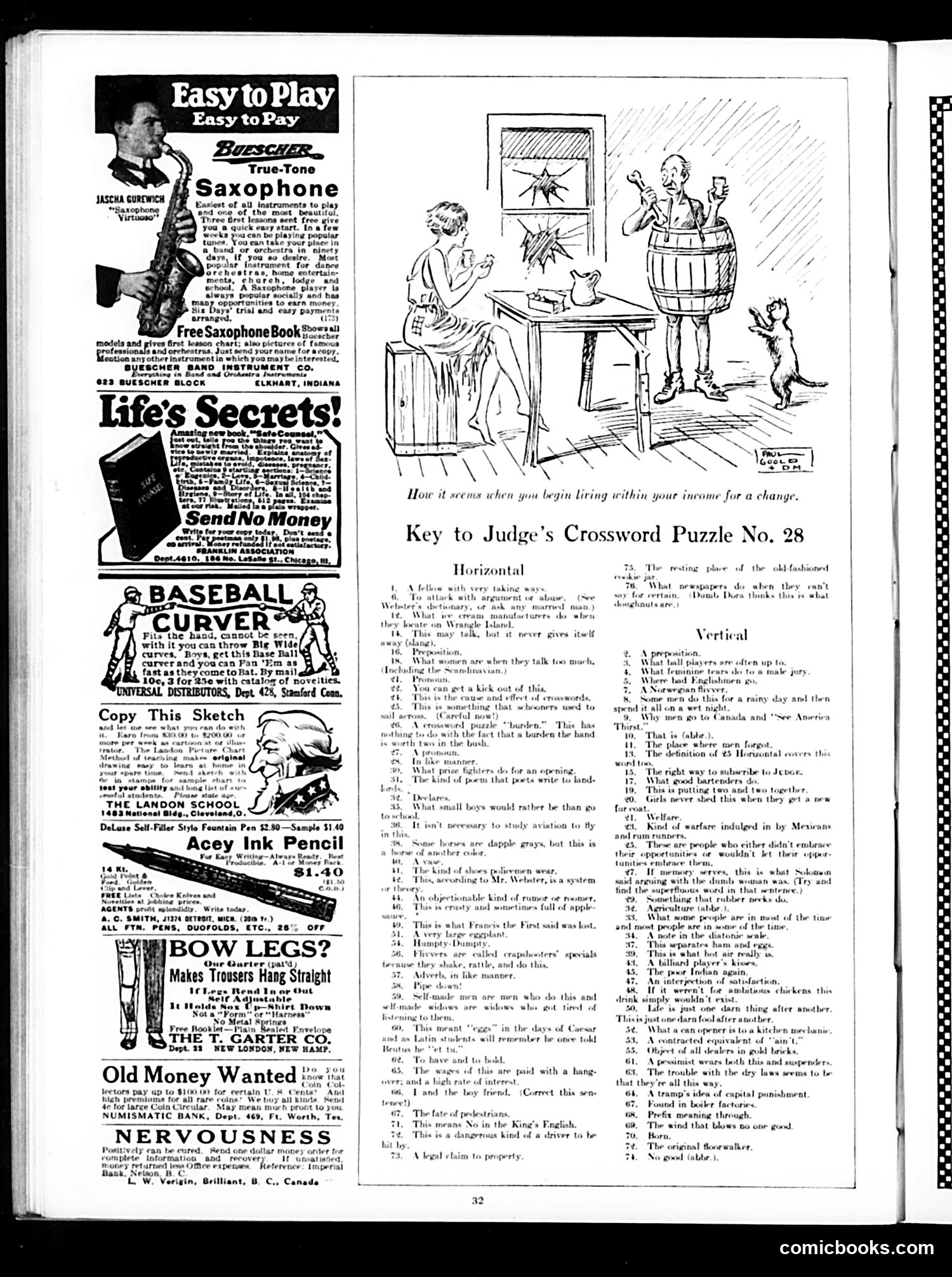
The main cartoon on this page depicts a domestic scene illustrating the caption: "How it seems when you begin living within your income for a change." The illustration shows a woman at a table with a man emerging from a barrel—suggesting he's been living in poverty or hardship. Other figures in the background appear to be reacting with surprise. The satire targets middle-class anxiety about financial constraint and living expenses. During this era (appears to be early 20th century based on styling), the joke plays on the common struggle of maintaining appearances and lifestyle while managing limited income. The barrel-dweller is the visual punchline: the absurd extreme of forced frugality. The surrounding page consists primarily of advertisements for self-improvement products, musical instruments, and mail-order novelties—typical of Judge's mixed content format—alongside a crossword puzzle answer key.
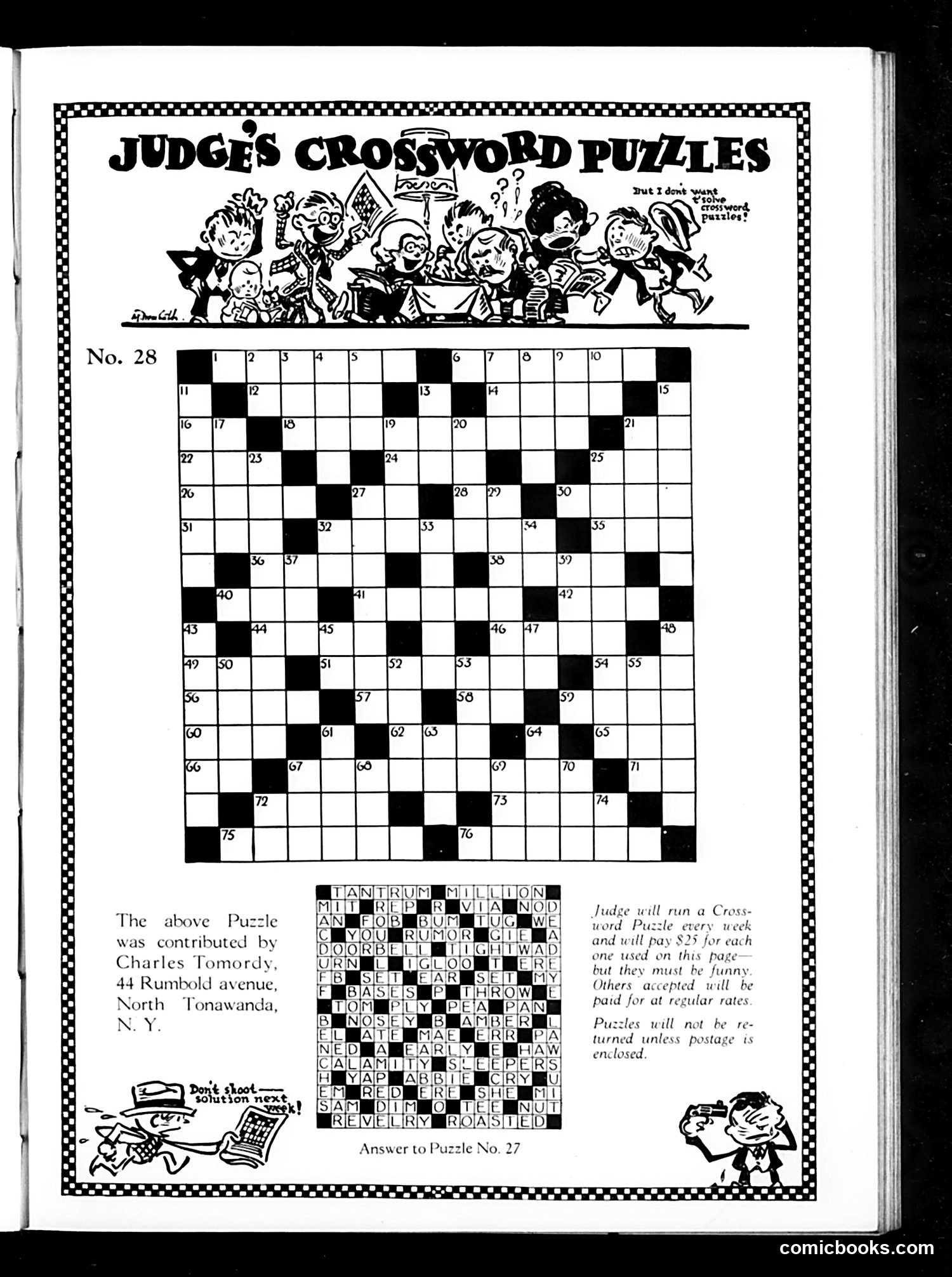
This page features **Judges Crossword Puzzles**, No. 28—a crossword puzzle competition. The main content is a large blank crossword grid submitted by Charles Tomordy of North Tonawanda, New York. Below the puzzle is the answer grid to the previous week's Puzzle No. 27, filled with answers like "HAUNTED," "MILLION," "RUMOR," and "ROASTED." The page includes a **competition announcement**: Judge will publish one crossword puzzle weekly, paying $25 for humorous puzzles used and regular rates for others. Unsolved puzzles won't be returned without postage. The cartoonish header features playful characters reacting to crosswords, fitting Judge magazine's satirical, lighthearted tone. This represents the popular crossword puzzle craze of the early-to-mid 20th century, when these puzzles became a widespread cultural phenomenon and competitive entertainment.
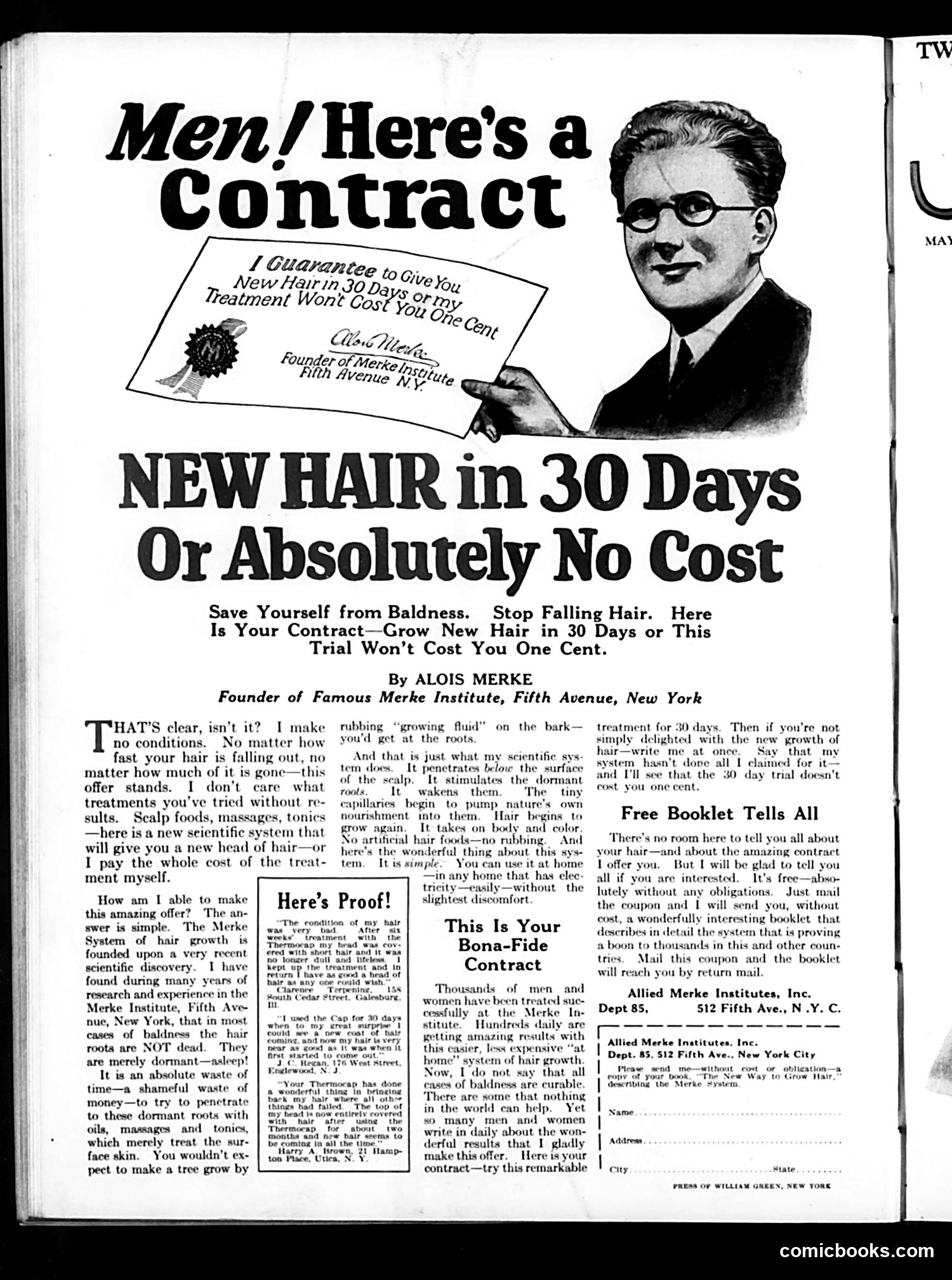
This page is primarily **advertising, not satire**—it's a full-page promotional piece for the Merke Institute's hair-growth treatment system, circa early 20th century. **The Content:** Alois Merke, founder of the Merke Institute on Fifth Avenue in New York, advertises a "Thermocap" device claiming to regrow hair in 30 days or cost nothing. He guarantees results for baldness sufferers, asserting that hair roots are merely "dormant" rather than dead, and his electrical system (requiring home electricity) will stimulate them. **Why It Matters Today:** This exemplifies early 1900s medical quackery—pseudoscientific claims about dormant hair roots, testimonial "proof," and risk-free guarantees designed to exploit baldness sufferers' desperation. The formal contract language lends false legitimacy. This predates FDA regulation of such claims and represents exploitative advertising practices that modern consumer protection laws now prohibit. The page uses scientific-sounding language to mask unproven assertions—a common tactic in dubious health products.