
Judge, 1925-05-09 · page 11 of 36
Judge — May 9, 1925 — page 11: what you’re looking at
What you’re looking at
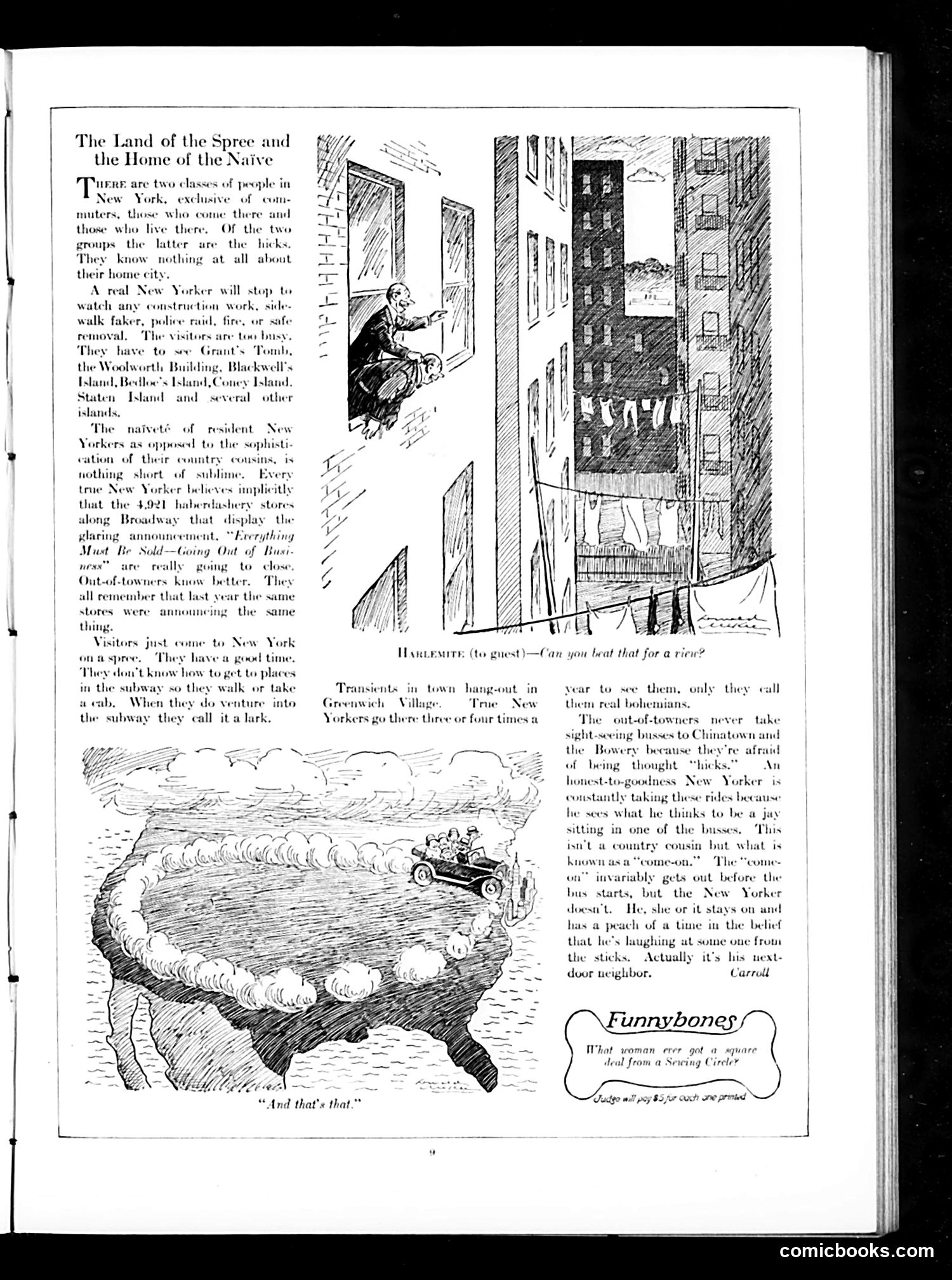
This satirical piece mocks New Yorkers' condescending attitudes toward out-of-town visitors, while revealing New Yorkers themselves are actually the naive ones. **The satire's point:** Resident New Yorkers consider visiting tourists ("hicks") unsophisticated for visiting tourist attractions like Grand Central, the Woolworth Building, and Coney Island. Yet New Yorkers themselves repeatedly ride sightseeing buses, believing they're mocking "country cousins"—unaware their fellow riders are actually their own neighbors doing the same thing. **The cartoon:** Shows a cramped tenement building with narrow window views—illustrating limited urban perspectives. The "Harlequin" caption jokes about viewing nothing noteworthy. **The humor:** The irony that New Yorkers' claimed superiority is baseless; they're equally gullible tourists in their own city, deceiving themselves about who they're laughing at. The bottom joke about sewing circles appears unrelated filler humor.
📄 Transcribed text from this page (OCR, searchable)
Machine-transcribed from the original scan — historical spelling and the odd misread are preserved.
The Land of the Spree and the Home of the Naive HERE. are two classes of people in New York, exclusive of com- muters, these who come there and those who live there. Of the two groups the latter are the hicks. They know nothing at all about their home city. A real New Yorker will stop te | wateh any | | walk faker, p : removal, ‘The visitor | ‘They have to see s Tomb, the Woolworth Building, Blackwell's Island, Bedloe's Island, Coney Island, Staten Island onstruction work, side- too busy. 1 several other | The naiveté of resident New pposed to the sophisti- 2 cation of their country cousins, is | nothing short of sublime. E true New Y that the 4 along Broadway that glaring announcement, “Everything Must Be Sold—Going Out of Busi ness” are really going to. close Out-of-towners know better. They all remember that last vear the same Hy rker believes implicitly ry stores ay the stores were announcing the same 'f thing. i Visitors just come to New York ; —— | on.aspree: ‘They ltave a, good time. Hancemrre (to guest) —Can you beat that for a view? i | ‘They don’t know how to get to places | in the subway so they walk or take in town hang-out. in year to see them, only they call aeab, When they do venture into Greenwich Villa True New them real bohemians. the subway they call it a lark. Yorkers go there three or four times a The out-of-towners never sight-seeing busses to Chi Y the Bowery because t | | 2 of being thought “hick: An | honest-to-goodness. New Yorker is | constantly taking these rides because H he sees what he thinks to be a jay = sitting in one of the busses. This | isn’t a country cousin but what is known a. yme-on.”” The “eome- on” invariably gets out before the bus starts, but. the New Yorker | doesn't. He, she or it stays on and i} has a peach of a time in the belief i that he's laughing at sume one frou | the sticks, Actually its his uext- } door neighbor, Carroll Funnybones What woman erer got a square | deal from a Sewing Cireler “And that's that.” comicbooks.com