
Judge, 1925-05-09 · page 28 of 36
Judge — May 9, 1925 — page 28: what you’re looking at
What you’re looking at
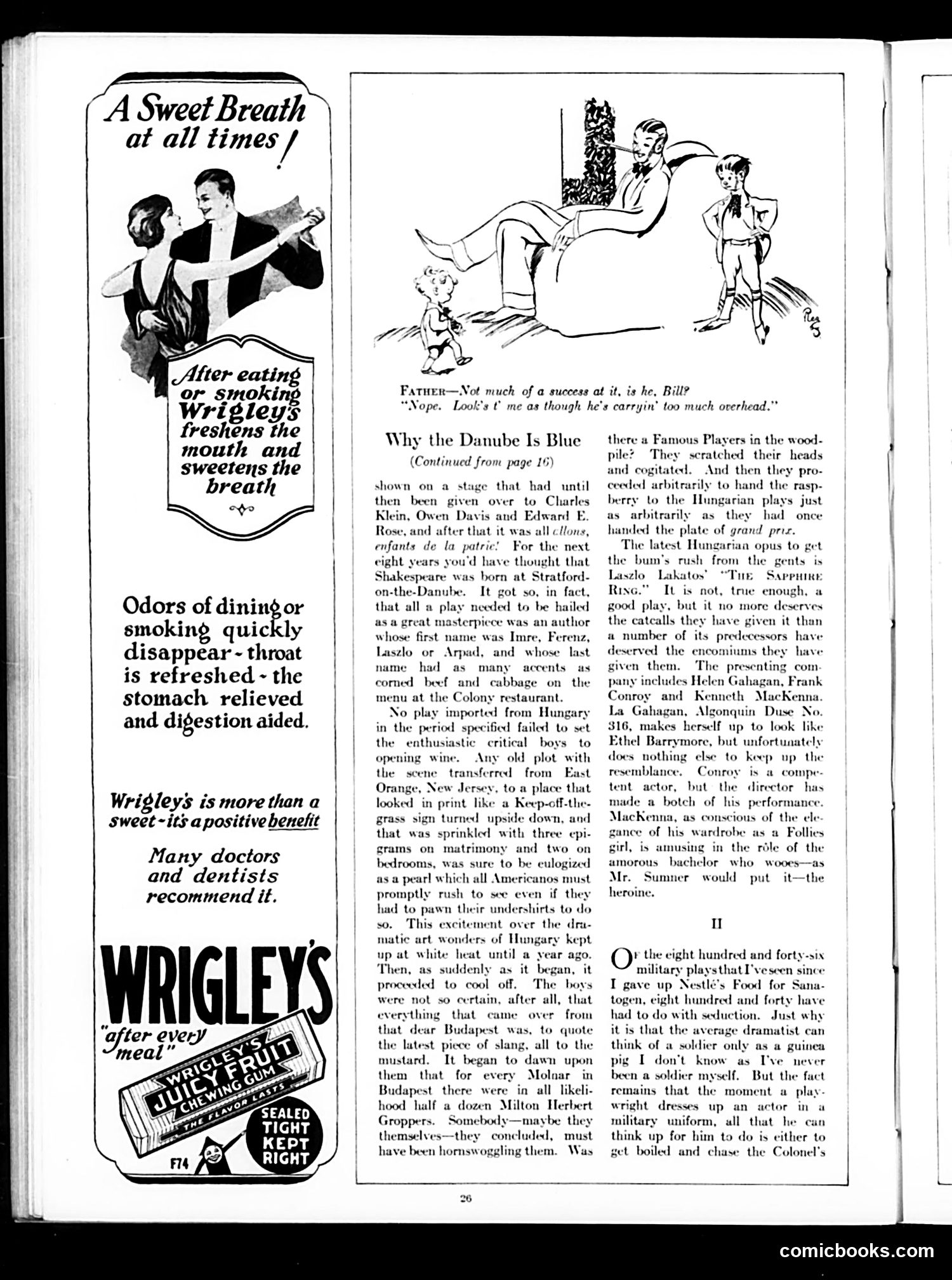
This page contains **primarily advertising** for Wrigley's chewing gum (left column) alongside theater criticism and a cartoon joke. **The cartoon** shows a father watching his son attempt acrobatics or physical feats with poor results. The punchline—"Look's t' me as though he's carryin' too much overhead"—is a business/financial pun: the son's awkward posture resembles a struggling enterprise with excessive costs. **The text** is theater criticism discussing the recent craze for Hungarian plays on Broadway (circa early 1920s). The author satirizes how critics previously lauded any imported Hungarian drama as masterpieces, then abruptly dismissed them as worthless. He argues this arbitrary reversal is unfair, using the recent Hungarian play "The Sapphire Ring" as an example of a mediocre work that doesn't deserve worse treatment than previously overpraised Hungarian imports received. The final section (section II) appears to be separate theater criticism about military-themed plays, complaining that dramatists lazily reduce soldiers to seduction plots.
📄 Transcribed text from this page (OCR, searchable)
Machine-transcribed from the original scan — historical spelling and the odd misread are preserved.
A Sweet Breath > at all times / After eating or smokii Wrigleys freshens the mouth and sweetens the breath ote Odors of dining or smoking quickly disappear - throat is refreshed - the Stomach relieved and digestion aided. Wrigleys is more than a Sweet ~its a positive benefit Many doctors and dentists recommend it. WRIGLEY, AY \ aa Fatuer—Not much of a success at it, is he, Bill? “Nope. Look's t’ me as though he's carryin’ too much overhead.” Why the Danube Is Blue (Continued from page 16) shown on a stage that had until then been given over to Charles Klein, Owen Davis and Edward E. Rose, and after that it was all clons, enfants de la patric? For the next eight years you'd have thought that Shakespeare was born at Stratford- on-the-Danube. It got so, in fact, that all a play needed to be hailed as a great masterpiece was an author whose first name Imre, Fer Laszlo or Arpad, and whose Is name had as many accents as comed beef and cabbage on the menu at the Colony restaurant. No play imported from Hungary in the period specified failed to set the enthusiastic critical boys to opening wine. Any old plot with thes transferred from East Orange, New Jersey, to a place that looked in print like a Keep-off-the- grass sign turned upside down, and that was sprinkled with three epi- grams on matrimony and two on bedrooms, was sure to be eulogized as a pearl which all Americ promptly rush to see ¢ had to pawn their undershirts to do so. This excitement over the dra- matic art wonders of Hungary kept up at white heat until a year ago. Then, as suddenly as it began, it procesded to cool off. The boys were not so certain, after all, that everything that came over from that dear Budapest to quote the latest piece of slang, all to the mustard. It began to dawn upon them that for every Moloar Budapest there were in all likeli- hood half a dozen Milton Herbert Groppers. Somebody—maybe they themselves—they concluded, must have been homswoggling them. Was there a Fi pile? and cogita ceeded arbi nous Players in the wood- scratched their heads And then they pro- to hand the - berry to the Hungarian plays just as arbitrarily as they had once handed the plate of grand pris. The latest Hungarian opus to get the bum’s rush from the gents is Laszlo Lakatos’ “Tue Sappuire Rine.” It is not, true enough, a good play, but it no more deserves the catealls they have given it than a number of its predecessors have deserved the cncomiums they have given them. The presenting com pany includes Hel gan, Frank Conroy and Kenneth MacKenna. La Gahagan, Algonquin Duse No. 316, makes hersel If up to look like Ethel Barrymore, but unfortunately does nothing else to keep up the emblance. Conroy is a compe- actor, but the director has a botch of his performance. nna, as conscious of the ele of his wardrobe as a Follies girl, is amusing in the role of the amorous bachelor who wooes Mr. Sumner would put heroine. as it—the bat O' the eight hundred and forty-six military playsthat I've seen since I gave up Nestlé’s Food for Sana- togen, eight hundred and forty have had to do with seduction. Just why it is that the average dramatist can think of a soldier only as a guinea pig I don't know as T've never been a soldier myself. But the fact remains that the moment a play- wright dresses up an actor in a military uniform, all that he can think up for him to do is either to get boiled and chase the Colonel's comicbooks.com