
A complete issue · 36 pages · 1925
Judge — February 28, 1925
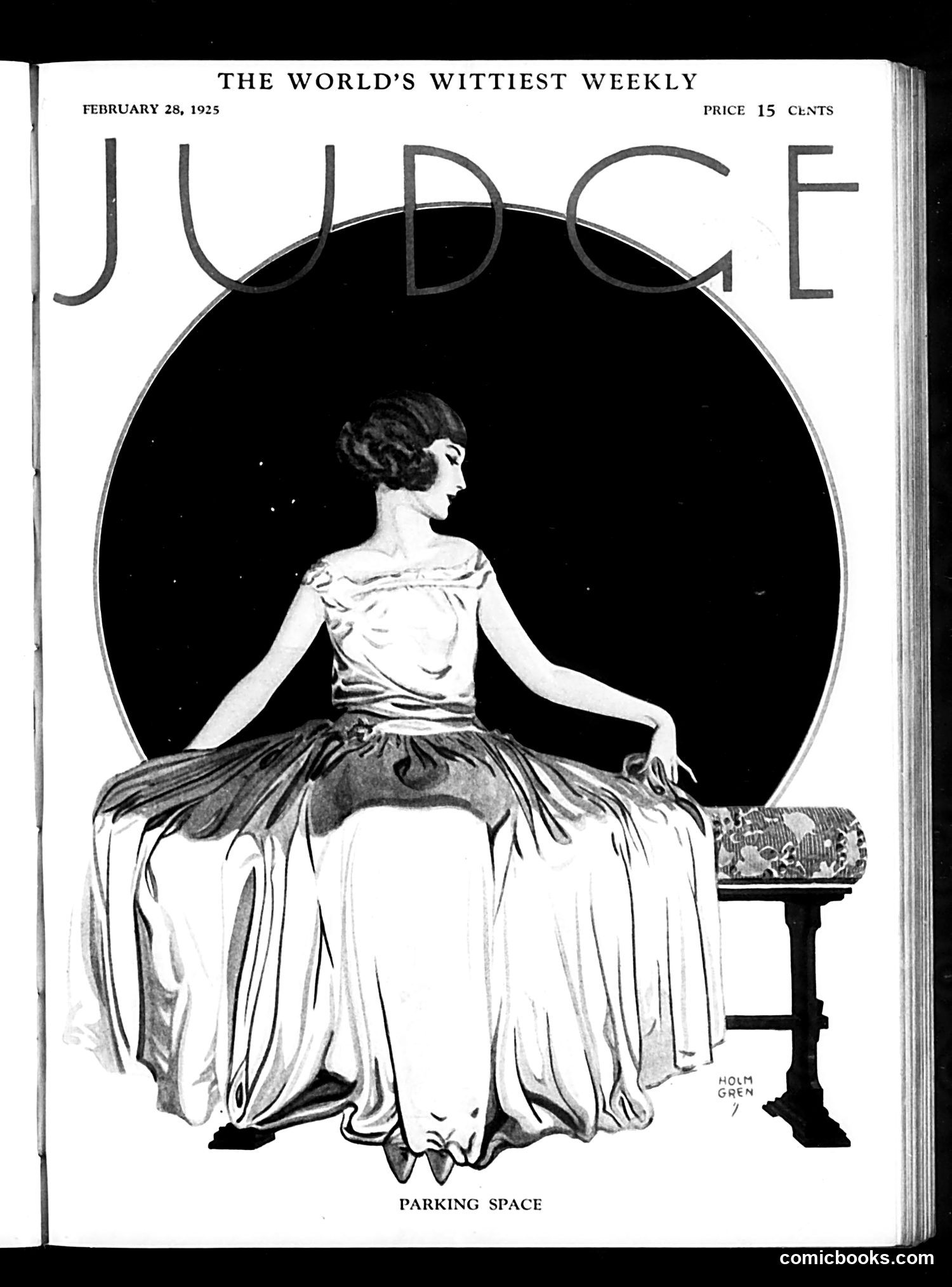
This cartoon satirizes the growing automobile crisis in 1920s America. The elegantly dressed woman sitting prominently in an empty circular space represents the newly scarce commodity of urban parking. The caption "Parking Space" is the joke: as cars proliferated during the automotive boom, finding a place to park became increasingly difficult in cities. The woman's dignified pose—as if she's a prized possession or work of art—mocks how valuable and sought-after parking had become. The illustration suggests parking space was being treated like a luxury item or work of fine art worth displaying. This reflects genuine urban congestion problems that emerged as automobile ownership exploded in the 1920s.
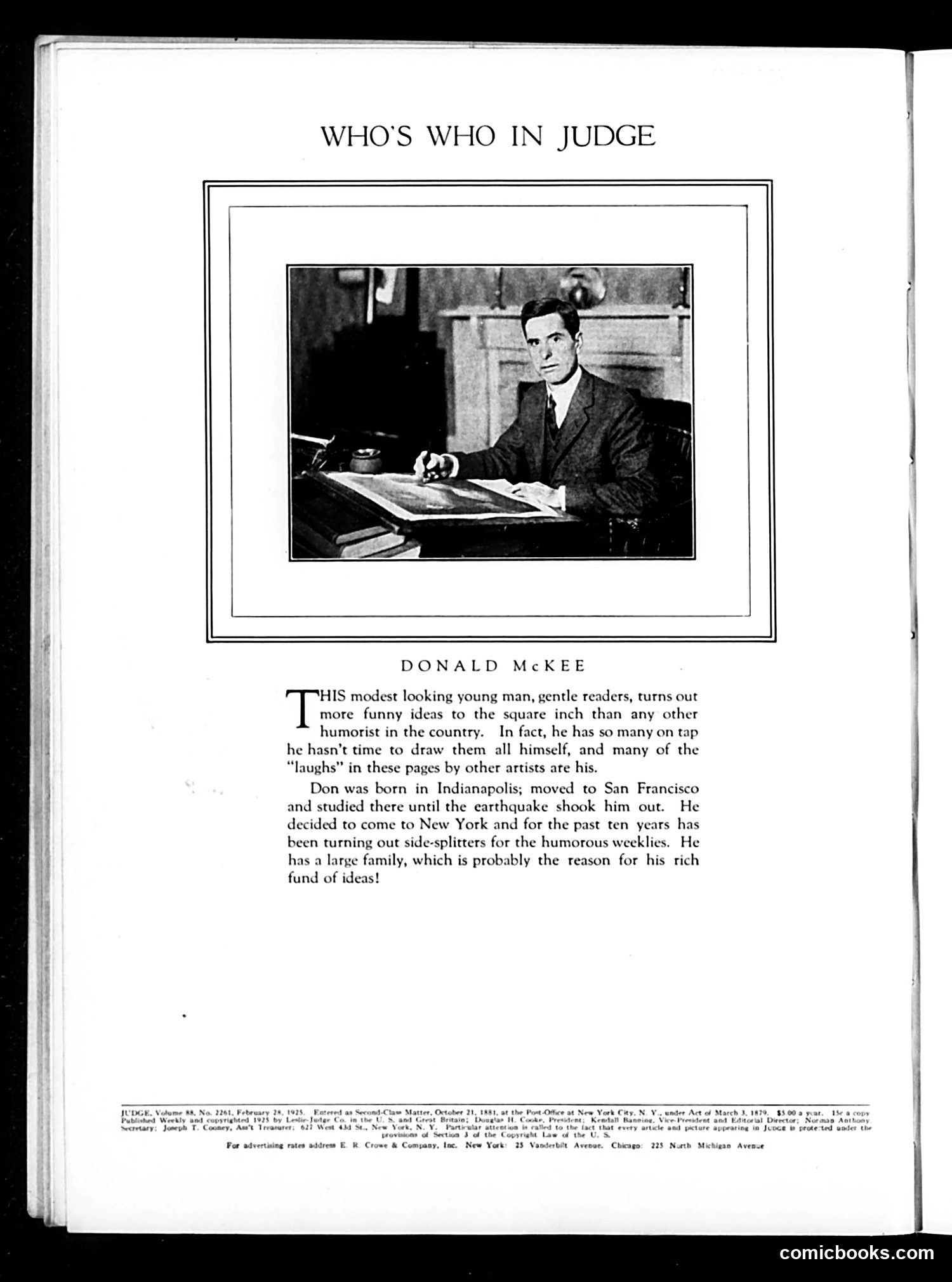
This is a biographical profile rather than a political cartoon. It introduces **Donald McKee**, a humor cartoonist and illustrator for *Judge* magazine. According to the text, McKee was born in Indianapolis, moved to San Francisco (where an earthquake prompted his relocation), and had been working in New York for ten years creating "side-splitters" for the humorous weekly. The profile notes he produces so many comic ideas that other artists draw some of the jokes credited to him, and attributes his prolific output to having a large family. The photograph shows McKee at a drafting desk, working on illustrations—a standard professional portrait for such features in early-20th-century magazines.
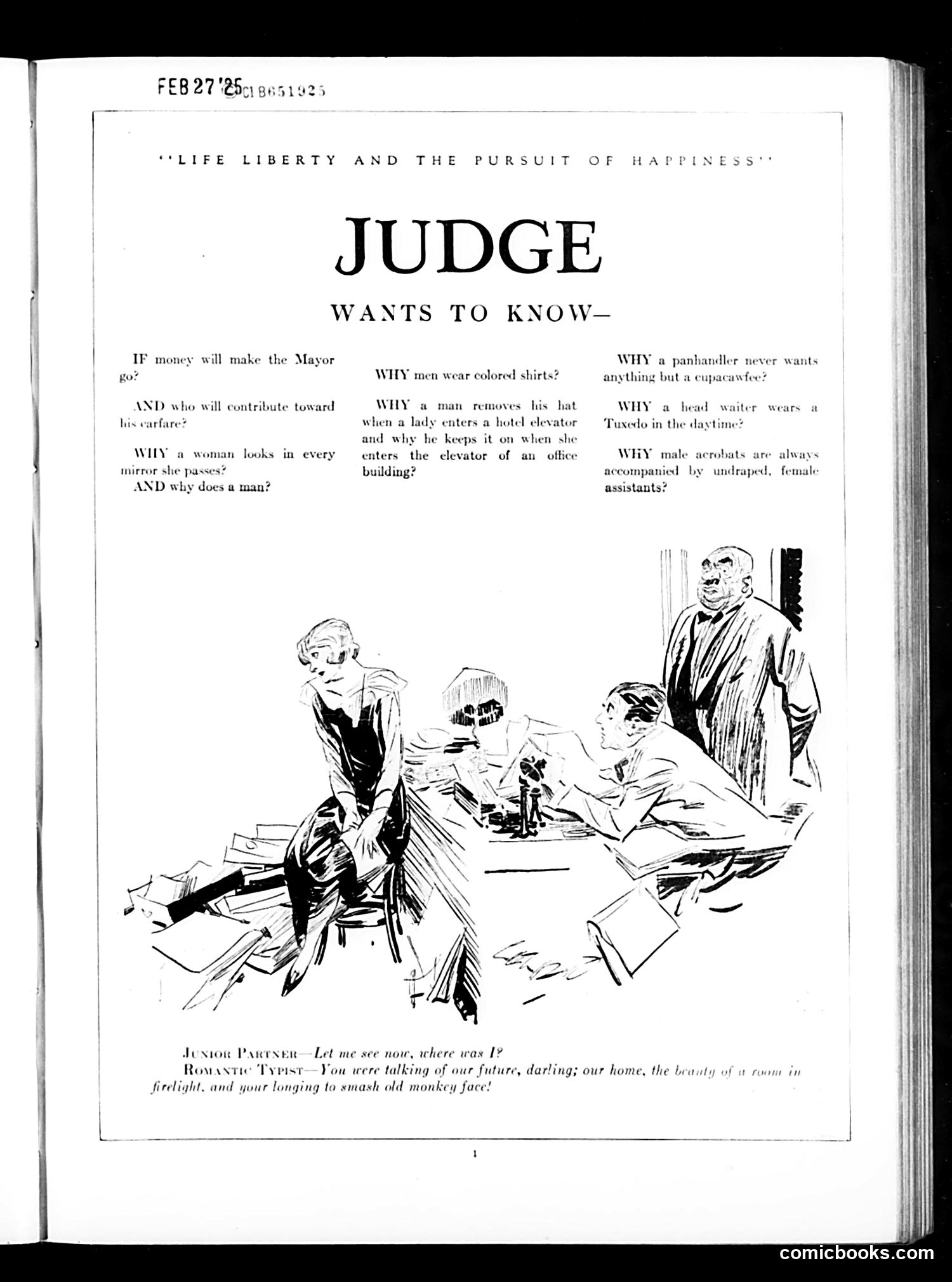
This page from *Judge* magazine presents absurdist questions about everyday social conventions, using them to mock the contradictions and illogical customs of 1920s American society. The cartoon depicts an office scene where a judge (or authority figure) interrogates people about peculiar social behaviors: Why do women check mirrors constantly? Why wear colored shirts? Why remove hats in elevators? Why do waiters wear tuxedos during daytime? The satire targets the arbitrary, unquestioned rules governing dress, etiquette, and gender behavior. By framing these conventions as bizarre mysteries requiring judicial investigation, the cartoonist highlights how absurd social norms become when examined rationally—a common progressive critique of rigid Victorian-era propriety that persisted into the Jazz Age.
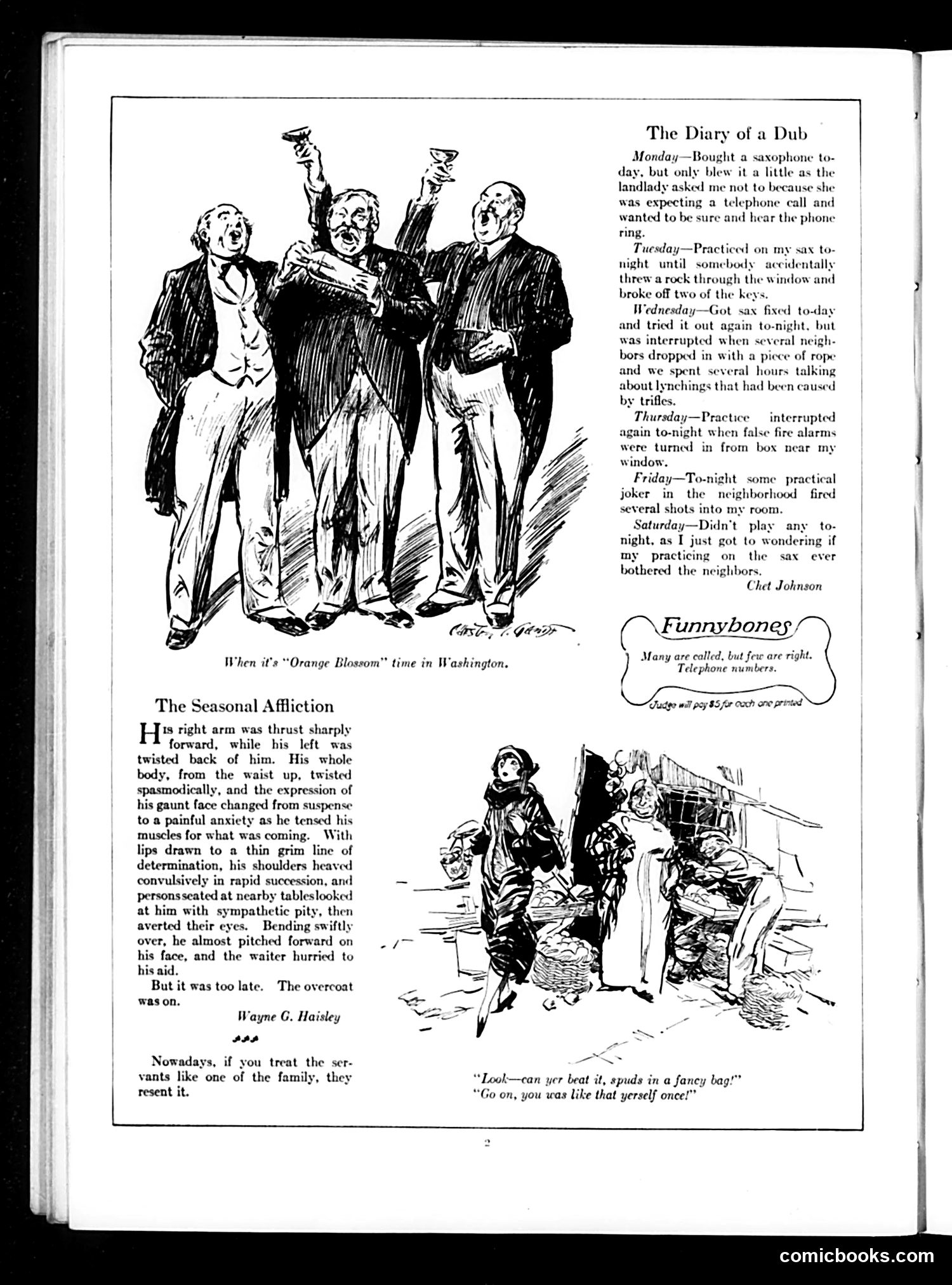
The top cartoon, "When it's 'Orange Blossom' time in Washington," depicts three men playing saxophones while appearing distressed or contorted. "Orange Blossom" appears to be a period slang term or reference (likely related to Washington D.C. social events), and the cartoon satirizes the cacophony and chaos of musicians—possibly representing politicians or government officials—struggling to perform together harmoniously. "The Seasonal Affliction" describes a man in physical distress, likely suffering from spring allergies or hay fever—a relatable medical complaint of the era. The humor derives from the sympathetic yet exaggerated depiction of his suffering. The lower cartoon shows a woman scolding what appears to be a younger person about cleanliness, using period-appropriate class commentary about servant behavior versus fancy presentation.
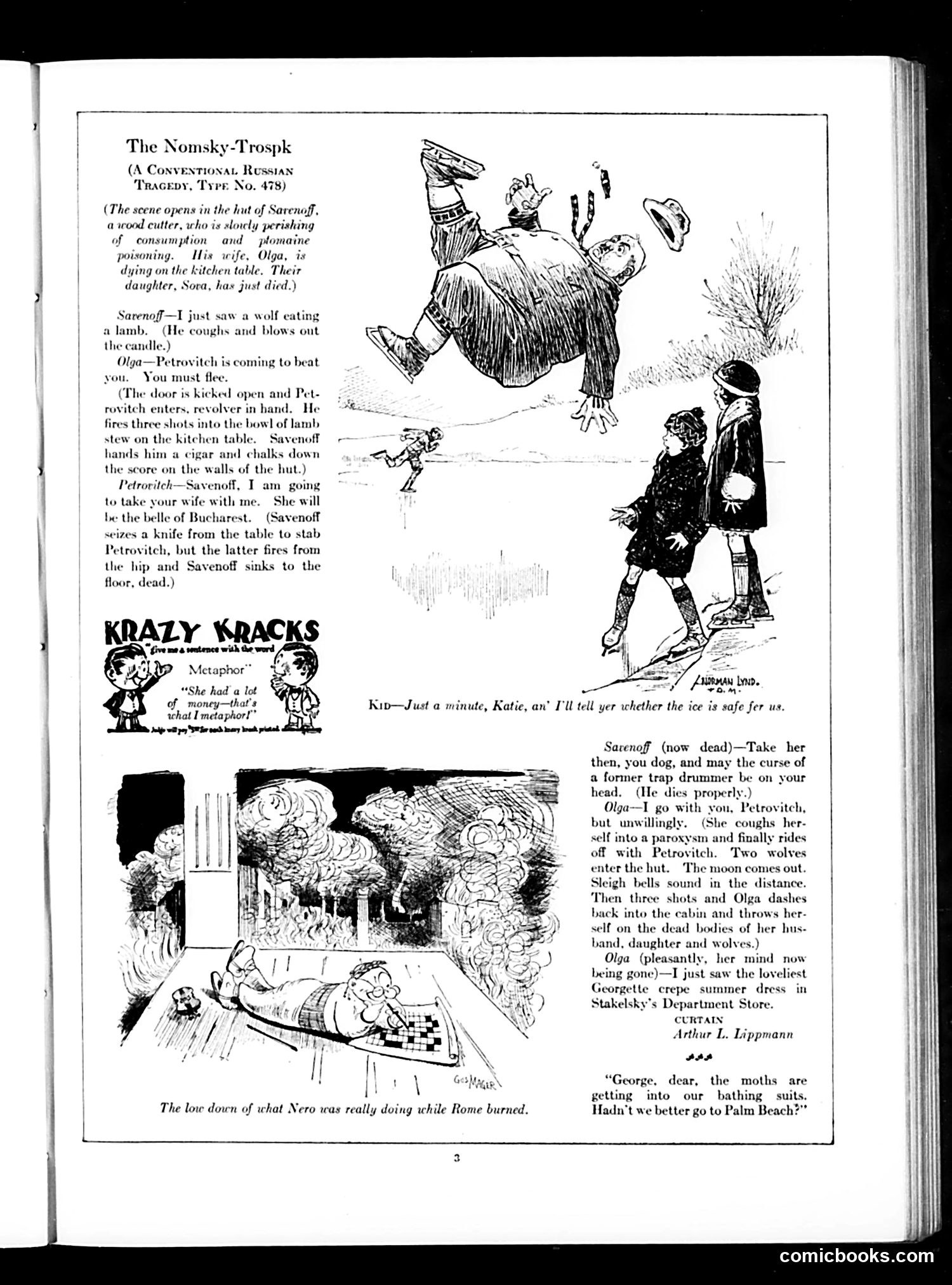
This page contains two distinct items: 1. **"The Nomsky-Trosk"** - A theatrical parody of Russian tragedy, depicting a domestic murder scene with exaggerated violence. A man is thrown through the air while his wife dies below. The satire mocks overwrought Russian dramatic conventions popular in early 20th-century American theater, treating them as absurdly melodramatic. 2. **"Krazy Kracks"** - A small section defining "Metaphor" using simple language, likely aimed at children. 3. **Lower cartoon** - Labeled "The low down of what Nero was really doing while Rome burned," showing Nero fiddling indoors while the city burns outside—a visual punchline reversing the famous historical phrase to suggest Nero engaged in mundane activities during Rome's destruction. The page primarily satirizes theatrical pretension and classical historical clichés.
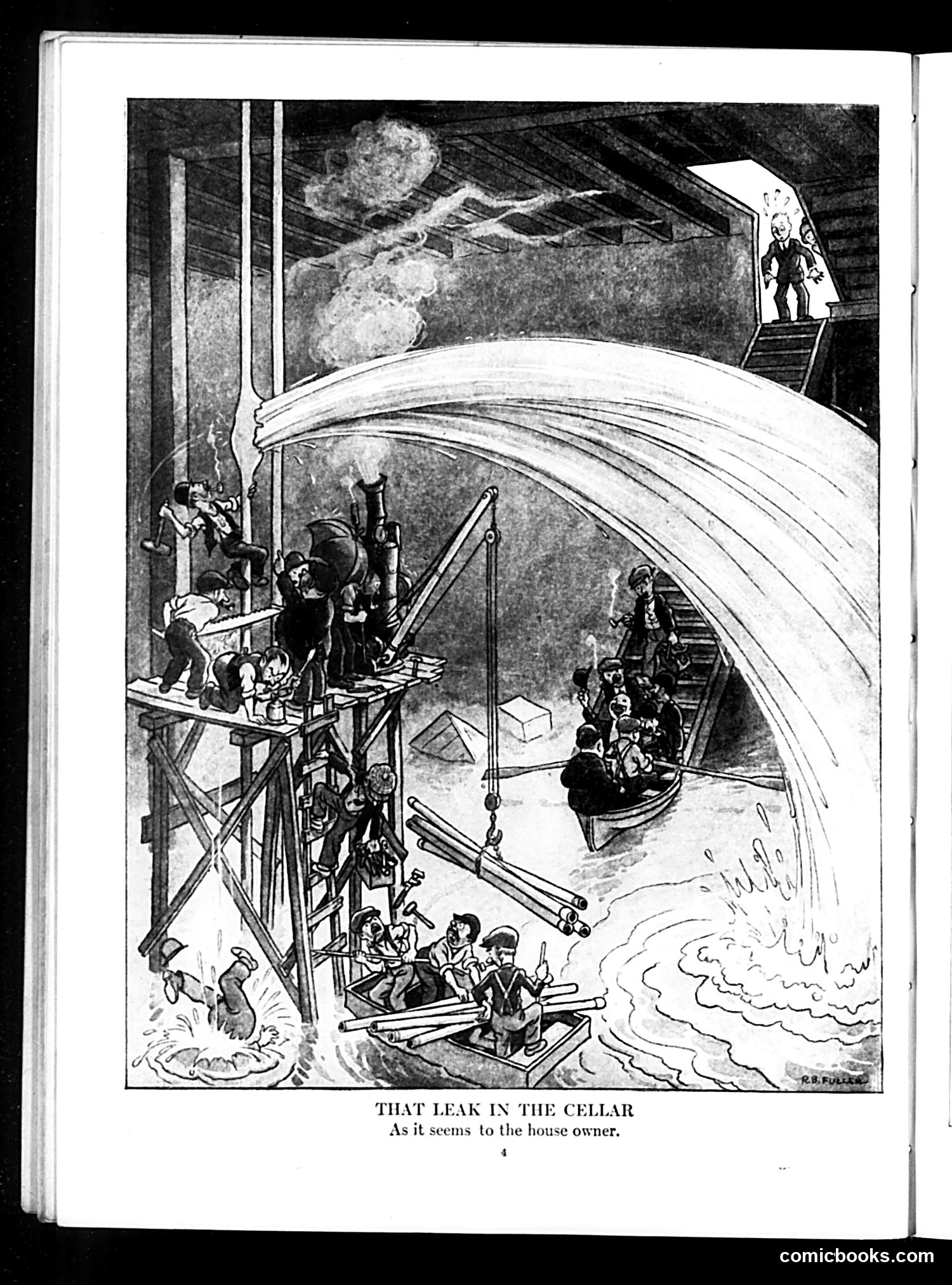
This cartoon uses exaggerated visual metaphor to satirize how homeowners perceive minor household problems. What is actually a simple basement leak becomes, in the anxious owner's imagination, a catastrophic flood requiring elaborate rescue operations. Multiple boats, rescue workers, and construction scaffolding suggest an apocalyptic scenario—all supposedly caused by water seeping from above. The joke mocks the tendency of property owners to catastrophize maintenance issues, imagining worst-case disasters rather than accepting routine repairs. The caption's subtitle emphasizes this is subjective perception ("as it seems"), not reality. The detailed illustration style, credited to R.B. Fuller, contrasts humorous absurdity with serious rendering, amplifying the satire of disproportionate worry.
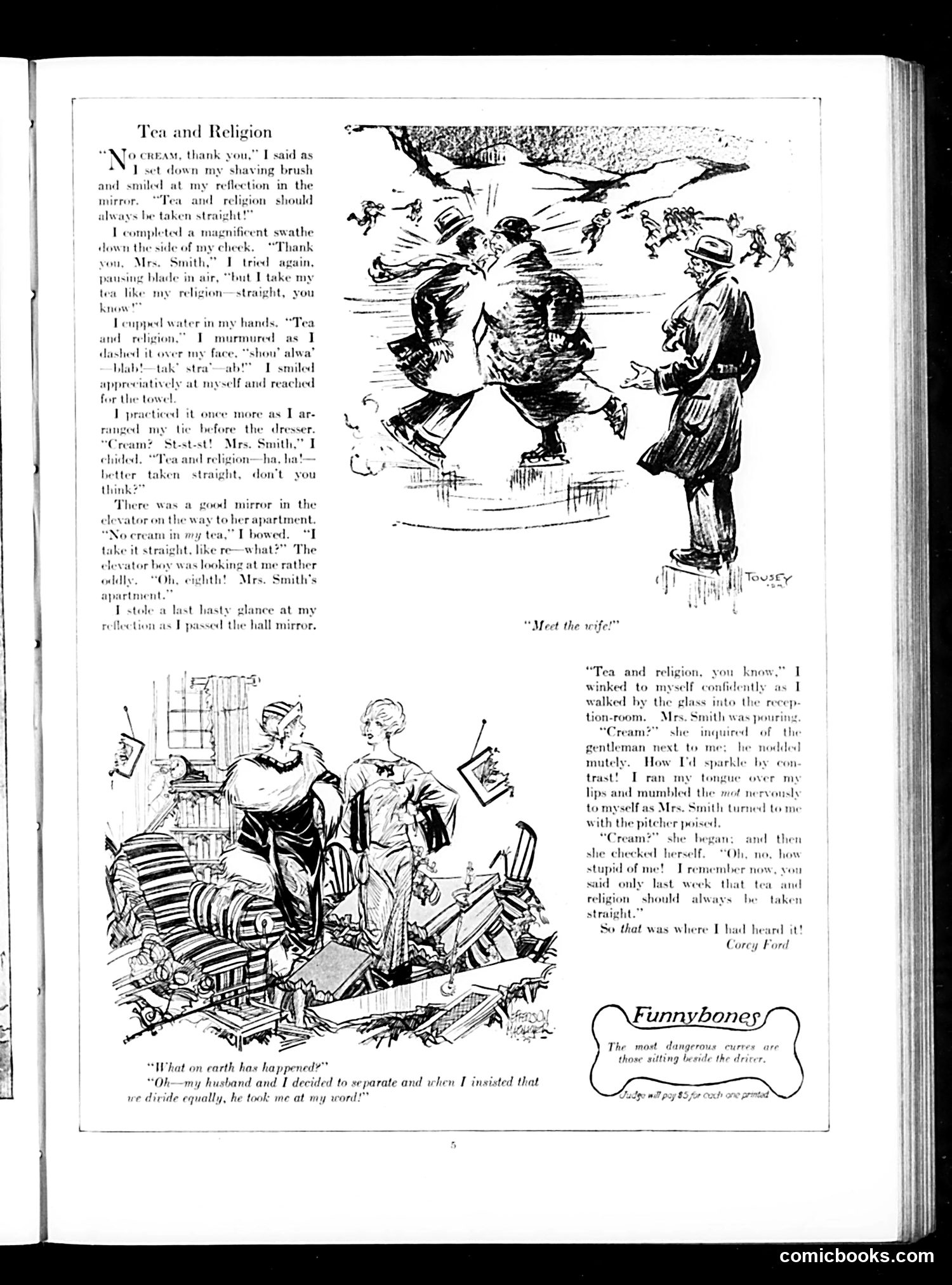
This satirical piece mocks a domestic dispute resolved through marital compromise. The narrator recalls Mrs. Smith's morning reproval about taking tea "straight" without cream—calling it irreligious. Later, when they separate and she insists on dividing equally, he counters that tea and religion "should always be taken straight." The upper cartoon shows chaos erupting when the husband meets "the wife," likely depicting their conflict. The lower cartoon illustrates the marital chaos surrounding their separation dispute. The satire targets Victorian-era domestic hypocrisy: Mrs. Smith weaponizes religious rhetoric to criticize her husband's preferences, yet abandons those same principles when defending her financial interests during their separation. The "Funnybones" caption adds commentary on marital discord.
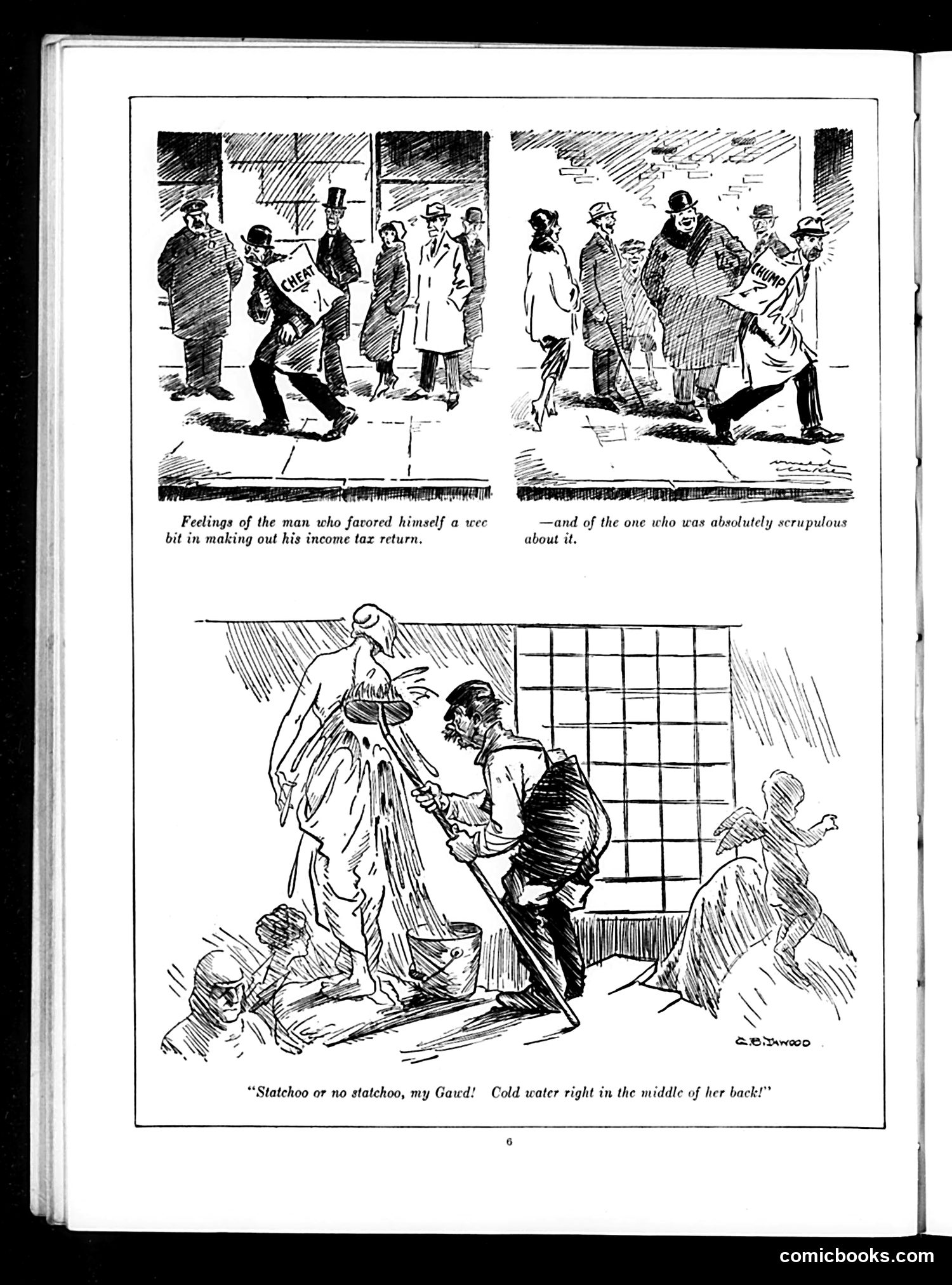
This Judge page satirizes income tax compliance through three cartoons: **Top panels**: Contrast two men filing taxes—one who "favored himself a wee bit" (cheated slightly) appearing relaxed among onlookers, versus one "absolutely scrupulous" who looks anxious and guilty. The joke mocks how dishonest filers often seem unbothered while honest ones stress over scrutiny. **Bottom panel**: A domestic scene where a man pours cold water on a woman's back, claiming legal justification ("Statchoo or no statchoo"—statute or not). This satirizes how people invoke technical legal arguments to justify ethically questionable behavior—similar to tax cheating rationalization. **Overall message**: The satire suggests that Americans rationalize cutting corners on taxes and other obligations through legalistic technicalities, while honest compliance paradoxically invites suspicion and anxiety. It critiques both tax evasion and the anxious consciences of the scrupulous.
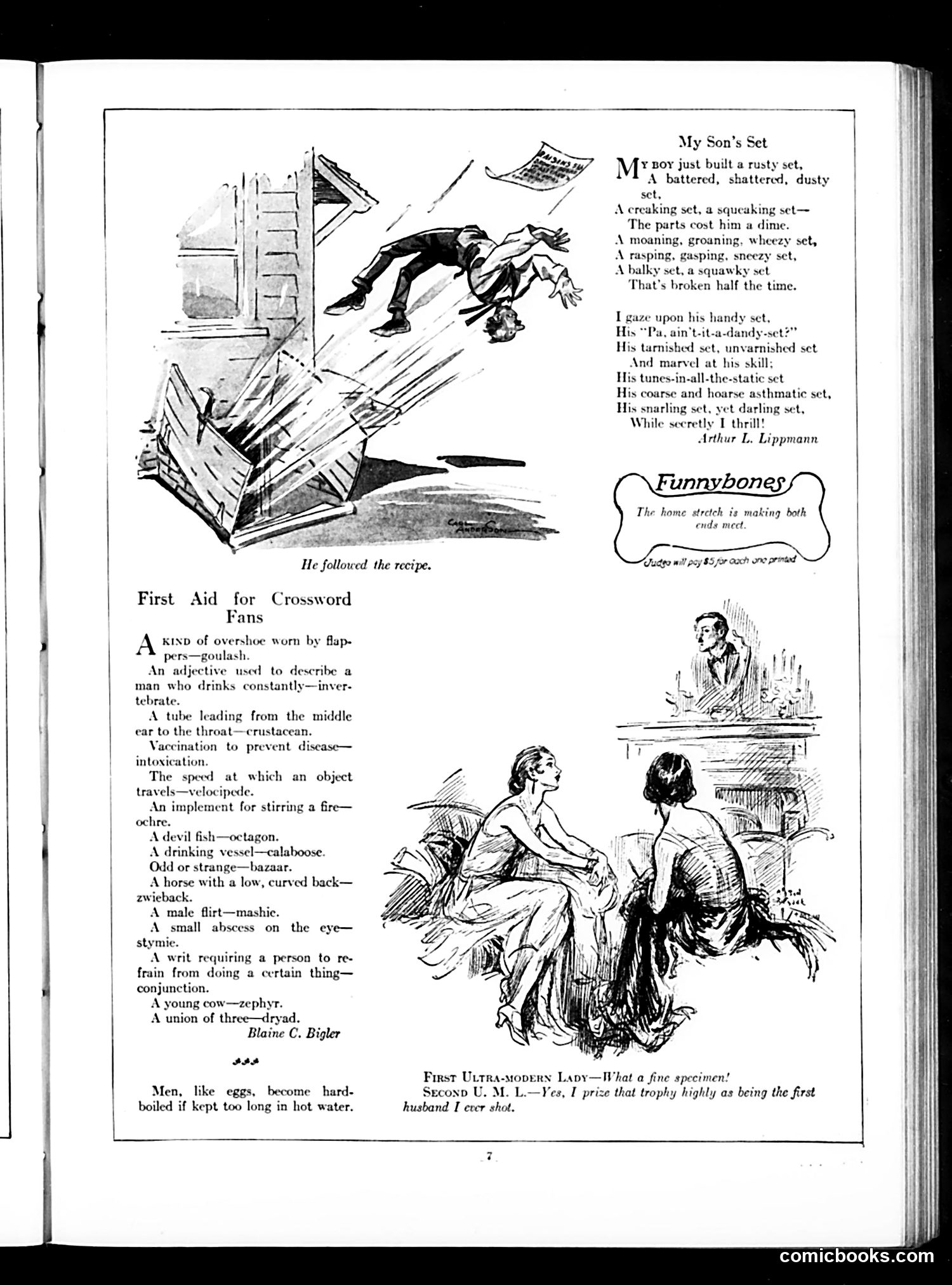
**"My Son's Set"** (top): A humorous poem by Arthur L. Lippmann celebrating a boy's homemade radio set—constructed cheaply ("parts cost him a dime") but functioning despite being broken, squeaky, and producing static-filled reception. The father's pride in his son's ingenuity is the joke's heart. **"First Aid for Crossword Fans"** (left): Blaine C. Bigler presents intentionally wrong crossword puzzle answers, playing on the era's fad for crossword puzzles. The humor lies in deliberate absurdity: "goulash" for overshoe, "velocipede" for speed, "bazaar" for odd/strange—mixing unrelated definitions to confuse solvers. **"Funnybones"** (center): A one-line domestic gag about financial struggle. **Bottom cartoon**: Two fashionable women discuss a taxidermied animal trophy. The "ultra-modern lady" jokes that she prizes it as "the first husband I ever shot"—dark humor suggesting either divorce or marital discord presented as trophy hunting. All content reflects 1920s preoccupations: radio technology, crossword puzzles, and modern women's independence.
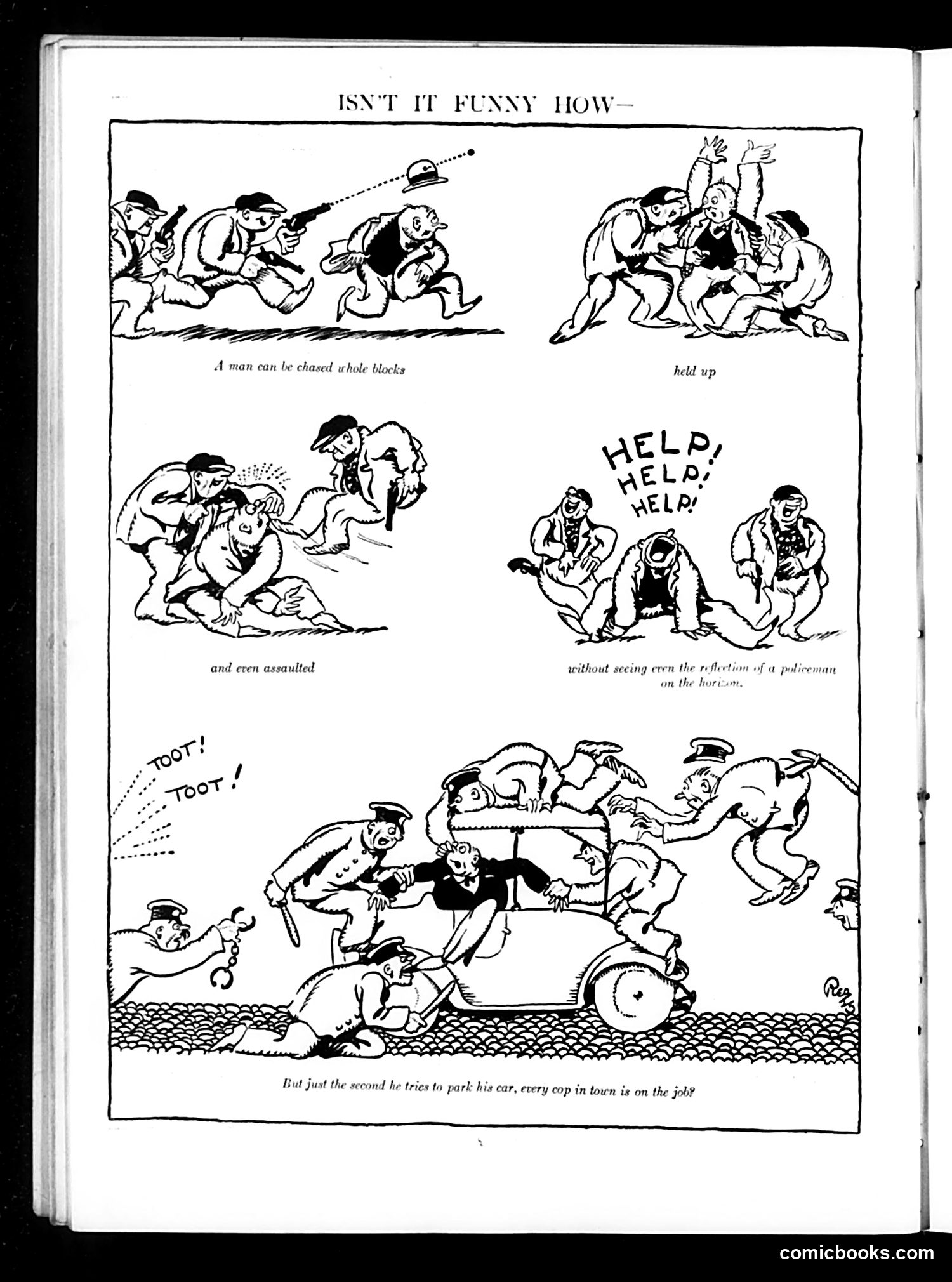
This comic satirizes police priorities in early 20th-century urban America. The title "ISN'T IT FUNNY HOW—" sets up an ironic complaint: a man can be chased for blocks, held up, assaulted, and robbed *without a single police officer appearing*. Yet the moment he attempts to park his car, "every cop in town is on the job." The satire targets police ineffectiveness at preventing serious crimes (robbery, assault) while zealously enforcing minor traffic violations. This reflects contemporary frustration with law enforcement's misplaced focus on revenue-generating parking enforcement rather than public safety. The humor lies in the absurd contrast between negligence toward violent crime and aggressive intervention for a parking violation.
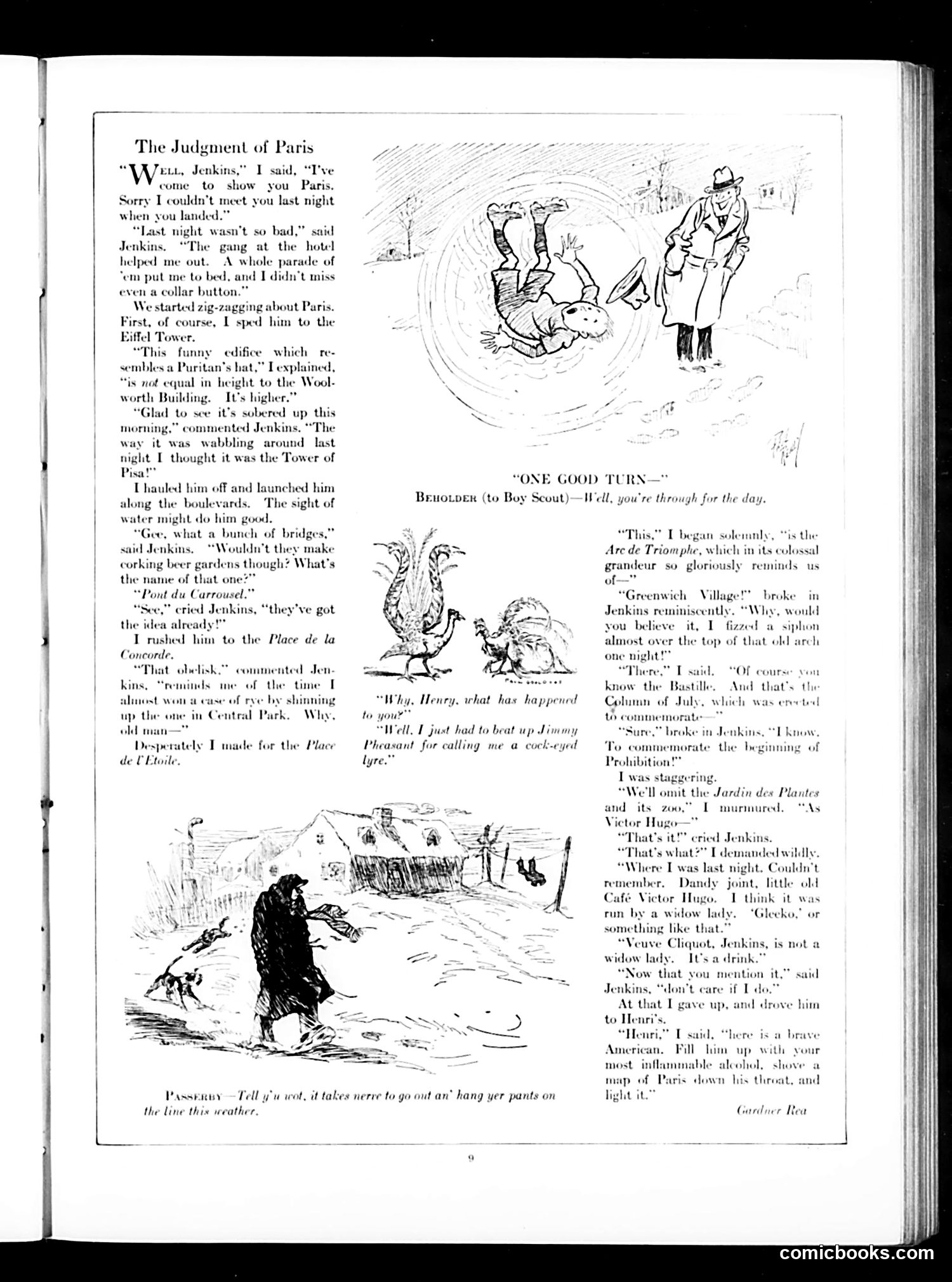
This is a humorous narrative (not a political cartoon) mocking an American tourist named Jenkins visiting Paris. The satire targets American ignorance of European culture and architecture. Jenkins repeatedly misidentifies or trivializes famous Parisian landmarks through crude American comparisons: the Eiffel Tower against the Woolworth Building; the Arc de Triomphe reminds him of Greenwich Village; he mistakes the Café Cliquot liqueur bottle label for a restaurant named after a widow. The joke hinges on Jenkins being chronically drunk—he's hungover from the night before, can't remember where he went, and the narrator gives up, sardonically suggesting he fill Jenkins with alcohol and light it. The accompanying small cartoon, "One Good Turn," shows a Boy Scout who beat up another boy for calling him a "cock-eyed lyre" (likely "liar"), playing on Scout honor codes. The satire mocks both American provincialism and alcoholic tourism clichés.
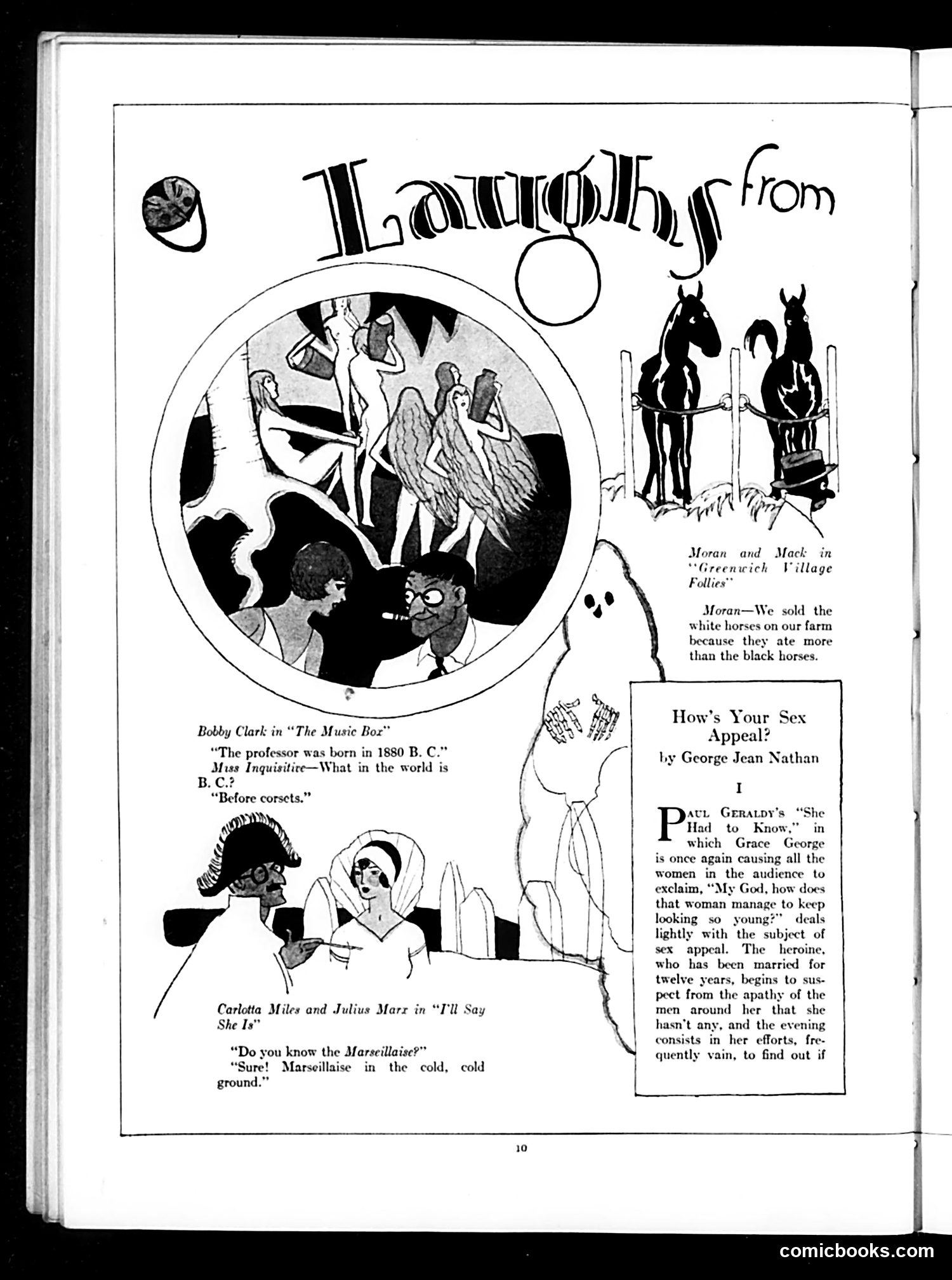
This page collects theatrical jokes and commentary from Broadway shows circa the 1920s. The humor relies on wordplay and contemporary references: **Bobby Clark sketch**: A pun on "B.C." (Before Christ) reinterpreted as "Before Corsets"—joking about women's fashion constraints. **Julius Marz/Carlotta Miles bit**: Plays on the "Marseillaise" (French national anthem) confused with "in the cold, cold ground" (likely a Stephen Foster reference), mocking mangled cultural knowledge. **Moran and Mack**: A racist "logic" joke—the punchline's absurdity is the humor, though the context involves ethnic comedy stereotyping common to the era. **George Jean Nathan's theater review** discusses Paul Gieraldi's "She Had to Know," examining how actress Grace George maintains youthful appeal despite twelve years of marriage, treating "sex appeal" as a theatrical and social performance. The page reflects 1920s entertainment culture: vaudeville-influenced wordplay, Broadway commentary, and era-specific attitudes toward gender and attractiveness.
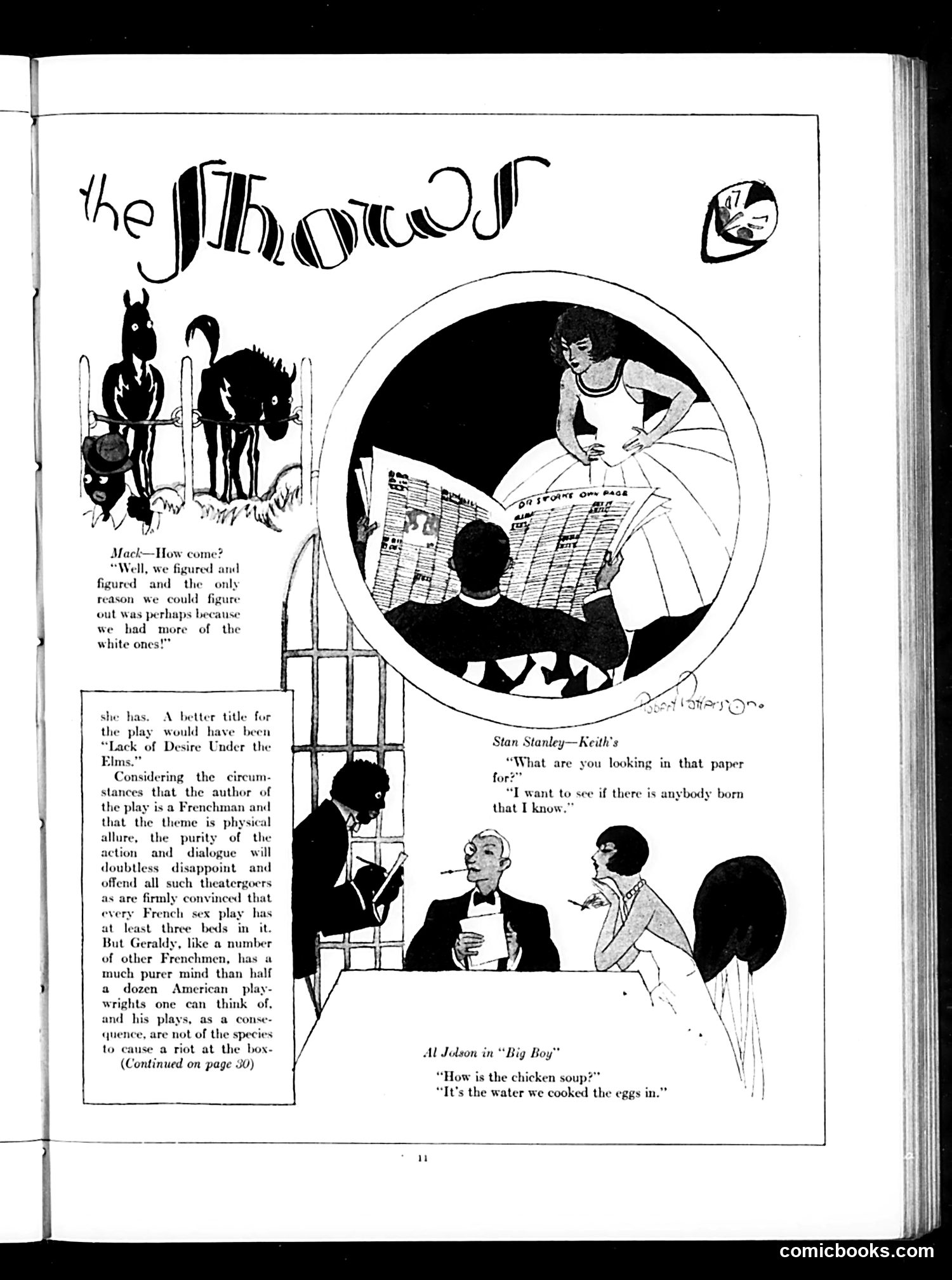
This page contains theatrical reviews and humorous one-liners typical of Judge's satirical format. The top left cartoon features animals (appearing to be a goat and dog) discussing why they had more "white ones"—likely a joke about livestock breeding or farm animals, though the setup is unclear without fuller context. The main text discusses a French play (appears to be by Geraldy), contrasting European theatrical sophistication with American prudishness. It mocks American theatergoers' expectations that French plays must contain scandalous content ("at least three beds"). Below are three separate theatrical one-liners: - A joke about someone searching a newspaper for people they know - A Stan Stanley/Keith's vaudeville reference - An Al Jolson "Big Boy" joke mocking poor-quality chicken soup (the "eggs" punchline suggests cheap, watered-down broth) These brief jokes reflect Judge's format of mixing theater criticism with quick satirical humor about contemporary entertainment and social pretensions.
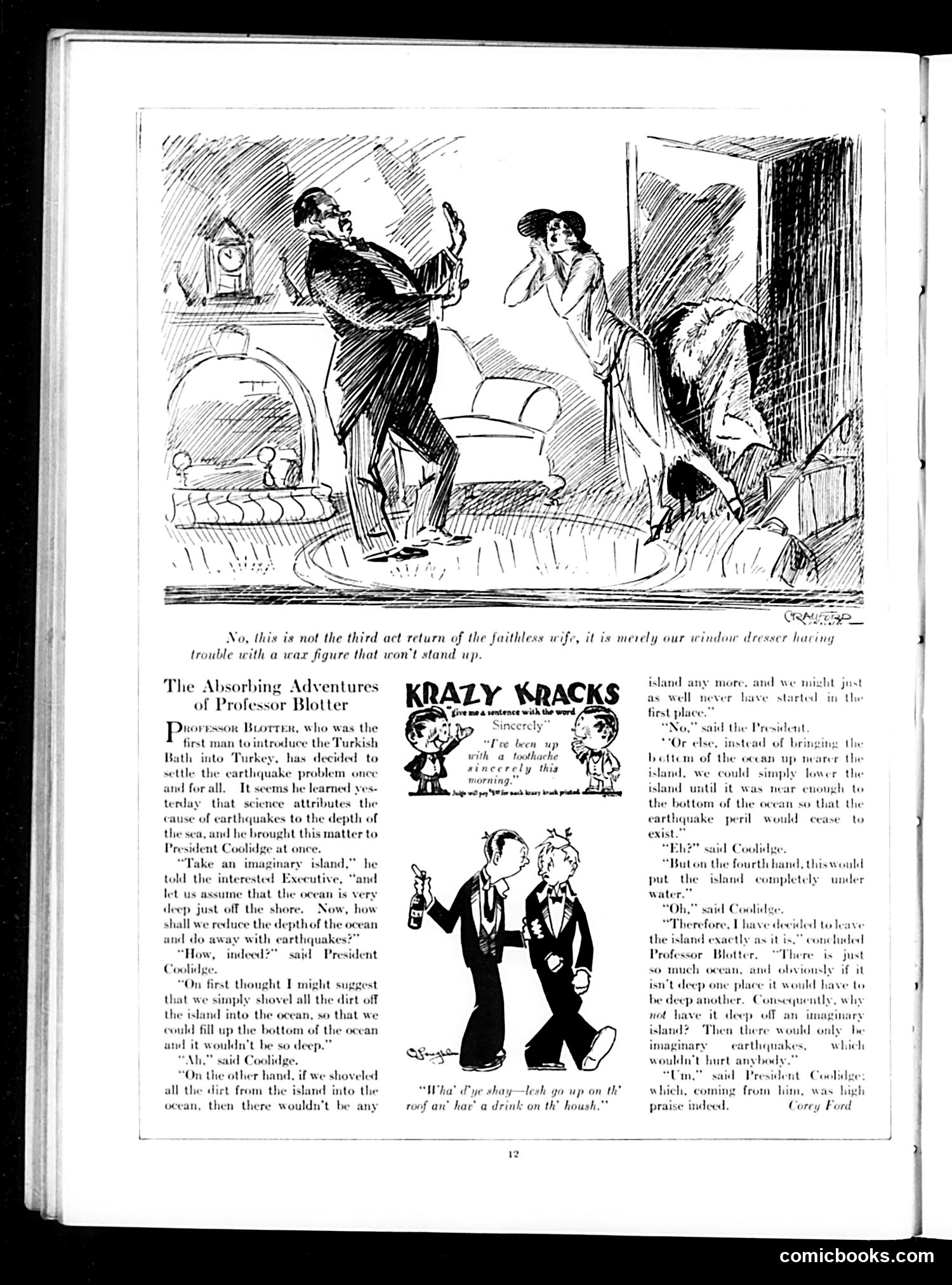
This page contains two distinct satirical pieces mocking President Calvin Coolidge's intellect and decision-making. **"The Absorbing Adventures of Professor Blotter"** depicts Professor Blotter proposing absurd solutions to earthquake prevention—shoveling dirt to change ocean depth, then lowering an island instead. President Coolidge accepts each ridiculous suggestion without objection, portrayed as unable to recognize logical fallacies or think critically. The satire targets Coolidge's reputation for being taciturn and intellectually limited. **"Krazy Kracks"** is a brief joke feature (unrelated to the main story), typical filler content in Judge magazine. **The top cartoon** depicts a domestic farce: a man gestures dramatically at a woman near a door, with a caption clarifying this is merely a window dresser struggling with a wax mannequin—a visual pun on theatrical melodrama. The overall message: Judge sardonically presented Coolidge as a dim executive willing to approve any proposal, however nonsensical, reflecting 1920s progressive criticism of his passive governance style.
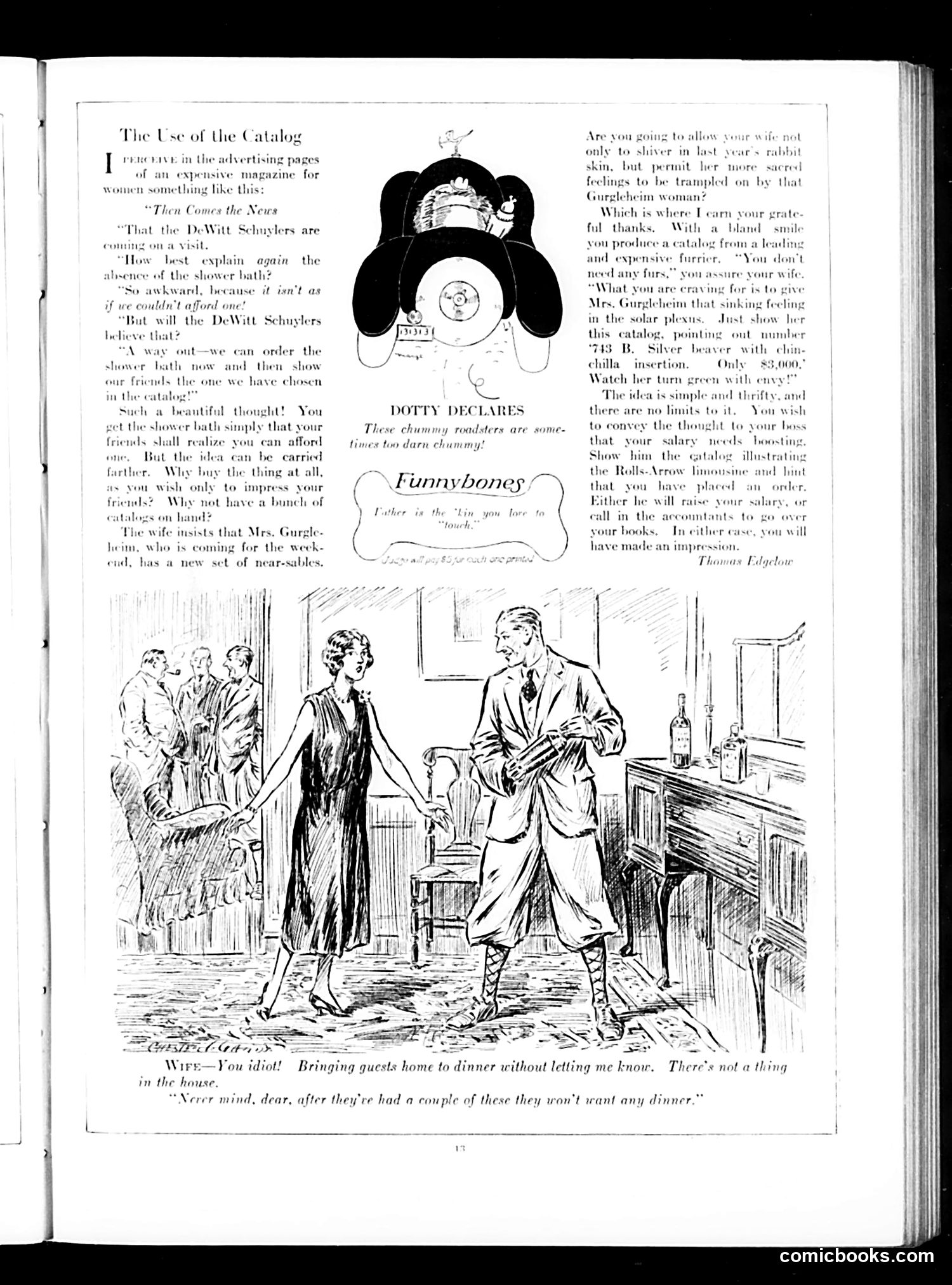
This page satirizes the early 20th-century practice of using consumer purchases as status displays for impressing others. **Main Satire ("The Use of the Catalog"):** The text mocks the idea of buying luxury goods—like an expensive shower bath or fur coats—not for personal enjoyment but solely to prove wealth to acquaintances. It critiques the absurdity of purchasing items you cannot afford simply to impress guests or rivals like "Mrs. Gurgieheim." The solution offered is deliberately ridiculous: buy a catalog and show it around, achieving the same social effect without the expense. **Bottom Cartoon:** A domestic scene shows a husband bringing unexpected dinner guests home without warning his wife. His solution: serve them alcohol ("a couple of these") so they won't notice there's no food. **Overall Theme:** The page satirizes materialism, status-anxiety, and the performative nature of wealth in American society—buying things to *appear* wealthy rather than for genuine need or pleasure. It's social commentary on American consumer culture disguised as humorous advice.
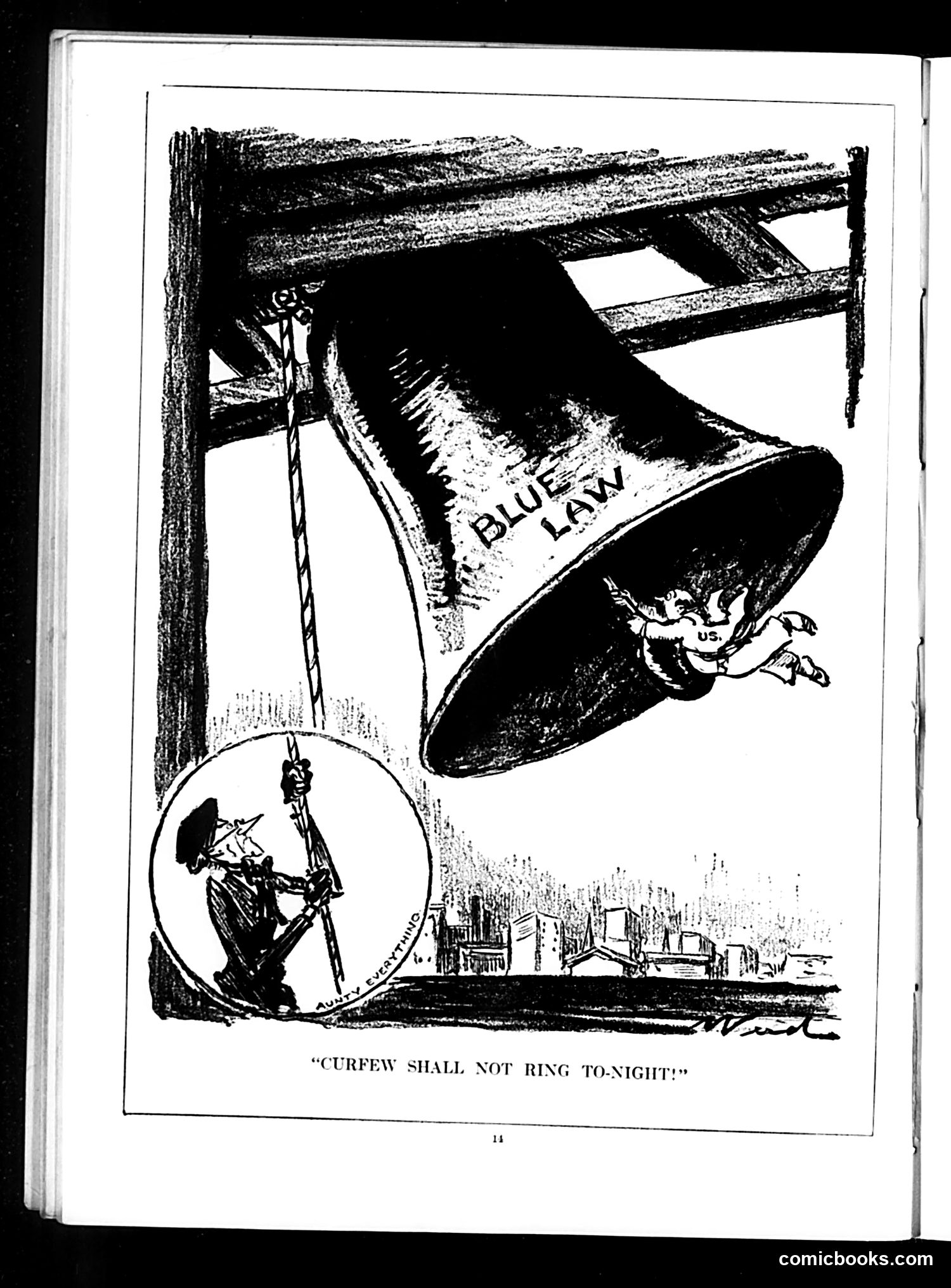
This cartoon satirizes resistance to wartime curfew laws. A large bell labeled "BLOW LAW" hangs from a gallows-like structure, with a figure (appearing to be Uncle Sam or a U.S. authority figure) about to ring it. Below, a smaller figure clings to the rope, preventing the bell from ringing. The title references a popular 19th-century sentimental poem about a young woman stopping an execution bell. Here, the satire inverts that heroic narrative: instead of sympathetically stopping a bell, the cartoon depicts someone desperately—almost comically—resisting civic authority's lawful curfew enforcement. The cartoon likely mocks those who defied wartime curfews, treating their resistance as absurdly futile against federal law. The cityscape in the background suggests urban context, possibly during WWI or WWII rationing/security measures.
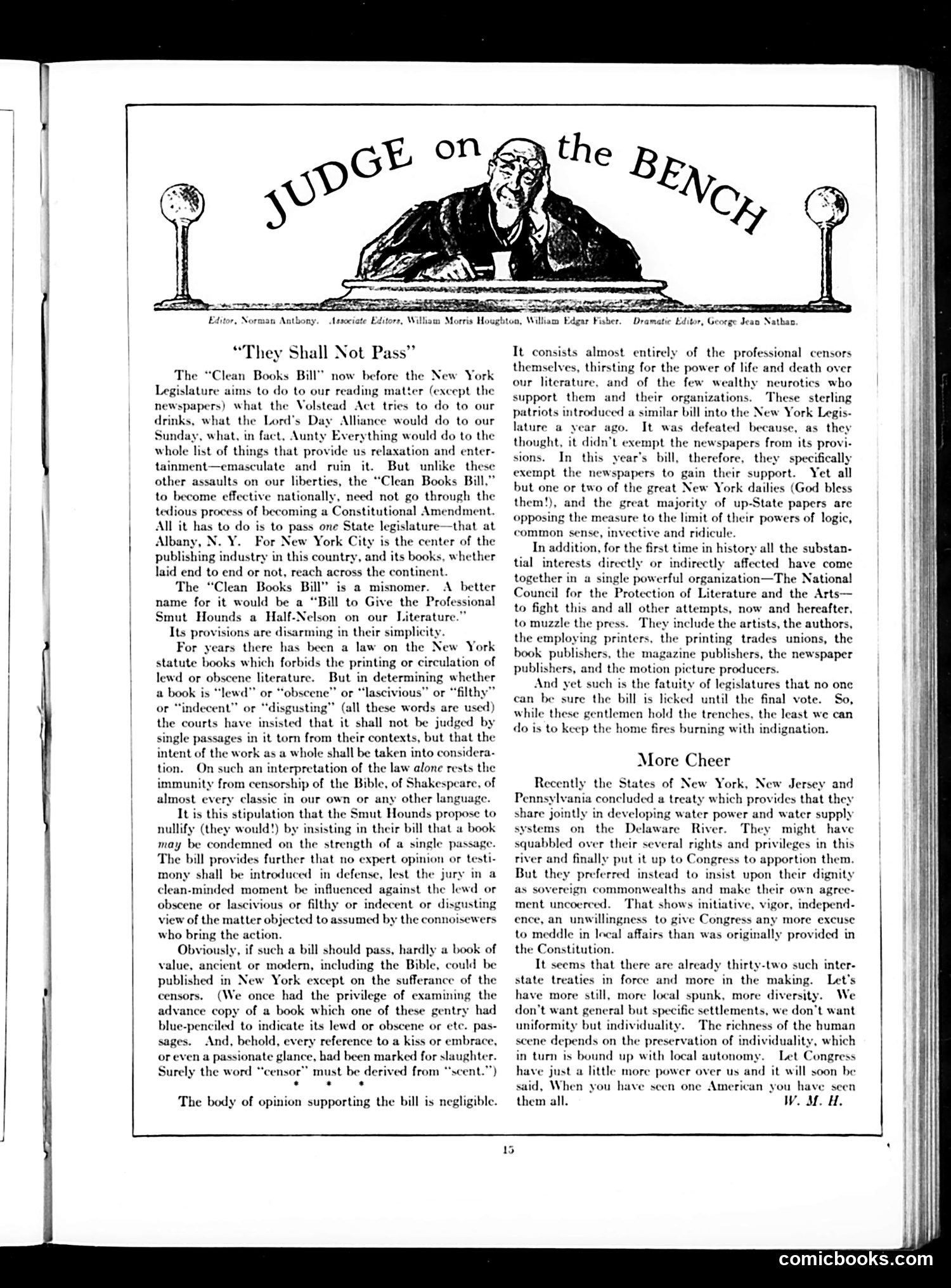
This editorial attacks New York's proposed "Clean Books Bill," a censorship measure. The cartoon's judge figure represents the bill's supporters—professional censors and wealthy moralists seeking power over literature. The satire's key point: the bill would judge books by isolated passages rather than overall intent, threatening classics like Shakespeare and the Bible. The author sarcastically calls it a "Bill to Give the Professional Smut Hounds a Half-Nelson on our Literature." The piece ridicules the censors' hypocrisy—they specifically exempted newspapers (which opposed the bill) while targeting books. Judge magazine positions itself against censorship, comparing the Clean Books Bill to Prohibition and the Lord's Day Alliance as attacks on public freedoms. The cartoon's sneering judge represents the "gentry" who would blue-pencil even innocent references to kisses or embraces. The editorial notes widespread literary and press opposition while dismissing supporter numbers as "negligible."
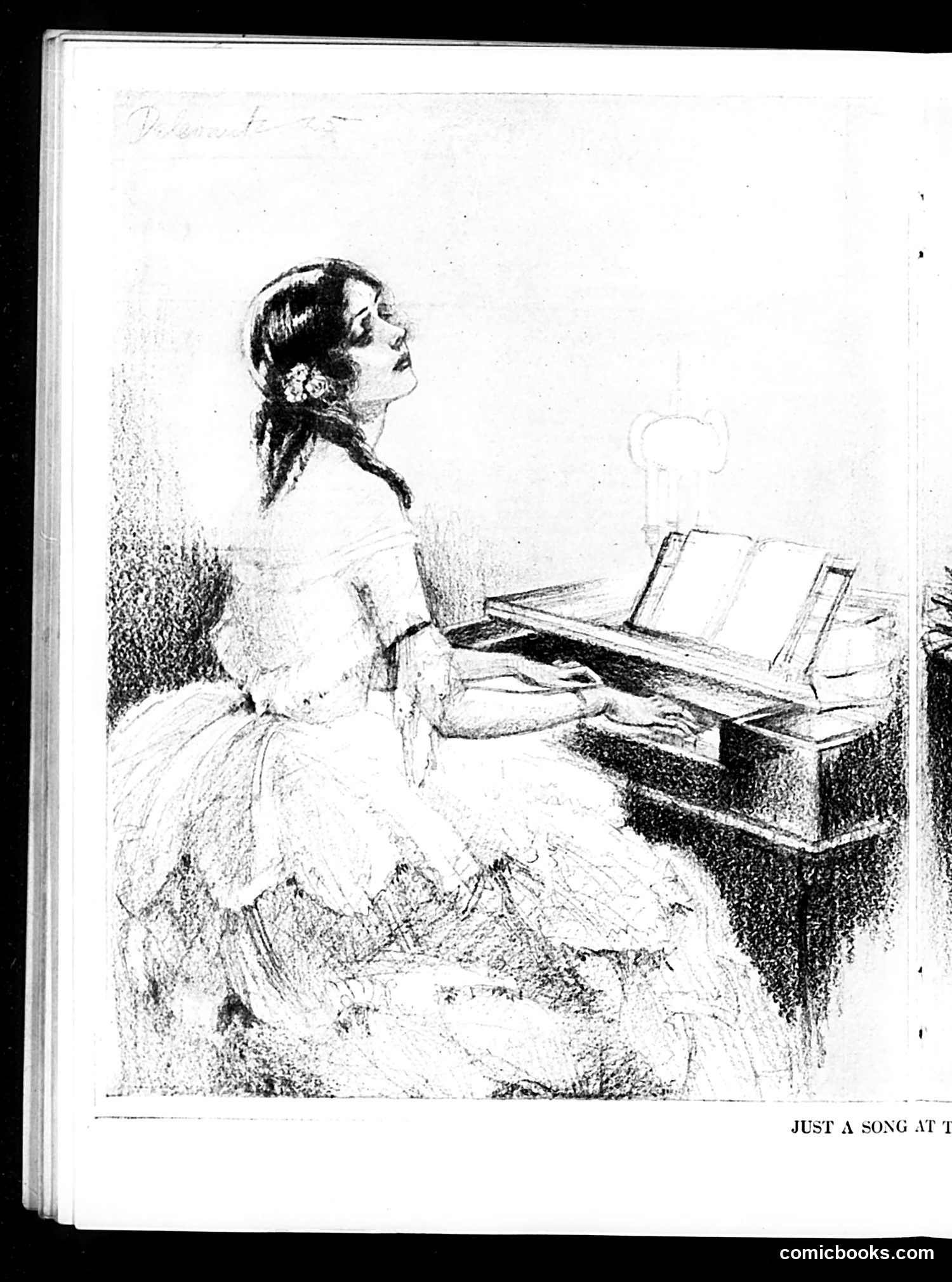
This appears to be an illustration from *Judge* magazine showing a woman seated at a piano, looking upward pensively. She wears an elegant white dress with decorative hair ornaments, typical of late 19th or early 20th-century fashion. The caption reads "JUST A SONG AT T[...]" (text is cut off). Without the complete caption or additional context, the precise satirical point is unclear. However, the image likely comments on women's roles in domestic or cultural spheres—possibly mocking sentimentality in popular music, women's artistic aspirations, or drawing-room culture of the era. The woman's idealized, somewhat wistful expression suggests either romantic yearning or artistic pretension being gently ridiculed by the magazine's satirical lens.
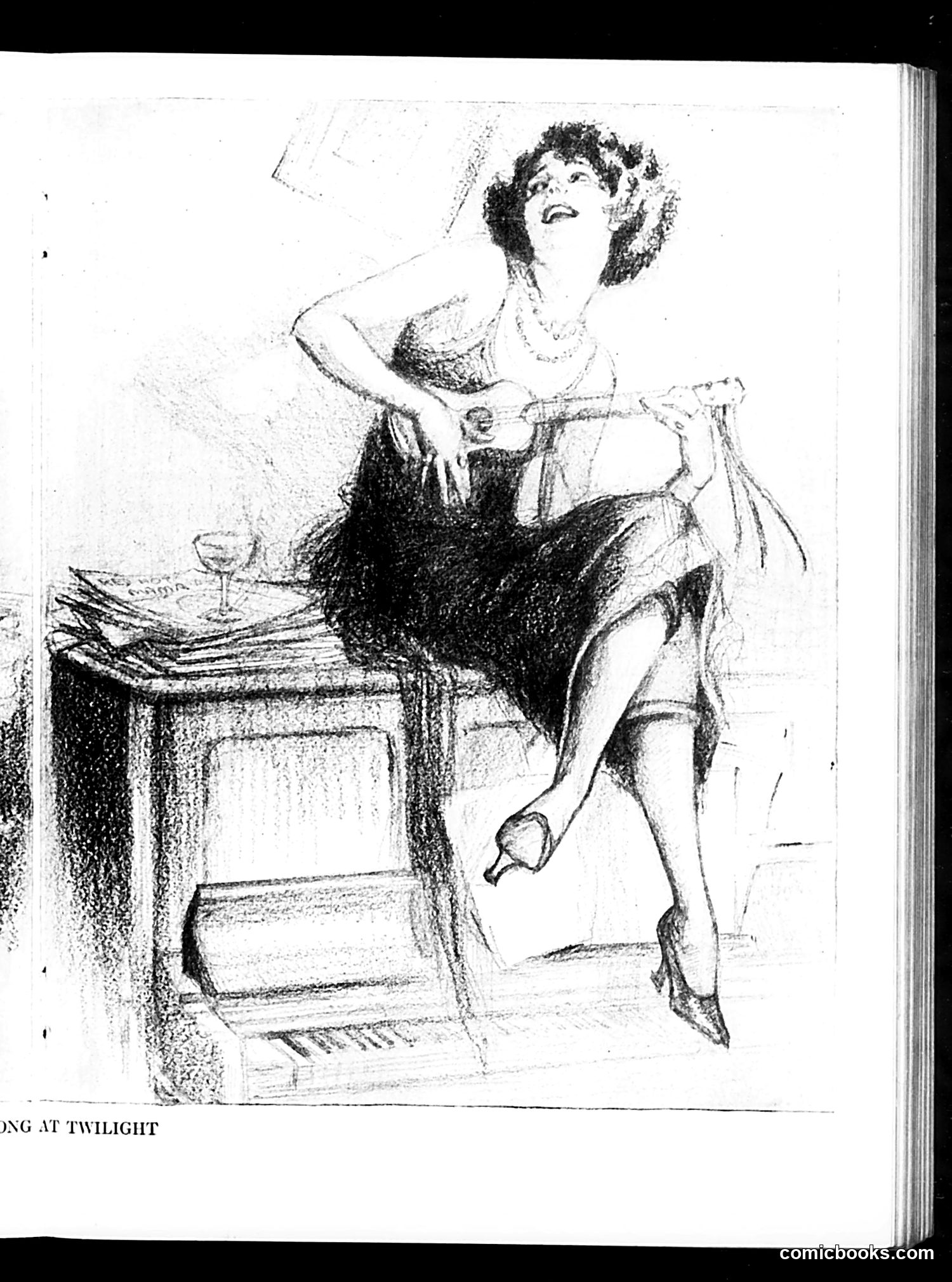
This appears to be an illustration from *Judge* magazine showing a woman seated at a piano in an interior setting, looking upward while playing or singing. The partial caption reads "SONG AT TWILIGHT." Without the full text, the specific satirical point is unclear. However, based on the romantic, sentimental imagery—a woman in elegant dress performing music at dusk—this likely satirizes either: genteel Victorian/Edwardian domestic culture; sentimental artistic pretension; or possibly critiques women's limited social roles confined to parlor entertainment. The sketch style and composition suggest commentary on upper-class leisure activities and artistic affectation, though the exact target of the satire cannot be determined from the visible image and incomplete caption alone.
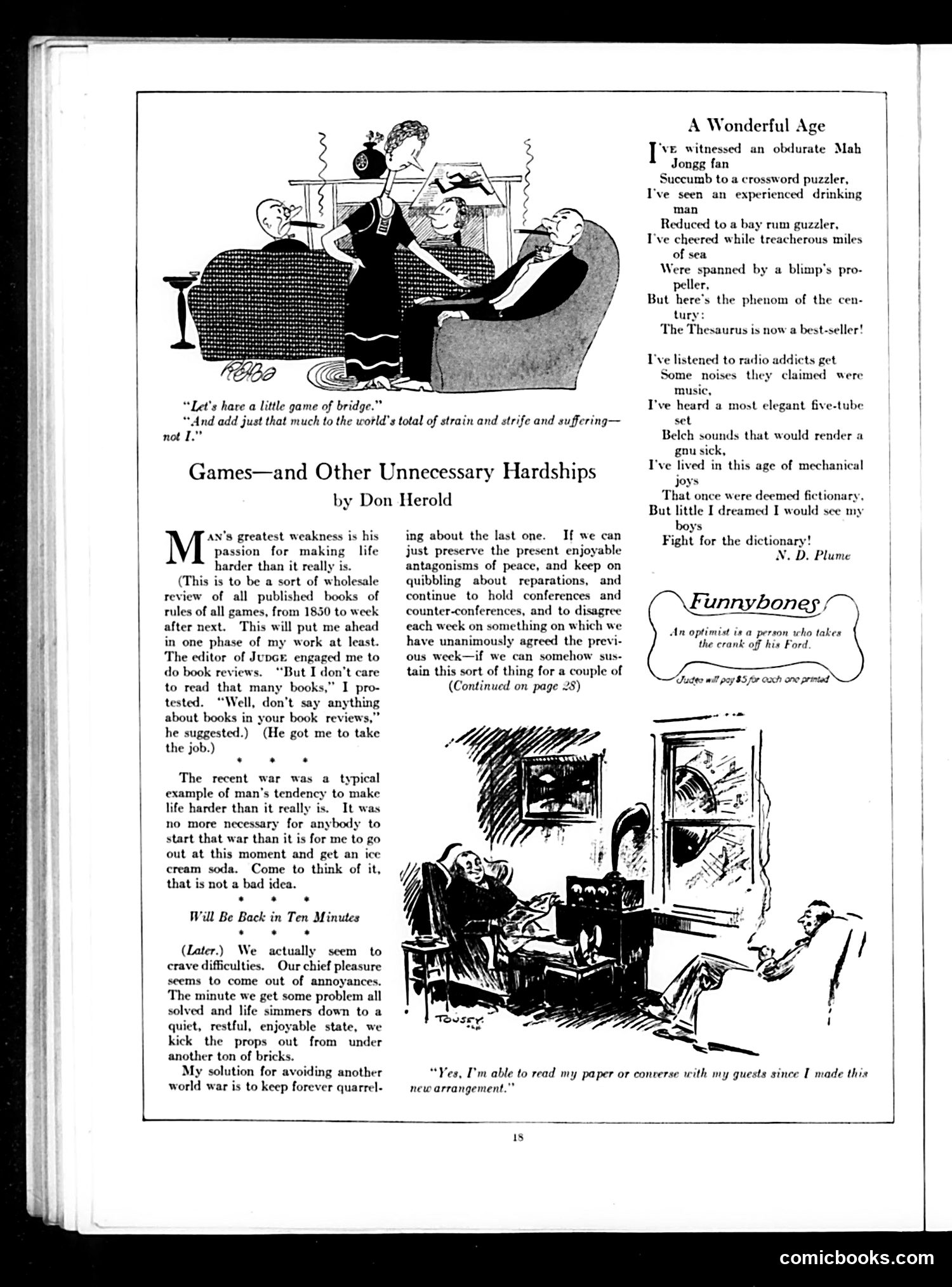
This page satirizes modern life's unnecessary complications through Don Herold's essay and accompanying cartoons. **Main Cartoon (top):** Shows a woman playing bridge with two men on a sofa, with the caption criticizing bridge as adding "strain and strife and suffering" to the world—mocking society's embrace of leisure activities that create stress rather than relaxation. **"A Wonderful Age" poem (right):** Lists absurd modern phenomena: Mah-jongg crazes, crossword puzzles replacing drinking, a *Thesaurus* becoming a bestseller, radio noise mistaken for music, and boys fighting "for the dictionary"—satirizing how trivial fads and consumer goods have become cultural obsessions. **Bottom Cartoon:** Shows a man reading undisturbed at home while chaos erupts outside his window—captioned about finally being able to read and converse since making an arrangement, satirizing how people must engineer elaborate solutions just to achieve basic peace. **Overall theme:** The page mocks how modern Americans complicate their own lives through games, gadgets, and trivial pursuits, then scramble for workarounds. Herold argues humanity naturally resists simplicity, preferring invented difficulties to genuine relaxation.
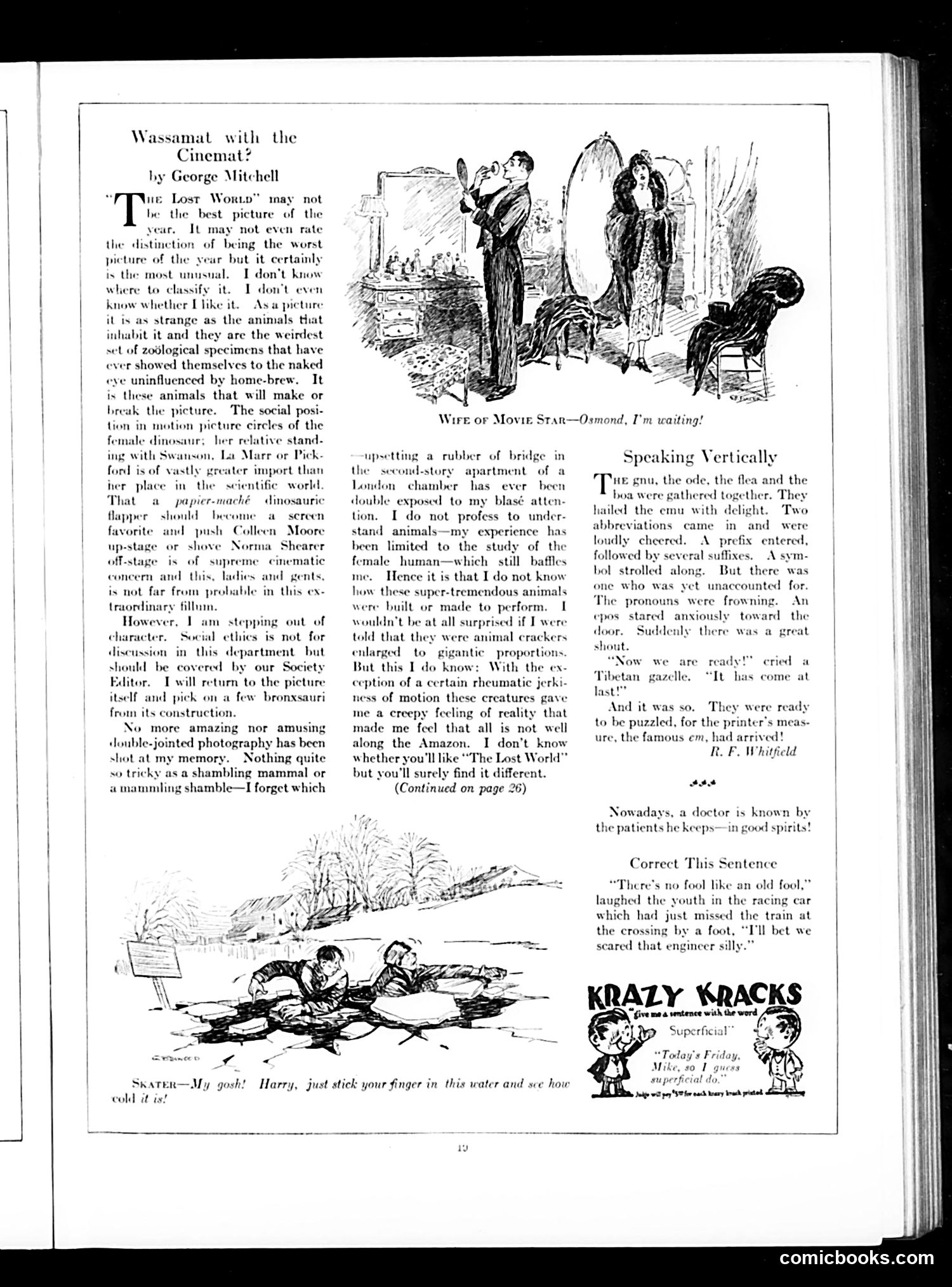
This is a film review by George Mitchell of "The Lost World," a 1925 dinosaur movie. Mitchell's satire mocks the film's unusual appeal: while the picture itself may be unremarkable, its dinosaur characters are so strange and captivating that they'll determine its success or failure in Hollywood circles—potentially outranking established actresses like Colleen Moore and Norma Shearer. Mitchell sarcastically praises the film's technical achievement (the double-exposed photography creating realistic dinosaurs) while admitting he doesn't understand how the creatures were constructed or performed. The joke centers on how cinema's novelty—spectacular special effects—can override traditional quality, making dinosaurs into unexpected movie stars. The page also contains unrelated humor: a skating scene joke and wordplay about grammatical terms ("The emu...the flea...the boa...prefix...suffix") assembled to celebrate the arrival of an "em" (typographic unit).
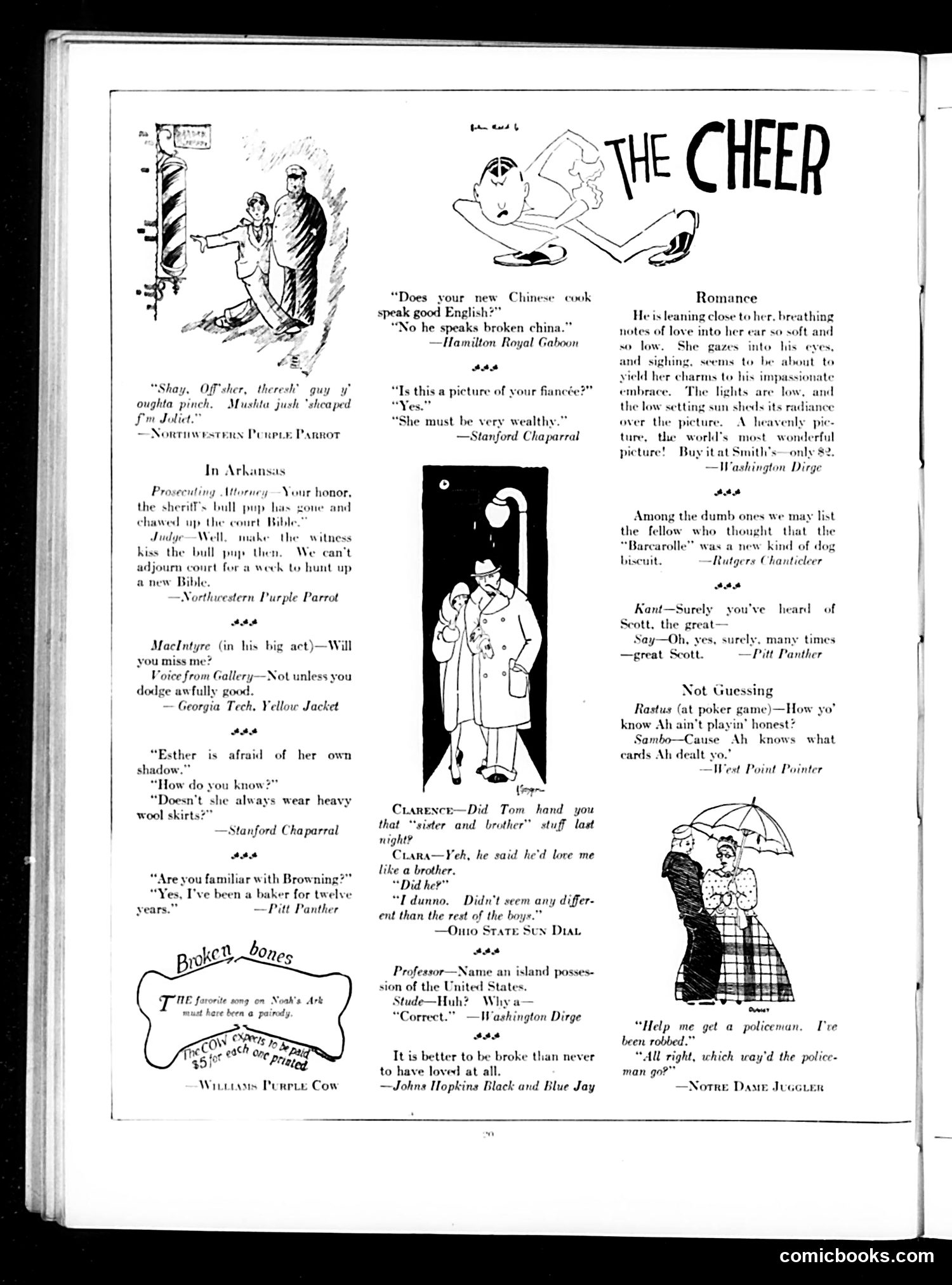
This page collects brief jokes and witticisms from college humor magazines (identified by their mastheads: Northwestern Purple Parrot, Stanford Chaparral, Pitt Panther, etc.). The content reflects early 20th-century college and social comedy. The jokes target common subjects: ethnic stereotypes (a Chinese cook speaking "broken china"), gender roles (a woman wearing heavy wool skirts to hide her figure), romantic sentimentality (a parody of overwrought love scenes), and casual absurdism (thinking "Barcarolle" is a dog biscuit). One section satirizes academic pretension—a professor accepts "an island" as a correct answer about U.S. possessions, apparently valuing wordplay over geography. The humor is primarily observational and pun-based rather than overtly political. The advertisements and illustrations (romantic couple, woman with umbrella, barber-shop scene) are era-typical. This represents mainstream college-level satire of the period, emphasizing clever wordplay over substantive commentary.
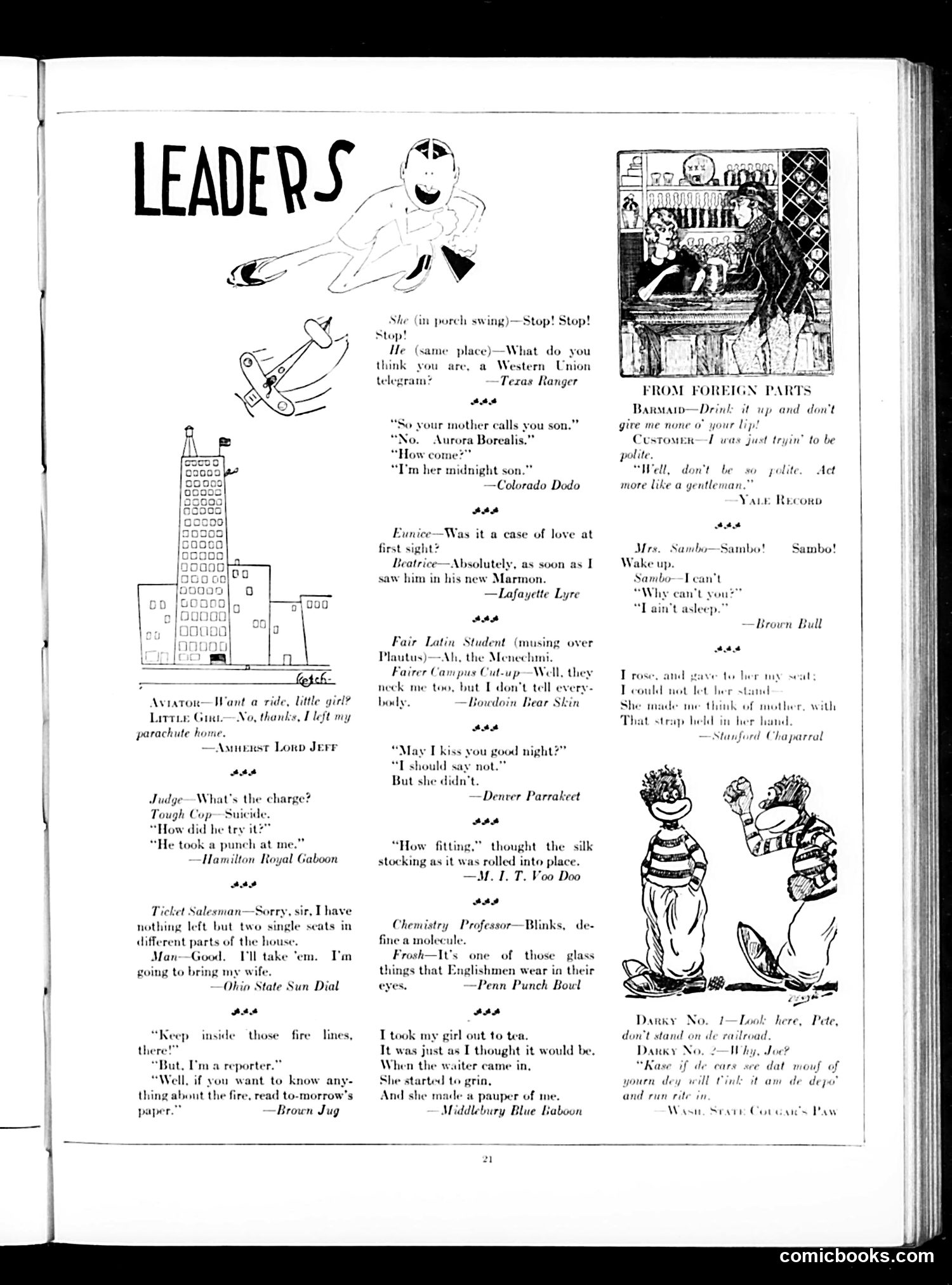
This page from Judge magazine collects brief jokes and one-liners, typical of the publication's humor format. Most content reflects early 20th-century social attitudes: **Notable elements:** The aviation joke plays on early aircraft dangers—a child casually refuses a ride because she left her parachute home, suggesting both the novelty and perceived riskiness of flying. Several jokes reference automobiles (the "Marmon" reference), indicating cars as status symbols and dating venues. The "Darky" jokes at bottom employ racist dialect humor and caricatures standard to the era's mainstream publications. These mock Black speech patterns and appearance. Other jokes target college students, romantic courtship conventions, and professional types (professors, reporters, cops). The "Western Union telegram" joke references rapid communication technology. The overall tone is lighthearted, domestic, and oriented toward college-age and young adult audiences. The humor largely depends on wordplay, puns, and social observation rather than visual gags, though illustrations accompany the text.
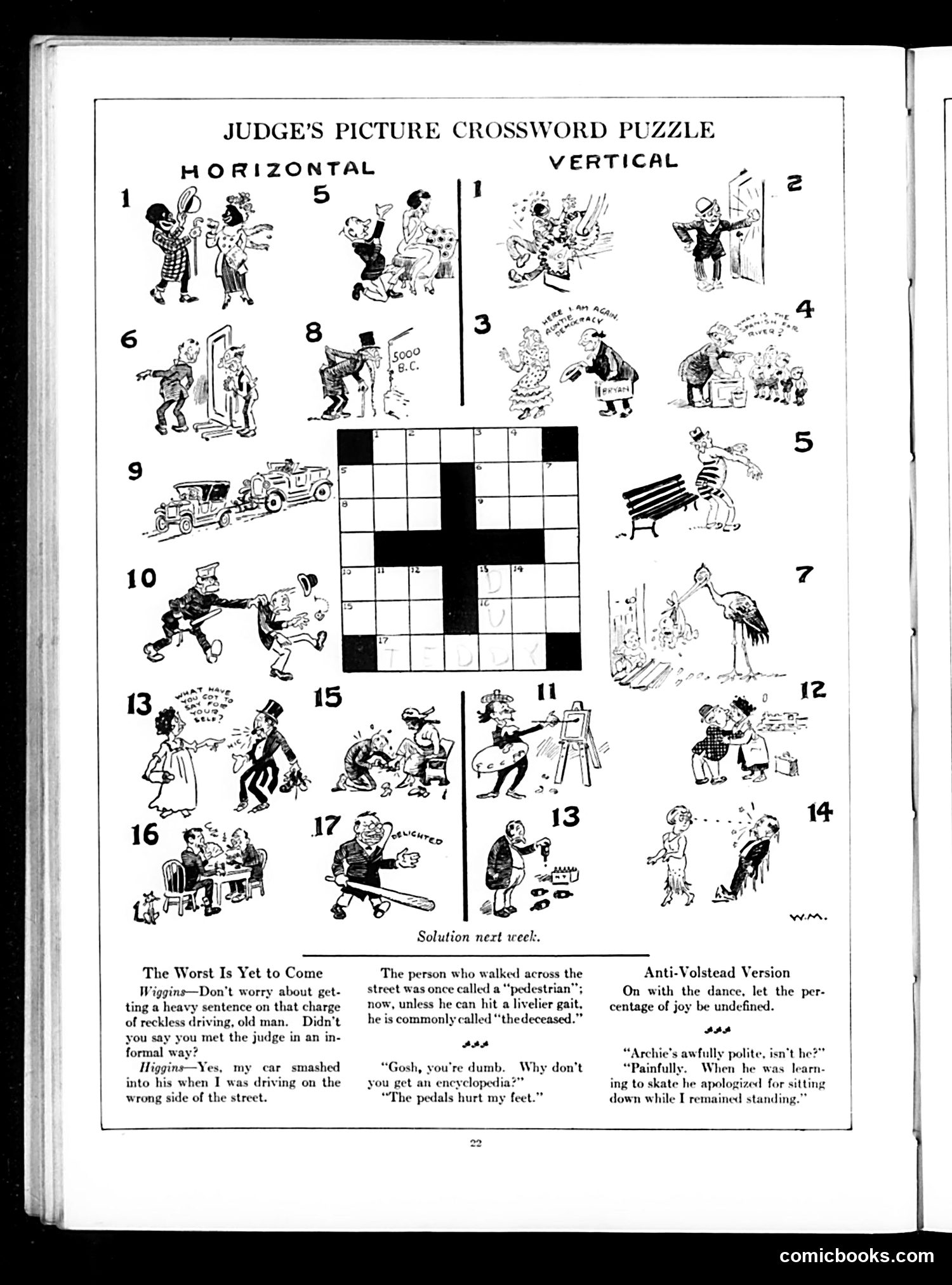
This is a picture crossword puzzle from *Judge*, a satirical magazine. The horizontal and vertical clues are represented by numbered cartoon vignettes rather than text definitions. The accompanying jokes reference early 20th-century social concerns: 1. **Reckless driving**: A dialog about meeting a judge after a car accident—satirizing dangerous automobile culture and judicial consequences. 2. **Pedestrian safety**: A dark joke about pedestrians being called "deceased" instead, implying high traffic fatality rates in urban areas. 3. **Prohibition (Volstead Act)**: A reference to dancing "on with the dance" despite alcohol prohibition, suggesting continued revelry despite the law. 4. **Skating etiquette**: A joke about overly polite behavior—Archie apologizing while sitting while another remained standing during skating lessons. These vignettes capture contemporary anxieties about automobiles, Prohibition enforcement, and social propriety in 1920s America. The puzzle format itself was typical entertainment for *Judge* readers.
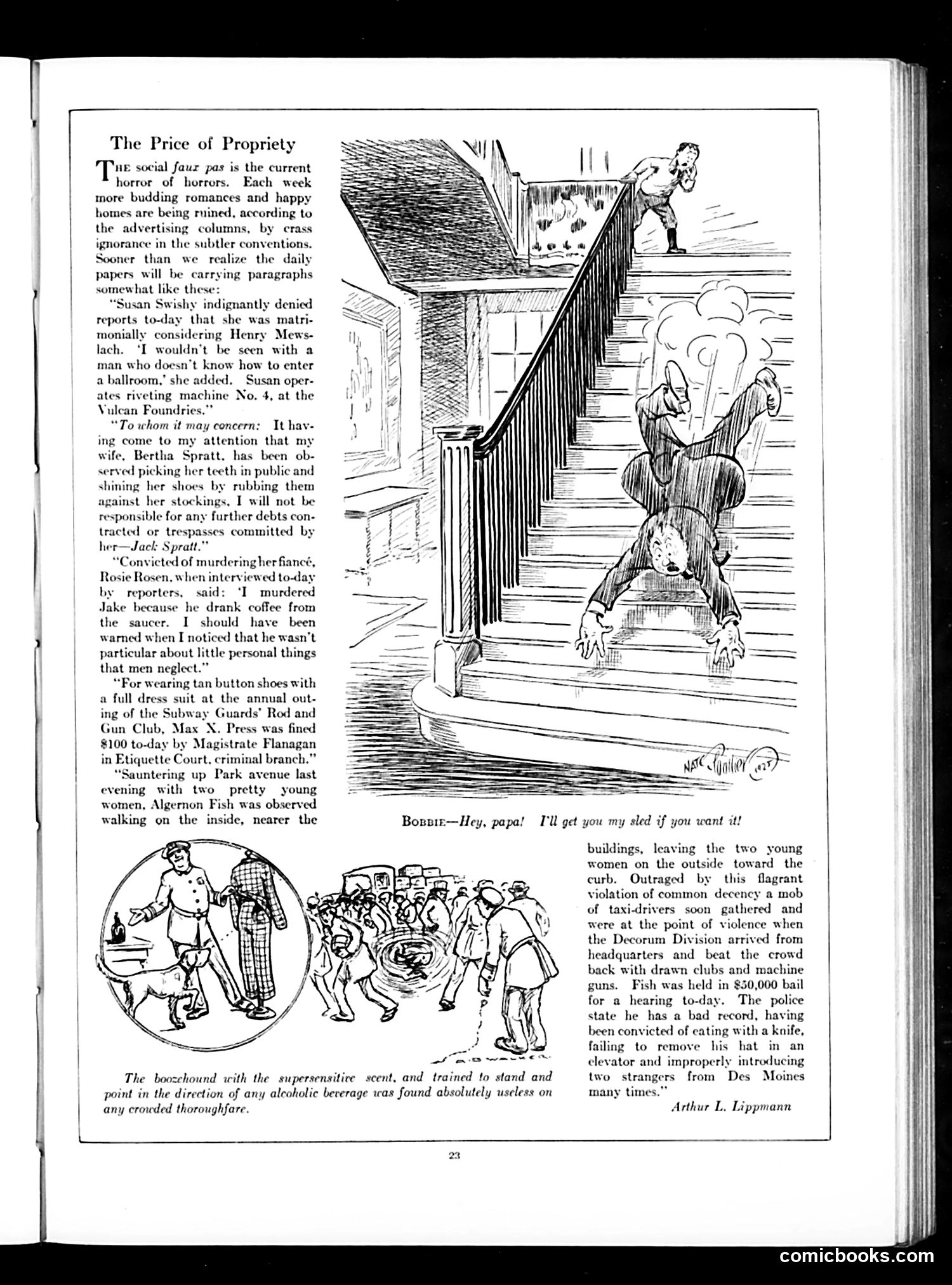
This article mocks the era's obsession with rigid social etiquette rules. The main text presents fictional newspaper snippets imagining a dystopian future where minor breaches of manners—picking teeth publicly, drinking coffee from a saucer, wearing wrong shoes—become serious social crimes warranting arrest, fines, or even murder justifications. The satirical point: advertising and advice columns of the time relentlessly promoted "proper" behavior, suggesting that violations could destroy romantic prospects and social standing. Judge suggests this is absurd hysteria. The cartoons reinforce this: one shows a woman descending stairs improperly (possibly the "tan button shoes" violation); another depicts a trained dog that cannot detect alcohol in crowds—commentary on how useless rigid rules are in practical life. The author (Arthur L. Lippmann) critiques how commercialized etiquette anxiety manipulates consumers into buying conformity.
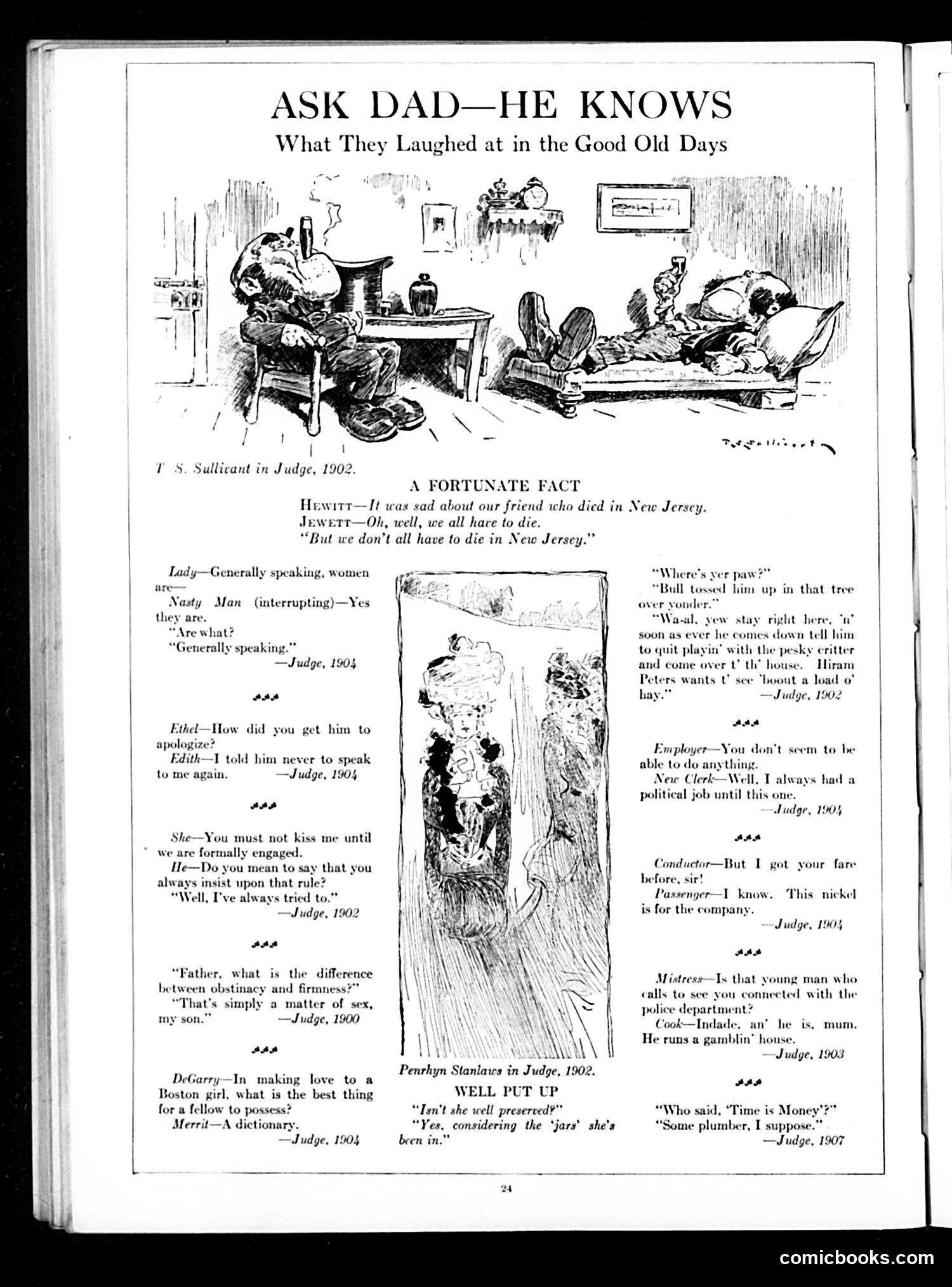
This page collects short humorous exchanges from *Judge* magazine (1900-1907), presented as wisdom from fathers and older men about social situations. The jokes reflect early 20th-century attitudes: **Social commentary includes:** - Gender stereotypes ("women are nasty") - Regional prejudice (New Jersey as undesirable) - Class anxieties (a "political job" versus honest work; distinguishing "firmness" from stubbornness) - Courtship etiquette ("don't kiss until formally engaged") - Urban life (streetcar conductors, plumbers, gamblers) **The satire targets** conventional morality, pretension, and hypocrisy—a man tips a conductor a nickel "for the company" (not the worker); a mistress's cook admits her young visitor "runs a gamblin' house." The humor relies on recognizable social types and period-specific class markers that modern readers must decode historically.
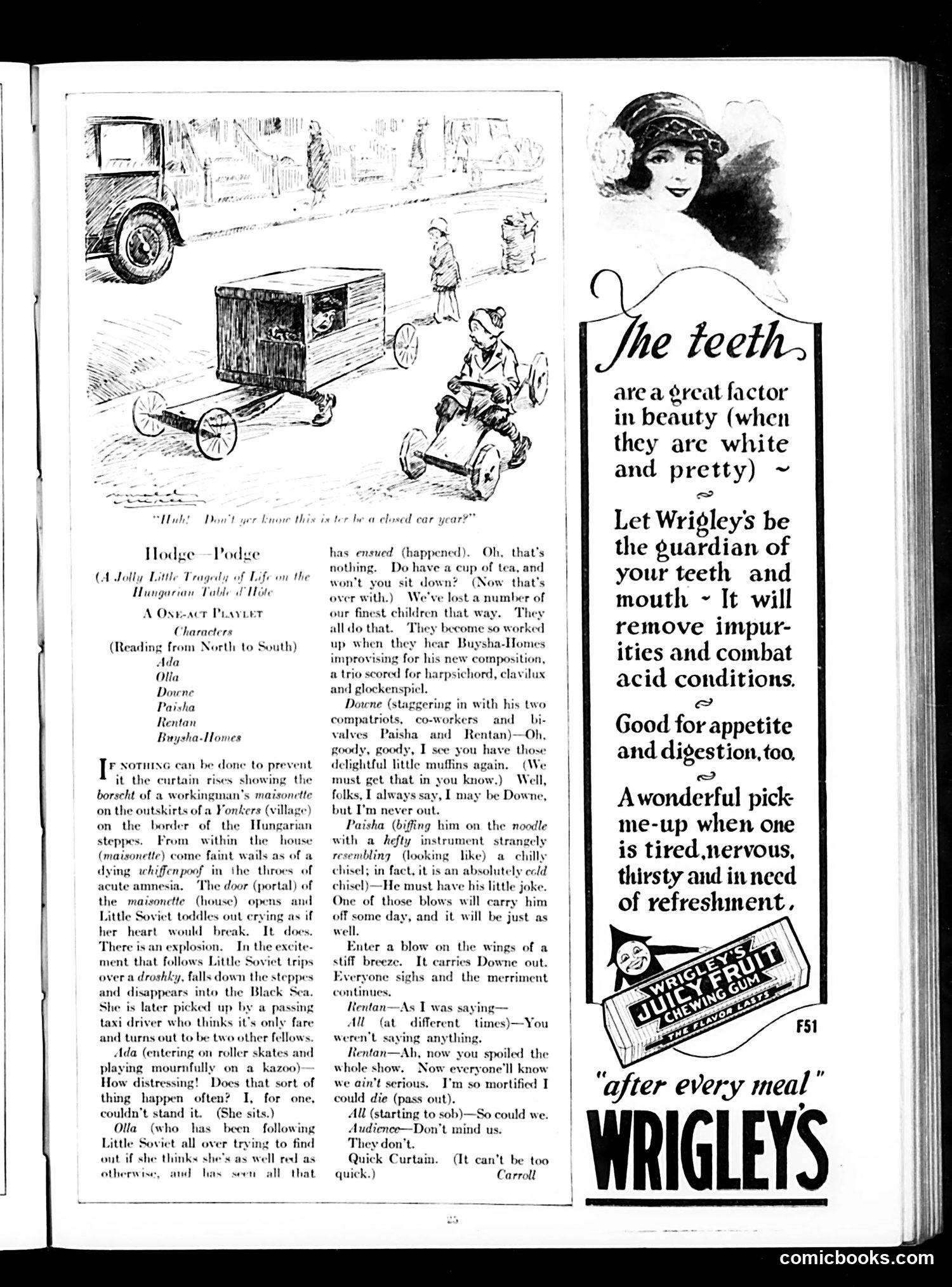
This page contains a humorous one-act play satirizing immigrant life on the Hungarian border of Yonkers. The sketch depicts working-class Eastern European characters in absurdist situations—a child dies from hearing dissonant music, people casually accept tragedy over tea, and violence is treated as routine comedy. The satire likely targets both immigrant stereotypes (poverty, overcrowding, emotional volatility) and avant-garde artistic pretension (the composer Buysha-Homes creating experimental music that literally kills children). The characters' names and exaggerated dialect suggest mockery of non-English speakers. The page also includes a Wrigley's gum advertisement claiming teeth are "a great factor in beauty," reflecting period beauty standards emphasizing white teeth—marketing that assumes a certain audience's aspirations.
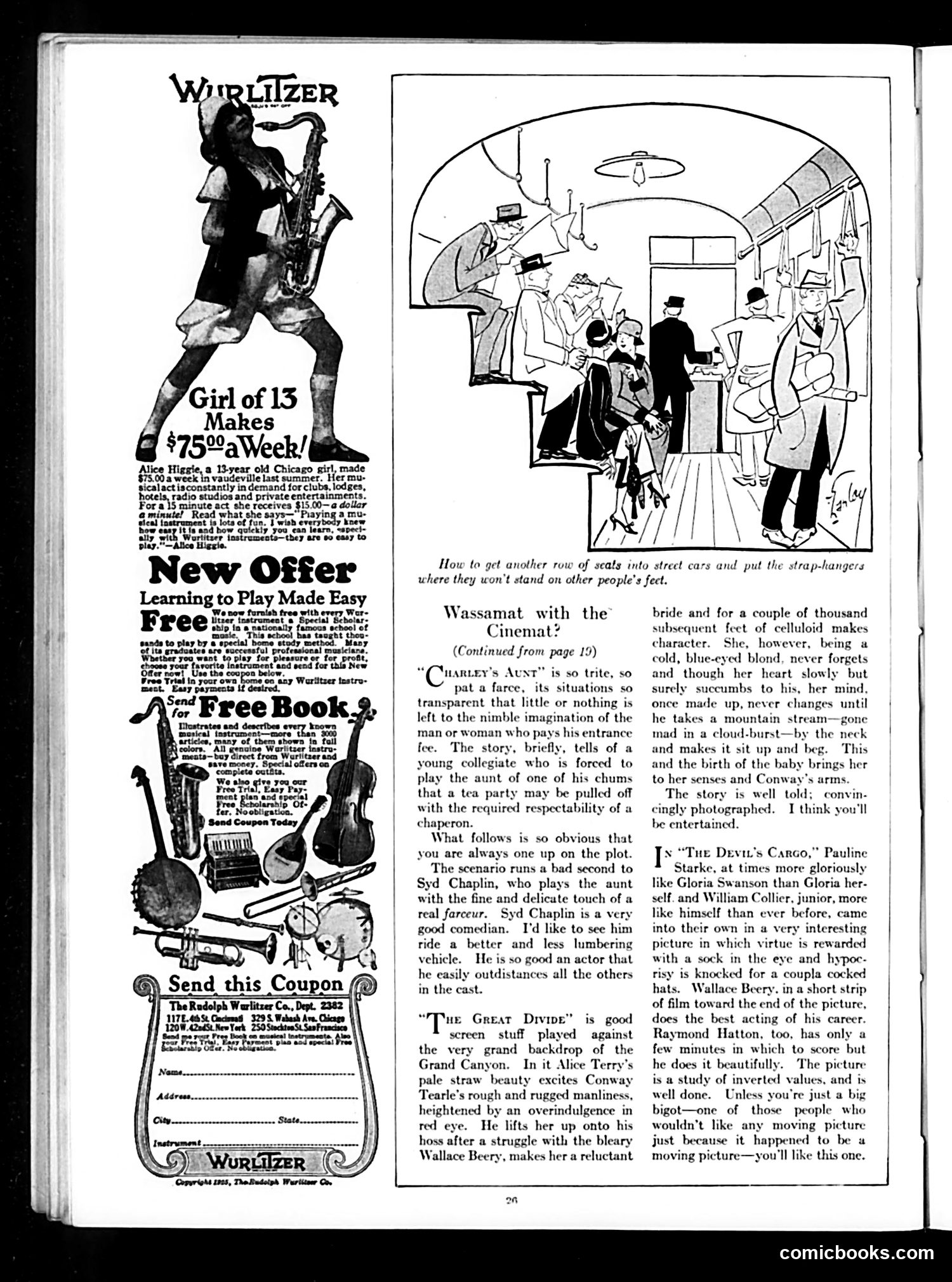
This page contains **mostly advertising and film criticism**, not political satire. The left side features a **Wurlitzer musical instrument advertisement** promoting a "girl of 13 makes $75 a week" by learning saxophone—a common early 20th-century marketing pitch emphasizing economic opportunity for young people. The right side is a **film review column** critiquing recent movies: "Charley's Aunt" (starring Syd Chaplin), "The Great Divide" (with Alice Terry and Conway Tearle), "The Devil's Cargo," and others. The reviewer discusses acting quality and plot, praising Chaplin's comedic talent while finding some scenarios predictable. The cartoon above the reviews depicts a **practical joke about crowded streetcars**—how to squeeze additional passengers by creative seating arrangements, a relatable urban humor topic of the era. There is **no significant political content** on this page. It's primarily consumer advertising and entertainment criticism typical of Judge magazine's lighter fare.
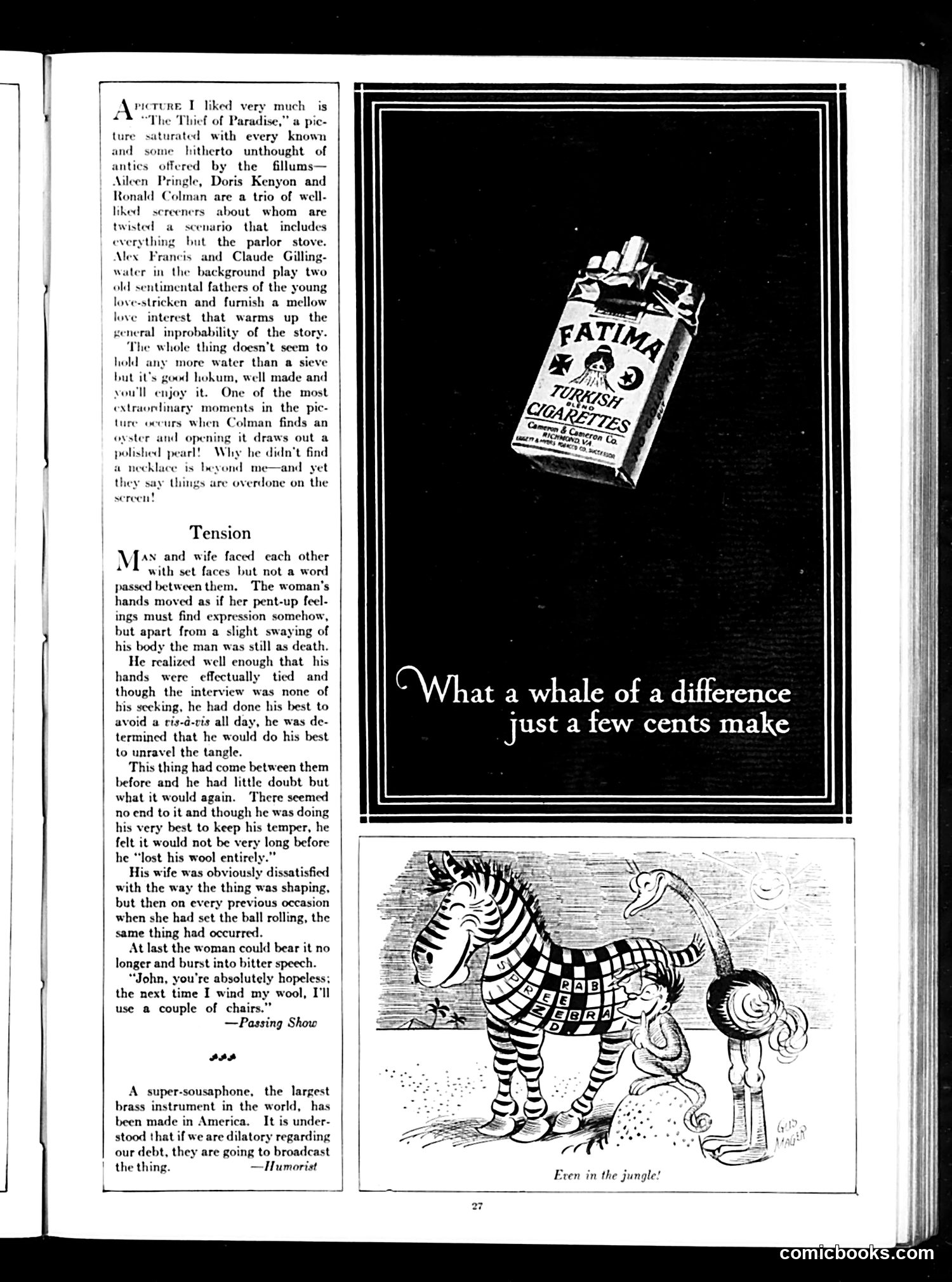
This page combines film criticism with advertisements and humor. **Top left:** A review of "The Thief of Paradise," praising the silent film despite its implausible plot. The critic sarcastically notes that star Ronald Colman finds a polished pearl inside an oyster—an absurdly convenient plot device—yet audiences accept it while claiming cinema avoids exaggeration. **Center right:** An advertisement for Fatima Turkish Cigarettes, using the visual hook "What a whale of a difference just a few cents make" to suggest premium quality at minimal cost. **Bottom left:** A brief humorous piece about a marital argument where a wife threatens to wind her wool using chairs rather than her husband's hands—a domestic joke about spousal usefulness. **Bottom right:** A cartoon captioned "Even in the jungle!" showing a woman and zebra, accompanying a joke about a new supersousaphone (large brass instrument) that America might use to broadcast debt obligations—absurdist humor about national finances.
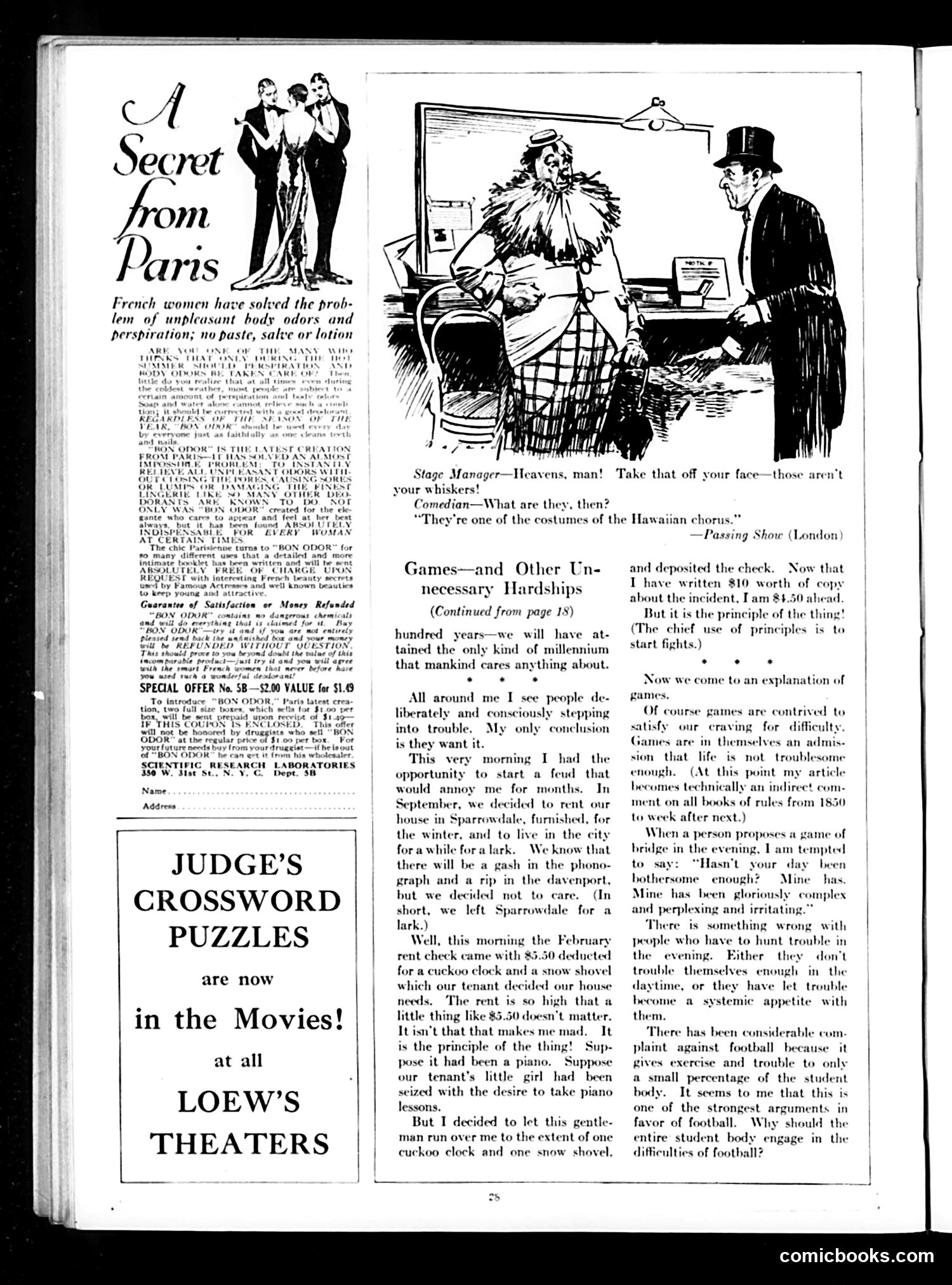
This page contains **a brief theatrical joke** and **advertisements**, not political cartoons. The cartoon shows a stage manager confronting a comedian about his facial hair, which the comedian claims are "costumes of the Hawaiian chorus." The humor is simple: the manager mistakes the comedian's whiskers for actual props, and the comedian jokes that they're part of a costume ensemble. This reflects early 20th-century vaudeville/theater humor about physical comedy and prop confusion. The main content is **"Games—and Other Unnecessary Hardships,"** a humorous essay arguing that people deliberately create trouble in their lives through games like bridge and football. The writer uses examples (a rented house tenant's deductions, game-playing) to satirize how humans seek out difficulty unnecessarily. The left side advertises **"Bon Odor,"** a French deodorant product, and promotes **Judge's Crossword Puzzles** now appearing in Loew's Theaters. This is primarily **entertainment/advertisement content** rather than political satire.
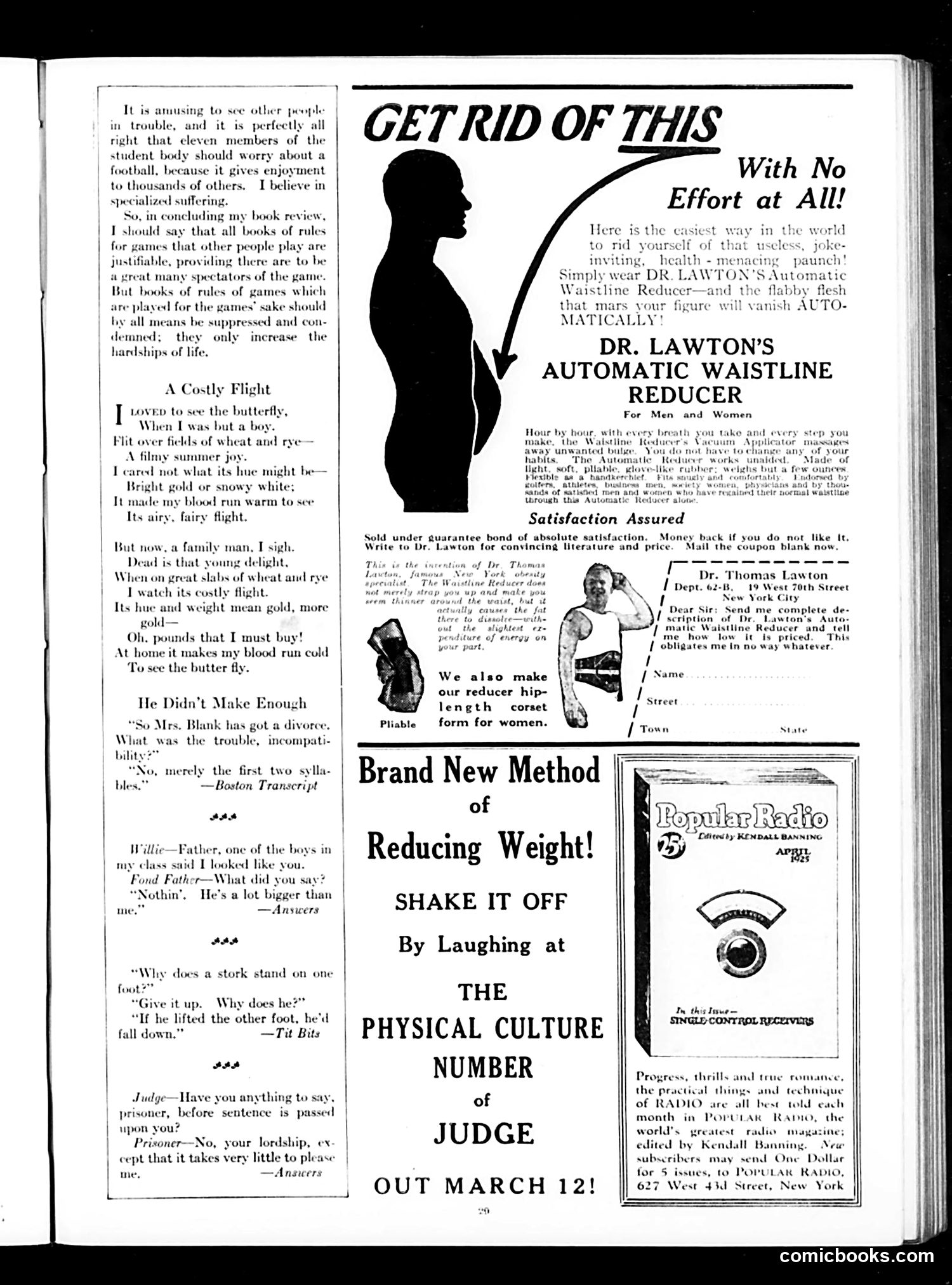
This page is primarily **advertising-driven**, with satirical humor pieces as filler content. The main advertisement promotes **Dr. Lawton's Automatic Waistline Reducer**—a weight-loss device marketed to men and women with claims of effortless figure improvement. The silhouette illustration shows the promised result. This reflects 1920s-era snake oil marketing: dubious "automatic" contraptions promising body transformation without genuine effort. The smaller humorous pieces are light satirical vignettes typical of Judge's style: a poem about butterflies (now costly as farm pests), jokes about divorce and family life, and wordplay (the stork joke). These satirize everyday middle-class concerns and social awkwardness rather than politics. The **Physical Culture Number** ad (bottom) promotes an upcoming March 12 issue focused on fitness culture. **Context for modern readers**: This reflects 1920s consumer culture's embrace of technological "shortcuts" for personal improvement, alongside traditional genteel humor about domestic life and social propriety.
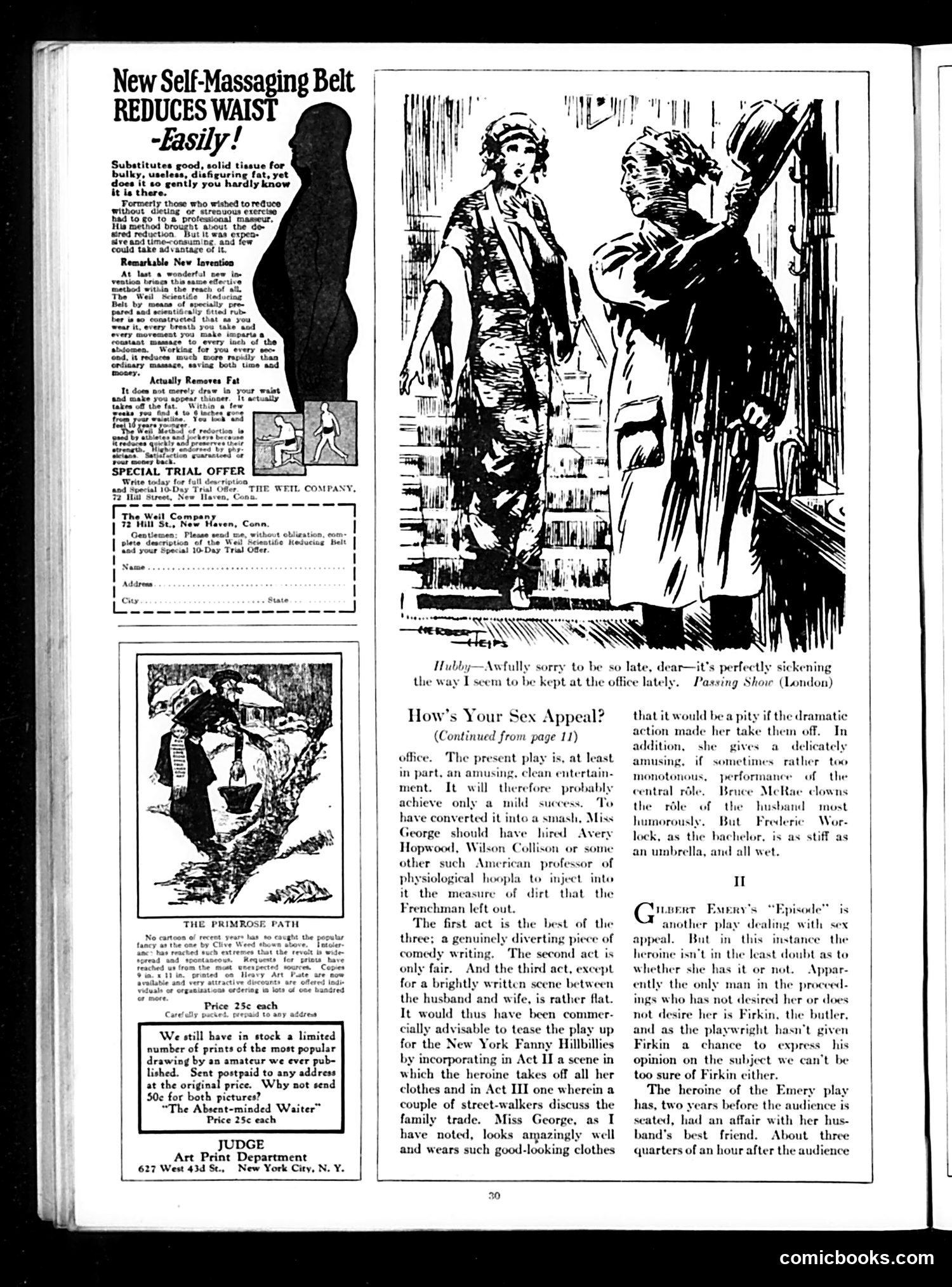
This page mixes advertising with theater criticism. The **left side** promotes a "Self-Massaging Belt" for weight reduction—a dubious health device typical of early 20th-century quack remedies claiming to reduce waist size without diet or exercise. The smaller images show silhouettes demonstrating the belt's supposed effects. The **right side** contains an illustration and theater review titled "How's Your Sex Appeal?" The cartoon shows a domestic scene where a husband apologizes to his wife for working late, with the caption suggesting marital tension. The accompanying text reviews two plays dealing with sexual attractiveness and infidelity. The critic dismisses one production as insufficiently risqué for commercial success, joking that it needs more "dirt" to appeal to audiences. The second play is criticized for wooden acting, though the female lead is praised for her appearance and comedic timing. Overall, the page reflects period preoccupations with appearance, sexuality, and entertainment while advertising dubious remedies.
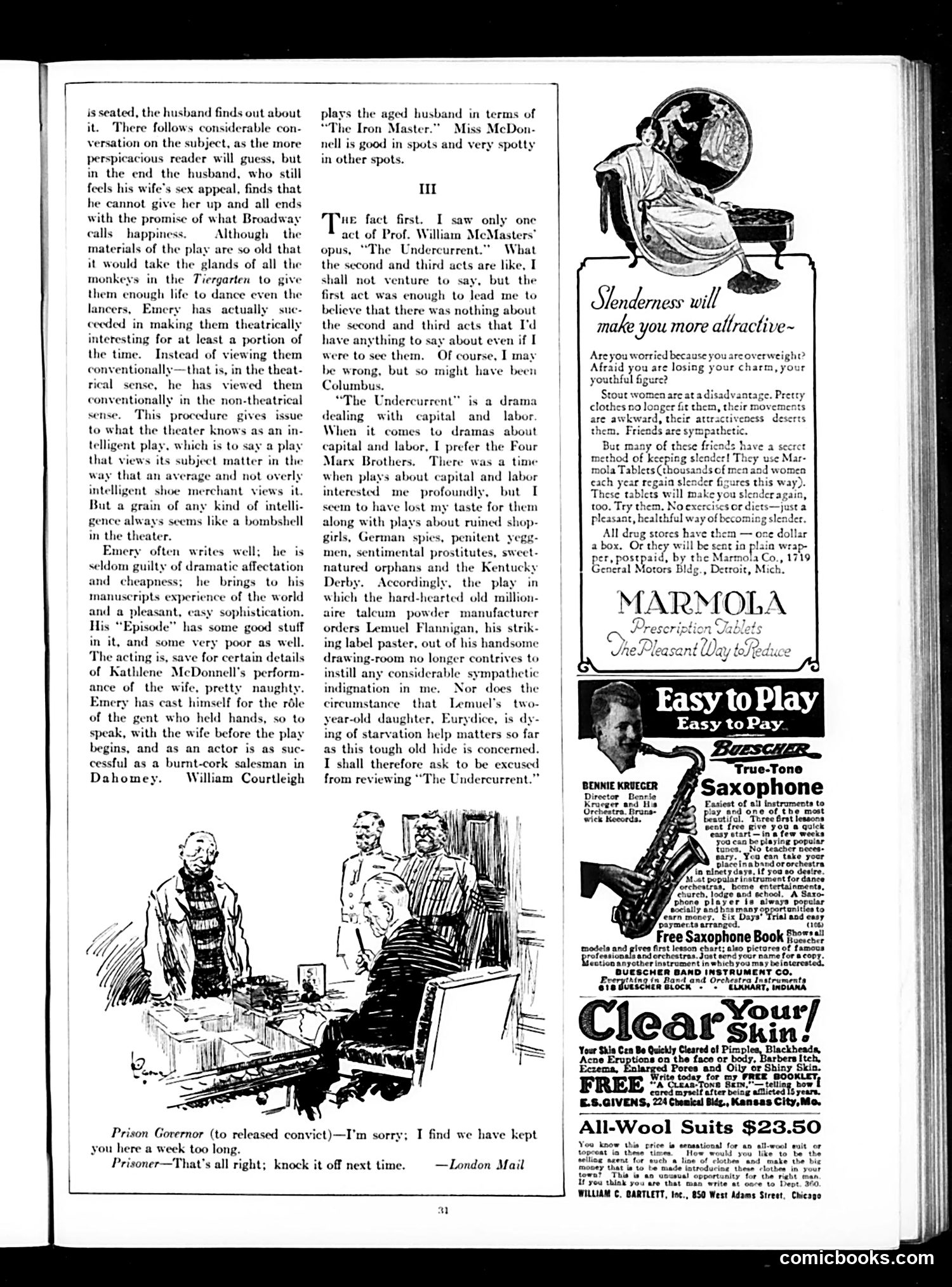
This page contains **theater reviews** and **advertisements** rather than political cartoons. The main cartoon is a **prison joke** (bottom left): A governor apologizes to a released convict for keeping him a week too long; the prisoner replies "knock it off next time"—darkly humorous because the convict treats his overlong imprisonment as a minor clerical error to be corrected on his next arrest, assuming he'll return to prison. The text reviews two theatrical productions with sophisticated, sarcastic criticism. The reviewer dismisses "The Undercurrent" (about capital/labor conflicts) as tediously outdated propaganda, sarcastically suggesting even Columbus might be wrong before endorsing such predictable social drama. The advertisements include **Marmola diet tablets** and a **saxophone** offer, typical 1920s consumer goods aimed at readers concerned with modern appearance and leisure pursuits—reflecting post-WWI consumer culture. The page represents Judge's mix of theatrical criticism and commercial messaging for its educated, middle-class readership.
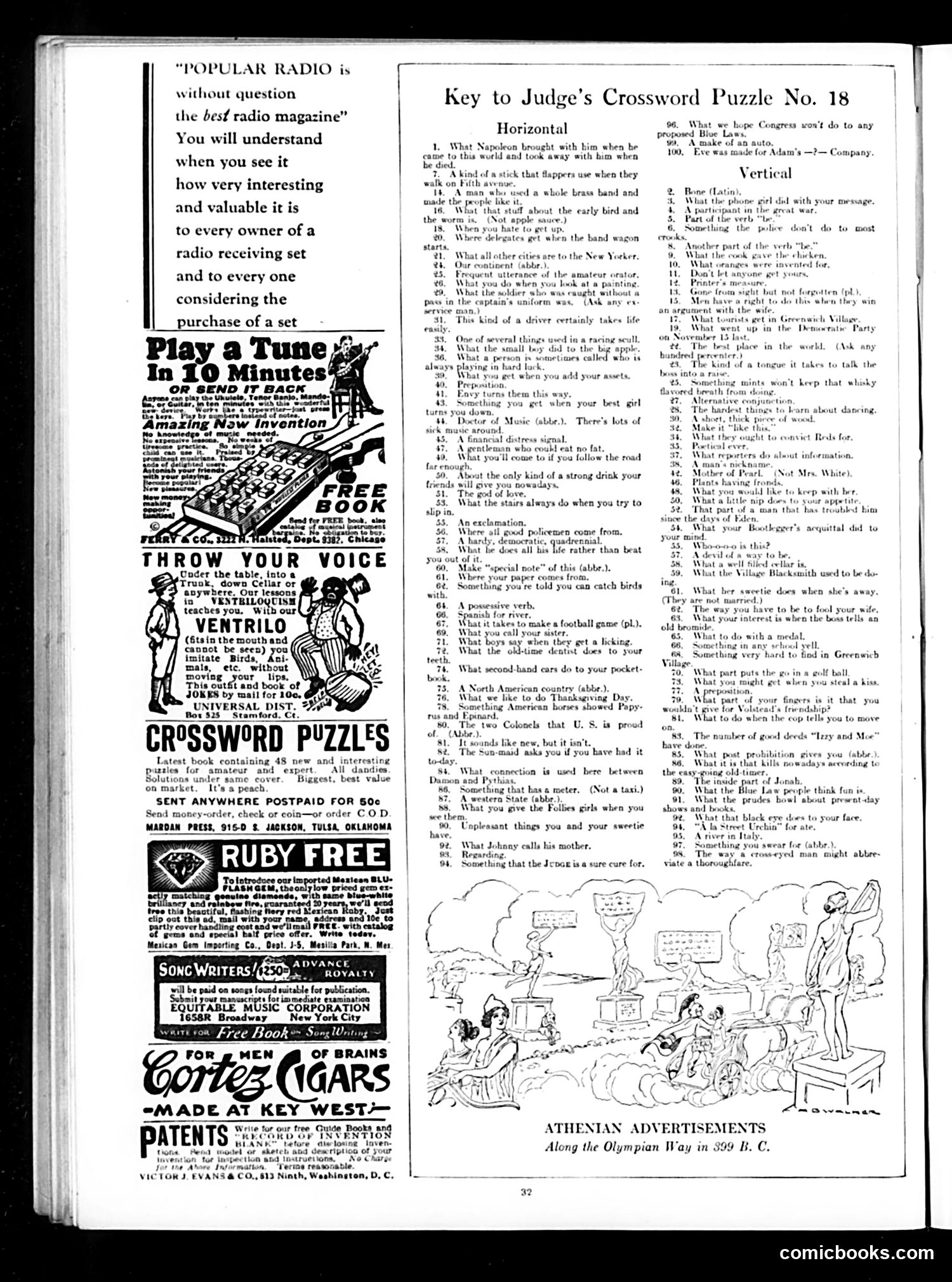
This is primarily an **advertisements and solutions page**, not a satirical cartoon page. The main content consists of: 1. **Crossword puzzle solutions** for "Judge's Crossword Puzzle No. 18" 2. **Period advertisements** including: - Radio instruction ("Play a Tune in 10 Minutes") - Ventriloquism lessons (VENTRILO) - Crossword puzzle books - Patent services - Songwriting royalty opportunities - Cigars ("Cortez Cigars") 3. **A small cartoon** at bottom labeled "Athenian Advertisements Along the Olympian Way in 399 B.C."—a humorous anachronistic sketch imagining modern advertisements in ancient Athens. **Context for modern readers:** The advertisements reflect 1920s consumer culture—mail-order self-improvement courses, emerging radio technology, and entertainment products. The page demonstrates how Judge monetized its publication through classified ads while providing reader services like puzzle solutions.
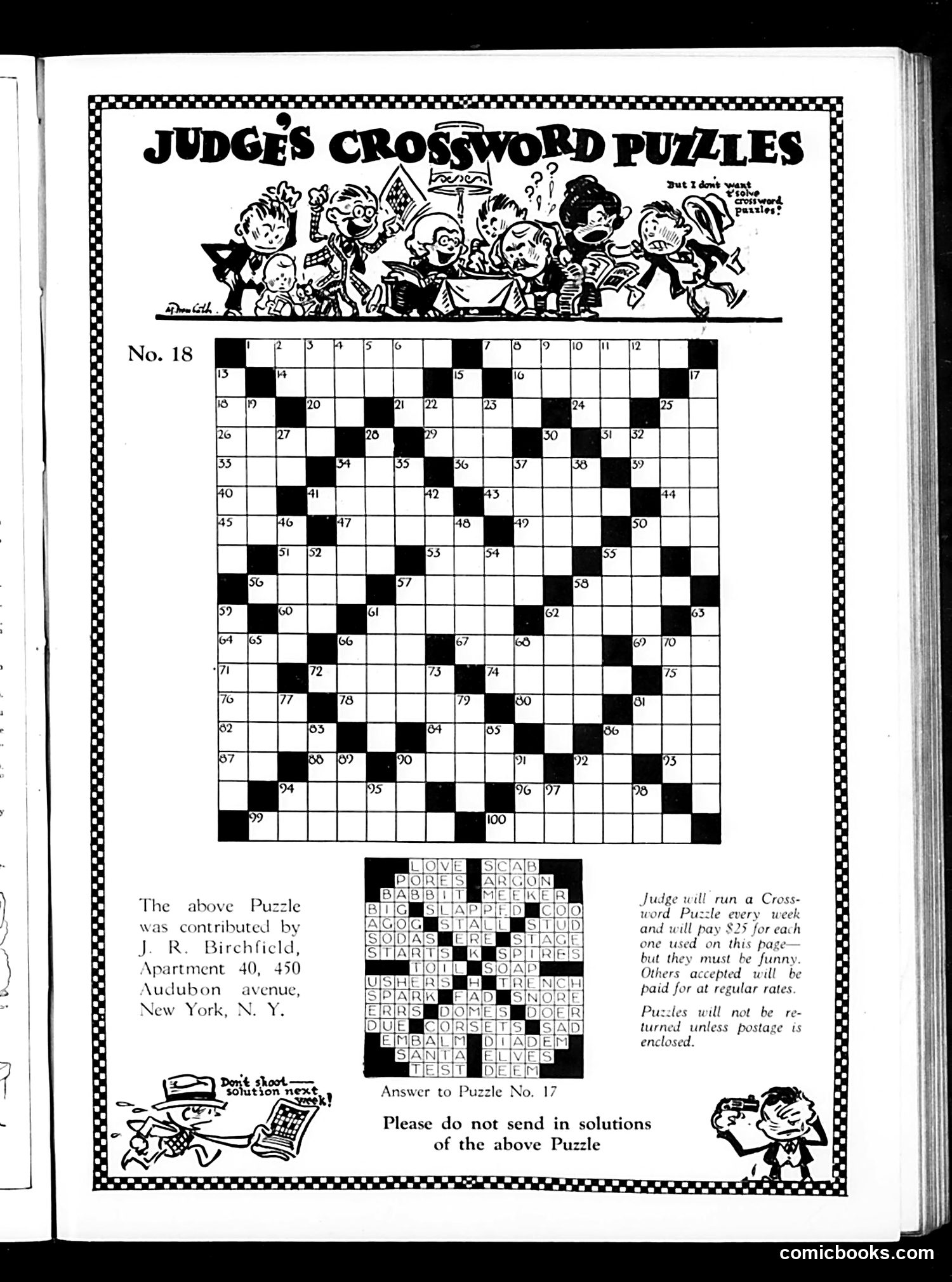
This page features primarily a crossword puzzle (No. 18) with accompanying administrative content. The main visual elements are cartoon children at the top expressing enthusiasm about crossword puzzles, and two small cartoon figures at the bottom. The text announces Judge magazine's new weekly crossword puzzle feature, offering $25 payment for accepted puzzles that are "funny"—indicating these aren't standard puzzles but humorous ones tailored to Judge's satirical content. The contributor's address is listed, and instructions specify that solutions won't be returned without postage and should not be submitted for the current puzzle. The page also includes the answer key to the previous week's puzzle (No. 17), visible as a completed grid. This represents Judge's venture into the crossword craze that swept America in the 1920s-1930s, adapting the popular format to their comedic editorial mission.
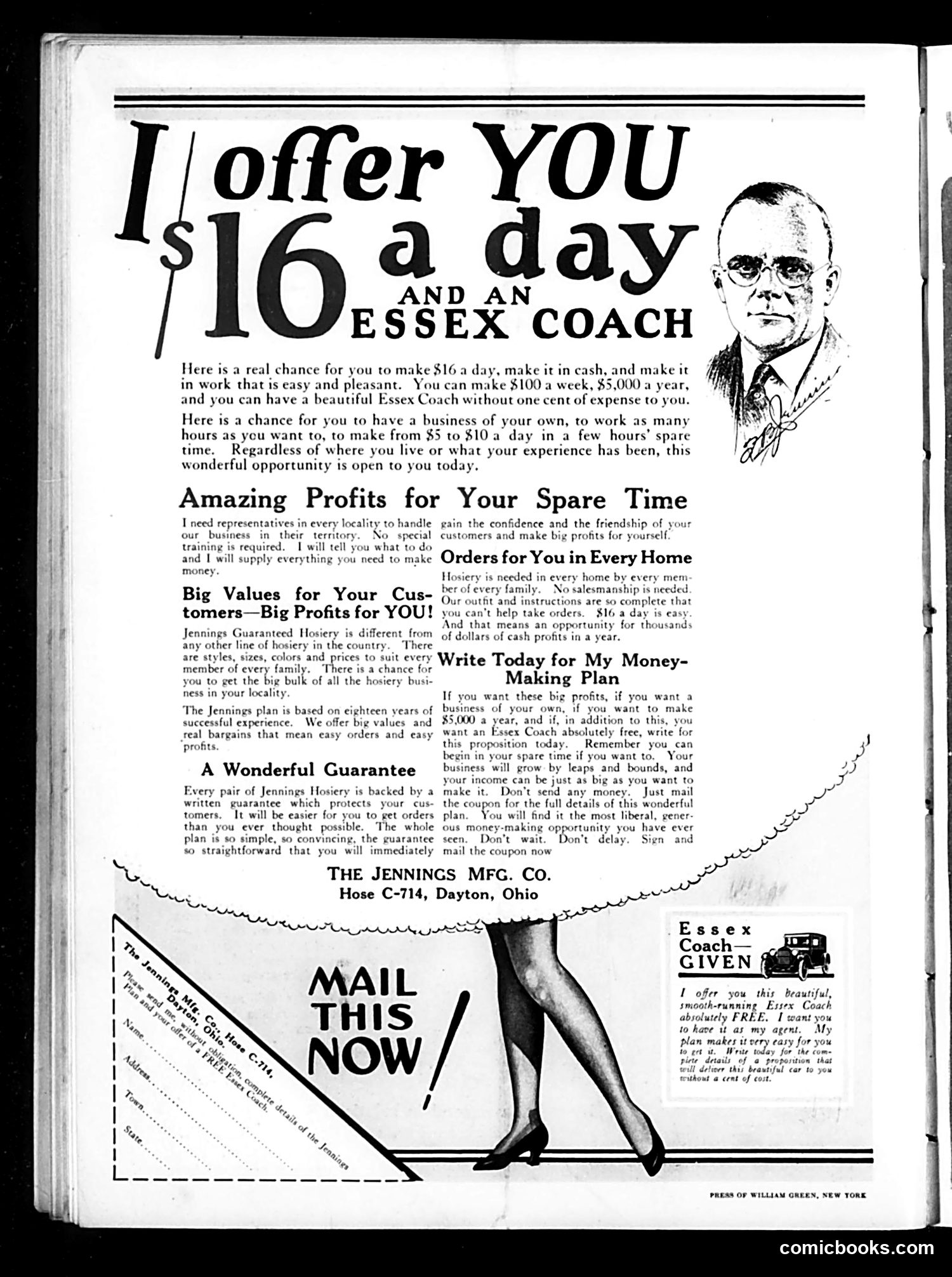
This is primarily a **business opportunity advertisement**, not political satire. The Jennings Manufacturing Company promotes a multi-level marketing scheme selling hosiery (stockings). The pitch promises $16 daily income and a free Essex Coach automobile as incentives to recruit sales representatives. The man pictured appears to be a company representative or testimonial figure endorsing the scheme. The content exploits common Depression-era economic desperation—promises of easy money, spare-time work, and consumer goods without upfront cost. The imagery of women's legs (advertising hosiery) and the emphasis on recruiting ("I need representatives in every locality") reflects both period marketing tactics and the scheme's structure. **For modern readers**: This represents early direct-sales/MLM business models that were barely regulated then. The guaranteed profits and free-car offers would raise immediate red flags today as classic predatory marketing targeting financially vulnerable people.