
Judge, 1925-02-28 · page 17 of 36
Judge — February 28, 1925 — page 17: what you’re looking at
What you’re looking at
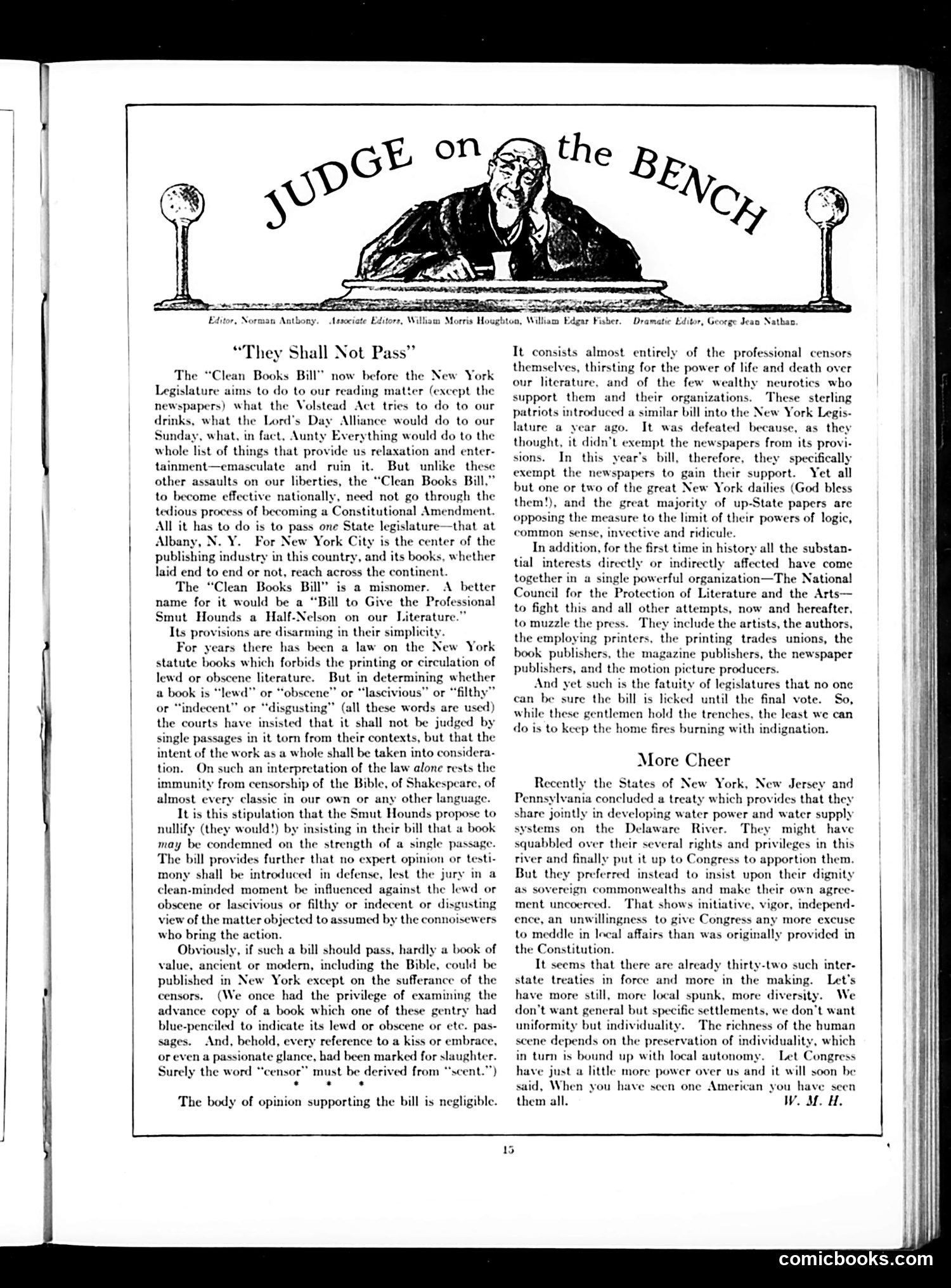
This editorial attacks New York's proposed "Clean Books Bill," a censorship measure. The cartoon's judge figure represents the bill's supporters—professional censors and wealthy moralists seeking power over literature. The satire's key point: the bill would judge books by isolated passages rather than overall intent, threatening classics like Shakespeare and the Bible. The author sarcastically calls it a "Bill to Give the Professional Smut Hounds a Half-Nelson on our Literature." The piece ridicules the censors' hypocrisy—they specifically exempted newspapers (which opposed the bill) while targeting books. Judge magazine positions itself against censorship, comparing the Clean Books Bill to Prohibition and the Lord's Day Alliance as attacks on public freedoms. The cartoon's sneering judge represents the "gentry" who would blue-pencil even innocent references to kisses or embraces. The editorial notes widespread literary and press opposition while dismissing supporter numbers as "negligible."
📄 Transcribed text from this page (OCR, searchable)
Machine-transcribed from the original scan — historical spelling and the odd misread are preserved.
a: Editor, Norman Anthony. Associate B “They Shall Not Pass” The “Clean Books Bill” now before the New York Legislature aims to do to our reading matter (except the newspapers) what the Volstead Act tries to do to our drinks, what the Lord’s Day Alliance would do to our Sunday, what, in fact, Aunty Everything would do to the whole list of things that provide us relaxation and enter- tainment—emasculate and ruin it. But unlike these other assaults on our liberties, the “Clean Books Bill,” to become effective nationally, need not go through the tedious process of becoming a Constitutional Amendment. All it has to do is to pass one State legislature—that at Albany, N. Y. For New York City is the center of the publishing industry in this country, and its books, whether laid end to end or not, reach across the continent. The “Clean Books Bill” is a misnomer. A better name for it would be a “Bill to Give the Professional Smut Hounds a Half-Nelson on our Literature.” Its provisions are disarming in their simplicity. For years there has been a law on the New York statute books which forbids the printing or circulation of lewd or obscene literature. But in determining whether a book is “lewd” or “obscene” or “lascivious” or “filthy” or “indecent” or “disgusting” (all these words are used) the courts have insisted that it shall not be judged by single passages in it torn from their contexts, but that the intent of the work as a whole shall be taken into considera- tion. On such an interpretation of the law alone rests the immunity from censorship of the Bible, of Shakespeare, of almost every classic in our own or any other language. It is this stipulation that the Smut Hounds propose to nullify (they would!) by insisting in their bill that a book may be condemned on the strength of a single passage. The bill provides further that no expert opinion or testi- mony shall be introduced in defense, lest the jury in a clean-minded moment be influenced against the lewd or obscene or lascivious or filthy or indecent or disgusting view of the matter objected to assumed by the connoisewers. who bring the action. Obviously, if such a bill should pass, hardly a book of value, ancient or modern, including the Bible, could be published in New York except on the sufferance of the censors. (We once had the privilege of examining the advance copy of a book which one of these gentry had blue-penciled to indicate its lewd or obscene or etc. pas- sages. And, behold, every reference to a kiss or embrace, or even a passionate glance, had been marked for slaughter. Surely the word “censor” must be derived from “scent.”) The body of opinion supporting the bill is negligible. William Morris Houg! vege Jean Nathan. It consists almost entirely of the professional censors themselves, thirsting for the power of life and death over our literature, and of the few wealthy neurotics who support them and their organizations. These sterling patriots introduced a similar bill into the New York Legis- lature a year ago. It was defeated because, as they thought, it didn’t exempt the newspapers from its provi- sions. In this year’s bill, therefore, they specifically exempt the newspapers to gain their support. Yet all but one or two of the great New York dailies (God bless them!), and the great majority of up-State papers are opposing the measure to the limit of their powers of logic, common sense, invective and ridicule. In addition, for the first time in history all the substan- tial interests directly or indirectly affected have come together in a single powerful organization—The National Council for the Protection of Literature and the Arts— to fight this and all other attempts, now and hereafter, to muzzle the press. They include the artists, the authors, the employing printers, the printing trades unions, the book publishers, the magazine publishers, the newspaper publishers, and the motion picture producers. And yet such is the fatuity of legislatures that no one can be sure the bill is licked until the final vote. So, while these gentlemen hold the trenches, the least we can do is to keep the home fires burning with indignation. More Cheer Recently the States of New York, New Jersey and Pennsylvania concluded a treaty which provides that they share jointly in developing water power and water supply systems on the Delaware River. They might have squabbled over their several rights and privileges in this river and finally put it up to Congress to apportion them. But they preferred instead to insist upon their dignity as sovereign commonwealths and make their own agree- ment uncoerced. That shows initiative, vigor, independ- ence, an unwillingness to give Congress any more excuse to meddle in local affairs than was originally provided in the Constitution. It seems that there are already thirty-two such inter- state treaties in force and more in the making. Let's have more still, more local spunk, more diversity. We don’t want general but specific settlements, we don’t want uniformity but individuality. The richness of the buman scene depends on the preservation of individuality, which in turn is bound up with local autonomy. Let Congress have just a little more power over us and it will soon be said, When you have seen one American you have seen them all. W. M. H. comicbooks.com