
A complete issue · 36 pages · 1924
Judge — April 26, 1924
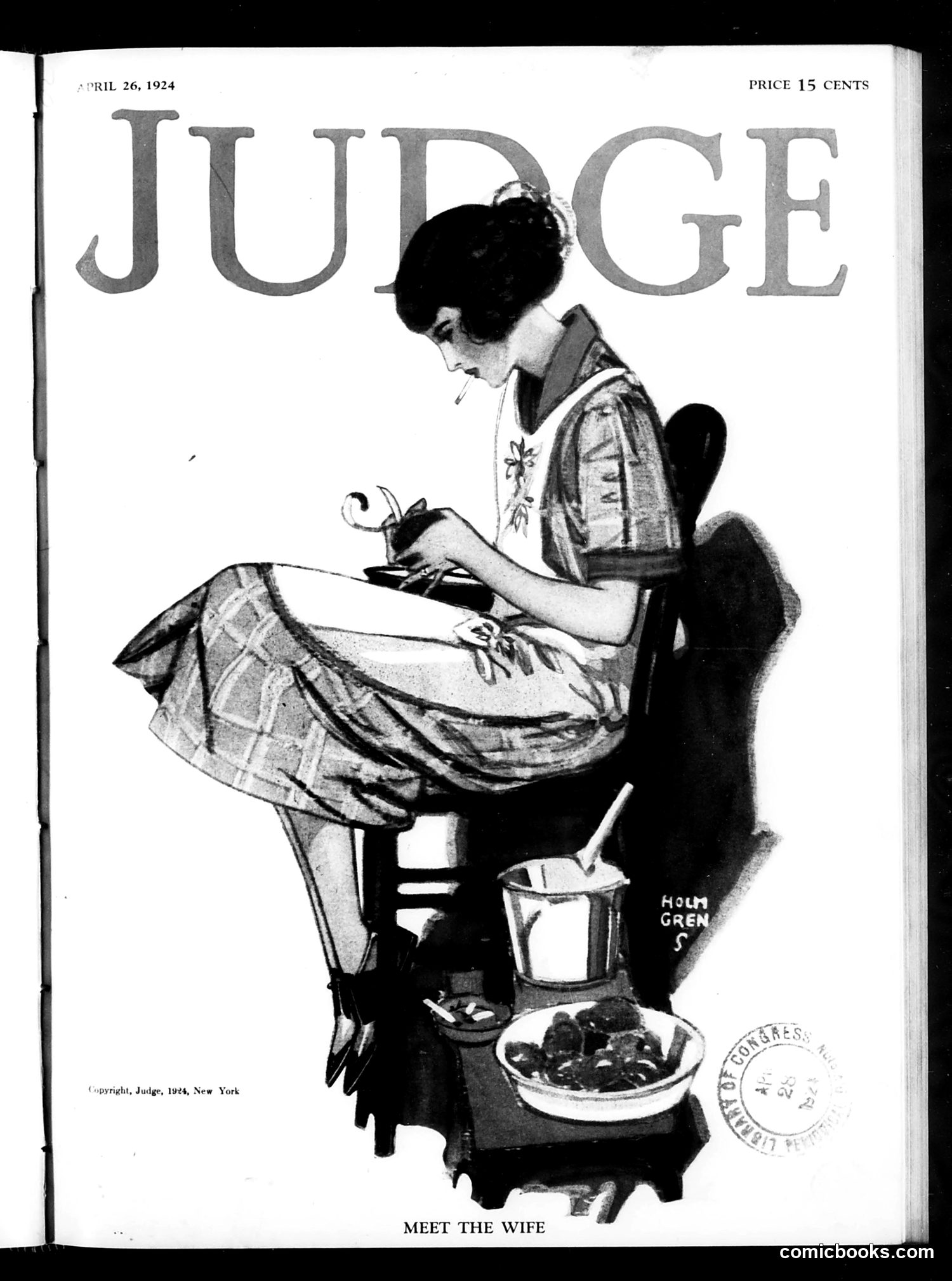
This cover illustration by Hollands Gren depicts a woman seated, reading what appears to be a magazine or publication while smoking a cigarette. She's dressed in fashionable 1920s attire with a patterned blouse and skirt. The caption "Meet the Wife" suggests this is satirizing modern married women of the era. During the 1920s, Judge frequently mocked changing social norms—particularly women's increasing independence, smoking, and leisure activities. The image likely critiques or jokes about wives who engaged in newfound freedoms (voting rights, social activities, cigarette smoking) that were considered controversial or scandalous by conservative standards of the time. The illustration represents typical Jazz Age anxieties about evolving gender roles.
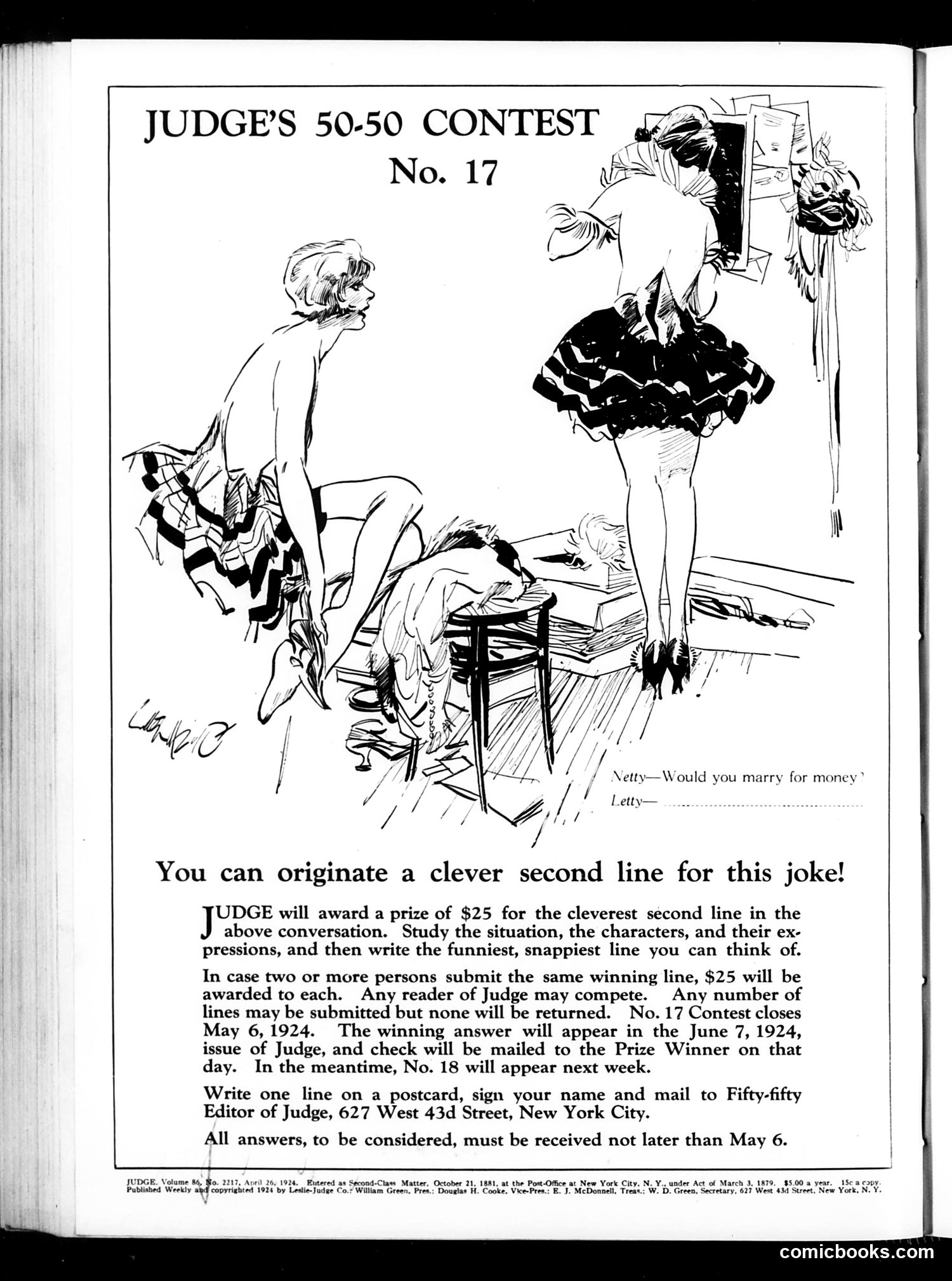
This page presents a humor contest rather than political satire. The cartoon shows three women in 1920s fashion—two seated, one standing—in what appears to be a social situation. The first woman (Netty) asks the second (Letty), "Would you marry for money?" The contest invites readers to submit a clever second line completing Letty's response. Judge will award $25 for the wittiest punchline. The humor likely plays on contemporary attitudes about women, marriage, and wealth during the Jazz Age—a period when discussions of women's economic independence and marriage motivations were becoming more open topics. The contest closes May 6, 1924, with the winning answer to appear in Judge's June 7 issue.
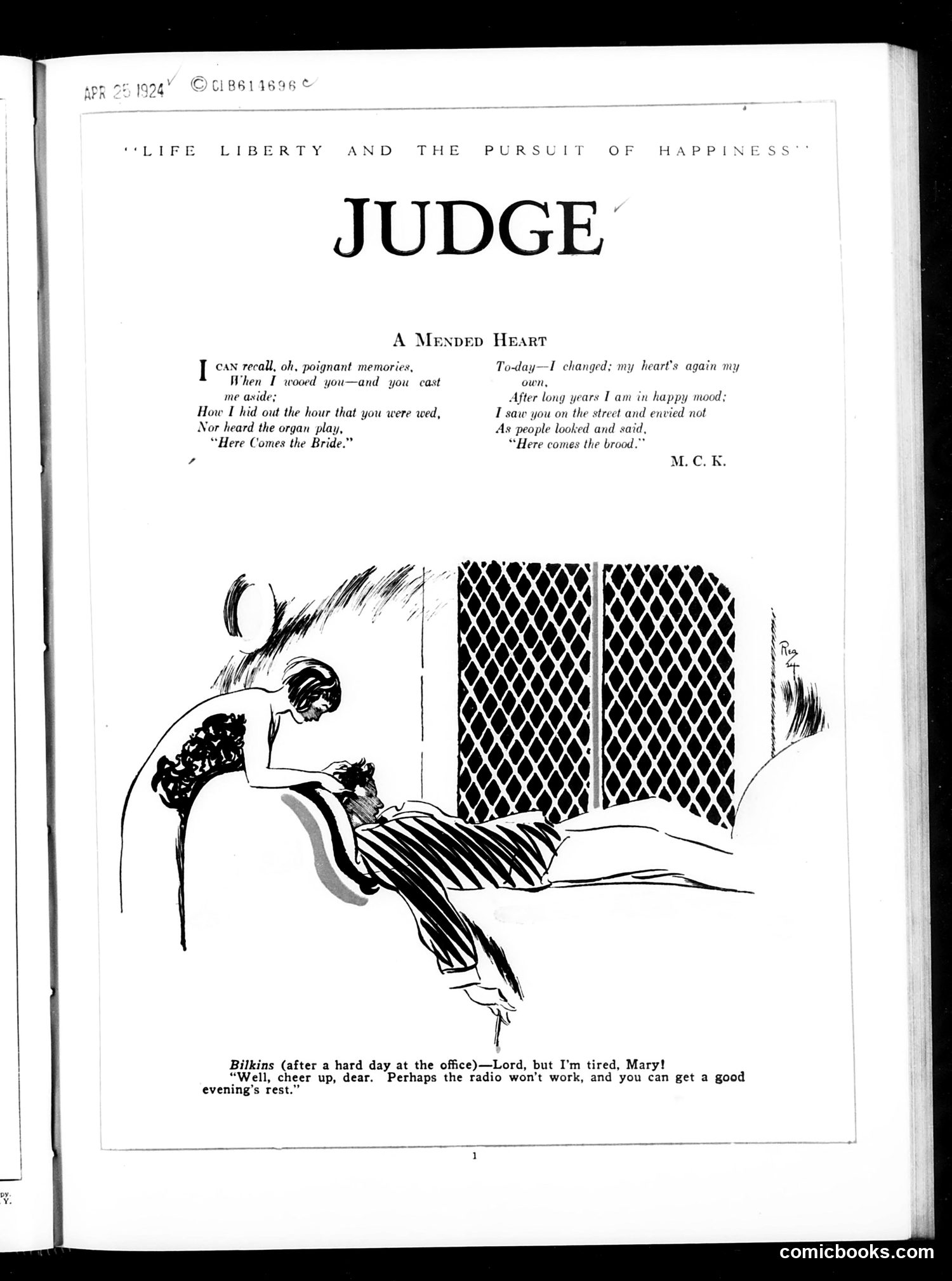
This page features a domestic satire titled "A Mended Heart" by M.C.K. The cartoon shows a woman tending to a reclining man labeled "Bilkins," who has returned home exhausted from office work. The woman offers him flowers and comfort while suggesting rest and radio entertainment. The humor targets the modern working husband—"tired" from his job—who needs domestic care and leisure. The "mended heart" likely refers to marital reconciliation or restoration of domestic contentment through traditional wifely attentiveness. This reflects 1920s gender roles where women's domestic labor was supposed to restore male vigor after industrial work. The satire gently mocks both workplace exhaustion and the prescribed remedy of home comfort.
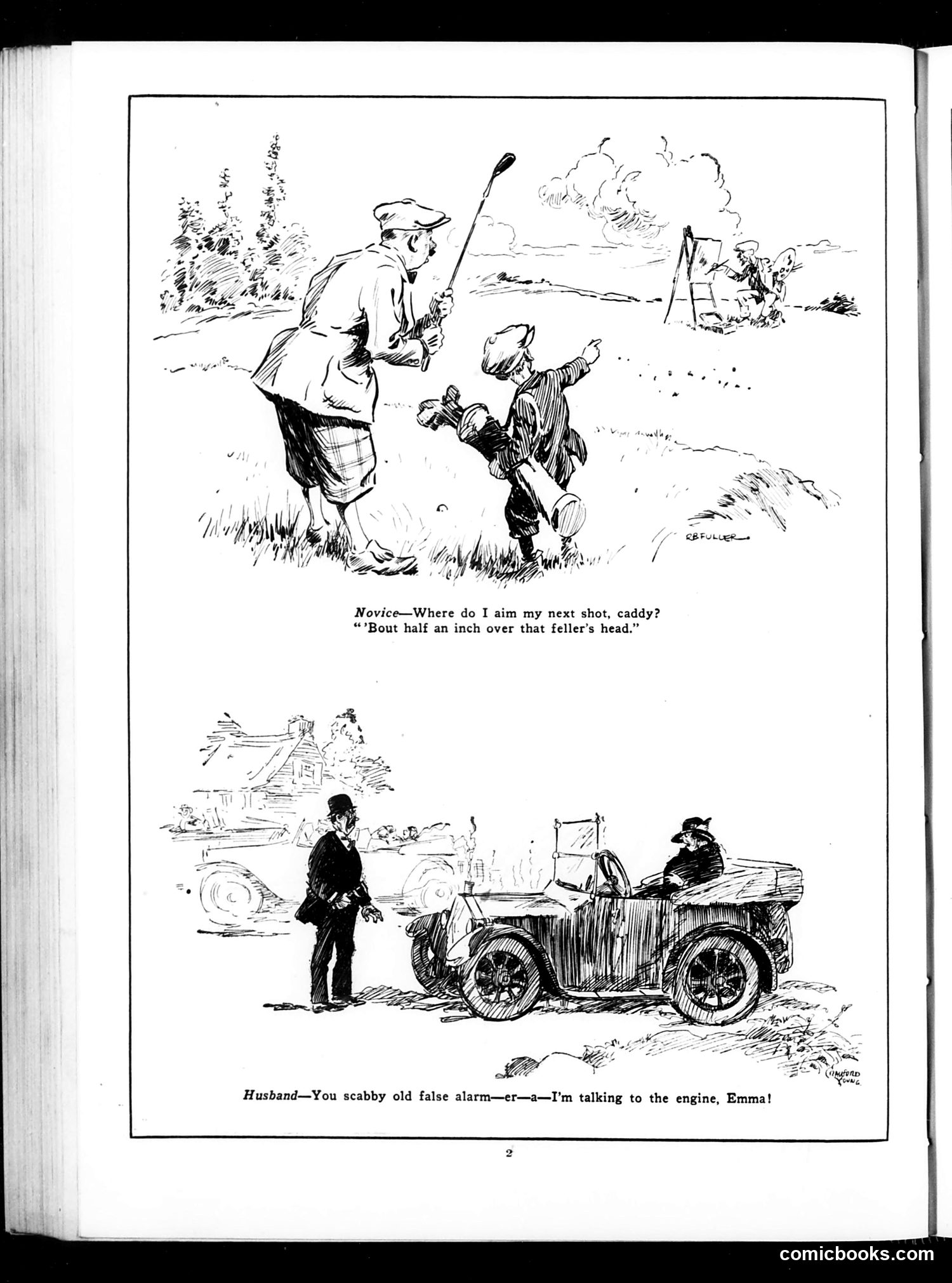
This page contains two unrelated cartoon jokes: **Top cartoon**: A novice golfer asks his caddy where to aim his next shot. The caddy replies, "Bout half an inch over that feller's head"—suggesting the golfer is so inept he'll likely hit someone anyway. **Bottom cartoon**: A husband, apparently stopped by police for a traffic violation or accident, defensively tells his wife Emma, "You scabby old false alarm—er—a—I'm talking to the engine, Emma!" He's caught blaming mechanical failure rather than admitting poor driving. Both are domestic humor jokes typical of early 20th-century Judge magazine—poking fun at incompetent golfers and defensive husbands. They reflect contemporary attitudes toward emerging leisure activities (golf) and automobile ownership.
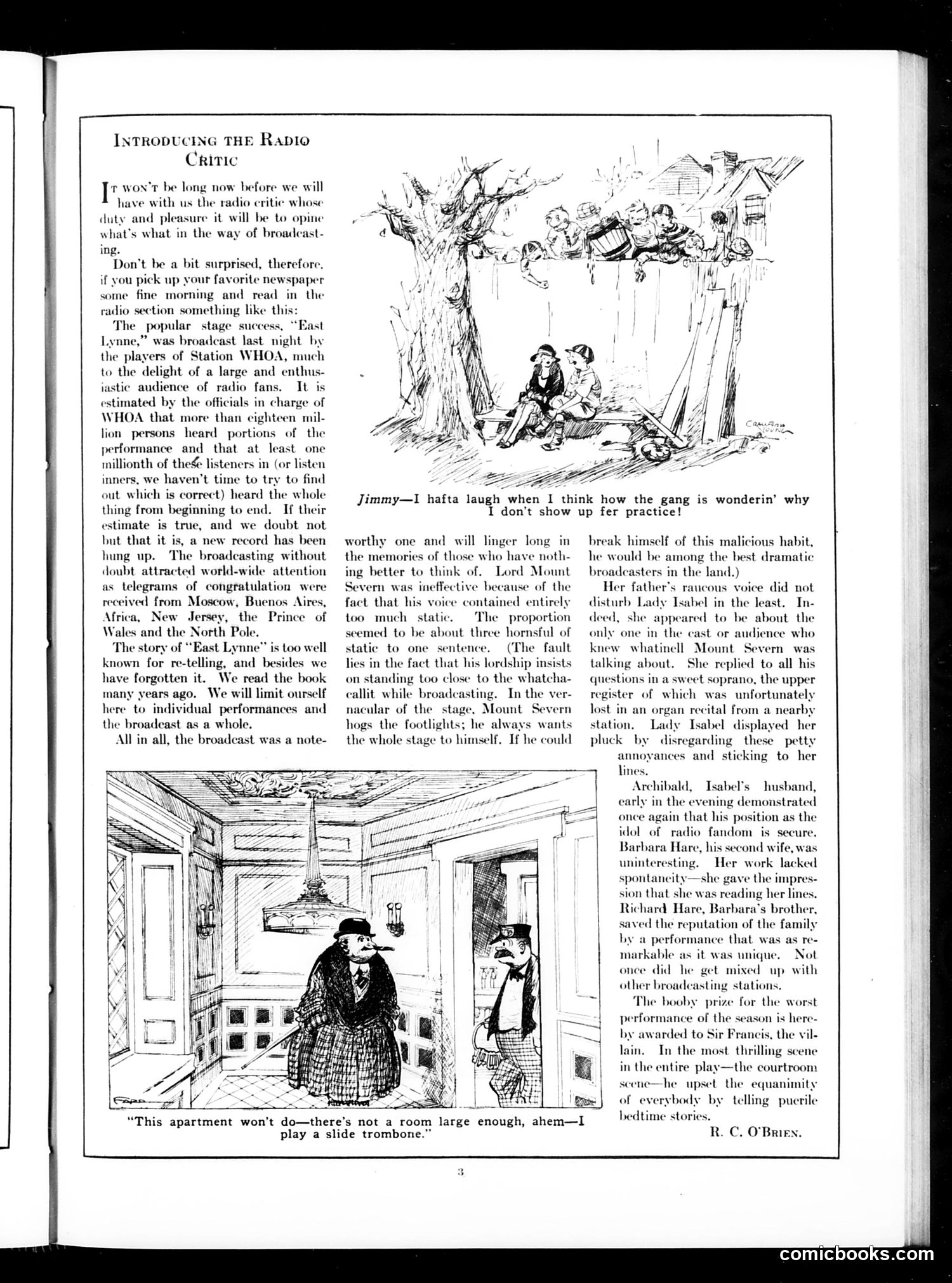
This page satirizes early radio broadcasting, specifically a recent "East Lynne" dramatic performance on station WHOA that attracted eighteen million listeners. The article mockingly introduces the emerging role of the "radio critic"—a new journalistic position created to review radio broadcasts. The cartoons illustrate performance problems: the top shows characters under a tree discussing the broadcast's poor quality; the bottom depicts an apartment too cramped for proper performance ("there's not a room large enough...I play a slide trombone"). The satire targets both the absurdity of mass radio audiences and the pretension of establishing formal criticism for this new medium. The joke implies that radio drama is technically awkward and that critics are unnecessary for such crude performances—a dismissive view of early broadcasting that now seems historically ironic.
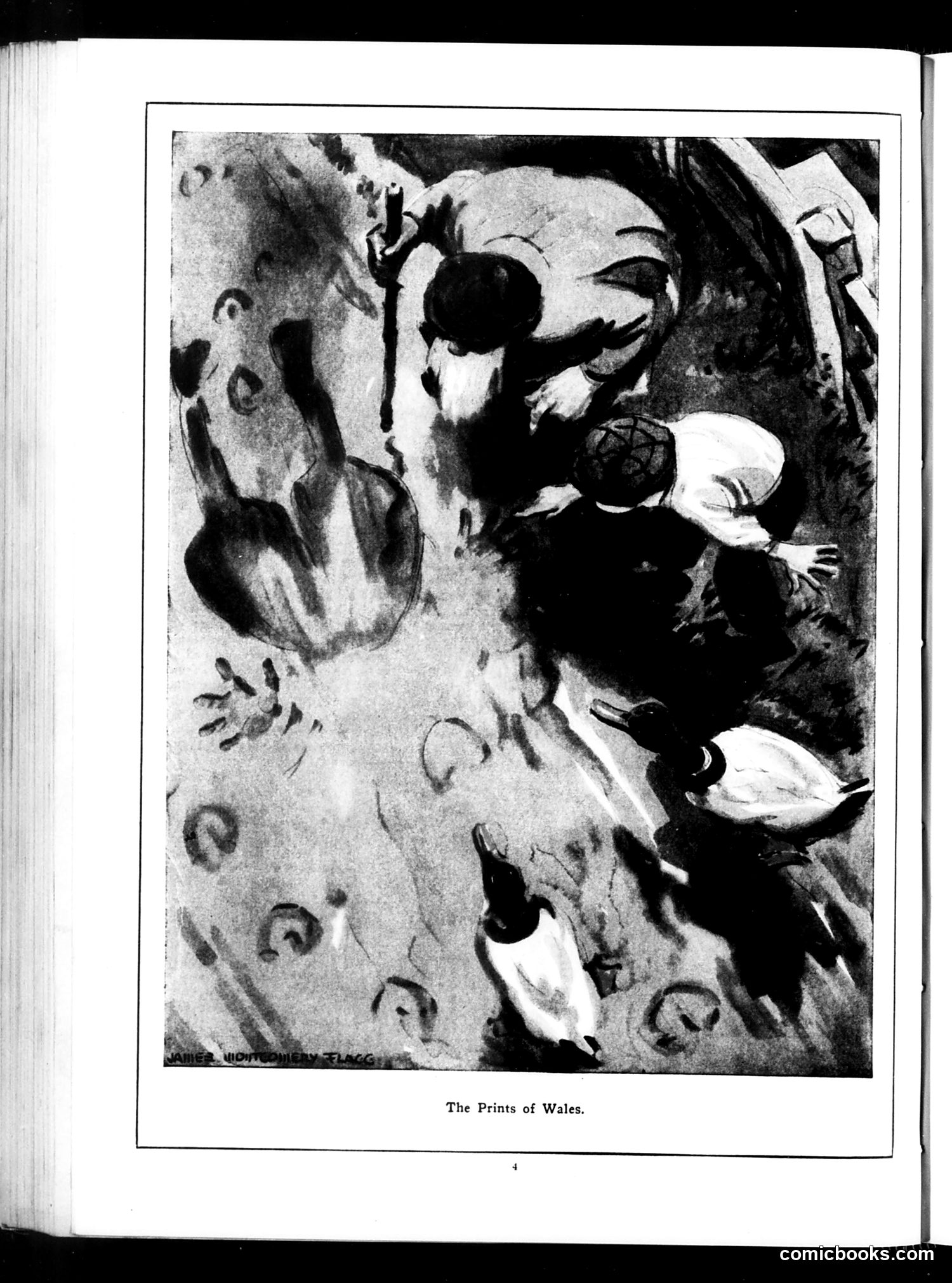
This cartoon appears to satirize the Prince of Wales (likely Edward VIII or his predecessor) through a visual pun on "prints." The image shows footprints or paw prints in sand or similar material, with figures examining them—playing on the double meaning of "prints" (impressions/tracks versus artistic prints). The satire likely comments on the Prince's public visibility, behavior, or scandals that left metaphorical "marks" on society. By depicting literal prints being investigated or studied, Judge mocks the Prince's prominent position and the scrutiny his actions received from the public and press. The specific political context—which Prince, which scandal—remains unclear without additional dating information, but the wordplay satirizes royal visibility and accountability.
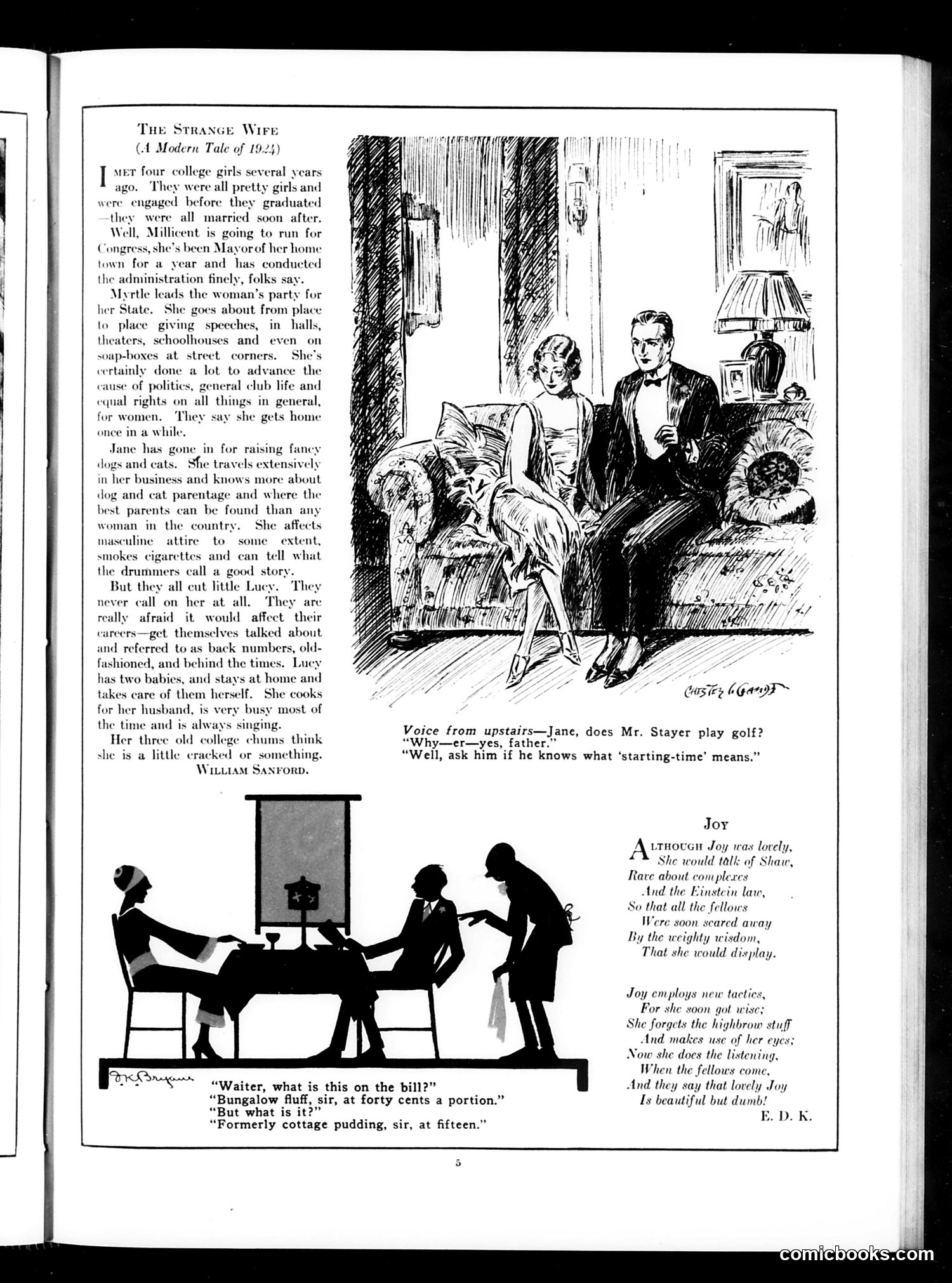
This page satirizes women's changing social roles in the 1920s. "The Strange Wife" contrasts four college friends: Millicent runs for Congress, Myrtle leads a women's political party, Jane raises fancy dogs while affecting masculine dress and smoking—all considered progressive. Lucy, however, stays home raising babies and cooking for her husband. Her friends ostracize her as "cracked" and old-fashioned, viewing domesticity as career-damaging. The satire cuts both ways: the page mocks both the ambitious "New Woman" pursuing politics and business, and the social pressure against traditional homemakers during this era of female empowerment. The other cartoons joke about inflation ("cottage pudding" renamed "bungalow fluff" at triple the price) and how women abandoned intellectual pretensions ("highbrow stuff") once they realized men found them more appealing when silent and attractive—a dig at female strategic conformity.
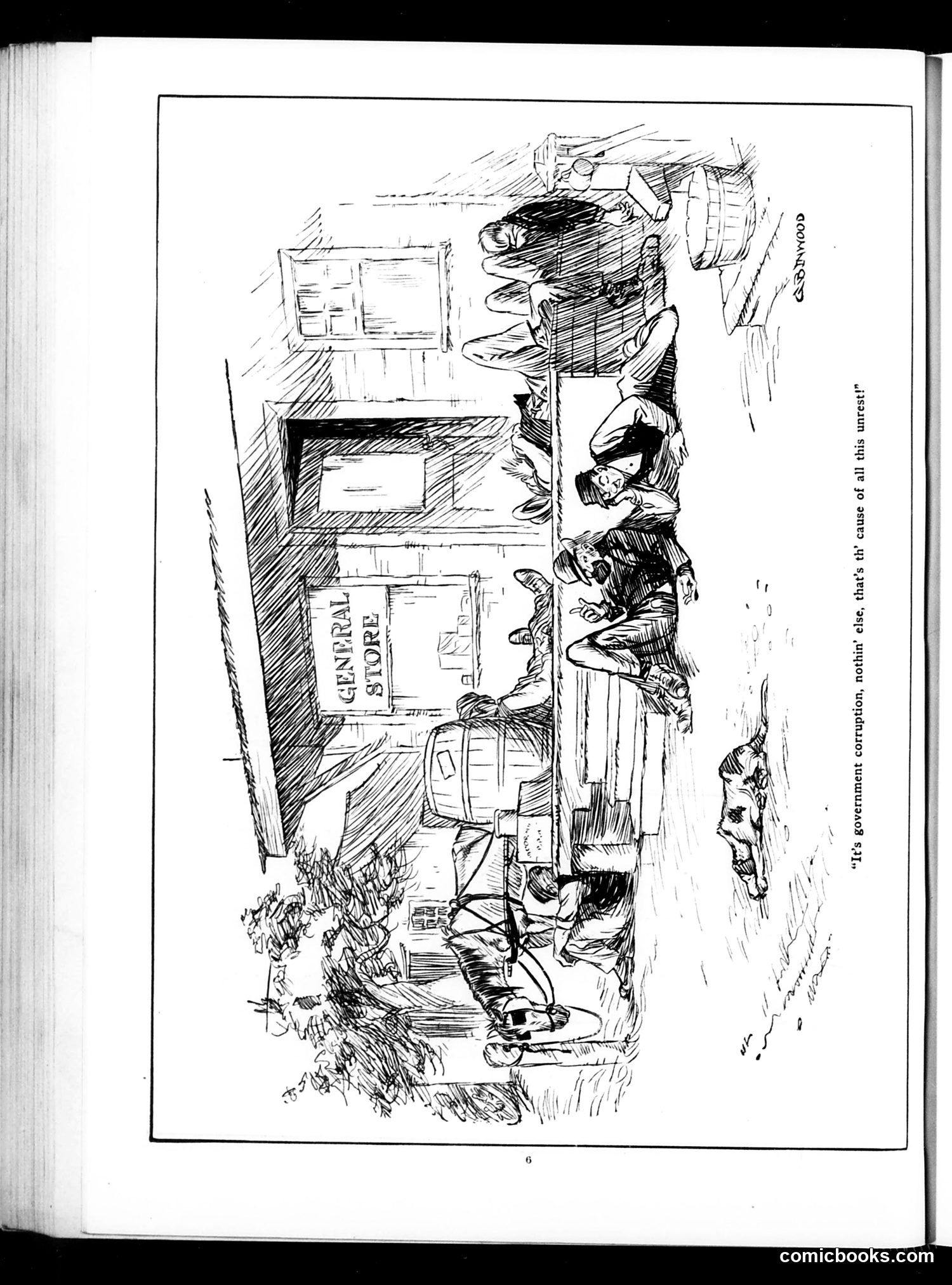
This political cartoon depicts a "General Store" being looted or ransacked by multiple figures, with the caption "It's government corruption runnin' des, that's a cause o' all this unrest!" The satire critiques **government corruption** as the root cause of social unrest. The general store represents the common citizen's resources or the public treasury being plundered by corrupt officials and politicians (represented by the figures raiding it). The cartoon suggests that corrupt government—not legitimate grievances—is responsible for civil disorder. This is typical Gilded Age/Progressive Era satire from *Judge* magazine, which frequently attacked political machines, bribery, and misappropriation of public funds as destabilizing forces in American society. The figure speaking appears to be a working-class citizen observing this corruption firsthand, thereby validating the magazine's reformist perspective.
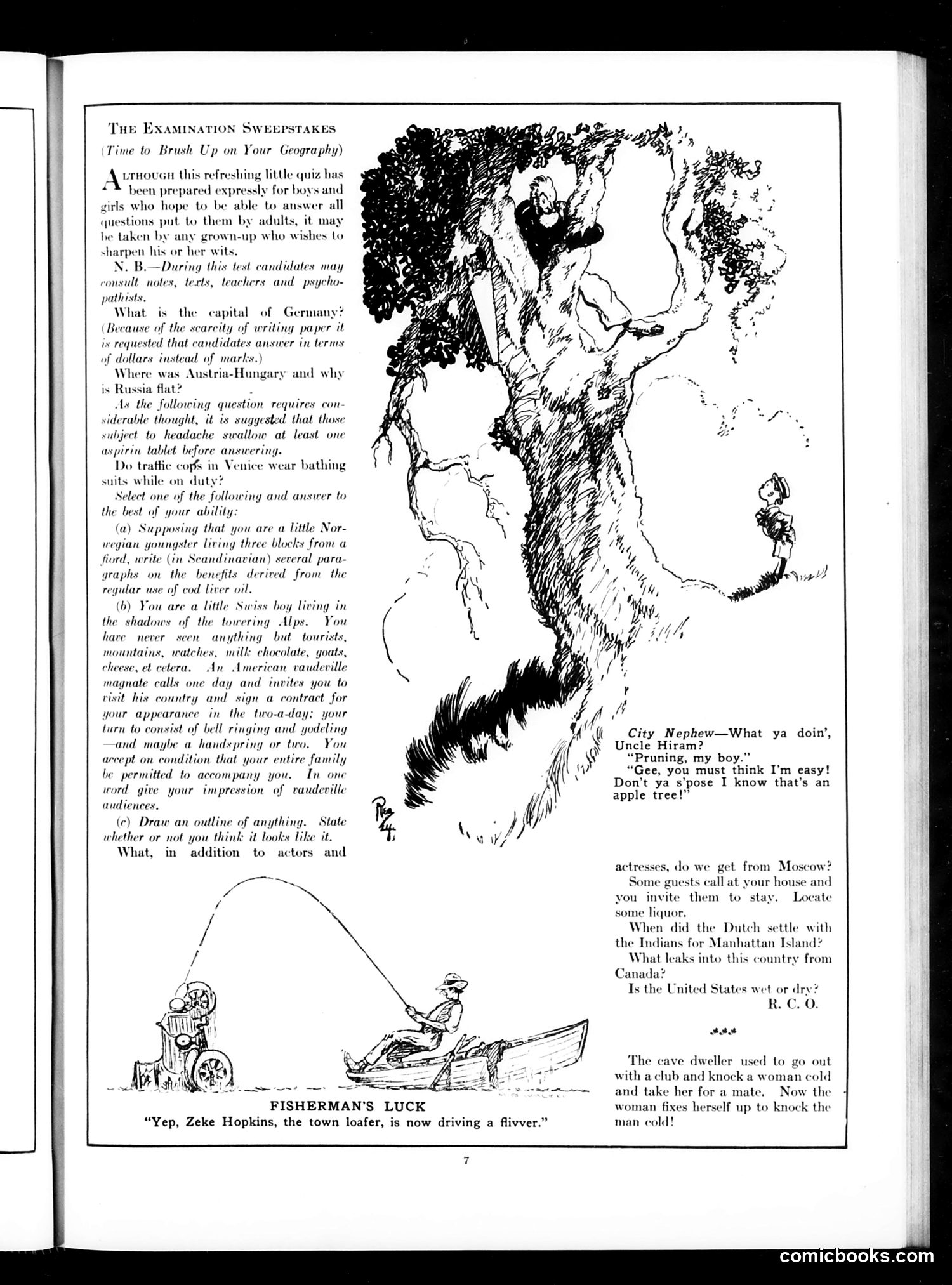
This satirical quiz mocks both contemporary education and American society circa the 1920s. The humor works on multiple levels: **Educational satire**: The absurd geography questions (asking students to answer in "dollars instead of marks," requesting Scandinavian essays from Norwegian children) parody rigid, impractical schooling that disconnects from real life. **Social commentary**: References to Prohibition ("Is the United States wet or dry?"), immigration ("What leaks into this country from Canada?"), and vaudeville reflect current anxieties. The Swiss boy vaudeville scenario satirizes American entertainment industry exploitation. **The cartoons**: "Fisherman's Luck" jokes that the town loafer now drives a car (a "flivver"). The closing joke reverses traditional gender dynamics—women now use cosmetics instead of men using clubs to acquire mates, suggesting modern courtship as female manipulation. The overall tone suggests skepticism toward both formal education and modern American society's rapid changes.
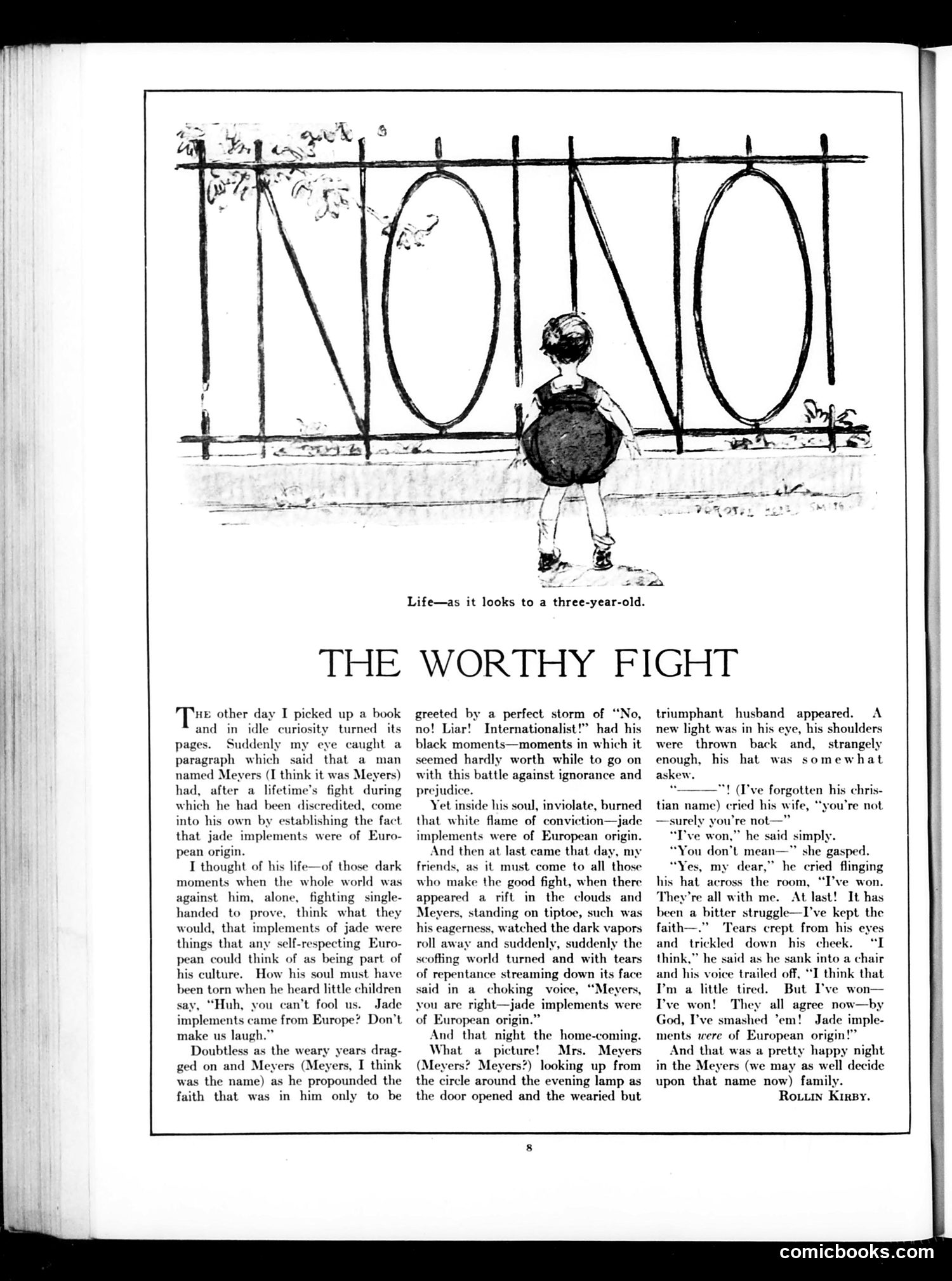
The cartoon illustrates a satirical story about a man named Meyers who spends his life fighting to prove that jade implements originated in Europe, despite universal ridicule and disbelief. The simple illustration above—a small child overwhelmed by giant circular shapes—reinforces the story's theme: perspective matters. The satire targets scientific stubbornness and nationalist pride. Meyers's obsessive insistence on European origin of jade (an Asian material) appears absurd, yet he's portrayed as heroic for maintaining conviction against mockery. The elaborate, emotional climax—where society finally vindicates him—mocks both scientific dogmatism and the human need for vindication. This likely satirizes early 20th-century debates about cultural origins and "racial" contributions to civilization, poking fun at those who'd force non-European achievements into European frameworks through sheer persistence rather than evidence.
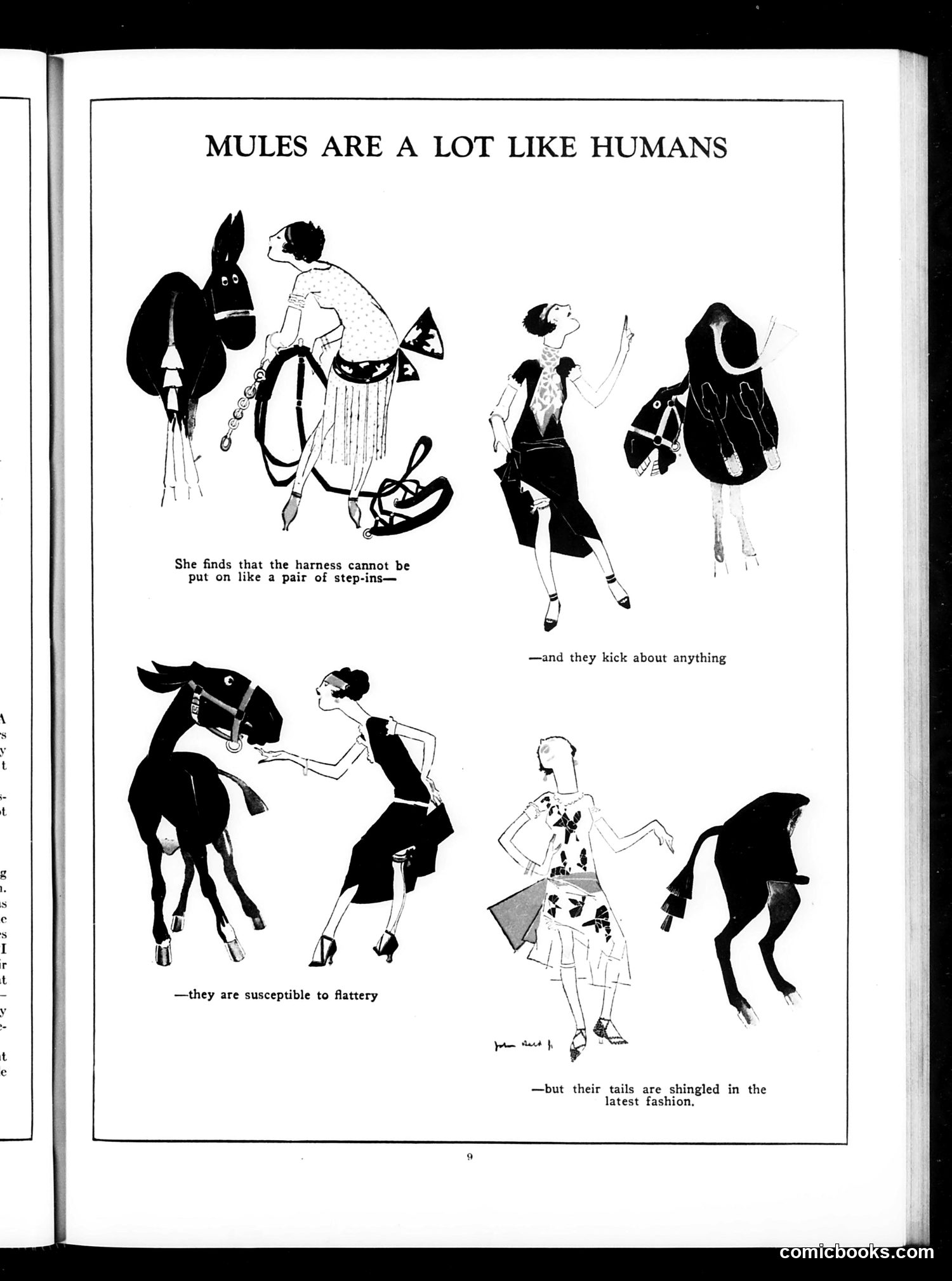
This is a humorous comparison between mules and women, using equestrian training as a vehicle for social satire. The cartoon depicts a woman attempting to harness a stubborn mule, paralleling female behavior: the mule resists being dressed (like struggling with clothing), kicks unpredictably (women are temperamental), responds to compliments (susceptible to flattery), and—in the final jab—styles its tail fashionably like contemporary women. The satire relies on early 20th-century gender stereotypes: women as irrational, vain, difficult to manage, and obsessed with fashion. The "step-ins" reference suggests undergarments, adding a mildly risqué note typical of Judge's sophisticated humor. The comparison between animals and women was common period satire, though crude by modern standards.
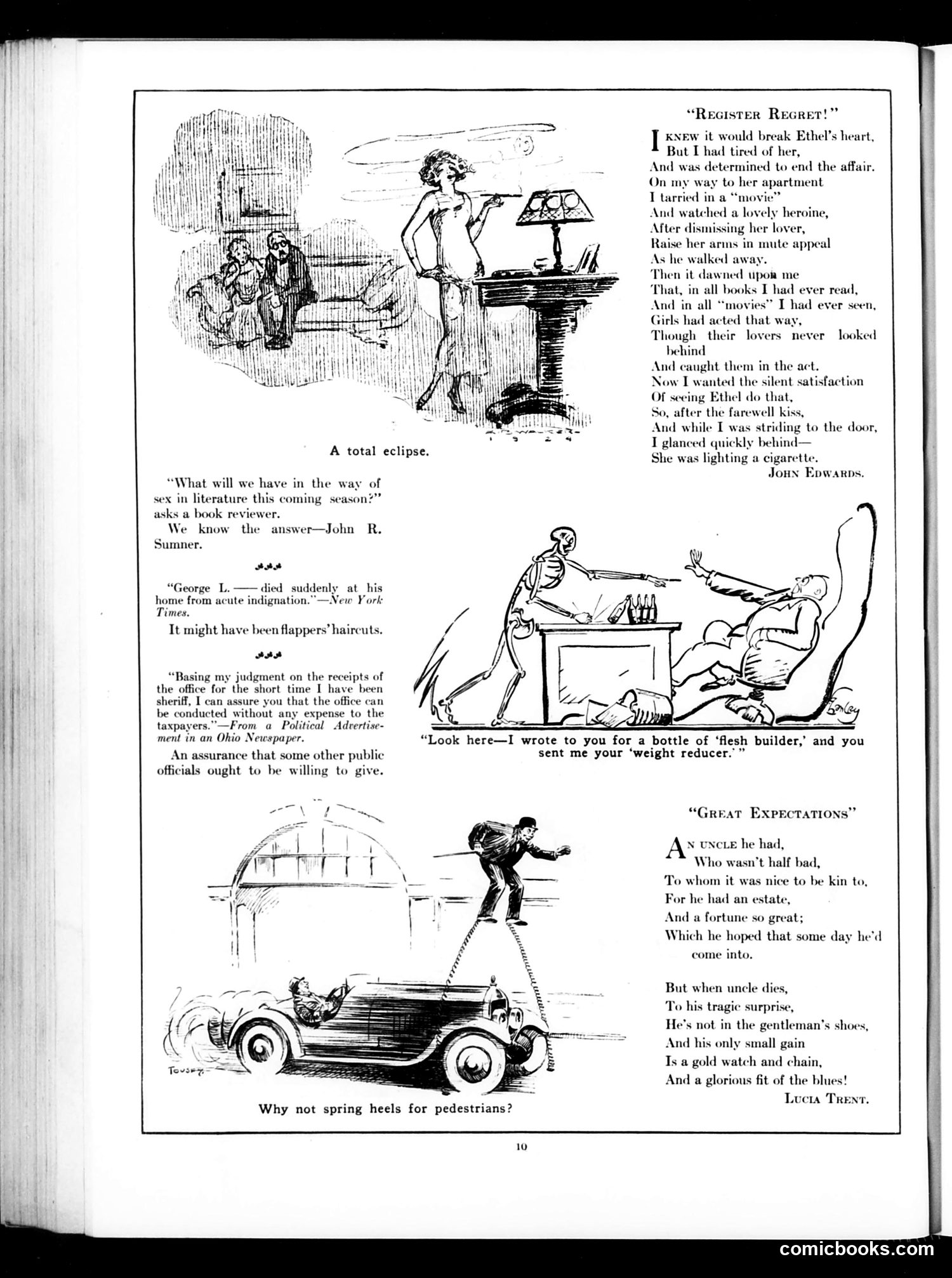
This page contains several satirical pieces typical of 1920s social commentary: **"Register Regret!"** (poem by John Edwards): A man breaks up with his girlfriend after seeing movie heroines dramatically raise their arms when spurned—expecting Ethel to do the same. Instead, she lights a cigarette, deflating his romantic fantasy. The satire mocks both melodramatic cinema conventions and male expectations of female behavior. **"A Total Eclipse"** cartoon: Shows a woman ignoring two suitors. The accompanying quote jokes that sex in literature will be whatever John R. Sumner (a real anti-obscenity crusader) censors—satirizing his influence over publishing standards. **"Great Expectations"** (poem by Lucia Trent): Parodies Dickens's novel, describing a man expecting to inherit his uncle's estate but receiving only a watch and "the blues." Additional items mock bureaucratic claims, product advertisements, and urban safety concerns. The humor targets contemporary anxieties about changing social mores, cinema culture, and institutional hypocrisy.
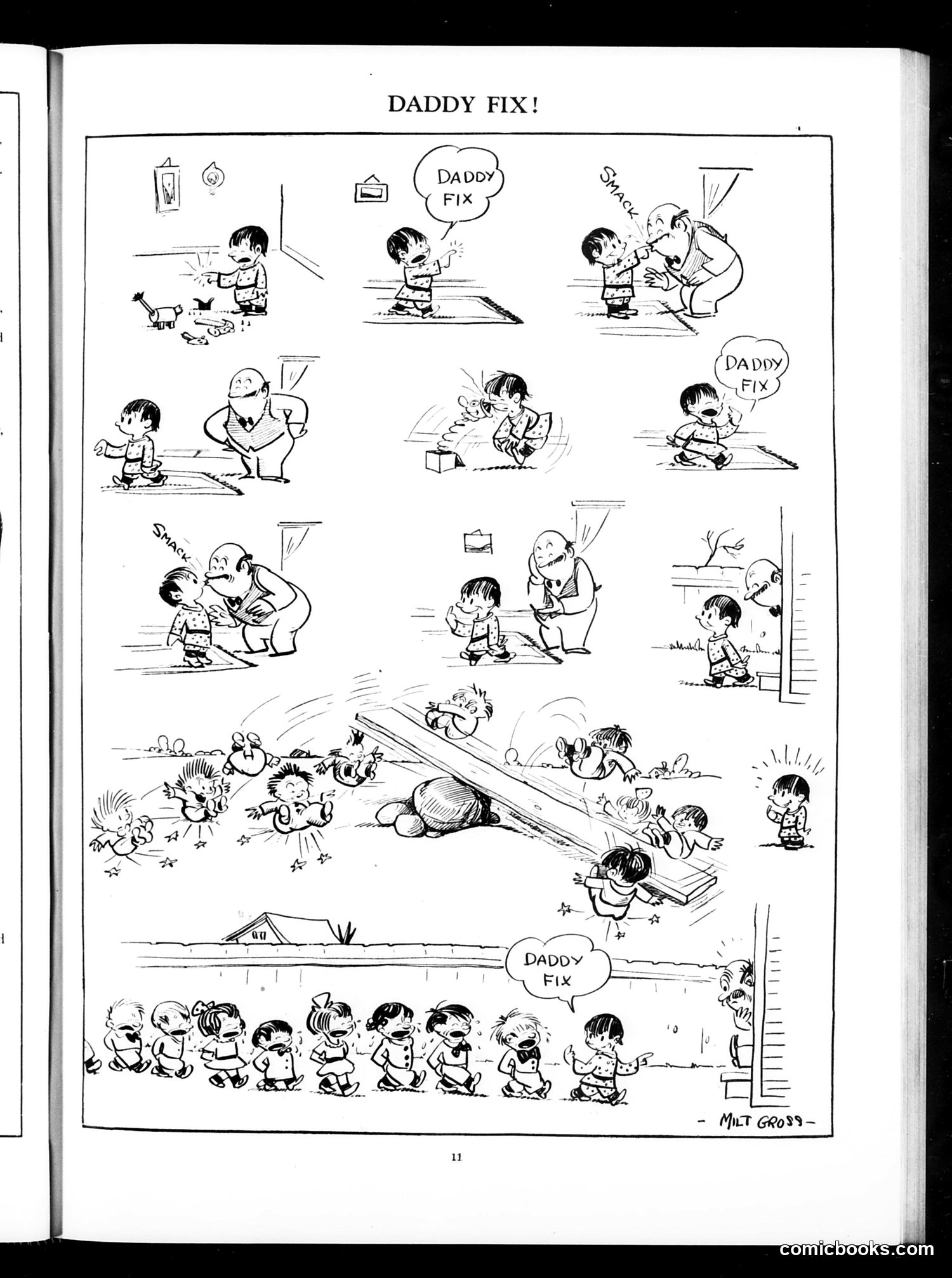
This is a humorous comic strip by Milt Gross depicting a child repeatedly calling "Daddy fix!" while creating increasingly catastrophic messes. The sequence shows: the child breaking household items (a lamp, furniture), the father attempting repairs with a toolbox, escalating chaos including what appears to be a seesaw accident launching toys and children into the air, and finally an enormous parade of children marching toward the exhausted father. The satire targets parental frustration: the child's endless demands for dad to "fix" things he's broken, and by extension, the expectation that fathers serve as perpetual handymen and problem-solvers. The exaggerated final panel—an army of children demanding repairs—hyperbolizes the relentless nature of parental maintenance work, transforming a domestic annoyance into absurdist comedy.
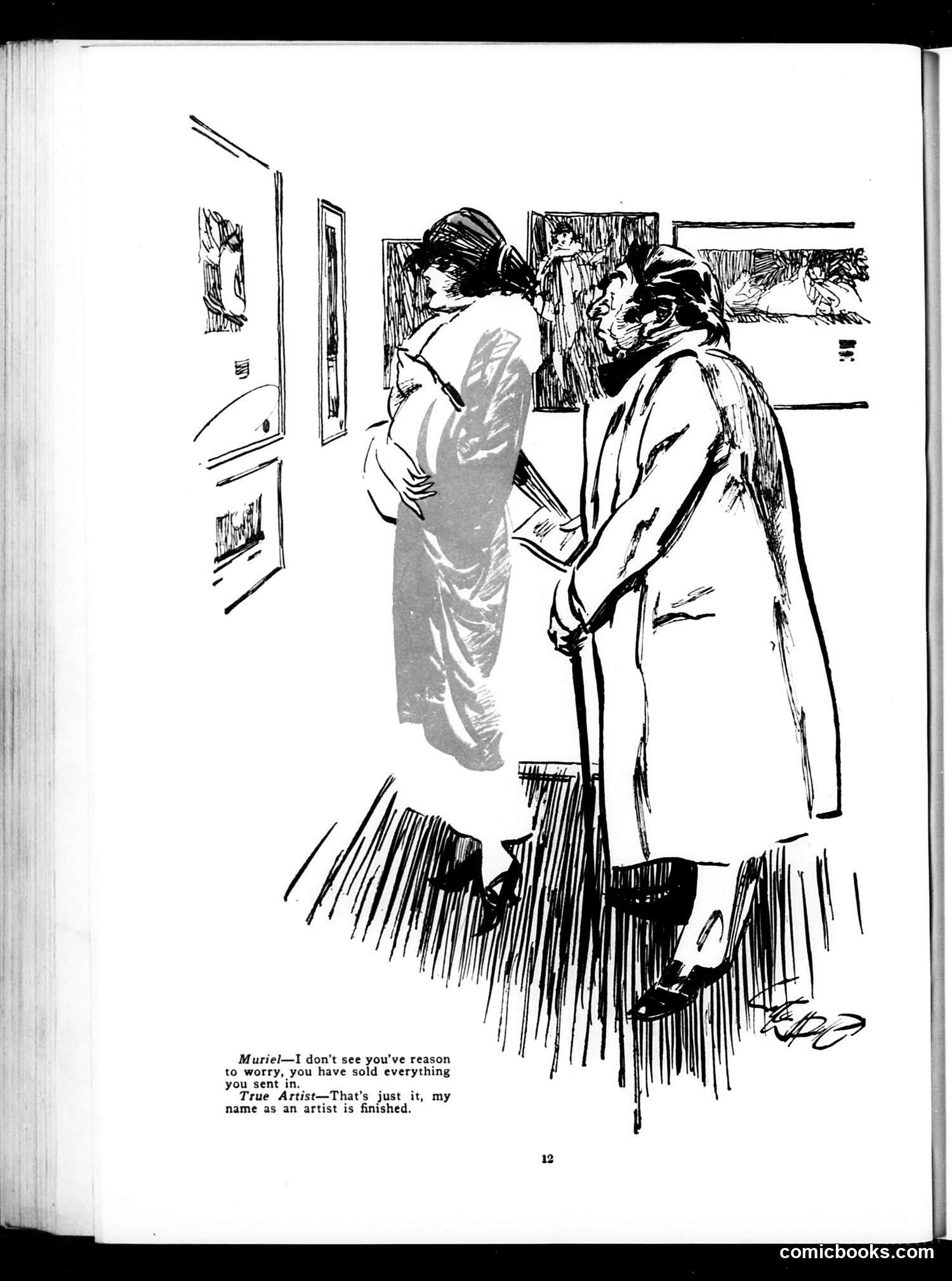
This single-panel cartoon depicts two women in conversation in what appears to be a home interior. One woman (labeled "Muriel") expresses concern about financial hardship, noting the other has "sold everything you sent in." The second woman, identified as "True Artist," responds that losing her reputation as an artist doesn't matter—her name "as an artist is finished." The satire targets bohemian or artistic pretension: the "True Artist" character prioritizes maintaining her artistic identity and mystique over financial security. The joke suggests that some artists are so committed to their image that they'll accept poverty rather than compromise their persona. This reflects early 20th-century attitudes toward starving artists and the romanticization of artistic struggle.
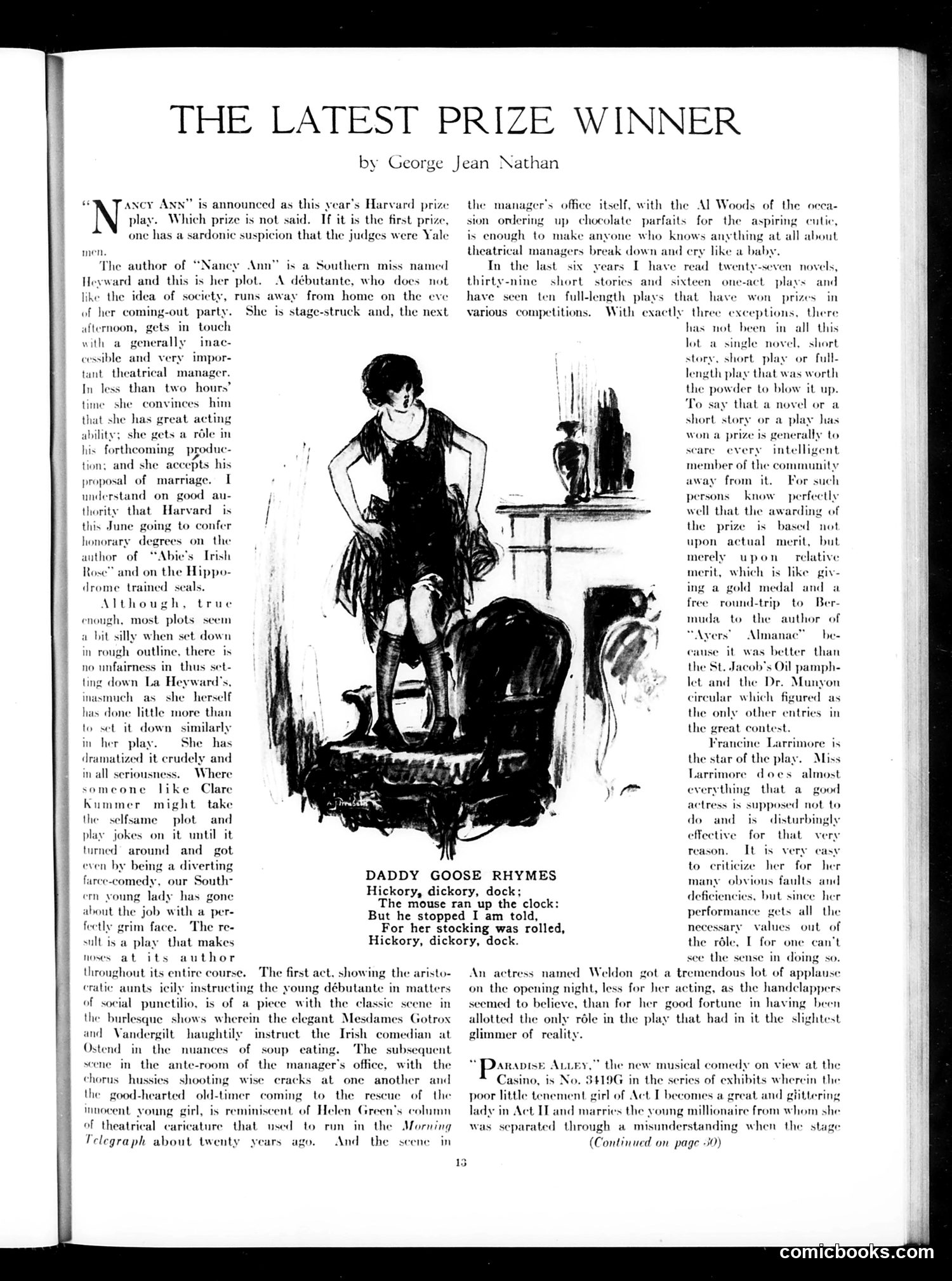
This is a theater review by George Jean Nathan, Judge's drama critic, satirizing the Harvard Prize for drama. The piece mocks "Nancy Ann," a play by Southern debutante author Heyward, for its implausible plot: a runaway girl convinces a theatrical manager of her acting talent in two hours, lands a role, and accepts his marriage proposal. Nathan's satire targets both the play's melodramatic absurdity and the prize itself—opening with a jab that if Harvard truly awarded this first prize, "the judges were Yale men" (implying Yale would never recognize such inferior work). The "Daddy Goose Rhymes" parody below is unrelated filler content typical of Judge's mixed format. The cartoon illustration depicts the play's central absurdity: the debutante's improbable rapid rise in theater. Nathan argues the plot becomes ridiculous when dramatized seriously, contrasting it with how a talented writer like Clare Kummer might have transformed it into satirical farce instead.
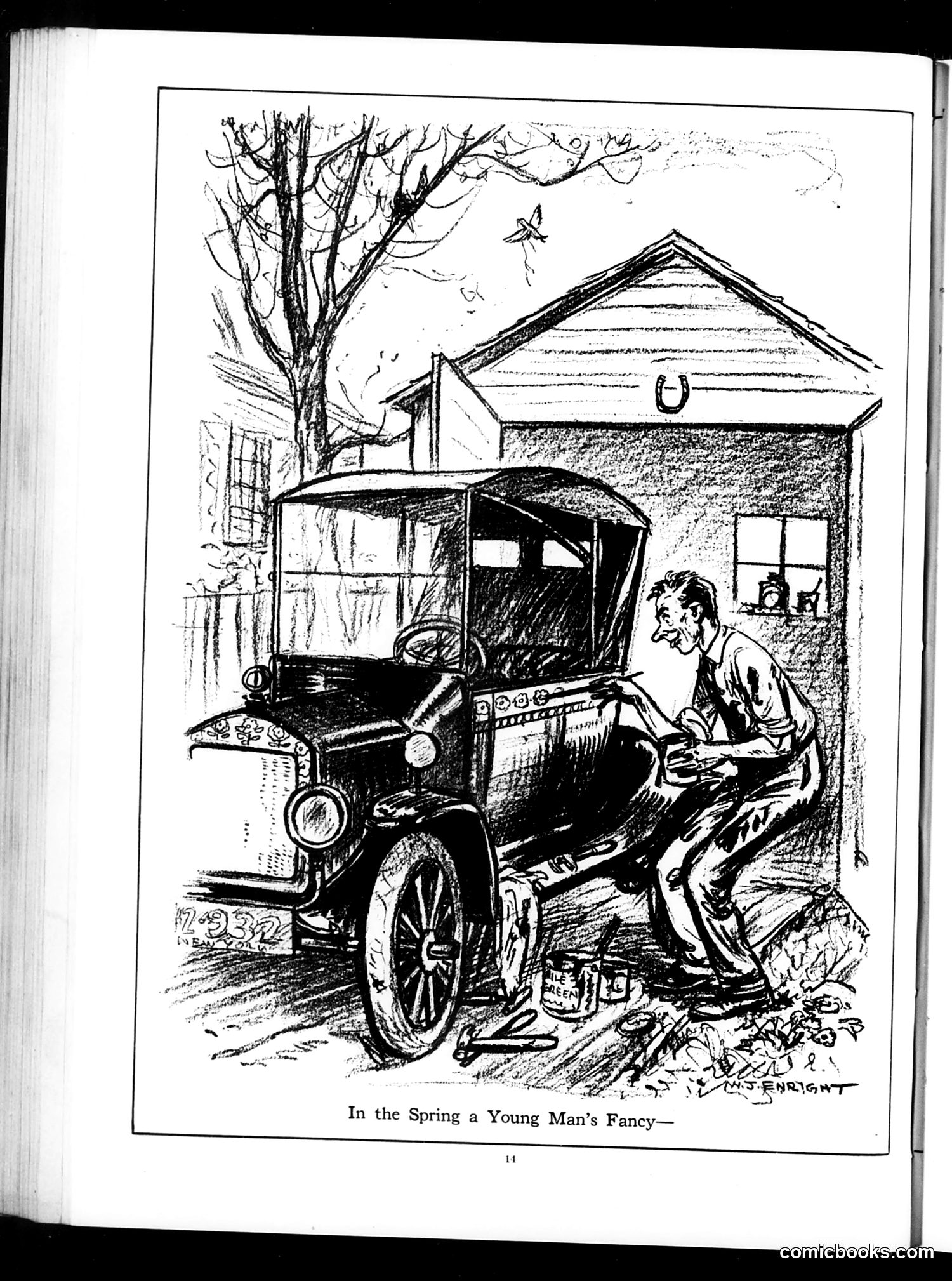
This cartoon illustrates the famous literary phrase (originally from Tennyson's poem "Locksley Hall") about springtime stirring romantic thoughts in young men. The sketch shows a young man admiring an automobile rather than a woman—a witty inversion of the traditional romantic sentiment. The joke plays on early 20th-century American car culture: the "fancy" that captures this young man's attention is automotive, not romantic. The modest house and bare tree suggest modest circumstances, making the car an aspirational object. The mechanic or owner tinkering with the vehicle emphasizes how cars have replaced traditional romance as the object of male desire and fascination in modern times. It's social satire about changing values and male priorities.
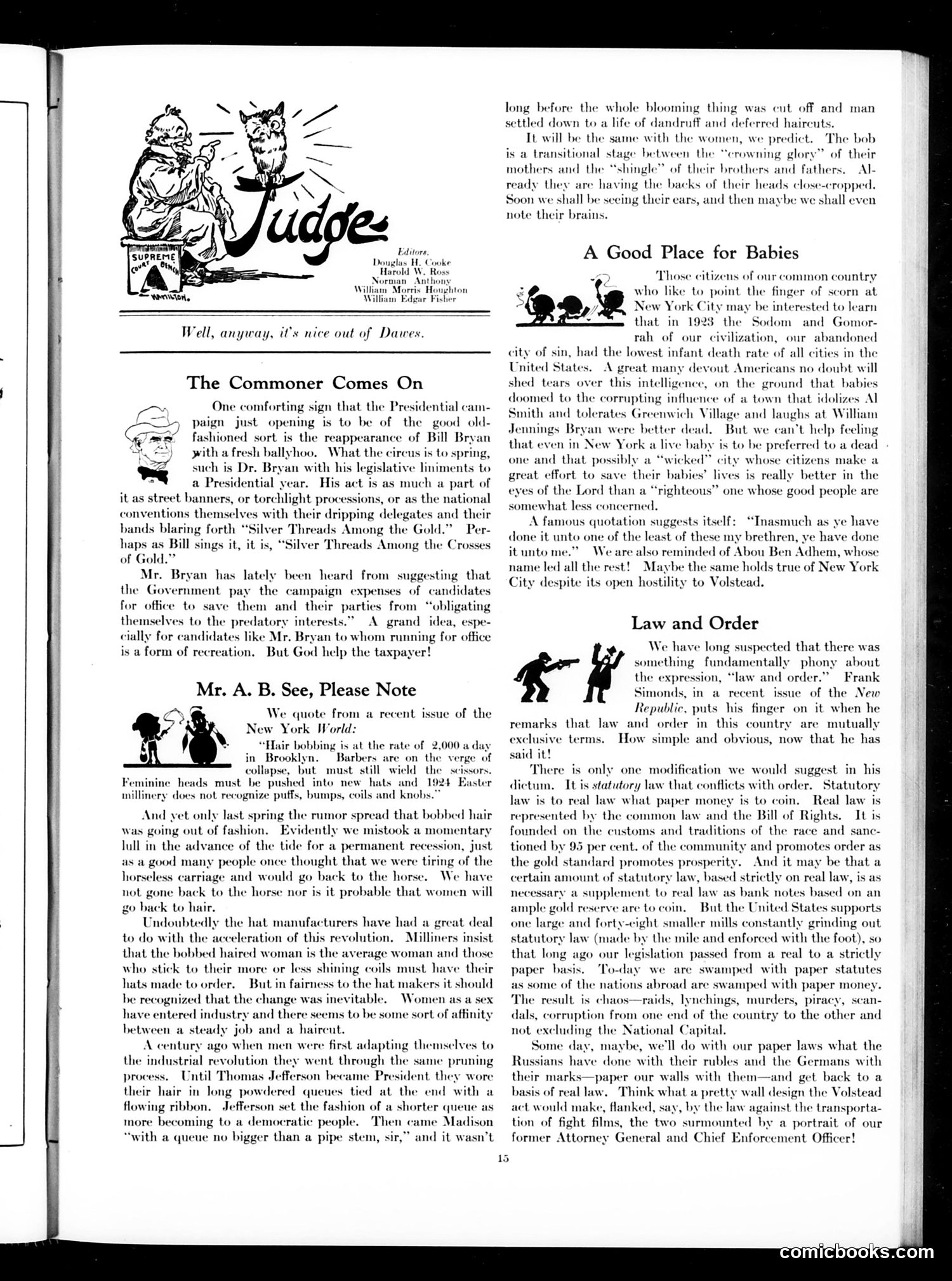
This page contains three satirical pieces targeting American politics and social trends circa the 1920s. **"The Commoner Comes On"** attacks William Jennings Bryan (the three-time presidential candidate nicknamed "The Commoner"), mocking his campaign style and his recent proposal that the government fund candidates' campaigns. The satire suggests Bryan enjoys running for office as recreation while asking taxpayers to pay for it. **"Mr. A.B. See, Please Note"** satirizes women's bobbed hair as a fashion trend. The piece predicts women will eventually cut their hair as short as men did during the Industrial Revolution, progressing from bobs to "shingles" (an even shorter style). The joke concludes darkly: "then maybe we shall even note their brains"—implying women are intellectually inferior. **"A Good Place for Babies"** defends New York City (associated with vice, Al Smith, and Greenwich Village bohemianism) by noting it had the lowest infant mortality rate in 1923. The satire mocks religious conservatives who would prefer babies born in such a "sinful" city had died instead.
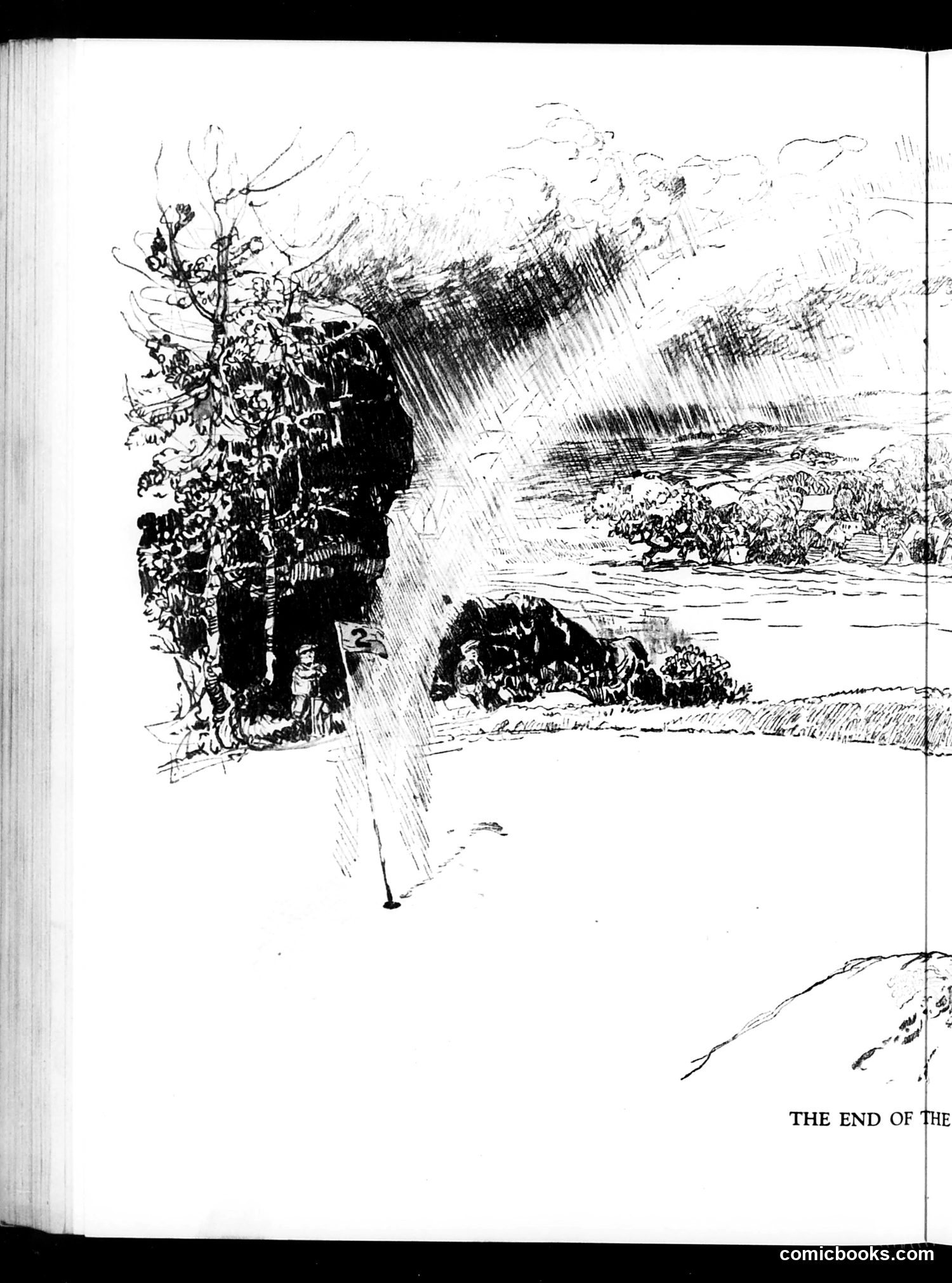
This appears to be a final illustration from a story or serial in Judge magazine, marked "THE END OF THE" (text cut off). The ink sketch depicts a riverside or lakeside landscape with gnarled, leafless trees on the left bank and what appear to be vegetation or brush on the right. The heavy cross-hatching in the sky suggests stormy or dramatic weather conditions. Without the complete caption or preceding pages, I cannot identify the specific narrative, characters, or satirical point this illustration concludes. The artistic style is consistent with late 19th or early 20th-century Judge illustrations, but the fragmentary text and lack of context prevent me from explaining what political or social satire this ending represents.
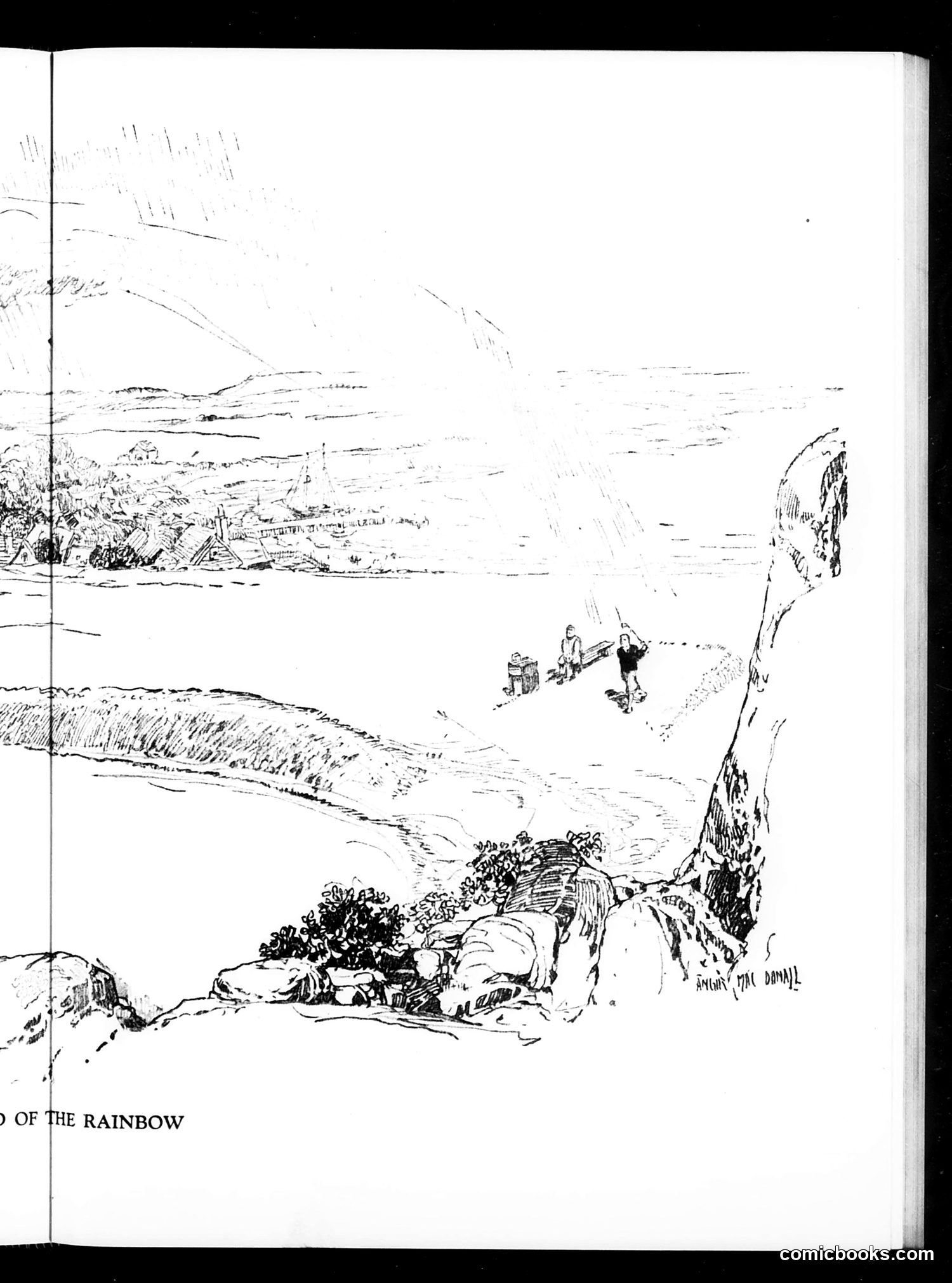
This page from *Judge* magazine features a landscape sketch titled "OF THE RAINBOW" (partial title visible). The illustration shows a coastal or riverside scene with dramatic cliffs on the right side. Several small human figures are depicted on the beach or shoreline, appearing to be engaged in some activity or observation. The artistic style is typical of *Judge*'s late 19th/early 20th-century pen-and-ink illustrations. However, without the complete title, OCR text, or caption, I cannot definitively identify the specific political or social satire intended. The sketch appears to depict leisure activity or possibly commentary on tourism, but the exact satirical target remains unclear from the visible information alone. The full page context and title would be necessary for accurate interpretation.
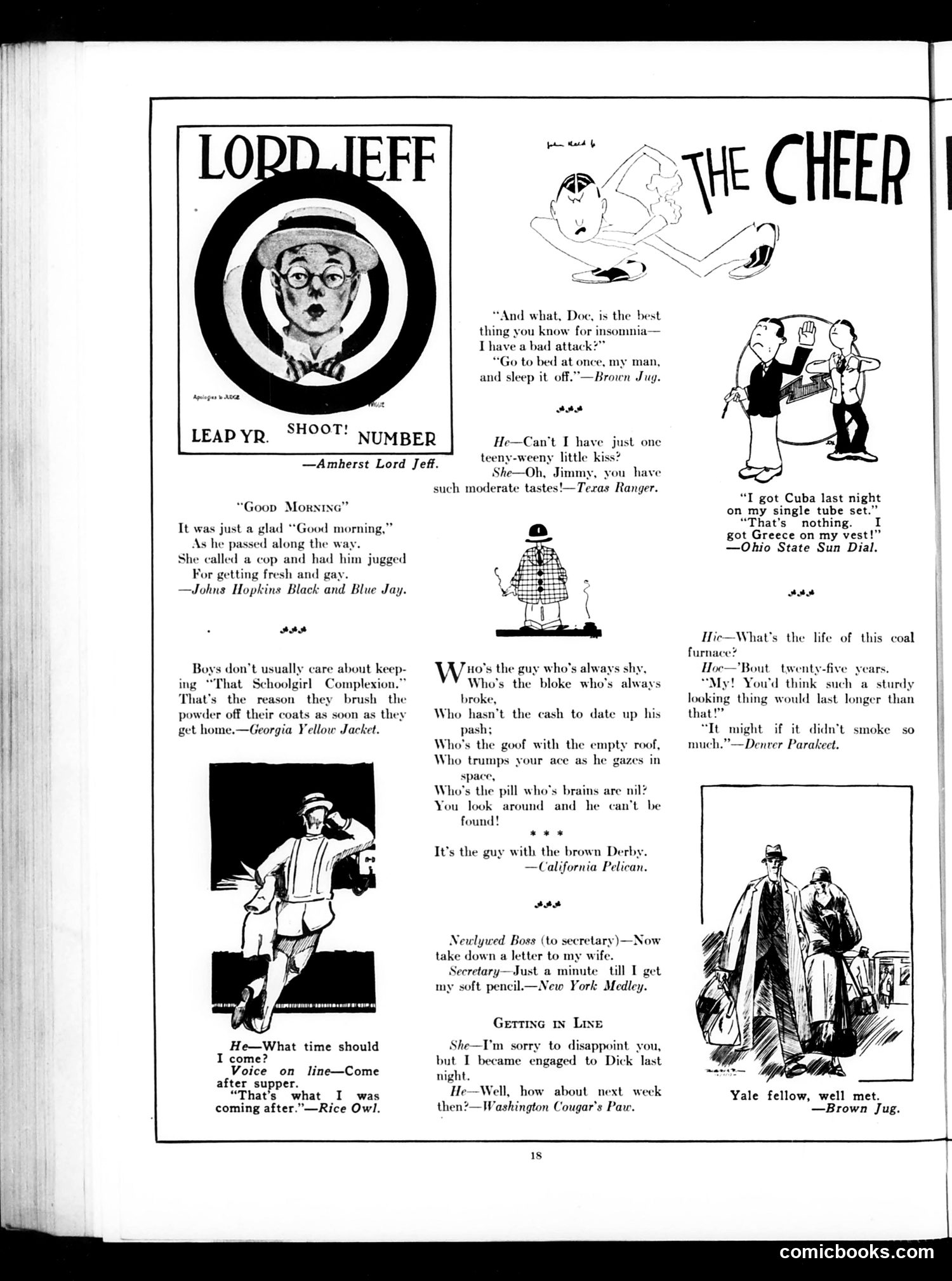
This page from *Judge* (a major American satirical magazine) compiles humorous quips and jokes, primarily from college humor publications, organized around themes of courtship, dating, and modern life circa the 1920s. **Key content:** - **"Lord Jeff" masthead**: References Amherst College's Lord Jeffrey Amherst - **College humor sources**: Jokes credited to *Brown Jug*, *Texas Ranger*, *Ohio State Sun Dial*, etc.—indicating this was a college humor anthology - **Themes**: Dating etiquette ("teeny-weeny little kiss"), male stereotypes ("guy with the brown Derby"), modern technology (radio sets receiving "Cuba"), and gender dynamics - **The satire**: Gentle mockery of courtship conventions, male incompetence, and the emerging dating culture of the era The page reflects 1920s anxieties about changing social norms—particularly around dating, women's independence (the woman calling a cop for a "fresh" greeting), and new consumer technologies. The humor is lighthearted rather than pointed political satire.
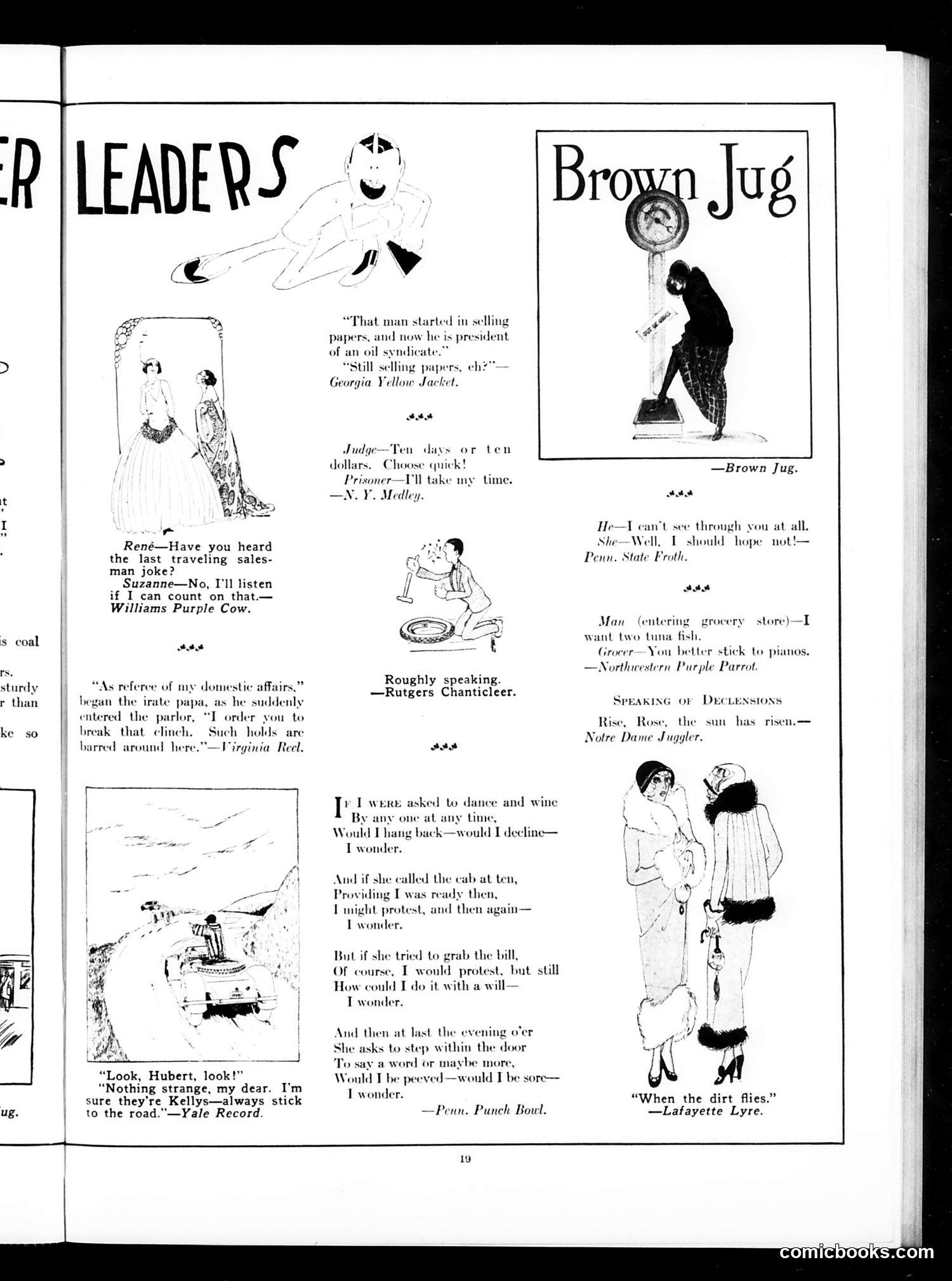
This page from *Judge* is a collection of short jokes and quips rather than political cartoons. Most content satirizes college life and dating customs of the early 20th century. Key items include: **"Brown Jug"**: A man checks the time while sweeping, illustrating the phrase "when the dirt flies"—wordplay on the idiom. **Dating/Romance Jokes**: Multiple quips mock male hesitation about commitment. A man wonders whether he'd protest if a woman tried to pay the bill or invited him inside—poking fun at gentlemanly pretense and masculine uncertainty. **College Humor**: References to traveling salesmen (stock joke subjects), a "Kellys" family always on the road, and puns from various college magazines (*Yale Record*, *Penn. Punch Bowl*) reflect the era's collegiate humor culture. **Social Commentary**: A brief note about a paper-seller becoming an oil syndicate president satirizes rapid American wealth accumulation. The page reflects early 1900s preoccupations: gender relations, class mobility, and college-boy wit rather than sharp political critique.
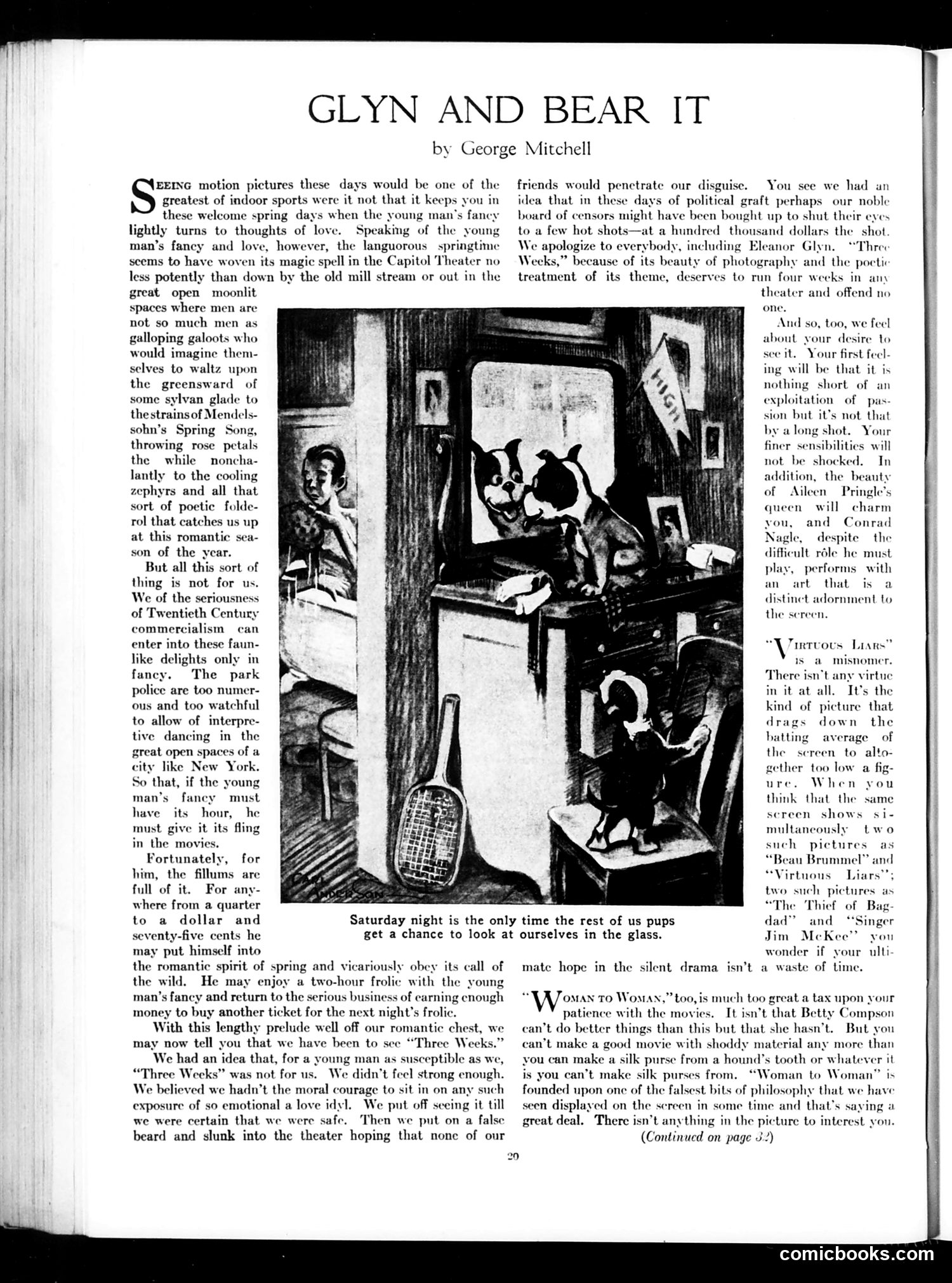
This is a film review column by George Mitchell satirizing spring romance and cinema censorship. The author humorously confesses to sneaking into a theater *disguised in a false beard* to watch "Three Weeks"—apparently a risqué romantic film he feared was morally scandalous. His anxiety suggests the film's sexual content worried he'd be recognized attending. The satire targets: - **Censorship paranoia**: Political corruption ("graft") may have influenced censors to approve controversial content - **Spring fever clichés**: The opening mocks romantic springtime tropes (moonlit spaces, Mendelssohn's "Spring Song") - **Movies as escapism**: Young men pay repeatedly for vicarious romantic thrills they can't enjoy in public parks (watched too closely by police) Mitchell ultimately endorses "Three Weeks" and criticizes other contemporary films like "Virtuous Liars," suggesting movies should maintain quality standards. The cartoon image shows couples in theater boxes—emphasizing cinema as a sanctioned space for observing romance forbidden elsewhere.
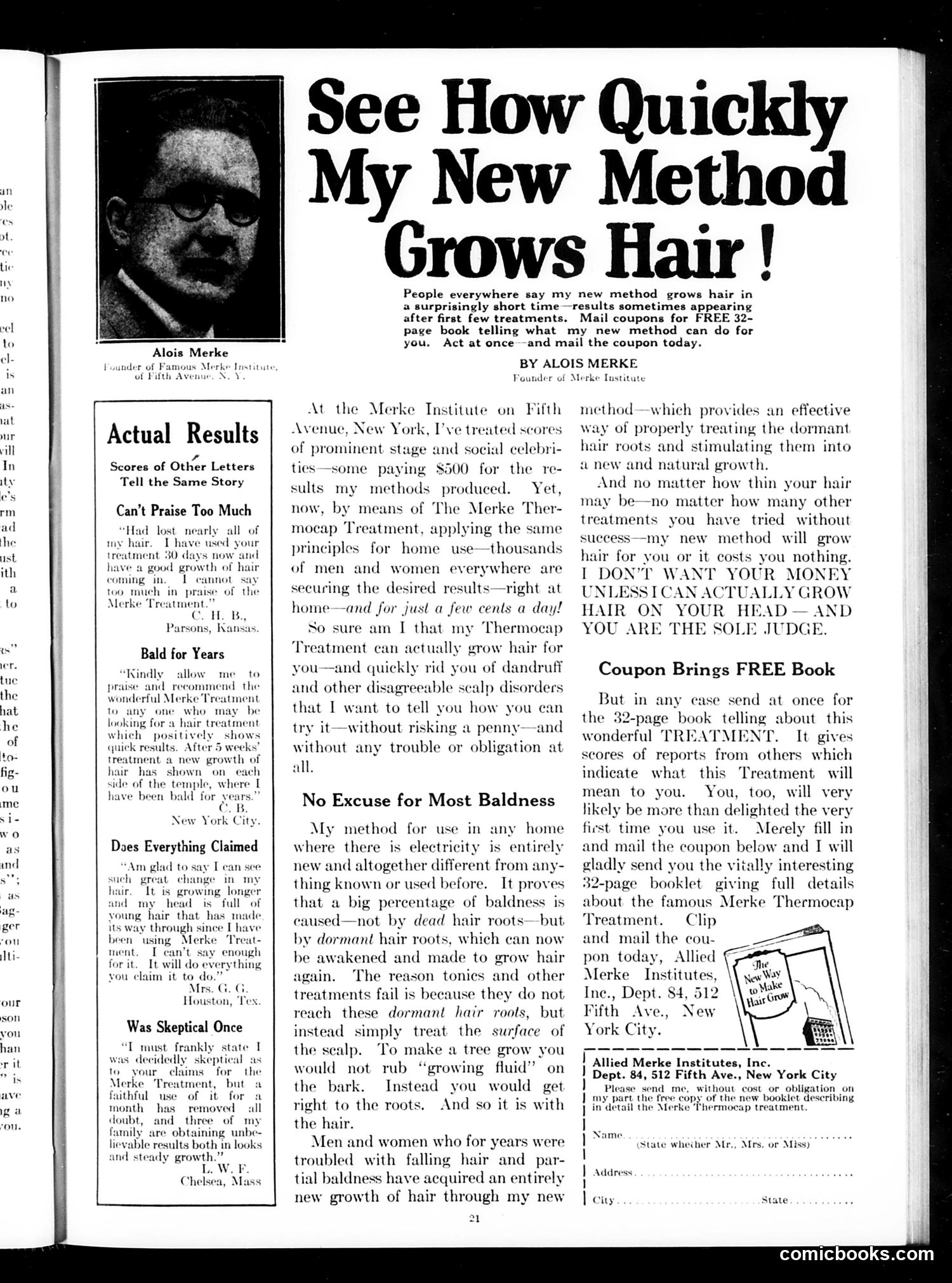
This page is primarily a **commercial advertisement**, not satire. It promotes Alois Merke's "Thermocap Treatment"—an electrical home device claiming to grow hair by stimulating dormant hair roots. The ad uses standard early-20th-century marketing tactics: celebrity testimonials (referencing "prominent stage and social celebrities"), before-and-after claims, and emphasis on affordability ("just a few cents a day"). Merke positions himself as founder of an institute on Fifth Avenue, lending credibility. The pseudo-scientific language—distinguishing between "dead" and "dormant" hair roots, the tree-growing analogy—attempts to legitimize an unproven treatment. The bold promise ("YOU ARE THE SOLE JUDGE") shifts liability to the consumer while the free 32-page booklet functions as a lead-generation tool. This represents typical **patent medicine-era advertising**, before FDA regulation, when such hair-loss remedies were common and largely unregulated. Judge magazine apparently accepted such advertisements alongside its satirical content.
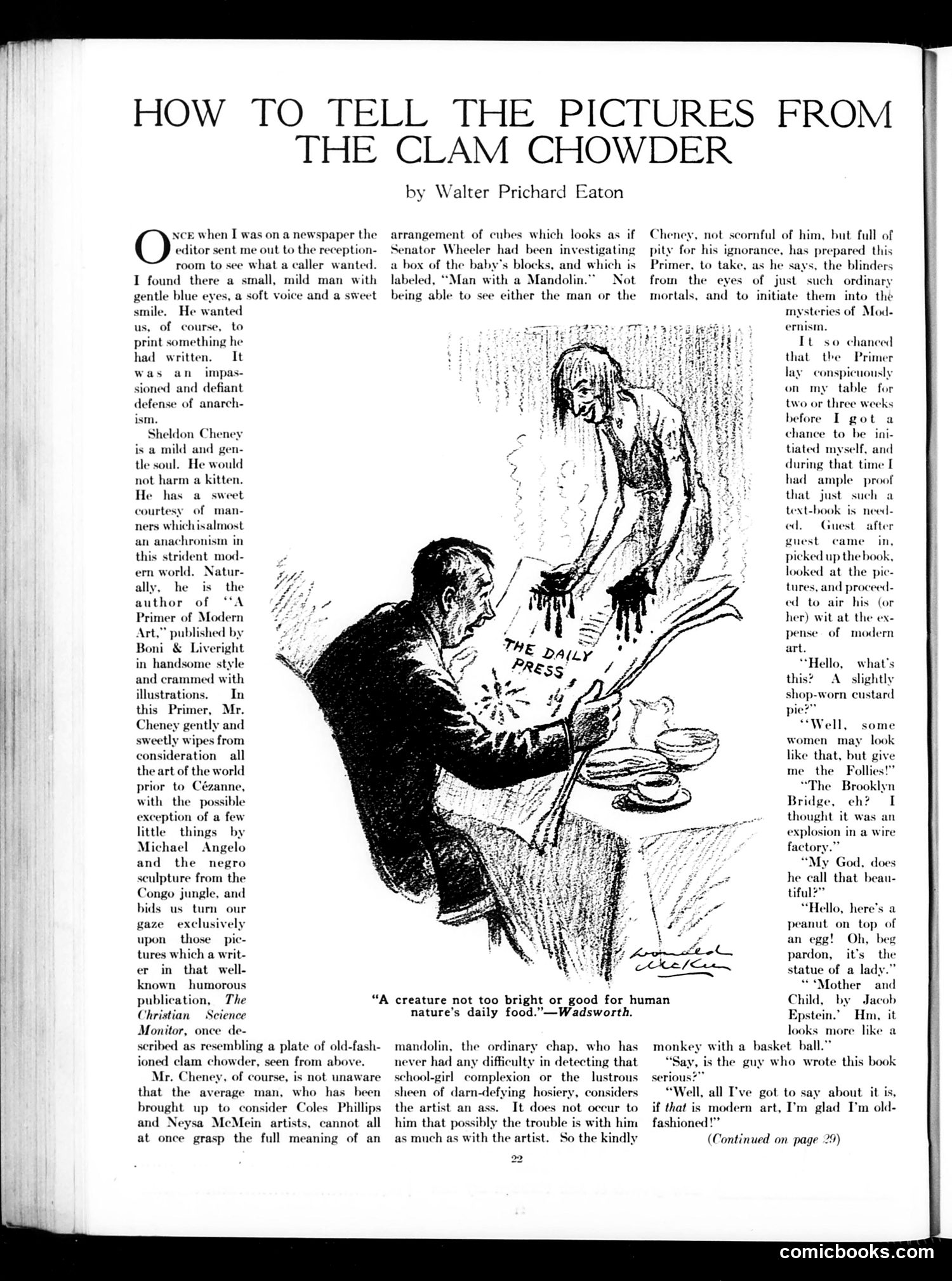
This page satirizes the disconnect between avant-garde modern art and ordinary viewers' incomprehension. The central cartoon depicts a man confronting abstract cubist art (labeled "The Daily Press"), appearing bewildered and defensive. The article mocks Sheldon Cheney's "Primer of Modern Art," which dismisses all pre-Cézanne art to champion modernism. Eaton's humor lies in showing how supposedly educated patrons—brought up appreciating commercial illustrators like Coles Phillips—cannot grasp cubism's value. When guests view Cheney's book, they make derisive jokes comparing abstract paintings to "custard pie," wire factory explosions, and peanuts on eggs. The satire cuts both ways: Cheney condescends to "ordinary mortals" needing enlightenment, while those mortals reasonably question whether the art itself—or the artist—might be at fault. The Wadsworth epigraph suggests some things aren't meant for "human nature's daily food," implying modernism may be deliberately obscure or pretentious.
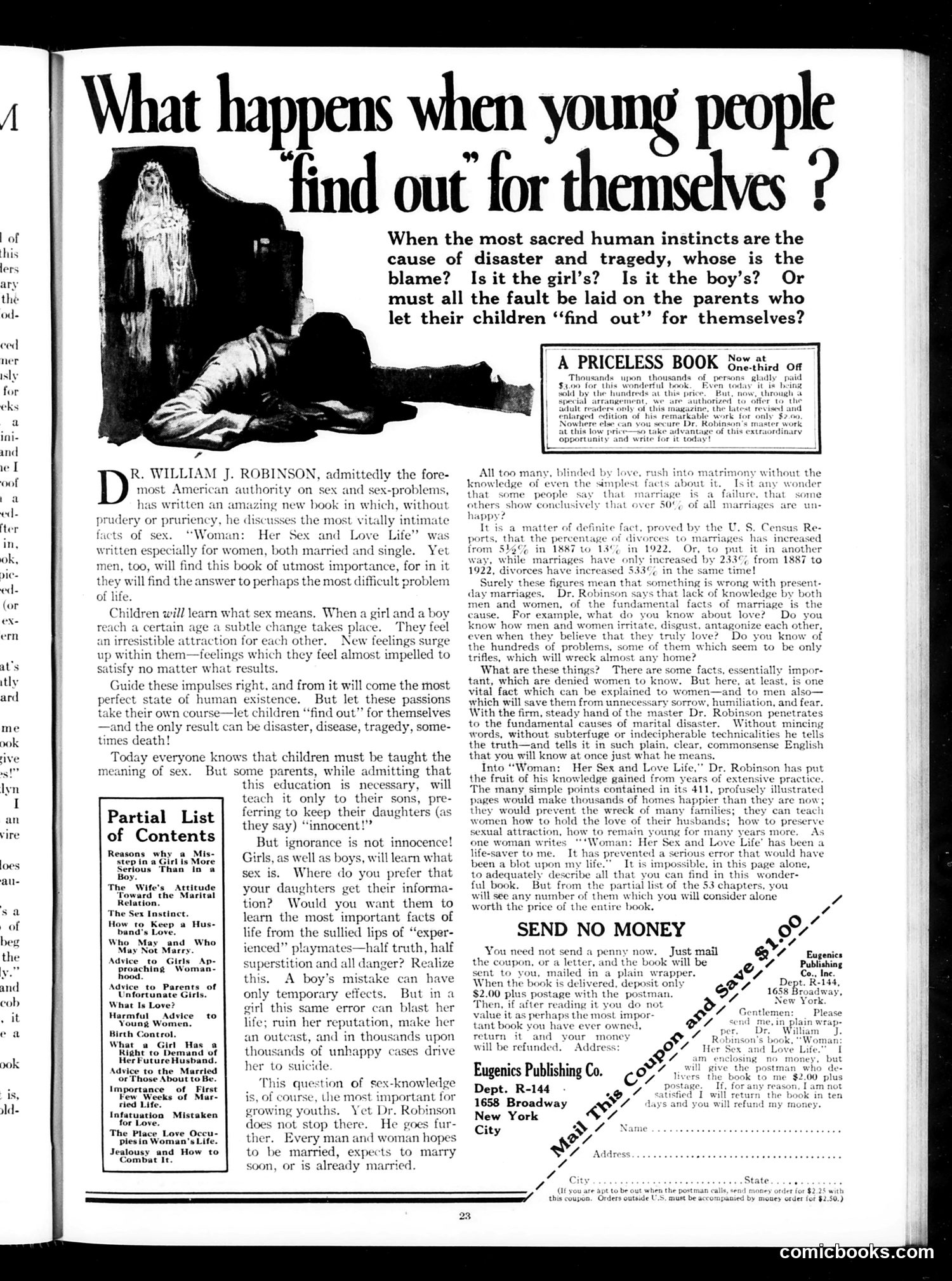
This page advertises Dr. William J. Robinson's book "Woman: Her Sex and Love Life," using fear-based marketing common to early 20th-century sex education publishing. **The Satire/Message:** The illustrated figure appears to represent ignorance or moral danger—the consequences of youth "finding out" about sex without proper guidance. The ad frames sexual knowledge as simultaneously dangerous (leading to "disaster, disease, tragedy") yet essential. **The Social Context:** This reflects a genuine 1920s debate about sex education. Progressive figures like Robinson advocated teaching youth scientific facts rather than leaving them to learn from peers or experience. The ad exploits parental anxiety—suggesting both that ignorance causes problems AND that improper sources are worse. **The Pitch:** "Send no money"—customers mail the coupon and pay $2.00 upon delivery. This suggests the book was considered too scandalous for retailers to stock openly. The page satirizes how publishers marketed "frank" sexual education by simultaneously claiming necessity and sensationalism.
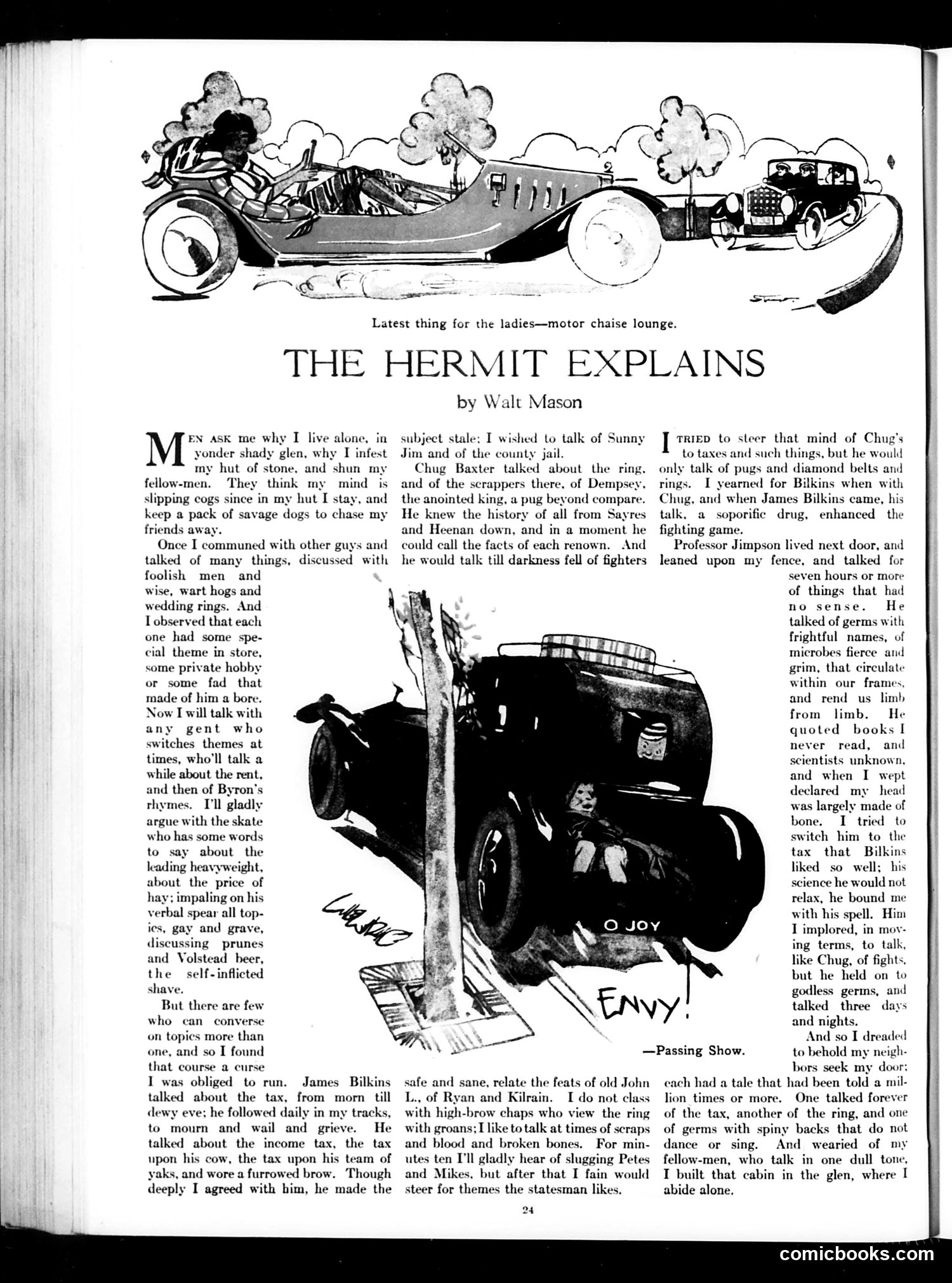
This satirical story explains why someone retreats from society. The narrator describes three tiresome acquaintances, each obsessed with a single topic: James Bilkins relentlessly discusses **income taxes** (likely referencing the newly implemented federal income tax, a controversial topic in early 20th-century America); Chug Baxter endlessly recounts **boxing match details** and fighter histories; and Professor Jimpson monotonously lectures about **germs and microbes** using scientific jargon. The joke mocks social bores and one-track minds—people incapable of varying conversation. The accompanying illustration shows a fashionable motorized "chaise lounge," a humorous luxury item for ladies. The satire captures early 1900s anxieties: new taxation, boxing's popularity, and emerging scientific fears about hygiene and disease—all weaponized through tedious conversation.
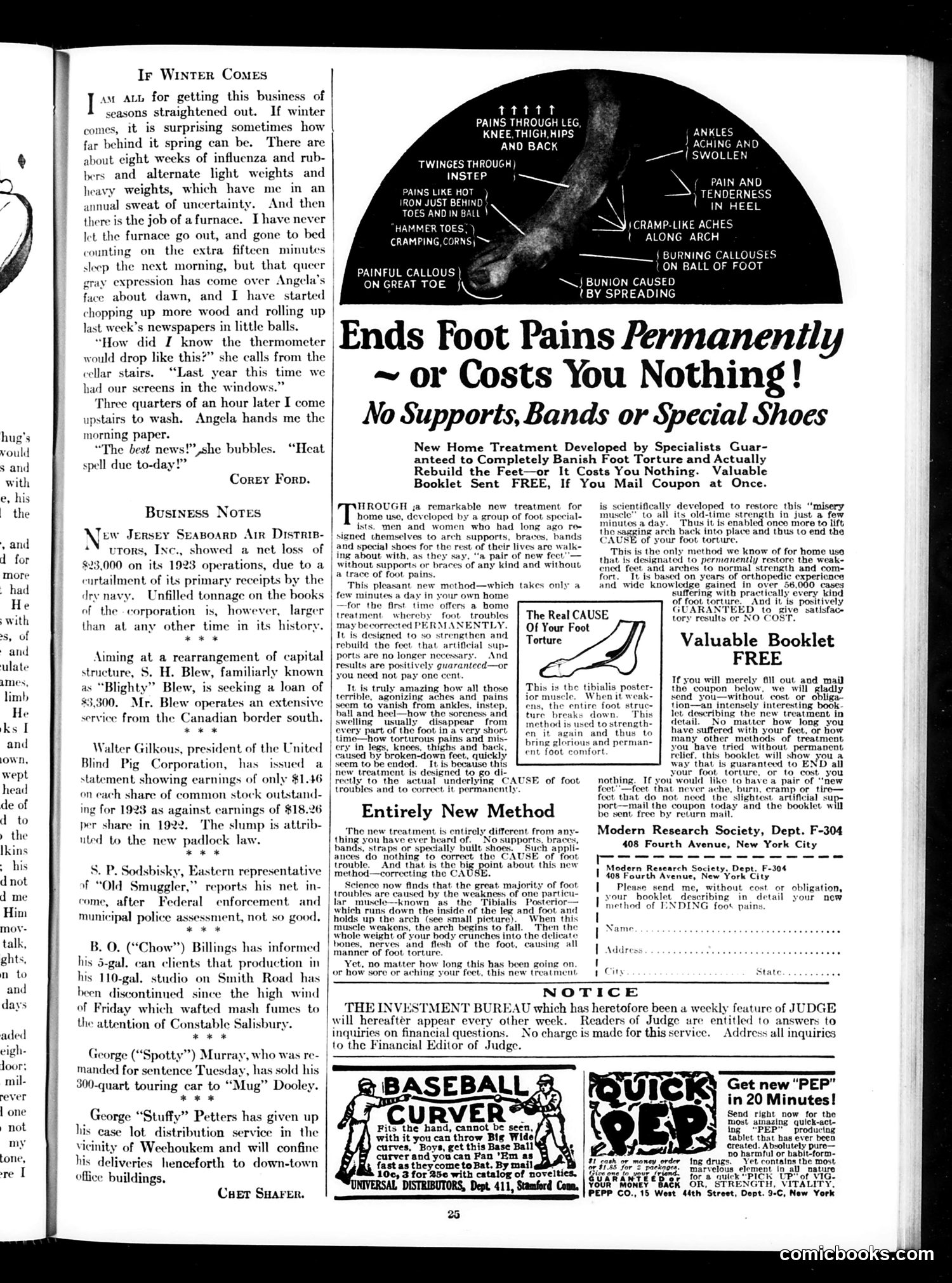
This page mixes editorial content with advertising. The left side contains "Business Notes"—satirical commentary on Prohibition-era bootleggers and smugglers using thin disguises (names like "Blighty" Blew, "Chow" Billings, "Spotty" Murray). These snippets mock real criminals caught by enforcement while maintaining Judge's comedic tone. The dominant right-side advertisement promotes a foot-pain treatment claiming to permanently cure various ailments (bunions, calluses, hammer toes) without supports or shoes—a common dubious medical claim of the 1920s. The illustration diagrams foot problems in pseudo-scientific detail to lend credibility. The "If Winter Comes" essay above is unrelated domestic humor about seasonal heating anxieties. The page reflects 1920s America: rampant underground liquor distribution, aggressive health-product marketing making exaggerated claims, and satirical targeting of actual criminals via humorous pseudonyms.
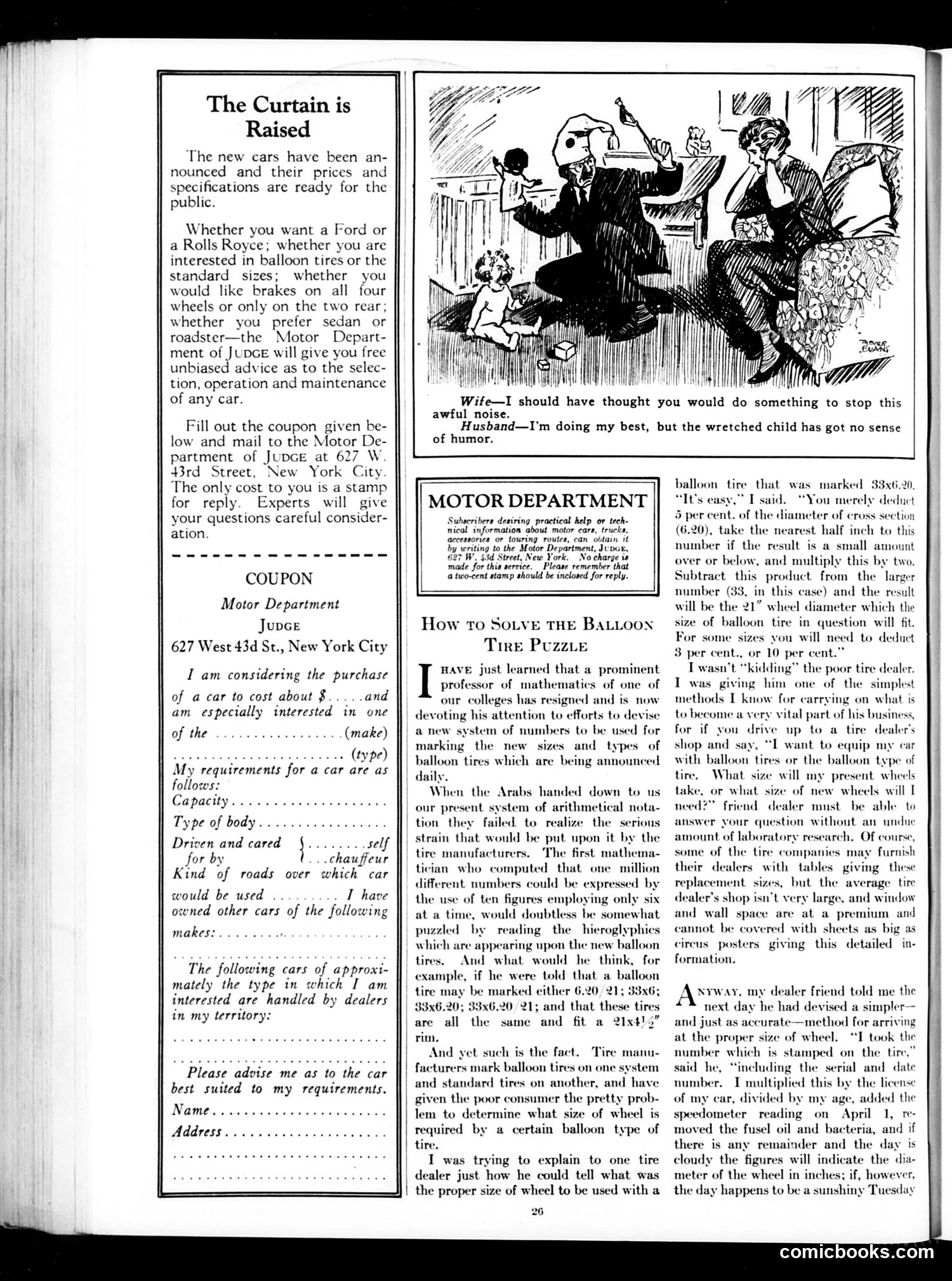
This Judge magazine page contains two distinct items: **The Cartoon**: A domestic scene where a husband plays loudly with a toy balloon (or makes noise with it) while his wife complains. He responds that the child "has got no sense of humor"—a joke about the wife not appreciating his antics or the husband's obliviousness to household disruption. **The Main Content**: An advertisement for Judge's Motor Department, offering free automotive advice via coupon. The accompanying article satirizes the confusing numbering system for newly-introduced balloon tires. A mathematics professor has supposedly resigned to devise a clearer labeling method, as manufacturers use inconsistent sizing nomenclature (e.g., "33x6.20" vs "33x6.20 21"). The author demonstrates the absurdly complicated arithmetic required to determine which wheel size matches which balloon tire—poking fun at automotive industry confusion and poor consumer communication during this era of rapid tire-technology innovation. The satire targets both industry complexity and consumer bewilderment.
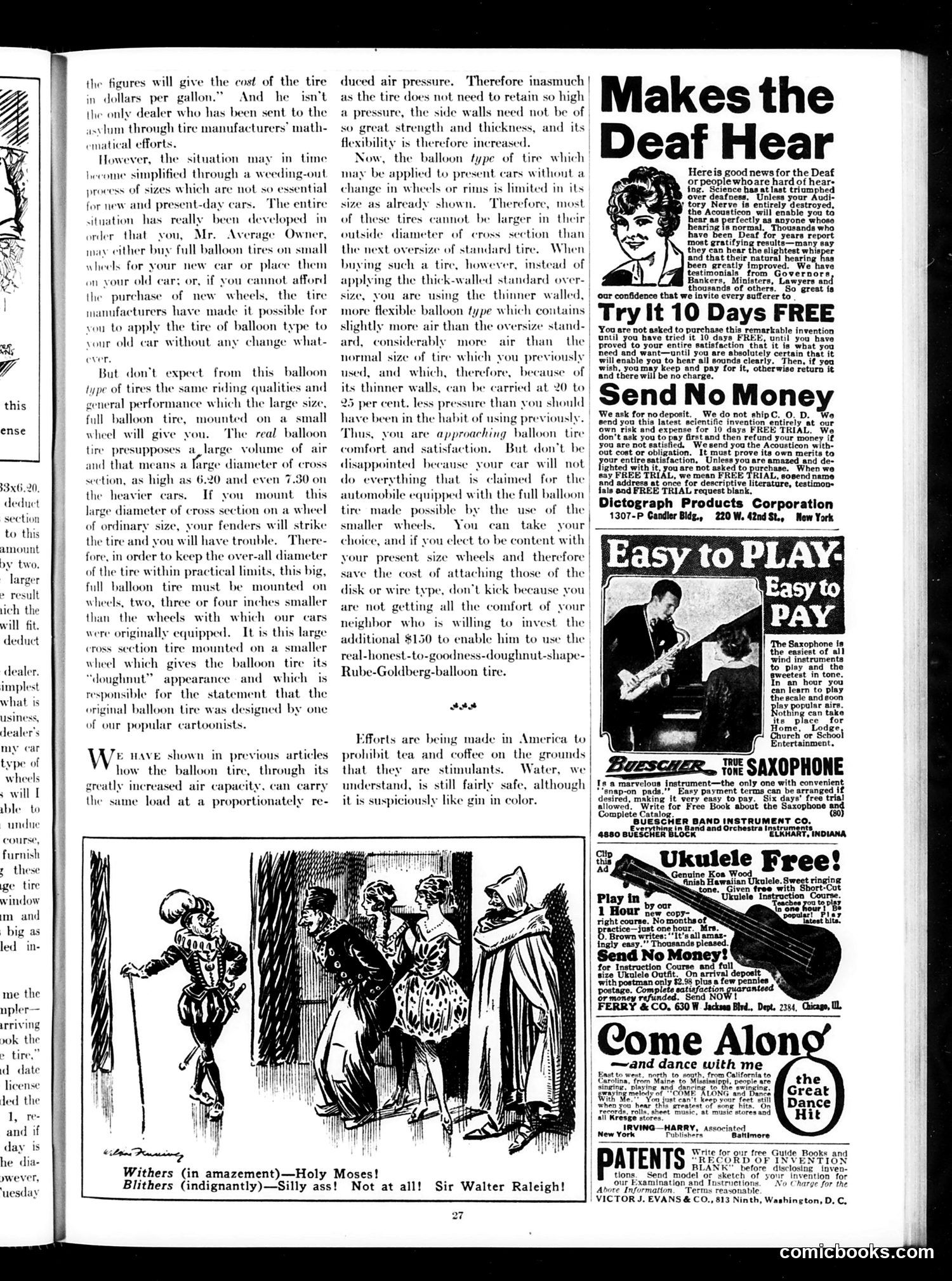
This page is primarily **advertising**, not political satire. The main cartoon at bottom shows a historical scene captioned "Fathers (in amazement)—Holy Moses! Blithers (indignantly)—Silly ass! Not at all! Sir Walter Raleigh!" This appears to be a humorous anachronism joke about Sir Walter Raleigh, likely depicting someone defending Raleigh's reputation regarding tobacco or some other historical matter. The bulk of the page consists of product advertisements typical of 1920s magazines: hearing aids ("Makes the Deaf Hear"), a saxophone course, ukulele lessons, a dance instructional, and patent information. These reflect era-specific consumer products and educational offerings. The lengthy left-column text discusses balloon tire technology for automobiles—a genuine technical article explaining tire engineering to readers, not satire. This represents the magazine's mixed editorial-advertising format.
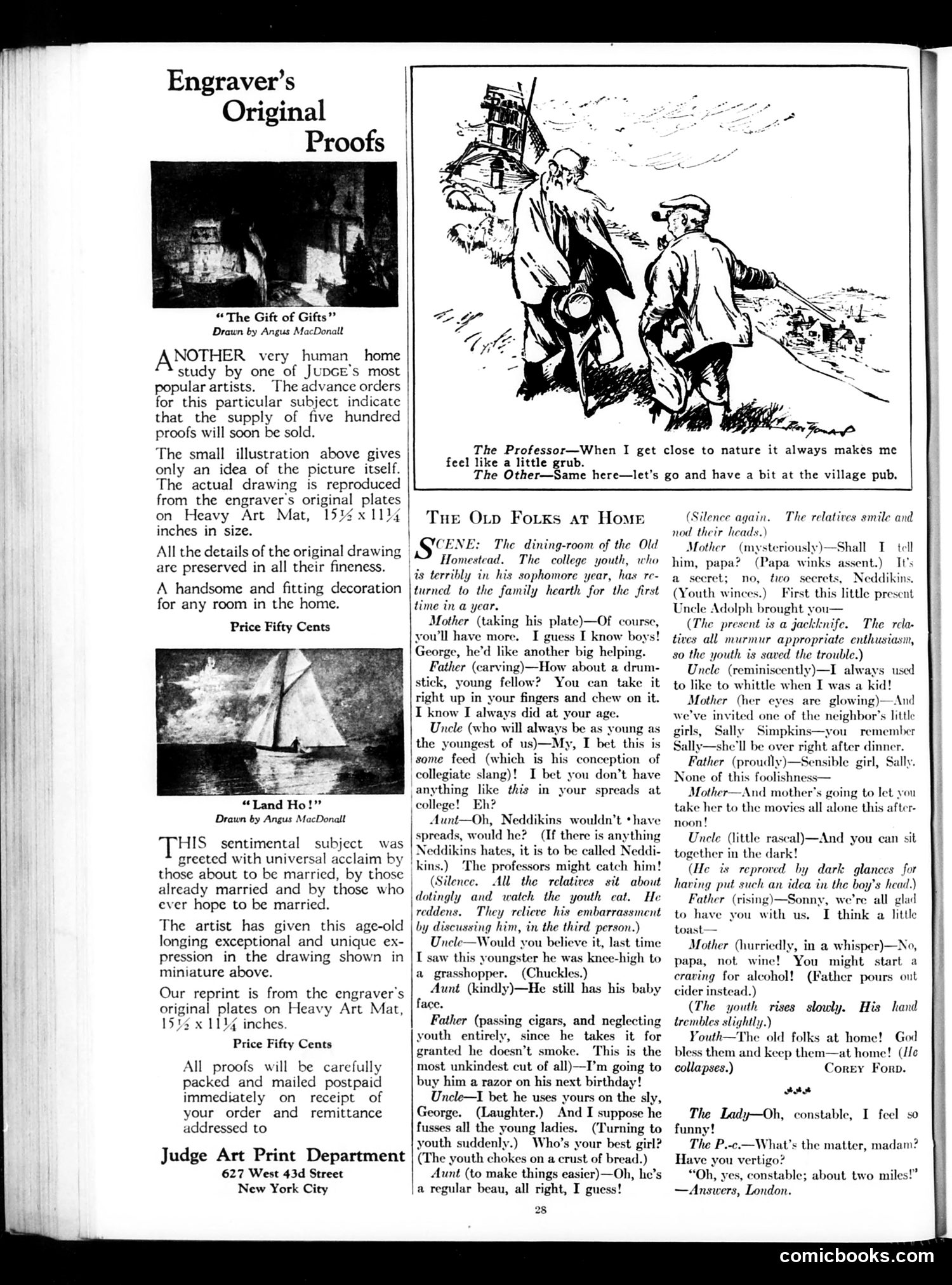
This domestic comedy sketch satirizes the awkwardness of a college sophomore's homecoming visit. The humor centers on how his family treats him—alternating between proud displays of his maturity and patronizing reminders of his childhood. The relatives fuss over him, offer him adult privileges (cigars, razor), yet simultaneously embarrass him by discussing him in the third person and arranging a date with a neighbor girl. The youth's discomfort—choking on bread, wincing—is the joke's emotional core. The satire targets both generational pretense (the young man's collegiate sophistication) and parental obliviousness. The family believes they're honoring his growth while actually highlighting how little he's changed in their eyes. This reflects early 20th-century anxieties about coming-of-age and family dynamics during the college era.
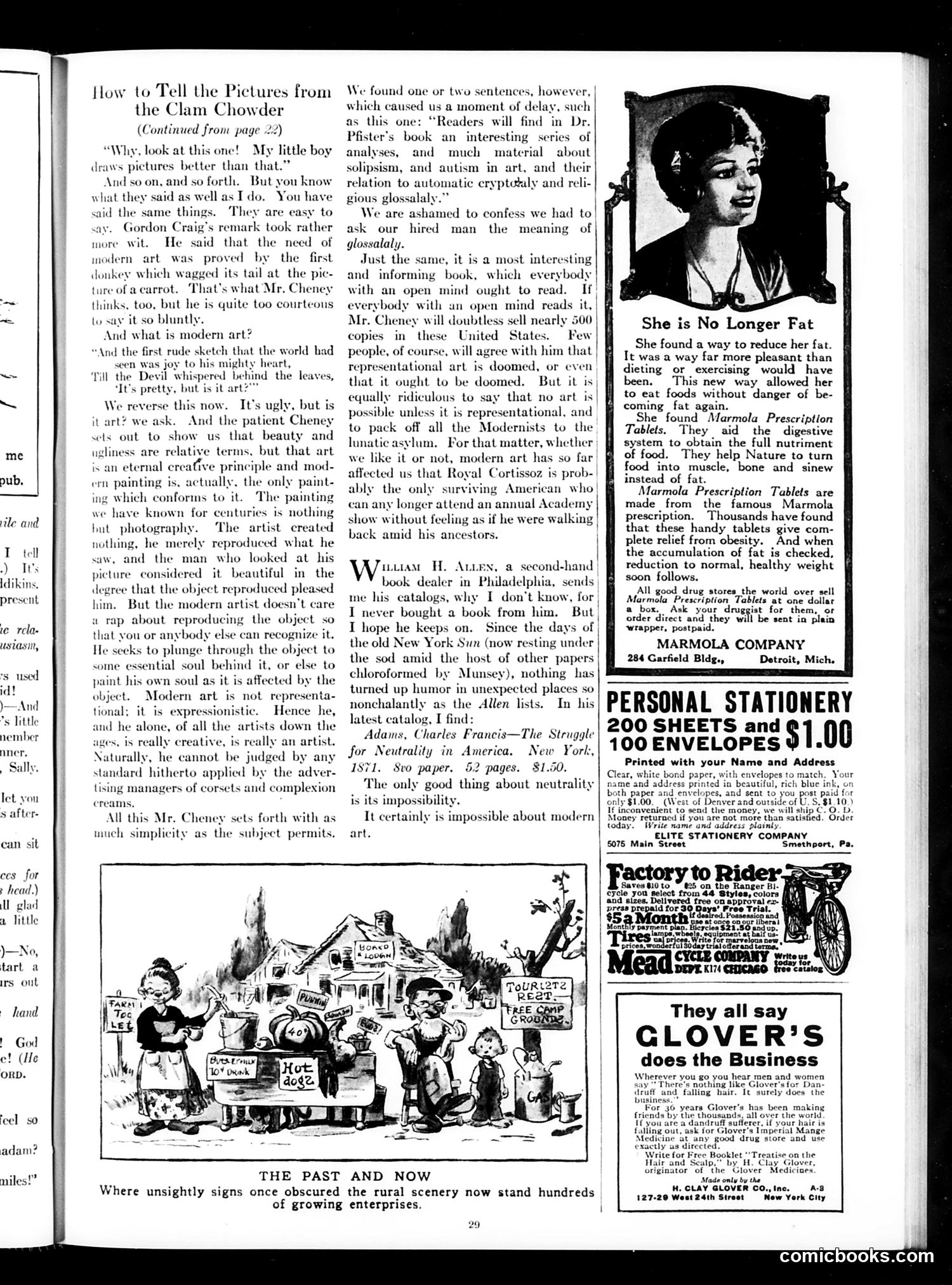
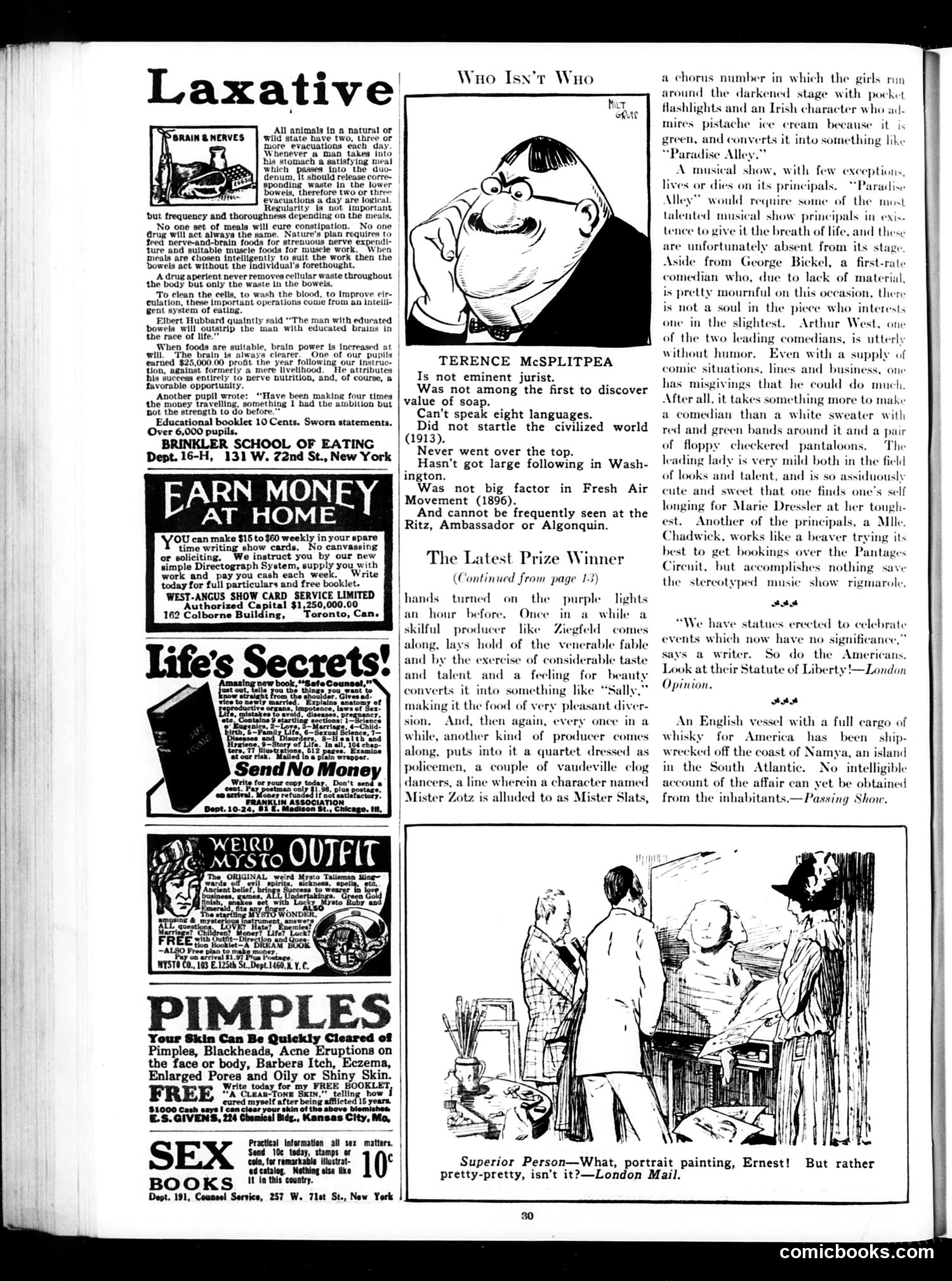
This page from the satirical magazine *Judge* contains two distinct elements: **Main Cartoon Content:** The featured piece is "Who Isn't Who," a humorous profile of "Terence McSplittea," a fictional nonentity. The joke is a list of what McSplittea *didn't* accomplish—he wasn't an eminent jurist, didn't discover soap's value, can't speak eight languages, didn't go "over the top" (WWI reference), and lacks influence in Washington or New York society. The satire mocks ordinary people by inverting the typical "Who's Who" biographical format, poking fun at the pretentiousness of such directories. **Secondary Content:** The page is dominated by period advertisements for mail-order schemes (show cards, "weird outfit" products), self-improvement guides (the Brinkler School of Eating), and dubious remedies (pimple cures, sex books)—typical of early 20th-century magazine advertising targeting readers seeking quick success or solutions. The McSplittea cartoon epitomizes Judge's satirical voice: mocking vanity and social pretension through clever wordplay and absurdist humor.
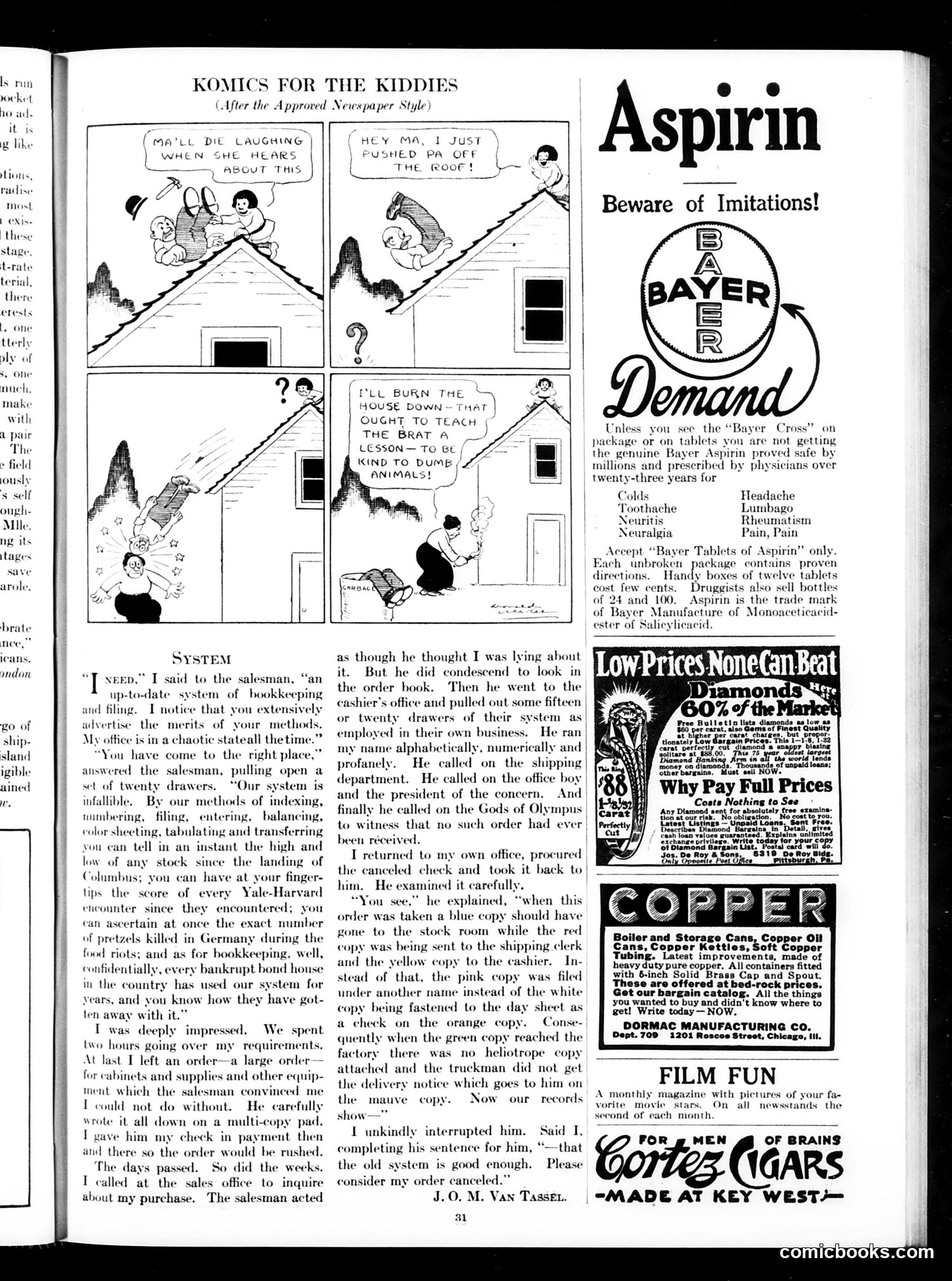
## "Komics for the Kiddies" This four-panel cartoon satirizes overly dark humor falsely marketed as children's entertainment. Each panel depicts a parent causing harm to a child (pushing father off roof, burning house down) while claiming to teach lessons. The joke mocks newspapers that publish grotesquely inappropriate content under the guise of "approved" comics—the brutal scenarios contradict the innocent premise. ## "System" Article This satirical story ridicules elaborate office filing systems. A salesman convinces a businessman to purchase an unnecessarily complex multi-copy, color-coded filing system. When the customer later tries to retrieve his order, the system has failed so spectacularly that no record exists. The salesman's absurd explanation (pink copy filed wrong, missing heliotrope copy, etc.) exposes how such "infallible" systems often create chaos rather than efficiency. The satire targets early 20th-century corporate obsession with systematization. Both pieces reflect Judge's mocking of contemporary American trends and institutions.
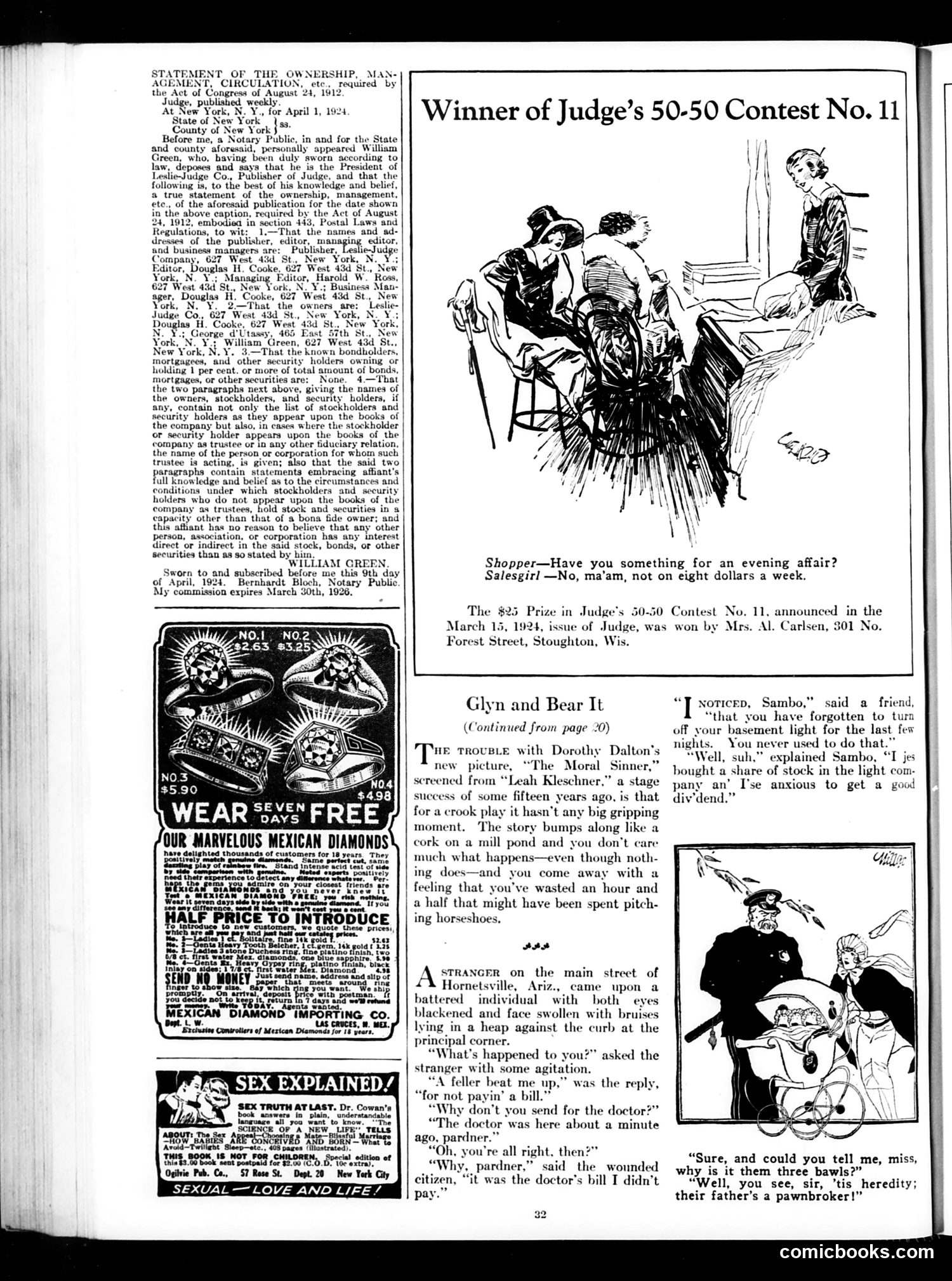
This page consists primarily of **legal/administrative content** (ownership statement for Judge magazine, dated April 1, 1924) and **advertisements**, with two brief humorous sections at bottom right. **The cartoons/humor:** The main illustrated content shows two separate jokes: 1. **"Shopper" cartoon** (top right): A woman asks a shopkeeper if he has something suitable for an evening affair, specifying "not on eight dollars a week"—a Depression-era joke about limited budgets for working women. 2. **"Glyn and Bear It" section** (bottom): Two brief anecdotes. The first mocks Dorothy Dalton's film "The Moral Sinner" as boring and underwhelming. The second depicts a stranger asking a battered man in Arizona what happened; the man replies "a feller beat me up," and when asked if he called a doctor, explains the doctor was already there—the joke being the doctor himself beat him up over an unpaid bill (or paternity claim, suggested by pawnbroker reference). The page is essentially a mix of required legal notices and period advertisements, with modest satirical humor typical of Judge's lighter content.
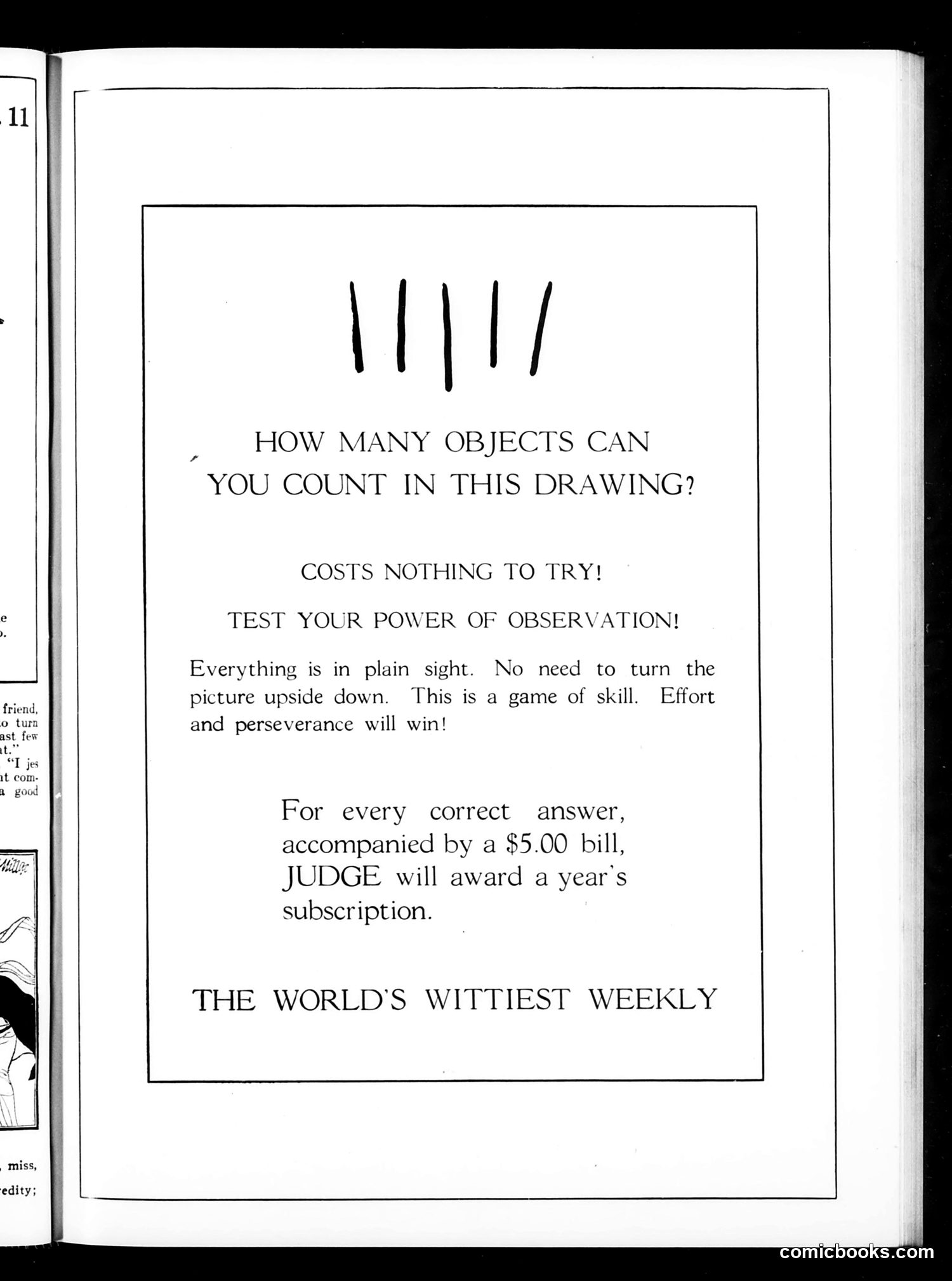
This is primarily **an advertisement page**, not a political cartoon. Judge magazine is promoting a visual counting puzzle to readers, featuring five vertical lines at the top (the "objects" to count). The content is a **participation game**: readers must count the objects in the drawing, send their answer with a $5 bill, and receive a year's free subscription if correct. The copy emphasizes observation skills and perseverance. There is **no political satire or social commentary** on this page. It's a straightforward promotional gimmick typical of early-to-mid 20th century magazines, using interactive contests to boost subscriptions and engagement. The tone is lighthearted and game-like rather than satirical. The "World's Wittiest Weekly" tagline refers to Judge's brand as a humor publication.
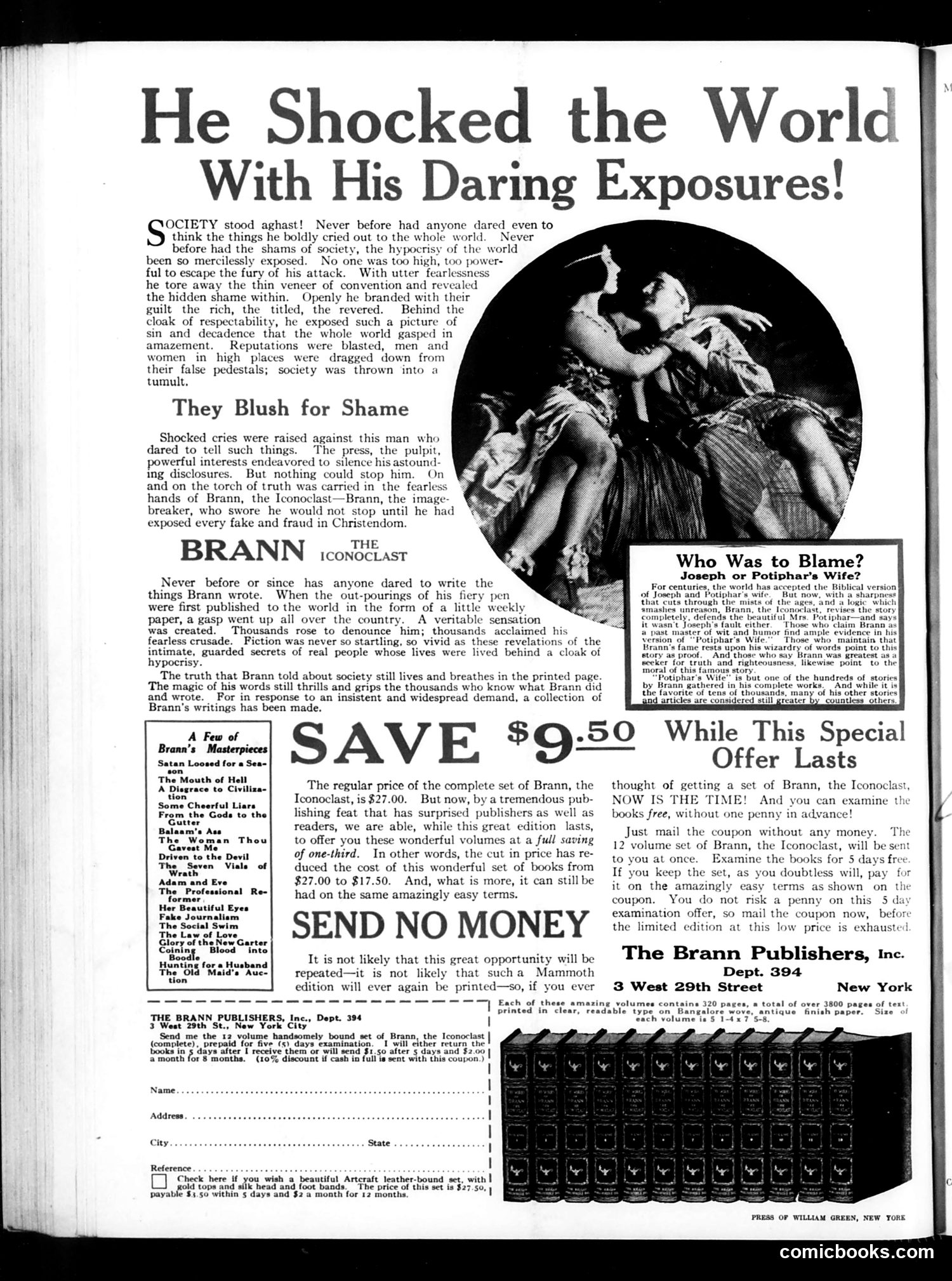
This page advertises a 12-volume collection of writings by **William Cowper Brann**, an actual Texas journalist and social critic (1855-1898). Brann published *The Iconoclast*, a weekly paper known for attacking religious hypocrisy, corruption among the wealthy and powerful, and social shams. The advertisement employs hyperbolic language ("Shocked the World," "daring exposures") to market Brann as a fearless truth-teller who exposed fraud in churches and high society. The imagery shows Brann as a heroic figure tearing away society's false respectability. The satirical angle appears subtle: this is primarily a straightforward sales pitch leveraging Brann's genuine reputation as a muckraking iconoclast. However, the grandiose tone—"Never before or since has anyone dared"—borders on self-parody, typical of Judge's advertising style. The offer ($9.50 savings, "send no money," easy payment terms) reflects standard early-20th-century mail-order tactics. This is advertisement disguised as editorial content, common in period magazines.