
Judge, 1924-04-26 · page 15 of 36
Judge — April 26, 1924 — page 15: what you’re looking at
What you’re looking at
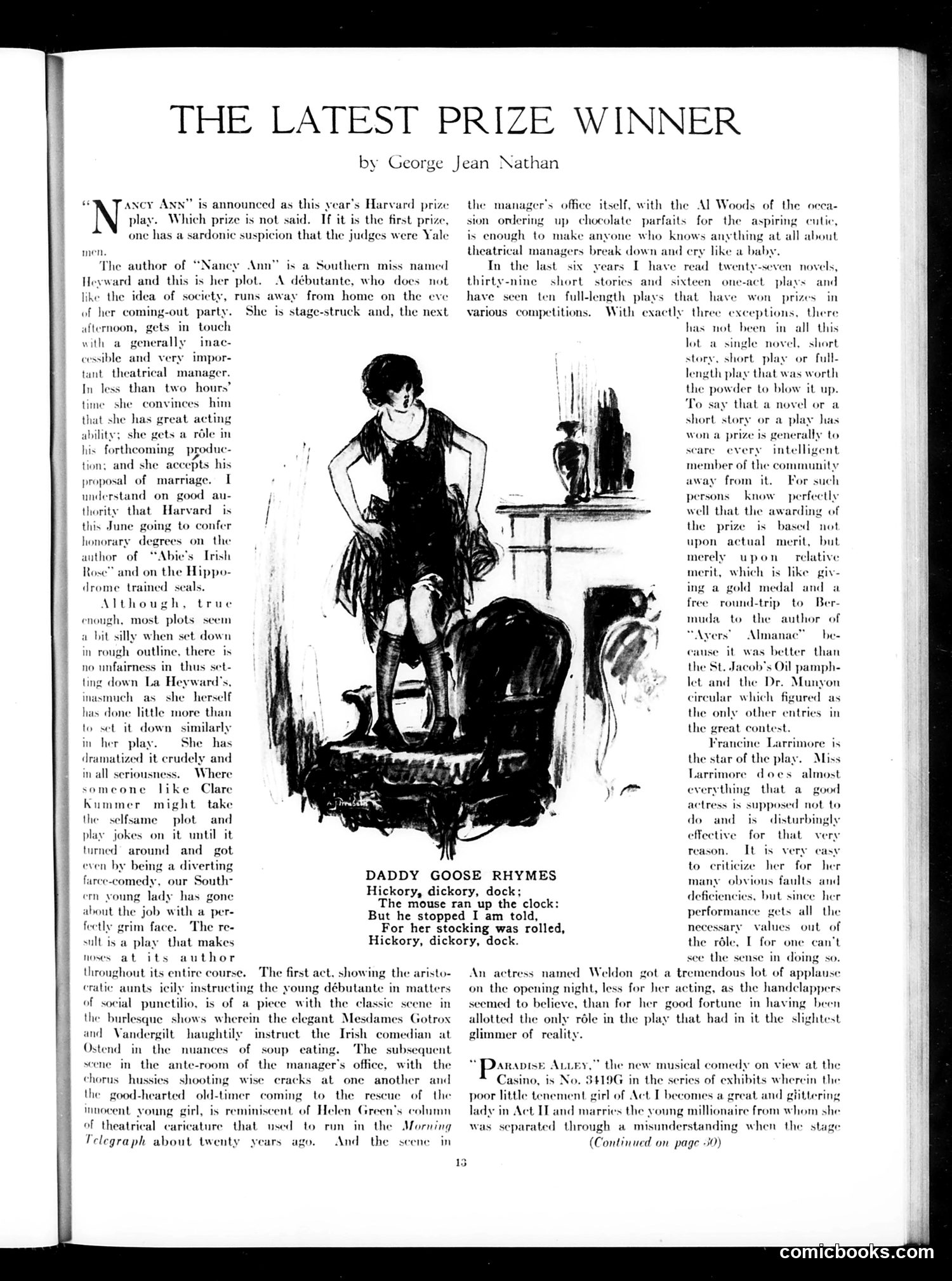
This is a theater review by George Jean Nathan, Judge's drama critic, satirizing the Harvard Prize for drama. The piece mocks "Nancy Ann," a play by Southern debutante author Heyward, for its implausible plot: a runaway girl convinces a theatrical manager of her acting talent in two hours, lands a role, and accepts his marriage proposal. Nathan's satire targets both the play's melodramatic absurdity and the prize itself—opening with a jab that if Harvard truly awarded this first prize, "the judges were Yale men" (implying Yale would never recognize such inferior work). The "Daddy Goose Rhymes" parody below is unrelated filler content typical of Judge's mixed format. The cartoon illustration depicts the play's central absurdity: the debutante's improbable rapid rise in theater. Nathan argues the plot becomes ridiculous when dramatized seriously, contrasting it with how a talented writer like Clare Kummer might have transformed it into satirical farce instead.
📄 Transcribed text from this page (OCR, searchable)
Machine-transcribed from the original scan — historical spelling and the odd misread are preserved.
THE LATEST PRIZE WINNER by George Jean Nathan “ ney Ann” is announced as this year’s Harvard prize N I Which prize is not said. If it is the first prize, onc has a sardonic suspicion that the judges were Yale men. The author of “Nancy Ann” is a Southern miss named Heyward and this is her plot. A débutante, who does not like the idea of society, runs away from home on the eve of her coming-out party. She is stage-struck and, the next afternoon, gets in touch with a generally inac- cessible and very impor- tant theatrical In less than two hours’ time she him that she has gre ability; she gets a réle in produc- manager. convinces t acting his forthcoming tion; and she accepts his proposal of marriage. I understand on good au- thority that Harvard is this June going to confer honorary degrees on the author of “Abie’s Trish Rose” and on the Hippo- drome trained seals. Although, most plots seem true enough a bit silly when set down in rough outline, there is no unfairness in. thus set- ting down La Heyward’s, inasmuch as she herself has done little more than to set it down. similarly in her play. She has dramatized it crudely and in all seriousness. Where like Clare might take the selfsame plot and play jokes on it until it turned around and got even by being a diverting farce-comedy, our South- ern young lady has gone someone Kummer about the job with a per- fectly grim face. The re- sult is a play that makes at its author throughout its entire course. cratic The first act. showing the aristo- nts icily instructing the young débutante in matters punctilio, is of a piece with the classic scene in the burlesque shows wherein the elegant M and Vandergilt haughtily instruct the Ostend in the nuances of soup eating. seene in the ante-room of the manager's offic chorus of soci mes Gotrox Trish comedian at The subsequent with the shooting wise cracks at one another and the good-hearted old-timer coming to the hussies rescue of the innocent young girl, is reminiscent of Helen Green's column of theatrical caricature that used to run in the Morning Telegraph about twenty years ago. And the scene in DADDY GOOSE RHYMES Hickory, dickory, dock; The mouse ran up the clock: But he stopped I am told, For her stocking was rolled, Hickory, dickory, dock. the manager's office itself, with the Al Woods of the occa- sion ordering up chocolate parfaits for the aspiring cutie, is enough to mi » who knows anything at all about theatrical managers break down and ery like a bab: In the last six years I have read thirty short one-act plays and have seen ten full-length plays that have won prizes in various competitions. ke anyon twenty-seven novels, nine stories and sixteen With exactly three exceptions, there all’ this lot a single novel, short or full- as worth the powder to blow it up. To say that a novel or a short story or a has not been in story. short pl length play that as won a prize is generally to intelligent member of the community away from it. know perfectly well that the awarding of seare every For such persons based not merit, but the prize is upon actual merely upon relative merit, which is like giv- ing a gold medal and a free round-trip to Ber- muda to the author of ‘ Almanac” be- was better than the St. Jacob's Oil pamph- let and the Dr. Munyon circular which figured as the only other entries in the great contest. cause it Francine Larrimore is the star of the play. Miss Larrimore does almost everything that a good actress is supposed not to do and is effective for disturbingly that reason. It is. very’ easy to criticize her for her very many obvious faults and es, but since her gets all the out. of I for one can't see the sense in doing so. An actress named Weldon got a tremendous lot of applause on the opening night, less for her acting, as the handclappers seemed to believe, than for her good fortune in having been allotted the only réle in the play that had in it the slightest glimmer of reality. deficien performanc nece the rdle values * Panavise Atuey,” the new musical comedy on view at the Casino, is No. 3419G in the series of exhibits wherein the poor little tenement girl of Act I becomes a great and g) lady in Act [Land marries the young millionaire from whom she was separated through a misunderstanding when the stage tlering (Continued on page 30) comicbooks.com