
Judge, 1924-04-26 · page 5 of 36
Judge — April 26, 1924 — page 5: what you’re looking at
What you’re looking at
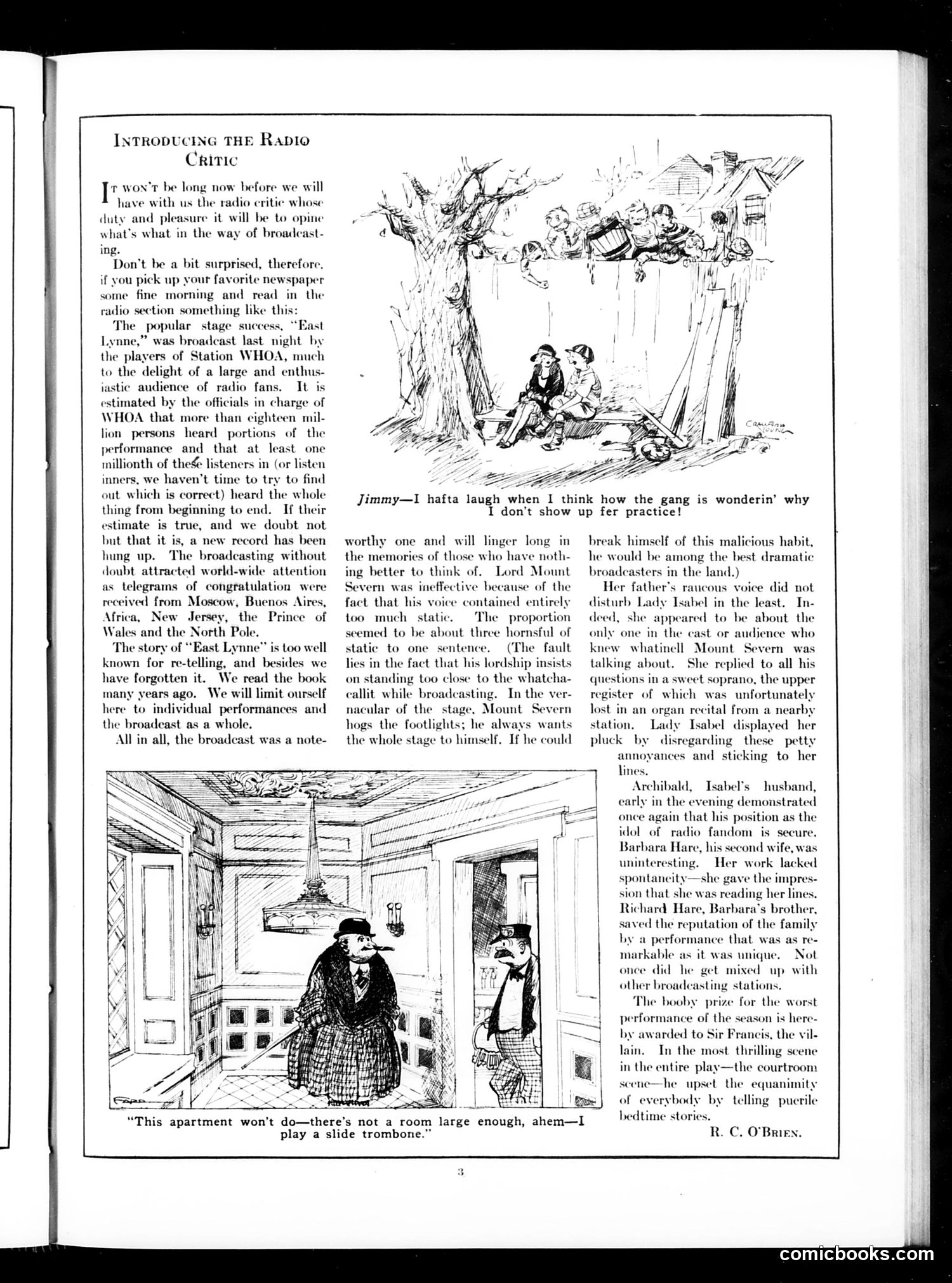
This page satirizes early radio broadcasting, specifically a recent "East Lynne" dramatic performance on station WHOA that attracted eighteen million listeners. The article mockingly introduces the emerging role of the "radio critic"—a new journalistic position created to review radio broadcasts. The cartoons illustrate performance problems: the top shows characters under a tree discussing the broadcast's poor quality; the bottom depicts an apartment too cramped for proper performance ("there's not a room large enough...I play a slide trombone"). The satire targets both the absurdity of mass radio audiences and the pretension of establishing formal criticism for this new medium. The joke implies that radio drama is technically awkward and that critics are unnecessary for such crude performances—a dismissive view of early broadcasting that now seems historically ironic.
📄 Transcribed text from this page (OCR, searchable)
Machine-transcribed from the original scan — historical spelling and the odd misread are preserved.
INTRODUCING THE Rapio Critic I" won't be long now befe will have with us the radio er duty and pleasure it will be to opine what's what in the way of broadcast- ing. Don't be a bit surprised, therefore, if you pick up your favorite newspaper some fine morning and read in the radio section something like th The popular stage success, “East Lynne,” was broadcast last. night by the players of Station WHOA, much to the delight of a large and enthus- iastie audience of radio fans. It is estimated by the officials in charge of WHOA that more than eighteen mil- lion persons heard portions of the performance and that at least one millionth of theg listeners in (or listen inners, we haven't time to try to find out which is correct) heard the whole thing from beginning to end. If their estimate is true, and we doubt not but that it is, a new record has been hung up. The broadcasting without doubt attracted world-wide attention as telegrams of congratulation were ed from Moscow, Buenos Aires, New Jersey, the Prince of Vales and the North Pole The story of “East Lynne” is too well known for re-telling, and besides we have forgotten it. We read the book many years ago. We will limit ourself here to individual performances and the broadeast as a whole. All in all, the broadcast was a note- whose 4 San} Jimmy—I hafta laugh when I think how the gang is wonderin’ why I don’t show up fer practice! worthy one and will linger long in the memories of those who have noth- ing better to think of. Lord Mount Se s ineffective ise of the fact that his v red entirely too much static. The proportion seemed to be about three hornsful of ie to one (The fault in the fact that his lordship insists on standing too close to the whatcha- callit while broadcasting. In the ver- nacular of the stage, Mount Severn hogs the footlights; he always wants the whole stage to himself. If he could sentence, break himself of this malicious habit, he would be among the best dramatic broadcasters in the land.) Her father’s raucous voice did not disturb Lady Isabel in the least. In- deed, she appeared to be about the only one in the cast or audience who knew whatinell Mount Severn was talking about. She replied to all his questions in a sweet soprano, the upper register of which was unfortunately lost in an organ recital from a nearby station, Lady Isabel displayed her pluck by disregarding these petty annoyances and sticking to her lines. Archibald, Isabel's husband, carly in the evening demonstrated once again that his position as the idol of radio fandom is secure. Barbara Hare, his second wife, was uninteresting. Her work lacked spontaneity—she gave the impres- sion that she was reading her lines. Richard Hare, Barbara’ u's brother, saved the reput ; ion of the fam by a performance that was as markable as it was unique. Not once did he get mixed up with other broadcasting stations. The booby prize for the worst performance of the season is here- by awarded to Sir Francis, the vil- lain. In the most thrilling scene in the entire play—the courtroom scene—he upset the equanimity of everybody by: telling puerile bedtime stories. R. C. O'Brien, “This apartment won’t do—there’s not a room large enough, ahem—I play a slide trombone.” Da le ee comicbooks.com