
A complete issue · 36 pages · 1924
Judge — April 19, 1924
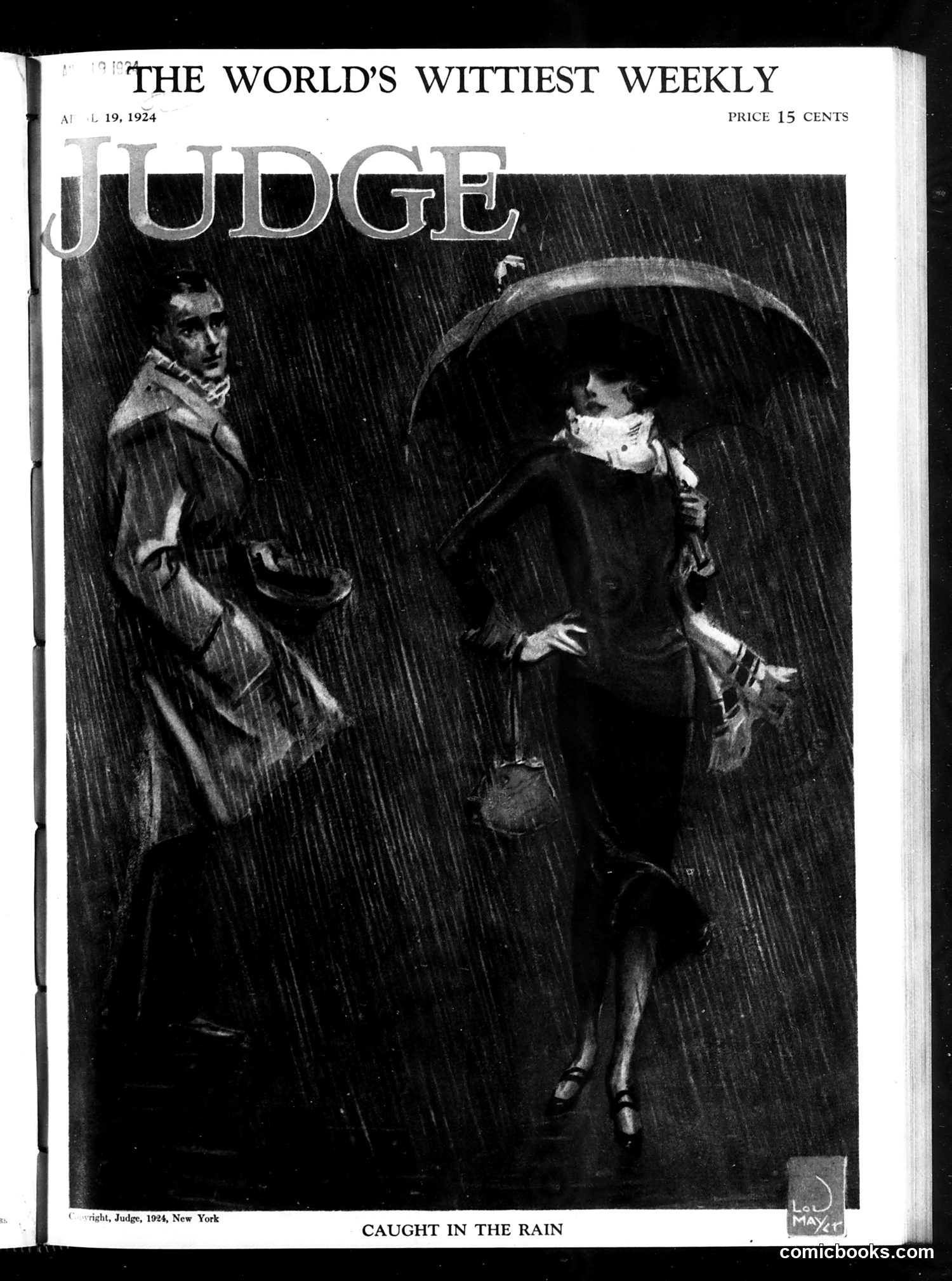
This Judge magazine cover from April 19, 1924 depicts two figures caught in heavy rain. The woman in the foreground wears a large hat and holds a handkerchief to her face, while a man in a coat stands behind her in the background, observing. The title "Caught in the Rain" appears a double entendre—suggesting both literal weather and being caught in a compromising situation. Given Judge's satirical nature and the 1924 date, this likely comments on social propriety and scandal. The woman's distressed posture and the man's presence implies infidelity or an illicit encounter exposed. The rain functions as both setting and metaphor for exposure or embarrassment. Without identifying the specific figures, the cartoon appears to satirize the social consequences of being publicly discovered in an inappropriate situation.
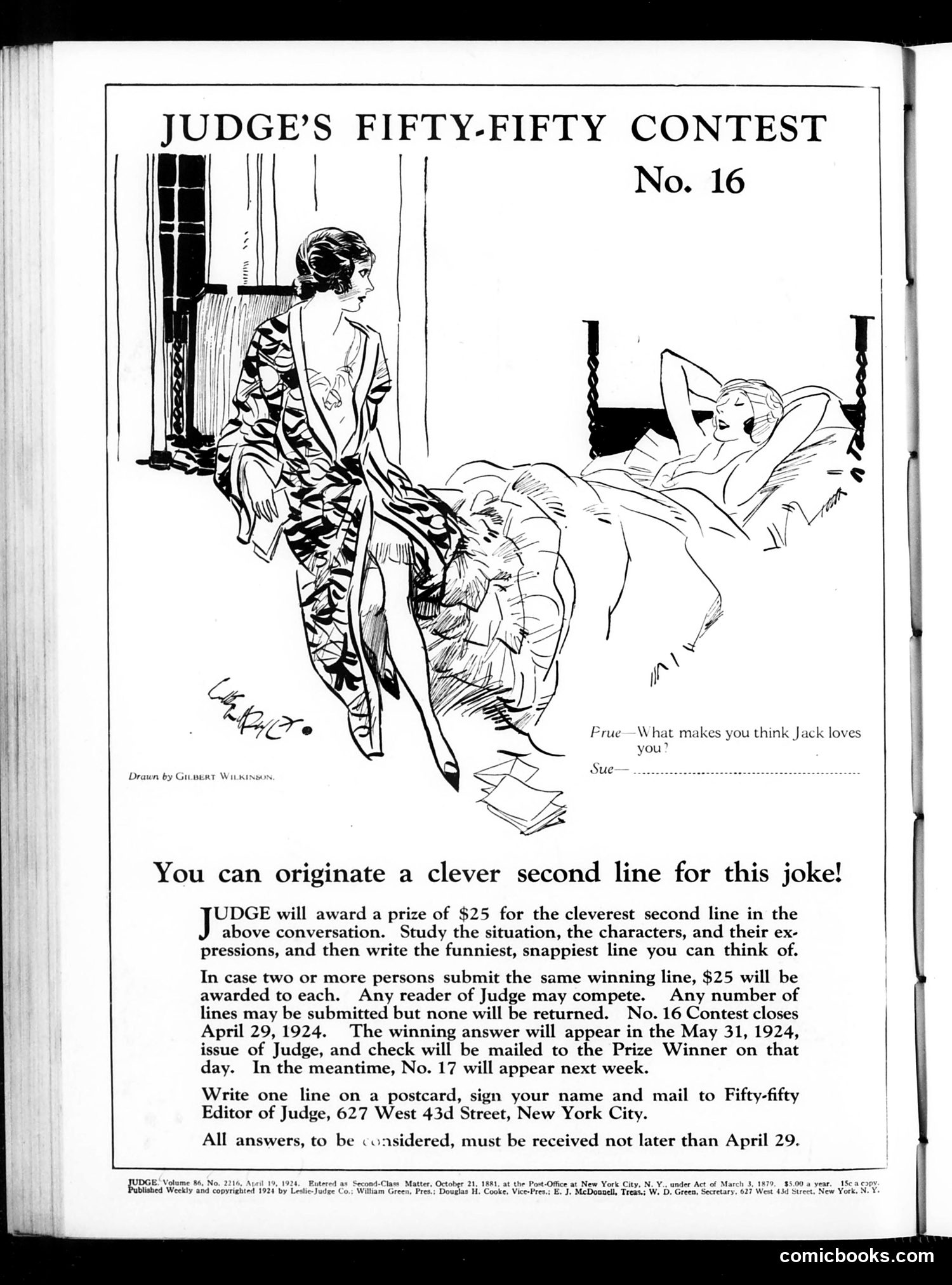
This page presents a humor contest, not political satire. The cartoon by Gilbert Wilkinson depicts a domestic scene: a woman in an ornate robe sits on a bed while a man lies in it. The setup dialogue reads: **Frue:** "What makes you think Jack loves you?" **Sue:** [blank line for reader response] Judge magazine invited readers to submit clever punchlines for this romantic/marital humor scenario, offering a $25 prize for the cleverest second line. The cartoon captures 1920s attitudes toward relationships and gender dynamics through lighthearted domestic comedy rather than political commentary. The contest deadline was April 29, 1924, with winners announced in the May 31 issue.
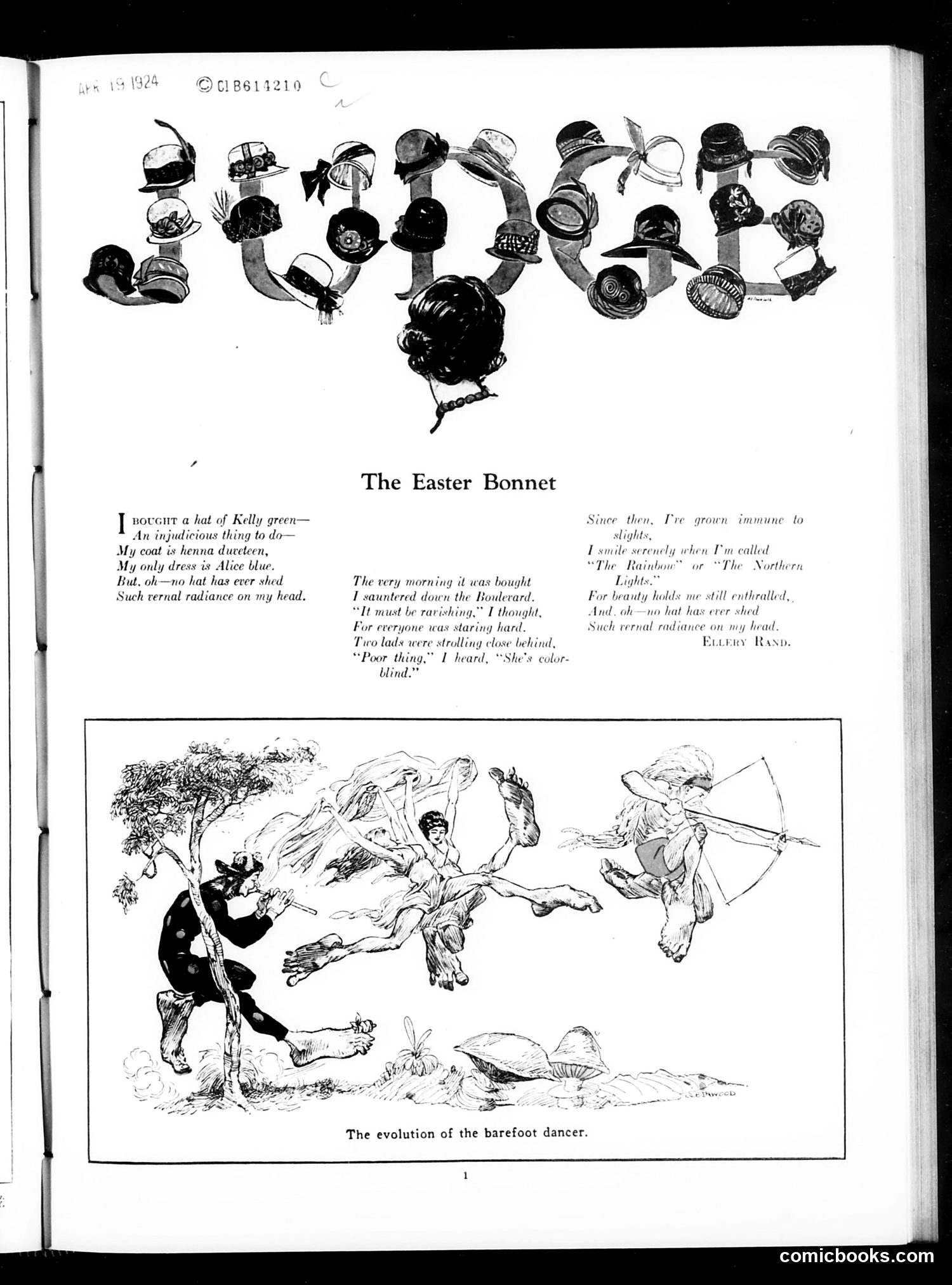
This page from *Judge* magazine satirizes Easter fashion, particularly women's elaborate Easter bonnets. The upper illustration displays various extravagant hat styles stacked above a woman's head, mocking the absurd excess of millinery trends. The poem by Ellery Rand humorously describes a woman purchasing a "Kelly green" hat—"an injudicious thing to do"—despite her limited wardrobe. The satire highlights the disconnect between women's actual means and their spending on fashionable accessories, particularly hats which were status symbols and essential Easter wear. The lower illustration, "The evolution of the barefoot dancer," appears unrelated—a separate satirical piece about modern dance trends, showing a figure's exaggerated contortions. The overall message critiques conspicuous consumption and women's fashion obsession during the Easter season.
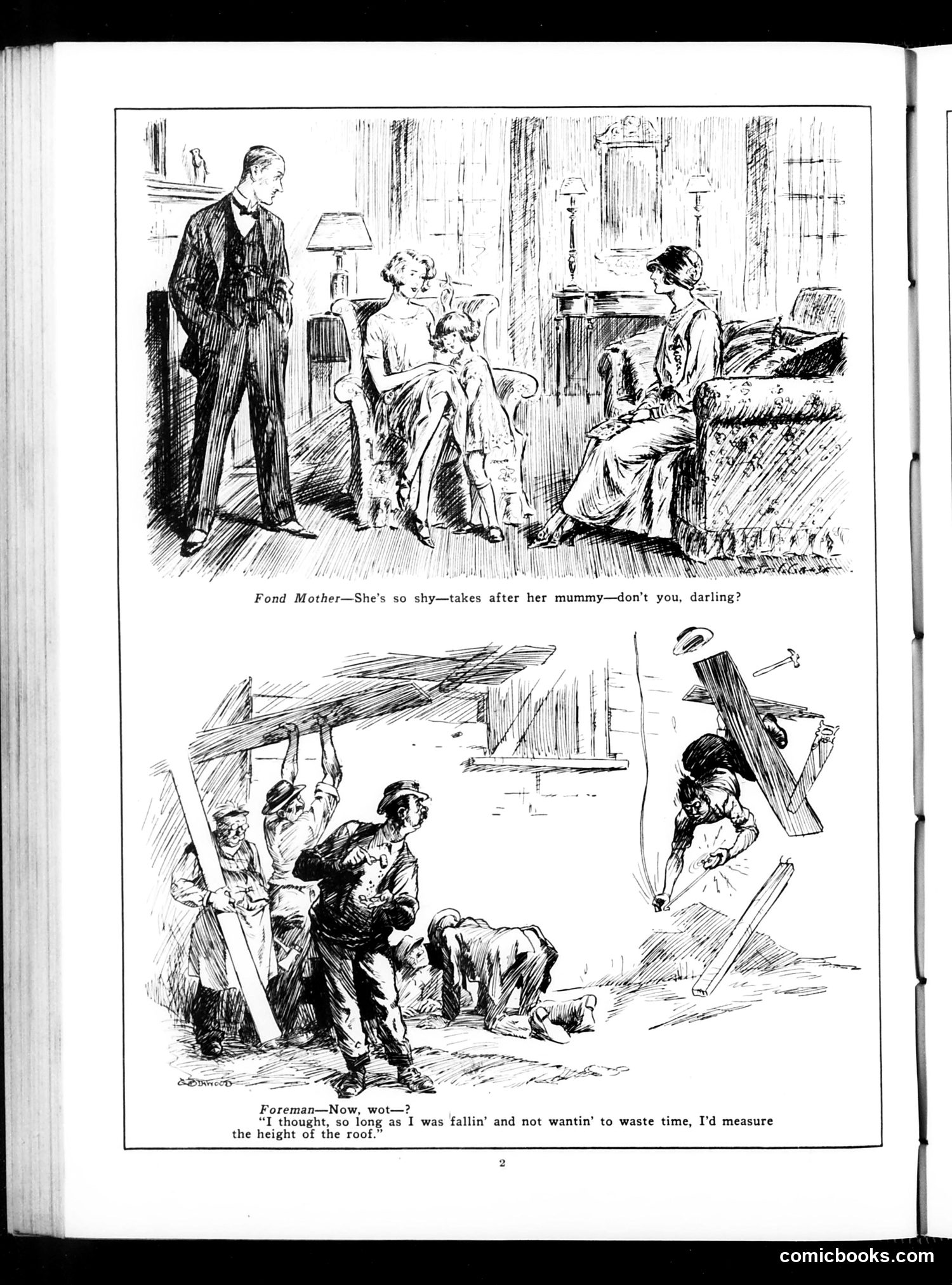
This page contains two separate satirical cartoons: **Top cartoon:** "Fond Mother" depicts a domestic scene where a well-dressed man stands while a woman sits holding children. The caption suggests the mother is shy and mimics her behavior—a commentary on how women were expected to adopt passive, timid mannerisms in Victorian society. **Bottom cartoon:** "Foreman" shows construction workers and a fallen man. The foreman explains he's measuring the roof height using the fallen worker's body as a measuring tool—a dark humor joke about workplace safety indifference and the casual disregard for workers' welfare common in industrial-era labor conditions. Both cartoons use exaggeration to mock social attitudes: gender performance expectations and worker exploitation.
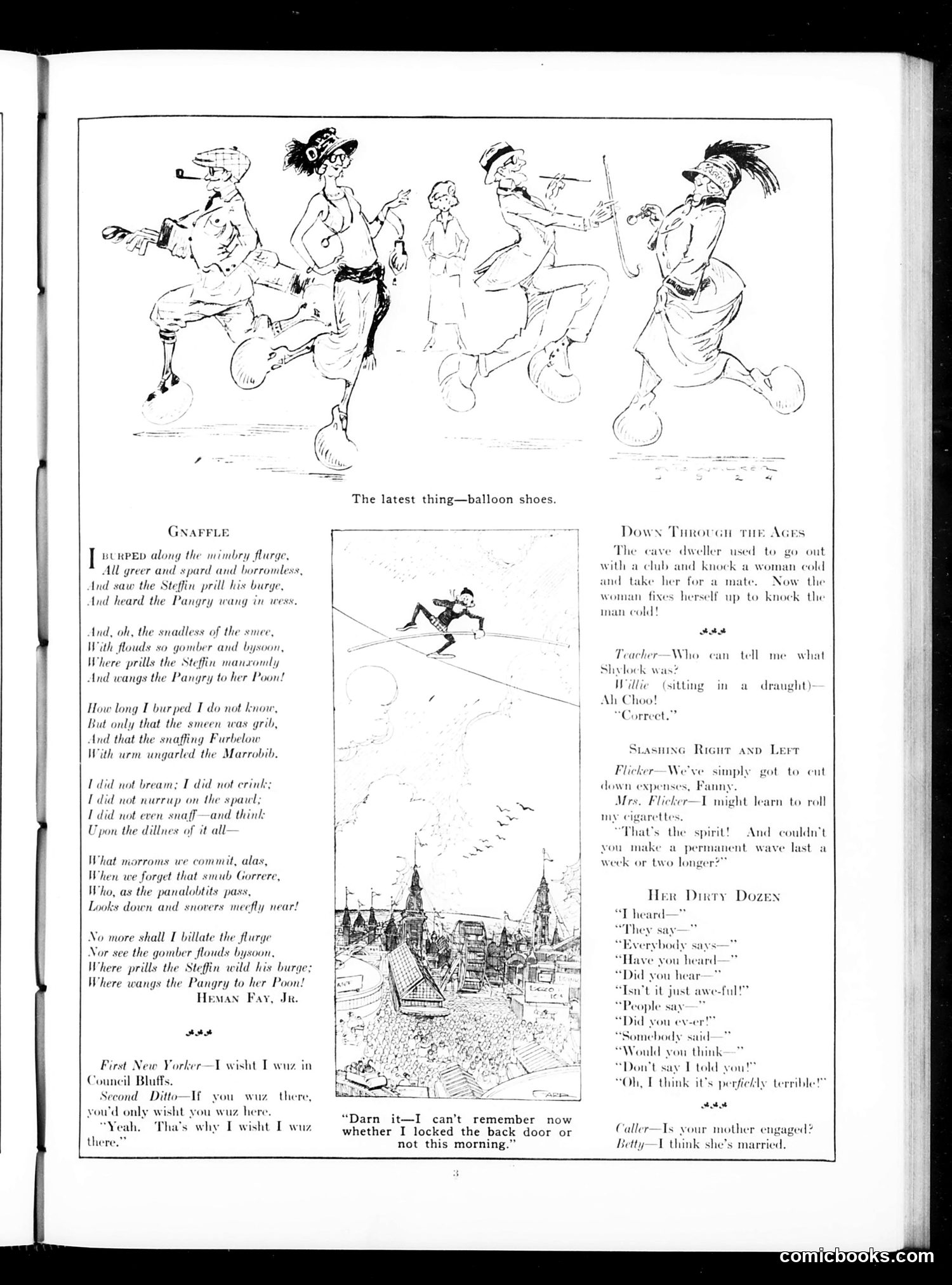
**Top Section:** "The latest thing—balloon shoes" depicts figures wearing exaggerated inflated footwear, satirizing a fashion fad. This appears to be mockery of absurd consumer trends. **Left Column:** "Gnaffle" is a narrative poem by Hanan Fay, Jr. about a buried character named Gnaffle who was "greet and apart and harmless." The poem's nostalgic, elegiac tone suggests social commentary on loss or change. **Center:** An illustration shows a figure on what appears to be a tightrope or wire, labeled "Darn it—I can't remember now whether I locked the back door or not this morning," satirizing modern anxiety and forgetfulness. **Right Column:** Brief comedic dialogues ("Down Through the Ages," "Slashing Right and Left," "Her Dirty Dozen") mock contemporary social situations and gender relations through quick witty exchanges. The page primarily targets early-20th-century urban fashions, anxieties, and social conventions.
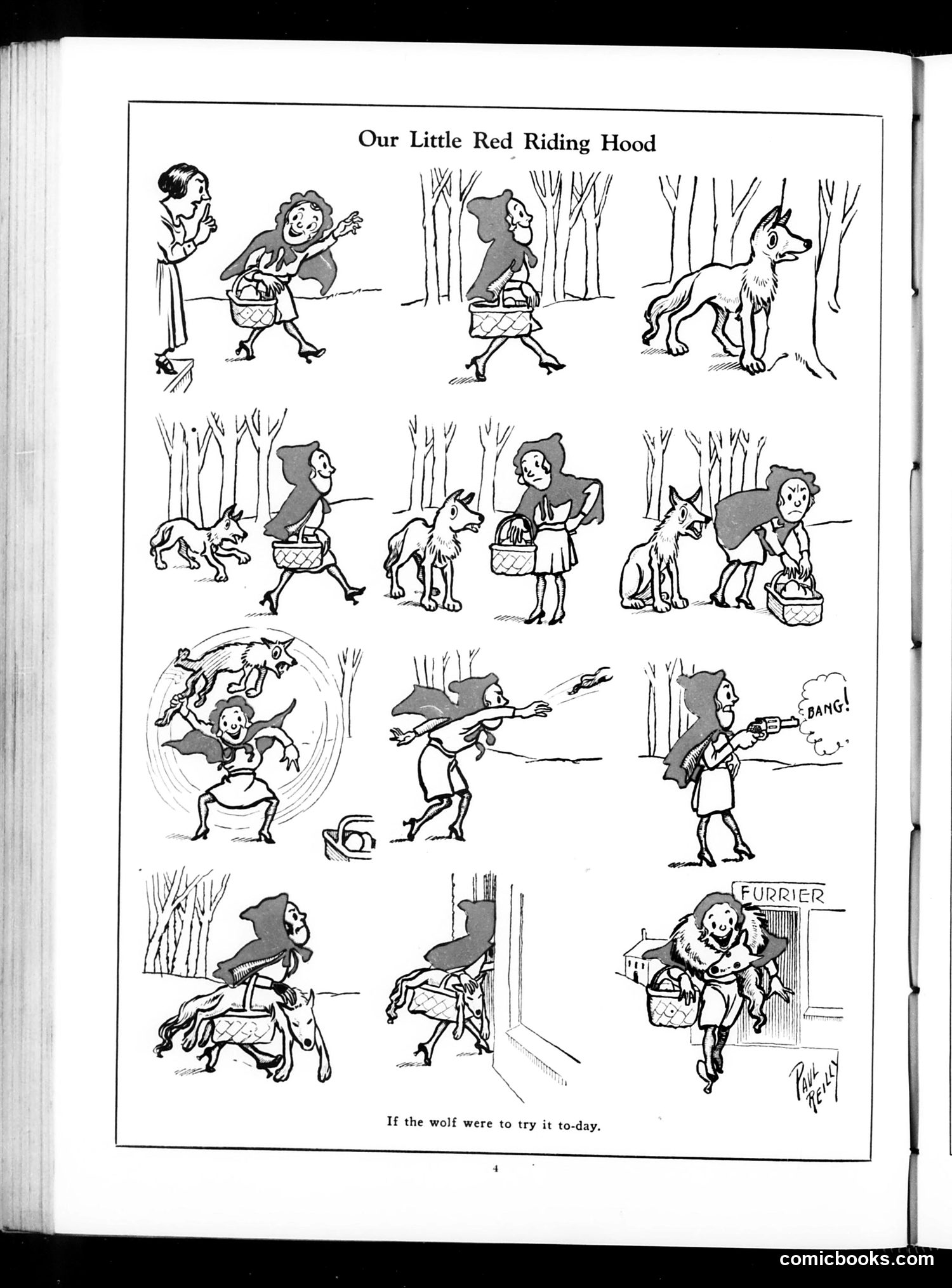
This is a humorous reinterpretation of the classic fairy tale for a modern (early 20th century) audience. The caption "If the wolf were to try it to-day" suggests a satirical commentary on how the traditional story would play out in contemporary times. The sequential panels show Little Red Riding Hood encountering various obstacles and dangers—a wolf, a hunter's gun, and what appears to be a furrier's shop—rather than simply encountering the wolf in the woods. The joke appears to critique modern urban dangers and complications that would prevent the classic tale from unfolding as originally written. The cartoon uses the familiar narrative as a framework to comment on contemporary life's complications and hazards.
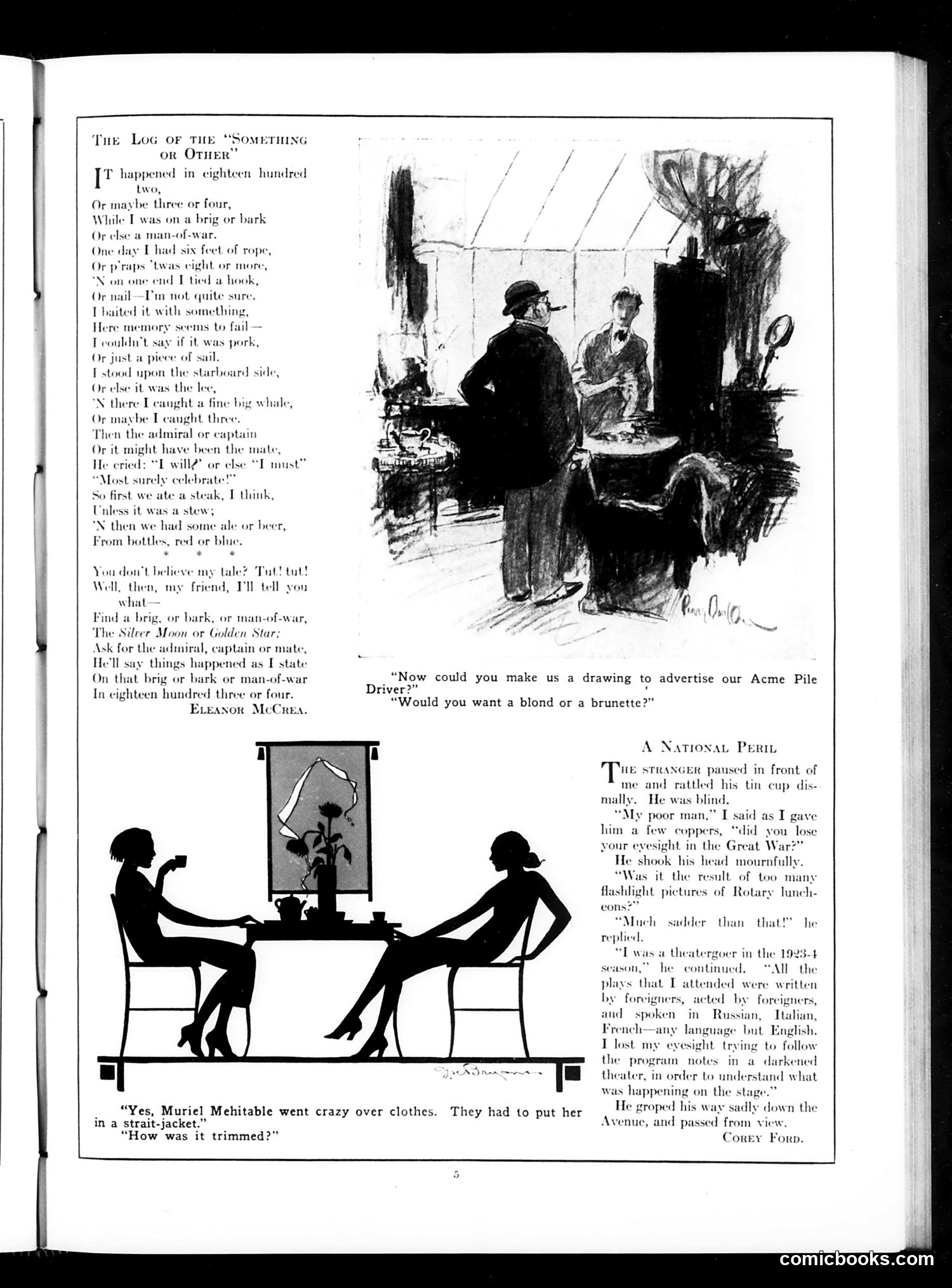
This page contains three separate satirical pieces from Judge magazine: **"The Log of the Something or Other"** (top left): A humorous poem mocking sailors' tall tales. The narrator recounts an implausibly vague fishing story—uncertain of dates, what he caught, what he ate—yet insists it's verifiable by asking any ship's officer. It satirizes how unreliable seafarers' stories are, full of convenient memory gaps. **The clothing joke** (bottom left): A brief gag about a woman named Muriel Mehitable who went "crazy over clothes" and had to be institutionalized in a straitjacket. The punchline ("How was it trimmed?") jokes that even in an asylum, she's concerned with fashion details—satirizing women's obsession with clothing trends. **"A National Peril"** (right): This satirizes 1920s theater culture. A blind beggar lost his eyesight not in WWI but from straining to read program notes in darkened theaters during the 1923-24 season when all plays were performed in foreign languages (Russian, Italian, French). It mocks both pretentious foreign theater and the impractical experience it created for audiences.
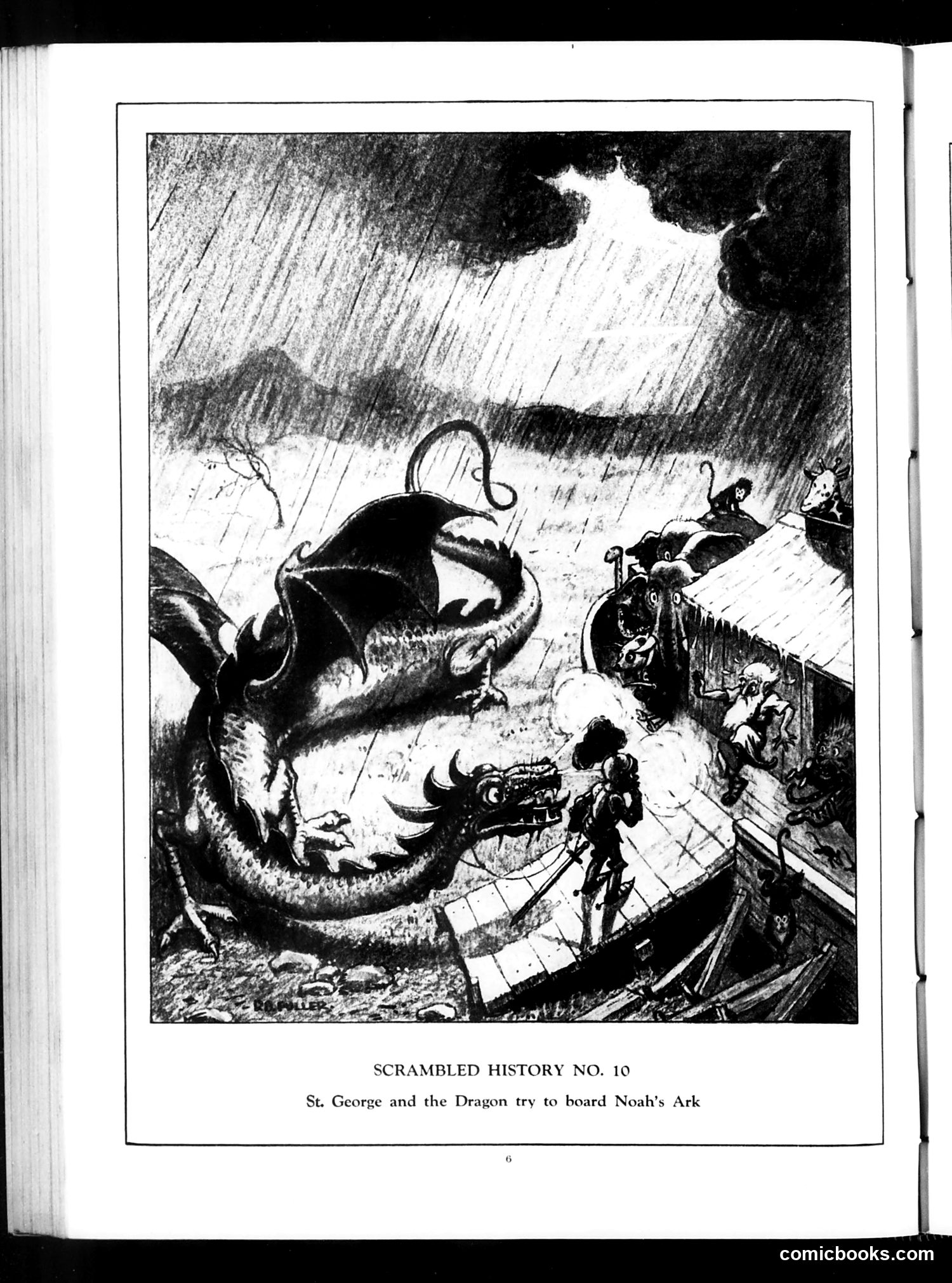
This is a humorous illustrated cartoon titled "Scrambled History No. 10" that deliberately combines unrelated historical/religious narratives for comedic effect. The image shows St. George (the legendary saint famous for slaying dragons) and an actual dragon attempting to board Noah's Ark during heavy rain. The joke relies on absurdist juxtaposition: merging the medieval legend of St. George with the Biblical flood narrative. The "scrambled history" series apparently takes well-known stories and comically misplaces their elements together. The visual satire comes from depicting these iconic figures in an impossible scenario—the dragon St. George should be fighting is now his companion trying to escape the flood, suggesting desperation overrides their legendary conflict.
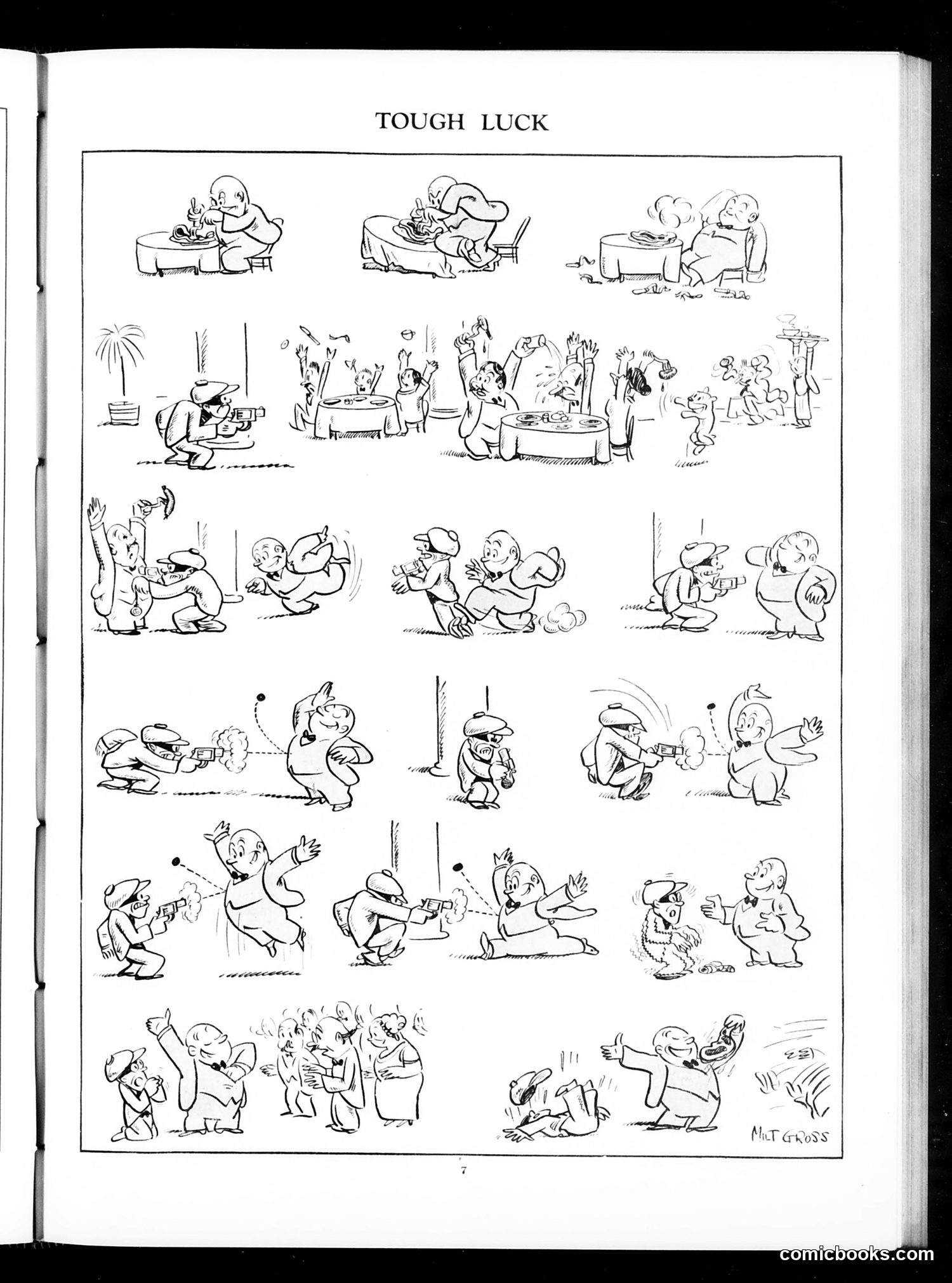
This is a wordless comic strip showing various scenes of misfortune and bad luck. The narrative appears to follow characters experiencing a series of mishaps: people at dining tables with food disasters, conflicts breaking out, individuals being struck or falling, and general chaos and slapstick confusion. The comic uses physical comedy and sequential art to illustrate the concept of "tough luck"—bad fortune befalling the characters through various accidents and unfortunate circumstances. The style is characteristic of early-to-mid 20th century American comic illustration, relying on exaggerated expressions and dynamic poses to convey humor through visual storytelling rather than dialogue. The signature reads "MILT GROSS," a prolific cartoonist known for his physical comedy style in comics and animation.
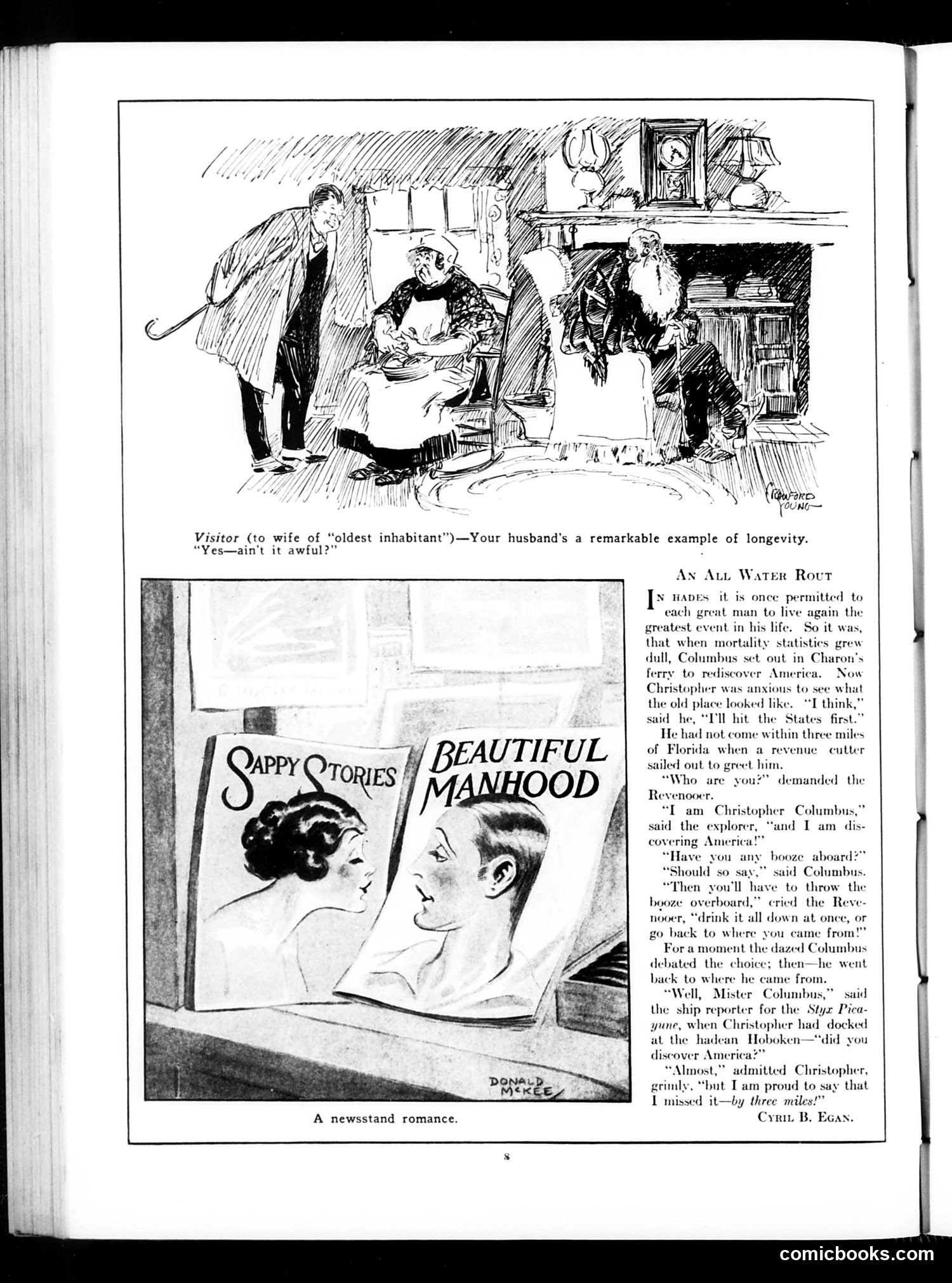
This page contains two separate satirical pieces from *Judge* magazine: **Top cartoon:** A visitor compliments an elderly man's longevity to his wife, who responds "Yes—ain't it awful?" The joke is dark humor about aging: she's sarcastically suggesting that living to extreme old age is actually undesirable, not admirable. **Bottom piece ("An All Water Rout"):** A satirical story where Columbus, allowed to revisit Earth in the afterlife, attempts to rediscover America. A revenue cutter (U.S. Coast Guard vessel) intercepts him and demands he dump any alcohol overboard—a reference to Prohibition enforcement. Columbus must choose between throwing booze overboard or returning to the underworld; he chooses to go back. The joke satirizes overzealous Prohibition agents who would literally prevent even historical exploration rather than tolerate alcohol. **Newsstand image:** Shows magazines titled "Sappy Stories" and "Beautiful Manhood"—likely mocking pulp fiction and mass-market magazines of the era.
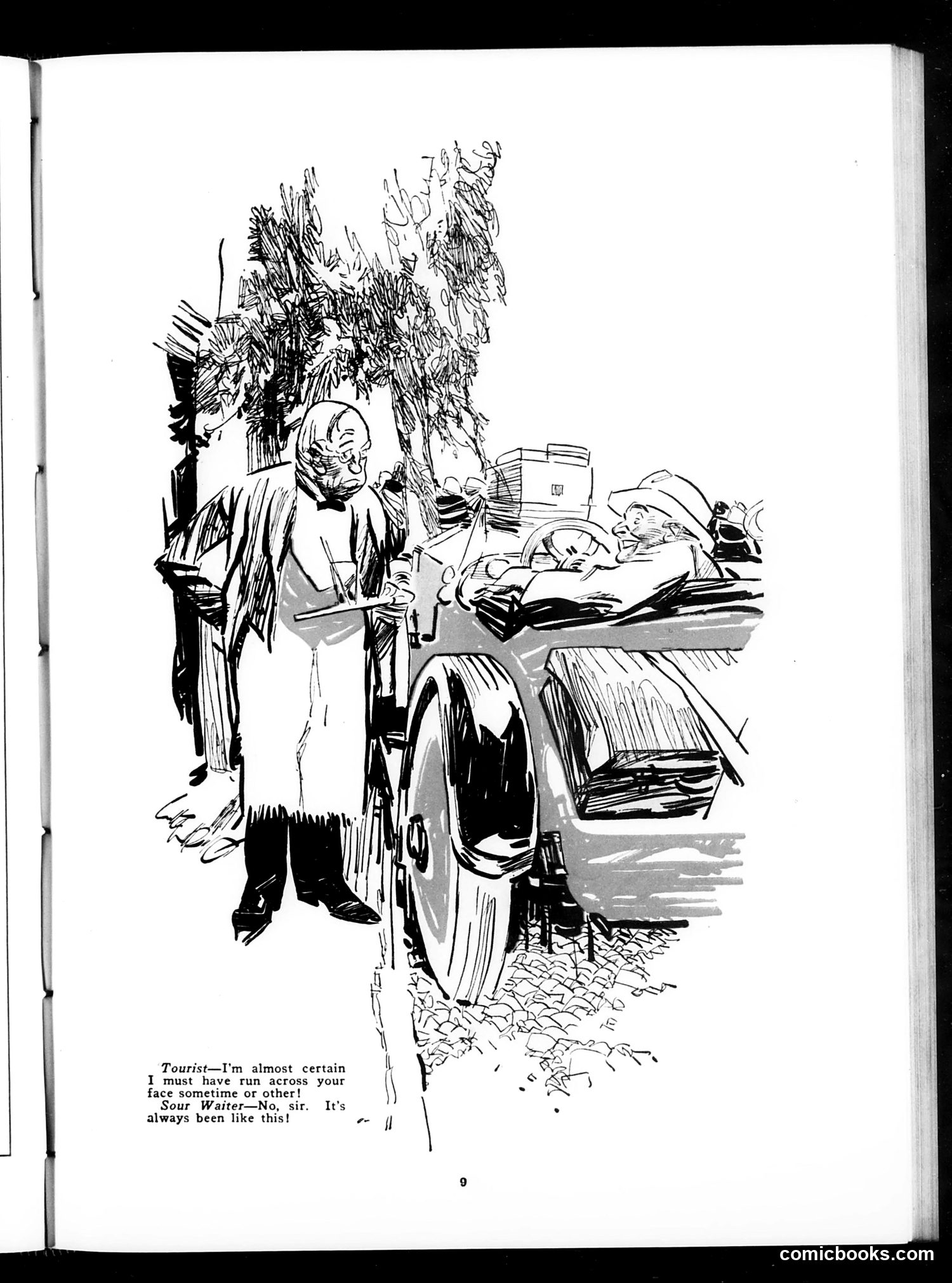
This is a single-panel joke cartoon featuring two men: a tourist and a sour waiter. The tourist, examining the waiter's face, claims he must have seen it before somewhere. The waiter's deadpan response—"No, sir. It's always been like this!"—is the punchline, implying his perpetually gloomy or disagreeable expression is permanent and unchanging. The humor relies on the visual contrast between the tourist's pleasant demeanor and the waiter's sour appearance, along with the implied insult in the exchange. The cartoon satirizes the stereotypical unhappy or surly waiter, a common service-industry type. The exaggerated ink illustration style emphasizes the waiter's dour expression for comedic effect.
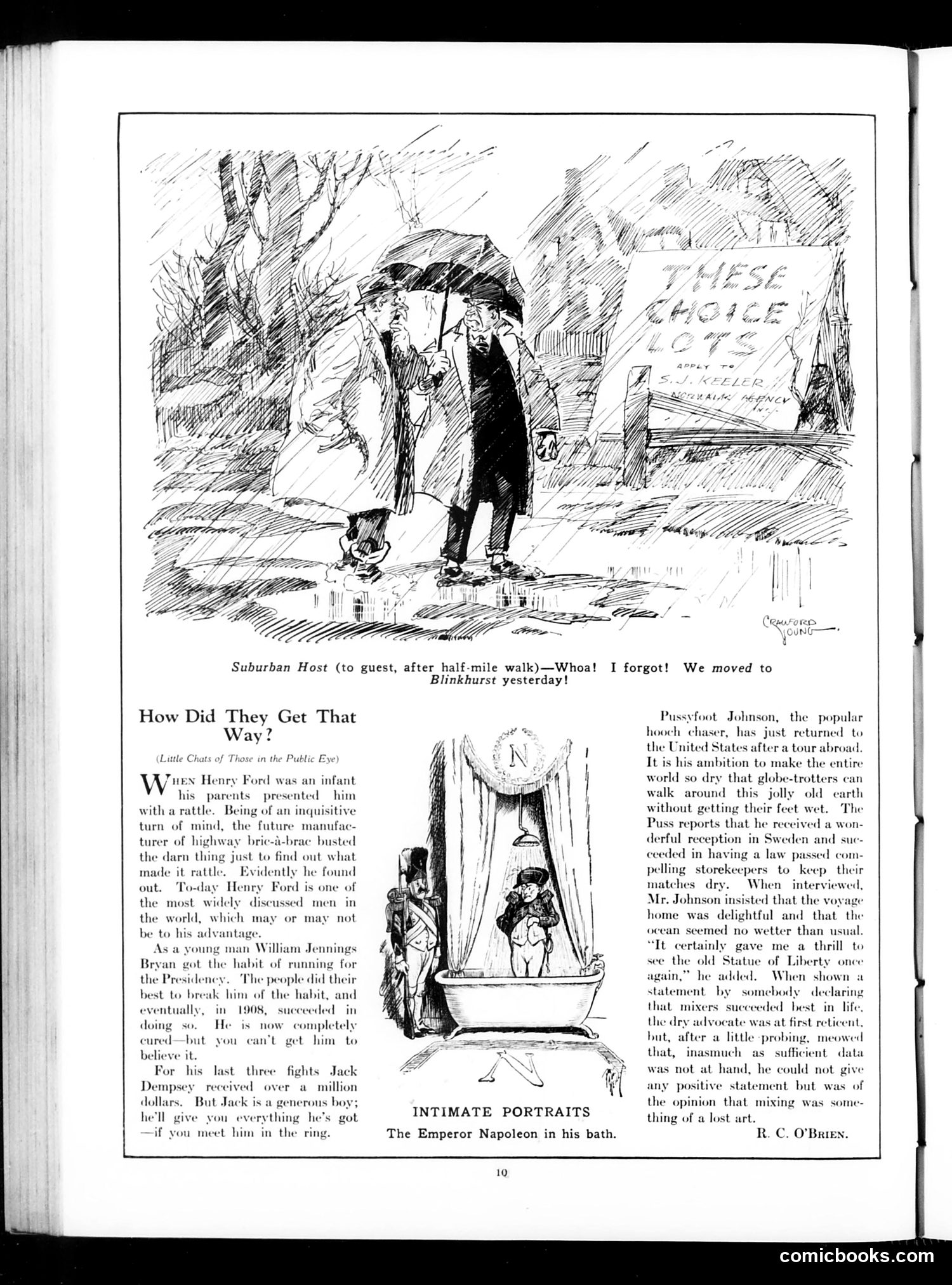
**Top Cartoon**: A suburban homeowner has walked a guest half a mile in the rain to show property, only to realize he's moved. The joke is on the host's poor memory or the absurdity of suburban real estate pitches. **"How Did They Get That Way?"**: Brief satirical portraits of public figures: - **Henry Ford**: As an infant, he destructively disassembled a rattle. The joke: his inquisitive, tinkering nature made him famous—suggesting his success stems from this fundamental personality trait. - **William Jennings Bryan**: He habitually ran for President (three times: 1896, 1900, 1908). The satire mocks his persistent candidacy despite repeated electoral failures, joking he's "cured" but won't admit it. - **Jack Dempsey**: The boxer recently earned over a million dollars in three fights—presented as evidence he's generous, though the humor is ambiguous. **"Intimate Portraits"**: A crude sketch of Napoleon bathing, likely meant as absurdist humor about depicting famous historical figures in intimate moments. The page exemplifies *Judge*'s style: topical satire targeting recognizable public figures through exaggerated character sketches.
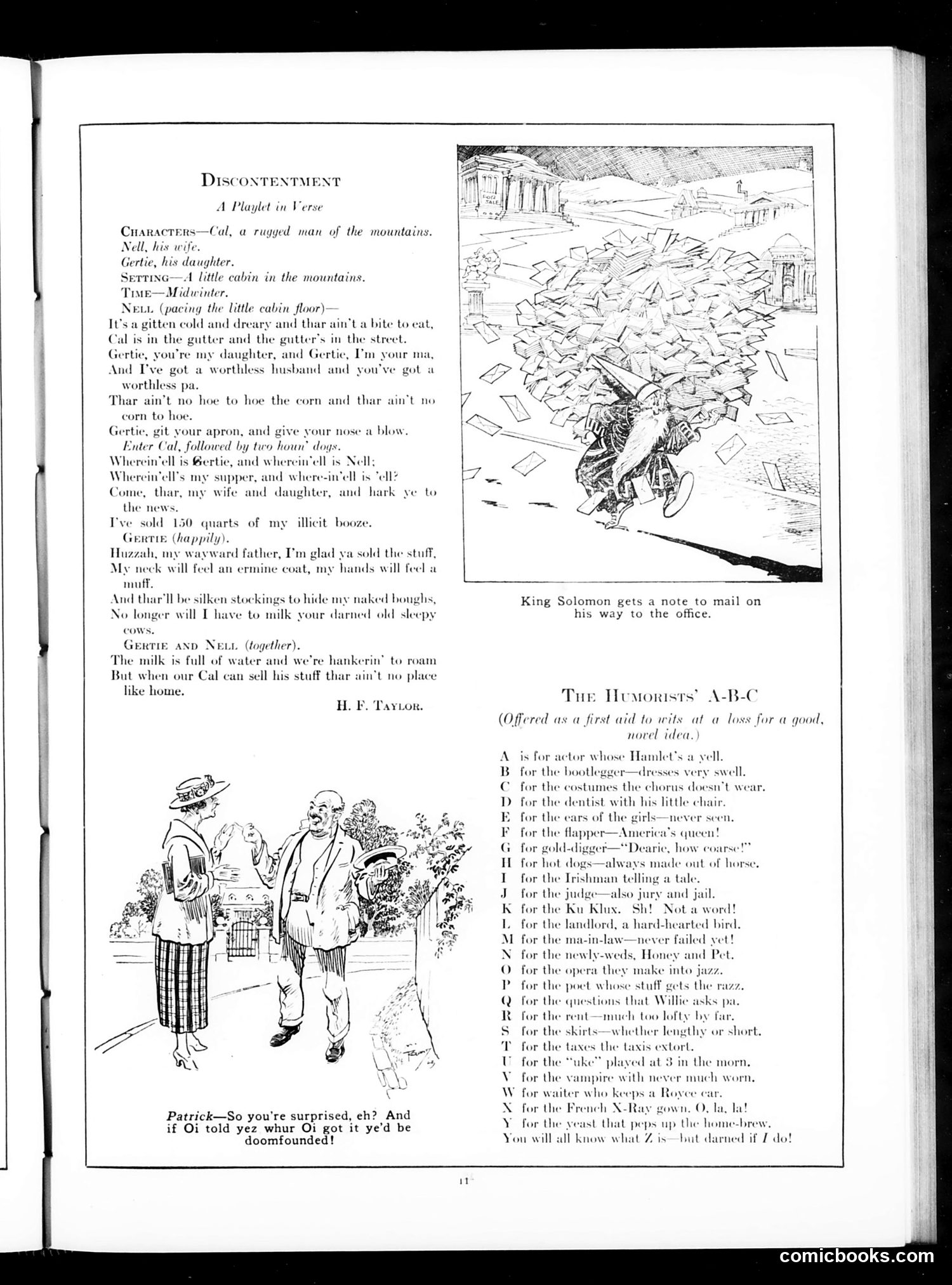
This playlet satirizes the unintended consequences of Prohibition (1920-1933). Cal, a poor mountain man who cannot afford honest food, becomes prosperous by illegally selling bootleg liquor—"150 quarts of my illicit booze." His family, previously destitute and complaining, suddenly rejoices at newfound luxury: ermine coats, silk stockings, and the ability to leave their squalid existence. The joke cuts both ways: it mocks both the family's materialistic desperation and, implicitly, Prohibition itself as creating a black market where criminals profit while honest citizens suffer. The irony—that lawbreaking provides better living than legal poverty—suggests the policy's failure and moral absurdity. The accompanying "Humorists' A-B-C" is unrelated joke material using alphabet entries for contemporary satirical references (taxes, vampires, flappers, etc.), typical Judge magazine filler.
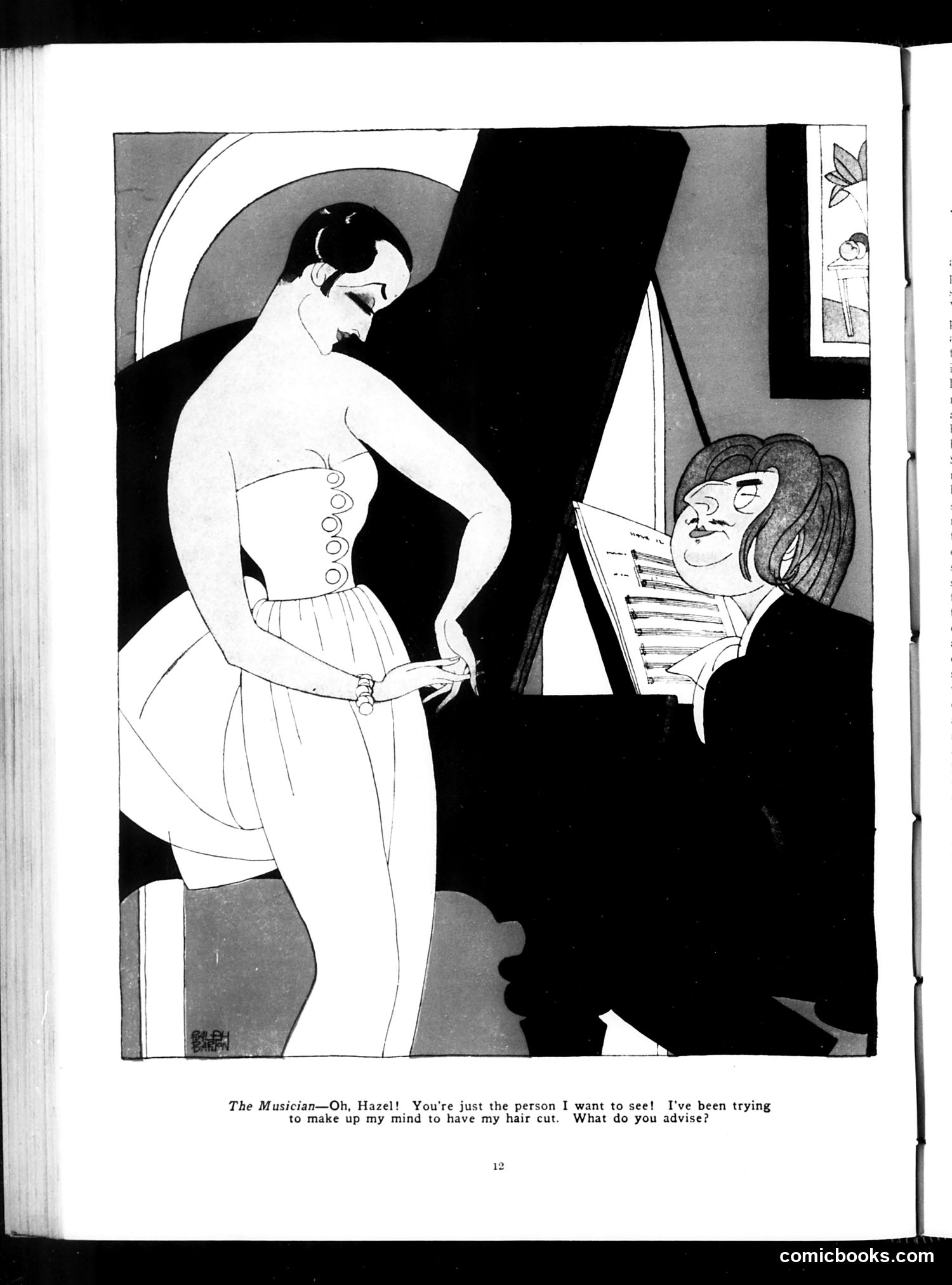
This is a single-panel cartoon depicting two women: a musician (seated at a piano) and a woman named Hazel. The musician seeks Hazel's advice about getting a haircut. The satire likely plays on early 20th-century gender roles and social anxieties. The musician—depicted in a somewhat exaggerated, suggestive pose in a sleeveless dress—appears to be seeking cosmetic advice from what seems to be a hairdresser or beauty professional named Hazel. The humor appears to target either: 1. Women's preoccupation with appearance and fashion, or 2. The perceived vanity of performers/musicians Without additional context about Judge magazine's editorial stance or the specific era, the precise satirical target remains unclear, though it comments on contemporary attitudes toward women's grooming and appearance management.
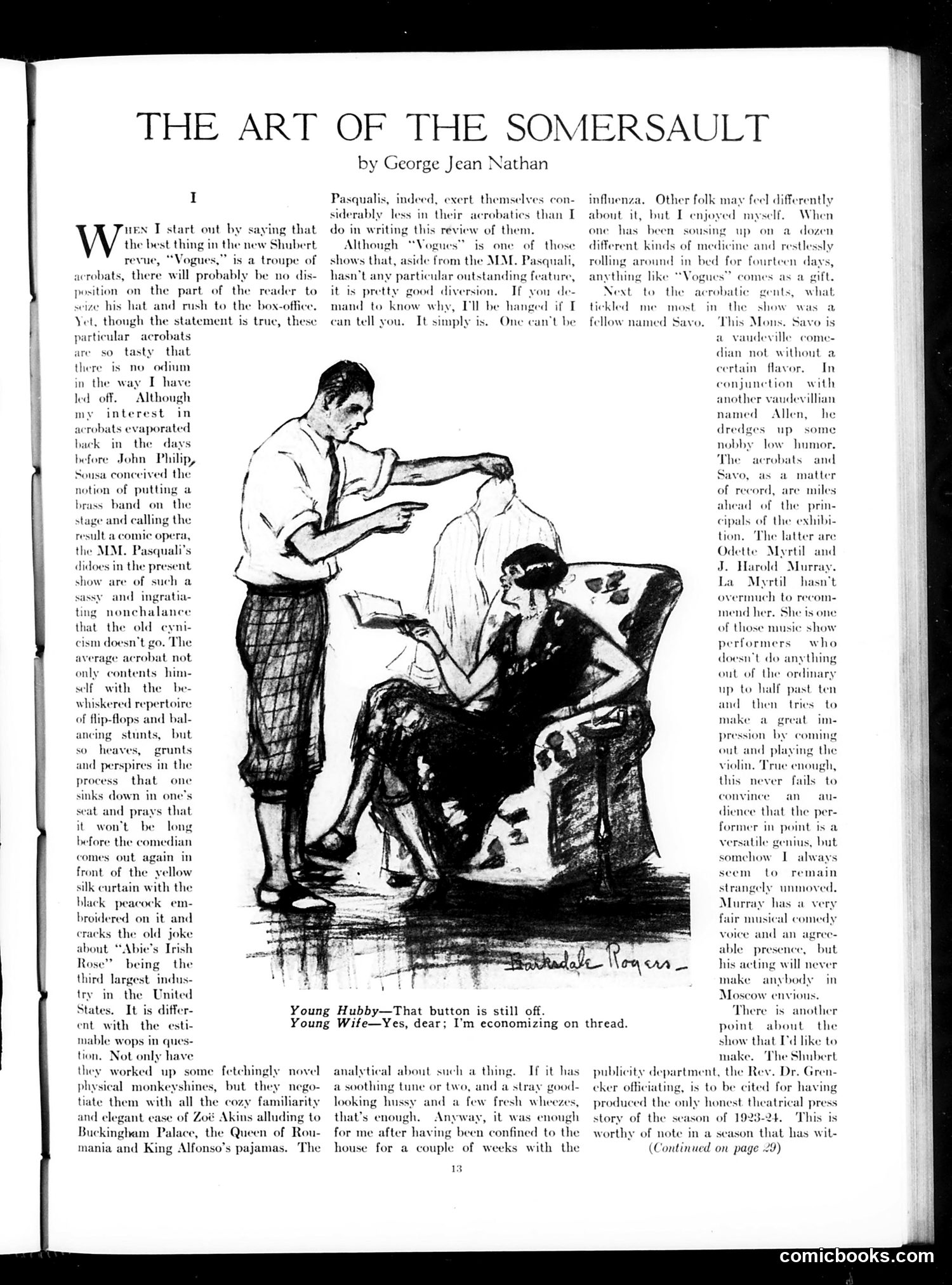
This is theater critic George Jean Nathan's review of the Shubert revue "Vogues." The central cartoon illustrates a domestic scene: a husband points out a missing button to his wife, who responds she's "economizing on thread"—a Depression-era joke about household penny-pinching. Nathan's main point: the show's best feature is the acrobatic troupe the Pasqualis, whose skilled, graceful performances stand out in an otherwise forgettable revue. He praises their "sassy and ingratiating nonchalance"—they perform without the usual grunting and straining typical of acrobats. He's less impressed by the named performers (Myrtil, J. Harold Murray, and Savo), describing them as competent but unremarkable. His casual use of ethnic slurs ("wops") reflects the magazine's era but is jarring today. Overall, Nathan argues the show works despite lacking genuine quality—sometimes entertainment doesn't require critical justification, particularly for someone recovering from influenza.
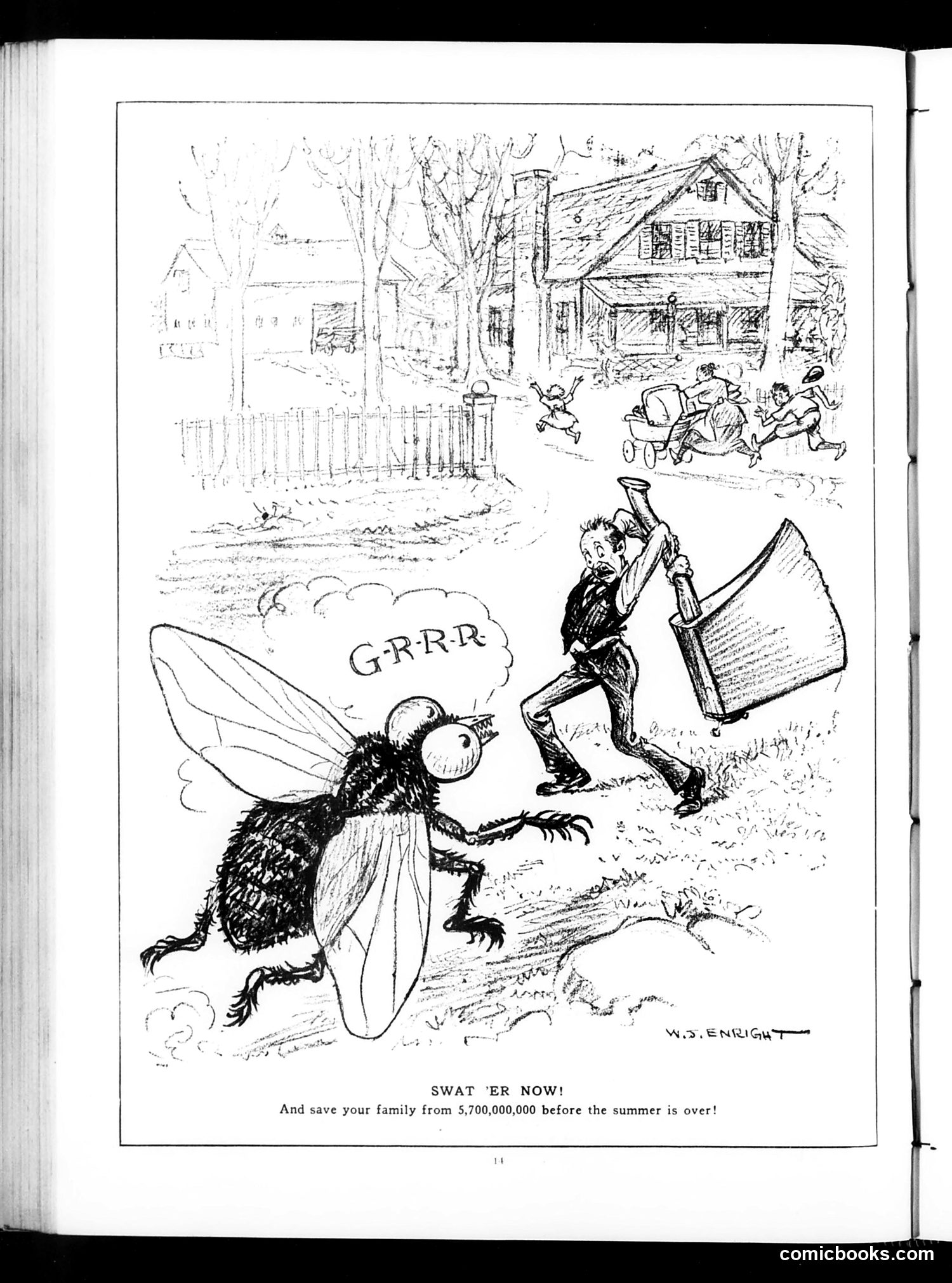
This Judge magazine cartoon is a public health PSA using exaggeration and humor to promote fly-swatting. The giant fly making a "GRRR" sound represents the disease-carrying housefly—a genuine public health menace in the early 20th century before modern sanitation and pesticides. The specific figure of 5,700,000,000 (5.7 billion) likely references estimated fly populations or projected deaths from fly-borne diseases. The man wielding a large flyswatter like a weapon, and the domestic scene in the background with children playing, emphasize that protecting one's family required active pest control. The cartoon satirizes the era's combination of genuine health concerns with somewhat alarmist public safety campaigns, using melodramatic imagery to encourage readers to take action against household pests.
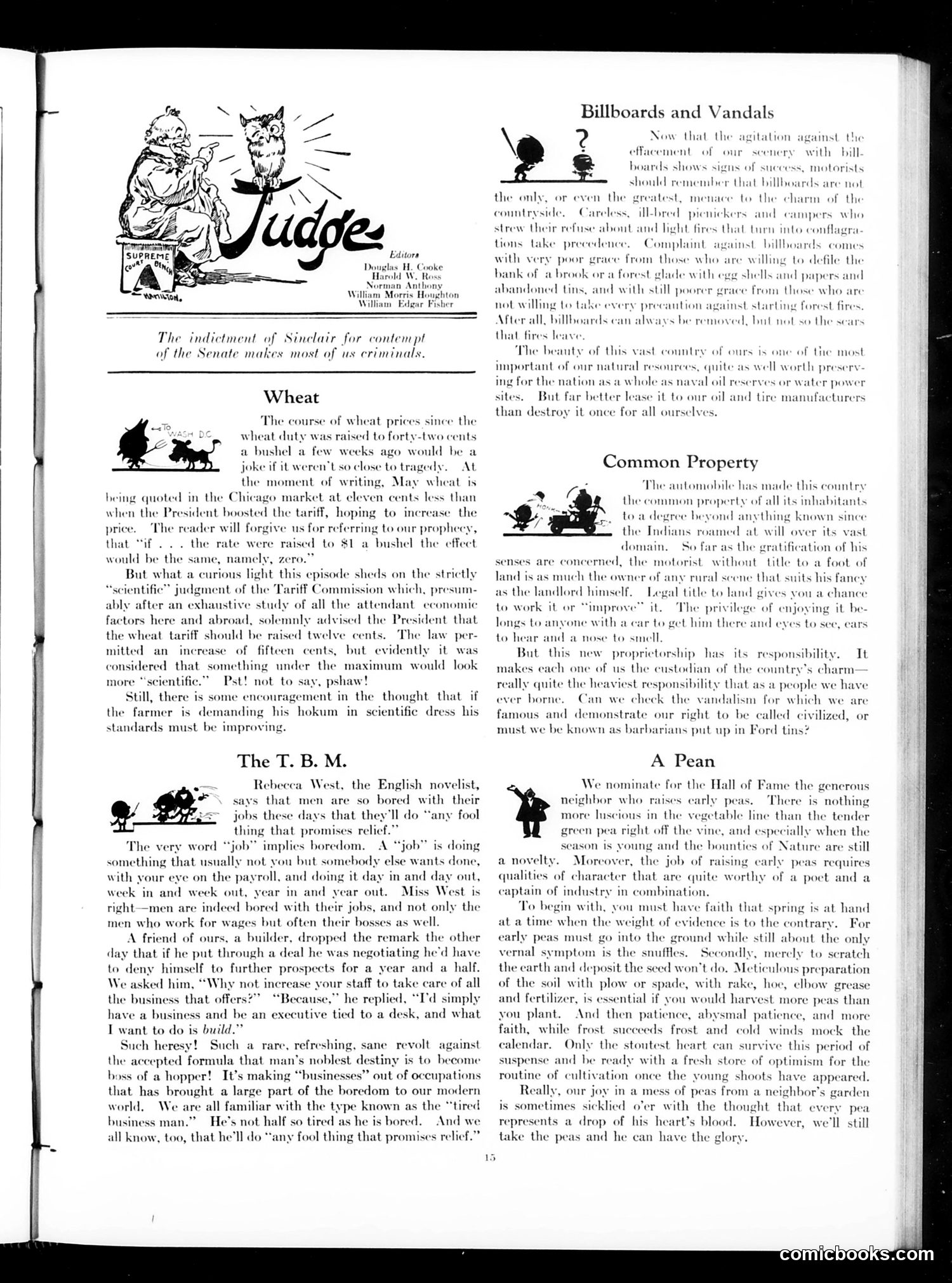
This page contains **editorial commentary** on several contemporary issues (circa early 1900s): **"Wheat"** criticizes the Tariff Commission's "scientific" tariff increase on wheat. Despite raising the duty to boost prices, wheat actually *fell* in value—mocking the protectionist logic as pseudoscientific hokum dressed in technical language. **"The T.B.M."** references Rebecca West's observation that men are bored by their jobs. Judge uses this to satirize American business culture: the pursuit of becoming a boss creates soul-crushing executive drudgery. Even entrepreneurs sacrifice fulfillment for "success." **"Billboards and Vandals"** advocates removing highway billboards but points out picnickers are equally destructive—littering, abandoning tins, and carelessly starting forest fires. The irony: society targets billboards while ignoring worse environmental damage from careless citizens. **"Common Property"** and **"A Pean"** discuss land ownership and pea cultivation respectively. The tone is consistently sardonic, attacking hypocrisy and false reasoning in policy and behavior.
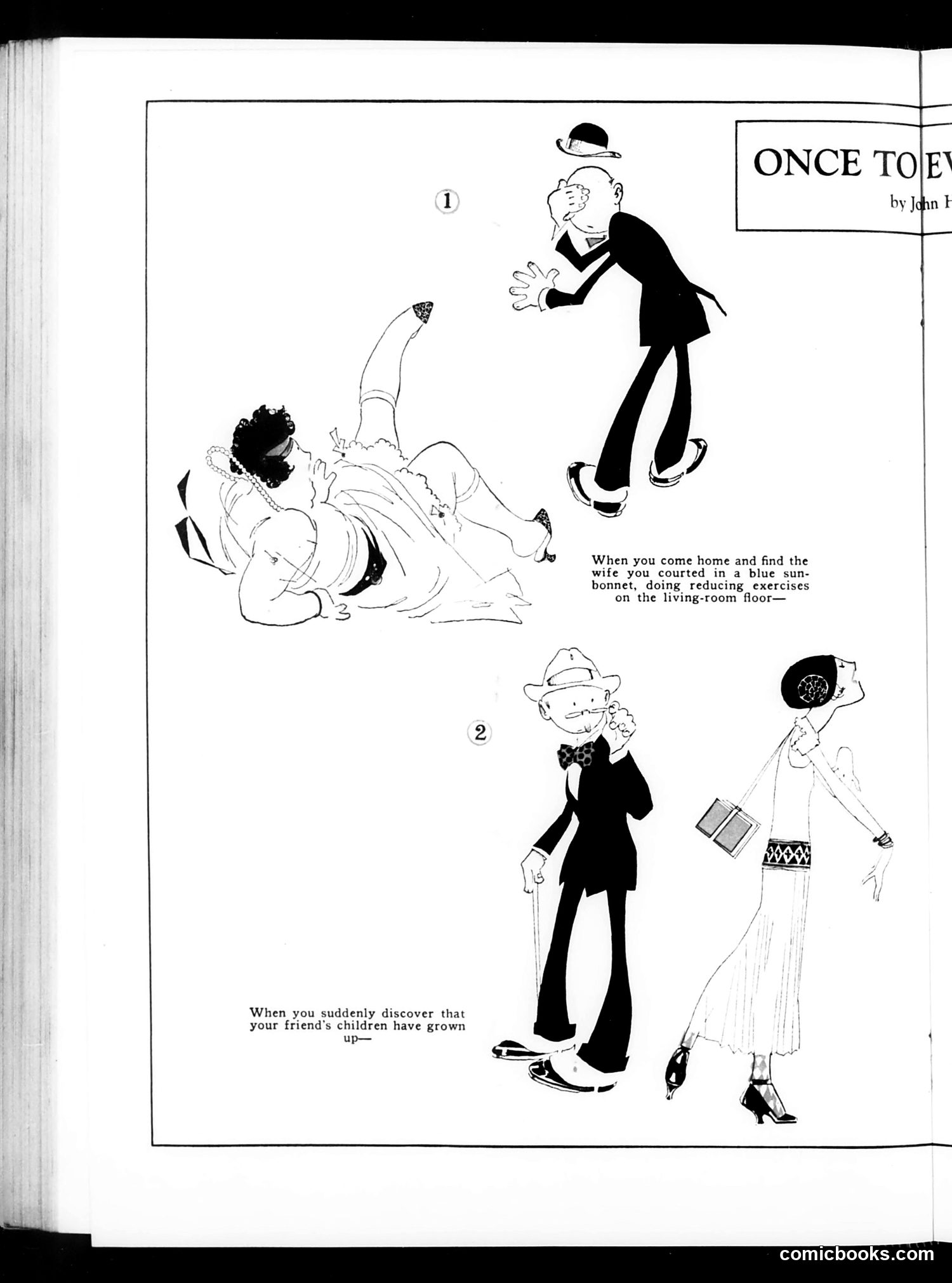
This page presents two domestic humor scenarios typical of early 20th-century Judge magazine: **Panel 1** depicts a husband arriving home to find his wife doing floor exercises in casual attire—a "blue sunbonnet"—rather than the fashionable appearance he courted. The joke satirizes how wives' appearances and priorities shift after marriage, particularly the trend of women adopting "reducing exercises" (dieting/fitness routines) rather than maintaining romantic presentation. **Panel 2** shows a man encountering his friend's now-grown children, suggesting the shock of time's passage. The humor lies in the disconnect between remembering children as young and encountering them as adults. Both sketches target common anxieties about marriage, aging, and changing appearances—themes that resonated with Judge's middle-class male readership. The cartoons mock both spouses and the passage of time with gentle domestic satire.
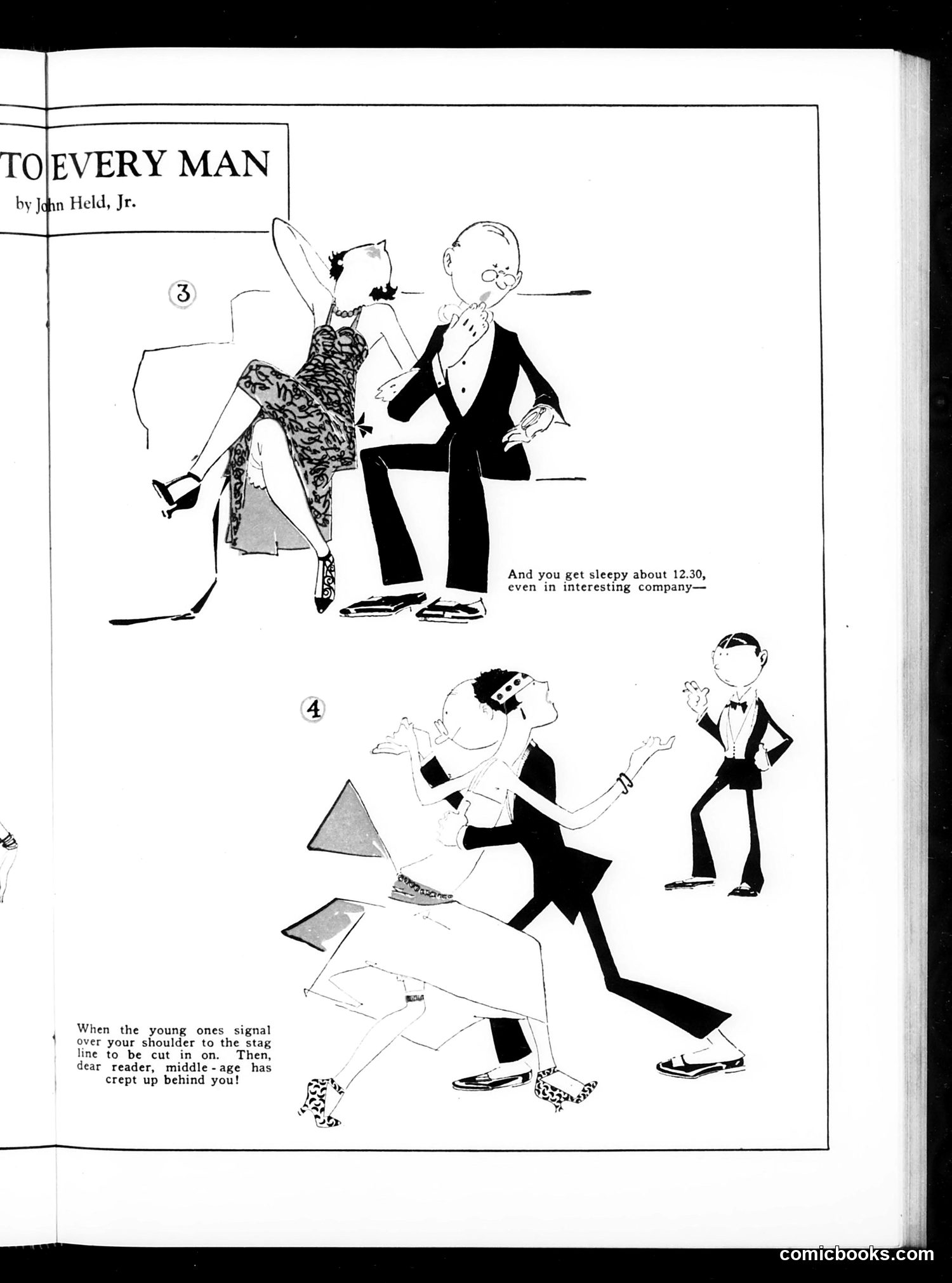
This is a satirical commentary on middle age and dating customs of the Jazz Age era (likely 1920s-30s). **Panel 3** shows a man in formal wear at what appears to be a dance, struggling to stay awake despite being in "interesting company" with an attractive woman. **Panel 4** depicts the humiliation of middle age: young dancers signal the "stag line" (unattached men) to "cut in" and replace him as dance partner—a common practice at the time. The man stands awkwardly aside while youth displaces him. The joke's sting: middle age arrives when you're no longer desirable as a dance partner. Held's minimalist style emphasizes the man's deflation and irrelevance. The satire targets both aging anxieties and the era's youth-obsessed dating culture where a man's worth was measured by his desirability on the dance floor.
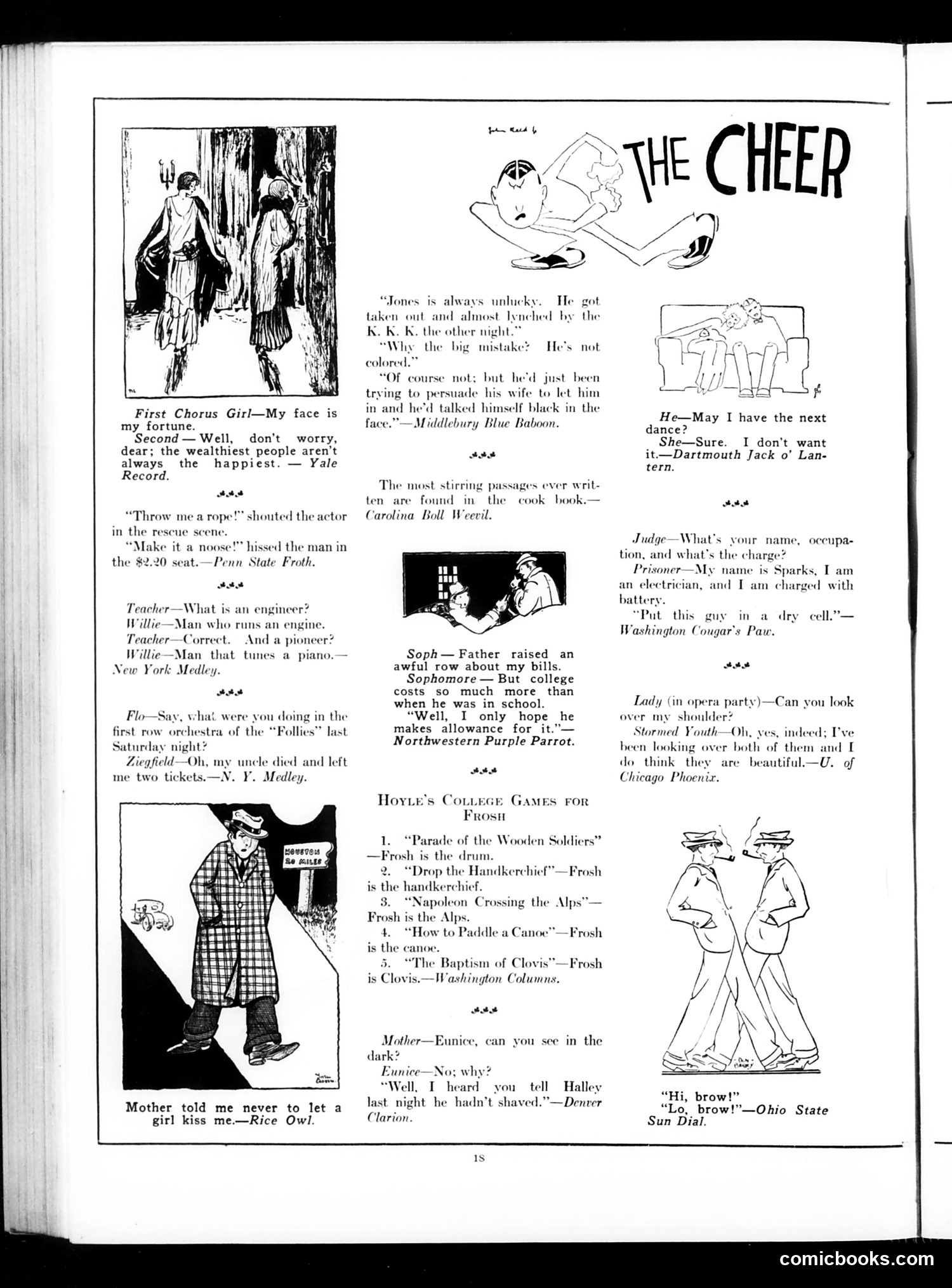
This is a collection of short jokes and quips compiled from college humor magazines, typical of Judge's "Cheer" sections. The content reflects early 20th-century college culture and casual prejudices: **Key elements:** - **KKK reference**: One joke darkly plays on the Ku Klux Klan's violence, suggesting a white man was nearly lynched after arguing with his wife—the punchline being he "talked himself black in the face" (figuratively angry). This treats serious racial violence as comedic fodder. - **"Dry cell" wordplay**: A prisoner named Sparks, an electrician "charged with battery," is jailed in a "dry cell"—electrical puns masking a genuine crime. - **College life satire**: Multiple jokes mock freshman hazing, student poverty, and dating rituals—standard fodder for college humor of the era. - **Illustrations**: Simple line drawings accompany quips about chorus girls, opera-goers, and dancing couples. The page exemplifies how period humor often normalized casual bigotry alongside genteel collegiate comedy.
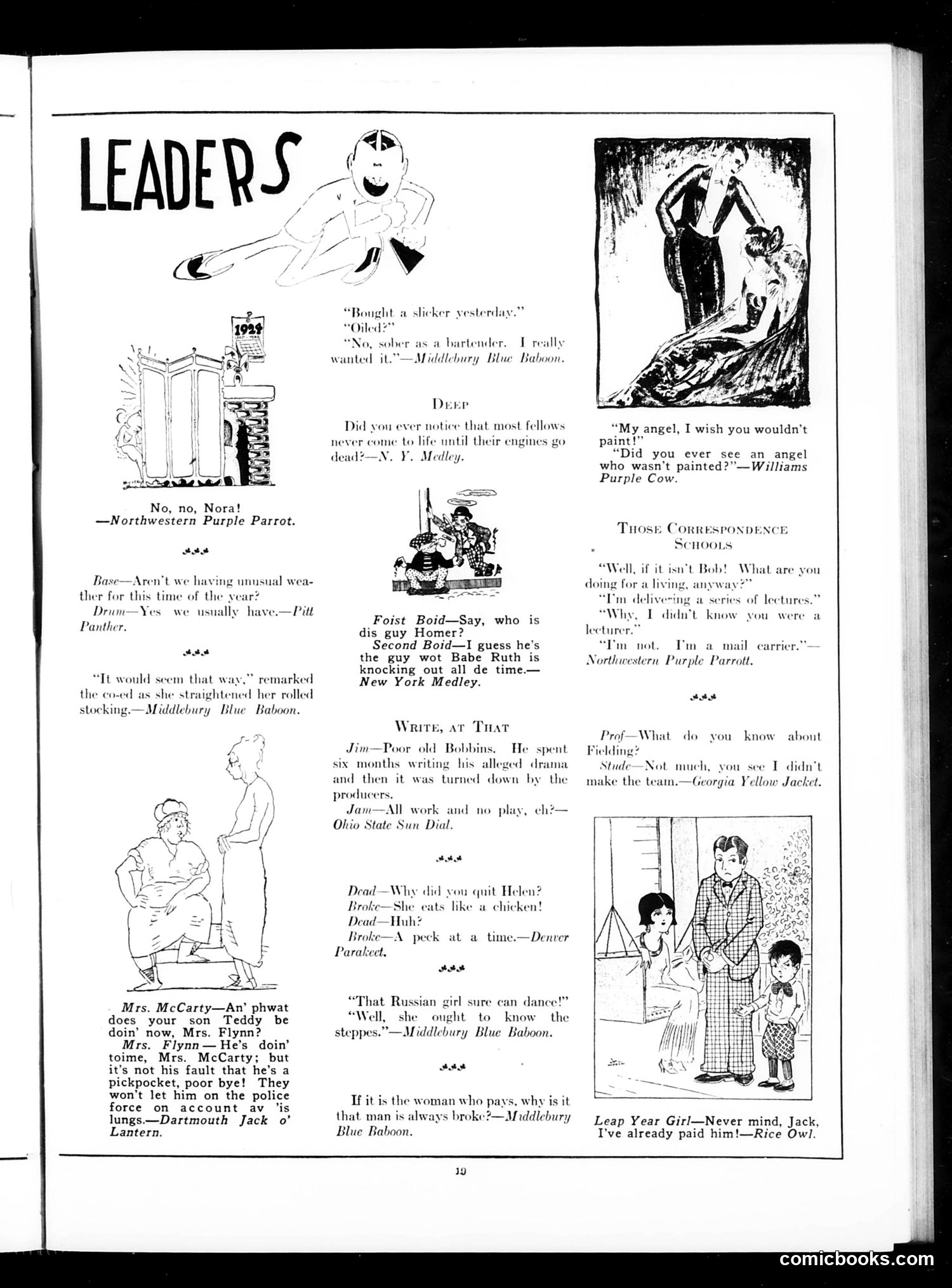
This page collects brief jokes and comic vignettes from college humor magazines circa 1920s-30s, showcasing period satire targeting social conventions and everyday absurdities. **Notable content:** - **Mrs. McCarty/Flynn dialogue**: Irish immigrant humor (stereotypical accents) about a son who's a pickpocket but can't join police due to lung problems—mocking both petty crime and bureaucratic inconsistency. - **Homer/Babe Ruth reference**: A "bird" (New York slang for person) confuses the ancient Greek poet Homer with home runs Babe Ruth hits, satirizing cultural ignorance. - **Dating/relationship jokes**: "Russian girl/steppes" pun; woman-who-pays reversal of 1920s dating norms; leap-year girl paying her escort (women's rare dating agency in leap years). - **"Write, at That"**: Struggling playwright Bobbins rejected by producers—mocking theatrical gatekeeping. The humor relies on wordplay, ethnic stereotypes, and social role reversals typical of collegiate humor magazines distributed through universities.
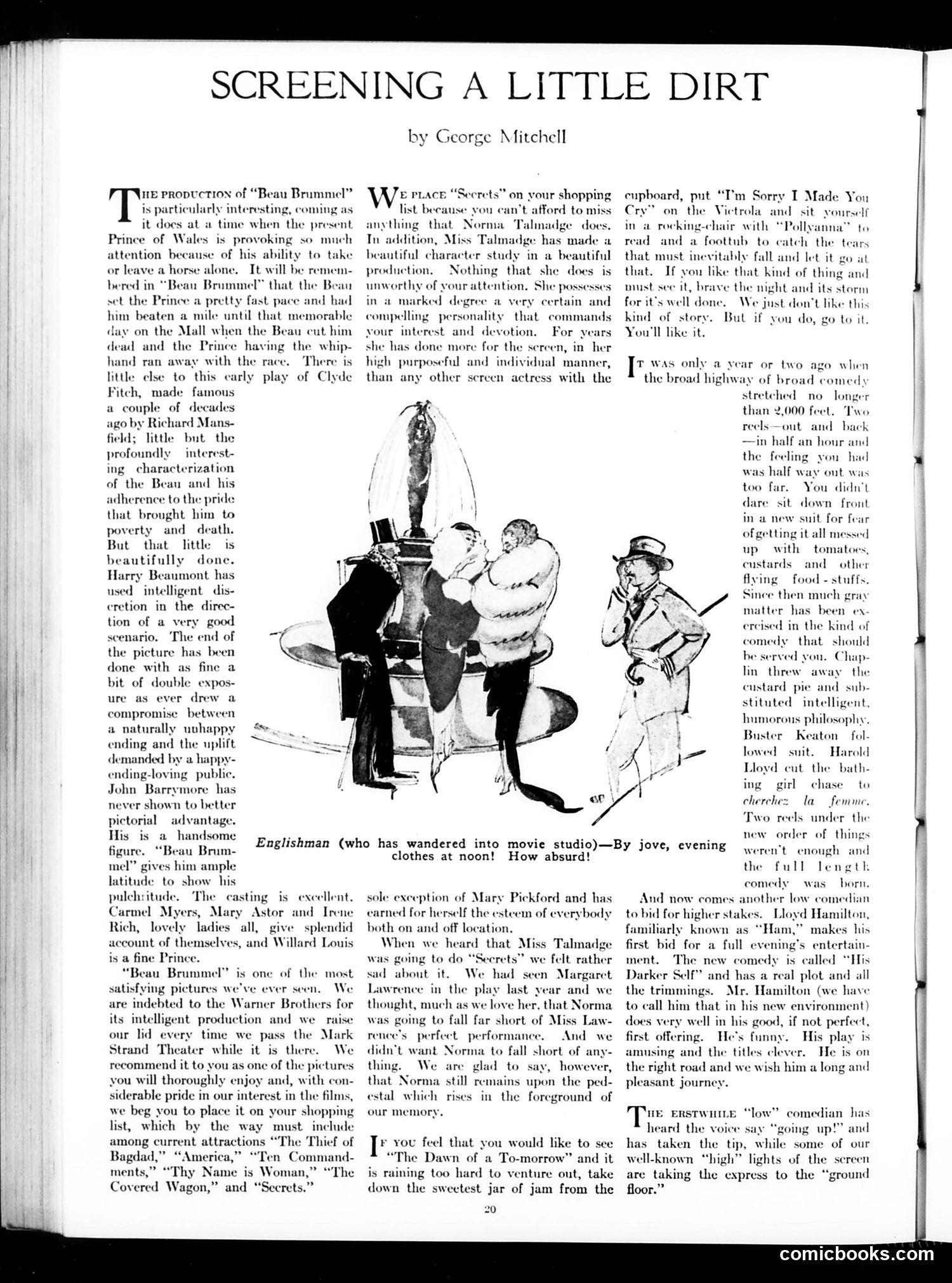
This is a film review column by George Mitchell discussing current movie releases. The main illustration is a satirical cartoon captioned "Englishman (who has wandered into movie studio)—By jove, evening clothes at noon! How absurd!" It depicts a formally dressed British gentleman shocked at encountering casually dressed Americans in a film studio at midday—poking fun at British formality versus American informality in the workplace. The reviews themselves are straightforward promotional pieces for silent films: "Beau Brummel" (starring John Barrymore) and "Secrets" (starring Norma Talmadge). The critic praises both productions, with particular enthusiasm for Talmadge's performance, declaring her superior even to Margaret Lawrence in the original stage play. The cartoon's humor relies on the stereotype of uptight British fashion codes contrasting with American casualness—a common early-20th-century comedic trope reflecting post-WWI cultural differences.
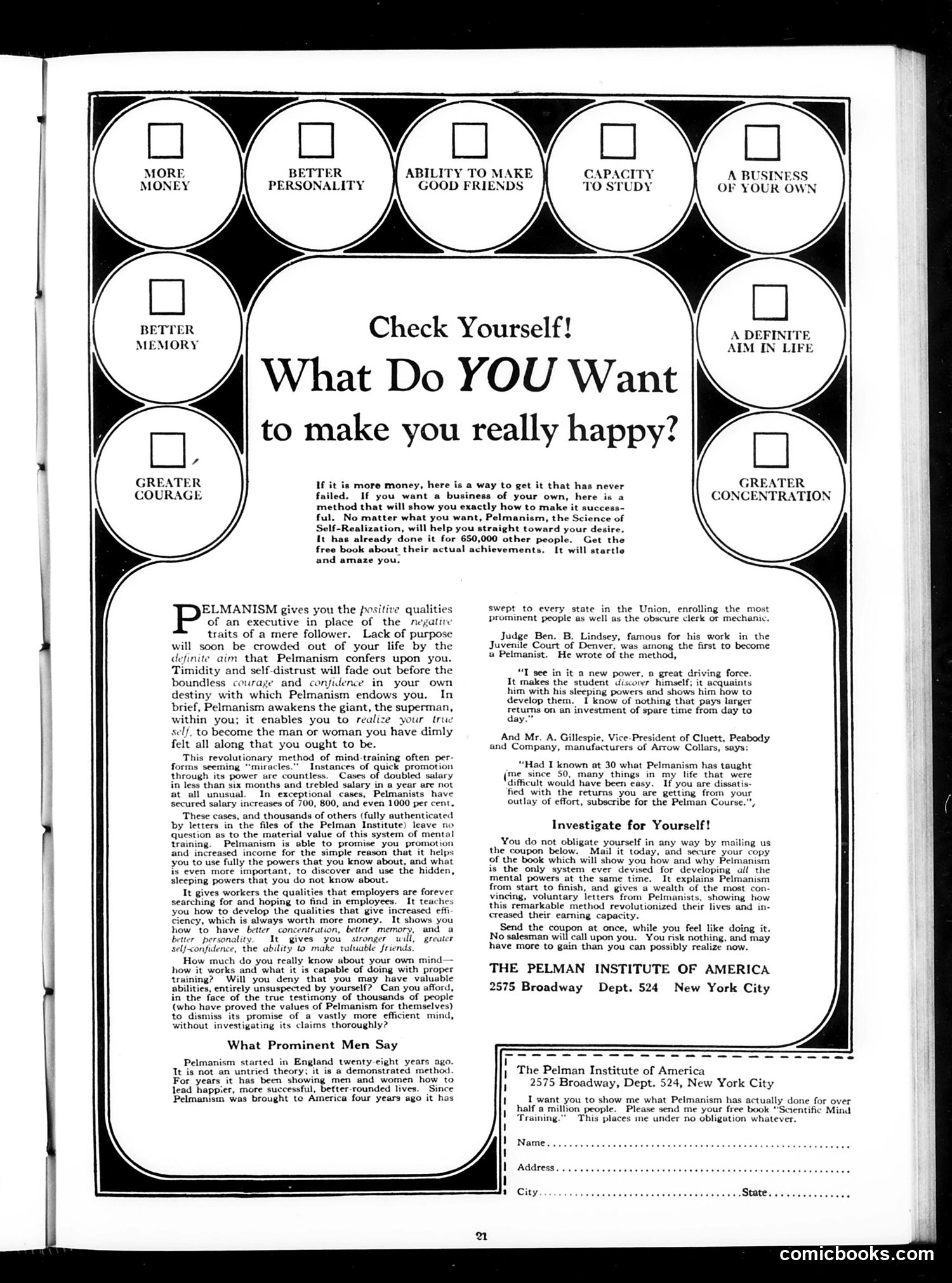
This page is primarily **advertising for the Pelman Institute of America**, a self-help organization promoting "Pelmanism"—a mail-order mind-training system that claims to unlock hidden mental powers and guarantee personal success. The circular design presents appealing outcomes (more money, better personality, business ownership, improved memory) as rewards for following Pelmanism's method. The advertisement uses testimonials from prominent figures like Judge Ben B. Lindsey to establish credibility, claiming 650,000 people have already enrolled. **The satire** (if present) appears subtle: Judge magazine may be gently mocking the era's widespread faith in quick-fix self-improvement schemes and pseudoscientific "mental training" systems. The breathless promises—salary increases of "1000 per cent" and near-miraculous transformations—strain credibility even by 1920s standards. This reflects the period's fascination with self-help culture and emerging psychology, while skeptics viewed such programs as exploitative marketing targeting aspirational Americans.
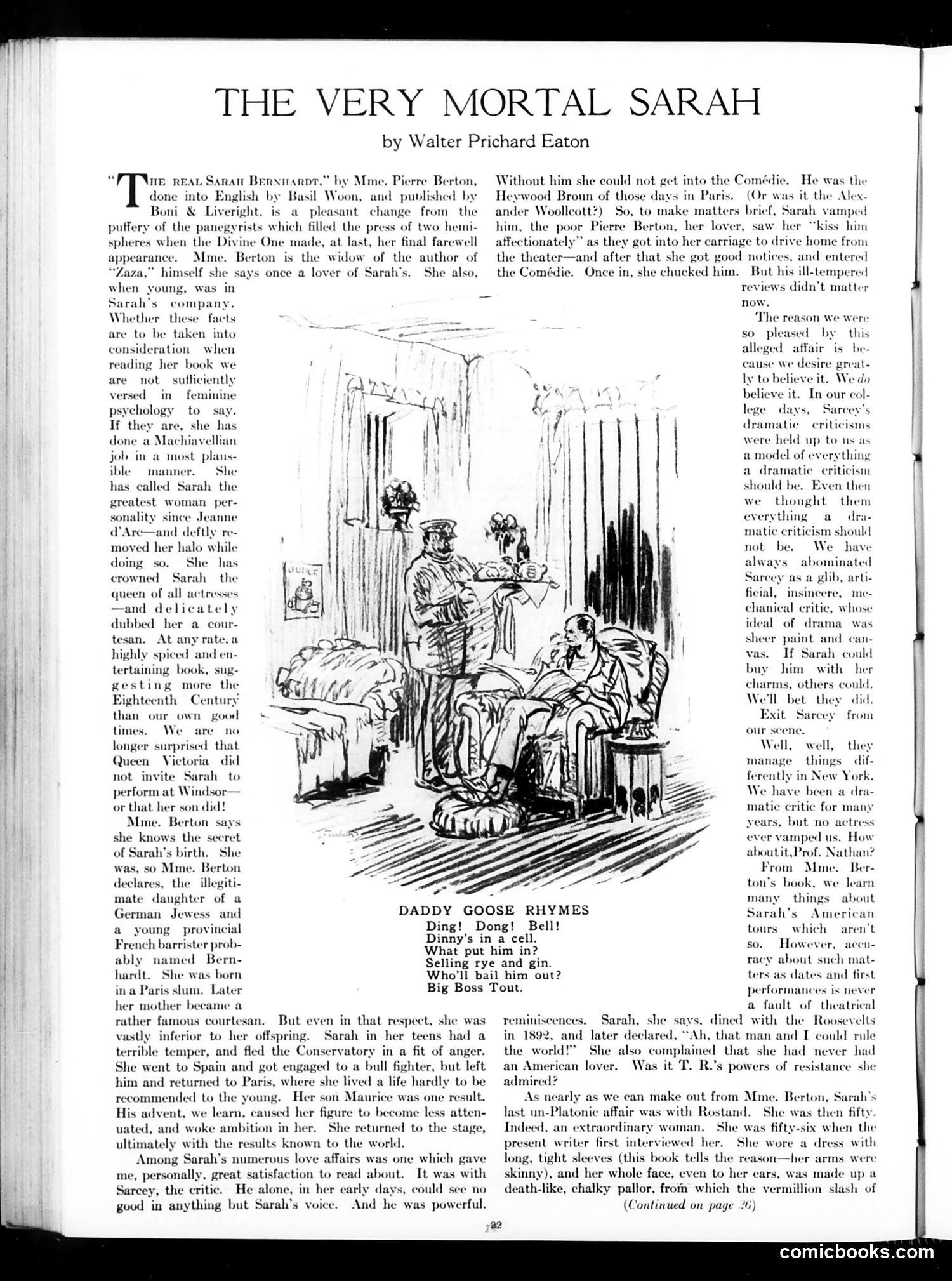
This is a literary essay about Sarah Bernhardt, the famous French actress. The text discusses her legendary status and mystique, noting that despite her aging and mortality, critics treated her as an infallible dramatic authority. The small illustration labeled "DADDY GOOSE RHYMES" appears to be an unrelated children's nursery rhyme feature (a common Judge magazine section), showing figures in what looks like a bedroom or domestic scene. The essay itself is biographical commentary rather than political satire—examining how Bernhardt's reputation had become almost mythical in theater criticism, even as she aged. The author suggests contemporary critics should evaluate drama more objectively rather than deferring to Bernhardt's legendary status.
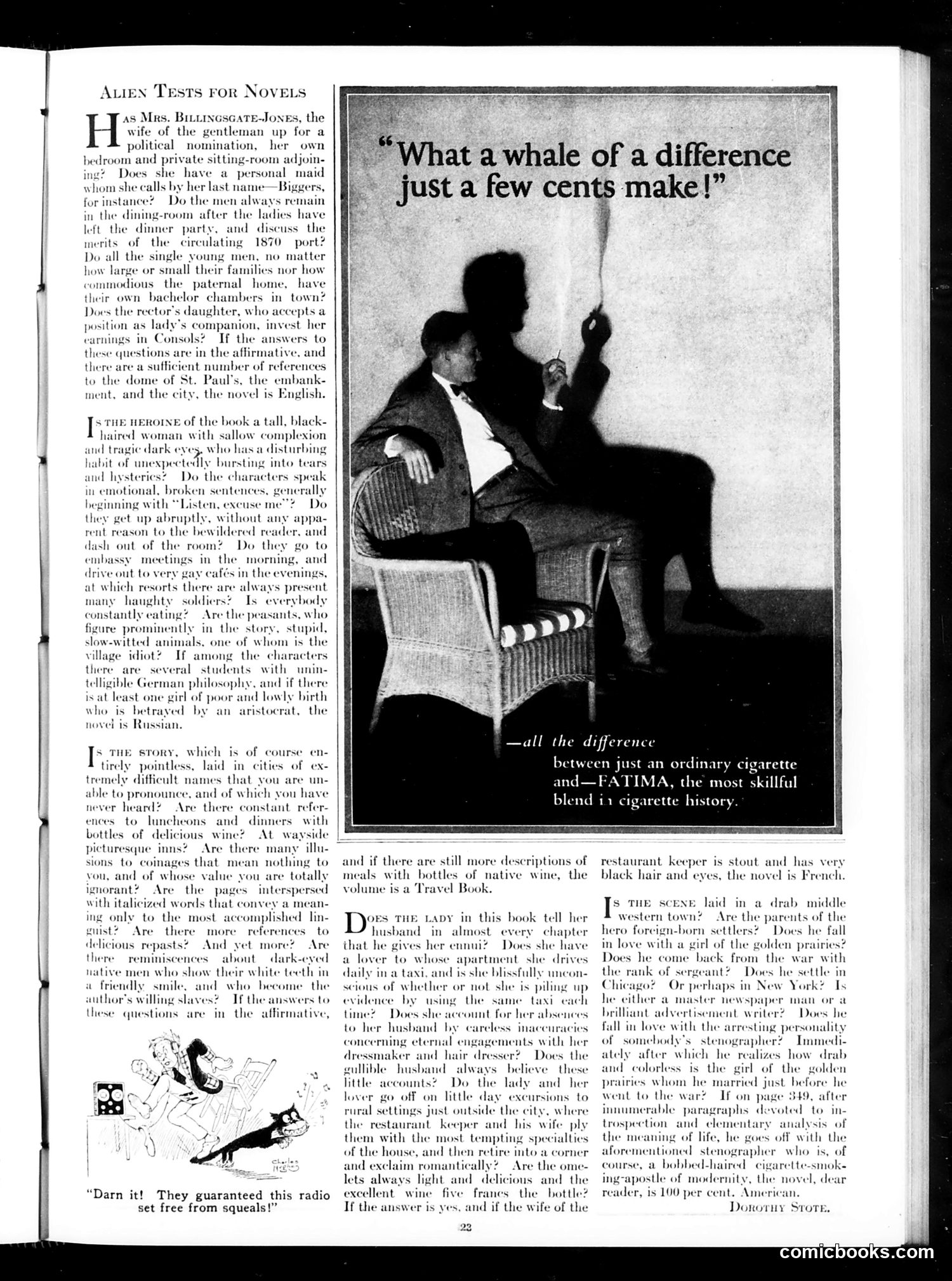
This page satirizes literary clichés by offering diagnostic "tests" to identify a novel's national origin based on hackneyed tropes. **The English Novel Test**: Does it obsess over social conventions (bachelor chambers, proper dinner etiquette, references to St. Paul's Cathedral)? **The Russian Novel Test**: Does it feature tortured heroines with inexplicable emotional outbursts, dim peasants, revolutionary students spouting German philosophy, and betrayals by aristocrats? **The Continental/French Novel Test**: Unpronounceable place names, constant lavish meals with wine, italicized foreign phrases, and affairs with taxi-driven lovers at rural inns? The satire ridicules how formulaic and derivative these national literary traditions had become—each relying on recognizable stereotypes rather than originality. Judge mocks authors who substitute exotic window-dressing (foreign meals, melodrama, philosophy-spouting characters) for genuine narrative substance. The cigarette advertisement's ironic caption—"What a whale of a difference just a few cents make"—echoes the page's point: small superficial differences, applied mechanically, supposedly transform the product.
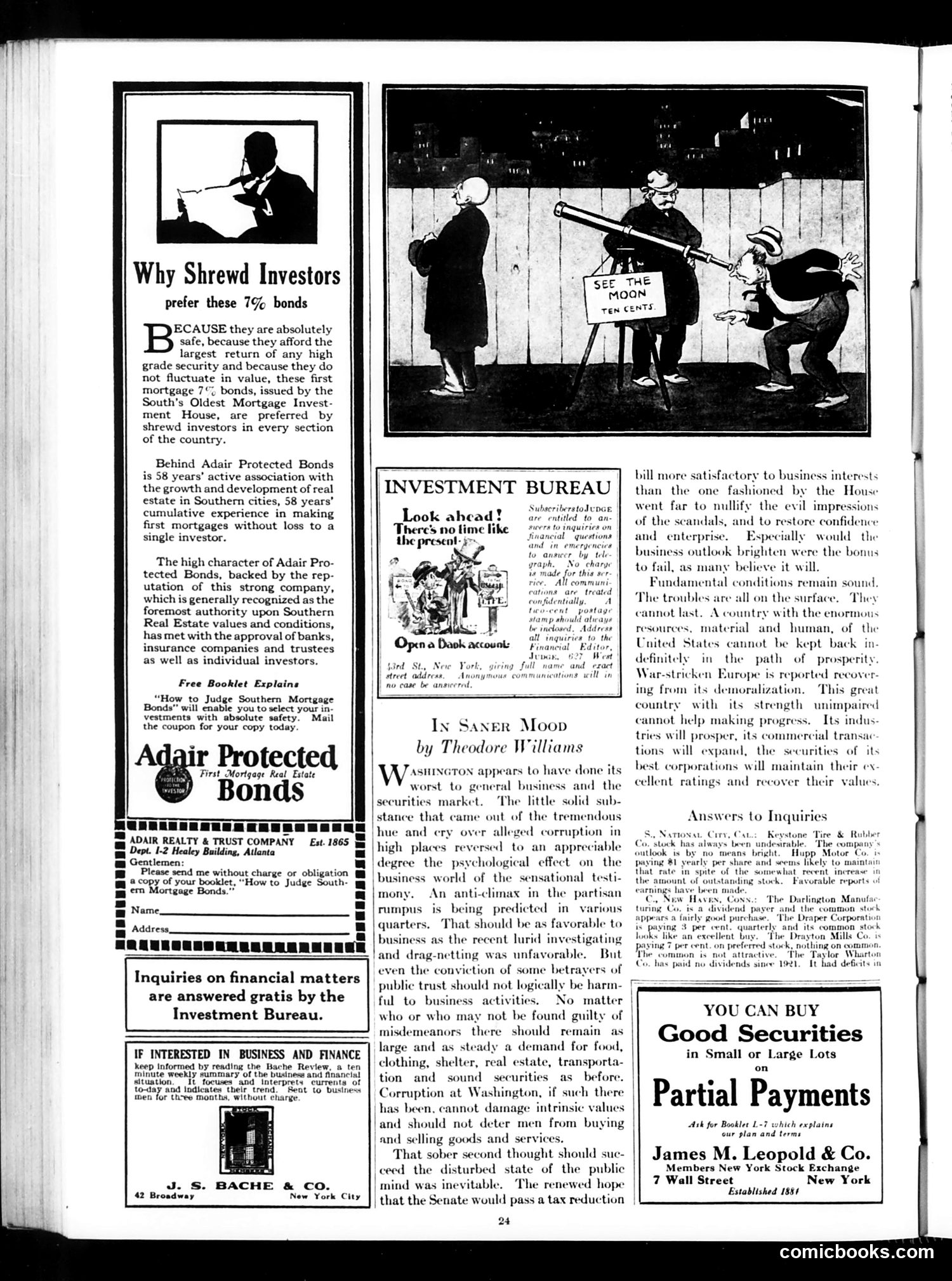
This page is primarily **advertising** for financial products (bonds and investment services), interspersed with editorial content from Judge magazine. The **cartoon** (upper right) depicts a street hustler with a telescope offering to "See the Moon for Ten Cents"—a classic con-artist setup satirizing **get-rich-quick schemes**. This likely comments on the era's widespread financial fraud and dubious investment pitches targeting ordinary people. The text "In Saner Mood" by Theodore Williams discusses the **Washington corruption scandals** (appears to reference post-WWI Teapot Dome or similar), arguing that despite political turmoil, fundamental economic conditions remain sound. The piece reassures readers that corruption shouldn't deter investment in legitimate securities. The juxtaposition is intentional: amid actual scandals eroding public trust, Judge runs advertisements promoting "safe" bonds—creating ironic commentary on whether any investments are truly trustworthy during this period of institutional corruption and public skepticism. The page captures 1920s-era anxiety about financial reliability and political trustworthiness.
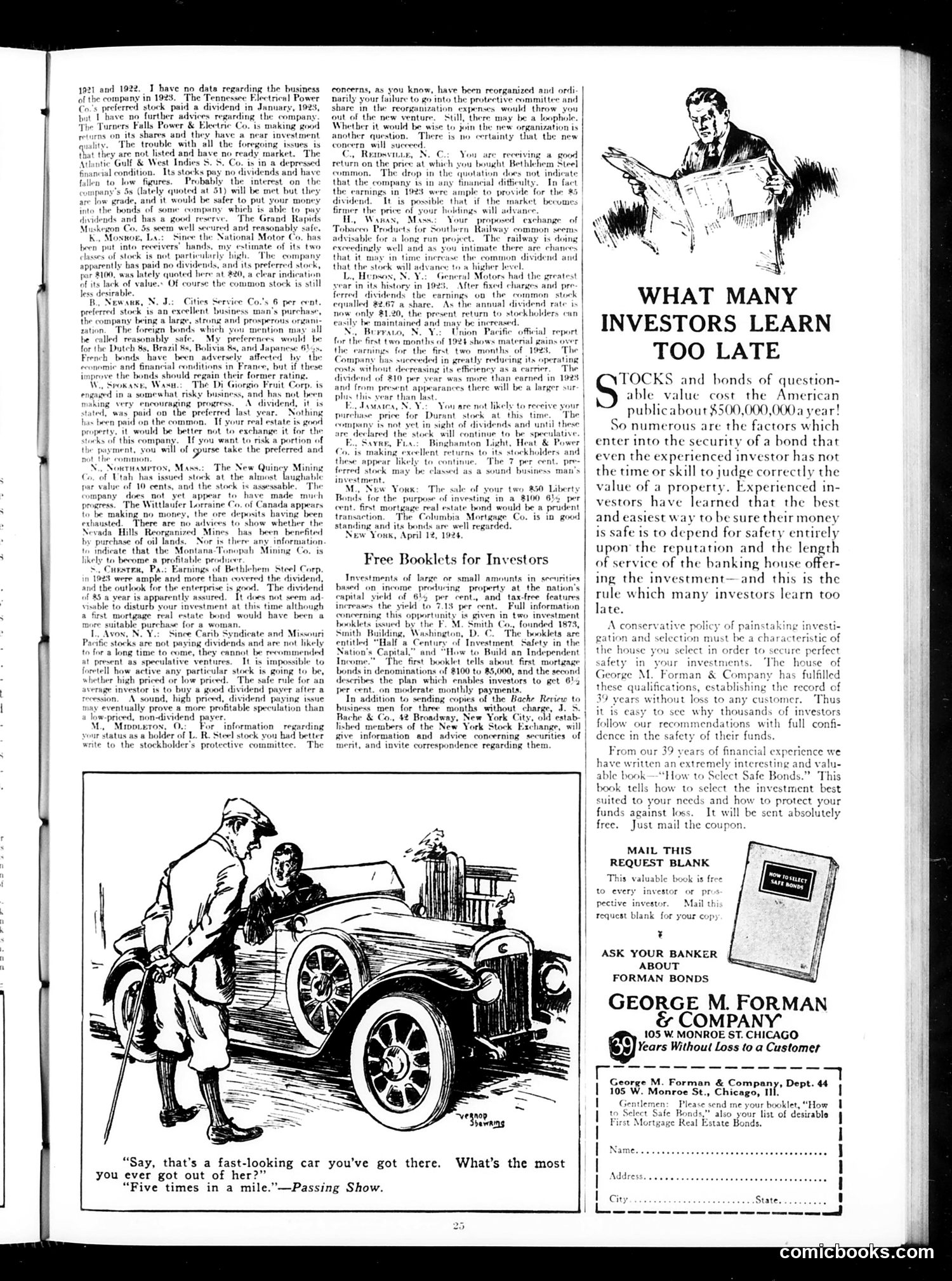
This page contains two distinct elements: a financial advice column and a cartoon joke. The **main cartoon** depicts a man examining another man's car, commenting "Say, that's a fast-looking car you've got there. What's the most you ever got out of her?" The punchline—"Five times in a mile"—is credited to "Passing Show." This is a simple automotive humor joke with no political significance; it plays on the double meaning of "get out of" (performance vs. literal exit). The **financial column** addresses investor concerns about various stocks and bonds, discussing dividend payments, market value, and investment safety. This reflects 1920s-era concerns about stock speculation and risk—topics that became tragically relevant after the 1929 crash. The **advertisement** for George M. Forman & Company offers free investment guidance booklets, promoting bonds as safer alternatives to stocks. The page overall represents pre-Depression financial journalism aimed at cautious investors seeking trustworthy advice about securities.
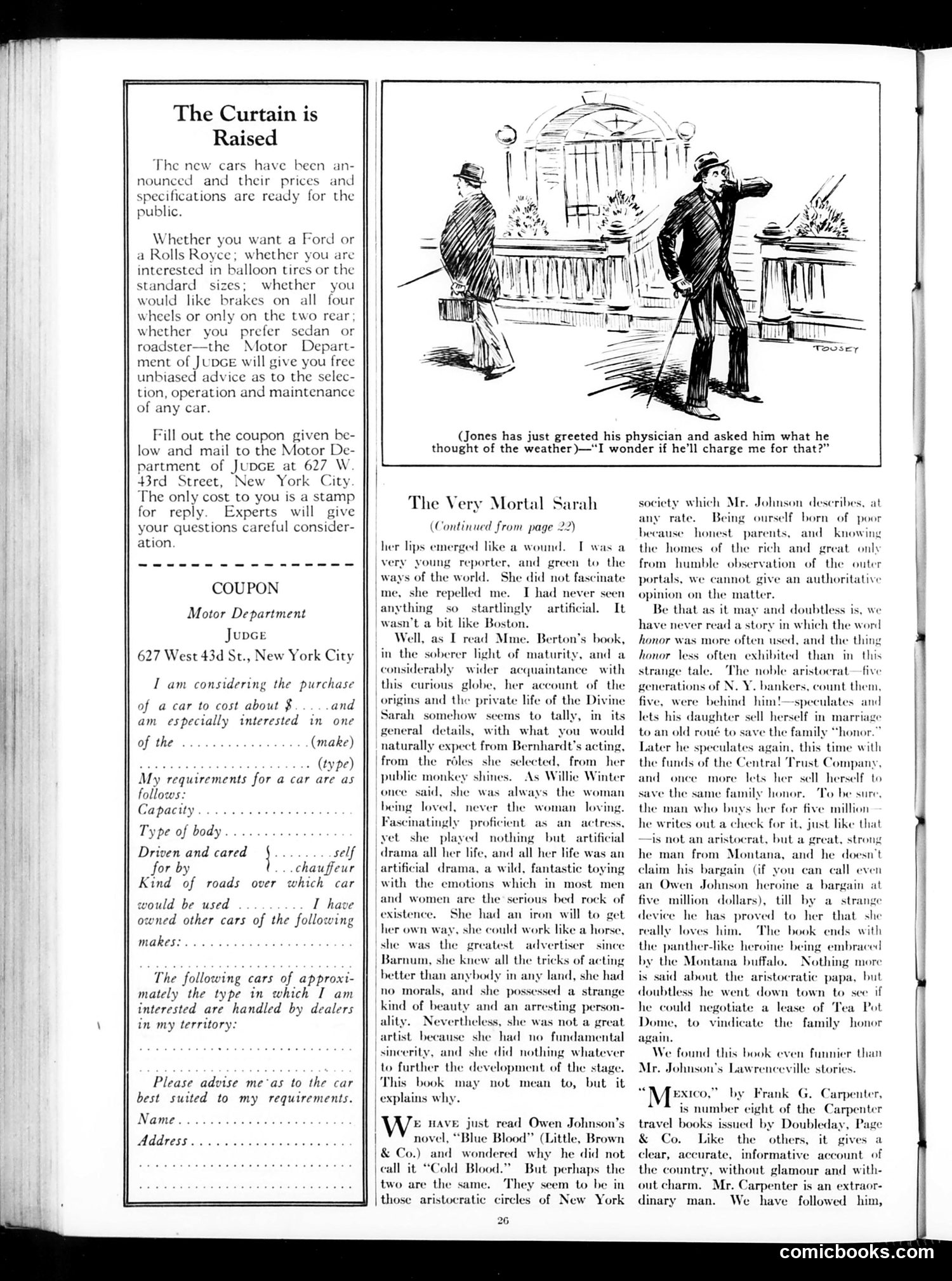
This page contains two distinct sections: **The Cartoon (top right):** A simple joke about a patient (Jones) greeting his doctor and asking about the weather, then quipping "I wonder if he'll charge me for that?" The satire targets doctors' tendency to bill for even the most trivial interactions—a timeless complaint about medical fees. **"The Very Mortal Sarah" (main article):** A book review of a biography about Sarah Bernhardt, the famous French actress. The reviewer criticizes Bernhardt as fundamentally artificial—a woman who performed constantly in real life, possessed no genuine sincerity, and was driven by ego and self-promotion rather than artistic integrity. The piece argues she advanced theater through marketing genius and technical skill, not genuine contribution to the art form. **The Left Side:** An advertisement for Judge's Motor Department, offering free car-buying advice via coupon. The page reflects early 20th-century attitudes about celebrity authenticity and professional ethics.
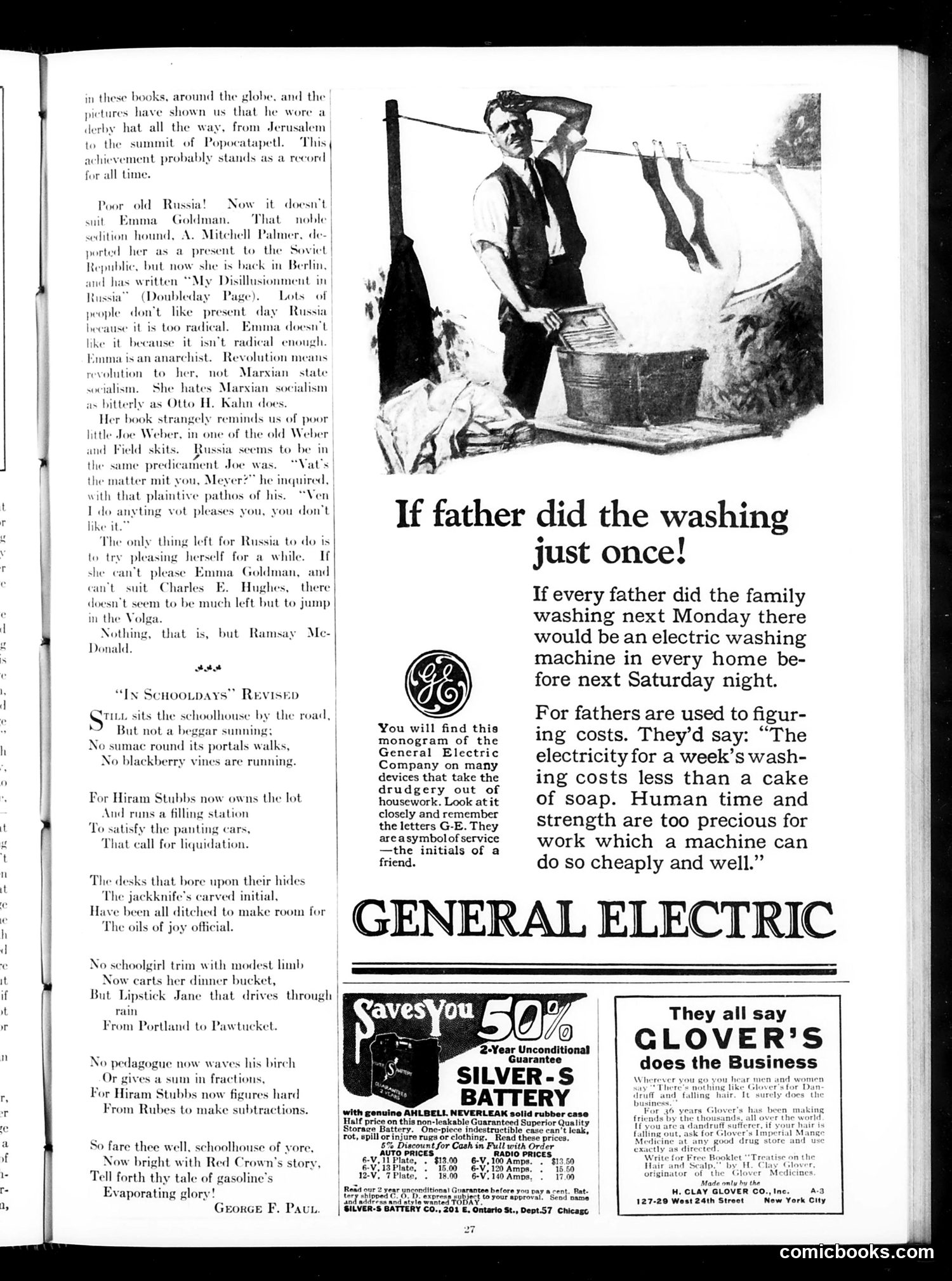
This page mixes political commentary with period advertising. The main satirical text discusses Emma Goldman, the anarchist activist deported to Soviet Russia by Attorney General A. Mitchell Palmer. The joke: Goldman, a radical revolutionary, is disappointed that Soviet Russia isn't radical *enough*—it's become a Marxian state rather than true anarchism. Judge compares her predicament to a Yiddish vaudeville sketch where nothing satisfies the protagonist. The accompanying poem "In Schooldays Revised" nostalgically contrasts old rural America (one-room schoolhouses, modest schoolgirls) with modern commercialism (filling stations, "Lipstick Jane"), satirizing how gasoline and consumer culture have replaced traditional institutions. The page also features period advertisements for General Electric washing machines and Silver-S batteries, typical of 1920s publications. The ads appeal to middle-class aspirations for labor-saving devices. **Key context:** This reflects post-WWI American anxiety about radicalism, rapid modernization, and changing social values.
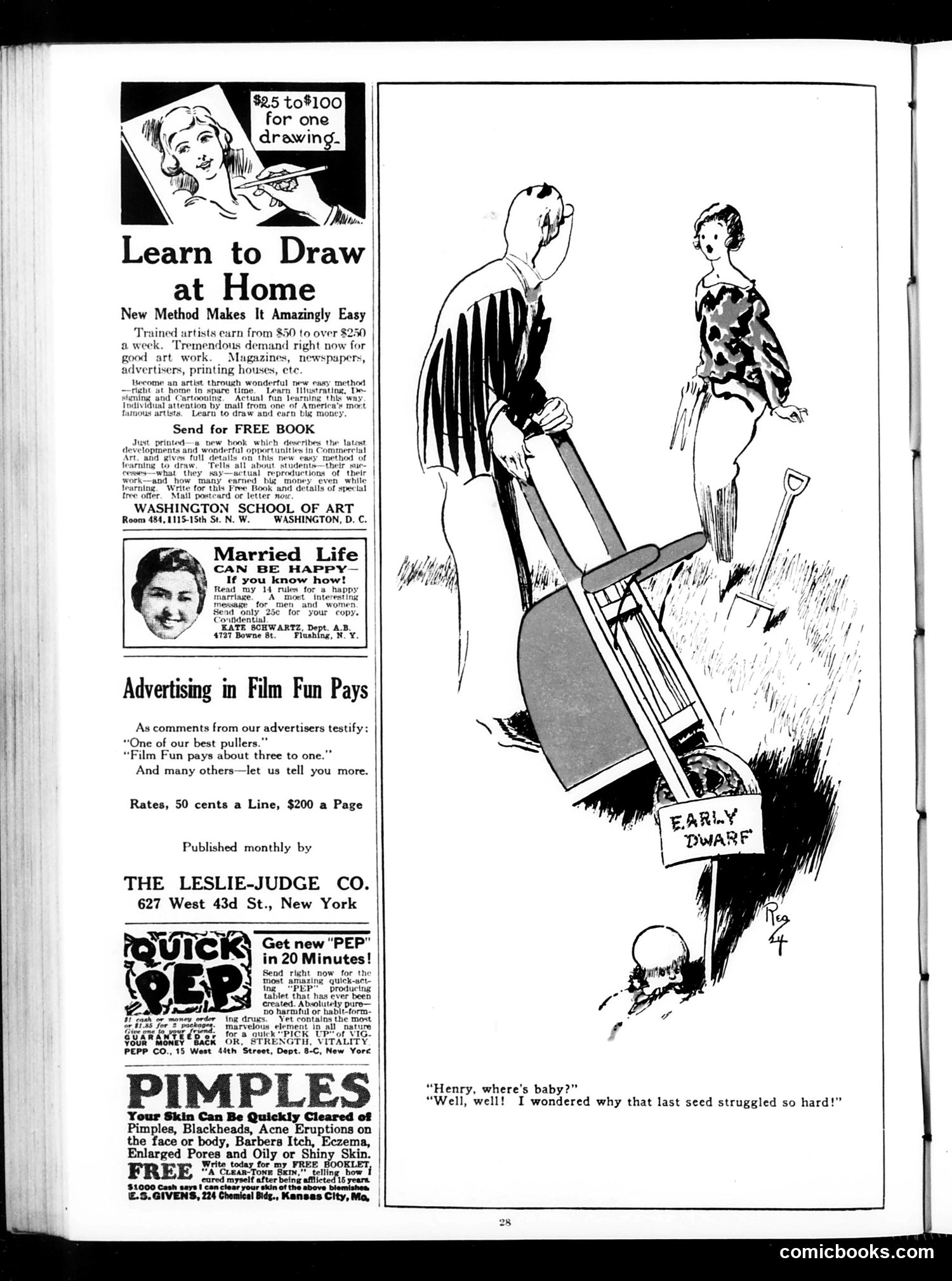
This page is primarily **advertising**, with one small cartoon at the bottom. The main cartoon depicts a man digging in a garden while a woman asks "Henry, where's baby?" His response—"Well, well! I wondered why that last seed struggled so hard!"—is a dark joke playing on the double meaning of "seed." The humor relies on the crude implication that the baby has been accidentally buried or mixed in with garden seeds, suggesting parental negligence or absent-mindedness. It's grotesque by modern standards but represents the era's taste for sardonic, macabre humor about domestic life. The page's numerous ads reflect early 20th-century concerns: art training correspondence courses, marriage advice, skin treatments for acne and eczema, and "Quick Pep" (an energy supplement). These advertisements reveal period anxieties about self-improvement, appearance, and social advancement.
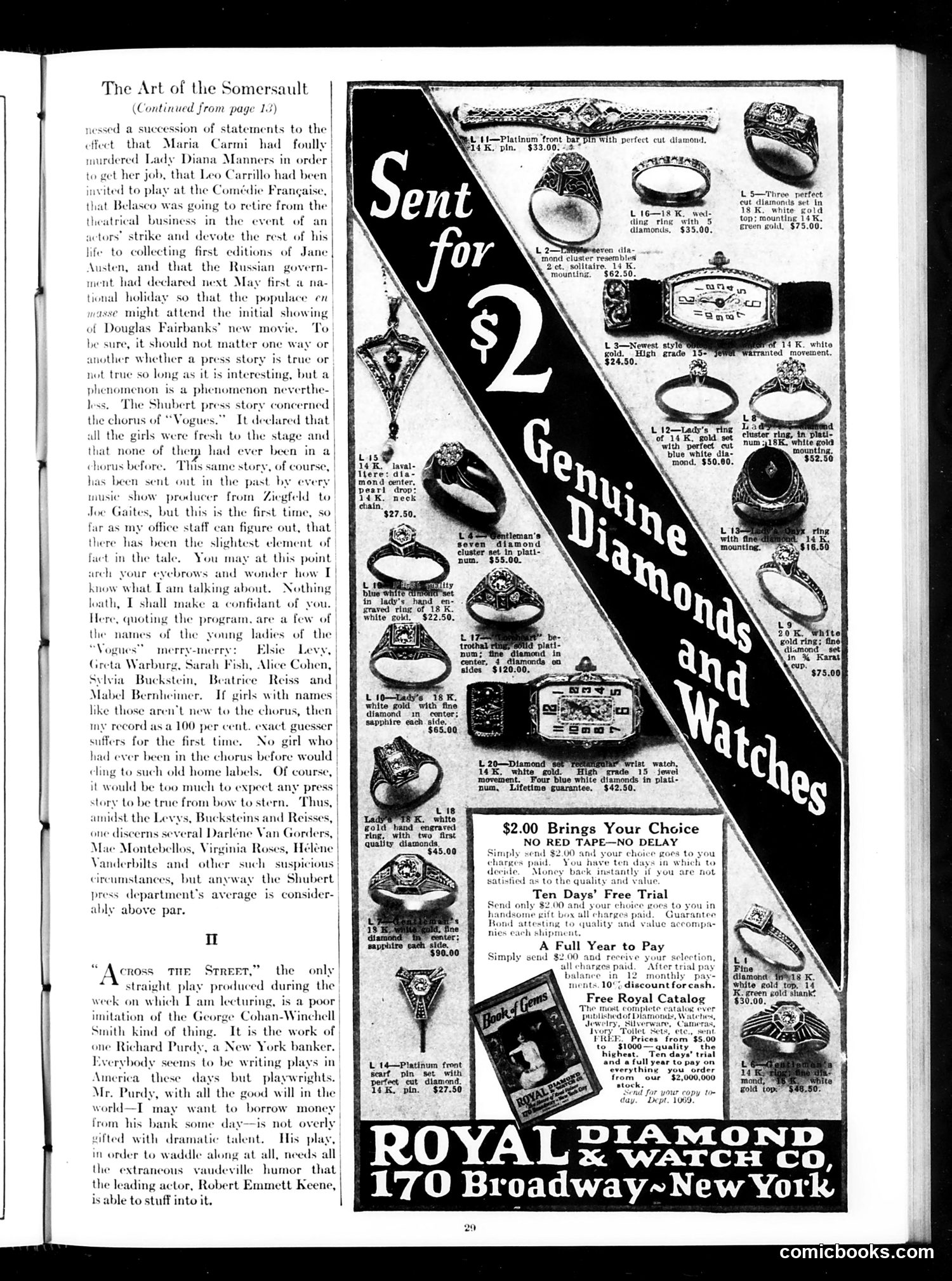
This page is **primarily a jewelry advertisement** for Royal & Diamond Watch Co., occupying roughly the right half and dominating the layout. The left side contains theatre criticism discussing the "Somersault" (likely a theatrical review column). The author critiques press releases from theatre producers—particularly the Shubert organization's claim that chorus girls in their show "Vogues" were all newcomers. The critic sarcastically notes this is technically true, evidenced by the girls' surnames: Elsie Levy, Greta Warburg, Sarah Fish, Sylvia Buckstein—clearly Jewish and immigrant names, implying they're genuinely fresh arrivals rather than seasoned Broadway chorus girls. He contrasts these with suspiciously WASP names like "Darlene Van Gorders," suggesting the press release mixed truth with fiction. A brief theatre review mentions Richard Purdy's play "Across the Street," dismissing it as mediocre and dependent on star Robert Emmett Keene's vaudeville talents to succeed. **The satire concerns theatrical PR exaggeration and the immigrant composition of 1920s Broadway chorus lines.**
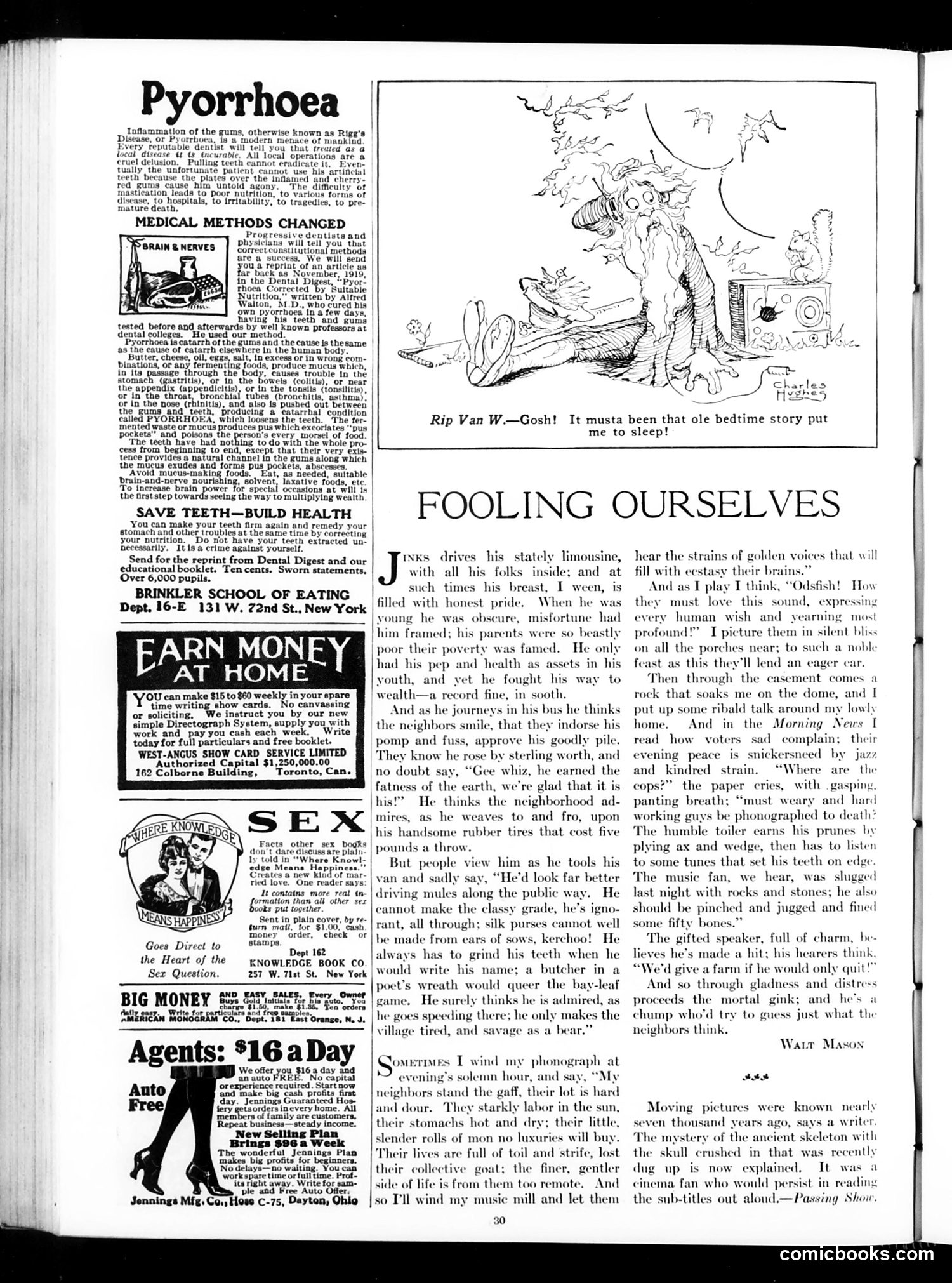
This page from *Judge* magazine mixes serious health advocacy with period advertising and humor. **Main Content - "Fooling Ourselves"** (by Walt Mason): A satirical essay about self-deception and wealth-seeking. The narrator observes his neighbors pretending to prosperity—driving a "stately limousine," dressing well—while actually living in poverty and hardship. Mason mocks this performative aspiration, suggesting people lie to themselves about their status and spend beyond their means. The piece critiques American materialism and the gap between appearance and reality, a common *Judge* theme targeting social pretension. **Supporting Elements**: The page also features medical advertisements (dental health, nutrition schools) and "get rich quick" schemes typical of early 20th-century magazines—showing the publication's dual nature as both satirical commentary and commercial vehicle. The cartoon at top right (captioned "Rip Van W.—Gosh!") depicts a man emerging from a tree, suggesting the old folktale, likely a visual counterpoint to Mason's theme about illusion versus reality.
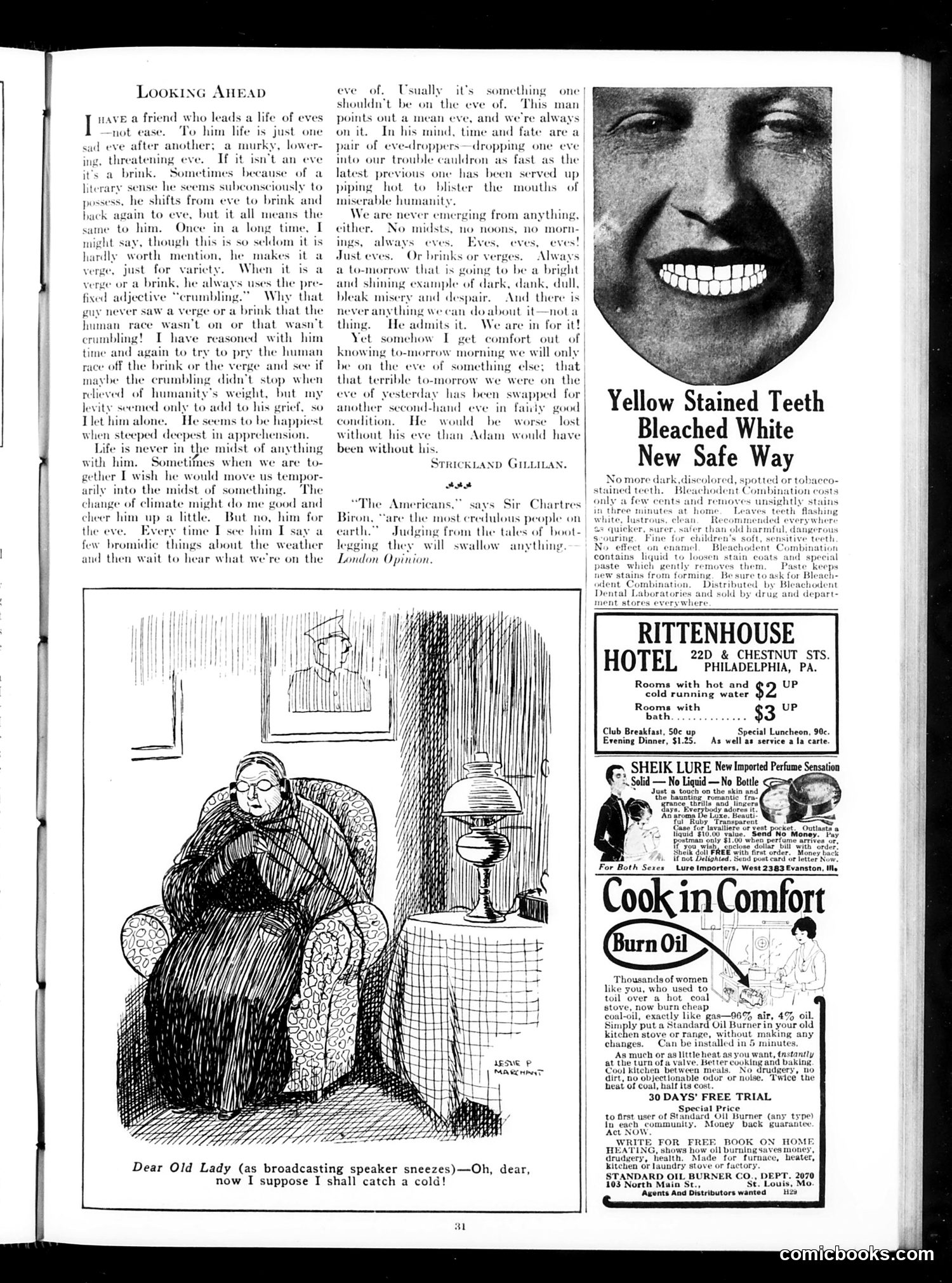
This page contains an essay titled "Looking Ahead" by Strickland Gillilan and period advertisements; there is no political cartoon requiring historical analysis. **The Essay's Social Commentary:** Gillilan satirizes a pessimistic friend who perpetually sees life through a lens of impending doom—always on the "eve" of disaster or the "verge" of collapse. The friend views time as an endless cycle of misery, with no present moment of peace, only anticipation of worse trouble ahead. Gillilan gently mocks this chronic anxiety and catastrophizing mindset, noting the friend finds strange comfort in despair. The piece reflects early 20th-century social anxiety about modern life's uncertainties. **The Cartoon:** A simple illustration labeled "Dear Old Lady (as broadcasting speaker sneezes)—Oh dear, now I suppose I shall catch a cold!" shows an elderly woman listening to a radio broadcast, fearful she'll catch illness through the radio waves—satirizing public ignorance about how broadcasting technology works and exaggerated health anxieties. **Advertisements shown** include teeth-whitening products, a Philadelphia hotel, and oil burners—typical period marketing with no political content.
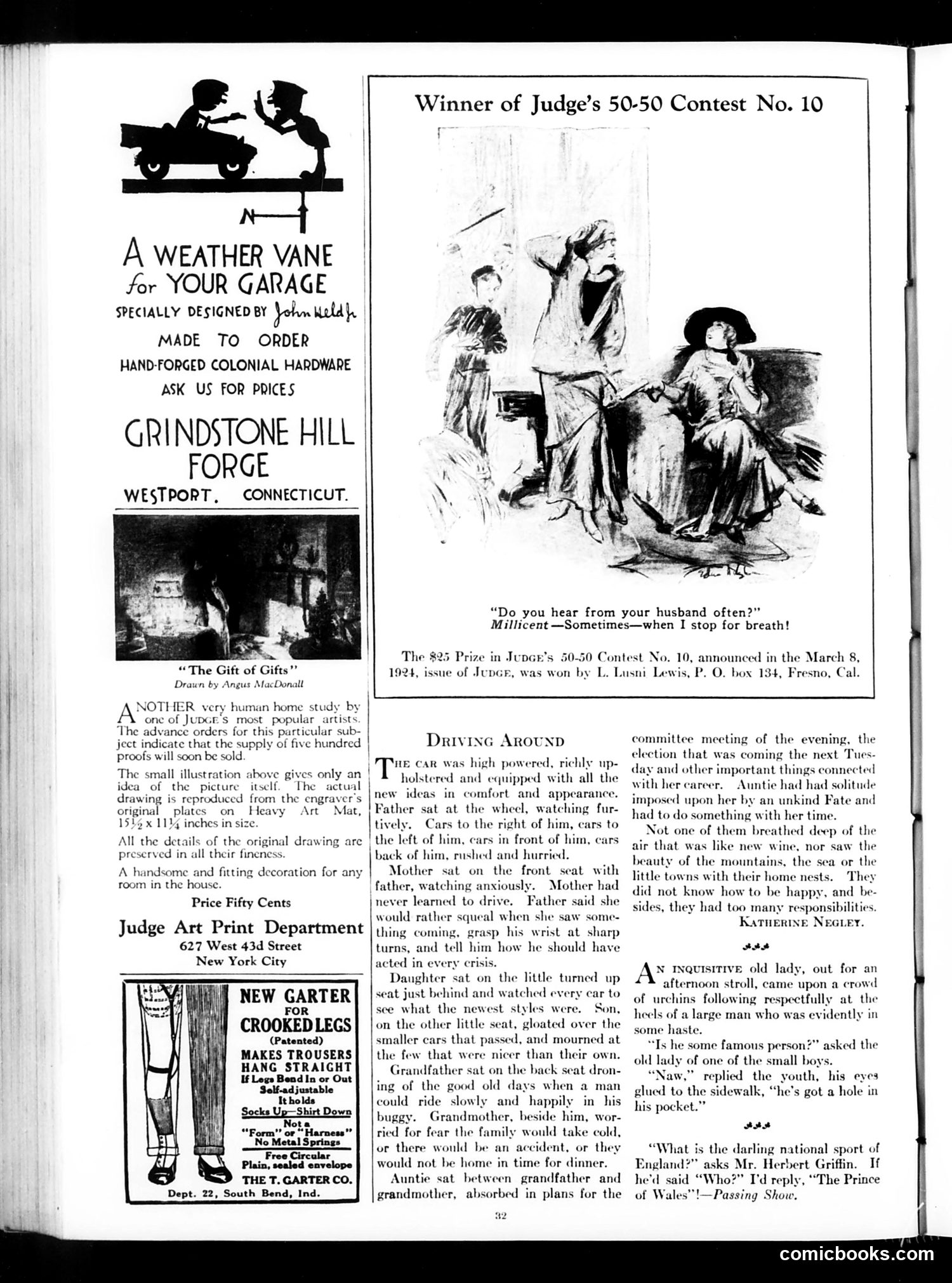
This page contains primarily **advertisements and short fiction** rather than political satire. The main cartoon at top right, titled "Winner of Judge's 50-50 Contest No. 10," shows a sketch of people in what appears to be a domestic scene. The caption reads: "Do you hear from your husband often?" with the reply "Millicent—Sometimes—when I stop for breath!" This is a **gentle domestic joke** about a talkative wife, a common humor trope of the era. The page also advertises a weather vane from Grindstone Hill Forge (Connecticut), a Judge Art Print Department offering, and a "New Garter for Crooked Legs" product. The lower section contains the start of a short story titled "Driving Around" about a family automobile outing—likely humorous social commentary on 1920s car culture and family dynamics, though the full text is partially cut off here.
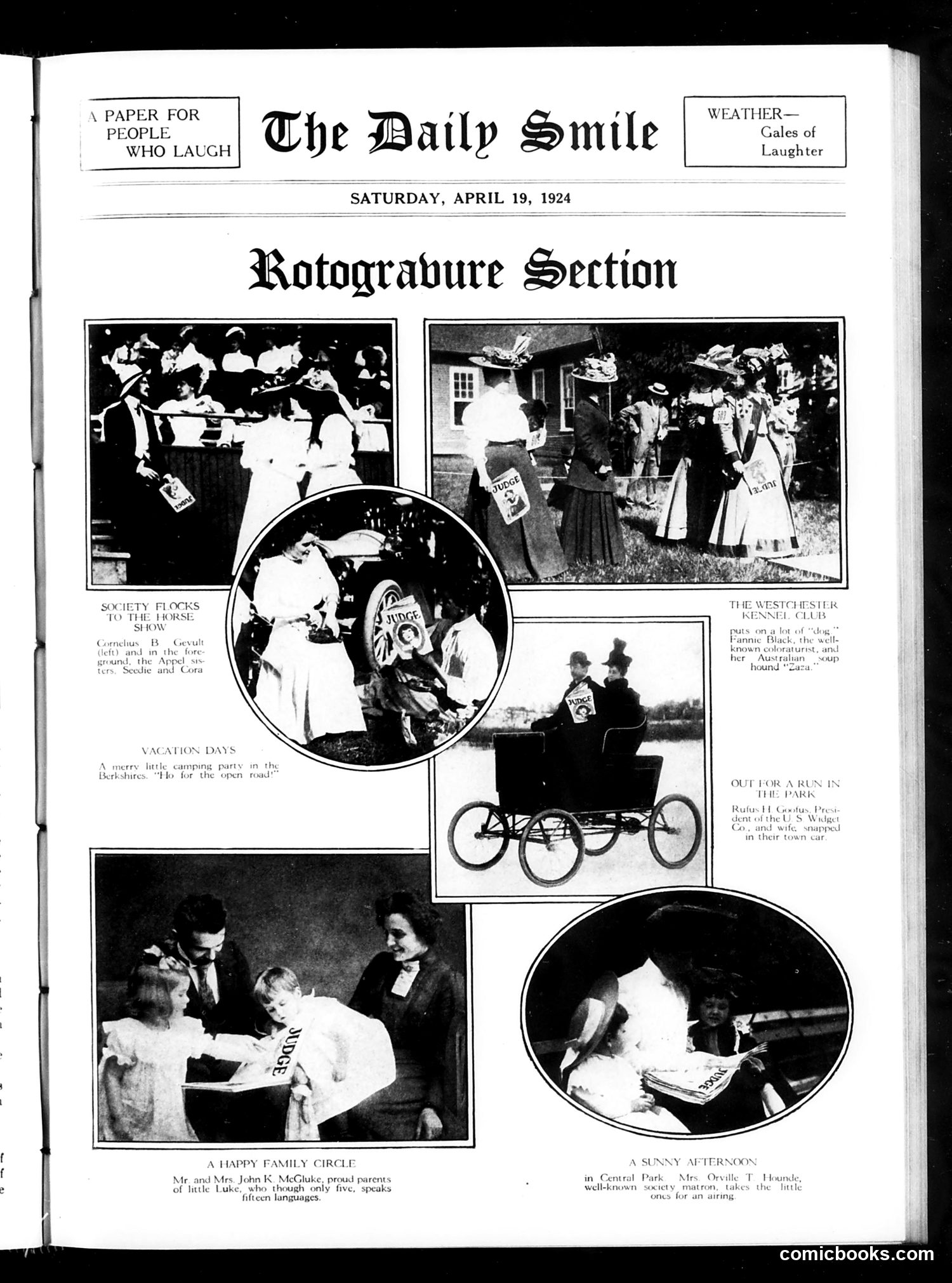
This is a **photojournalism page**, not political satire. The "Rotogravure Section" was a popular newspaper feature showcasing photographs of society events and notable people. The page documents upper-class leisure activities: - **Society Flocks to the Horse Show**: Wealthy people attending equestrian events - **Vacation Days**: A camping party in the Berkshires - **The Westchester Kennel Club**: A dog show featuring notable contestants - **Out for a Run in Paris**: A U.S. Wedge Company official and wife in their automobile - **A Happy Family Circle**: Mr. and Mrs. John K. McGluke with their five-year-old son Luke, noted for speaking fifteen languages - **A Sunny Afternoon in Central Park**: Social activities The page reflects 1920s preoccupations with wealth display, leisure, and cosmopolitan sophistication. The inclusion of a multilingual child suggests contemporary fascination with exceptional achievements and cultured accomplishment among the privileged classes.
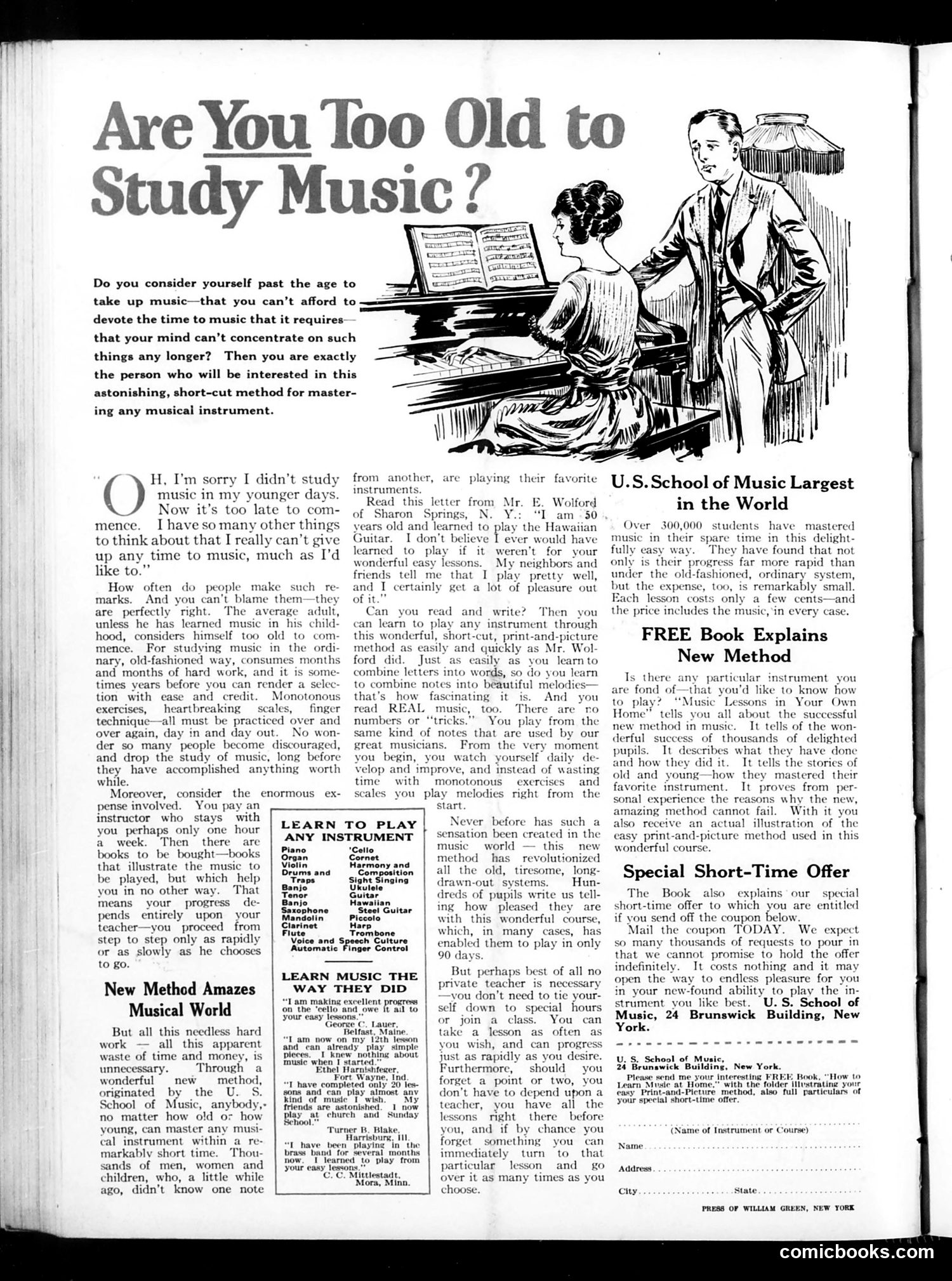
This is primarily **advertising content**, not satire. The page features a testimonial-style advertisement for the U.S. School of Music's correspondence music lessons. The headline poses a rhetorical question to address potential customers' objections: older adults often believe they're too old or too busy to learn music. The accompanying illustration shows a well-dressed man instructing a woman at a piano—a scene meant to inspire confidence in the method. The advertisement includes a real testimonial from "Mr. E. Wolford" of Sharon Springs, N.Y., claiming he learned Hawaiian guitar at age 50 using their mail-order system. The copy emphasizes speed, low cost (lessons costing "only a few cents"), and convenience—you learn at home from printed materials rather than hiring expensive in-person instructors. This reflects early 20th-century mail-order marketing: ambitious promises of self-improvement through correspondence courses. The framing assumes readers are skeptical about learning as adults, so the ad uses everyday language and "real" testimonials to build credibility.