
Judge, 1924-04-19 · page 25 of 36
Judge — April 19, 1924 — page 25: what you’re looking at
What you’re looking at
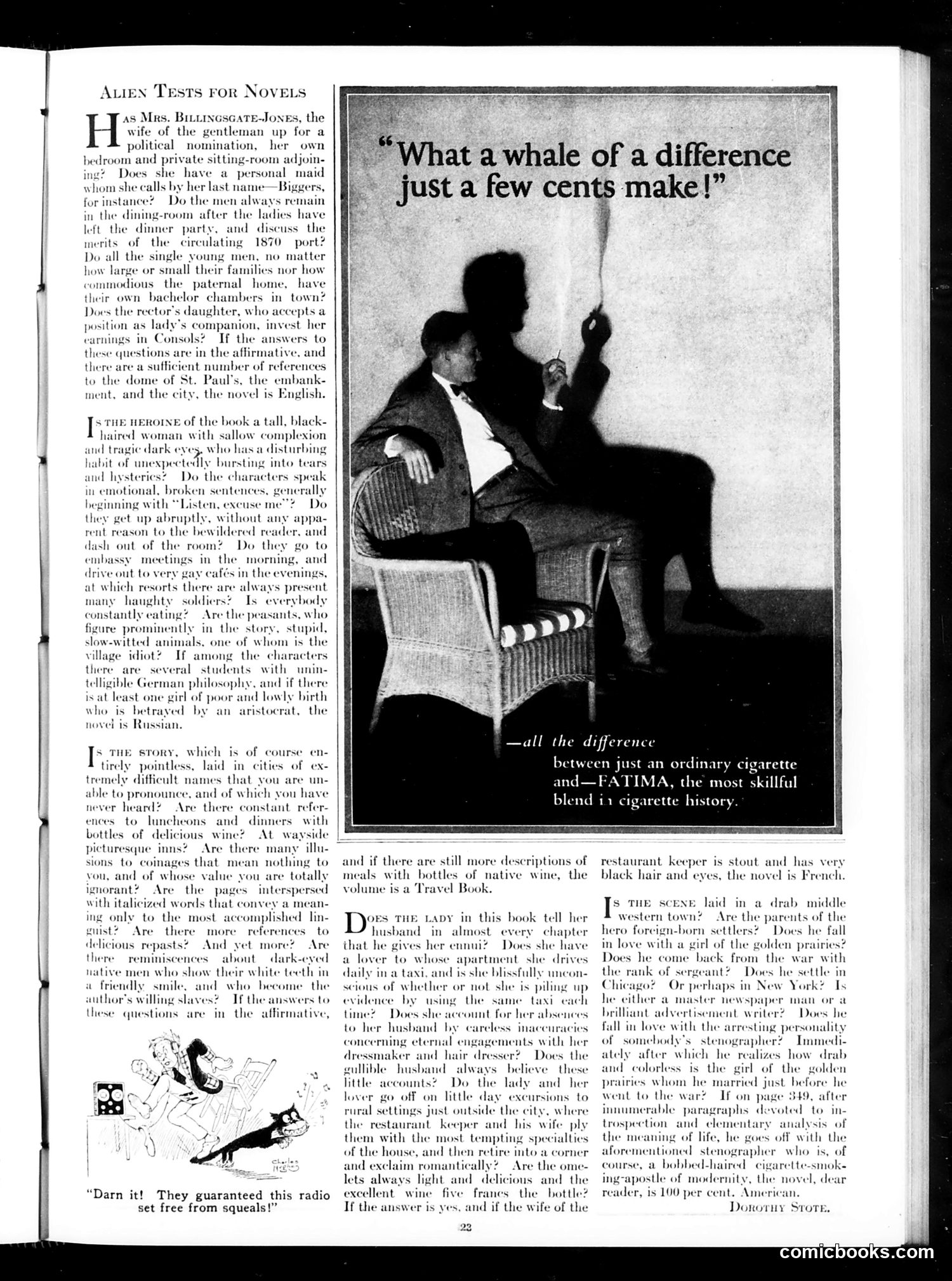
This page satirizes literary clichés by offering diagnostic "tests" to identify a novel's national origin based on hackneyed tropes. **The English Novel Test**: Does it obsess over social conventions (bachelor chambers, proper dinner etiquette, references to St. Paul's Cathedral)? **The Russian Novel Test**: Does it feature tortured heroines with inexplicable emotional outbursts, dim peasants, revolutionary students spouting German philosophy, and betrayals by aristocrats? **The Continental/French Novel Test**: Unpronounceable place names, constant lavish meals with wine, italicized foreign phrases, and affairs with taxi-driven lovers at rural inns? The satire ridicules how formulaic and derivative these national literary traditions had become—each relying on recognizable stereotypes rather than originality. Judge mocks authors who substitute exotic window-dressing (foreign meals, melodrama, philosophy-spouting characters) for genuine narrative substance. The cigarette advertisement's ironic caption—"What a whale of a difference just a few cents make"—echoes the page's point: small superficial differences, applied mechanically, supposedly transform the product.
📄 Transcribed text from this page (OCR, searchable)
Machine-transcribed from the original scan — historical spelling and the odd misread are preserved.
Auien Tests For NOVELS as Mrs, Bittincscate-Jones, the wife of the gentleman up for a political nomination, her own bedroom and private sitting-room adjoin- ing? Does she have a personal maid whom she calls by her last name—Biggers, for instance? Do the men always remain in the dining-room after the ladies have left the dinner party, and discuss the merits of the circulating 1870 port? Do all the single young men, no matter how large or small th amilies nor how commodious the paternal home, have their own bachelor chambers in town? Does the rector’s daughter, who accepts a position as lady's companion, invest her earnings in Consols? If the answers to th questions are in the there are a sufficient number of references to the dome of St. Paul's, the embank- ment, and the city, the novel is English. I THE HEROINE of the book a tall, F haired woman with sallow complexion rk eves, Who disturbing habit of unexpectedly bursting into te and hysteries? Do the chi in emotional, broken sentences, y beginning with “Listen, excuse m Do they get up abruptly, without any appa- rent reason to the bewildered reader, and dash out of the room? Do they go to meetings in the morning, and drive out to very gay cafés in the evenings, at which resorts there are always present many haughty soldiers? Is. everybody constantly eating? Are the peasants, who figure prominently in the story, stupid, slow-wit nimals, one of whom is the village idio' If among the characters there are several students with telligible German philosophy, and if the is at ts embassy unin- ast one who is betrayed by an aristocrat, the novel is Russian. I THE story, Which is of course en- tirely pointless, laid in. cities of ex- tremely difficult names that you are un- able to pronounce, and of which you have never heard? Are there constant refer- ences to luncheons and dinners with bottles of delicious wine? At wayside picturesque inns? Are there many illu. sions to coinages that mean nothing to you, and of whose value you are totally ignorant? Are the pages interspersed with italicized words that convey a mean- ing only to the most accomplished lin- guist? Are there more refers delicious repasts? And yet more? Are reminiscences about dark-eved native men who show their white teeth in a friendly smile, and who become the author's willing slaves? Tf the these questions are in the affirmative, ices to there nswers to. “Darn it! They guaranteed this radio set free from squeals!” irl of poor and lowly birth | ag ey _- What a whale of a difference | justa few | make!” e i { —all the difference between just an ordinar and— blend i1 cigarette | and if there are still more descriptions of meals with bottles of native wine, the volume is a Travel Box OES THE LADY in this book tell her husband in’ almost that he gives her ennui? a lover to whose apartment she drives daily ina taxi, and is she blissfully uncon- scious of whether or not she is piling up evidence by using the Axi cach time ‘count for | to her husband by concerning ¢ ial engagements with her dressmaker and hair dresser? Does the gullible always believe little account Do the lady and her lover go off on little day excursions to rural settings just outside the city, where the restaurant keeper and his wife ply them with the most tempting specialties of the house, and then retire into a corner and exclaim romantically? Are the ome- lets always light and delicious and the excellent: wine five francs the bottle? If the answer is yes, and if the wife of the every ¢ Does she have Does she i absences reless inaccuracies cigarette ATIMA, the most skillful story. restaurant keeper is stout and has very black hair and eyes, the novel is French. scene laid in a drab middle s TI I western town? Are the parents of the hero foreign-born settlers? Does he fall in love with a girl of the golden prairies? Does he come back from the war with the rank of sergeant? Does he settle in Chicago? Or perhaps in New York? Is he cither a master newspaper man or a brilliant advertisement writer? Does he fall in love with the arresting personality Immedi- ately after which he realizes how drab and colorless is the girl of the golden prairies whom he married just: before he went to the war? If on page 349, after innumerable par dhs devoted to. in- trospection and elementar ialysis of the meaning of life, he goes off with the aforementioned stenographer who is, of course, a bobbed-haired cigarette-smok- ing-apostle of modernity, the novel, dear reader, is 100 per cent. American. Donoruy Srore. of somebody's stenographer?