
A complete issue · 36 pages · 1924
Judge — March 29, 1924
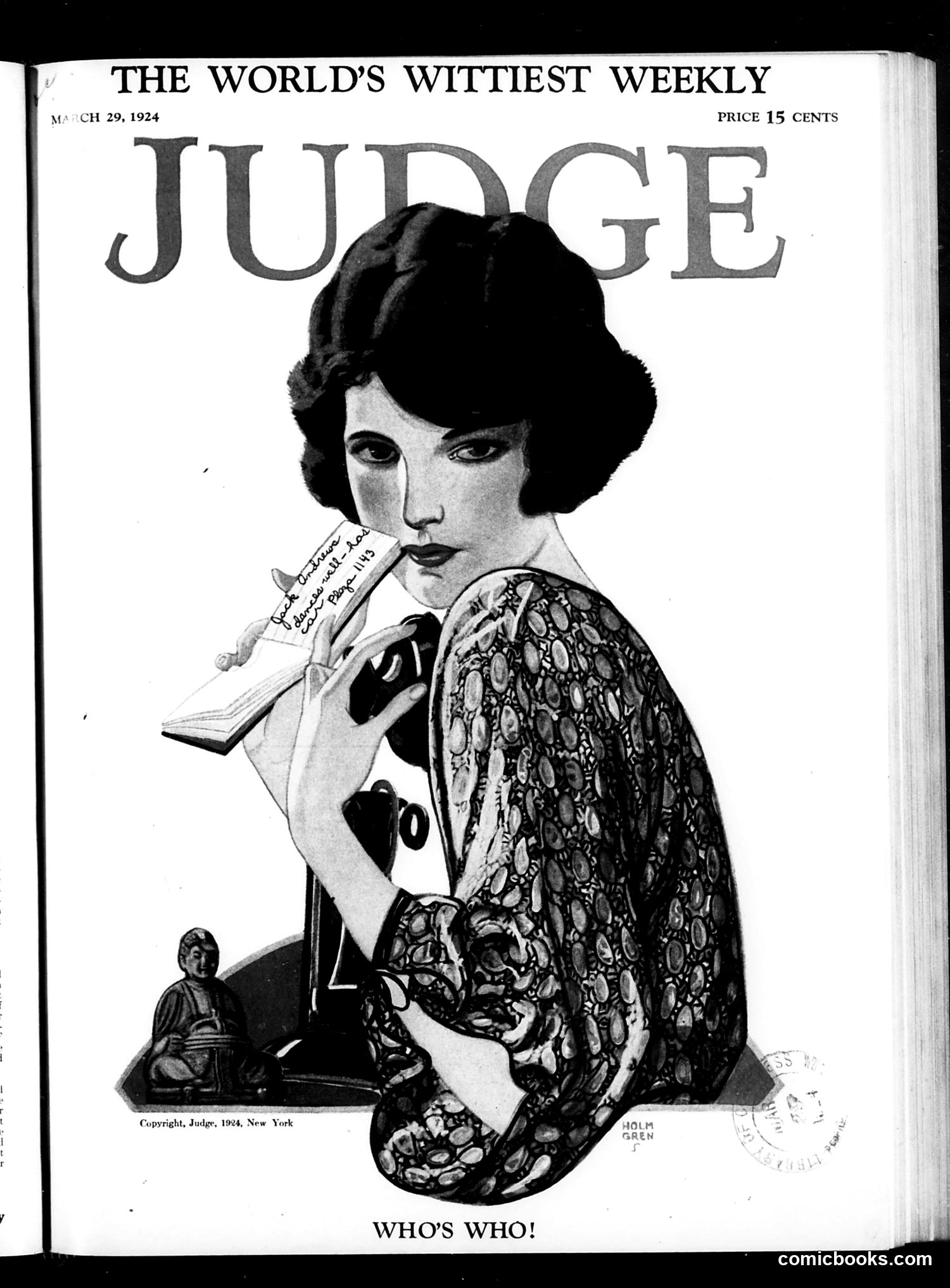
This is a cover illustration rather than a political cartoon. It depicts a stylishly dressed woman in 1920s fashion—the "flapper" era—with bobbed hair, ornate patterned clothing, and a small cherub or cupid figure at her feet. She holds what appears to be a hand mirror or compact. The cover's caption "WHO'S WHO!" suggests this is a portrait illustration for the magazine's society or celebrity section, likely identifying a notable woman of the period. The satire appears gentle, poking fun at 1920s women's fashion and vanity culture rather than addressing specific political figures. The cherub adds a humorous, romantic dimension typical of Judge's lighter commentary on contemporary social trends and popular culture.
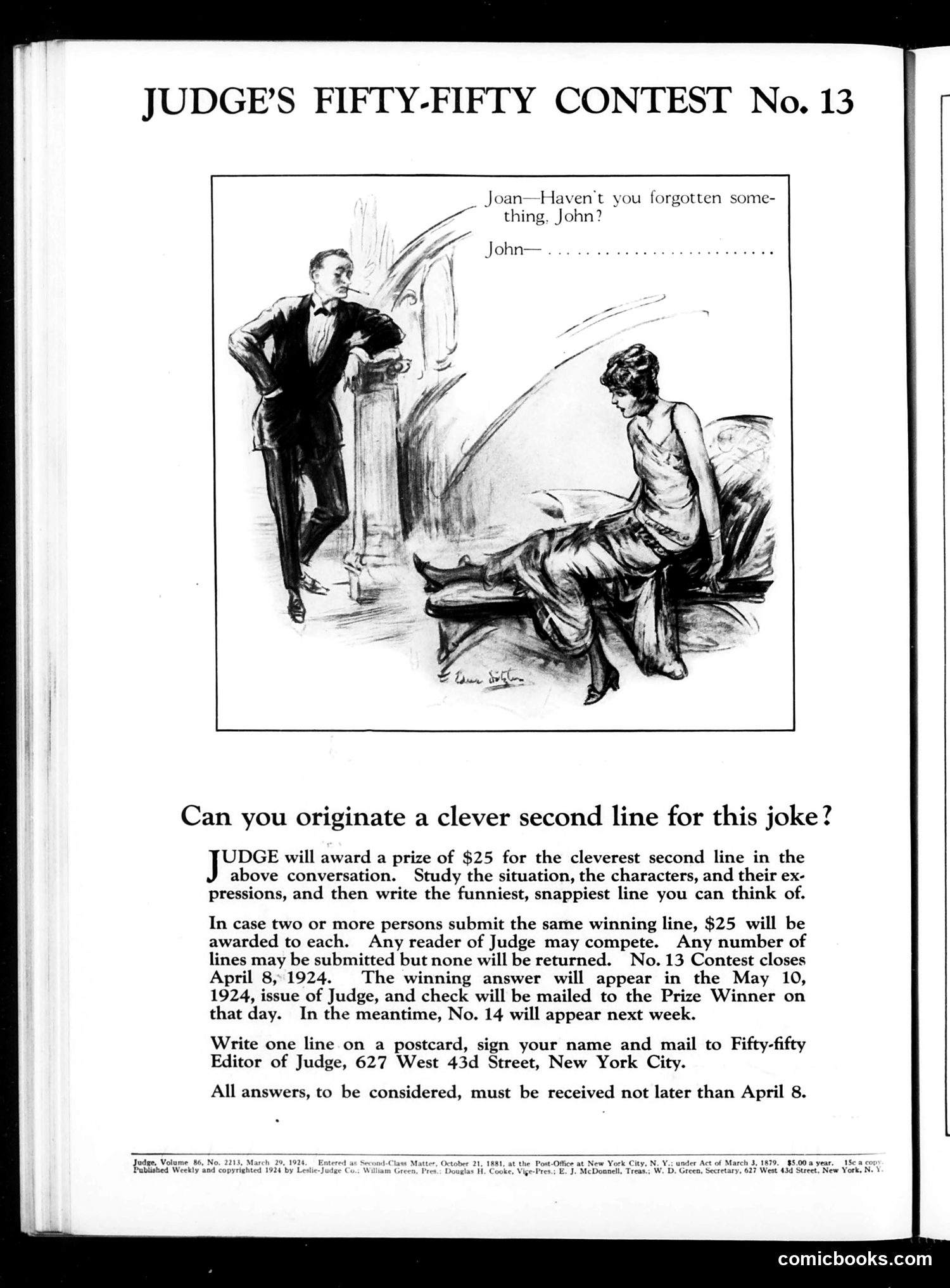
This page presents a "Judge's Fifty-Fifty Contest" inviting readers to complete a joke. The cartoon shows a well-dressed man (John) confronting a woman seated indoors, with John's line: "Haven't you forgotten something, John?" The setup appears to be a domestic or romantic scenario where the humor likely involves the woman's response—the "something forgotten" could reference a social custom, promise, or relationship expectation typical of 1920s courtship or marriage. The contest offers $25 for the cleverest second line, encouraging reader participation. Judge magazine regularly featured such interactive humor contests, appealing to readers' wit while generating engagement. The specific social context—likely involving gender dynamics or romantic conventions of the Jazz Age—would have been immediately recognizable to contemporary readers but requires historical knowledge for modern audiences to fully appreciate.
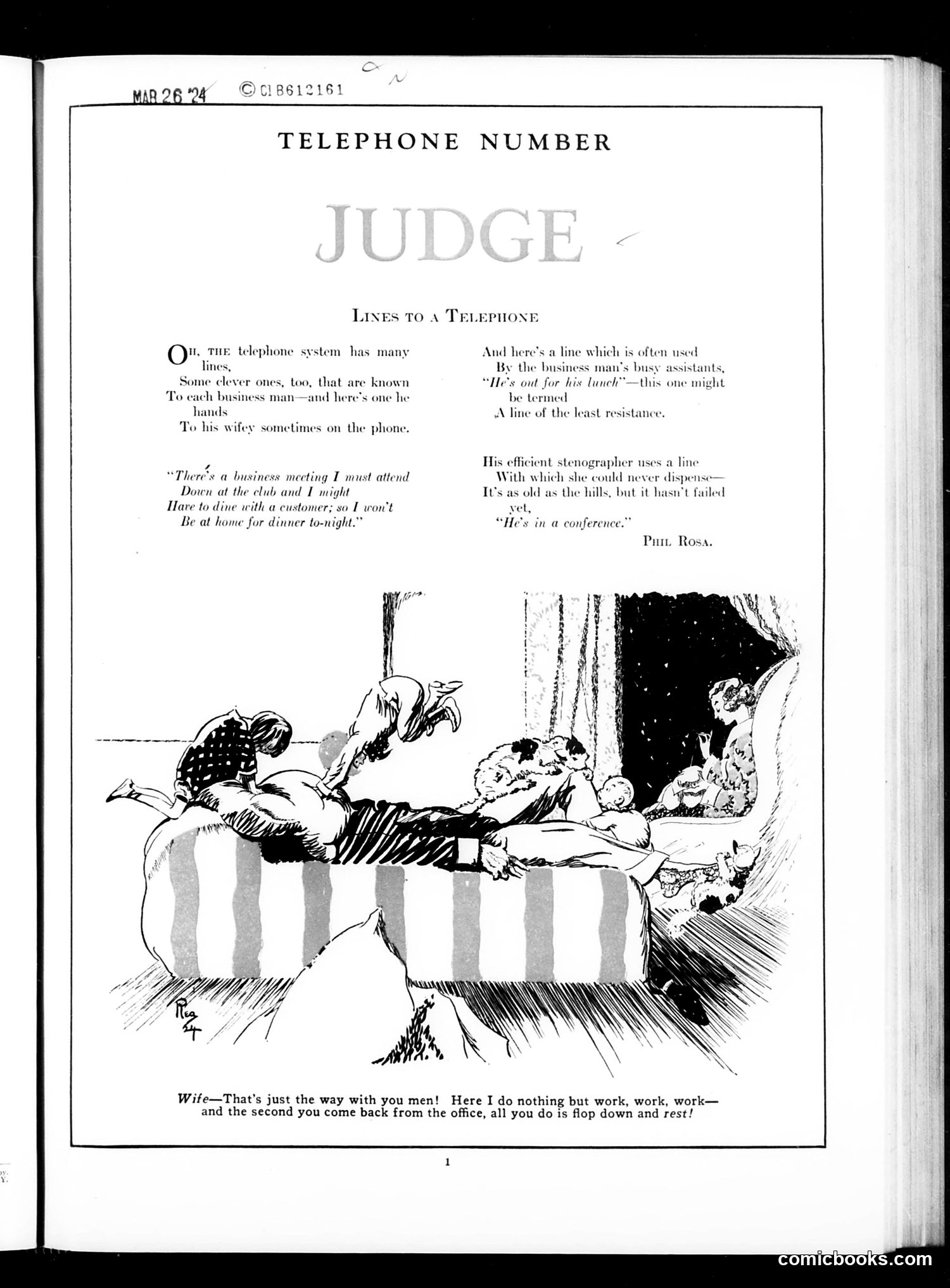
This satirical cartoon addresses the tension between professional and domestic life in early 20th-century America. The illustration shows a businessman lounging at home while his wife complains that he does nothing but rest upon returning from the office, while she manages the household. The accompanying poem humorously catalogs various telephone lines—some business-related, others representing excuses for avoiding home. References to "a line of the least resistance" and "He's out for his lunch" satirize how men use work obligations to escape domestic responsibilities. The satire targets the gender dynamics of the era: the assumption that office work is exhausting (justifying leisure at home) while housework remains invisible and unrelenting. The wife's exasperation underscores this double standard.
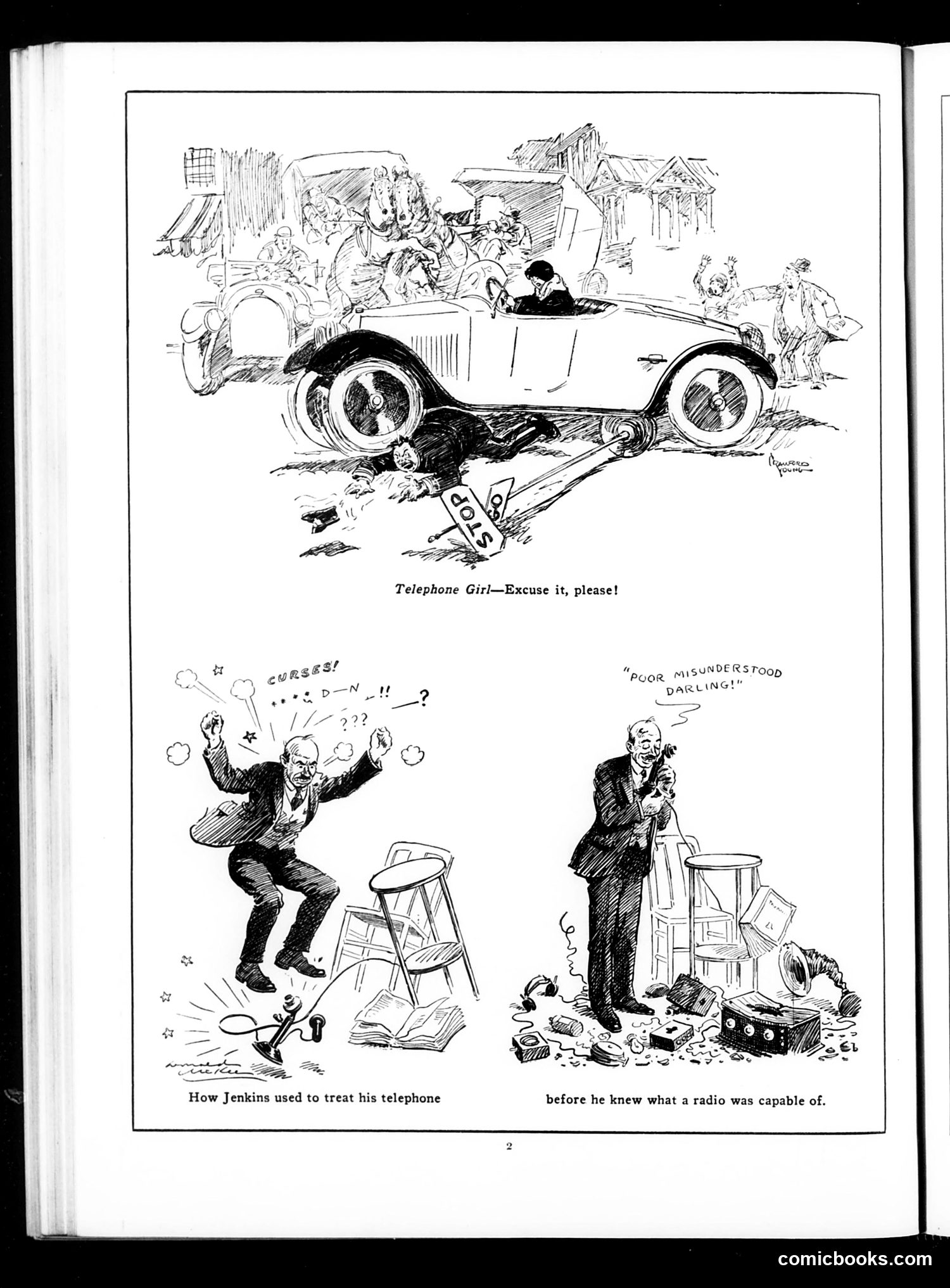
This page contains three cartoons satirizing early 20th-century technology and social attitudes. The top cartoon, "Telephone Girl—Excuse it, please!" depicts an automobile accident caused by a distracted telephone operator, mocking the new technology's disruptive effects on attention and safety. The bottom two panels show "How Jenkins used to treat his telephone" versus behavior "before he knew what a radio was capable of." The left panel shows a man destroying his telephone in frustration; the right shows the same man reverently preserving his possessions after understanding radio's capabilities. The satire suggests that radio—a newer, more powerful communication technology—made people reconsider the value of earlier technologies like telephones. It mocks how quickly attitudes shift toward innovations and our tendency to underestimate emerging technologies' impact.
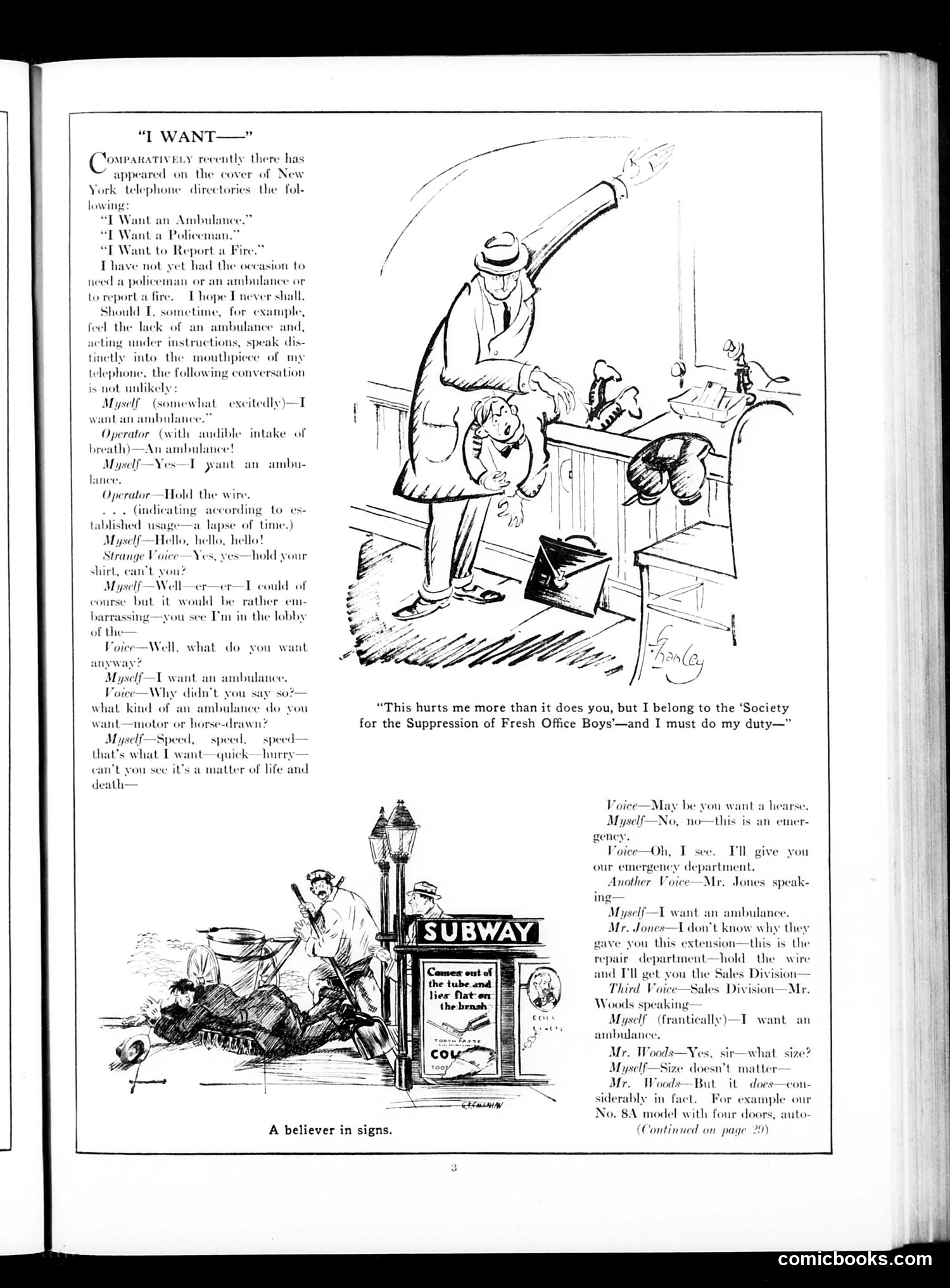
This page satirizes the New York telephone system's ambulance service. The left column presents a comedic dialogue where a frantic caller repeatedly demands "an ambulance" to the operator, who struggles to understand what he wants—mishearing requests for police, fire department service, or clarification on vehicle type. The top cartoon depicts the caller's frustration as he attempts to communicate with an indifferent operator and telephone company staff. The bottom illustration, captioned "A believer in signs," shows someone literally interpreting a subway sign's instruction to "Come out of the tube and step out on the street"—emerging from underground with debris flying. The satire targets both the telephone operator's poor service and the public's confusion with city infrastructure and communication systems.
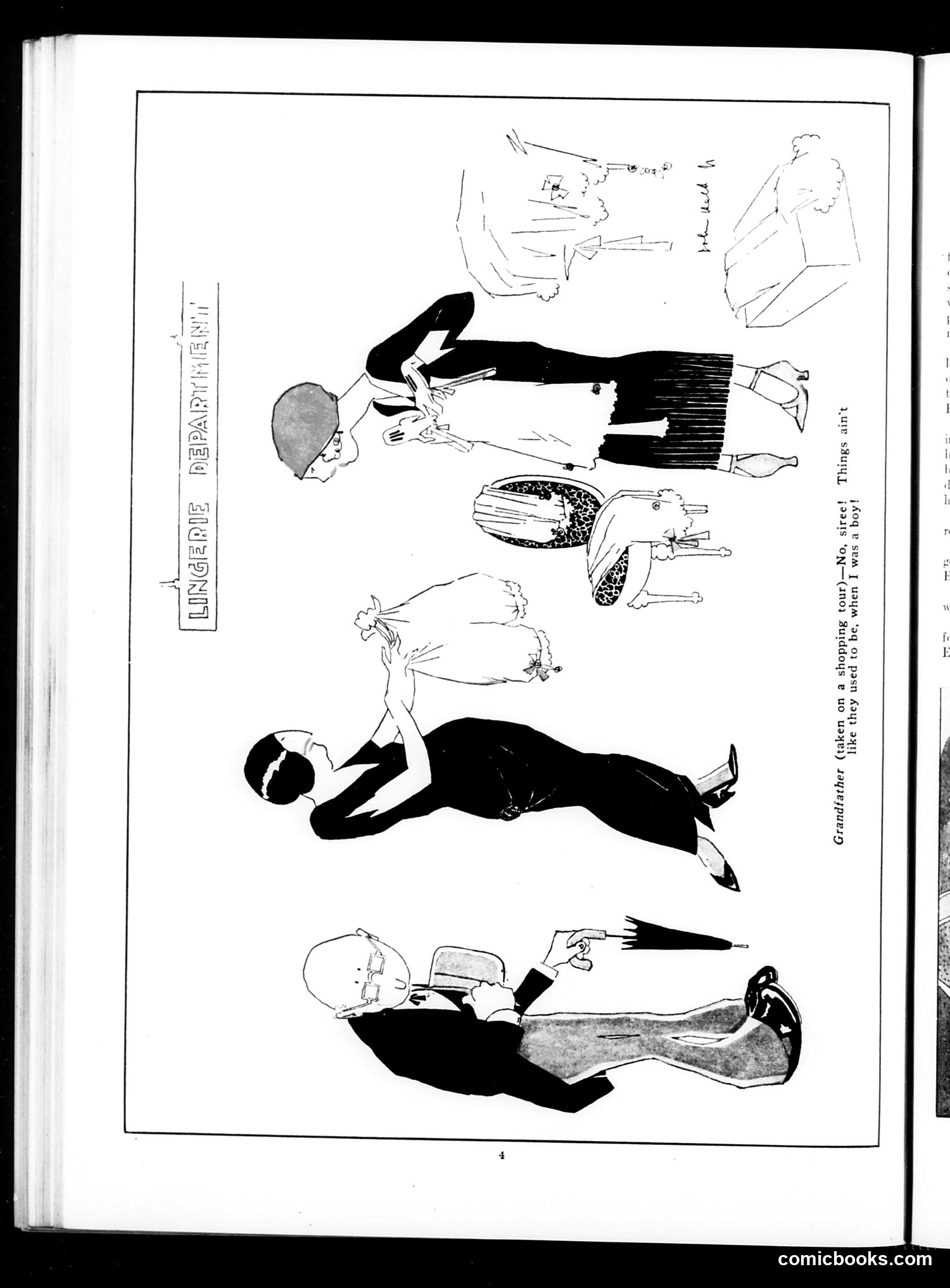
This Judge magazine page satirizes shopping behavior and fashion through illustrated vignettes. The title "Lingerie Department" frames the content around women's intimate apparel shopping. The cartoon depicts various female shoppers and store scenarios, likely mocking: - Women's enthusiasm for shopping and fashion consumption - Department store culture and retail dynamics - Possibly changing gender roles and women's independence (as consumers) - The absurdity of fashion trends or pricing The figures appear to be generic representations of shoppers rather than specific political figures. The humor relies on exaggerated poses and expressions showing animated customer behavior. The sketch-style drawings suggest this is satirizing everyday commercial activity rather than political events. Without clearer date context or specific captions identifying individuals, the satire targets consumerism and shopping culture broadly rather than particular public figures or policies.
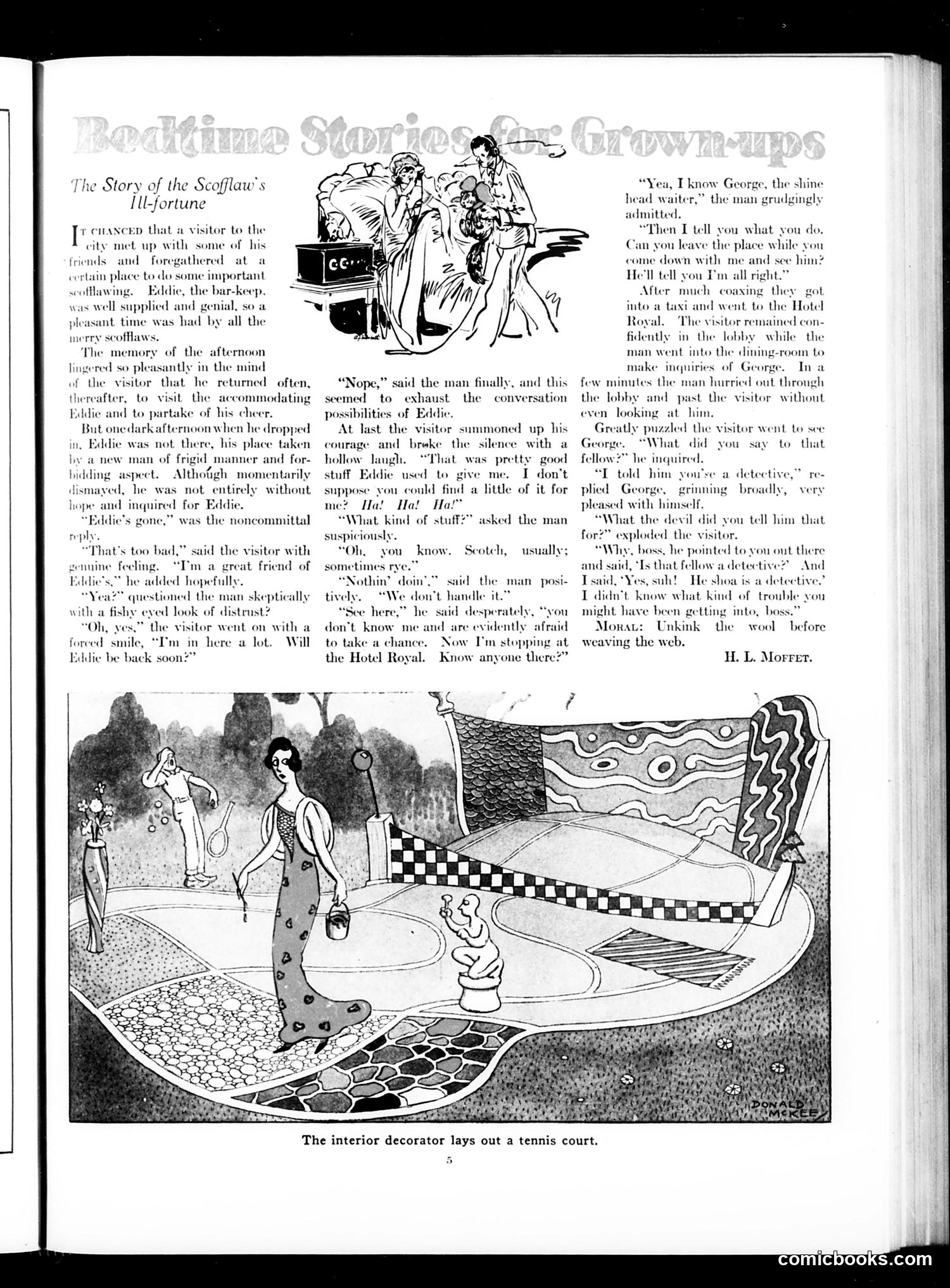
This satirical story mocks Prohibition-era lawbreakers (scofflaws). A visitor repeatedly patronizes an illegal bar run by "Eddie," seeking bootleg liquor. When Eddie disappears and a new bartender refuses service, the visitor attempts to prove his trustworthiness by having the Hotel Royal's head waiter, George (depicted with a racial caricature typical of the period), vouch for him. George, misunderstanding the inquiry, tells the bartender the visitor is a detective—the worst possible endorsement for an illegal operation. The bartender flees in panic. The satire targets scofflaws' foolishness and desperation during Prohibition. The moral ("Unkink the wool before weaving the web") suggests careful planning prevents disaster. The lower illustration appears decorative, showing an interior designer's fanciful tennis court design—possibly satirizing impractical artistic trends, though its connection to the main story is unclear.
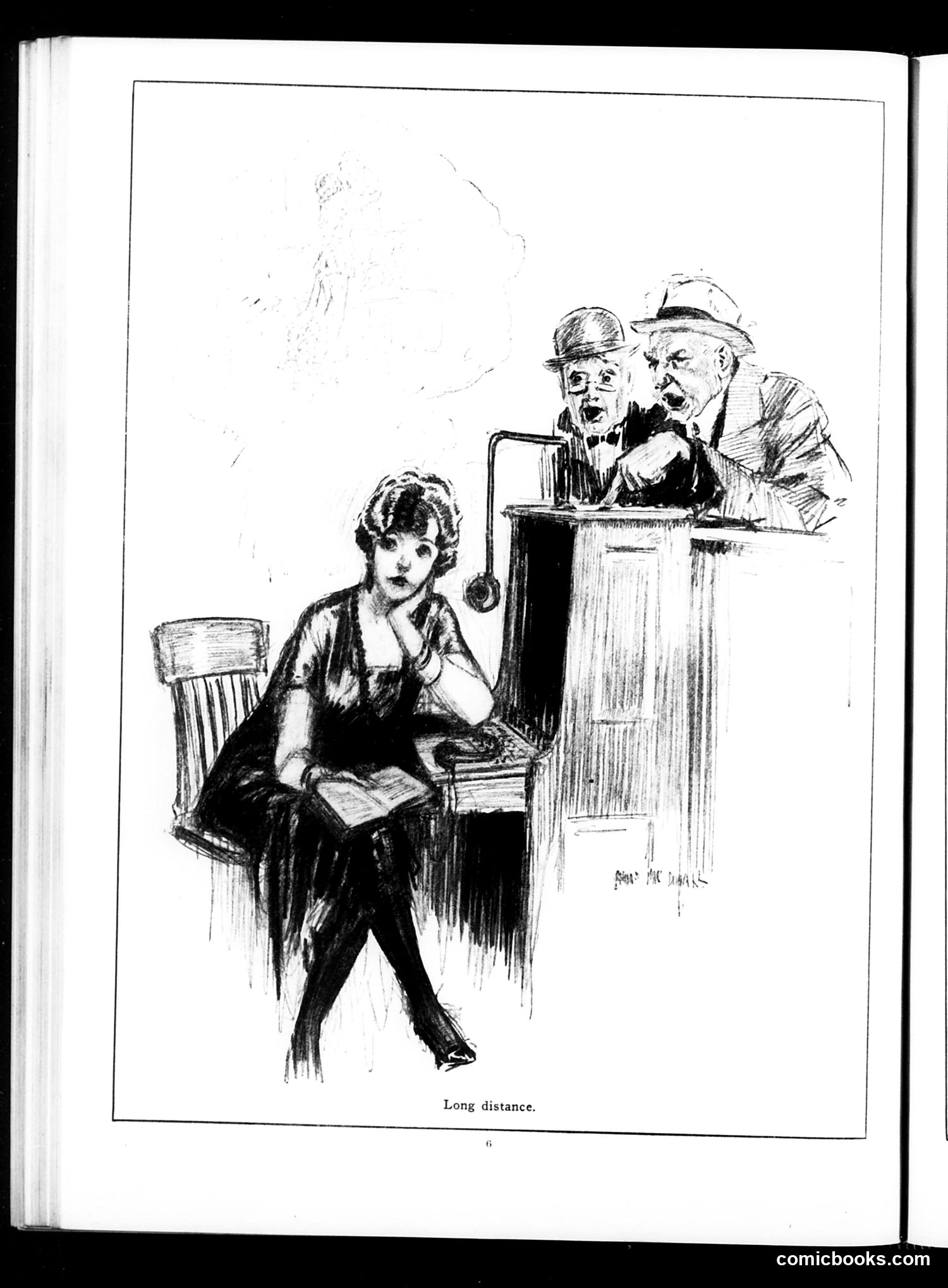
This cartoon from *Judge* magazine depicts a young woman sitting alone, holding what appears to be a telephone or communication device, while two men in bowler hats peer over a partition behind her, appearing excited or animated. The title "Long distance" likely references long-distance telephone communication—a relatively new technology in the early 20th century. The satire appears to target the novelty and social awkwardness of long-distance calls, possibly mocking either the intrusive nature of operators/eavesdropping or the humorous situations that arose from this new communication method. The woman's composed expression contrasts with the men's animated reactions, suggesting the cartoon comments on how differently people reacted to this modern technology, or perhaps the awkwardness of others overhearing personal conversations.
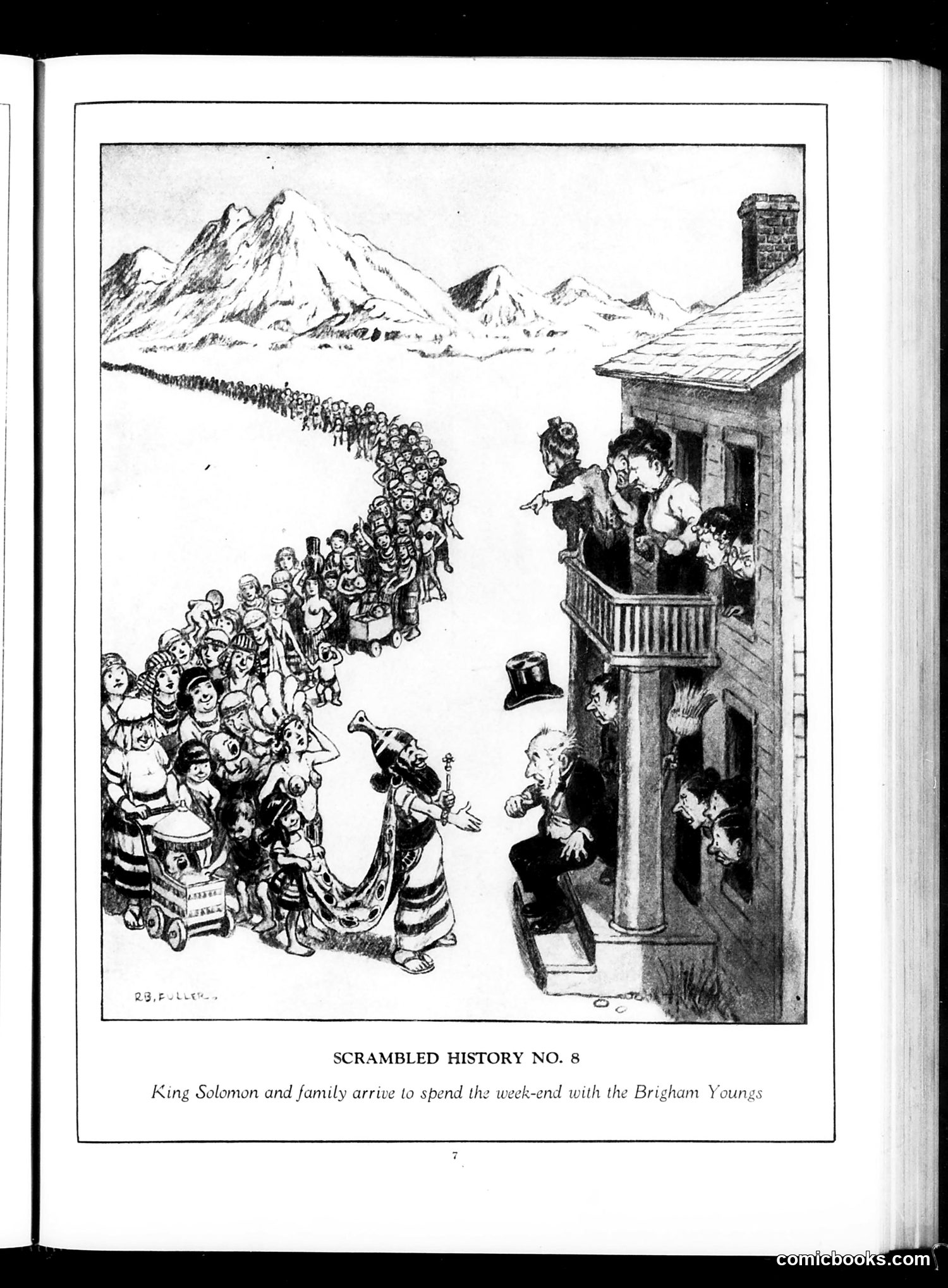
This satirical cartoon equates King Solomon—famous in Biblical tradition for his many wives—with Brigham Young, the Mormon leader known for practicing polygamy. The joke "scrambles" history by imagining Solomon visiting Young's household. The image shows an enormous procession of people (Solomon's "family") approaching a modest house where Young and his household await. The visual humor derives from the absurd contrast: even Solomon's legendary multiple marriages pale beside the implied scale of Young's polygamous arrangements. This is anti-Mormon satire playing on 19th-century American anxieties about polygamy. By comparing Young to Solomon, the cartoonist mocks Mormon practice as biblically archaic and excessive. The "week-end visit" framing adds comedic exaggeration—suggesting Young's household is so large it requires a biblical-scale gathering to visit it.
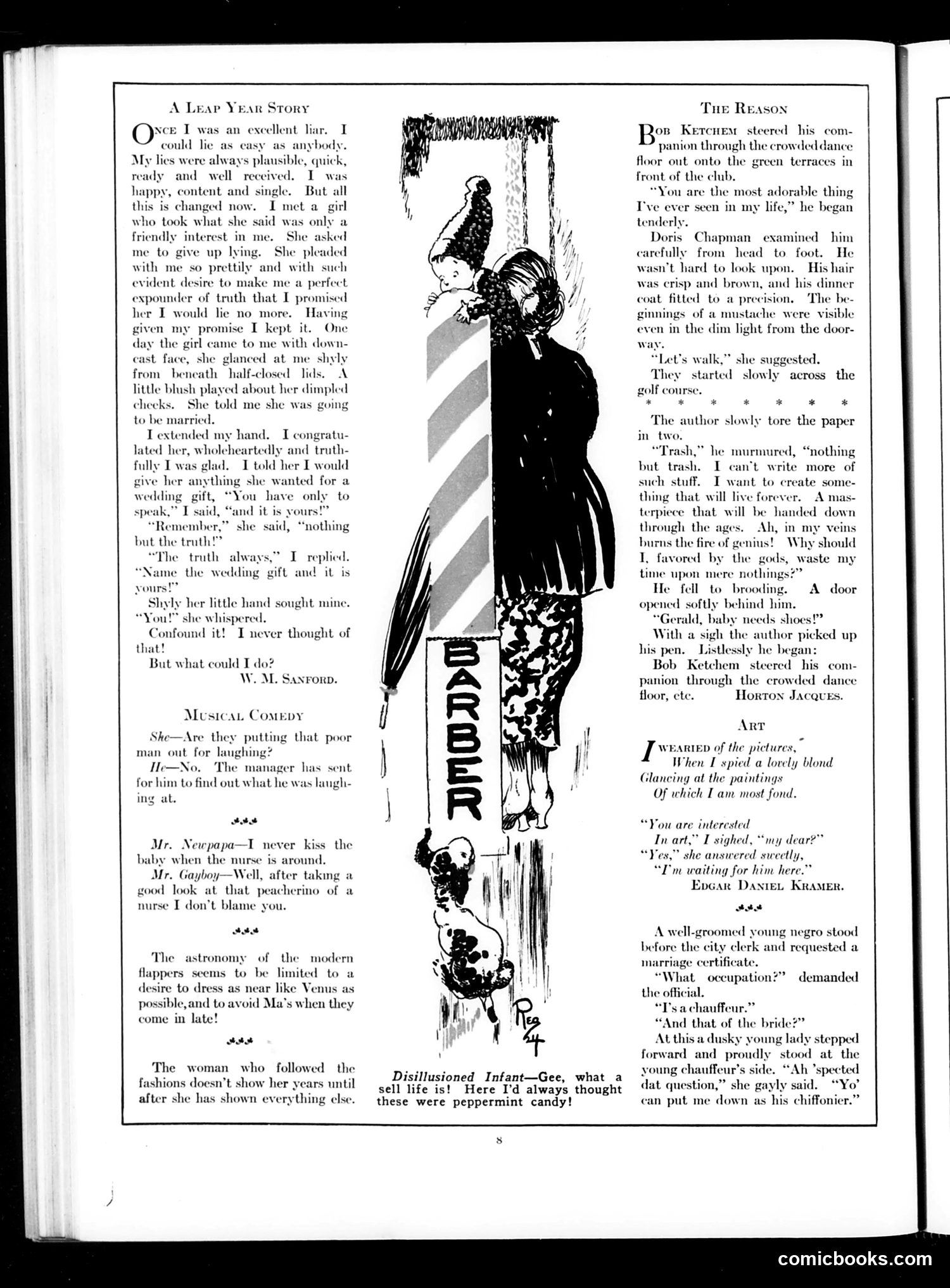
This page from *Judge* magazine contains several brief humor pieces typical of early 20th-century American satire: **"A Leap Year Story"** (left column): A comedic tale exploiting the tradition of Leap Year, when women could propose to men. A chronic liar promises a woman he'll stop lying, then when she proposes by asking him to name his wedding gift, he's trapped—the only honest answer is "You," committing him to marriage. **"The Reason"** (right column): Two romantic vignettes interrupted by domestic reality. A man makes tender advances to a woman on a golf course; simultaneously, an aspiring author tears up his work, mourning his lost artistic ambitions—until his wife reminds him the baby needs shoes, forcing him back to practical work. **Brief jokes** scattered throughout mock contemporary targets: flapper fashions, modern astronomy knowledge, and (in the final item) a racist caricature depicting a Black chauffeur and his bride, playing on stereotyped dialect humor common to the era. The satire reflects early-1900s concerns about changing gender roles, artistic pretension versus economic reality, and fashionable youth culture.
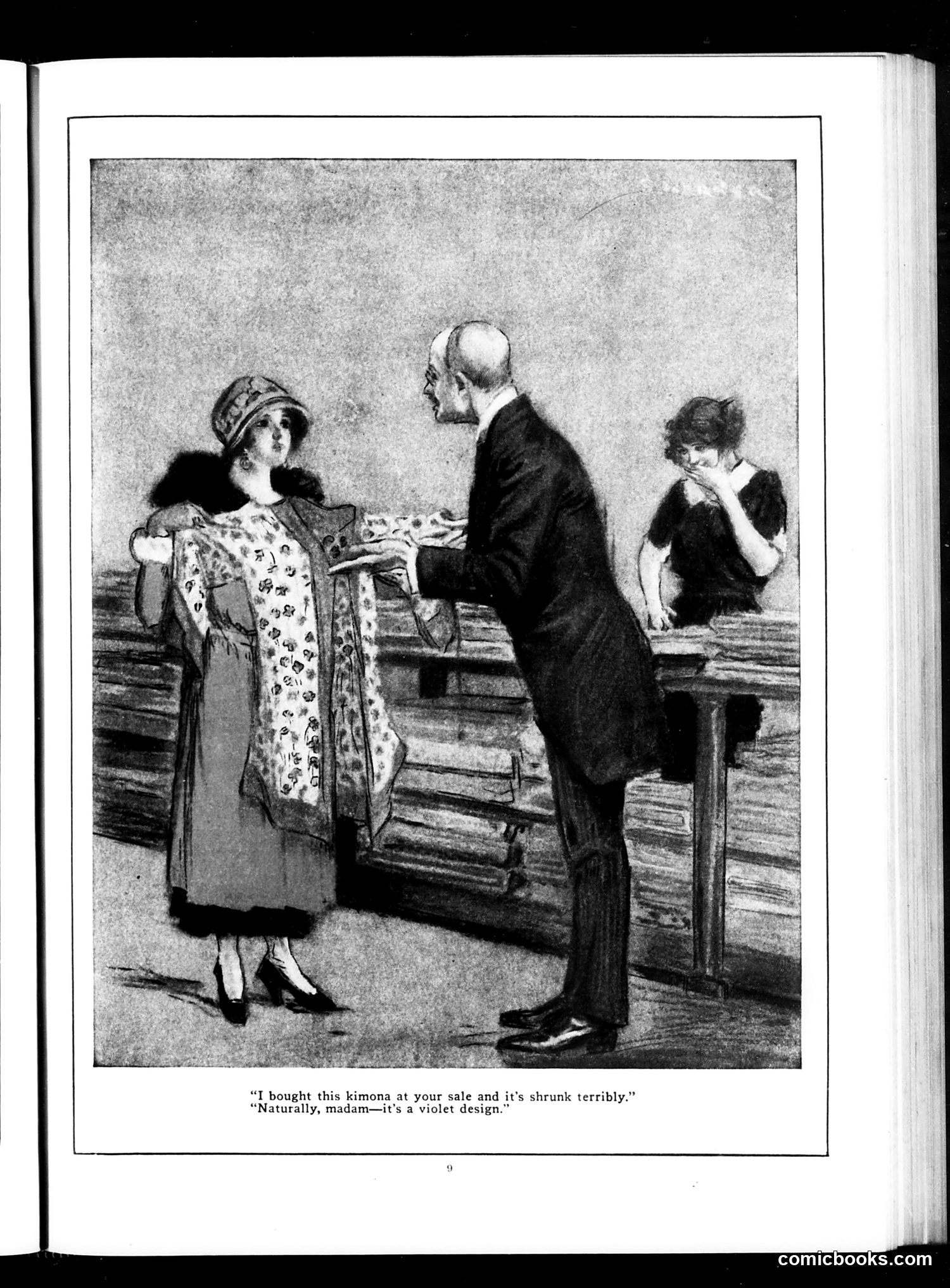
This is a single-panel cartoon playing on a visual pun about fabric dyes. A woman complains to a merchant that a kimona (Japanese robe) she purchased has shrunk significantly. His response—"it's a violet design"—makes a joke: violet dye was notoriously unstable and prone to fading or shrinking in that era, making it an inferior choice for quality textiles. The cartoon satirizes both poor-quality merchandise and the merchant's glib dismissal of legitimate customer complaints. By blaming the design rather than acknowledging a defective product, he deflects responsibility. The joke relies on contemporary knowledge of textile manufacturing—that violet dye was problematic—which would be immediately obvious to Judge's readers but is now obscure to modern audiences.
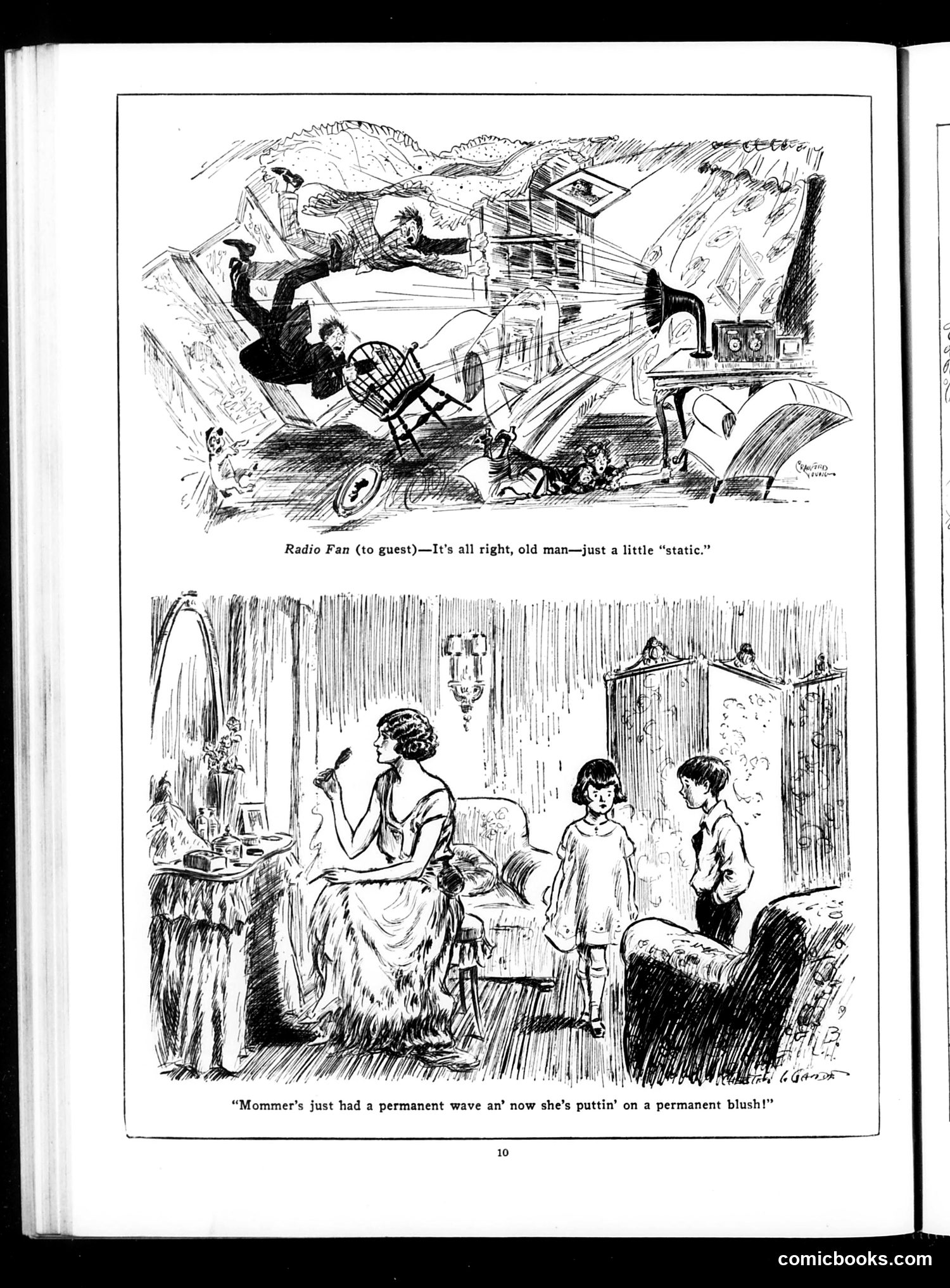
This page contains two separate cartoons satirizing early 1920s-30s technology and beauty trends. The **top cartoon** mocks radio enthusiasts ("Radio Fans"), showing a chaotic domestic scene where a radio receiver is malfunctioning spectacularly—furniture flying, people tumbling—while the owner dismissively tells his guest it's merely "static." The joke targets how radio owners normalized poor reception and technical failures as normal. The **bottom cartoon** jokes about women's cosmetic practices. A mother has just gotten a "permanent wave" (chemical hair treatment), and her embarrassment is so acute she's developed a permanent blush. The humor plays on both the vanity of pursuing beauty treatments and the social awkwardness of appearing too eager about one's appearance. Both cartoons reflect period anxieties about new consumer technologies and evolving standards of female appearance.
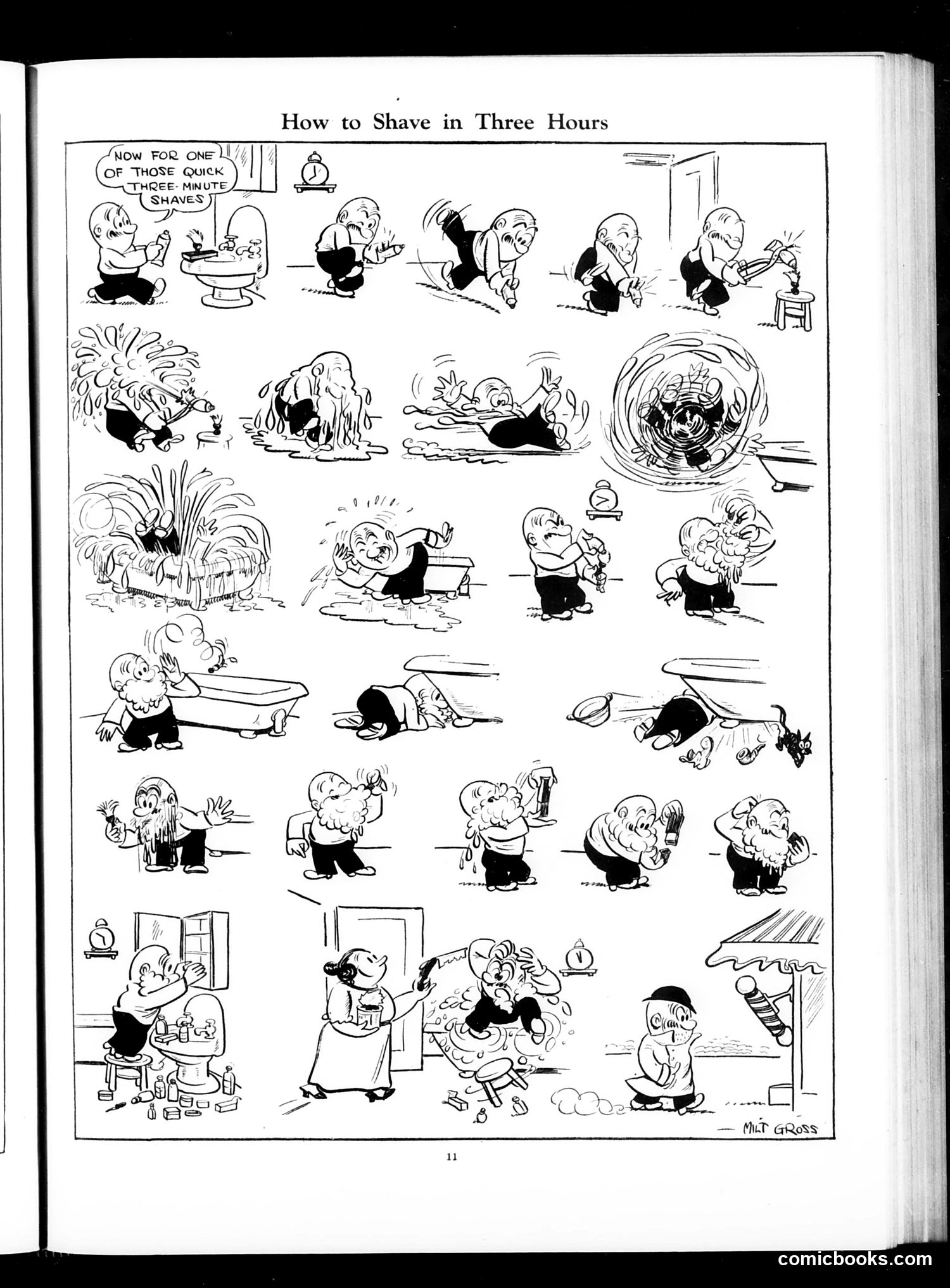
This is a humorous cartoon by Milt Gross depicting the comical chaos of a quick shave that ironically takes three hours. The sequence shows a man attempting a rapid shaving routine but encountering progressively absurd mishaps: water splashing everywhere, soap getting out of control, the razor creating disasters, bathtub overflows, and escalating pandemonium involving family members and household destruction. The joke satirizes the contrast between advertised "quick" grooming routines and reality—what should be simple becomes catastrophically complicated. The slapstick visual humor, with exaggerated expressions and environmental chaos, was characteristic of 1920s-30s comic strips. The satire gently mocks masculine grooming rituals and domestic disorder, reflecting period humor about household management and male incompetence in personal care tasks.
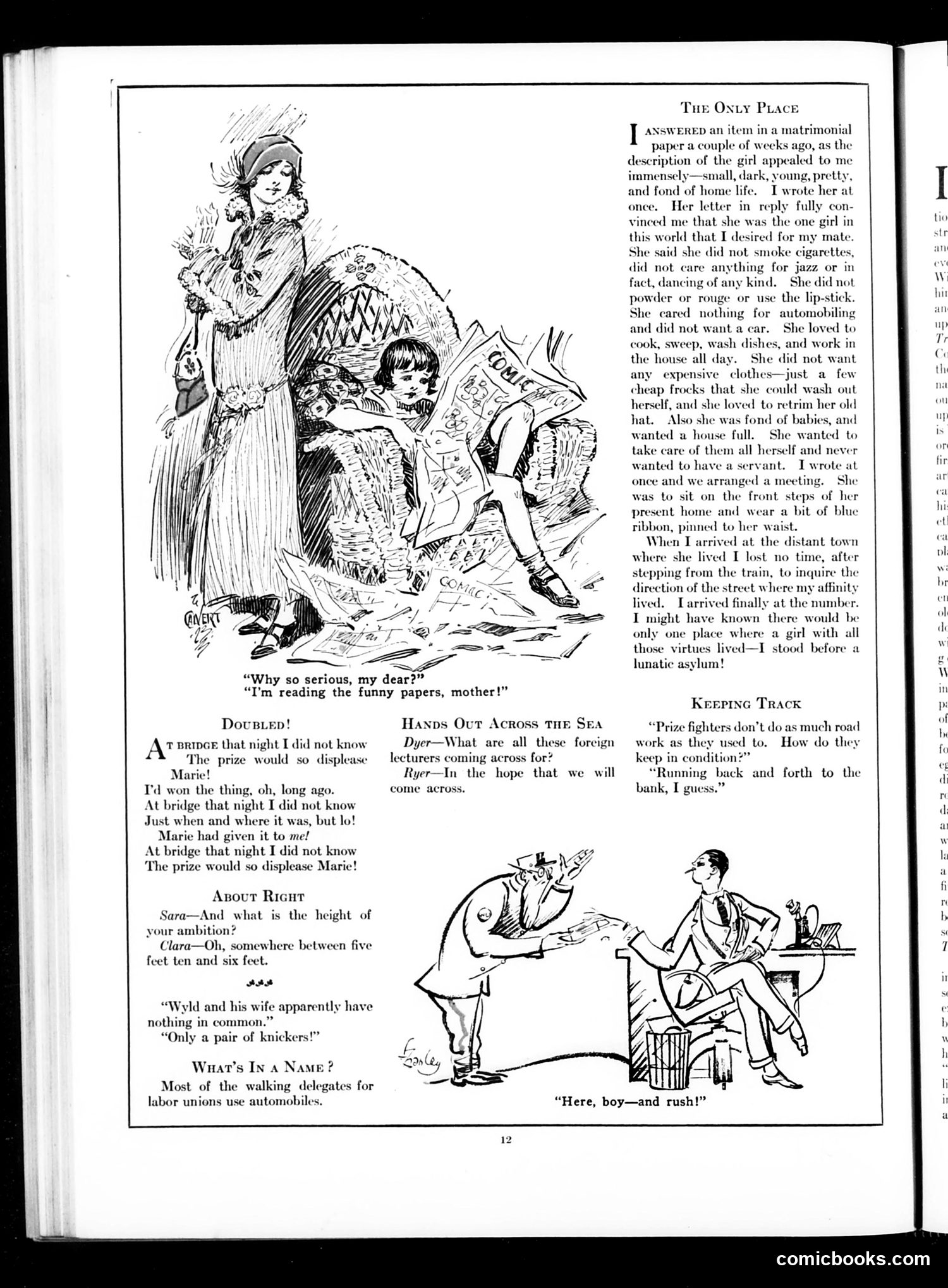
This page contains several brief satirical jokes typical of early 20th-century humor: **"The Only Place"** is the main feature—a lengthy personal essay mocking matrimonial advertisements. A man answers an ad describing an ideal homebody woman: non-smoking, domestic, modest, child-loving. Upon meeting her, he discovers she lives in a lunatic asylum, suggesting the woman's description was impossibly unrealistic or that such "perfect" domesticity is itself insane. **Smaller jokes** include: - A child reading "funny papers" (comics) seriously, finding them depressing - A woman's ambition being marriage to a tall man - Labor union leaders using automobiles (mocking union hypocrisy) - A married couple having "nothing in common" except undergarments - Foreign lecturers hoping Americans will donate money - Prize fighters maintaining fitness by frequent bank visits (satirizing their spending habits) The satire targets gender roles, materialism, labor corruption, and conspicuous consumption—common Judge targets of the era.
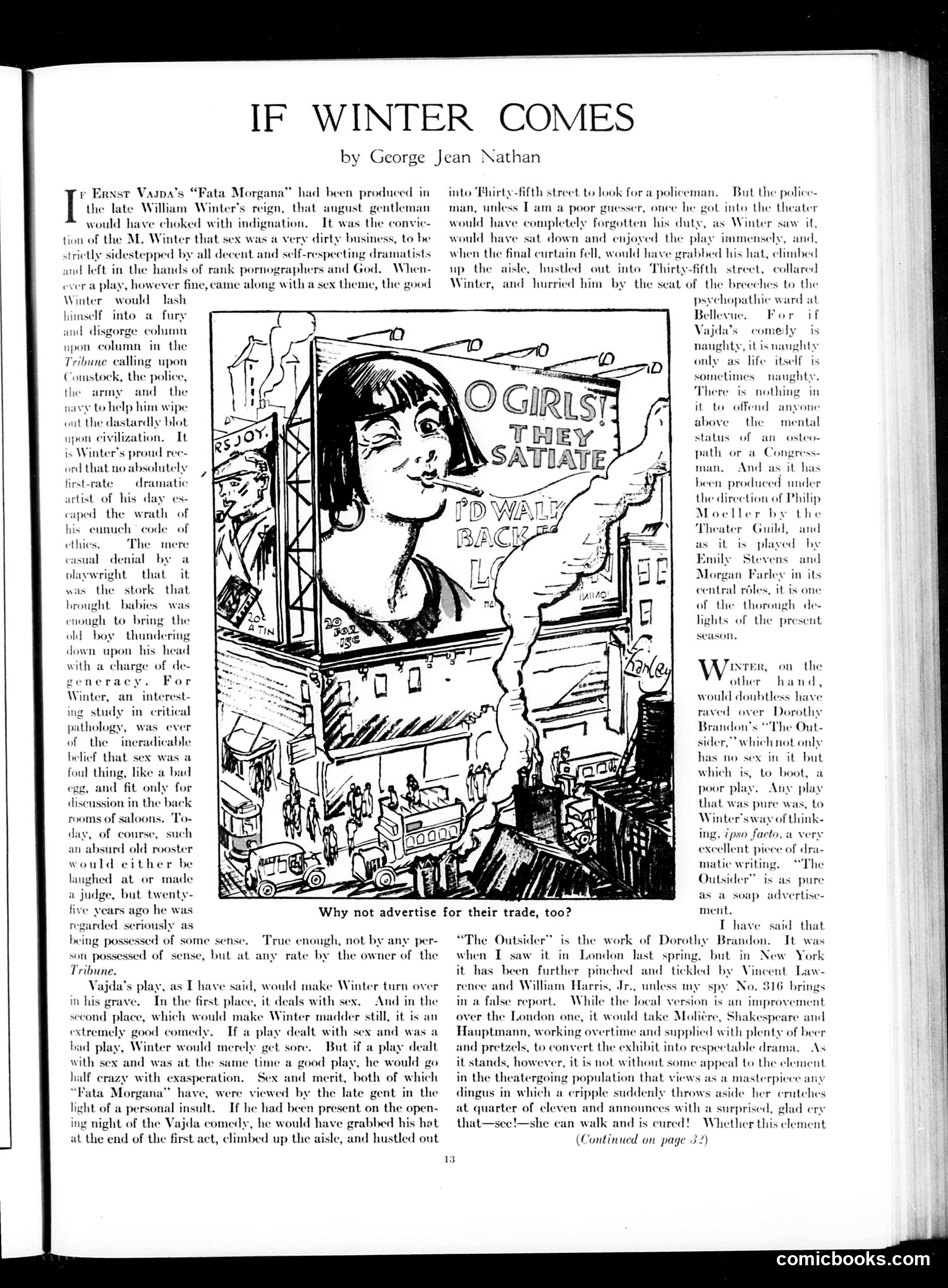
This is a theater criticism column attacking the late William Winter, a 19th-century drama critic who rigidly censored any theatrical treatment of sexuality. Nathan describes Winter's hypocritical prudishness: Winter would savagely condemn any play dealing with sex, yet simultaneously dismiss non-sexual plays as worthless. The accompanying cartoon satirizes Winter's crusade by depicting a theater marquee advertising a play with suggestive content ("O Girls! They Satiate / I'd Walk Back"). The caption "Why not advertise for their trade, too?" mocks Winter's absurd position—that acknowledging sex exists in drama is somehow worse than acknowledging it exists in actual life. Nathan contrasts Winter's approach with contemporary theater: praising Vajda's witty, sexually-frank comedy (produced by the Theater Guild with Emily Stevens) while dismissing Dorothy Brandon's prudish "The Outsider" as artistically worthless precisely because it avoids the subject entirely. The satire targets Victorian moral gatekeeping and critical hypocrisy.
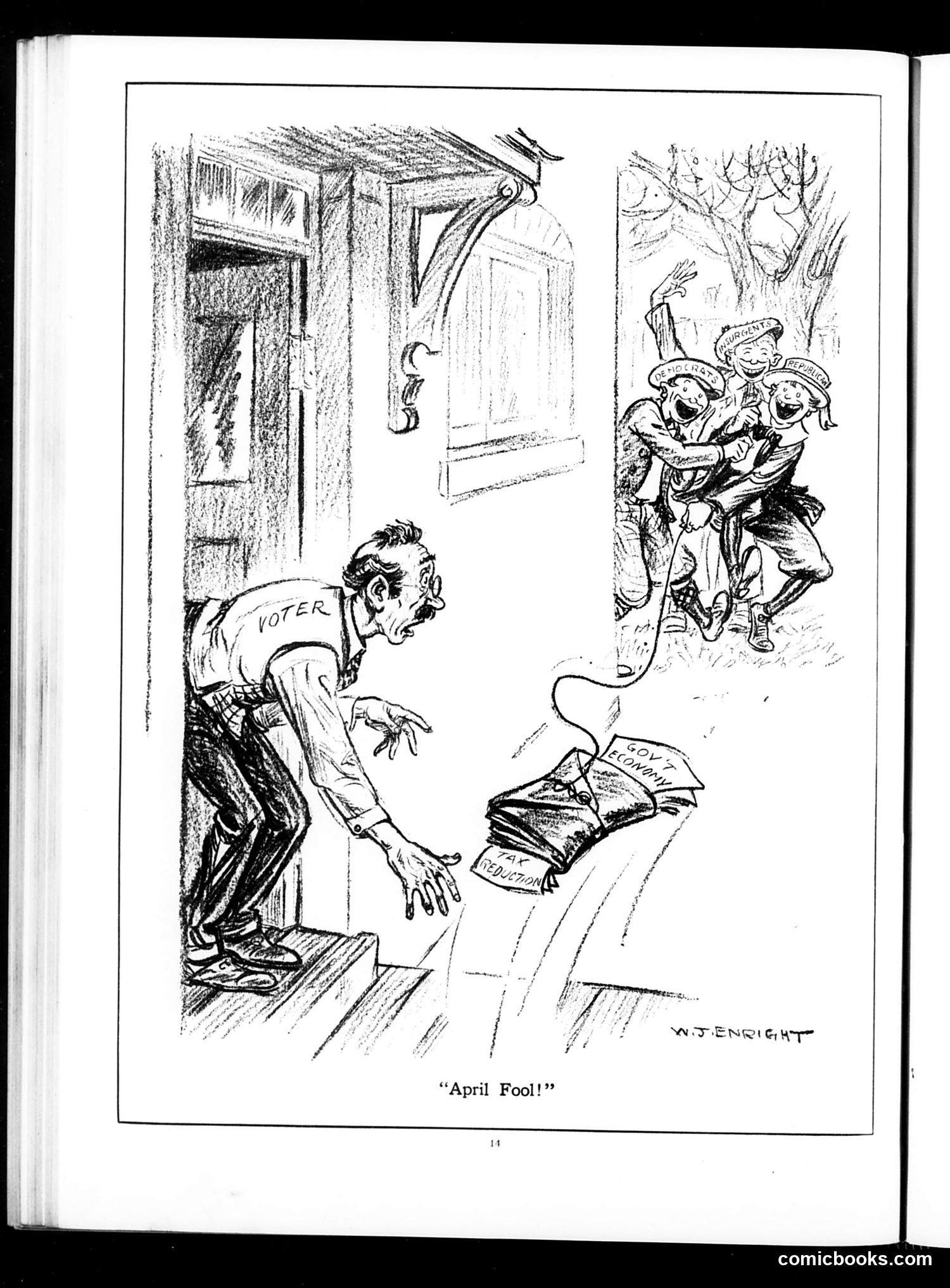
This cartoon depicts a man labeled "VOTER" cowering at a doorway while children outside taunt him with what appears to be a string or rope. The voter holds papers labeled (text partially unclear but suggests campaign or voting materials). The children's gleeful expressions and the caption "April Fool!" suggest the voter is being mocked or pranked. The satire appears to criticize voters—likely portraying them as foolishly susceptible to political manipulation or deception during campaign season. By depicting the voter as timid and the children as aggressive tricksters, the cartoonist suggests voters are being played for fools by politicians or campaign rhetoric. The April Fool's reference emphasizes the foolishness theme, implying voters should be skeptical of political appeals.
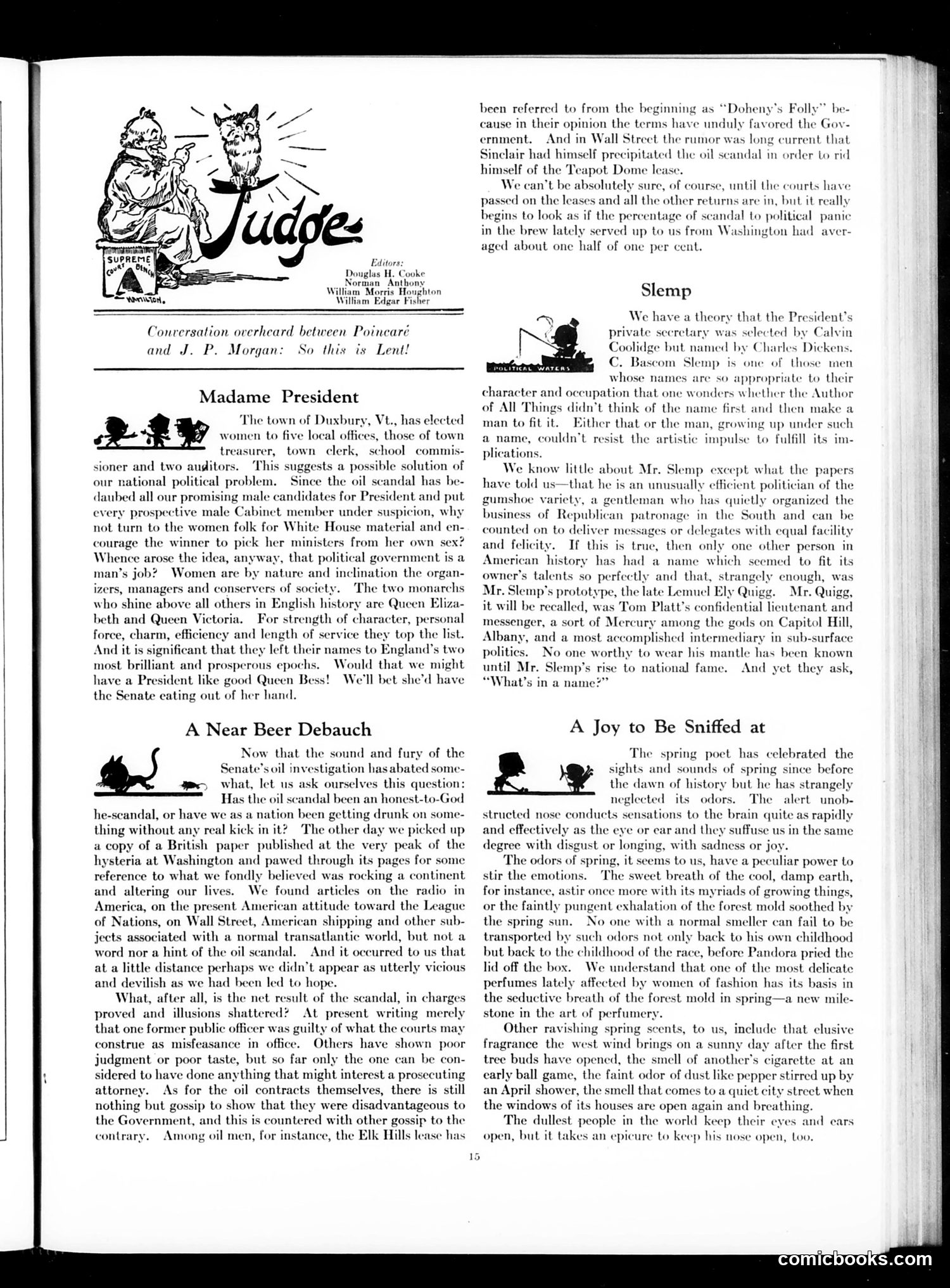
**The Main Cartoon** ("So this is Lent!") depicts two figures in conversation—likely French Premier Poincaré and American banker J.P. Morgan. The joke plays on "Lent" (the Christian fasting period) as a reference to financial restraint or reduced activity, suggesting the oil scandal investigations have dampened business as usual. **Key Articles:** 1. **"Madame President"** satirizes recent Vermont town elections of women to local offices, proposing female leadership as a solution to the current "oil scandal" that has tainted male politicians. The piece ironically celebrates women leaders like Queen Elizabeth and Victoria. 2. **"A Near Beer Debauch"** addresses the Teapot Dome scandal (oil lease controversy), questioning whether public outrage matches actual proven wrongdoing. It suggests the scandal's impact has been exaggerated—a "near beer" (weak substitute) rather than genuine crisis. 3. **"Slemp"** briefly notes that President Coolidge's private secretary, C. Bascom Slemp, has a name so perfectly suited to his character that it seems Dickens invented it. The page satirizes 1920s political corruption and public reaction to it.
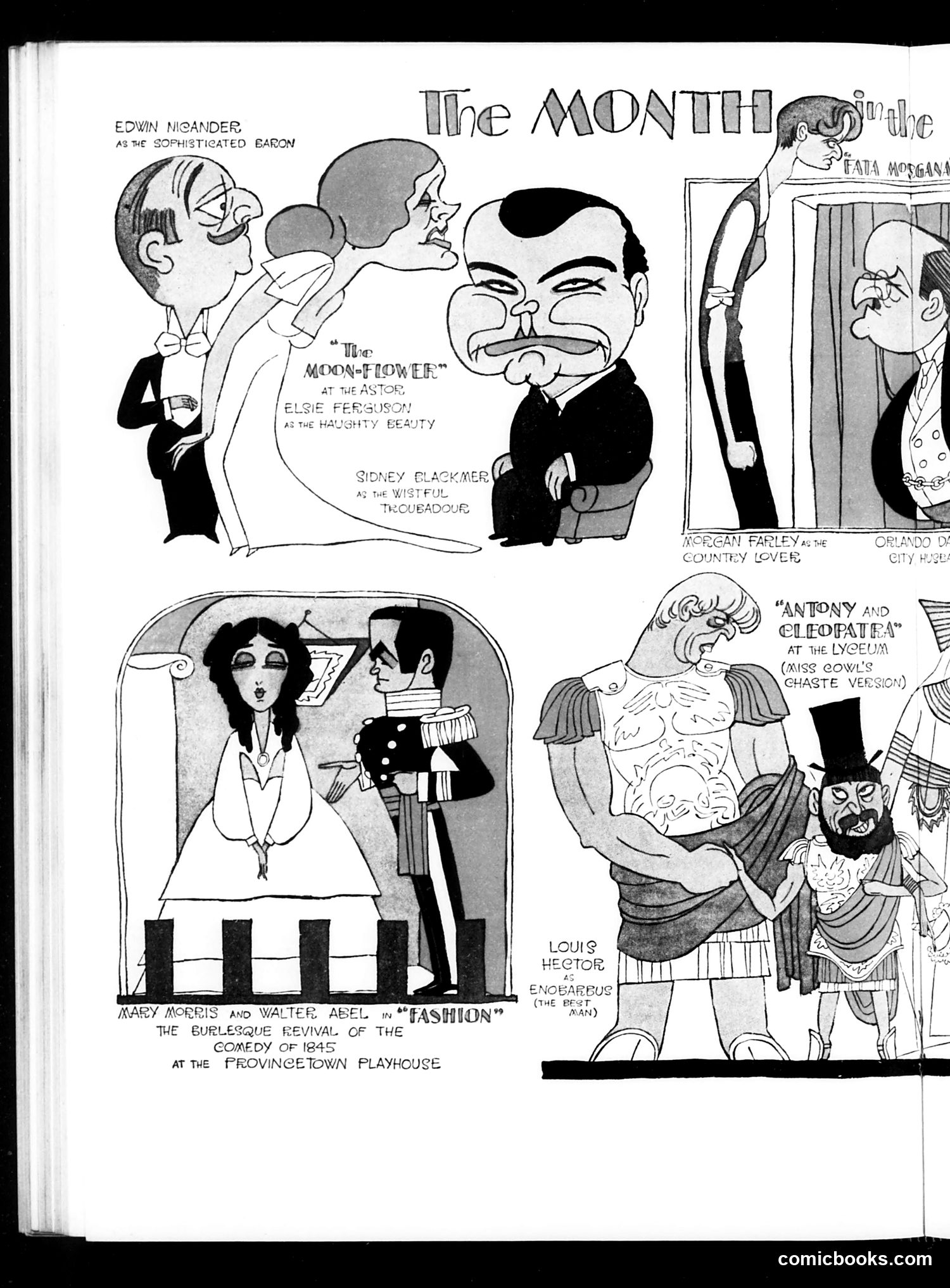
This page from *Judge* magazine features theatrical caricatures and reviews of 1920s stage productions. The top section mocks "The Moon-Flower" and other plays with exaggerated character drawings. The main content reviews contemporary theater: Mary Morris and Walter Abel in a burlesque revival of the 1845 comedy "Fashion" at the Provincetown Playhouse, and a "chaste version" of "Antony and Cleopatra" at the Lyceum. The satirical drawings exaggerate performers' facial features in the style typical of theatrical criticism cartoons from this era. The humor appears to derive from the incongruity of reviving old comedies and the earnest staging of classical drama—standard targets of *Judge*'s theatrical satire during the 1920s theatrical renaissance.
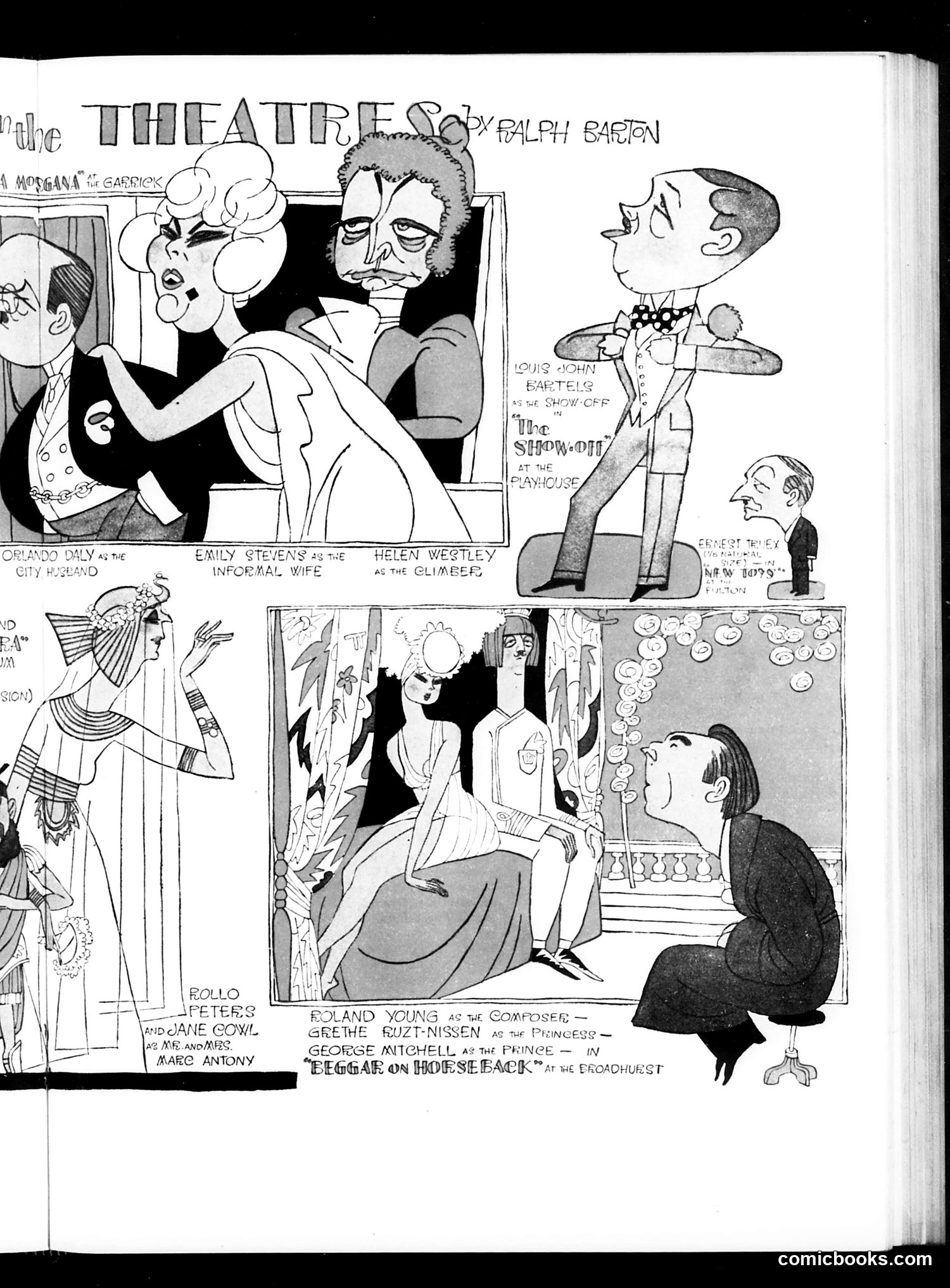
This page showcases theatrical advertisements and caricatures from contemporary Broadway productions. The top portion features exaggerated character sketches from various shows, including "The Showoff" at the Playhouse and "Beggar on Horseback" at the Broadhurst. The satire targets theatrical pretension and absurdist comedy plots typical of 1920s Broadway. The caricatures mock both performers and characters—particularly social climbers and nouveau-riche types seeking status. Ralph Barton's distinctive grotesque style exaggerates facial features to ridicule the vanity and artificiality of theater folk and their audiences. The lower panels appear to reference specific plot points from these productions, though without additional context, precise dramatic meanings remain unclear. The overall tone is mockingly affectionate toward Broadway's aspirational characters and performers.
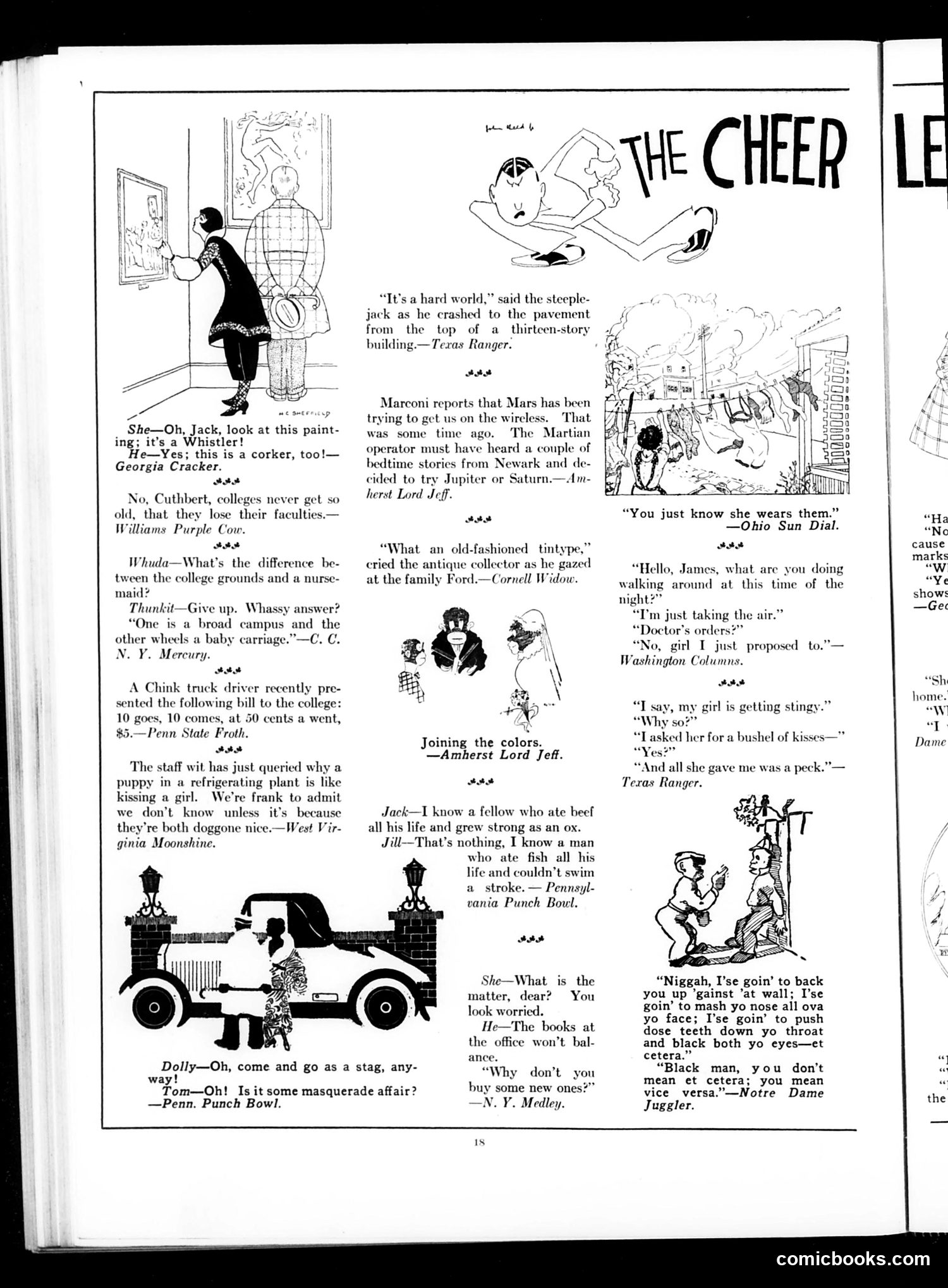
This page collects brief humorous quips and jokes from college publications, typical of Judge's "Cheer" section. The content includes: **College humor**: Puns about campus life ("broad campus" vs. baby carriage wheels), jokes about professors losing "faculties," and a billing gag from a Chinese truck driver. **Period references**: A Marconi wireless joke about Mars (contemporary fascination with radio technology and space), and a Ford automobile joke (the Model T as "old-fashioned"). **Romantic/flirtation humor**: Multiple jokes about dating, proposals, and courtship—reflecting early 20th-century social anxieties around romance. **The final "joke"**: A deeply offensive racial caricature depicting a violent altercation, with wordplay on "et cetera" vs. "vice versa." This represents the casual racism endemic to the era's "humor." The page reflects Jazz Age college culture and period attitudes, with humor ranging from innocent wordplay to material now recognized as hateful.
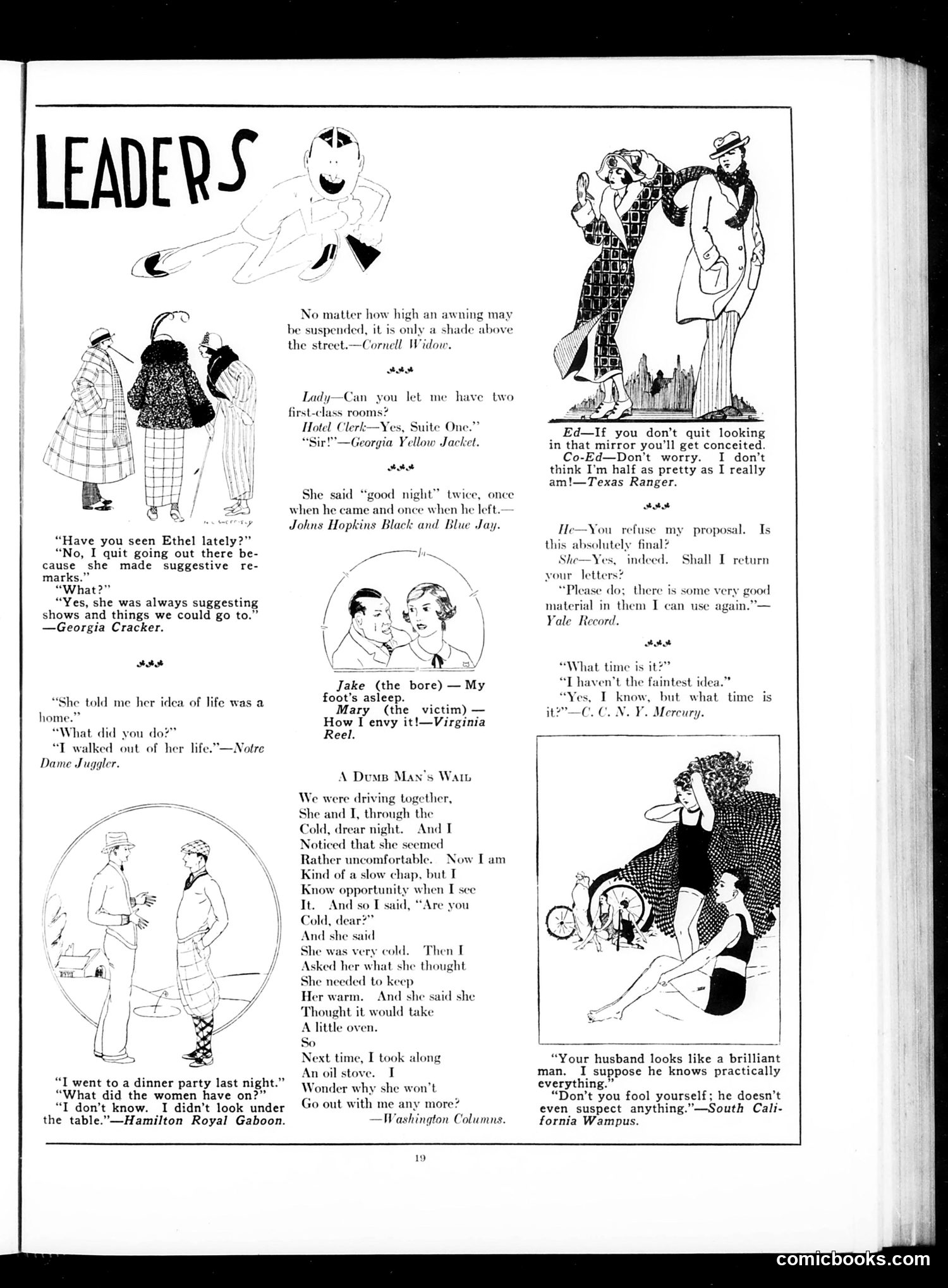
This page collects short humorous anecdotes and jokes about romantic and social interactions, typical of early-20th-century satirical magazines. The content reflects period attitudes toward courtship and gender relations. The jokes mock both sexes: women who make "suggestive remarks" about outings, or hint at wanting physical warmth from male suitors; men who are oblivious, boring ("Jake the bore"), or naive about romantic intentions. One recurring theme involves misunderstandings about desire—a woman asking for an "oven" to stay warm is interpreted as wanting a literal stove rather than physical closeness. The illustrations show fashionable 1920s clothing and styling. The humor relies on double-entendres and the gap between what's said and what's meant—typical of Judge's sophisticated, adult-oriented comedy aimed at educated readers who'd catch the innuendo. The credited sources (various college humor publications) suggest this represents campus/collegiate humor of the era.
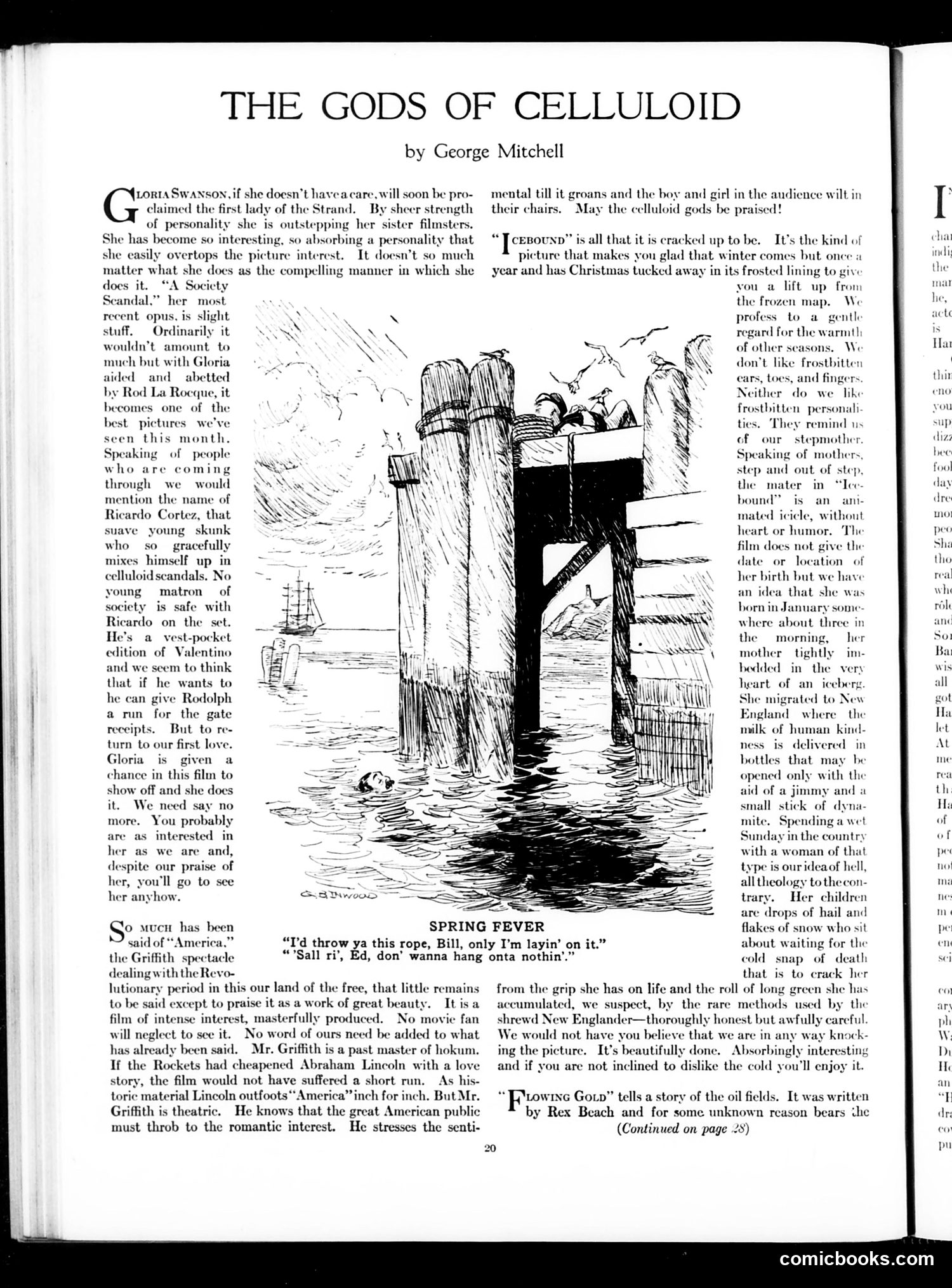
This page contains film reviews by George Mitchell critiquing 1920s silent films and their stars. The main subjects are Gloria Swanson (praised for her commanding screen presence), Ricardo Cortez (a suave leading man compared favorably to Valentino), and D.W. Griffith's epic "America." The cartoon "Spring Fever" depicts two men lounging by water—one lying on a rope meant for rescue, refusing help with the quip "don' wanna hang onta nothin'." It's a visual joke about apathy and depression during spring idleness. Mitchell's reviews are characteristic of era film criticism: evaluative of star power and production quality while somewhat dismissive of melodramatic devices (he notes Griffith relies on "hokum" and romantic sentiment rather than historical accuracy). The tone reflects 1920s entertainment journalism—gossipy about actors' reputations, focused on star personalities over plot, and assuming readers' familiarity with Hollywood's minor scandals.
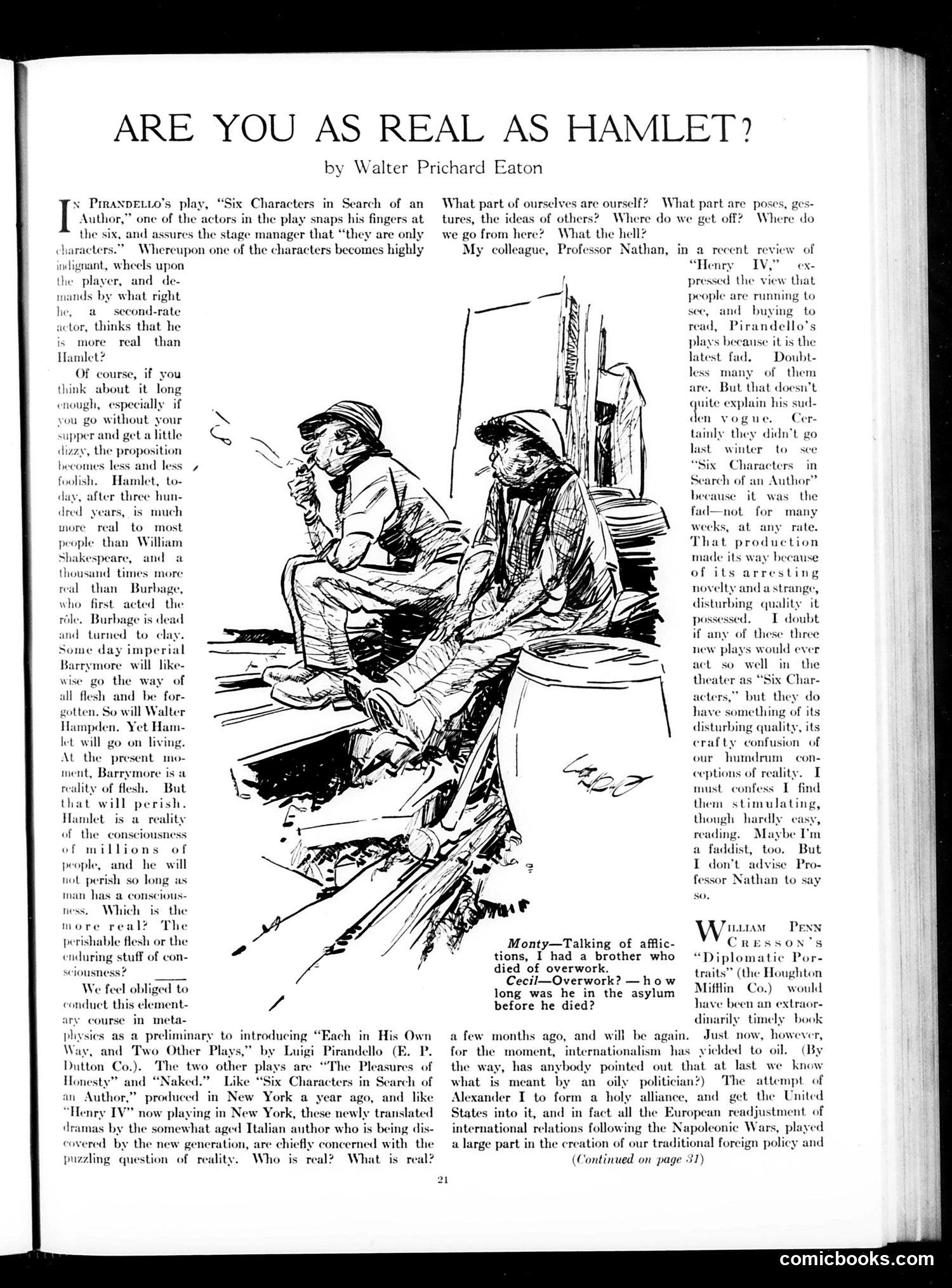
This essay by Walter Prichard Eaton discusses Luigi Pirandello's plays (newly translated and staged in New York), which explore the philosophical question: what is "real"? The accompanying sketch shows two actors in discussion, illustrating Eaton's opening anecdote: when a character in Pirandello's play demands to know by what right a "second-rate actor" claims to be more real than Hamlet, it raises a genuine metaphysical puzzle. Eaton argues that fictional characters like Hamlet possess greater "reality" than the actors who play them—Hamlet endures in millions of minds across centuries, while actors like Burbage (Shakespeare's original Hamlet) have turned to dust. Even contemporary stars like John Barrymore will perish, but Hamlet will persist. The essay uses this to introduce Pirandello's work as serious philosophy disguised as entertainment—though some (like critic George Jean Nathan) dismiss it as mere fashionable fad. Eaton defends the plays' genuine intellectual stimulation about identity and consciousness.
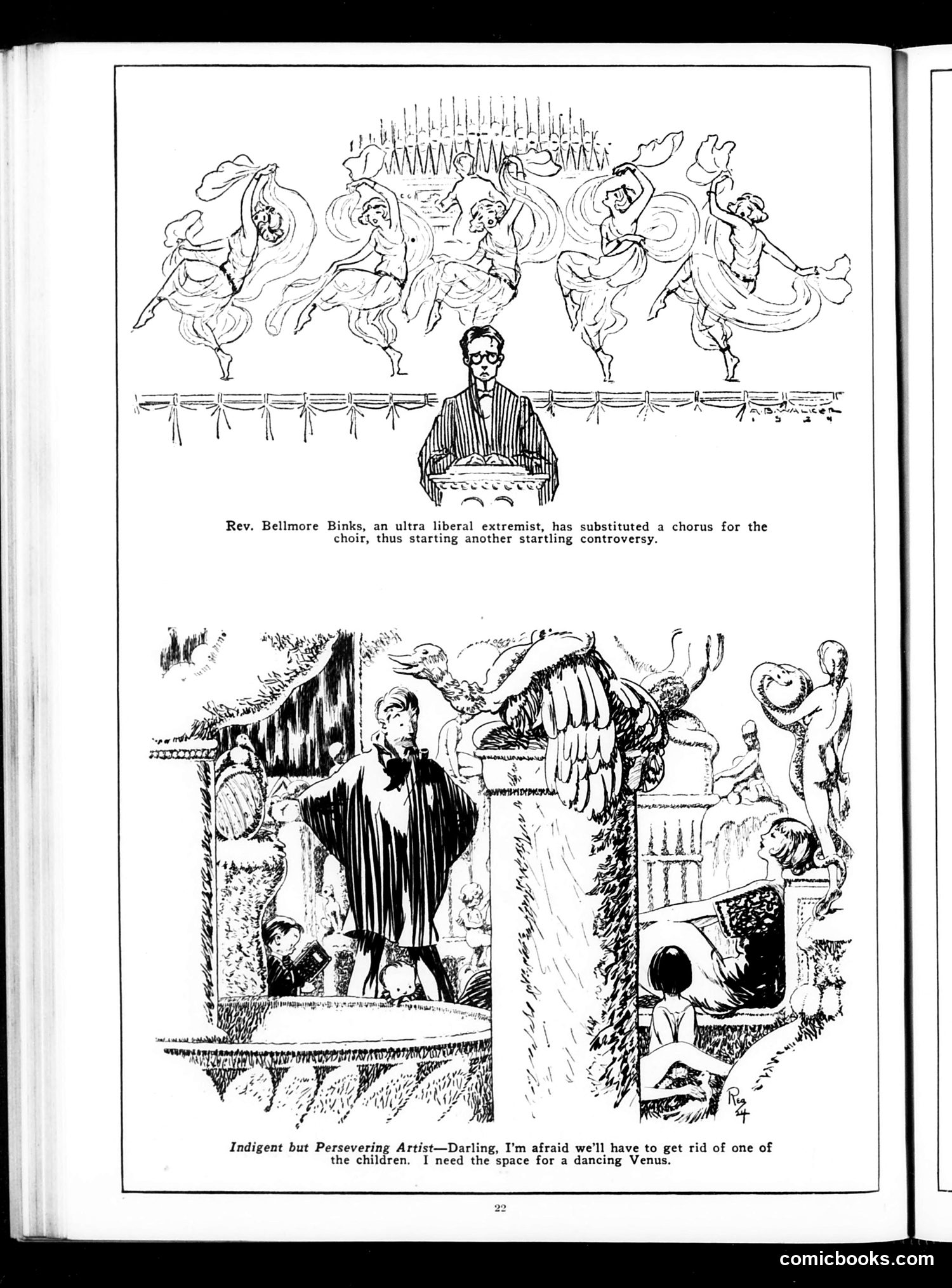
**Top Cartoon:** Satirizes Rev. Bellmore Binks, described as an "ultra liberal extremist," who has replaced a traditional church choir with a chorus line of dancing women. The joke mocks progressive religious reformers of the era who challenged conventional church practices—substituting dignified hymn-singing with what appears to be theatrical, provocative entertainment. This generated controversy among traditionalists. **Bottom Cartoon:** Depicts a struggling artist telling his wife he must remove one of their children to make room for a dancing Venus sculpture. The satire targets impoverished artists who prioritize their art over family welfare—"indigent but persevering" is ironic commentary on bohemian self-sacrifice and misplaced priorities. Both cartoons ridicule contemporary cultural tensions between traditional morality and modern artistic/progressive movements, with satirical contempt for those who adopt unconventional practices.
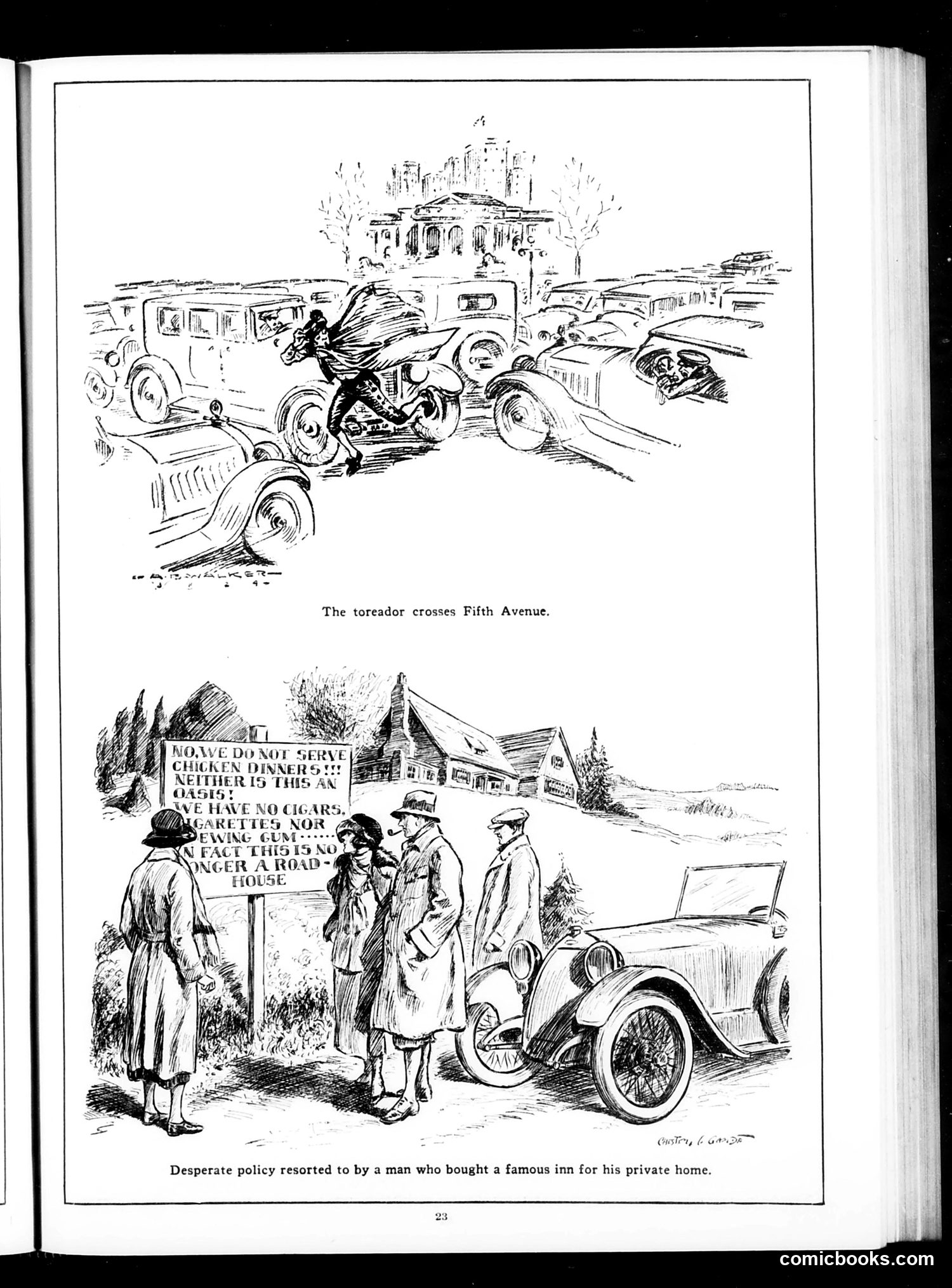
This page contains two satirical cartoons about automobile culture in early 20th-century America. The **top cartoon**, "The toreador crosses Fifth Avenue," depicts a motorcyclist navigating through heavy automobile traffic on Fifth Avenue (New York's prestigious shopping district). The "toreador" comparison—referencing a bullfighter—satirizes the dangerous skill required to drive motorcycles through crowded streets, treating traffic navigation like a daring performance. The **bottom cartoon** mocks a wealthy man who purchased a famous inn for his private residence. The sign advertises the inn's amenities (chicken dinners, gambling). His desperate policy appears to be posting fake warning signs ("DANGER," "NO LONGER A ROAD-HOUSE") to discourage visitors and preserve his privacy—suggesting the satirical point that converting a public gathering place into a private home creates awkward social tensions and failed attempts to reclaim former commercial appeal.
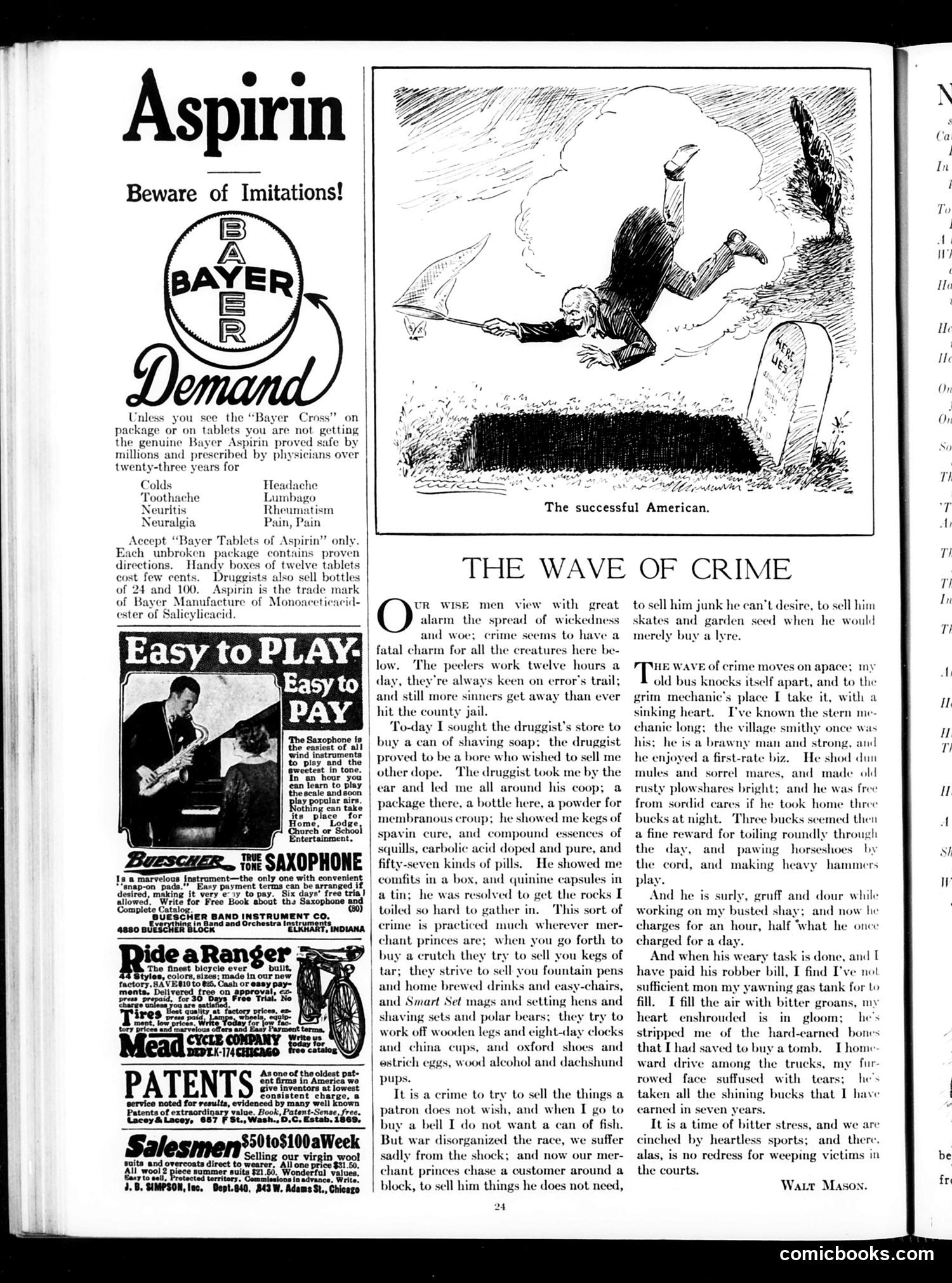
This page features a satirical essay by Walt Mason criticizing merchant dishonesty during wartime. The cartoon shows Death as a skeletal figure emerging from a grave, representing crime's spread through society. Mason's complaint: shopkeepers are aggressively upselling customers unwanted goods. He illustrates this with anecdotes—visiting a druggist wanting soap but pressured into buying unnecessary medicines, or needing a crutch but offered tar instead. He blames wartime disruption ("war disorganized the race") for degrading merchants' integrity. The satire targets post-WWI economic chaos when businessmen abandoned traditional service ethics to chase profits. The "successful American" caption is ironic—depicting Death triumphant suggests crime and greed, not genuine success. This reflects anxieties about commercialism corrupting American values during the economic upheaval following World War I.
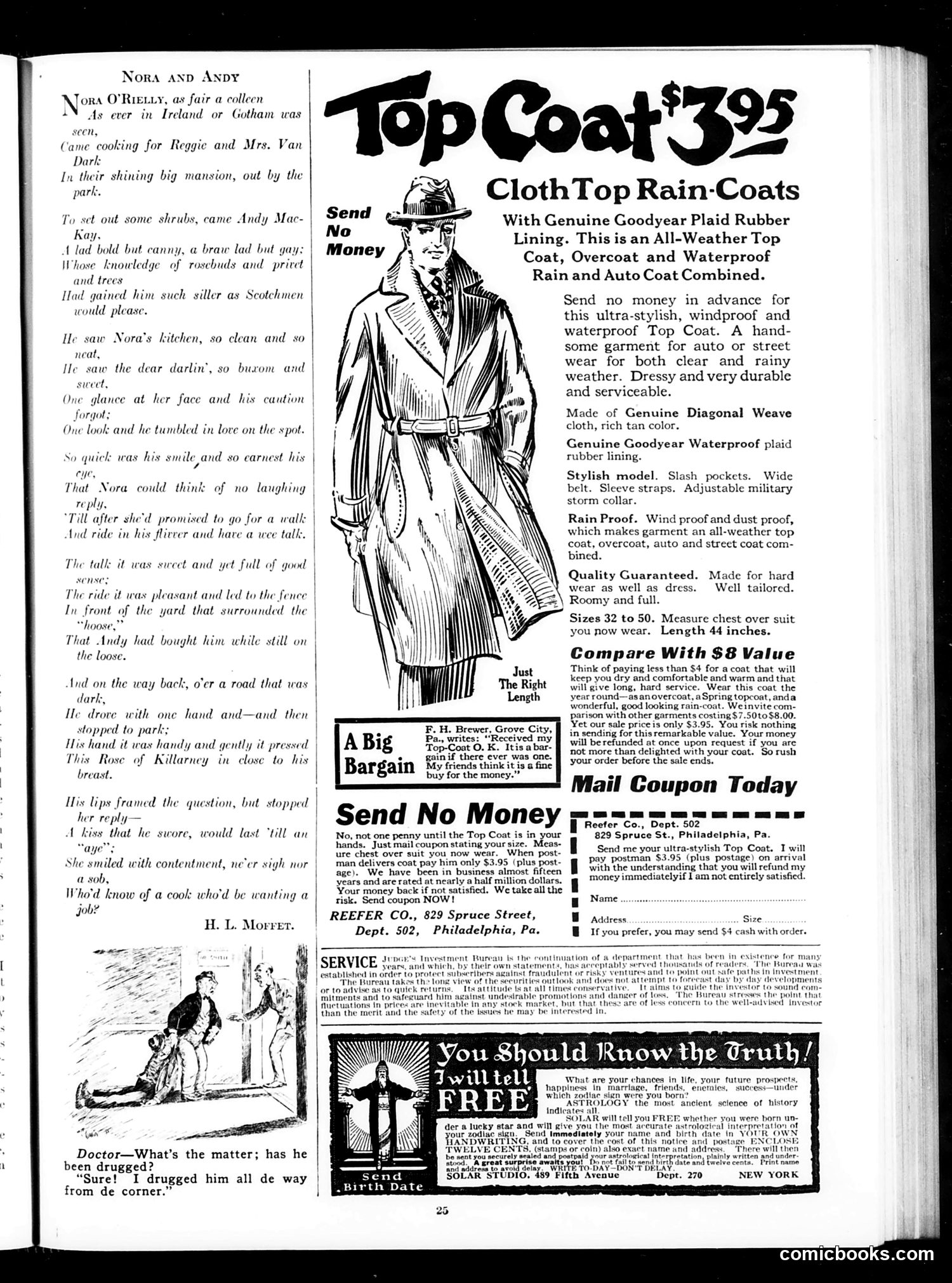
This page contains a sentimental Irish-American romance story in verse, not political satire. The narrative follows Andy MacKay, a Scottish gardener, who falls in love with Nora O'Rielly, an Irish cook employed by wealthy New Yorkers ("Mrs. Van Dark"). The story employs ethnic stereotypes common to the era: the "canny" Scot, the "fair colleen" Irish lass, references to "flivvers" (Model T Fords), and dialect spelling ("wae," "aye"). It culminates in a romantic parking scene and proposal. The small cartoon at bottom—a doctor asking a drugged man what's wrong—is unrelated humor. The page is primarily **advertising space**, dominated by a mail-order raincoat promotion ($3.95, "send no money") from Reefer Co. in Philadelphia, featuring a stylized illustration of a man in an overcoat.
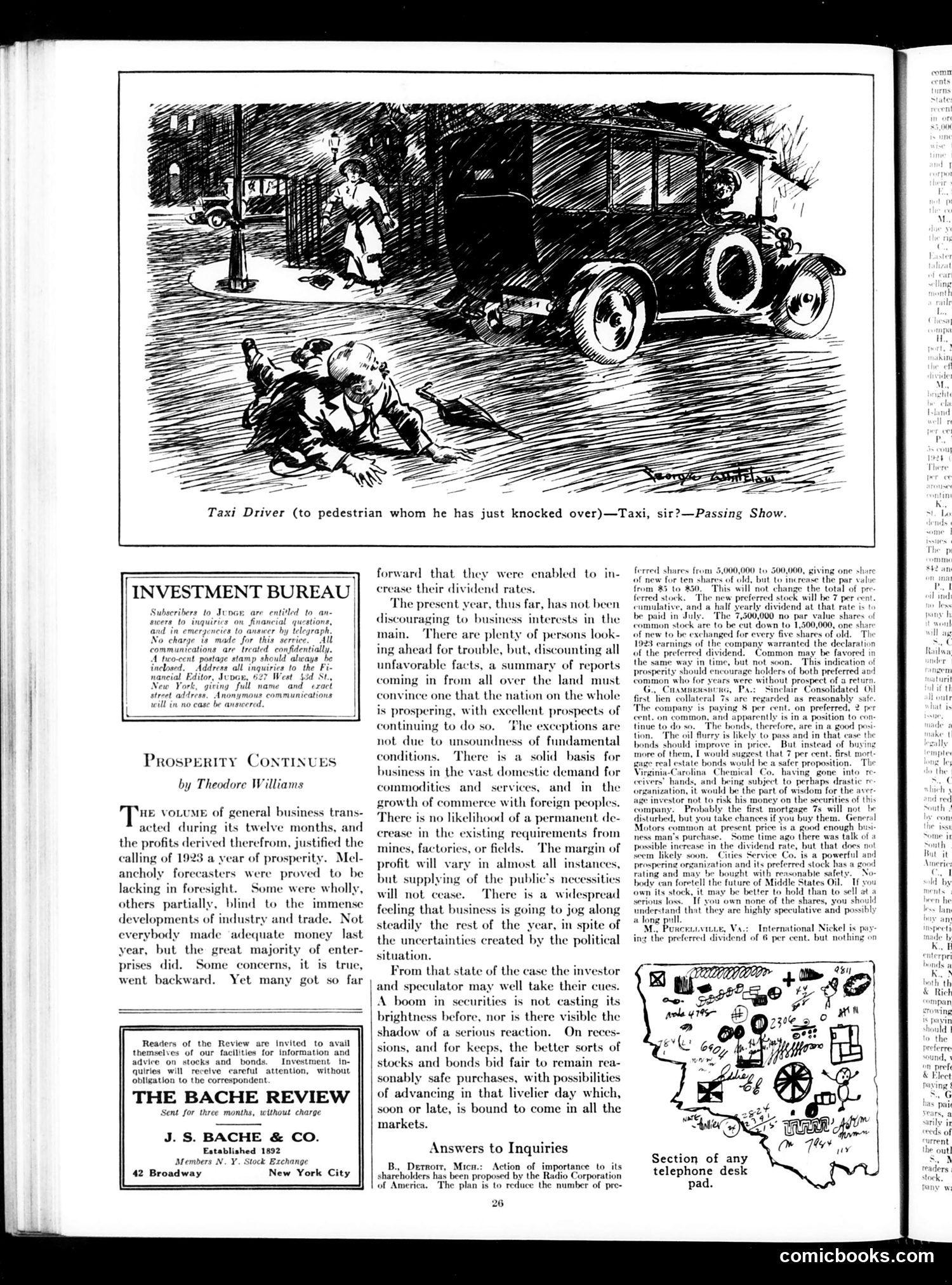
This single-panel cartoon satirizes reckless taxi driving in 1920s urban America. The illustration shows a well-dressed taxi driver who has struck a pedestrian lying on the street, casually asking "Taxi, sir?"—implying he's offering a ride to the injured person he's just hit. The humor is dark and cynical: it mocks both the cavalier attitude of drivers toward pedestrian safety and the absurdity of immediately soliciting business from someone you've just harmed. This reflects genuine 1920s anxieties about automobile traffic dangers and driver negligence in crowded cities. The caption credits "Passing Show," suggesting this was a recurring satirical theme. The cartoon appears amid business and investment content, making it an editorial aside rather than primary page content.
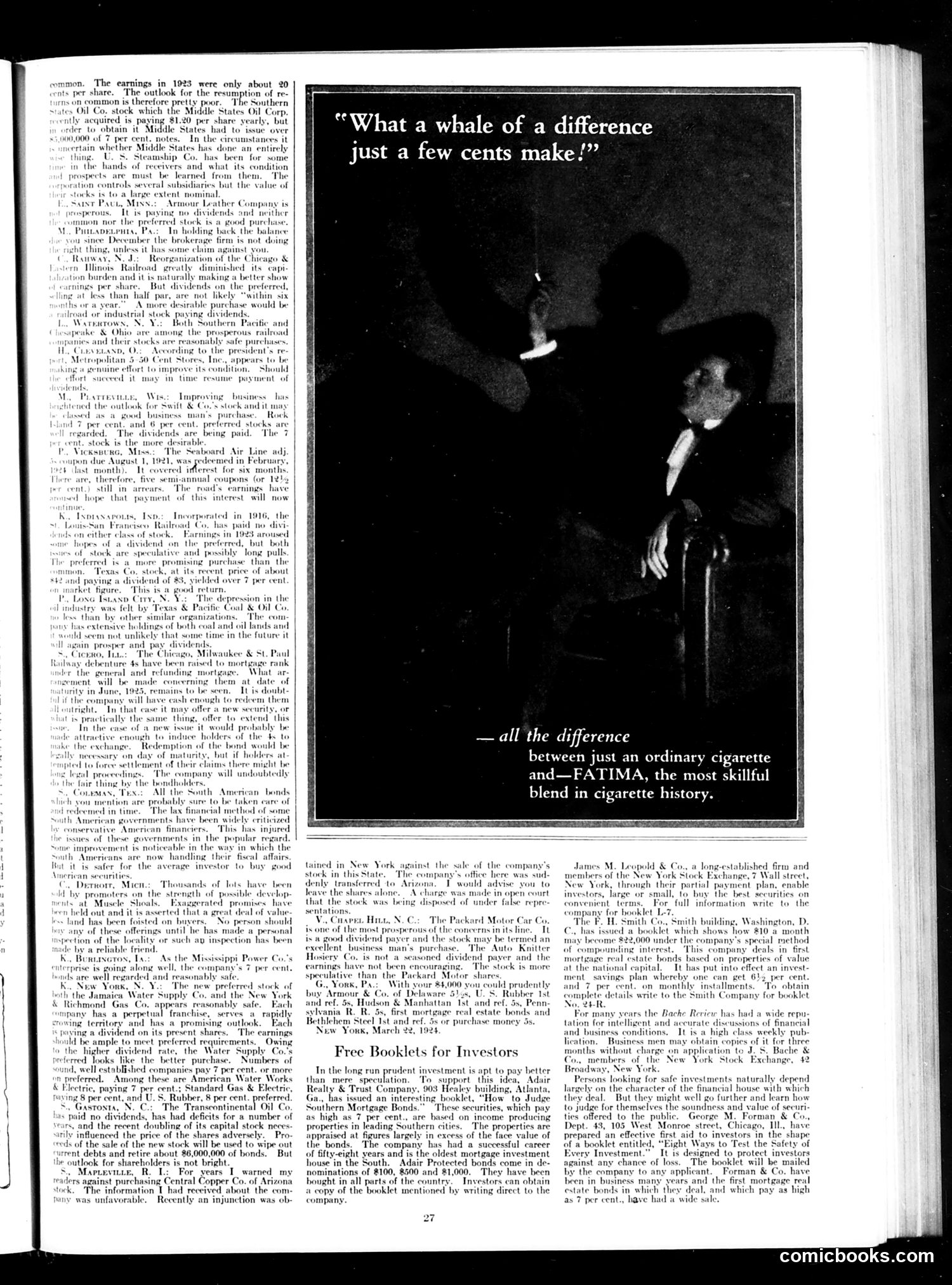
This page contains a **cigarette advertisement for Fatima** positioned as editorial content within Judge magazine's stock investment advice column. The ad features a photograph of a woman's hands holding a cigarette, with the tagline "What a whale of a difference just a few cents make!" The copy emphasizes that Fatima offers "the most skillful blend in cigarette history"—positioning a small price difference as yielding superior quality. **The satire/irony**: The ad appears deliberately placed amid dry financial advice about stock dividends and bond redemptions, where investors are literally calculating penny-per-share differences in returns. The cigarette ad borrows this language of marginal financial gains to sell a consumer product, suggesting that tiny cost differences matter equally whether investing in railroads or purchasing smokes. This is **early 20th-century consumer advertising** using financial/investment rhetoric to justify premium pricing for a branded cigarette product to a presumably affluent, male readership interested in stocks.
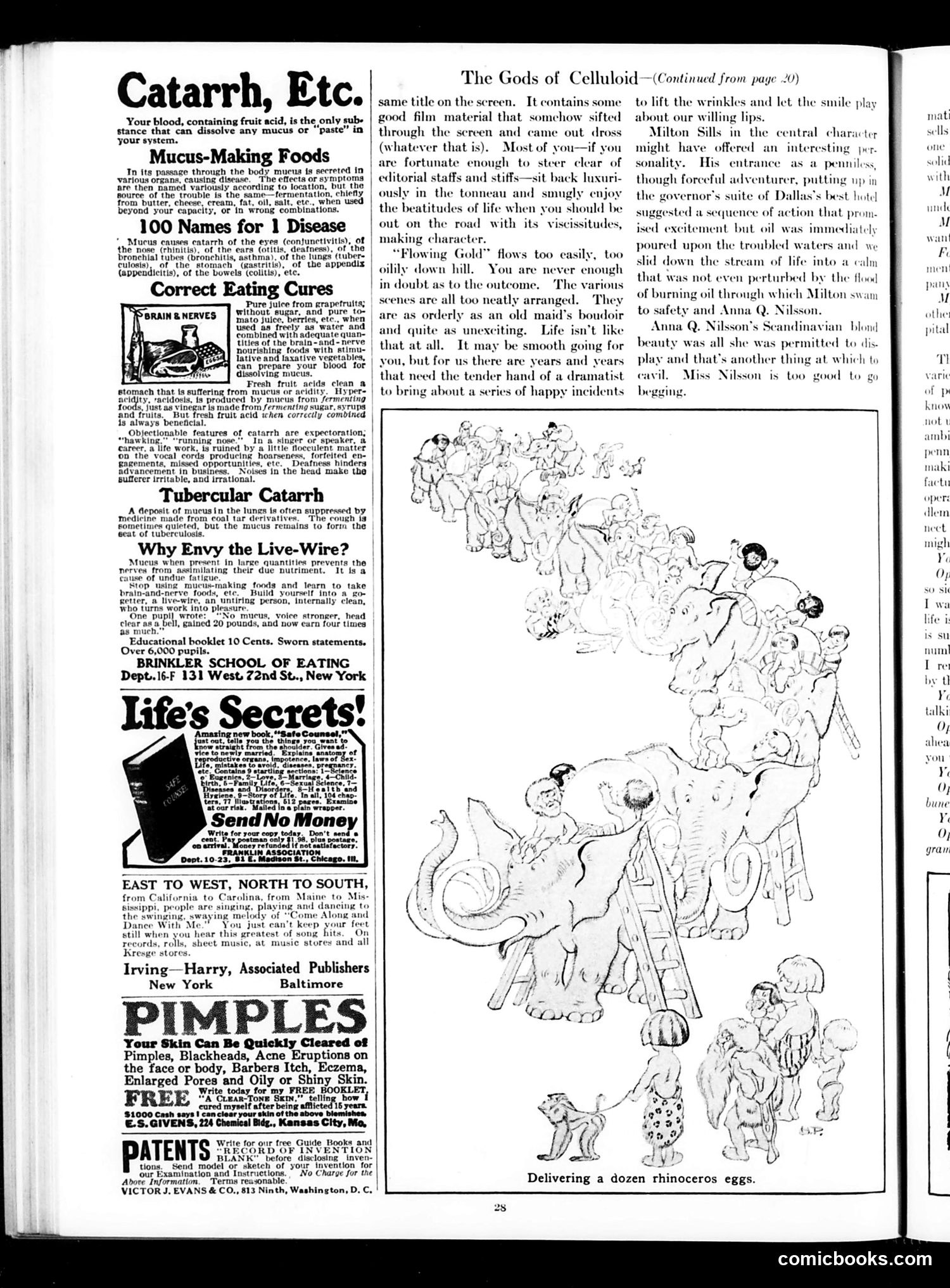
This page is primarily **advertising**, not political satire. The dominant content consists of health product advertisements (for catarrh, pimples, patent medicines, and a school of eating) typical of early 20th-century publications. The cartoon illustrates "Delivering a dozen rhinoceros eggs"—a whimsical scene showing multiple figures transporting large egg-shaped objects, likely referencing a film or story mentioned in the partially visible article "The Gods of Celluloid" (about motion pictures). The cartoon appears to be humorous illustration rather than political commentary. The page reflects the era's medical pseudoscience, with dubious claims about "mucus-making foods" and "fruit acid" cures—reflecting pre-FDA advertising standards when such unsubstantiated health claims were commonplace in magazines.
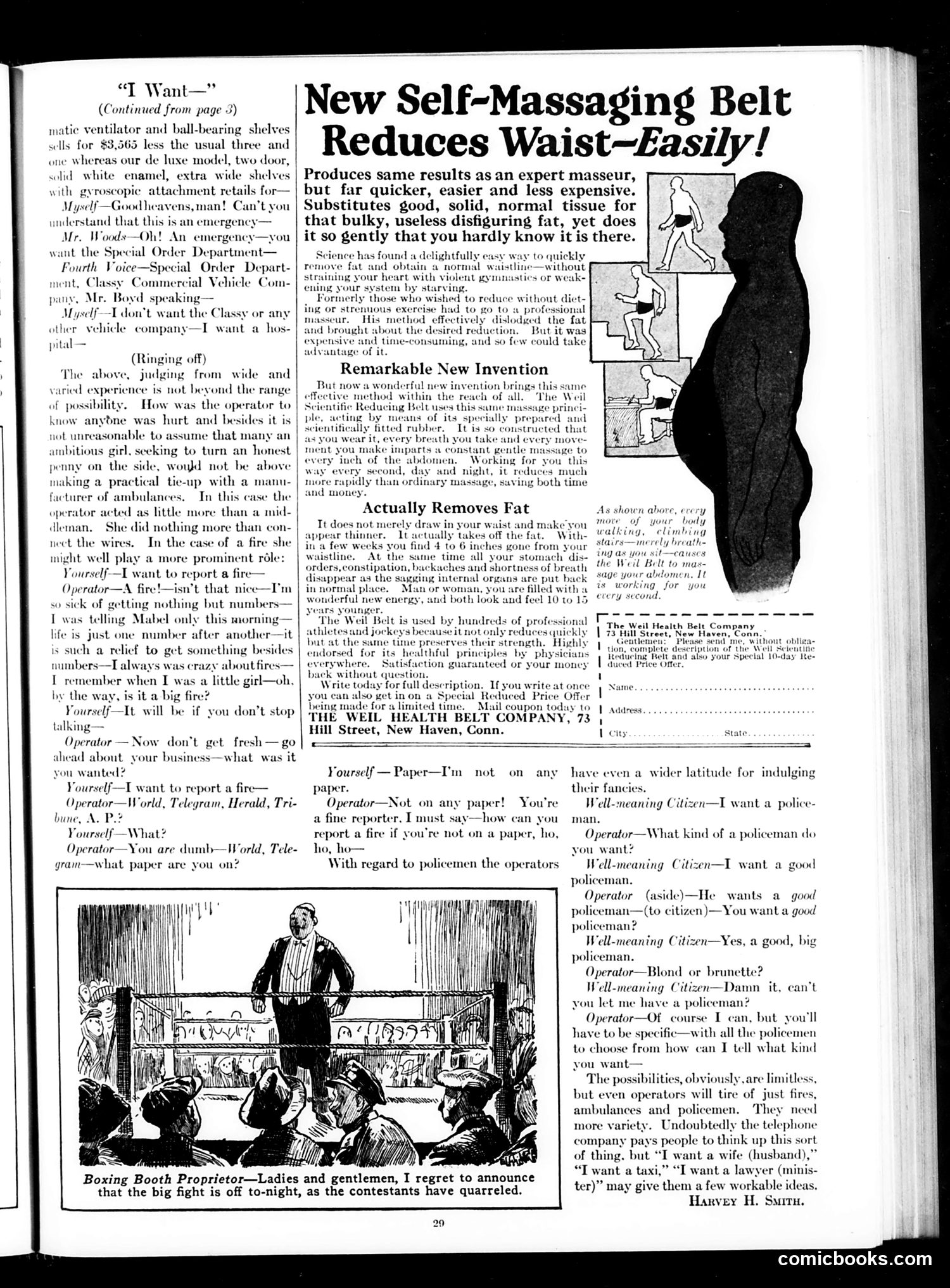
This page contains two distinct sections: **The "I Want—" Dialogue** (left side) satirizes telephone operators and the emerging telephone system. The humor targets operators who treated calls casually—the sketch shows an operator more interested in gossiping about her personal life than connecting emergency calls properly. When a caller desperately needs an ambulance, the operator treats it as just another tedious number. The satire mocks both the operator's unprofessionalism and the absurdity of trusting life-or-death situations to distracted workers. The repeated complaint "it is just one number after another" captures the dehumanizing nature of early telephone work. **The "New Self-Massaging Belt" Advertisement** (right side) is a period health product ad promising effortless weight loss through a vibrating belt worn around the waist. It claims to reduce fat without dieting or exercise—a common dubious claim of early 20th-century patent medicines and gadgets. The silhouetted illustrations show women using the device. The page reflects early 1900s anxieties: unreliable technology infrastructure and the public's susceptibility to pseudoscientific weight-loss schemes.
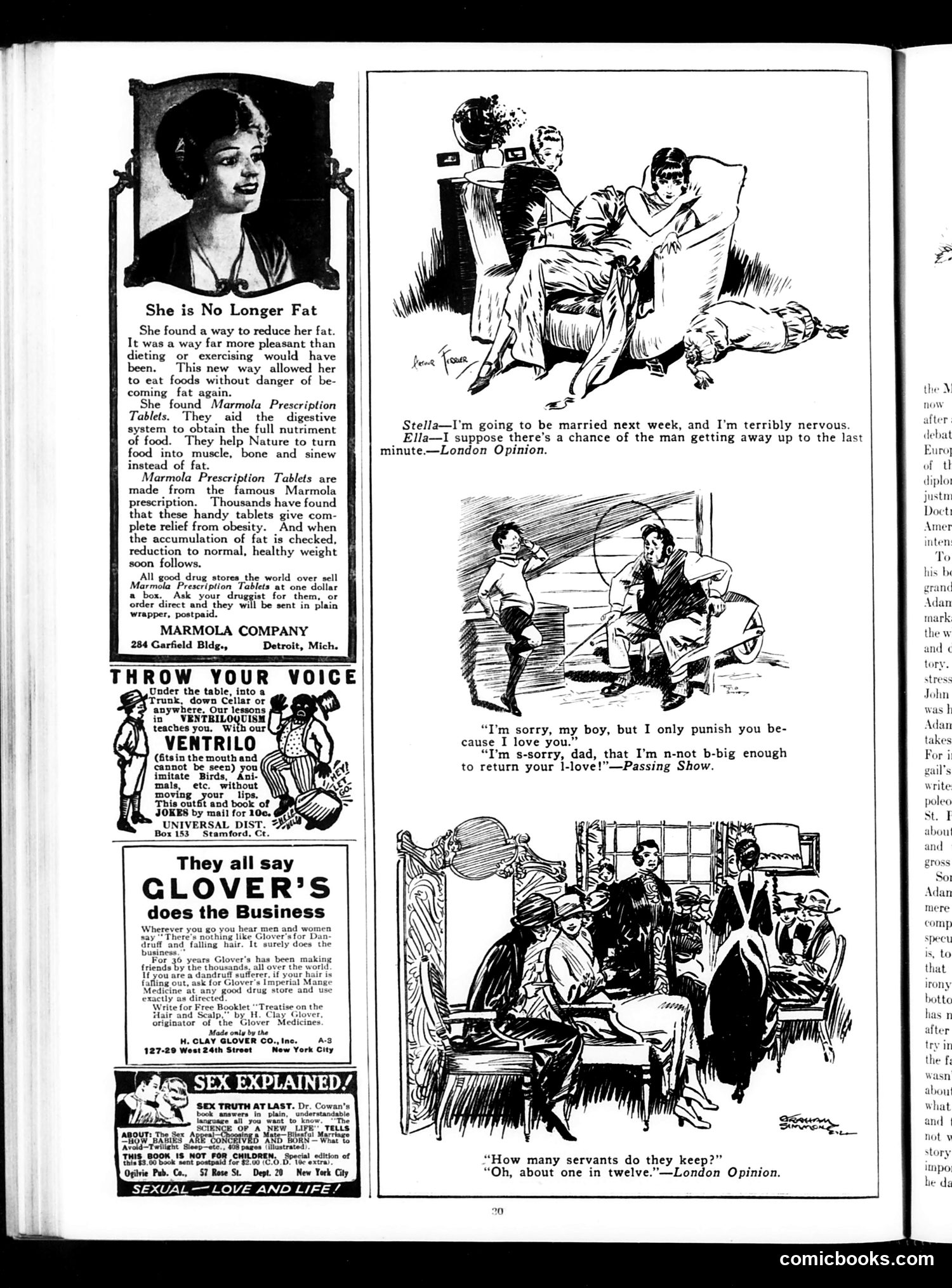
This page from *Judge* magazine contains three illustrated joke cartoons and multiple advertisements typical of early 20th-century periodicals. The cartoons depict domestic scenarios with accompanying punchlines attributed to "London Opinion": 1. **Top cartoon**: A bride-to-be expresses nervousness about her wedding; her friend jokes that the groom might "get away" at the last minute—satirizing cold feet and marital hesitation. 2. **Middle cartoon**: A father punishes his son "because I love you," and the boy responds he's "not big enough to return your love"—mocking sentimental Victorian paternal discipline rhetoric. 3. **Bottom cartoon**: A question about servant numbers receives the answer "about one in twelve"—likely referencing economic hardship or post-war labor shortages affecting household staff availability. The advertisements promote period remedies: Marmola weight-loss tablets, a ventriloquism kit, dandruff treatments, and sex education books—reflecting contemporary consumer concerns and taboo topics of the era.
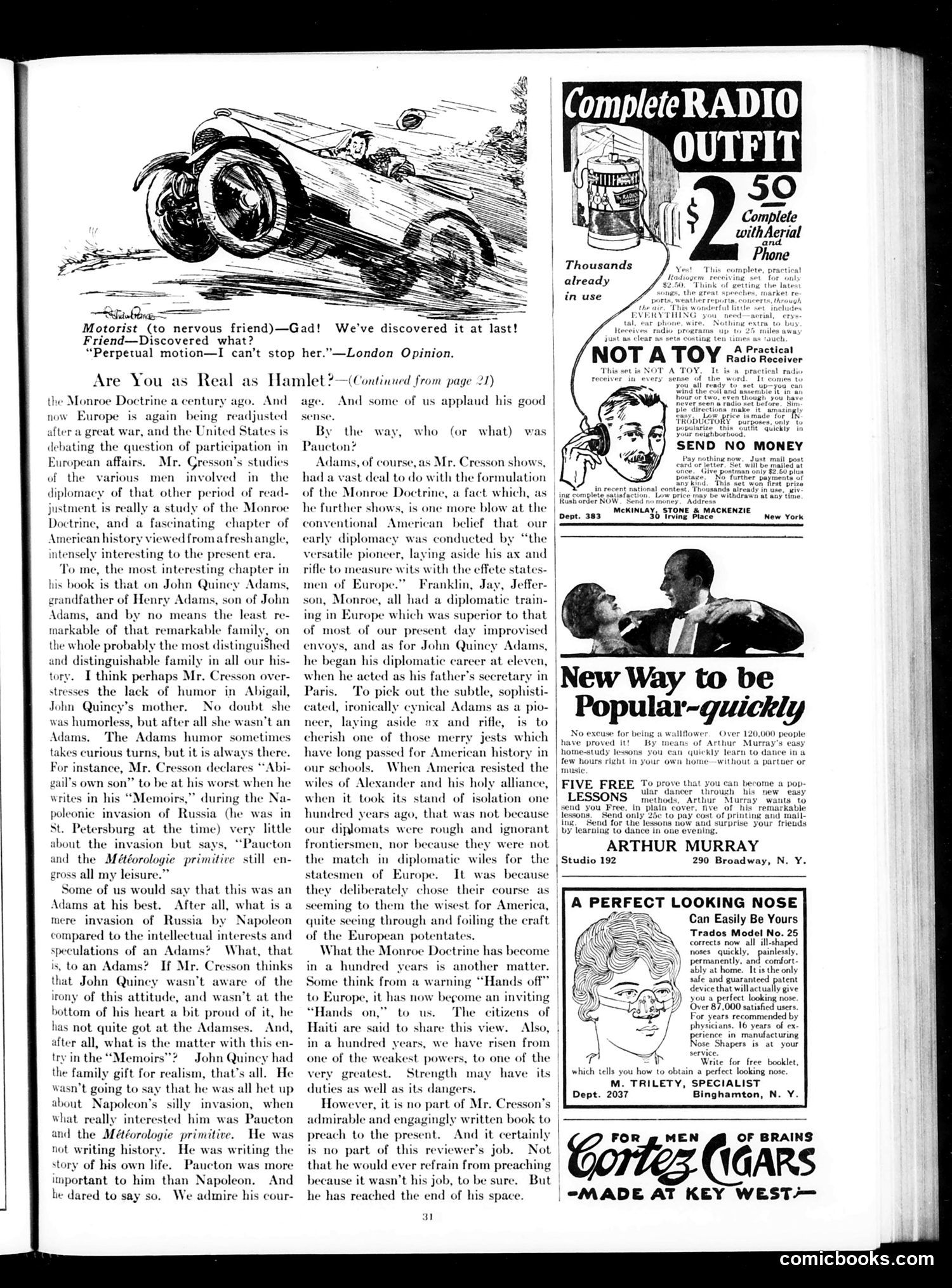
The small cartoon at the top depicts a motorist who has discovered "perpetual motion" — he can't stop his car. This is a humorous jab at early automobile technology, likely from the 1920s-30s, when cars were notoriously difficult to control or brake. The joke plays on the physics term "perpetual motion" (a theoretical machine that runs forever) to mock malfunctioning brakes. # The Main Article The page's primary content is a book review titled "Are You as Real as Hamlet?" discussing a work about early American diplomacy and the Monroe Doctrine. The reviewer praises John Quincy Adams' intellectual sophistication and ironic wit, arguing that early American diplomats were skilled statesmen — not rough frontiersmen — who deliberately chose isolationism as sound policy, not from ignorance but from strategic wisdom. The piece counters popular American mythology portraying the founding generation as unsophisticated pioneers.
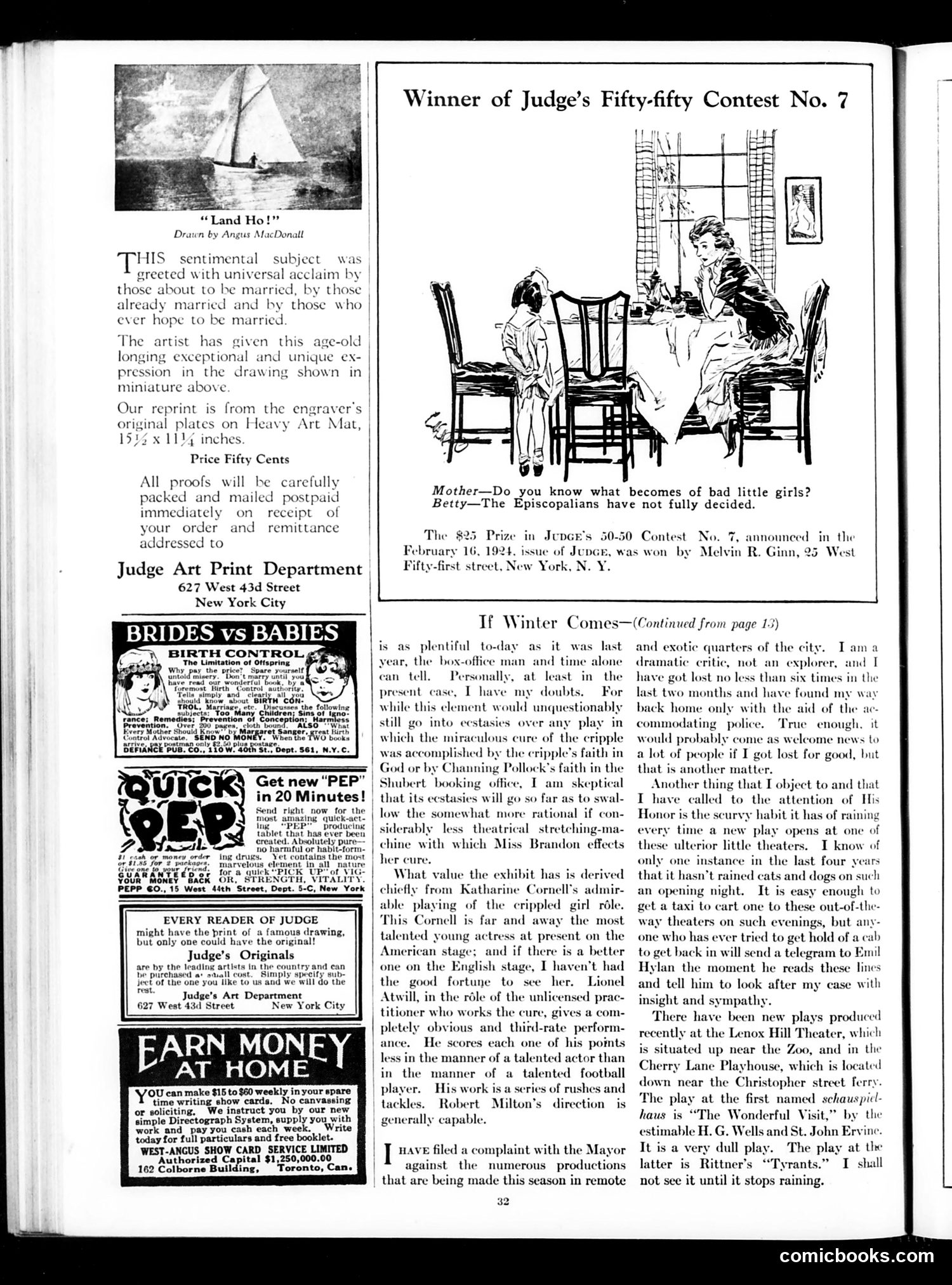
**The Main Cartoon:** "Land Ho!" by Angus MacDonald depicts a sailboat approaching shore—a metaphor for marriage. The text explains it resonated universally with those contemplating, already in, or hoping to enter marriage. The "land" represents the destination of matrimony, portrayed as a longed-for harbor. This sentimental image sold as a print for fifty cents. **The Joke Below:** A mother asks her daughter what happens to "bad little girls." The daughter replies: "The Episcopalians have not fully decided." This satirizes the Episcopal Church's perceived indecisiveness on moral questions and social standards—suggesting even church authorities cannot definitively address such issues. It's mild social satire typical of Judge's humor. **Context:** The page is primarily advertisements and notices for Judge's art prints and various mail-order services (show cards, birth control literature, energy tonics). The theatrical review discusses Katharine Cornell's performance in a play about miraculous healing—period entertainment commentary.
This page appears to be primarily **promotional/advertising content** rather than a cartoon. The bulk of the page consists of what looks like **Chinese or Japanese characters** in vertical columns—difficult to read clearly in this reproduction, though they may represent decorative text or an advertisement. The only clearly legible English text is at the bottom: "All of which means that the Mah Jongg Number of Judge will be out next week!" **Context for modern readers:** This is announcing a special issue of *Judge* magazine dedicated to **Mah-Jongg**, the Chinese tile game that experienced a craze in America during the 1920s-1930s. The exotic game became fashionable among American socialites and was frequently referenced in period humor and advertising. This page is essentially a teaser/announcement promoting an upcoming themed issue of the magazine, likely filled with jokes and satire about the Mah-Jongg fad. The foreign-language text reinforces the "exotic Oriental" marketing angle popular in that era's American popular culture.
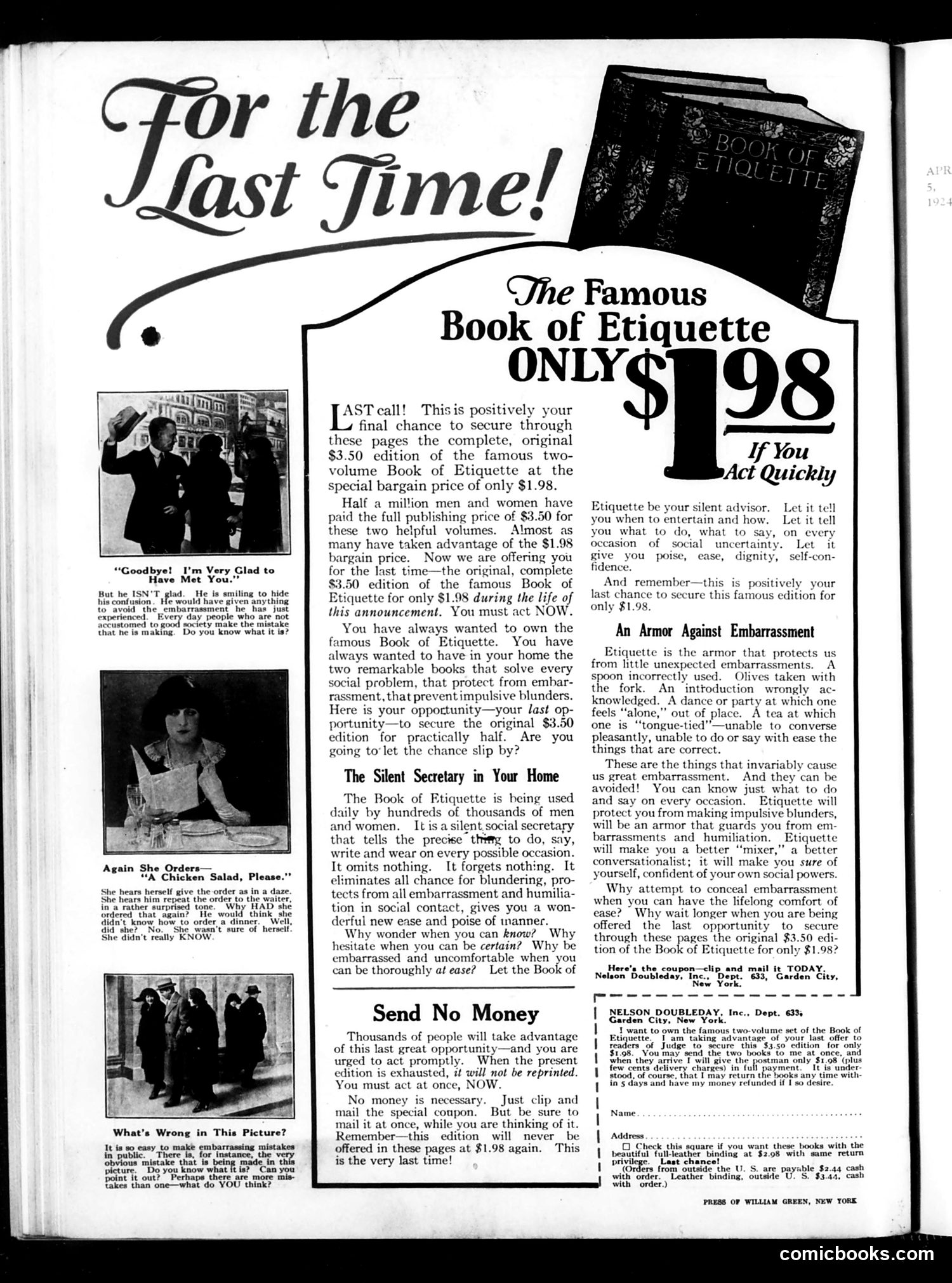
This is primarily a **full-page advertisement** for a "Book of Etiquette," not a political cartoon. The small photographs on the left are illustrative vignettes showing social embarrassment scenarios—a man awkwardly greeting others, a woman nervously ordering at a restaurant, people in confused social situations. The satire is mild and social rather than political: the ad mocks people who lack proper manners and social confidence. The captions ("Goodbye! I'm Very Glad to Have Met You—But he ISN'T glad" and "A Chicken Salad, Please") show common situations where people fail to behave correctly according to etiquette rules. The advertisement's central pitch is that this $3.50 book is being offered for $1.98 "for the last time"—a classic marketing pressure tactic claiming urgency. The text frames etiquette as "armor against embarrassment," suggesting early-20th-century American anxiety about social status and proper behavior, particularly for those aspiring to "good society."