
Judge, 1924-03-29 · page 17 of 36
Judge — March 29, 1924 — page 17: what you’re looking at
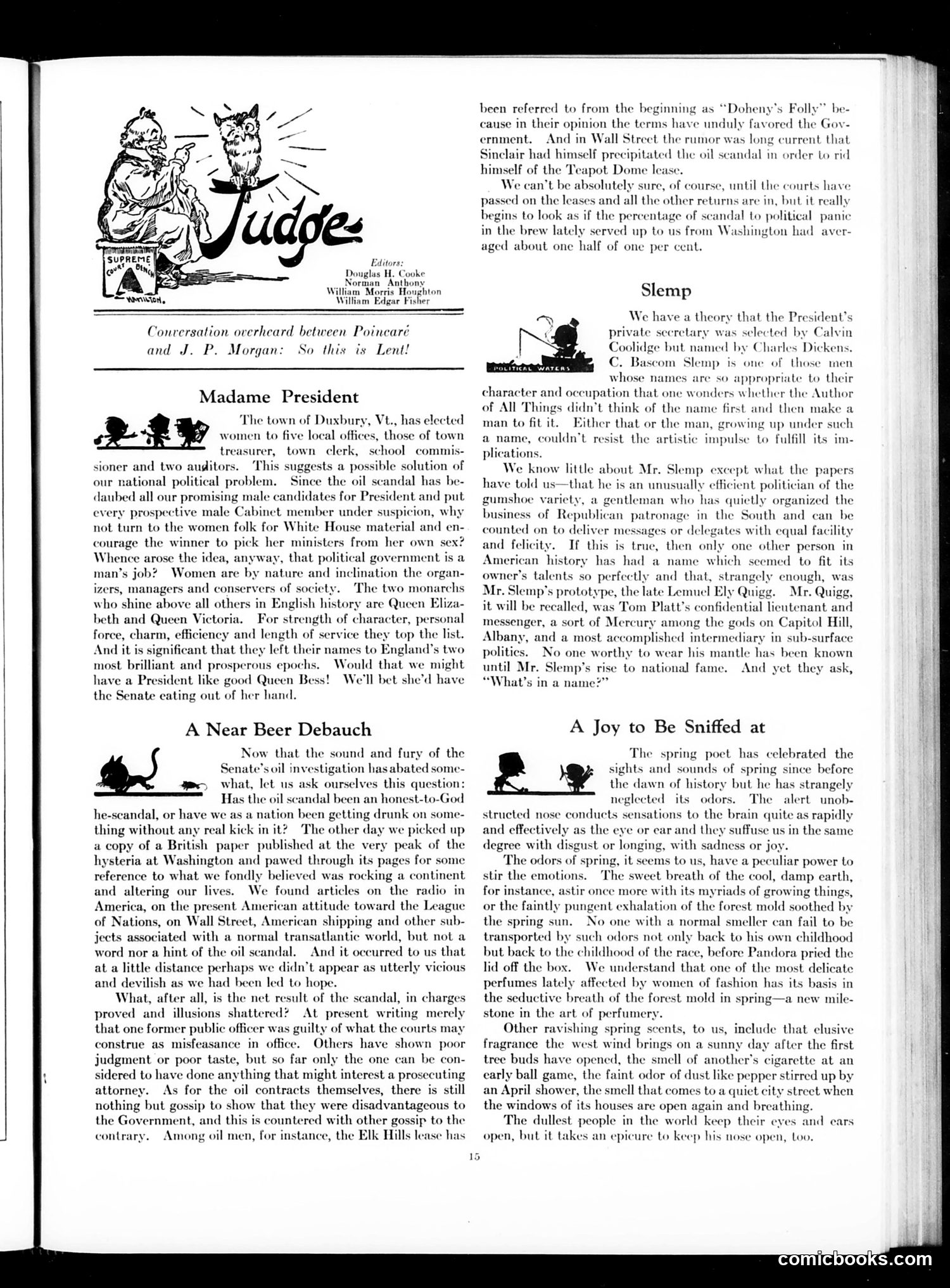
What you’re looking at
**The Main Cartoon** ("So this is Lent!") depicts two figures in conversation—likely French Premier Poincaré and American banker J.P. Morgan. The joke plays on "Lent" (the Christian fasting period) as a reference to financial restraint or reduced activity, suggesting the oil scandal investigations have dampened business as usual. **Key Articles:** 1. **"Madame President"** satirizes recent Vermont town elections of women to local offices, proposing female leadership as a solution to the current "oil scandal" that has tainted male politicians. The piece ironically celebrates women leaders like Queen Elizabeth and Victoria. 2. **"A Near Beer Debauch"** addresses the Teapot Dome scandal (oil lease controversy), questioning whether public outrage matches actual proven wrongdoing. It suggests the scandal's impact has been exaggerated—a "near beer" (weak substitute) rather than genuine crisis. 3. **"Slemp"** briefly notes that President Coolidge's private secretary, C. Bascom Slemp, has a name so perfectly suited to his character that it seems Dickens invented it. The page satirizes 1920s political corruption and public reaction to it.
📄 Transcribed text from this page (OCR, searchable)
Machine-transcribed from the original scan — historical spelling and the odd misread are preserved.
Conversation overheard between Poinearé and J. P. Morgan: So this is Lent! Madame President The town of Duxbury, Vt., has elected women to five local offices, those of town 22h treasurer, town clerk, commis- sioner and two auditors. ‘This suggests a possible solution of our national political problem. Since the oil scandal has be- daubed all our promising male candidates for President and put every prospective male Cabinet member under suspicion, why not turn to the women folk for White House material and en courage the winner to pick her ministers from her own si Whence arose the idea, anyway, that political government is a man’s job? Women are by nature and inclination the organ- izers, managers of society. The two monarchs who shine above all others in English history are Queen E beth and Queen Victoria. For strength of character, personal force, charm, efficiency and length of service they top the list. And it is significant that they left their names to England’s two most brilliant and prosperous epochs. Would that we might have a President like good Queen Bess! We'll bet she’d have the Senate eating out of her hand. school nd conser’ i A Near Beer Debauch Now that the sound and fury of the Senate’s oil investigation has abated some- what, let us ask ourselves this question: Has the oil scandal been an honest-to-God he-scandal, or have we as a nation been getting drunk on some- thing without any real kick in it? The other day we picked up a copy of a British paper published at the very peak of the hysteria at Washington and pawed through its pages for some reference to what we fondly believed was rocking a continent and altering our lives. We found articles on the radio in America, on the present American attitude toward the League of Nations, on Wall Street, American shipping and other sub- jects associated with a normal transatlantic world, but not a word nor a hint of the oil scandal. And it occurred to us that at a little distance perhaps we didn’t appear as utterly vicious and devilish as we had been led to hope. What, after all, is the net result of the scandal, in charges proved and illusions shattered? At present writing merely that one former public officer was guilty of what the courts may construe as misfeasance in office. Others have shown poor judgment or poor taste, but so far only the one can be con- sidered to have done anything that might interest a prosecuting attorney. As for the oil contracts themselves, there is still nothing but gossip to show that they were disadvantageous to the Government, and this is countered with other gossip to the Among oil men, for instance, the Elk Hills lease has Lael contrary. been referred to from the beginning as “Doheny’s Folly” be- cause in their opinion the terms have unduly favored the Gov- ernment. And in Wall Street the rumor was long current that Sinclair had himself precipitated the oil scandal in order to rid himself of the Teapot Dome lease. We can’t be absolutely sure, of course, until the courts have passed on the leases and all the other returns are in, but it really begins to look as if the percentage of scandal to political panic in the brew lately served up to us from Washington had aged about one half of one per cent. aver- Slemp We have a theory that the President's pivete secretary was selected by Calvin Coolidge but named by Charles Dickens. Bascom Slemp those moss names are so appropriate to their character and occupation that one wonders whether the Author of All Things didn’t think of the name first and then make a man to fit it. Either that or the man, g g up under such a name, couldn't resist the artistic impulse to fulfill its im- plications. We know little about Mr. Slemp except what the papers have told us— that he is an unusually efficient politician of the gumshoe variety, is one of nen OWi a gentleman who has quietly organized the business of Republican patronage in the South and can be counted on to deliver messages or de and felicity. If this is true, American history ates with equal facility then only one other person in has had a name which seemed to fit its owner’s talents so perfectly and that, strangely enough, was Mr. Slemp’s prototype, the late Lemucl Ely Quigg. Mr. Quigg, it will be recalled, was Tom Platt’s confidential lieutenant and messenger, a sort of Mercury among the gods on Capitol Hill, Albany, and a most accomplished intermediary in sub-surface politic No one worthy to wear his mantle has been known until Mr. Slemp’s rise to national fame. And yet they ask, “What's in a name? A Joy to Be Sniffed at The spring poct has celebrated the sights and sounds of spring since before the dawn of history but he has strangely neglected its The alert unob- structed nose conducts sensations to the brain quite as rapidly and effectively as the eye or ear and they suffuse us in the same degree with disgust or longing, odors. with sadness or joy. The odors of spring, it seems to us, have a peculiar power to stir the emotions. The sweet breath of the cool, damp earth, for instance, astir once more with its myriads of growing things, or the faintly pungent exhal: the spring sun. ion of the forest mold soothed by No one with a normal smeller can fail to be transported by such odors not only back to his own childhood but back to the childhood of the race, before Pandora pried the lid off the box. We understand that one of the most delicate perfumes lately affected by women of fashion has its basis in the seductive breath of the forest mold in spring stone in the art of perfumery. Other ravishing spring to us, include fragrance the west wind brings on a sunny day tree buds have opened, the smell of another's ¢ early ball game, the faint odor of dust like pepper stirred up by an April shower, the smell that comes to a quiet city street when the windows of its houses are open again and breathing. The dullest people in the world keep their eyes and cars open, but it takes an epicure to keep his nose open, Loo. —a new mile- ents, that elusive after the first arette at an