
Judge, 1924-03-29 · page 23 of 36
Judge — March 29, 1924 — page 23: what you’re looking at
What you’re looking at
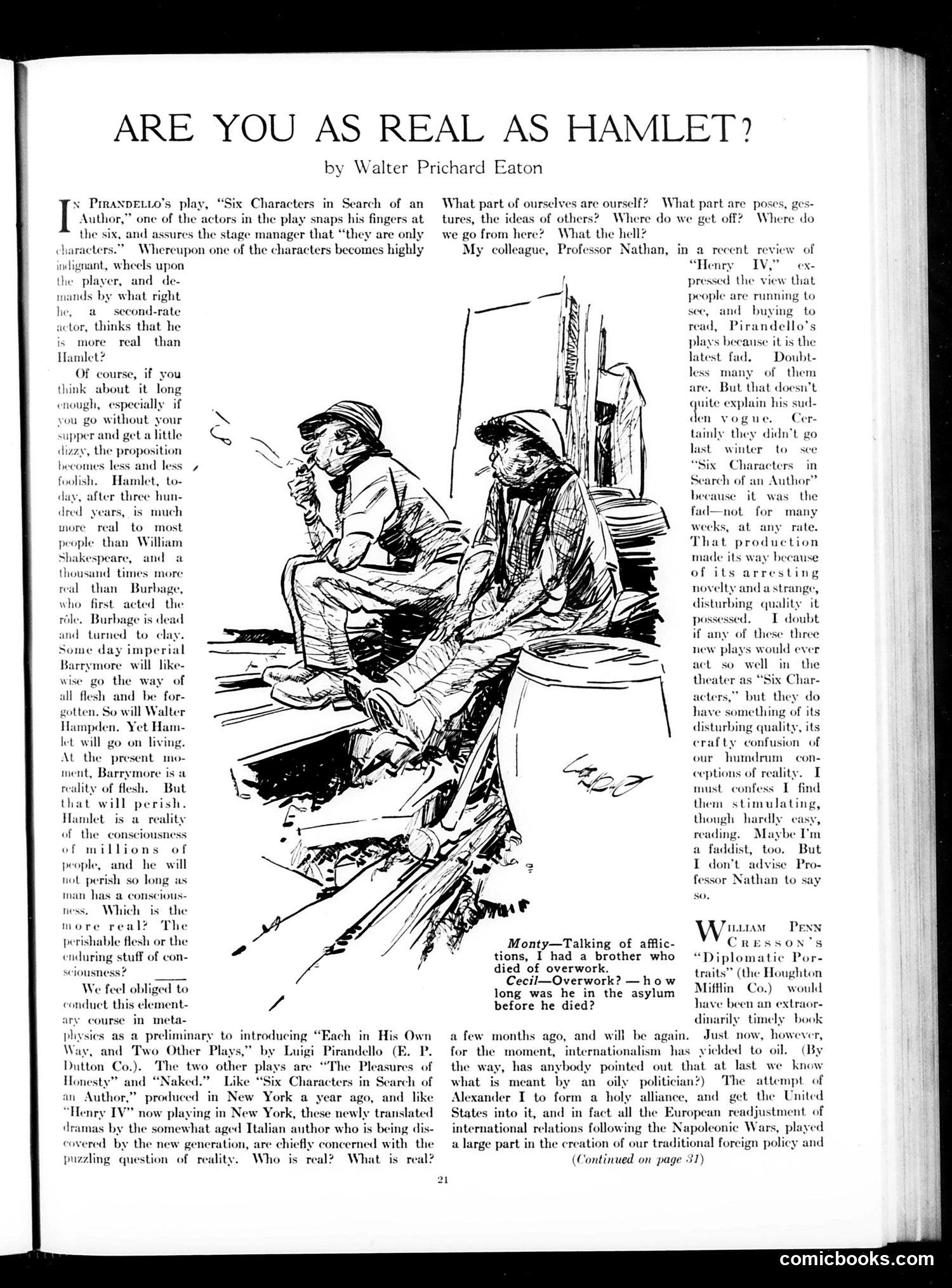
This essay by Walter Prichard Eaton discusses Luigi Pirandello's plays (newly translated and staged in New York), which explore the philosophical question: what is "real"? The accompanying sketch shows two actors in discussion, illustrating Eaton's opening anecdote: when a character in Pirandello's play demands to know by what right a "second-rate actor" claims to be more real than Hamlet, it raises a genuine metaphysical puzzle. Eaton argues that fictional characters like Hamlet possess greater "reality" than the actors who play them—Hamlet endures in millions of minds across centuries, while actors like Burbage (Shakespeare's original Hamlet) have turned to dust. Even contemporary stars like John Barrymore will perish, but Hamlet will persist. The essay uses this to introduce Pirandello's work as serious philosophy disguised as entertainment—though some (like critic George Jean Nathan) dismiss it as mere fashionable fad. Eaton defends the plays' genuine intellectual stimulation about identity and consciousness.
📄 Transcribed text from this page (OCR, searchable)
Machine-transcribed from the original scan — historical spelling and the odd misread are preserved.
ARE YOU AS REAL AS HAMLET? by Walter Prichard Eaton rch of an fingers at are only Whereupon one of the characters becomes highly ant, wheels upon the player, and de- mands by what right lie, a second-rate actor, thinks that he real than and assures the stage mana is more Hamlet? Of course, if you think about it long cnough, especially if vou go without your supper and get a little dizzy, the proposition becomes less and less Hamlet, to- day, after three hun- dred. years, is much more rr to most people than William Shakespeare, and a foolish, thousand times more real than who first Burbage, acted the rile. Burbage is « and turned to clay. Some day imperial Barrymore will like- wise go the way of all flesh and be for- gotten. So will Walter Hampden. Yet Ham- let will go on living. At the present mo- ment, Barrymore is a reality of flesh. But that will perish. Hamlet is a reality of the consciousness of millions of and he will hot perish so long as man has a conscious- Which is’ the more real? The perishable flesh or the enduring stuff of con- sciousness? We feel obliged to conduct this element- ary course in meta- physics as a preliminary to introducing “Each in His Own Way, and Two Other Plays,” by irandello (E. P. Dutton Co.). The two other play f Honesty” and “Naked.” Like an Author,” produced in “Henry IV” now playing in dramas by the somewhat « covered by the new generation, are chiefly concerned with the puzzling question of reality. Who is real? What is real? hess. What part of ourselves are ourself? What part are poses, ges- tures, the ideas of others? Where do we get off? Where do we go from here? What the hell? My colleague, Professor Nathan, in a recent rev) “Henry IV,” pressed the view that people are running to see, and buying to read, Pirandello’s plays because it is the latest fad. Doubt- less many of them are. But that doesn’t ane explain his sud- Cer- tainly they didn’t go last den vogue. winter to sce x Characters in Search of an Author” because it was the fad—not for many at any rate. t production made its way because of its arresting novelty and a strange, disturbing quality it I doubt if any of these three possessed. new plays would ever act so well in the theater as “Six Char- acters,” but they do have something of its disturbing quality, its crafty confusion of our humdrum con- ceptions of reality. I must confess I find them stimulating, though hardly easy, reading. Maybe I'm a faddist, too. But I don’t advise Pro- fessor Nathan to say Wis Penn Cresson’s “Diplomatic Por- traits” (the Houghton Mifflin Co.) would have been an extraor- dinarily timely book Just now, however, internationalism has yielded to oil. (By , has anybody pointed out that at last we know what is meant by an oily politician?) The attempt of Alexander I to form a holy alliance, and get the United into it, and in fact all the European readjustment of international relations following the Napoleonic Wars, played a large part in the creation of our traditional foreign policy and (Continued on page 31) Monty—Talking of afflic- tions, I had a brother who died of overwork. Cecil—Overwork? —how long was he in the asylum before he died? a few months ago, and will be again. for the moment, comicbooks.com