
A complete issue · 32 pages · 1921
Judge — January 29, 1921
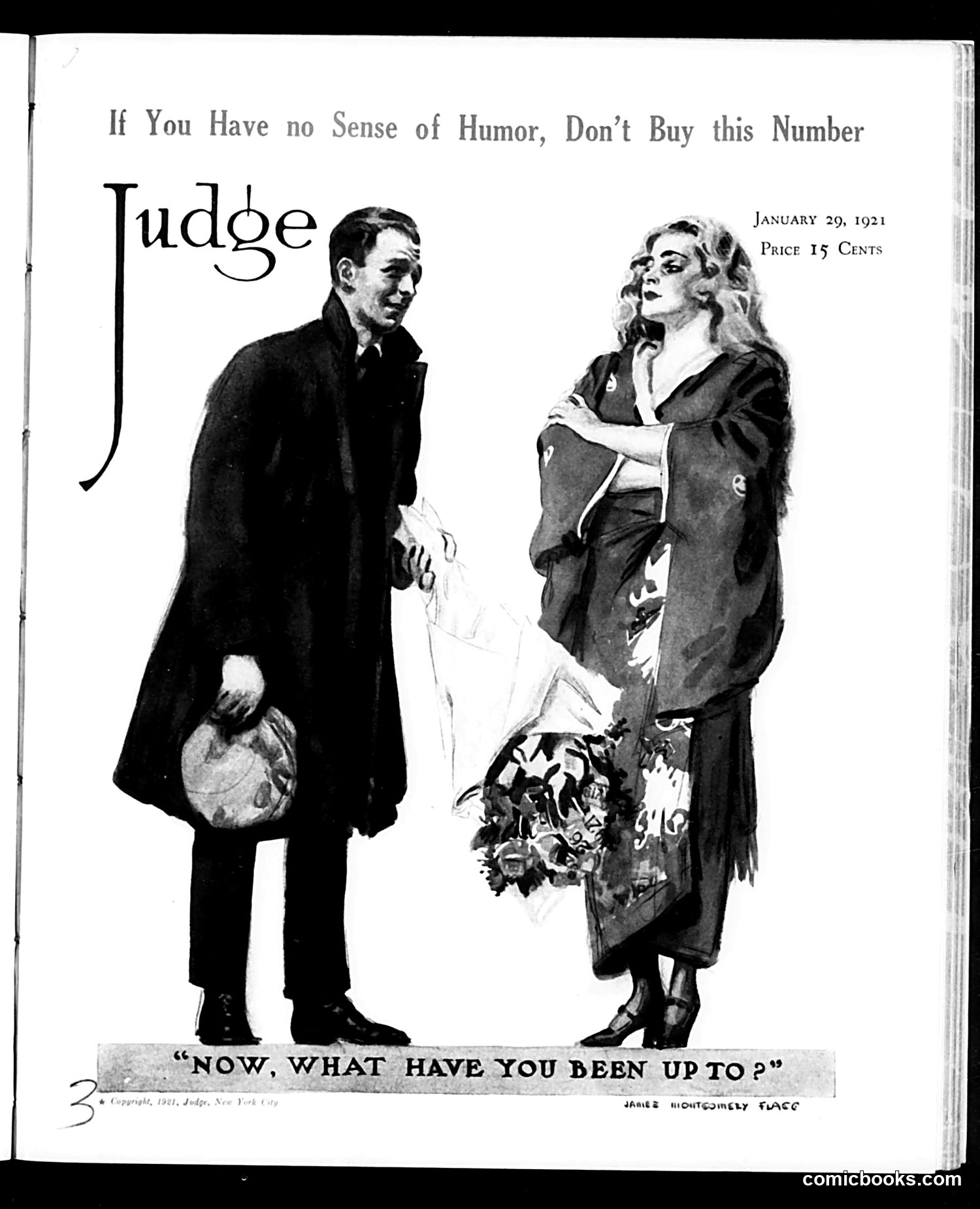
This satirical cartoon depicts a domestic confrontation between a man and woman. The man, dressed formally in a dark coat, confronts the woman—who appears disheveled with torn clothing and holds wilted flowers—asking "Now, what have you been up to?" The humor operates on a double meaning: her disarrayed appearance suggests either romantic infidelity or some other mischievous activity, while her guilty demeanor implies she's been caught in wrongdoing. The caption's interrogatory tone suggests spousal suspicion. The header warns humorless readers to avoid this issue, indicating the magazine's satirical content about marital relations and gender dynamics was considered edgy for 1921 audiences. The publication date places this during the Jazz Age, when traditional social conventions were increasingly questioned.
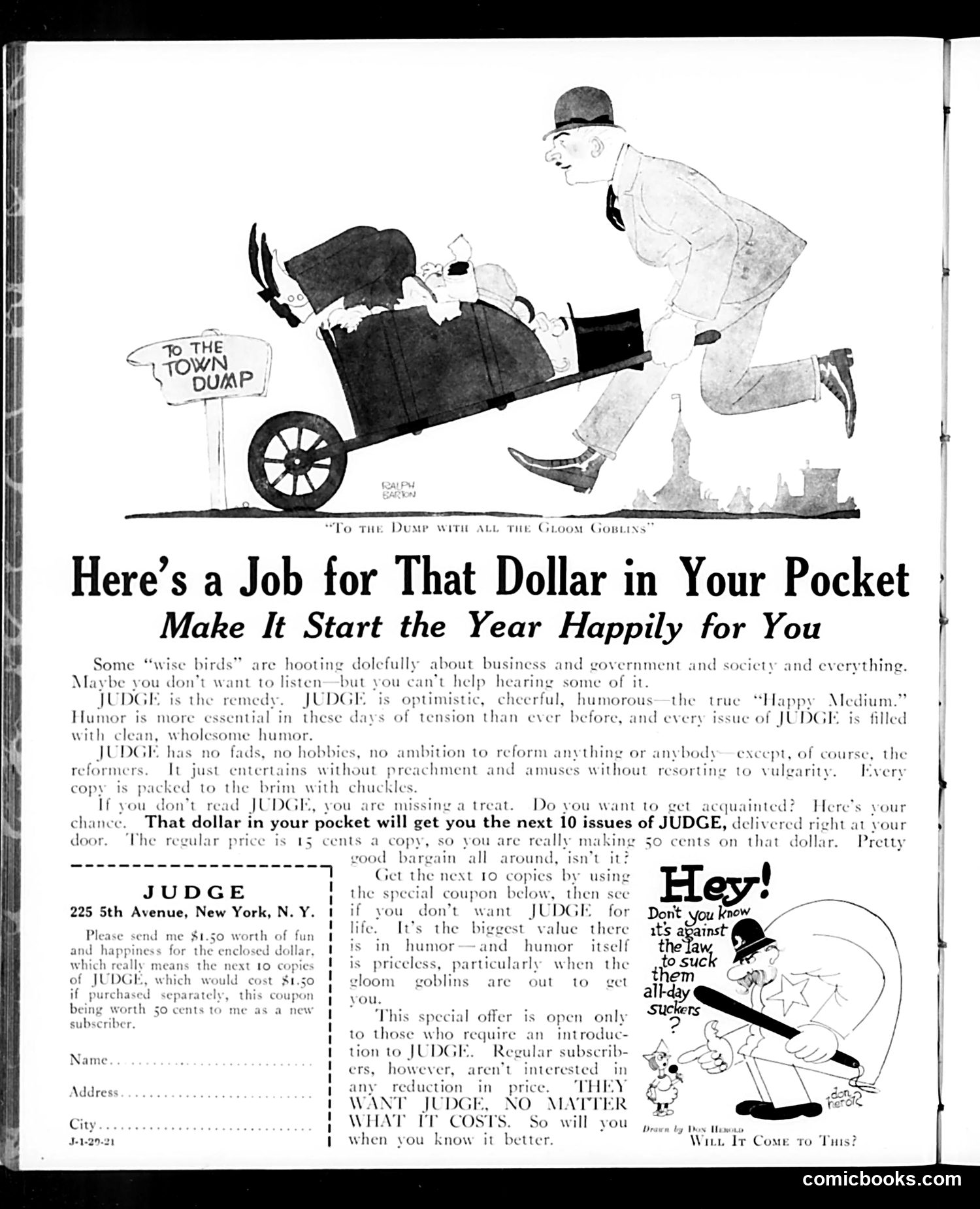
This page is primarily **advertising for Judge magazine itself**, using satire to promote subscriptions. The main cartoon shows a man dumping garbage labeled "To the Town Dump" while fleeing, captioned "To the Dump with All the Gloom Goblins." This visual pun illustrates Judge's stated editorial philosophy: the magazine offers **humor as an antidote to contemporary anxieties** about "business and government and society." The advertisement emphasizes Judge as an "optimistic, cheerful, humorous" publication—what it calls the "Happy Medium"—positioned against the gloom and tension of the era (likely 1920s-30s). The offer of 10 issues for one dollar was meant to introduce new readers to this escapist humor. The secondary cartoon (right) reinforces the anti-gloom message with crude humor about "suckers" and daily misery, again promoting laughter as remedy.
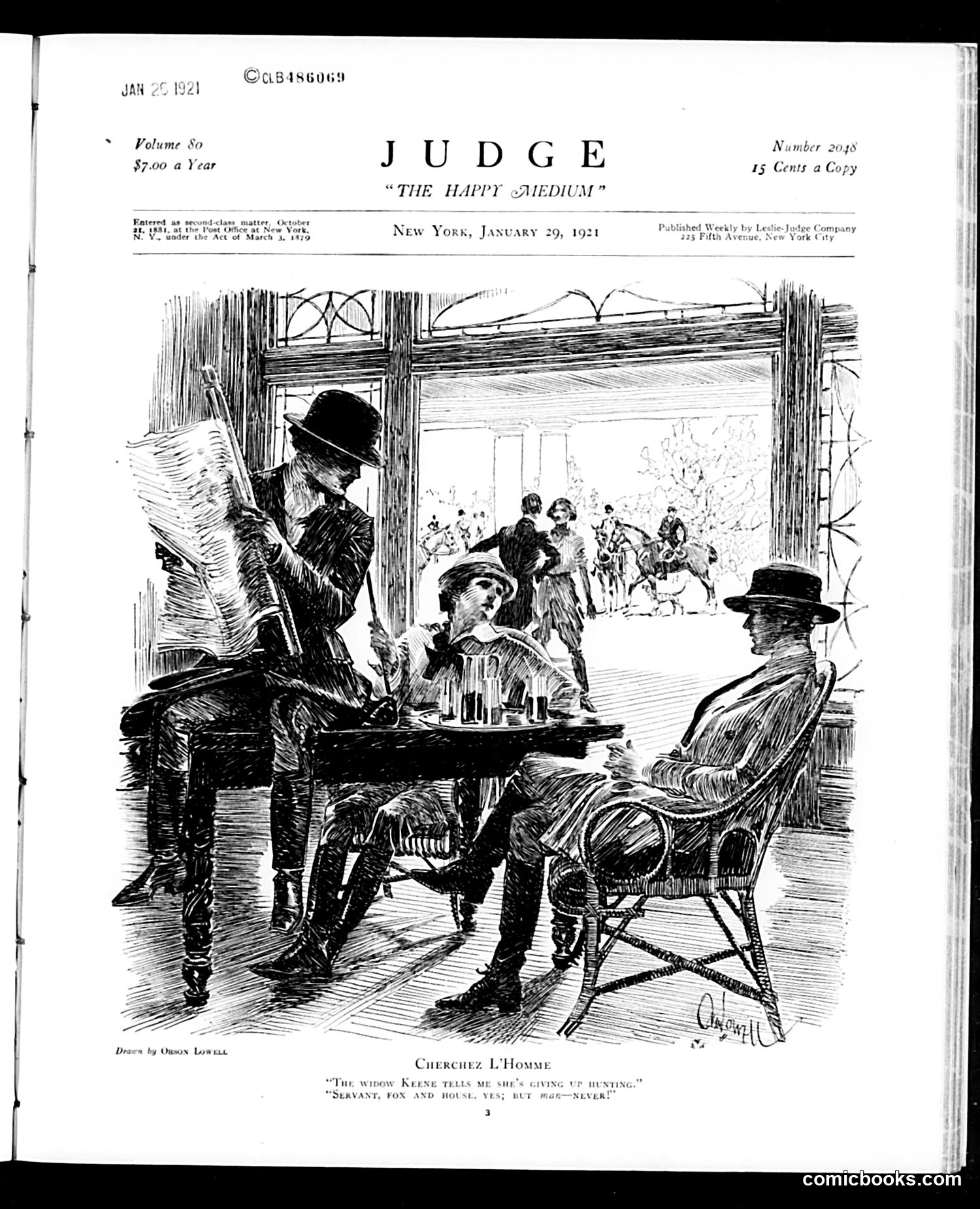
This satirical cartoon, titled "Chez L'Homme" (At the Man's Place), depicts three men in what appears to be a gentleman's club or similar establishment. One man stands holding a newspaper while speaking to two seated men. The caption reads: "The widow Keene tells me she's giving up hunting. 'Servant, fox and house, yes; but man—NEVER!'" The joke plays on the double meaning of "hunting"—both literal fox hunting (a traditional aristocratic sport) and romantic pursuit. The widow apparently will abandon all conventional pursuits except hunting for husbands. This reflects post-WWI social commentary about women's changing roles and independence, presented through the lens of high-society gossip and masculine banter typical of Judge's satirical approach to contemporary social dynamics.
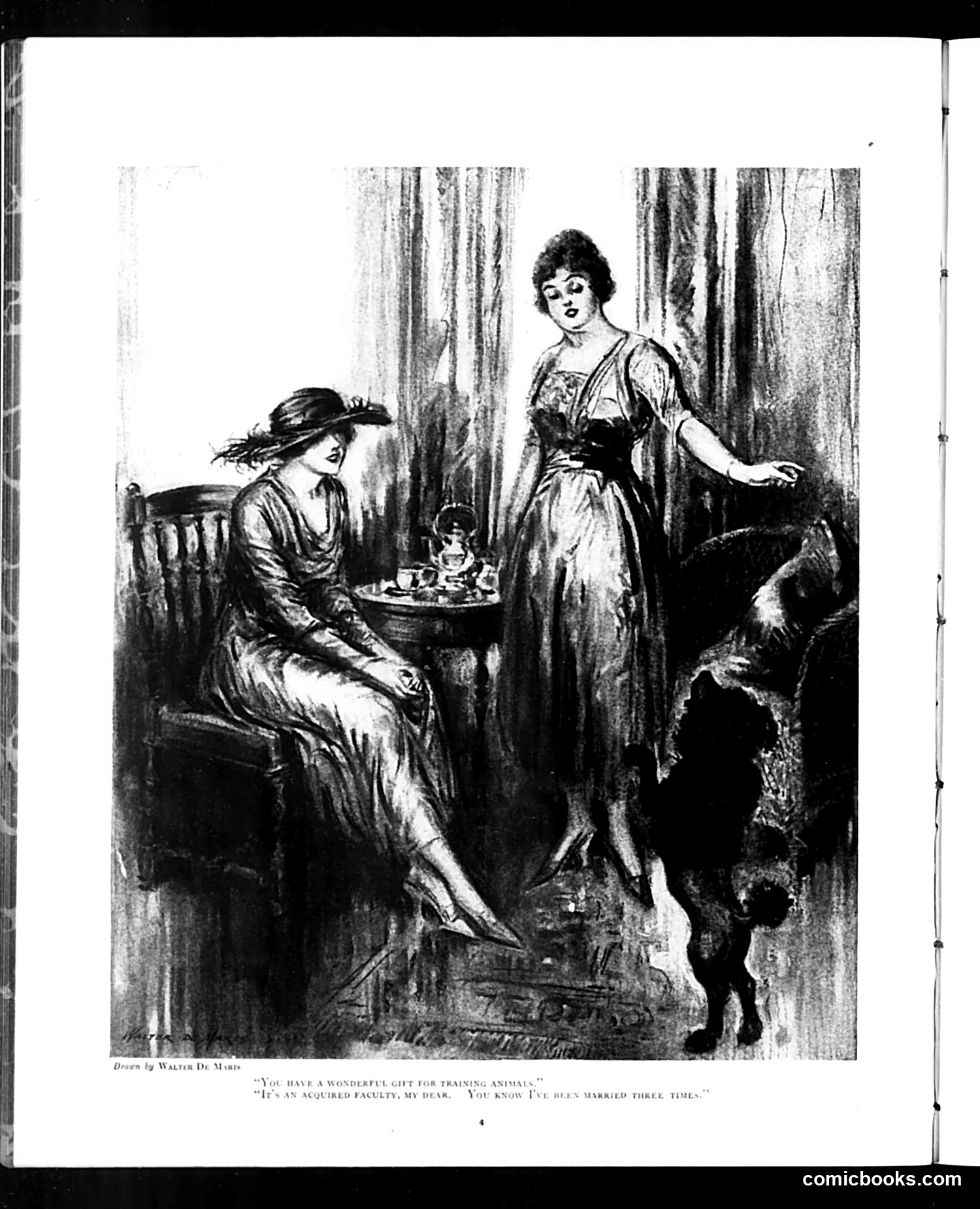
This illustration by Walter De Maris depicts a domestic scene between two women and a small dog. The seated woman wears a fashionable hat typical of the early 20th century, while the standing woman displays elegant period dress. The dialogue reveals the satire's target: the standing woman boasts of her talent for "training animals," claiming it's "an acquired faculty" developed through three marriages. The joke hinges on a crude comparison—she's suggesting her multiple husbands were "animals" requiring training, thereby mocking both matrimonial friction and women's domestic authority. This reflects contemporary attitudes about marriage and gender roles, using animal-training as metaphorical commentary on spousal management. The humor relies on assumptions about marital conflict being normative and subject to female manipulation.
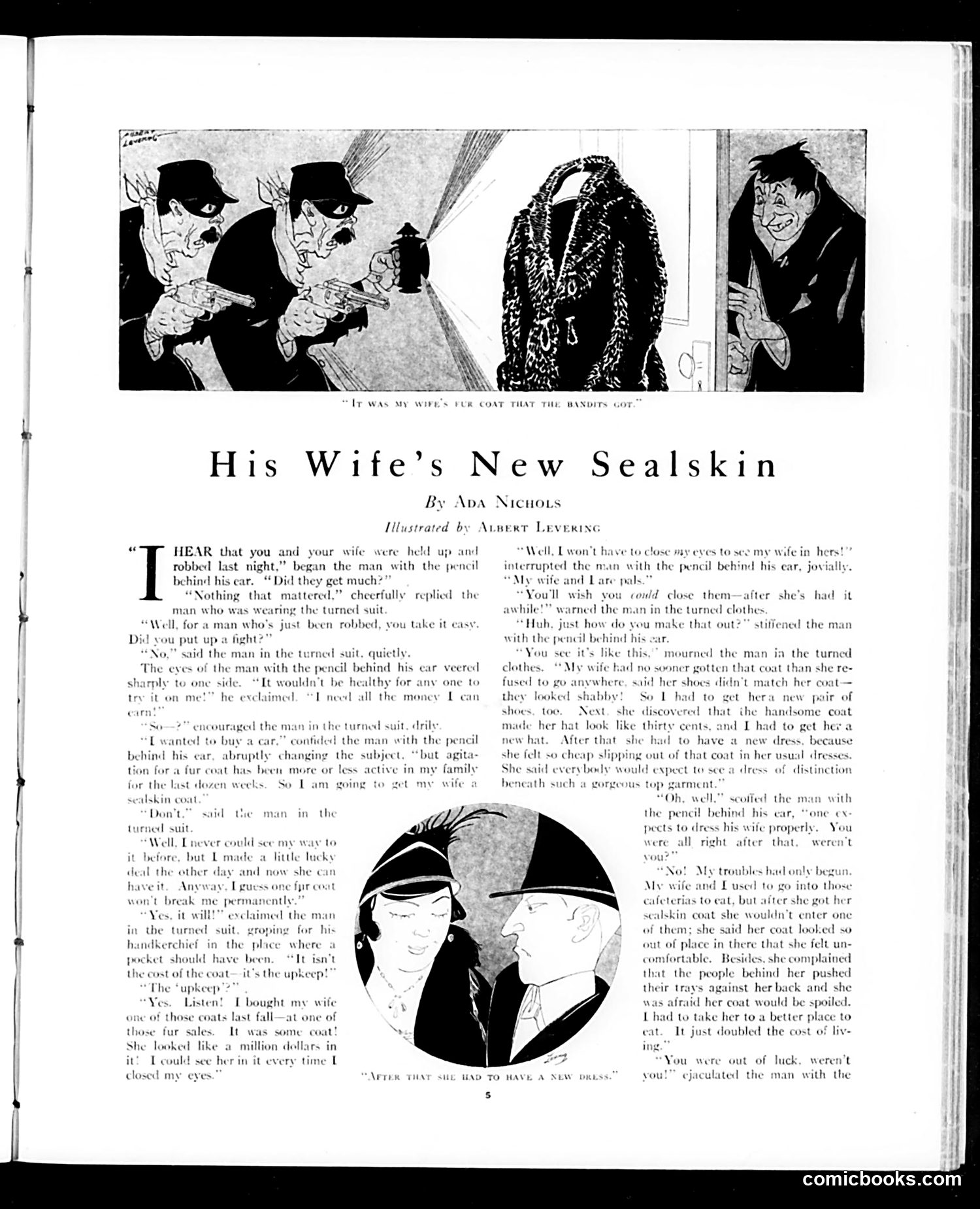
This is a humor story by Ada Nichols about a husband and wife robbed at gunpoint. The joke centers on consumer excess and marital tension during what appears to be the early 20th century. The husband complains about financial losses from the robbery, but the wife's primary concern is her stolen fur coat. The story's punchline reveals her real problem: the sealskin coat made her look wealthy and attractive—she's now distressed because replacing it will be expensive and she can't afford an equally glamorous replacement. The satire targets materialism and vanity, particularly women's obsession with luxury goods like expensive furs as status symbols. The cartoons illustrate the wife's dismay at losing her prized possession, mocking both consumer culture and the apparent priorities of wealthy society women.
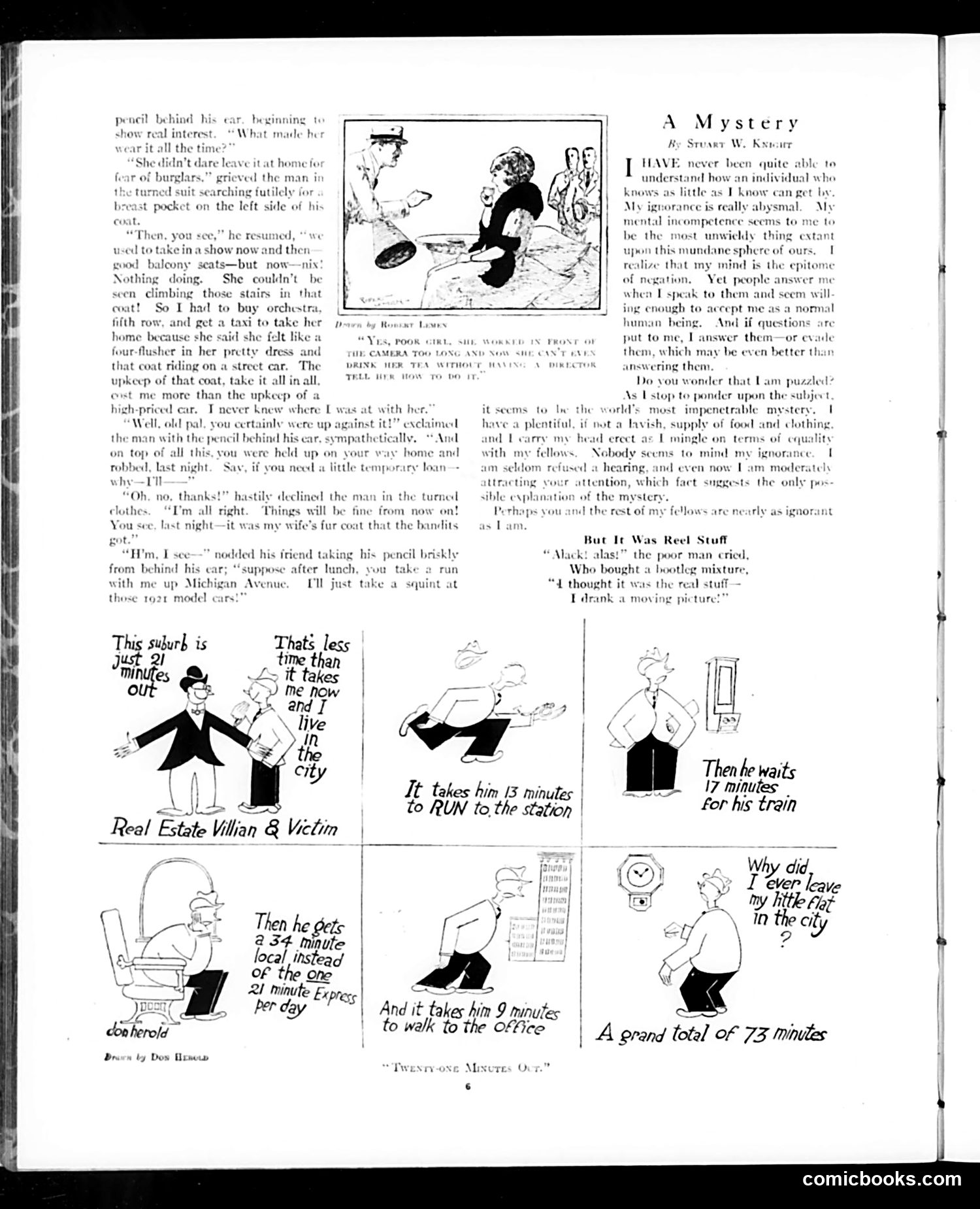
This page contains two distinct pieces: **"A Mystery"** (top): A short story by Stuart W. Knight about a socially awkward, mentally incompetent man who struggles to interact with others. The narrative explores his isolation and self-awareness of his inadequacy—essentially a character study of social dysfunction. **"Twenty-One Minutes O.F."** (bottom): A comic diagram satirizing urban commuting inefficiency. A man spends 73 minutes total traveling to his office job—21 minutes by train, 17 minutes waiting, 9 minutes walking, plus time at home and in a local café. The satire critiques the absurdity of modern commuter life: all this time invested to reach an office job, leaving him questioning why he even bothers keeping a city apartment. The joke highlights the paradox of metropolitan living's time-consuming inconvenience.
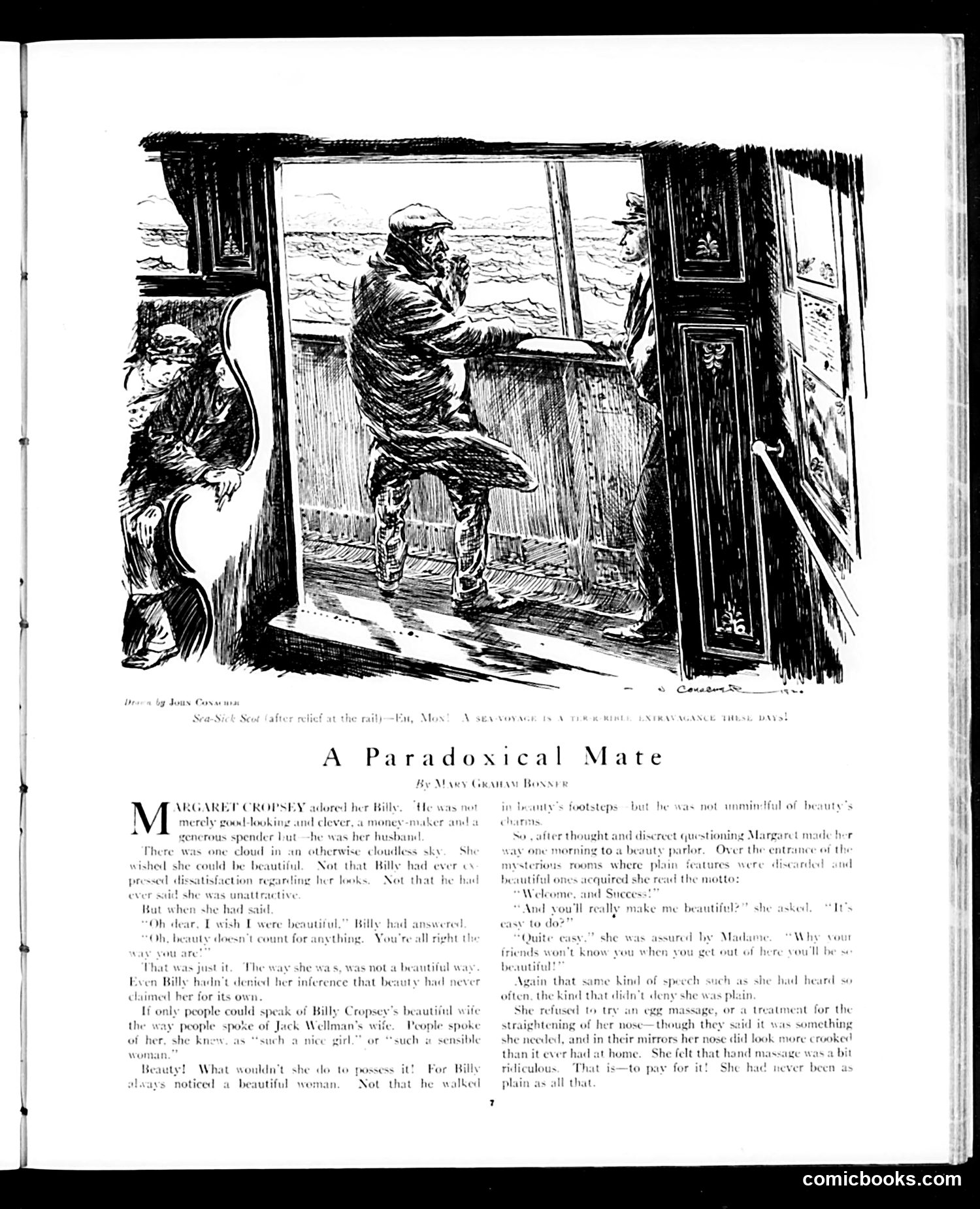
This is a short story illustration, not political satire. The cartoon depicts a scene from Mary Grannan Bonner's fiction about Margaret Cropsey, who is dissatisfied with her appearance despite being married to Billy, a good man who loves her. The satire targets **women's insecurity about beauty** and the cosmetics/beauty industry. Margaret visits a beauty parlor with a motto promising transformation ("Welcome and Success!"), seeking treatments and massages to improve her looks. The story mocks how women pursue expensive, ineffective beauty treatments despite having loving husbands who don't care about their appearance. The joke is the irony: Margaret has what matters—a devoted spouse—yet pursues beauty industry promises that waste money and effort on "plain as all that" reality. This reflects early 20th-century anxiety about female vanity and emerging beauty commerce targeting women's insecurities.
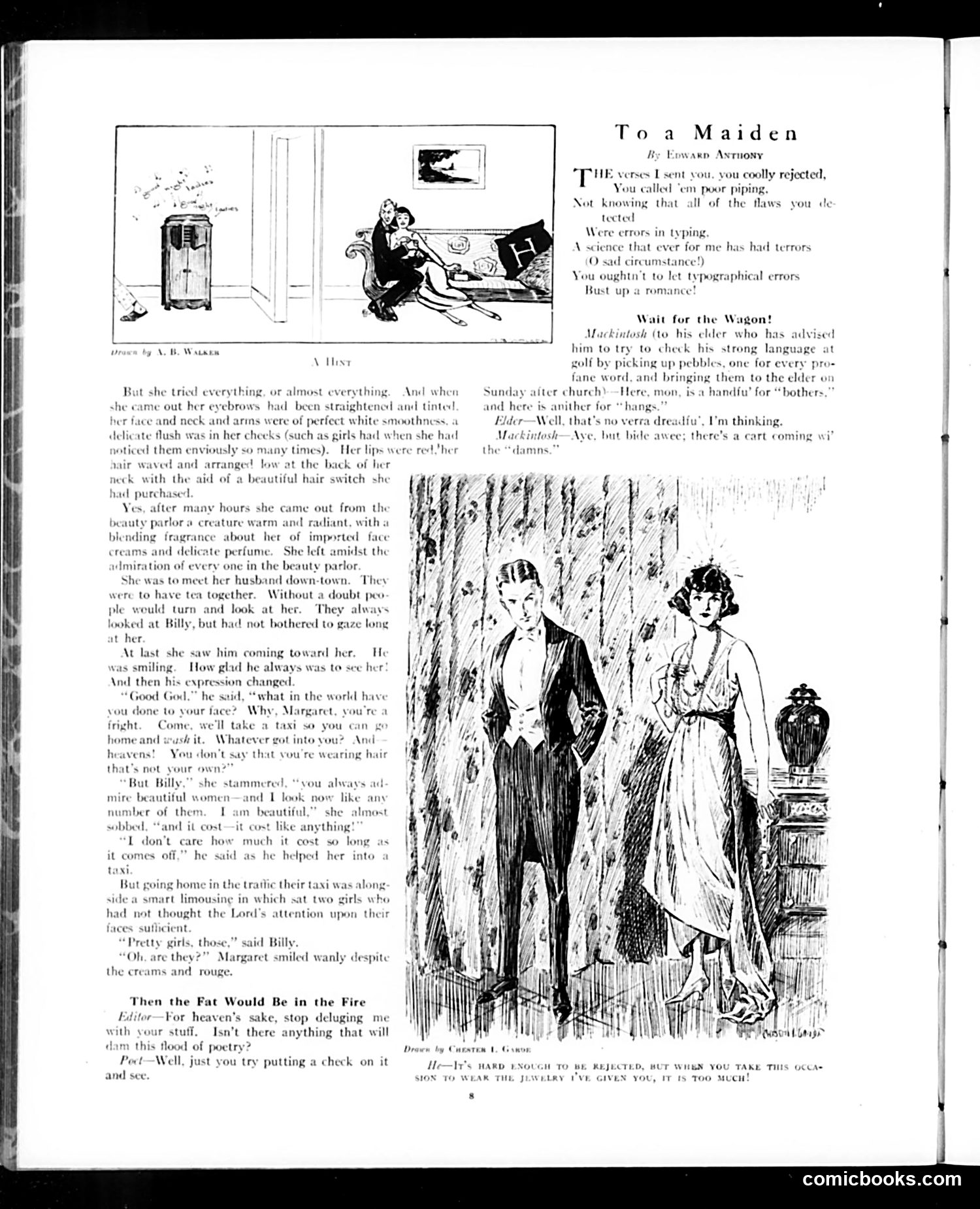
This page contains three separate humor pieces: **"To a Maiden"** (poem): A poet blames his rejected verses on typographical errors rather than poor quality—a self-deprecating joke about artistic rejection and ego protection. **"Wait for the Wagon!"** (cartoon strip): Shows a golfer (Mackintosh) advised to collect pebbles for each profanity uttered on the golf course as self-discipline. The humor derives from the implicit suggestion he'd accumulate too many pebbles—mocking men's notoriously foul language while golfing, a popular leisure activity for the wealthy. **"Then the Fat Would Be in the Fire"** (dialogue): An editor and poet banter about submitting unsolicited poetry—the poet claiming he cannot stop writing, while the editor demands he stop the "flood." The cartoons satirize contemporary social behaviors: artistic vanity, gentlemen's golf etiquette expectations, and the persistence of amateur poets—all likely recognizable to early-20th-century Judge readers familiar with these social circles.
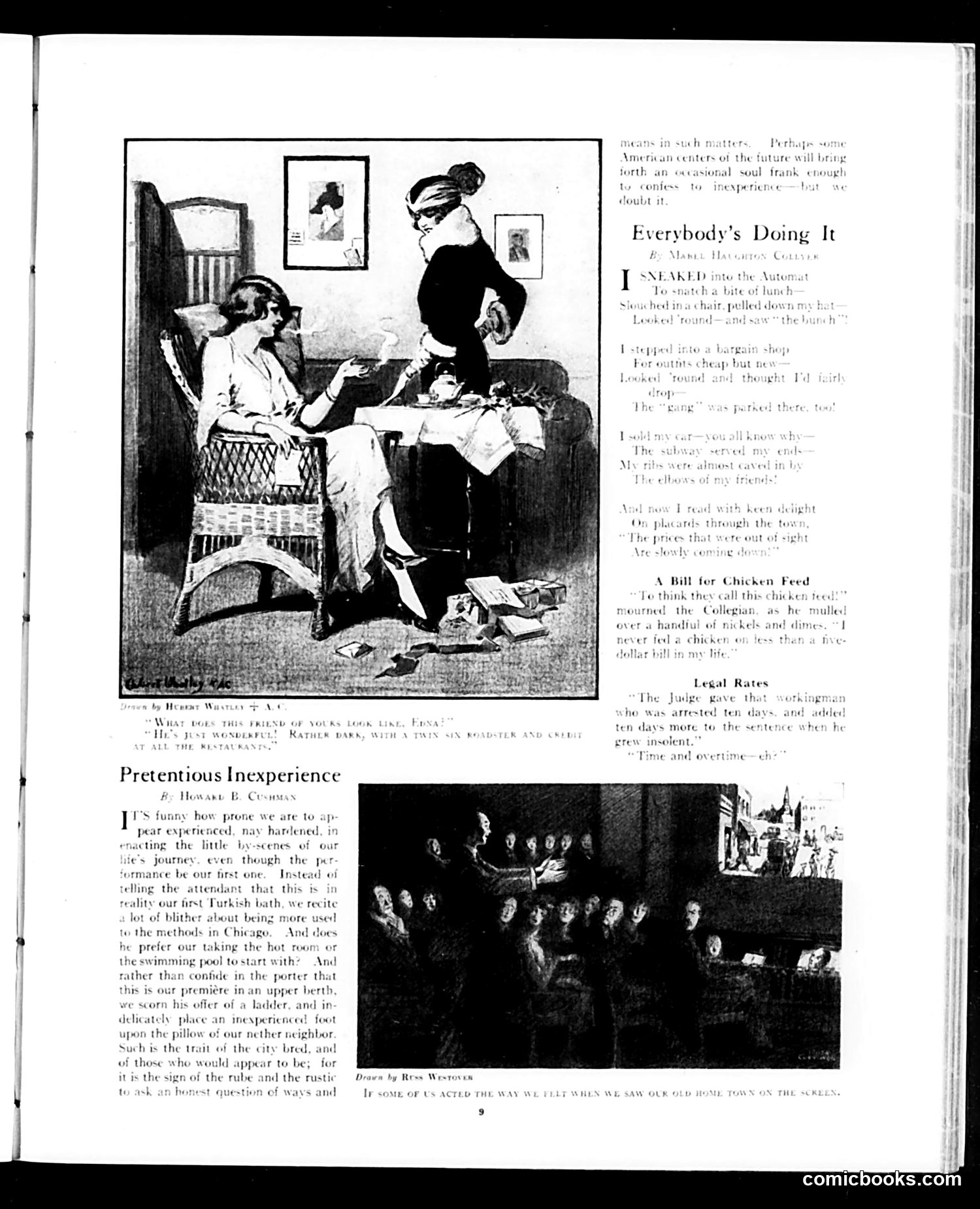
This page from *Judge* magazine contains three separate humorous pieces satirizing early 20th-century American social anxieties: **"Everybody's Doing It"** mocks people who mindlessly adopt fashionable behaviors—the illustration shows a woman enthusiastically recounting trendy activities she's copied from others, appearing shallow and unoriginal. **"A Bill for Chicken Feed"** satirizes inflation and rising costs of living, with a character shocked at escalating prices for basic necessities—a complaint about economic hardship. **"Pretentious Inexperience"** critiques urban middle-class affectation, where people pretend sophistication they lack during travel or unfamiliar situations (Turkish baths, upper berth trains), revealing their actual inexperience and rustic origins. The accompanying illustration appears to show a movie theater scene, likely reinforcing themes of people imitating behaviors they've seen on screen. The satire targets middle-class pretension and economic anxiety of the era.
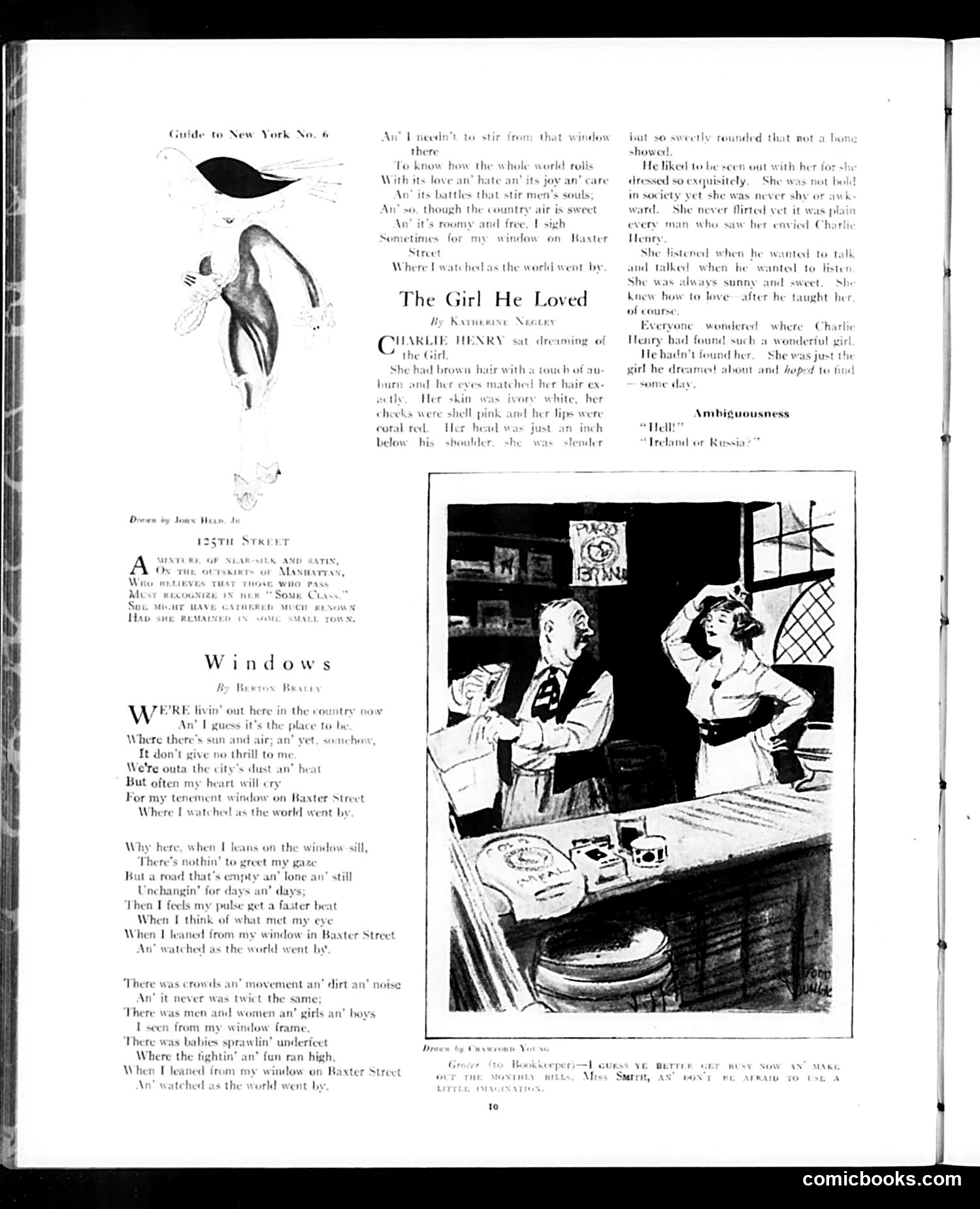
This page contains three literary pieces rather than political cartoons: 1. **"The Girl He Loved"** by Katherine Newlin—a romantic short story about Charlie Henry's idealized vision of a woman with specific physical attributes (brown hair, ivory skin, coral lips). The narrative suggests he hasn't actually found her yet, only dreams of doing so. 2. **"Windows"** by Berton Braley—a nostalgic poem contrasting urban tenement life on Baxter Street (crowded, noisy, full of movement) with the speaker's current country living, expressing longing for the vitality of city observation despite preferring rural peace. 3. **"125th Street"** (brief)—appears to describe Manhattan locations. The accompanying illustration shows a domestic scene with three figures in what appears to be a 1920s kitchen. The bottom cartoon snippet titled **"Ambiguousness"** presents a humorous two-line exchange: "Hell!" / "Ireland or Russia?"—likely satirizing post-WWI confusion or American uncertainty about European geopolitics, though context is limited. This appears to be early 20th-century light fiction and humor rather than hard political satire.
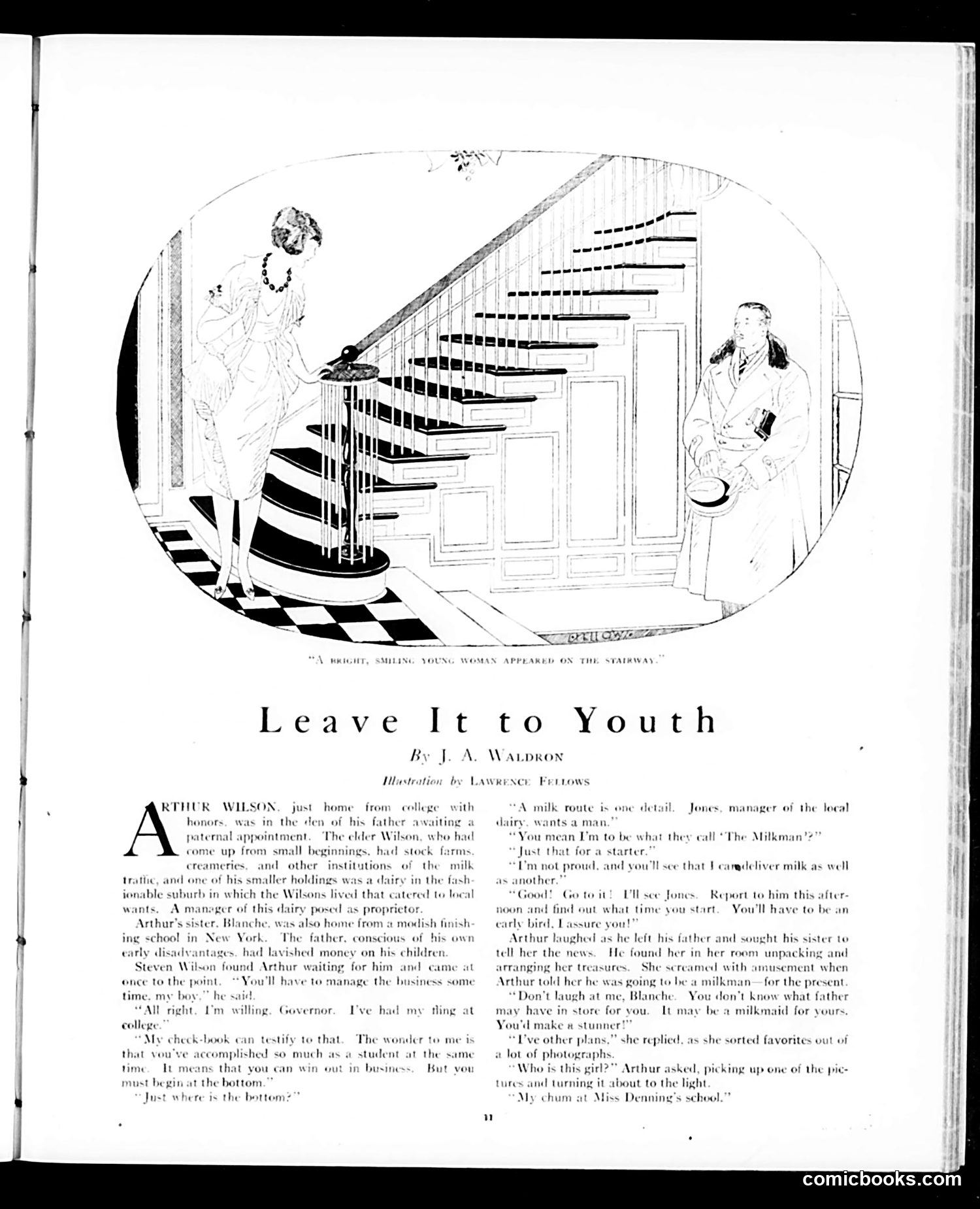
This is the opening of a short story rather than a political cartoon. The narrative follows Arthur Wilson, a college graduate from a wealthy family (his father built a business empire from "small beginnings"), who must start at the bottom working as a milkman for his father's dairy operation in an upscale suburb. The satire targets early 20th-century class anxieties and generational attitudes. Arthur's father, a self-made businessman, believes his privileged children need humbling through actual work. Arthur accepts this "character-building" assignment with some reluctance, while his sister Blanche finds amusement in his temporary descent into manual labor. The humor lies in the contrast between Arthur's educated status and his mundane new job—a common narrative device exploring whether wealthy youth could appreciate honest work and develop work ethic. The illustration shows the moment he accepts this assignment, capturing the clash between gentleman (right, observing) and laborer (left, on the stairs).
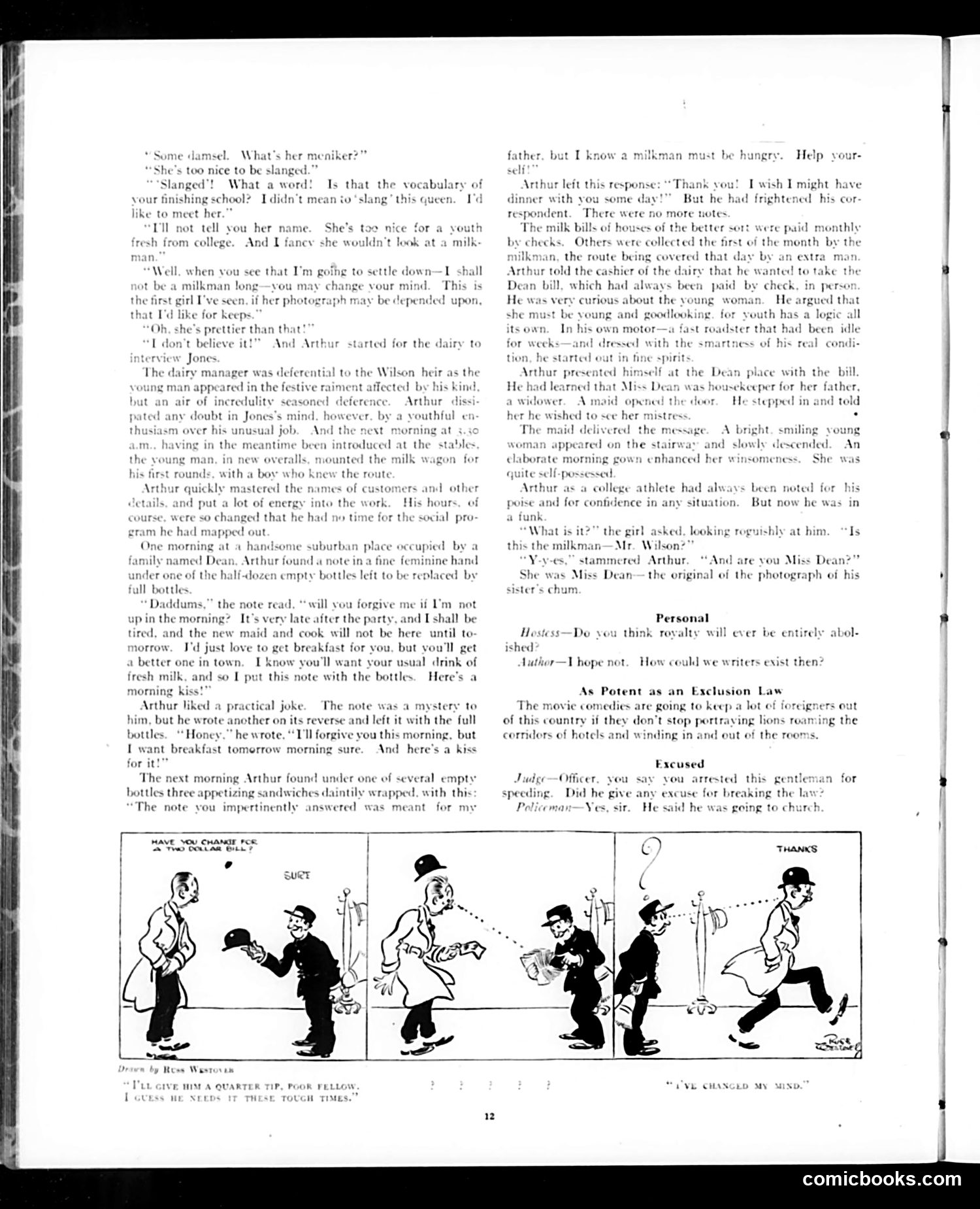
This page contains a short story about a milkman named Arthur Wilson and a comic strip below it. **The Story**: Arthur, a milkman, falls for Miss Dean, the young housekeeper at a wealthy family's home. He presents himself at her employer's house with a bill, hoping to impress her. The narrative plays on class dynamics—Arthur is self-conscious about his working-class status as a milkman, yet presents himself with unwarranted confidence. Miss Dean, however, is revealed to be the original subject of a photograph her employer possesses, suggesting she's actually from a higher social position than Arthur realizes. The satire mocks Arthur's social presumptions and working-class aspirations. **The Comic Strip** (bottom): Shows a man repeatedly offering money or assistance to another figure who keeps rejecting it with increasingly exaggerated responses, captioned "I'll give him a quarter tip, poor fellow. I guess he needs it these tough times" and ending with "I've changed my mind." It satirizes condescension and false charity. Both pieces reflect early 20th-century anxieties about class, social mobility, and pretension.
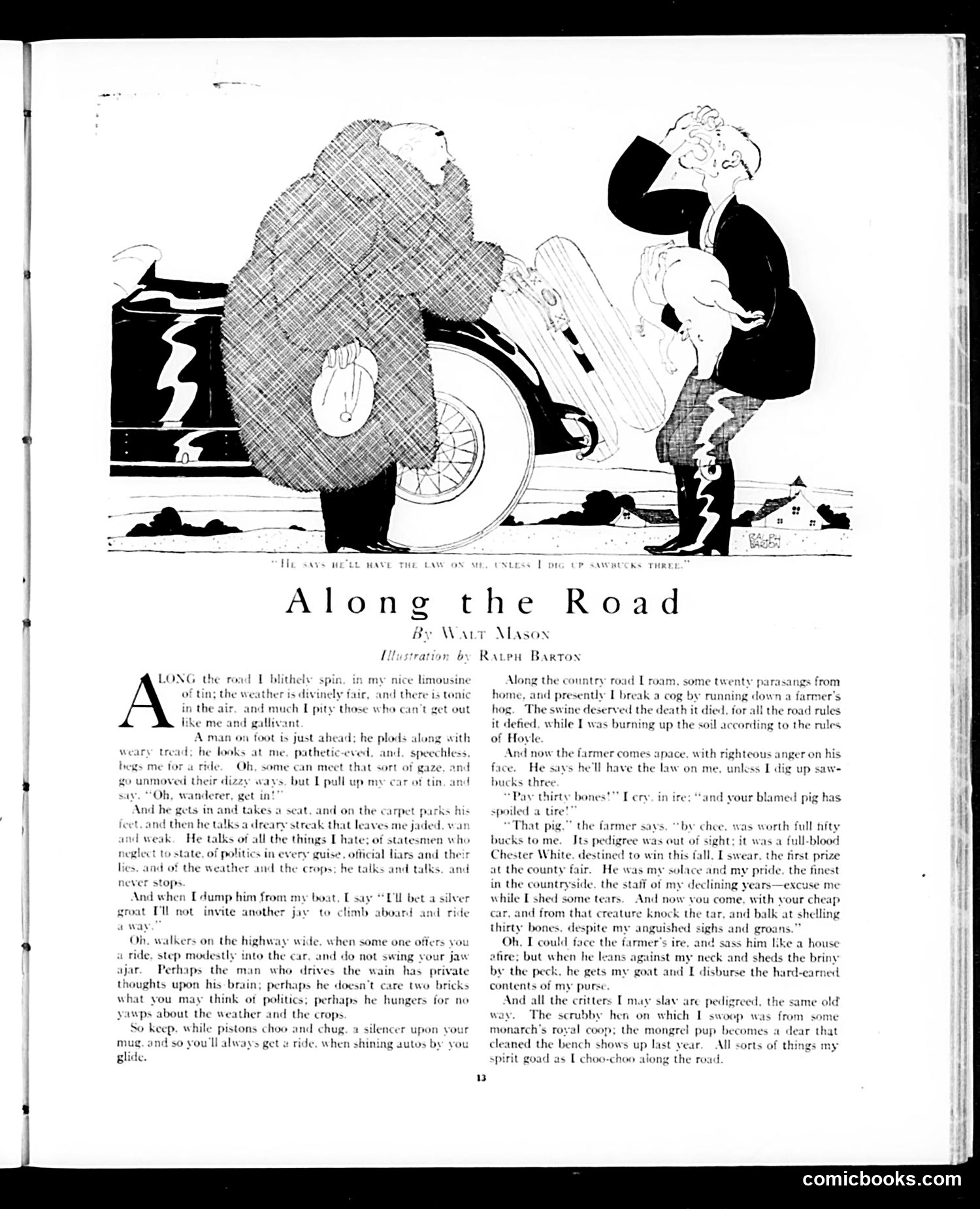
This is a humorous story illustrated by Ralph Barton about automobile etiquette and rural encounters. The narrative follows a motorist who encounters two problems: **First scenario**: A pedestrian accepts a ride but annoys the driver with endless complaining about politicians, weather, and crops. The moral: hitchhikers should remain silent. **Second scenario**: The motorist hits and kills a farmer's prized pig. When the farmer arrives demanding compensation ("thirty bones"—slang for dollars), he emotionally appeals to the driver by describing the pig's pedigree and value. The driver, moved by the farmer's tears and guilt, pays up despite the pig's fault. The satire mocks both bad manners (the talkative hitchhiker) and the farmer's manipulation through sentimentality. The title illustration shows the confrontation between the motorist and angry farmer with the damaged vehicle. The piece reflects early 20th-century attitudes toward automobiles as luxury items and rural-urban class tensions.
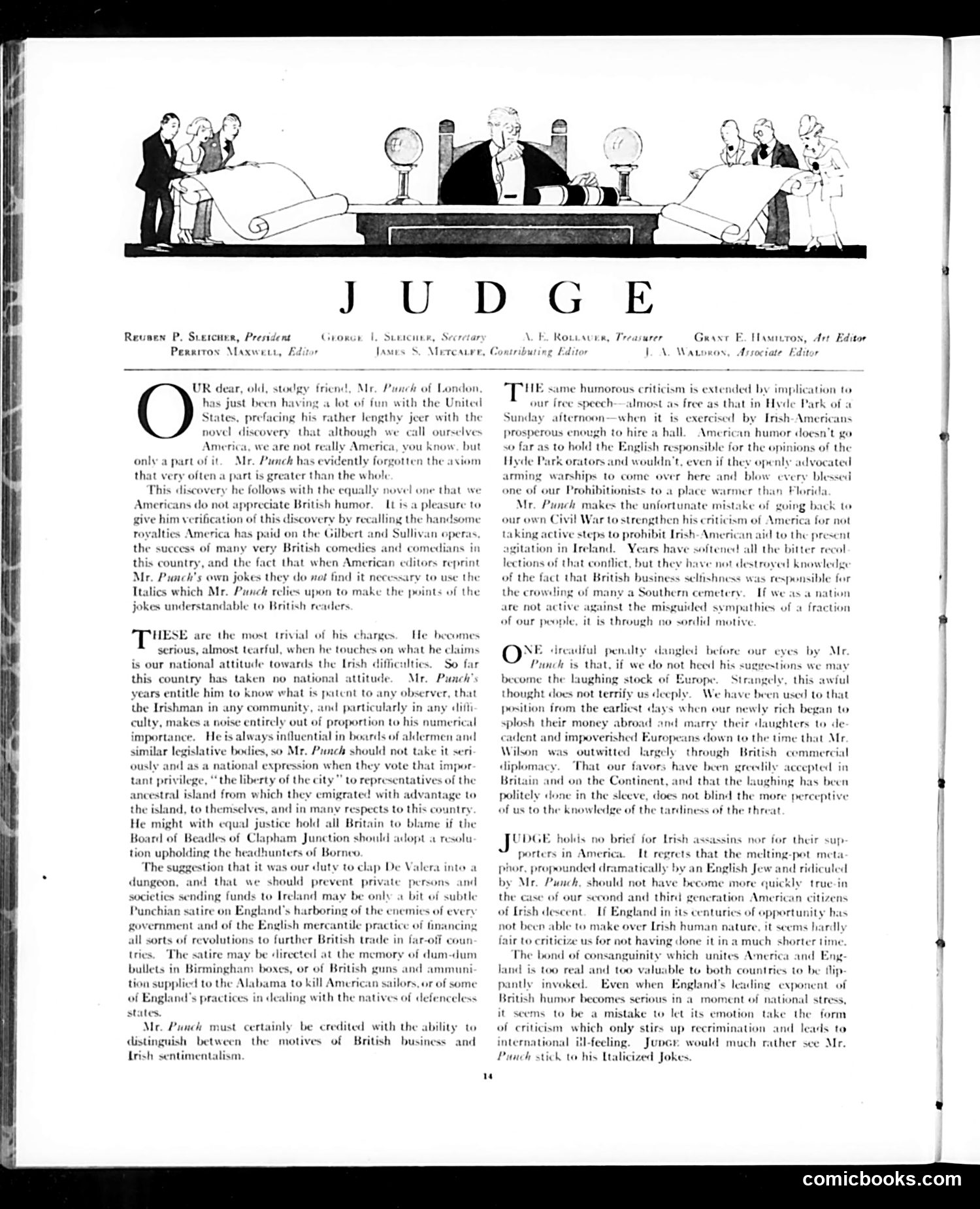
This is an editorial response in *Judge* magazine (American) defending the United States against criticism from *Punch* magazine (British). The illustration shows a judge presiding over a courtroom debate between the two publications. **The Dispute:** British *Punch* had criticized America for: (1) not truly being "America" but only part of it; (2) not appreciating British humor; (3) not taking a national stance against Irish independence activism. **Judge's Counterargument:** - Americans *do* appreciate British humor (citing Gilbert & Sullivan's financial success) - Irish-Americans' political influence reflects normal democratic participation, not national policy - America shouldn't be blamed for private citizens funding Irish causes any more than Britain should be blamed for extremist actions by its own groups - Invoking the Civil War, Judge suggests British hypocrisy about internal conflicts **The Satire:** Judge mocks *Punch's* pretension while defending American free speech and democratic principles against British moralizing.
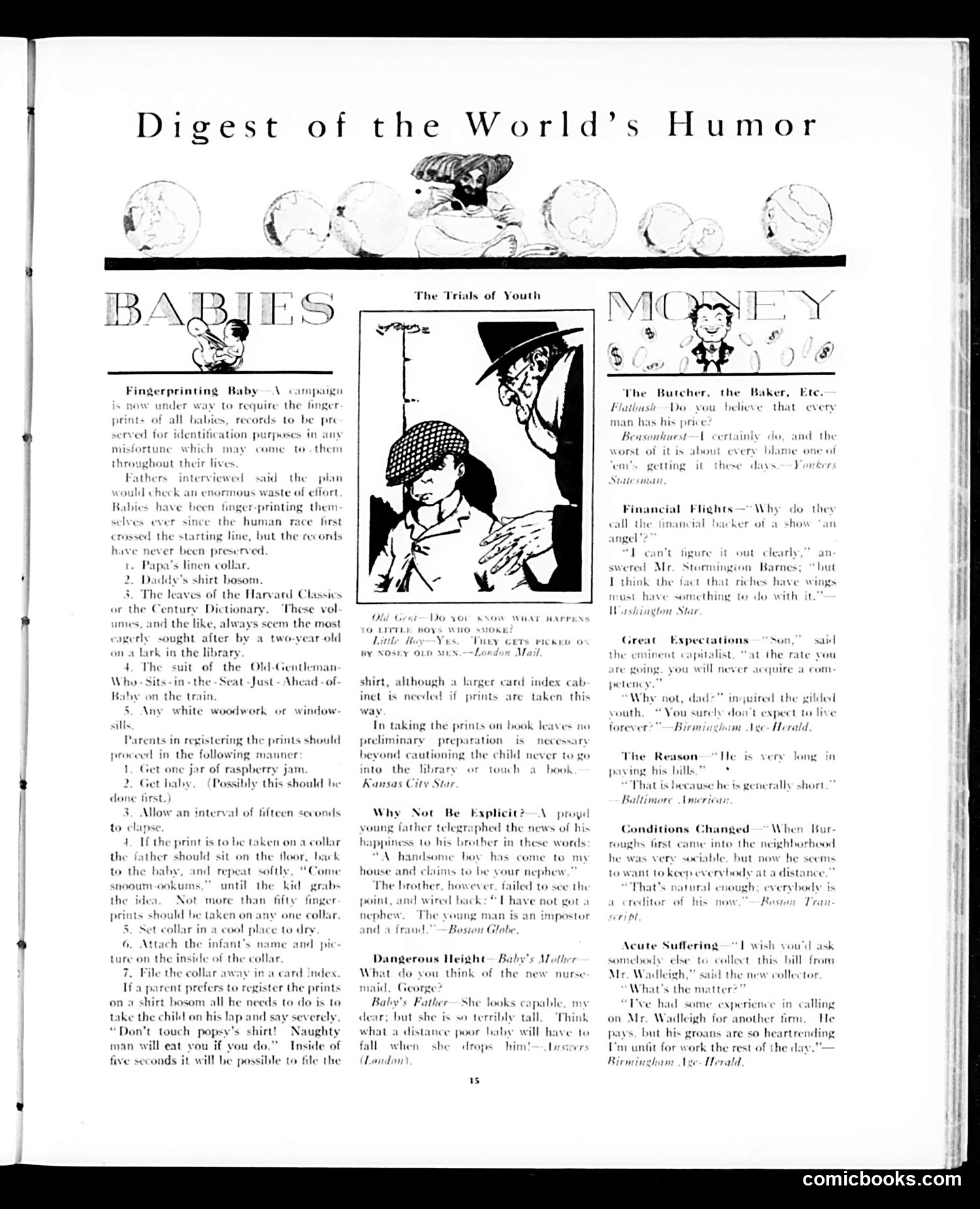
This page collects brief humorous anecdotes and jokes organized into three columns: "Babies," "The Trials of Youth," and "Money." The **"Babies" section** satirizes a real campaign to fingerprint infants for identification records. The joke mocks the impracticality: it provides absurdly detailed instructions for parents to obtain baby fingerprints using raspberry jam and household items, poking fun at both the bureaucratic scheme and parental incompetence. The **"Trials of Youth"** section contains short quips about young men—including one about a father's confusing telegram announcing a baby, and another about a nurse's excessive height posing danger to infants. The **"Money" column** offers jokes about financial matters: wealthy men claiming everyone has a price, a capitalist lecturing a youth about acquiring wealth, and a running gag about a chronic debtor (Mr. Wadleigh) whose bill-collection is so emotionally exhausting that the collector becomes unfit for work. These are typical turn-of-the-century satirical observations on contemporary social anxieties: bureaucracy, class pretension, and financial anxiety.
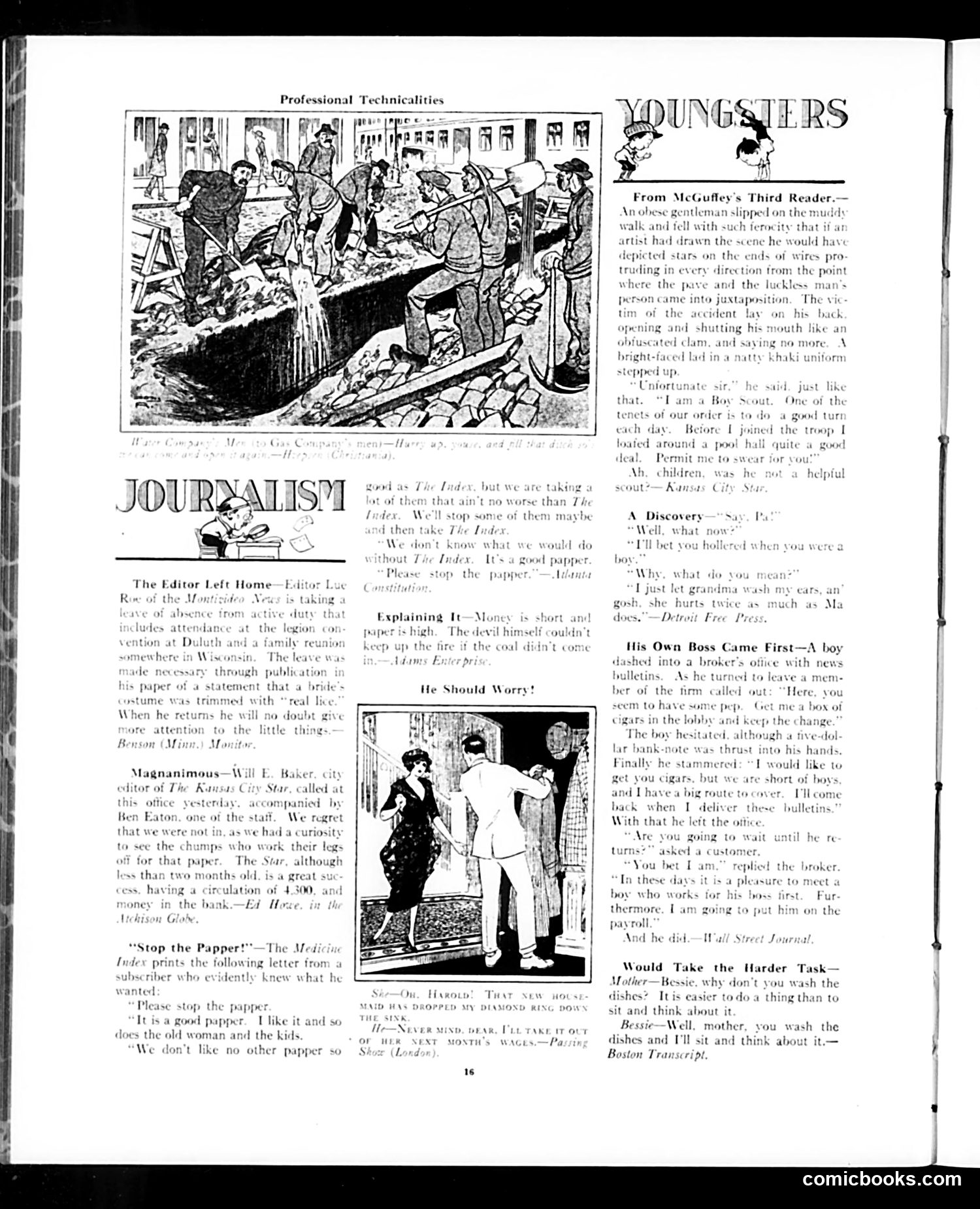
This page contains several brief humorous anecdotes satirizing American social types and workplace dynamics of the era. **"Magnanimous"** mocks a Kansas newspaper editor's self-importance—he visits a rival publication expecting special treatment, then patronizingly praises their paper while insulting it by comparison to his own. **"He Should Worry!"** and related vignettes appear to satirize working-class attitudes. One depicts a Boy Scout helping an accident victim, another shows a boy reluctant to take a bribe at his broker employer's office (satirizing low business ethics), and a third humorously portrays a young delivery boy negotiating a route. **"Would Take the Harder Task"** is a joke about a lazy child (Bessie) who refuses to wash dishes because *thinking* about chores is harder than doing them—satire of youthful logic and avoidance. The large illustration (top) depicts street chaos, likely illustrating one of these anecdotes, though the specific reference is unclear. Overall, the page targets workplace pretension, youthful irresponsibility, and social climbing—typical Judge satire themes.
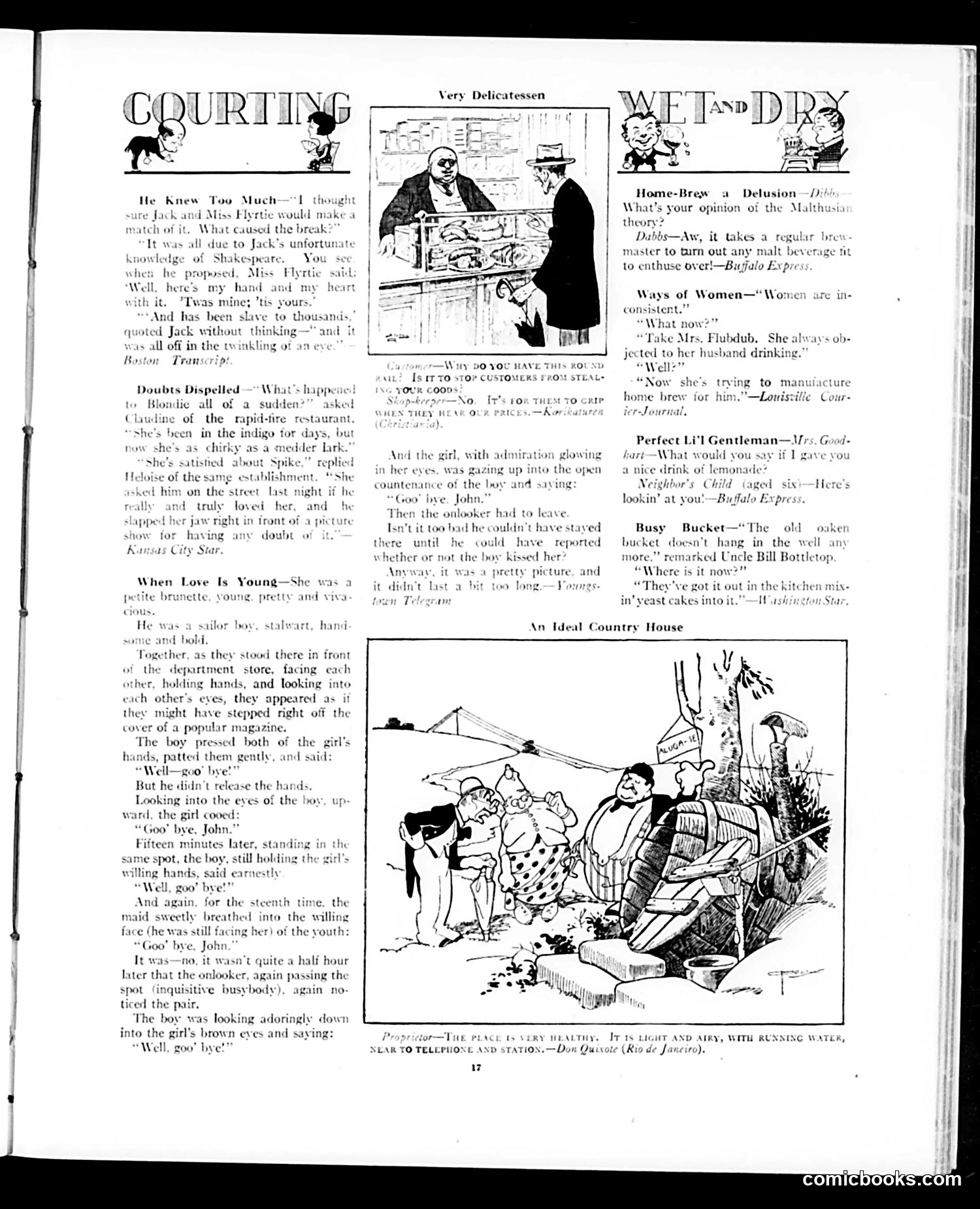
This page from *Judge* magazine contains humor pieces satirizing Prohibition-era America. The main cartoons mock: **"Home-Brew a Delusion"** – A play on economic theory, where "Dabbs" dismisses Malthusian population arguments by claiming only professional brewmasters can make decent malt beverages worth drinking. The joke targets Prohibition's unintended consequence: amateur home-brewing replacing commercial beer. **"Ways of Women"** – Mrs. Flubdub previously objected to her husband's drinking but now manufactures home brew herself—satirizing the hypocrisy and role reversals Prohibition created. **"Busy Bucket"** – References the old-fashioned well-bucket, now repurposed for storing home-brew yeast cakes, humorously showing how Prohibition infiltrated domestic life. The lighter pieces like "When Love Is Young" provide non-political humor about courtship. Overall, the page reflects *Judge*'s satirical stance on Prohibition's failure and the widespread home-brewing culture it spawned.
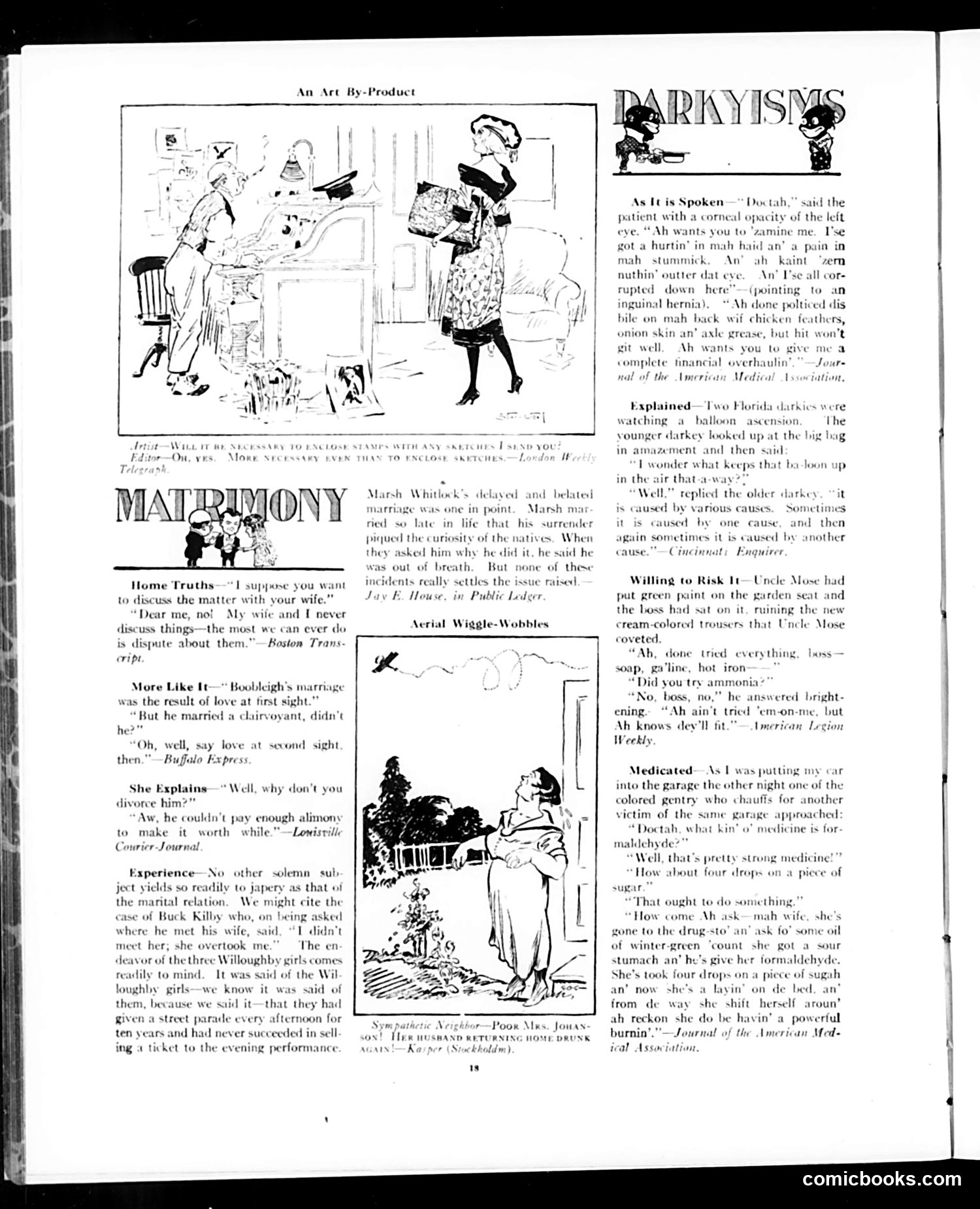
This page from Judge contains several short humorous anecdotes satirizing American social life, primarily focused on **racial stereotypes and marital discord** — both popular Judge topics of the era. The main cartoons feature **exaggerated dialect humor** portraying African American characters ("darkies," "colored gentry") in subservient or comedic situations. One depicts a patient with a heavy Southern accent describing ailments to a doctor; another shows two men discussing a balloon's flight using absurdly circular logic. The **matrimony section** mocks marriage itself through brief jokes: marriages resulting from "love at second sight," wives being financial burdens, and the inevitability of marital dispute. One anecdote suggests a character married so late in life it confused locals. The satire targets **middle-class anxieties** about marriage, medical care, and the "servant problem" of hiring domestic help. The racial humor reflects Judge's assumption that readers found exaggerated dialect and stereotypical depictions of Black Americans entertaining. This reflects early 20th-century American magazine humor standards, now widely recognized as offensive.
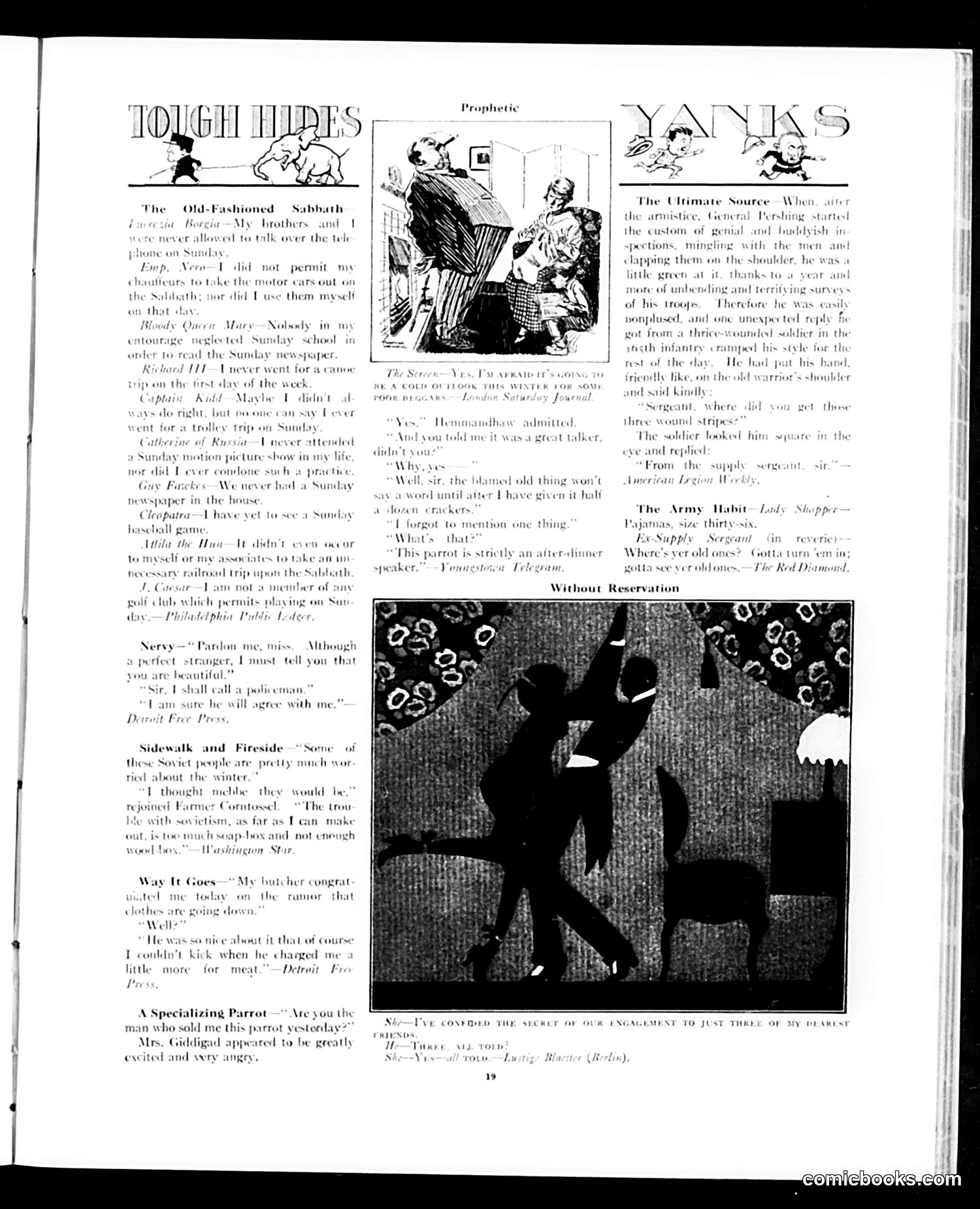
This page contains humorous anecdotes mocking religious hypocrisy regarding Sabbath observance. The "Tough Tides" section features various people claiming their families historically observed strict Sunday rules—no phones, no cars, no entertainment. The joke is that these claims appear fabricated or exaggerated, suggesting readers shouldn't trust such self-righteous posturing. The "Prophetic" cartoon depicts someone sneezing, captioned as foretelling a cold, playing on superstitious beliefs about omens. "Without Reservation" shows a domestic scene where someone reveals an engagement secret to three friends, with the ironic caption suggesting such "secrets" aren't actually kept private—social gossip undermines confidentiality. Other brief items mock awkward social encounters, price-gouging butchers, and a parrot that won't talk. The overall tone satirizes American pretension, dishonesty, and social awkwardness in early 20th-century life. The magazine appears to be from the 1920s-30s era based on style and references.
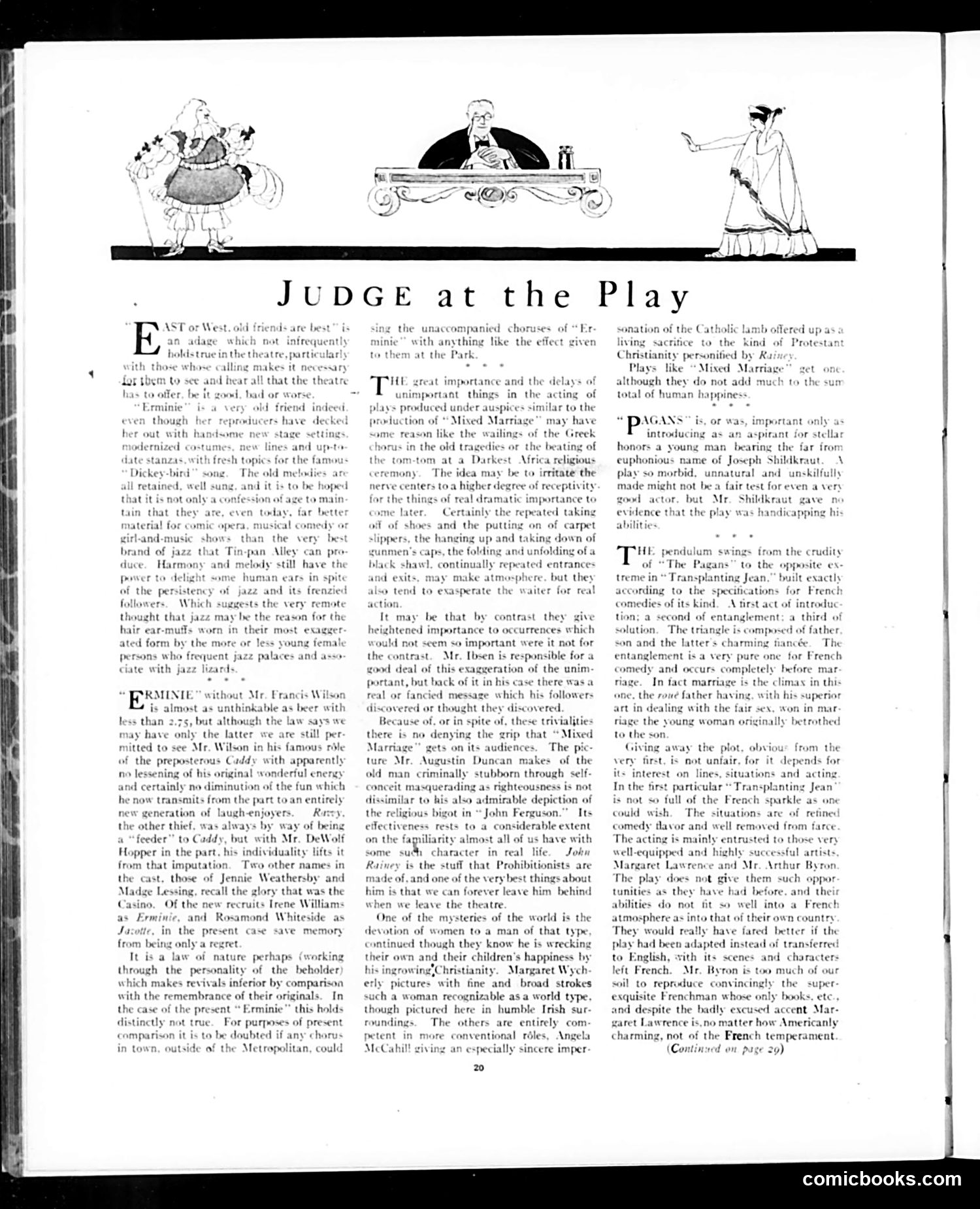
This theater review page critiques several Broadway productions. The header illustration shows three figures: a portly man in theatrical costume, a judge at a desk, and a woman in classical robes—representing different theatrical styles or eras. The main review discusses "Mixed Marriage," praising its emotional grip on audiences despite its reliance on repetitive, exaggerated staging elements (hanging garments, entering/exiting characters). The critic credits actor Augustin Duncan's performance. Secondary reviews mention "Pagans" (criticized as crude and exploitative) and "Transplanting Jean" (structured too formulaically as French comedies). The piece praises Francis Wilson's return in the "preposterous" comedy "Erminie," suggesting nostalgia for lighter theatrical fare over contemporary serious dramas. The satire targets modern plays' pretentiousness—their emphasis on gritty realism and religious/social messaging over entertainment value. The critic argues older musical comedies, despite simplicity, offered superior merit to contemporary "important" works.
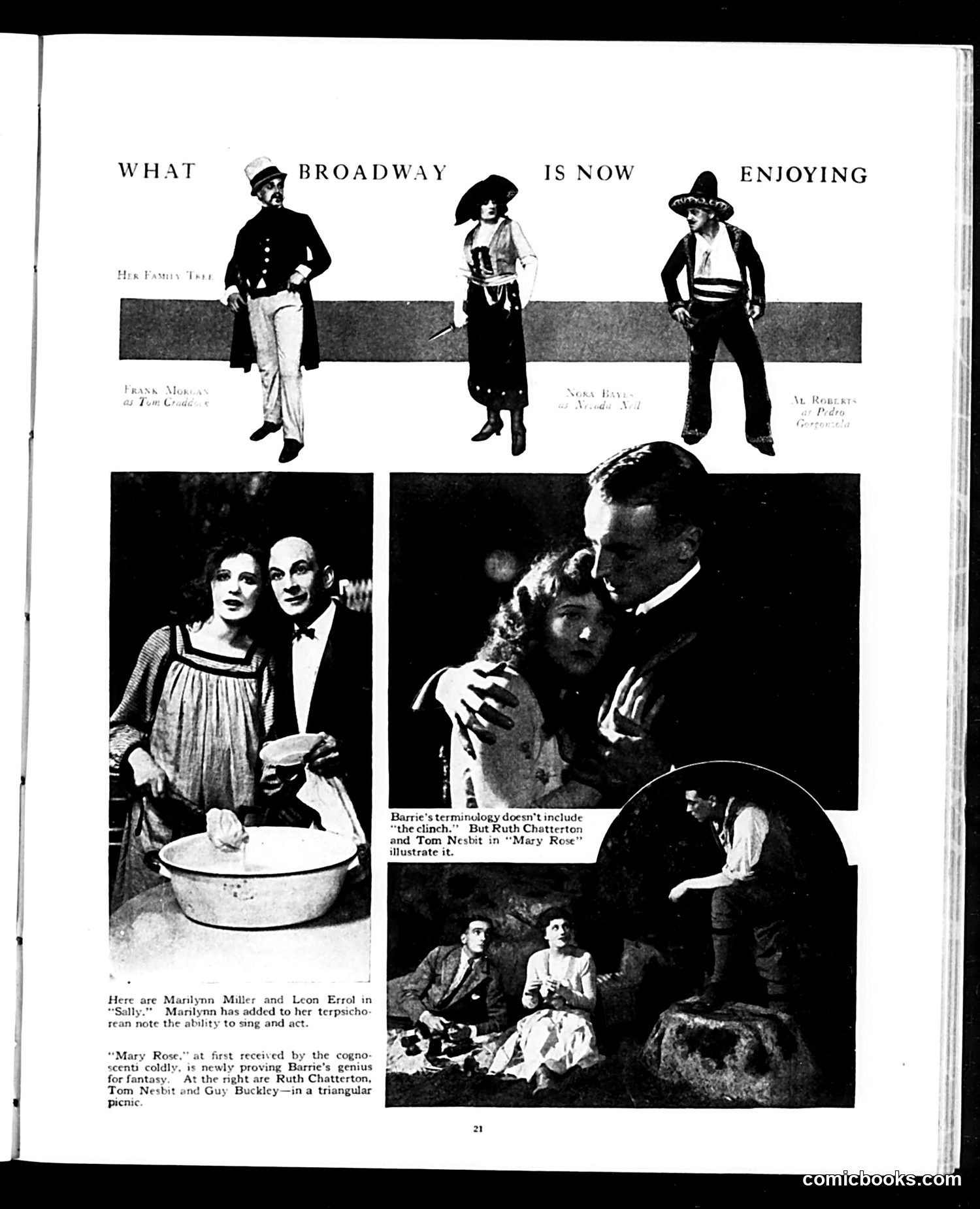
This page showcases current Broadway productions circa the 1920s. The header presents three illustrated figures representing theatrical stereotypes—a soldier, a woman in modern dress, and a Mexican character—introducing featured shows. The content focuses on three productions: "Sally" (starring Marilynn Miller and Leon Errol), "Mary Rose" (by J.M. Barrie), and an unnamed third show featuring Ruth Chatterton and Tom Nesbit. The satire is gentle: it mocks Barrie's prudish Victorian theatrical language ("Barrie's terminology doesn't include 'the clinch'") while noting that his play "Mary Rose" actually depicts physical affection—illustrated by a photograph of actors embracing. The joke suggests that Barrie's supposedly proper fantasy play contains surprisingly modern romantic content. The page functions primarily as entertainment publicity rather than political satire, celebrating Broadway's contemporary offerings and performers.
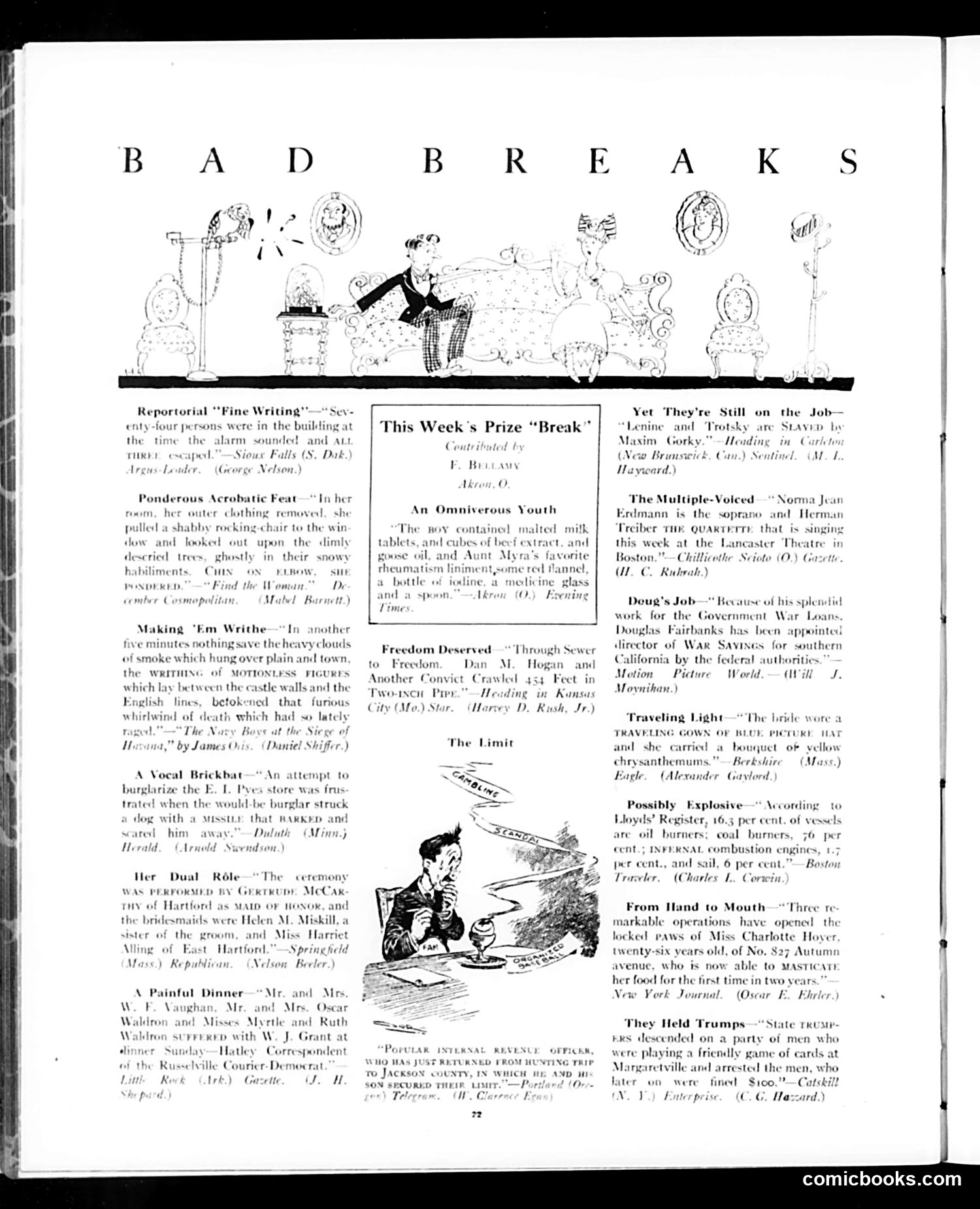
This is a *humor* page from Judge magazine featuring a recurring feature called "Bad Breaks"—a collection of unintentionally funny newspaper excerpts. The joke is that newspapers published absurd or awkwardly-phrased sentences that created unintended comic meanings. Examples include: - A fire report describing "seventy-four persons...escaped" in oddly melodramatic language - A boy who ate malted milk tablets mixed with beef extract, goose oil, and rheumatism liniment - A convict who crawled 454 feet through a sewer "to Freedom" - A revenue officer who went hunting and "secured their whiskey" The cartoon (bottom center) shows a man at a desk—likely an editor catching these mistakes. The satire mocks newspaper writers for careless phrasing that inadvertently creates humor or suggests inappropriate meanings. It's gentle mockery of journalistic incompetence rather than political commentary.
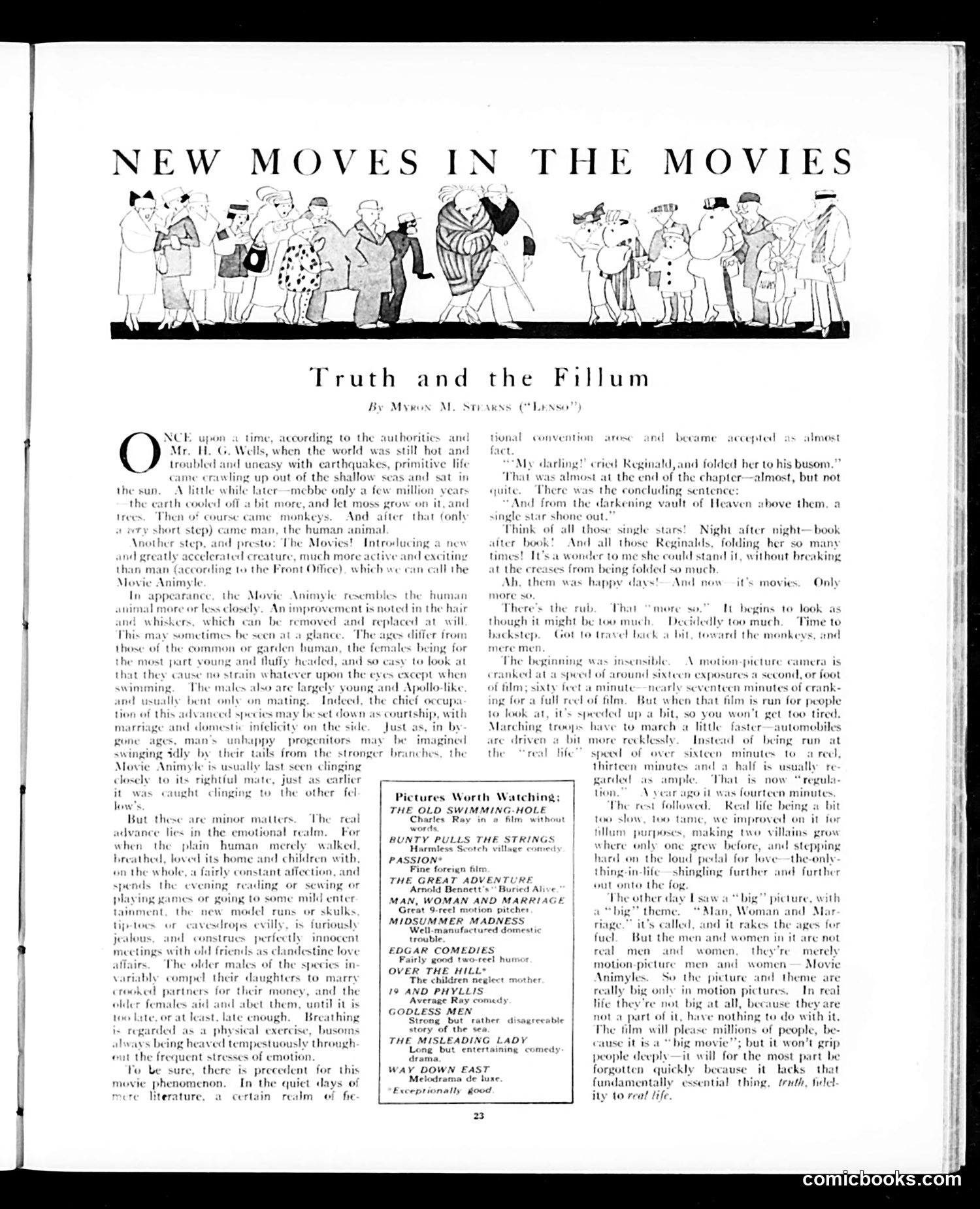
This article by Myron M. Stearns satirizes the artificiality of silent film acting and editing techniques. The title illustration shows stylized figures representing movie characters—exaggerated, theatrical types distinct from real humans. The satire's core: **silent films distort reality through speed and repetition**. Stearns uses H.G. Wells' evolutionary framework as a joke—humans evolved from sea creatures to the "Movie Animyle," a creature even more artificial than ordinary humans, defined entirely by mating and courtship. The specific critique: filmmakers accelerate action (marching troops march faster, cars drive recklessly) and manipulate footage length (shortening reels from 16 to 13.5 minutes of "real life" speed) to maintain audience interest. They multiply dramatic elements—where a novel has one star shining, films show many; one villain becomes two. **The point**: silent cinema's technical requirements create absurd, exaggerated portrayals divorced from believable human behavior. The accompanying "Pictures Worth Watching" box lists current films being reviewed, grounding the critique in contemporary movies audiences would recognize.
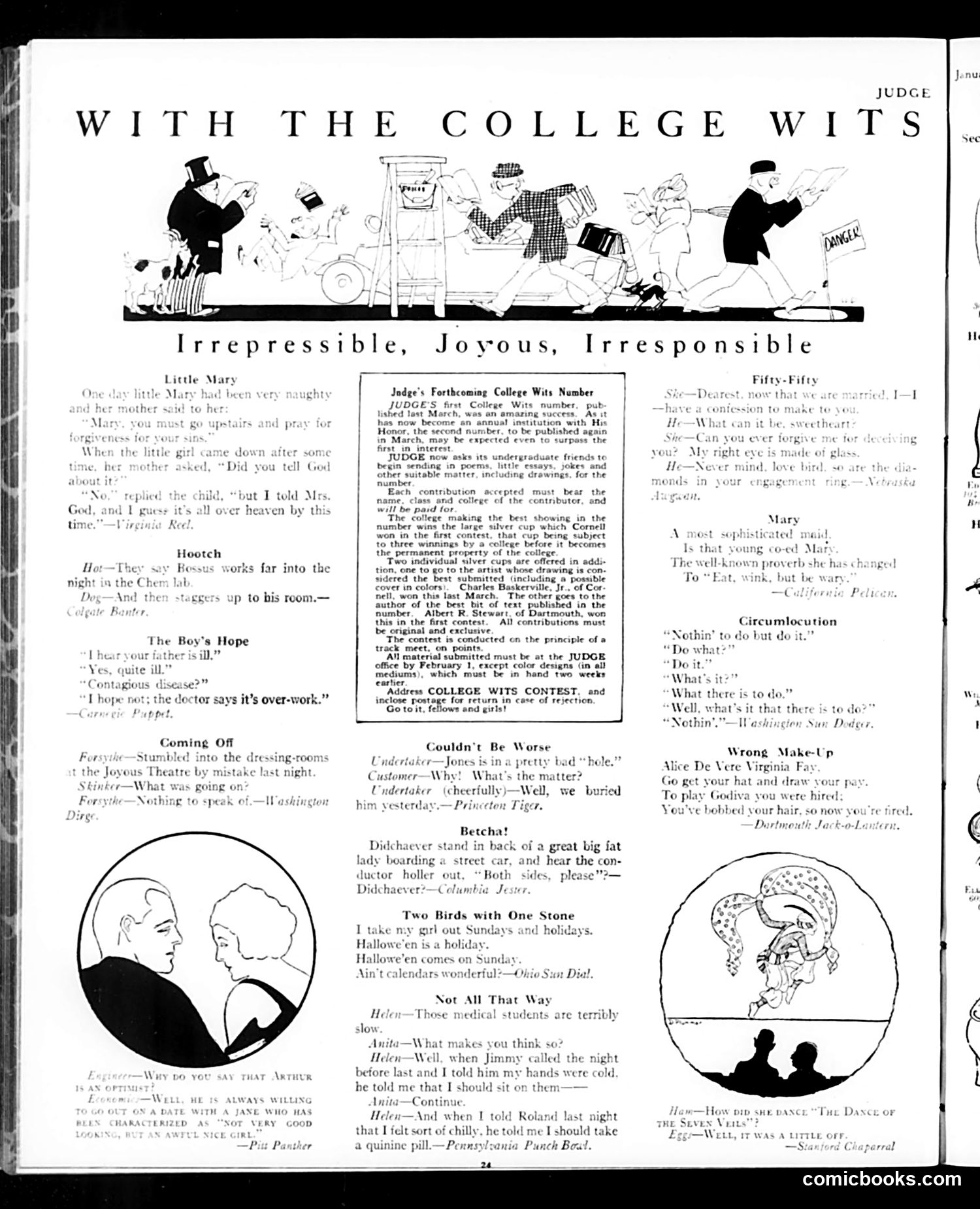
This page satirizes college life and student behavior during the early 20th century. The header illustration shows undergraduates engaged in various irresponsible antics—drinking ("Hootch"), romance, and general chaos—labeled "Irrepressible, Joyous, Irresponsible." The individual jokes mock typical college scenarios: medical students' laziness, romantic misunderstandings where men feign sympathy to avoid commitment (asking girls to take quinine pills when they're "chilly"), and social pretension. One piece ridicules a woman who bobs her hair but fails at "wrong make-up," suggesting the affectation of modern femininity. The page announces a "College Wits Contest" offering silver cups and publication opportunities for best student submissions. The humor targets undergraduate culture as frivolous, romance-obsessed, and hypocritical—portraying college men as simultaneously pursuing women while dodging genuine emotional involvement.
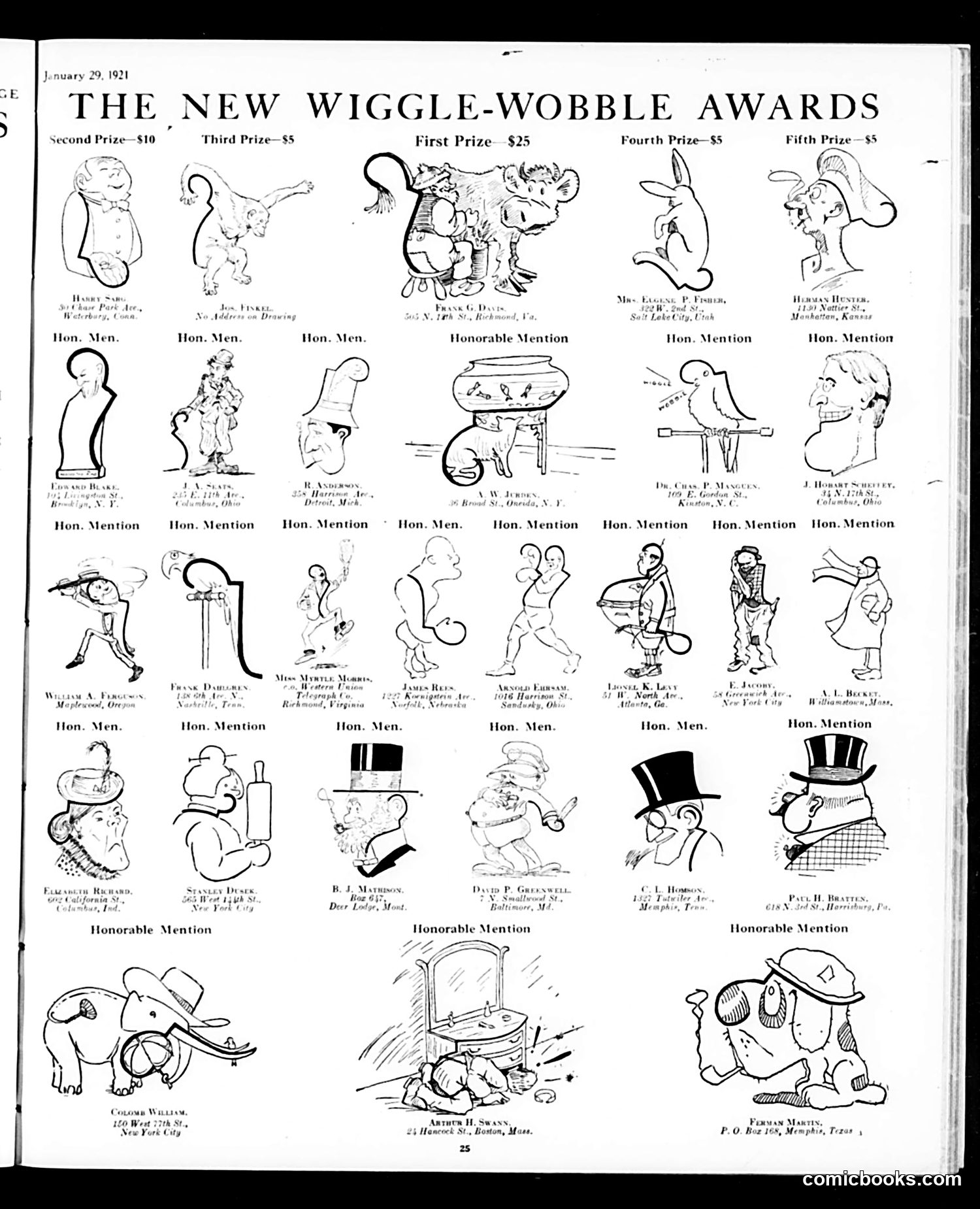
This page presents results of a humorous drawing contest Judge magazine ran, titled "The New Wiggle-Wobble Awards." The contest invited readers to submit cartoons or caricatures, likely parodying the exaggerated, modernist "wiggle" drawing style popular in early 1920s illustration and animation. The page displays winning and honorably-mentioned entries—mostly crude, comic figure sketches and caricatures of recognizable people (appear to be public figures or celebrities of the era, though specific identities are unclear from the image alone). Prize amounts ($25 first place down to $3 for fourth/fifth) incentivized participation. The satire targets the pretension of artistic awards while celebrating amateur, deliberately ungainly cartooning. It's essentially Judge's playful mockery of both modernist art trends and contest culture itself—rewarding the funny, the awkward, and the exaggerated over technical skill.
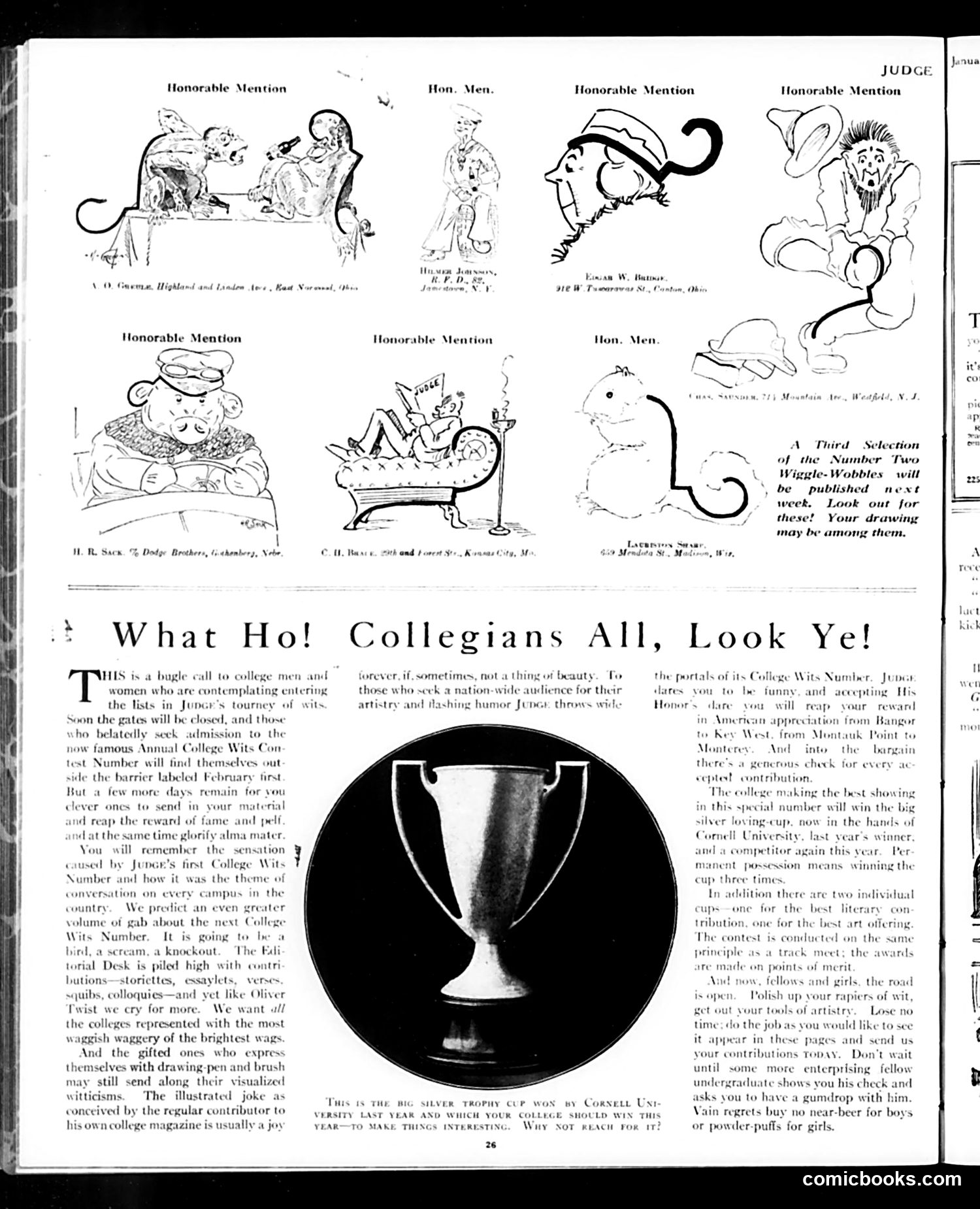
This is a promotional call for Judge magazine's "College Wits Contest"—an annual competition soliciting humorous contributions (cartoons, jokes, essays, verses) from college students nationwide. **The Setup:** Judge is urging students to submit their work before a February 1st deadline. The top college will win a silver trophy cup (currently held by Cornell University); individual winners receive cash prizes and publication. **The Satire:** The page mocks the earnest self-importance of college life and student creativity. The crude cartoons labeled "Honorable Mention" are deliberately mediocre illustrations—the joke being that Judge is *already* accepting subpar work. The text jokingly warns clever students to hurry before "the gates will be closed" and begs for more submissions ("like Oliver Twist we cry for more"), playfully suggesting Judge is desperate for material. **Historical Context:** This represents early 20th-century American collegiate culture and Judge's role as a humor magazine dependent on reader contributions. The trophy and institutional competition reflect how colleges took their social standing seriously.
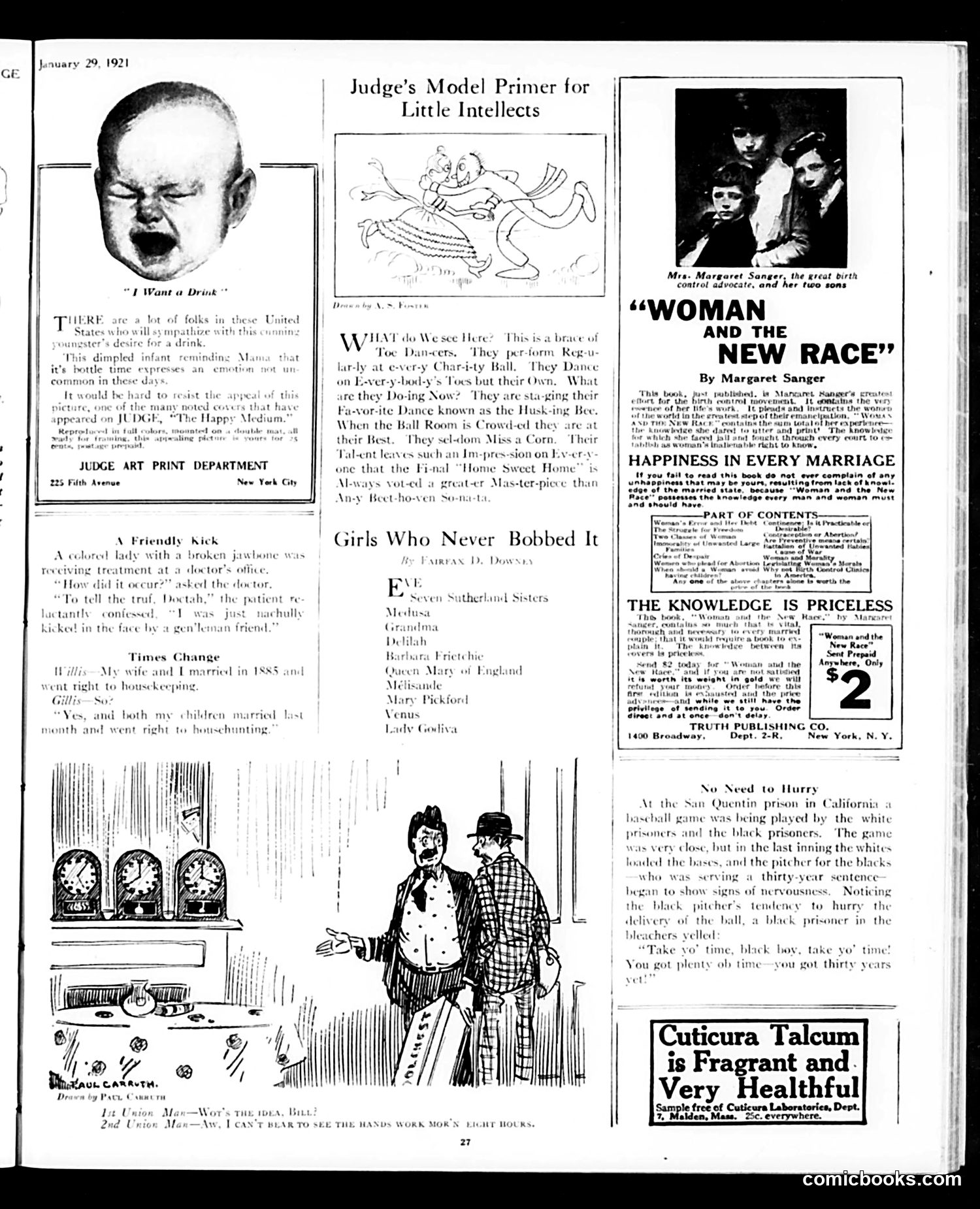
This page contains several satirical pieces reflecting 1921 concerns: **"Judge's Model Primer for Little Intellects"** mocks wealthy socialites—the "toe-dancers" at charity balls who "dance on everybody's toes but their own," suggesting they're self-serving despite charitable pretenses. **"Girls Who Never Bobbed It"** lists women (Queen Mary, Mary Pickford, Venus, Lady Godiva) who resisted the "bob" hairstyle—a symbol of 1920s women's liberation. The satire targets those clinging to old femininity standards. **Margaret Sanger advertisement** for *"Woman and the New Race"* reflects ongoing controversy over birth control advocacy in this era. **"No Need to Hurry"** presents a racial stereotype joke about a Black prisoner at San Quentin, using dialect humor about his 30-year sentence—typical of era's casual racist humor in mainstream publications. The page overall captures 1921's social anxieties: changing gender roles, wealth inequality, and racial attitudes normalized in period media.
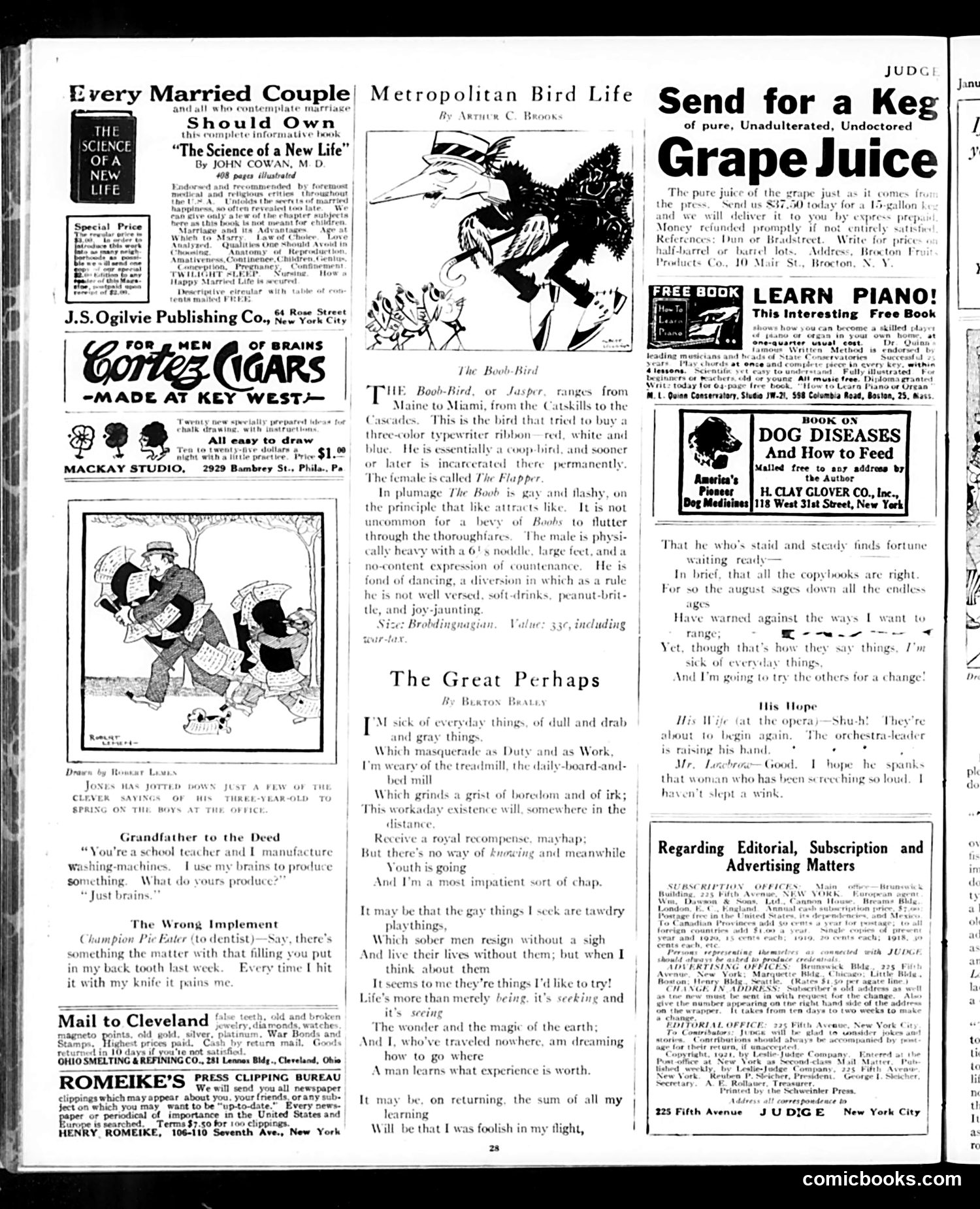
This page is primarily **advertisements and light satirical content**, typical of Judge magazine's format. The main cartoon appears to be **"Mail to Cleveland"** by Horace Lorenz, showing a school teacher and factory owner in dialogue. The "Grandfather to the Deed" joke mocks class differences: a factory owner dismisses a schoolteacher's intellectual work, asking what a teacher's "brains produce"—satirizing the era's tension between industrial capitalism and intellectual labor. **"The Wrong Implement"** jokes about a dentist patient using a knife on a filling, a simple physical gag about carelessness. The **"Boob-Bird" ornithology piece** is whimsical satire describing a foolish person as if cataloging a bird species—a common Judge humor device mocking social types. **"The Great Perhaps"** is a poem expressing youthful yearning for adventure over mundane work—capturing early 20th-century restlessness. The page is otherwise dominated by mail-order advertising: grape juice, piano lessons, dog care books, and Romeike's press clipping service—typical Judge revenue sources reflecting consumer culture of the era.
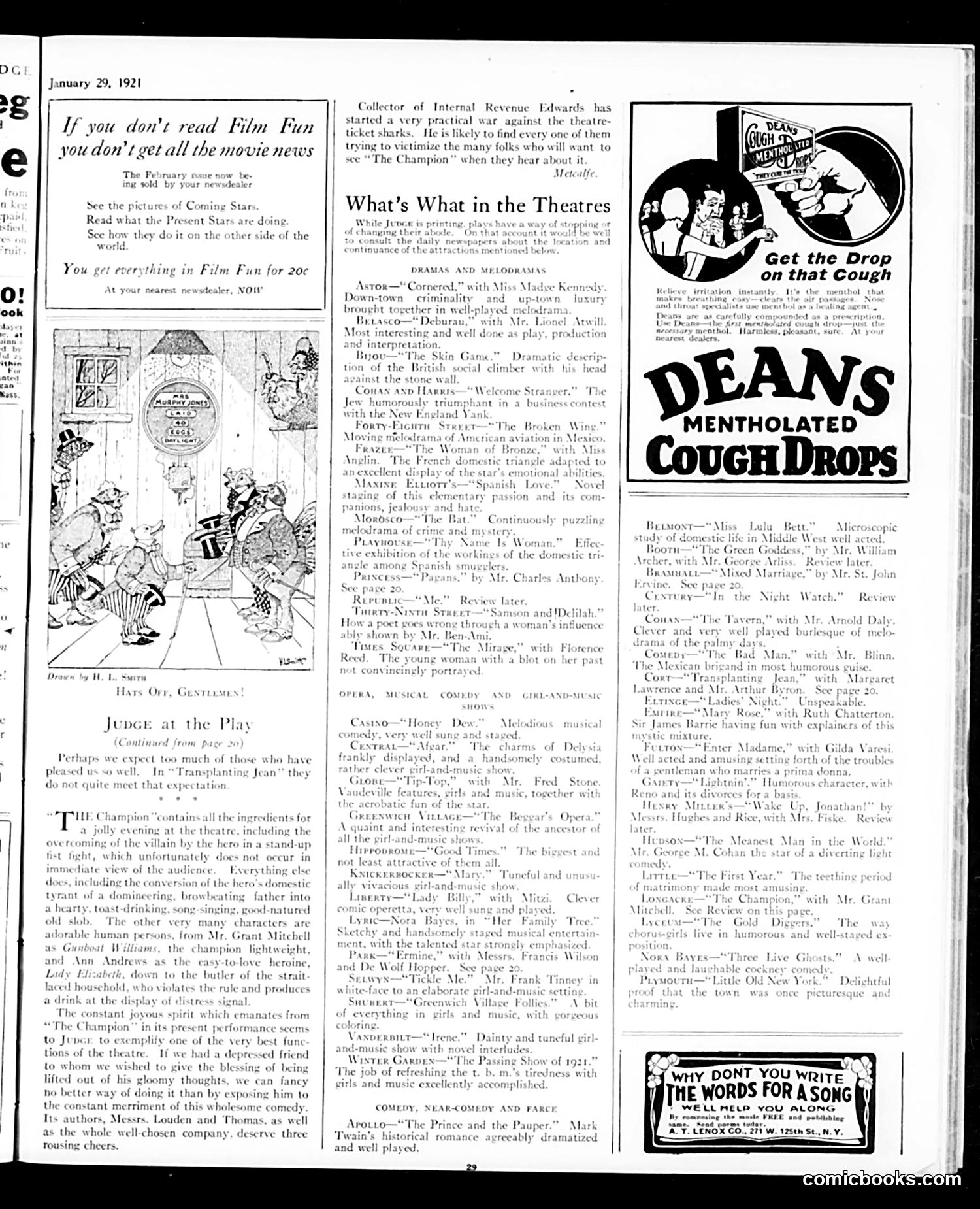
This page is primarily **theatre and film reviews** with advertising, not political satire. The main cartoon ("Judge at the Play") celebrates theatre's moral function: it praises a play for "lifting" a depressed friend "out of his gloomy thoughts" and exposing him "to the constant merriment of this wholesome comedy." The piece argues theatre is valuable because it can improve people's emotional and spiritual states through laughter and entertainment. The "What's What in the Theatres" section lists current Broadway shows with brief critical reviews. Notable is a reference to "The Champion"—apparently a popular film—and a mention that the **Collector of Internal Revenue Edwards** is fighting theatre "ticket sharks" (scalpers who resell tickets at inflated prices). The advertisements include **Deans Mentholated Cough Drops** and a song-writing service. This reflects 1921 commercial culture and the period's concern with patent medicines.
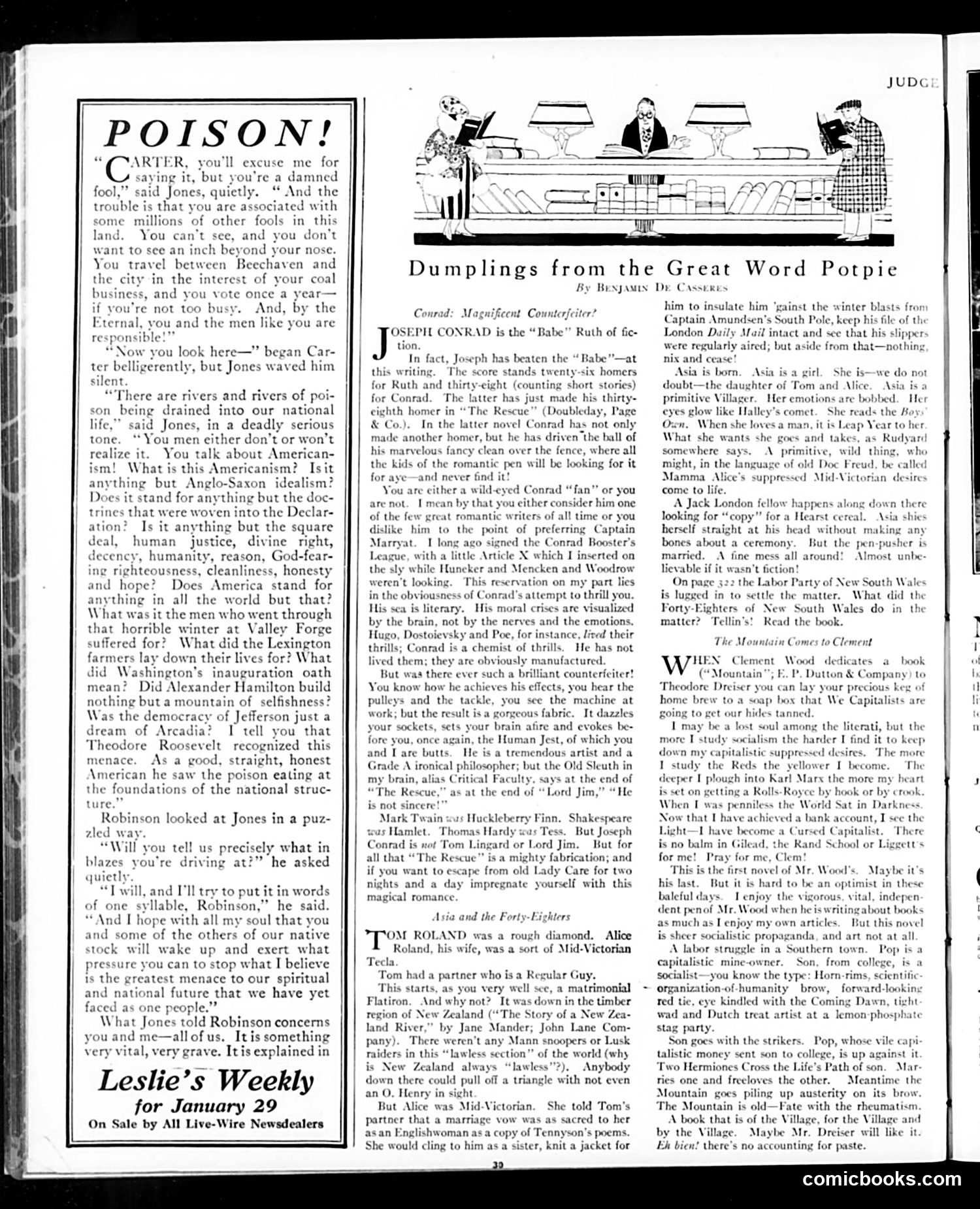
This page contains two distinct pieces: **"POISON!" (left column):** A dramatic dialogue where character Jones passionately lectures Robinson about threats to American values. Jones invokes the Founding Fathers, Valley Forge, and Theodore Roosevelt while warning of some unnamed "poison" destroying the nation's foundations. The text never specifies what this poison is—it appears the full explanation was promised in the referenced Leslie's Weekly article. This is likely early 20th-century populist rhetoric about immigration, socialism, or industrial corruption, but the specific target remains unclear from this page alone. **"Dumplings from the Great Word Potpie" (right): A book review column by Benjamin De Casseres critiquing novelist Joseph Conrad. The reviewer praises Conrad's productivity and imagination but criticizes his work as overly intellectual and artificially constructed—"thrills" manufactured by a chemist rather than genuinely lived. The tone is sophisticated literary criticism typical of the era's highbrow magazines.
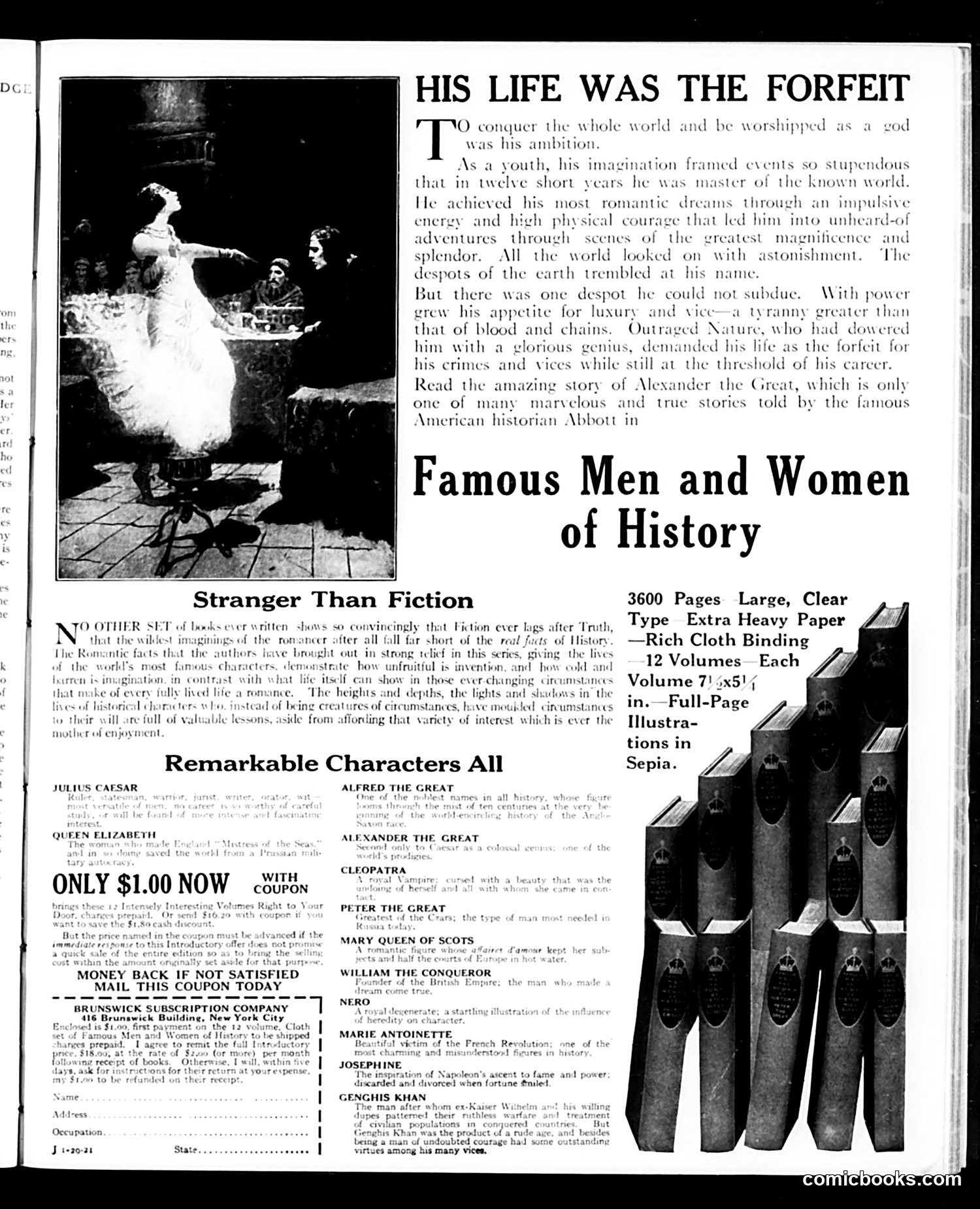
This is primarily a **book advertisement**, not a political cartoon. It promotes "Famous Men and Women of History," a 12-volume encyclopedia by American historian John S. C. Abbott. The opening narrative describes **Alexander the Great**—his youthful ambitions, military conquests, and eventual downfall. The text emphasizes his paradox: a genius who conquered the world but "could not subdue" his own appetites for luxury and vice. Nature itself "demanded his life as the forfeit for his crimes." The advertisement positions Abbott's work as superior to fiction, claiming real history surpasses imagination. It lists figures like Julius Caesar, Cleopatra, Peter the Great, and Genghis Khan—historical figures whose dramatic lives supposedly prove "truth is stranger than fiction." The image shows what appears to be a dramatic historical scene, likely depicting Alexander in a moment of triumph or moral conflict. This reflects late 19th/early 20th-century publishing marketing: positioning historical biography as morally instructive entertainment, appealing to readers seeking both drama and edification.
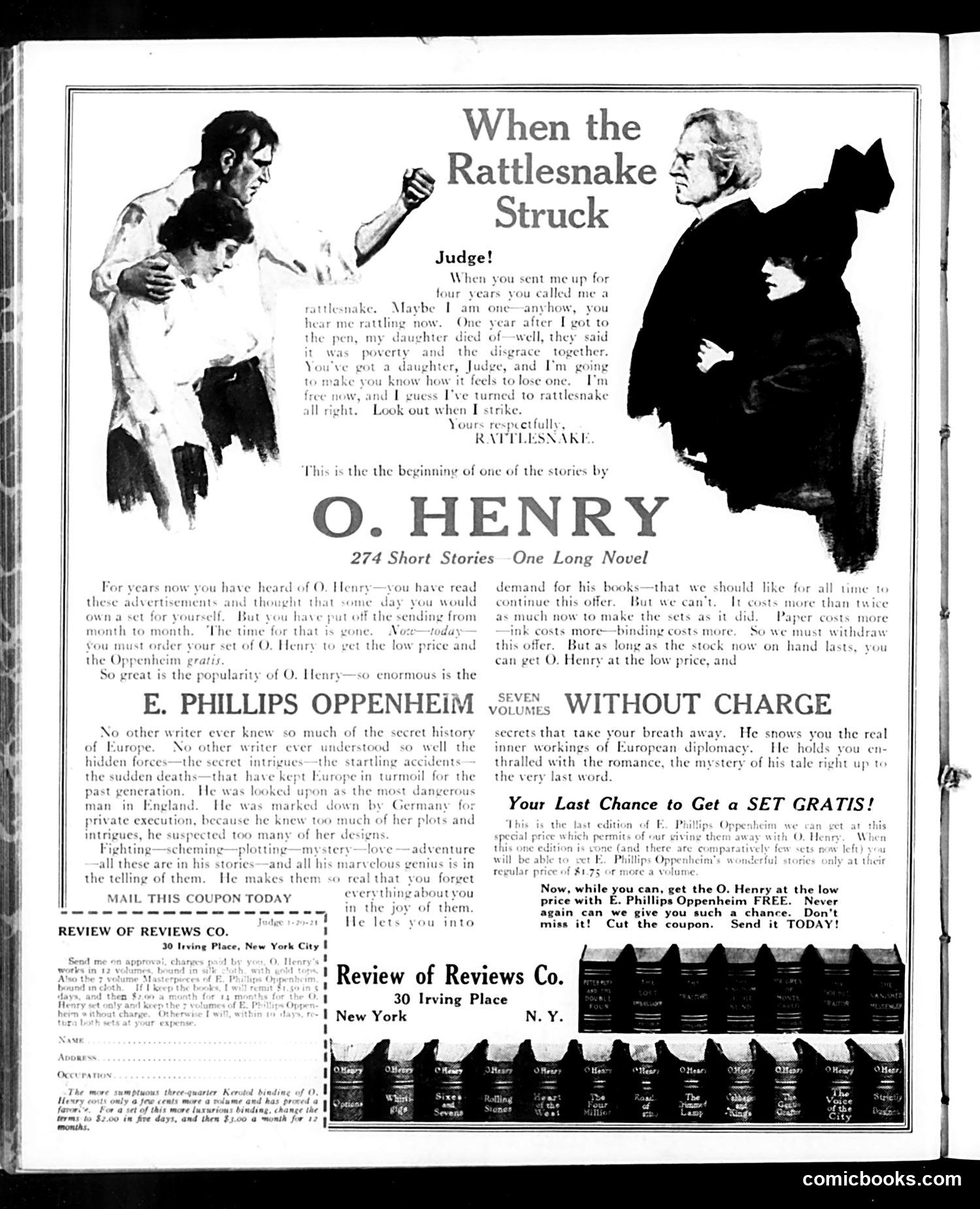
This is primarily a **book advertisement** disguised as satirical content. The "When the Rattlesnake Struck" illustration depicts a convict confronting a judge, representing a story by O. Henry—a hugely popular short-story writer of that era. The satire is implicit: the "rattlesnake" metaphor suggests a wronged man (sent to prison for four years) who has become dangerous after his daughter died in poverty while he was incarcerated. The judge, depicted formally on the right, faces this threat from his past judgment. However, **the page is dominated by advertising**. The bulk of the space promotes O. Henry's complete works through E. Phillips Oppenheim's publisher (Review of Reviews Co.), offering a "free" set of volumes as an incentive to subscribe. The ad emphasizes limited stock and urgency ("Your Last Chance"), a common sales tactic. The social commentary—if any—is minimal; this is essentially a commercial using O. Henry's reputation for emotional, human-interest stories to sell books.