
Judge, 1921-01-29 · page 14 of 32
Judge — January 29, 1921 — page 14: what you’re looking at
What you’re looking at
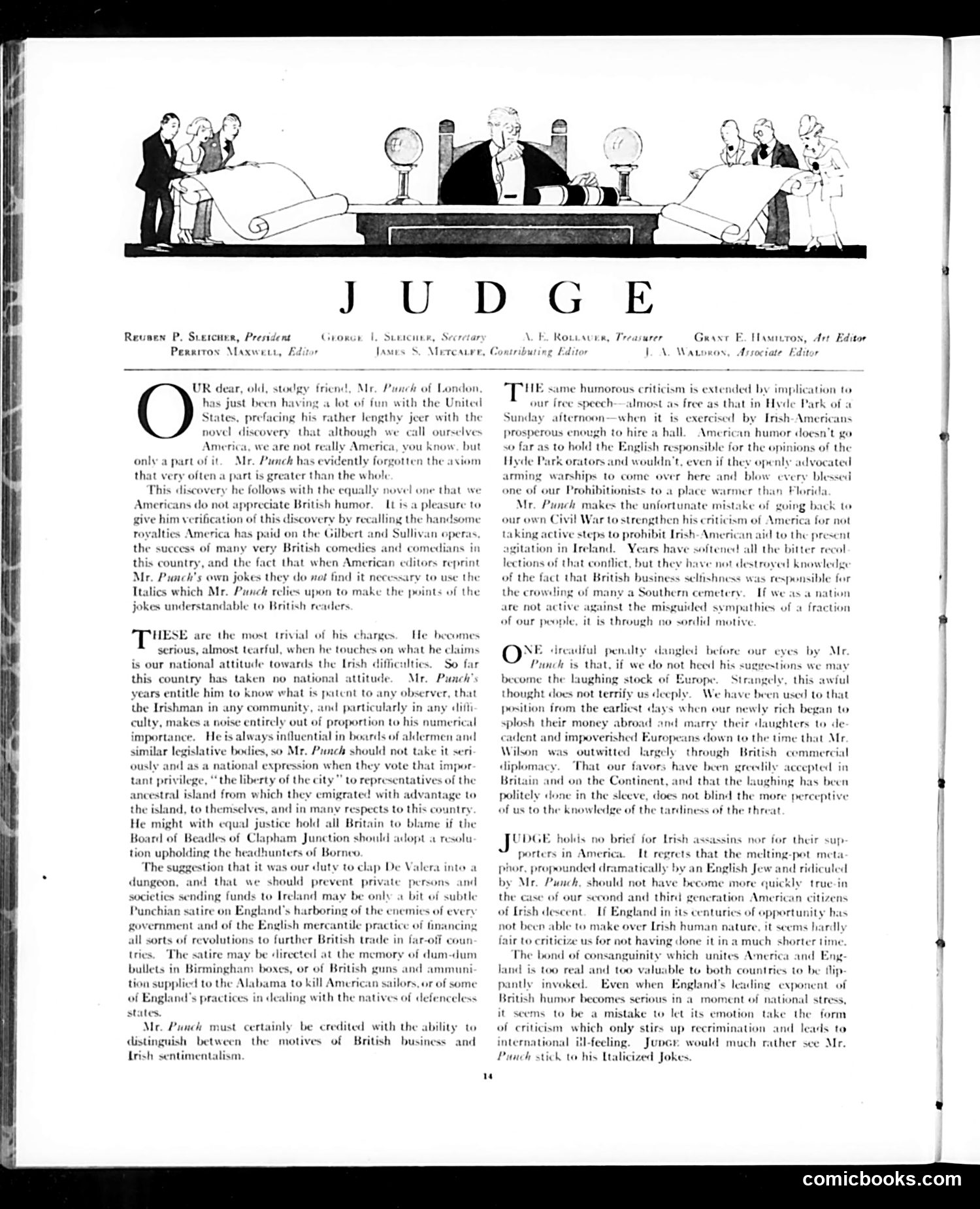
This is an editorial response in *Judge* magazine (American) defending the United States against criticism from *Punch* magazine (British). The illustration shows a judge presiding over a courtroom debate between the two publications. **The Dispute:** British *Punch* had criticized America for: (1) not truly being "America" but only part of it; (2) not appreciating British humor; (3) not taking a national stance against Irish independence activism. **Judge's Counterargument:** - Americans *do* appreciate British humor (citing Gilbert & Sullivan's financial success) - Irish-Americans' political influence reflects normal democratic participation, not national policy - America shouldn't be blamed for private citizens funding Irish causes any more than Britain should be blamed for extremist actions by its own groups - Invoking the Civil War, Judge suggests British hypocrisy about internal conflicts **The Satire:** Judge mocks *Punch's* pretension while defending American free speech and democratic principles against British moralizing.
📄 Transcribed text from this page (OCR, searchable)
Machine-transcribed from the original scan — historical spelling and the odd misread are preserved.
Revnen P. Srercuer, President Grokur |. Suescunn, Secretar Perriros \Maxwett, Editor James S. Meteare, Contri UR dear, old, stodgy friend, Mr. Punch of London has just been having a lot of fun with the United States, prefacing his rather lengthy jeer with the novel discovery that although we call ourselves America, we are not really America, you know. but only a part of it. Mr. Punck bas evidently forgotten the axiom that very often a part is greater than the whole This discovery he follows with the equally novel one that we Americans do not appreciate British humor. Lt is a pleasure t« give him verification of this discovery by recalling the handsome royalties America has paid on the Gilbert and Sullivan operas the success of many very British comedies and comedians in this country, and the fact that when American editors reprint Mr. Punch's own jokes they do not find it necessary to use the Italics which Mr. Punch relies upon to make the points of the jokes understandable to British readers HE. serious, almost tearful, when he touches on what he claims is our national attitude towards the Lrish difficulties. So far this country has taken no national attitude. Mr. Punch years entitle him to know what is patent to any observer, that are the most trivial of his charges. He becomes the Irishman in any community, and particularly in any «itt culty, makes a noise entirely out of proportion to his numer importance. He is always influential in boards of aldermen and similar legislative bodies, so Mr. Punch should not take it seri ously and as a national expression when they vote that impor tant privilege, “the liberty of the city” to representatives of the ancestral island from which they emigrated with advantage to the island, to themselves, and in many respects to this country He might with equal justice hold all Britain to blame if the Board of Beadles of Clapham Junction should adopt a resolu tion upholding the headhunters of Bornvo. The suggestion that it was our duty to clap De Valera into a dungeon, and that we should prevent private persons and societies sending funds to Ireland may be only a bit of subtk Punchian satire on England's harboring of the enemies ‘emment and of the English mercantile practice of financing all sorts of revolutions to further British trade in far: tries. The satire may be «lirected at the memory of dum-dum bullets in Birmingham boxes, or of British guns and an tion supplied to the Alabama to kill American sailors, or of some every of England's practices in dealing with the natives of cless states. Mr. Punch must certainly be credited with the ability to distinguish between the motives of British business and [rish sentimentalism. \. B. Rotusunn, Treasurer Grawr E. tasieros, det E 1 A. Watpros, Associate Editor HE same humorous criticism is extended by implication to our free speech—almost as free as that in Hyde Park of a Sunday afternoon—when it is exercised by [nsh-Americans prosperous enough to hire a hall. American humor doesn’t go so far as to hold the English responsible for the opinions of the Hyde Park orators and wouldn't, even if they Ivocated arming warships to one of our Prohibitionists t venly d yme over here and blow every blessed a place warmer than Florida Mr. Punch makes the unfortunate mistake of going back to our own Civil War to strengthen his criticism of America for not taking active steps to prohibit Irish-Ameri igitation in Ireland. Years have softened all the bit lections of that conflict, but they have not destroved knowledge the fact that British business selfishness s the ere an aid to the present r recol responsible for ling of many a Southern cemetery. Ef we as a natic ure not active against the misguided sympathies of a fraction of our 7 le, itis through no sordid motive NE ‘ireadiul penalty dangled before our eyes by Me Punch is that, if we not heer become the laughing stock of Europe. Strangely, this awful thought does not terrify us deeply. We have been used to that his sugvestions we may position from the earliest days when our newly rich began to splosh their money abroad and marry their daughters to de cadent and impoverished Europeans down to the time that Mr Wilson was outwitted largely through British commercial diplomacy. That our favors have been greedily accepted in Britain and on the Continent, and that the laughing has been politely « in the sleeve, does not blind the more perceptive of us to the knowledge of the tardiness of the threat JUDGE holis no brief for Lrish assassins nor for their sup porters in America. It regrets that the melting-pot meta phor, propounded dramatically by an English Jew and ridiculed by Mr. Punch, should not have become more quickly true-in the case of our second and third generation American citizens of [rish descent. If England in its centuries of opportunity has not been able to make over Lrish human nature, it seems hardly fair to criticize us for not having done it in a much shorter time The bond of consanguinity which unites America and Er land is too real and too valuable to both countries to be tl pantly invoked. Even when England's leading exponent British humor becomes seri it seems to be a mistake to let its emotion take the form of criticism which only stirs up recrimination and leads te international itl-fecling. Jupcr would much rather see Mr. Puch stick to his Lalicized Jokes, vf us ina moment of national stress, 2 comicbooks.com