
A complete issue · 28 pages · 1917
Judge — December 8, 1917
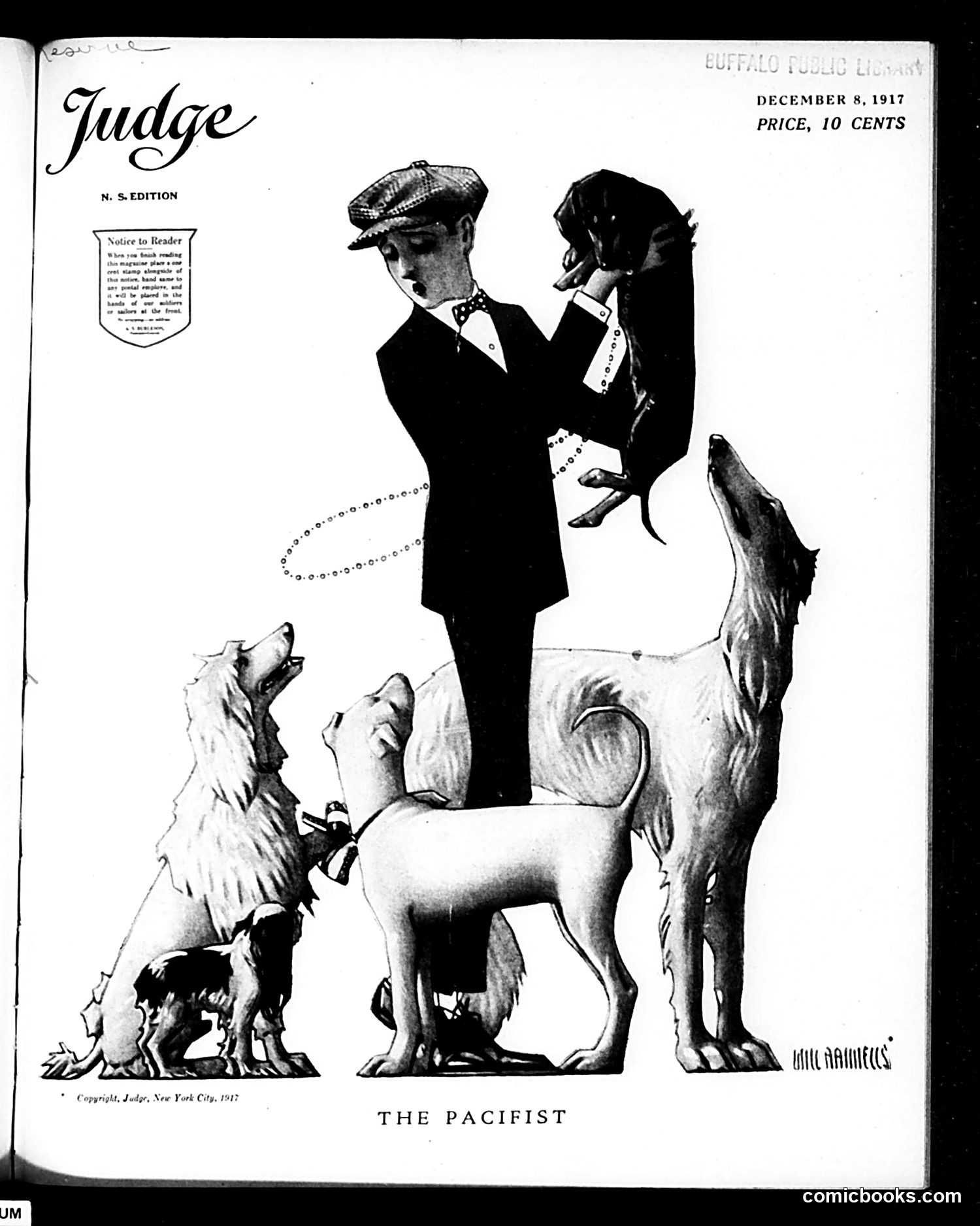
This satirical cartoon criticizes anti-war advocates during World War I. A well-dressed man holding a woman represents a "pacifist"—someone opposing American military involvement. He stands elevated on three dogs of increasing size, which symbolize the escalating demands or chaos he ignores. The dogs likely represent military necessity, national security concerns, or the consequences of refusing to fight. By depicting the pacifist literally standing above and indifferent to these urgent issues, the cartoonist mocks pacifists as disconnected from reality. Published December 1917—nearly a year into America's WWI entry—this reflects widespread public frustration with peace advocates. The cartoon suggests pacifists are naive or irresponsible for prioritizing peace over perceived national obligations.
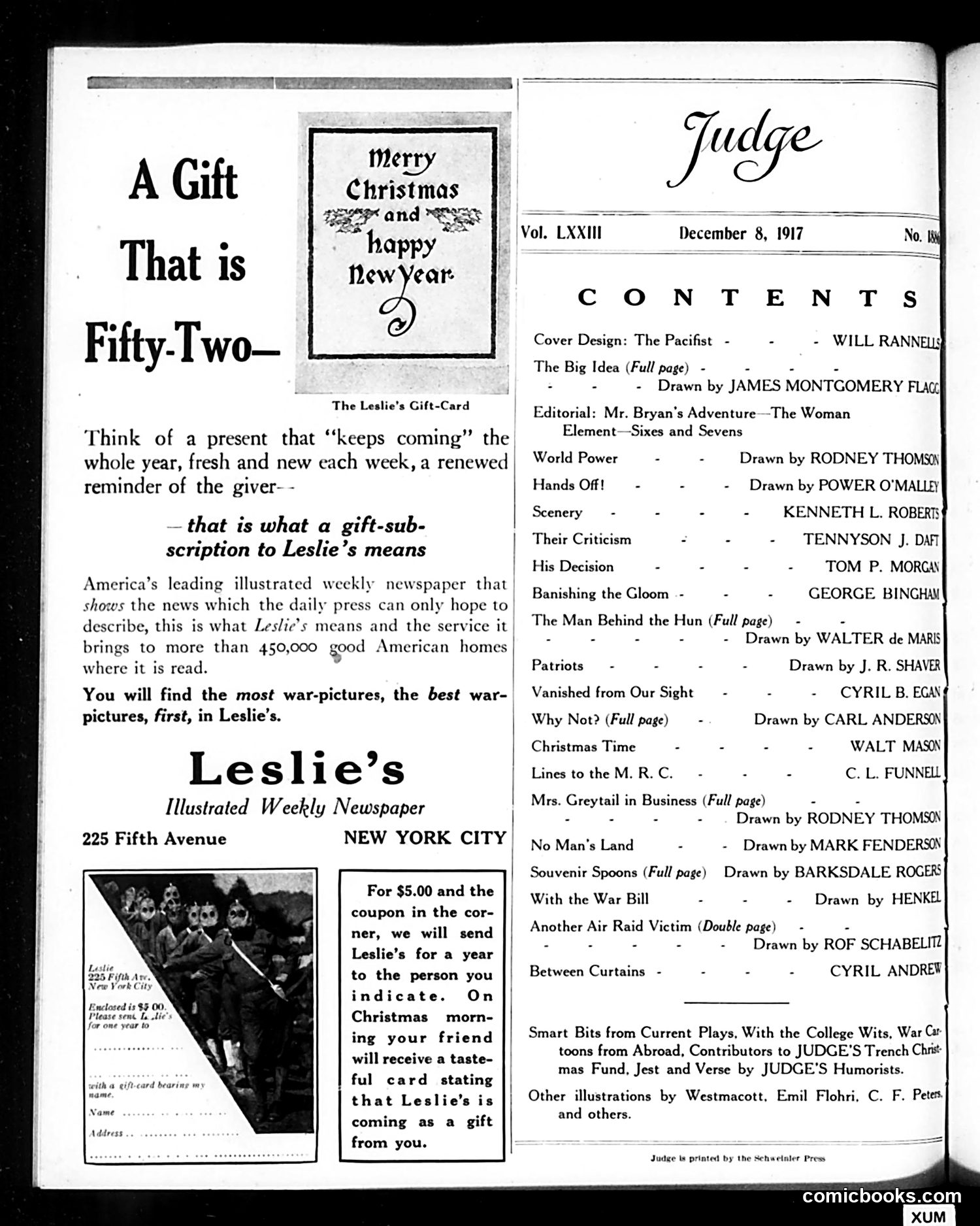
This page is primarily **advertising for Leslie's Illustrated Weekly Newspaper** as a gift subscription. The left side promotes a year-long subscription for $5, emphasizing that Leslie's delivers "fresh and new each week" throughout the year. The right side is a **table of contents** listing various articles and illustrations from that issue. Notable pieces include war-related content ("World Power," "Another Air Raid Victim," "With the War Bill") and social commentary ("Mrs. Greytail in Business," "Why Not?"), reflecting concerns during America's involvement in World War I (1917). The masthead indicates this is **Volume LXXIII, No. 1917**, dated December 8, 1917. The page contains no visible political cartoons—it functions primarily as a sales pitch and editorial guide rather than satirical content.
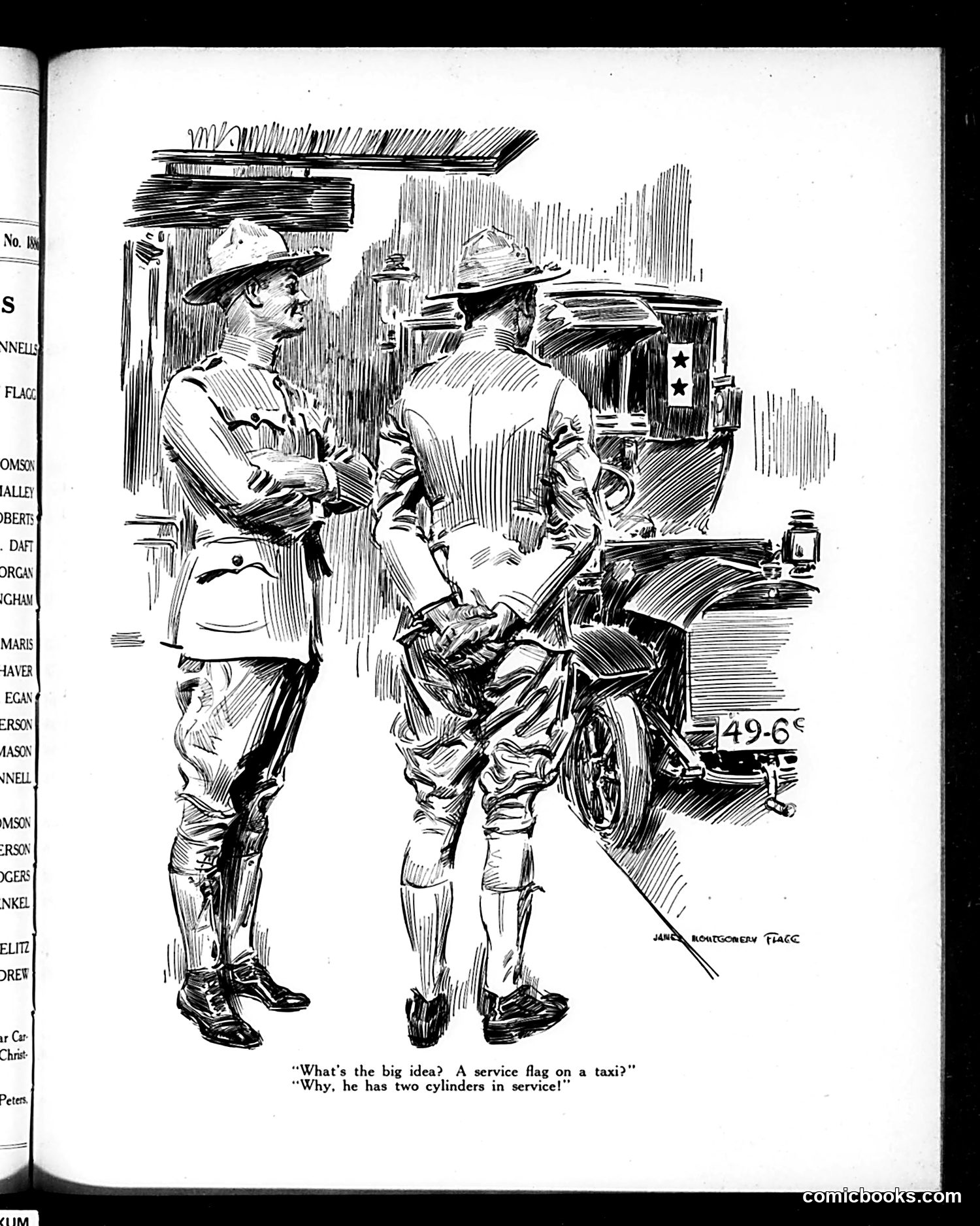
This cartoon depicts two military officers in what appears to be a World War I-era setting (based on their uniforms and the taxi visible in the background). One officer, standing on the left, questions the other about a "service flag on a taxi," expressing surprise that the vehicle "has two cylinders in service." The joke plays on the double meaning of "service": the patriotic service flags displayed during WWI to indicate family members in military service, versus an automobile's mechanical cylinders. The humor mocks either the absurdity of putting a service flag on a civilian taxi, or satirizes overzealous patriotic displays. The cartoon criticizes what it suggests is misplaced or excessive wartime flag-waving among civilians, particularly regarding ordinary commercial vehicles.
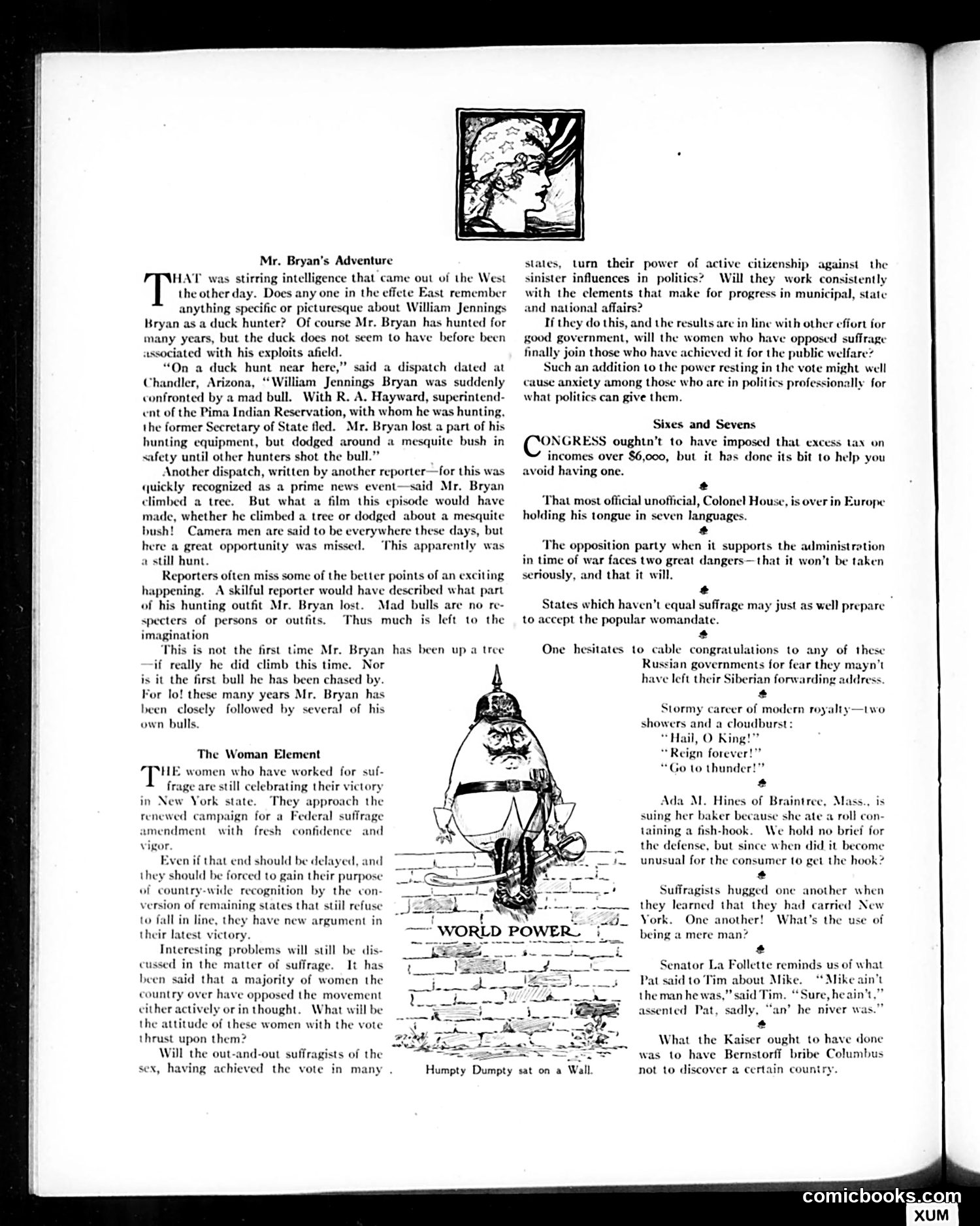
The central cartoon depicts "Humpty Dumpty sat on a Wall," referencing the nursery rhyme. In this political adaptation, Humpty Dumpty represents **world power or global stability**, precariously balanced atop a wall amid chaos below. The image suggests that post-WWI international order is fragile and unstable—one misstep could cause catastrophic collapse. The surrounding text discusses women's suffrage victories and political anxieties about female voting power, alongside commentary on Congressional tax policies and various international tensions. The Humpty Dumpty reference implies that reconstructing global affairs "after the fall" would prove nearly impossible—a darkly humorous commentary on the precarious geopolitical situation of the era.
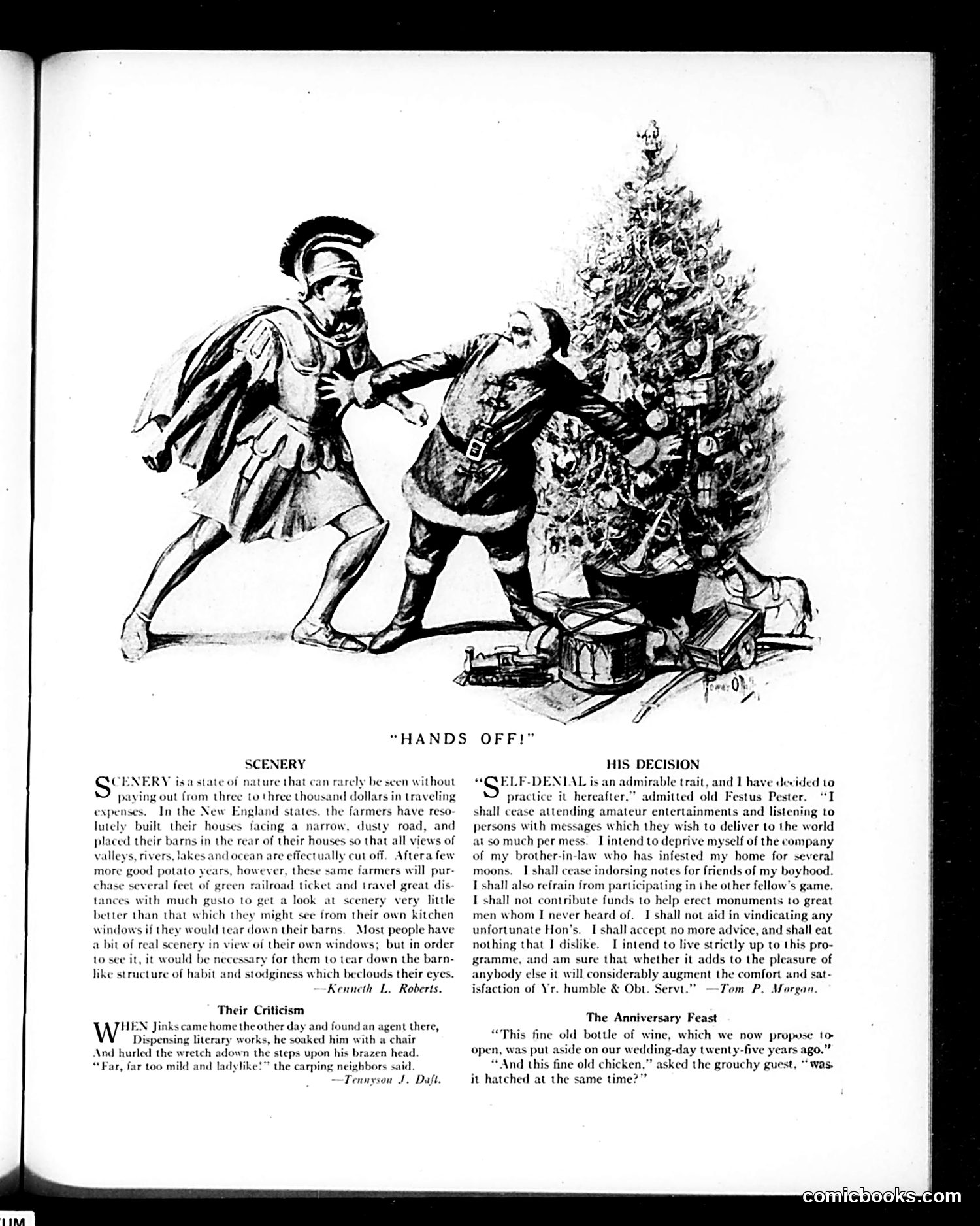
The main cartoon depicts a Roman soldier attempting to restrain a rotund figure (likely representing someone in authority) from grabbing an elaborately decorated Christmas tree laden with gifts and ornaments. The title "Hands Off!" suggests criticism of someone overreaching or interfering inappropriately. The soldier's restraining gesture implies legal or constitutional limits being imposed. Without additional context about the specific Judge issue date, the exact identity of the rotund figure remains unclear—though it could reference a political figure or business magnate of the era attempting to monopolize or exploit Christmas commerce or charitable giving. The accompanying text pieces ("Scenery," "His Decision," "Their Criticism," "The Anniversary Feast") appear to be separate humor items unrelated to the main cartoon.
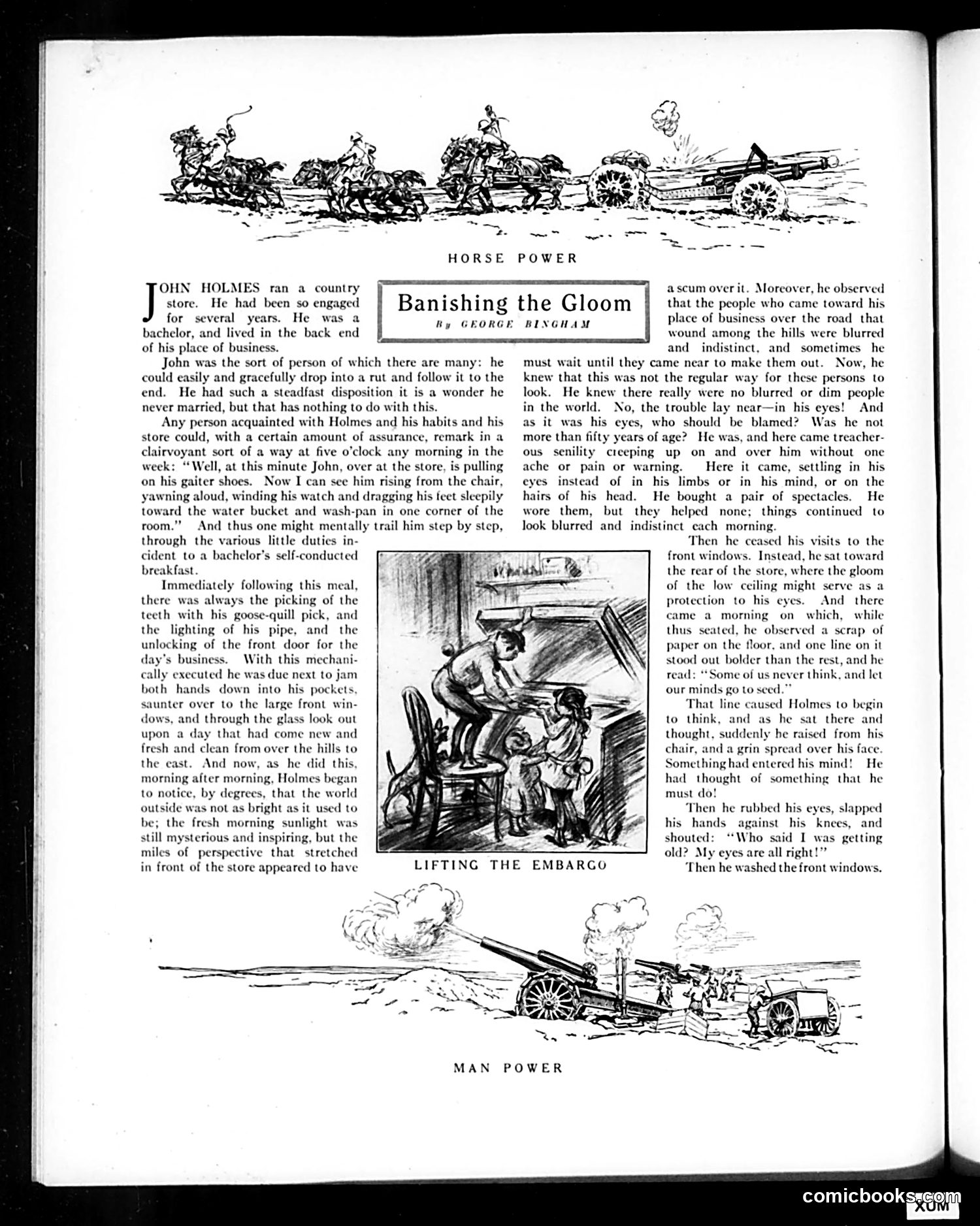
This story by George Bingham depicts John Holmes, a country store owner struggling with depression and poor eyesight. The narrative contrasts "Horse Power" (top) with "Man Power" (bottom), illustrating different modes of transportation and labor. The satire appears aimed at attitudes toward progress and modernization. Holmes's gloom lifts when he discovers an inspiring newspaper line: "Some of us never think, and let our minds go to seed." This epiphany prompts him to wash his windows and improve his outlook—a metaphor for clearing mental cobwebs. The piece critiques the passive, defeatist mentality afflicting rural Americans, suggesting that mental engagement and initiative (not merely physical labor) combat despair. The juxtaposition of horse-drawn and steam-powered transport emphasizes this theme of progress requiring active minds.
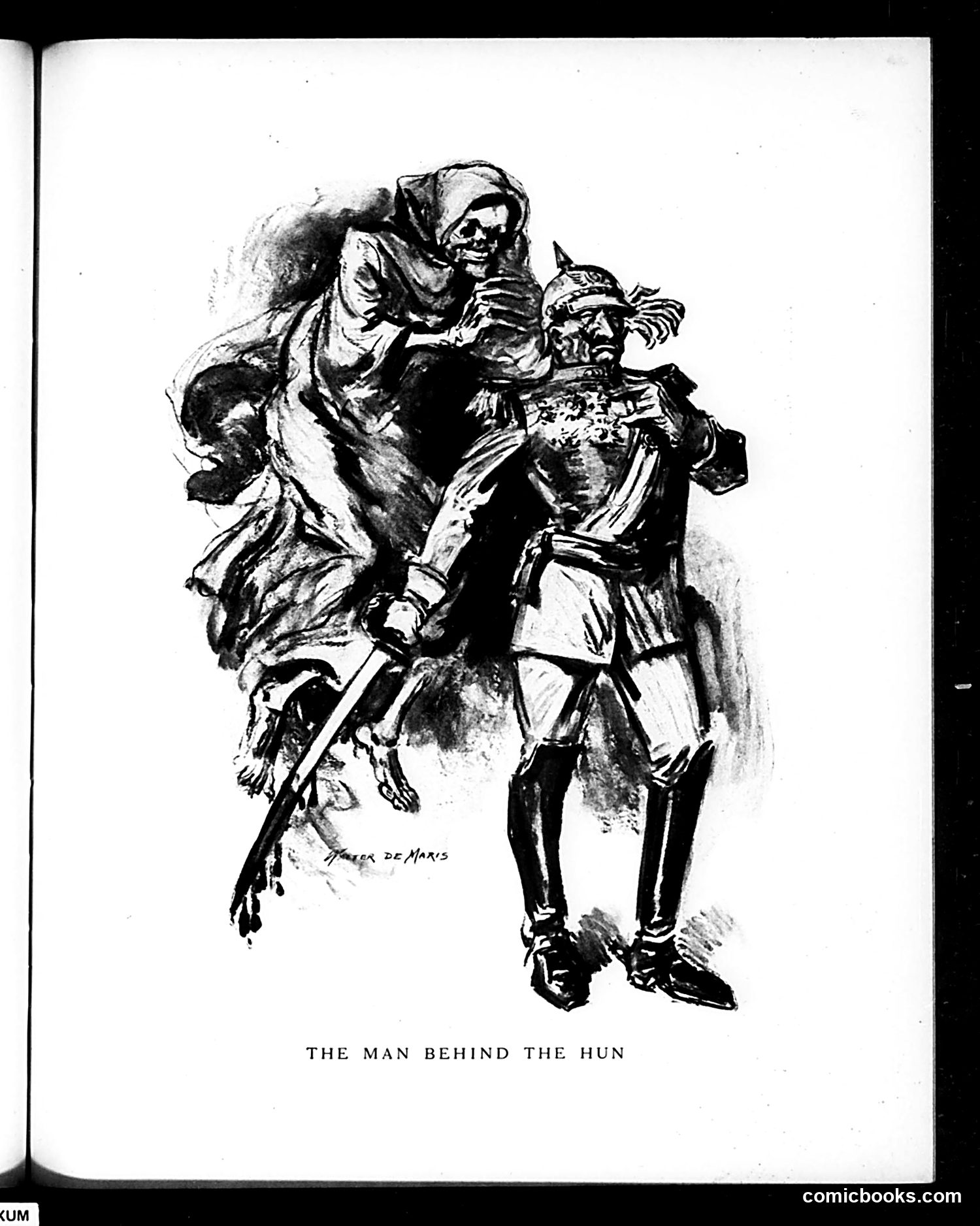
This satirical illustration from *Judge* magazine depicts a skeletal Death figure looming behind a German military officer in full uniform with a spiked Prussian helmet. The artwork uses the common World War I-era metaphor of Death as the hidden force orchestrating German aggression—the "man behind" driving the conflict. The cartoon reflects American anti-German propaganda from the WWI period, portraying German militarism as inherently linked to death and destruction. The skeletal personification suggests that German leadership brought only carnage and mortality to Europe. This type of imagery was standard in Allied propaganda to dehumanize the enemy and rally public support for the war effort against Germany.
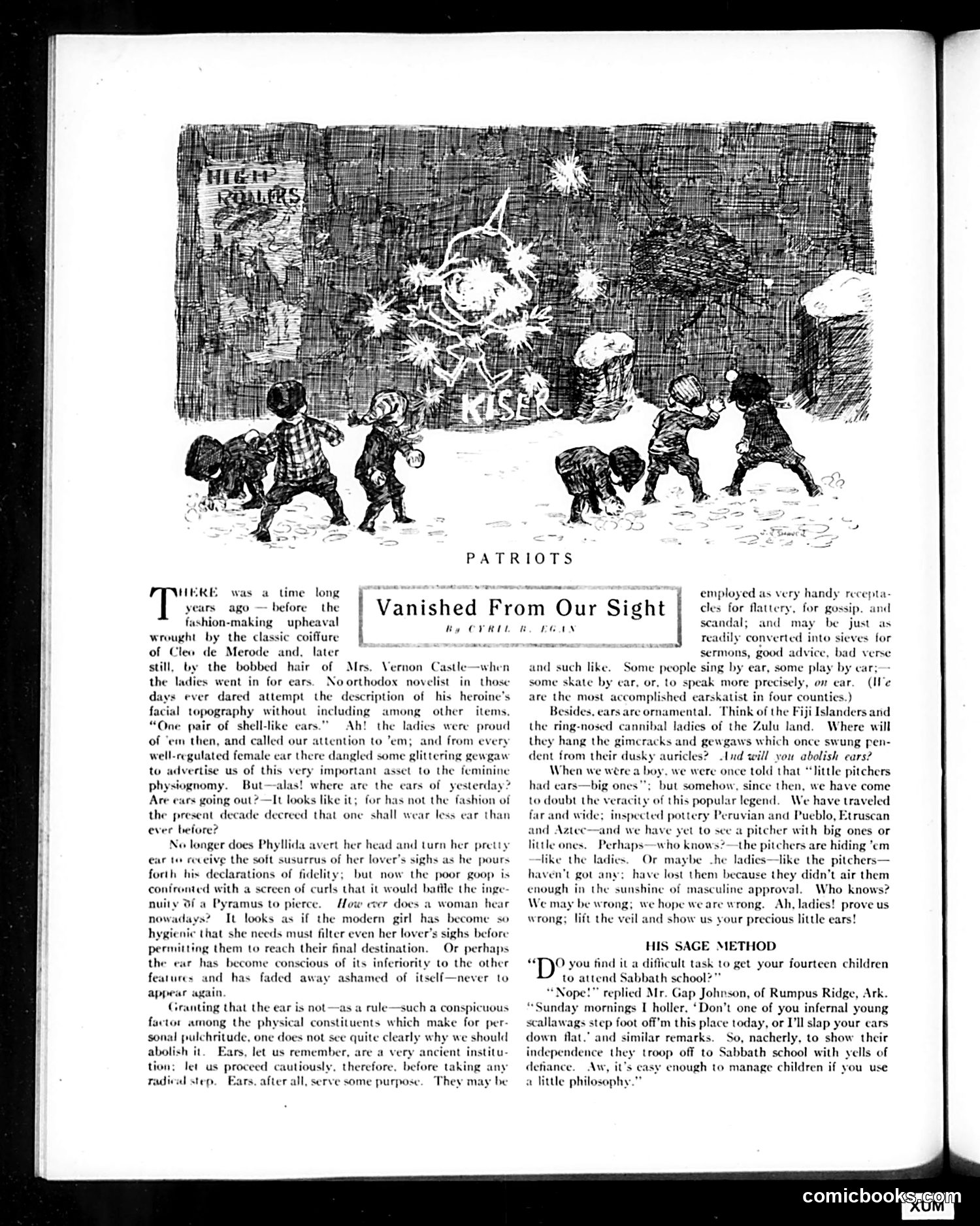
This humorous essay satirizes the fashion trend of bobbed hair and head-hugging styles (associated with dancers Cleo de Merode and Mrs. Vernon Castle) that have made women's ears invisible. The author laments that Victorian-era "shell-like ears" — once considered beautiful feminine features worthy of jewelry — have disappeared from view. The satire operates on multiple levels: it mocks women's fashion obsession, the decline of romantic gestures (lovers can no longer hear whispers), and social pretension. References to "Fiji Islanders" and "Zulu" women with ear ornaments, plus absurd discussions of pitchers with ears, underscore the piece's tongue-in-cheek tone. The bottom section, "His Sage Method," provides comic relief: a rural father claims controlling fourteen children is simple—he forbids them from leaving home, so they rebelliously attend Sabbath school anyway. The joke: reverse psychology through parental authority, presented as folk wisdom. Together, these pieces mock both fashionable society and rural folk traditions.
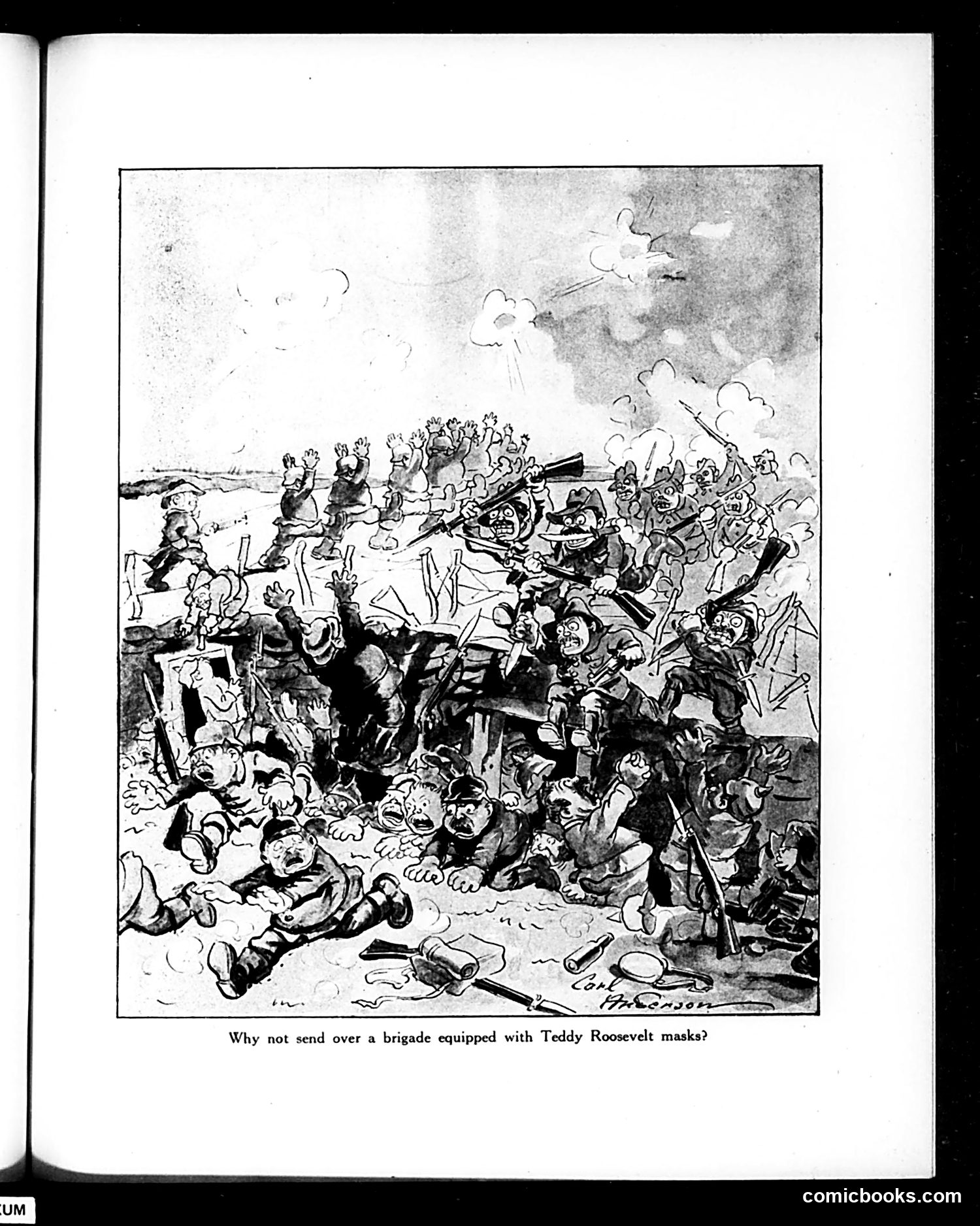
This cartoon satirizes American military strategy during what appears to be World War I. The caption asks sarcastically, "Why not send over a brigade equipped with Teddy Roosevelt masks?" The image depicts a chaotic battlefield scene with soldiers in combat. The joke suggests that sending American troops wearing Theodore Roosevelt masks—playing on Roosevelt's famous reputation as a tough, aggressive "Rough Rider"—might intimidate enemy forces into surrender, rendering actual military hardware unnecessary. This mocks both Roosevelt's outsized public persona and American political debates about military preparedness and intervention strategy. The cartoon implies that relying on Roosevelt's fearsome image as a substitute for actual military resources would be foolishly ineffective, satirizing those who might overestimate psychological warfare versus genuine military capability.
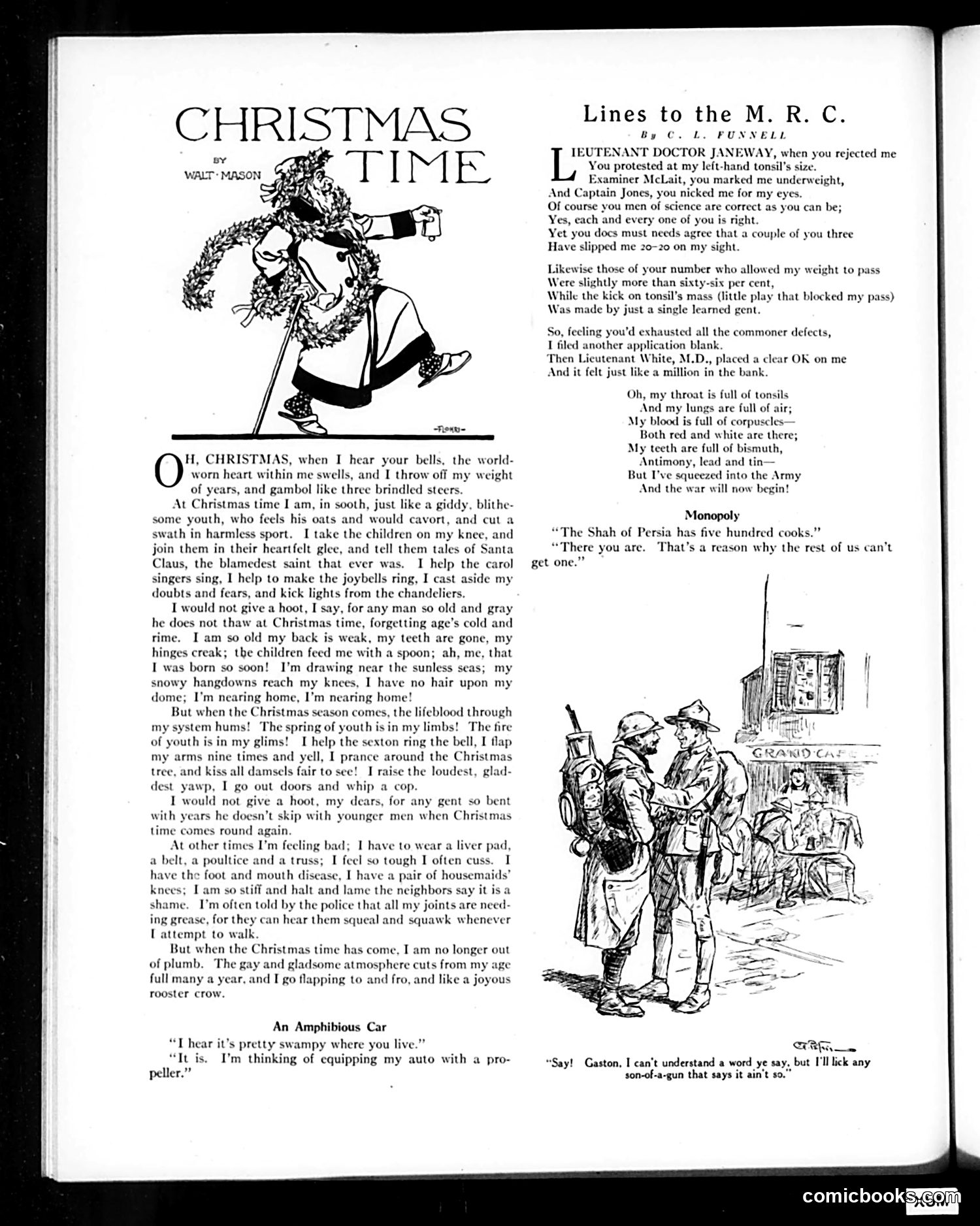
**"Christmas Time" (Main Poem)**: Walt Mason's sentimental verse celebrates how Christmas rejuvenates the elderly and infirm. The narrator, though crippled by age—toothless, weak-backed, suffering from "foot and mouth disease"—becomes youthful and energetic during the holiday season. He "whips a cop" and kisses women, temporarily escaping his physical deterioration. The satire gently mocks both aging and Christmas's supposed magical restorative powers. **"Lines to the M.R.C." (Right Column)**: This poem satirizes military medical examiners rejecting a volunteer soldier. Various doctors find different physical defects (tonsil size, weight, eyesight), but their assessments contradict each other. Finally, one doctor approves him. The joke: despite being physically unfit, he's cleared for service—suggesting the Army's desperation for recruits or the arbitrary nature of medical standards during wartime (likely WWI-era). **Minor pieces**: "An Amphibious Car" and "Monopoly" are brief jokes about swampy land and Persian cooks monopolizing kitchen staff.
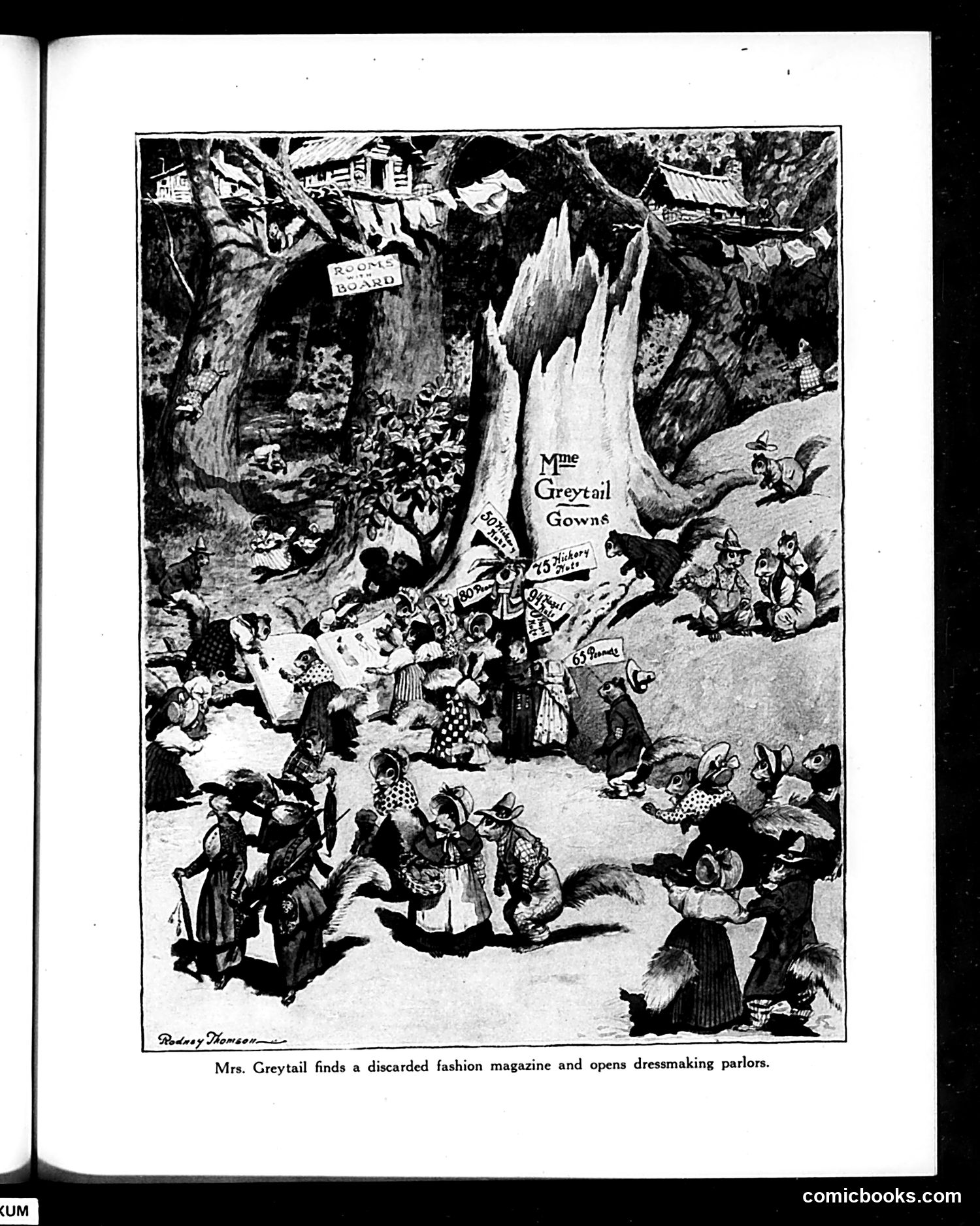
This is a whimsical illustration by Rodney Thomson showing anthropomorphic animals (appearing to be mice or rats) in a woodland setting. Mrs. Greytail, having discovered an abandoned fashion magazine, has established a dressmaking business beneath a large tree. The satire likely mocks the era's fashion industry and aspirations—even woodland creatures now desire fashionable dress based on discarded human magazines. Various animal customers and workers are depicted around the makeshift parlor, some carrying price signs and garments. The humor derives from the incongruity of applying human fashion commerce to animal society, and possibly satirizes how easily trends spread and how people (or animals) pursue fashionable clothing regardless of practicality. This appears to be a humorous social commentary on consumerism and fashion obsession through the lens of animal fantasy.
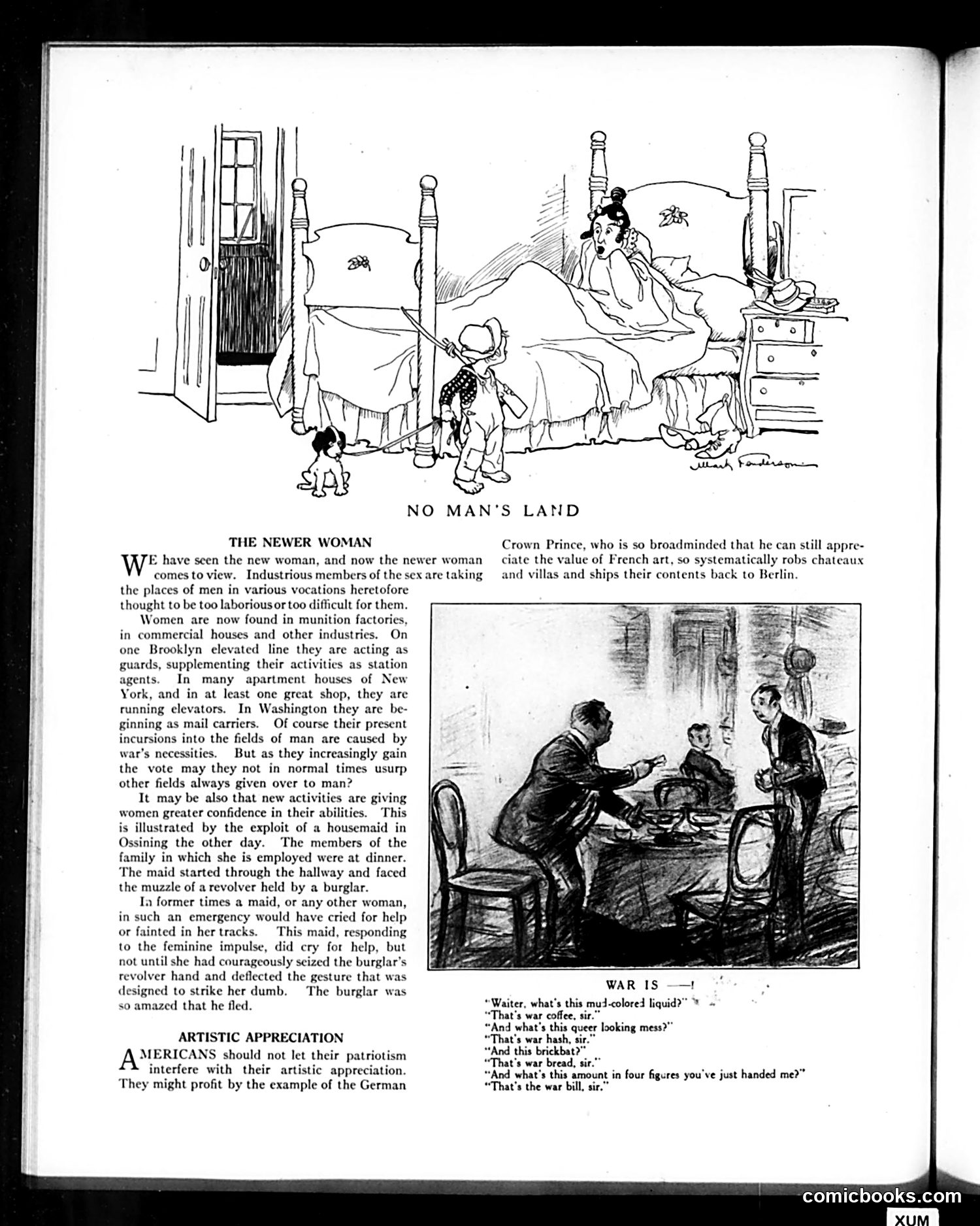
This Judge magazine page satirizes three wartime topics (WWI era): **"No Man's Land" (top cartoon):** Shows a woman in bed while a child and man stand nearby—likely mocking the irony that women are taking "men's jobs" in factories and as mail carriers during wartime labor shortages, yet domestic spheres remain unchanged. **"The Newer Woman" (main article):** Celebrates women entering previously male-only occupations (munitions factories, elevators, mail delivery) due to war necessity, while questioning whether they'll retain these roles peacetime. A heroic anecdote describes a housemaid disarming a burglar—suggesting war gives women confidence and capability. **"War Is—!" (bottom cartoon):** A waiter-diner dialogue joke where "war coffee," "war hash," and a bloated "war bill" represent inflation and poor wartime rationing—the final line sarcastically blames "the war" for extortionate pricing. The German Crown Prince reference (robbing French art) reflects anti-German sentiment common in American WWI-era satire.
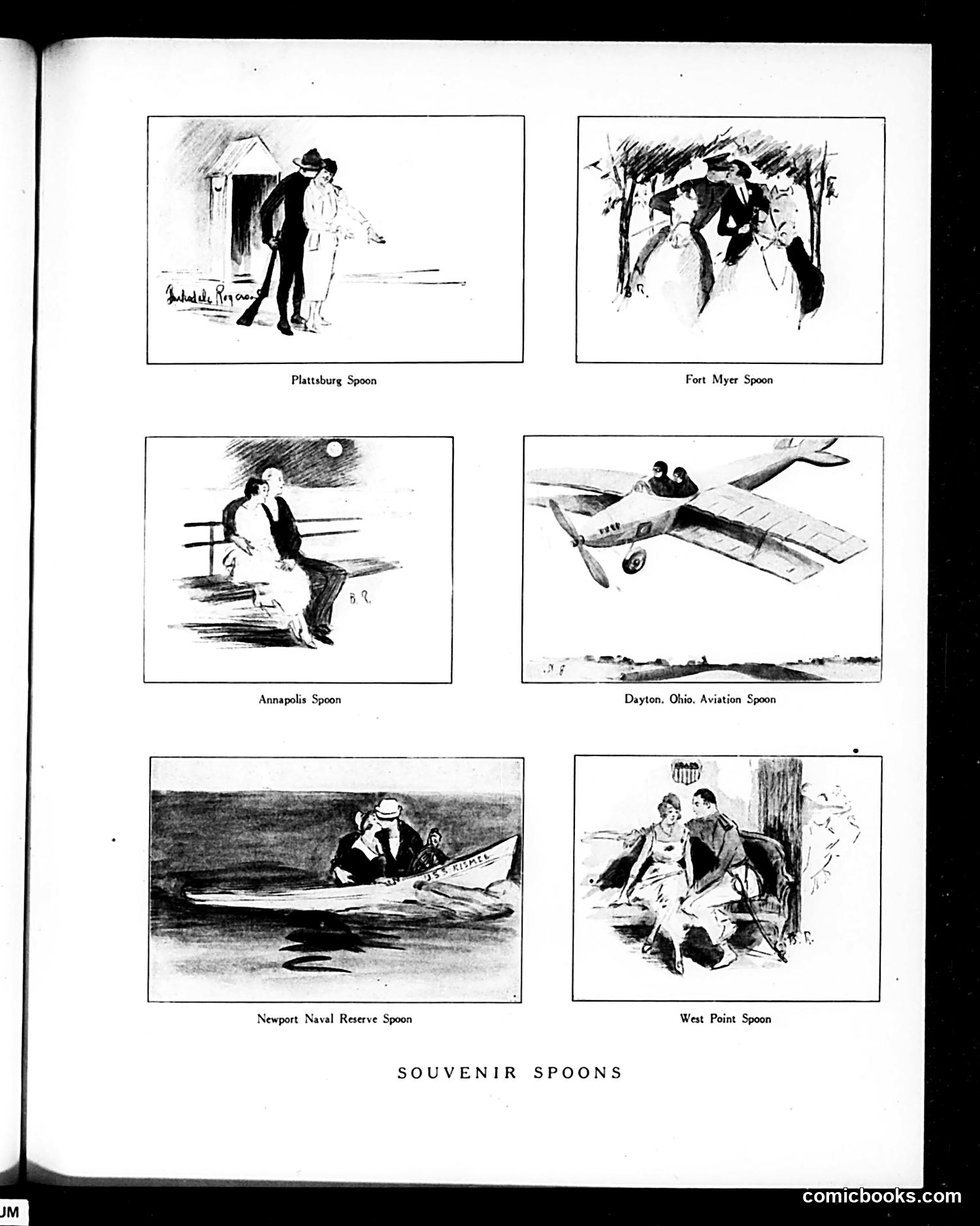
This page mocks the early 20th-century craze for collecting decorative "souvenir spoons"—miniature spoons commemorating places and institutions. Each cartoon depicts a humorous scenario at a famous American military or naval location: Plattsburg, Fort Myer, Annapolis, Dayton (aviation), Newport Naval Reserve, and West Point. The satire appears to criticize either the commercialization of these institutions through trivial merchandise, or perhaps the militaristic enthusiasm of the era. The illustrations show people awkwardly obtaining these spoons—some in compromising or absurd situations—suggesting the ridiculous nature of collecting such items as meaningful mementos. The page likely appeals to Judge magazine's audience by poking fun at what was probably seen as a frivolous consumer trend, while simultaneously referencing America's military preparedness during a period of growing defense consciousness.
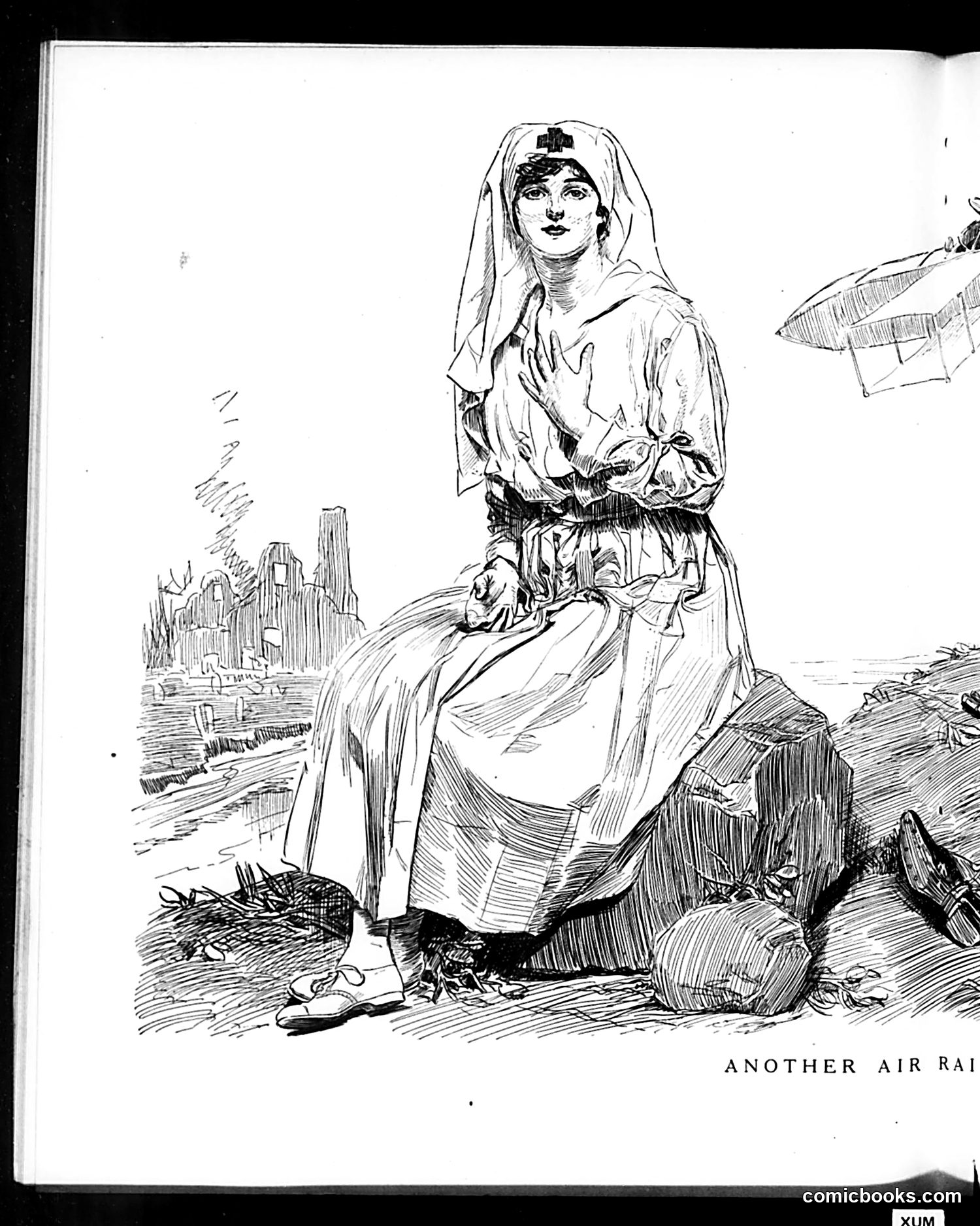
This appears to be a pen-and-ink illustration from Judge magazine showing a woman in traditional Eastern European or Russian peasant dress—identifiable by her headscarf, long skirt, and simple blouse—standing amid rubble and destruction. The partial caption "ANOTHER AIR RAI[D]" suggests this depicts air raid damage, likely referencing World War II bombing campaigns. The woman's solemn expression and the devastated cityscape behind her convey the human cost of aerial warfare. Without the complete caption or additional context, the specific satirical point is unclear—whether this critiques bombing strategy, civilian suffering, or another aspect of wartime policy. The image effectively uses the contrast between the stoic figure and surrounding destruction to evoke pathos rather than humor.
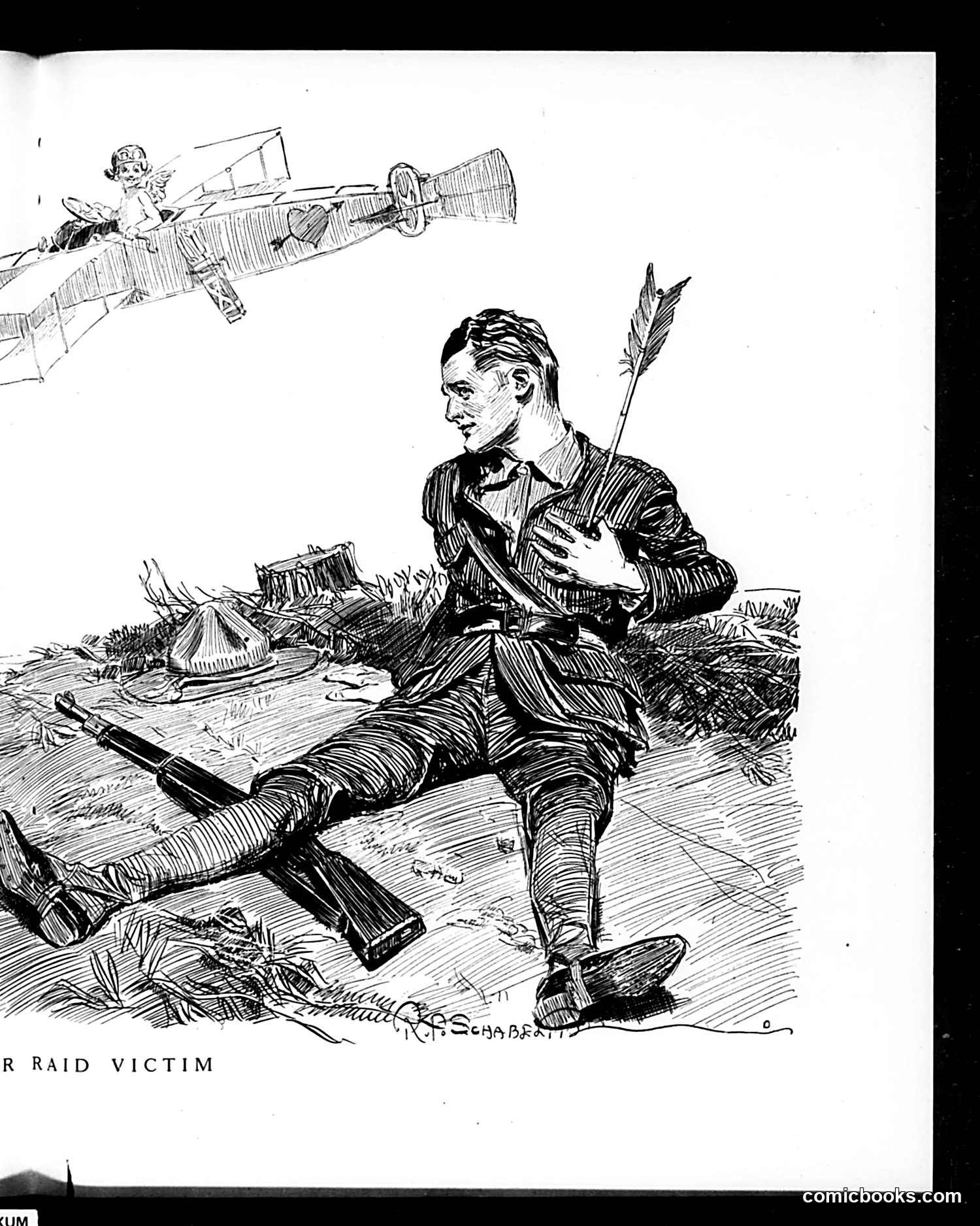
This cartoon depicts a wounded soldier sitting amid battlefield debris—overturned helmets, scattered equipment, and destroyed fortifications. An arrow protrudes from his chest. Above, a small figure (likely representing an enemy aircraft or pilot) operates what appears to be an early aircraft with mounted weapons. The title "Air Raid Victim" indicates this is satirizing aerial bombardment. Given Judge magazine's American satirical focus, this likely comments on WWI aerial warfare or early aviation military tactics. The ironic juxtaposition—a soldier armed with conventional weapons now vulnerable to attack from above—underscores how aviation fundamentally changed warfare by introducing a dimension beyond traditional ground combat. The cartoon's point appears to be highlighting the new vulnerability modern soldiers faced from this emerging threat.
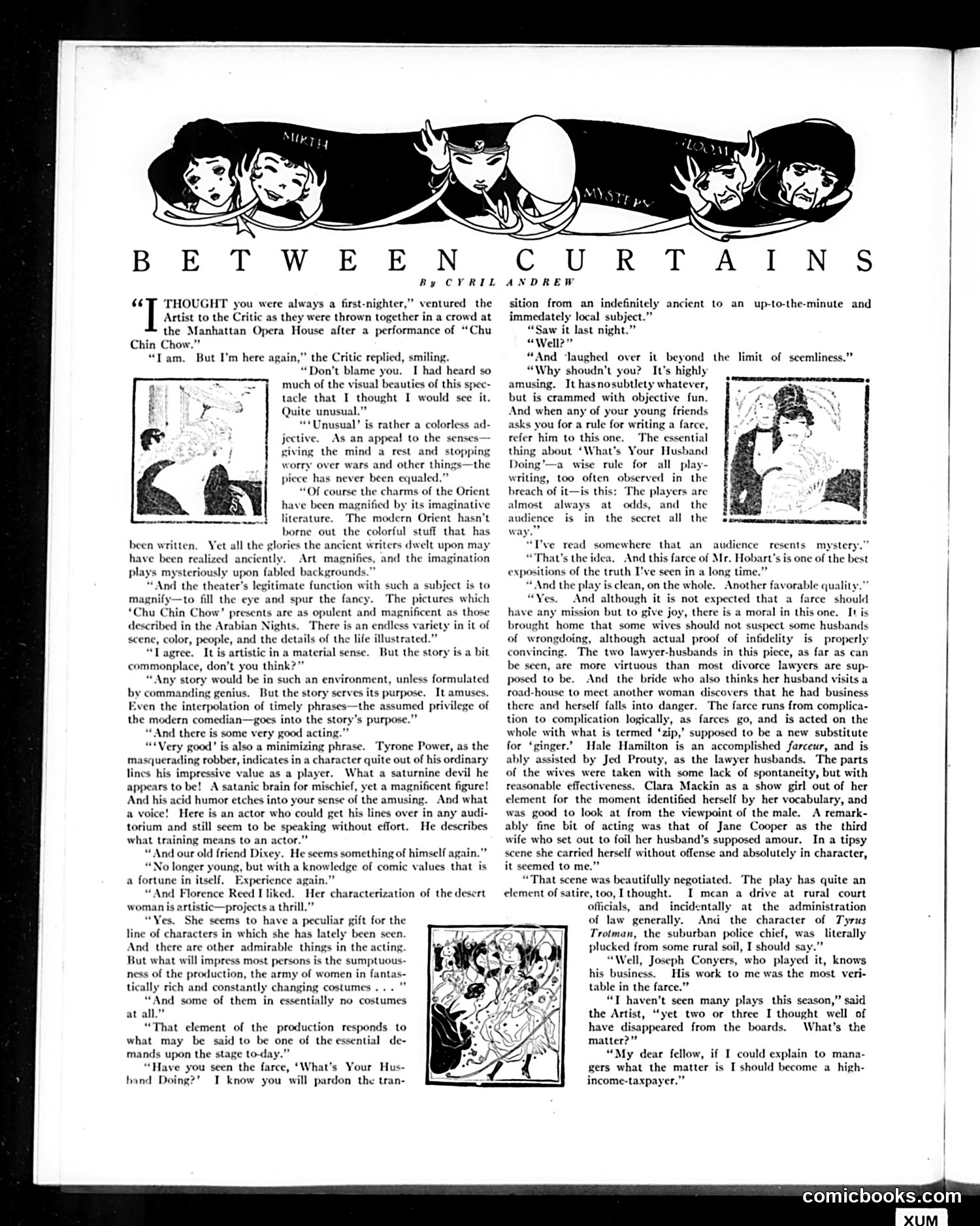
This is a theatrical criticism piece, not a political cartoon. Two men—an Artist and a Critic—discuss the Broadway production "Chu Chin Chow" at the Manhattan Opera House. The satire targets theatrical criticism itself. The Critic initially claims he never attends opening nights, yet the Artist catches him in contradiction. Their subsequent conversation reveals the Critic's verbose, grandiose style ("minimizing phrase," elaborate descriptions) contrasts with practical theatrical wisdom. The piece mocks how critics use ornate language to justify spectacle over substance—praising "Chu Chin Chow" for its visual magnificence and opulent sets (comparing them to *Arabian Nights*) while admitting the story is "commonplace." The Critic defends this as theater's legitimate function: to "magnify" and please the eye. The subplot discussion of the farce "What's Your Husband Doing?" suggests even shallow entertainment has value if executed well—another dig at pretentious criticism that overanalyzes simple amusement.
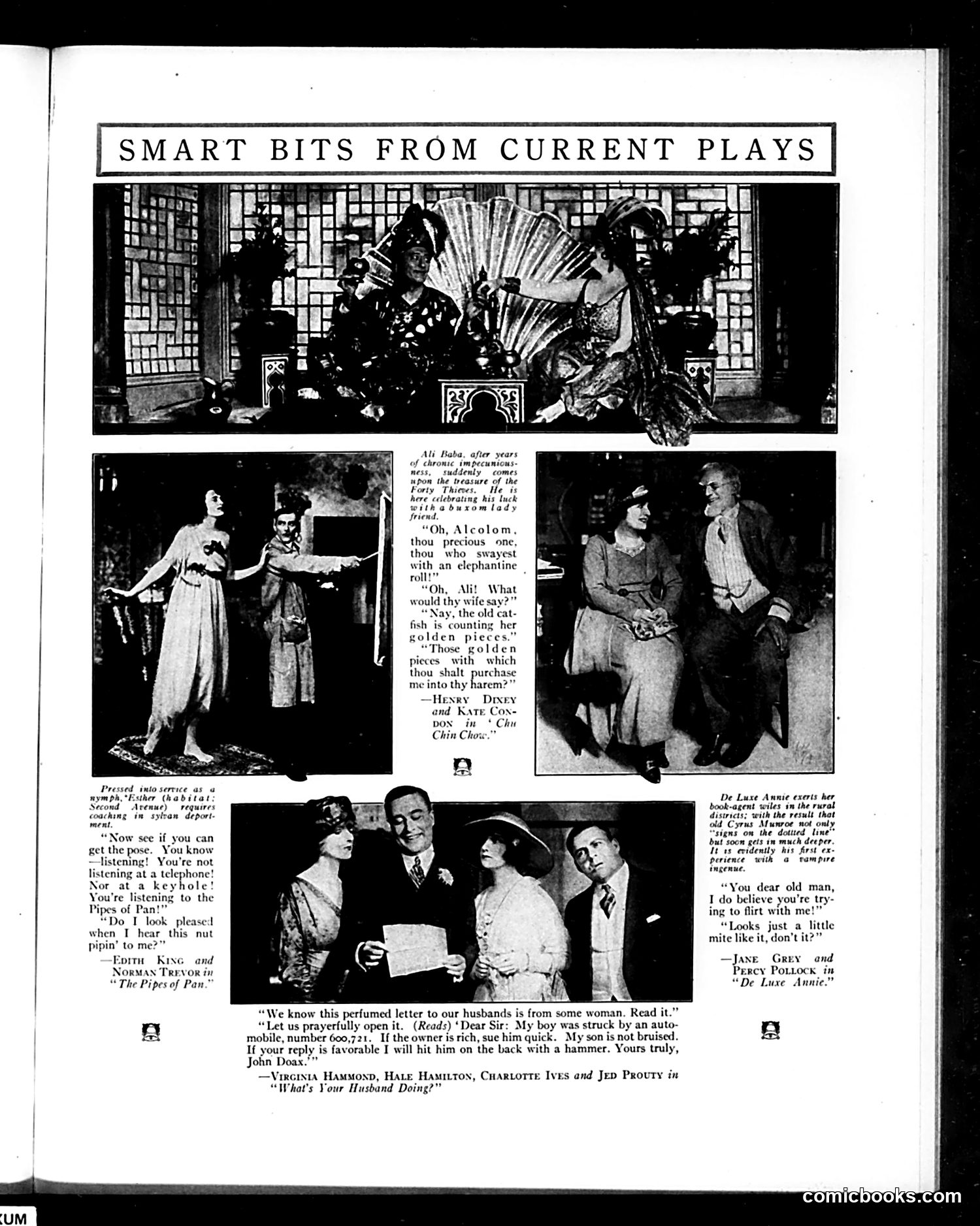
This page showcases humorous dialogue excerpts from Broadway productions of the era (likely 1910s-1920s). The content satirizes theatrical conventions and contemporary social types: **"The Pipes of Pan"**: Mocks amateur theatrics—a street woman ("Esther from Second Avenue") awkwardly coached to play a woodland nymph, unconvincingly attempting a "listening" pose. **"Chu Chin Chow"**: Parodies orientalist fantasy and male delusion. An Arab character celebrates newfound treasure while his companion fixates on materialism ("counting her golden pieces"), highlighting shallow greed masquerading as romance. **"De Luxe Annie"**: Satirizes female con artists ("vampires") exploiting rural marks. An insurance agent succumbs to Annie's seduction, humorously suggesting male gullibility. **"What's Your Husband Doing?"**: Absurdist comedy about suspicious wives intercepting a perfumed letter. The punchline—a scam letter from a woman claiming her son was hit by a car, requesting money and promising to "hit him on the back with a hammer"—mocks both marital paranoia and transparent fraud schemes.
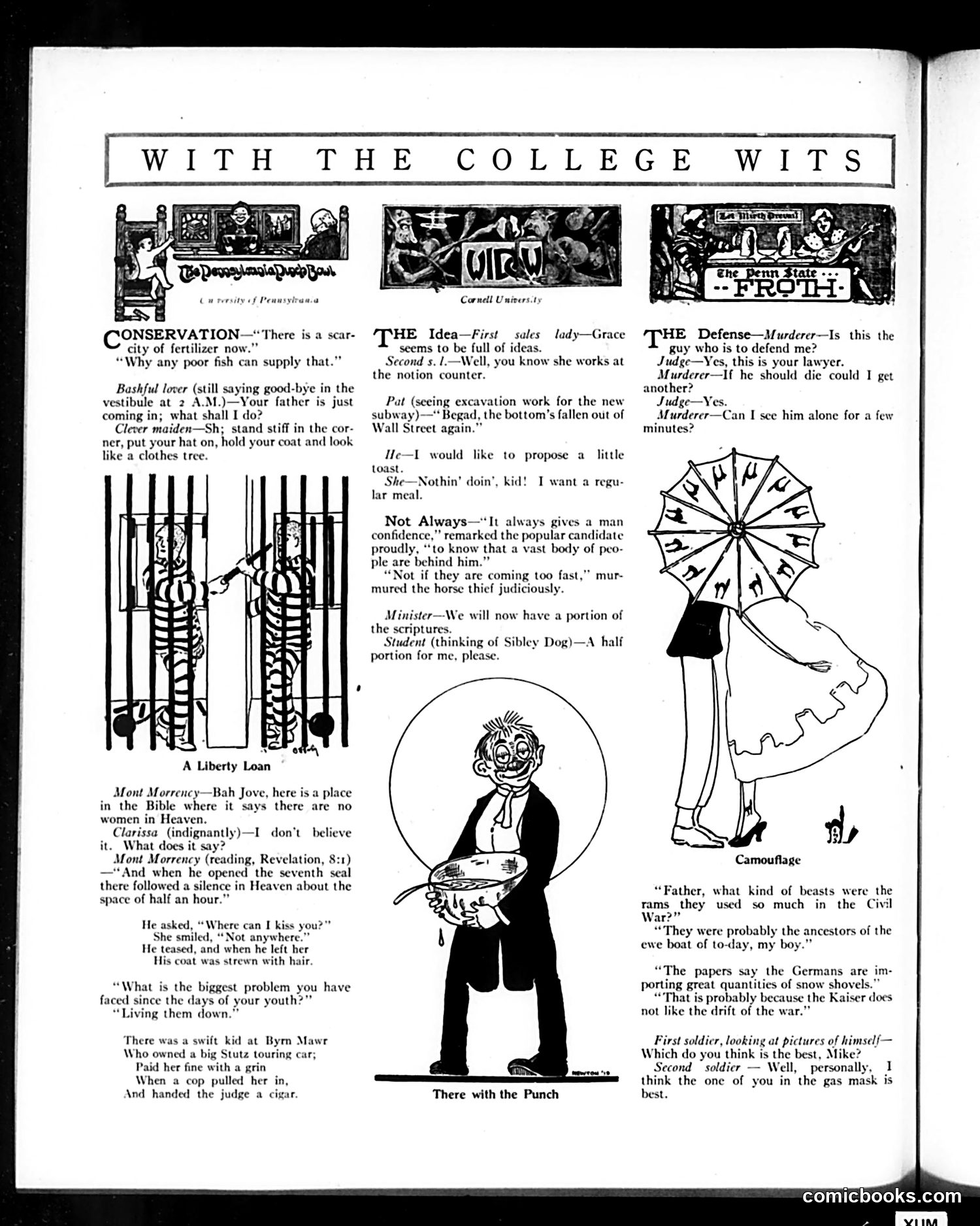
This page collects brief satirical jokes and cartoons typical of Judge's format during the World War I era (references to "Liberty Loan," "Germans," and "Civil War" suggest early 1900s-1910s). **Key content:** - **"A Liberty Loan"** cartoon: A bashful young man hides like a "clothes tree" when his girlfriend's father arrives—satirizing awkward courtship customs. - **Various one-liners mock** college life, romance, and social pretension (e.g., a wealthy Bryn Mawr girl bribes a judge with a cigar). - **War-era humor**: References to fertilizer scarcity, German snow shovels, and gas masks reflect WWI anxieties. - **"There with the Punch"** illustration: Shows a man serving food, captioning social commentary about confidence and criminals. The humor relies on period-specific social codes: strict gender propriety, class consciousness, and wartime concerns now largely unfamiliar to modern readers.
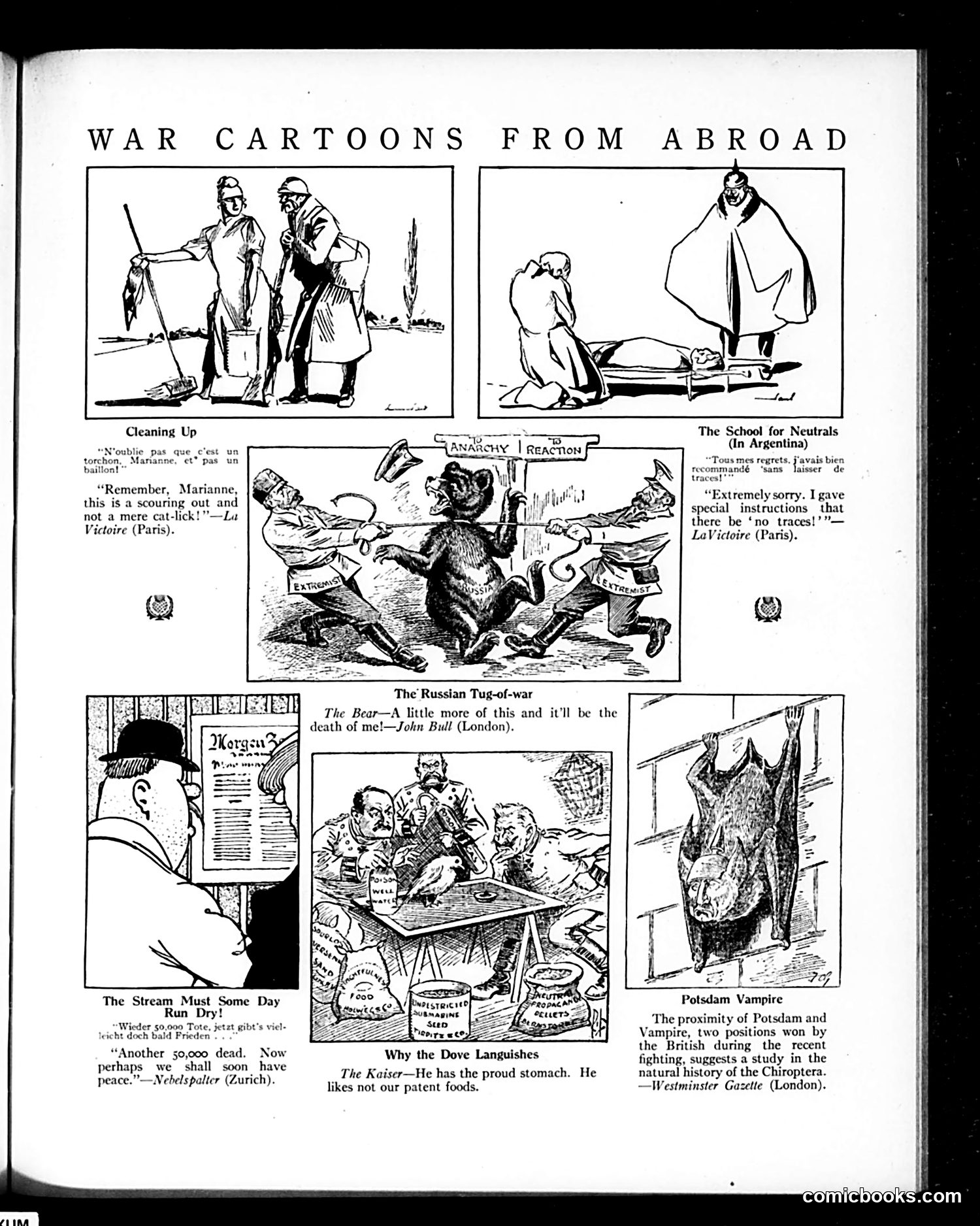
This Judge page reprints anti-German political cartoons from Allied publications during WWI, offering international perspectives on the war. **Key cartoons:** - **"The Russian Tug-of-war"**: Russia (depicted as "The Bear") is being pulled apart, suggesting the strain of fighting Germany—a comment on Russia's weakening position (this likely refers to pre-1917 Russian exhaustion). - **"Why the Dove Languishes"**: The Kaiser refuses "patent foods," satirizing Germany's food shortages and blockade suffering. - **"The School for Neutrals"**: France warns Argentina (a neutral) about leaving "no traces"—mocking nations that claim neutrality while covertly aiding Germany. - **"Potsdam Vampire"**: A vampire represents Germany draining resources; "Potsdam" (German military seat) is juxtaposed with an actual place name, suggesting vampiric predation. The cartoons use exaggeration and animal symbolism to mock German militarism, war suffering, and alleged hypocrisy by neutrals.
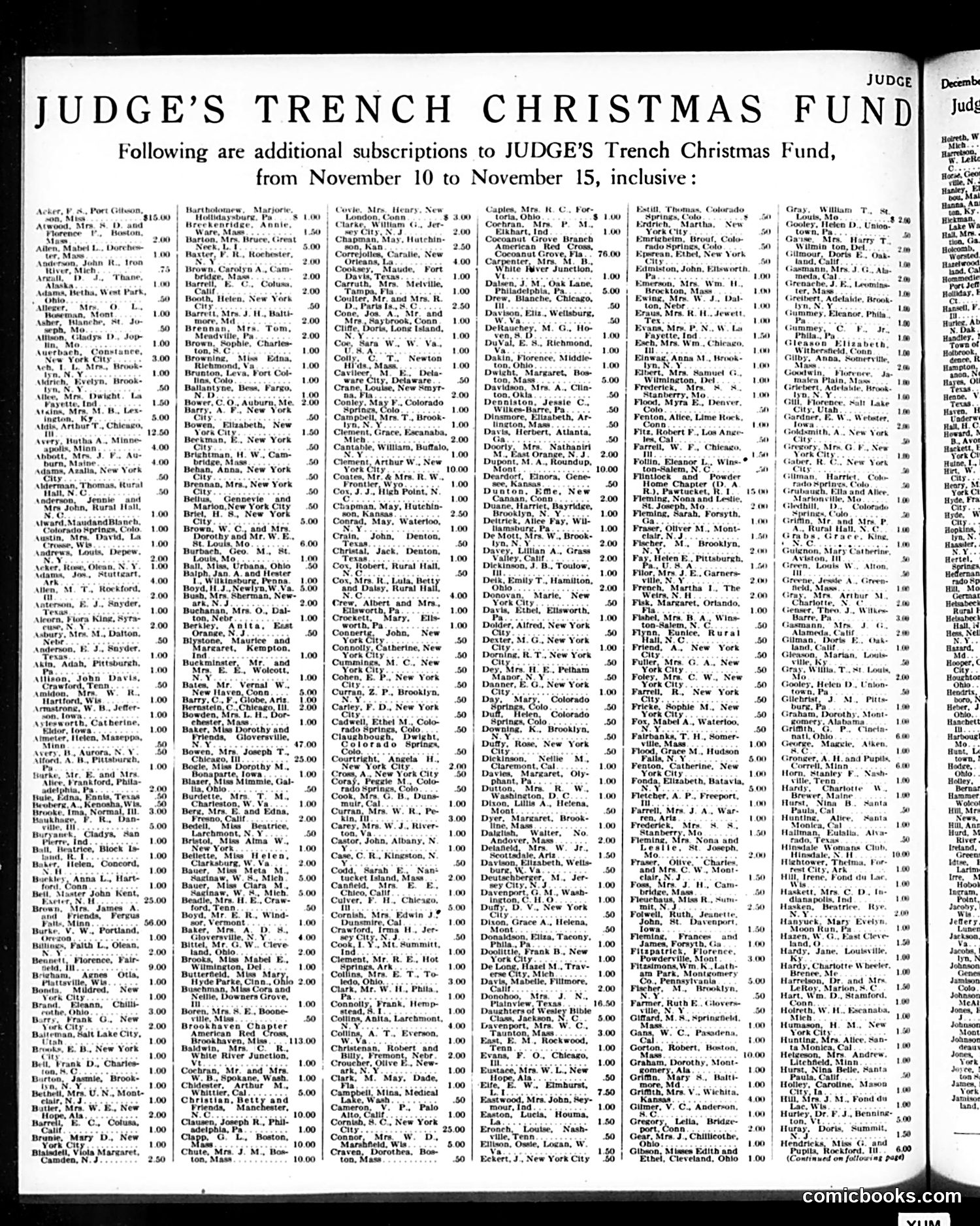
This page is **not a cartoon or satirical content** — it's a **charitable subscription list** for Judge magazine's "Trench Christmas Fund," collecting donations from November 10-15 (year unclear from image, but likely WWI-era based on "Trench" reference). The fund appears to support soldiers in WWI trench warfare. The page lists hundreds of individual and group donors — primarily women's names, families, and organizations (like the American Red Cross chapter) — contributing amounts ranging from 50 cents to $113. This reflects **home-front charitable mobilization** during wartime, when American civilians collected money for troops. The multiple columns of small-print names demonstrate the broad public participation in patriotic fundraising. This type of content was common in American magazines during the Great War period.
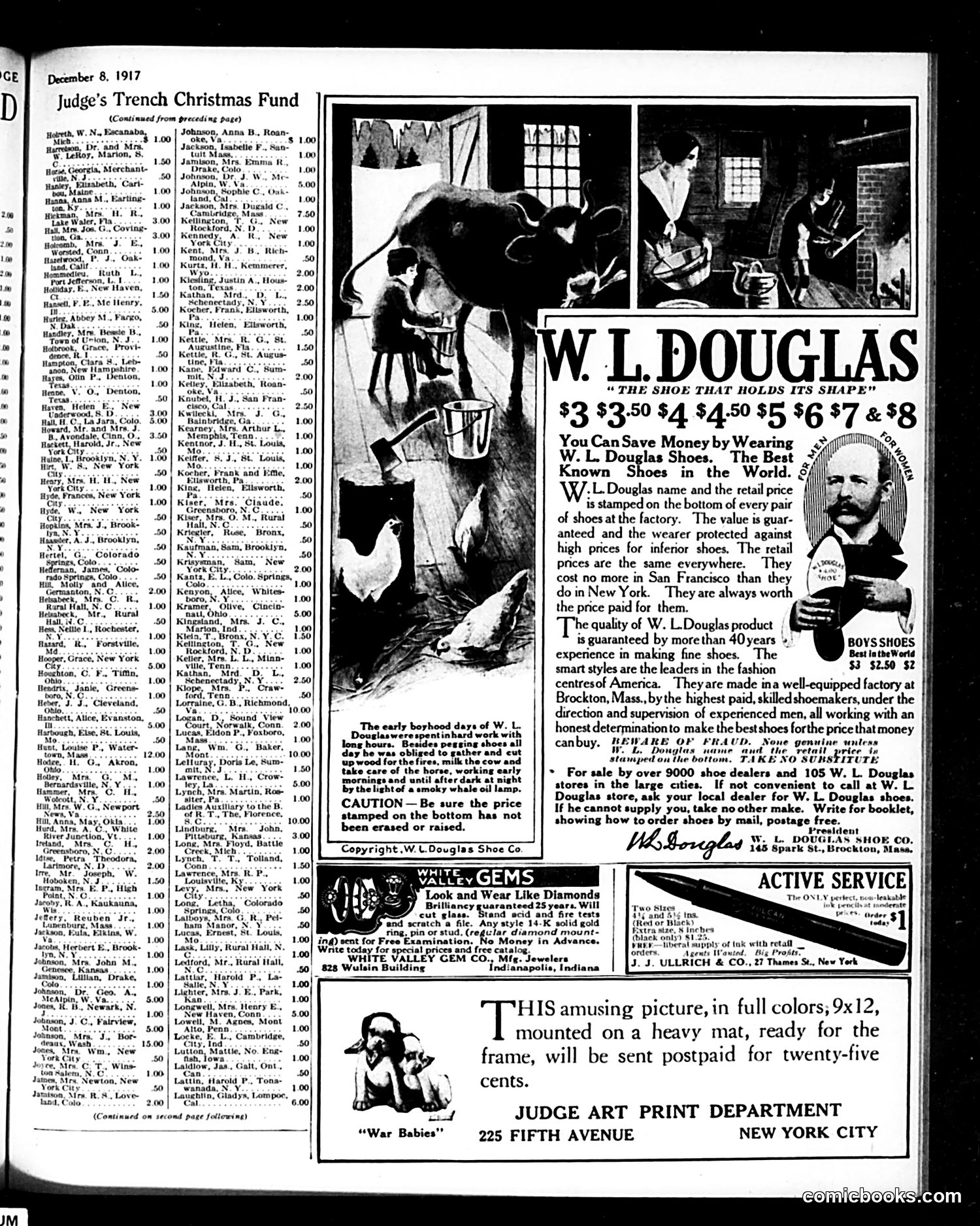
This page is primarily a **charitable fundraising list** rather than satirical content. The left column shows "Judge's Trench Christmas Fund"—donations from readers to support American soldiers in World War I trenches (the U.S. entered WWI in April 1917). The donations range from 50 cents to $12, representing widespread public support for troops. The right side features **advertisements**, including a prominent W. L. Douglas shoe ad emphasizing affordable, quality footwear available nationwide at consistent prices—a selling point during wartime inflation. A White Valley Gem jewelry ad and an "Active Service" ad (partially visible) also appear. A small cartoon labeled "War Babies" shows a dog, likely a generic illustration rather than political satire. The page reflects **1917 American home-front patriotism**: civilian charitable giving to soldiers combined with consumer advertising continuing normally during wartime.
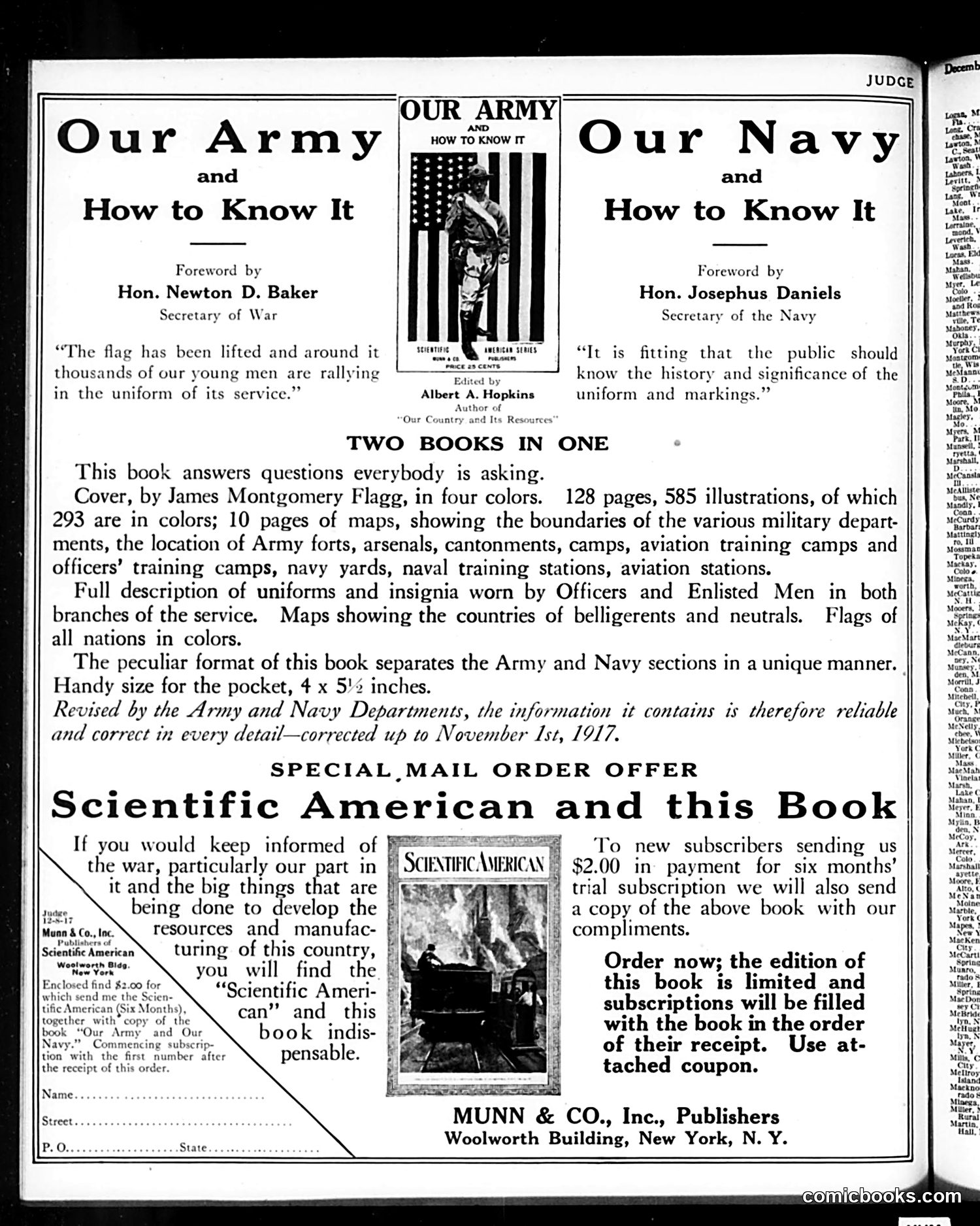
This page is primarily a book advertisement, not a satirical cartoon. It promotes two military handbooks (Army and Navy) edited by Albert A. Hopkins, endorsed by Secretary of War Newton D. Baker and Secretary of the Navy Josephus Daniels. The content is patriotic rather than satirical, designed to help Americans understand military uniforms, insignia, and organization during World War I (dated November 1, 1917). A secondary advertisement offers the book as a promotional incentive for *Scientific American* subscriptions. The implied appeal: by subscribing to a science magazine and purchasing this military reference guide, readers support America's war effort through informed citizenship. The cover illustration by James Montgomery Flagg (famous for "I Want YOU" recruitment posters) reinforces the patriotic theme with a soldier and flag imagery.
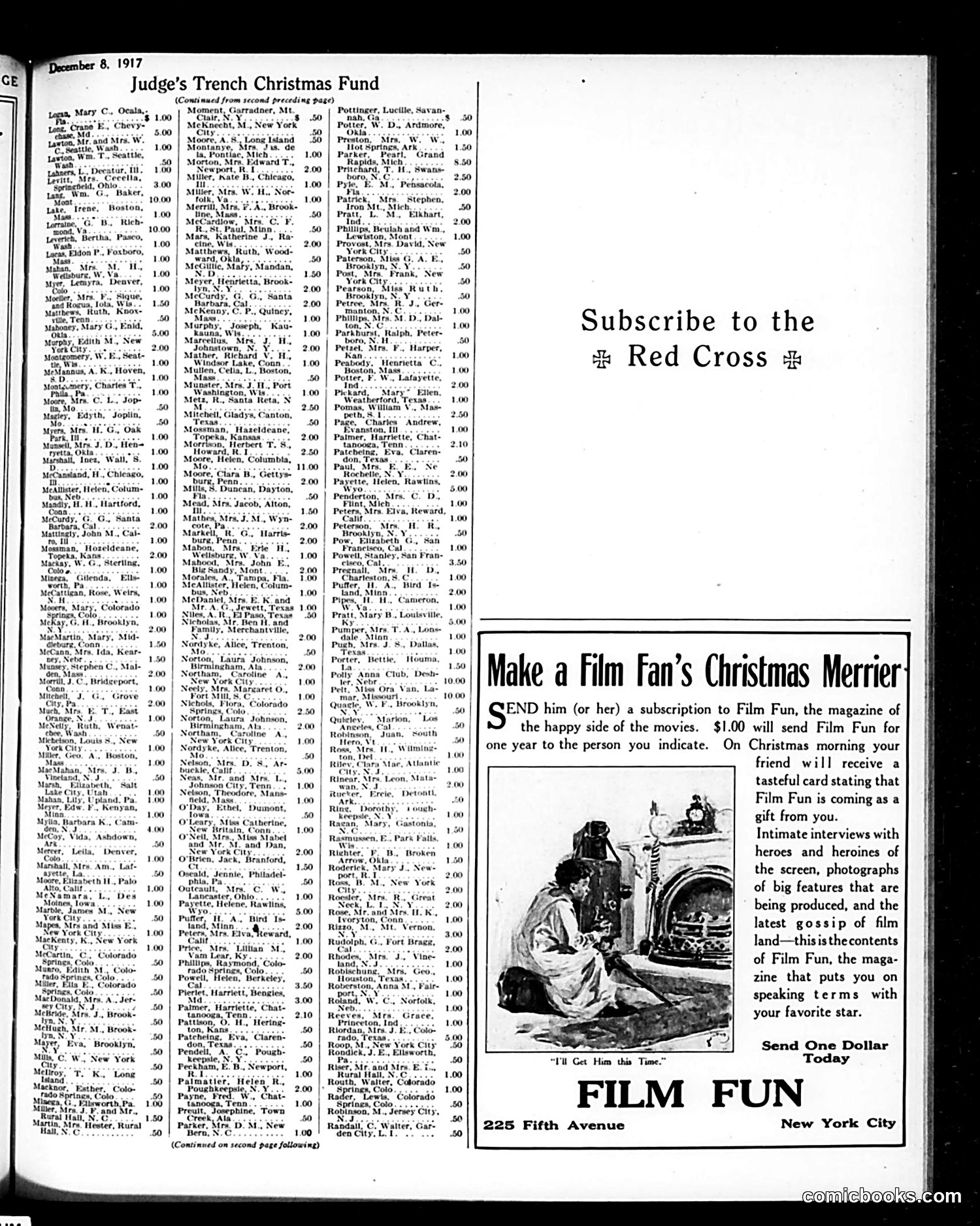
This page is primarily a **charitable donation list**, not a political cartoon. It shows contributions to the "Judge's Trench Christmas Fund"—a fundraising effort by Judge magazine to send Christmas packages to American soldiers fighting in World War I (the U.S. entered the war in April 1917). The left column lists hundreds of donors' names and contribution amounts, ranging from 50 cents to $11.00. The right side contains two advertisements: one promoting Red Cross subscriptions, and another advertising "Film Fun" magazine as a Christmas gift. The context: In 1917, American soldiers serving in European trenches faced brutal conditions. Judge magazine, a popular satirical publication, mobilized its readership to support troops through this charitable fund. The advertisements on the same page reflect patriotic wartime messaging—the Red Cross appeal and the offer to send entertainment (film magazines) to soldiers to boost morale. This represents American civilian support for World War I efforts through both direct fundraising and morale-boosting initiatives.
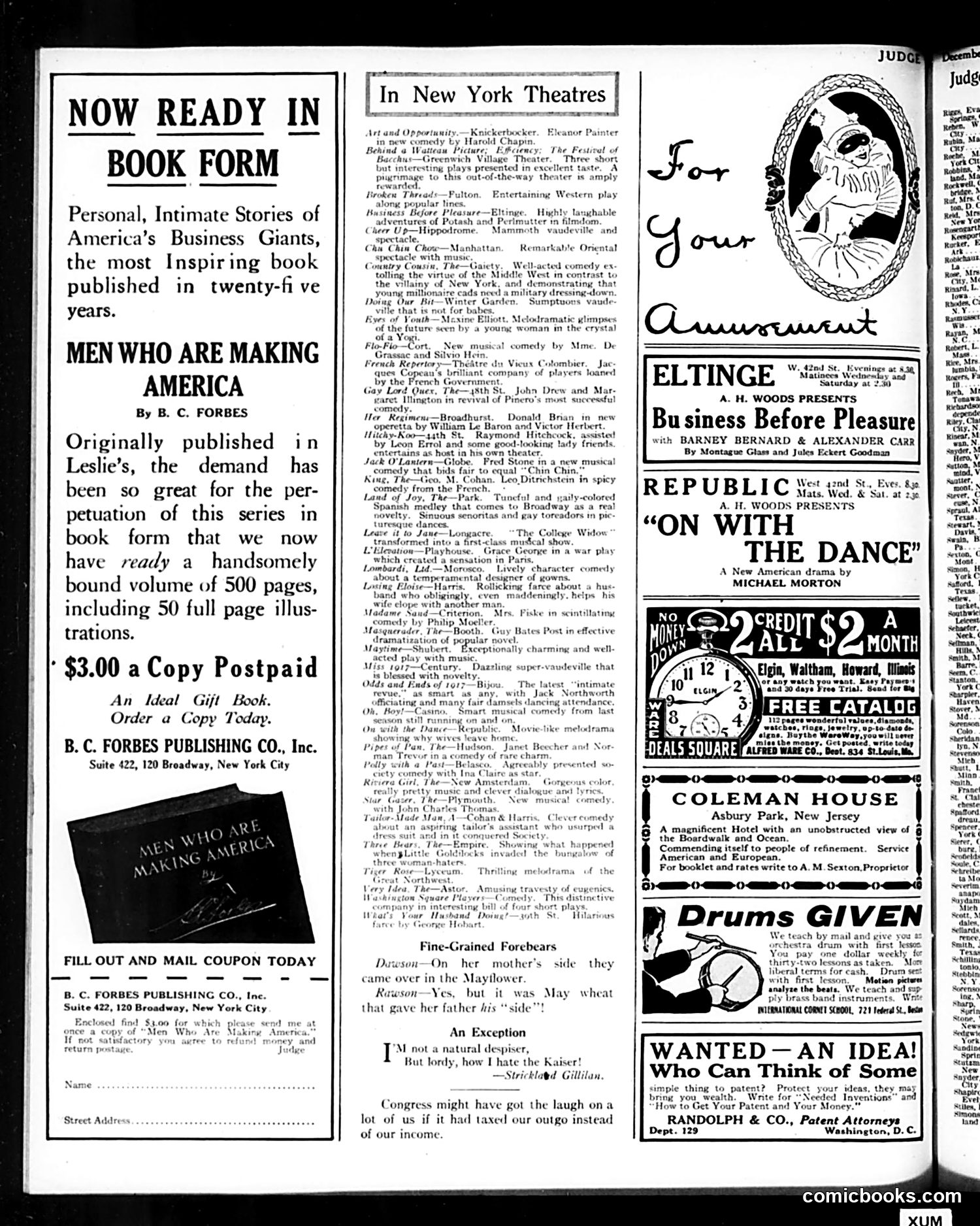
This page is primarily **advertising and theater listings** rather than political satire. The dominant content includes: **Book Advertisement** (left): B.C. Forbes Publishing promotes "Men Who Are Making America," a collection of business profiles originally serialized in *Leslie's* magazine. This reflects early 20th-century American celebration of industrialists and entrepreneurs as cultural heroes. **Theater Listings** (center): Extensive New York theater advertisements promoting Broadway shows and musicals of the era. **Minor Humor** (bottom): Two brief jokes—one about a woman's ancestry ("Fine-Grained Forebears"), the other anti-Kaiser sentiment ("An Exception"), reflecting WWI-era attitudes. A third quip jokes about taxation. **Miscellaneous Ads** (right): Hotels, music lessons, patent attorneys—typical period advertising. The page contains **no significant political cartoons or satire**. Its satirical content is limited to short, mild jokes that don't require historical context beyond general familiarity with WWI sentiment and period humor conventions.
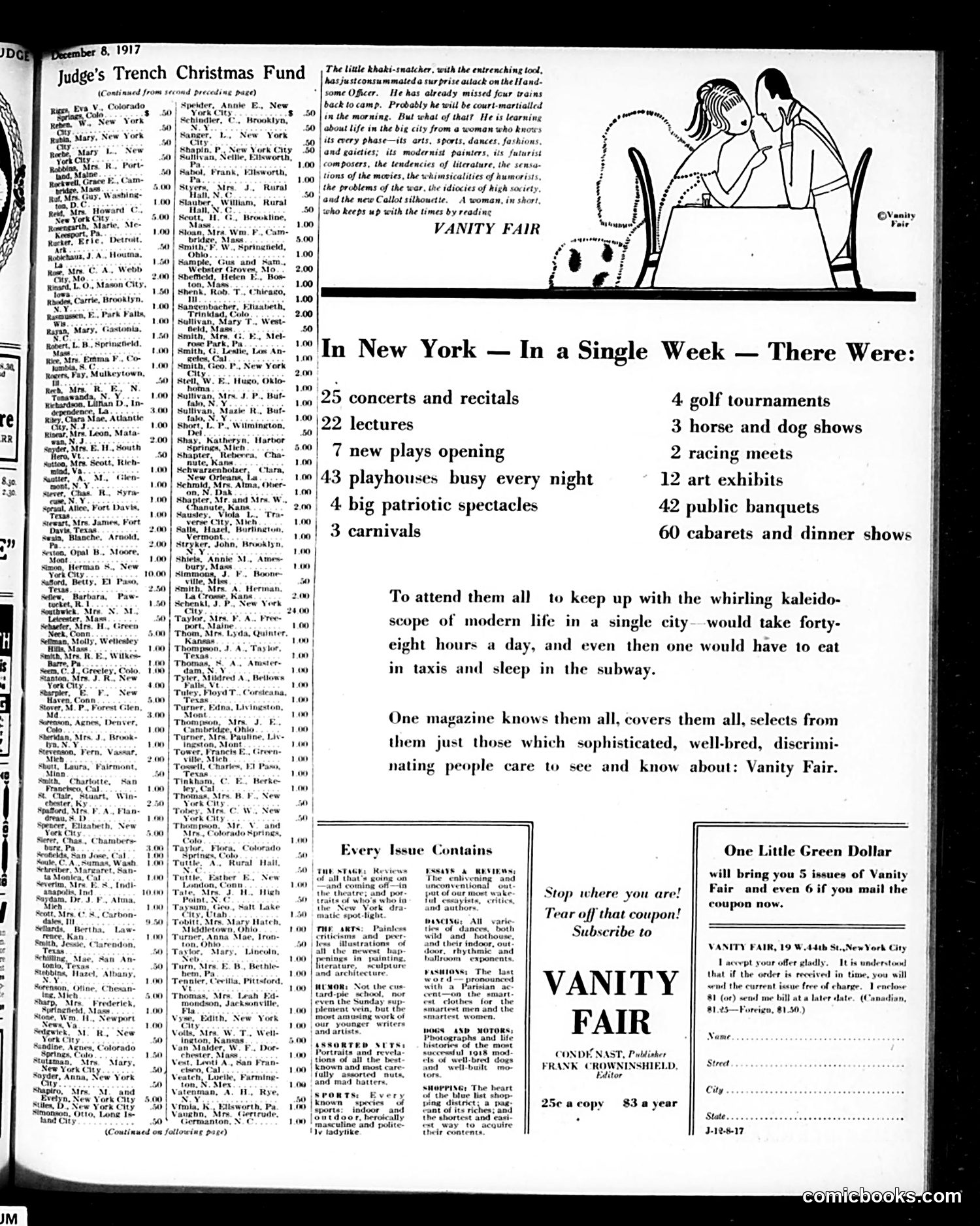
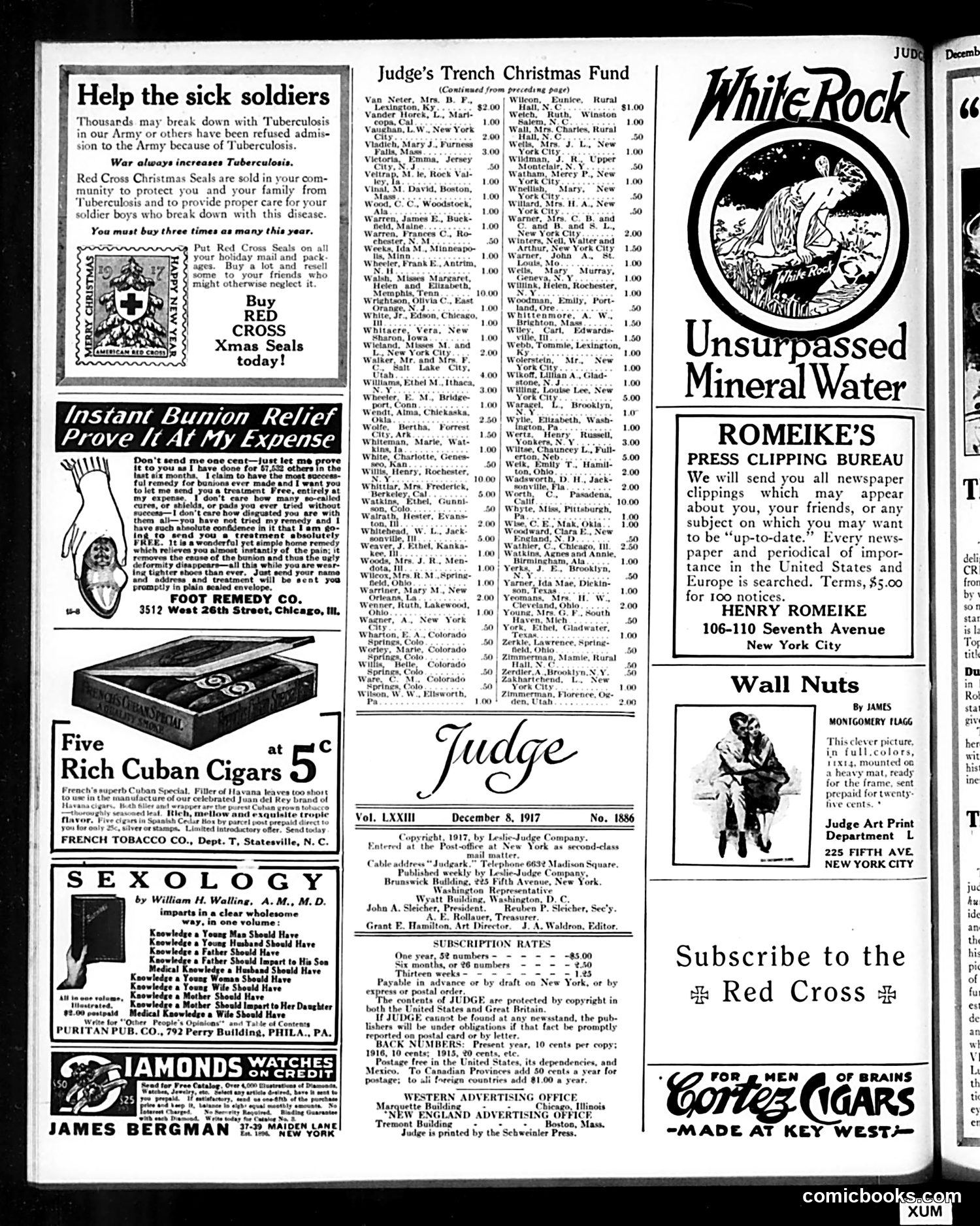
This page is primarily a **title page and advertisements** from Judge magazine (December 8, 1917), with limited satirical content. The main feature is the "Judge's Trench Christmas Fund"—a fundraising list for soldiers in World War I trenches, showing donations from readers. This reflects the wartime context of 1917, when American soldiers were actively fighting in France. The surrounding advertisements are period-appropriate commercial pitches: Red Cross Christmas Seals (promoting tuberculosis awareness and soldier welfare), bunion remedies, Cuban cigars, a "Sexology" instruction book, watches sold on credit, and a press clipping service. The only clear social commentary is the Red Cross appeal, which connects home-front civilian concerns (tuberculosis prevention) to military support—a wartime public health issue made urgent by mass mobilization. Most of the page is **commercial rather than satirical**, typical of Judge's format mixing advertising with editorial content.
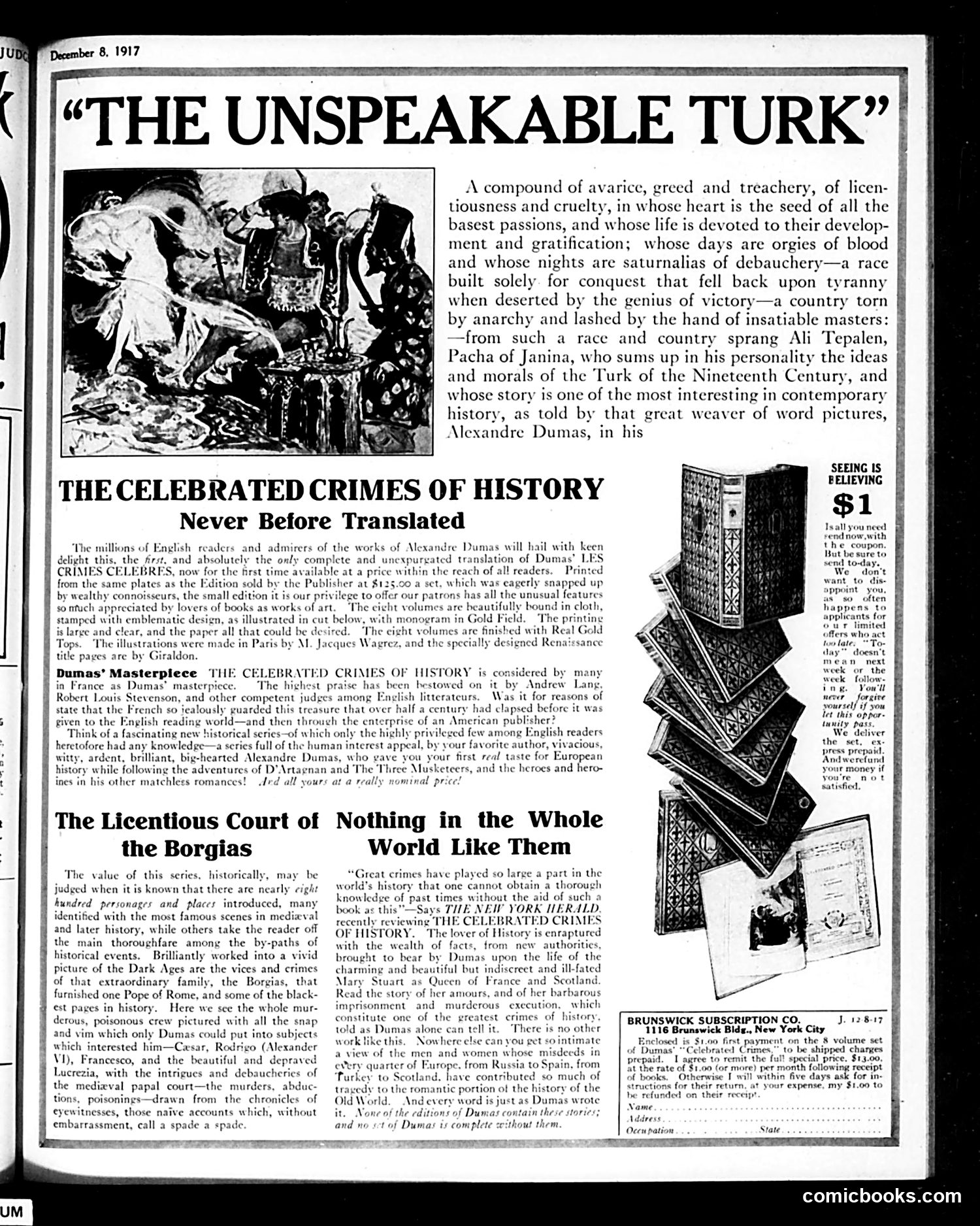
This page advertises Alexandre Dumas's *Celebrated Crimes of History*, a multi-volume book series newly translated into English. The headline and opening text attack the Ottoman Empire and Turkish leadership, specifically Ali Tepalen (Ali Pasha of Janina), whom the text describes as embodying Turkish "avarice, greed and treachery." The timing is significant: this advertisement appears during World War I, when the Ottoman Empire was allied with Germany and Austria-Hungary against Britain and France. The inflammatory language—describing Turkey as a nation of "conquest" and "tyranny"—reflects Allied wartime propaganda portraying the Turks as barbaric and dangerous enemies. The page also advertises other volumes in the series covering historical crimes, including the Borgias. The publisher (Brunswick Subscription Company) markets these books as exposés of humanity's darkest chapters, using sensationalism to boost sales during wartime nationalist fervor.
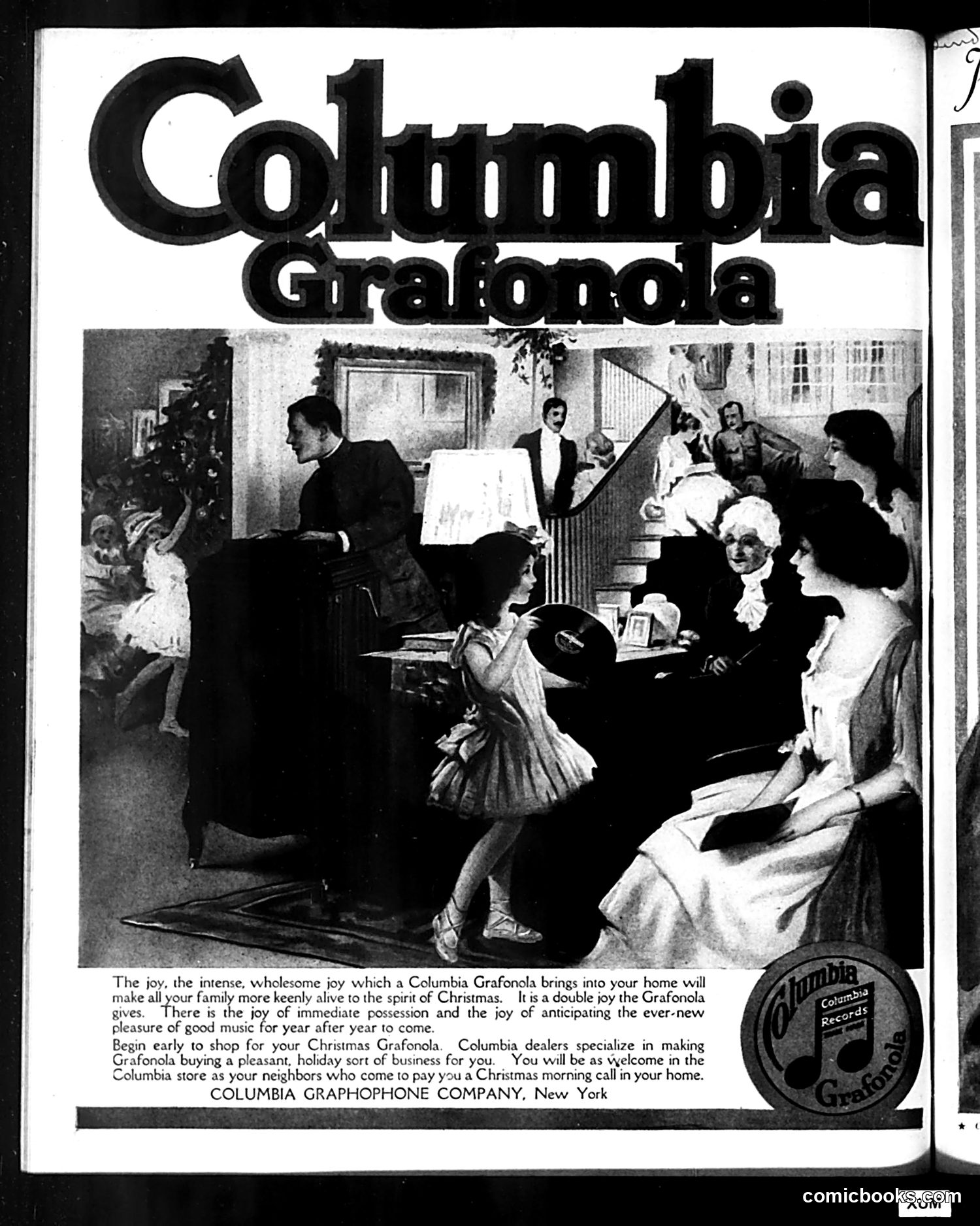
This is primarily a **Christmas advertisement**, not political satire. It promotes Columbia Grafonolas (early phonograph/record players) as ideal holiday gifts. The image depicts a festive domestic scene: a middle-class family gathered around a piano or musical device in an elegantly furnished parlor, with adults and children in formal dress. The advertisement emphasizes two selling points: the immediate pleasure of owning the device and the lasting joy of enjoying recorded music throughout the year. The text targets holiday shoppers, encouraging early purchase and assuring them that Columbia dealers make the buying experience pleasant and welcoming—comparable to receiving Christmas visits from neighbors. This reflects early 20th-century consumer culture, when phonographs were luxury items positioned as family entertainment that would enhance domestic happiness and social standing. The wholesome, formal family gathering illustrated the aspirational lifestyle Columbia marketed to middle-class Americans.