
Judge, 1917-12-08 · page 8 of 28
Judge — December 8, 1917 — page 8: what you’re looking at
What you’re looking at
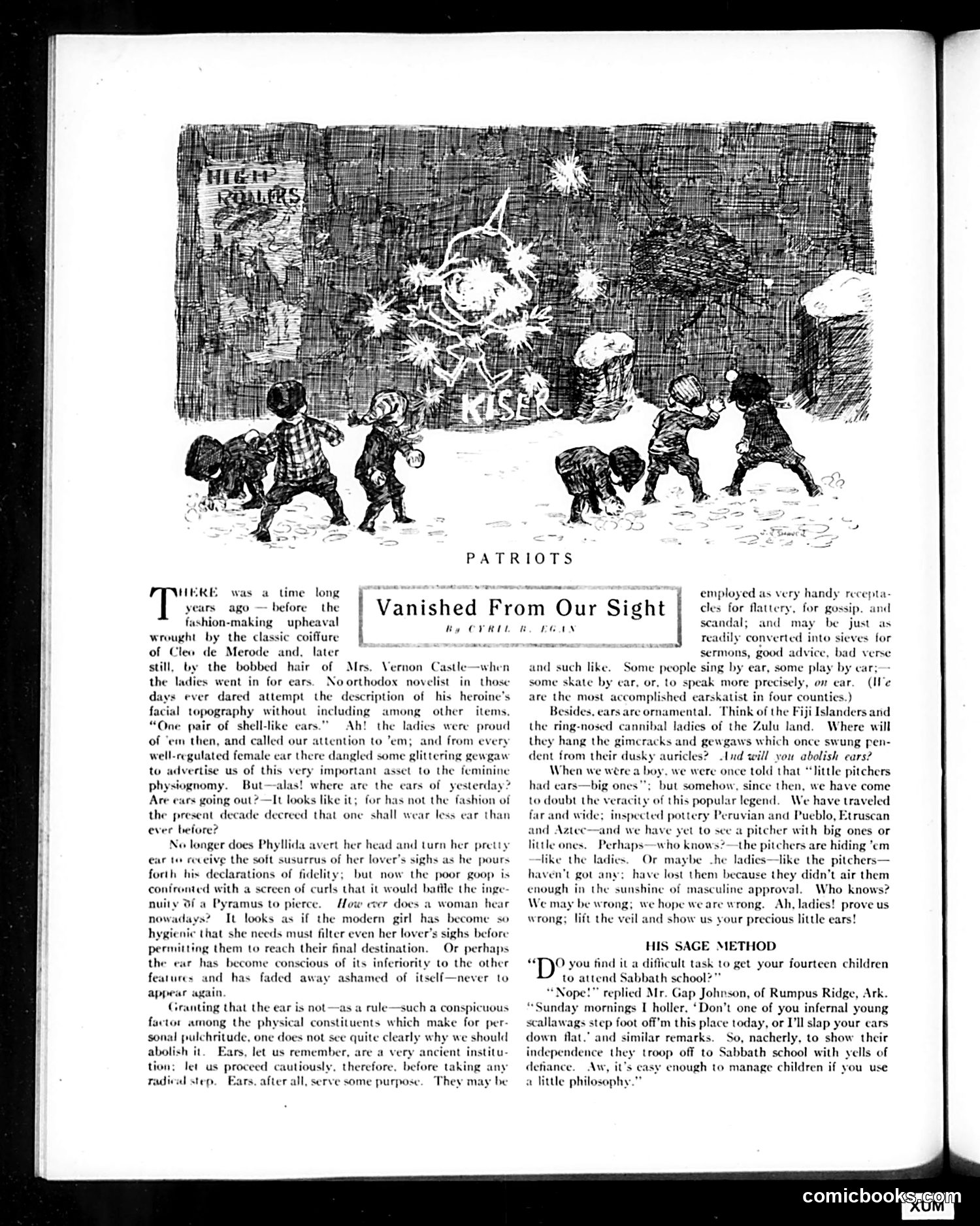
This humorous essay satirizes the fashion trend of bobbed hair and head-hugging styles (associated with dancers Cleo de Merode and Mrs. Vernon Castle) that have made women's ears invisible. The author laments that Victorian-era "shell-like ears" — once considered beautiful feminine features worthy of jewelry — have disappeared from view. The satire operates on multiple levels: it mocks women's fashion obsession, the decline of romantic gestures (lovers can no longer hear whispers), and social pretension. References to "Fiji Islanders" and "Zulu" women with ear ornaments, plus absurd discussions of pitchers with ears, underscore the piece's tongue-in-cheek tone. The bottom section, "His Sage Method," provides comic relief: a rural father claims controlling fourteen children is simple—he forbids them from leaving home, so they rebelliously attend Sabbath school anyway. The joke: reverse psychology through parental authority, presented as folk wisdom. Together, these pieces mock both fashionable society and rural folk traditions.
📄 Transcribed text from this page (OCR, searchable)
Machine-transcribed from the original scan — historical spelling and the odd misread are preserved.
PATRIOTS HERE was a time long years ago — before the fashion-making upheaval wrought by the classic coiffure of Cleo de Merode and, later still, by the bobbed hair of Mrs, Vernon Castle—when the went in for ears. Noorthodox novelist. in those days ever dared attempt the description of his heroine’s facial topography without including among other items. “One pair of shell-like ears.” Ab! the ladies were proud of then, and called our attention to ’em; and from every well-regulated female ear there dangled some glittering gewgaw to advertise us of this very important asset to the feminine physiognomy. But—alas! where are the ears of yesterday? Are ears going out?—It looks like it; for has not the fashion of the preseat decade decreed that one shall wear less ear than Wy CYREL longer does Phyllida avert her head and turn her pretty tw eeceive the soft susurrus of her lover's sighs as he pours forth his declarations of fidelity; but now the poor goop is confronted with a screen of curls that it would batile the inge- nuity Df a Pyramus to pierce. How ever does a woman hear ? It looks as if the modern girl has become so hygienic that she needs must filter even her lover's sighs before permitting them to reach their final destination. Or perhaps ear has become conscious of its inferiority to the other nowaday appear ag ‘anting that the ear is not factor among the physical constituents which make for per- pulchritude, one does not see quite clearly why we should abolish it. Ears, let us remember, are a ve ncient institu tion: let us proceed cautiously, therefore, before taking any radivil step. Ears. after all, serve some purpose. They may be as a rule—such a conspicuous | Vanished From Our Sight h employed as very handy recepta- cles for flattery, for gossip. and scandal; and may be just as readily converted into sieves for sermons, good advice, bad verse Some people sing by ear, some play by car; (We EGAN and such like. some skate by ear, or, to speak more precise! are the most accomplished earskatist in four Besic ursarcornamental. Think of the the ring-nosed cannibal ladies of the Zulu land. Where will they hang the gimeracks and gewgaws which once swung pen- dent from their dusky auricles? And will you abolish ears? When we were a boy. we were once told that “little pitchers had cars—big ones"; but somehow, since then, we have come to doubt the veracity of this popular legend. We have traveled far and wide; inspected pottery Peruvian and Pueblo, Etruscan and Aztec—and we have yet to see a pitcher with big ones or little ones. Perhaps—who knows?—the pitchers are hiding ‘em -like the ladies. Or maybe -he ladies—like the pitchers haven't got any; have lost them because they didn’t air them enough in the sunshine of masculine approval. Who knows? We may be wrong; we hope we are wrong. Ah, ladies! prove us wrong; lift the veil and show us your precious little ears! “T)O you tind ita difficult task to get your fourteen children to attend Sabbath school?” “Nope!” replied Mr. Gap Johnson, of Rumpus Ridge, Ark. “Sunday mornings I holler, ‘Don’t one of you infernal young scallawags step foot off’m this place today, or I'll slap your cars down flat.’ and similar remarks. . nacherly, to show their independence they troop off to Sabbath school with yells of defiance. Aw, ii asy enough to manage children if you use a little philosophy comicbookss¢em