
Judge, 1917-12-08 · page 12 of 28
Judge — December 8, 1917 — page 12: what you’re looking at
What you’re looking at
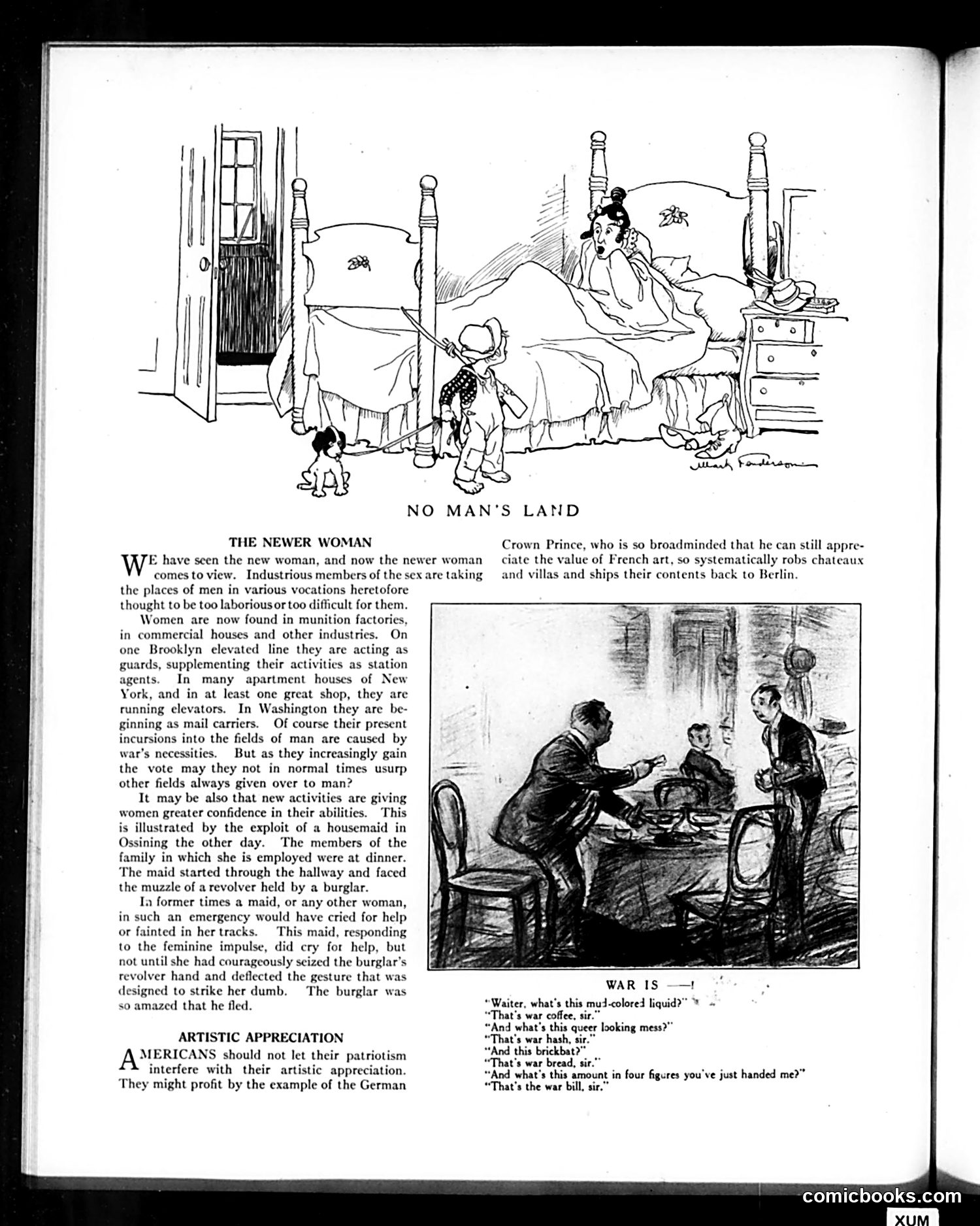
This Judge magazine page satirizes three wartime topics (WWI era): **"No Man's Land" (top cartoon):** Shows a woman in bed while a child and man stand nearby—likely mocking the irony that women are taking "men's jobs" in factories and as mail carriers during wartime labor shortages, yet domestic spheres remain unchanged. **"The Newer Woman" (main article):** Celebrates women entering previously male-only occupations (munitions factories, elevators, mail delivery) due to war necessity, while questioning whether they'll retain these roles peacetime. A heroic anecdote describes a housemaid disarming a burglar—suggesting war gives women confidence and capability. **"War Is—!" (bottom cartoon):** A waiter-diner dialogue joke where "war coffee," "war hash," and a bloated "war bill" represent inflation and poor wartime rationing—the final line sarcastically blames "the war" for extortionate pricing. The German Crown Prince reference (robbing French art) reflects anti-German sentiment common in American WWI-era satire.
📄 Transcribed text from this page (OCR, searchable)
Machine-transcribed from the original scan — historical spelling and the odd misread are preserved.
Hl Ih tl NO MAN’S LAND THE NEWER WOMAN Crown Prince, who is so broadminded that he can still appre- E have seen the new woman, and now the newer woman ciate the value of French art, so systematically robs chateaux comes to view. Industrious members of the sex are taking and villas and ships their contents back to Berlin. the places of men in various vocations heretofore thought to be too laborious or too difficult for them. Women are now found in munition factories, in commercial houses and other industries. On one Brooklyn elevated line they are acting as guards, supplementing their activities as station agents. In many apartment houses of New York, and in at least one great shop, they are running elevators. In Washington they are be- ginning as mail carriers. Of course their present incursions into the fields of man are caused by war's necessities. But as they increasingly gain the vote may they not in normal times usurp other fields always given over to man? It may be also that new activi are giving women greater confidence in their abilities. This illustrated by the exploit of a housemaid in ng the other day. The members of the family in which she is employed were at dinner. The maid started through the hallway and faced the muzzle of a revolver held by a burglar. In former times a maid, or any other woman, in such an emergency would have cried for help or fainted in her tracks. This maid, responding to the feminine impulse, did cry for help, but not until she had courageously seized the burglar’s revolver hand and deflected the gesture that was designed to strike her dumb. The burglar was WAR IS ——! so amazed that he fled. “Waiter, what's this mud-colored liquid? “That's war coffee, sir. looking mess?” ARTISTIC APPRECIATION ™ AMERICANS should not let their patriotism hae thes betta? interfere with their artistic appreciati a eit lee tesink eh ° * interfere eir artis ppreciation. ‘And what's this amount in four figures you've just handed me?’ They might profit by the example of the German ‘That's the war bill, sir.” comicbooks.com