
Judge, 1917-12-08 · page 16 of 28
Judge — December 8, 1917 — page 16: what you’re looking at
What you’re looking at
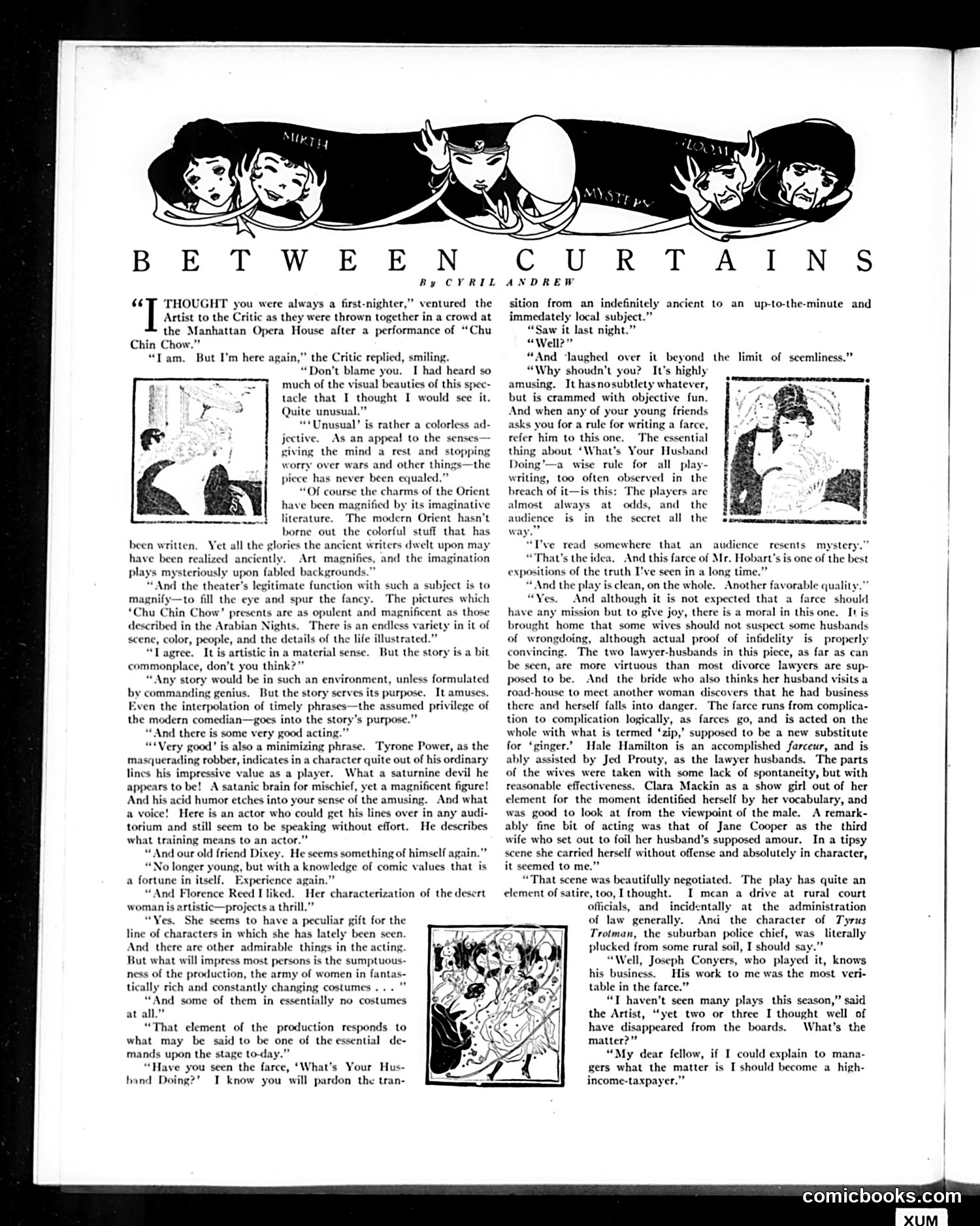
This is a theatrical criticism piece, not a political cartoon. Two men—an Artist and a Critic—discuss the Broadway production "Chu Chin Chow" at the Manhattan Opera House. The satire targets theatrical criticism itself. The Critic initially claims he never attends opening nights, yet the Artist catches him in contradiction. Their subsequent conversation reveals the Critic's verbose, grandiose style ("minimizing phrase," elaborate descriptions) contrasts with practical theatrical wisdom. The piece mocks how critics use ornate language to justify spectacle over substance—praising "Chu Chin Chow" for its visual magnificence and opulent sets (comparing them to *Arabian Nights*) while admitting the story is "commonplace." The Critic defends this as theater's legitimate function: to "magnify" and please the eye. The subplot discussion of the farce "What's Your Husband Doing?" suggests even shallow entertainment has value if executed well—another dig at pretentious criticism that overanalyzes simple amusement.
📄 Transcribed text from this page (OCR, searchable)
Machine-transcribed from the original scan — historical spelling and the odd misread are preserved.
Artist to the Critic as they were thrown together in a crowd at a | THOUGHT you were always a first-nighter,” ventured the the Manhattan Opera House after a performance of “Chu Chin Chow. “Tam. the Critic replied, smiling. “Don’t blame you. I had heard so much of the visual beauties of this spec- ta that I thought I would sce it. Quite unusual.” “*Unusual’ is rather a colorless ad- jective. As an appeal to the senses— giving the mind a rest and stopping worry over wars and other things—the piece has never been equaled.” “Of course the charms of the Orient have been magnified by its imaginative literature. The modern Orient hasn't borne out the colorful stuff that has been written. Yet all the glories the ancient writers dwelt upon may have been realized anciently. Art magnifies, and the imagination plays mysteriously upon fabled backgrounds. And the theater’s legitimate function with such a subject is to magnify—to fill the eye and spur the fancy. The pictures which ‘Chu Chin Chow’ presents are as opulent and magnificent as those described in the Arabian Nights. There is an endless variety in it of scene, color, people, and the details of the life illustrated.” “Lagree. It is artistic in a material sense. But the story is a bit commonplace, don’t you think?” “Any story would be in such an environment, unless formulated by commanding genius. But the story serves its purpose. It amuses. Even the interpolation of timely phrases—the assumed privilege of the modern comedian—goes into the story's purpose.” “And there is some very good acting. “*Very good’ is also a minimizing phrase. Tyrone Power, as the masquerading robber, indicates in a character quite out of his ordinary lines his impressive value as a player. What a saturnine devil he appears to be! A satanic brain for mischief, yet a magnificent figure! And his acid humor etches into your sense of the amusing. And what Here is an actor who could get his lines over in any audi- ing without effort. He describes But I'm here again. a voice! torium and still seem to be spe: what training means to an actor. “And our old friend Dixey. He seems something of himself again.” No longer young, but with a knowledge of comic values that is a fortune in itself. Experience again.” “And Florence Reed I liked. Her character woman is artistic—projects a thrill.” ae She seems to have a peculiar gift for the line of characters in which she has lately been seen. And there are other admirable things in the acting. But what will impress most persons is the sumptuous- ness of the production, the army of women in fantas- tically rich and constantly changing costumes..." And some of them in ntially no costumes at all.” That element of the production responds to what may be said to be one of the essential de- mands upon the stage to-day.” “Have you seen the farce, ‘What's Your Hus- hand Doing?’ I know you will pardon the tran- ization of the desert By CYRIL ANDREW sition from an indefinitely ancient to an up-to-the-minute and immedately local subject.” “Saw it last night.” “Well?” “And ‘laughed over it beyond the limit of scemliness.” “Why shoudn’t you? It’s highly amusing. It hasnosubtlety whatever, but is crammed with objective fun. And when any of your young friends ks you for a rule for writing a farce, er him to this one, The essential ¢ mnamenerw encore name « rel thing about ‘What's Your Husband Doing’—a wise rule for all play- writing, too often observed in the breach of it—is this: The players are almost always at odds, and the audience is in the secret all the way.” Sra a SRE are I've read somewhere that an audience resents mystery.” “That's the idea. And this farce of Mr. Hobart’s is one of the best expositions of the truth I've seen in a long time.” “And the play is clean, on the whole. Another favorable quality.” “Yes. And although it is not expected that a farce should have any mission but to give joy, there is a moral in this one. It is brought home that some wives should not suspect some husbands of wrongdoing, although actual proof of infidelity properly convincing. The two lawyer-husbands in this piece, as far as can be seen, are more virtuous than most divorce lawyers are sup- posed to be. And the bride who also thinks her husband visits a road-house to mect another woman discovers that he had business there and herself falls into danger. The farce runs from complica- tion to complication logically, as farces go, and is acted on the whole with what is termed ‘zip,’ supposed to be a new substitute for ‘ginger.’ Hale Hamilton is an accomplished farceur, and is ably assisted by Jed Prouty, as the lawyer husbands. ‘The parts of the wives were taken with some lack of spontaneity, but with reasonable effectiveness, Clara Mackin as a show girl out of her element for the moment identified herself by her vocabulary, and was good to look at from the viewpoint of the male. A remark- ably fine bit of acting was that of Jane Cooper as the third wife who set out to foil her husband’s supposed amour. In a tipsy scene she carried herself without offense and absolutely in character, it seemed to me. “That scene was beautifully negotiated. The play has quite an element of satire, too, Ithought. I mean a drive at rural court officials, and incidentally at the administration of law generally. And the character of Tyrus Trotman, the suburban police chief, was literally plucked from some rural soil, I should say.” “Well, Joseph Conyers, who played it, knows his business. His work to me was the most veri- table in the farce.” “T haven’t seen many plays this season,” said the Artist, “yet two or three I thought well of have disappeared from the boards. What's the matter?” “My dear fellow, if I could explain to mana- gers what the matter is I should become a high- income-taxpayer.”” comicbooks.com