
A complete issue · 24 pages · 1915
Judge — March 6, 1915
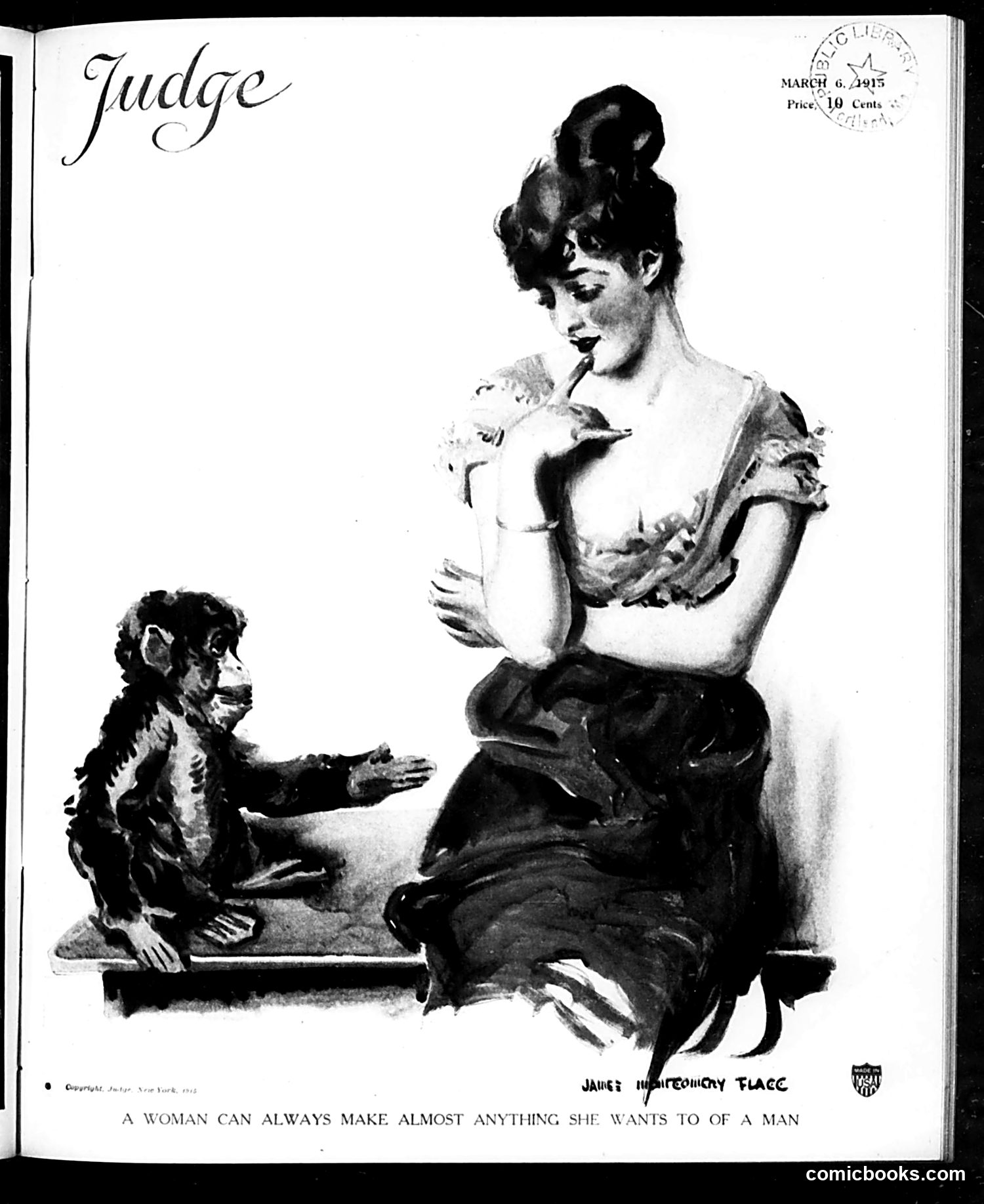
This *Judge* magazine cover from March 6, 1915 features an illustration by James Montgomery Flagg showing a fashionable woman interacting with a small chimpanzee or monkey. The caption reads: "A WOMAN CAN ALWAYS MAKE ALMOST ANYTHING SHE WANTS TO OF A MAN." The satire plays on early-20th-century gender dynamics by humorously suggesting women's manipulative power over men. The juxtaposition of the woman with the primate appears intended as a cheeky commentary—implying men are easily controlled or "trained" like animals by attractive women. This reflects the era's conflicted attitudes toward changing female independence, particularly as women's suffrage movements gained momentum. The tone is lighthearted rather than genuinely misogynistic, typical of *Judge*'s social satire of the period.
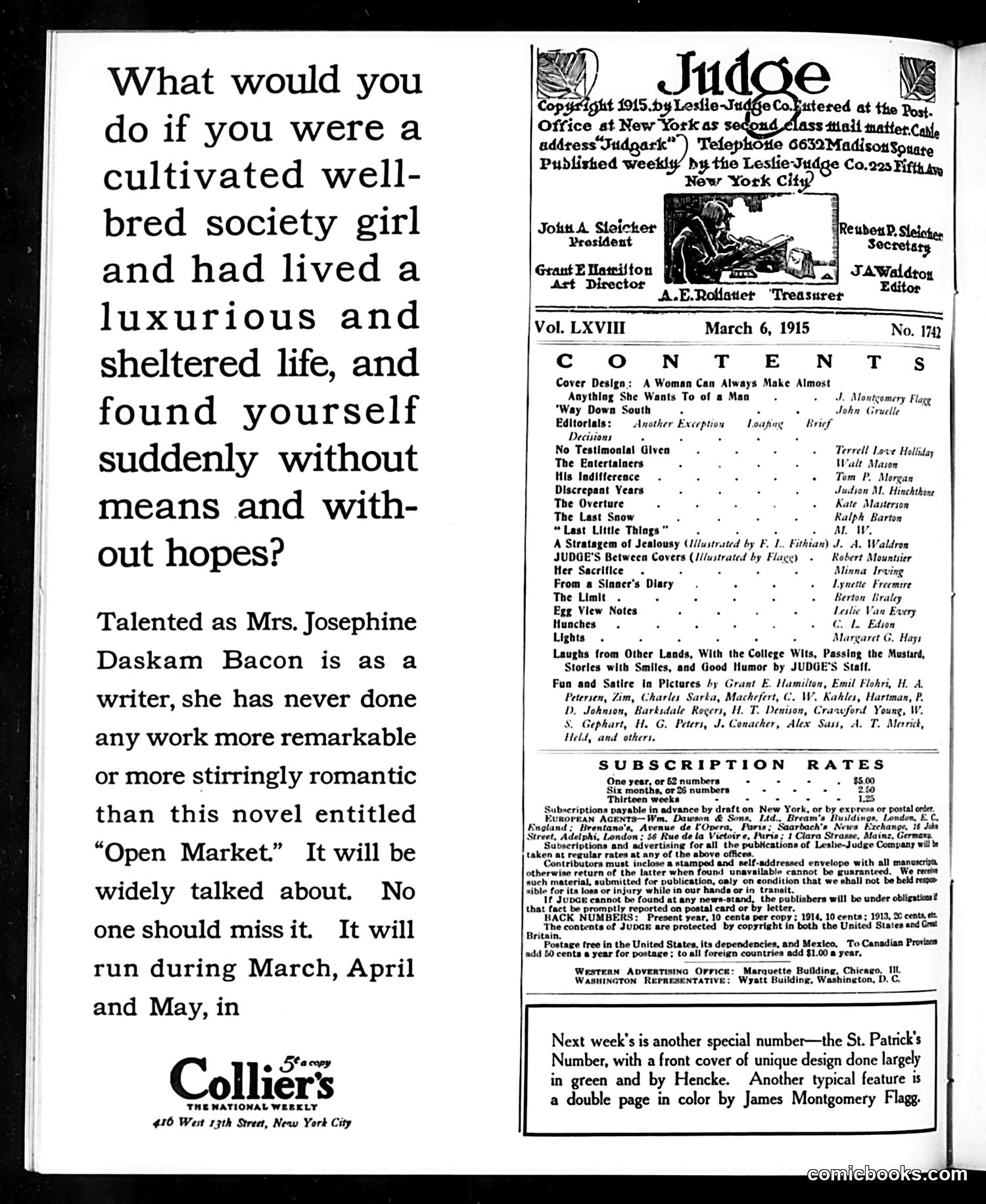
This page consists primarily of a **Collier's magazine advertisement** (left side) promoting a serialized novel called "Open Market" by Josephine Daskam Bacon. The ad poses a rhetorical question to upper-class female readers: what would you do if suddenly impoverished? The right side shows **Judge magazine's masthead and contents page** for Vol. LXVIII, No. 1742. The contents list various satirical articles and illustrations typical of the era's humor magazine. The advertisement's central appeal is **class anxiety**—targeting wealthy women by imagining their worst fear: loss of wealth and social status. This reflects early 20th-century concerns about economic instability and the fragility of genteel society during the Progressive Era. The pitch emphasizes romance and drama as selling points for readers seeking escapist fiction.
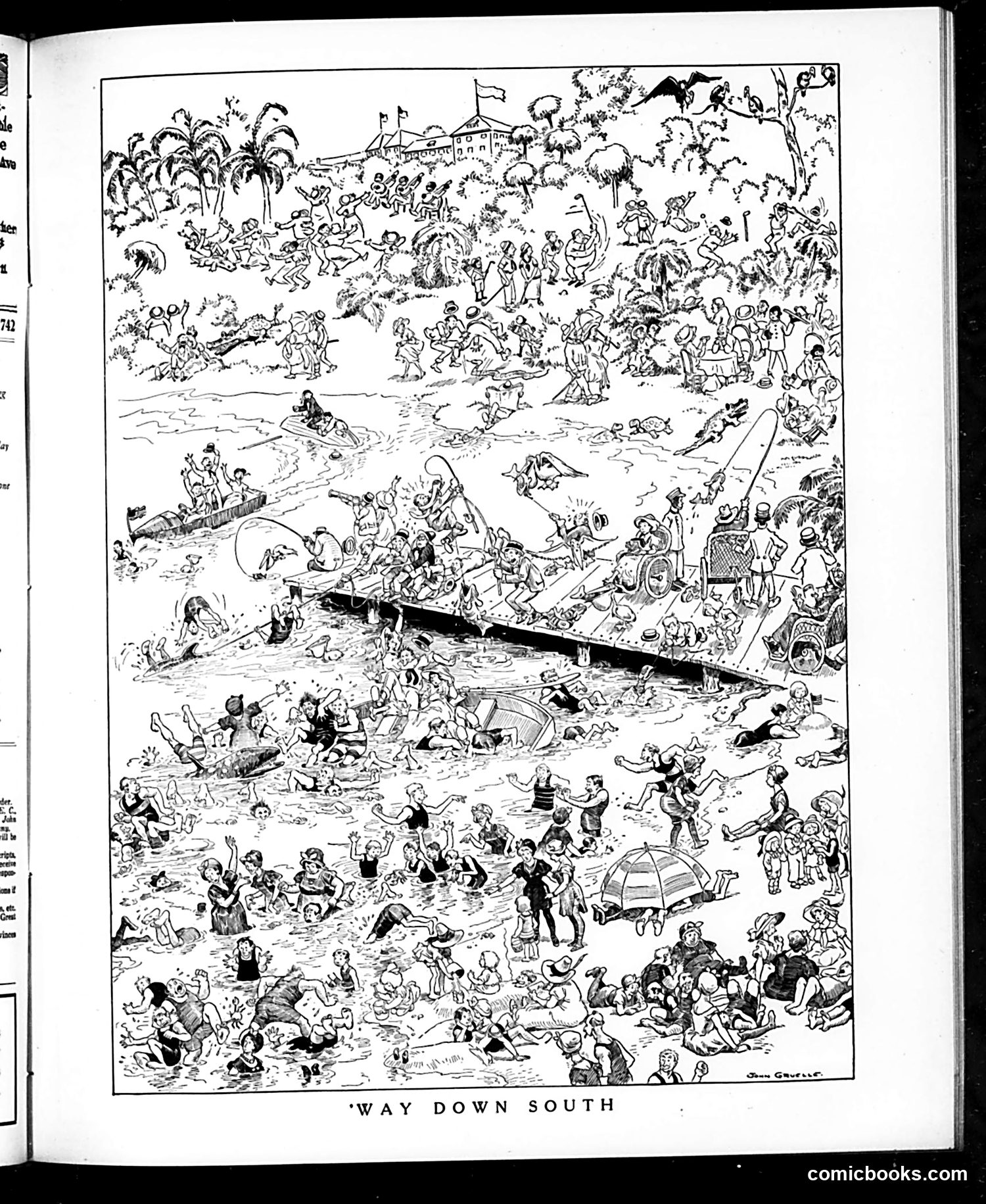
This crowded beach illustration titled "Way Down South" appears to be social satire depicting a Southern vacation destination, likely from the early-to-mid 20th century. The densely packed scene shows numerous beachgoers engaged in various leisure activities—swimming, lounging, playing games—alongside what appears to be a shipwreck or large vessel in the water. The cartoon likely satirizes either: - The commercialization and overcrowding of Southern beach resorts - Class or racial dynamics at Southern vacation spots (historically segregated) - The chaos of modern tourism and leisure culture The title's colloquial phrasing ("Way Down South") and the chaotic composition suggest social commentary on how modernization and tourism were transforming the American South. Without clearer identifying markers or accompanying text, the specific target remains somewhat unclear.
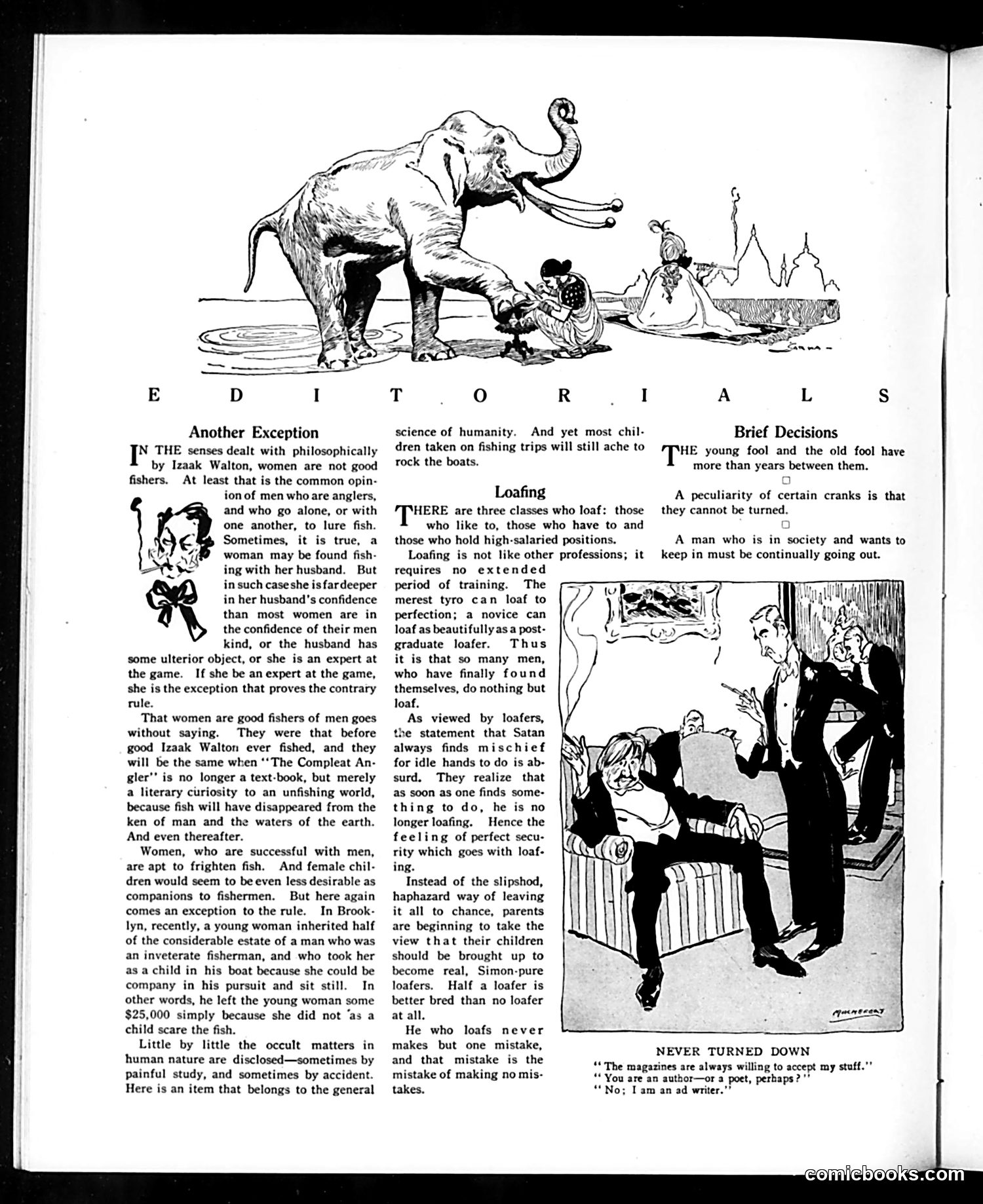
**Top Illustration: "Editorials"** The large elephant cartoon depicts a scene in what appears to be Asia (suggested by temple architecture). An elephant interacts with seated figures in colonial dress. This likely satirizes Western imperial presence and attitudes toward foreign lands and peoples—a common Judge theme mocking American or European colonialism and the perceived superiority of Western civilization. **Text Articles** The page contains three pieces: "Another Exception" (discussing women fishing), "Loafing" (social commentary on idleness), and "Brief Decisions" (aphorisms). The "Never Turned Down" cartoon shows a publisher rejecting an aspiring writer—satirizing the gatekeeping of publishing and the rejection manuscript writers constantly faced. The overall page targets social pretension, idleness, and American attitudes toward empire.
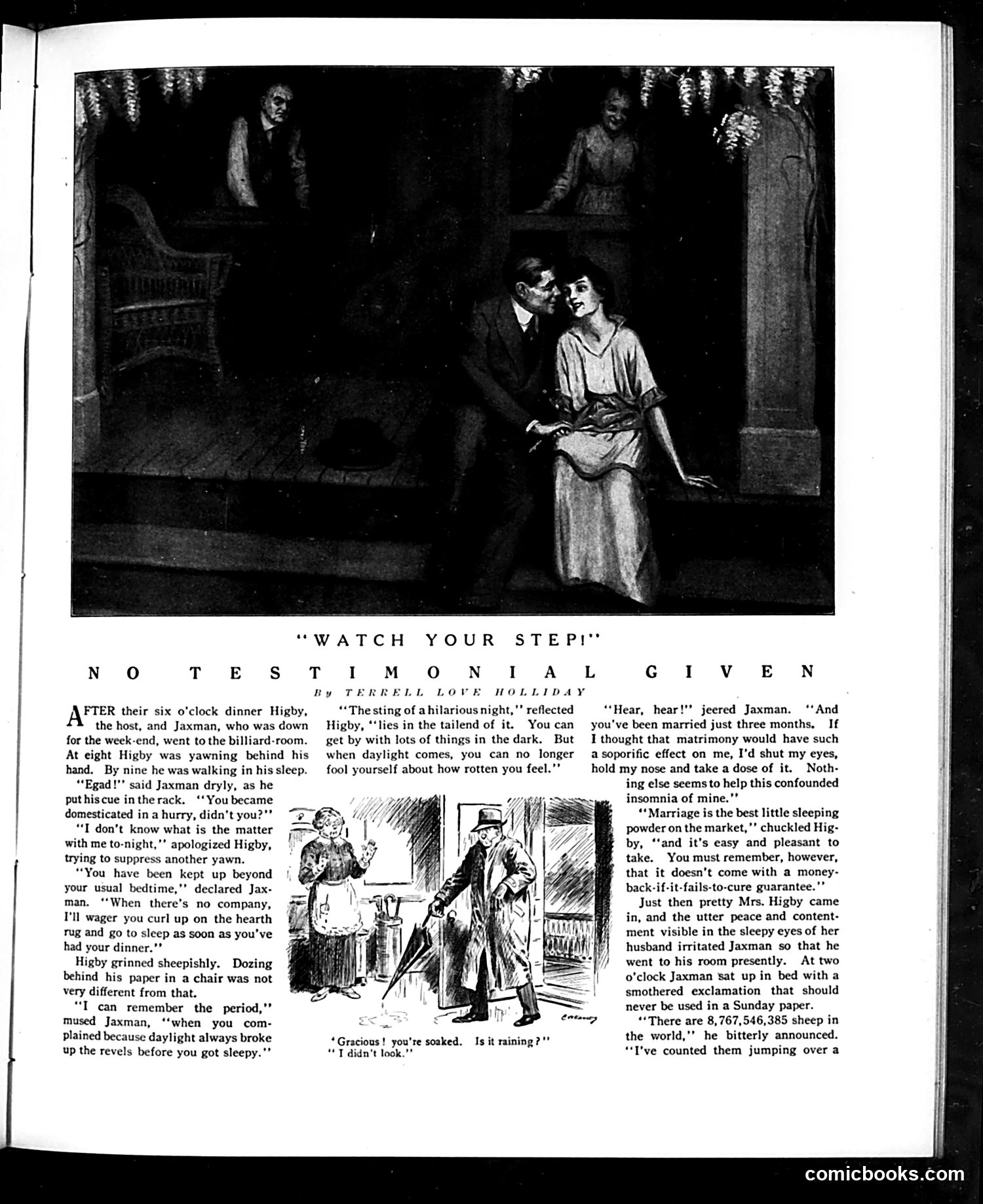
This page features a short story titled "No Testimonial Given" by Terrell Love Holliday, illustrated with sketches. The narrative focuses on marital discord between characters named Higby and Jaxman, contrasting their perspectives on marriage. The story's humor derives from domestic tension: Higby complains that marriage has disrupted his sleep, while Jaxman defends matrimony as a "best little sleeping powder on the market." The central joke appears to be satirizing how marriage affects men's rest and comfort. The accompanying sketch shows a man in a hat speaking with a woman, with the caption "Gracious! you're soaked. Is it raining?" / "I didn't lock," suggesting domestic miscommunication or the wife's forgetfulness. The overall satire mocks early 20th-century married life anxieties, specifically how matrimony conflicts with bachelor comfort.
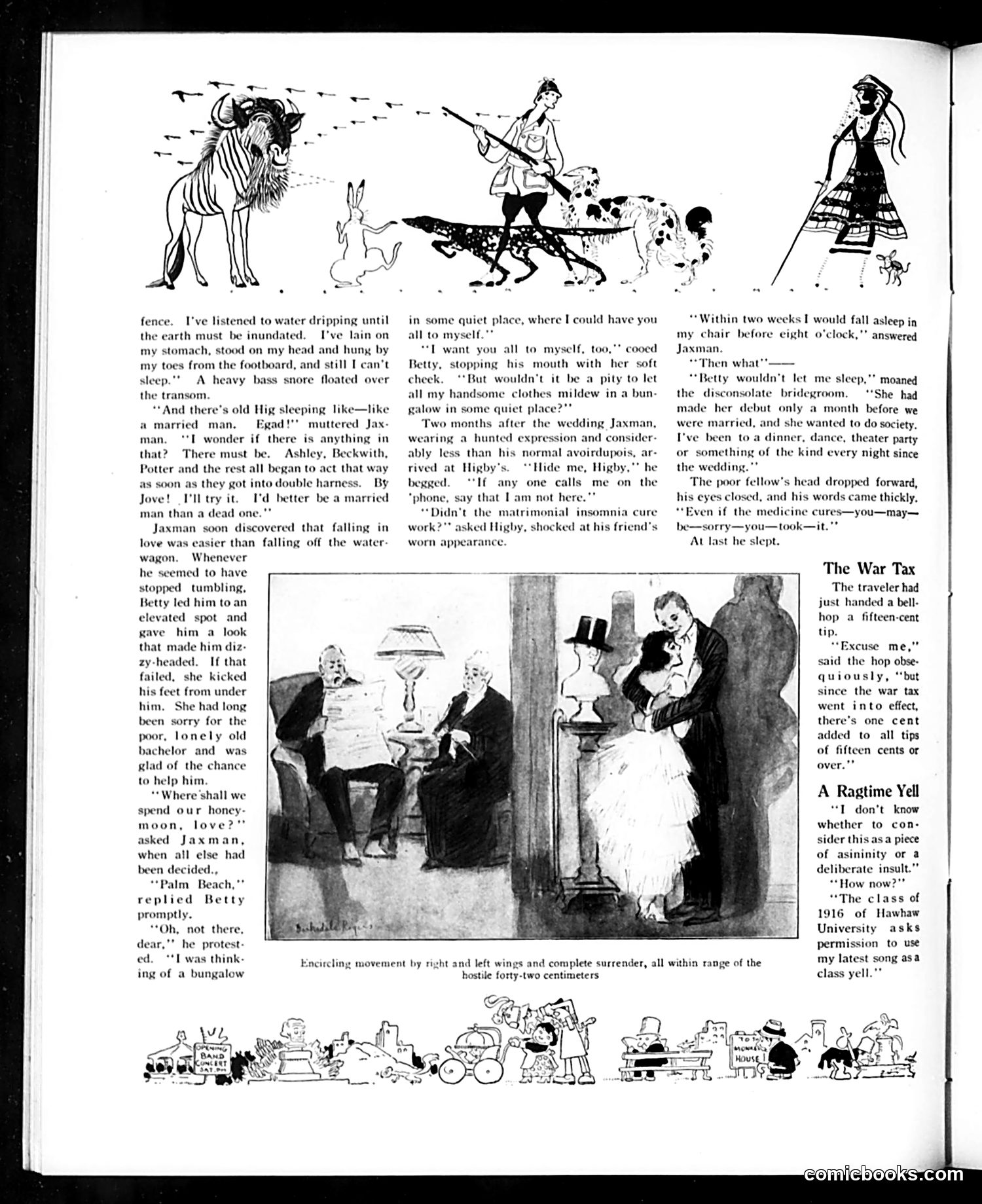
This page contains three separate satirical pieces about post-WWI American life: **Main Story (Jaxman's Marriage):** A humorous narrative about a bachelor, Jaxman, who discovers married men sleep soundly and decides to marry. After wedding Betty, he finds matrimonial life exhausting—she drags him to constant social events while he desperately seeks sleep. The joke mocks the sacrifice bachelors make upon marriage, portraying wedded life as a loss of personal freedom and rest. **"The War Tax":** A brief joke about a bellhop demanding an additional penny tip because a war tax now applies to fifteen-cent gratuities. This satirizes the intrusive taxation and bureaucratic complications following WWI. **"A Ragtime Yell":** A college class seeks permission to use the author's popular song as their class yell, which he finds insulting—unclear whether the insult involves the song's quality or the appropriation itself. All three pieces reflect post-war American social adjustment and economic disruption.
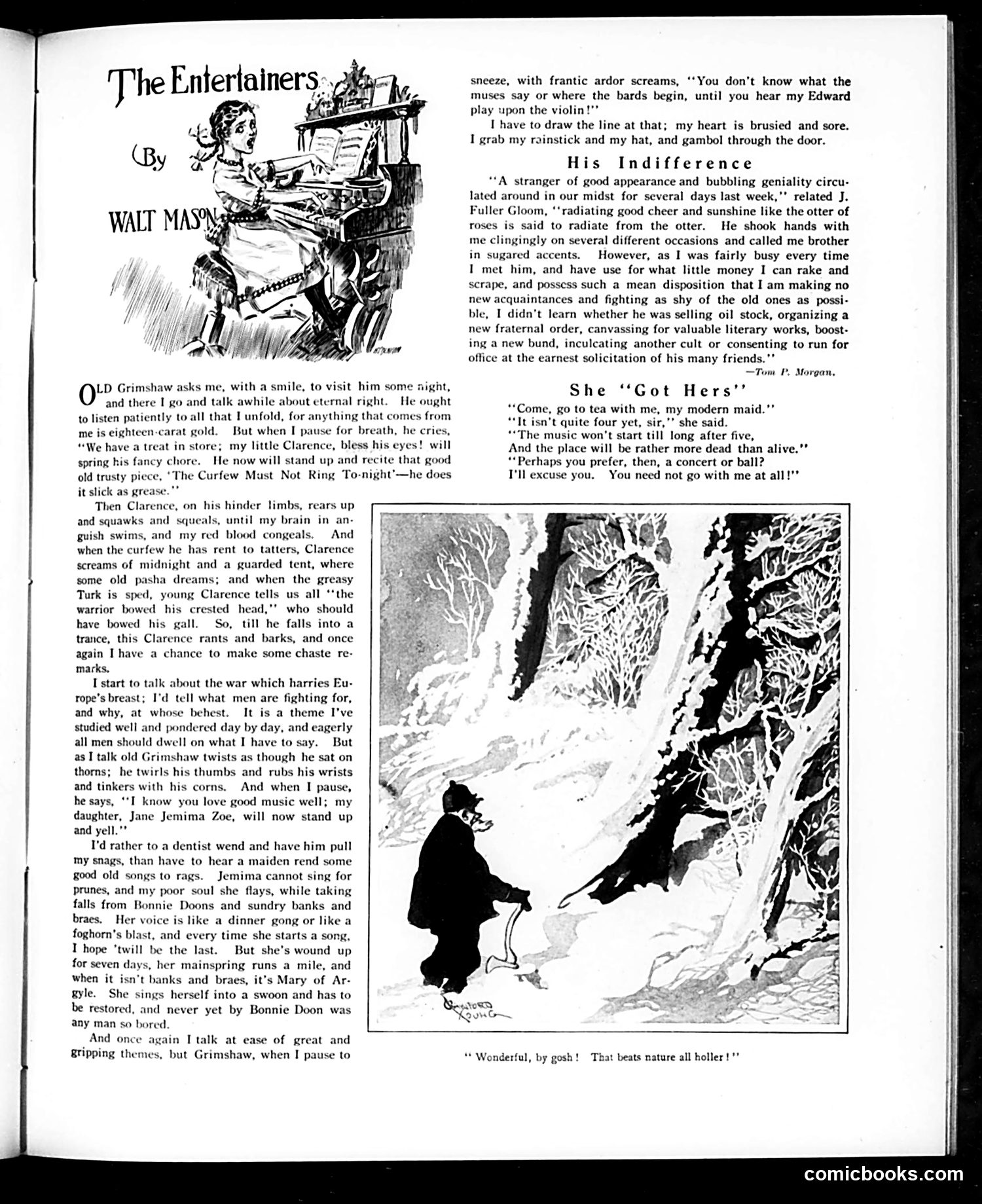
This page satirizes amateur entertainment and social obligation in early 20th-century America. The main story mocks the narrator's painful experiences visiting "Old Grimshaw," whose family inflicts terrible performances on guests: the son Clarence screeches dramatic recitations, and daughter Jane Jemima Zoe sings atrociously ("her voice is like a dinner gong"). The narrator, who wants to discuss serious topics like the war in Europe, is repeatedly interrupted by these amateur entertainers. He eventually flees in exasperation. The accompanying cartoons and anecdotes reinforce the theme: hosts and their relatives subjecting captive audiences to unwanted performances and pitches. "His Indifference" shows how people avoid genuine social connection by feigning busyness. "She 'Got Hers'" depicts a modern woman extracting social entertainment on her terms. The satire targets both amateur performers' obliviousness and hosts' social tyranny—the obligation to endure terrible entertainment politely.
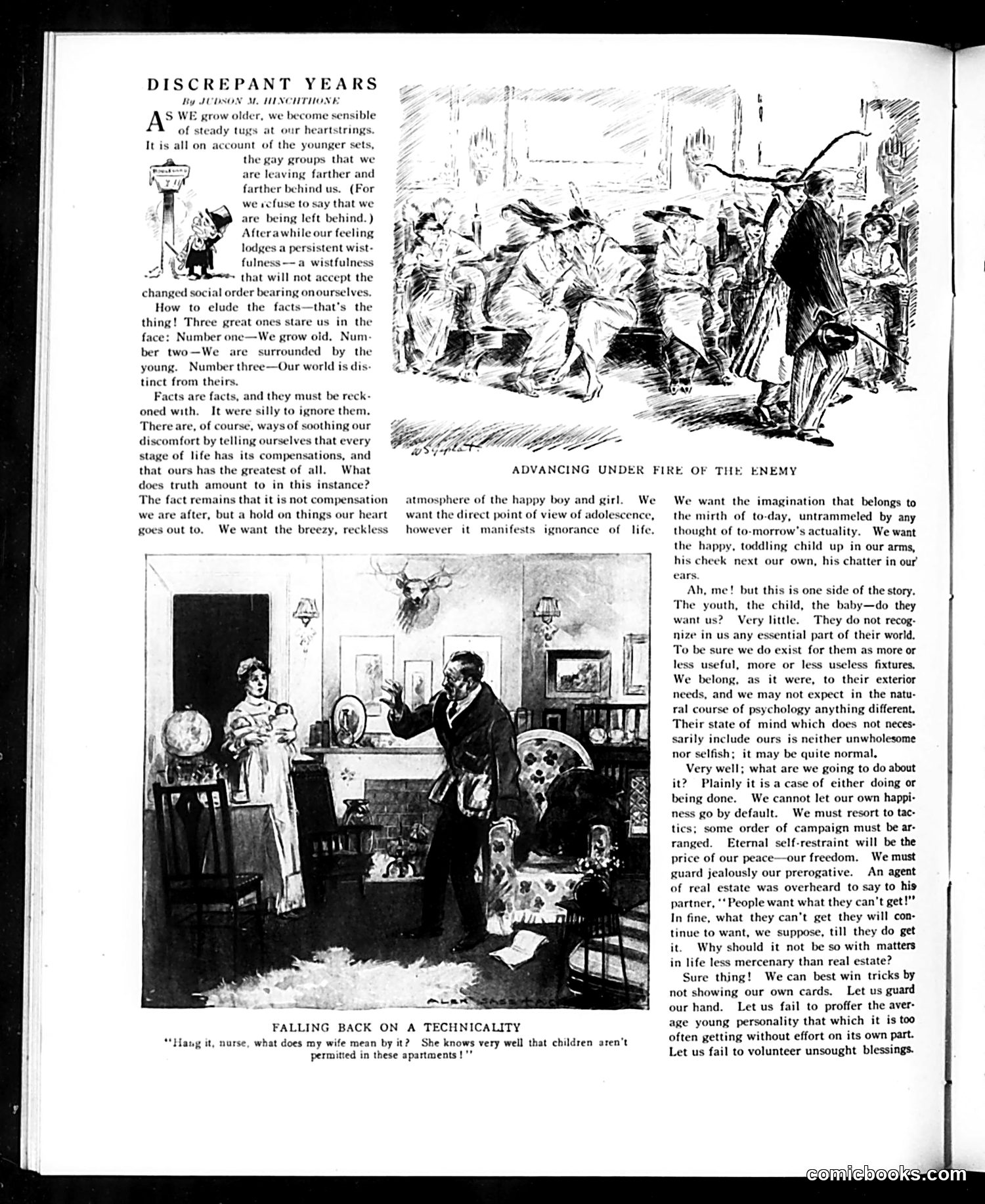
This satirical article explores generational alienation. The author argues that aging adults become melancholy watching younger people move ahead, experiencing three facts: they grow old, youth surrounds them, and their world differs from the young's. The lower cartoon illustrates the tension: a man confronts his wife about children in their apartment building, revealing how adults impose rules while resenting their own irrelevance to youth. The article's conclusion presents cynical "tactics": adults should withhold affection and approval to make themselves desired—manipulating youth through scarcity, just as a real estate agent noted people want what they can't obtain. Rather than freely offer love and blessing, the author suggests deliberately remaining aloof. The satire critiques this emotional manipulation while sympathizing with aging adults' anxieties about obsolescence in a youth-oriented society. It's both sympathetic to aging fears and skeptical of the defensive strategies people adopt.
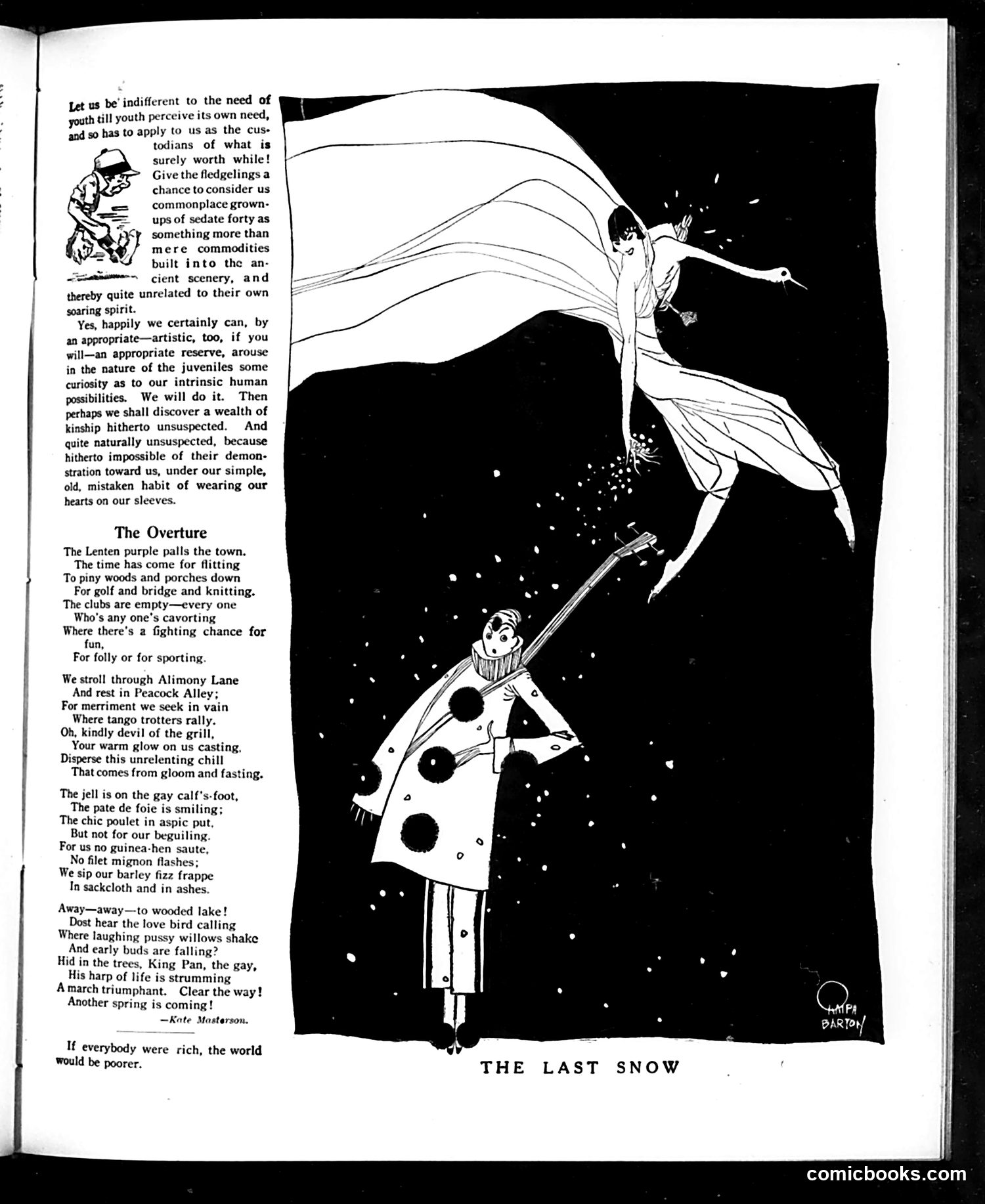
This page satirizes upper-class spring leisure during Lenten season. The prose section mocks condescending attitudes of wealthy adults toward youth, urging older generations to appear more interesting and "artistic" to younger people. "The Overture" poem, credited to Kate Masterson, ridicules the wealthy observing Lenten fasting while complaining about deprivation. References to "Alimony Lane" and "Peacock Alley" suggest marital discord among the affluent. The poem ironically catalogs forbidden foods (jelly, pâté, poulet) while describing their actual consumption in "sackcloth and ashes"—mock-pious posturing. The illustration shows a woman in a polka-dotted dress ascending into snow-filled air, apparently escaping to spring leisure activities. The overall satire targets the hypocrisy of wealthy society's performative piety during Lent, their complaints about self-imposed restrictions, and their obsession with seasonal social rituals. The closing maxim—"If everybody were rich, the world would be poorer"—underscores the critique of materialism.
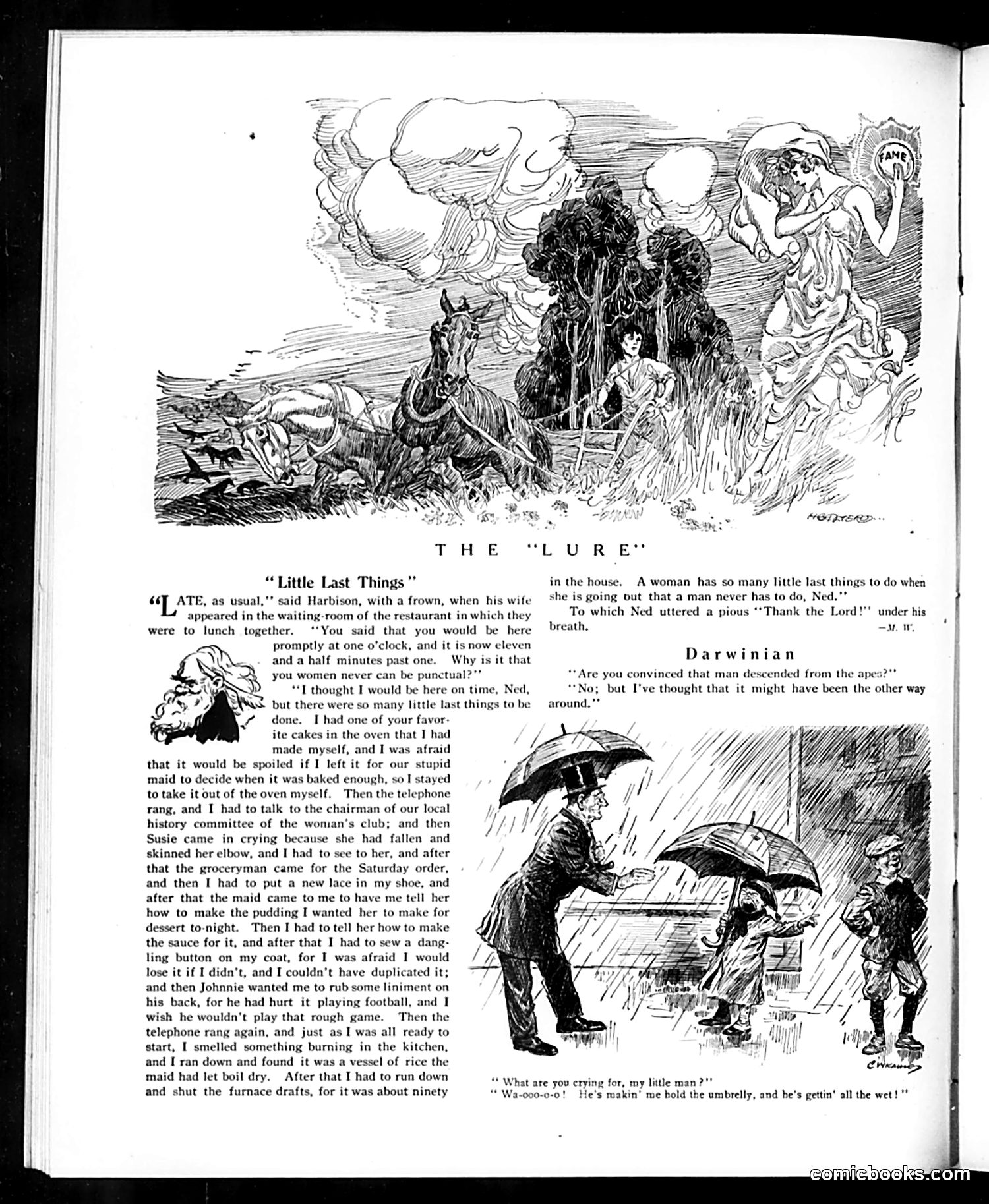
This page contains two separate pieces of social satire typical of early-20th-century humor magazines. **"Little Last Things":** A husband (Harbison) complains about his wife's chronic lateness to lunch. She responds with an exhaustive catalog of domestic emergencies—baking, phone calls, a child's injury, servants' incompetence, clothing repairs, her son's liniment needs—that made departure impossible. The satire targets both spouses: the husband's obliviousness to household complexity, and the wife's admission that women's lives are consumed by endless trivial domestic duties. The joke's point is that what men dismiss as "little last things" actually constitute the entire substance of middle-class women's days. **"Darwinian":** A brief joke about evolution. When asked if man descended from apes, someone quips the descent might have gone "the other way around"—suggesting humans have devolved into ape-like behavior. This reflects contemporary debates about Darwinism. **Bottom cartoon:** A man forces a child to hold an umbrella in rain while he stays dry—dark humor about parental selfishness. These reflect period anxieties about gender roles and intellectual trends.
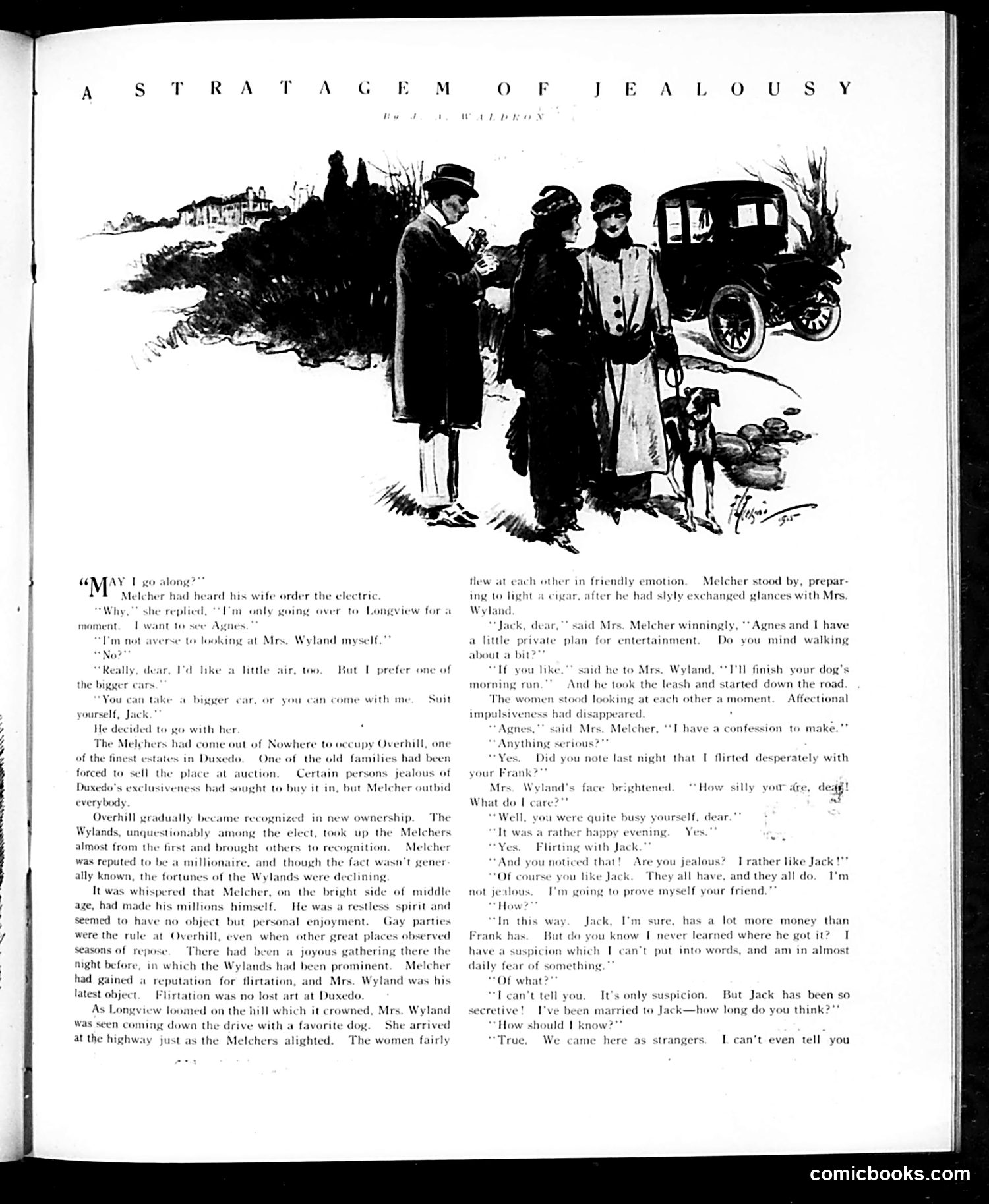
This illustration and story depict upper-class infidelity and social maneuvering among wealthy couples at a fictional estate called "Overhill" in "Duxedo" (satirizing exclusive communities like Tuxedo Park). The cartoon shows four figures and an automobile—the Melchers and Wylands—representing nouveau riche social climbers. The narrative reveals marital tension: Mrs. Melcher confesses to Mrs. Wyland that she flirted with Jack Wyland the previous evening, while Mrs. Wyland admits doing the same with Frank Melcher. The satire targets the shallow, strategic nature of high-society relationships where couples engage in calculated flirtation and suspicion rather than genuine affection. Mrs. Wyland hints at darker concerns about Jack's secretive wealth, suggesting moral ambiguity beneath the glamorous surface. The story mocks the pretense and emotional dishonesty of wealthy social circles.
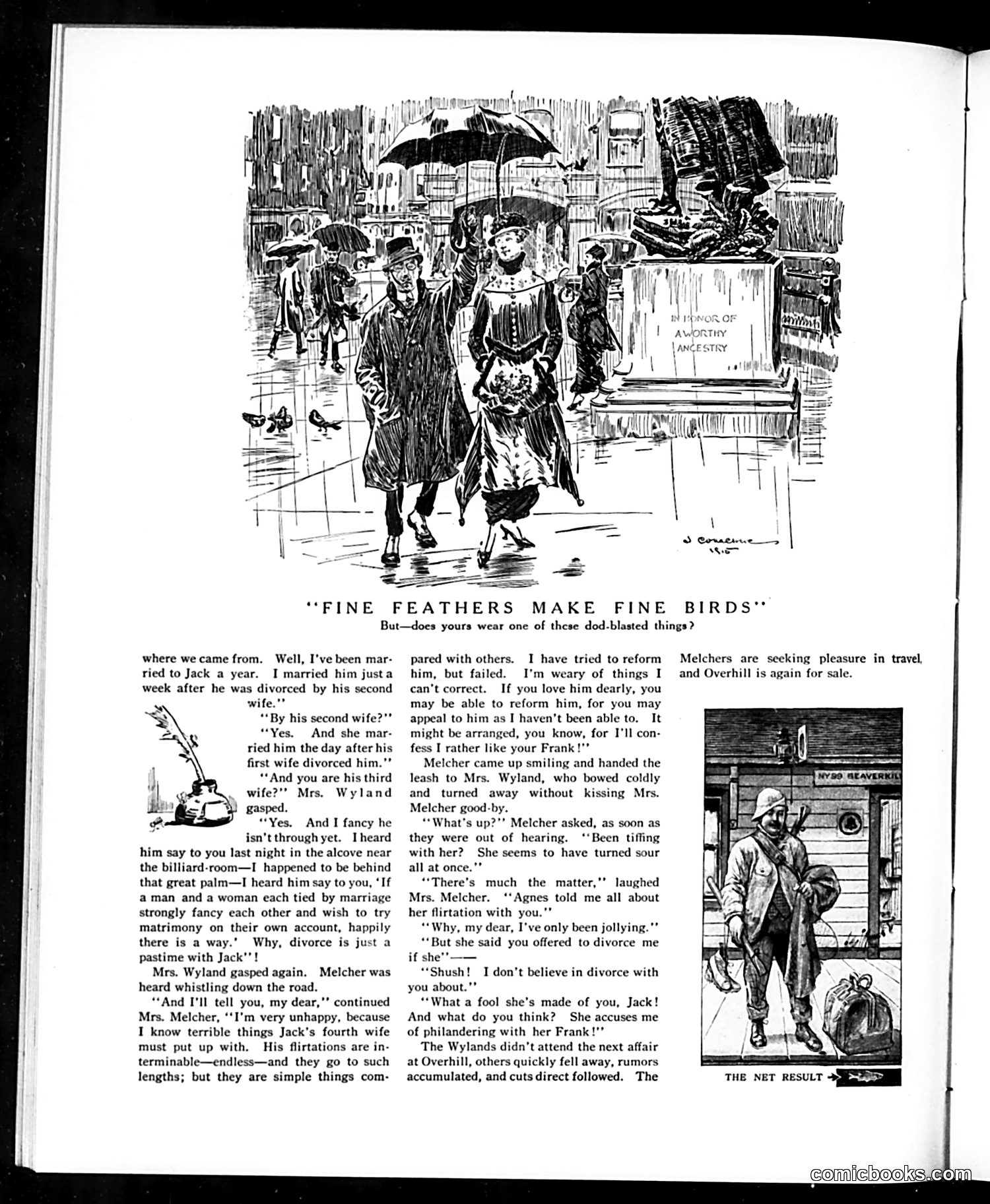
This satirical piece mocks the casual divorce culture among the wealthy elite. The cartoon depicts fashionably dressed socialites in the rain, introducing characters entangled in serial marriages. The story portrays Jack Melcher as a serial philanderer who cycles through wives with startling frequency—his current wife is his third or fourth, and he's openly flirting with Mrs. Wyland while married. The humor derives from treating divorce as a casual social "pastime" rather than serious marital dissolution. Mrs. Melcher's warnings to Mrs. Wyland about Jack's infidelity and his offer to divorce his wife for her, combined with mutual accusations of philandering between the couples, expose the moral bankruptcy and social chaos of this lifestyle. The conclusion—the Wylands become social pariahs, the Melchers flee town, and Overhill house goes up for sale—suggests Judge magazine's moralistic critique: such frivolous, scandal-ridden behavior destroys reputations and social standing. The title's phrase about "fine feathers" (fancy appearance) making "fine birds" ironically suggests outward elegance masks inner moral corruption.
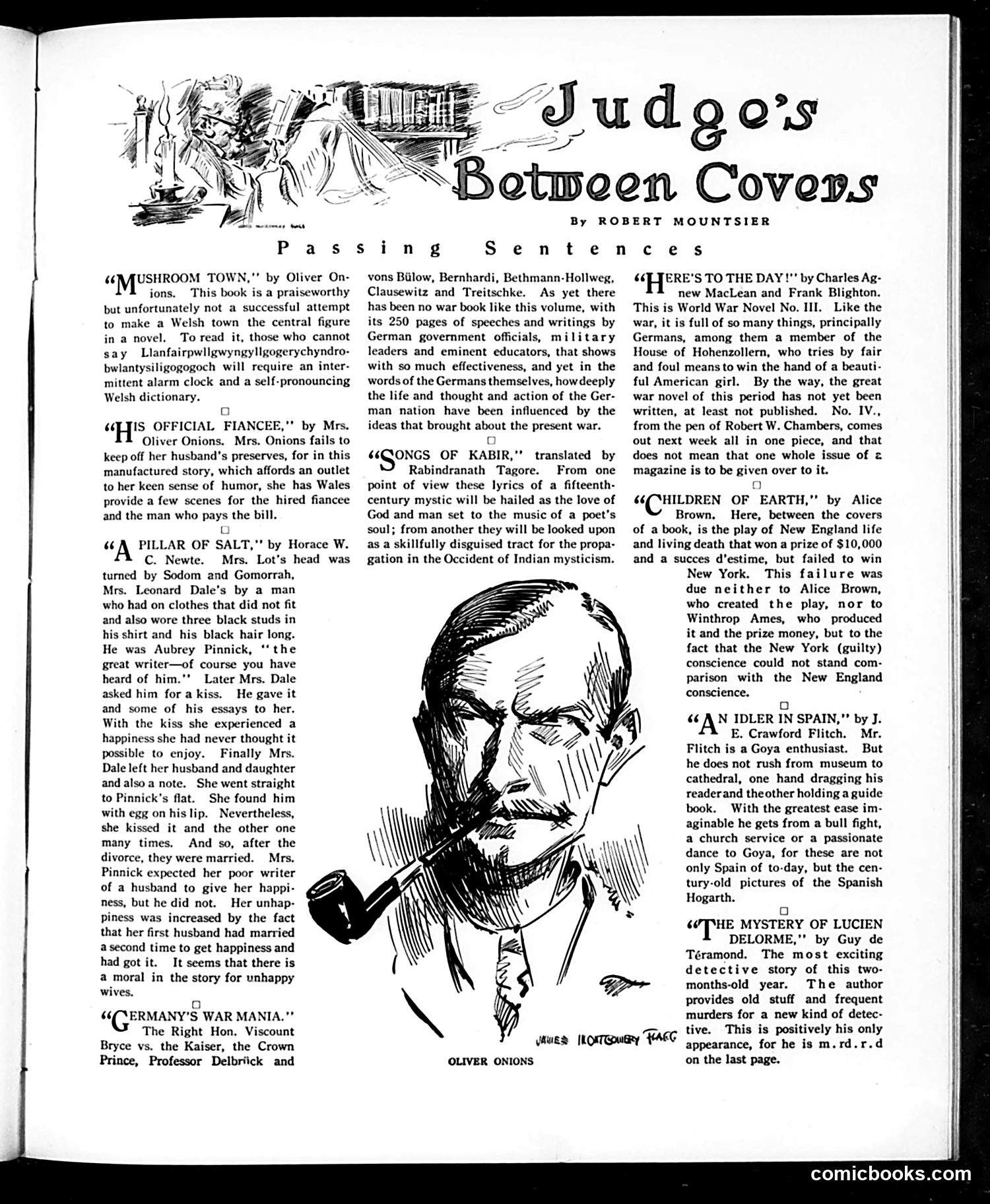
This page presents satirical book reviews from *Judge* magazine's literary section. The central illustration is a caricatured portrait of **Oliver Onions**, a contemporary author being reviewed multiple times on this page. The satire targets both the books and their authors. Reviewers mock Welsh place names (Llanfairpwllgwyngyllgogerychwindrobwlantysiligogogoch) as unpronounceable, snipe at Mrs. Oliver Onions for writing similar material to her husband, and critique relationship narratives—particularly Mrs. Dale's foolish abandonment of family for a mediocre writer with egg on his lip. A significant review examines **"Germany's War Mania,"** presenting German military and intellectual writings that reveal how German thought shaped the current war (World War I). The page also catalogs multiple "World War Novels" flooding the market, suggesting publisher and public oversaturation with war fiction. The overall tone emphasizes literary mediocrity and poor romantic judgment among characters and readers alike.
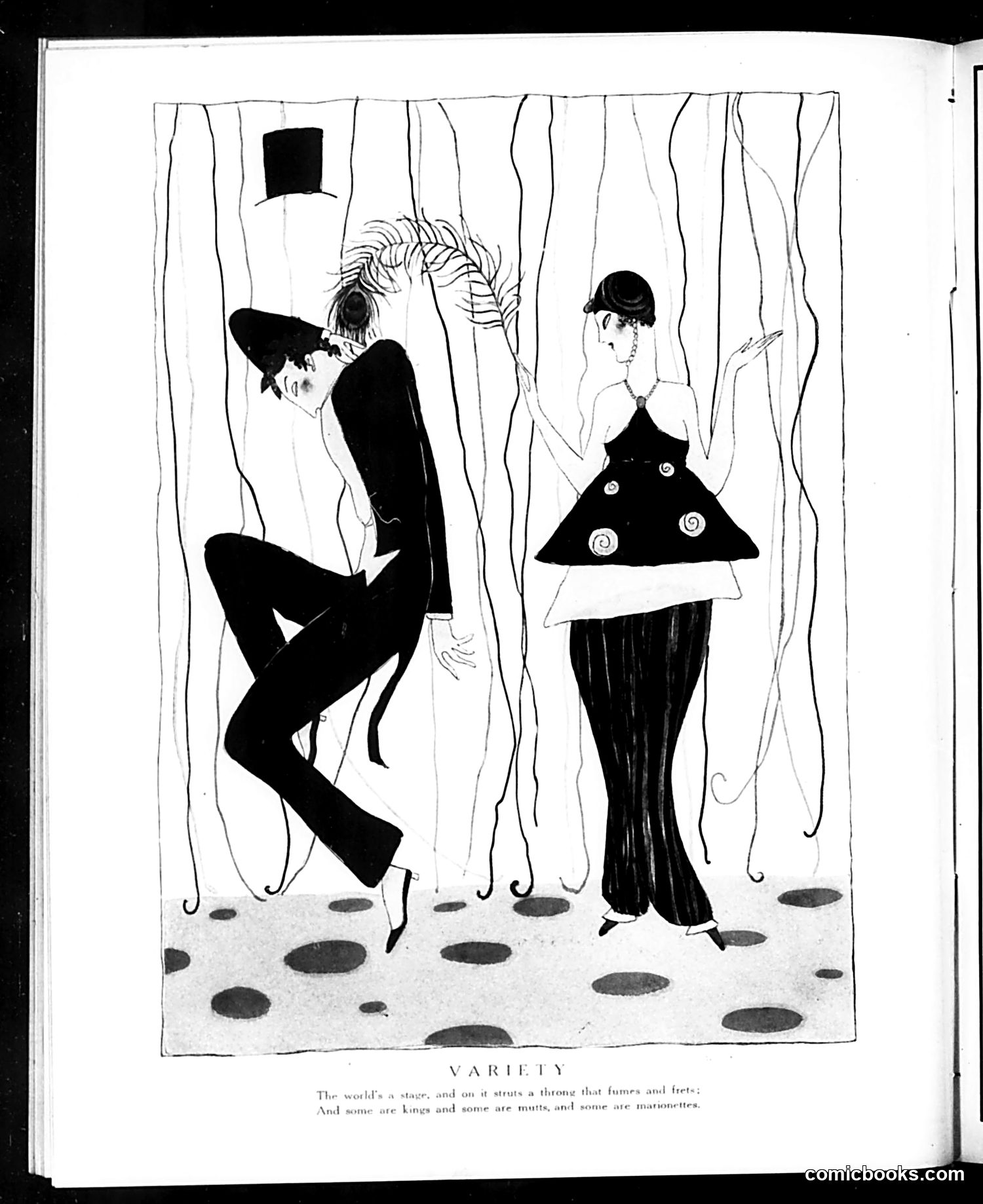
This illustration satirizes social pretension and class performance. The caption "Variety" with its quoted text ("The world's a stage, and on it struts a throng that fumes and frets; / And some are kings and some are muts, and some are marionettes") alludes to Shakespeare's "All the World's a Stage." Two fashionably dressed figures in a stylized forest setting represent different social "types" performing their roles. The left figure appears effeminate or affected (suggested by exaggerated posture), while the right wears decorative spiral motifs on their outfit—possibly indicating artificiality or superficiality. The scattered dots beneath may represent footlights, reinforcing the theatrical metaphor. The satire mocks how people adopt artificial personas and social roles, treating everyday life as performance rather than authentic living.
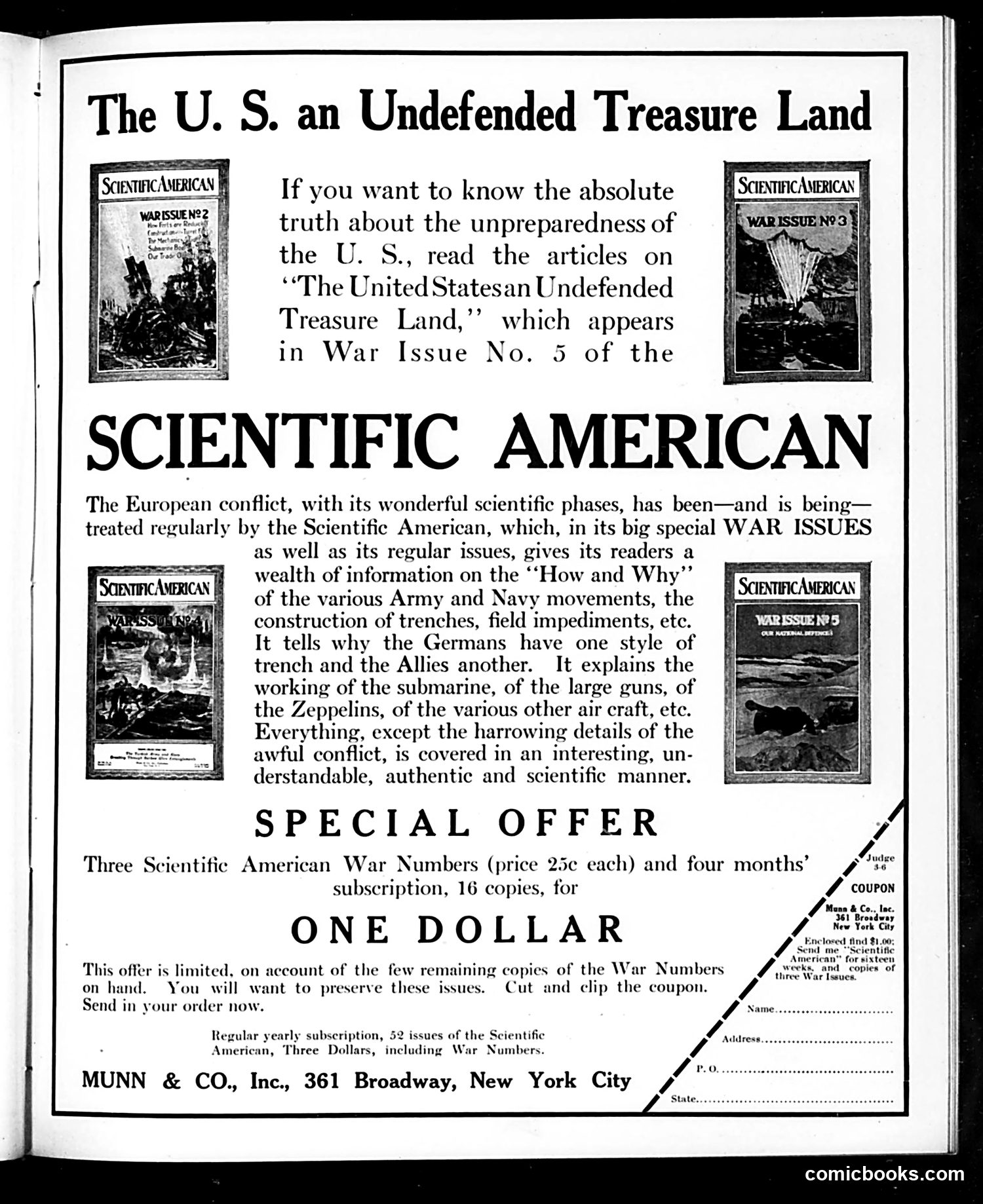
This is primarily **advertising**, not satire or political commentary. It's a 1915-era advertisement promoting *Scientific American* magazine's special "War Issues" covering World War I. The page advertises articles titled "The United States an Undefended Treasure Land" (appearing in War Issue No. 5), which apparently addressed American military unpreparedness—a real concern during early WWI neutrality. The ad emphasizes *Scientific American's* detailed, technical coverage of military technology: trenches, submarines, large guns, Zeppelins, and aircraft. The "special offer" pitches three war-numbered issues plus four months of subscription for one dollar—presented as limited availability ("few remaining copies"). The implied appeal is that readers should preserve these informative issues about cutting-edge military science. The page reflects genuine 1915 American anxiety about defense capability amid European conflict, while functioning as straightforward magazine promotion.
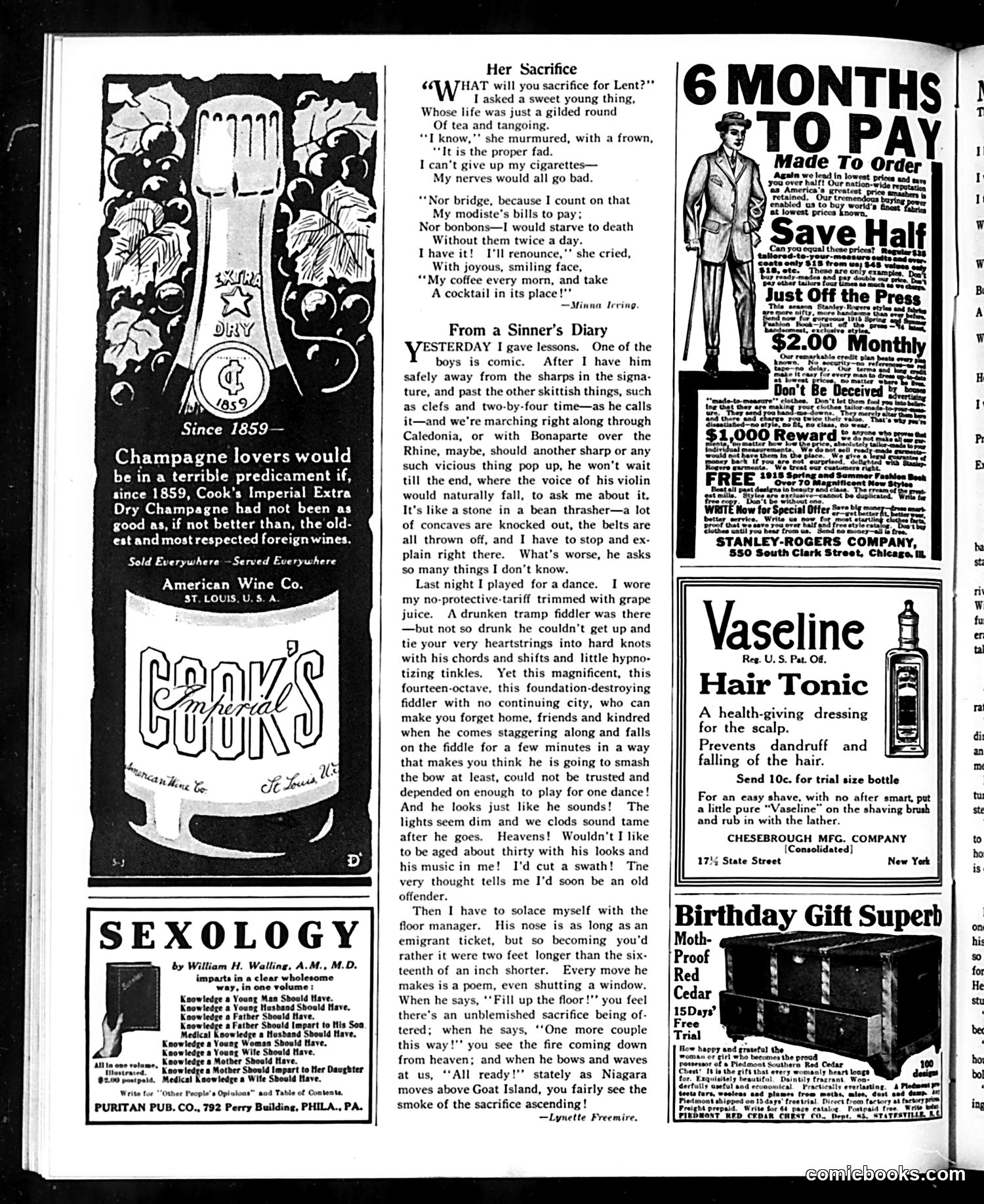
This page from Judge magazine contains satirical content mocking religious observance and gender norms circa the early 1900s. **"Her Sacrifice"** is a brief poem ridiculing a young woman's shallow approach to Lenten fasting. She claims she cannot give up cigarettes, bridge games, or bonbons (candy), but cheerfully "sacrifices" her morning coffee by replacing it with a cocktail instead—missing the spiritual point of self-denial entirely. The satire targets both the hypocrisy of performative religiosity among the wealthy and contemporary attitudes about women's frivolity. **"From a Sinner's Diary"** satirizes a music teacher's romanticization of morally questionable men—a drunk violinist and a vain dance-floor manager—whose charm and talent momentarily make her overlook their character flaws. The narrator's self-aware reflections on her own vanity and weakness provide dark humor. The remaining content is advertising for period products: champagne, a sex-education book, hair tonic, and a "moth-proof" cedar chest—typical of Judge's revenue model.
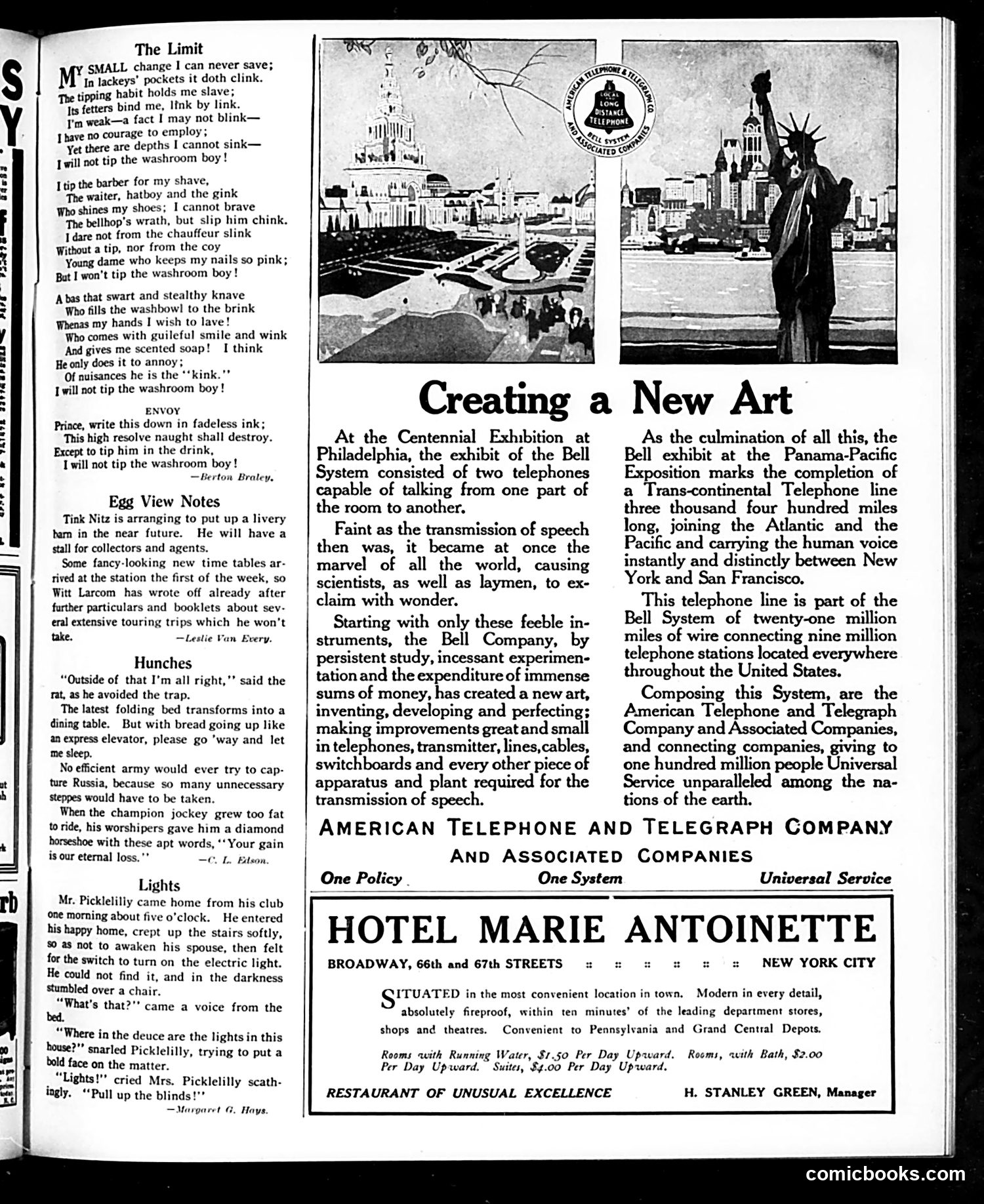
**Main Content:** This is primarily a page of humorous verse and advertising, not a political cartoon. **"The Limit" Poem:** A satirical piece by Berton Braley about tipping culture in early 20th-century America. The speaker complains he's forced to tip everyone—barbers, waiters, bellhops, shoeshine boys, chauffeurs, and manicurists—yet draws a defiant line: he refuses to tip the washroom boy, treating this petty act of resistance as a point of principle. The joke satirizes the absurdity and exhaustion of America's expanding tipping expectations, which had become socially compulsory despite the speaker's limited means. **Remaining Content:** Brief humorous anecdotes ("Egg View Notes," "Hunches," "Lights") and a substantial advertisement for the American Telephone & Telegraph Company celebrating the newly completed transcontinental telephone line connecting New York and San Francisco—positioned as a technological marvel. **Context for Modern Readers:** Tipping in this era was becoming an American social obligation that frustrated working-class people, making Braley's poem resonate with contemporary anxieties about economic pressure and social expectations.
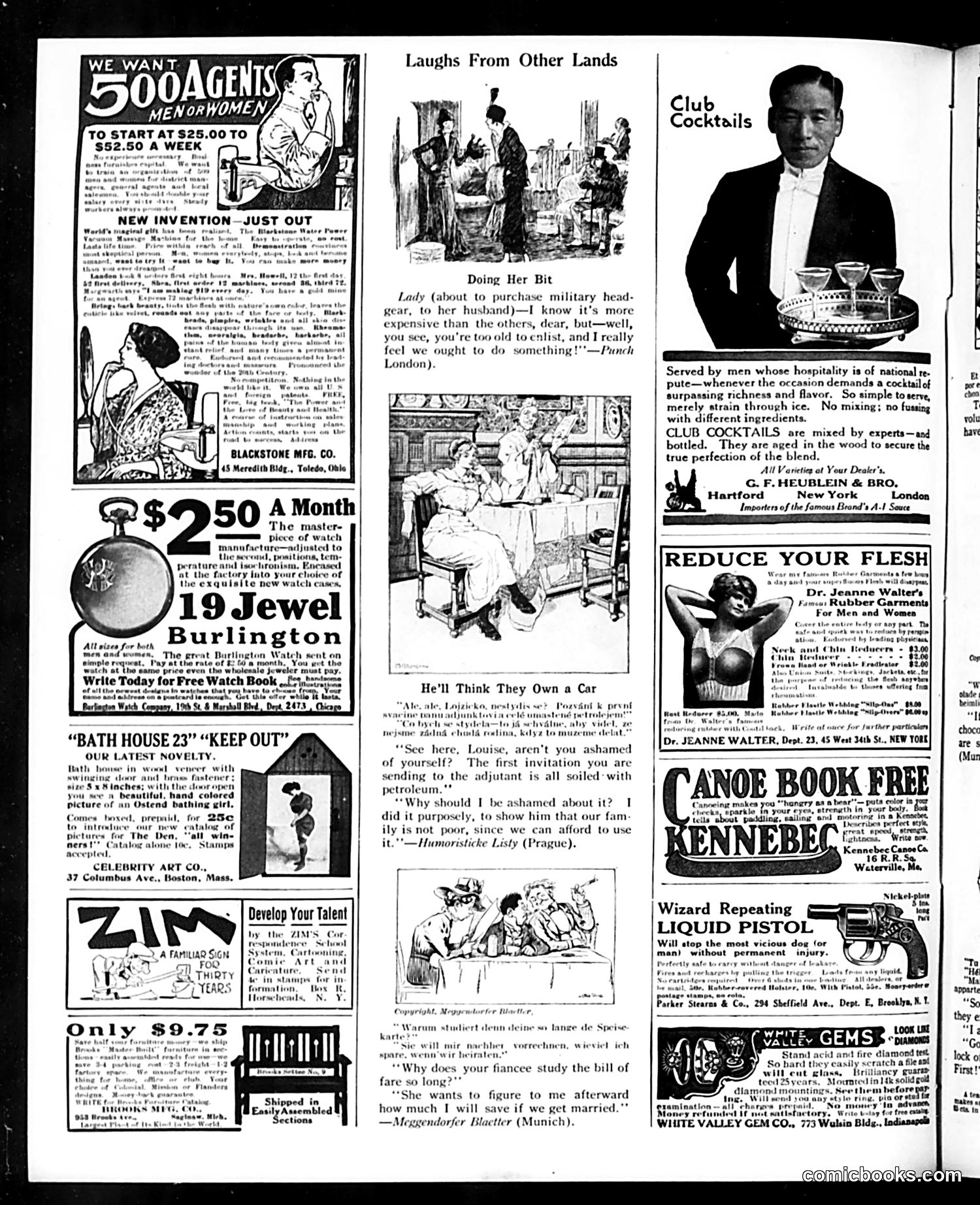
This page is primarily **advertisements and reprinted international humor**, not political satire. The "Laughs From Other Lands" section contains three jokes translated from European magazines (Punch, Humoristische Listy, Meggendorfer Blätter). The jokes reflect **World War I-era sensibilities**: A British wife buys military headgear since her husband is too old to enlist—a contribution to the war effort. A Czech couple uses petroleum-stained bills to appear wealthy. A third joke plays on marital financial anxiety. The advertisements target early-20th-century consumers: mail-order watches, talent development courses, "reducing" products (weight loss via rubber garments), canoes, and novelty items like the "Liquid Pistol" dog repellent. The page reflects wartime concerns and period consumer culture rather than offering sharp political commentary. The international humor selections suggest Judge's cosmopolitan readership.
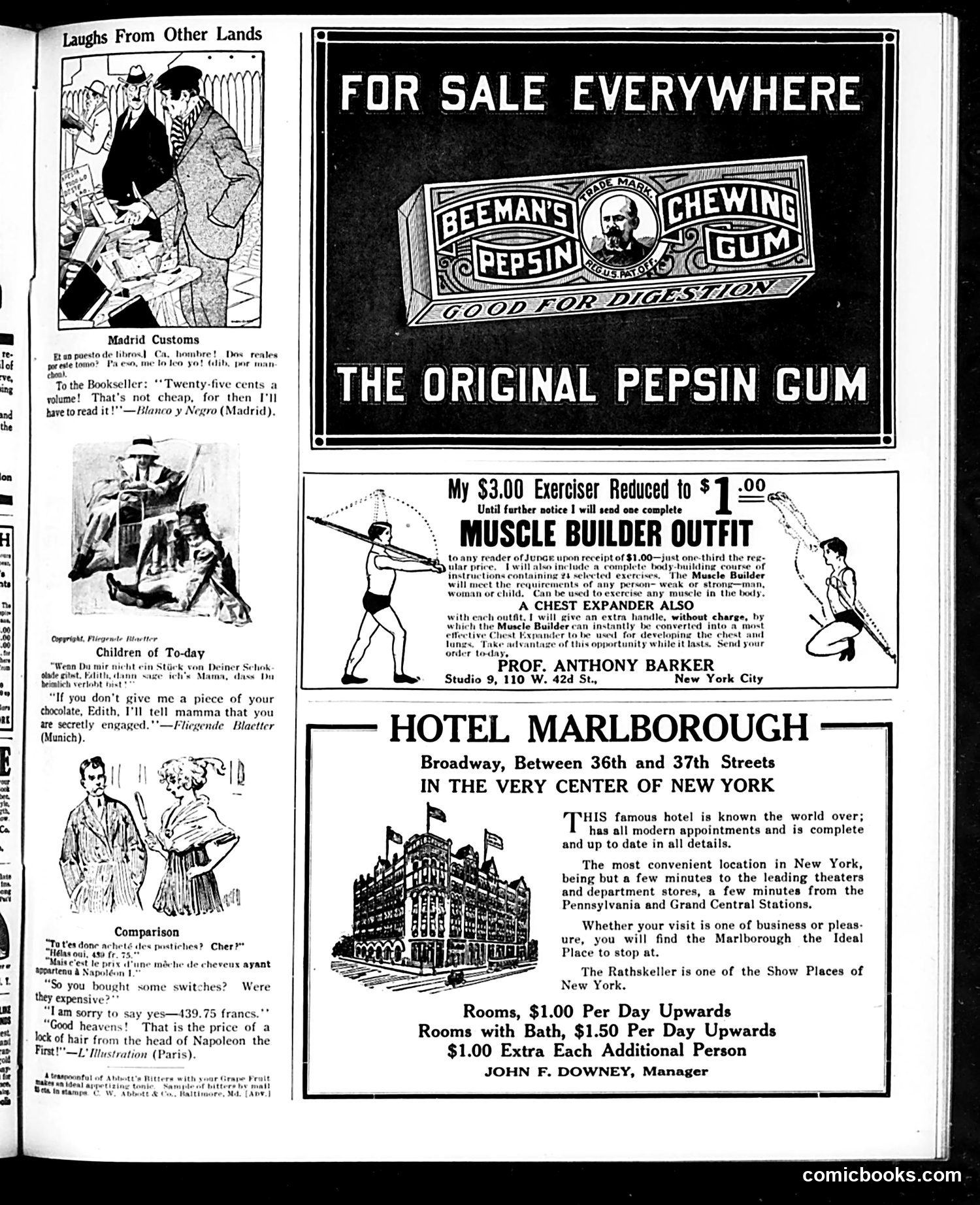
This page from Judge magazine combines international humor with advertisements typical of early-20th-century periodicals. **"Laughs From Other Lands" Section:** The left column reprints satirical cartoons from European publications (Madrid, Munich, Paris). These include a Madrid Customs joke about a bookseller reluctant to buy expensive books he'd have to read, and Munich and Paris pieces involving blackmail and hair switches—the latter referencing Napoleon, a common historical reference point for European humor. **Advertisements:** The page is dominated by ads: Beeman's Pepsin Chewing Gum (marketed for digestion), a "$1 Muscle Builder Outfit" mail-order exercise equipment, and the Hotel Marlborough in New York. These reflect period consumer culture and mail-order commerce. The content demonstrates Judge's formula: mixing reprinted international humor with American advertisements, appealing to educated readers interested in European culture while promoting commercial products and services of the era.
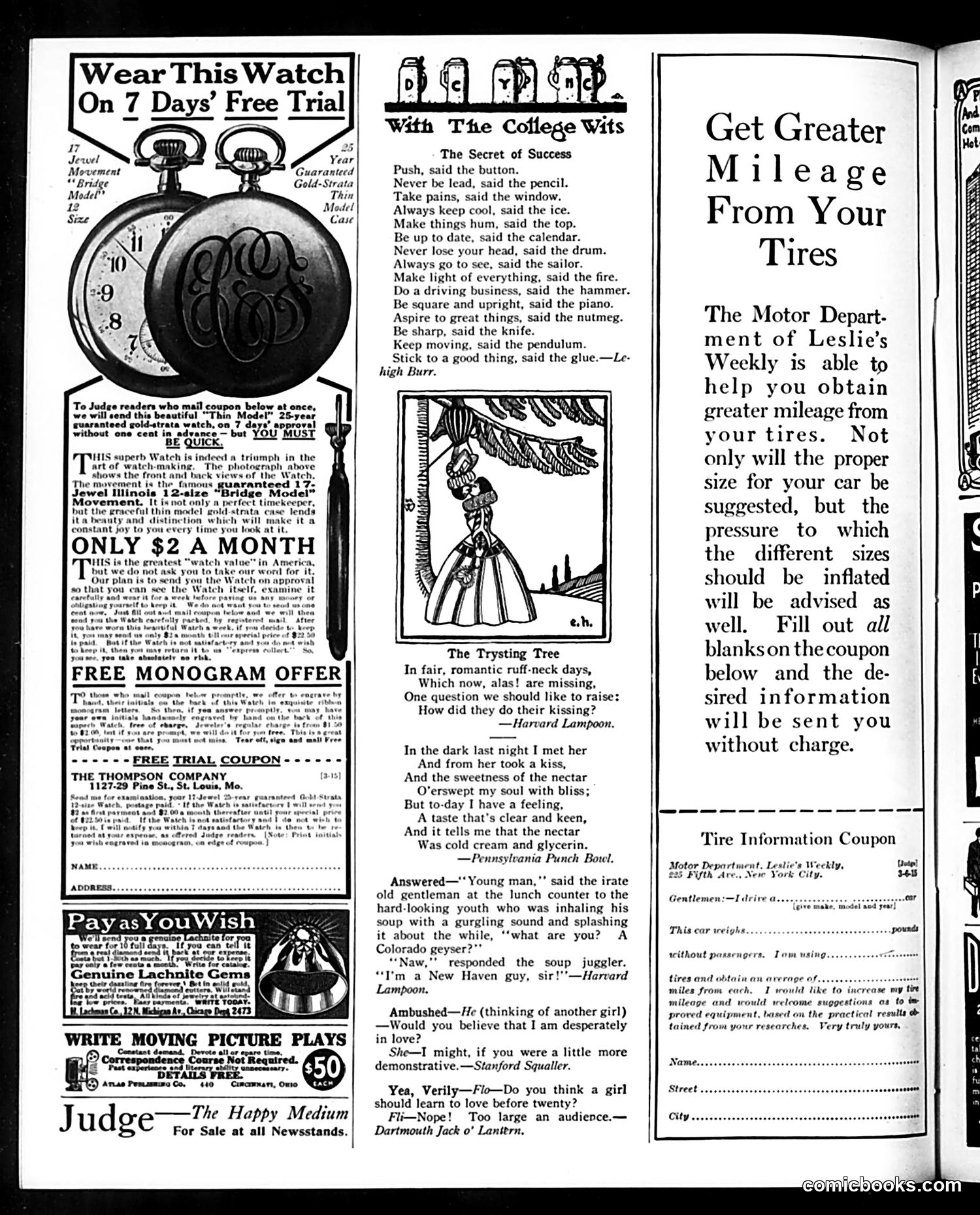
This is a **magazine advertisement and humor page** from Judge, primarily featuring paid advertisements alongside period humor columns. The main content includes: 1. **Watch advertisement** ("Wear This Watch On 7 Days' Free Trial") - a common early 20th-century sales pitch offering trial periods to build consumer confidence in mail-order purchases. 2. **"With The College Wits"** - a humor section reprinting jokes from college magazines (Harvard Lampoon, Stanford Squaller, Dartmouth Jack o' Lantern). The jokes are gentle, mostly about romantic mishaps: a woman's "kiss" tasting of cold cream and glycerin (cosmetics), a loud soup-eater, and misunderstandings about demonstrating affection. 3. **Leslie's Weekly tire coupon** - an automotive service feature advising readers on proper tire inflation and size. The humor reflects early 20th-century collegiate life and dating customs, with light mockery of youth romance and modern conveniences (cosmetics, automobiles). There is **no political satire** here—this page is primarily commercial advertising interspersed with lightweight social humor.
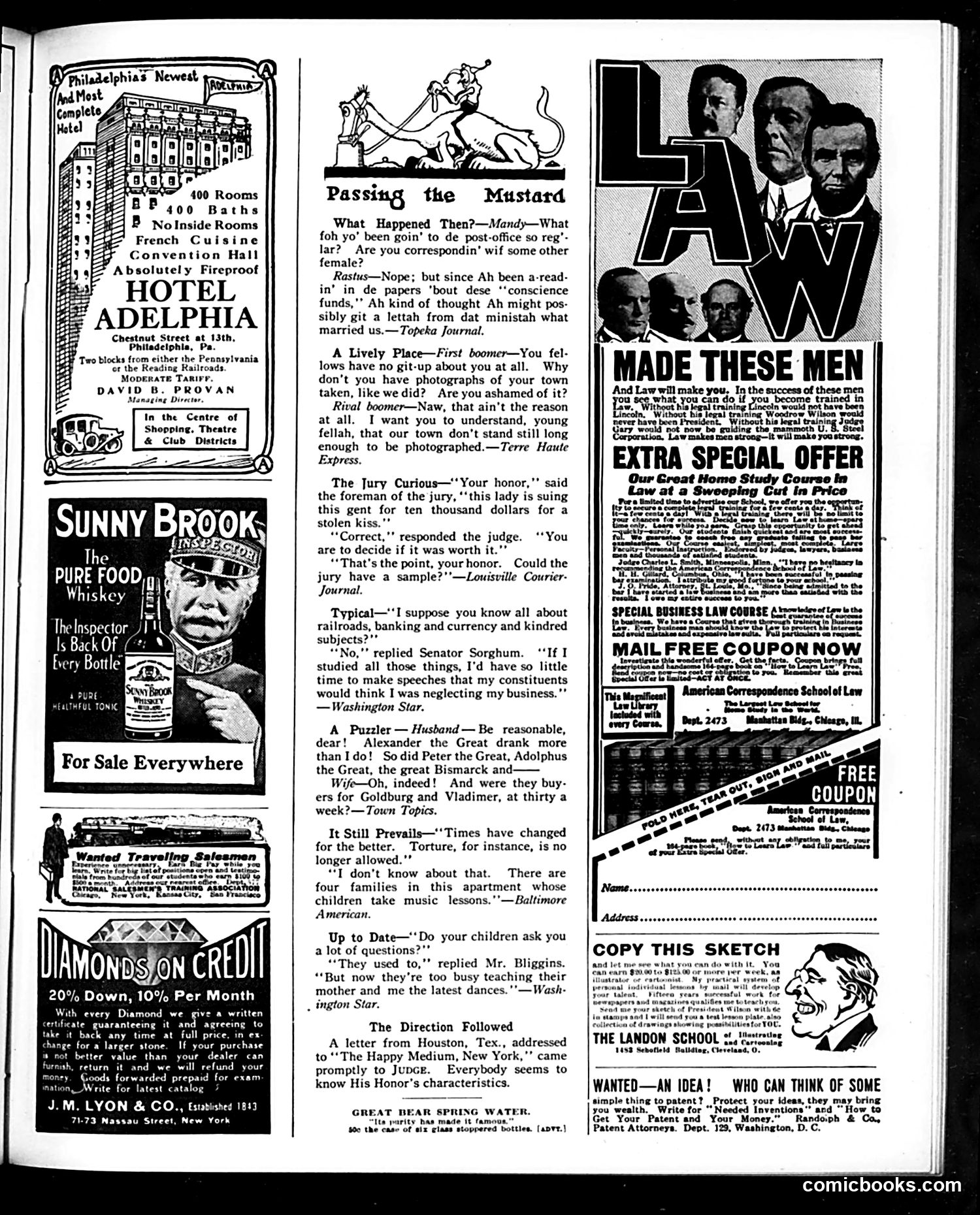
This page is primarily **advertising** interspersed with brief humorous anecdotes rather than political cartoons. The small jokes target late 19th/early 20th-century concerns: "Passing the Mustard" uses racist dialect humor about an African American man ("Rastus") seeking "conscience fund" money from a minister who married him. "The Jury Curious" makes light of sexual harassment (a stolen kiss valued at $10,000). "It Still Prevails" jokes that music lessons constitute torture—a common complaint about children's education. "A Puzzler" references historical figures (Alexander the Great, Peter the Great, Bismarck) to mock a drunk husband's excuses. "The Direction Followed" contains a mild jab at Judge magazine itself, calling it "The Happy Medium"—suggesting it occupies a moderate position. The advertisements promote hotels, whiskey, diamonds, traveling jobs, and correspondence schools—typical early 1900s commerce. No specific political figures are caricatured on this page.
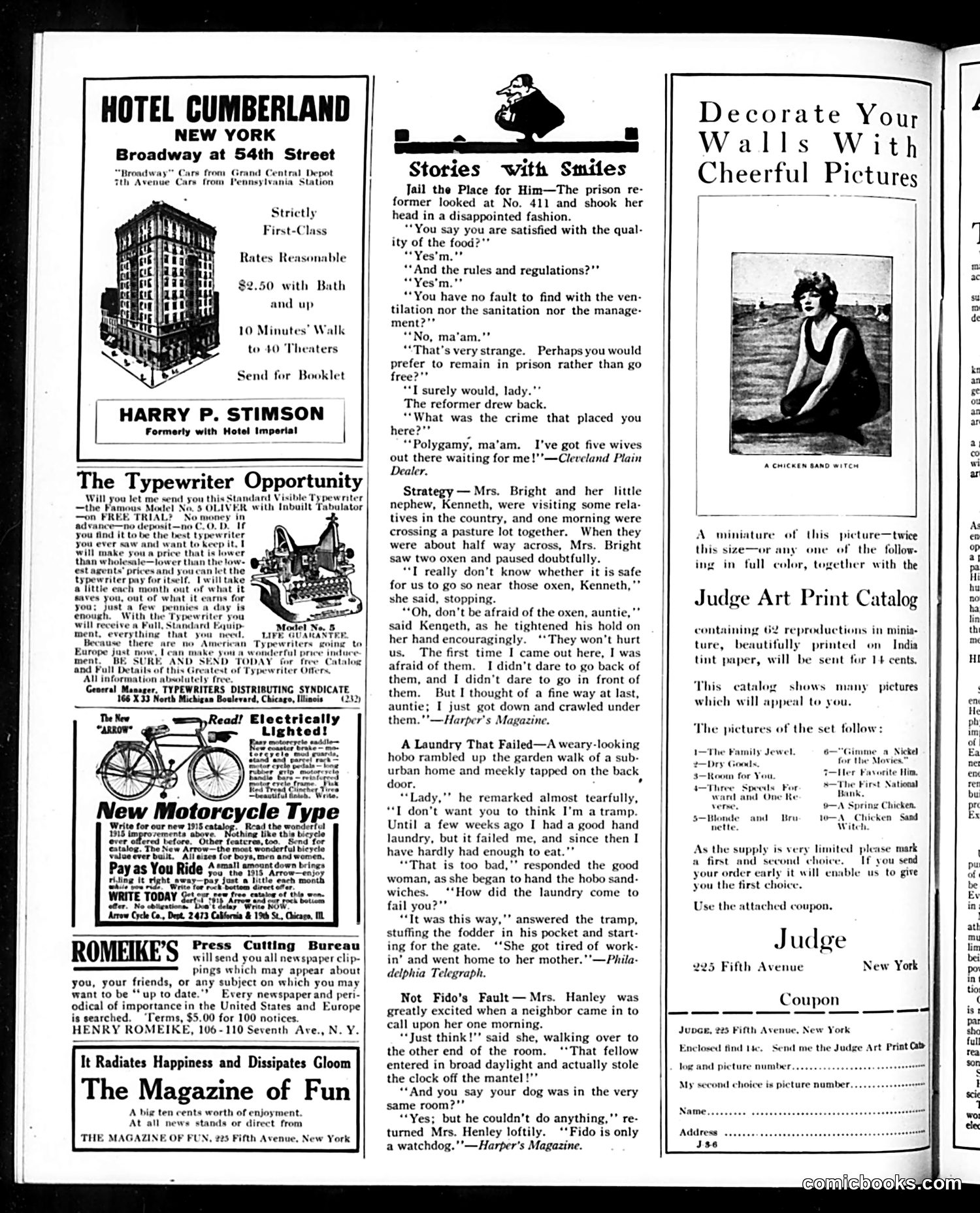
This page contains three brief humorous anecdotes typical of Judge magazine's satirical style: 1. **"Jail the Place for Him"**: A prison reformer interviews an inmate satisfied with conditions. The joke's punchline reveals he's a polygamist preferring incarceration to facing five wives at home—satirizing both prison reform efforts and marital discord. 2. **"Strategy"**: A nephew reassures his aunt about oxen by explaining he previously crawled under them to avoid confrontation—a child's naive "logic" that's darkly humorous. 3. **"A Laundry That Failed"**: A homeless man claims his laundry business collapsed when his wife "got tired of work-in' and went home to her mother"—satirizing both failed entrepreneurship and domestic instability, with the tramp's opportunistic cadging for food as he leaves. These jokes reflect early 20th-century attitudes toward poverty, marriage, and social institutions through gentle ridicule rather than harsh satire.
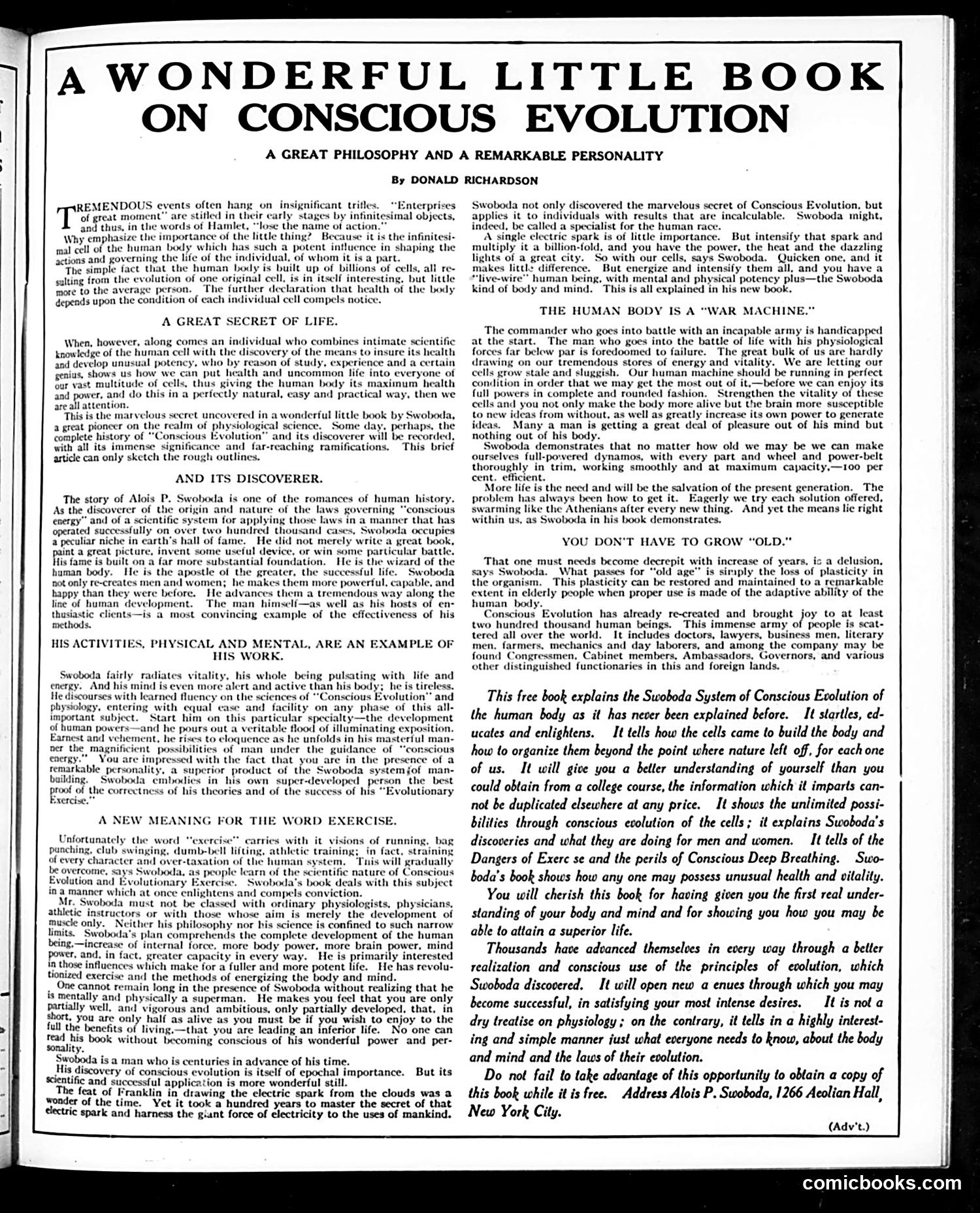
This page is **primarily advertising copy**, not satirical political commentary. It promotes Alois P. Swoboda's health philosophy and self-help book on "Conscious Evolution." The text presents Swoboda as a pioneering figure who discovered scientific principles governing human cells and developed an "Evolutionary Exercise" system to optimize health. Key claims include that he has successfully treated over 200,000 cases and that his methods can prevent aging and create superior physical and mental vitality. The advertisement emphasizes Swoboda himself as proof of his system's efficacy—describing him as radiating vitality and embodying "super-developed" humanity. This reflects early 20th-century pseudoscientific wellness marketing common in American magazines, promoting individual self-improvement through quasi-scientific body-building techniques. The page contains **no visible political satire or cartoon figures**—it's a straightforward promotional advertisement typical of *Judge* magazine's revenue model during this era.
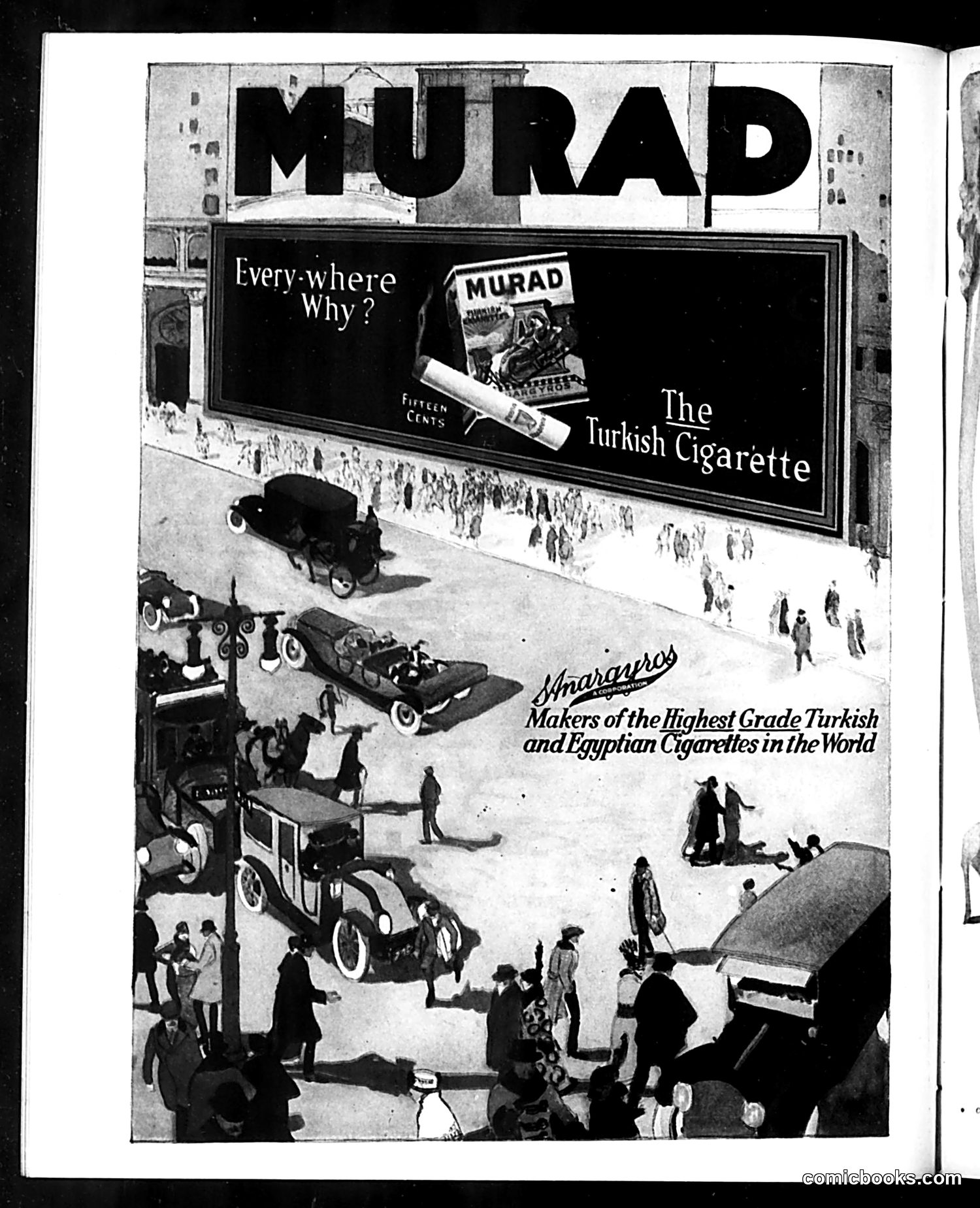
This page is primarily **advertising, not political satire**. It features a Murad cigarette advertisement showing an aerial view of a bustling city square or marketplace with pedestrians, vehicles, and a large billboard promoting "Murad—The Turkish Cigarette" for fifteen cents. The ad's tagline "Everywhere Why?" appears designed to emphasize the product's ubiquitous popularity. The company Anargyros is credited as maker of "the Highest Grade Turkish and Egyptian Cigarettes in the World." This reflects early 20th-century cigarette marketing, when Turkish and Egyptian cigarettes were considered premium products. The judge magazine likely ran such advertisements to fund operations. There is no apparent political commentary or satire present on this page.