
Judge, 1915-03-06 · page 8 of 24
Judge — March 6, 1915 — page 8: what you’re looking at
What you’re looking at
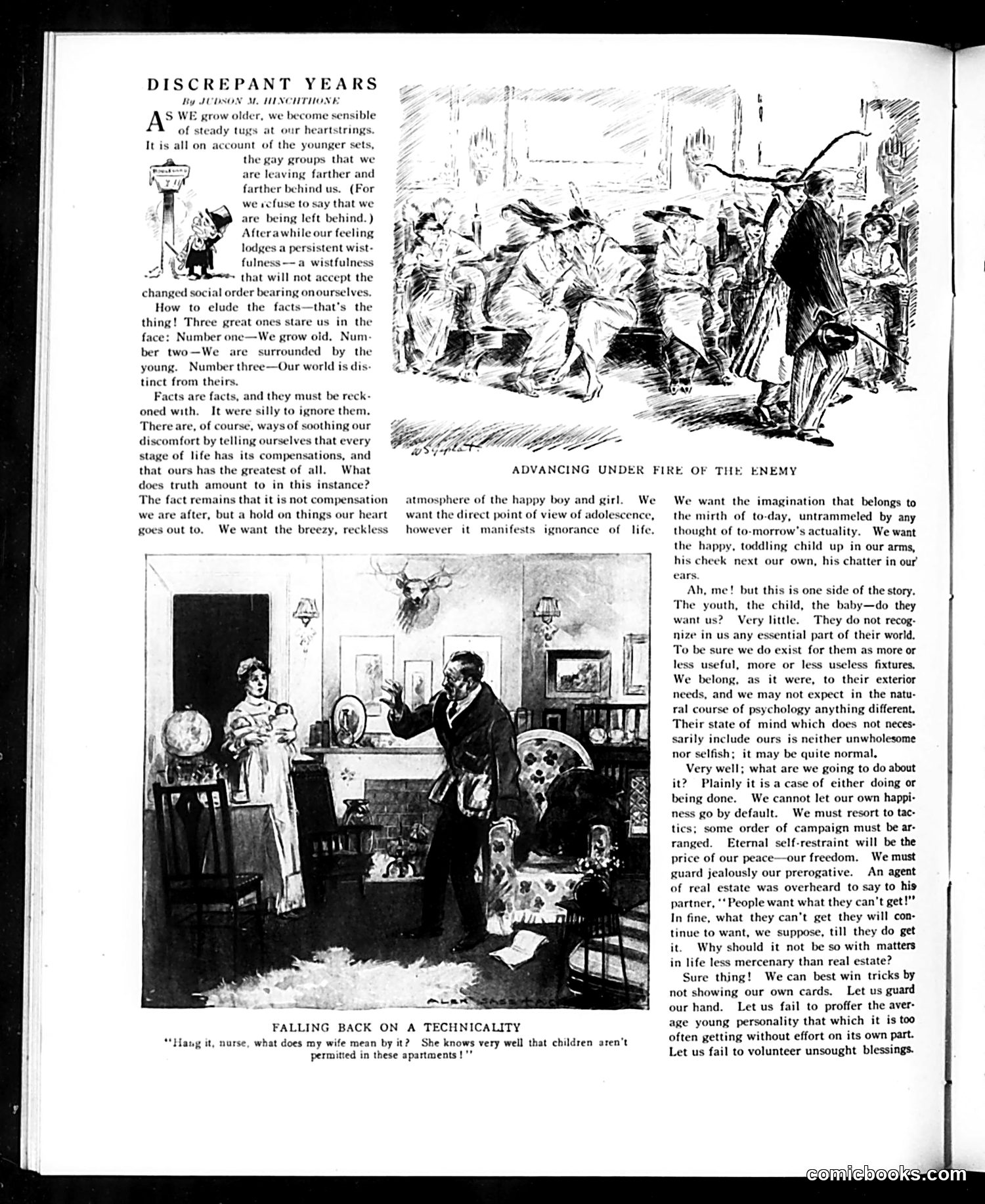
This satirical article explores generational alienation. The author argues that aging adults become melancholy watching younger people move ahead, experiencing three facts: they grow old, youth surrounds them, and their world differs from the young's. The lower cartoon illustrates the tension: a man confronts his wife about children in their apartment building, revealing how adults impose rules while resenting their own irrelevance to youth. The article's conclusion presents cynical "tactics": adults should withhold affection and approval to make themselves desired—manipulating youth through scarcity, just as a real estate agent noted people want what they can't obtain. Rather than freely offer love and blessing, the author suggests deliberately remaining aloof. The satire critiques this emotional manipulation while sympathizing with aging adults' anxieties about obsolescence in a youth-oriented society. It's both sympathetic to aging fears and skeptical of the defensive strategies people adopt.
📄 Transcribed text from this page (OCR, searchable)
Machine-transcribed from the original scan — historical spelling and the odd misread are preserved.
DISCREPANT YEARS By JUDSON M. HINCHTHONE grow older, we become sensible of steady tugs at our heartstrings. It is all on account of the younger sets, the gay groups that we are leaving farther and farther behind us. (For we refuse to say that we are being left behind.) Afterawhile our feeling lodges a persistent wist- fulness — a wistfulness that will not accept the changed social order bearing onourselves. How to elude the facts—that’s the thing! Three great ones stare us in the fi Number one—We grow old. Num ber two—We are surrounded by the young. Number three—Our world is dis- tinct from their Facts are facts, and they must be reck- oned with. It were silly to ignore them. There are, of course, ways of soothing our discomfort by telling ourselves that stage of life h: that ours has the greatest of 4 does truth amount to in this instance? The fact remains that it is not compensation we are after, but a hold on things our heart goes out to, We want the breezy, reckless r Yo LLL” ADVANCING atmosphere of the happy boy and girl. We want the direct point of view of adolescence, however it| manifests ignorance of life. FALLING BACK ON A TECHNICALITY “Hang it, nurse, what does my wife mean by it? She knows very well that children aren't permitted in these apartments !"" UNDER FIRE OF THE ENEMY We want the imagination that belongs to the mirth of to-day, untrammeled by any thought of to-morrow's actuality. We want the happy, toddling child up in our arms, his cheek next our own, his chatter in our ears Ah, me! but this is one side of the story. The youth, the child, the baby—do they want us? Very little. They do not recog- nize in us any essential part of their world, To be sure we do exist for them as more or less useful, more or less useless fixtures. We belong, as it were, to their exterior needs, and we may not expect in the natu- ‘al course of psychology anything different. Their state of mind which does not neces- sarily include ours is neither unwholesome nor selfish; it may be quite normal, Very well; what are we going to do about it? Plainly it is a case of either doing or being done. We cannot let our own happi- ness go by default. We must resort to tac- tics; some order of campaign must be ar- ranged. Eternal self-restraint will be the price of our peace—our freedom. We must guard jealously our prerogative. An agent of real estate was overheard to say to his partner, ‘* People want what they can’t get!"" In fine, what they can’t get they will con- tinue to want, we suppose, till they do get it. Why should it not be so with matters in life less mercenary than real estate? Sure thing! We can best win tricks by not showing our own cards. Let us guard our hand. Let us fail to proffer the aver- age young personality that which it is too often getting without effort on its own part. Let us fail to volunteer unsought blessings.