
Judge, 1915-03-06 · page 13 of 24
Judge — March 6, 1915 — page 13: what you’re looking at
What you’re looking at
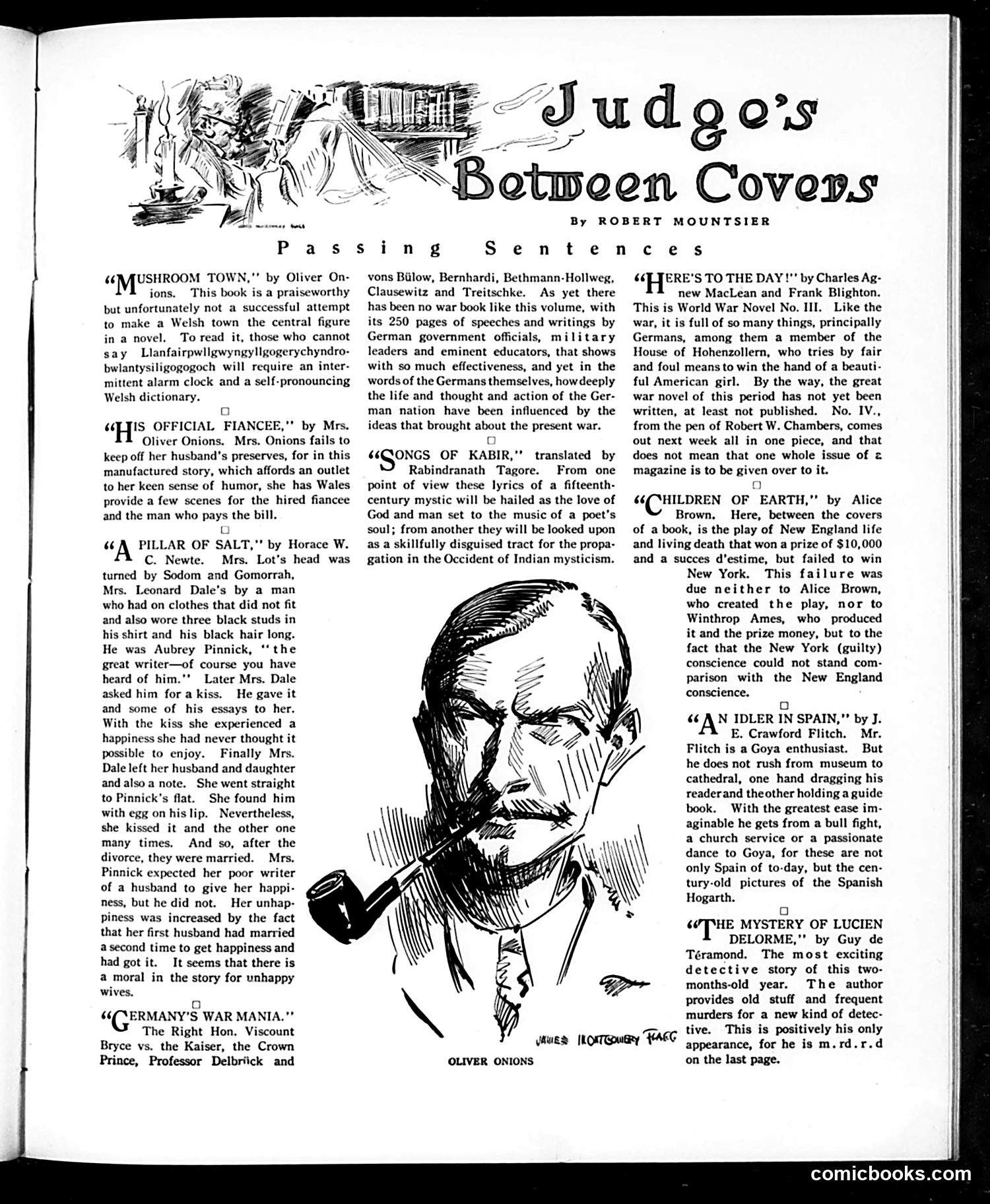
This page presents satirical book reviews from *Judge* magazine's literary section. The central illustration is a caricatured portrait of **Oliver Onions**, a contemporary author being reviewed multiple times on this page. The satire targets both the books and their authors. Reviewers mock Welsh place names (Llanfairpwllgwyngyllgogerychwindrobwlantysiligogogoch) as unpronounceable, snipe at Mrs. Oliver Onions for writing similar material to her husband, and critique relationship narratives—particularly Mrs. Dale's foolish abandonment of family for a mediocre writer with egg on his lip. A significant review examines **"Germany's War Mania,"** presenting German military and intellectual writings that reveal how German thought shaped the current war (World War I). The page also catalogs multiple "World War Novels" flooding the market, suggesting publisher and public oversaturation with war fiction. The overall tone emphasizes literary mediocrity and poor romantic judgment among characters and readers alike.
📄 Transcribed text from this page (OCR, searchable)
Machine-transcribed from the original scan — historical spelling and the odd misread are preserved.
Pass 6¢\{USHROOM TOW: by Oliver On- ions. This book is a praiseworthy but unfortunately not a successful attempt to make a Welsh town the central figure in a novel. To read it, those who cannot say Llanfairpwllgwyngyllgogerychyndro- bwlantysiligogogoch will require an inter- mittent alarm clock and a self-pronouncing Welsh dictionary. fa} 66LJIS OFFICIAL FIANCEE,"’ by Mrs. Oliver Onions. Mrs. Onions fails to keep off her husband's preserves, for in this manufactured story, which affords an outlet to her keen sense of humor, she has Wales provide a few scenes for the hired fiancee and the man who pays the bill. a “ PILLAR OF SALT,” by Horace W. C. Newte. Mrs. Lot's head was turned by Sodom and Gomorrah, Mrs. Leonard Dale’s by a man who had on clothes that did not fit and also wore three black studs in his shirt and his black hair long. He was Aubrey Pinnick, ‘‘ the great writer—of course you have heard of him.’’ Later Mrs. Dale asked him for a kiss. He gave it and some of his essays to her. With the kiss she experienced a happiness she had never thought it possible to enjoy. Finally Mrs. Dale left her husband and daughter and also a note. She went straight to Pinnick’s flat. She found him with egg on his lip. Nevertheless, she kissed it and the other one many times. And so, after the divorce, they were married. Mrs. Pinnick expected her poor writer of a husband to give her happi- ness, but he did not. Her unhap- piness was increased by the fact that her first husband had married asecond time to get happiness and had got it. It seems that there is a moral in the story for unhappy wives. Oo 667 ERMANY’S WAR MANIA."" The Right Hon, Viscount Bryce vs. the Kaiser, the Crown Prince, Professor Delbriick and ing vons Biilow, Bernhardi, Bethmann-Hollweg, Clausewitz and Treitschke. As yet there has been no war book like this volume, with its 250 pages of speeches and writings by German government officials, military leaders and eminent educators, that shows with so much effectiveness, and yet in the words of the Germans themselves, howdeeply the life and thought and action of the Ger- man nation have been influenced by the ideas that brought about the present war. (a) 66QONGS OF KABIR,"’ translated by Rabindranath Tagore. From one point of view these lyrics of a fifteenth- century mystic will be hailed as the love of God and man set to the music of a poet's soul; from another they will be looked upon as a skillfully disguised tract for the propa- gation in the Occident of Indian mysticism. Judgo's etpeen Coveon.s By ROBERT MOUNTSIER Sentences 66]LJERE’S TO THE DAY!"’ by Charles Ag- new MacLean and Frank Blighton. This is World War Novel No. III. Like the war, it is full of so many things, principally Germans, among them a member of the House of Hohenzollern, who tries by fair and foul means to win the hand of a beauti- ful American girl. By the way, the great war novel of this period has not yet been written, at least not published. No. IV., from the pen of Robert W. Chambers, comes out next week all in one piece, and that does not mean that one whole issue of z magazine is to be given over to it. a 66(°HILDREN OF EARTH,” by Alice Brown, Here, between the covers of a book, is the play of New England life and living death that won a prize of $10,000 and a succes d’estime, but failed to win New York. This failure was due neither to Alice Brown, who created the play, nor to Winthrop Ames, who produced it and the prize money, but to the fact that the New York (guilty) conscience could not stand com- parison with the New England conscience. a S6AN IDLER IN SPAIN,” by J. E. Crawford Flitch. Mr. Flitch is a Goya enthusiast. But he does not rush from museum to cathedral, one hand dragging his readerand theother holding a guide book. With the greatest ease im- aginable he gets from a bull fight, a church service or a passionate dance to Goya, for these are not only Spain of to-day, but the cen- tury-old pictures of the Spanish Hogarth. is) 60T.HE MYSTERY OF LUCIEN DELORME,”’ by Guy de Téramond. The most exciting detective story of this two- months-old year. The author provides old stuff and frequent murders for a new kind of detec- tive. This is positively his only ARG vAUES LOKTRUGRY appearance, for he is m.rd.r.d OLIVER ONIONS on the last page. comicbooks.com