
A complete issue · 16 pages · 1910
Judge — October 22, 1910
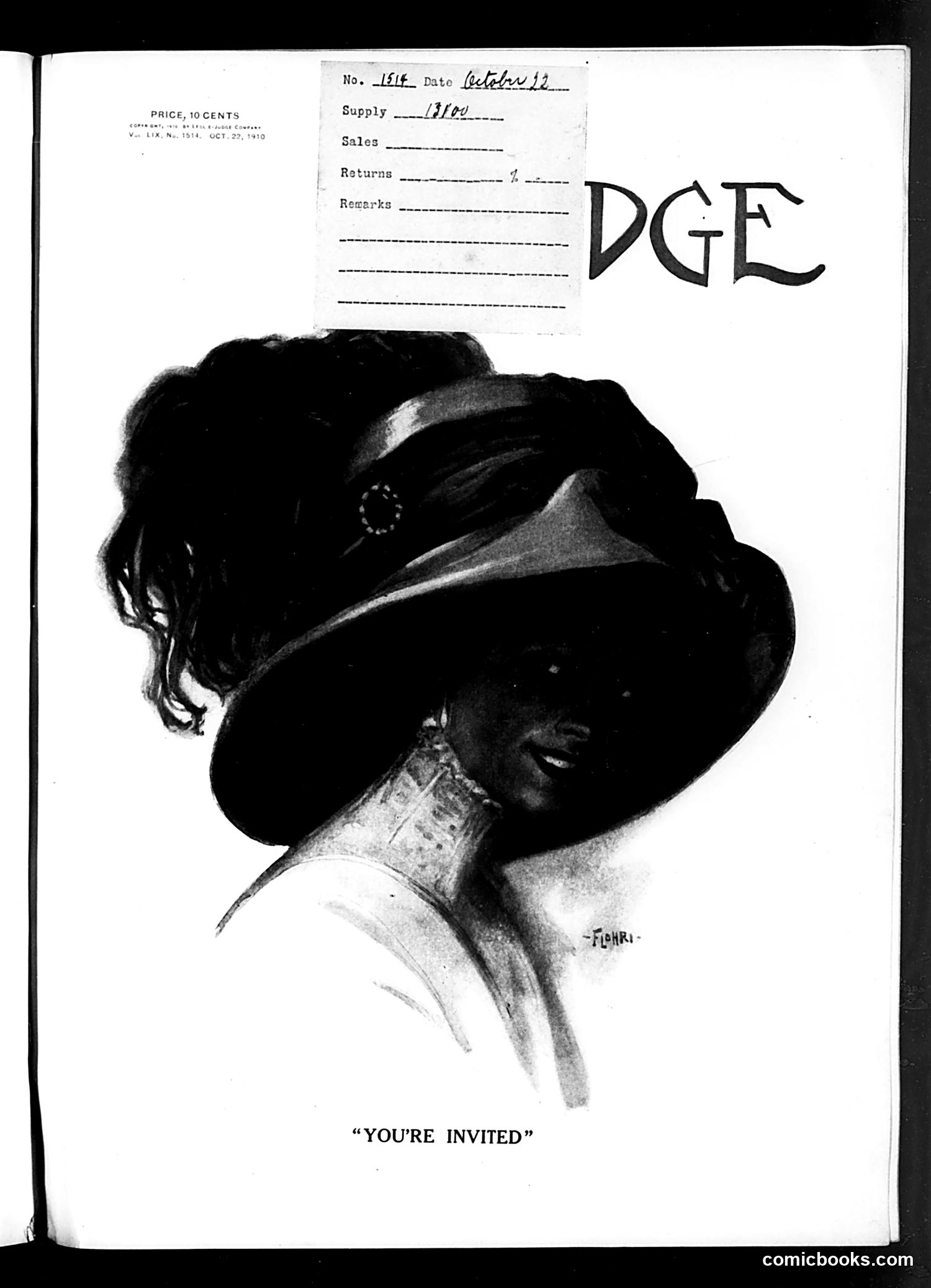
This appears to be a cover or advertisement page from *Judge* magazine (dated October 12, based on the header notation). The central image is a stylized portrait of a woman wearing an elegant, wide-brimmed hat with feathers and a decorative band, rendered in soft charcoal or pencil by an artist signed "Fichra." The text "YOU'RE INVITED" and the prominent "DGE" lettering (likely part of "*Judge*") suggest this was promotional material, possibly advertising a social event or the magazine itself. The price notation "10 CENTS" and administrative fields (Supply, Sales, Returns, Remarks) indicate this is a magazine cover or internal page. Without additional context, the specific satirical or political message remains unclear, though the fashionable woman's portrait suggests commentary on contemporary women's fashion or social customs of the early 20th century.
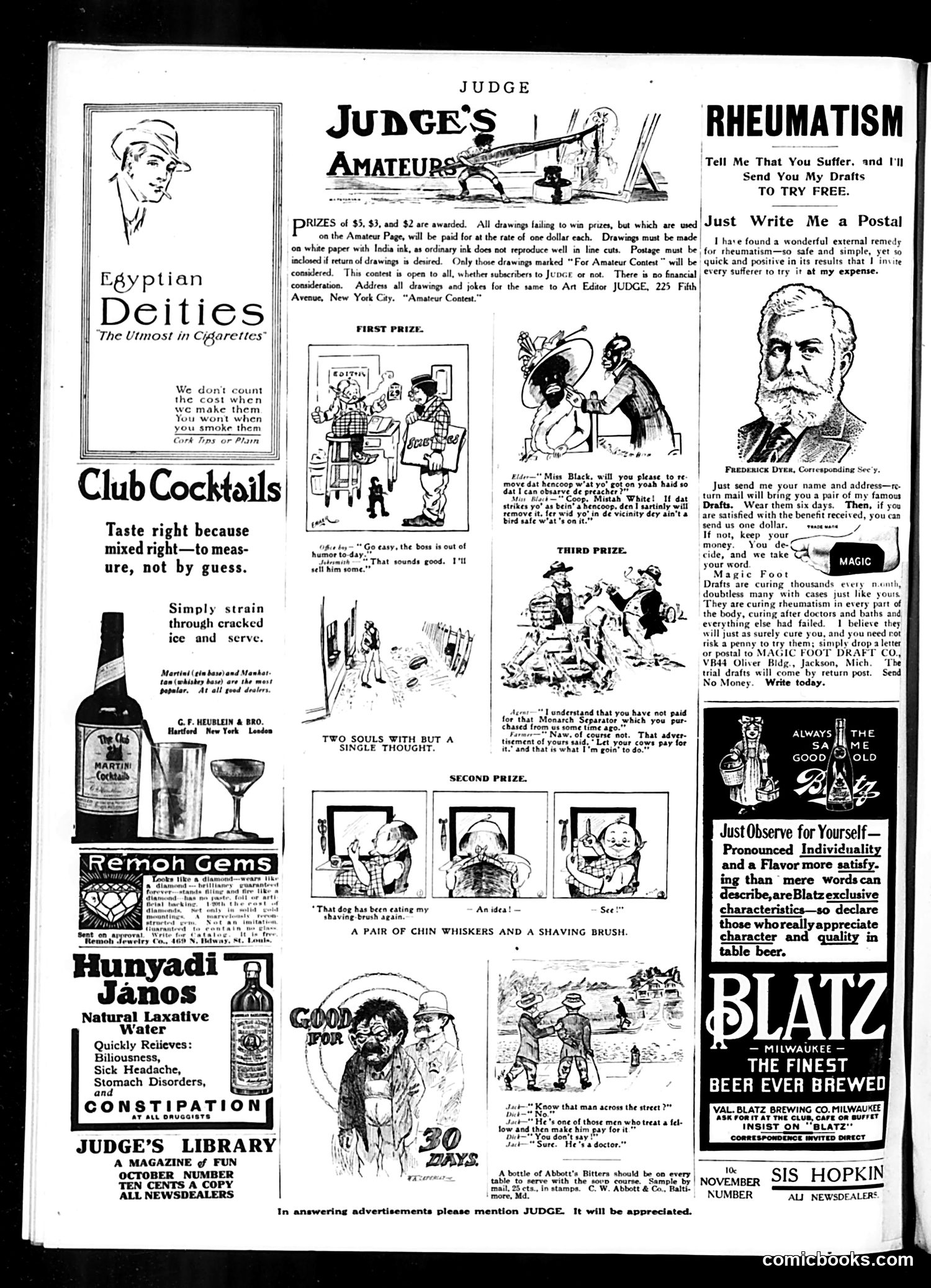
This page is primarily **advertising and filler content** rather than political satire. The main features include: **"Judge's Amateurs"** - A drawing contest offering small cash prizes ($3-$2) for amateur artwork submissions on unspecified topics. **Advertisements** dominate: Egyptian Deities cigarettes, Club Cocktails, Remoh Gems liqueur, Hunyadi Janos laxative water, and Blatz Milwaukee beer. The cartoon illustrations accompanying these ads appear to be **generic humor** rather than political commentary—depicting domestic scenes and social situations meant to amuse readers. **Context**: By the November issue date shown, this reflects the post-Prohibition era when alcohol advertising was legal again, and magazines relied heavily on paid advertisements to sustain publication alongside editorial content.
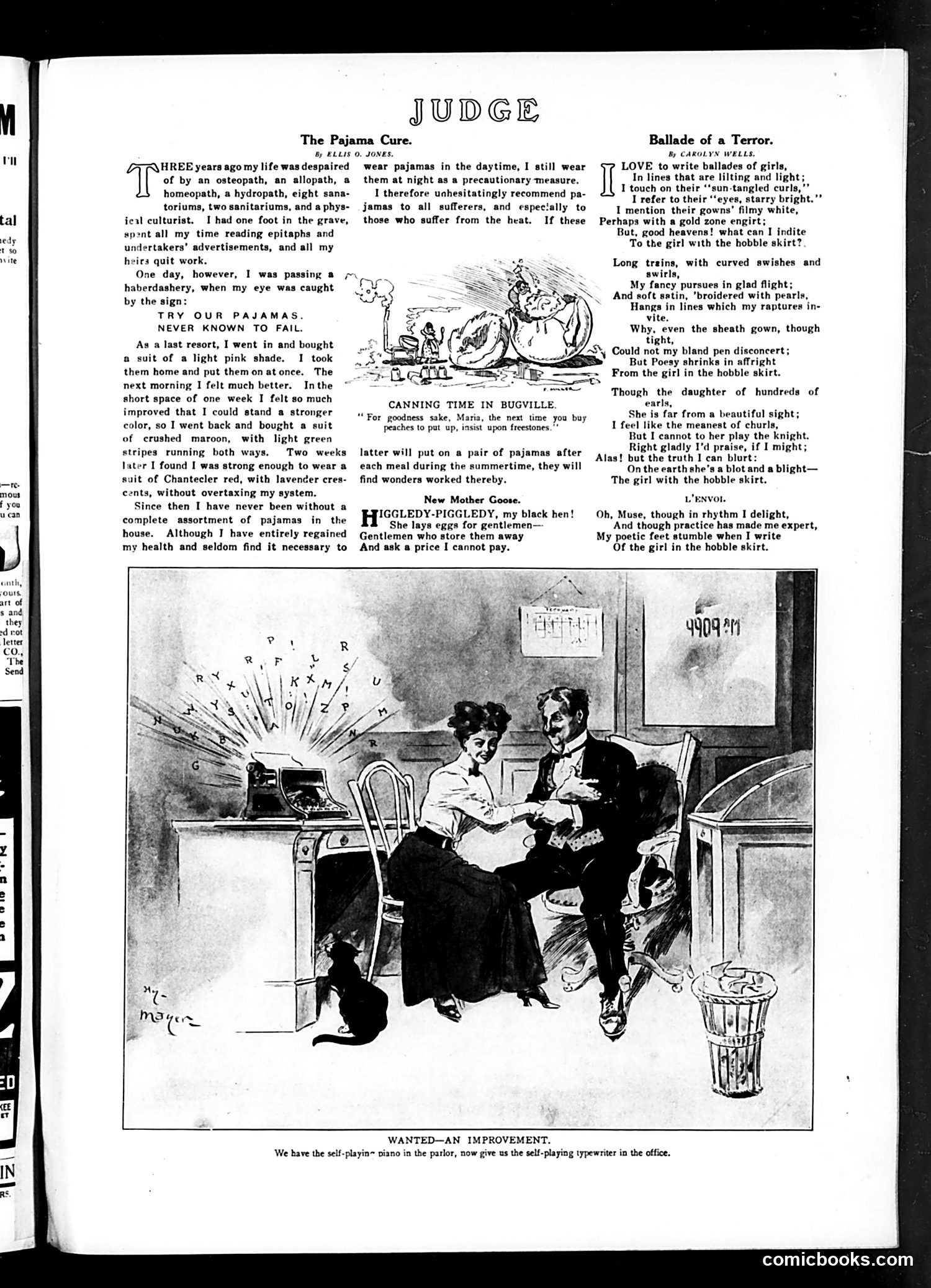
This page contains three distinct pieces: 1. **"The Pajama Cure"** (top left): A humorous essay by Floyd G. Jones advocating pajamas as a health cure-all, claiming they improved his various ailments. The tone is satirical commentary on contemporary health fads and medical quackery. 2. **"Ballad of a Terror"** (top right): A poem by Carolyn Wells mocking a girl's "bobble skirt"—a fashionable but restrictive garment of the era. The satire critiques both the impractical fashion and the writer's difficulty composing poetry about it. 3. **"Wanted—An Improvement"** (bottom cartoon): Shows a woman at a typewriter in an office while a man reads nearby. The caption jokes that they've replaced the office's self-playing piano with a self-playing typewriter—satirizing workplace modernization and mechanical efficiency trends of the early 1900s.
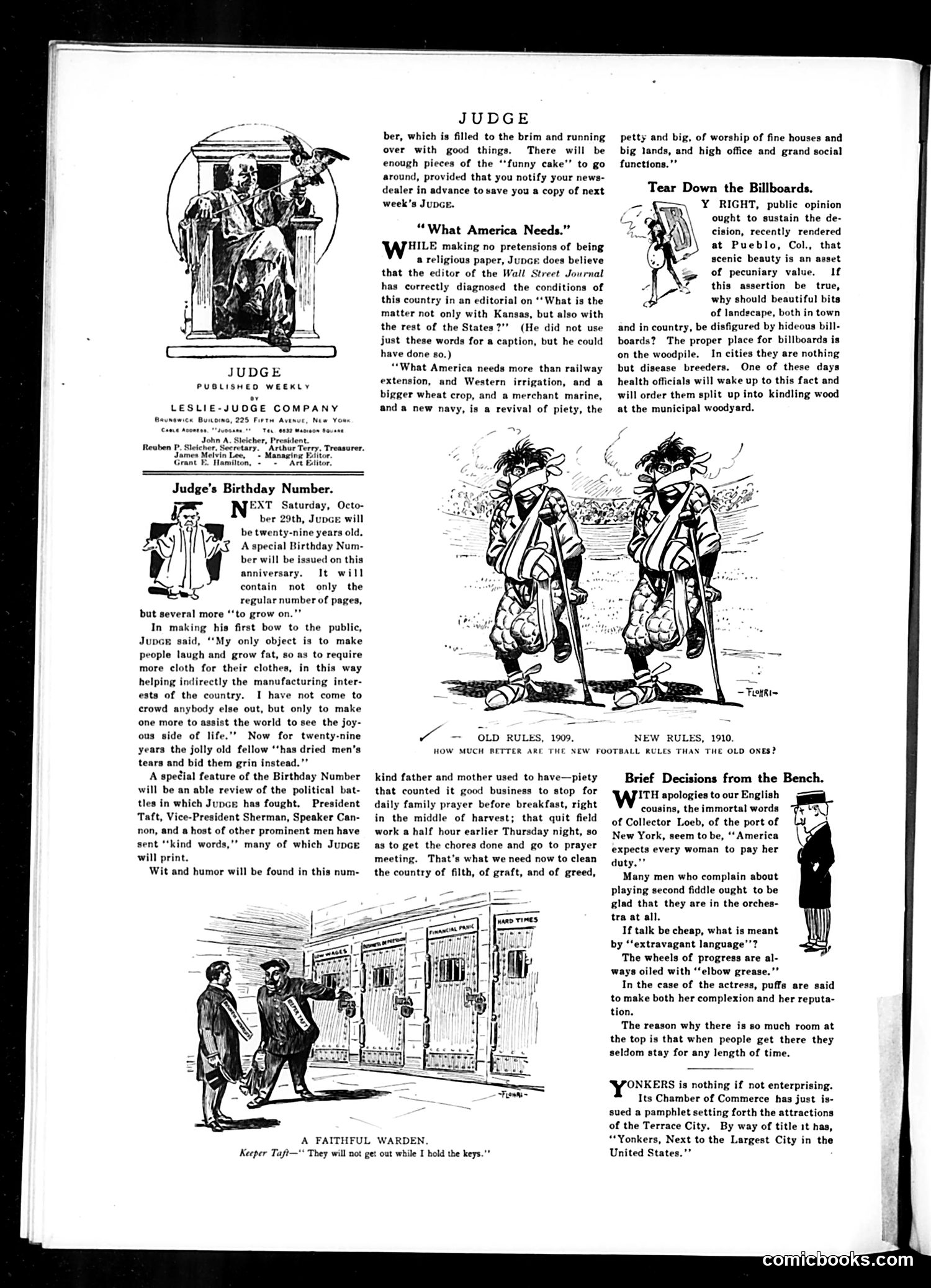
This page contains several satirical pieces from Judge magazine. The main content includes: **"What America Needs"** criticizes the *Wall Street Journal* editor's editorial about Kansas conditions, arguing America needs railroad expansion, irrigation, bigger wheat crops, merchant marine, and a new navy—essentials for national prosperity. **"Tear Down the Billboards"** argues that scenic billboards damage landscape value and should be removed from cities and countryside, suggesting they belong only in municipal woodyards. **"Old Rules, 1909 vs. New Rules, 1910"** (cartoon) shows two identical figures representing changing football regulations between these years, satirizing the sport's evolving rules. The page also contains brief satirical observations about social customs, including commentary on English courtesies and Yonkers' Chamber of Commerce self-promotion.
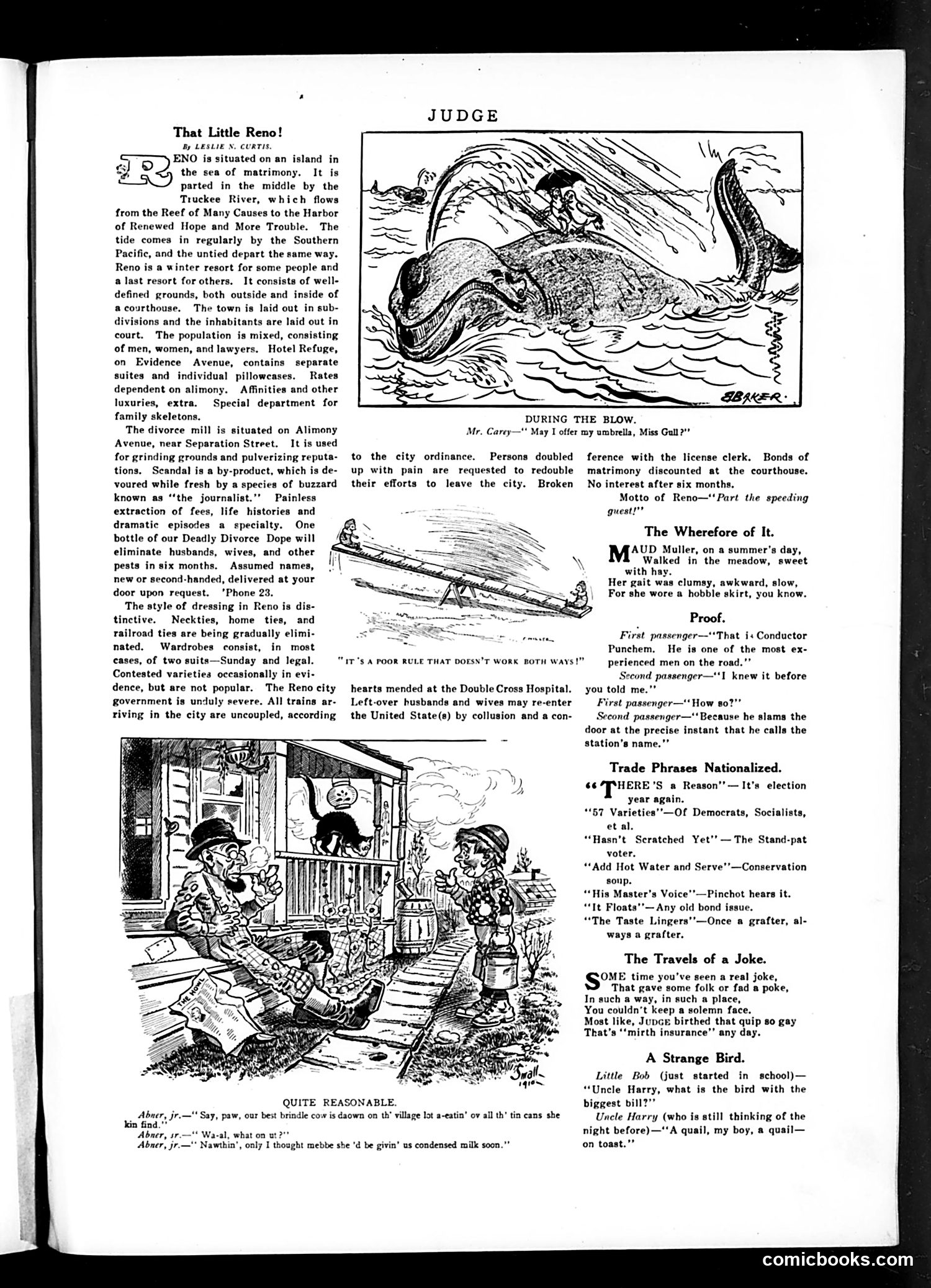
This page contains several satirical pieces typical of Judge magazine's humor: **"That Little Reno!"** describes Reno, Nevada as a divorce destination, mocking its role as a legal haven where people went to obtain divorces quickly. The piece satirizes Reno's economy built on facilitating divorces and the predictable flow of separated couples through the town. **"Quite Reasonable"** (bottom cartoon) depicts a domestic dispute over a cow, using rural dialect humor common to the era. **Other sections** include brief humorous anecdotes like "The Wherefore of It" (about a woman in a hobble skirt), "Trade Phrases Nationalized" (satirizing political slogans), and "The Travels of a Joke" (about joke circulation). The overall tone reflects early-20th-century American satirical magazine conventions: social commentary mixed with light humor, dialect jokes, and observations on contemporary issues like divorce law and fashion.
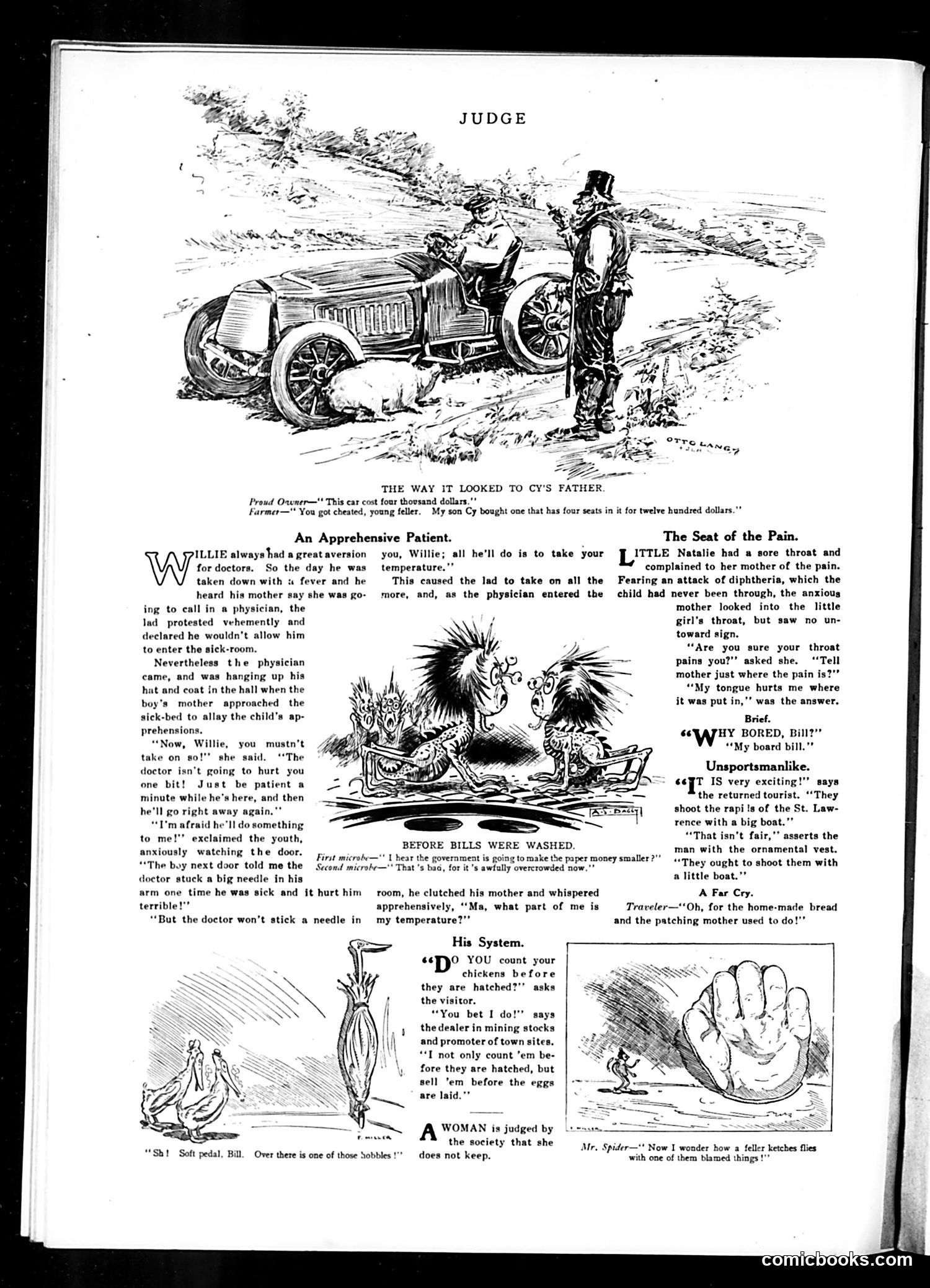
This page collects several brief satirical jokes and cartoons typical of early-20th-century American humor: **"The Way It Looked to Cy's Father"** mocks the new automobile industry's inflated pricing. A farmer is astounded that his son bought a four-seater car for $1,200 when a wealthy man paid $4,000—satirizing how new car technology had become unexpectedly affordable. **"An Apprehensive Patient"** jokes about childhood fear of doctors, playing on the boy's misunderstanding: when told the doctor will "take his temperature," he fears the doctor will literally remove it. **"The Seat of the Pain"** presents a child's literal interpretation of language—when asked where her throat pain is, she answers "where my tongue was put in," confusing anatomical location with action. Other brief gags mock financial speculation ("His System" about stock promoters counting chickens before eggs are laid), tourism, and fashion (the "hobble skirt"). The tone is gentle, domestic humor rather than political satire, reflecting Judge's mixed content of jokes, cartoons, and advertisements.
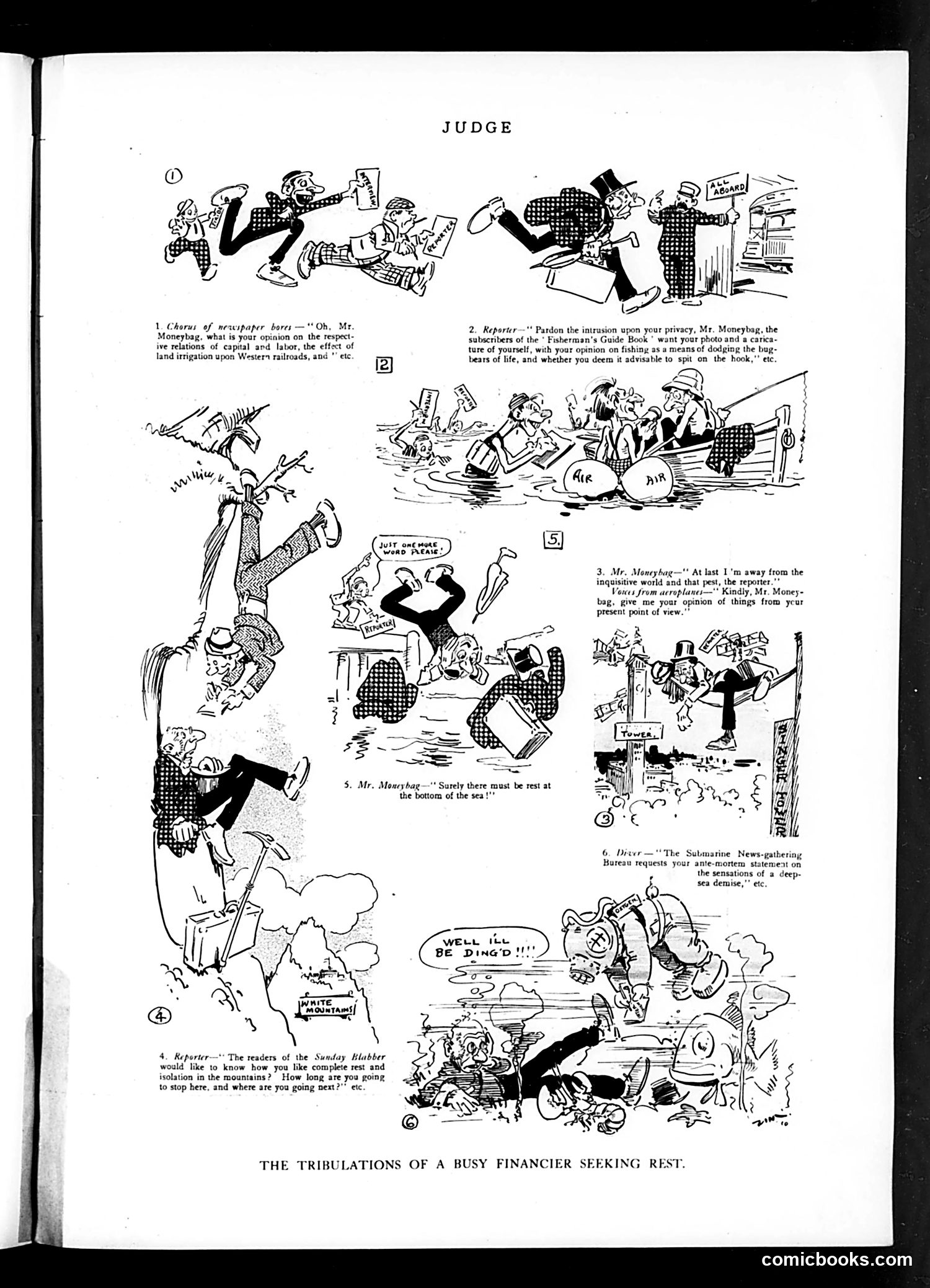
This satirical cartoon mocks the relentless pursuit of wealthy businessmen by newspapers and reporters. The protagonist, "Mr. Moneybag," attempts to escape public scrutiny by vacationing in various locations—mountains, seaside, even underwater—but journalists track him everywhere, demanding quotations on topics ranging from capital-labor relations to fishing advice. The joke targets both the invasive nature of early 20th-century journalism and the absurdity of treating a financier's vacation opinions as newsworthy. Each panel shows reporters from different publications interrupting his rest with increasingly ridiculous requests, culminating in a diver demanding a "pre-mortem statement" from the ocean floor. The satire reflects broader anxieties about press intrusion, sensationalism, and the manufactured celebrity of wealthy industrialists during the Gilded Age era.
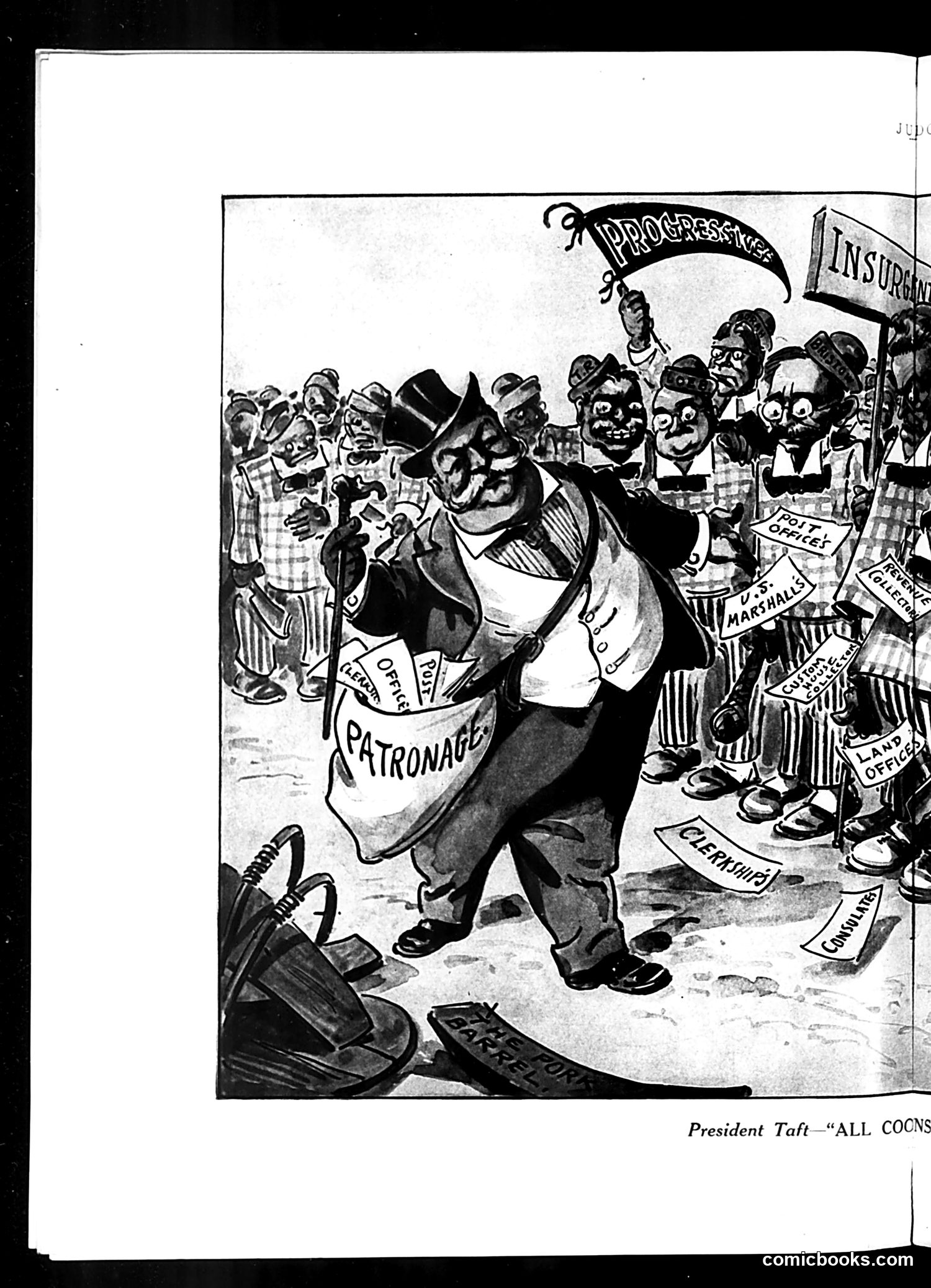
This cartoon from *Judge* magazine depicts President William Howard Taft surrounded by figures labeled with government positions (visible labels include "PATRONAGE," "OFFICE," "MARSHAL," "COLLECTOR"). The caption reads "ALL COONS..." The cartoon uses racial caricature imagery that reflects the deeply racist visual conventions of early 20th-century American political satire. The satire targets Taft's administration's alleged dependence on patronage—the practice of distributing government jobs and favors to political allies rather than based on merit. The "coons" reference likely plays on both the animal imagery (a common dehumanizing trope of the era) and period slang, criticizing what the cartoonist saw as Taft's compromised leadership dependent on corrupt political networks.
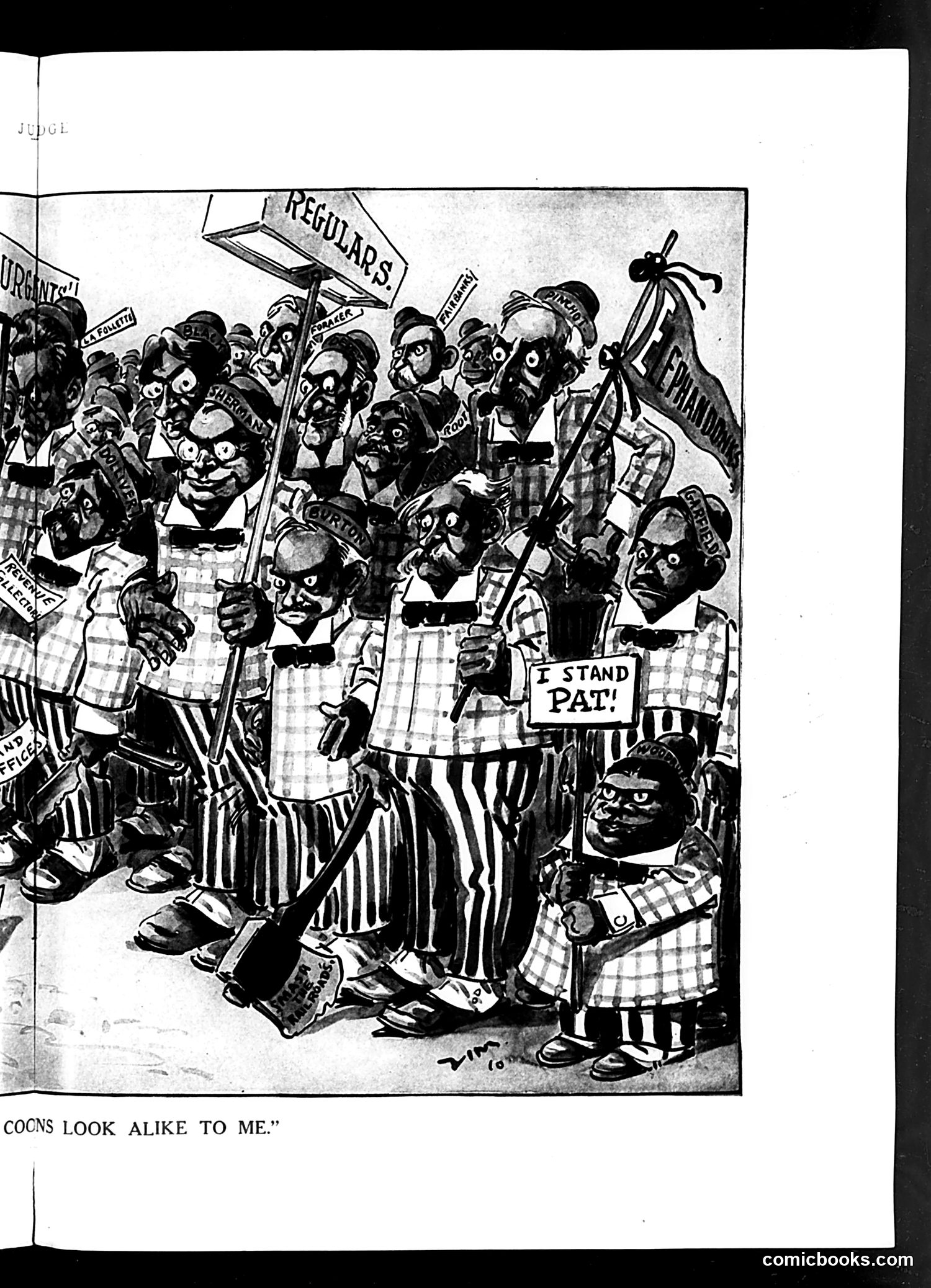
This is a racist caricature cartoon from *Judge* magazine employing offensive stereotypes common to early 20th-century American satire. The cartoon depicts a large group of figures with exaggerated features holding signs reading "REGULARS" and what appears to be political banners, with one figure stating "I STAND PAT!" and another saying "COONS LOOK ALIKE TO ME." The satire appears to target political organization or party regularity—likely mocking politicians or party members as indistinguishable from one another. The dehumanizing racial caricatures and slur in the caption reflect the deeply prejudiced visual language of the era's political commentary, where such imagery was used to demean both African Americans and political opponents simultaneously. The specific political reference remains unclear without additional context.
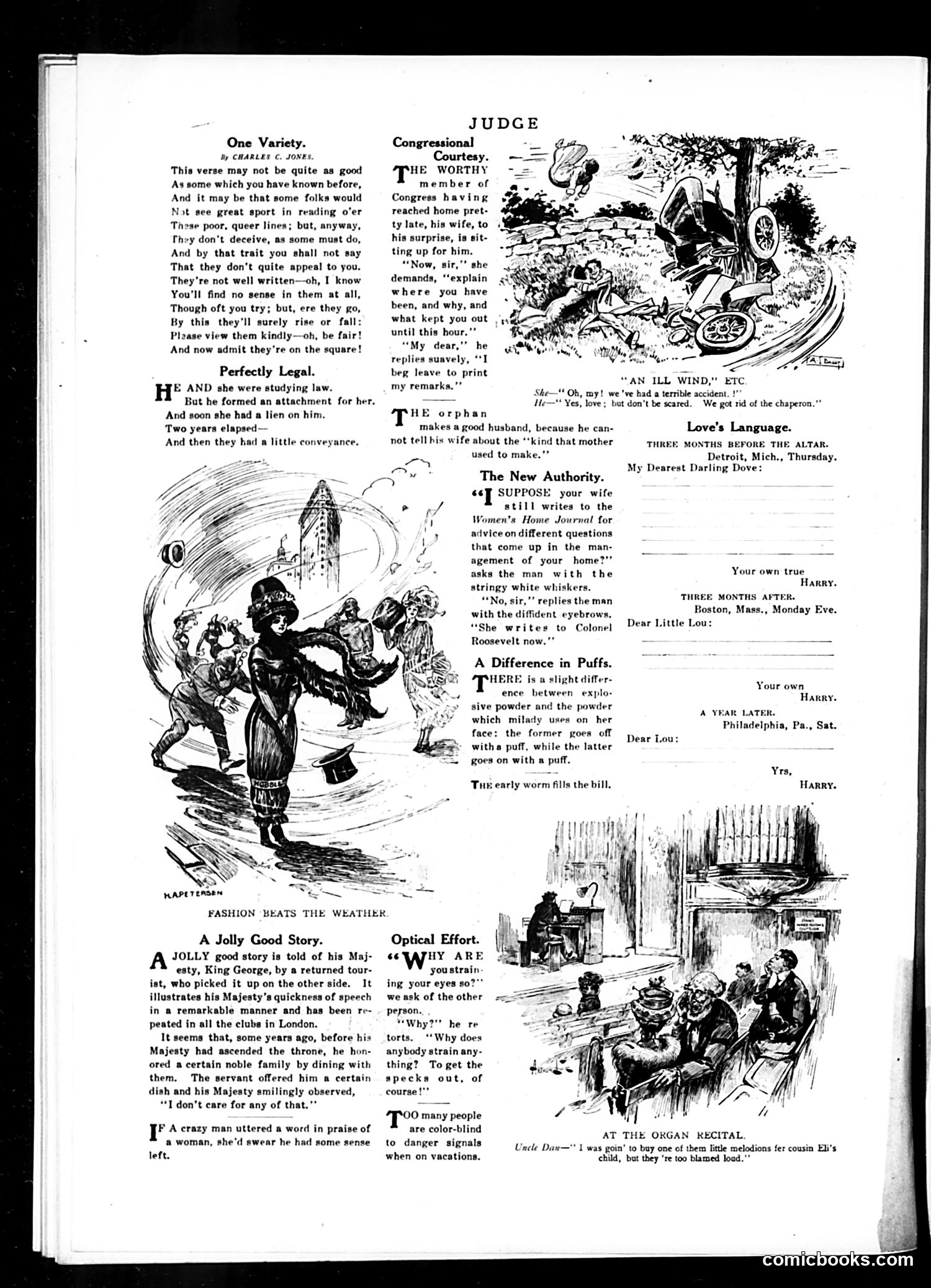
This page contains several short humorous pieces typical of early 20th-century American satirical magazines: **"Perfectly Legal"** plays on legal terminology—a couple's courtship and marriage described as property law ("lien," "conveyance"). **"Congressional Courtesy"** mocks politicians' evasiveness: a congressman avoids his wife's questions about his late night by claiming he needs to "print my remarks"—a reference to congressmen's privilege of having speeches recorded in official records, suggesting bureaucratic obstruction of personal accountability. **"The New Authority"** satirizes President Theodore Roosevelt's influence on American opinion. Rather than consulting domestic advice columns, wives now seek guidance from "Colonel Roosevelt," reflecting his contemporary celebrity and public authority on all subjects. **"Love's Language"** humorously charts romantic decline through increasingly terse letters: from "Dearest Darling Dove" to merely "Dear Lou." The remaining pieces are light wordplay and observational humor with no specific political reference.
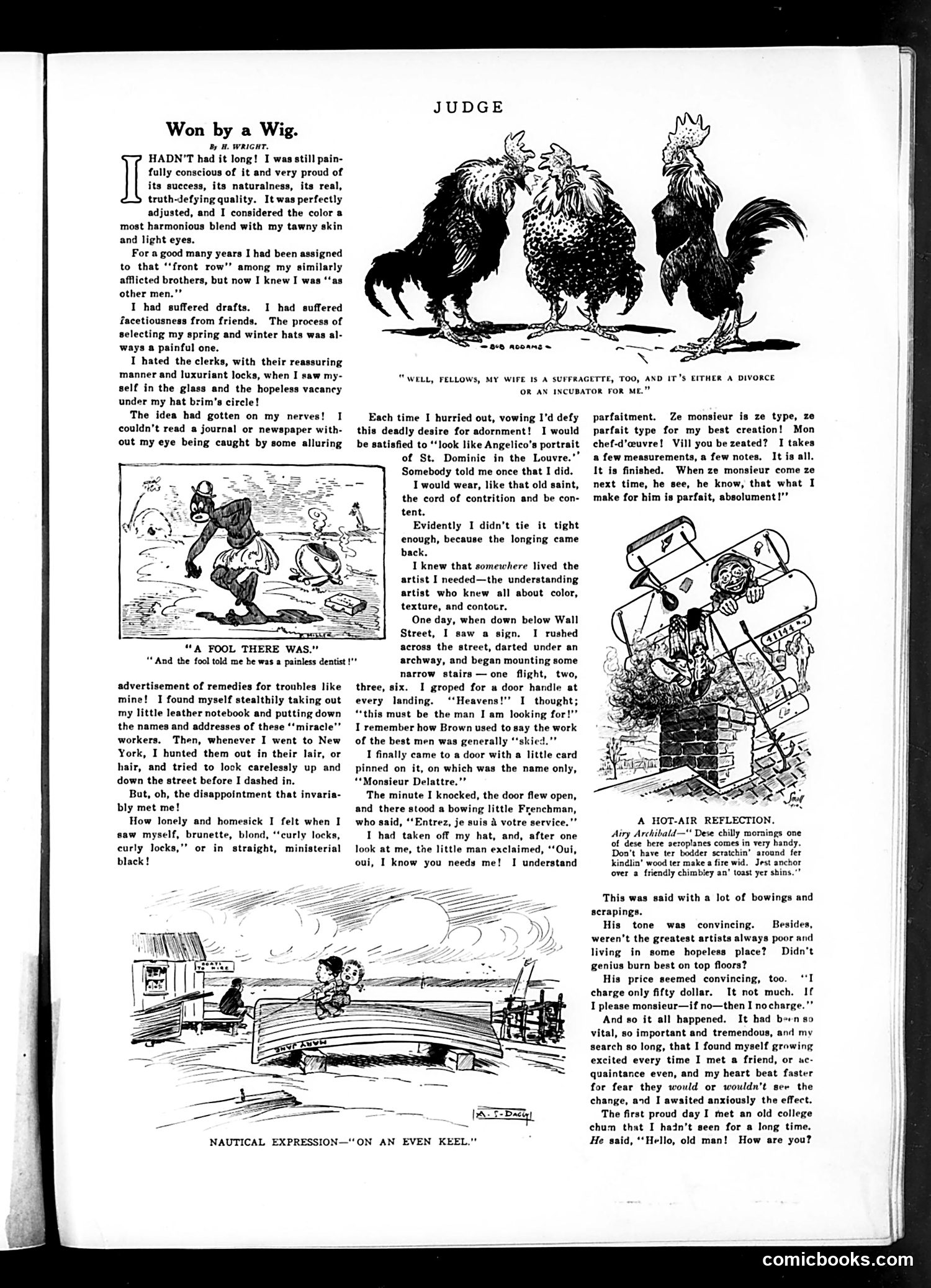
This is a humorous short story illustrated with satirical cartoons about a bald man's vanity and social anxiety. The unnamed narrator has suffered years of embarrassment about his baldness, obsessively seeking remedies advertised in newspapers. Finally, he discovers "Monsieur Delattre," a French wigmaker who flatters him extravagantly, promising a perfect custom creation. The satire targets: - **Male vanity** about appearance and social status - **Advertising culture** of the era, which preyed on insecurities - **Class anxiety**—the narrator's desperate attempts to appear respectable, fearing he's marked as inferior - **French affectation**—the exaggerated Frenchman character type common in period American satire The accompanying cartoons ("A Fool There Was," "Nautical Expression," "Hot-Air Reflection") are unrelated gags typical of Judge's format. The overall message mocks masculine self-consciousness and consumer culture's exploitation of it.
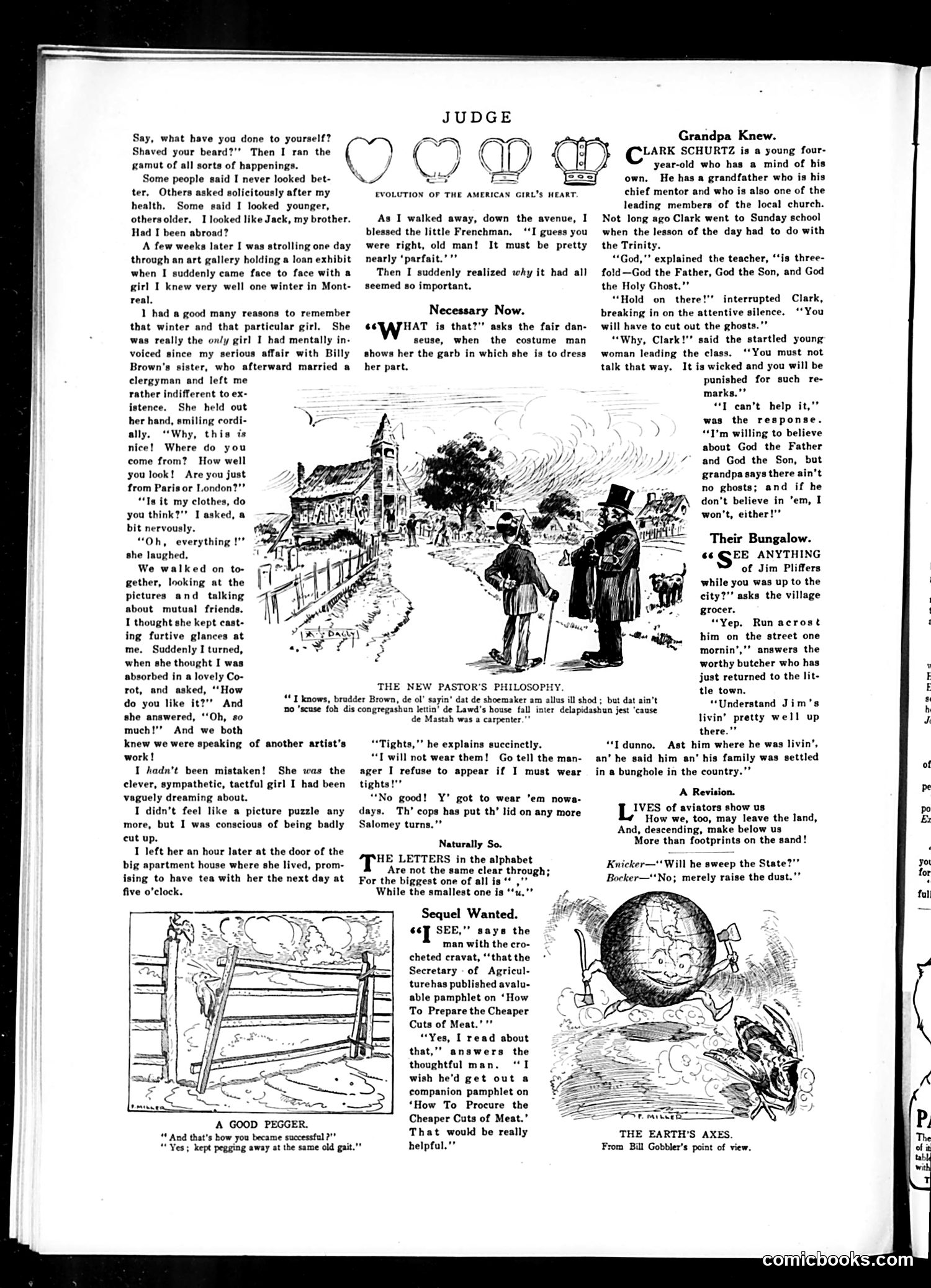
This page from *Judge* magazine contains several brief satirical pieces typical of early 20th-century American humor: **Main Story**: A man's encounter with an ex-flame who initially doesn't recognize him after he shaves his beard. The satire examines how superficial changes in appearance affect perception and attraction. **"The New Pastor's Philosophy"**: Mocks a Black preacher's rationalization for church disrepair—claiming Jesus was a carpenter so poor maintenance is acceptable. This relies on racist dialect humor common to the era. **"Tights" cartoon**: Satirizes post-WWI censorship, where police ("cops") enforced modesty standards in theater costumes, forcing dancers to wear tights. **The Church Trinity joke**: A precocious child corrects his teacher's religious explanation, suggesting even children recognize logical flaws—gentle satire of rote religious instruction. **"Secretary of Agriculture" quip**: Jokes that while government teaches cheap meat *preparation*, people actually need help *affording* cheap meat—Depression-era economic commentary.
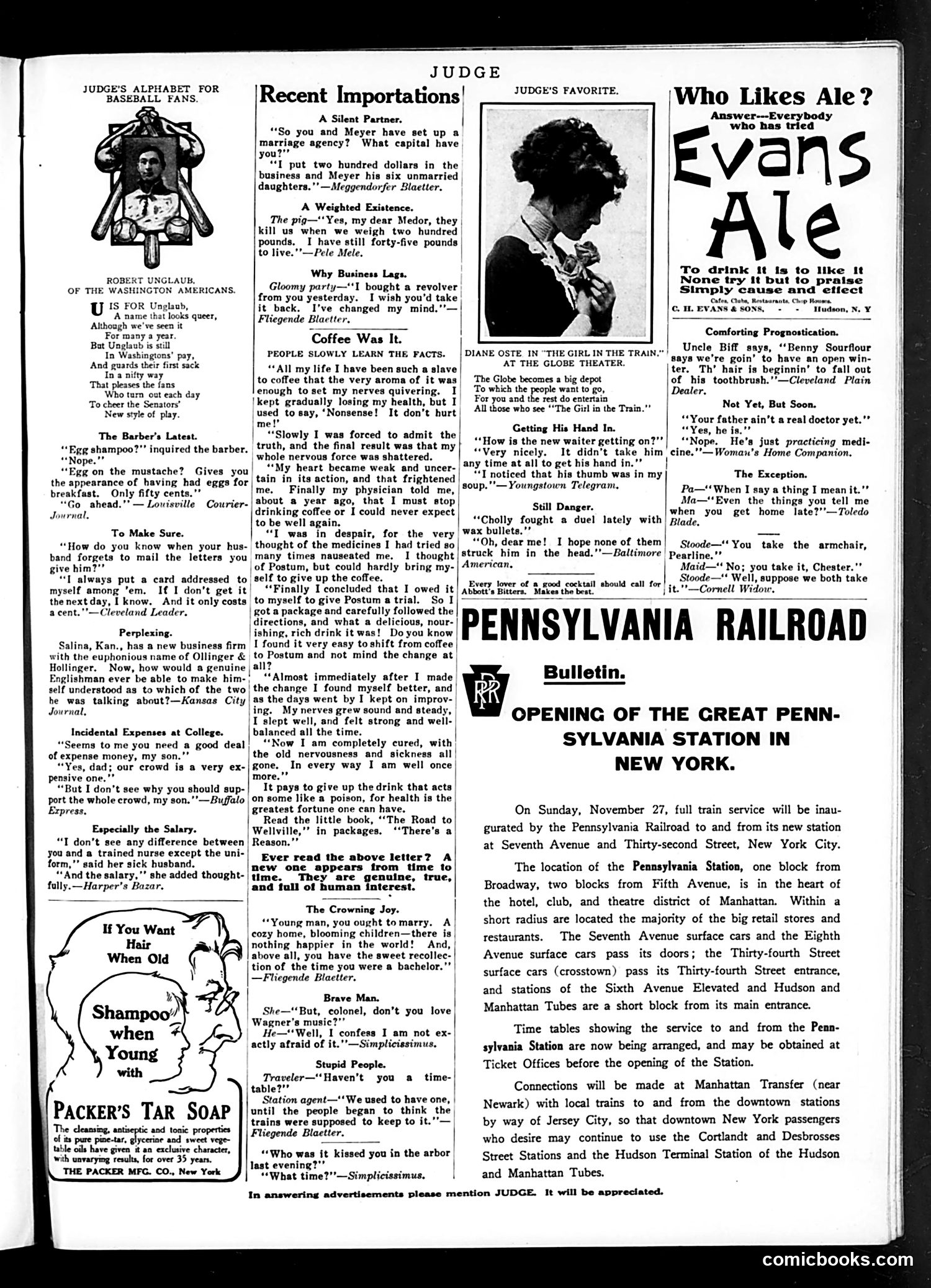
This page from *Judge* magazine contains mostly **humor shorts and advertisements** rather than political cartoons. The content reflects early 20th-century American sensibilities: **The humor pieces** are brief jokes about contemporary life—marriage agencies, business inefficiency, and social awkwardness. "Perplexing" mocks difficulty distinguishing between similar names ("Ollinger & Hollinger"), a common vaudeville-style joke. **Baseball reference**: The alphabet entry for "U" celebrates Robert Unglaub, a Washington Senators player, using light sports humor typical of the era. **The dominant advertisement** is a lengthy **Postum testimonial**—a caffeine-free grain beverage marketed as a health alternative to coffee. This reflects genuine early-1900s health anxieties about coffee's effects on "nerves" and overall vigor, common in period advertising. **Evans Ale advertisement** uses period-typical marketing ("Everybody who has tried" it). The **Pennsylvania Railroad bulletin** announces the new Manhattan station opening, representing the era's pride in modern infrastructure.
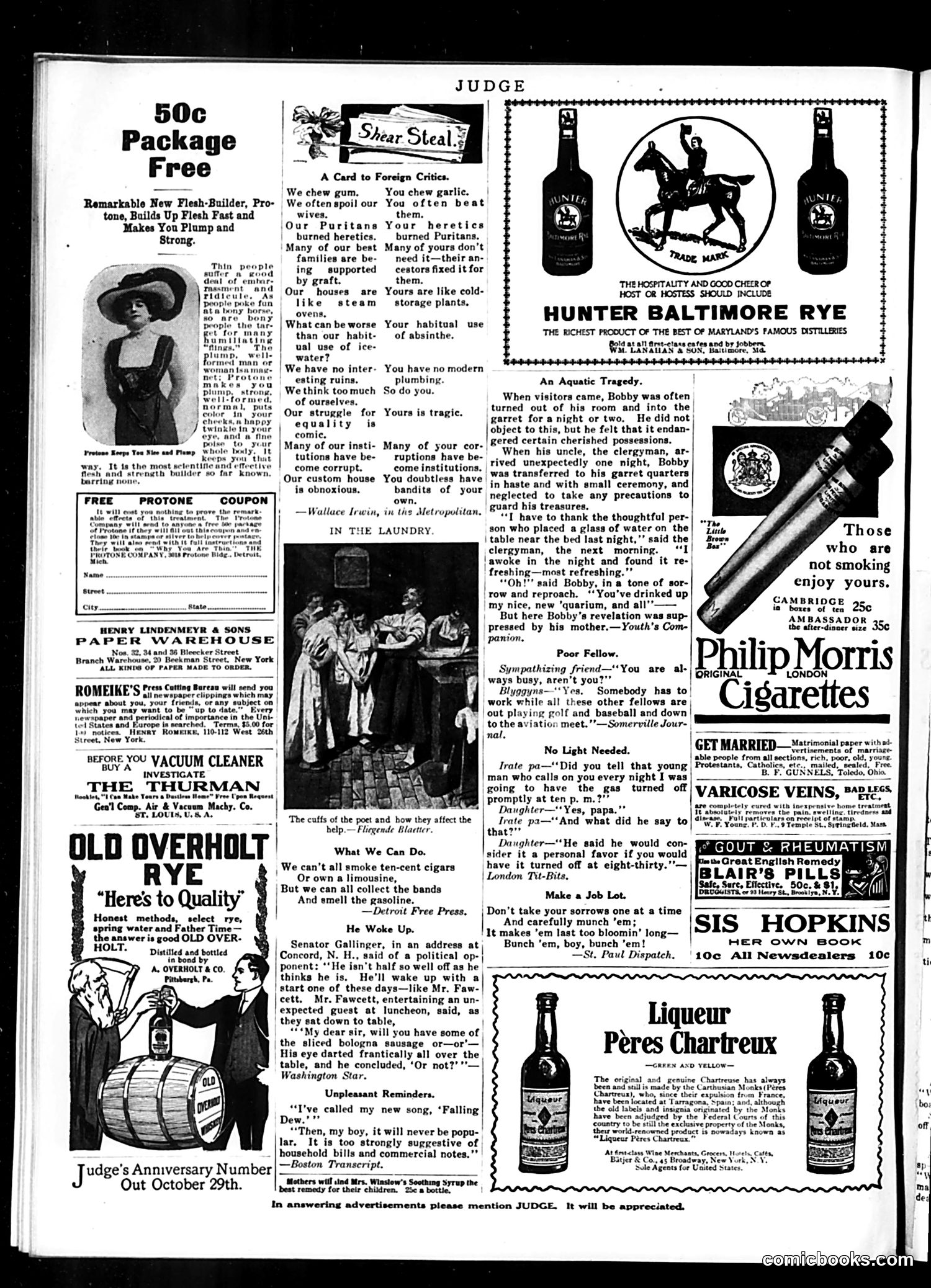
This page is primarily **advertisements and light humor pieces**, not political cartoons with specific satirical targets. The main content includes: **"A Card to Foreign Critics"** by Wallace Irwin: A comedic comparison contrasting American and European customs—American gum-chewing vs. European garlic-eating, American ice water habits vs. European absinthe use, etc. It's gentle cultural satire poking fun at both nations' stereotypes rather than targeting specific figures or events. **Humorous anecdotes** about everyday life: "In the Laundry," "What We Can Do" (about collecting cigar bands), "He Woke Up" (a joke about a politician's awkward lunch), and "An Aquatic Tragedy" (about a boy's treasures endangered by houseguests). The rest consists of period advertisements for products like flesh-builder "Protone," vacuum cleaners, rye whiskey, and cigarettes. **For modern readers:** This represents Judge's lighter content—society humor and consumer ads rather than hard political satire. The "Foreign Critics" piece reflects early 1900s American anxiety about European judgment of American culture.
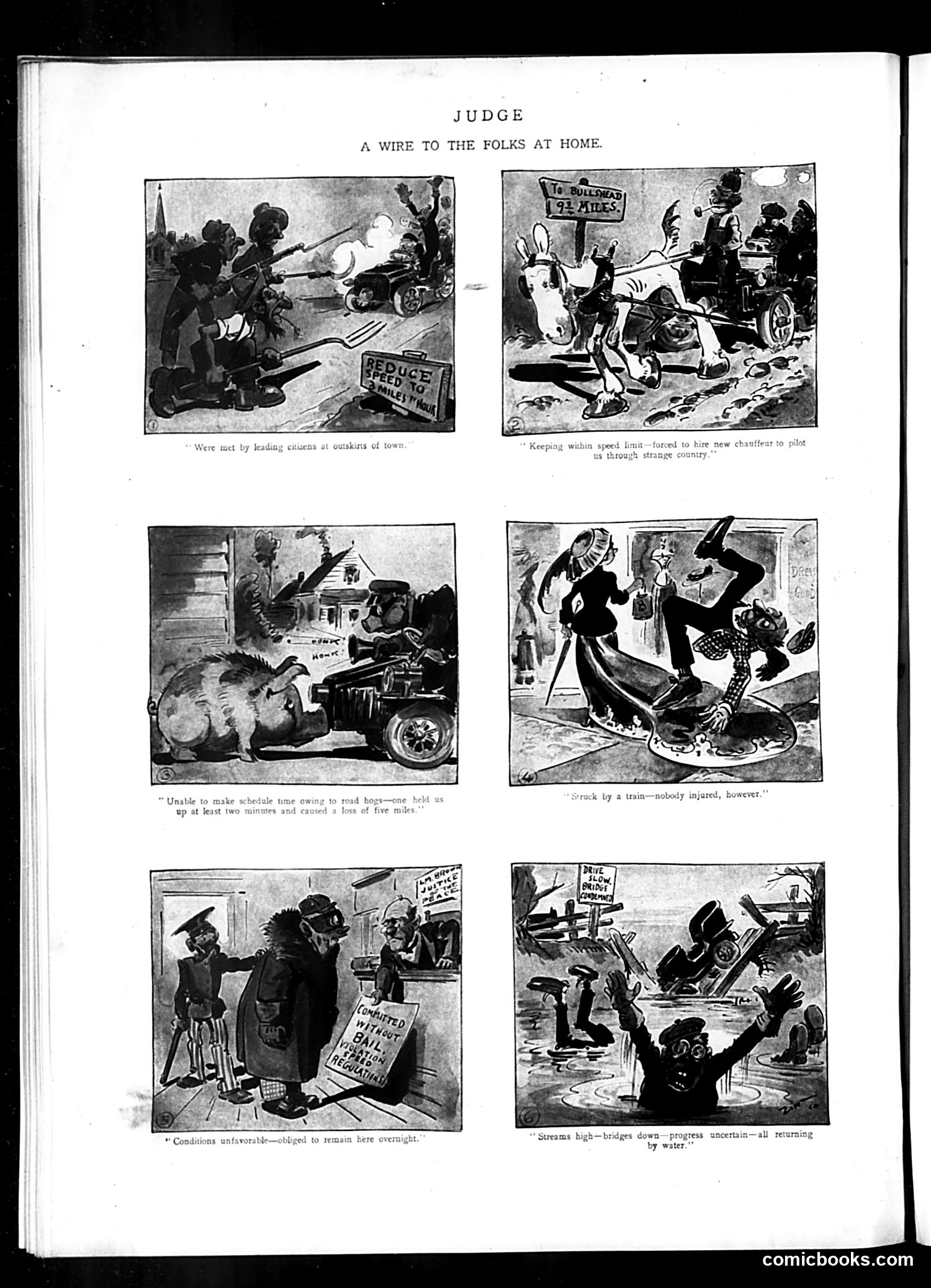
This is a six-panel satirical comic about wartime transportation and supply-chain chaos, likely from WWI or WWII era. The panels depict increasingly absurd vehicle mishaps: 1. Leading citizens redirecting a military convoy 2. A deer-drawn cart replacing motorized transport 3. A massive pig blocking traffic ("Unable to make schedule time owing to road hogs—held up at least two minutes") 4. A character struck by a train 5. Officials dealing with "unfavorable conditions" forcing overnight stays 6. Bridges collapsing into water, with figures drowning The satire mocks wartime inefficiencies and transportation bottlenecks affecting home-front communications ("wire to folks at home"). The escalating disaster sequence suggests bureaucratic incompetence and resource scarcity turning even routine supply runs into nightmarish ordeals, all preventing simple messages home.