
Judge, 1910-10-22 · page 11 of 16
Judge — October 22, 1910 — page 11: what you’re looking at
What you’re looking at
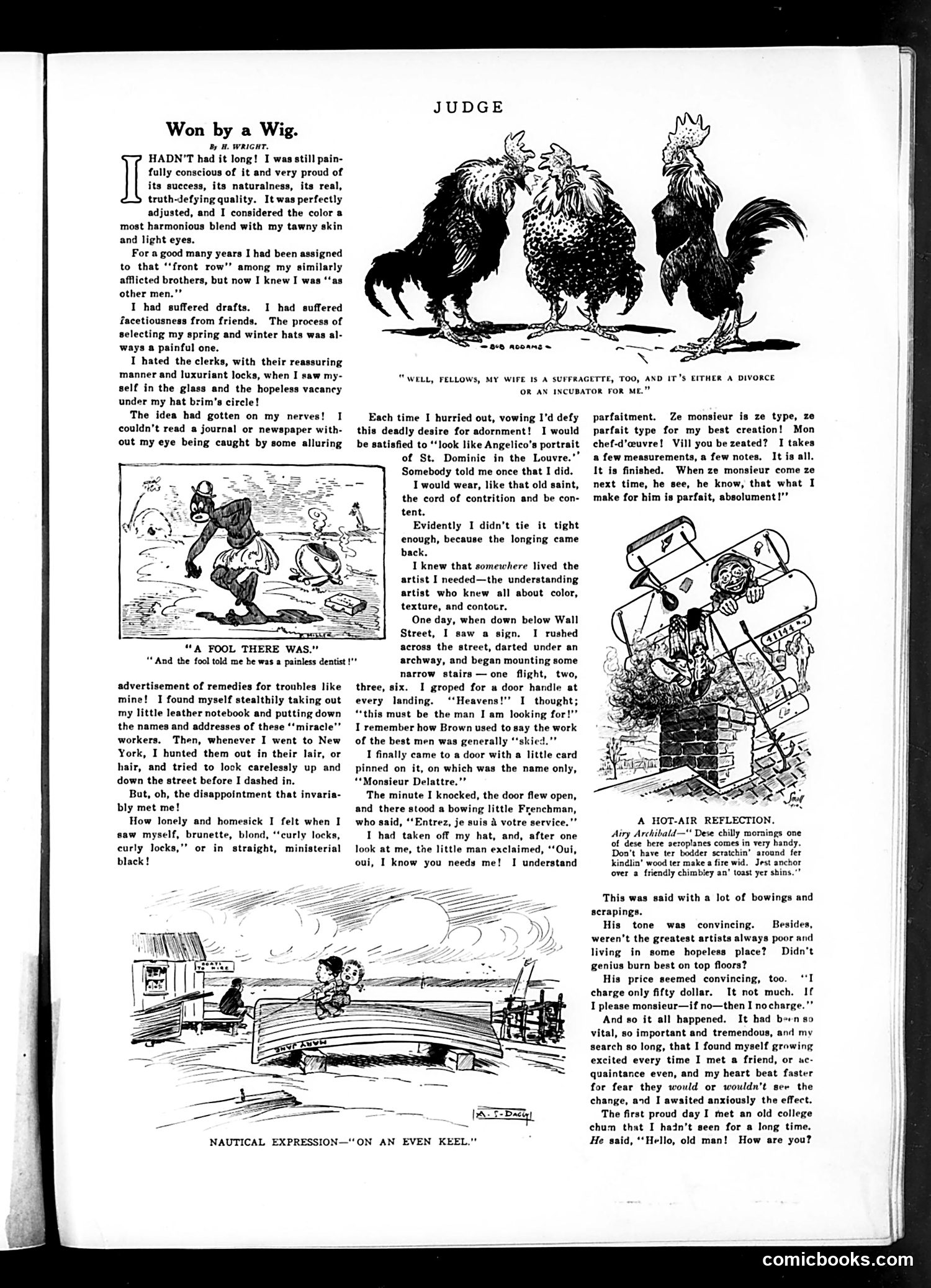
This is a humorous short story illustrated with satirical cartoons about a bald man's vanity and social anxiety. The unnamed narrator has suffered years of embarrassment about his baldness, obsessively seeking remedies advertised in newspapers. Finally, he discovers "Monsieur Delattre," a French wigmaker who flatters him extravagantly, promising a perfect custom creation. The satire targets: - **Male vanity** about appearance and social status - **Advertising culture** of the era, which preyed on insecurities - **Class anxiety**—the narrator's desperate attempts to appear respectable, fearing he's marked as inferior - **French affectation**—the exaggerated Frenchman character type common in period American satire The accompanying cartoons ("A Fool There Was," "Nautical Expression," "Hot-Air Reflection") are unrelated gags typical of Judge's format. The overall message mocks masculine self-consciousness and consumer culture's exploitation of it.
📄 Transcribed text from this page (OCR, searchable)
Machine-transcribed from the original scan — historical spelling and the odd misread are preserved.
Won by a Wig. by m. waicnr, HADN'T had it long! I was still pain- fully conscious of it and very proud of its success, its naturalness, its real, truth-defying quality. It was perfectly adjusted, and I considered the color a most harmonious blend with my tawny skin and light eyes. For a good many years I had been assigned to that ‘‘front row’? among my similarly afflicted brothers, but now I knew I was ‘‘as other men.”” I had suffered drafts. 1 had suffered Zacetiousness from friends. The process of selecting my spring and winter hats was al- ways a painful one. I hated the clerks, with their reassuring manner and luxuriant locks, when I saw my- self in the glass and the hopeless vacancy under my hat brim’s circle! The idea had gotten on my nerves! I couldn't read a journal or newspaper with- out my eye being caught by some alluring “A FOOL THERE WAS." “And the fool told me he was a painless dentist !"* advertisement of remedies for troubles like mine! I found myself stealthily taking out my little leather notebook and putting down the names and addresses of these ‘‘miracle”” workers. Then, whenever I went to New York, I hunted them out in their lair, or hair, and tried to lock carelessly up and down the street before I dashed in. But, oh, the disappointment that invaria- bly met me! How lonely and homesick I felt when I saw myself, brunette, blond, ‘‘curly locks, curly locks,” or in straight, ministerial black! “WELL, FELLOWS, MY WIFE IS A SUFFRAGETTE, TOO, AND IT’S EITHER A DIVORCE OR AN INCUBATOR FOR ME.” Each time I hurried out, vowing I'd defy this deadly desire for adornment! I would be satisfied to “‘look like Angelico’s portrait of St. Dominic in the Louvre.”’ Somebody told me once that I did. I would wear, like that old saint, the cord of contrition and be con- tent. Evidently I didn’t tie it tight enough, because the longing came back. I knew that somewhere lived the artist I needed—the understanding artist who knew all about color, texture, and contour. One day, when down below Wall Street, I saw a sign. I rushed across the street, darted under an archway, and began mounting some narrow stairs —one flight, two, three, six. I groped for a door handle at every landing. ‘‘Heavens!"’ I thought; “this must be the man I am looking for!” I remember how Brown used to say the work of the best men was generally ‘‘skied. I finally came to a door with a little card pinned on it, on which was the name only, **Monsieur Delattre.’’ The minute I knocked, the door flew open, and there stood a bowing little Frenchma who said, “Entrez, je suis a votre service. I had taken off my hat, and, after one look at me, the little man exclaimed, ‘‘Oui, oui, I know you needs me! I understand NAUTICAL EXPRESSION—‘ON AN EVEN KEEL." parfaitment. Ze monsieur is ze type, ze parfait type for my best creation! Mon chef-d’ceuvre! Vill you be zeated? I takes a few measurements, a few notes. It is all. It is finished. When ze monsieur come ze next time, he see, he know, that what I make for him is parfait, absolument!’’ A HOT-AIR REFLECTION. Airy Archibald—"' Dese chilly mornings one of dese here aezoplanes comes in very handy. Don't have ter bodder scratchin’ around fer kindlin’ wood ter make a fire wid. Jest anchor over a friendly chimbiey an’ toast yer shins.”” This was said with a lot of bowings and scrapings. His tone weren't the greatest a living in some hopeless place? genius burn best on top floors? His price seemed convincing, too. ‘I charge only fifty dollar. It not much. If I please monsieur—if no—then I nocharge.”” And so it all happened. It had bern so vital, so important and tremendous, and mv search so long, that I found myself growing excited every time I met a friend, or uc- quaintance even, and my heart beat faster for fear they would or wouldn't ger the change, and I awaited anxiously the effect. The first proud day I met an old college chum that I hadn’t seen for a long time. He said, ‘Hello, old man! How are you? was convincing. Besides, ists always poor and Didn't comicbooks.com