
A complete issue · 16 pages · 1910
Judge — June 18, 1910
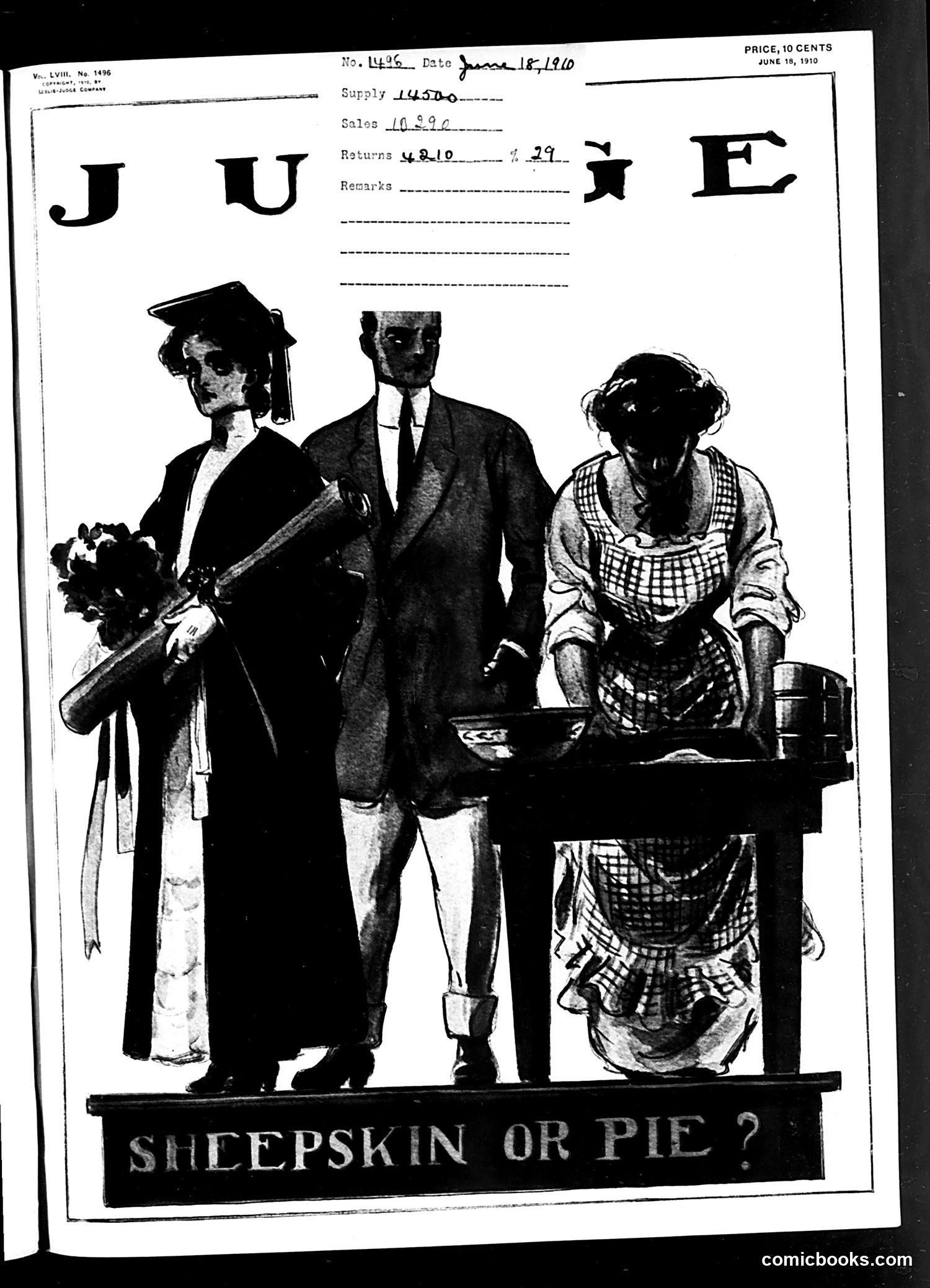
This satirical cartoon depicts a tension between education and practical survival. Three figures present contrasting paths: a graduate in academic robes holding a diploma ("sheepskin"—slang for a degree), a stern businessman in the middle, and a working-class woman at a stove preparing food ("pie"). The caption "Sheepskin or Pie?" poses a choice between obtaining a college diploma versus having food on the table. The satire likely critiques the era's debate over whether formal education actually provided economic security for graduates, or whether practical work guaranteed better sustenance. The masked faces suggest this represents universal human dilemmas rather than specific individuals.
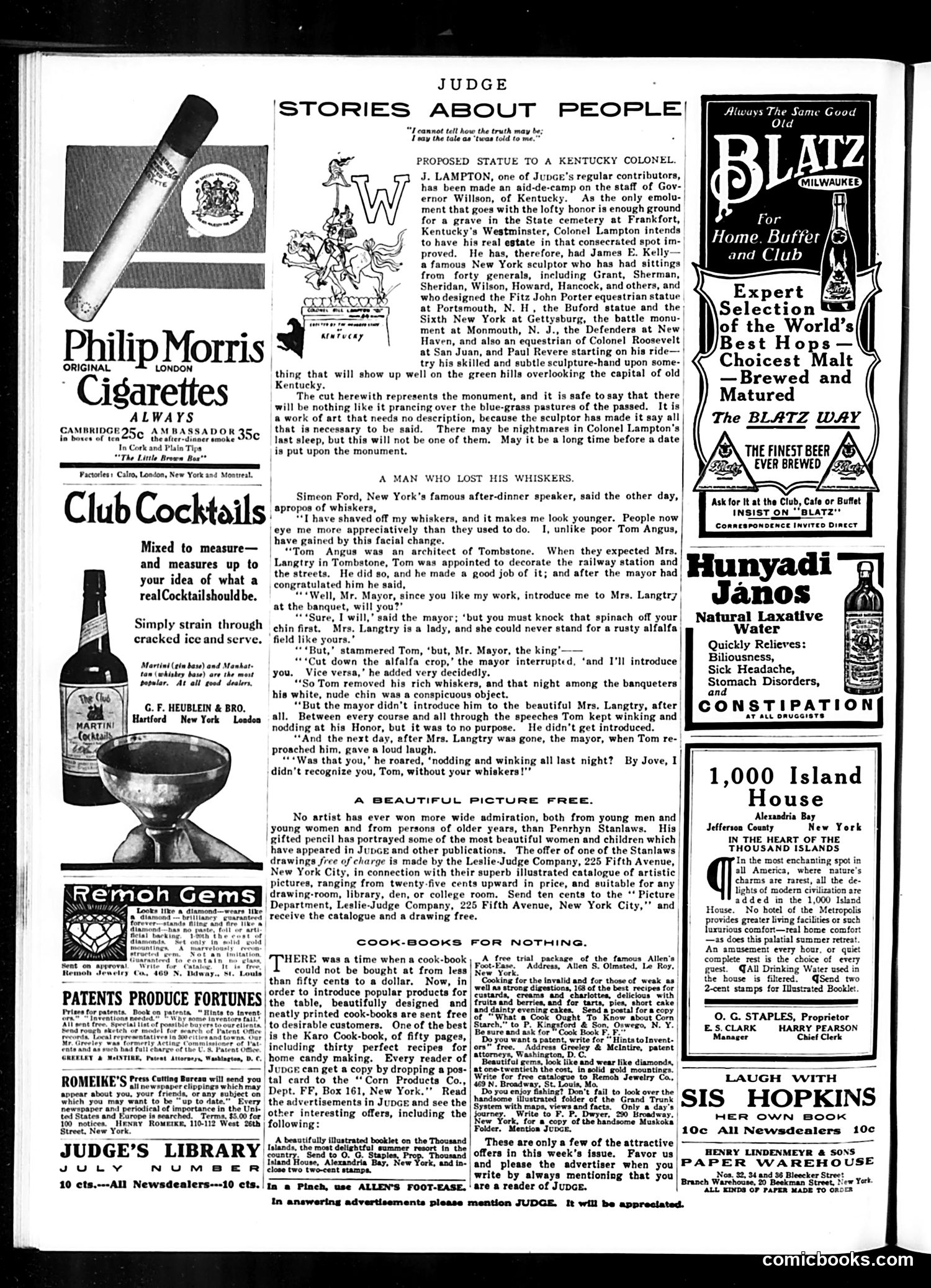
This page is primarily **advertising and miscellaneous content** rather than political satire. The main elements include: - **Philip Morris cigarettes** advertisement (left side) - **Club Cocktails** mixer advertisement - Various product ads (Remoe Gems, Hunyadi Janos laxative, Blatz beer) - A short humor section titled "Stories About People" featuring anecdotes about a Kentucky Colonel's statue and a man named Simeon Ford who shaved off his whiskers The humor is gentle and domestic rather than politically satirical—focusing on social embarrassment and personal mishaps. The Colonel Lampton statue story plays on rural/frontier character types common to period humor. Overall, this appears to be a typical Judge issue mixing light entertainment with commercial advertising.
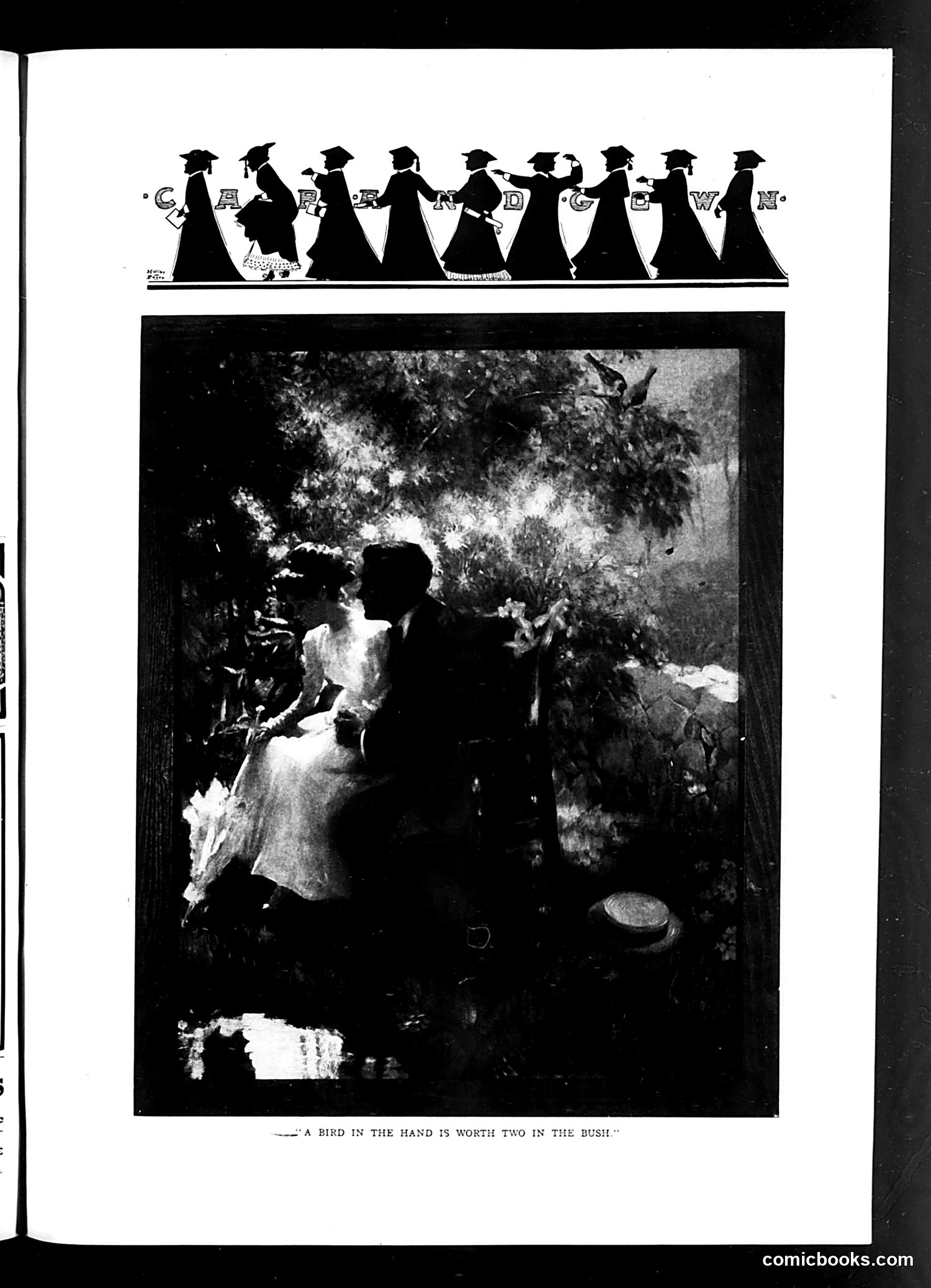
The page features a silhouette header showing ten graduates in academic robes and mortarboards labeled "CARDING" (likely referring to a card game or deception). Below is a photograph captioned "A BIRD IN THE HAND IS WORTH TWO IN THE BUSH." The photograph depicts a romantic garden scene with a couple—a woman in a light dress and a man in dark clothing—among foliage and flowers, appearing intimate or clandestine. The satire likely comments on **educational fraud or diploma mills** (the "carding" reference suggests deception) contrasted with romantic pursuits. The proverb caption suggests taking what's certain (the "bird in hand") over uncertain prospects—possibly satirizing the choice between legitimate education versus shortcuts, or between serious commitment versus casual romance. The juxtaposition implies Judge's social criticism of education practices or courtship conventions during this era.
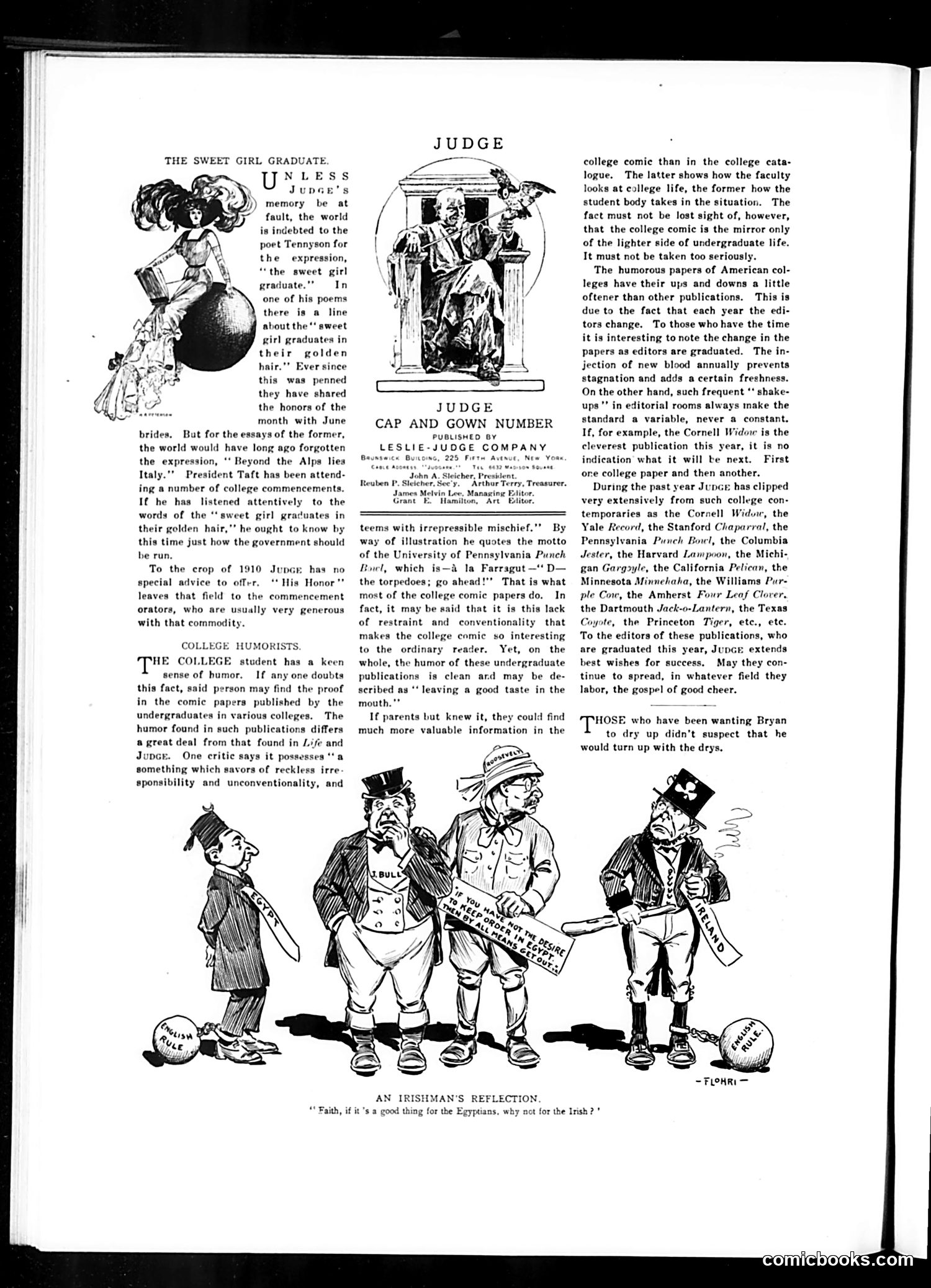
This page discusses college humor publications, particularly focusing on **Judge's Cap and Gown Number** — a special issue targeting college graduates. The main cartoon at bottom, titled "An Irishman's Reflection," depicts three caricatured military or political figures examining a scroll. The caption reads: "Bah, if it's a good thing for the Egyptians, why not for the Irish?" This appears to reference Irish independence or home rule debates—sarcastically suggesting that if Egypt deserves self-governance (likely referring to Egyptian nationalist movements of the era), Ireland should receive similar treatment. The page emphasizes that college comics provide valuable social commentary while maintaining good taste, distinguishing Judge from other undergraduate publications. The cartoon uses ethnic caricature typical of the period's satirical approach to political issues.
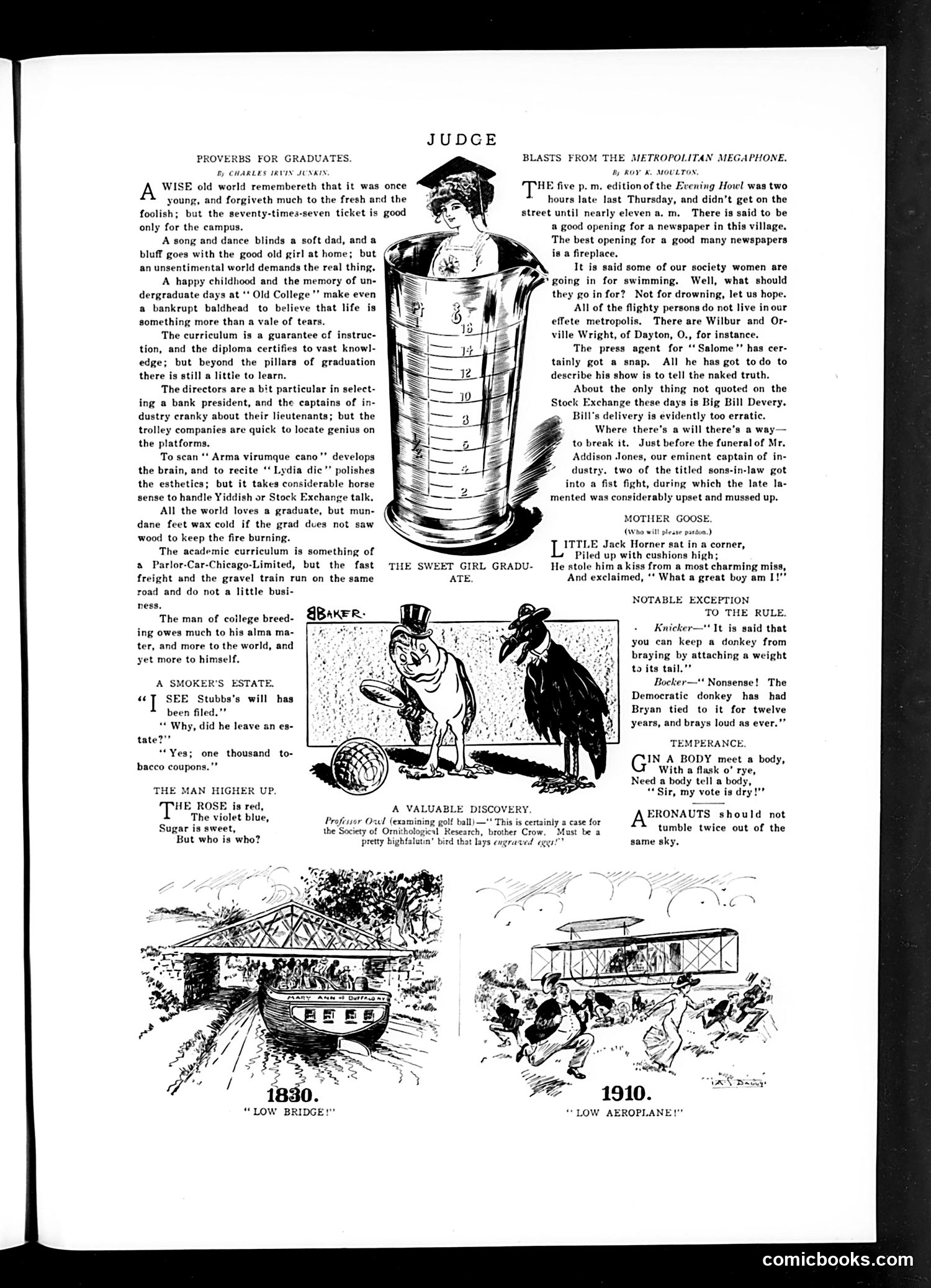
This page contains several independent satirical pieces rather than a cohesive cartoon narrative. **"The Sweet Girl Graduate"** depicts a woman measured in a large cylinder—satirizing the obsession with female measurements and physical standards during the Gilded Age. **"A Valuable Discovery"** shows a professor examining a golf ball, joking about scientific pretension regarding trivial subjects. **"Notable Exception"** features a dialogue mocking Democratic politician William Jennings Bryan's famous political alliance with a donkey. **"1830 Low Bridge" vs. "1910 Low Aeroplane"** compares historical obstacles—a canal bridge blocking boats versus an early airplane—illustrating technological progress and changing hazards. The cartoons employ physical humor and contemporary references (aviation, golf culture, political figures) to satirize modern society's absurdities, scientific overreach, and technological change.
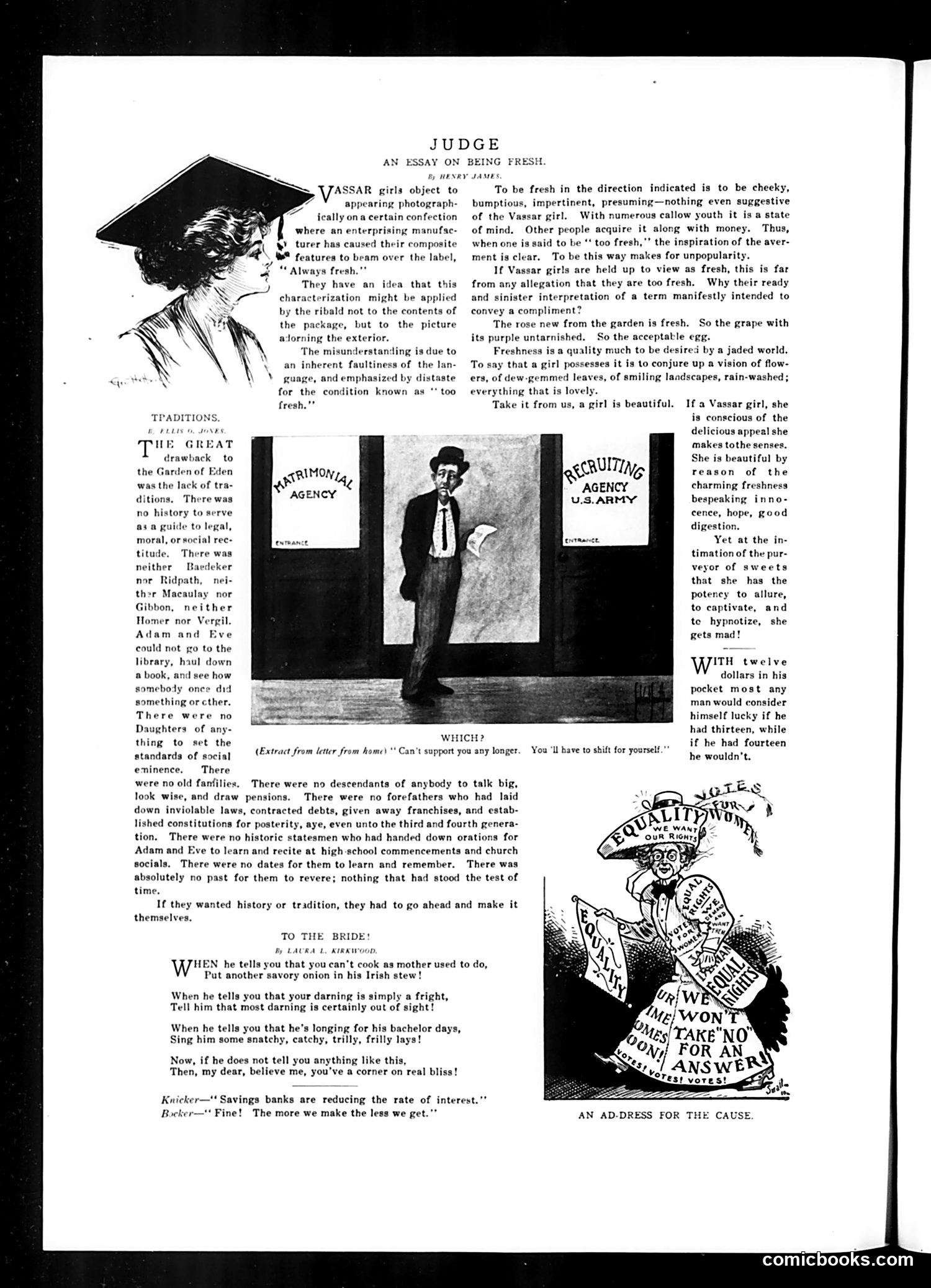
This page satirizes **Vassar College girls** and their perceived "freshness"—a quality the essay argues is being misinterpreted. **The Main Essay** (attributed to Henry James) defends Vassar girls against accusations of being "too fresh" (impudent, presumptuous). The author argues "freshness" should be understood positively—like fresh flowers or fruit—suggesting innocence and charm. He notes Vassar girls resent this characterization and get angry when candy/product manufacturers use their images labeled "Always Fresh." **The Historical Section** humorously contrasts Adam and Eve's world—lacking traditions, history, or social hierarchies—with modern society's obsession with ancestry and precedent. It's satirizing American social pretension. **The Advertisement** (bottom right) shows a woman's profile with text opposing something (appears to be a women's suffrage or equality message, though partly unclear). **Minor content** includes humorous poems about newlywed advice and a brief joke about savings banks. The overall tone mocks both Vassar girls' sensitivities and American society's class consciousness.
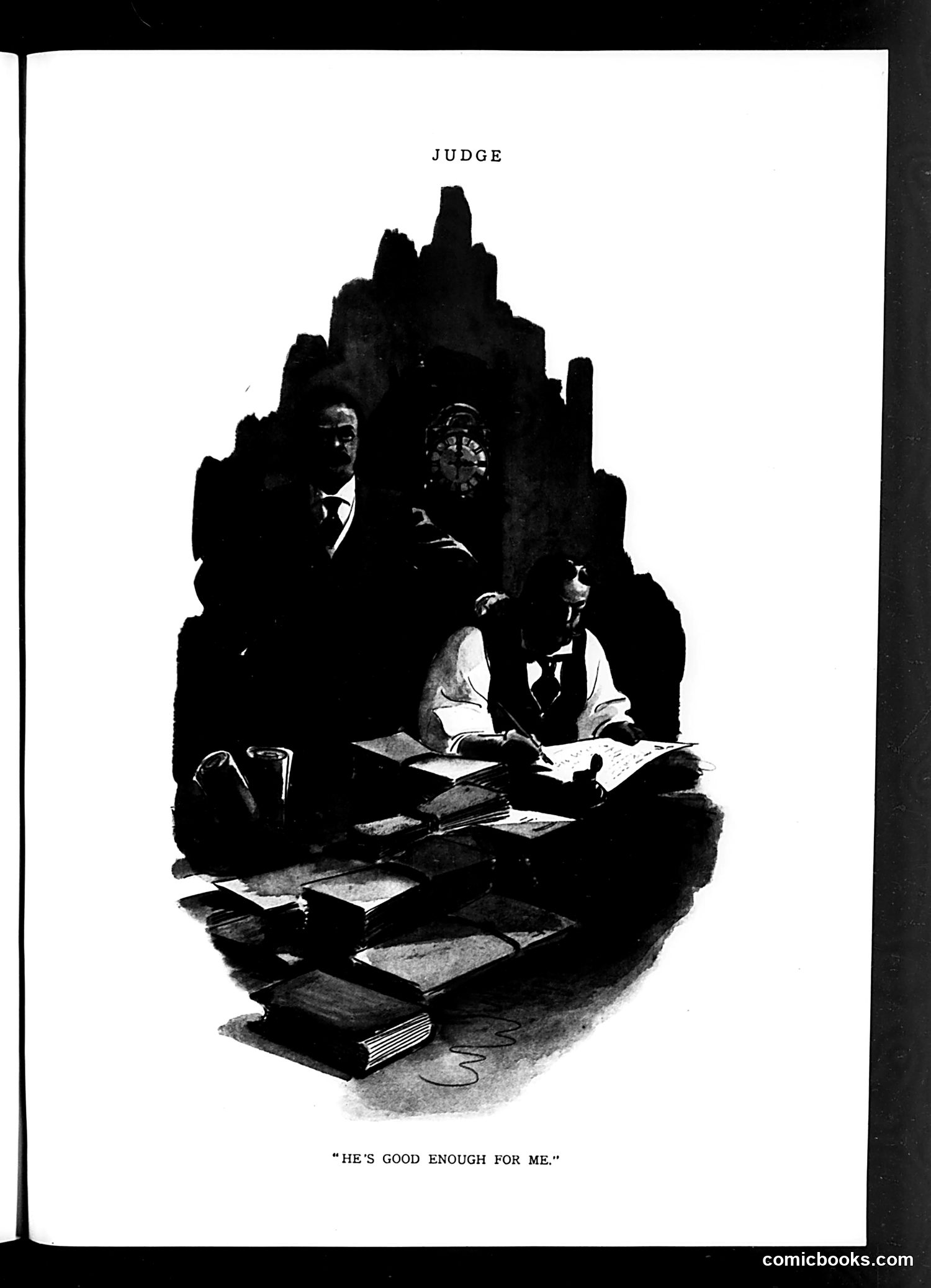
This political cartoon titled "Judge" depicts a courtroom scene where a judge sits at a desk surrounded by shadowy figures—likely representing corrupt politicians or special interests looming over the judicial process. The caption "He's good enough for me" suggests sardonic commentary on judicial appointments or the selection of judges. The satire critiques how judges were chosen based on political patronage rather than merit or integrity. The ominous silhouettes of powerful figures dominating the scene implies that judicial independence was compromised by outside pressure or influence. The "good enough" phrase drips with irony—the judge may be acceptable to corrupt powers, but questionable for upholding justice itself. This reflects Progressive Era concerns about judicial reform and political machine influence over courts.
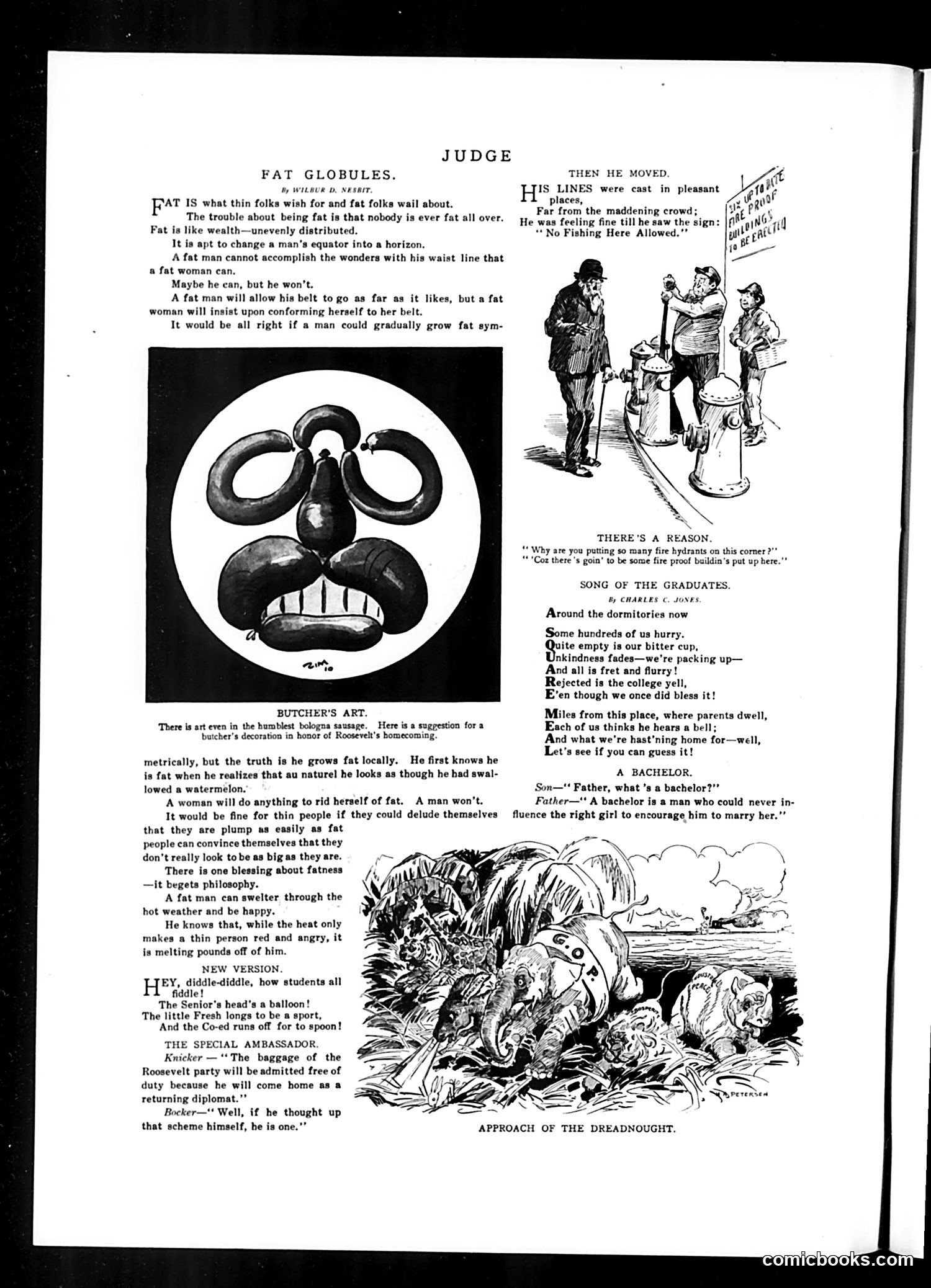
This page from the satirical magazine *Judge* contains several distinct pieces: **"Fat Globules"** mocks the uneven distribution of weight on men versus women, using humorous observations about body composition and social attitudes toward dieting. **"Butcher's Art"** shows a grotesque face made of sausages—a crude visual pun suggesting butchers might create such decorative displays "in honor of Roosevelt's homecoming," likely satirizing President Theodore Roosevelt's return from hunting or travel. **"The Special Ambassador"** is a brief joke about Roosevelt's baggage entering duty-free because "he will come home as a returning diplomat"—poking fun at Roosevelt's diplomatic importance or pretensions. **"Song of the Graduates"** is nostalgic verse about college students leaving dormitories, with a riddling final stanza about what they're "hast'ning home for." **"A Bachelor"** offers a definition joke: a bachelor is a man who can't convince the right girl to marry him. The remaining illustrated vignettes appear to be unrelated short comic observations about fishing and fire hydrants.
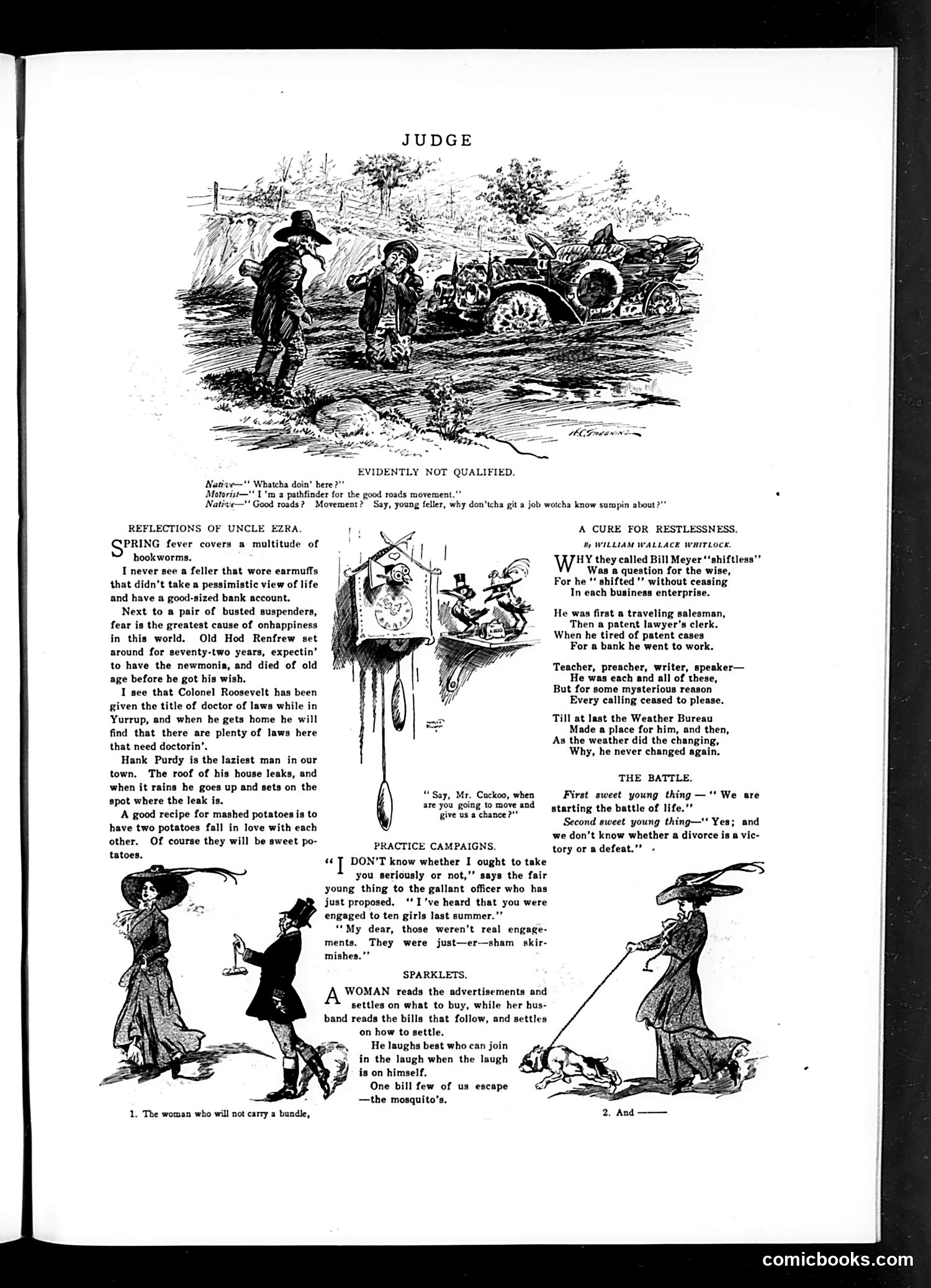
This page contains multiple satirical pieces lampooning various American social issues circa early 1900s: **"Evidently Not Qualified"** mocks the "good roads movement"—a Progressive Era initiative to improve rural infrastructure. The native's skeptical response suggests doubt about the pathfinder's actual qualifications for the job. **"Reflections of Uncle Ezra"** presents rustic folk wisdom critiquing American life: Spring fever, materialism, anxiety, and laziness. The reference to Colonel Roosevelt receiving a doctorate of laws while abroad, then finding American laws needing reform, appears to satirize TR's reformist pretensions. **"A Cure for Restlessness"** tells of Bill Meyer, who constantly job-hops through various professions until finding stability at the Weather Bureau—a joke about perpetual career-switching and American restlessness. **"The Battle"** features young newlyweds cynically joking whether divorce represents victory or defeat in marriage—satirizing contemporary marital skepticism. The cartoons and "Sparklets" (brief observations) critique American materialism, political reform movements, and social instability with wry humor.
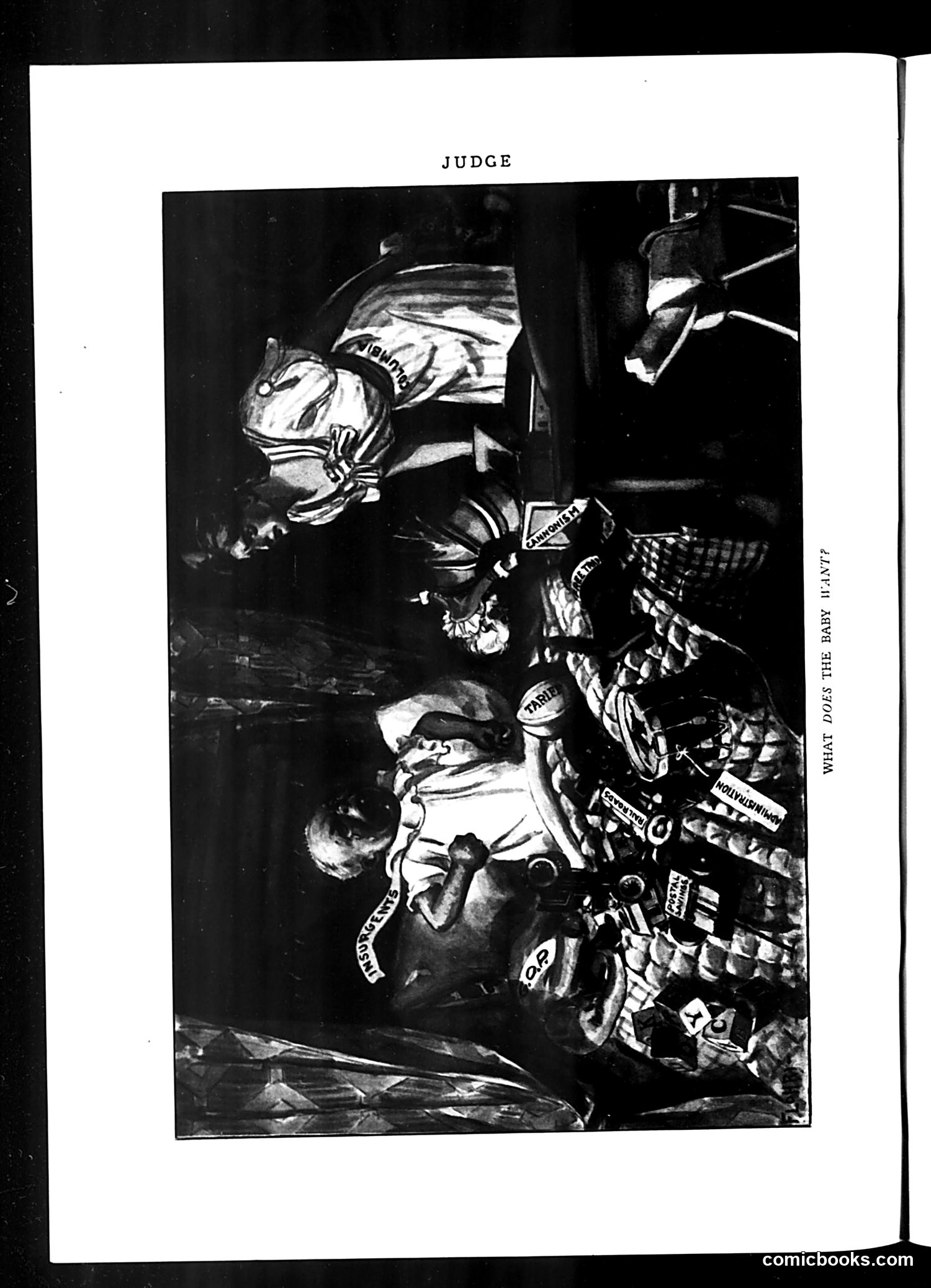
The page header reads "JUDGE" with a caption "WHAT DOES THE BABY INHERIT?" running vertically on the right side. The political cartoon depicts a military figure in ornate uniform and regalia covered with medals and decorations. The figure appears bloated or exaggerated, surrounded by what seem to be symbols of military power and authority. The satire appears to critique militarism and the inheritance of military power or authority. The question "What does the baby inherit?" suggests concern about passing down militaristic values, imperial ambitions, or authoritarian power structures to the next generation. The heavily decorated officer likely represents European military or imperial leadership prevalent during Judge magazine's satirical heyday. Without a precise date visible, the specific historical reference remains unclear, though this appears to critique early 20th-century militarism and imperialism.
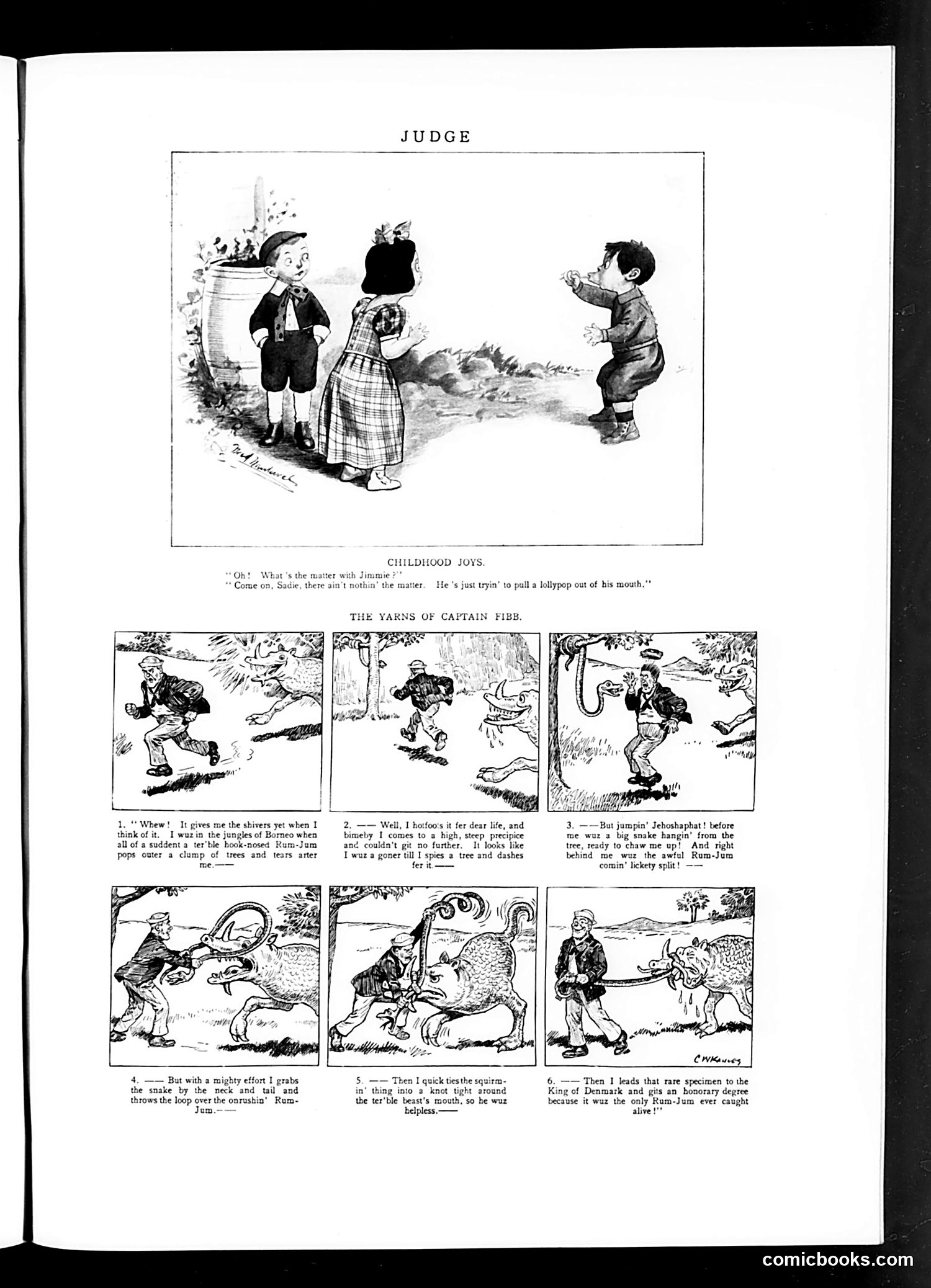
**"Childhood Joys"** is a simple domestic joke: a child struggles to remove a lollipop stuck in his mouth—the humor lies in the parents' matter-of-fact response to what appears to be a serious problem. **"The Yarns of Captain Fibb"** is a tall-tale parody mocking exaggerated adventure stories. Captain Fibb recounts an implausible series of jungle encounters: escaping a "hook-nosed Rum-Jum" (appears to be a fictional creature), being chased up a tree, wrestling a giant snake, tying the beast in a knot, and ultimately earning a royal honor from the King of Denmark for capturing this "rare specimen." The satire targets the widespread popularity of fabricated adventure narratives—particularly those featuring exotic locations and implausible heroics—that were common in period literature and tall tales. The deliberately absurd sequence (a knot-tied serpent, a non-existent creature, a nonsensical reward) exposes the genre's inherent ridiculousness. The comic acknowledges this is pure fiction by having Fibb himself frame these as dubious "yarns."
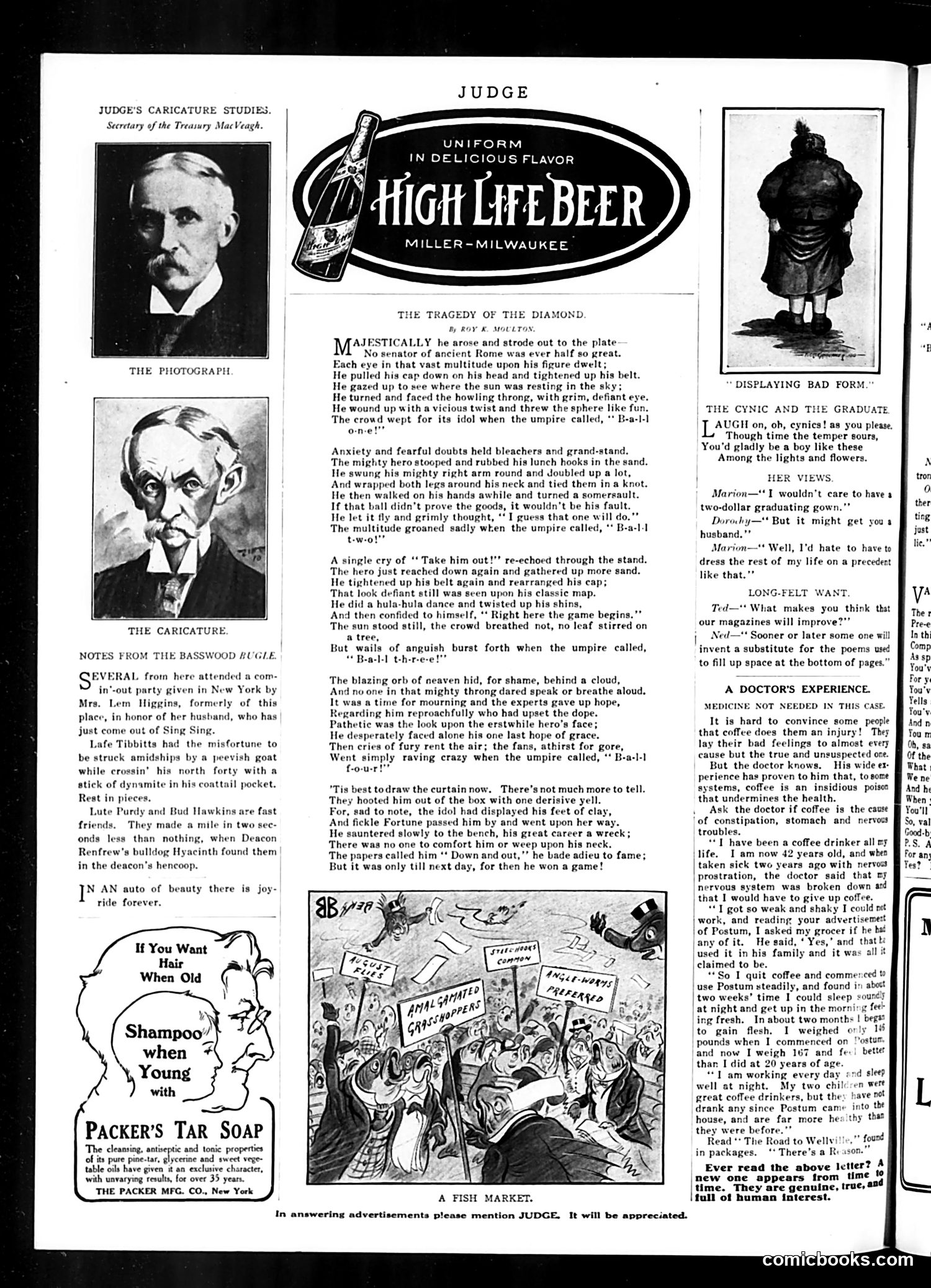
This page combines political caricature with humorous fiction and advertising from an early 20th-century American satirical magazine. **Political Content:** The top features a caricature study of Franklin MacVeagh, Secretary of the Treasury under President Taft, labeled "Displaying Bad Form"—likely satirizing his policies or public persona through exaggerated facial features. **Main Content:** "The Tragedy of the Diamond" is a baseball poem mocking a pitcher's theatrical, desperate attempts to succeed despite repeated strikes. Each elaborate gesture (leg-wrapping, handstands, hula-dancing) fails before the umpire calls strikes, only to have him succeed on the fourth attempt. The satire critiques both baseball's dramatics and human persistence through absurdist humor. **Supporting Material:** Rural gossip column "Notes from the Basswood Bugle," beer and soap advertisements, and a doctor's testimonial about coffee curing his ailments—typical period magazine content mixing editorial with advertising. The page reflects Judge's satirical approach: mocking public figures, absurdist sports humor, and period advertisements presented without irony.
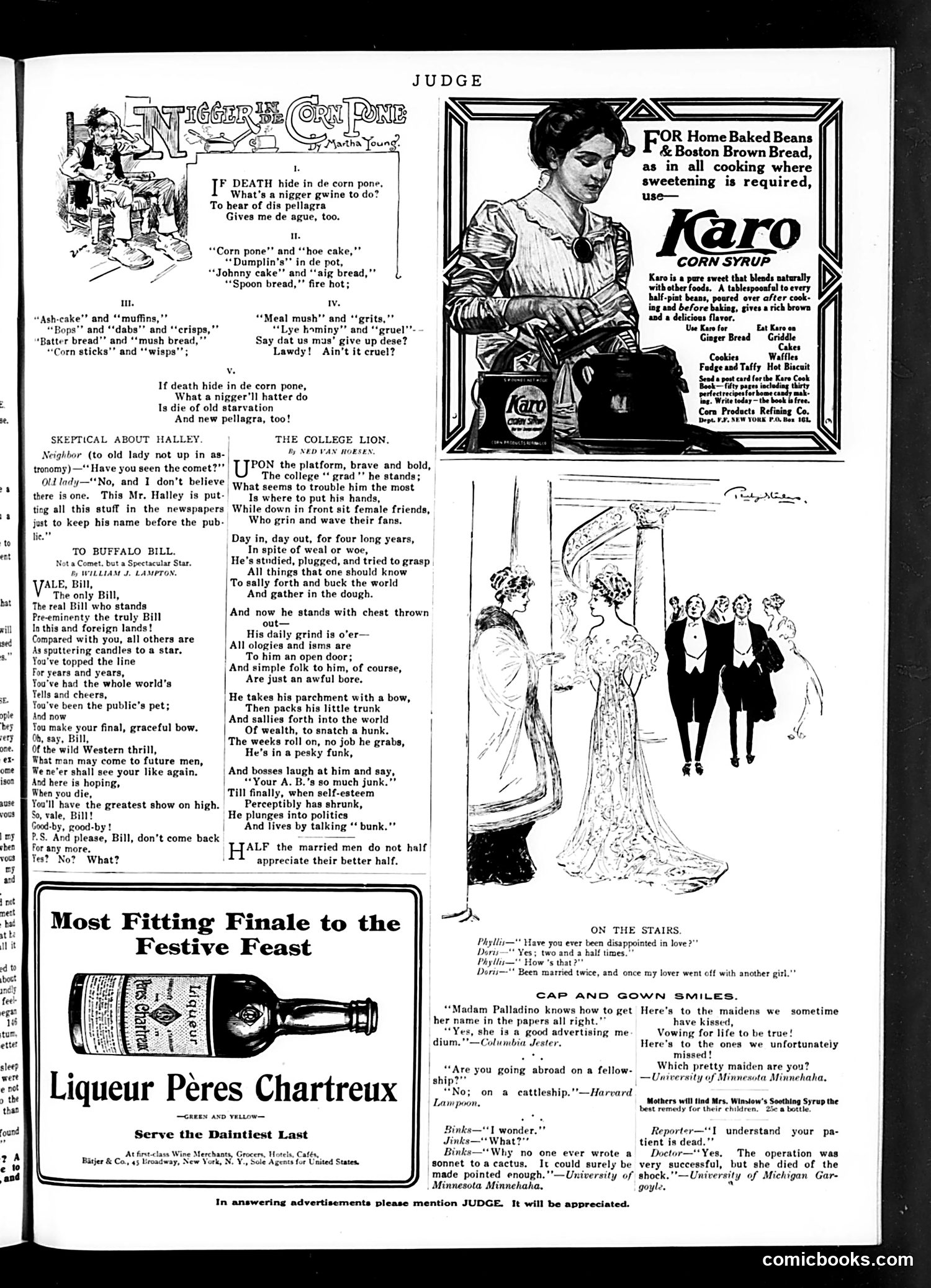
This page contains several distinct pieces of satirical content: **"In the Corn Pone"** uses dialect verse to satirize racial stereotypes while addressing a genuine public health crisis. The poem, written in exaggerated African American vernacular, discusses pellagra—a real disease caused by niacin deficiency linked to corn-based diets. The satire appears to mock both the disease's prevalence among poor populations and contemporary attitudes toward it. **"To Buffalo Bill"** is an elegiac poem celebrating Buffalo Bill's farewell performance, sarcastically praising his showmanship while mocking his legendary status and suggesting his achievements are ultimately shallow. **"The College Lion"** satirizes recent college graduates as pompous and unemployable—they emerge with degrees and inflated self-regard but cannot find work, eventually turning to politics and "talking bunk." The page also contains vintage advertisements for Karo corn syrup and Liqueur Pères Chartreuse, typical of the era's commercial magazine content. The overall tone reflects turn-of-the-century American attitudes: racial caricature alongside genuine social concern, celebrity mockery, and generational skepticism about education's practical value.
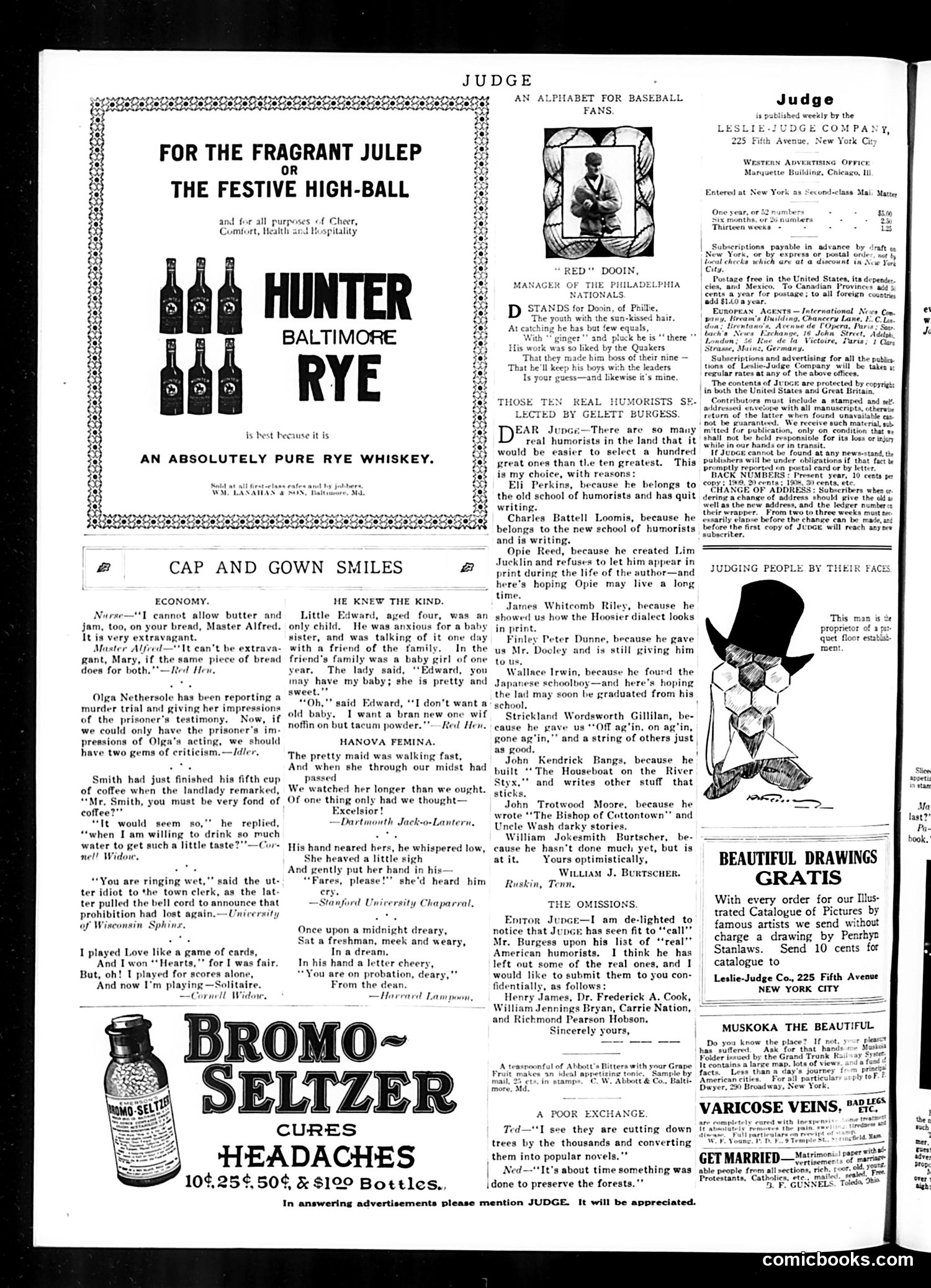
This is primarily an **advertising and editorial page** from Judge magazine, a satirical weekly publication. The page contains: **Main Content:** - Advertisement for Hunter Baltimore Rye Whiskey (positioned prominently) - An editorial feature by Gelett Burgess titled "Those Ten Real Humorists Selected by Gelett Burgess," listing humorists like Eli Perkins, Charles Battell Loomis, Opie Reed, James Whitcomb Riley, and Finley Peter Dunne with brief explanations of why each qualifies - Several humorous short anecdotes under "Cap and Gown Smiles" section - Advertisement for Bromo-Seltzer headache cure **Historical Context:** The page reflects early-1900s American humor—gentle domestic comedy about children, servants, and relationships. The Bromo-Seltzer ad suggests the magazine's audience was affluent enough to consume alcohol regularly. The inclusion of established humorists indicates Judge's literary pretensions alongside its satirical cartoons. **Note:** No significant political satire appears on this particular page.
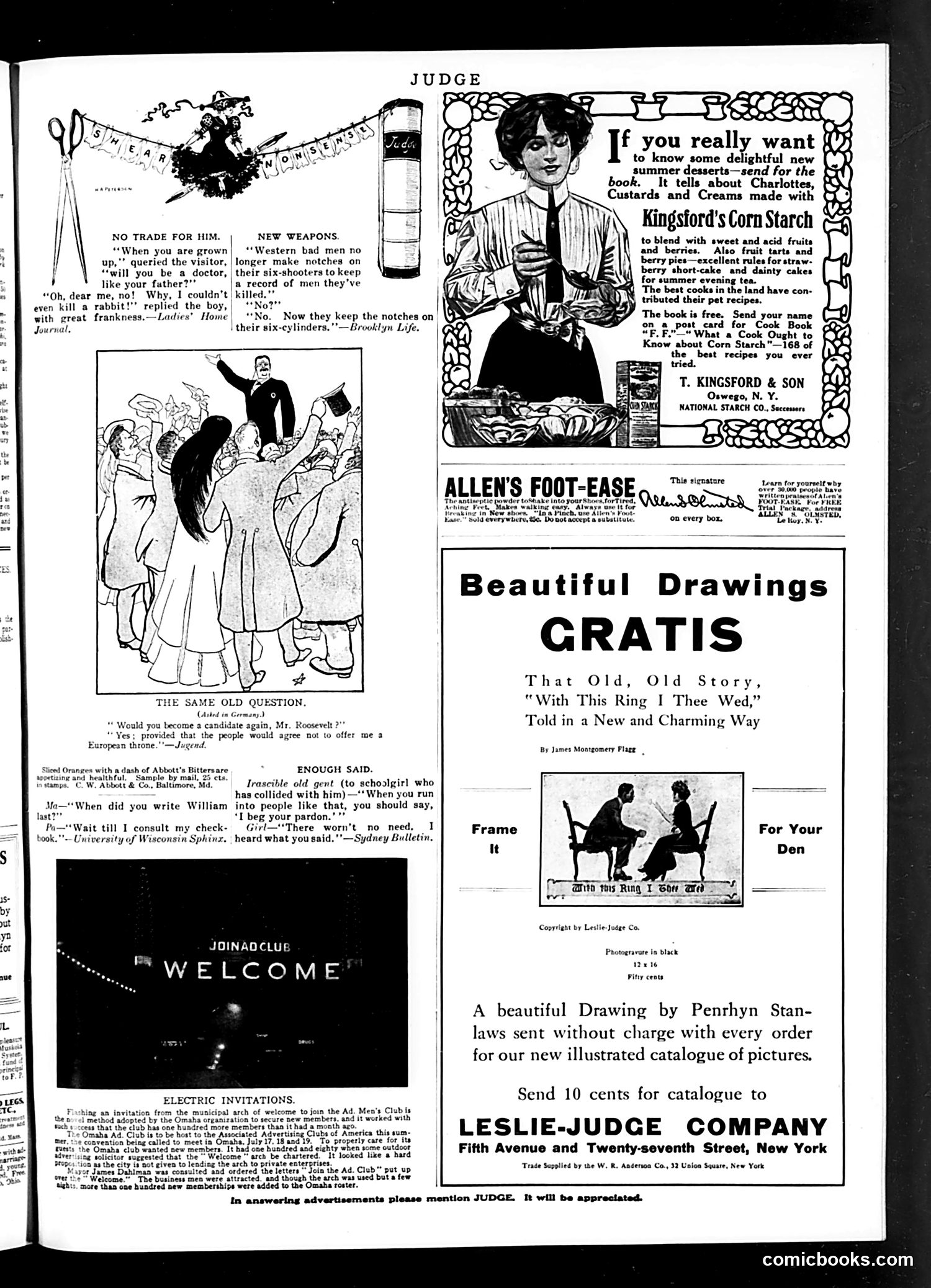
This page contains several satirical cartoons and advertisements typical of early 20th-century American humor: **"New Weapons"** jokes about Western gunmen replacing notch-counting with automobile cylinders—a contemporary reference to the transition from frontier culture to modern automotive society. **"No Trade for Him"** satirizes changing social values: a boy refuses to become a doctor like his father because he lacks the ruthlessness needed ("couldn't even kill a rabbit"), suggesting anxieties about lost masculine ideals. **"The Same Old Question"** references Theodore Roosevelt, who had recently left the presidency. The joke plays on European monarchies potentially offering him a throne—mocking both his perceived ambitions and American anxiety about Old World influence. **"Enough Said"** presents a generation-gap joke where a schoolgirl's insolence goes unpunished because she's already heard the old man's complaint. The remaining content is primarily **product advertisements** (Kingsford's Corn Starch, Allen's Foot-Ease, Leslie-Judge Company art prints), which was common revenue for magazines of this era.
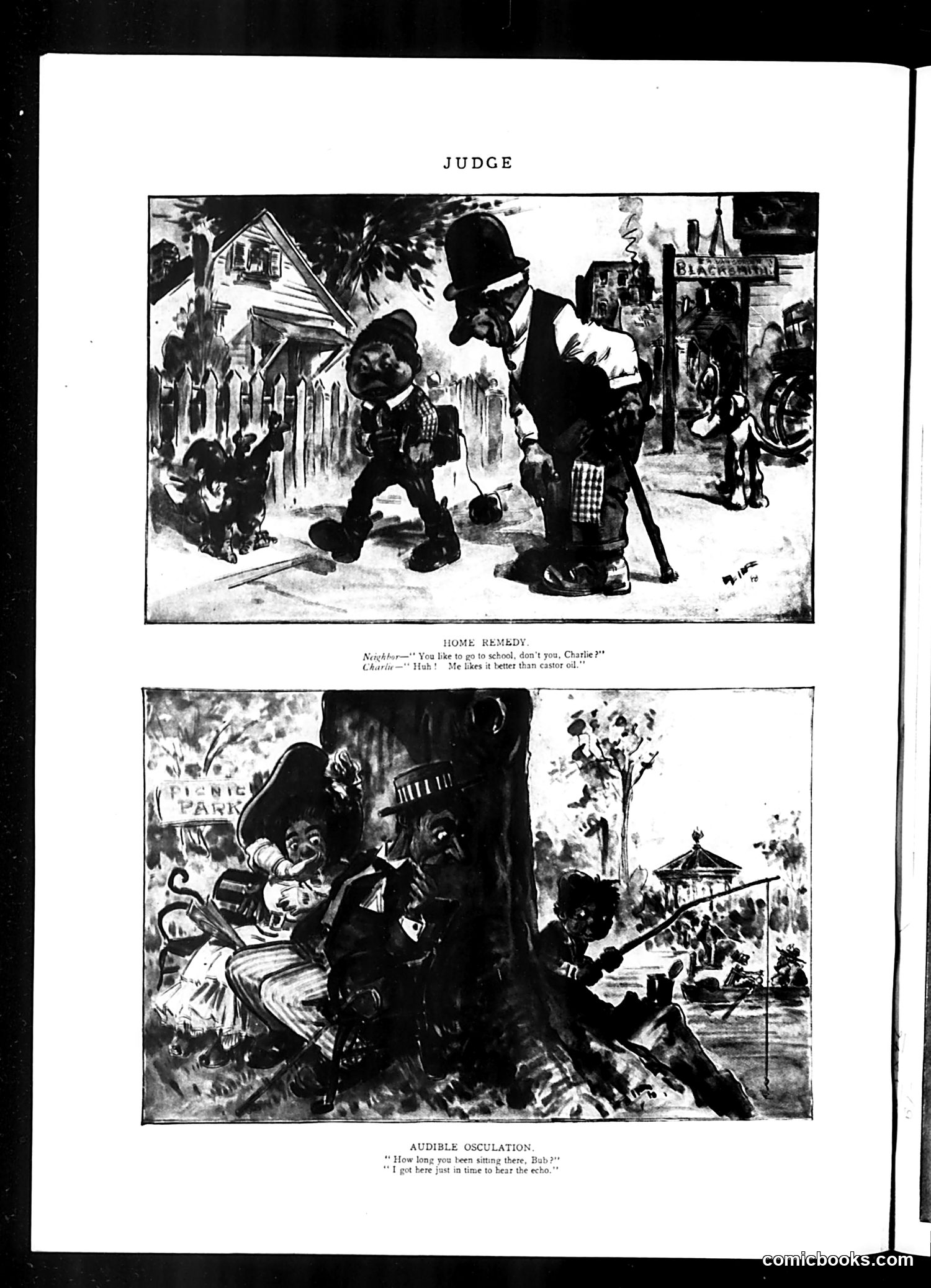
This page contains two cartoon panels titled "Home Remedy" and "Audible Osculation" featuring anthropomorphized animal characters (appearing to be dogs or similar creatures) in human clothing and situations. The cartoons appear to be domestic humor comics rather than explicit political satire. The "Home Remedy" panel shows what seems to be a truancy scenario—an adult telling a child character to attend school. The "Audible Osculation" panel depicts characters in an outdoor setting, likely illustrating a romantic or comedic scenario involving kissing sounds (suggested by the title). These are general-interest satirical comics typical of Judge magazine's lighter content, using animal characters for humorous social commentary about everyday domestic life rather than direct political critique.