
A complete issue · 16 pages · 1910
Judge — May 21, 1910
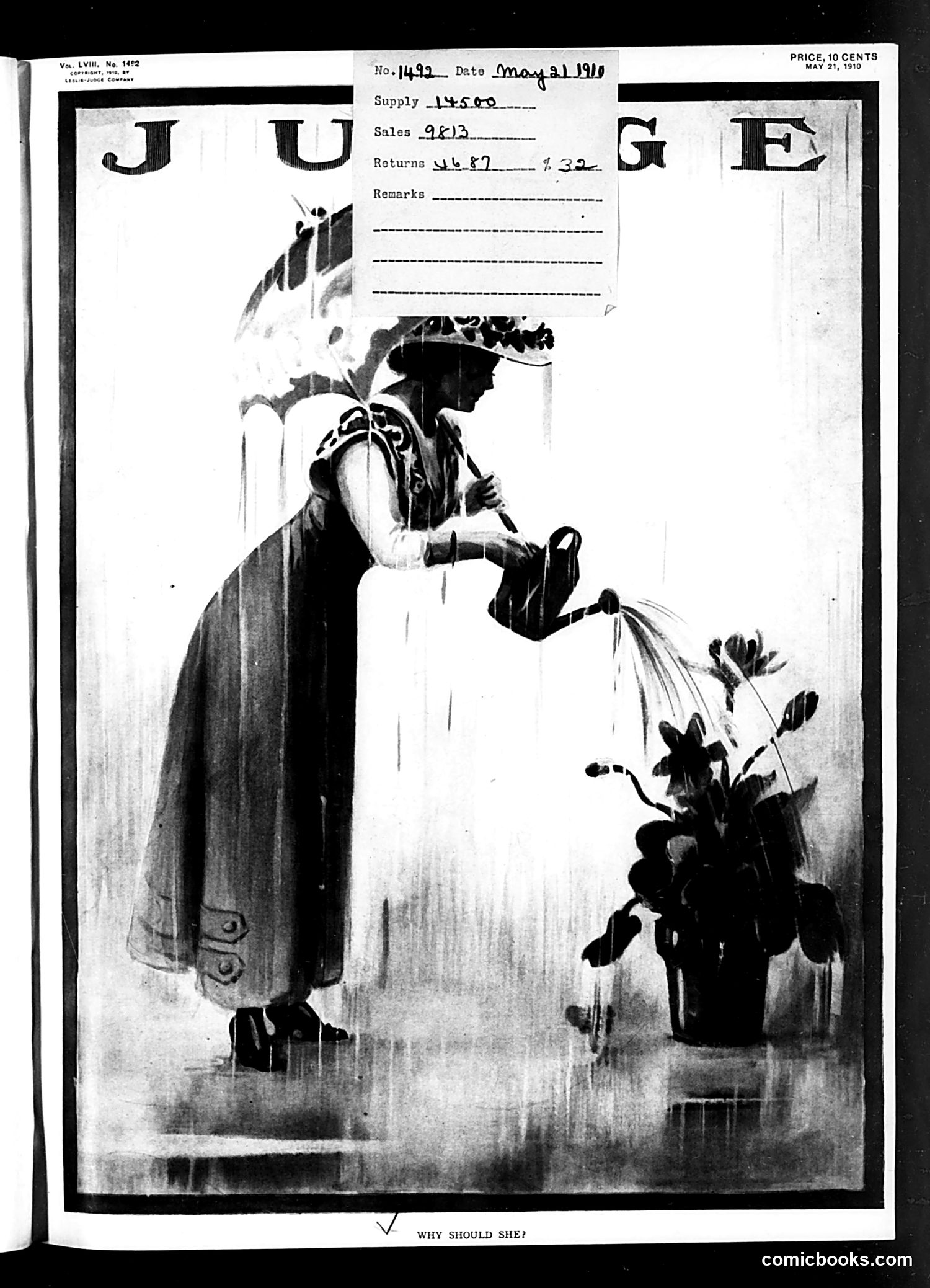
**The Cartoon:** "Why Should She?" depicts a woman in silhouette watering drooping flowers while rain falls outside. The image is a commentary on women's suffrage and domestic duty during the post-WWI period. **The Point:** The cartoon appears to satirize women questioning their traditional domestic roles—particularly the irony of women being expected to maintain household duties while simultaneously gaining political rights (the 19th Amendment was ratified in August 1920, very close to this publication date). The title "Why Should She?" suggests women asking why they must continue conventional domestic labor if they're gaining equality. **Context:** This reflects contemporary social tension as women's suffrage became imminent, with debates about whether voting rights would or should alter women's domestic responsibilities.
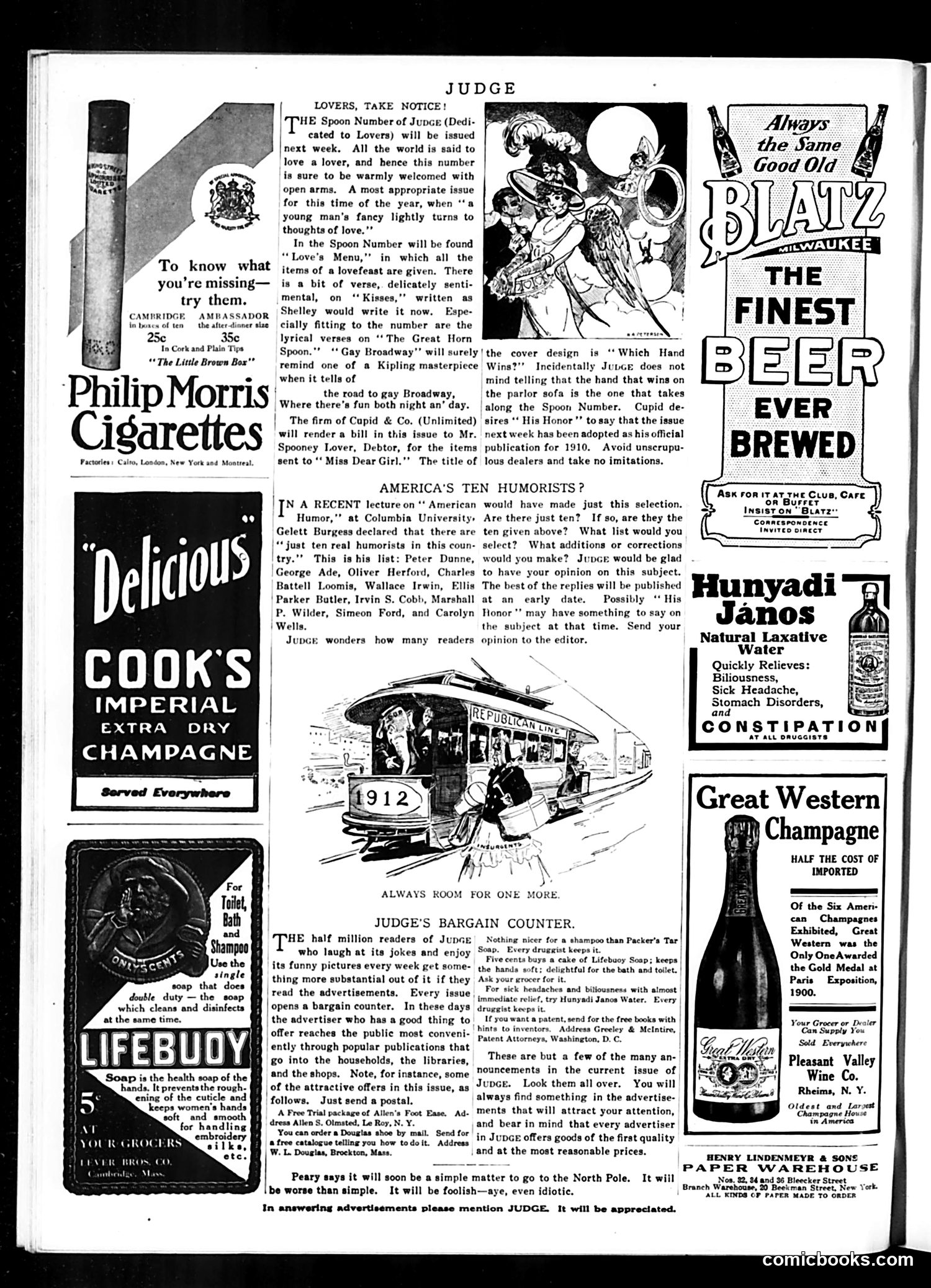
This page is primarily **advertising with minimal editorial content**. The main cartoon depicts a crowded streetcar labeled "1912," illustrating the caption "ALWAYS ROOM FOR ONE MORE." This appears to reference the **1912 U.S. presidential election**, likely satirizing the crowded field of candidates or the competitive political landscape of that year. The text section "America's Ten Humorists?" lists prominent figures including Peter Dunne and others, seemingly a lighthearted ranking of contemporary comedians and satirists. The bulk of the page features period advertisements for **Philip Morris Cigarettes, Cook's Champagne, Lifebuoy Soap, Blatz Beer, and other consumer products**—typical commercial content that subsidized the magazine. The editorial satire is minimal here; the publication functions primarily as an advertising vehicle.
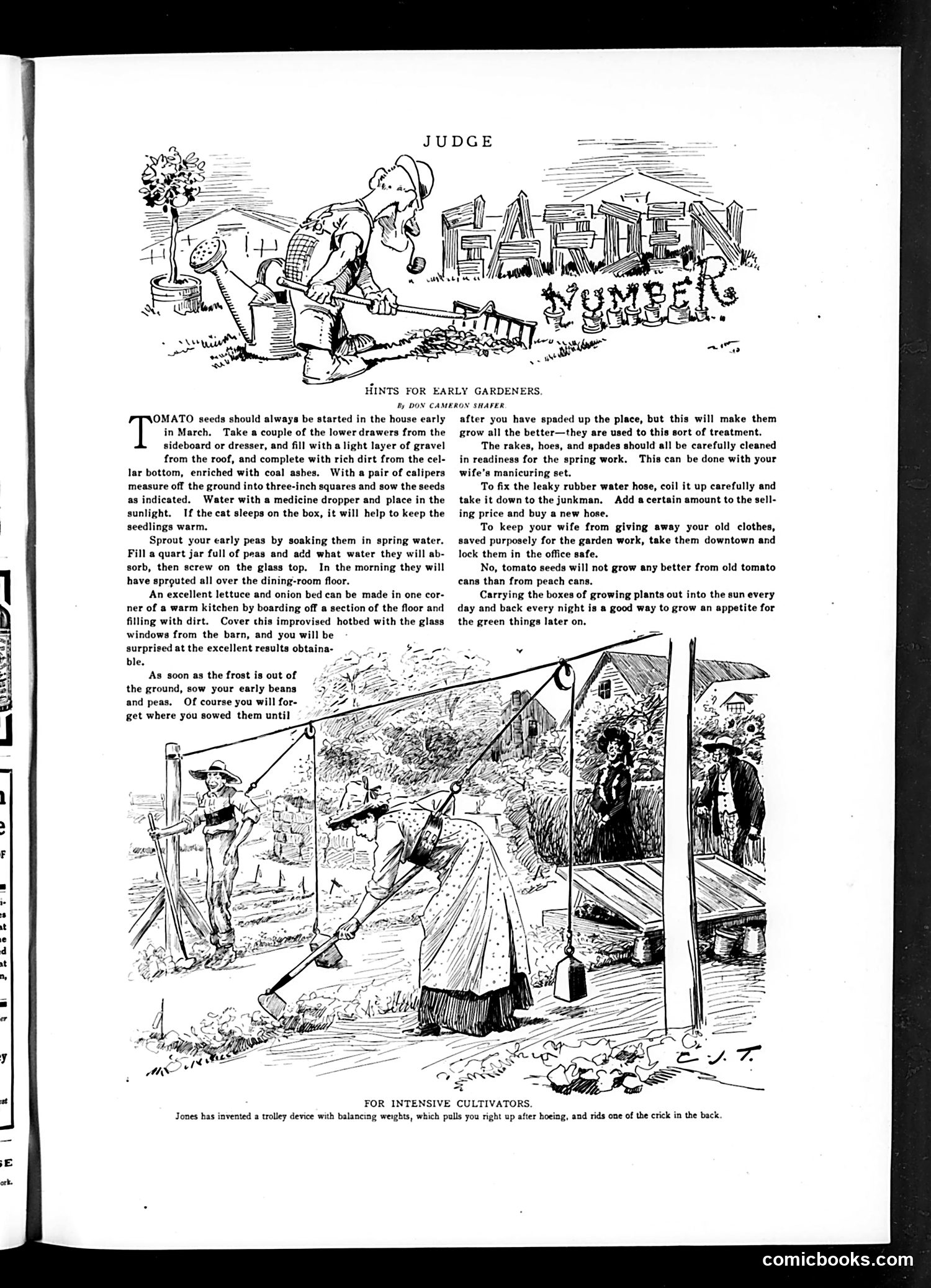
This page from *Judge* magazine is **not political satire** but rather **practical gardening advice** disguised as humorous illustration. The top cartoon shows a "Judge" figure supervising early gardeners, while the bottom illustration depicts various gardening activities—people digging, hauling water, and working soil. The article "Hints for Early Gardeners" by Don Cameron Shafter offers legitimate tips: starting tomato seeds indoors, soaking peas before planting, creating lettuce beds in kitchen corners, and managing water hoses. The humor is gentle and domestic rather than satirical—depicting the physical labor of gardening through exaggerated cartoon characters engaged in typical spring activities. The "intensive cultivators" caption at bottom jokes about the effort required. This represents *Judge*'s lighter, non-political content aimed at readers' daily lives rather than current events.
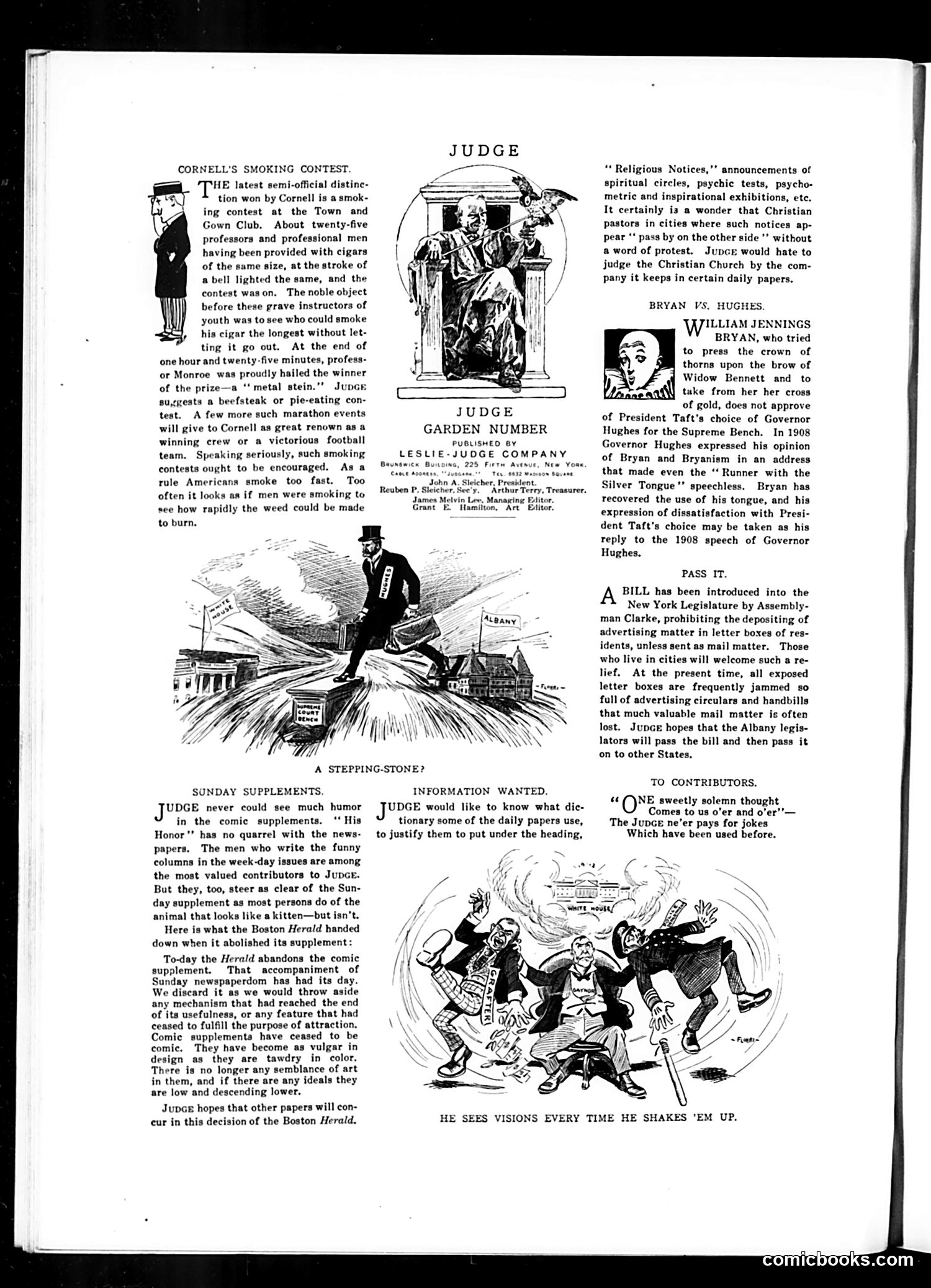
**Cornell's Smoking Contest:** A humorous item about Cornell University holding a smoking contest where students compete to smoke the fastest. The joke is that American etiquette rules discourage fast smoking, yet here's an institution encouraging it—satirizing both college traditions and changing social norms around tobacco. **"A Stepping-Stone?"** The cartoon depicts a man balanced on what appears to be Albany (New York's capital), using it as a stepping stone. This likely satirizes political ambition, suggesting someone uses a lower office as a platform to reach higher power—a common Judge theme about politicians' careerism. **Sunday Supplements criticism:** Judge critiques the Boston Herald's decision to abandon comic supplements, arguing they've become vulgar and artistically empty—reflecting early 20th-century debates about newspaper comics' cultural value.
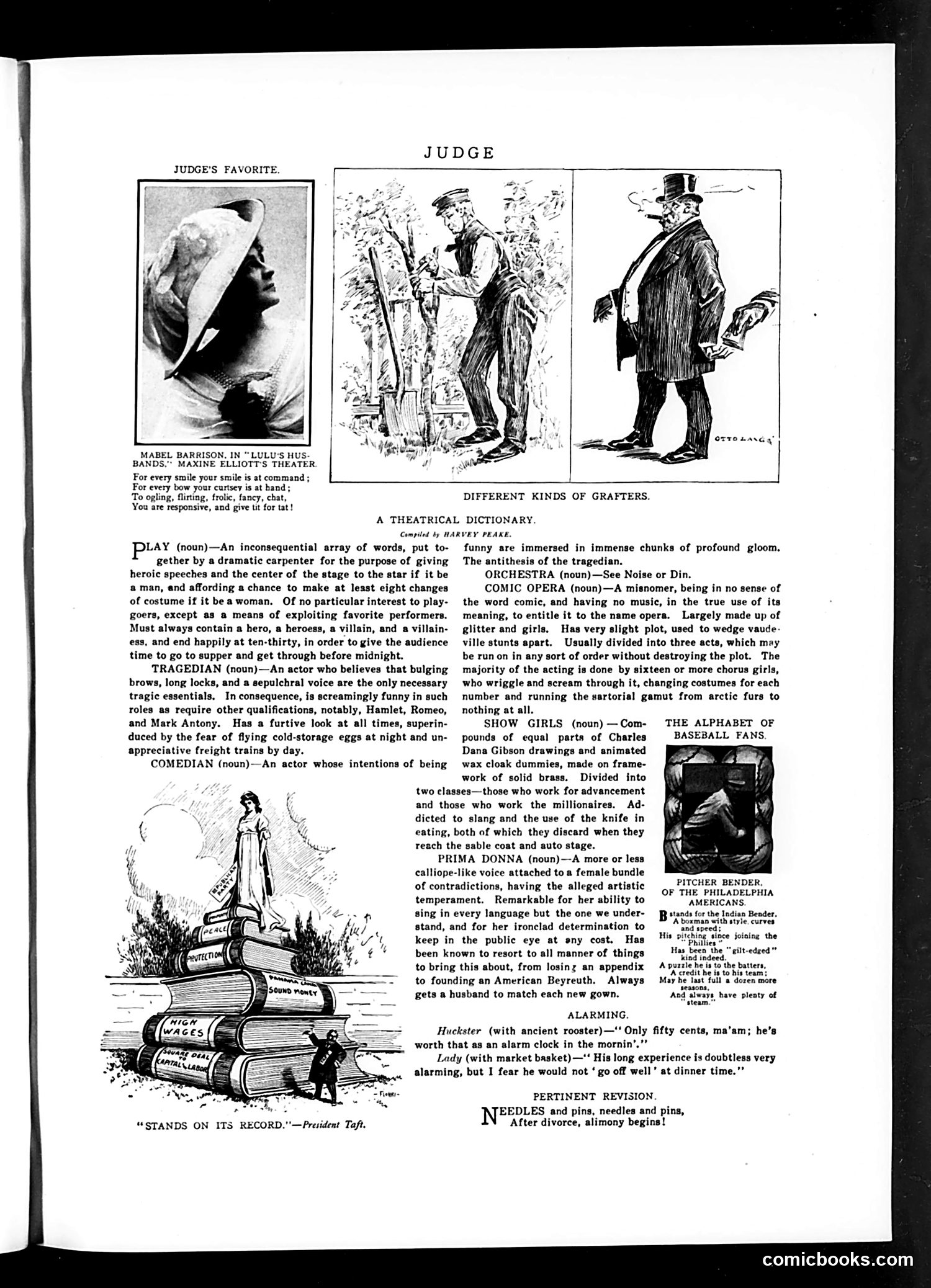
This page combines theatrical satire with a "Theatrical Dictionary" defining stage terms. The top left features Mabel Harrison in "Lulu's Husband" at Maxine Elliott's Theater, with a poem about her commanding performance. The center cartoon labeled "Different Kinds of Grafters" shows three caricatured figures—likely representing corrupt theatrical or political types. The term "grafters" (referring to those obtaining money dishonestly) suggests satire of fraud or embezzlement. The dictionary defines theatrical jargon (play, orchestra, comic opera, show girls, prima donna) with biting commentary on performers and industry practices. For example, "show girls" are described mockingly as interchangeable performers. Additional humorous definitions and a baseball fans sidebar complete the page, typical of Judge's blend of theatrical criticism and social commentary targeting entertainment industry corruption and superficiality.
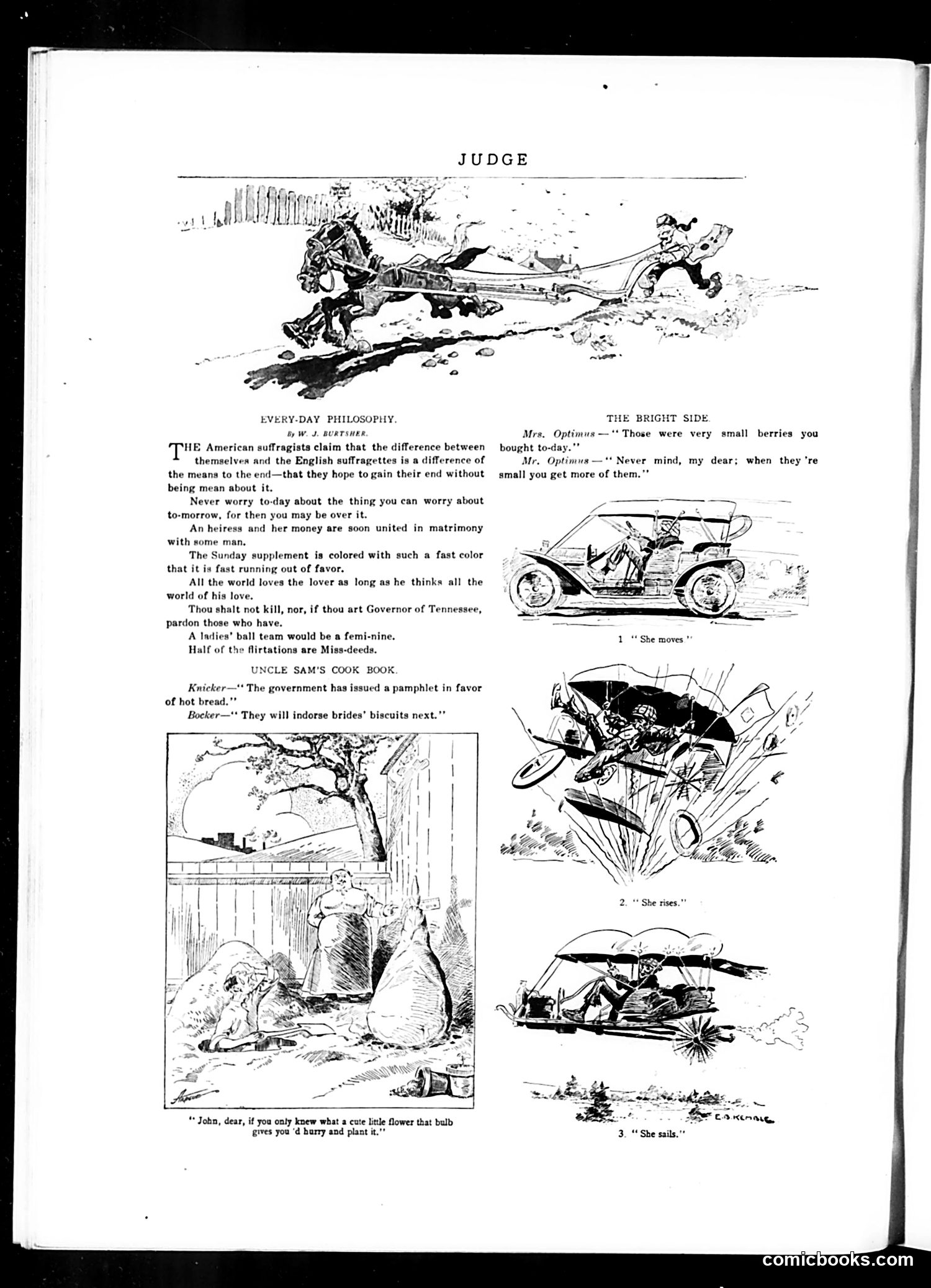
This page from Judge magazine contains humor pieces rather than political cartoons. The content includes: **"Everyday Philosophy"**: A series of one-liner jokes mocking American social conventions. Notable is a dig at Tennessee's Governor (likely referencing capital punishment policy), and wordplay about women's suffrage, distinguishing American suffragists from more militant English suffragettes. **"Uncle Sam's Cook Book"**: A brief joke about government food pamphlets, satirizing bureaucratic advice. **"The Bright Side"**: A domestic humor piece where Mr. Optimus reframes buying small berries positively—you get more quantity. The three automotive illustrations labeled "She moves," "She rises," and "She sails" appear to be visual gags about early automobiles, likely showing comedic depictions of cars malfunctioning or behaving unpredictably. The overall tone is lighthearted social commentary on contemporary American life—suffrage debates, government overreach, and new technology—rather than hard-hitting political satire.
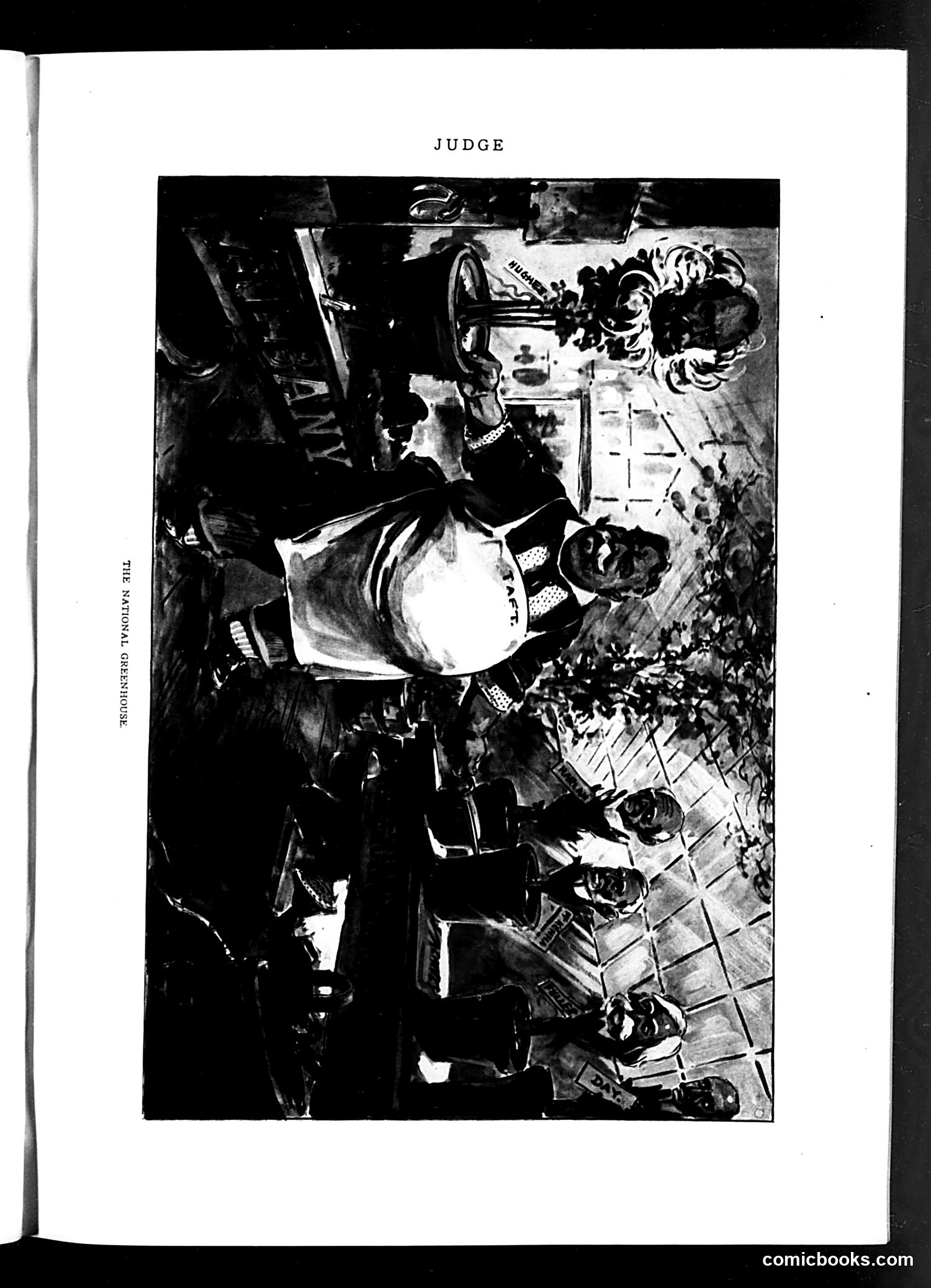
I can see this is a page from *Judge* magazine titled "JUDGE" at the top, but the OCR text provided is largely illegible (appearing as mostly symbols and formatting characters rather than readable words). The black and white photograph shows what appears to be a formal interior scene with multiple figures in period dress, though the image is rotated and somewhat difficult to parse clearly. Without legible text identifying the specific figures, events, or satirical targets, I cannot reliably explain what political or social commentary this particular page intends to convey. To properly explain the satire and historical context, I would need either clearer OCR text or additional identifying information about the publication date and subject matter.
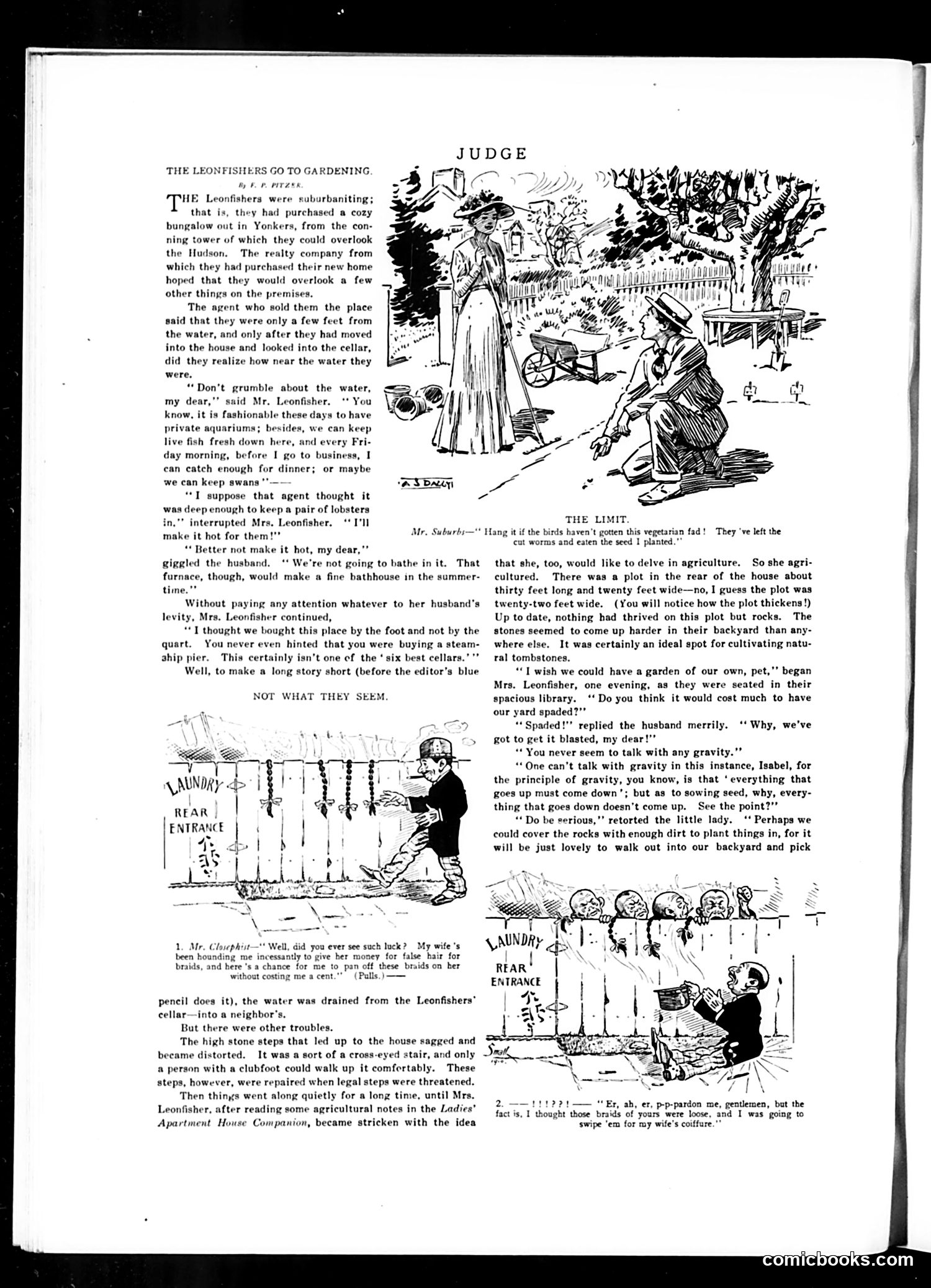
This is a humorous domestic satire about the Leonfishers, a couple who've moved to a suburban bungalow in Yonkers. The story mocks the newly wealthy suburban lifestyle and overly-optimistic real estate marketing of the era. The main jokes: the realtor's claim they're "near water" means their cellar floods; the steps are so poorly built that only someone with a clubfoot could walk them comfortably; and when Mrs. Leonfisher wants to garden, the yard is essentially solid rock. Her husband keeps making terrible puns ("spaded...blasted") rather than taking anything seriously. The accompanying cartoons show the couple's domestic misadventures with laundry and garden attempts. The satire targets both deceptive real estate practices and the pretensions of middle-class people attempting suburban gentility despite their properties being fundamentally defective.
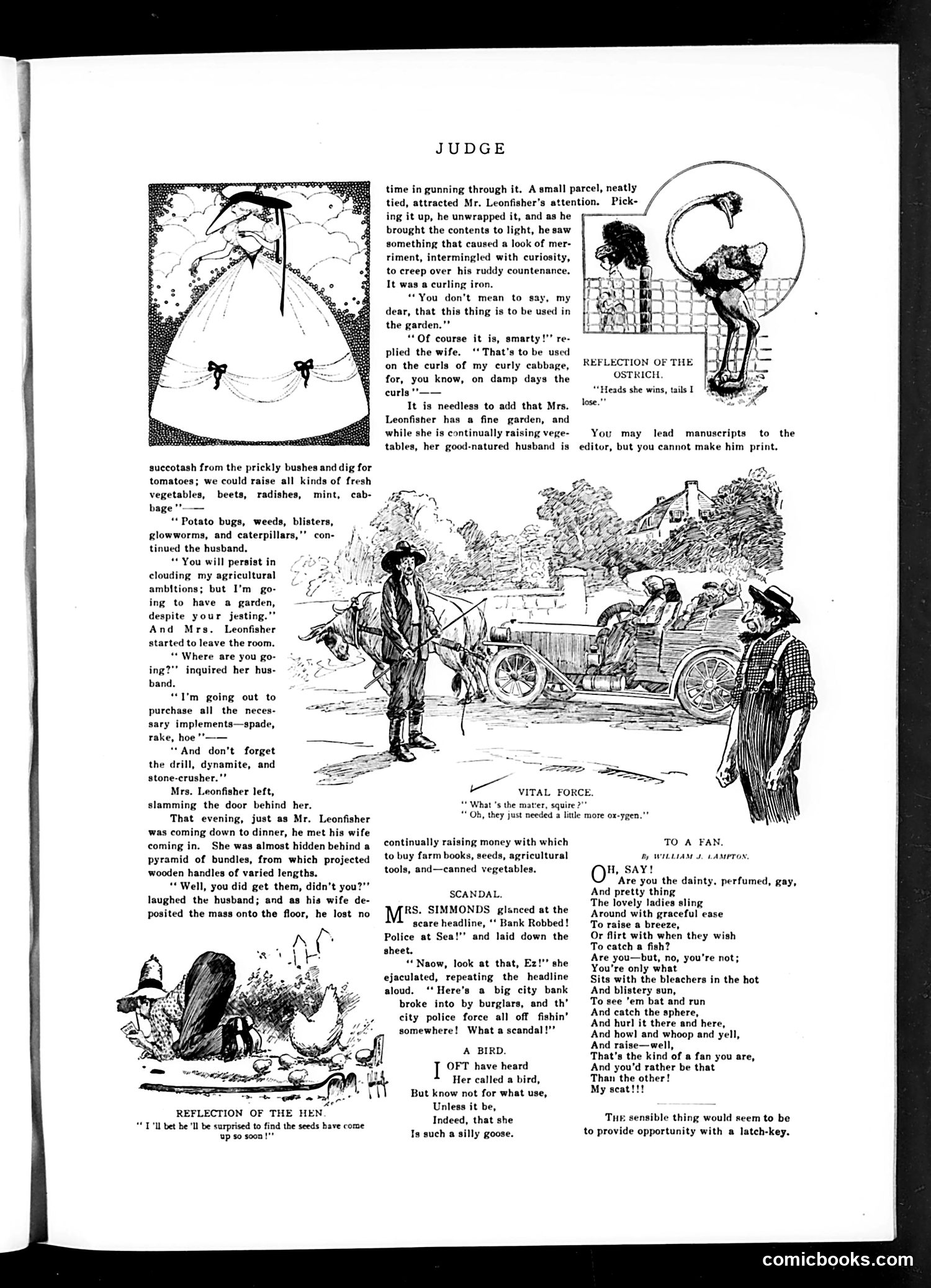
This page contains multiple satirical sketches typical of Judge magazine's humor: **Main Story - "The Garden Plot"**: Mr. Leonfisher plans an ambitious vegetable garden while his wife pragmatically lists obstacles (bugs, weeds, caterpillars). The joke culminates when she returns from shopping with gardening tools—but one item is a curling iron for her "curly cabbage," playing on the absurdity of applying beauty treatments to vegetables. The satire mocks both agricultural pretensions and gender stereotypes about women's concerns with appearance. **Secondary Cartoons**: Include jokes about hens reflecting on garden success, a political editorial about manuscript submissions, and a poem mocking female fans at sporting events as frivolous. The overall tone is gentle domestic satire aimed at middle-class aspirations and gender relations, typical of early-20th-century Judge magazine humor. The illustrations support the text's comedic exaggeration of everyday situations.
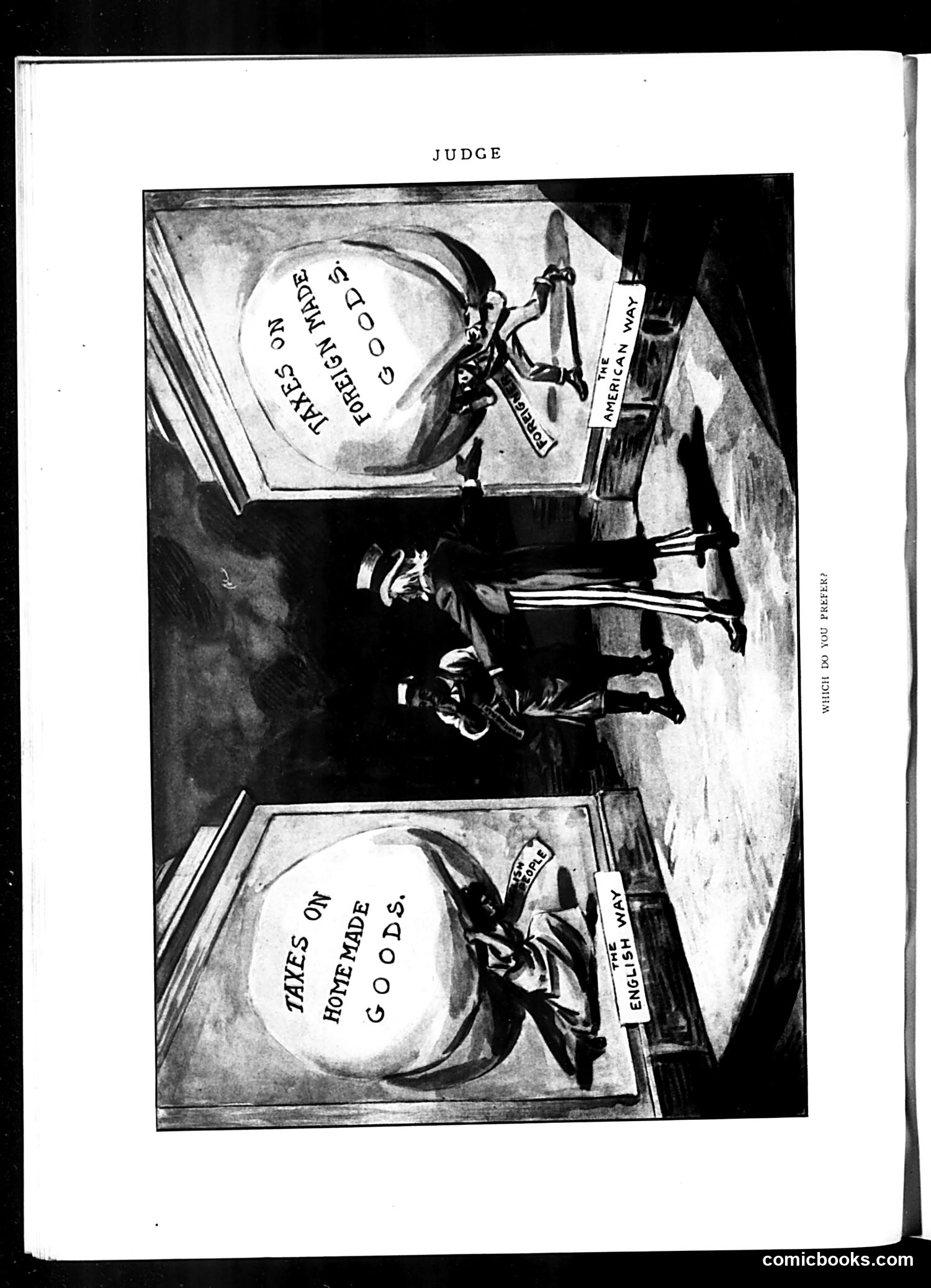
This page contains two vertical panels labeled "JUDGE," presenting a satirical commentary on American jurisprudence. The top panel shows a figure examining scales labeled "THERE IS NO SUCH THING AS GOOD" alongside "AMERICAN WAY," suggesting critique of judicial standards. The bottom panel depicts another figure with scales reading "HATES ON HOMEMADE GOODS" and "THE ENGLISH WAY," likely contrasting American and British legal or commercial approaches. The cartoons appear to satirize judicial decision-making and trade policy, possibly from the protectionist debate era. The crude OCR makes precise interpretation difficult, but the scales imagery indicates commentary on balanced (or imbalanced) justice and competing economic philosophies between nations.
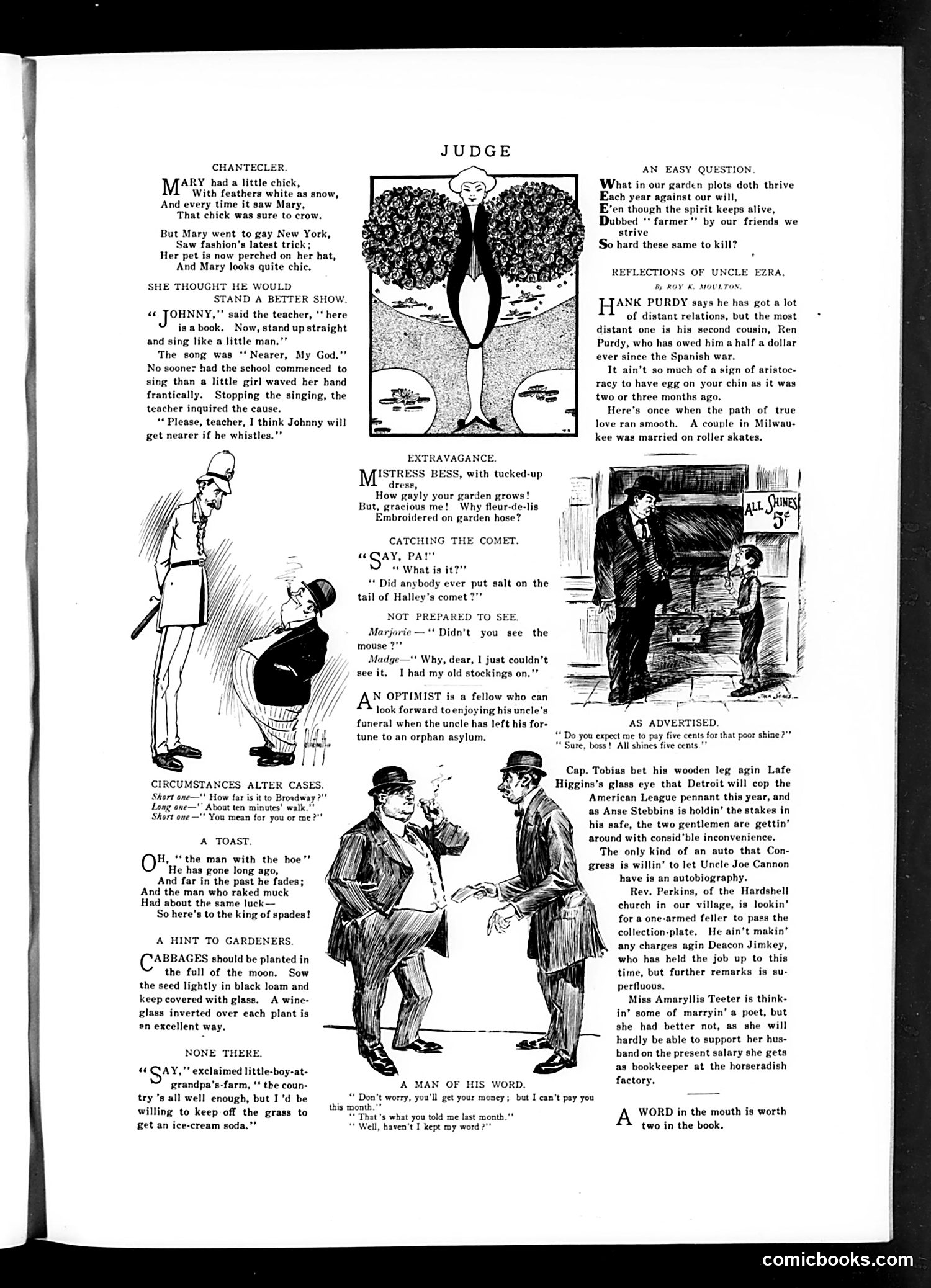
This page from *Judge* magazine contains various short humor pieces and cartoons reflecting early 20th-century American satirical sensibilities. **Key content includes:** - **"Chantecler"**: A pun on Rostand's famous play, mocking New York fashion by noting a woman now wears her pet chick as a hat ornament instead of keeping it as livestock. - **Teacher/Johnny joke**: Satirizes sentimental religiosity—when a boy sings "Nearer, My God" (a hymn), a girl suggests he whistle instead to actually get closer to heaven. - **Various social satire**: Jokes about gardening advice, height differences affecting Broadway distance, and working-class economic struggles (the shoe-shine boy charging five cents). - **"Uncle Ezra" column**: Rural folksy commentary on class pretension, distant relatives who don't repay debts, and small-town gossip. - **Political reference**: "Uncle Joe Cannon" (Speaker of the House) appears as a joke about Congressional autobiography obsession. The humor targets vanity, pretension, rural simplicity contrasted with urban sophistication, and economic hardship—typical *Judge* magazine fare for educated readers.
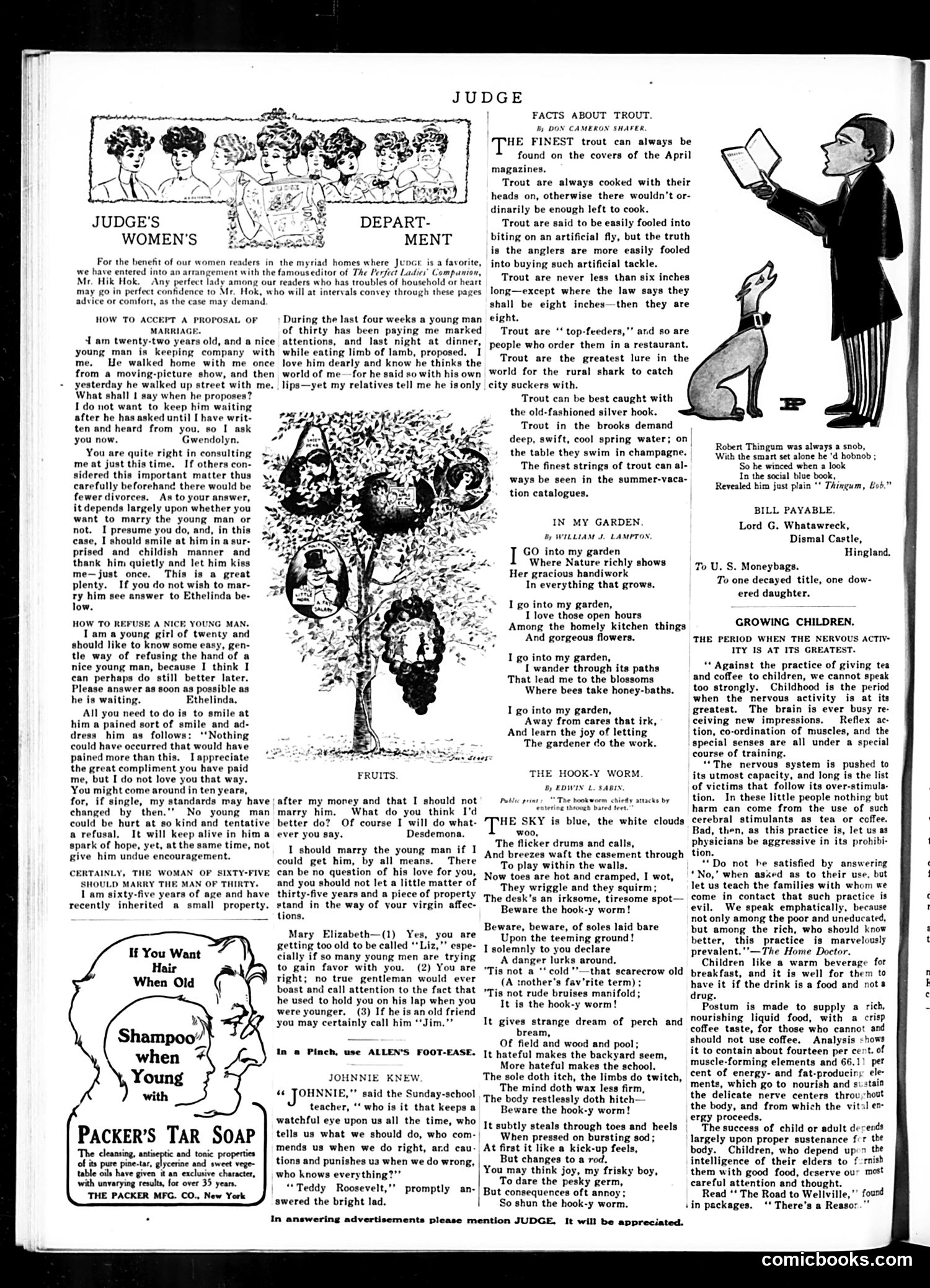
This page from *Judge* magazine contains satirical advice columns and advertisements aimed at female readers. The main satirical content is **"Judge's Women's Department,"** which parodies advice columns through absurdly patronizing guidance on marriage. The humor targets both women seeking romantic advice and the condescending male "experts" offering it. Key satirical scenarios: 1. **"How to Accept a Proposal"**: Mocks women's passivity by instructing them to smile "surprised and childish" and permit exactly one kiss—suggesting women have no agency beyond performing submission. 2. **"How to Refuse a Nice Young Man"**: Ridicules women who reject suitors while keeping them hopeful, advising vague encouragement to return "in ten years" if she remains single—satirizing both female indecision and the notion that women's value diminishes with age. 3. **The 65-year-old widow scenario**: Absurdly endorses a marriage between a 65-year-old woman and a 30-year-old man, mocking dismissive relatives' concerns about fortune-hunting while treating the age gap as irrelevant. The overall satire targets the era's patronizing approach to women's decision-making and the ridiculousness of prescriptive advice columns.
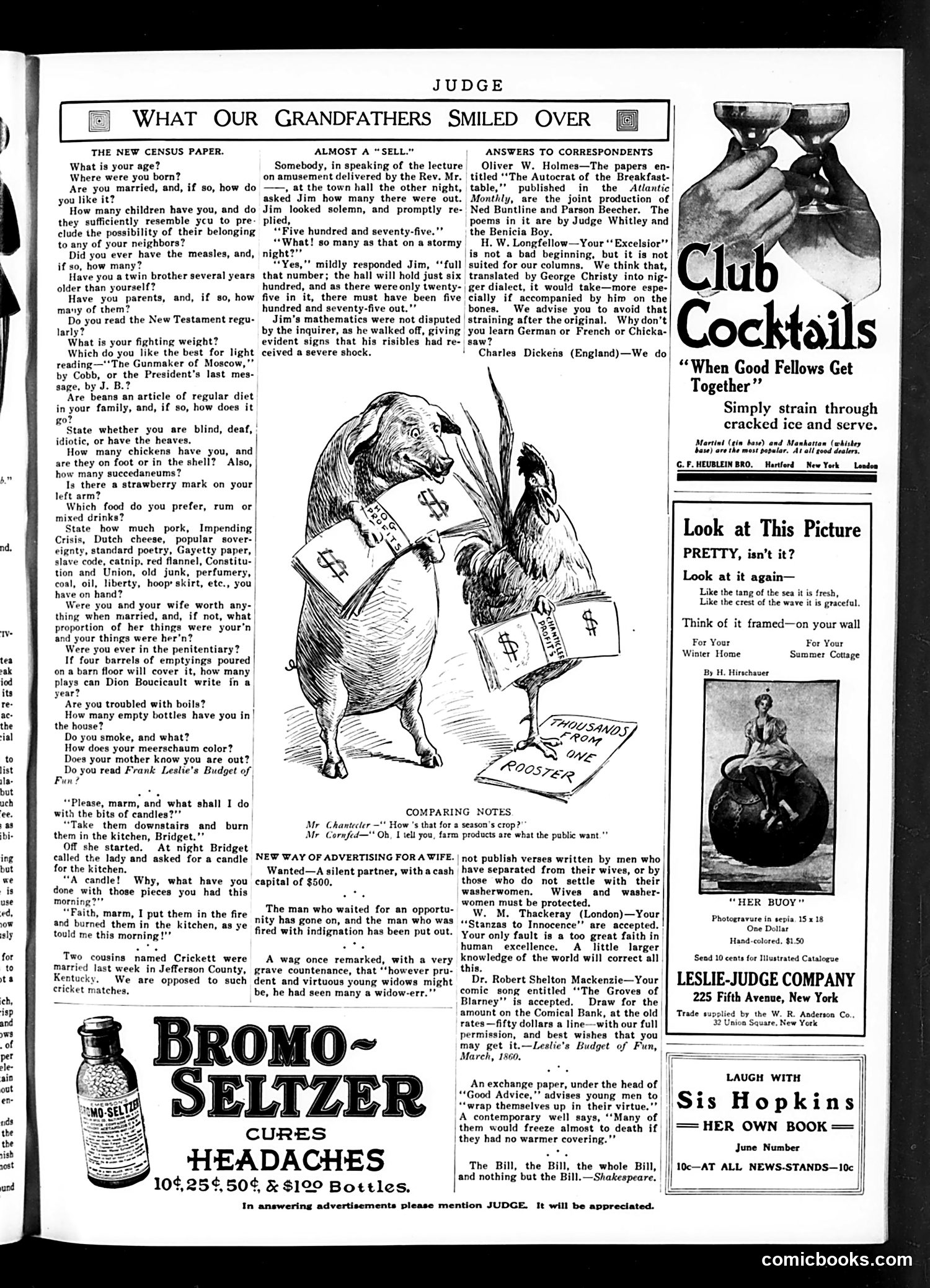
This page satirizes the absurdity of the U.S. Census questionnaire through mock interview questions. The humor relies on deliberately ridiculous, non-sensical inquiries—mixing legitimate demographic questions (age, birthplace, marital status) with absurd ones (number of times you had measles, whether your children actually belong to you, whether you're "idiotic"). The cartoon's point: Census officials were asking invasive, illogical, or impossibly detailed questions that went far beyond necessary population counting. The satire mocks both bureaucratic overreach and the questionnaire's apparent lack of coherent purpose. The anecdote about Jim and the lecture attendance adds another layer: Jim uses absurdist logic ("575 people were out" = 600 capacity minus 25 present) to mock similarly flawed reasoning in official forms. This reflects 19th-century skepticism toward government data-collection and intrusive questioning of citizens' private affairs.
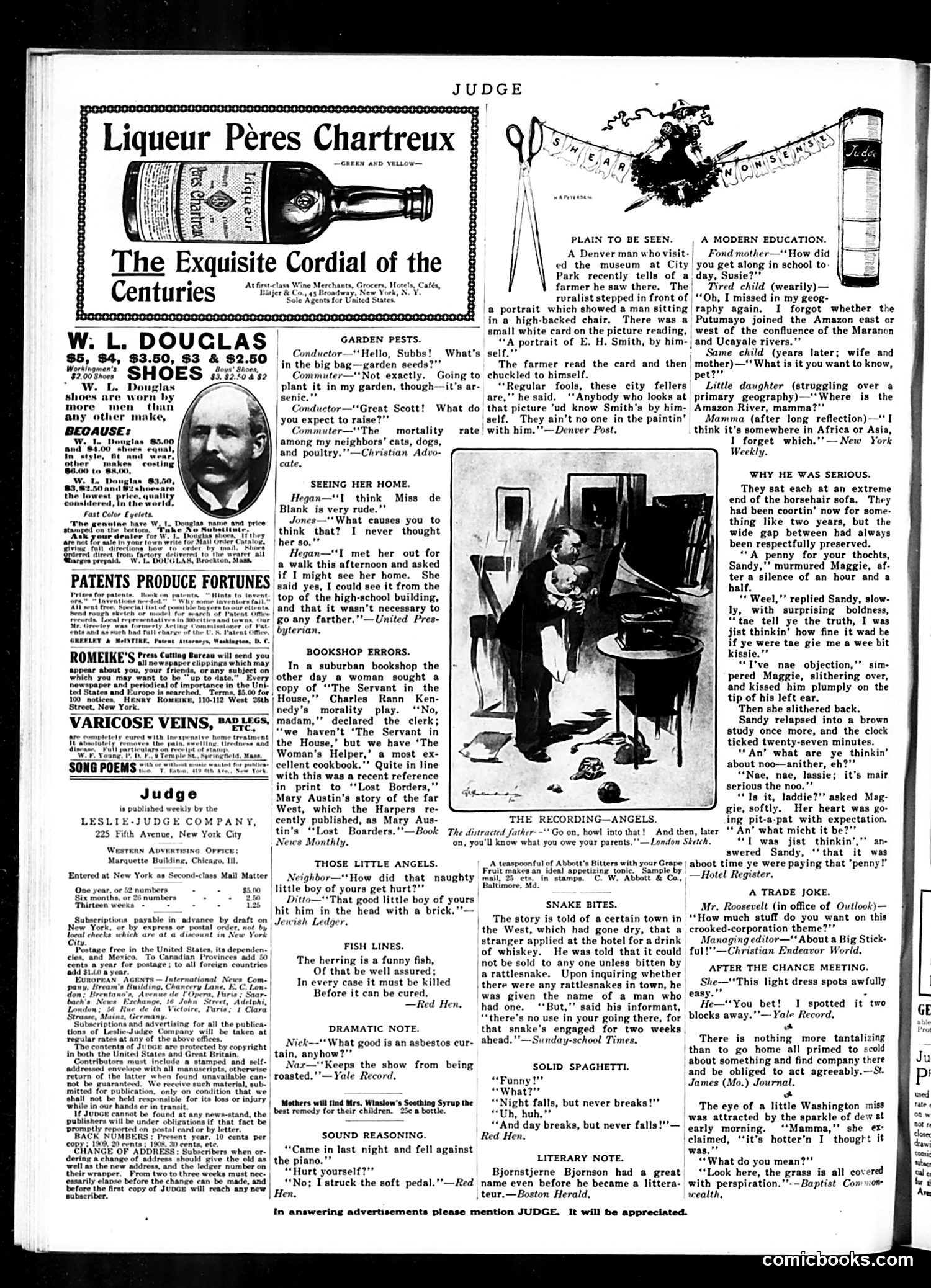
This page from Judge magazine contains mostly **advertisements and brief humorous anecdotes** rather than political cartoons. The main content includes: **Advertisements:** W.L. Douglas shoes dominate the left side, alongside patent medicine ads (Romeike's, varicose vein treatments). **Humor Sections:** Small jokes and quips scattered throughout: - "Garden Pests" plays on a conductor misunderstanding what seeds a commuter is planting (poison for neighborhood pets) - "Seeing Her Home" uses the double meaning of "see her home" (accompany/observe the house) - "Bookshop Errors" satirizes clerks' incompetence, mixing up book titles - "Fish Lines" and "Dramatic Note" are light puns **Social Commentary:** The anecdotes gently mock working-class confusion, suburban rudeness, and clerical incompetence—typical Judge fare for light satire aimed at educated readers. The page lacks the sharp political edge Judge was known for; it's primarily a vessel for small-space advertising and filler humor typical of early 20th-century magazines.
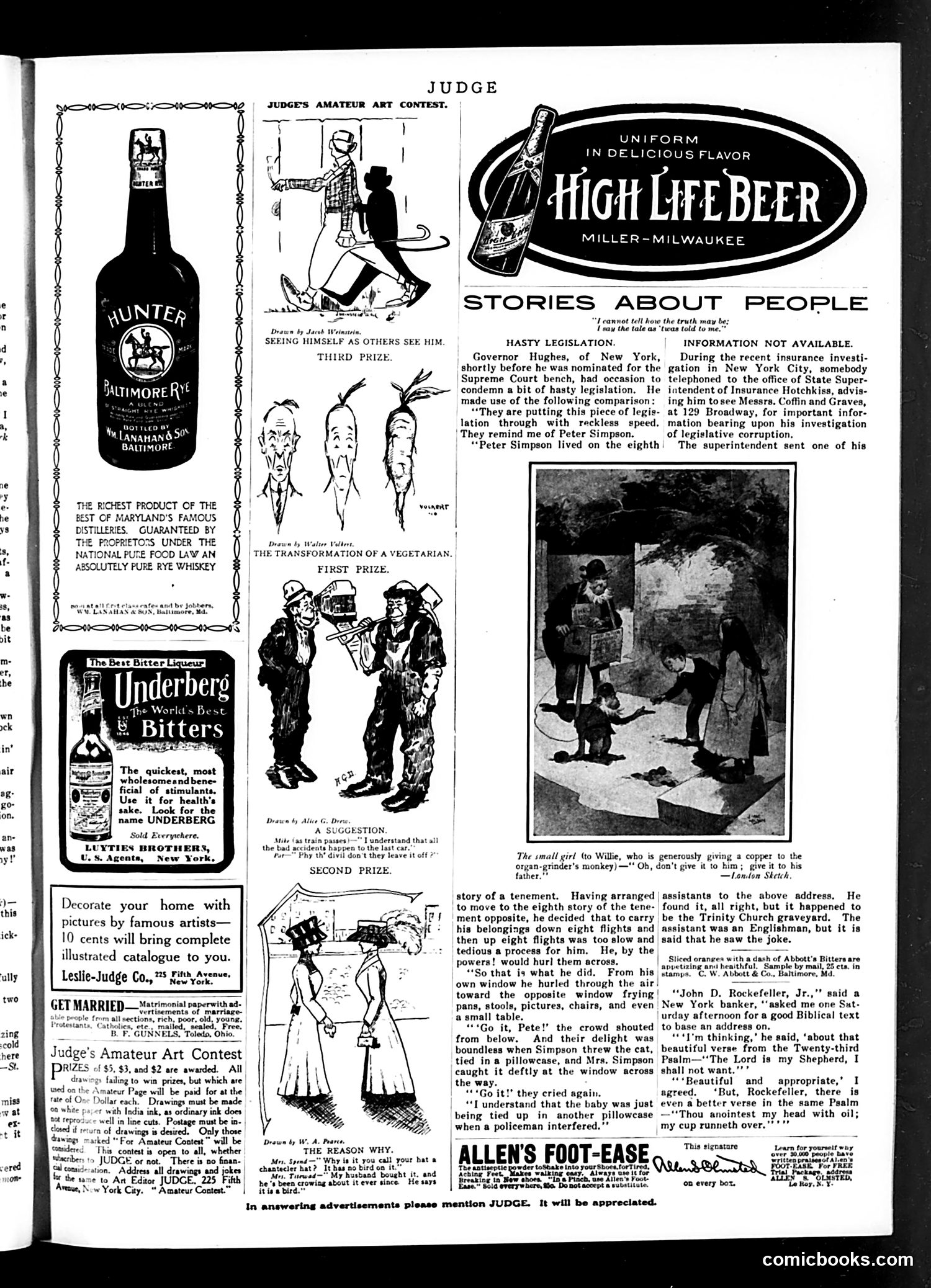
This page from **Judge** (a satirical magazine) contains multiple cartoons and advertisements satirizing American life circa early 1900s. ## Main Cartoons: **"Judge's Amateur Art Contest"** features three prize-winning submissions: - **Third Prize**: Caricatures showing contrast between self-perception and others' views—a social satire on vanity - **First Prize**: "The Transformation of a Vegetarian" mocks a tenement dweller moving apartments. The joke: Peter Simpson absurdly throws his belongings (and his wife, tied in a pillowcase) from one building window to another across the street. His neighbors cheer until a policeman stops him. It satirizes both immigrant tenement life and immigrant resourcefulness taken to ridiculous extremes. - **Second Prize**: Shows people viewing a bird-less picture, with a wife's joke about her husband "crowing" about it ## Content: The page includes articles about political figures (Governor Hughes) and insurance corruption investigations in New York. Advertisements for alcohol (Hunter whiskey, High Life beer, Underberg bitters) dominate the margins—typical of Judge's era.
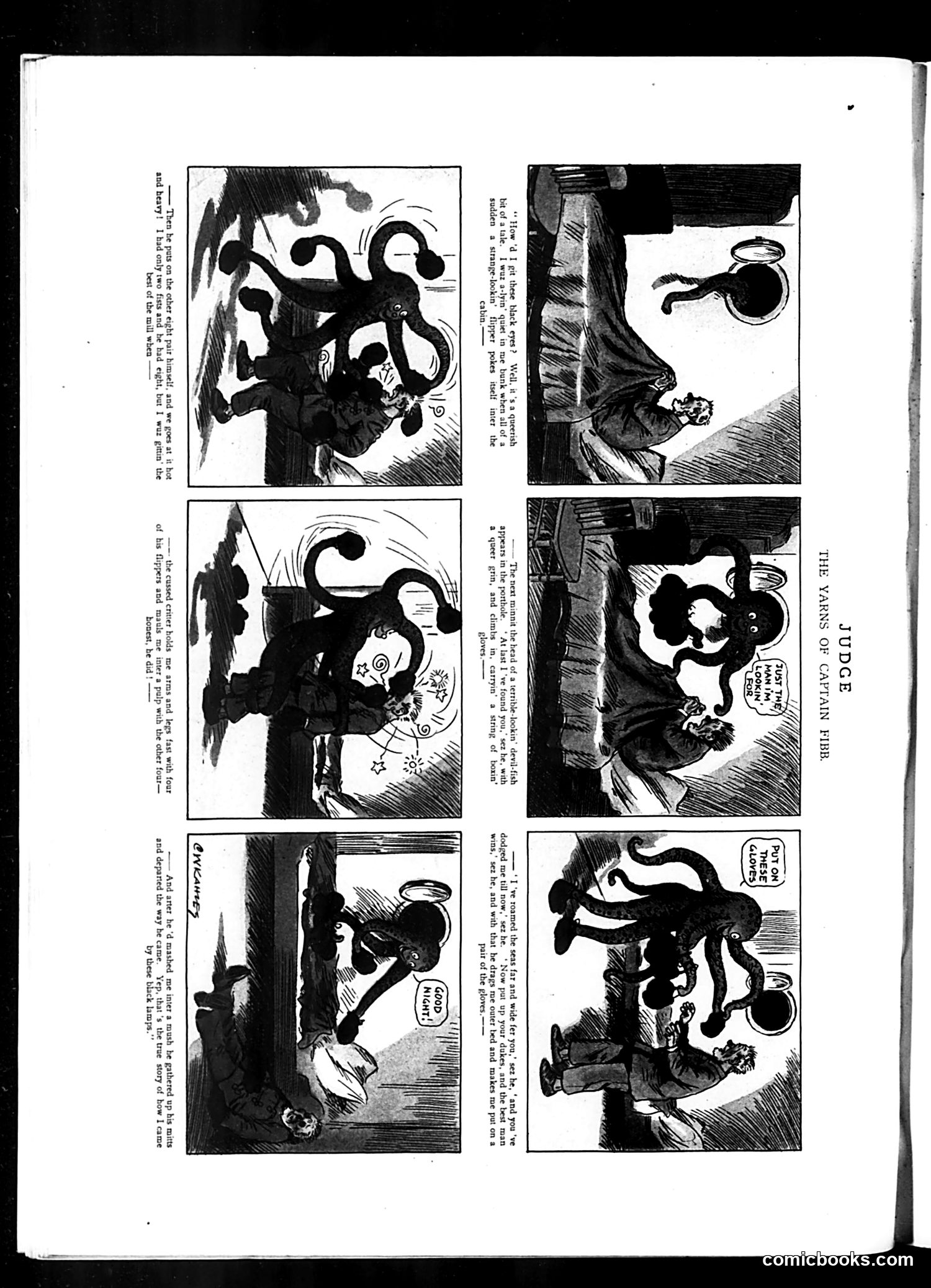
This appears to be a humorous tall tale from Judge magazine's "Captain Fibb" series. The comic strip illustrates an absurd fight scene told in sailor dialect. The joke centers on an encounter with a fantastical opponent who possesses multiple pairs of arms—depicted in the illustrations as an octopus-like creature with eight writhing tentacles functioning as boxing "mitts" or fists. The humor derives from the impossible mismatch: Captain Fibb has only two fists while his opponent has eight, resulting in complete defeat. The sailor's exaggerated explanation for his black eyes ("lamps") is that he was bested by this supernatural or mythological creature. This represents typical Judge magazine fare—combining crude comic illustrations with vernacular sailor speech for comedic effect, mocking both tall-tale traditions and the boastful stories sailors were stereotypically known to tell.