
A complete issue · 16 pages · 1910
Judge — May 7, 1910
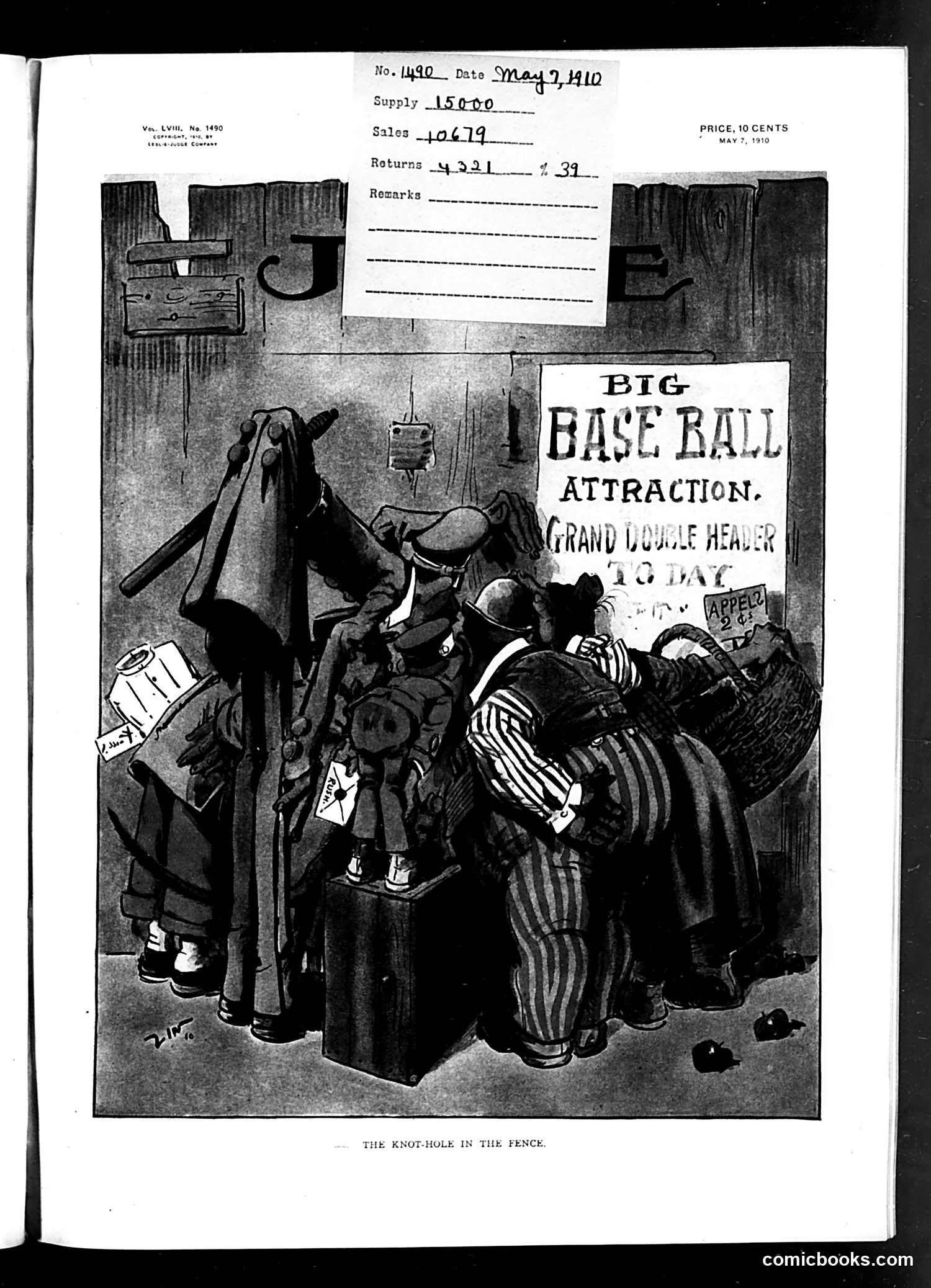
This cartoon satirizes the baseball craze of 1910, mocking boys who sneak peeks at games through gaps in ballpark fences rather than paying admission. The title refers to the common practice of children exploiting structural weaknesses to watch matches for free. The illustration shows a group of boys clustered around a large knothole, their heads positioned to catch glimpses of the action beyond. The "Big Baseball Attraction" sign and "Grand Double Header" text reference the popular sporting events drawing crowds. The satire targets both the resourcefulness of poor youth excluded by ticket prices and, implicitly, the baseball establishment's inability to prevent gate-crashing. It's a lighthearted commentary on economic class and access to entertainment during baseball's explosive early popularity.
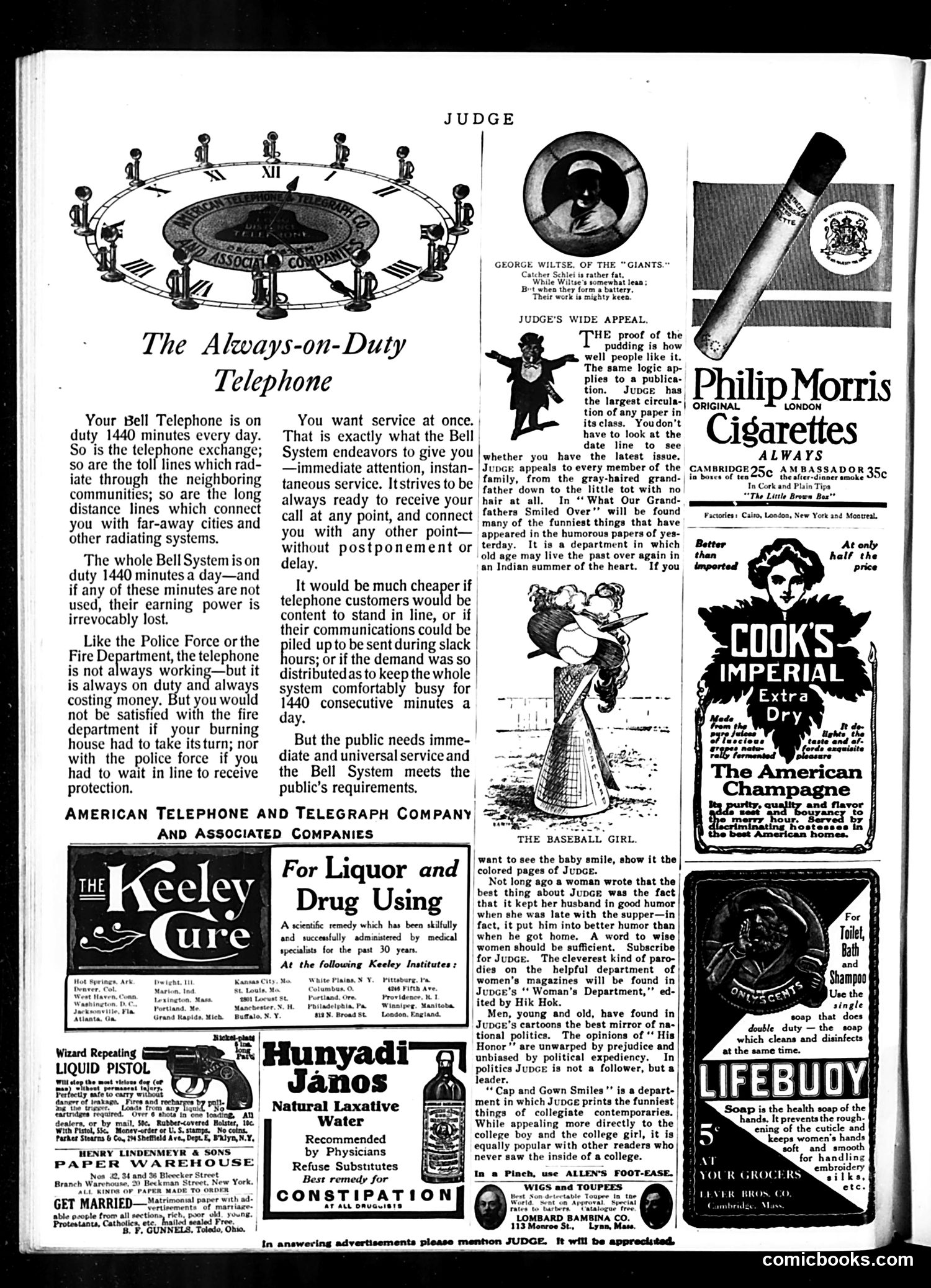
This page is primarily **advertisements** with minimal editorial content. The main cartoon appears to be "The Baseball Girl," depicting a woman in period dress. The one identifiable reference is to **George Wilste of the Giants** (a baseball player), shown as "Judge" in a circular portrait. The accompanying text suggests the column uses humor and commentary about public figures across various domains. The advertisements—for cigarettes, soap, liquor remedies, and other products—are typical of early 20th-century magazine content. The overall page reflects Judge's format: mixing satirical commentary on contemporary figures (sports, possibly politics) with commercial content, though specific political satire is unclear without fuller context about the publication date and events referenced.
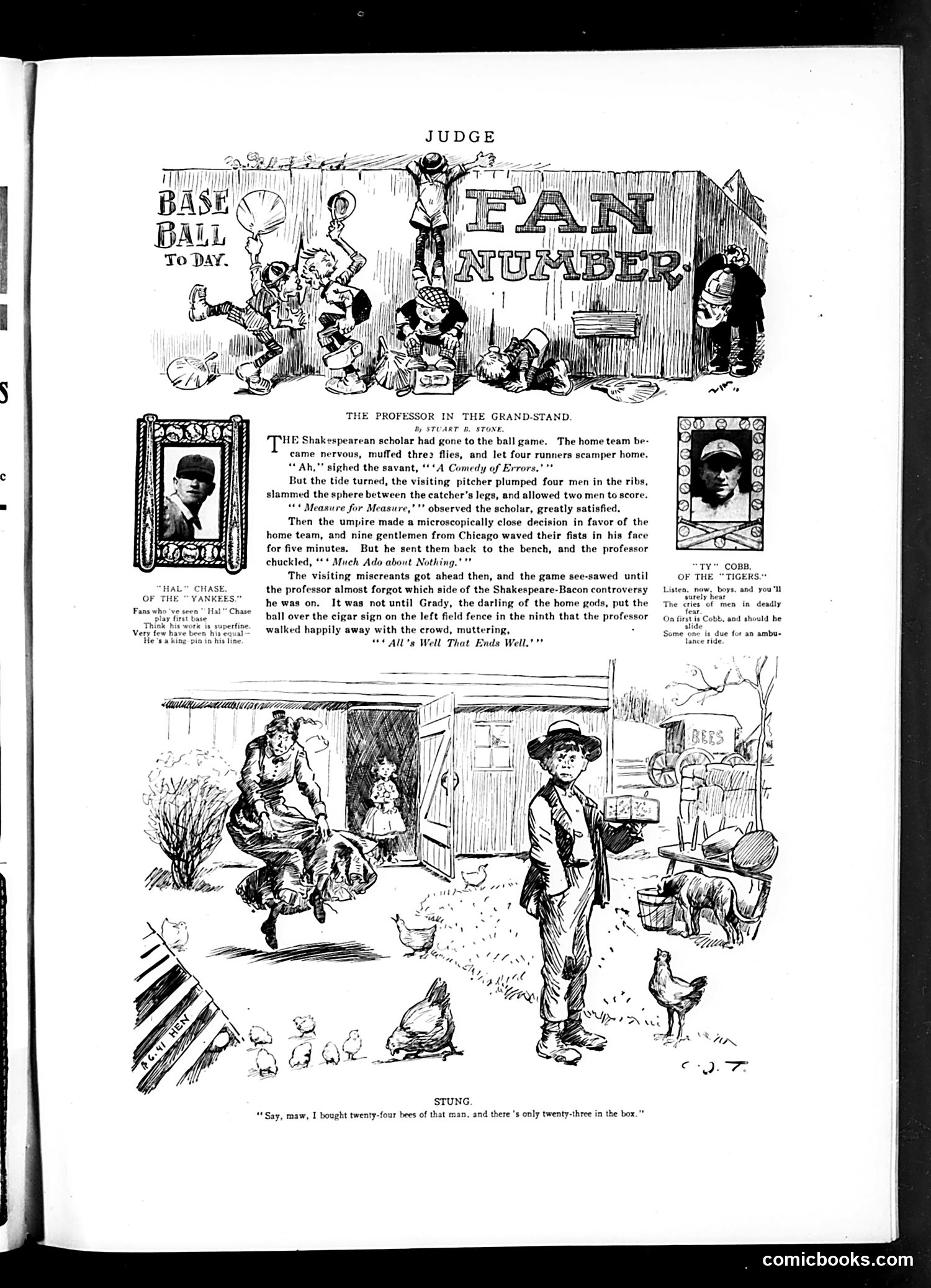
This page contains three distinct pieces: **Top Section ("Base Ball To Day")**: A satirical cartoon about a baseball game where a Shakespearean scholar attends and becomes so focused on Shakespeare-Bacon authorship controversy that he loses track of the actual game. The humor mocks pedantic academics who import literary debates into everyday activities—here, a professor nearly misses the final score while arguing with spectators about which poet wrote Shakespeare's plays. This reflects genuine early-20th-century scholarly obsession with the "Shakespeare-Bacon Question." **Center**: Player portrait cards, likely featuring contemporary baseball figures. **Bottom ("Stung")**: A domestic cartoon about someone who bought 24 beers from a man claiming only 23 remained—a simple deception joke about dishonest dealing. The page primarily uses baseball as a vehicle for gentle social satire about academics and petty fraud.
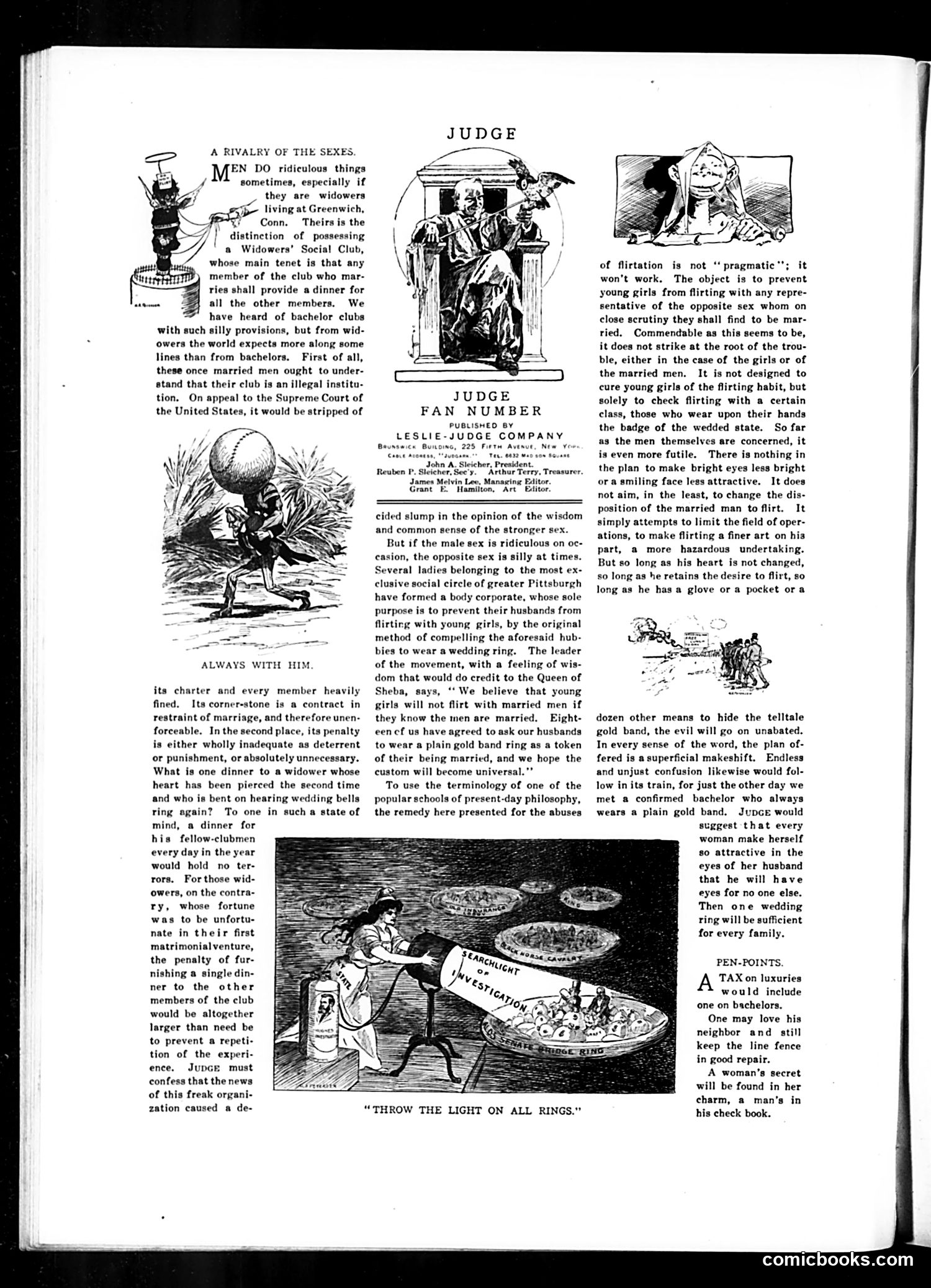
This page satirizes married men's flirtation habits. The main article criticizes men who flirt with young women despite being married, arguing the practice is widespread and problematic. The central cartoon "Throw the Light on All Rings" depicts a woman using a searchlight to examine rings on men's hands—literally exposing married men attempting to hide their marital status through deception (removing or concealing their wedding rings). The satire suggests this is a common scheme. The piece proposes a solution: a women's organization requiring husbands to visibly wear plain gold wedding bands to prevent flirtation. The humor targets both wayward married men and the social problem of marital infidelity, presenting the ring-wearing mandate as humorous but also addressing genuine social concern about male behavior during this era.
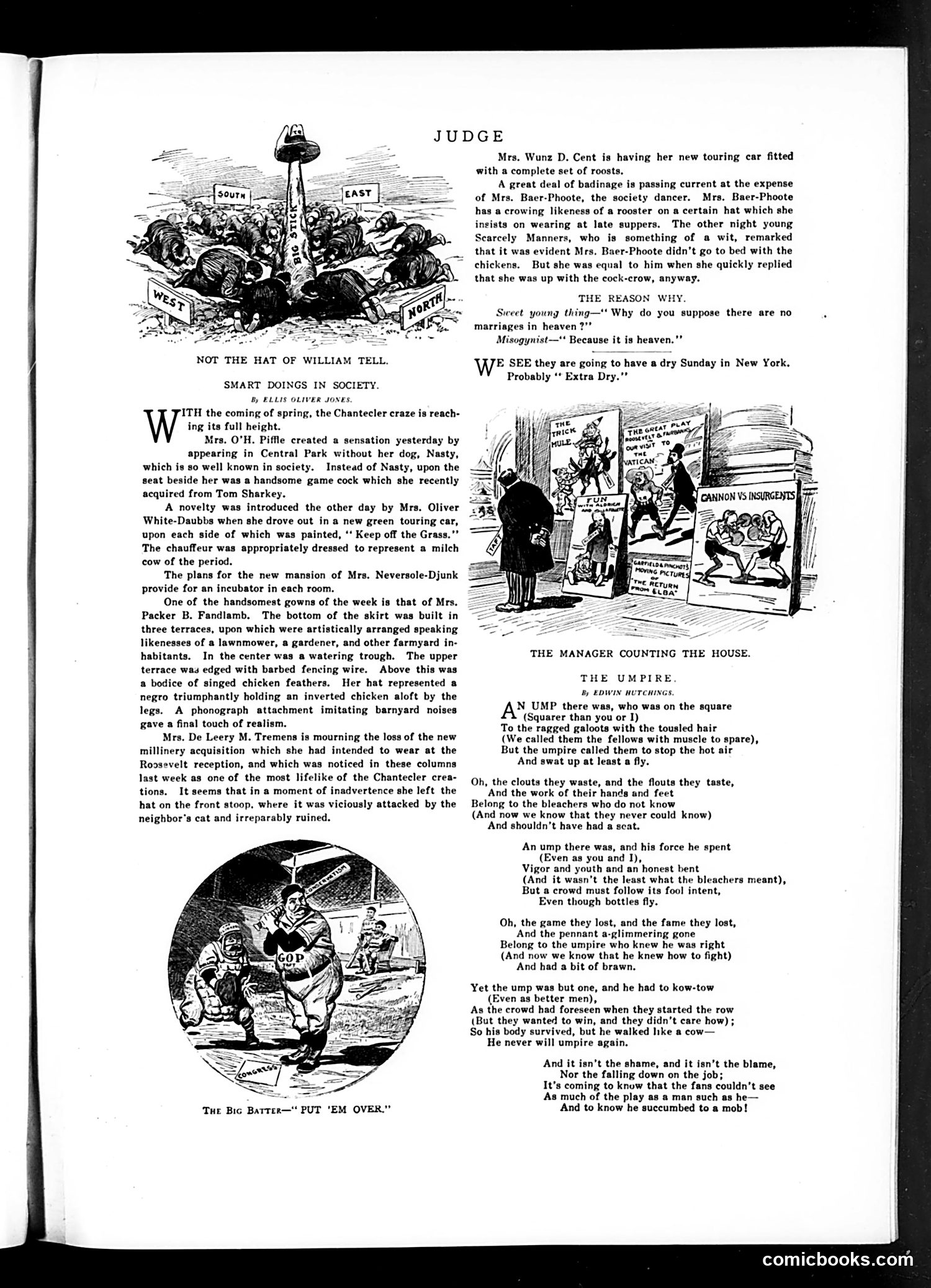
This page contains three distinct satirical pieces: **"Smart Doings in Society"** mocks upper-class absurdities: a woman causing a scandal by appearing in Central Park without her dog, and another novelty involving painted touring cars with "Keep off the Grass" messages. The satire targets frivolous society concerns. **"The Manager Counting the House"** (illustration) appears to satirize theatrical box office economics, though context is unclear. **"The Umpire"** is a poem mocking a baseball umpire whose unpopular decision lost a game. It suggests fans blamed him unfairly for the loss, satirizing how crowds scapegoat officials and mob mentality overrides fair judgment. The overall page reflects Judge's focus on lampooning American social pretension, sports culture, and public behavior circa early 20th century.
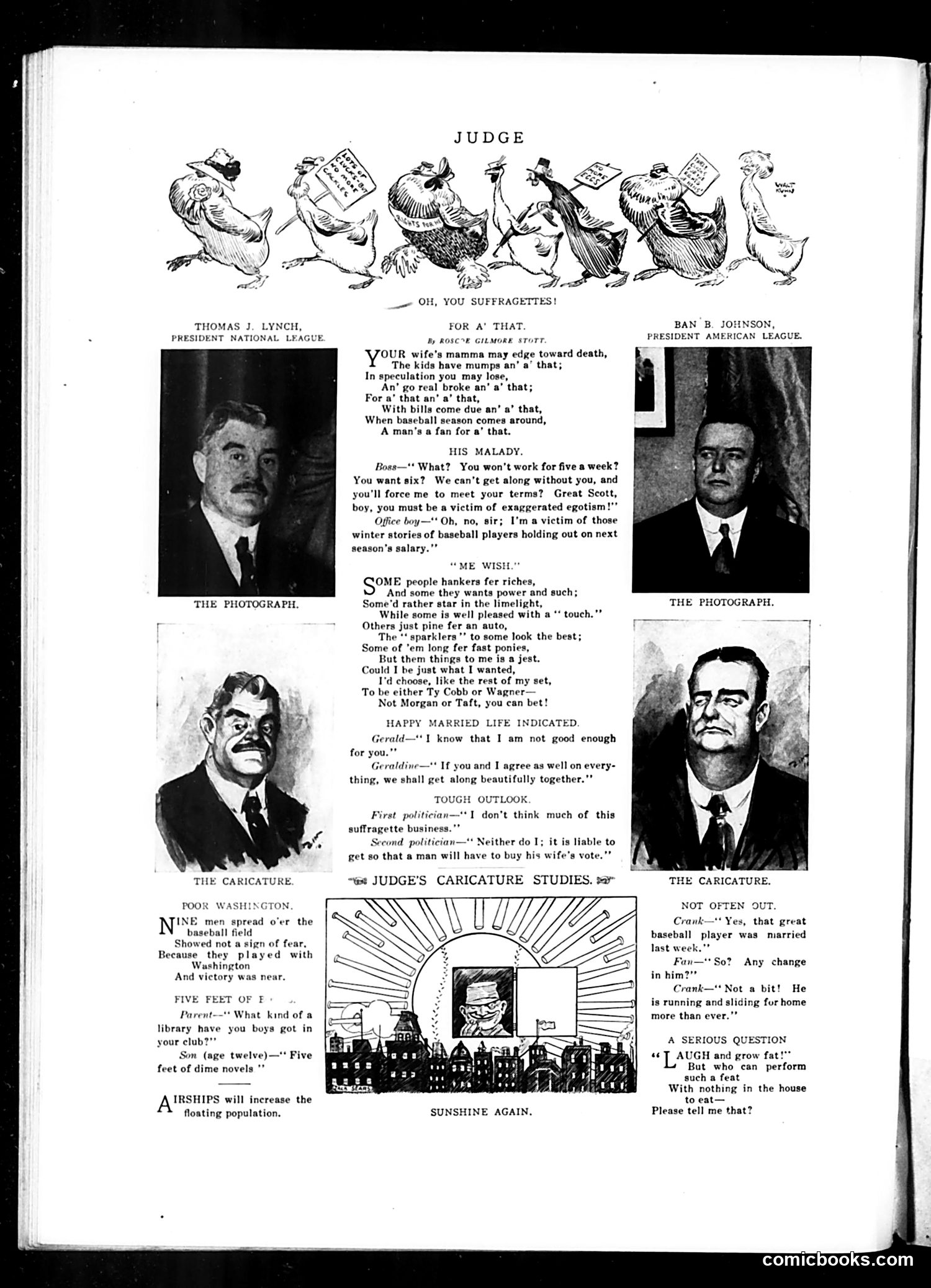
This page satirizes baseball culture and contemporary social issues circa 1910s. The top features caricatures of **Thomas J. Lynch** (National League president) and **Ban B. Johnson** (American League president)—the two men governing professional baseball. The central poem "For A' That" mocks men's obsession with baseball, suggesting fans will endure any personal hardship ("wife's mamma may edge toward death," financial ruin) so long as baseball season arrives. "His Malady" jokes that an office boy demands higher wages after reading winter stories about baseball players holding out for better contracts—he's caught "baseball fever." The suffragette reference appears minor—politicians joke that women's voting rights will force men to literally "buy his wife's vote." Other items mock: poor Washington baseball fans, office workers reading dime novels instead of working, and a married baseball player who remains obsessed with "sliding for home" despite matrimony. The satire assumes readers deeply invested in baseball and current labor disputes within the sport.
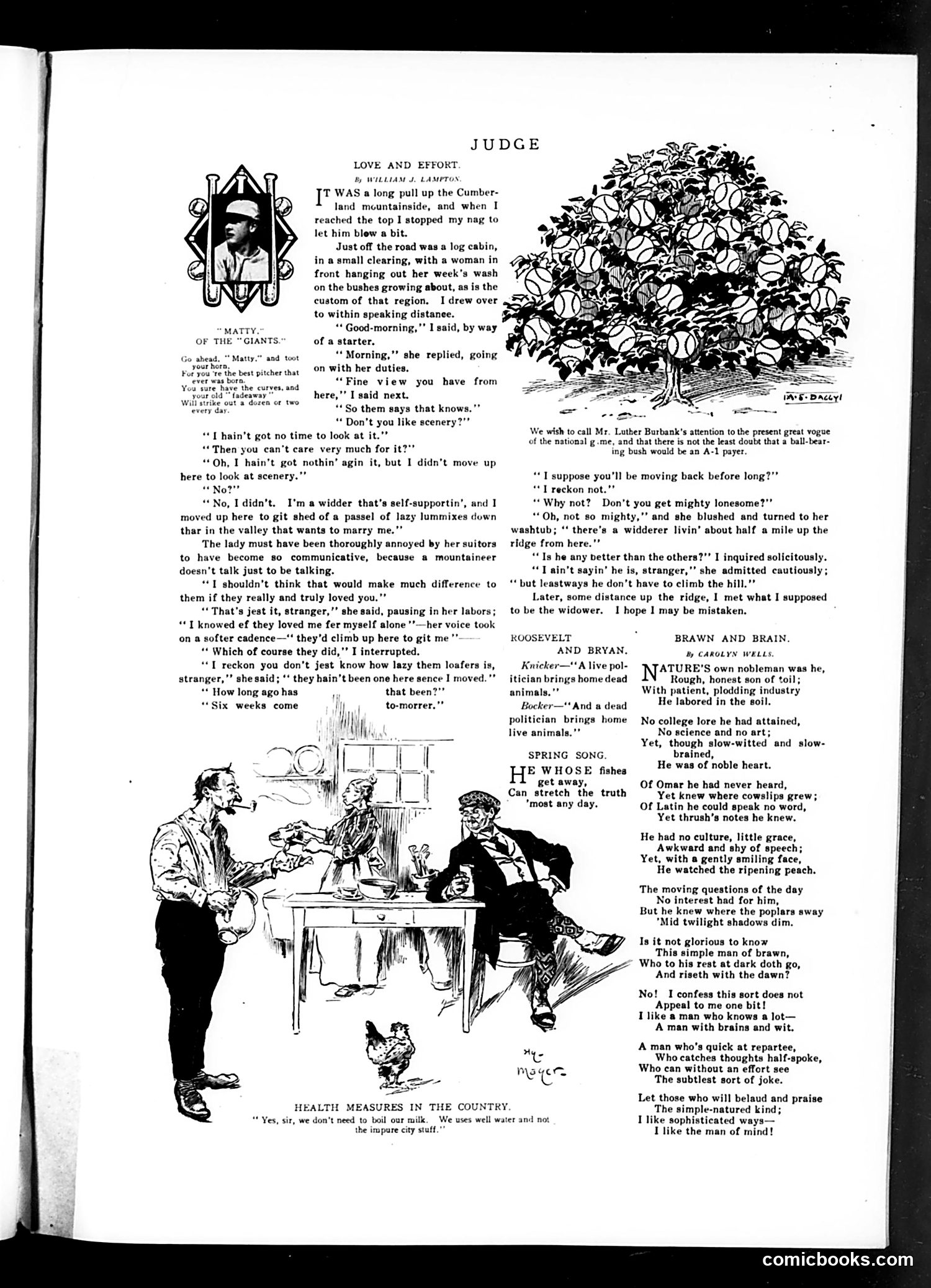
**"Love and Effort"** presents a humorous rural courtship story. A traveling narrator encounters a widow living in the Cumberland Mountains who moved there to escape suitors. She reveals a nearby widower hasn't had to "climb the hill" to court her—implying he's lazy, undercutting romantic notions about persistent love. **"Brawn and Brain"** compares two types of men—an uneducated farmer with natural wisdom versus educated urbanites. The poem celebrates the laborer's "noble heart" despite lacking classical education or cultural refinement. This appears to reference **Theodore Roosevelt and William Jennings Bryan**, political figures representing different American ideals: outdoor vigor versus intellectual sophistication. **"Health Measures"** mocks rural skepticism about sanitation, with a farmer boasting he doesn't need to boil milk, preferring "well water" to "city stuff." The cartoons satirize rural American attitudes—romantic pretense, anti-intellectualism, and misguided health practices—while also romanticizing rustic simplicity. The tone is affectionately mocking rather than contemptuous.
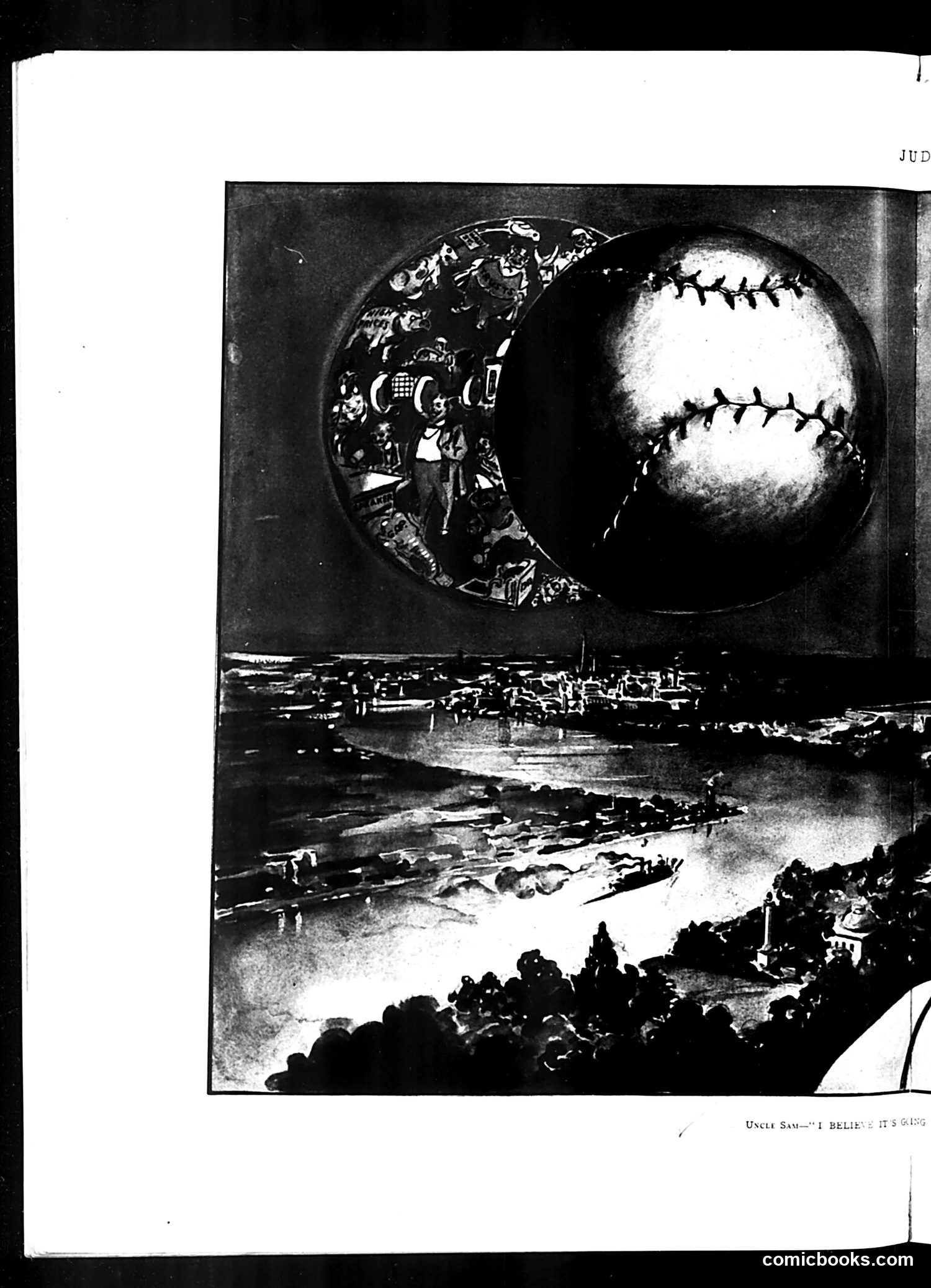
This appears to be a satirical illustration from *Judge* magazine showing a surreal, composite image: a large baseball dominates the upper right, while the left side depicts an intricate scene of urban or industrial life viewed through what resembles a circular lens or portal. Below stretches a landscape with crowds of people. The exact political or social satire is unclear without additional caption text or context visible on this page. The juxtaposition of the baseball (America's national pastime) with the complex human activity visible through the circular window suggests commentary on how Americans view their society—perhaps critiquing selective perception, nationalism, or priorities. However, without readable text identifying specific figures or events, the precise point remains uncertain.
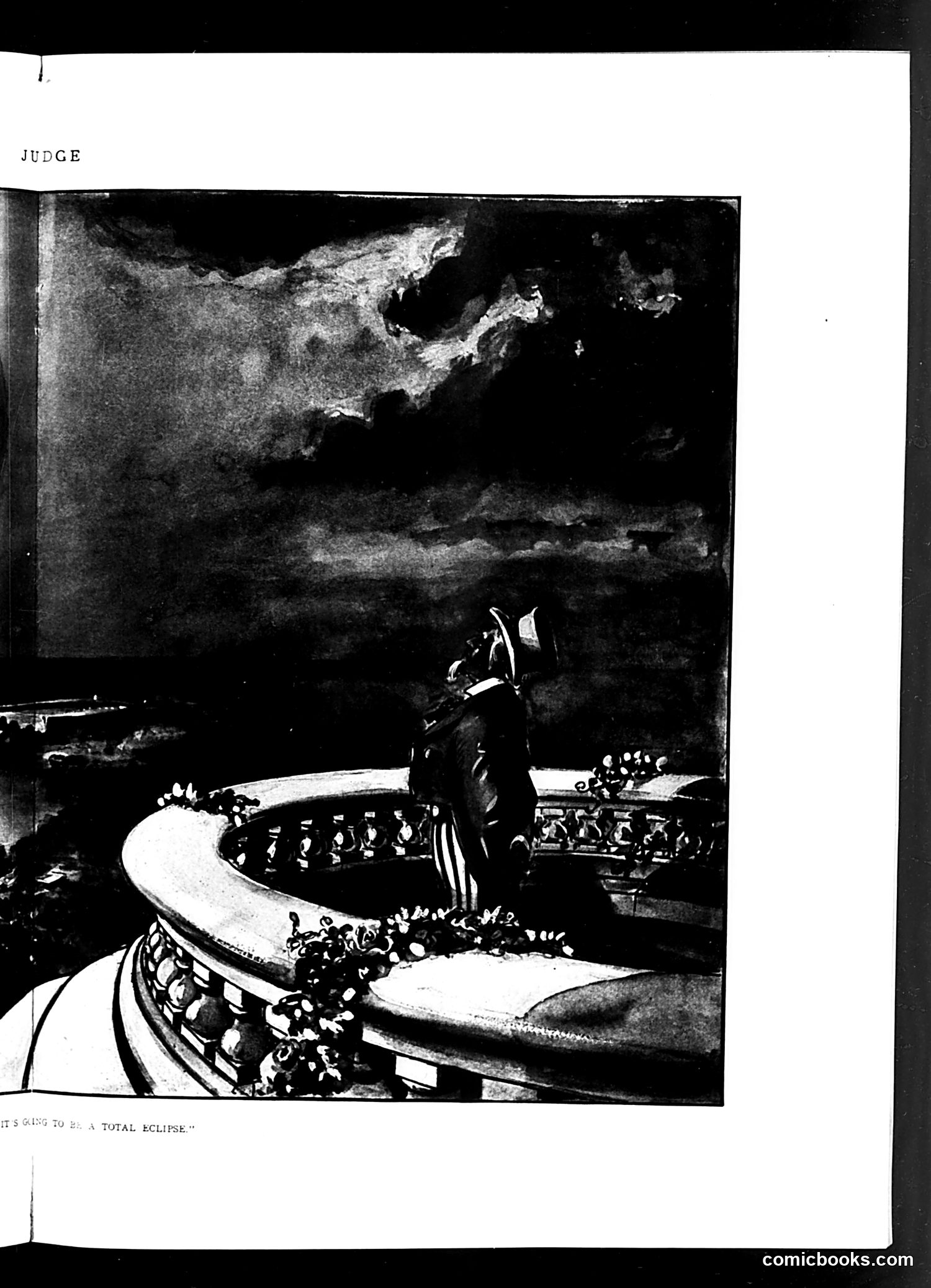
This page from *Judge* magazine shows a theatrical scene depicting "A Total Eclipse." The image portrays an ornate stage set with classical architectural elements (columns with decorative garlands) and a dramatic sky backdrop showing the moon obscuring the sun during an eclipse. A figure in period costume stands center-stage, apparently representing an actor or performer. The satirical point likely comments on theatrical spectacle or dramatic presentation—using the eclipse metaphor to suggest something momentous or awe-inspiring being staged for public consumption. The "total eclipse" may reference a specific theatrical production, political event, or social phenomenon of the era that *Judge* deemed worthy of mockery through this dramatic visual metaphor. Without additional context or clearer OCR text, the specific target of satire remains unclear.
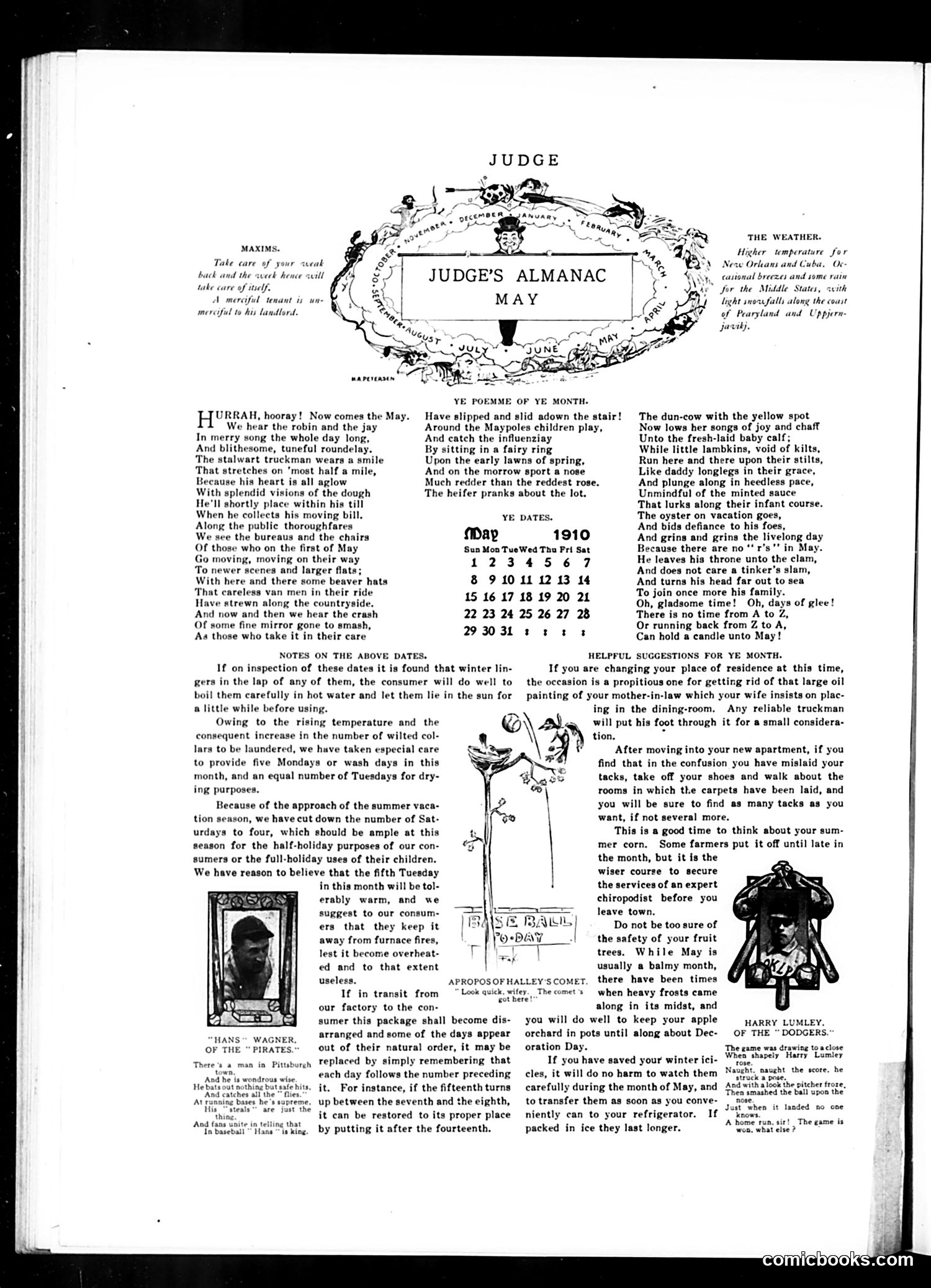
This is primarily a humorous almanac page for May 1910, not a political cartoon. The page combines: **Poetic Content**: A mock-serious "Poem of Ye Month" celebrating May through exaggerated rural imagery—robins, maypoles, cows, and heifer pranks—written in deliberately archaic language ("Ye"). **Practical Humor**: Notes on the calendar explaining joke "improvements" to May (five Mondays for laundry, fewer Saturdays due to summer vacation), presented as if the almanac itself was manufactured and could arrive damaged. **Seasonal Jokes**: References to moving day (May 1st was traditional), wilted collars needing laundering, oysters avoiding the "r"-less month (old foodie superstition), and Halley's Comet (which appeared in 1910). **Social Satire**: Brief maxims at top mock working-class life ("merciful tenant is unmerciful to his landlord"). The page reflects turn-of-the-century American humor—wordplay, puns, and gentle mockery of seasonal conventions rather than sharp political critique.
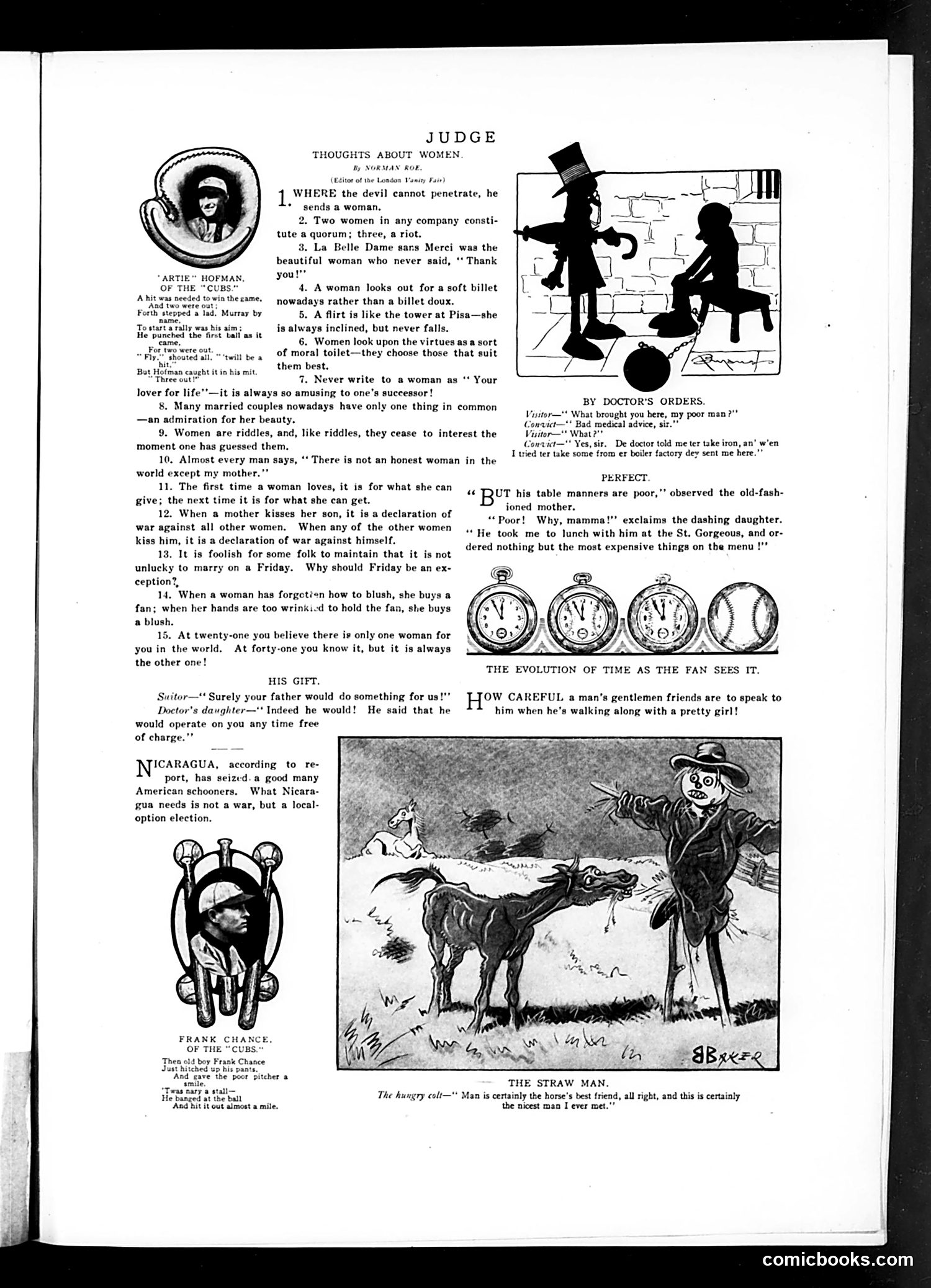
This page contains multiple satirical pieces typical of early 20th-century Judge magazine: **"Thoughts About Women"** presents 15 cynical aphorisms about female behavior, attributed to Norman Roe (editor of London's Vanity Fair). The humor relies on misogynistic stereotypes—women as vain, mercenary, and morally flexible. Example: "Women look upon the virtues as a sort of moral toilet—they choose those that suit them best." **Baseball references**: "Artie" Hofman and Frank Chance are depicted as Cubs players, mixing sports commentary with humor. **"The Straw Man"** cartoon shows a scarecrow controlling a donkey, with the punchline that this man is "the nicest man I ever met"—satirizing easily manipulated men or social hierarchy absurdities. **Other brief jokes** mock topics like Nicaragua's political instability, a convict's misunderstanding of medical advice ("take iron"), and observations about dating etiquette. The overall tone is lighthearted social commentary typical of Judge's satirical approach, blending sports, relationships, politics, and gender dynamics into brief, pointed jokes.
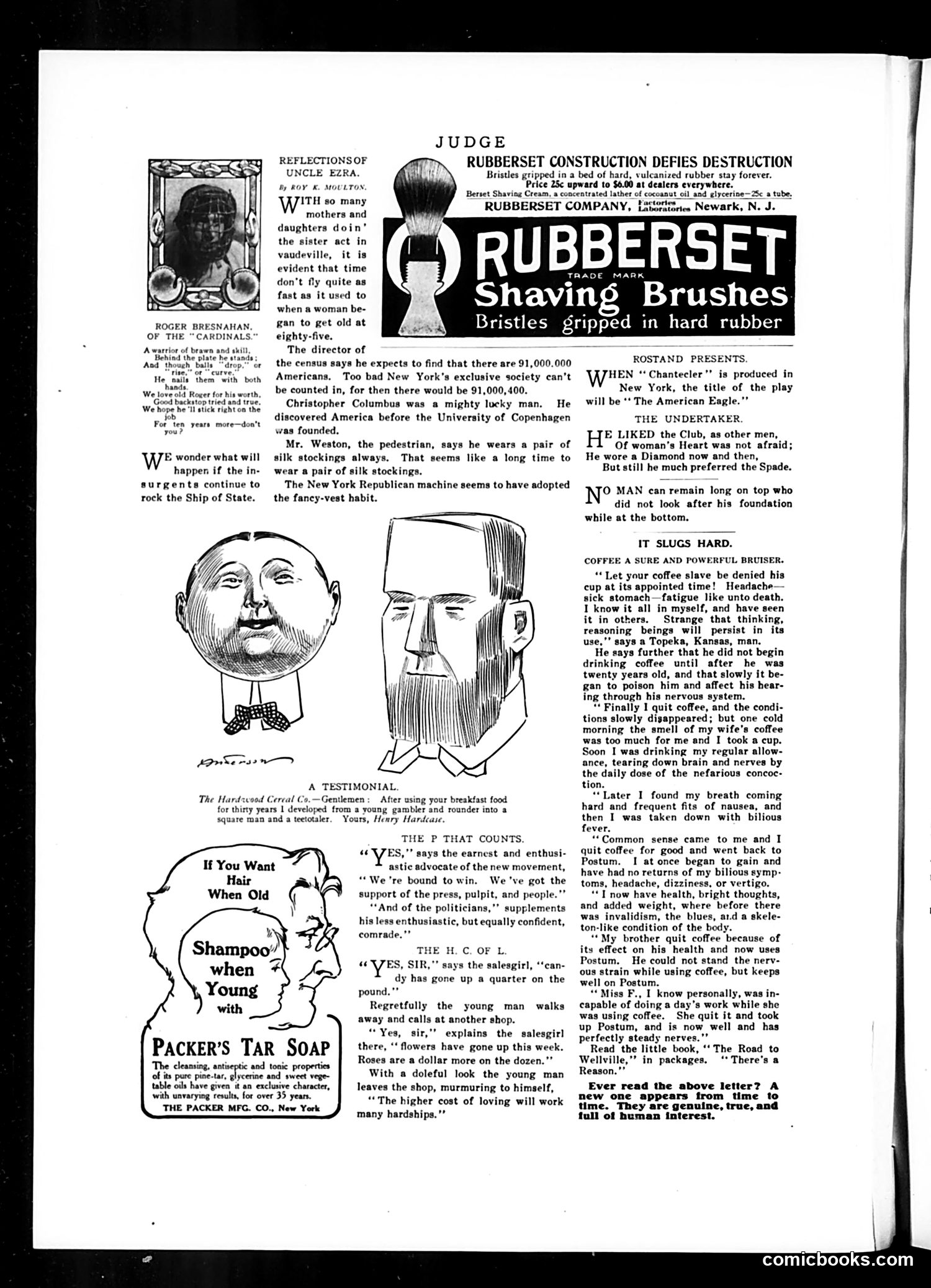
This page from *Judge* magazine contains satirical commentary and advertisements typical of early 20th-century American humor. **Main Content:** - "Reflections of Uncle Ezra" offers dry observations on contemporary life: mothers and daughters performing together in vaudeville, census projections, and the New York Republican Party's adoption of fancy vests. - A short satire titled "The H.C. of L." (presumably "High Cost of Living") mocks inflation through a young man's romantic troubles—flowers and candy prices have risen so much that courtship becomes financially burdensome. - Another piece jokes about political movements claiming support from "press, pulpit, and people" while politicians cynically join for self-interest. **Advertisements:** The page features prominent ads for Rubberset shaving brushes, Packer's Tar Soap, and product testimonials, alongside a reference to Rostand's play "Chantecler" being retitled "The American Eagle" for New York production. **Satirical Tone:** Throughout, the humor relies on observational wit about American society, commercialism, and the gap between idealistic rhetoric and cynical reality.
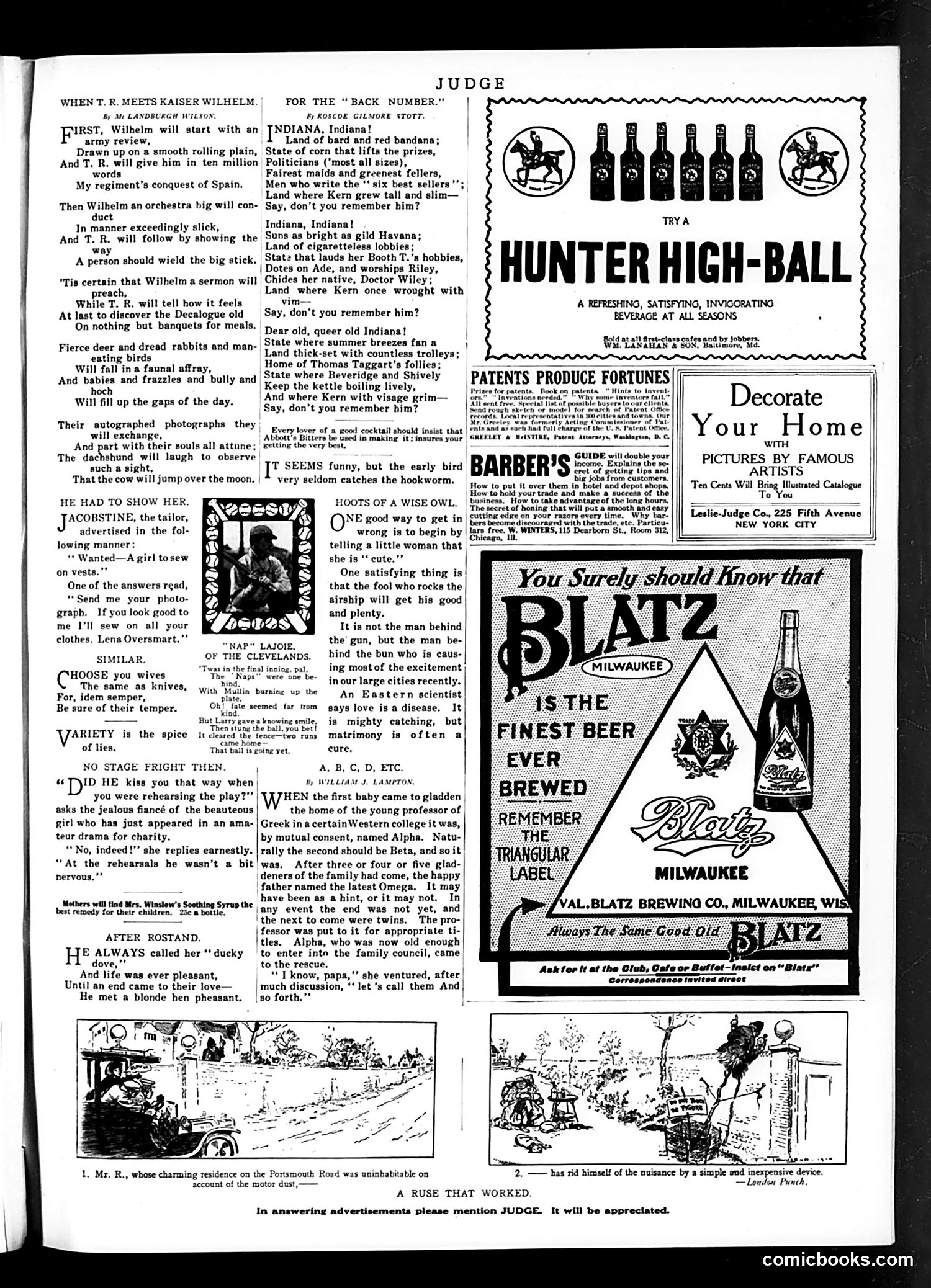
This satirical poem imagines a hypothetical encounter between President Theodore Roosevelt ("T.R.") and German Kaiser Wilhelm II. The joke relies on exaggerated character traits: **Roosevelt** is portrayed as bombastic and obsessed with self-promotion—he'll bore Wilhelm with endless stories about his role in the Spanish-American War (his "conquest of Spain") and his hunting exploits. **Kaiser Wilhelm** is depicted as vain and theatrical, conducting orchestras with "exceedingly slick" manner. The satire mocks Roosevelt's famous verbosity, his "bully" enthusiasm, and his tendency to dominate any situation. The absurd finale—with dachshunds laughing and cows jumping over the moon—suggests the ridiculous excess of such a meeting between two powerful egos. This reflects early-1900s American political humor that frequently lampooned Roosevelt's outsized personality and expansionist policies.
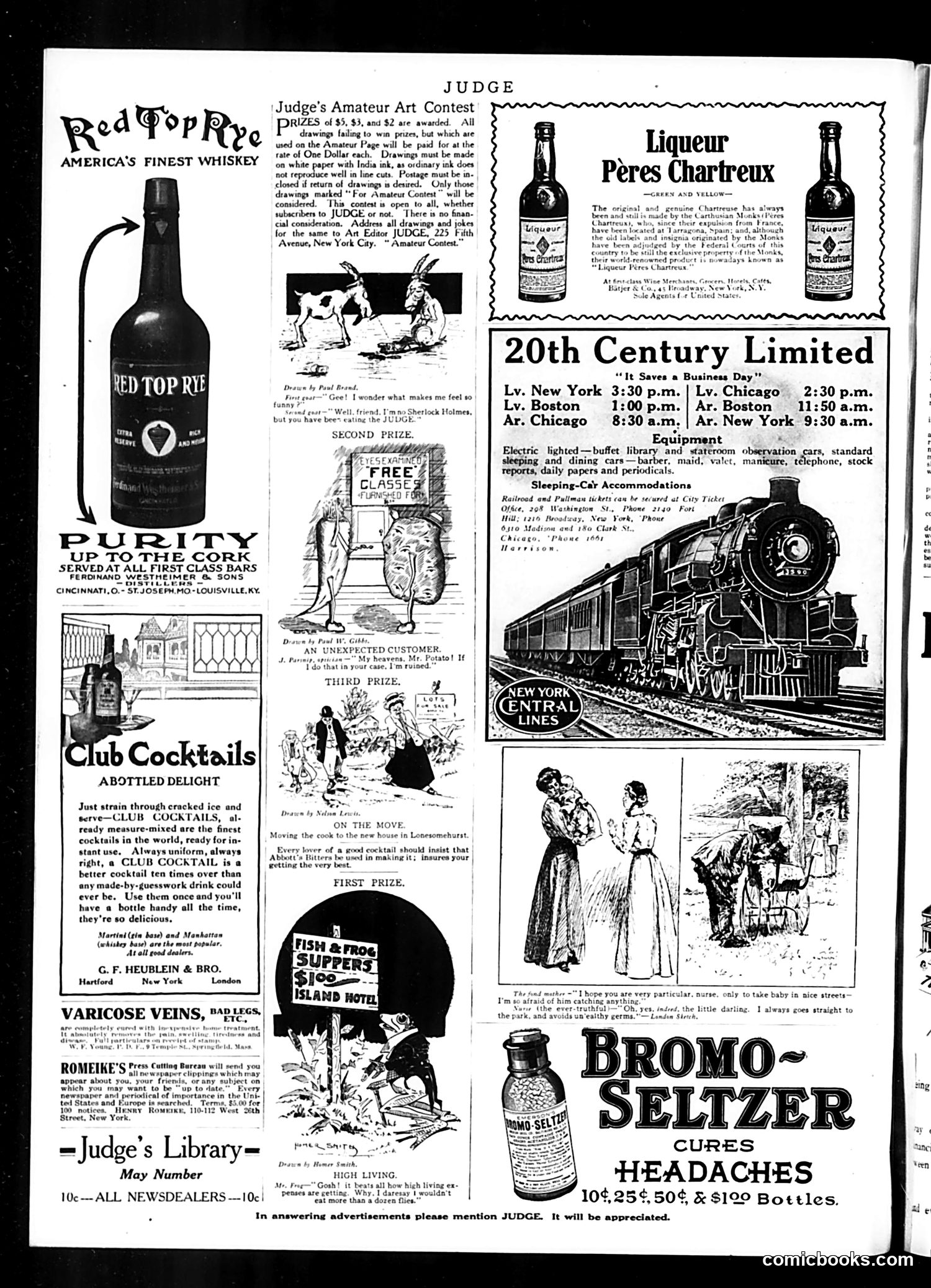
This is primarily an **advertising page** from Judge magazine's May issue, with a small amateur art contest component. The main content consists of ads for whiskey (Red Top Rye), premixed cocktails (Club Cocktails), Bromo-Seltzer, and the 20th Century Limited train service. The amateur art contest features three comic drawings with captions (scattered throughout). These are user-submitted humorous illustrations typical of the magazine's style: domestic/social humor about everyday situations—a person admiring their reflection, a woman calling someone to check on a baby, and a sketch about relocating household staff. The page reflects **1920s commercial culture**: prohibition-era whiskey advertising (still legal to advertise despite coming Prohibition), pre-mixed cocktails, hangover remedies (Bromo-Seltzer), and luxury rail travel as status symbols. The amateur contest itself showcases Judge's interactive relationship with readers and the era's widespread amateur cartooning culture. No political satire or caricature is evident on this page.
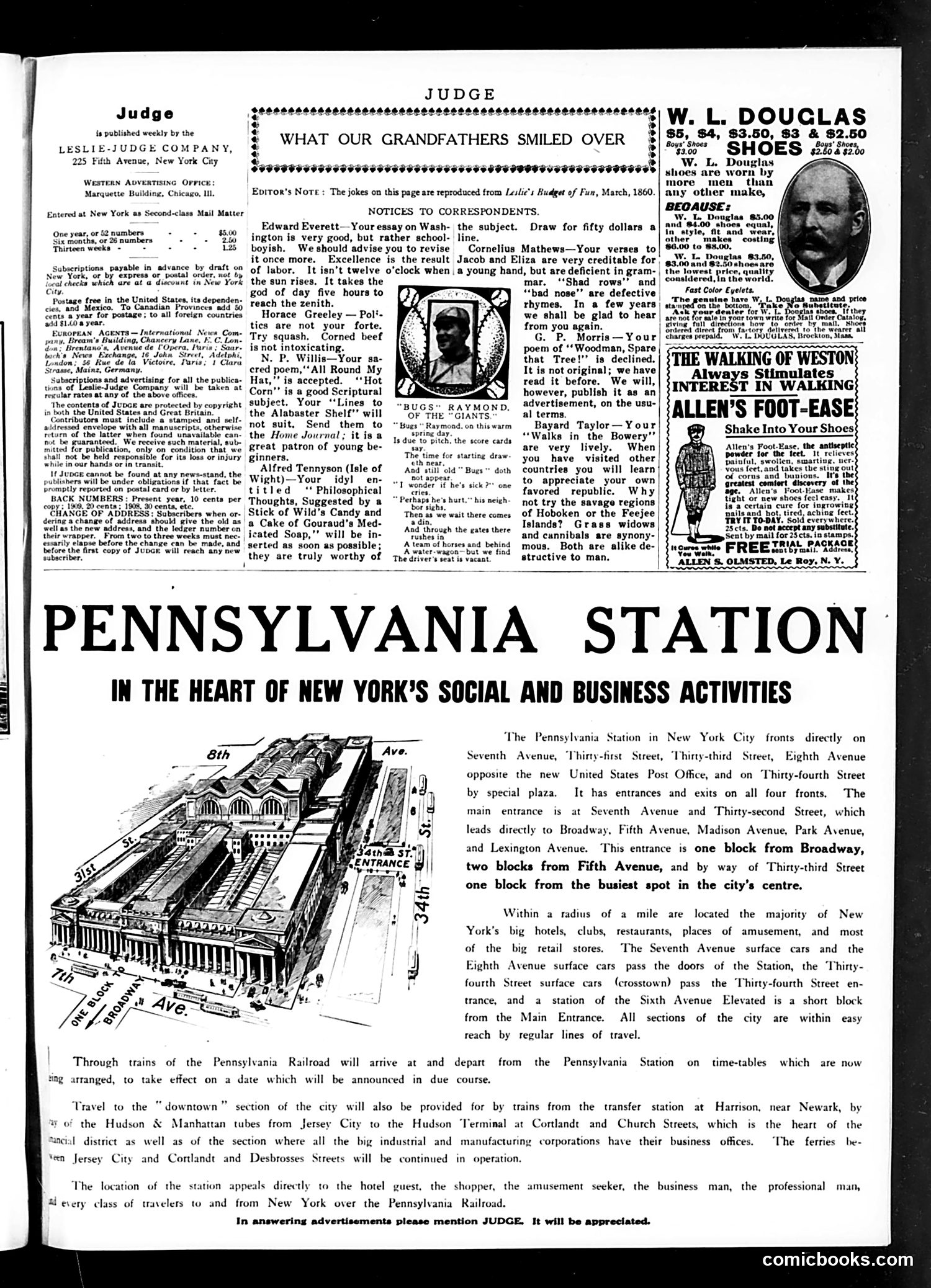
This page is primarily **advertising and administrative content** for Judge magazine, with minimal satirical content. The main feature is a large advertisement for Pennsylvania Station in New York City, describing its location and amenities. The only cartoon element is a small illustration labeled "Bugs Raymond" depicting what appears to be a baseball player, accompanying a brief anecdotal joke about waiting for someone nicknamed "Old Bugs." The "Notices to Correspondents" section parodies rejection letters to famous 19th-century figures (Edward Everett, Horace Greeley, Alfred Tennyson, etc.), humorously critiquing their work in exaggerated editorial tones. This was a common Judge humor format—mock-rejecting submissions from celebrities. The W.L. Douglas shoe advertisement on the right is standard period product marketing. Overall, this page reflects Judge's mixed content model: advertisements funding satirical commentary, with this particular issue leaning heavily toward commercial promotion rather than political satire.
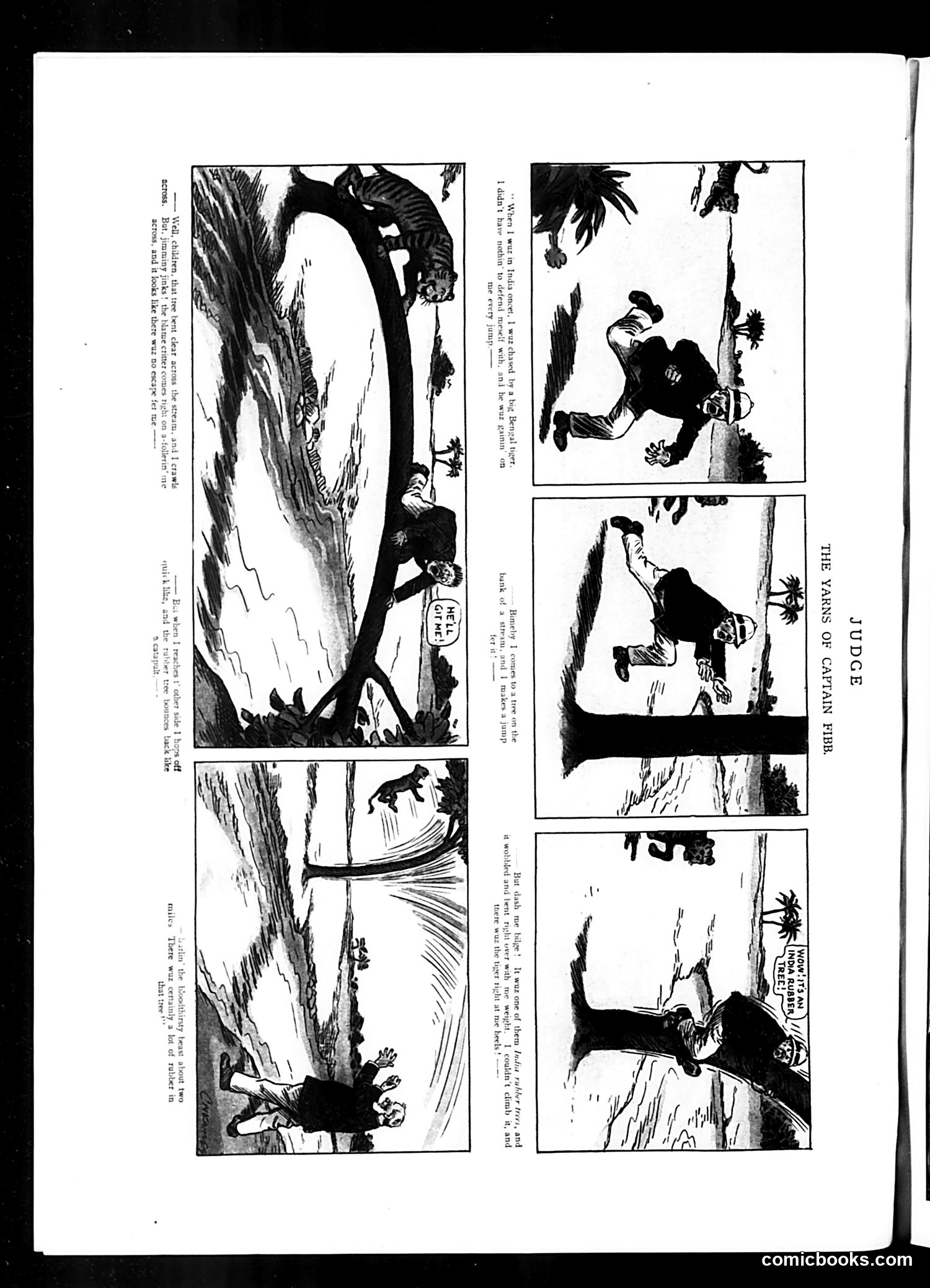
This appears to be a comic strip featuring a character climbing a palm tree in tropical settings. The title references Captain Kidd, the famous pirate, suggesting an adventure narrative. The OCR text is largely illegible, making it difficult to determine specific dialogue or plot details. Based on the visual sequence, the strip shows someone ascending the tree across multiple panels, likely pursuing treasure or escaping danger—classic pirate adventure tropes. Without readable text, I cannot identify the specific satirical point or whether this references contemporary political figures or events. The cartoon appears to be straightforward adventure fiction rather than political satire, though Judge typically included satirical content alongside entertainment pieces.