
Judge, 1910-05-07 · page 7 of 16
Judge — May 7, 1910 — page 7: what you’re looking at
What you’re looking at
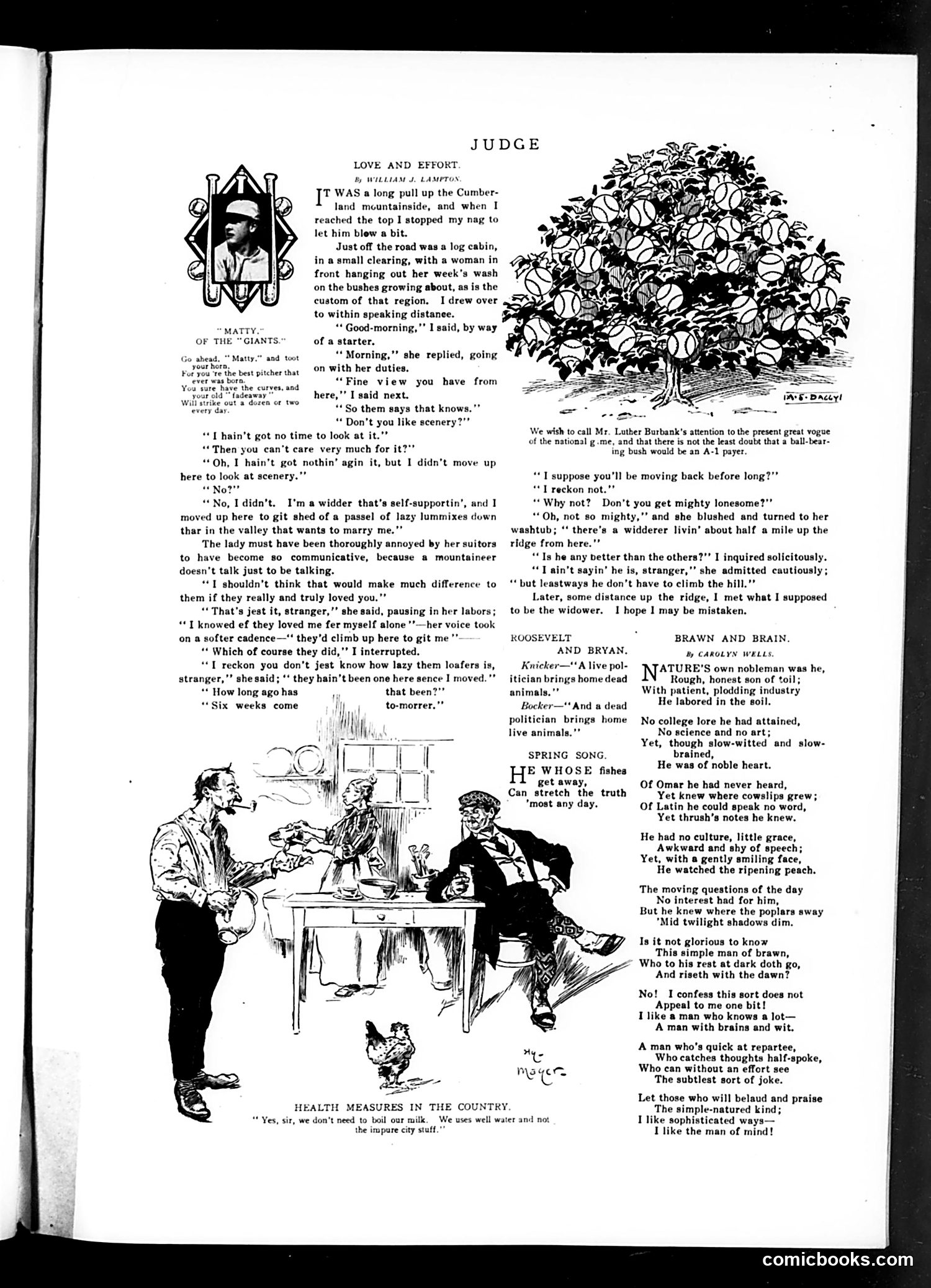
**"Love and Effort"** presents a humorous rural courtship story. A traveling narrator encounters a widow living in the Cumberland Mountains who moved there to escape suitors. She reveals a nearby widower hasn't had to "climb the hill" to court her—implying he's lazy, undercutting romantic notions about persistent love. **"Brawn and Brain"** compares two types of men—an uneducated farmer with natural wisdom versus educated urbanites. The poem celebrates the laborer's "noble heart" despite lacking classical education or cultural refinement. This appears to reference **Theodore Roosevelt and William Jennings Bryan**, political figures representing different American ideals: outdoor vigor versus intellectual sophistication. **"Health Measures"** mocks rural skepticism about sanitation, with a farmer boasting he doesn't need to boil milk, preferring "well water" to "city stuff." The cartoons satirize rural American attitudes—romantic pretense, anti-intellectualism, and misguided health practices—while also romanticizing rustic simplicity. The tone is affectionately mocking rather than contemptuous.
📄 Transcribed text from this page (OCR, searchable)
Machine-transcribed from the original scan — historical spelling and the odd misread are preserved.
JUD LOVE AND EFFORT. by WILLIAM J. LAMPTON [7 WAS a tong pull up the Cumber- land mountainside, and when I reached the top I stopped my nag to let him blew a bit. Just off the road was a log cabin, in a small clearing, with a woman in front hanging out her week's wash on the bushes growing about, as is the custom of that region. I drew over to within speaking distanee. “ Good-morning,”* I said, by way of a starter. “Morning,’”’ she replied, going on with her duties. “Fine view you have from here,” I said next. “* So them says that knows. “Don’t you like scenery?” “TL hain’t got no time to look at it."” “Then you can’t care very much for it?”’ “Oh, I hain’t got nothin’ agin it, but I didn't move up here to look at scenery."” * Ne?’ **No, I didn’t. I'm a widder that’s self-supportin’, and 1 moved up here to git shed of a passel of lazy lummixes down thar in the valley that wants to marry me."” ‘The lady must have been thoroughly annoyed by her suitors to have become so communicative, because a mountaineer doesn’t talk just to be talking. “1 shouldn't think that would make much difference them if they really and truly loved you.”* “That's jest it, stranger,” she said, pausing in her labors; “ [ knowed ef they loved me fer myself alone "*—her voice took on a softer cadence—‘ they'd climb up here to git me ”’ “* Which of course they did,’’ I interrupted. ““T reckon you don’t jest know how lazy them loafers is, stranger,’’ she said; ‘ they hain’t been one here sence I moved.” ** How long ago has that been?” “Six weeks come to-morrer.”" Go ahead, “* Matty.” and toot your hora, For you ‘re the best pitcher that y" will strike out a dozen or two 6 to Can stretch the truth — HEALTH MEASURES IN THE COUNTRY. “* Yes, sir, we don't need to boil our milk. We uses well wa! the impure city stuff."” GE ( Fee 4, gee regi oe POF ‘We wish to call Mr. Luther Burbank’s attention to the present great vogue of the national g.me, and that there is not the least doubt that a ball-bear- ing bush would be an A-1 payer. “I suppose you'll be moving back before long?” “LT reckon not.’* “Why not? Don’t you get mighty lonesome?” “Oh, not so mighty,” and she blushed and turned to her washtub; ‘‘ there’s a widderer livin’ about half a mile up the ridge from here."” “Is he any better than the others?” I inquired solicitously. “LT ain't sayin’ he is, stranger," she admitted cautiously ; “but leastways he don’t have to climb the hill.”” Later, some distance up the ridge, 1 met what I supposed to be the widower. I hope I may be mistaken, BRAWN AND BRAIN. By CAROLYN WELLS ‘ATURE'S own nobleman was he, Rough, honest son of t With patient, plodding industry He labored in the soil. ROOSEVELT AND BRYAN. Knicker—'*A live pol- itician brings home dead animals.”” Bocker— And a dead politician brings home live animals."* No college lore he had attained, No science and no art; Yet, though slow-witted and slow- brained, He was of noble heart. Of Omar he had never heard, Yet knew where cowslips grew; Of Latin he could speak no word, Yet thrush’s notes he knew. SPRING SONG. E WHOSE fishes get awa; "most any day. He had no culture, little grace, Awkward and shy of speech; Yet, with a gently smiling face, He watched the ripening peach. The moving questions of the day No interest had for him, But he knew where the poplars sway "Mid twilight shadows dim. Is it not glorious to know ‘This simple man of brawn, Who to his rest at dark doth go, And riseth with the dawn? No! I confess this sort does not Appeal to me one bit! T like a man who knows a lot— A man with brains and wit. A man who's quick at repartee, Who catches thoughts half-spoke, nysqere Who can without an effort see C The subtlest sort of joke. Let those who will belaud and praise The simple-natured kind; I like sophisticated ways— I like the man of mind! ter and not comicbooks.com