
A complete issue · 16 pages · 1910
Judge — March 26, 1910
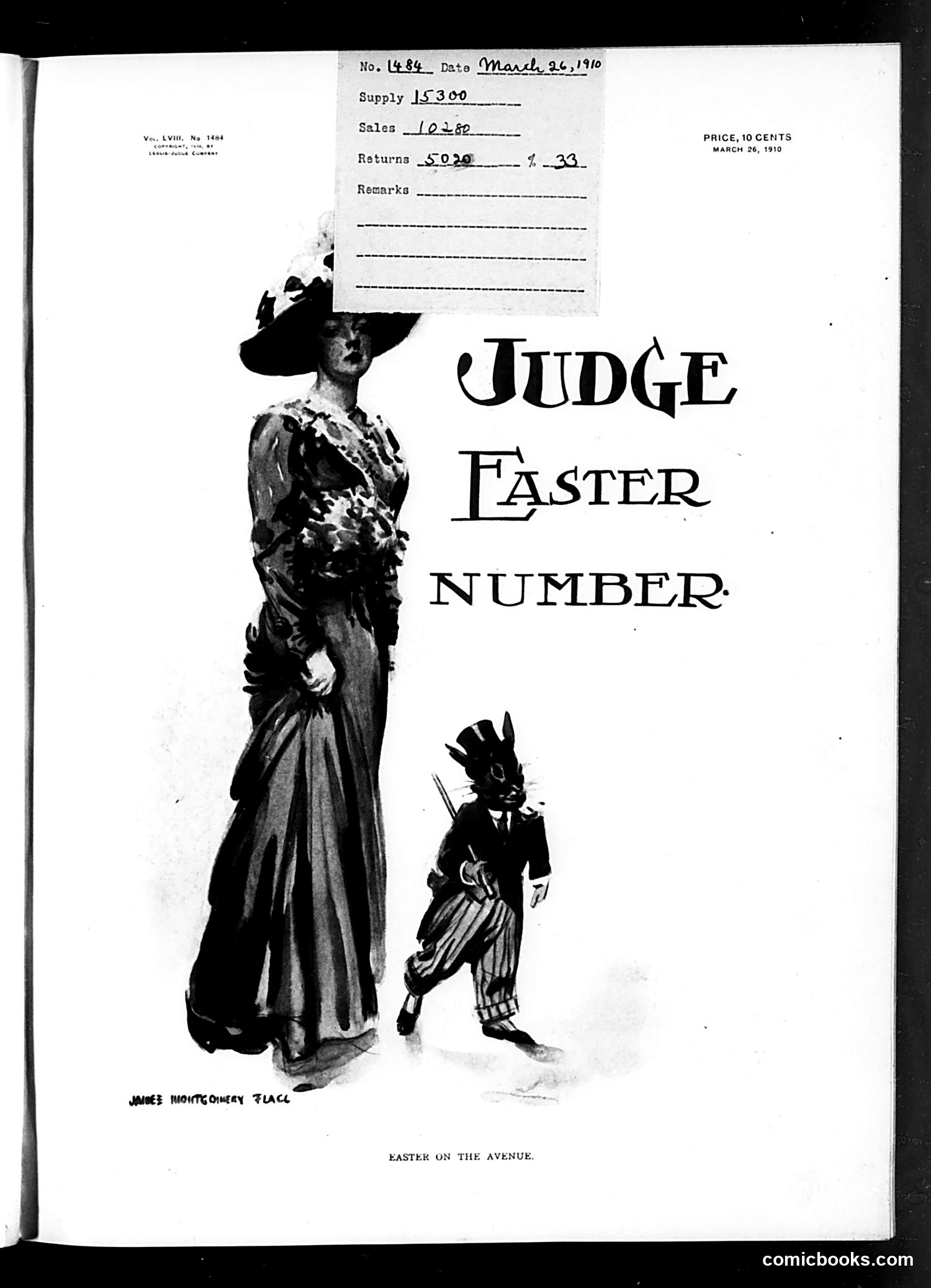
This is the cover of Judge magazine's Easter issue from 1910. The illustration, credited to James Montgomery Flagg, depicts a fashionably dressed woman in an elaborate Easter hat and gown walking alongside a small child dressed in formal attire. The caption reads "Easter on the Avenue," referring to Fifth Avenue in New York—then the center of elite social life. The satire likely comments on Easter's transformation into a secular fashion display among the wealthy. The exaggerated formality of both figures, especially the oversized Easter hat, mocks how the holiday had become primarily an occasion for parading expensive clothing rather than religious observance. This was a common satirical theme in early 20th-century American humor magazines.
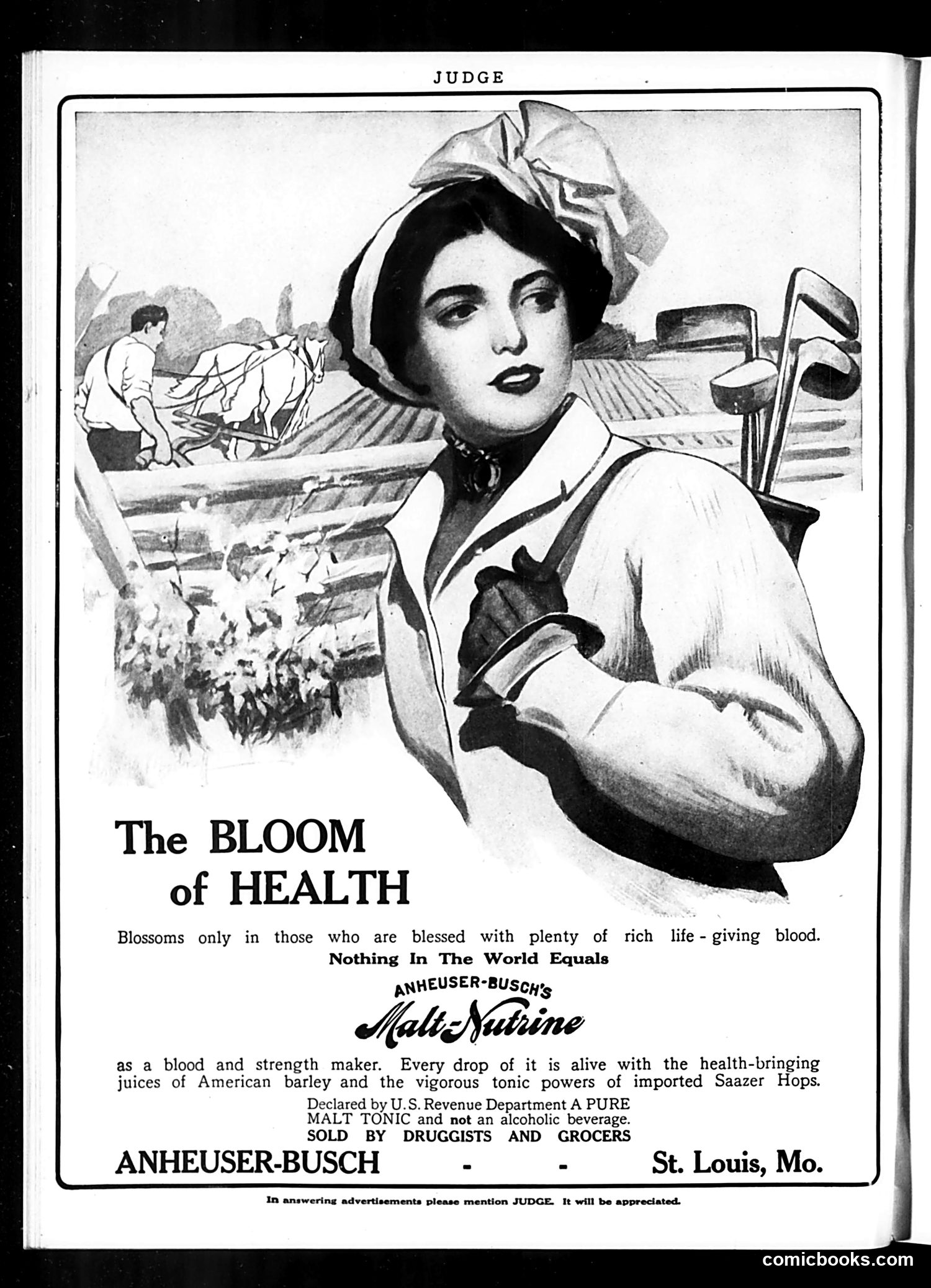
This page is primarily an **advertisement, not satire or political commentary**. It's a full-page ad for Anheuser-Busch's "Malt-Nutrine," a malt tonic product marketed as a health supplement. The ad features a woman in period dress holding a bottle, with agricultural workers visible in the background. The copy claims the product provides "health-bringing juices" from barley and hops, marketed as a "blood and strength maker" for those with "plenty of rich life-giving blood." Notably, it's declared "A PURE MALT TONIC and not an alcoholic beverage"—language likely required by Prohibition-era regulations to market what was essentially a malt extract product. The targeting of women and health claims reflect early 20th-century patent medicine advertising practices, before modern FDA regulations on health claims.
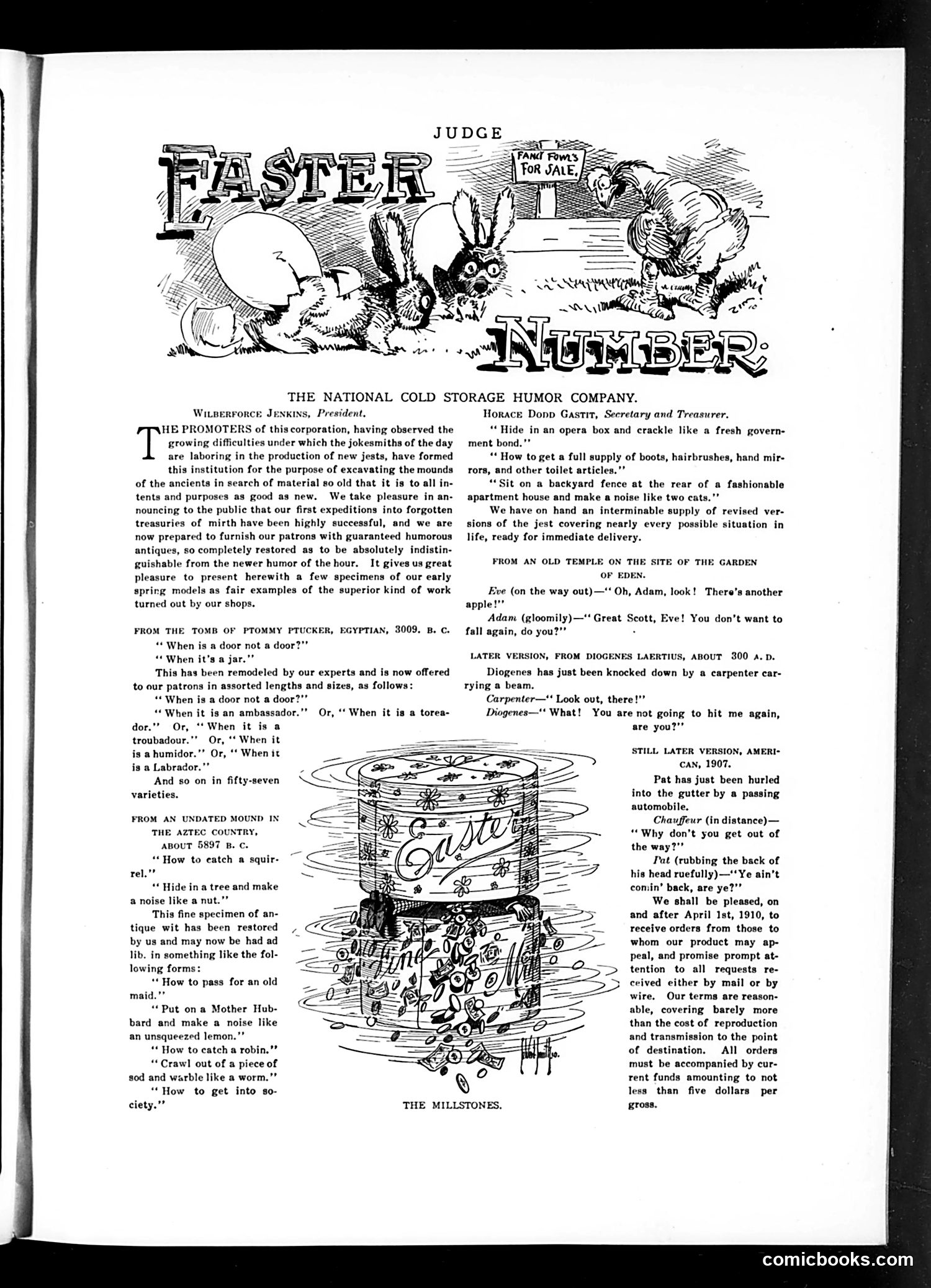
This page satirizes **cold storage** — a then-modern food preservation technology. "The National Cold Storage Humor Company" mock-advertises humorous anecdotes about old kitchen problems, presenting them as antiquated treasures now solved by cold storage. The central illustration shows a cylindrical storage container ("The Milestones") with radiating lines suggesting preservation or stasis. The satire mocks how businesses marketed new technologies by treating old domestic inconveniences as quaint historical curiosities. By framing outdated kitchen struggles as collectible humor from ancient times (Egyptian, Roman, medieval periods), Judge ridicules the commercial nostalgia and self-congratulation surrounding modern convenience innovations. The tone suggests skepticism toward corporate marketing that celebrates progress by trivializing past difficulties.
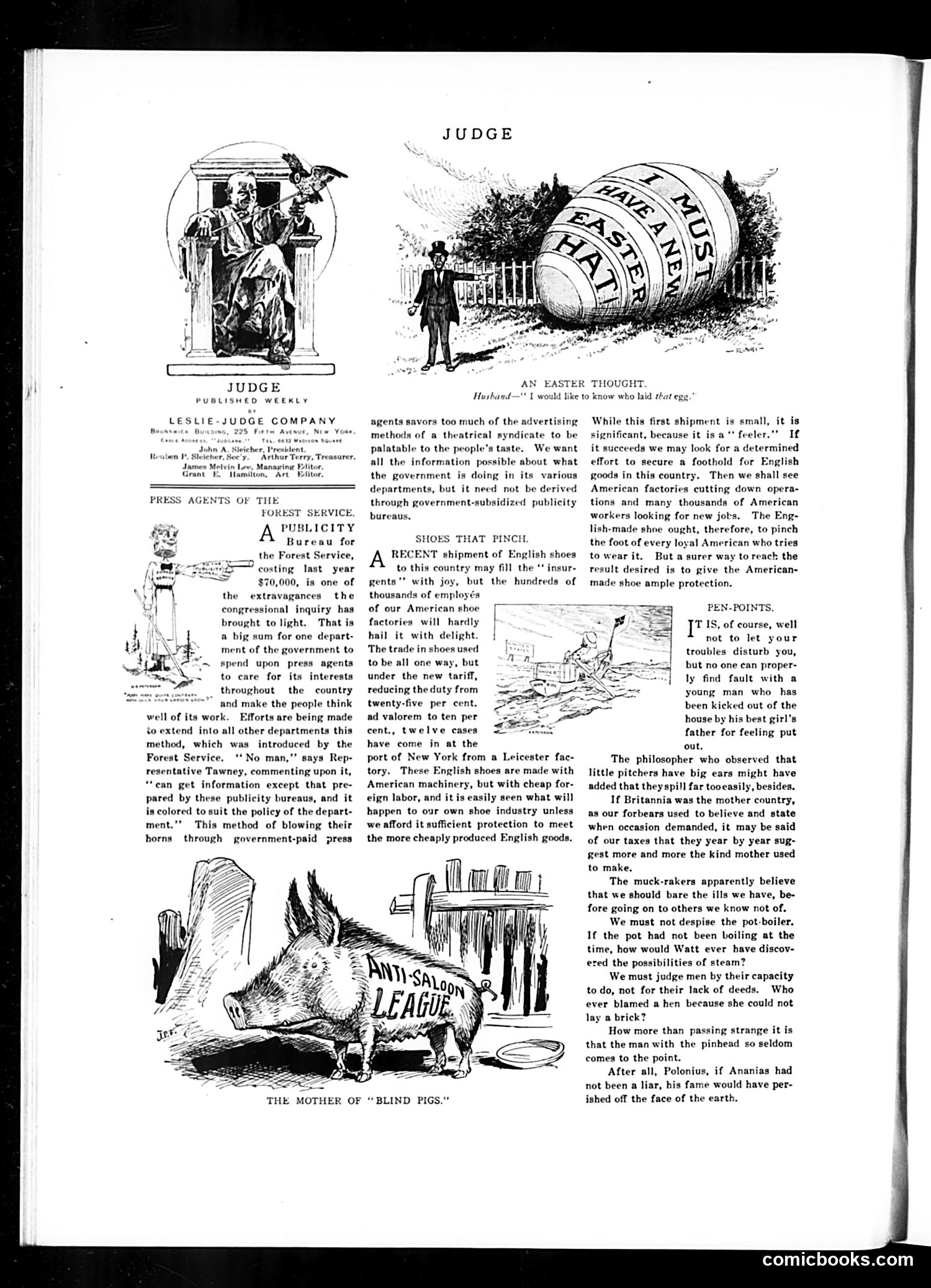
This page contains editorial cartoons and commentary from an American satirical magazine. The main cartoons critique: 1. **"An Easter Thought"**: A large barrel labeled "HAVE A SAFE EASTER" with a man beside it appears to reference unsafe consumer products or hazardous goods sold during holidays. 2. **"Shoes That Pinch"**: Text discusses English shoe imports undercutting American manufacturers through cheap labor and reduced tariffs (25% duty reduction), arguing this threatens American workers and industry. 3. **"The Mother of Blind Pigs"**: A pig labeled "Anti-Saloon League" appears to satirize Prohibition advocates as hypocritical or blind to unintended consequences. The overall theme criticizes government policy—whether tariff decisions affecting workers or Prohibition—as misguided bureaucratic overreach driven by special interests rather than public welfare.
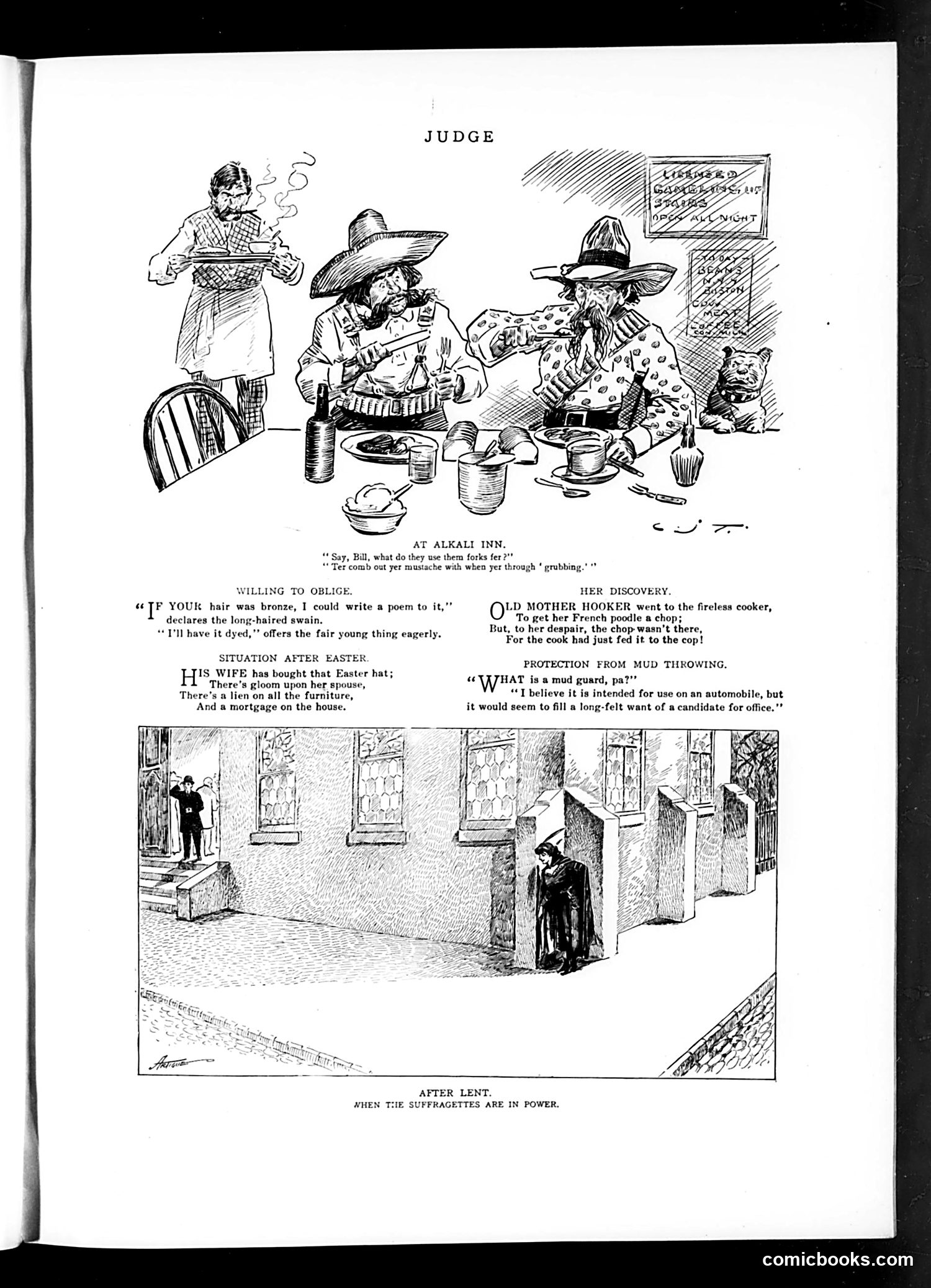
This page contains several satirical sketches and brief humorous pieces typical of Judge magazine's style. The top cartoon depicts two cowboys at an "Alkali Inn," with a woman serving food. The humor appears to involve crude frontier dining etiquette. The middle section includes short comedic observations: - "Willing to Oblige" jokes about a vain woman - "Situation After Easter" mocks wives who overspend on Easter hats - "Her Discovery" ridicules a woman seeking a French poodle - "Protection from Mud Throwing" satirizes mud guards on automobiles as suitable for political candidates The bottom cartoon, titled "After Lent: When the Suffragettes Are in Power," depicts women in what appears to be a corridor or institutional setting. This references the women's suffrage movement, suggesting satirical commentary on female political participation—a contested issue during the Progressive Era. The overall tone is dismissive toward women's ambitions and spending habits.
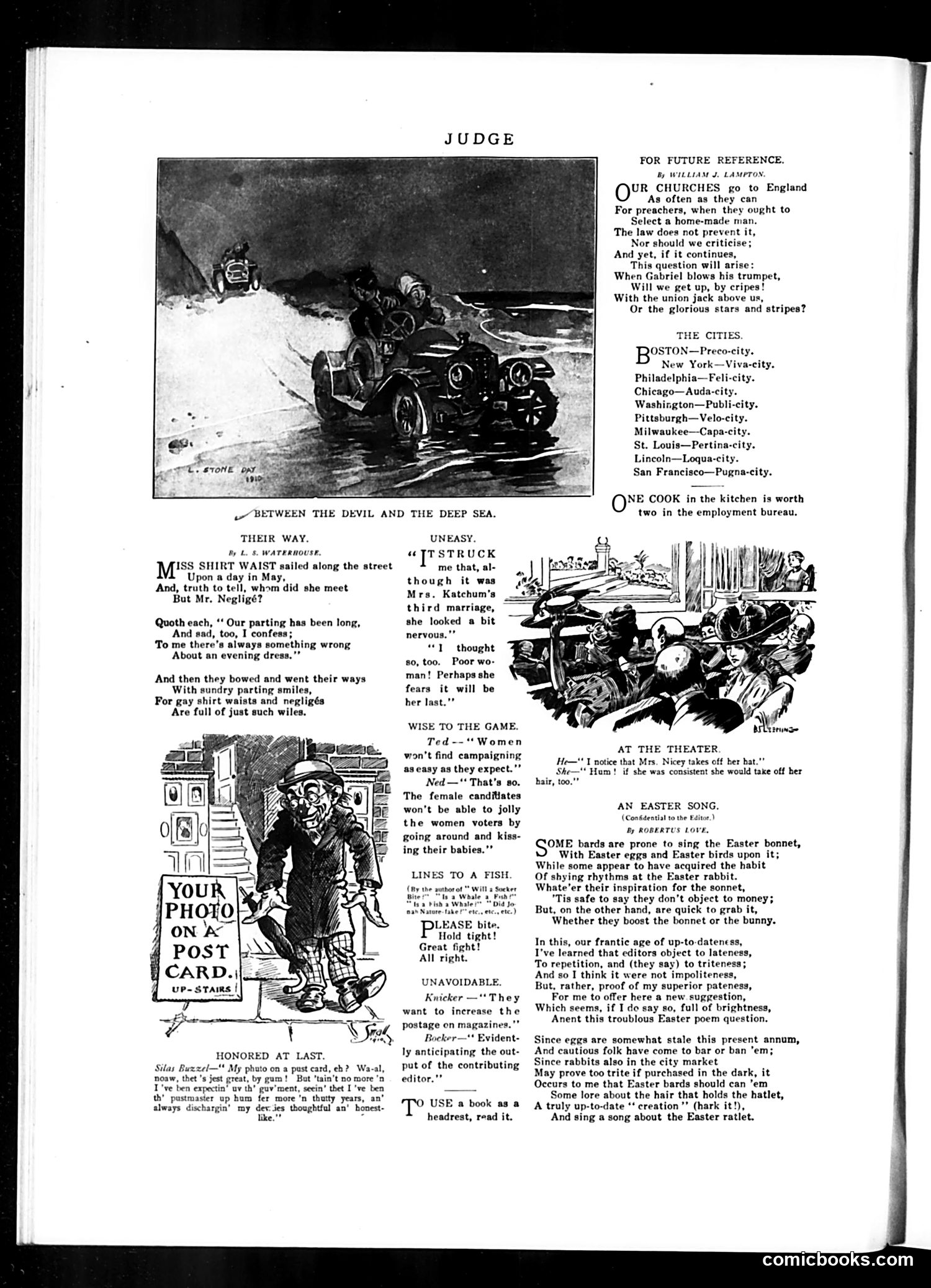
This page collects short humor pieces typical of early 1900s Judge magazine. Key satirical content includes: **"Between the Devil and the Deep Sea"** (top): A car accident cartoon illustrating reckless driving—a new social concern of the automobile age. **"Their Way"** and **"Wise to the Game"**: Social commentary on changing gender roles. "Their Way" humorously personifies clothing (shirt waists and negligés), while "Wise to the Game" jokes that female political candidates can't win women's votes using traditional feminine tactics like baby-kissing—implying women's suffrage debates were contemporary. **"Our Churches Go to England"**: Critiques American churches importing English preachers rather than developing homegrown clergy, questioning national identity (Union Jack vs. stars and stripes). **"The Cities"**: Wordplay matching cities with related words (Boston=Precocity, Chicago=Audacity). **"An Easter Song"**: Satirizes poets' clichéd Easter verse about bonnets and rabbits, proposing the "Easter ratlet" (rat) as refreshingly original. The page mixes social observation with light wordplay typical of Judge's satirical approach.
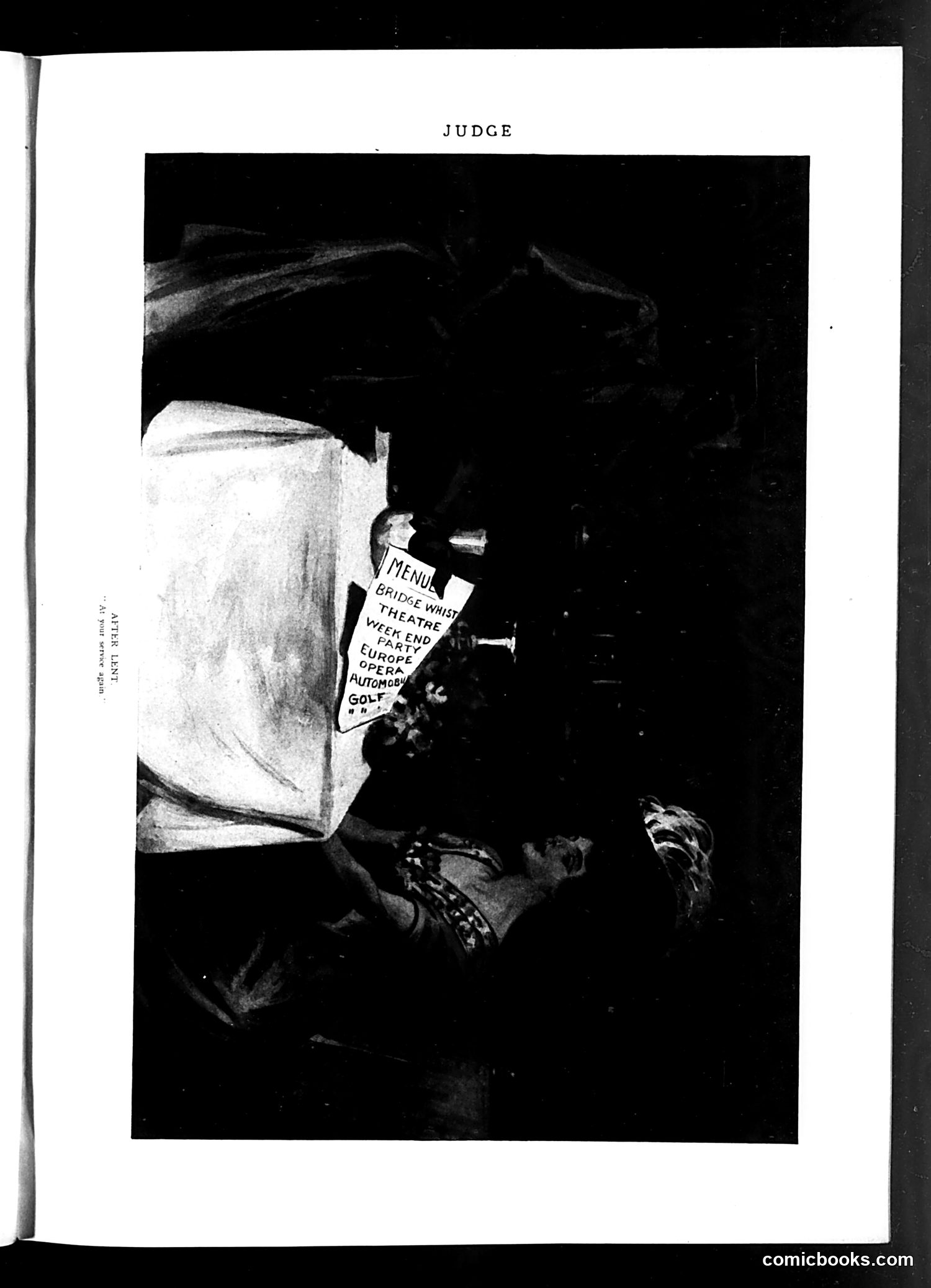
This page titled "JUDGE" shows a political cartoon depicting a large figure in judicial robes holding a gavel, with a smaller figure below holding a placard listing various social amenities: "MEMO / BRIDGE WHIST / THEATRE / WEEKEND PARTIES / EUROPE / OPERA / AUTOMOBILE / GOLF." The cartoon appears to satirize judicial authority and privilege—specifically critiquing how judges or the legal system prioritize leisure activities and upper-class pleasures (bridge, theatre, golf, European travel) over serious judicial duties. The looming judge figure with gavel dominates the composition, suggesting the irony of judicial power being exercised by someone distracted by social frivolities. Without a date, the exact historical context remains unclear, but the cartoon likely criticizes judicial corruption or misplaced priorities during the early 20th century.
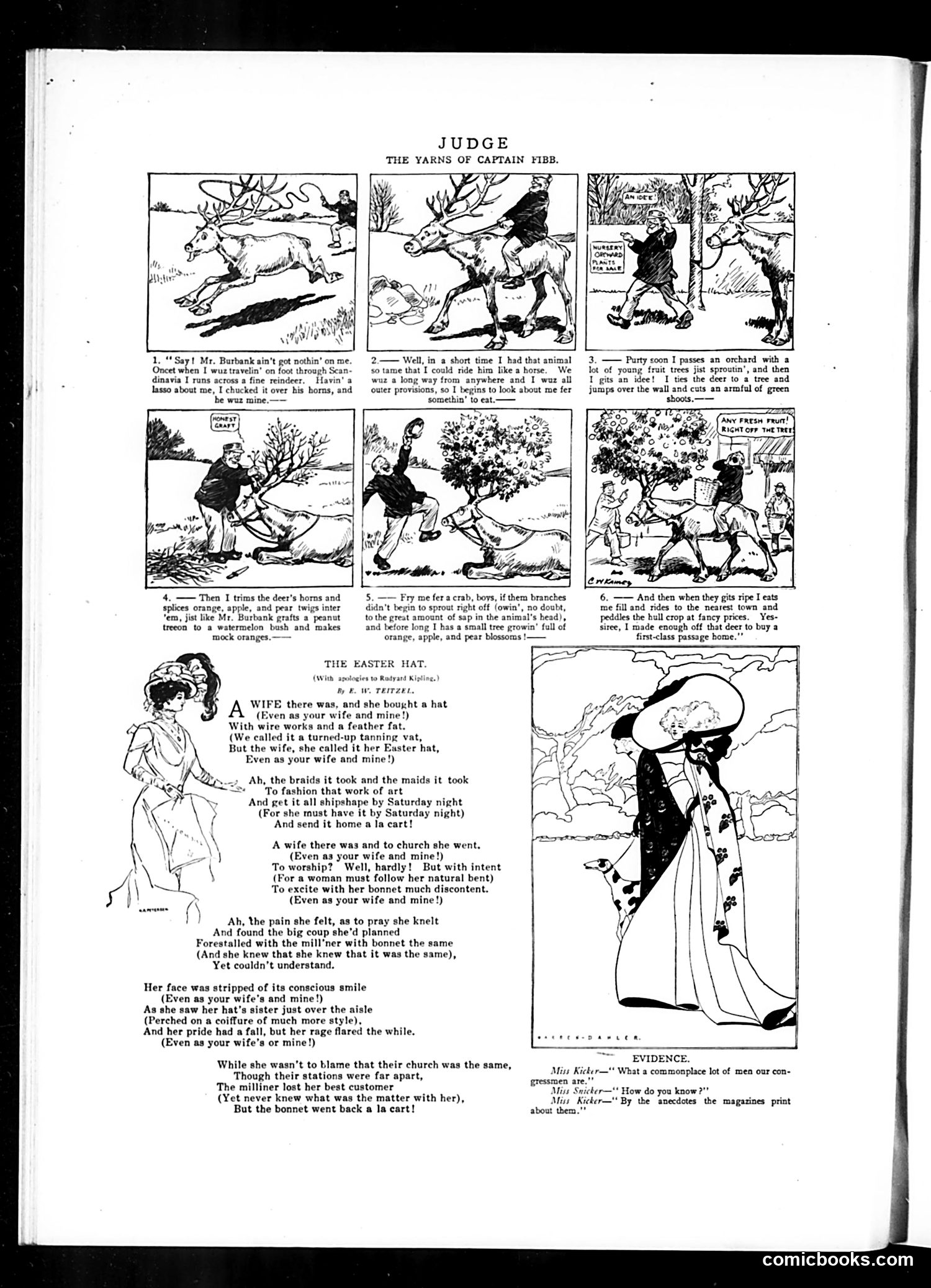
This page contains two distinct pieces of satire: **"The Yarns of Captain Fibb"** (top) mocks tall tales and exaggeration. The narrator claims impossible feats: taming a wild reindeer, then grafting fruit tree branches onto its antlers, which supposedly bear fruit. The satire targets boastful storytelling and invokes Luther Burbank, a real botanist famous for plant grafts—the joke being that even Burbank's real science pales beside this absurd fiction. **"The Easter Hat"** (bottom) satirizes women's vanity and conspicuous consumption around fashion. A wife spends enormous time and money on an elaborate Easter bonnet, only to arrive at church and see an identical hat on another woman—seemingly a rival of lower social standing. Her mortification and rage cause her to return the hat unused. The satire critiques women's competitive display of wealth through fashion and their concern with social distinction. A brief "Evidence" joke at the bottom mocks congressmen as unremarkable.
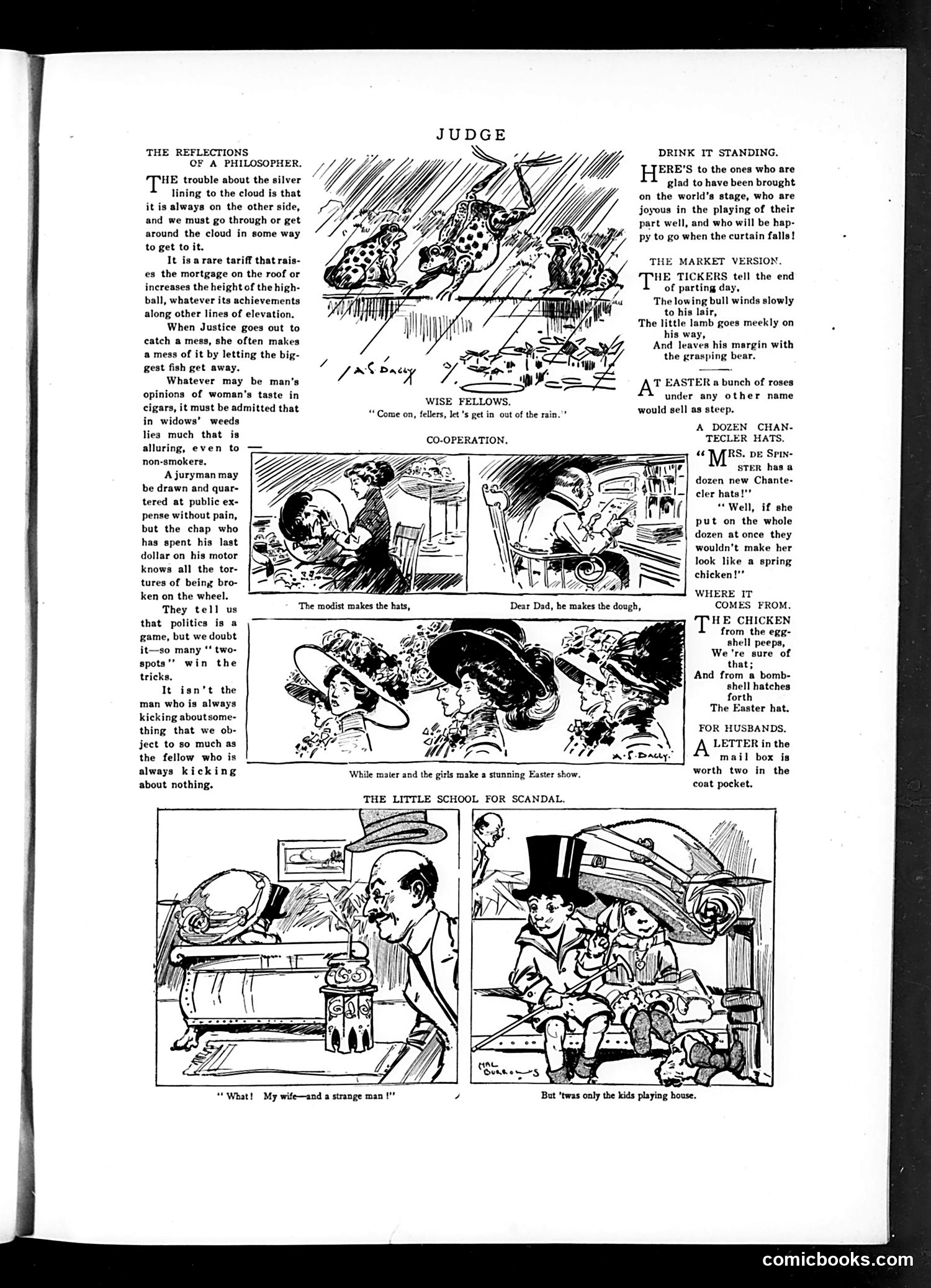
This page contains satirical commentary typical of early-20th-century Judge magazine. The "Reflections of a Philosopher" column offers dry observations about human nature and social follies—silver linings, tariffs, justice, women's taste, jury duty, automobiles, politics, and complaining. The cartoons mock contemporary subjects: "Wise Fellows" shows men seeking shelter from rain; "Co-operation" depicts domestic scenes; "The Market Version" parodies poetry using stock-market terminology ("tickers," "bull," "margin"). "A Dozen Chantecler Hats" jokes about fashionable Easter bonnets. "Where It Comes From" makes a crude analogy between chickens hatching from eggs and Easter hats emerging from "bombshells." "The Little School for Scandal" concludes with two panels: a husband discovering his wife with a stranger (scandal!), then the punchline—it's just children playing house, deflating the dramatic setup. The overall tone is genteel humor targeting urban, middle-class readers familiar with fashion, stock markets, and domestic pretension.
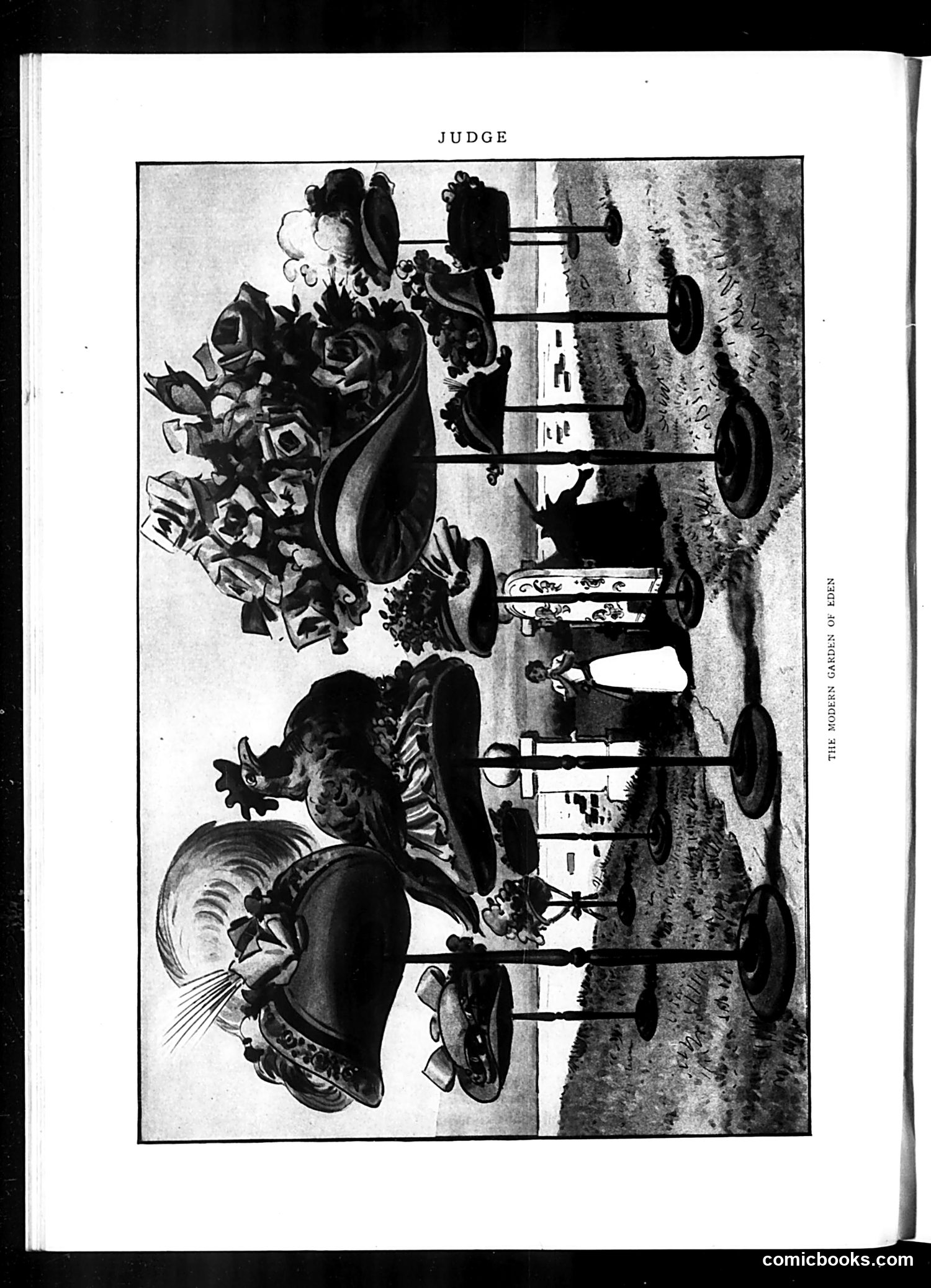
The OCR text is essentially unreadable, so I'll work from the image alone. This page from *Judge* appears to contain a single illustration titled "JUDGE" at the top. The image is printed upside-down relative to the page orientation, depicting what appears to be a courtroom or formal proceeding scene with multiple figures in period dress (likely late 19th or early 20th century). The figures appear to be caricatured, suggesting political or social satire typical of *Judge* magazine. Without legible text or clearer context, I cannot definitively identify the specific figures, political figures referenced, or the particular satirical point being made. The upside-down printing itself may be intentional—possibly part of the joke or commentary—but I cannot confirm the cartoon's specific subject or meaning without additional context.
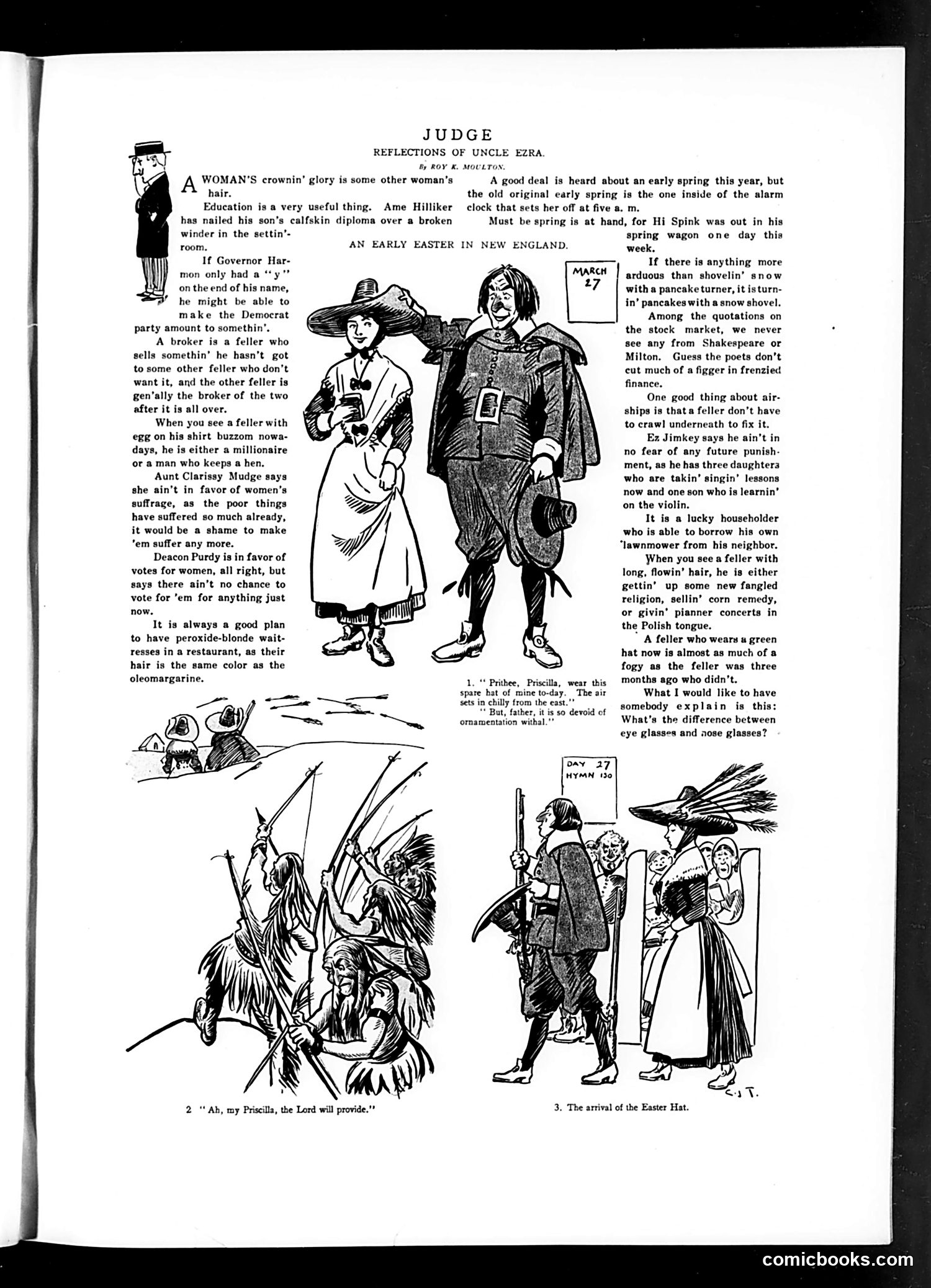
This page from Judge magazine features satirical observations on American life circa early 1900s, written under the persona of "Uncle Ezra," a folksy commentator offering wry social criticism. **Main content:** A collection of witty one-liners mocking contemporary life—women's suffrage debates, financial speculation ("frenzied finance"), early Easter celebrations in New England, and social pretensions. The cartoons illustrate specific jokes: an elaborate Easter hat arrival (satirizing women's fashion excess), and a poor farmer in threadbare clothing consulting Scripture about provision. **The satire targets:** gender politics (women's suffrage), financial speculation, religious hypocrisy, working-class struggles during economic inequality, and consumer culture. References to "Governor Harmon" and stock market quotations ground it in the Progressive Era. **The tone:** affectionate rural skepticism—Uncle Ezra speaks as an intelligent country observer deflating urban pretension and hypocrisy through homespun wisdom.
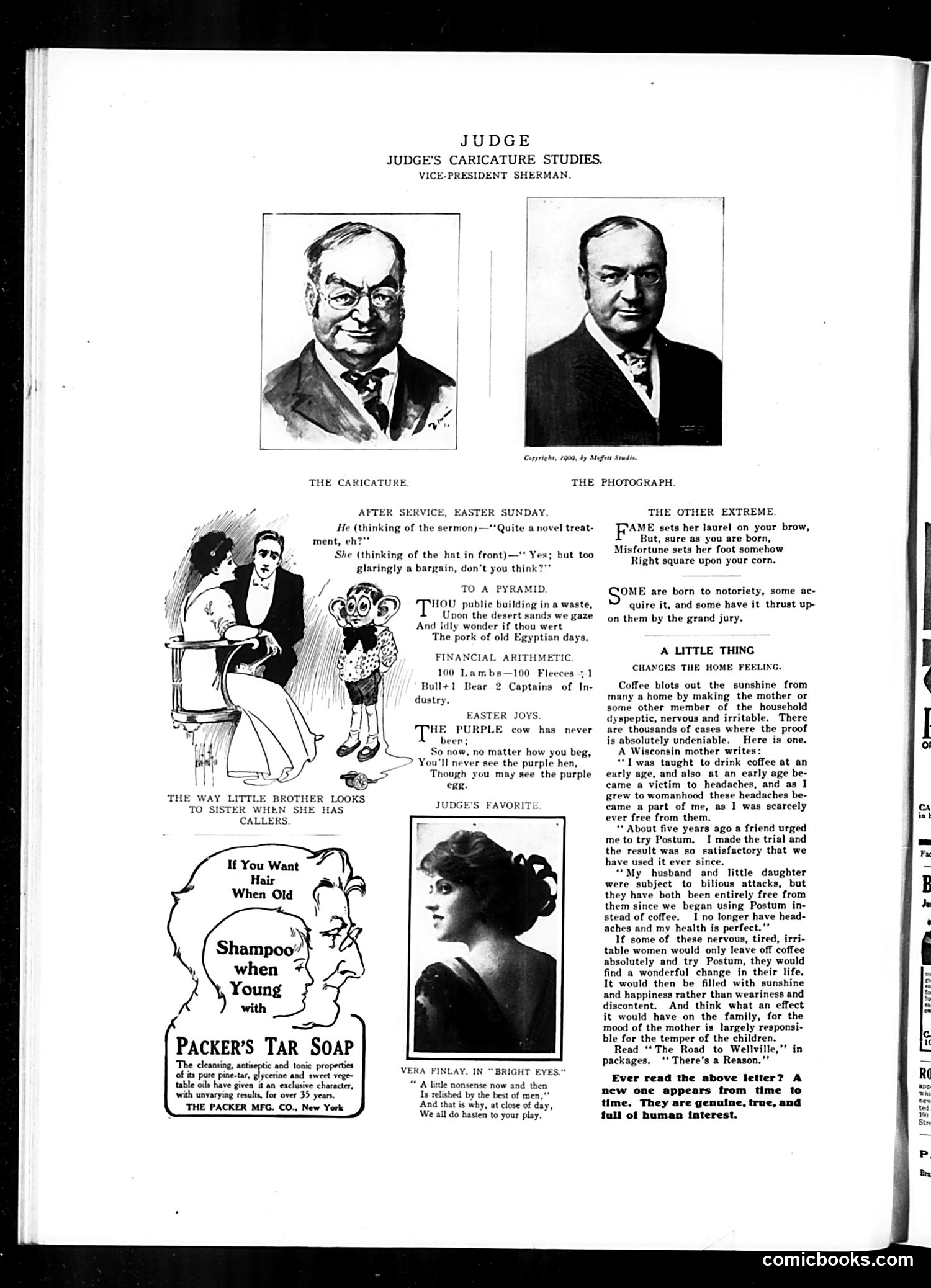
This page features **Vice-President James Sherman** in comparative caricature studies—the left image is a satirical drawing, the right a photograph. The format highlights how cartoonists exaggerate features for comedic effect. The page is primarily **miscellaneous humor and advertising** rather than focused political satire. Content includes: - Light verse about Easter and Egyptian pyramids - Wordplay jokes (the "purple cow/hen/egg" reference) - A humorous sketch of a boy's reaction to his sister's suitors - A Postum cereal advertisement disguised as a testimonial letter, claiming coffee causes headaches and nervousness while their product restores health The Sherman caricature appears designed to mock his appearance rather than any specific policy. The overall page reflects early 1900s magazine humor—mixing social observation with patent medicine advertising that made dubious health claims (here, attacking coffee while promoting Postum as a cure-all).
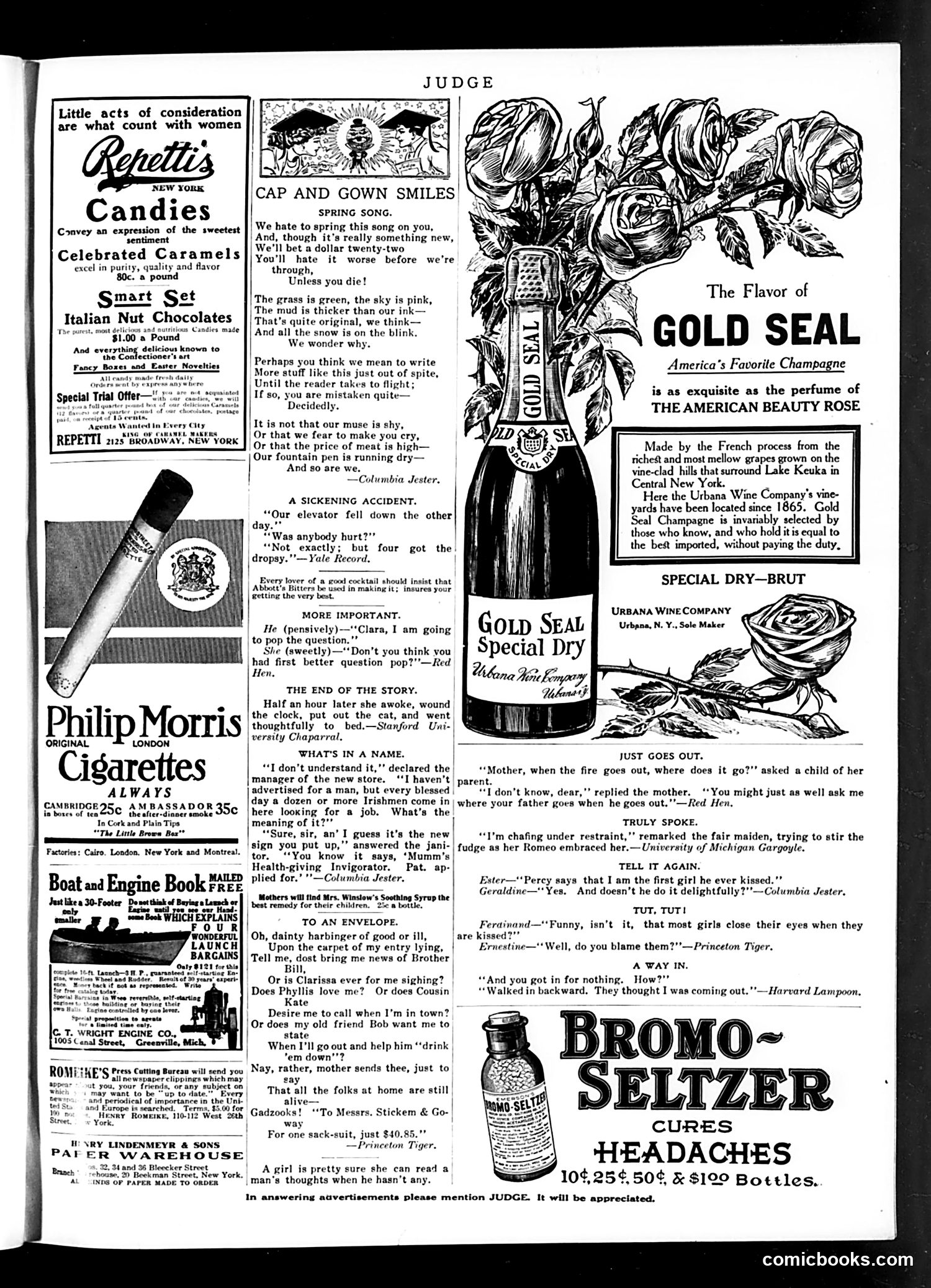
This page is primarily **advertising with light satirical humor sections**, typical of Judge magazine's format. **The main content consists of:** **Advertisements:** Repetti candies, Philip Morris cigarettes, Gold Seal champagne, and Bromo-Seltzer dominate the page—standard early 20th-century product placements. **Humor sections:** Short jokes and quips fill spaces between ads, including: - "Spring Song" (Columbia Jester)—a deliberately bad poem about spring - "A Sickening Accident"—wordplay about an elevator falling and causing "dropsy" - "What's in a Name"—an Irish laborer misreading "Mumm's Health-giving Invigorator" as a job advertisement **Social satire:** The humor reflects period stereotypes (Irish workers, gender dynamics in courtship) and targets contemporary concerns (elevators, modern advertising). The page reflects Judge's mixed editorial-advertising business model, where witty filler content surrounded commercial messages aimed at affluent readers.
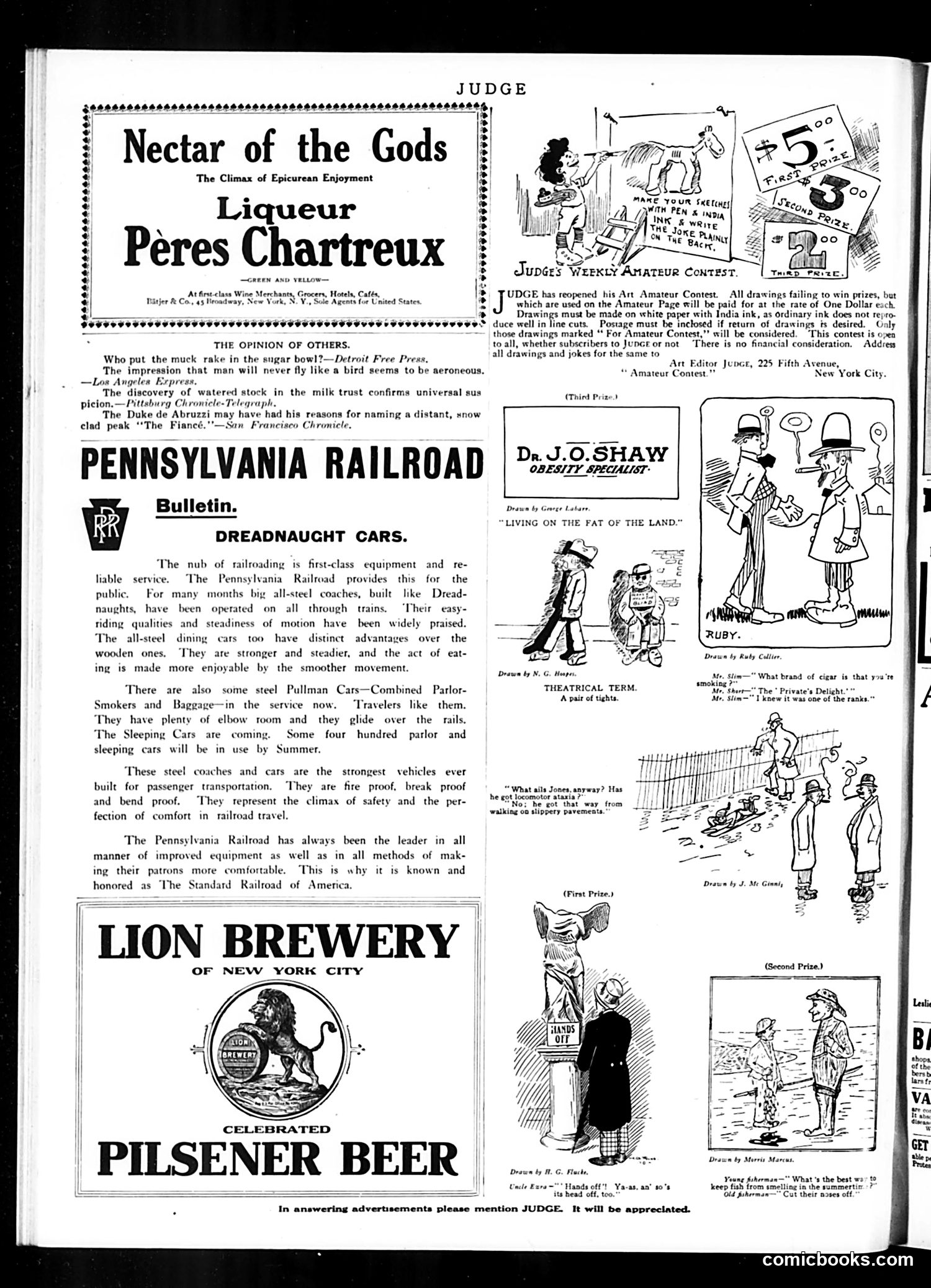
This page is primarily **advertising and contest announcements**, with several comic cartoons interspersed. The main content includes: 1. **Liqueur advertisement** for Pères Chartreux, a French drink 2. **Pennsylvania Railroad bulletin** promoting their new steel "Dreadnaught" cars—comparing them to military battleships to emphasize strength and safety 3. **Lion Brewery advertisement** for Pilsener Beer 4. **Art Amateur Contest announcement** inviting readers to submit drawings for publication The scattered cartoons are brief jokes with no clear political significance: - One involves cigars and military ranks - Another depicts someone slipping on a "slippery pavement" - Several show domestic or workplace humor The page reflects early 1900s consumer culture, emphasizing modern industrial equipment (steel railway cars) and imported luxuries (French liqueur, German beer). The contest suggests *Judge* actively engaged readers as amateur contributors—a precursor to modern crowdsourced content.
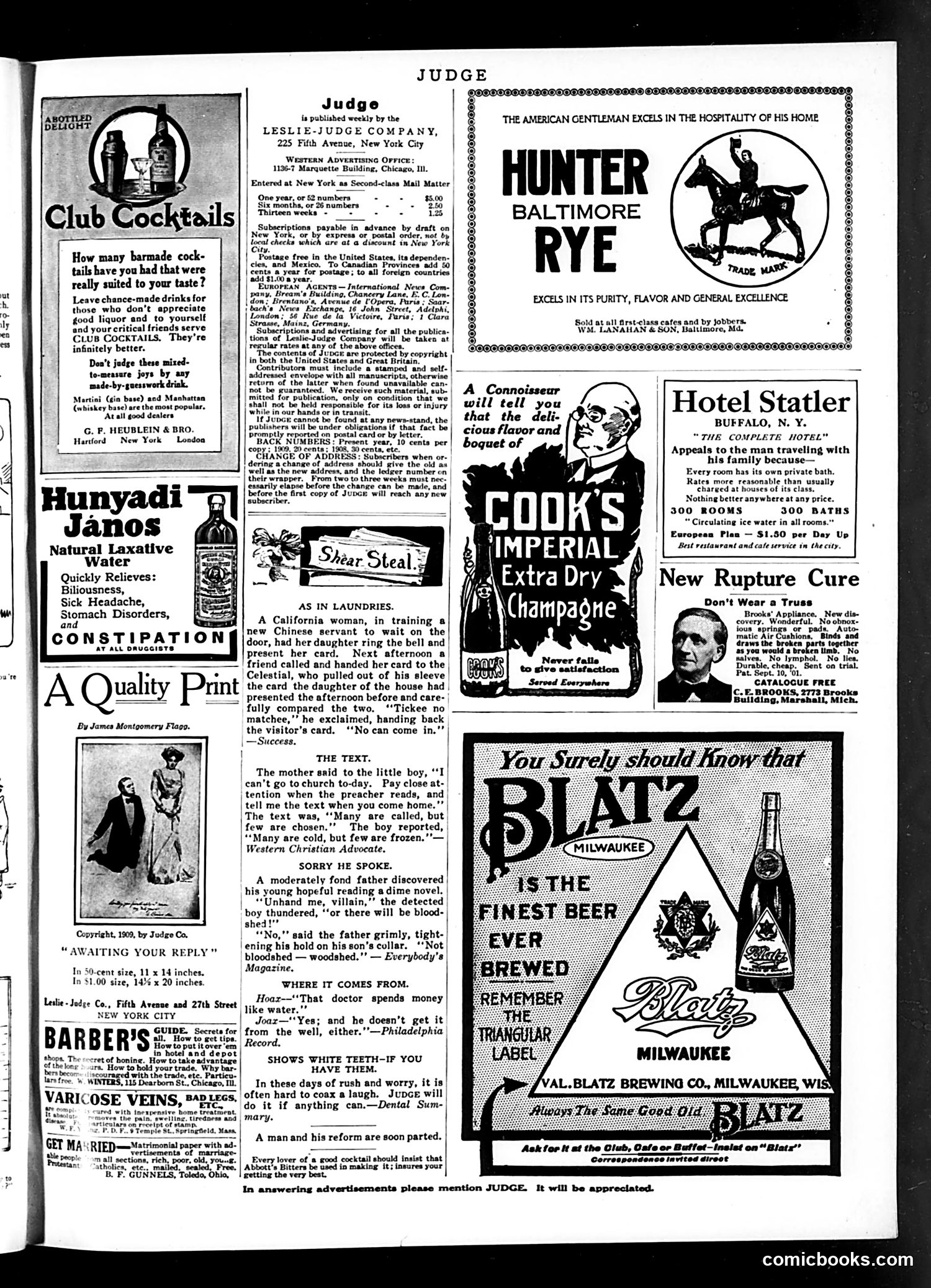
This is primarily an **advertising page** from Judge magazine (circa 1909, based on copyright notice). The page contains multiple product advertisements rather than political cartoons or satire requiring historical context. The one editorial cartoon present—"Awaiting Your Reply" by James Montgomery Flagg—shows a man and woman in formal dress, illustrating a anecdote about a Chinese servant who cannot distinguish between two women's calling cards. The humor relies on the period's racial stereotyping: the servant's broken English and literal thinking become the punchline. Below are several humorous short anecdotes (labeled "The Text," "Sorry He Spoke," etc.) playing on misunderstandings and wordplay—typical filler content for the era. The advertisements promote cocktail mixes, laxatives, hair tonics, hotels, and beer—standard commercial content with no political significance. The page reflects early 1900s consumer culture and advertising styles rather than satire.
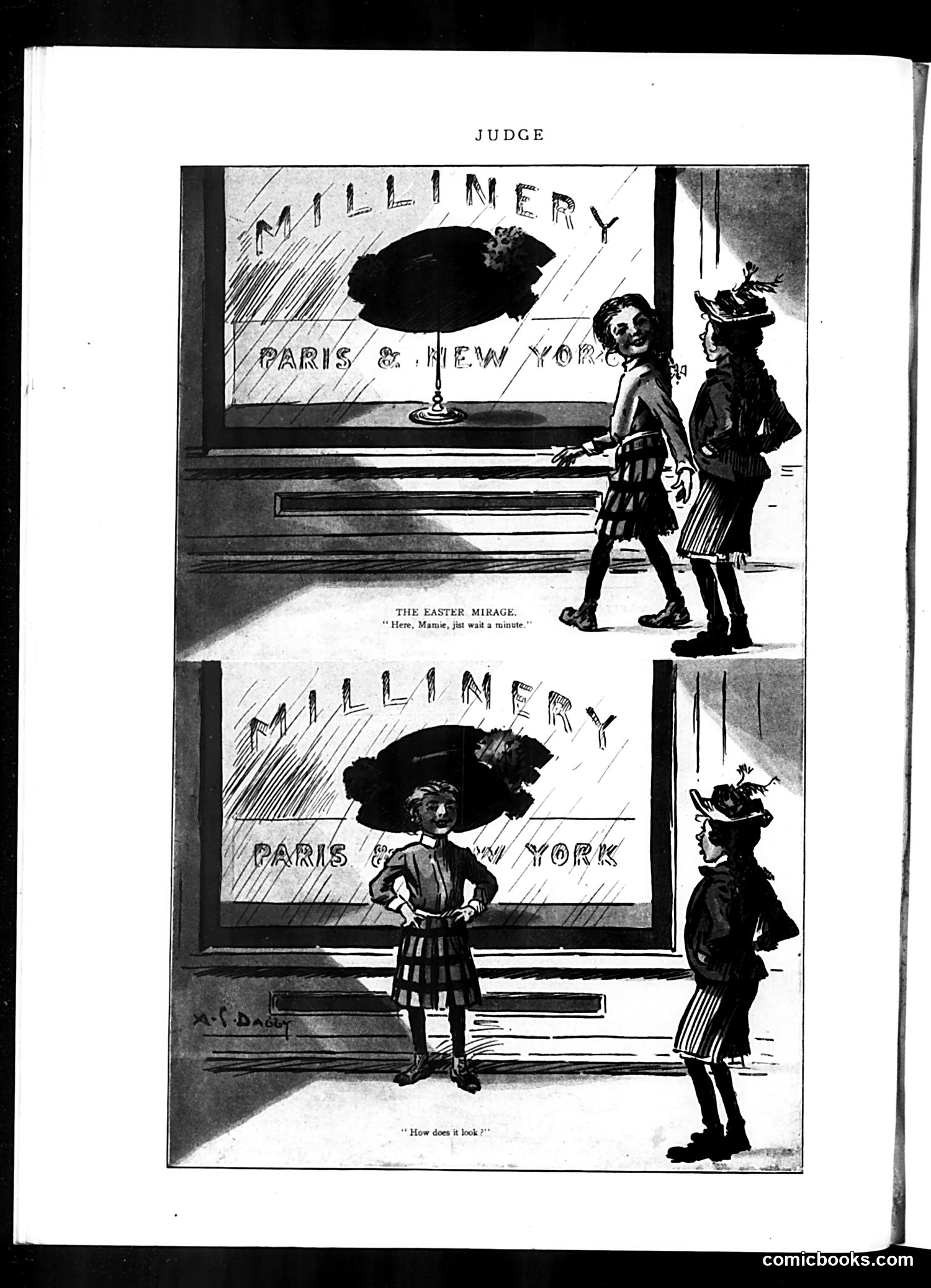
This two-panel Judge cartoon satirizes consumer desire and the fashion industry's false promises. Two young women admire a millinery (hat) shop window display advertising "Paris & New York" fashions. The top panel shows them gazing at an elaborate, expensive hat, with the caption "Here, Mame, just wait a minute." In the bottom panel, one woman has purchased the hat and models it, but appears disappointed—the hat looks noticeably less impressive on her than in the window. The caption "How does it look?" suggests her companion's honest but deflating response is coming. The "Easter Mirage" title references Easter shopping season and the illusory gap between advertised luxury goods and their actual appearance when owned—a timeless critique of consumerism and marketing deception.