
A complete issue · 16 pages · 1910
Judge — February 19, 1910
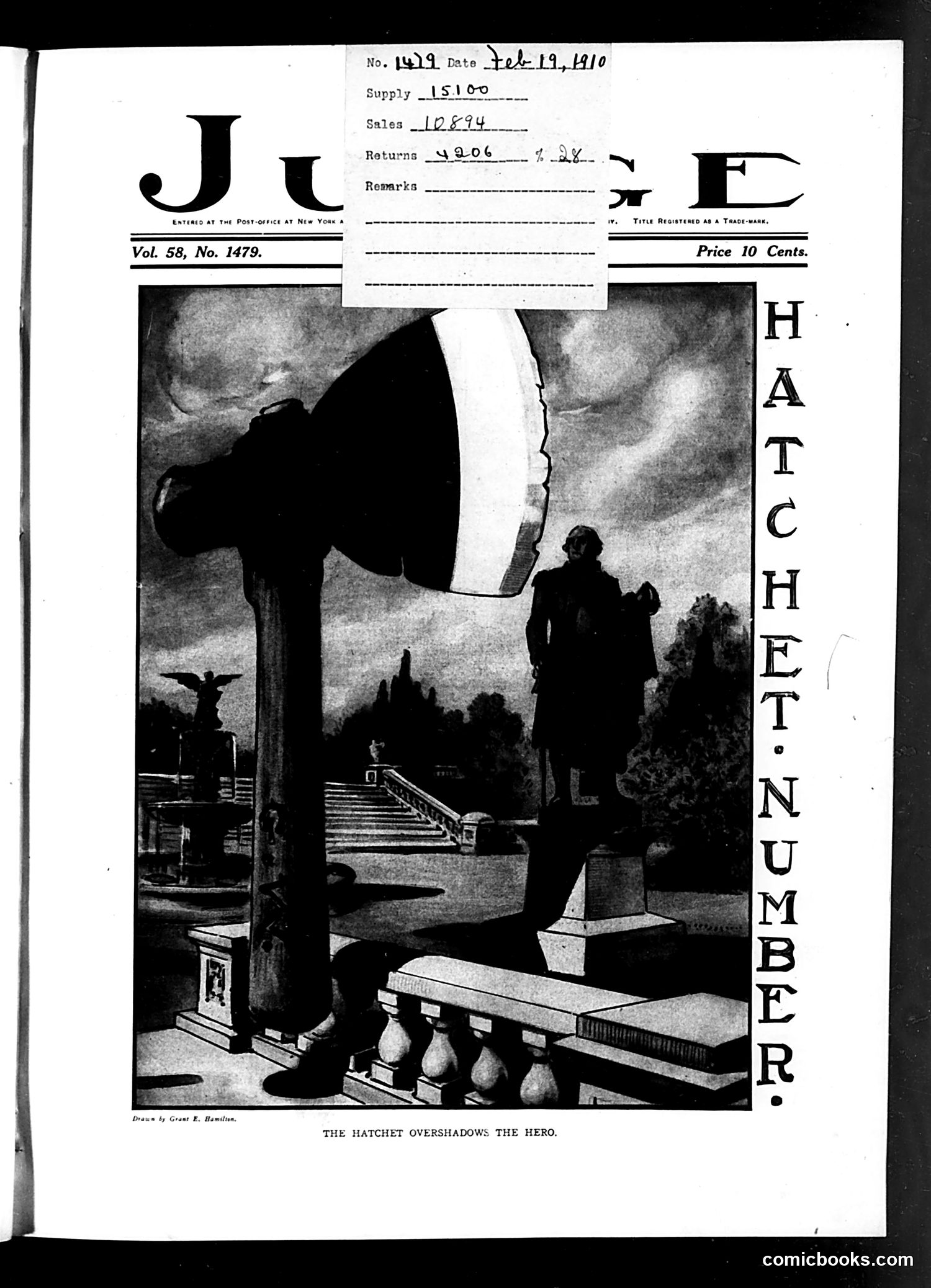
This *Judge* magazine cover from February 19, 1910 (Vol. 58, No. 1479) presents a political cartoon titled "The Hatchet Overshadows the Hero." The image shows a large hatchet looming over a solitary figure in what appears to be a public space or monument area. The hatchet likely references the George Washington legend (Washington and the cherry tree myth), while the overshadowed "hero" figure appears to reference a contemporary political or public figure whose importance is diminished by this historical symbol. The satire suggests that this person's achievements are eclipsed by traditional American iconography or historical precedent. Without additional context about 1910 political events, the specific figure satirized remains unclear, though the composition criticizes how historical mythology can overshadow present-day prominence.
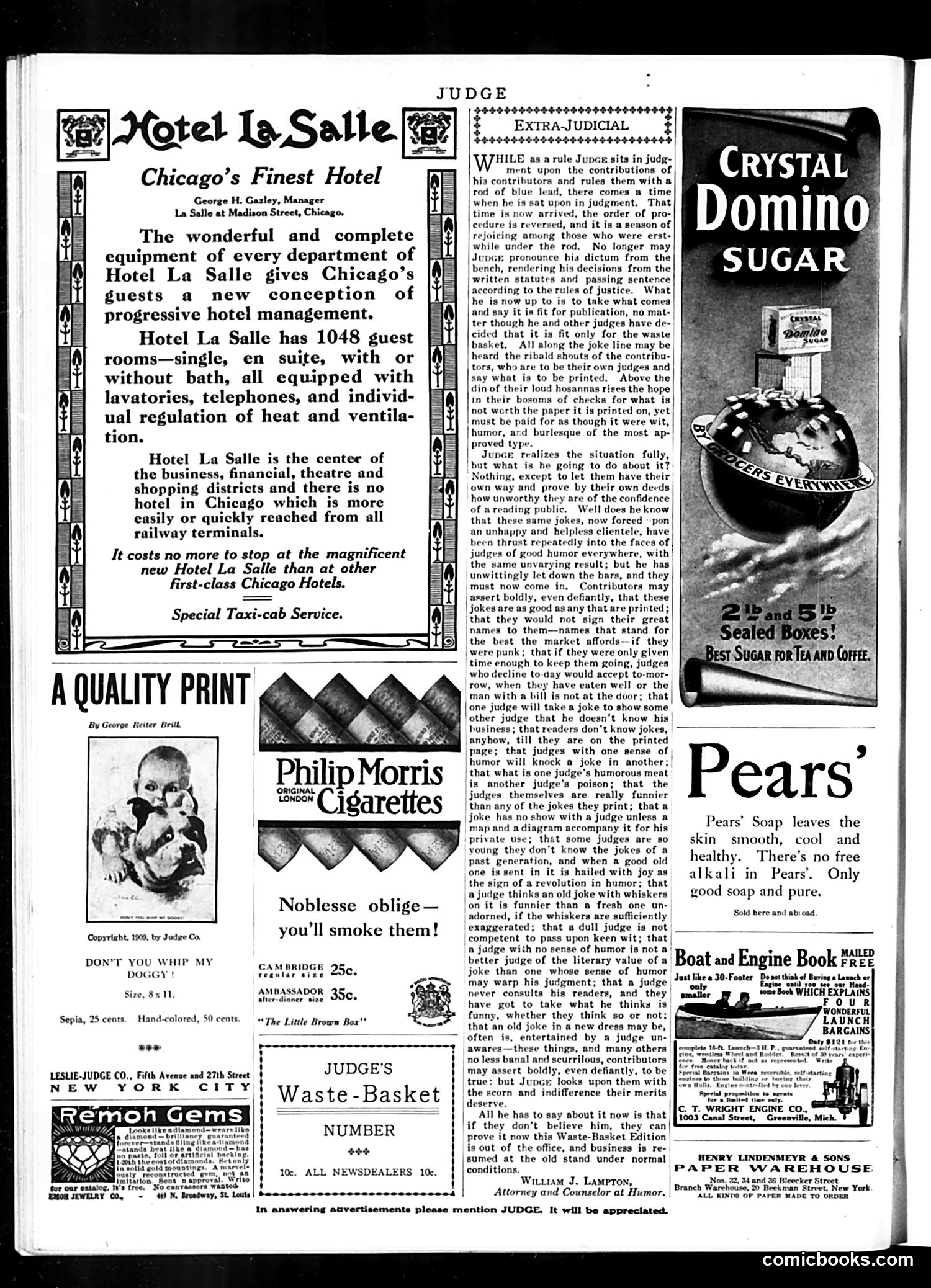
This page is predominantly **advertising** rather than political satire. The major advertisements include Hotel La Salle (Chicago), Crystal Domino Sugar, Pears' Soap, and Philip Morris Cigarettes. The only cartoon visible is titled **"A Quality Print"** by George Fisher Furst, depicting a child with the caption "DON'T YOU WHIP MY DOGGY!" It appears to be a sentimental rather than satirical piece, likely playing on viewer emotions to advertise printing services. The page also features **"Judge's Waste-Basket"** — a regular column of miscellaneous jokes and commentary. The lengthy "Extra-Judicial" article discusses judges' sense of humor and their ability to appreciate printed jokes, though the specific satirical point is unclear from the fragmentary OCR text. Overall, this is a commercial page with minimal political or social satire.
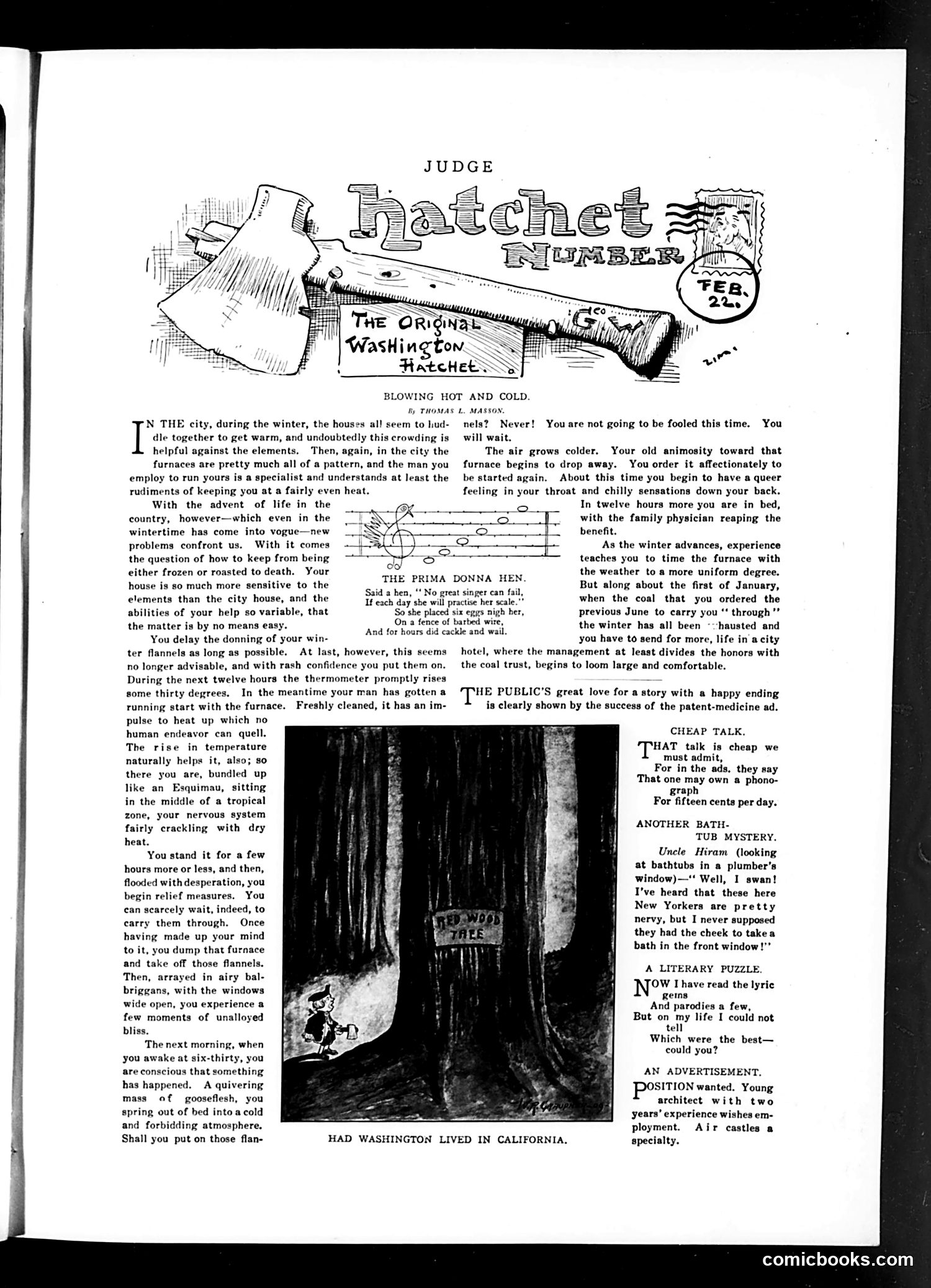
This page features "Judge Hatchet Number" with the subtitle "The Original Washington Hatchet" — a reference to the famous (apocryphal) story of young George Washington confessing to chopping down his father's cherry tree. The main article "Blowing Hot and Cold" by Thomas L. Masson satirizes winter furnace management—a relatable domestic complaint. The humor lies in describing the absurd temperature swings and inefficiency of residential heating systems: the furnace either fails entirely or overheats the house unbearably. The accompanying illustration shows what appears to be an interior scene titled "Had Washington Lived in California," likely mocking the contrast between Washington's legendary frontier hardship and California's milder climate. The page also contains advertisements and humor columns typical of Judge's satirical format.
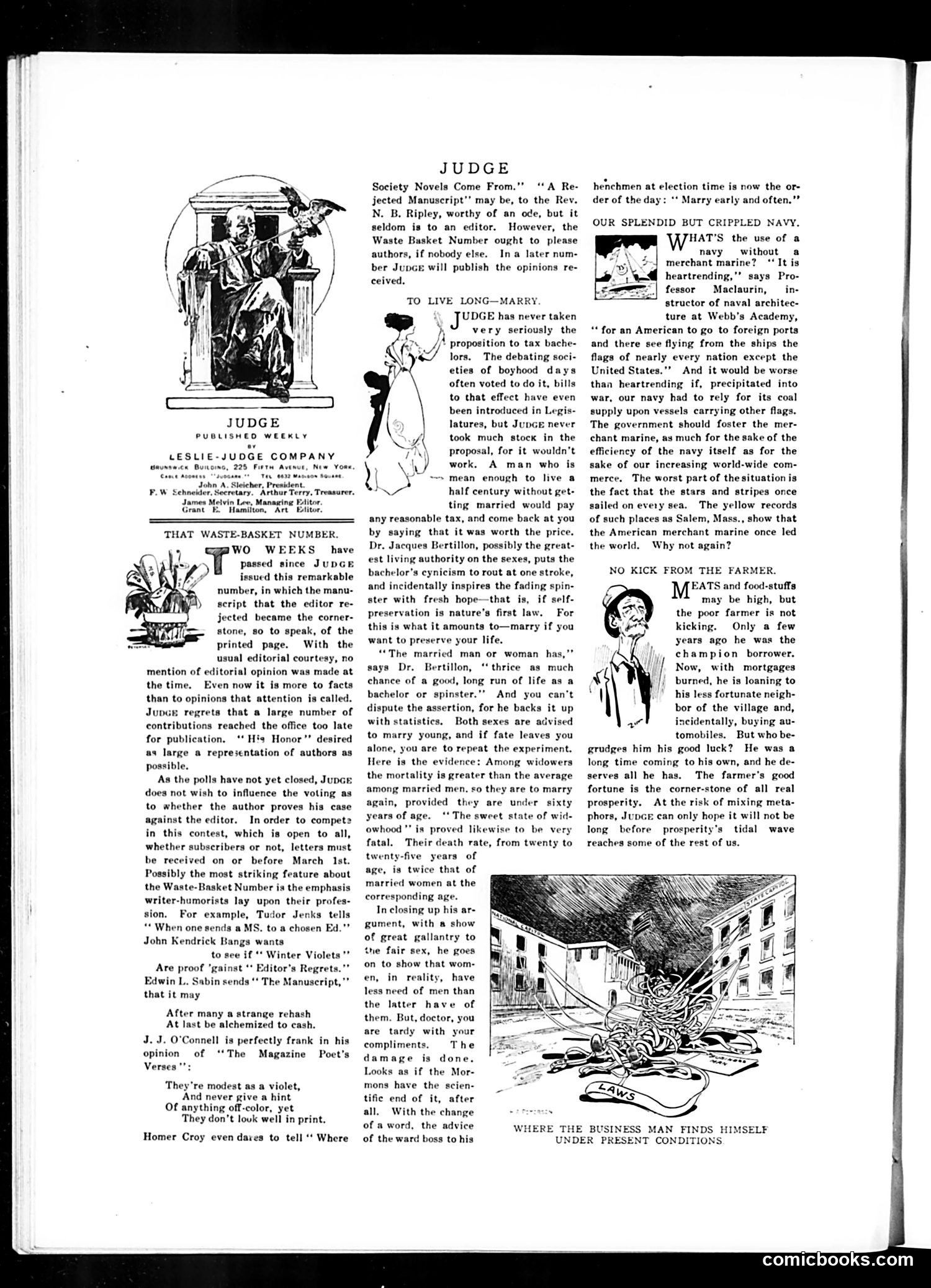
This page contains editorial commentary rather than political cartoons. The main section, titled "JUDGE," discusses a rejected manuscript submission and debates bachelor taxation—a real policy proposal debated in early 20th-century legislatures. The accompanying illustrations are generic: a figure at a desk (representing the editor), a woman in period dress, and a farmer. These aren't caricatures of specific individuals but rather type characters used to illustrate abstract social debates. The content satirizes editorial pretension and presents Dr. Jacques Bertillon's statistics arguing married people live longer than bachelors. The farmer illustration ("No Kick From This Farmer") represents rural skepticism toward such urban intellectual arguments. The page critiques both editorial gatekeeping and pseudoscientific claims used to justify marriage taxation proposals.
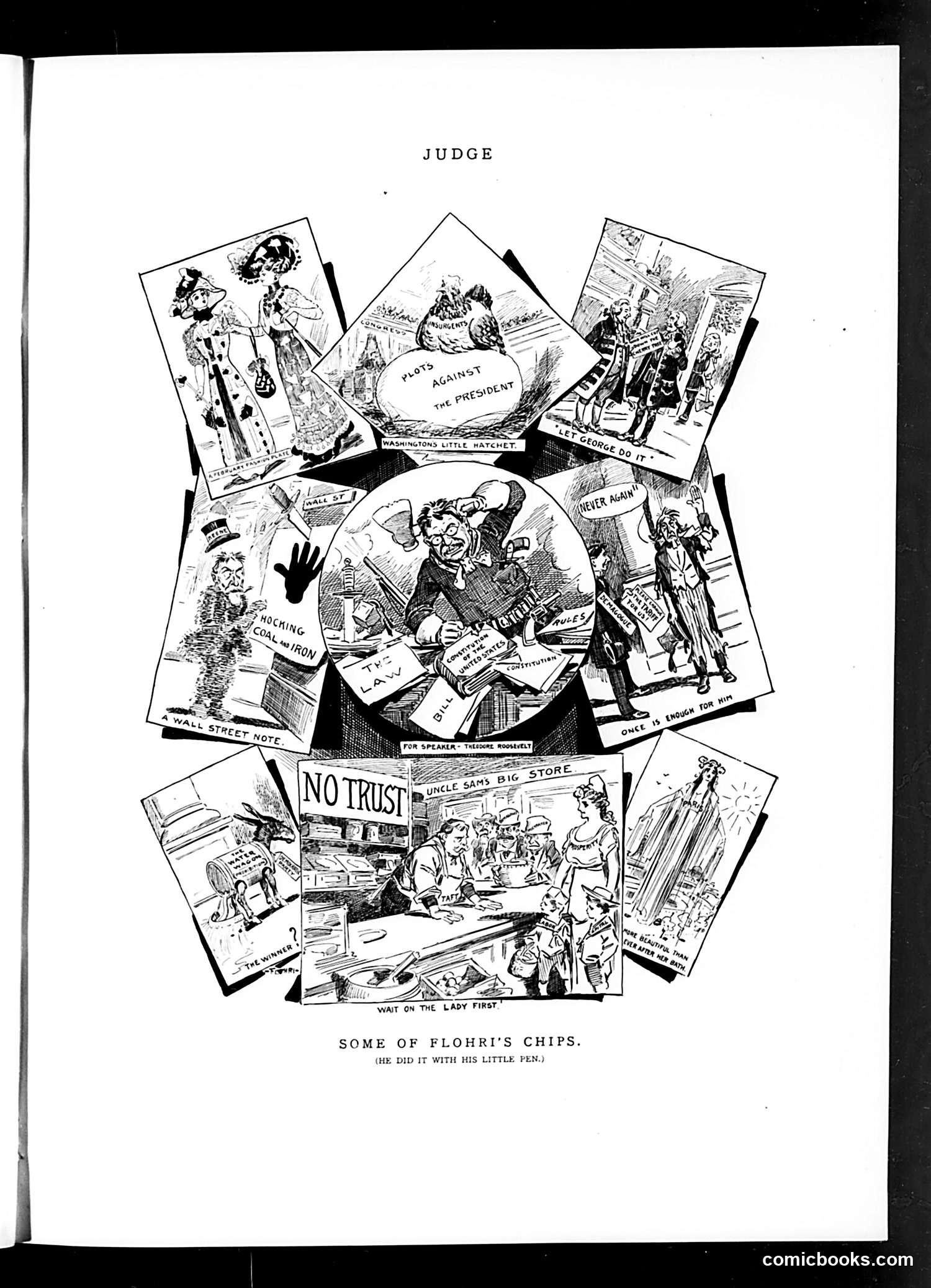
This page collects political cartoons by artist Flohr, arranged around a central caricature of a judge. The surrounding panels satirize various political and social scandals or controversies—likely from the early 20th century based on the style. Key visible references include "Plots Against the President," "Washington's Little Matches" (possibly referencing corruption), "No Trust" (invoking anti-monopoly sentiment), and panels titled "Wall Street Note" and "Wait on the Lady First." The subtitle indicates these are Flohr's commentary pieces—his "chips" or contributions—created with his pen. The arrangement around the judge figure suggests these represent cases or judgments on contemporary political scandals, though specific figures and events require additional historical context to identify precisely.
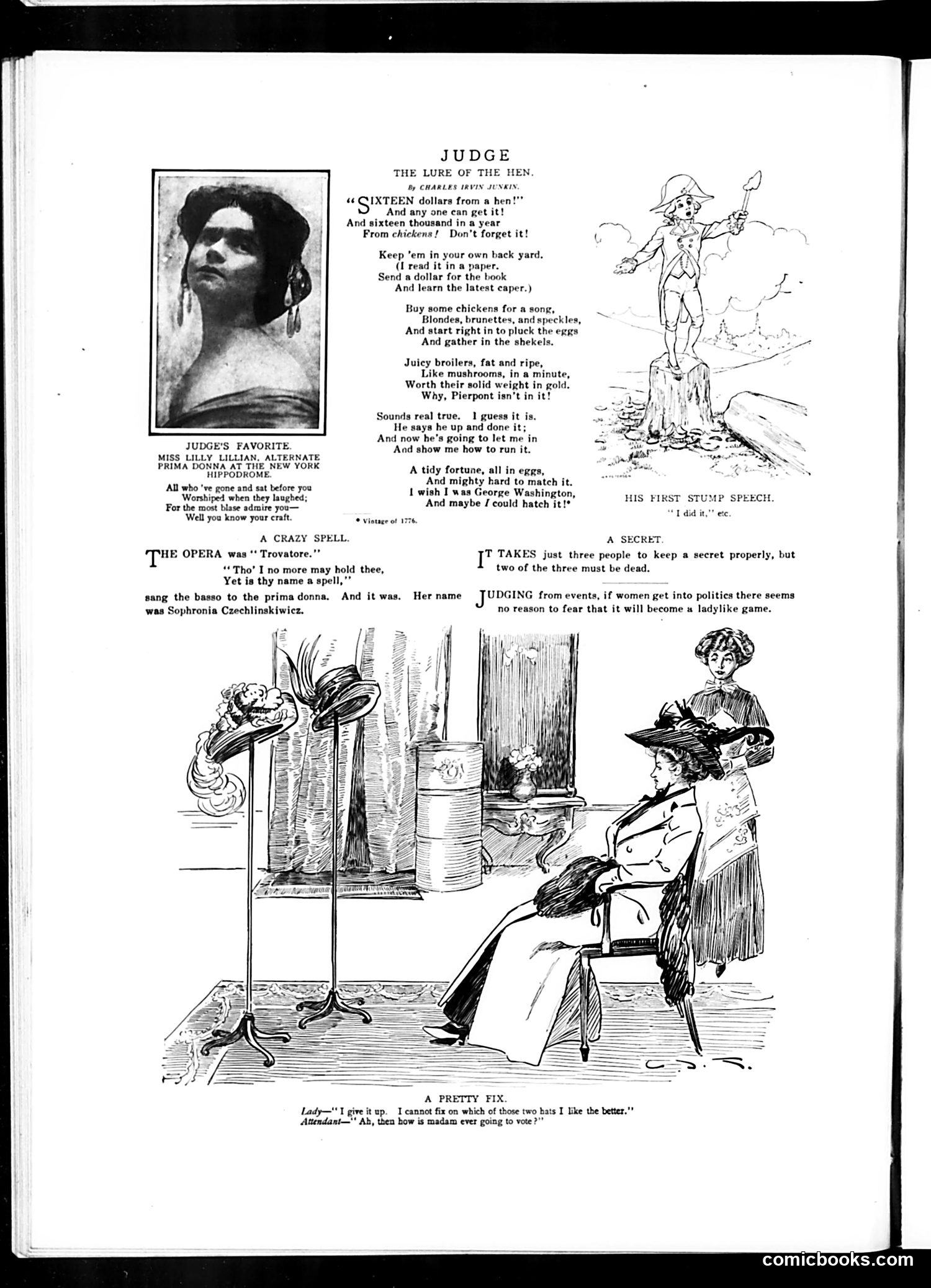
This page contains several satirical pieces typical of early 20th-century Judge magazine: **"The Lure of the Hen"** mocks a get-rich-quick scheme promising farmers $16 daily from backyard chickens. The poem satirizes naive people falling for dubious "how-to" books, comparing fictional egg profits to the wealth of J.P. Morgan (a famous financier). The "Vintage of 1776" reference suggests this scam preys on American optimism. **"A Pretty Fix"** is a political cartoon about women's suffrage. A woman cannot choose between two hats, prompting an attendant to sarcastically ask how she'll vote if she can't decide between hats. This reflects anti-suffrage arguments claiming women were intellectually unfit for voting—a common (and baseless) contemporary criticism. **"A Secret"** and other brief jokes round out the page's humor. The page celebrates actress Lilly Lillian and includes snippets about opera and social observations typical of Judge's mix of entertainment and social commentary.
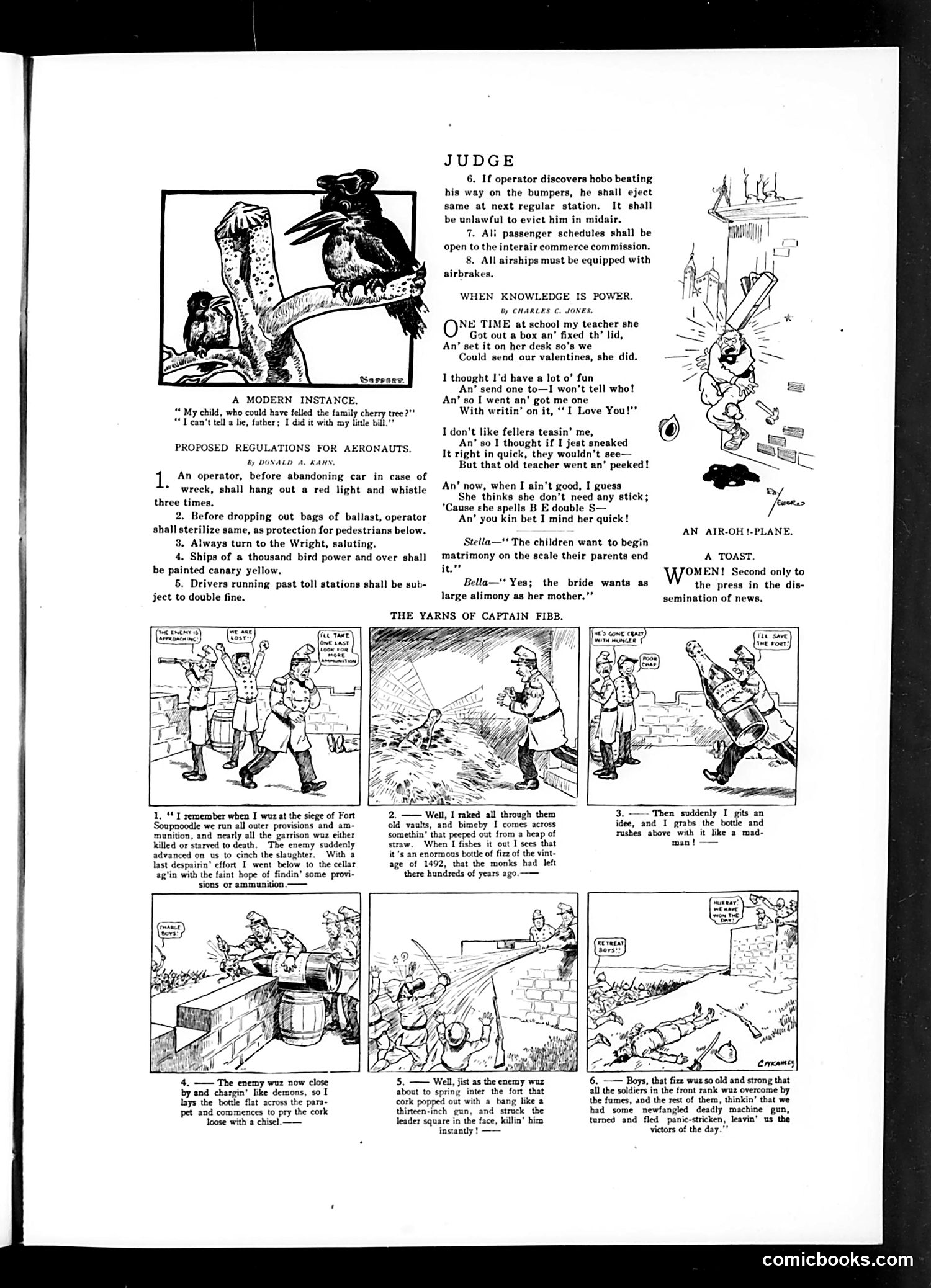
This page contains early 20th-century American satirical humor with three distinct sections: **"A Modern Instance"** parodies the Washington cherry tree legend by having a bird (likely representing aviation/the Wright brothers' innovations) admit to destroying a tree—a joke about aviation's rapid, disruptive emergence. **"Proposed Regulations for Aeronauts"** satirizes bureaucratic overreach by proposing absurd aviation rules (sterilizing ballast, "turning to the Wright," canary-yellow aircraft). The Wright brothers reference is clear; the humor mocks how quickly government attempts to regulate new technology. **"The Yarns of Captain Fibb"** is a tall-tale comic strip showing an impossibly exaggerated military story where an ancient bottle of monk's wine explodes like artillery, defeating enemies through sheer fumes. It's generic comedic bluster with no apparent political target. The page reflects early 1900s preoccupations: aviation's novelty, government regulation anxiety, and traditional American tall-tale humor traditions.
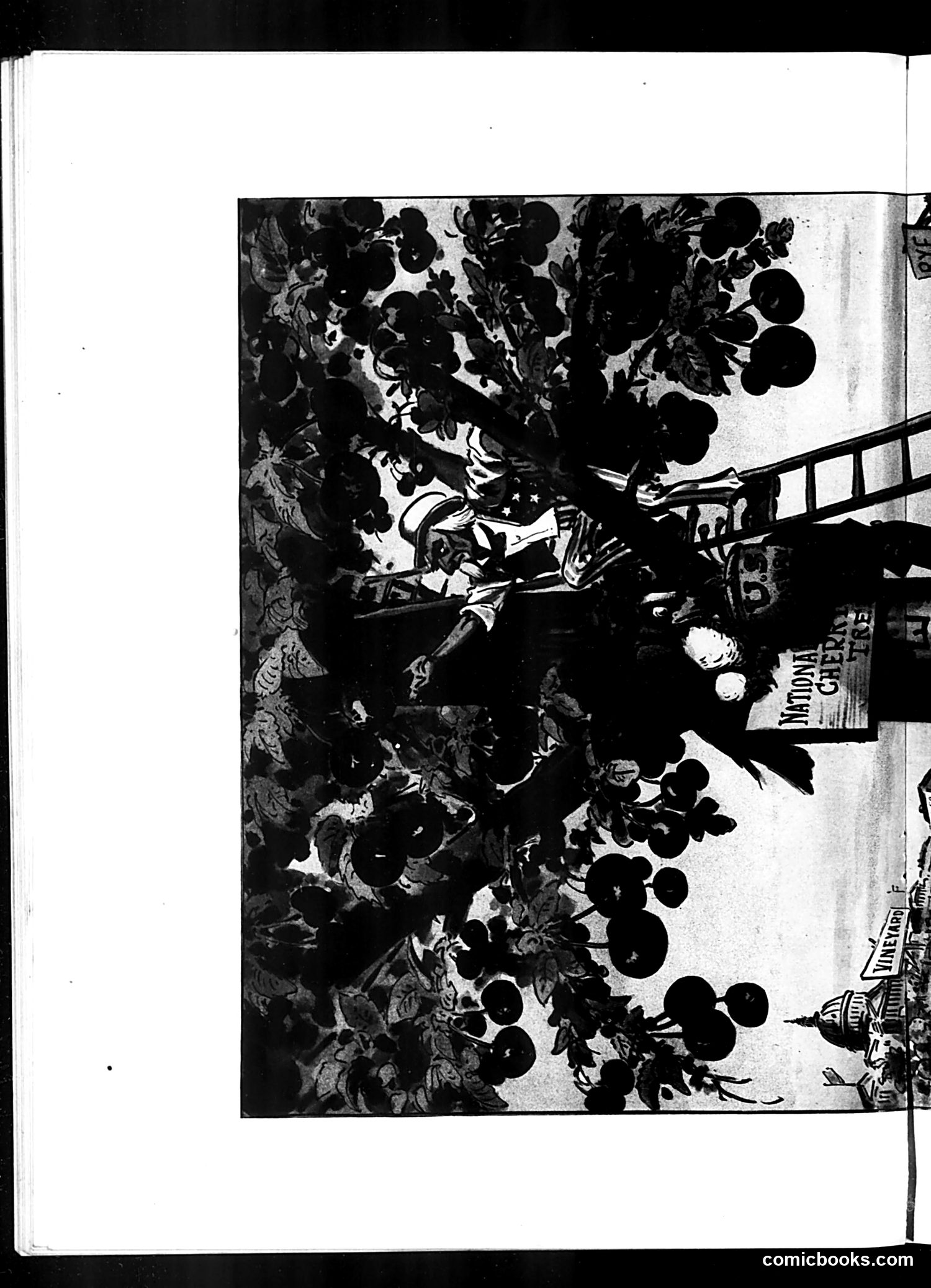
The OCR text is too corrupted to read. However, the black-and-white photograph shows what appears to be a vintage scene (possibly early-to-mid 20th century based on the image quality and style) depicting people gathered around large bunches of grapes or similar round fruit on vines, with a ladder visible. There's a newspaper or publication visible in the lower right. Without legible text, I cannot identify: - Specific political figures or references - The intended satirical message - Historical context or events being mocked - The cartoon's point To provide accurate analysis, I would need either clearer OCR text or additional context about Judge magazine's publication date and the page's caption/headline.
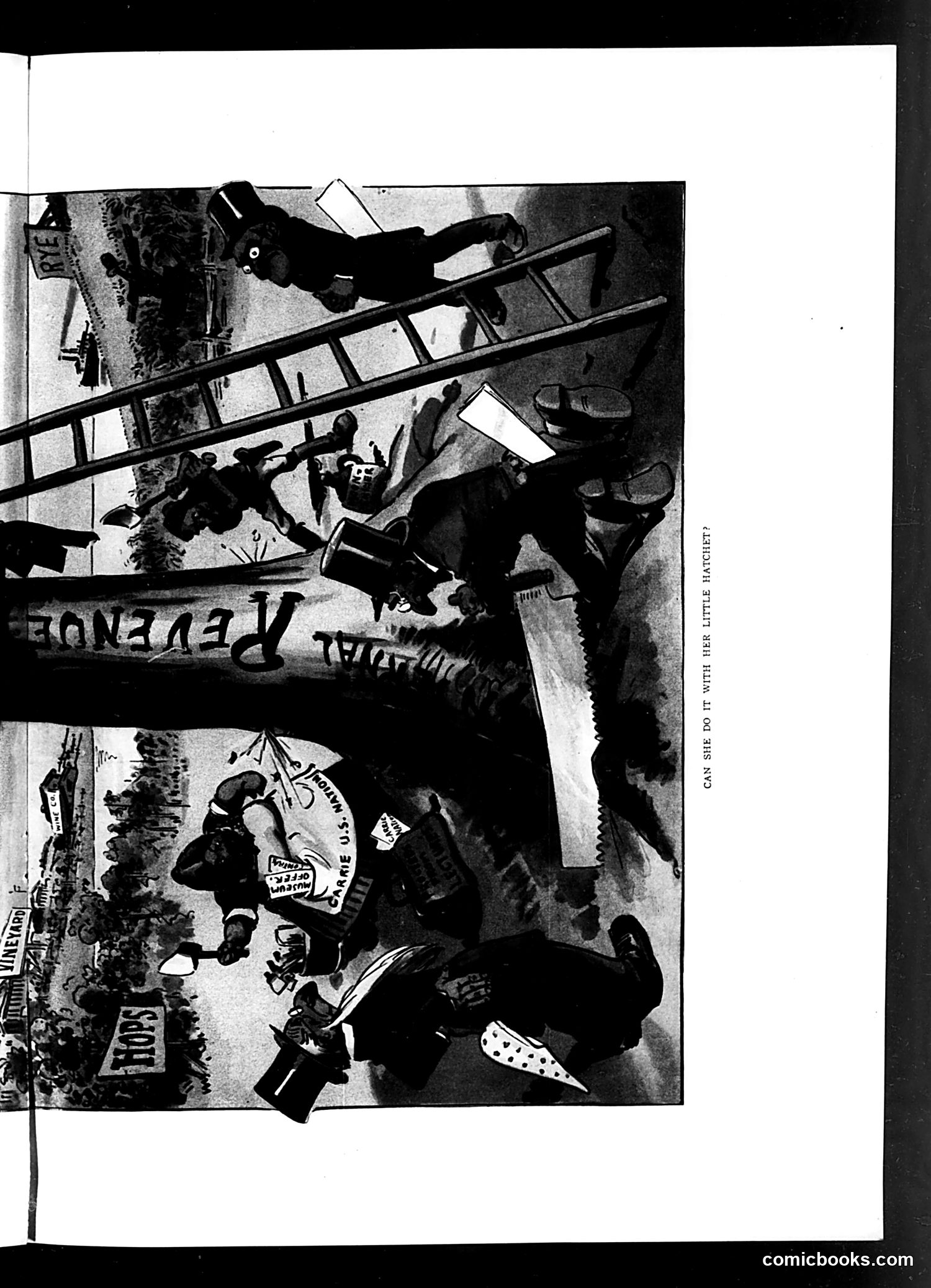
This page appears to be rotated 180 degrees, making it difficult to read clearly. The OCR text is largely corrupted/unreadable ("é1HHOLVH 3TLLIT YAH HLIM LI Od SHS NVD"). The black and white photograph shows what appears to be a scene with multiple people on or near a ladder or inclined surface, with some signage visible but not clearly legible in this image quality. Without readable text to clarify the cartoon's message or identify specific figures, I cannot reliably explain the satire or political/social references intended. To properly analyze this Judge magazine content, the page would need to be correctly oriented and higher resolution for both the image and text to be legible.
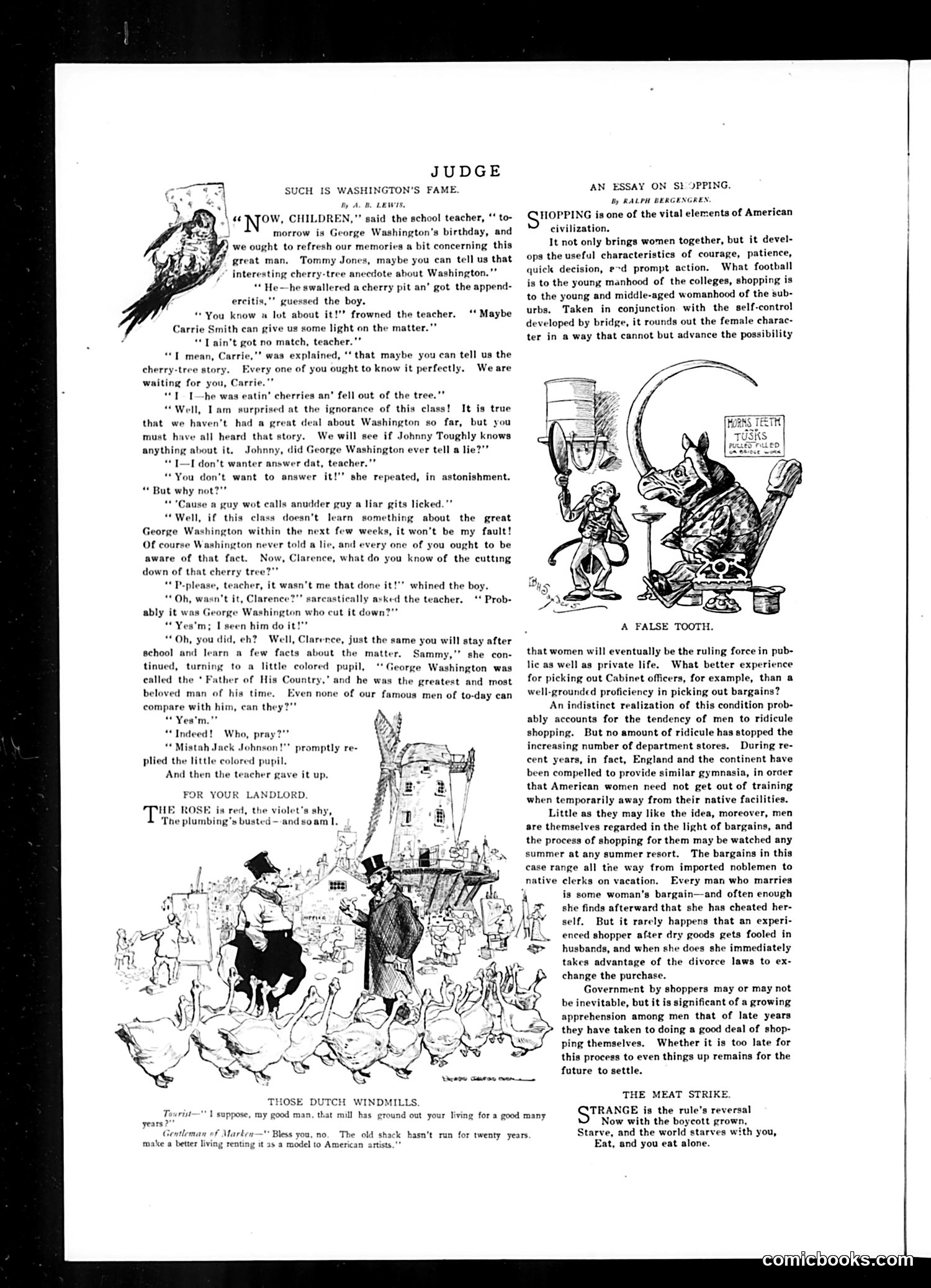
This page from *Judge* contains three satirical pieces: **"Washington's Fame"** (top): A schoolteacher tries to teach children about George Washington's cherry-tree legend (a famous but apocryphal story). The children either don't know it or misremember it absurdly. The joke's punchline: when asked to name someone great like Washington, a Black student answers "Jack Johnson"—the heavyweight boxing champion. This was shocking to the white audience because it equated a Black athlete with the nation's most revered founding father, undercutting American mythology. **"Those Dutch Windmills"** (bottom left): A landlord shows a tenant a dilapidated windmill, claiming it's been unused for twenty years but is "a model to American artists." The satire mocks either slumlords or false nostalgia. **"An Essay on Shopping"** (right): A mock-serious essay argues shopping develops female character like football develops male character, tongue-in-cheek suggesting women might eventually rule public life through their shopping expertise. It's simultaneously praising and gently mocking women's power.
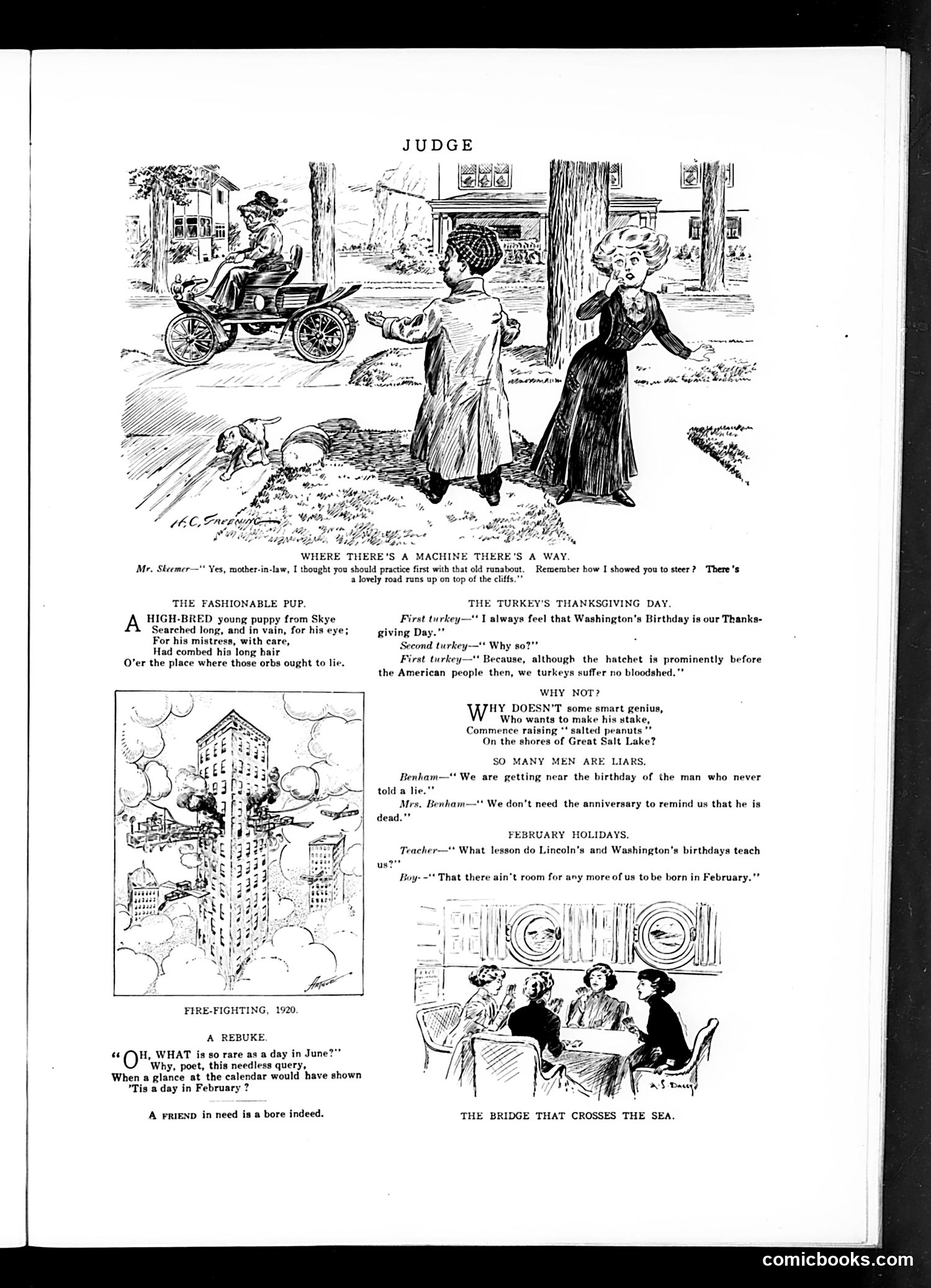
This page contains multiple brief satirical items typical of early-1920s humor: **"Where There's a Machine There's a Way"** depicts a darkly comedic scenario: a man suggests his mother-in-law practice driving on a cliff road—implying he hopes she'll drive off. The joke plays on the then-novel danger of automobiles and stereotypical tension between men and their in-laws. **Other items** include: a limerick mocking fashionable grooming (a Skye terrier's hair combed over its eyes), fire-fighting commentary, and seasonal jokes about Thanksgiving (turkeys noting they're safe on Washington's Birthday since the hatchet is "prominent" but not used on them). The "February Holidays" joke references Washington and Lincoln's birthdays, with a child's quip that there's no room for more February births—dark humor about overpopulation or family size. These represent Judge's style: topical, often morbid humor targeting contemporary society, fashion, and social anxieties, with wordplay and visual gags supporting the text.
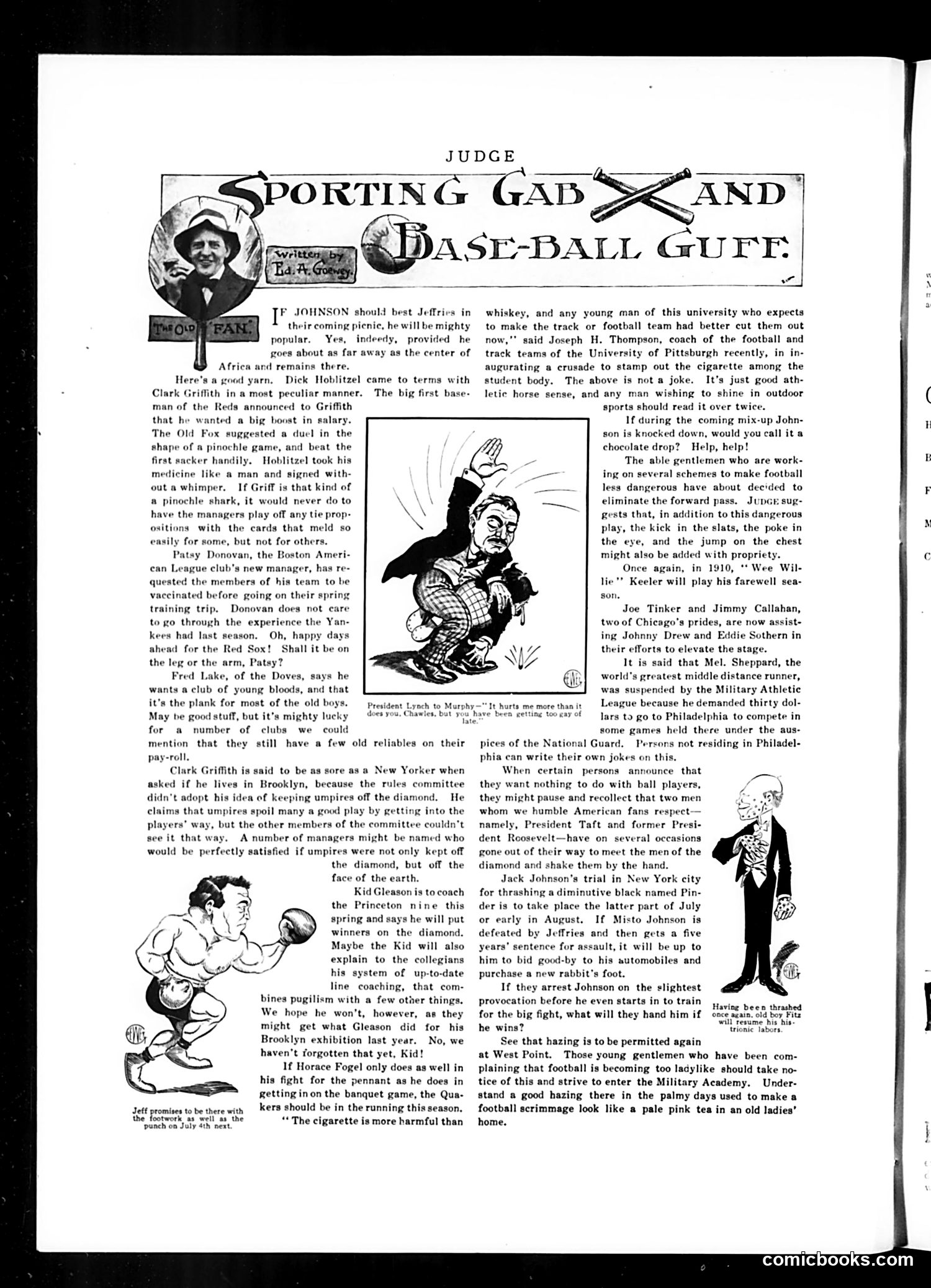
This page satirizes early-1900s sports and athletic culture. Key targets include: **Jack Johnson boxing reference**: The opening mocks Johnson's potential victory over Jeffries, suggesting he'd need to flee to "Africa" to remain popular—reflecting racist attitudes toward the Black boxer's 1910 championship. **Baseball management anecdotes**: Stories about players (Hoblitzel, Gleason) humorously critique managerial tactics and coaching methods. **Athletic health crusades**: A University of Pittsburgh coach's anti-cigarette campaign for athletes is presented as earnest but somewhat absurd—treating smoking as seriously as dangerous football practices (kicking, punching). **Football violence**: The piece mockingly notes that reformers debating eliminating the "forward pass" ignore actual brutality like "the kick in the slats" and "poke in the eye." The cartoons and text work together to gently ridicule the era's sports establishment while reflecting genuine period anxieties about masculinity, violence, and vice among young athletes.
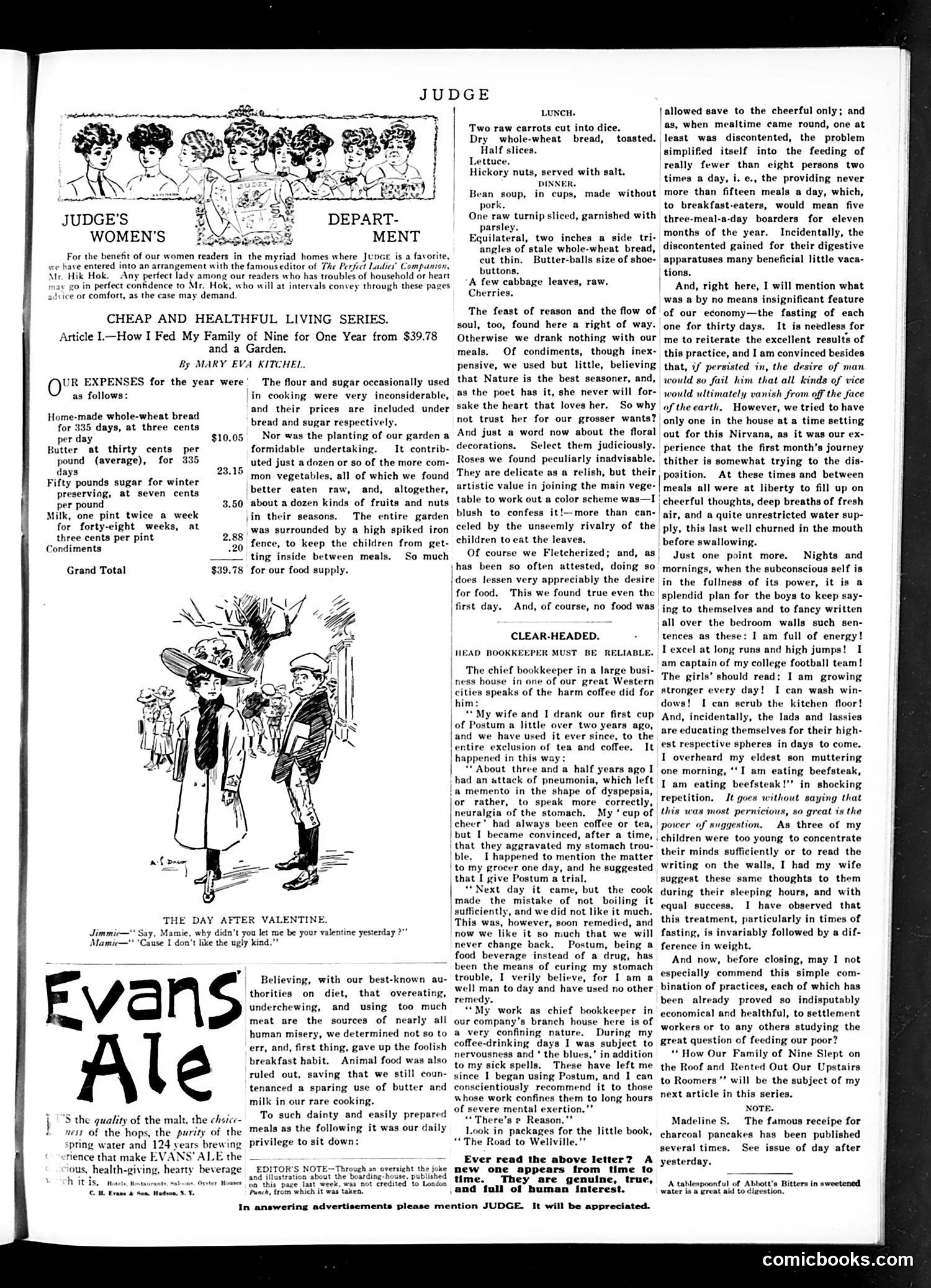
This is primarily a **women's advice and lifestyle section** from Judge magazine, not a political cartoon page. The main content includes: 1. **"Cheap and Healthful Living" article** by Mary Eva Kitchel, detailing how to feed a family of nine for $39.78 annually—listing sparse meals of bread, raw vegetables, and bean soup. This reflects early 1900s domestic economy writing aimed at working-class women. 2. **"The Day After Valentine" cartoon**: A small joke showing a boy (Jimmie) rejected by a girl (Mamie) who calls him "ugly"—typical sentimental humor of the era. 3. **"Clear-Headed" testimonial**: A bookkeeper's endorsement of Postum (a coffee substitute) as a remedy for digestive problems, presented as health advice. The page represents Judge's **women's department**, offering practical household guidance mixed with light romantic humor and advertisements. The satire is gentle—poking fun at courtship and dietary fads rather than addressing serious social issues. The overall tone treats women readers as domestic managers concerned with economy and health.
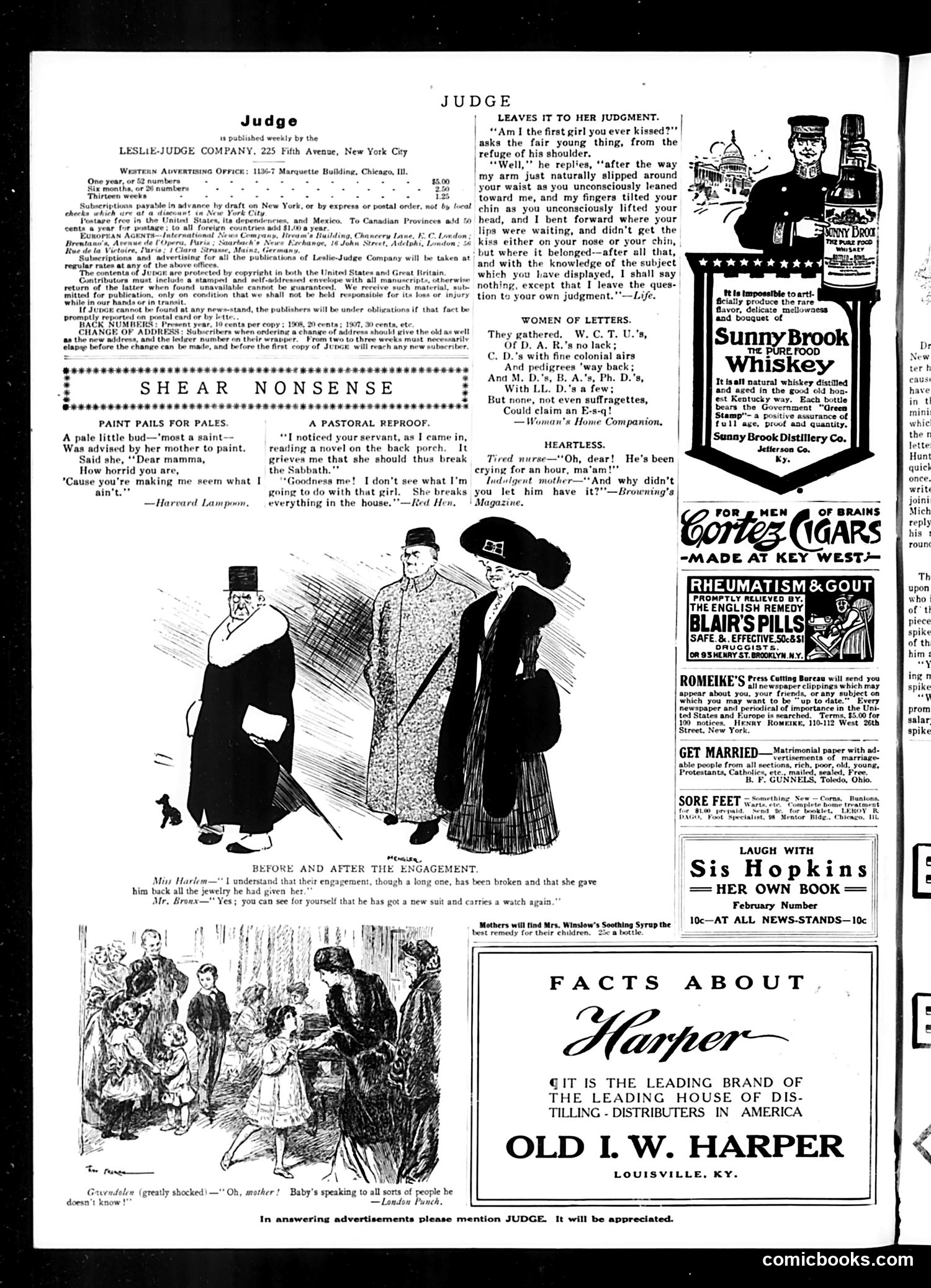
This page from *Judge* magazine contains satirical cartoons and humor pieces typical of early 20th-century American wit: **"Leaves It to Her Judgment"** (top cartoon): A young man deflects a woman's question about whether he's kissed her first by claiming he "leaves it to her judgment"—a playful dodge that mocks male evasiveness in romantic encounters. **"Before and After the Engagement"** (middle cartoon): The joke illustrates an engagement breaking up: the woman returned the jewelry, but the man is now visibly better off materially (new suit, watch). The satire critiques either the man's mercenary nature or suggests women were primarily valued for financial support. **"Shear Nonsense"** section: Brief humorous quips satirizing domestic life and gender relations. **"Women of Letters"** (bottom left): A satirical poem mocking various women's organizations and their pretensions—W.C.T.U., D.A.R., educated women with credentials (M.D., B.A., Ph.D., LL.D.)—depicting them as self-important or socially ridiculous. The rest consists primarily of advertisements for period products (whiskey, patent medicines, newspapers).
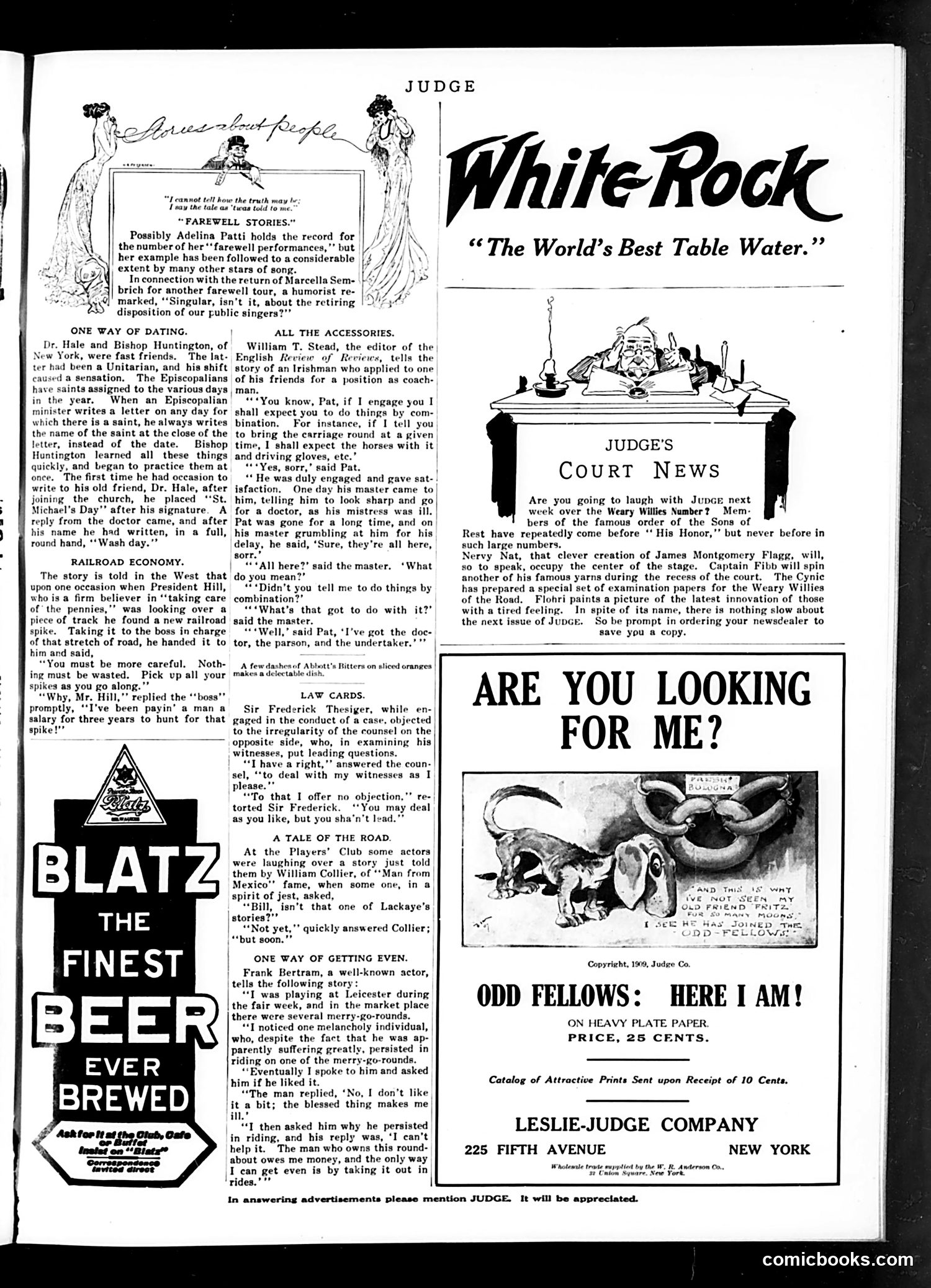
This page is primarily **anecdotal humor and advertisements** rather than political satire. The content consists of several brief comedic stories targeting show business and professional life: **Main Content:** - **"Farewell Stories"**: Mocks opera singers (particularly Adelina Patti) for repeatedly announcing "farewell performances" then returning - **Dating anecdote**: Jokes about Episcopal Church naming saints instead of dates; Dr. Hale humorously responds "Wash day" - **Railroad economy**: President Hill obsesses over a lost spike; his employee takes "do things by combination" literally, bringing doctor, parson, *and* undertaker when asked for a doctor - **Law cards & actor anecdotes**: Brief professional humor about lawyers and theater performers **Advertisements:** Blatz Beer, White Rock water, and Leslie-Judge Company's "Odd Fellows" print catalog dominate the right side. The satire targets **human absurdity and miscommunication** rather than specific political figures or events. No identifiable public figures appear beyond the named anecdote subjects.
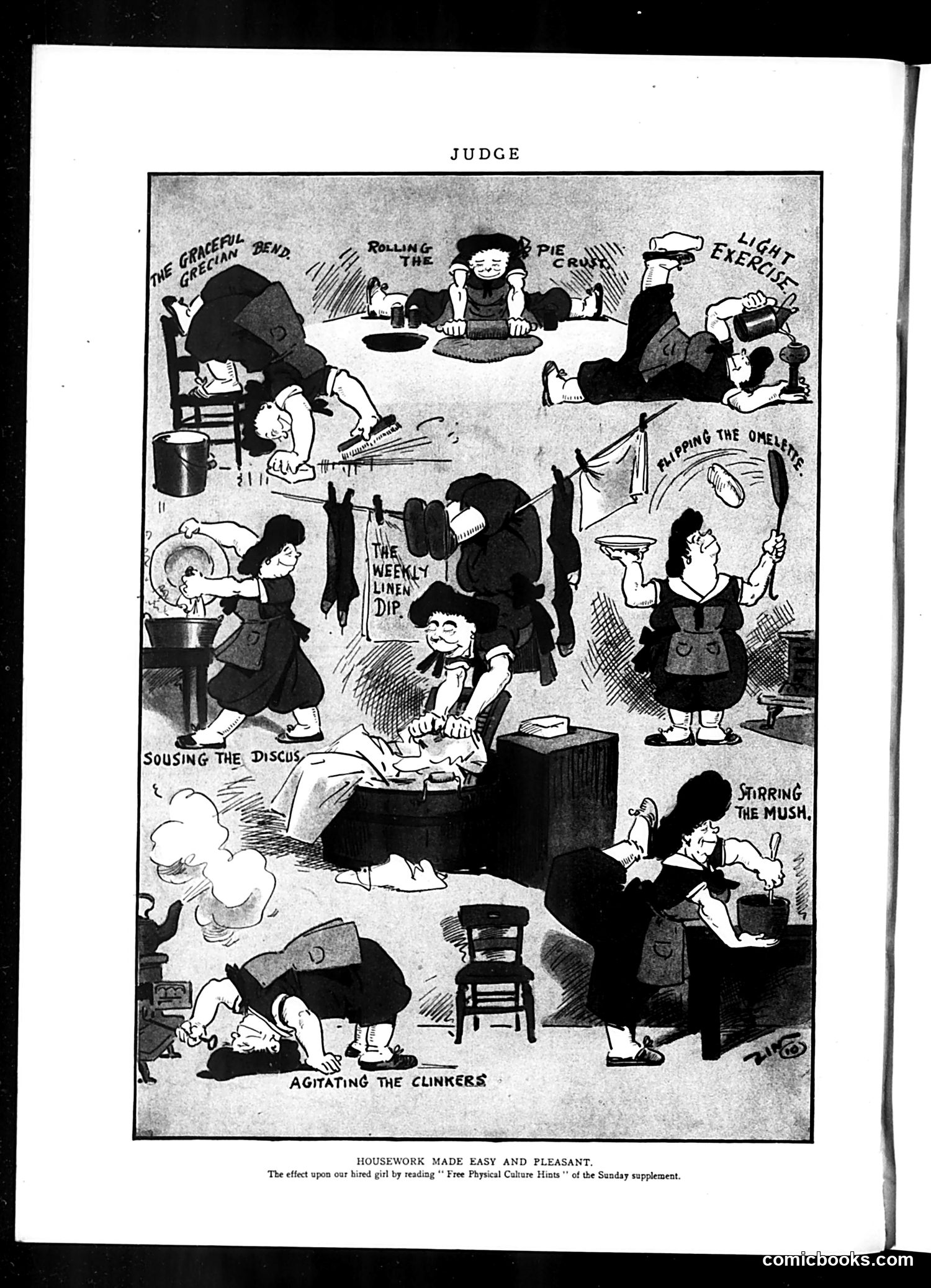
This cartoon satirizes the gap between advertising promises and domestic reality. The page title "Housework Made Easy and Pleasant" is ironic—it shows a maid performing various exhausting household tasks with exaggerated, chaotic energy. The caption reveals the joke: the maid has supposedly read "Free Physical Culture Hints" from a Sunday newspaper supplement and is now performing her chores as vigorous physical exercise. Activities like "sousing the discus" (washing dishes), "rolling the...pie," "light exercise" (cleaning), "flipping the omelette," and "stirring the mush" are labeled as if they're gym movements. The satire mocks both the era's "physical culture" movement (an early fitness craze) and misleading advertisements promising to make drudgery enjoyable. The exhausted maid demonstrates that no amount of reframing can actually make tedious housework pleasant or "easy."