
Judge, 1910-02-19 · page 4 of 16
Judge — February 19, 1910 — page 4: what you’re looking at
What you’re looking at
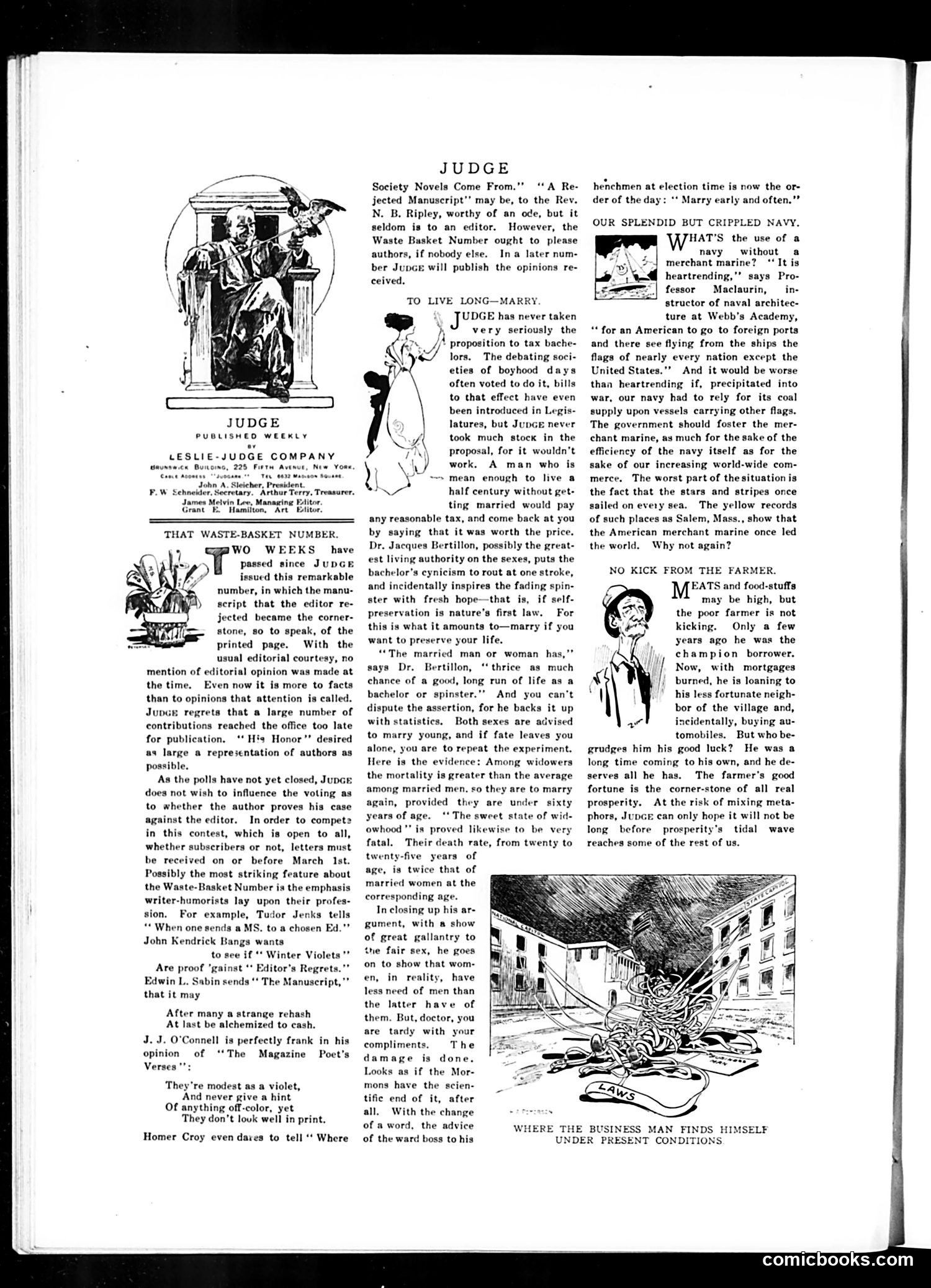
This page contains editorial commentary rather than political cartoons. The main section, titled "JUDGE," discusses a rejected manuscript submission and debates bachelor taxation—a real policy proposal debated in early 20th-century legislatures. The accompanying illustrations are generic: a figure at a desk (representing the editor), a woman in period dress, and a farmer. These aren't caricatures of specific individuals but rather type characters used to illustrate abstract social debates. The content satirizes editorial pretension and presents Dr. Jacques Bertillon's statistics arguing married people live longer than bachelors. The farmer illustration ("No Kick From This Farmer") represents rural skepticism toward such urban intellectual arguments. The page critiques both editorial gatekeeping and pseudoscientific claims used to justify marriage taxation proposals.
📄 Transcribed text from this page (OCR, searchable)
Machine-transcribed from the original scan — historical spelling and the odd misread are preserved.
JUDGE PUBLISHED WEEKLY LESLIE-JUDGE COMPANY ex Bunome, 225 Furtm Avenue, New Yous. John A. Sleicher, President. FW Sehneider, Secretary. Arthur Terry, Treasurer. James Melvin Lee, Managing F/litor. Grant Hamilton, Art Eslitor. THAT WASTE-BASKET NUMBER. WO WEEKS shave passed since JUDGE issued this remarkable number, in which the manu- script that the editor re- jected became the corner- stone, so to speak, of the printed page. With the usual editorial courtesy, no mention of editorial opinion was made at the time. Even now it is more to facts than to opinions that attention is called. Jupce regrets that a large number of contributions reached the office too late for publication. ‘* His Honor’ desired as large a representation of authors as possible, As the polls have not yet closed, Jupce does not wish to influence the voting a: to whether the author proves his case against the editor. In order to compet? in this contest, which is open to all, whether subscribers or not, letters must be received on or before March 1st. Possibly the most striking feature about the Waste-Basket Number is the emphasis writer-humorists lay upon their profes- sion. For example, Tudor Jenks tells ** When one sends a MS. to a chosen Ex John Kendrick Bangs wants to see if ‘* Winter Violet: Are proof ‘gainst ‘* Editor's Regrets Edwin L. Sabin sends ‘* The Manuscript, that it may After many a strange rehash At last be alchemized to cash. J.J. O'Connell is perfectly frank in his opinion of ‘*The Magazine Poet's Verses": They're modest as a violet, And never give a hint Of anything off-color, yet They don’t louk well in print. Homer Croy even daxes to tell “‘ Where JUDGE Society Novels Come From."" “A Re- jected Manuscript’ may be, to the N. B. Ripley, worthy of an ode, but it seldom is to an editor. However, the Waste Busket Number ought to please authors, if nobody else. In a later num- ber Jupce will publish the opinions re- ceived. TO LIVE LONG—MARRY UDGE has never taken },Y% very seriously the hi * proposition to tax bache- lors. The debating soci- eties of boyhood days often voted to do it, bills to that effect have even been introduced in Legis- latures, but JupGe never took much stock in the proposal, for it wouldn’t work, A man who is “> mean enough to live a half century without get- ting married would pay any reasonable tax, and come back at you by saying that it was worth the price, Dr. Jacques Bertillon, possibly the great- est living authority on the sexes, puts the bachelor’s cynicism to rout at one stroke, and incidentally inspires the fading ster with fresh hope—that i preservation is nature’s first law. this is what it amounts to—marry if you want to preserve your life. “The married man or woman has,’ says Dr. Bertillon, ‘‘ thrice as much chance of a good, long run of life as a bachelor or spinster."’ And you can’t dispute the assertion, for he backs it up with statistics, Both sexes are advised to marry young, and if fate leaves you alone, you are to repeat the experiment. Here is the evidence: Among widowers the mortality is greater than the average among married men. so they are to marry again, provided they are under sixty years of age. ‘* The sweet state of wid- owhood " is proved i fatal. Their death rate, from twenty to twenty-five years of age, is twice that of married women at the corresponding age. In closing up his ar- gument, with a show of great gallantry to tne fair sex, he goes on to show that wom- en, in reality, have less need of men than the latter have of them. But, doctor, you are tardy with your compliments. The damage is done. Looks as if the Mor- mons have the scien- tifie end of it, after all, With the change of a word, the advice of the ward boss to his eto be very henchmen at election time is now the or- der of the day: ** Marry early and often.”” OUR SPLENDID BUT CRIPPLED NAVY. HAT’S the use of a navy without a merchant marine? ‘It is heartrendin says Pro- fessor Maclaurin, — in- structor of naval architec- ture at Webb's Academy, “for an American to go to foreign ports and there see flying from the ships the flags of nearly every nation except the United States."’ And it would be worse than heartrending if, precipitated into war, our navy had to rely for its coal supply upon vessels carrying other flags. The government should foster the mer- chant marine, as much for the sake of the efficiency of the navy itself as for the sake of our increasing world-wide com- merce, The worst part of the situation is the fact that the stars and stripes once sailed on every sea. The yellow records of such places as Salem, Mass., show that the American merchant marine once led the world. Why not again? NO KICK FROM THE FARMER. TS and food-stuffs may be high, but the poor farmer is not kicking. Only a few years ago he was the champion borrower. Now, with mortgages burned, he is loaning to his less fortunate neigh- bor of the village and, incidentally, buying au- tomobiles. But who be- grudges him his good luck? He was a long time coming to his own, and he de- serves all he has. The farmer's good fortune is the corner-stone of all real prosperity. At the risk of mixing meta- phors, Jupce can only hope it will not be long before prosperity’s tidal wave reaches some of the rest of us. WHERE THE BUSINESS MAN FINDS HIMSELF UNDER PRESENT CONDITIONS comicbooks.com